This post may contain affiliate links. If you make a purchase through these links, we may earn a commission at no additional cost to you.
That sliver of outdoor space off your apartment door? It’s probably collecting dust, a forgotten mop, maybe a sad folding chair you haven’t opened since last summer.
Most people write off a narrow balcony as useless — too skinny for real furniture, too exposed for comfort, too small to bother decorating.
They’re wrong.
A balcony that measures three feet wide and ten feet long holds more potential than most living room corners. The trick is working with the shape instead of fighting it, choosing pieces that respect the corridor-like footprint, and building upward rather than outward.
These 11 narrow balcony ideas prove that limited width never has to mean limited style. Every one of them turns a tight outdoor strip into a space you’ll actually want to spend time in.
The Bistro Corner That Feels Like a Parisian Café
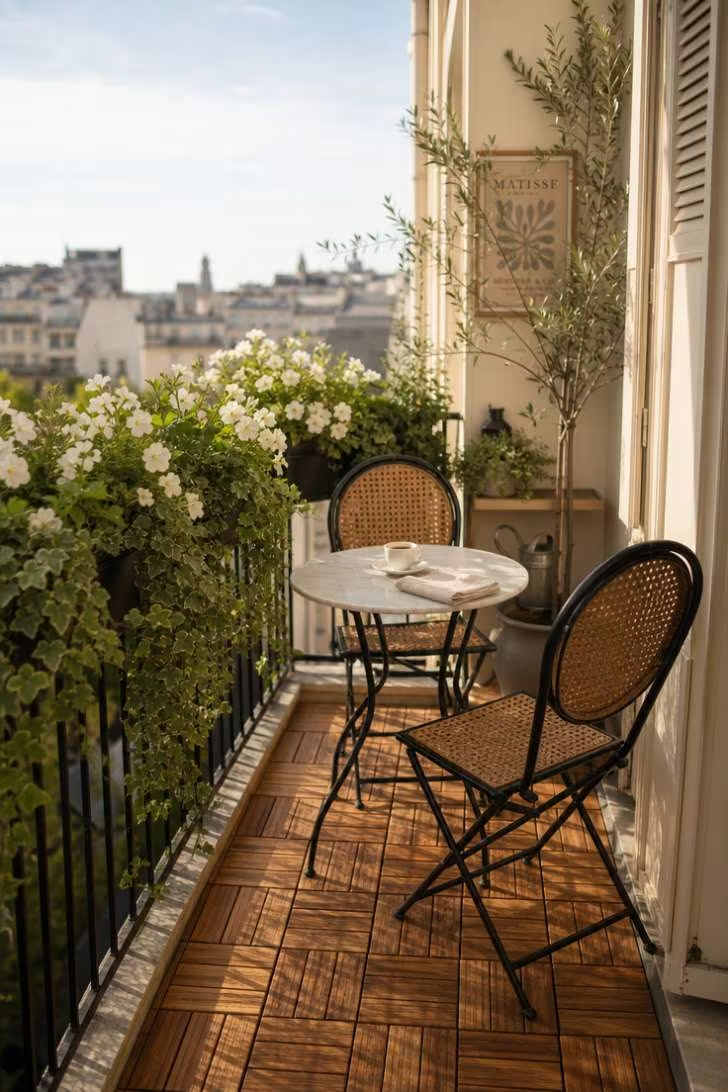
There’s a reason Parisian apartment balconies show up on every mood board: they do more with less than any other outdoor setup on earth.
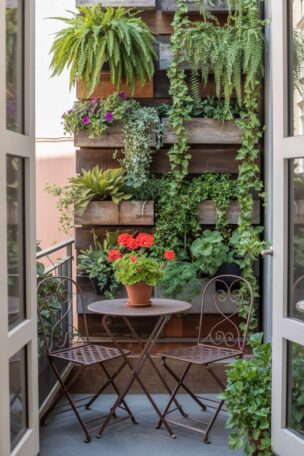
A round bistro table — 24 inches across, no more — tucks into the far end of your narrow balcony without blocking the walkway back to the door.
The key is the chair depth. Standard patio chairs eat 22 to 24 inches of space, which leaves you pressed against the railing on a 36-inch-wide balcony. Folding café chairs with woven seats measure closer to 16 inches deep when occupied, giving you room to slide past even when both seats are pulled out.
Position the table against the end wall rather than the side wall so you look outward through the railing when seated. That orientation creates a destination — you walk the length of the balcony to reach your spot, and the journey itself makes the space feel larger than its square footage suggests.
Round tables work better than square ones here because corners jut into the walkway. A circle lets you angle your knees in any direction.
Morning light hits differently when you’re sitting outside with coffee rather than watching it through glass. Something about the temperature on your skin, the street noise below, the steam curling off the cup — it recalibrates the whole morning.
Design Pro-Tip: Measure your balcony width, subtract 14 inches for a comfortable walking lane, and shop for chairs whose depth fits whatever remains. That one calculation prevents every furniture mistake.
Style Blueprint:
- Round bistro table under 24 inches in diameter
- Two folding café chairs with sub-18-inch depth
- Railing planters with trailing greenery
- Snap-together acacia wood deck tiles
- One weatherproof outdoor cushion per chair
A Living Wall That Breathes Life Into Bare Concrete
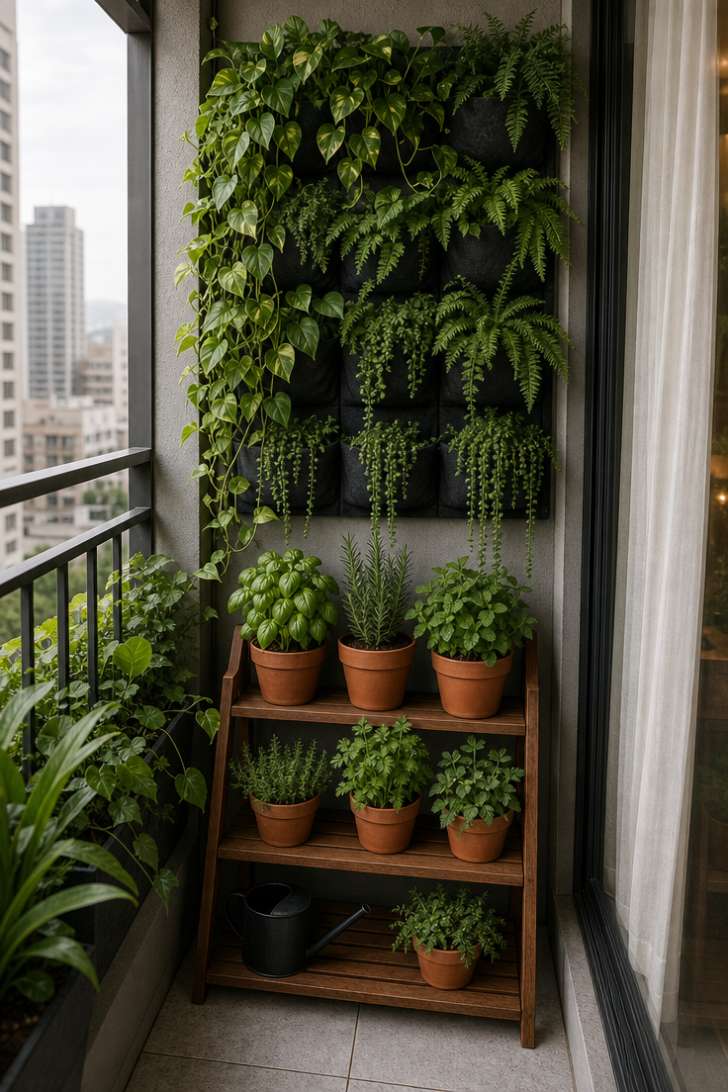
Blank walls on a narrow balcony are wasted real estate.
A vertical garden turns that flat surface into the most visually rich part of your entire apartment — and it takes up exactly zero floor space.
Felt pocket planters mount directly to the wall with screws or heavy-duty adhesive strips (renter-friendly versions exist). Each pocket holds a four-inch nursery pot, so you can swap plants seasonally without replanting.
The layering matters. Place trailing plants like pothos and string of pearls in the upper pockets so they cascade downward. Tuck compact ferns and peperomia in the middle rows. Reserve the bottom pockets for herbs you’ll actually snip for cooking — basil, mint, rosemary.
Watering is the only real maintenance challenge with vertical systems. Water runs downward through all the pockets, so the top row dries out fastest. A small watering can with a narrow spout gives you control. Some people install a simple drip line connected to a timer, but hand watering twice a week works for most setups.
The psychological effect is worth mentioning. Walking onto a balcony surrounded by green, living things produces a measurable drop in cortisol levels — your body reads the greenery as “safe, natural environment” even ten stories above a parking lot. That response happens fast, within a few minutes of sitting among the plants.
Style Blueprint:
- Felt or fabric wall-mounted pocket planter system (at least 12 pockets)
- Trailing plants for upper rows (pothos, string of pearls)
- Compact foliage plants for middle rows (ferns, peperomia)
- Herbs for bottom rows (basil, mint, rosemary)
- Narrow-spout watering can
The Hanging Chair That Floats Above It All
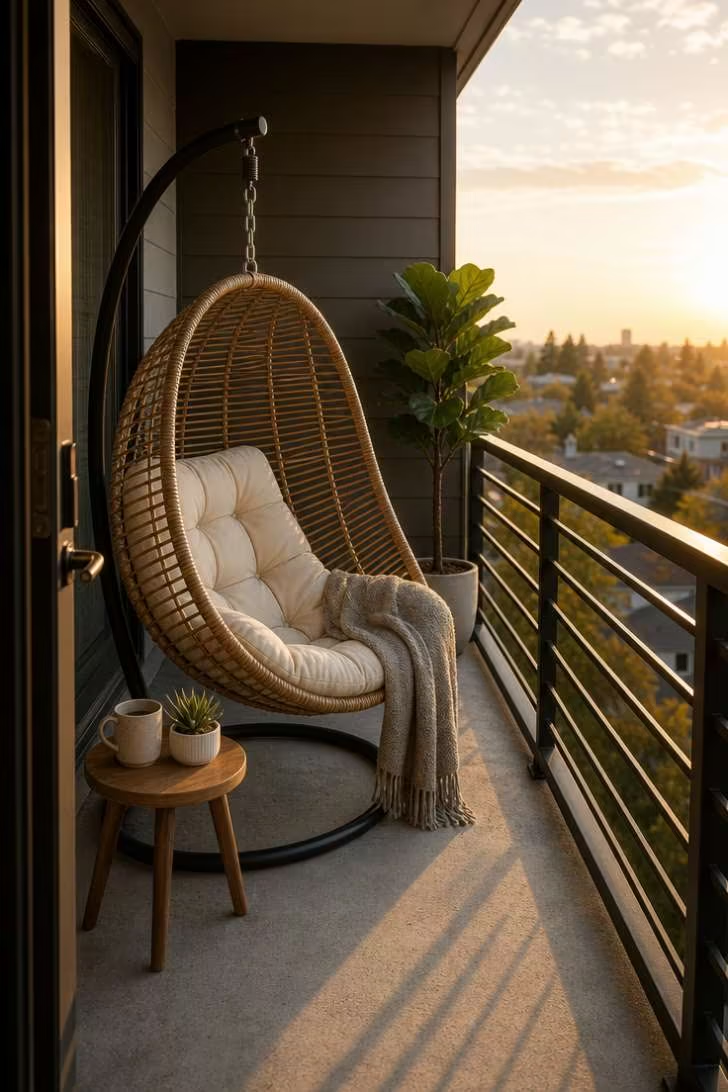
A hanging chair changes the geometry of a narrow balcony completely.
Traditional seating pushes against the floor — four legs, a flat base, a rigid footprint that can’t be moved aside quickly. A hanging chair lifts the seat off the ground, and the single attachment point means you can swing it gently out of the walkway when you need to pass.
Freestanding stands (no ceiling mount required) work for renters. The stand’s base footprint is roughly 40 by 40 inches, which fits a balcony that’s at least four feet wide. If yours is narrower, a ceiling-mounted macramé swing chair with a lower profile might work better, though you’ll need landlord approval for the hardware.
The egg shape matters for narrow spaces. Its curved back wraps around you, creating a cozy enclosure that blocks peripheral visual noise from neighboring buildings. You sit inside a little cocoon with your book and your coffee and the railing view, and the city falls away.
Pair it with the smallest side table you can find — 12 inches across is plenty for a mug and a phone. Anything bigger defeats the purpose of the floating chair’s minimal footprint.
Design Pro-Tip: Before buying a hanging chair stand, measure the diagonal of your balcony, not just the width. The stand’s base sits at an angle to the walls, so you need the corner-to-corner measurement to confirm it fits.
Style Blueprint:
- Rattan or wicker hanging egg chair with cushion
- Freestanding steel stand (or ceiling mount with approval)
- Small round side table, 12 inches maximum diameter
- Soft throw blanket for cooler evenings
- One statement plant in the far corner (fiddle leaf fig or bird of paradise)
A Zen Retreat Stripped Down to What Matters
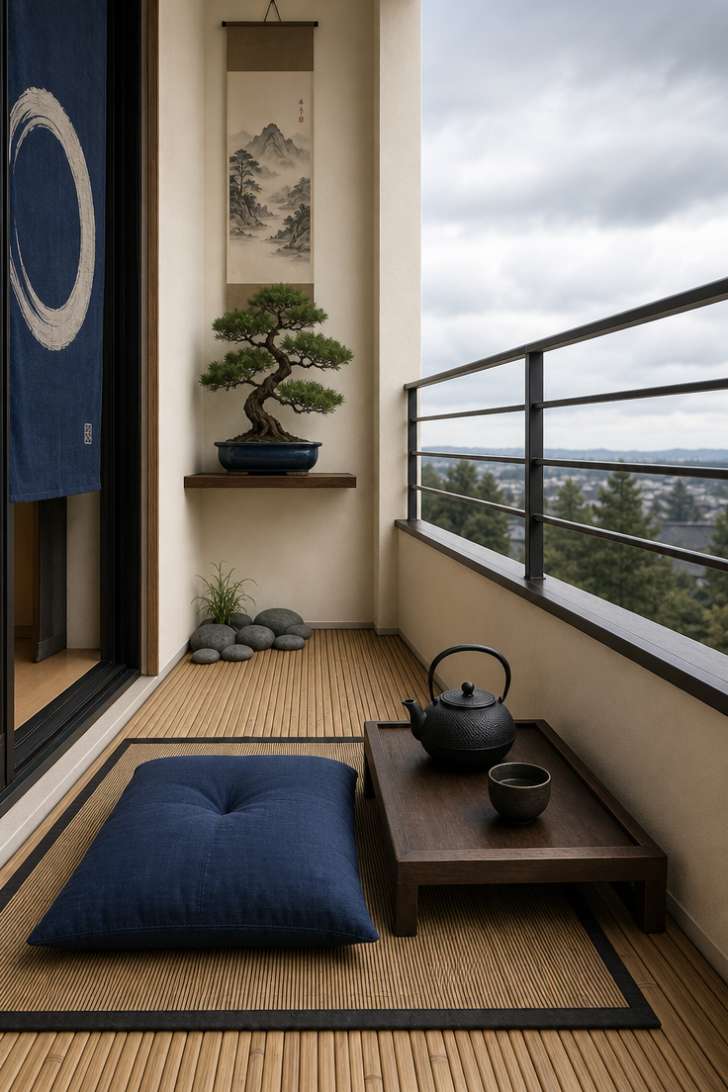
Most narrow balcony design advice tells you to add more — more furniture, more plants, more accessories.
This idea goes the opposite direction.
A single floor cushion. A low tray table. One plant. That’s it.
The Japanese concept of ma — negative space as a design element, not an empty gap — works perfectly on a narrow balcony because the shape already provides the constraint. You’re not leaving space empty because you ran out of ideas. You’re leaving it empty because the emptiness itself creates calm.
A bamboo mat or narrow bamboo deck tiles cover the concrete floor and warm the surface for sitting. The tray table sits only six inches off the ground, so your sight line from the cushion goes straight through the railing to the sky. No chair back blocks the view, no table edge interrupts the horizon.
Choose one plant with sculptural form rather than lush volume. A juniper bonsai, a single stem of lucky bamboo in water, or a compact Japanese maple in a shallow ceramic pot — each one becomes the visual anchor of the space because nothing else competes for attention.
The sensory experience on a stripped-down balcony is different from a decorated one. You notice the temperature more. You hear the wind. Your eyes rest on the sky instead of scanning objects. For anyone living in visual overstimulation — screens, notifications, cluttered interiors — that emptiness feels like relief.
Style Blueprint:
- Large floor cushion in a solid muted tone (indigo, charcoal, sage)
- Bamboo mat or bamboo deck tiles
- Low wooden tray table (under 8 inches tall)
- One sculptural plant (bonsai, Japanese maple, lucky bamboo)
- Smooth river stones as a decorative accent
An Edible Garden Packed With Herbs and Greens
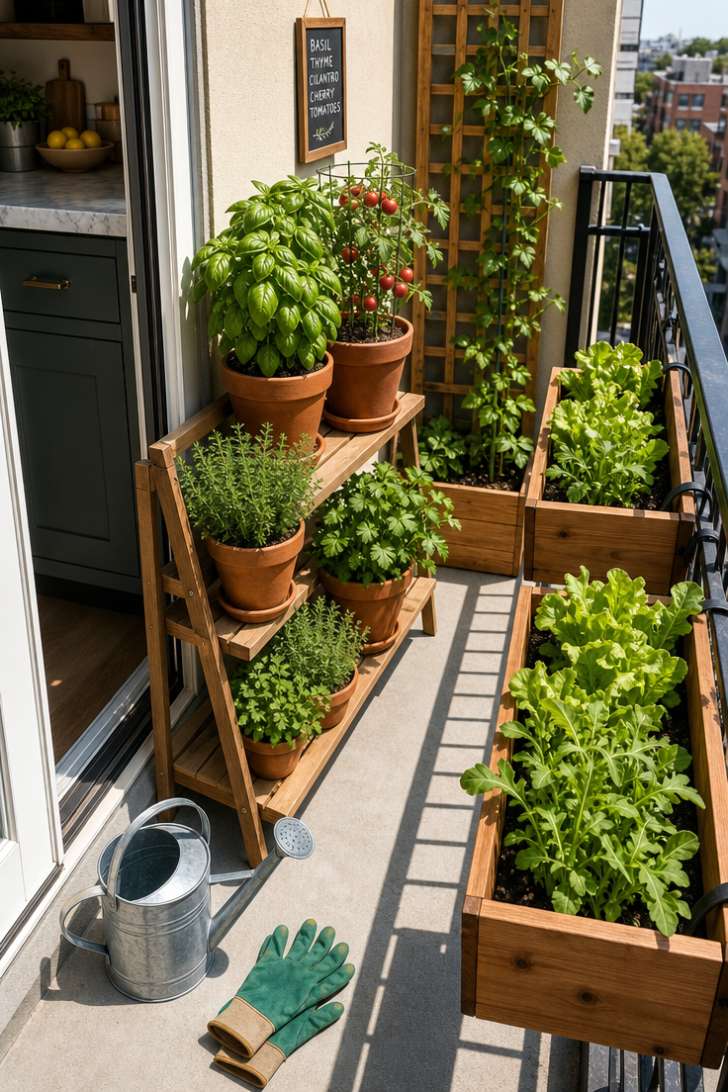
Growing food on a narrow balcony is one of the most practical things you can do with the space.
Herbs are the obvious starting point. Basil, mint, rosemary, thyme, and cilantro grow well in containers as small as six inches across, and they actually prefer the warmth that radiates off sun-heated apartment walls. A south-facing balcony in a warm climate can produce herbs year-round.
Tiered plant stands solve the width problem. A three-tier stand measures about 10 inches deep at the base and holds six to nine pots on a single wall, using vertical space the way a bookshelf uses a library wall. Place it against the building wall, not the railing side, so it stays protected from wind.
Railing planters designed for herbs are typically 18 to 24 inches long and five to six inches deep — narrow enough to straddle the railing without tipping. Fill them with fast-growing greens like arugula, lettuce, and spinach, which produce edible leaves within 30 days of planting.
Cherry tomatoes deserve a spot if you have at least six hours of direct sun. A single determinate cherry tomato plant in a 12-inch pot can produce 50 to 80 tomatoes over a summer season. Stake it against the wall to keep it from leaning into the walkway.
The practical payoff goes beyond saving a few dollars on grocery store herbs. Stepping outside to snip basil for pasta sauce or pick tomatoes still warm from the sun connects you to food in a way that a plastic clamshell from the supermarket never will.
Style Blueprint:
- Three-tier wooden plant stand (10 inches deep or less)
- Railing-mounted cedar or plastic planter boxes (18–24 inches long)
- Six-inch terra cotta pots for individual herbs
- One 12-inch pot for a cherry tomato plant
- Small galvanized watering can and garden gloves
A String Light Canopy That Glows After Dark
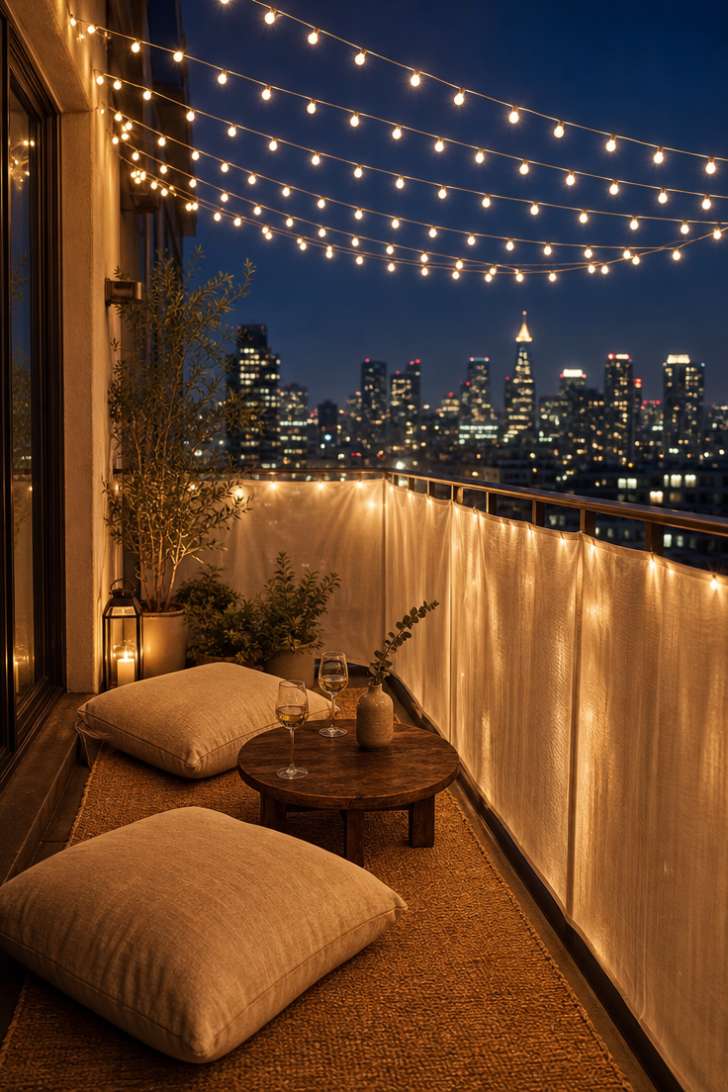
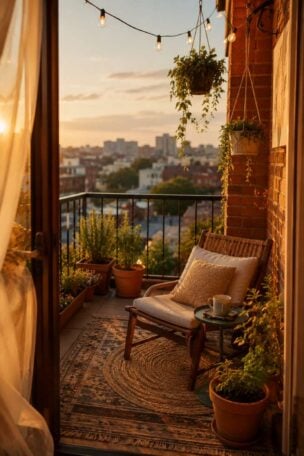
String lights do for a narrow balcony what a fireplace does for a living room — they give it a center of gravity, a reason to stay after dark.
Stringing them in parallel lines from the building wall to the railing at roughly 12-inch intervals creates a luminous ceiling that defines the space overhead. The effect is somewhere between a Tuscan courtyard and a backyard wedding, depending on the bulb style you choose.
Edison-style bulbs (the ones with visible filaments) cast warm amber light and look good from both inside and outside the apartment. Globe bulbs produce softer, more diffused light. Micro-LED fairy lights on thin wire create a starfield effect that works well when layered densely.
The installation matters. Use small cup hooks or adhesive-backed cable clips along the wall and screw-in hooks on the railing posts. Run a single extension cord along the base of the wall to a weatherproof outdoor outlet. Timer plugs that turn the lights on at sunset and off at midnight save you from remembering every night.
Low seating works best under a string light canopy because it keeps your head well below the bulb line. Floor cushions, a meditation bench, or a very low outdoor futon-style sofa all maintain that ceiling-of-light effect without putting your eyes at bulb level.
Design Pro-Tip: Hang string lights in a slight zigzag rather than perfectly straight lines. The small irregularity makes the installation look handmade and intentional rather than rigid and commercial.
Style Blueprint:
- Weatherproof string lights with warm white bulbs (two to three strands for a 10-foot balcony)
- Cup hooks or adhesive cable clips for mounting
- Outdoor timer plug
- Low floor cushions or a meditation bench
- Jute or cotton outdoor rug
A Tucked-Away Reading Corner for One
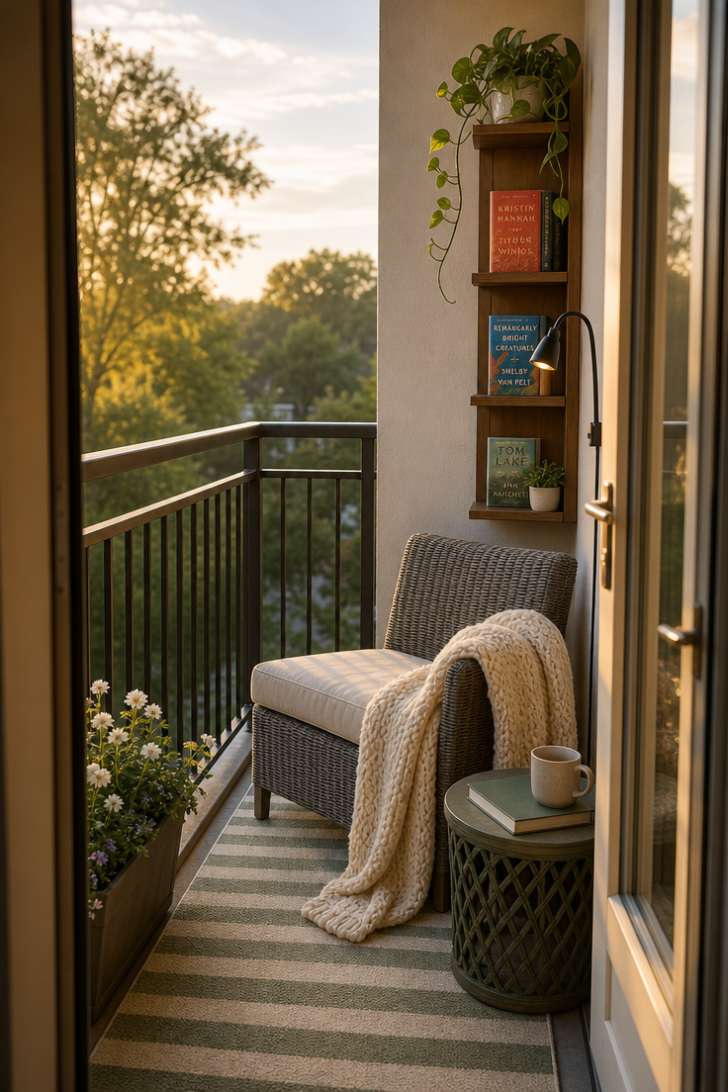
A reading nook needs exactly one good chair, decent light, and a surface for your book when you get up to make more tea.
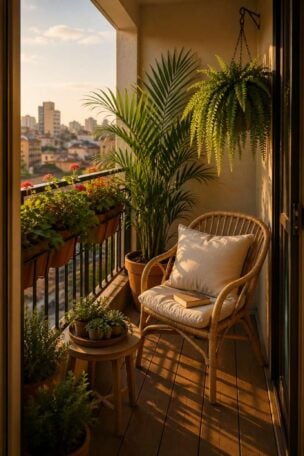
On a narrow balcony, a slim armless lounge chair works better than a standard armchair because it shaves four to six inches off the width. Wicker or synthetic rattan versions are lightweight enough to drag inside during storms.
The bookshelf mounts to the wall rather than standing on the floor. A vertical shelf 6 inches deep and 36 inches tall holds a handful of current reads without eating into the walkway. Add a flexible-neck reading lamp that plugs into a weatherproof outlet — overhead lighting on a balcony tends to attract bugs in summer, while a directed reading light keeps the glow close and controlled.
The outdoor runner rug defines the zone. A narrow one, about 2 feet by 6 feet, in soft stripes or a solid neutral, marks the reading area and adds textile warmth to what is otherwise a concrete and metal surface.
Reading outdoors changes the experience of a book in ways that indoor reading doesn’t replicate. Wind turns pages for you sometimes. Street sounds mix with the dialogue in your head. Rain starts and you get three seconds of that rain-on-warm-concrete smell before you grab your book and duck inside.
Style Blueprint:
- Slim armless outdoor lounge chair (under 22 inches wide)
- Wall-mounted vertical shelf (6 inches deep)
- Flexible-neck reading lamp (weatherproof plug-in or rechargeable)
- Narrow outdoor runner rug (2 by 6 feet)
- Chunky throw blanket for cooler evenings
A Living Privacy Screen Made From Tall Planters
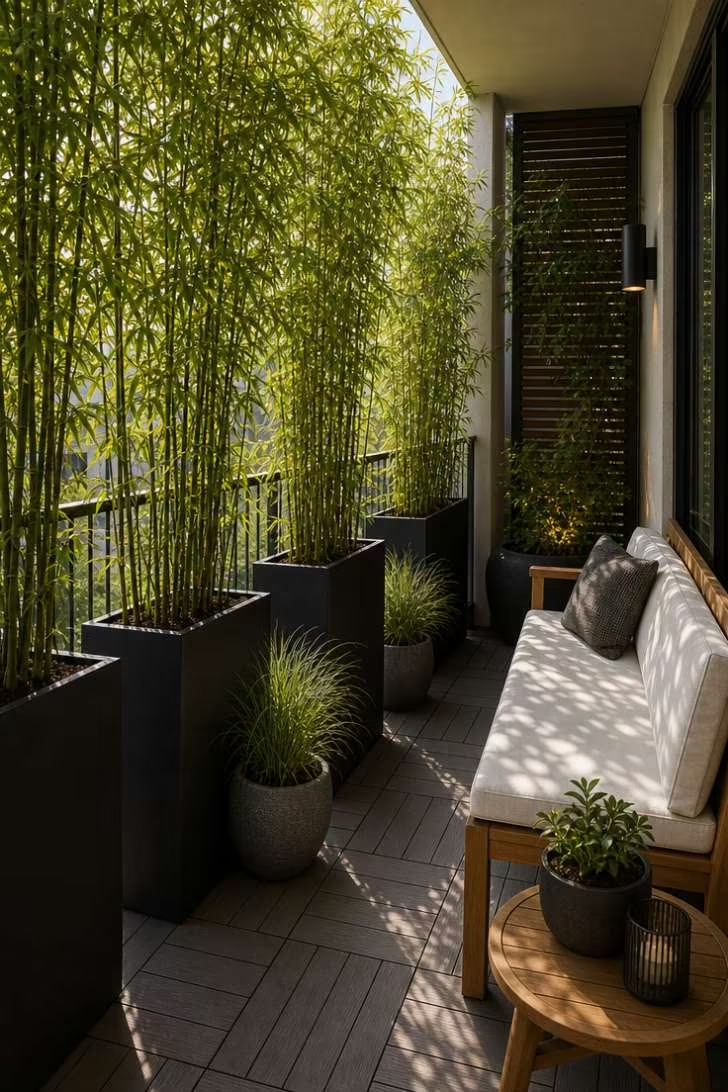
Privacy is the single biggest reason people avoid using their narrow balconies.
When your neighbor’s balcony is eight feet from yours, sitting outside can feel like sitting in a fishbowl. Tall plants solve this without the cold, permanent feel of a solid screen.
Clumping bamboo is the best all-purpose balcony privacy plant. Unlike running bamboo (which spreads aggressively and can crack containers), clumping varieties stay in their pot and grow upward in a tight column. Bambusa multiplex and Fargesia species work well in containers and handle partial shade.
The planter shape matters on a narrow balcony. Rectangular planters measuring roughly 10 inches wide, 10 inches deep, and 24 inches tall fit against the railing without blocking the walkway. Three of them spaced evenly along the railing create a green wall that rises above seated head height.
Ornamental grasses like Karl Foerster feather reed grass or purple fountain grass mixed between the bamboo add movement and texture. Grasses sway in wind, which softens the static look of the bamboo and adds sound — that gentle rustling is one of the most soothing background noises in outdoor design.
Weight is the practical concern here. A filled 24-inch planter with wet soil and a mature bamboo plant weighs between 40 and 60 pounds. Three of them put 120 to 180 pounds on one side of the balcony. Check your building’s load requirements and use lightweight potting mix with perlite to reduce weight by up to 30 percent.
Style Blueprint:
- Three tall rectangular planters in fiberglass or lightweight resin (10 by 10 by 24 inches)
- Clumping bamboo plants (Bambusa multiplex or Fargesia)
- One to two ornamental grasses for variety (Karl Foerster or fountain grass)
- Lightweight potting mix with perlite
- Slim bench or folding chair on the wall side
A Moroccan-Inspired Lounge With Color and Pattern
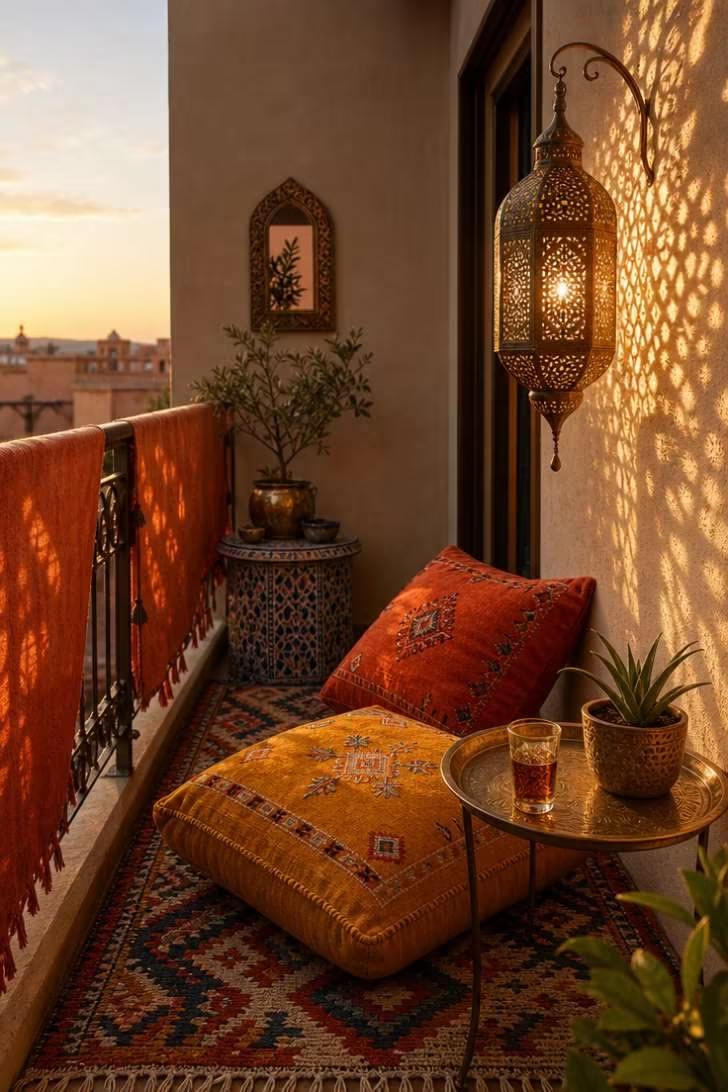
Moroccan design was built for small spaces.
Riads — the traditional courtyard houses of Marrakech and Fez — organize entire homes around narrow corridors and compact rooms, using color, pattern, and texture to make tight spaces feel abundant rather than cramped.
That same logic translates perfectly to a narrow balcony.
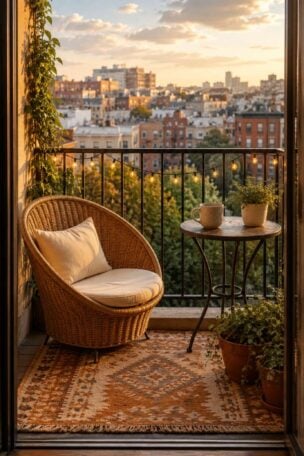
Start with the rug. A woven kilim or outdoor-rated Moroccan-style rug in warm tones (terracotta, saffron, dusty rose) covers the concrete and immediately signals that this is a room, not a corridor. Choose a rug that fills the full length of the balcony but stops a few inches short of the railing to avoid rain damage.
Floor cushions replace chairs entirely. Two large cushions, 24 inches square, stack when not in use and take up less space than any chair. The low seating position changes your relationship to the space — you notice the railing line above you, the sky beyond it, the pattern of light on the rug at your feet.
A brass tray table (the kind with folding legs) serves as your coffee table and stores flat against the wall when you need the floor space back. Pierced metal lanterns cast star-shaped shadow patterns that transform the balcony after dark into something genuinely atmospheric.
The color palette can be bolder here than in most small space designs because the Moroccan aesthetic embraces saturated color as a feature, not a risk. Saffron, cobalt, emerald, burnt orange — these tones look rich rather than overwhelming when they appear on textiles and accessories against a neutral wall.
Design Pro-Tip: Limit your Moroccan-inspired palette to three saturated colors plus one neutral. Saffron, terracotta, and cobalt blue on a cream or white background is a combination that almost always works, and it keeps the narrow space from feeling visually noisy.
Style Blueprint:
- Outdoor-rated kilim or woven rug in warm tones
- Two large floor cushions with geometric patterns (24 inches square)
- Brass tray table with folding legs
- Pierced metal lantern (hanging or tabletop)
- Small mosaic accent table or decorative tile piece
A Fold-Down Desk for Working With Open Air
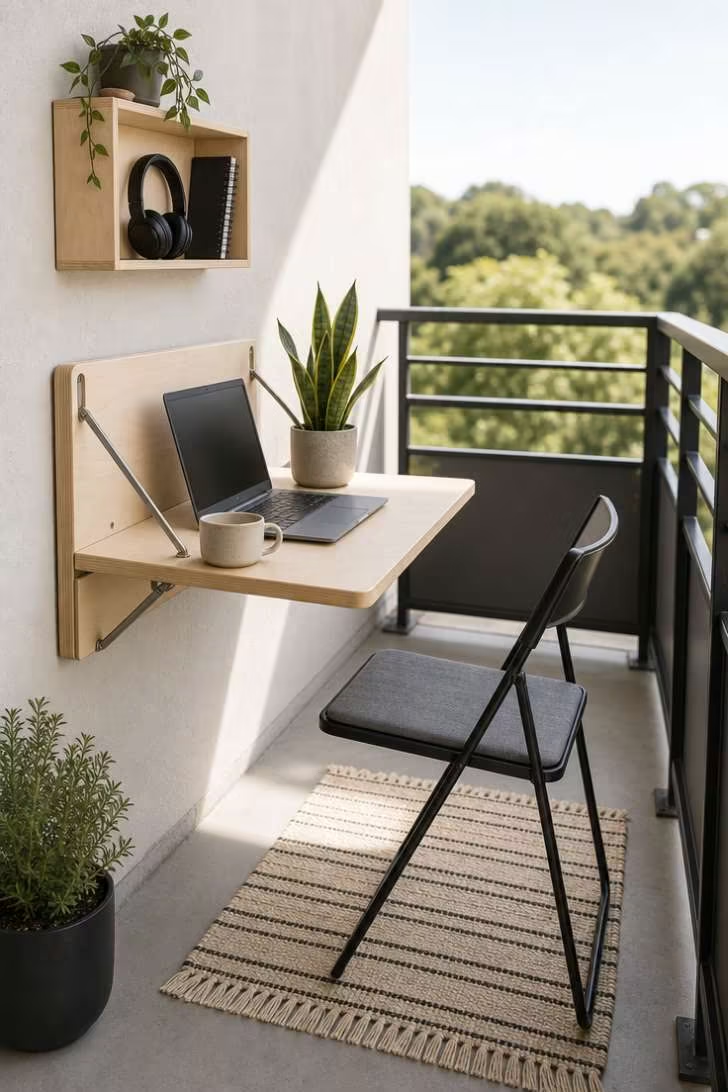
Remote work changed the way people use every room in their apartment, and the balcony is no exception.
A wall-mounted fold-down desk gives you an outdoor workspace that disappears when you’re done. The desk folds flat against the wall, projecting only two inches when closed. When open, a typical fold-down measures 24 to 30 inches wide and 16 to 20 inches deep — enough for a laptop, a notebook, and a cup of coffee.
Mount it at standing height (roughly 42 inches from the floor) or seated height (30 inches) depending on your preference. Standing height works surprisingly well on a narrow balcony because it keeps the walkway clear below desk level even when the desk is extended.
A folding chair stows inside or leans flat against the wall when the desk is closed. Choose one with a thin profile — metal folding chairs are 2 inches flat, while wooden ones can be 4 or more.
Working outside has measurable benefits for focus and mood that go beyond the feel-good idea of fresh air. Natural light regulates your circadian rhythm, which improves sleep quality that night. Variable background sound — birds, traffic, wind — provides a low-level stimulation that helps some people concentrate better than silence.
Practical limits exist, of course. Screen glare is real in direct sunlight (position the desk so the screen faces away from the sun). Wind blows papers. Insects visit your coffee. A morning work session from 7 to 10 a.m., before peak sun and heat, is the sweet spot for most climates.
Style Blueprint:
- Wall-mounted fold-down desk in birch or bamboo plywood (24–30 inches wide)
- Slim metal folding chair with a thin cushion
- Small wall-mounted shelf for accessories
- Compact potted plant (snake plant, small ZZ plant)
- Cotton or woven mat under the work zone
The Mirror Gallery That Doubles Your Space
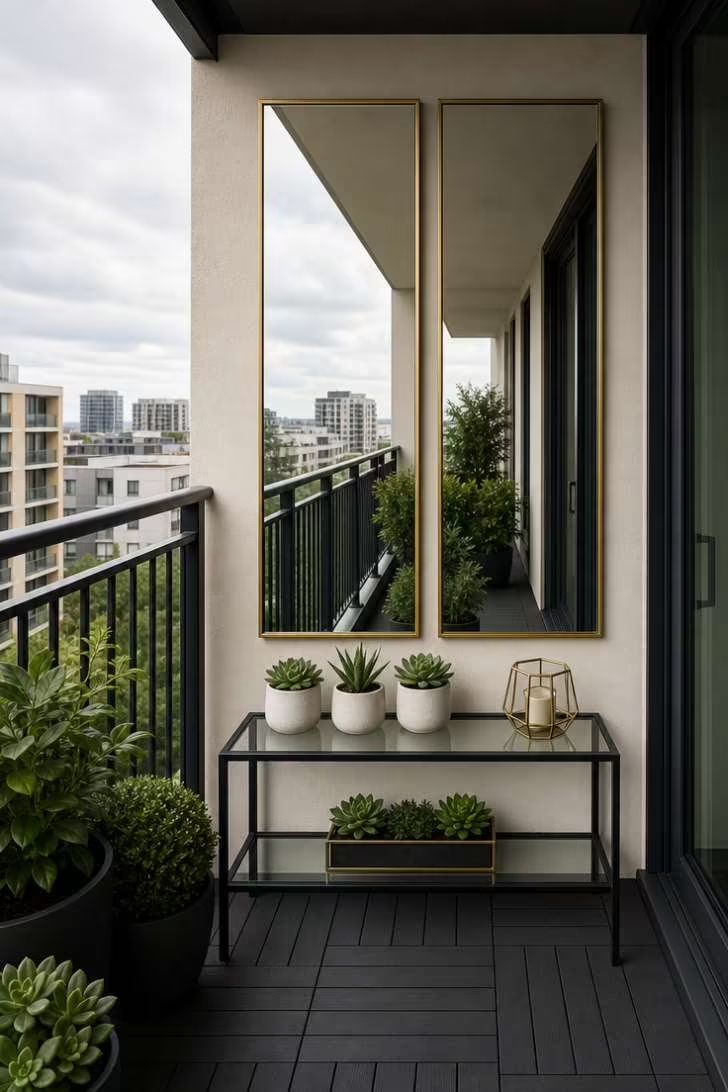
Mirrors are the oldest trick in small-space design, and they work even better outdoors than inside.
On a narrow balcony, a mirror mounted on the end wall (the short wall facing you as you step out) reflects the full length of the space back at you, creating an illusion of doubled depth. Your three-foot-wide balcony suddenly reads as six feet deep in your peripheral vision. The brain accepts the reflection as real space, which reduces the feeling of compression.
Weather-resistant mirrors are made with stainless steel or aluminum backing instead of standard silvered glass, which corrodes in humidity. Acrylic mirrors weigh less and resist shattering, though they scratch more easily. Both types come in standard frame styles — thin brass or black metal frames look clean and intentional rather than decorative.
Two medium mirrors (roughly 14 by 36 inches each) mounted vertically side by side create more visual impact than one large mirror, and they’re easier to hang on a narrow wall. Position them so they catch the sky and any nearby tree canopy rather than reflecting the neighboring building’s wall.
Place plants in front of the mirrors. The reflection doubles the greenery, turning two succulents into four and one trailing pothos into a cascade. A slim console table or shelf below the mirrors holds the plants and a few metallic accessories — the reflective surfaces compound, bouncing light and color back and forth.
The effect after dark is worth planning for. A single strand of warm string lights reflected in the mirrors multiplies the glow across the entire end wall. The balcony transforms from a daytime sitting area into a softly lit evening retreat without additional lighting investment.
Style Blueprint:
- Two weather-resistant mirrors in thin frames (14 by 36 inches each)
- Slim console table or wall-mounted shelf
- Three to four small potted plants (succulents, trailing pothos)
- Metallic accent pieces (brass candle holder, gold tray)
- Dark composite deck tiles for a grounding contrast
What Your Narrow Balcony Is Waiting For
Every one of these ideas starts with accepting the shape you’ve got rather than wishing for a bigger footprint.
A narrow balcony is a long, thin room with no roof, a railing for one wall, and the sky as its ceiling. Once you see it as a room — with zones, a floor treatment, a lighting plan, and a purpose — the decorating decisions fall into place.
Pick one idea from this list that matches how you actually want to use the space. If you drink coffee outside every morning, the bistro corner will change your routine. If you need privacy from a close neighbor, the living screen of bamboo and ornamental grasses will make you feel sheltered within a week of planting. If you work from home and crave fresh air, the fold-down desk pays for itself in improved afternoon energy.
You don’t need all 11 ideas. You need one good one, executed well, with pieces that fit your specific width and length.
The narrow balcony you’ve been ignoring is three or four purchases away from becoming the best seat in your apartment.