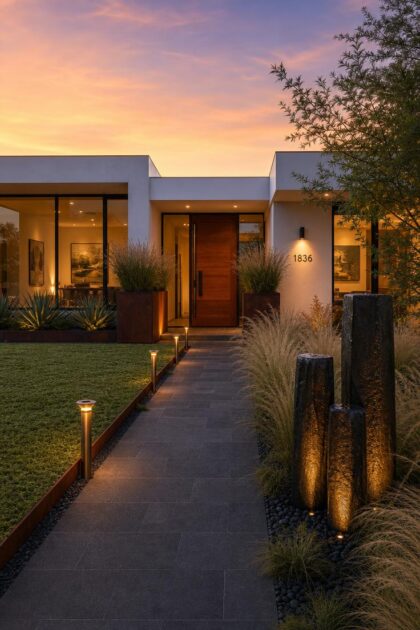
This post may contain affiliate links. If you make a purchase through these links, we may earn a commission at no additional cost to you.
The front yard is the handshake your home offers the street.
Most people overthink it — too many plants, too many materials, too much going on.
The best modern front yards do the opposite.
They pick two or three finishes, commit to a tight plant palette and let the architecture do the talking.
What follows are 13 specific scenes you can borrow, each built around materials and plants you can actually source and install.
No vague mood boards here — just concrete (sometimes literally) ideas worth copying for your own contemporary front yard design.
Board-Formed Concrete Retaining Wall With Dwarf Mondo Grass Strips
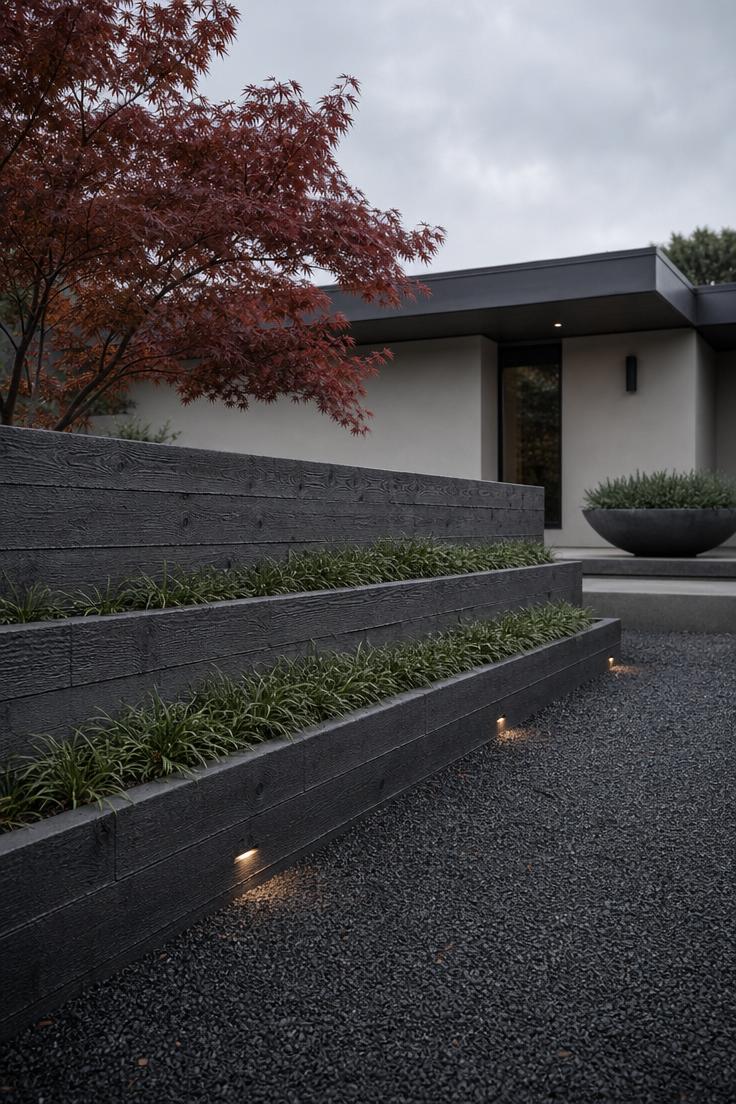
There’s a reason concrete keeps showing up in front yard hardscape ideas — nothing else gives you that combination of weight and warmth when you let the forming process leave its mark.
Board-forming imprints the grain of the lumber directly into the surface, so what you get is a wall that reads as both industrial and organic.
The trick here is the planting pockets between tiers.
Dwarf mondo grass fills those narrow channels and stays put — it doesn’t spill, doesn’t need mowing, doesn’t compete with the architecture.
Recessed step lights tucked into the wall’s face wash light downward at night without any visible fixtures during the day.
That restraint matters more than most people realize — when the eye isn’t distracted by hardware, the materials themselves become the focal point, and the whole front yard feels calmer for it.
Style Blueprint:
- Board-formed concrete retaining wall in charcoal stain
- Dwarf mondo grass (Ophiopogon japonicus ‘Nanus’)
- Fine-grade charcoal gravel mulch
- Recessed LED step lights with warm 2700K output
Corten Steel Planter Boxes Framing a Charcoal Porcelain Walkway
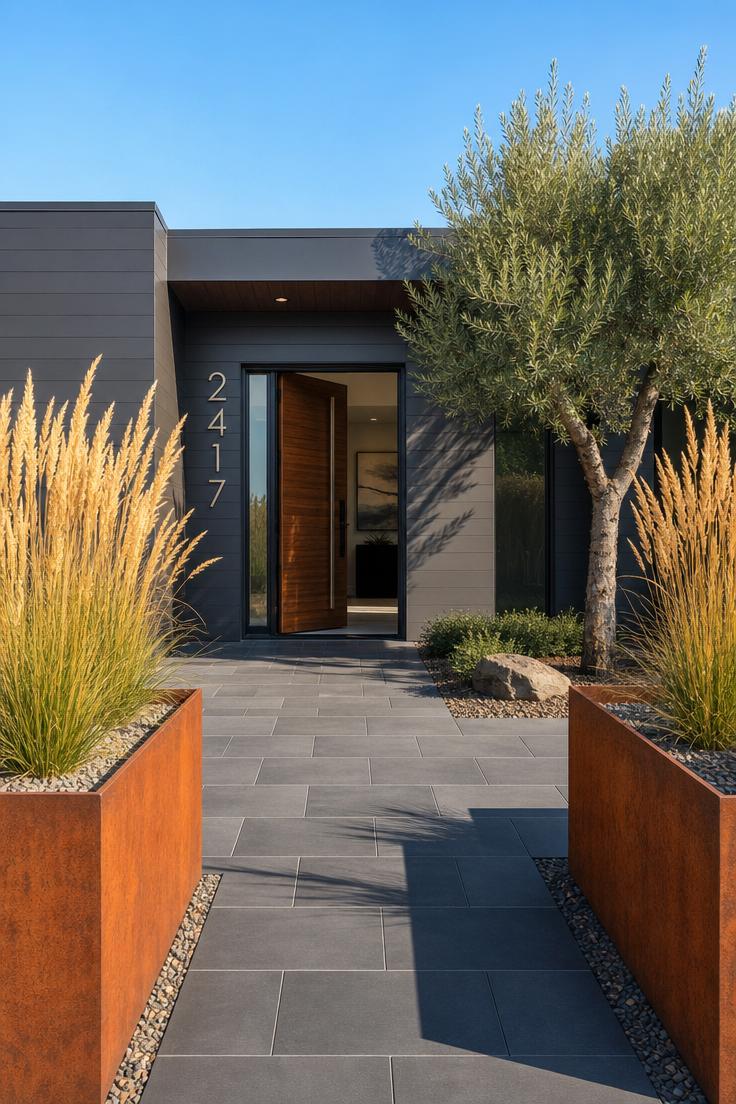
Corten steel earns its place in modern yard design because it solves two problems at once.
It defines a hard geometric edge, and it does it in a color that shifts with the seasons and the weather.
Fresh corten looks orange-amber; after a year or two of rain cycles, it deepens to a burnt umber that almost matches dark mulch.
Pairing it with charcoal porcelain pavers creates a front yard walkway design that photographs well but, more importantly, feels good to walk.
Those large-format tiles — 24 by 48 inches — reduce grout lines and make a short front path look longer than it is.
Karl Foerster grass is the go-to here because it grows in a tight upright column, never flopping across the path the way some ornamental grasses will.
It’s the plant equivalent of good posture.
Style Blueprint:
- Corten steel rectangular planter boxes (at least 30 inches tall)
- Large-format charcoal porcelain pavers (24×48″)
- Karl Foerster feather reed grass (Calamagrostis × acutiflora)
- Brushed-nickel house numbers in oversized format
A Ribbon Driveway With Creeping Thyme Between Concrete Tracks
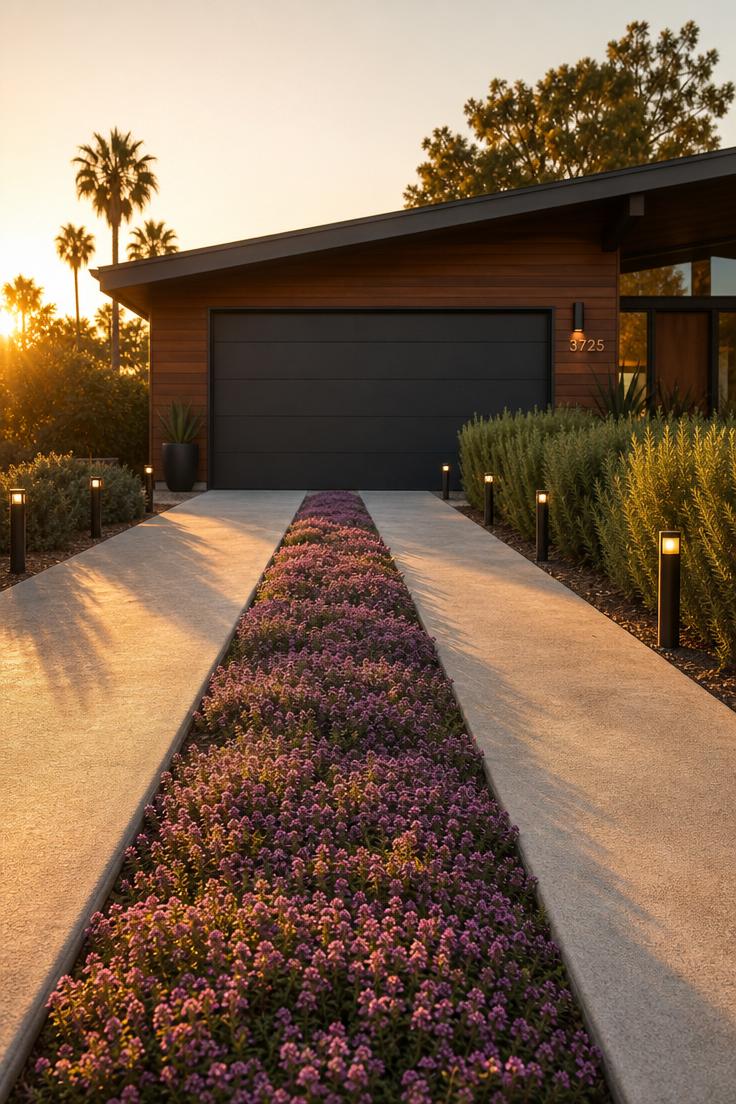
Ribbon driveways cut impervious surface nearly in half compared to a full concrete slab.
That’s not just good for stormwater — it changes the entire visual weight of the driveway from “parking lot” to “planted feature.”
Creeping thyme handles light foot and tire traffic, blooms in late spring and early summer, and releases that familiar herbal scent when you drive over it.
The strips themselves should be at least 24 inches wide and poured with a broom finish for traction.
What makes the proportions work is keeping the center channel between 18 and 24 inches — narrow enough that tires bridge it comfortably, wide enough for the thyme to put on a show.
A low maintenance front yard starts with decisions exactly like this one: replacing a material that needs nothing (concrete) with a plant that needs almost nothing (thyme) and getting a better-looking driveway out of the deal.
Style Blueprint:
- Poured concrete ribbon strips with broom finish (24″ wide minimum)
- Creeping thyme (Thymus serpyllum) center planting
- Hidden steel edge restraints
- Solar matte-black bollard path lights
Black Basalt Gravel Bed With Agave and Kangaroo Paw Clusters
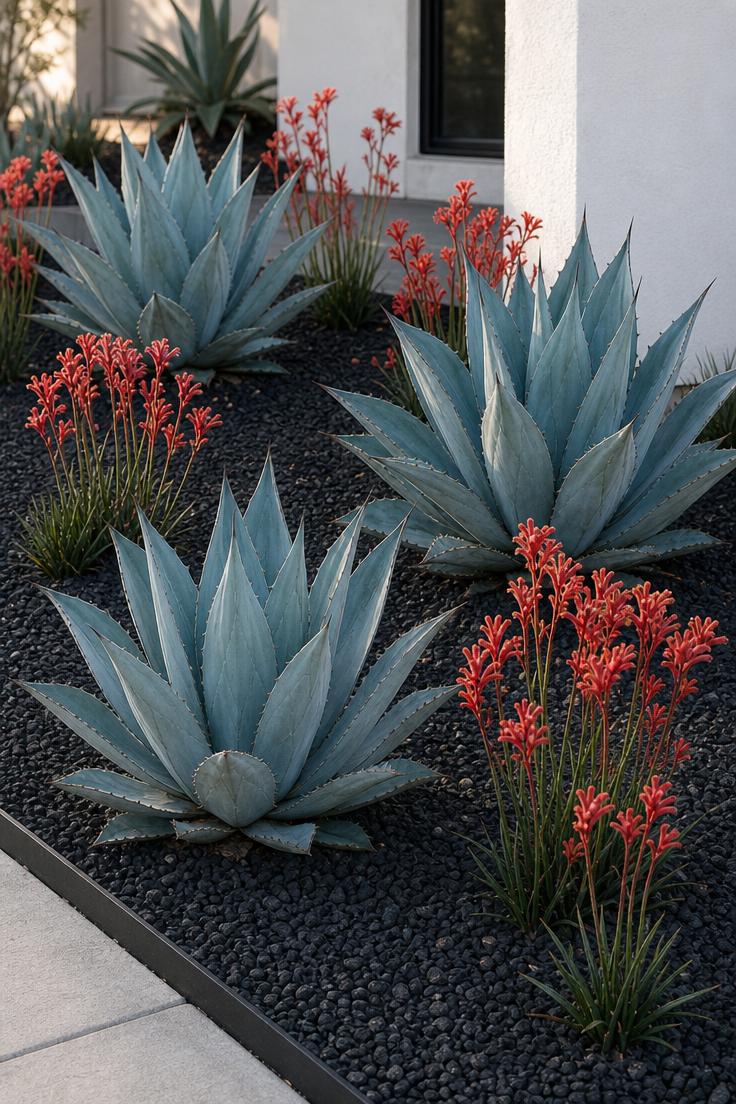
Dark gravel does something unexpected to a front yard — it makes plants look like sculpture.
Black basalt absorbs light instead of reflecting it, so every leaf edge and bloom color pops with the kind of contrast you’d see in a gallery.
Blue agave brings architectural heft; those thick rosettes can reach three feet across and hold their shape year-round without any pruning or fussing.
Kangaroo paw adds the movement and color that agave alone can’t provide — those coral blooms on long stems sway with any breeze and draw hummingbirds all season.
This is a drought tolerant front yard at its most photogenic, and it works in USDA zones 8 through 11 with zero supplemental irrigation once the plants establish.
Steel edging at the border keeps the gravel from migrating onto the sidewalk, which is the one maintenance detail that makes or breaks a gravel garden.
Style Blueprint:
- Fine black basalt gravel (3/8″ minus)
- Blue agave (Agave americana) specimen plants
- Kangaroo paw (Anigozanthos ‘Big Red’)
- Matte-black steel garden edging (4″ tall)
Floating Concrete Steps Over a Dry Creek Bed of River Stone
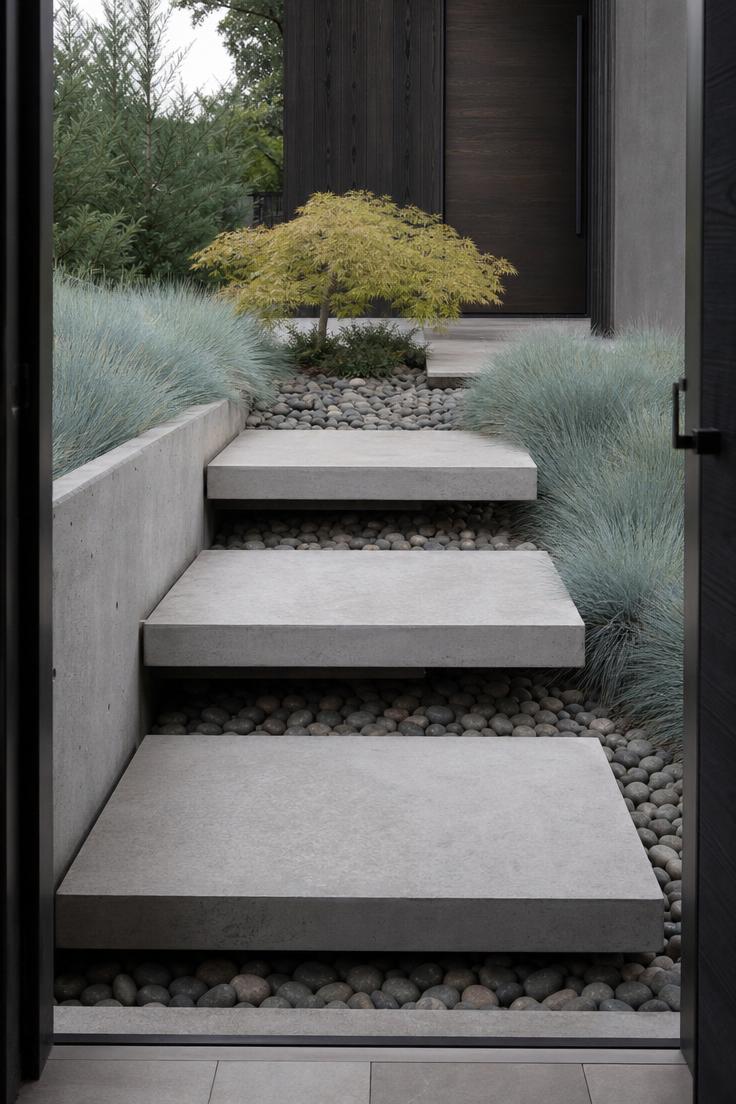
Cantilevered steps change the way you experience a front door approach.
Your foot lands on what appears to be a hovering slab, and the sound of stepping shifts from a flat thud to something slightly hollow. There is air underneath, and you notice it.
The river stone creek bed below is not just decorative. It can also form part of a drainage strategy for directing runoff through the landscape, provided the grading and drainage system are designed for the site.
Cantilevered concrete treads can create a floating visual effect, but tread thickness, reinforcement, anchorage, foundation conditions, frost exposure, and the supporting structure are engineering decisions. Use a site-specific engineered assembly or a manufactured system designed and installed for the actual conditions rather than relying on a universal slab dimension.
Blue fescue at the creek bed’s edges ties the stone to the planted areas with a soft blue-green buffer that needs shearing once a year, if that.
What makes the whole thing feel expensive is the negative space. The visible gap between each step and the stones below creates a shadow line that changes with the time of day.
Style Blueprint:
- Cantilevered concrete treads with a smooth troweled finish
- Tumbled river stone in grey-taupe blend (2–4″ diameter)
- Site-specific engineered or manufactured cantilever support system
- Blue fescue (Festuca glauca) border plantings
Design Pro-Tip: Limit your hardscape to two materials maximum, one for the walking surface and one for borders or accents. More than that and a modern front yard can start to look visually crowded.
Horizontal Cedar Slat Fence With Espaliered Pear Trees
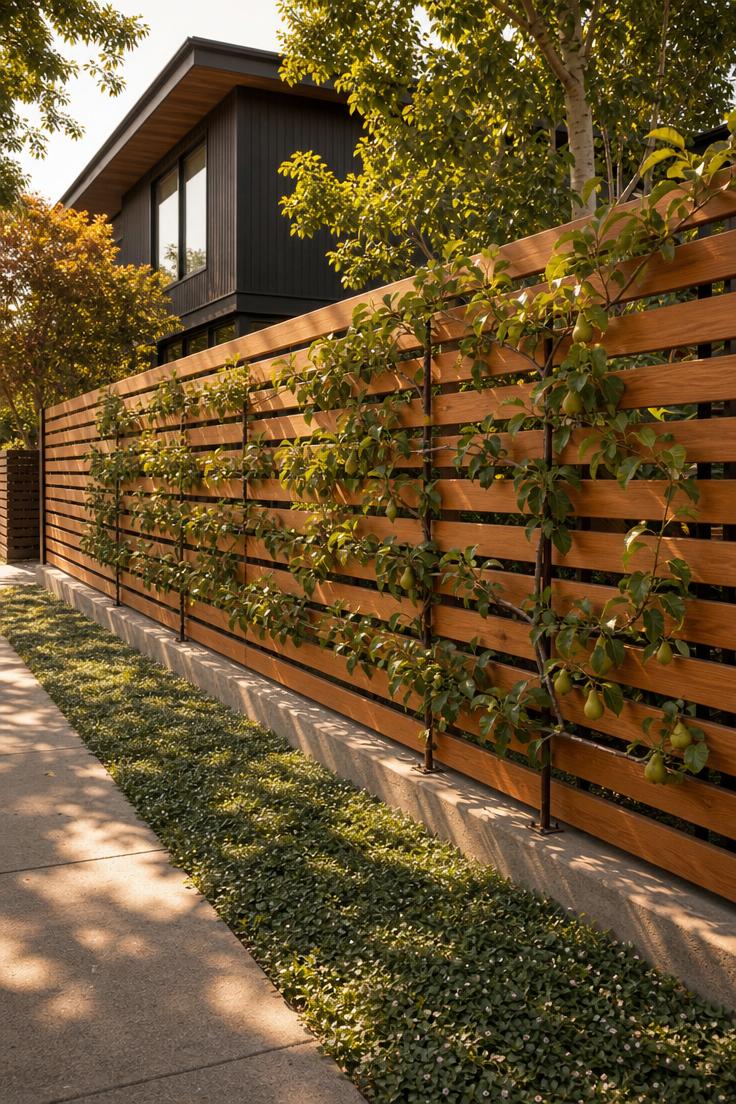
A cedar fence does double duty here — privacy screen and plant support.
Espaliered fruit trees are one of those details that look like they took years to achieve, and they did, but the payoff is a living wall that produces actual pears while screening the yard from the street.
Horizontal slats with a 1.5-inch gap let air through, which matters for both the tree’s health and the fence’s longevity — trapped moisture is what rots wood, not rain.
The stainless steel training wire runs horizontally between the slats, giving each branch a guide to follow as you prune it into a flat cordon pattern over two to three growing seasons.
Below the fence, a concrete mow strip creates a clean separation between the yard and the sidewalk, and Dymondia — a South African ground cover with tiny yellow flowers — fills the gap without needing mowing.
The whole composition reads as a front yard curb appeal move that’s equal parts architecture and agriculture.
Style Blueprint:
- Clear Western red cedar horizontal slats (1×6, 1.5″ spacing)
- Espaliered pear trees (Pyrus communis, horizontal cordon form)
- Stainless steel training wire (14-gauge)
- Concrete mow strip and Dymondia margaretae ground cover
A Sedge Lawn Bordered by Cor-Ten Edging and White Stucco
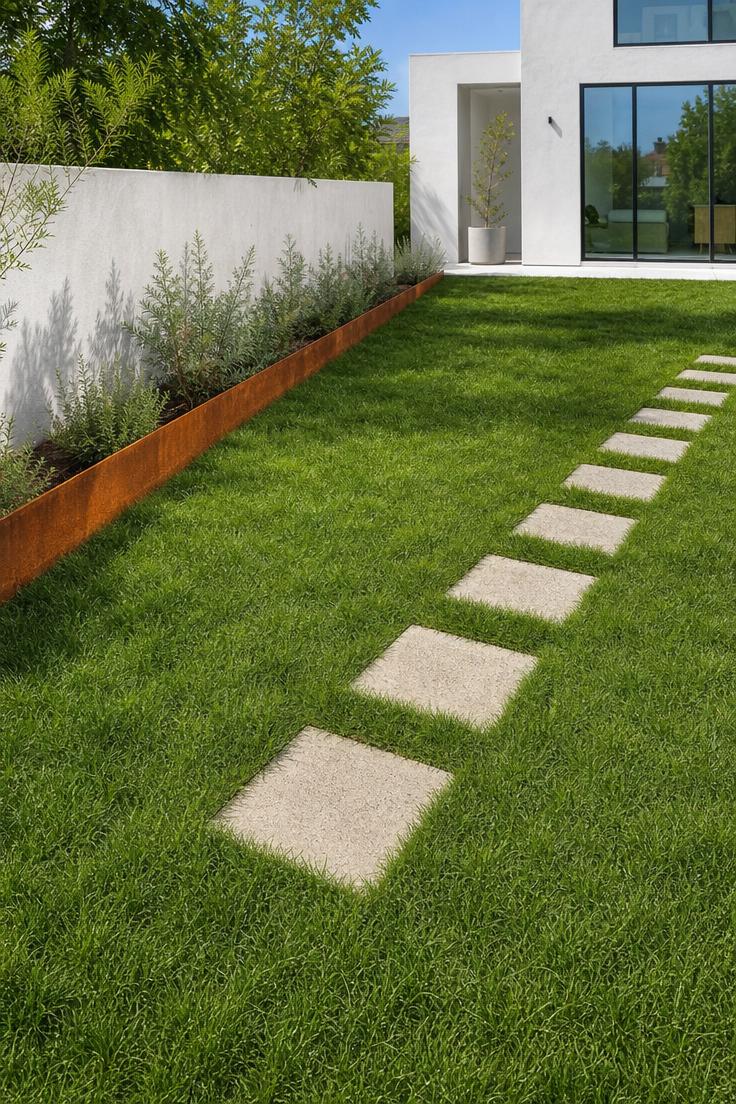
Sedge lawns look like grass but break all the rules that make traditional turf a chore.
Carex praegracilis stays green through California dry seasons on about a third of the water that Kentucky bluegrass demands.
It tops out at six inches if you never touch it, and most people mow it twice a year — once in early spring, once in late summer — just to keep it tidy.
The corten edging at the border does more than contain the sedge.
It draws a line that the eye follows around the perimeter of the yard, and that continuous rust-colored stripe against white stucco becomes a design element on its own.
This is a minimalist front yard at its most distilled: one plant species, one edge material, one wall color.
The diagonal stepping path across the middle adds just enough geometry to keep the space from feeling empty.
Style Blueprint:
- Carex praegracilis sedge lawn (plugs planted on 6″ centers)
- Corten steel garden edging (1/4″ thick, 4″ tall)
- Smooth white-rendered stucco boundary wall
- Smart irrigation controller with weather-based scheduling
Oversized Matte Black Planters With Olive Trees on a Limestone Porch
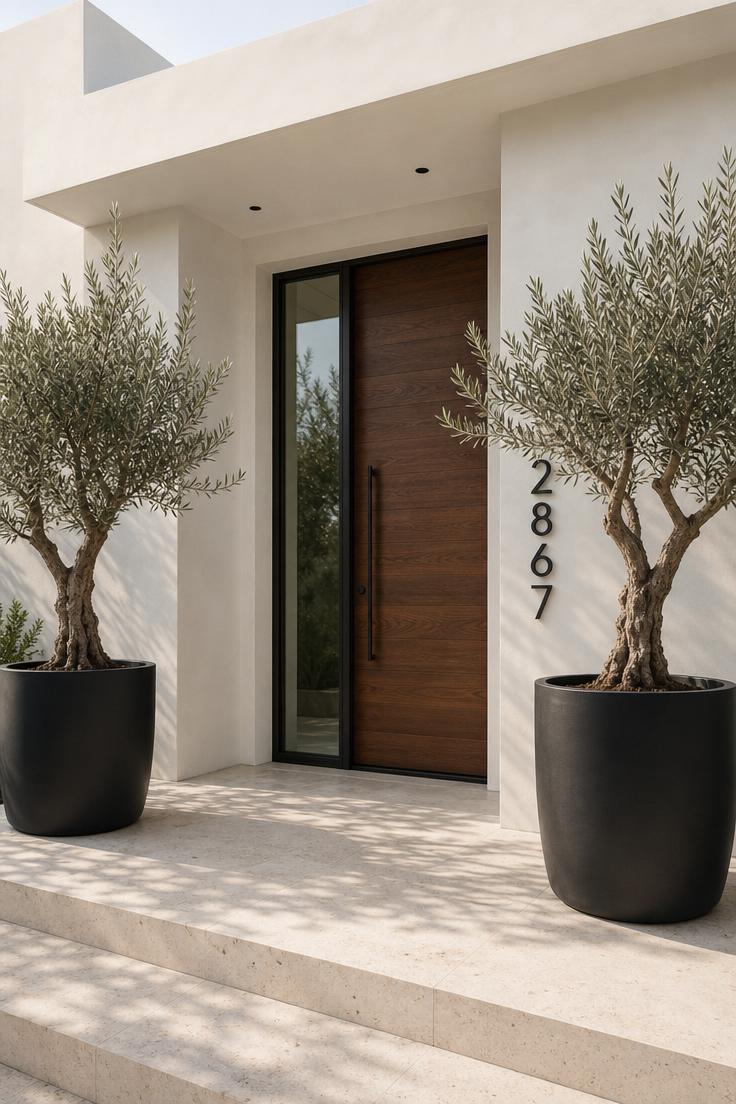
Scale is what separates a front porch that feels designed from one that feels decorated.
These planters stand nearly three feet tall and two-and-a-half feet across — big enough that the olive trees look like they belong rather than like afterthoughts stuck by the door.
Fruitless olive varieties (look for ‘Swan Hill’ or ‘Wilsonii’) give you the silvery leaf color and sculptural trunk character without the mess of dropping fruit on your limestone.
Honed limestone pavers under the planters bring a warmth that polished concrete can’t match, and the fossil impressions in the stone add a subtle layer of texture you only notice up close.
Matte-black fiberglass is the planter material of choice here because it’s half the weight of concrete, won’t crack in frost and disappears visually — letting the tree, not the pot, be the focus.
A single pivot door in walnut anchors the composition and makes the entry feel twice its actual width.
Design Pro-Tip: Place a water feature where you’ll hear it from inside. Near an entry window or beside the front door, even a small bubbler turns the sound of arriving home into something worth slowing down for.
Style Blueprint:
- Matte-black fiberglass planters (30″ diameter × 36″ tall)
- Fruitless olive trees (Olea europaea ‘Swan Hill’)
- Honed limestone pavers with natural fossil texture
- Oversized pivoting entry door in walnut finish
A Pondless Basalt Column Bubbler Set in Mexican Feather Grass
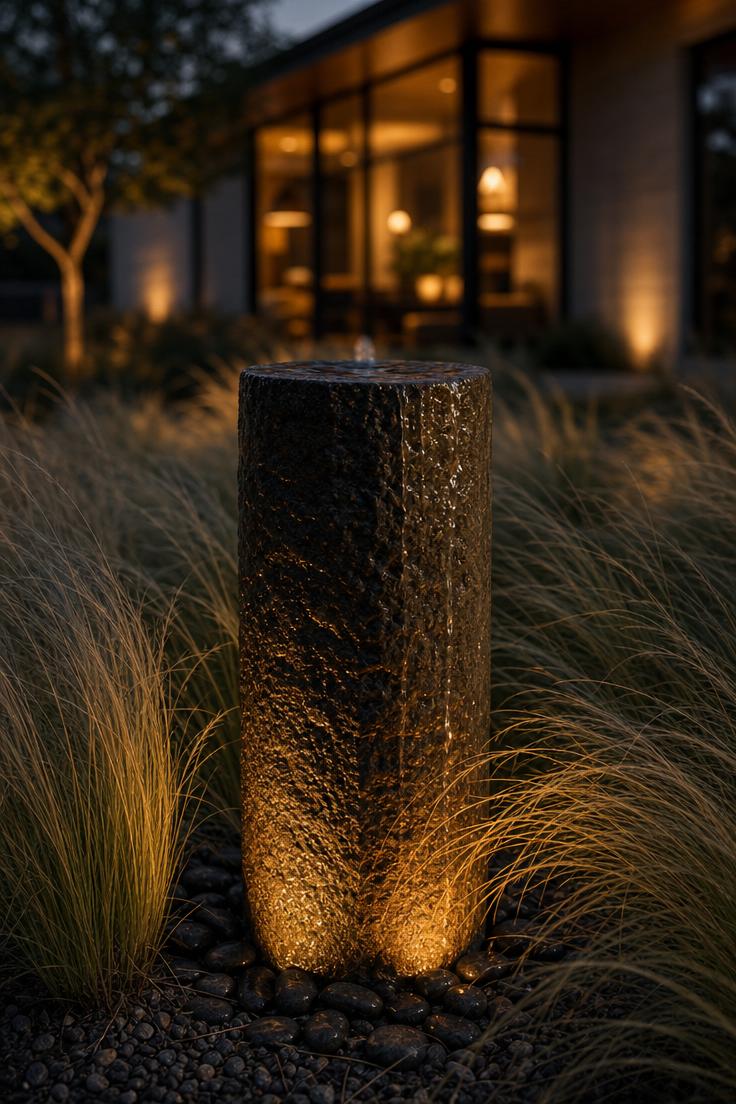
Running water changes a front yard’s atmosphere more than any plant or material swap.
This basalt column bubbler recirculates from a buried reservoir — no pond, no standing water, no mosquito habitat.
The column itself is a single piece of volcanic basalt, core-drilled so water pumps up through the center and sheets down the outer surface.
At dusk, a single uplight at the base turns the wet stone into something that glows.
Mexican feather grass planted tight around the feature adds movement — those fine, almost hair-like blades respond to any air current, so there’s always something swaying beside the still column.
The sound carries further than you’d expect from a feature this small.
On a quiet street, you hear the trickle from ten feet away, and it masks traffic noise from the road in a way that a front yard fence or hedge never could.
Combining water and modern outdoor lighting creates a front entry moment that works as well at 10 PM as it does at noon.
Style Blueprint:
- Core-drilled basalt column fountain (approximately 36″ tall)
- Mexican feather grass (Nassella tenuissima) planted in masses
- Submersible recirculating pump in buried reservoir basin
- Copper low-voltage uplight (warm 2700K beam)
Decomposed Granite Forecourt With Geometric Boxwood Blocks
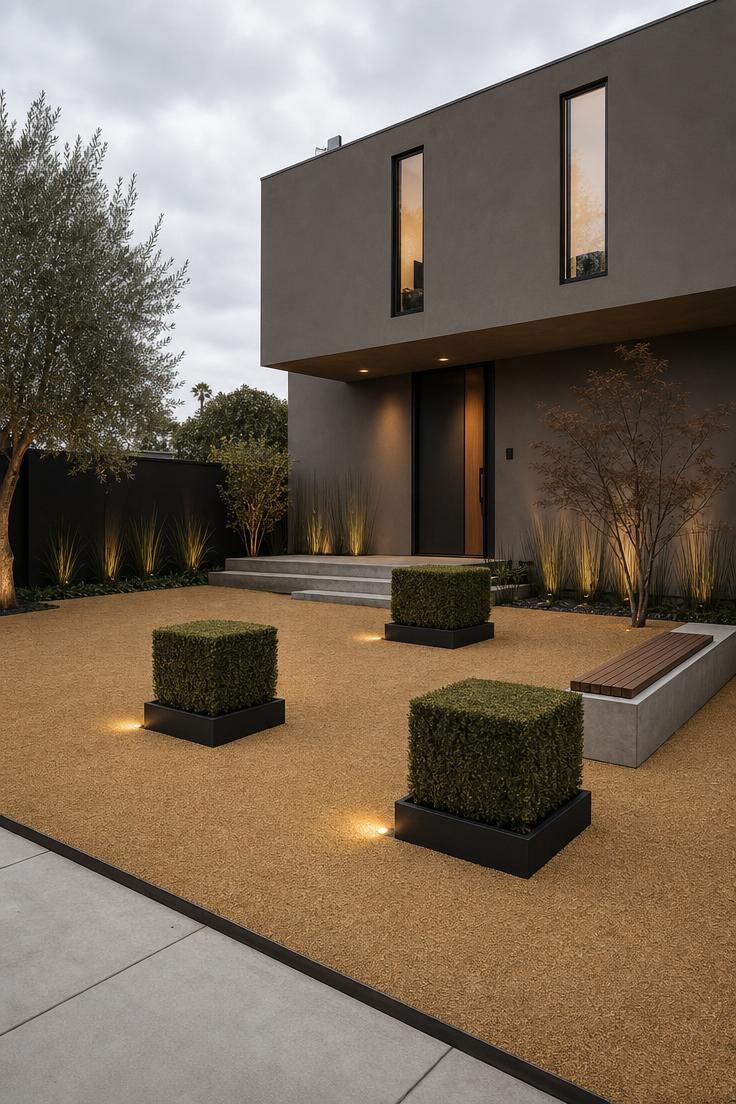
Decomposed granite is the unsung hero of xeriscaping front yard projects.
It costs a fraction of pavers, goes down in an afternoon and reads as warm gold against any facade color.
Stabilized DG — the kind mixed with a binding agent before compacting — won’t shift under foot traffic or wash away in rain the way loose DG will.
The three boxwood cubes planted here aren’t about green space for its own sake; they’re about using living material as geometry.
Clipped to different heights and staggered off-center, they create a composition that changes depending on where you stand.
From the sidewalk, you see three green volumes against a gold plane.
From the front door, looking back, they stack into a layered silhouette.
Recessed ground lights set flush with the DG add a gallery quality at night without any visible fixture during the day.
Style Blueprint:
- Stabilized decomposed granite in gold tone (compacted 3″ depth)
- English boxwood (Buxus sempervirens) clipped to geometric cubes
- Low square matte-black steel planters
- Recessed LED ground lights (flush-mount, IP67 rated)
Laser-Cut Aluminum Privacy Screen With Uplighting
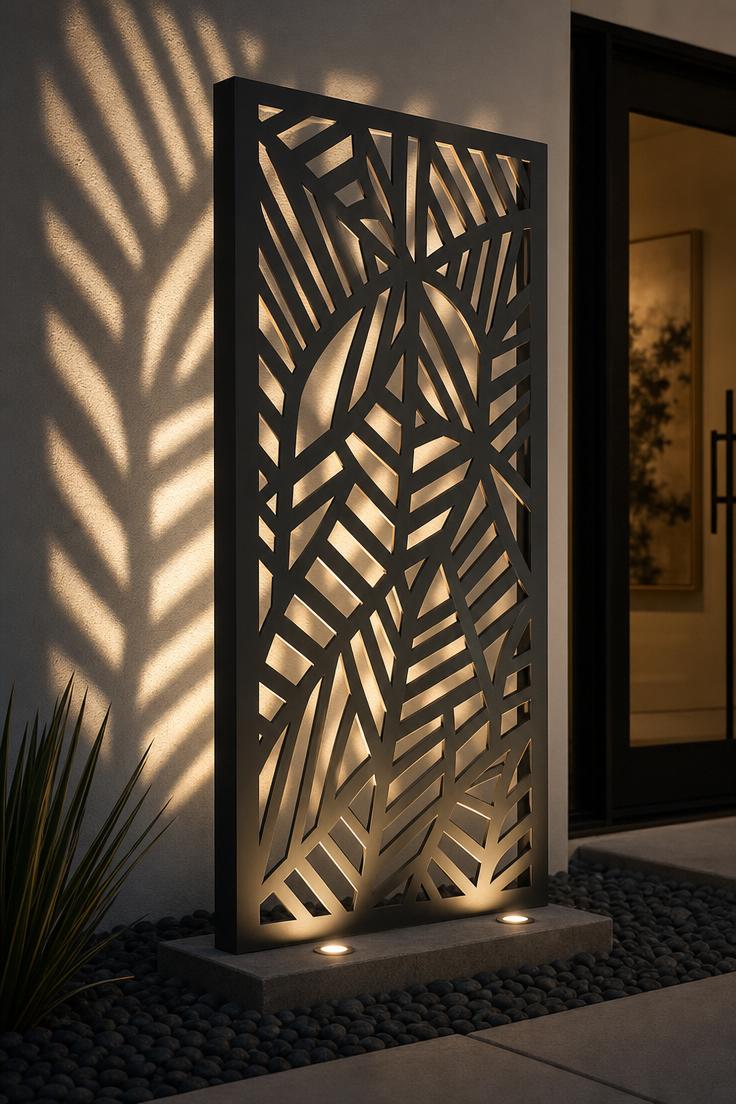
Privacy screens in a front yard walk a fine line — block too much and the house looks fortress-like; block too little and they’re pointless.
Laser-cut aluminum hits the middle ground by filtering views through a pattern that’s open enough for airflow and light but dense enough to obscure what’s behind it.
The real payoff comes after dark.
Two in-ground uplights at the base throw the cut pattern onto the wall behind, and suddenly you have a shadow mural that covers eight feet of blank stucco.
The pattern shifts subtly as the light angle changes through the evening.
Powder-coated aluminum in a matte finish won’t rust, won’t warp, won’t need painting — it’s genuinely a set-and-forget element.
Position it at an angle to the street rather than flat-on, and it screens the entry without feeling like a barrier.
Style Blueprint:
- Powder-coated aluminum laser-cut screen (matte charcoal)
- In-ground LED uplights (adjustable beam angle, 2700K)
- Smooth white stucco backdrop wall
- Concealed cable anchor mounts and concrete footing
A Succulent Mosaic Bed Framed by Smooth Concrete Curbing
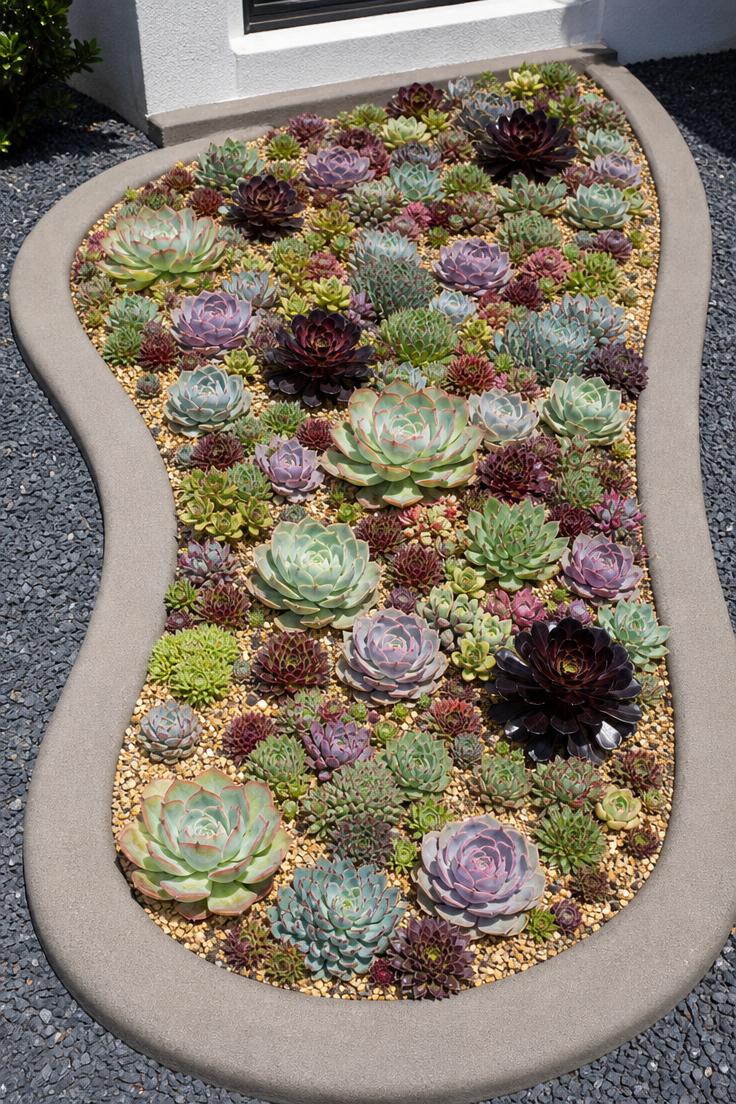
Succulents planted one-by-one in a pot look cute.
Succulents planted in masses look like topography.
This mosaic bed packs dozens of rosettes — each one three to six inches across — into a tight composition where leaf color does the work that flowers would do in a traditional border.
Echeveria in jade and dusty rose sit next to deep burgundy sempervivum, and the near-black paddles of Aeonium ‘Zwartkop’ anchor the darker zones.
Smooth concrete curbing gives the bed a clean, continuous border that reads like a picture frame.
Skip the rough or stamped concrete finishes here — the succulents themselves provide all the texture you need, so the curbing should be as simple as possible.
Gold gravel in the gaps between plants helps drainage and prevents soil splash during watering, which keeps those perfect rosettes clean.
Design Pro-Tip: Group succulents by growth rate, not just color. Faster growers at the outer edges let the bed fill in without the center getting crowded out within a season.
Style Blueprint:
- Mixed echeveria varieties (Echeveria ‘Lola’, E. elegans, E. ‘Perle von Nürnberg’)
- Sempervivum rosettes in burgundy cultivars
- Aeonium ‘Zwartkop’ for dark accent
- Smooth troweled concrete curbing in warm grey
Solar-Powered Brass Bollards Along a Bluestone Stepping Path
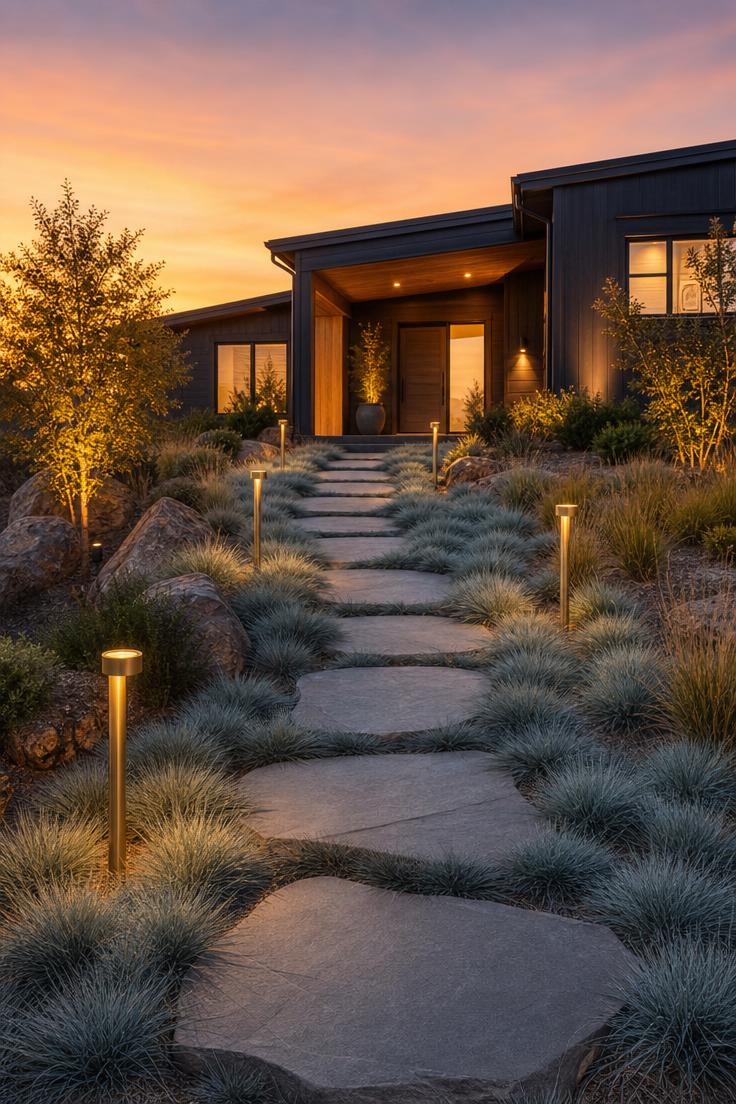
Brass is a material that earns its keep over time.
New brass bollards arrive bright and polished; within six months outdoors they develop a patina that softens the metallic sheen into something warmer and more settled.
Solar-powered versions have caught up to wired fixtures in output — current models run 200-plus lumens on a full charge, which is more than enough to light a stepping path without turning the front yard into a runway.
Thermal bluestone — heated and brushed to remove the outer layer — gives you a slip-resistant surface with a color that reads blue in some light and grey in others.
Setting the stones in blue oat grass rather than gravel creates a front yard walkway design that’s alive and shifts with the seasons, silver in summer, straw-gold in winter.
The combination of brass hardware and bluestone puts this firmly in the territory where modern yard design meets craft — nothing here is mass-produced-looking, and the cost per foot stays reasonable because solar fixtures skip the electrician entirely.
Style Blueprint:
- Solar-powered brushed brass bollard lights (200+ lumens, 24″ height)
- Thermal bluestone stepping stones (irregular cut, 18–24″ wide)
- Blue oat grass (Helictotrichon sempervirens) infill planting
- Permeable crushed stone base beneath stepping stones
Conclusion
Thirteen ideas, and the thread running through every one of them is specificity.
A board-formed concrete wall hits differently than a poured slab.
Creeping thyme in a ribbon driveway isn’t the same as grass.
Corten steel next to porcelain reads nothing like corten next to brick.
The details are the design.
If you’re starting from a blank front yard or rethinking what’s already there, pick one material and one plant that speak to each other and build outward from that pair.
A single corten planter with the right grass can shift the entire feeling of your curb appeal before you touch anything else.
Modern front yard landscaping works best when you resist the urge to do everything and commit to doing one thing well.
Start with the idea that made you pause longest on this list, and go from there.