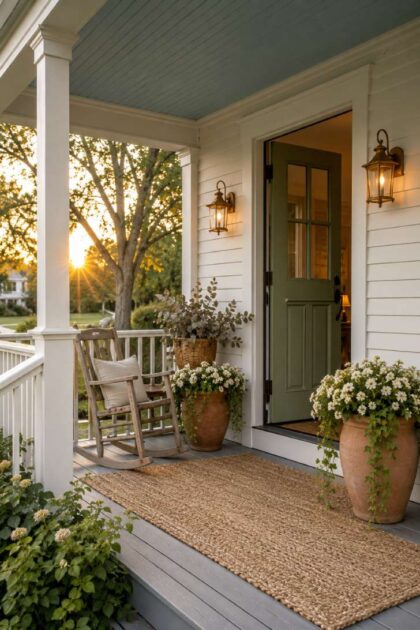
This post may contain affiliate links. If you make a purchase through these links, we may earn a commission at no additional cost to you.
A small front porch doesn’t need a grand footprint to leave a lasting impression.
Some of the most memorable entryways in any neighborhood belong to homes with just a few square feet of covered outdoor space.
What makes them work is intention — every piece of furniture, every plant, every color choice earns its place.
These 17 small front porch ideas prove that a compact porch can feel just as considered and inviting as one twice its size.
Whether you’re working with a narrow stoop or a petite covered entry, there’s something here you can start this weekend.
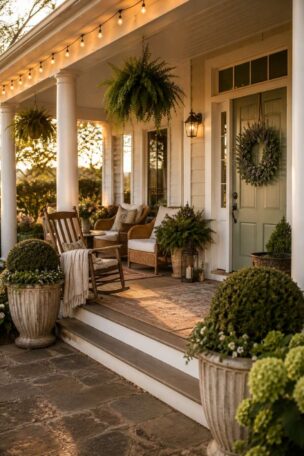
The Rocking Chair Corner
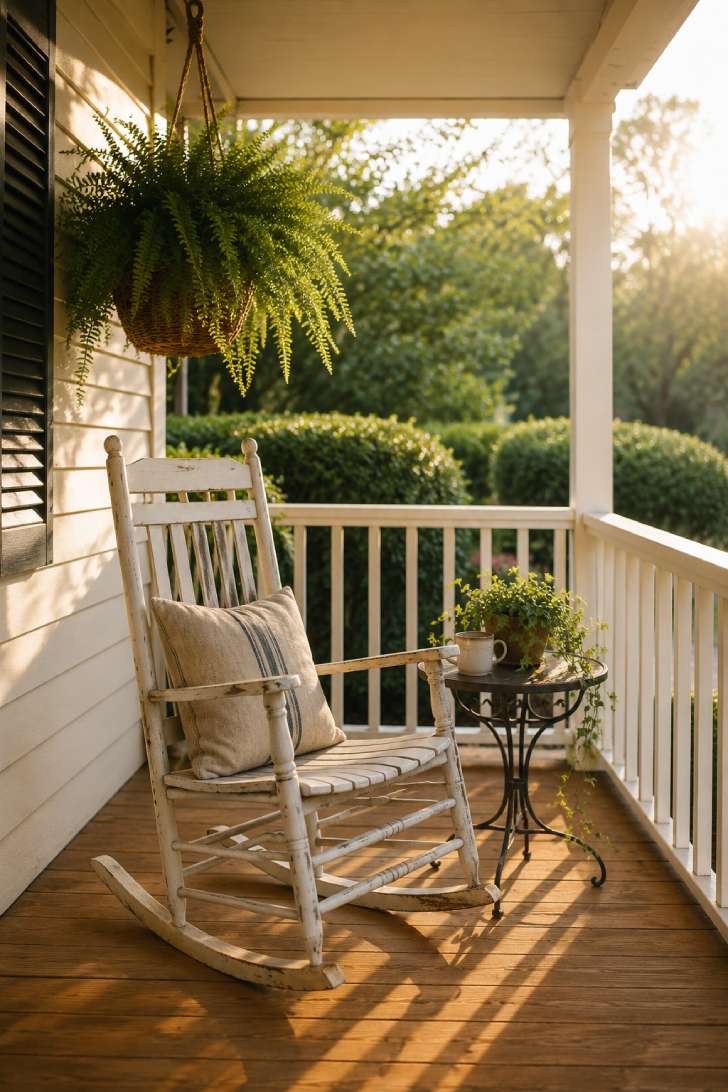
There’s a reason the rocking chair has never gone out of style on a front porch.
It asks you to slow down.
A single rocker placed at a slight angle toward the street — rather than flush against the wall — creates the feeling of a room, not a corridor.
Pair it with a petite side table just large enough for a drink, and suddenly you have a destination.
The hanging fern overhead does something interesting to how the space feels: it lowers the visual ceiling just enough to create a sense of shelter without closing things in.
That subtle enclosure is what turns an open ledge into a retreat.
On small porches, resist the urge to add a second chair.
One seat, one table, one overhead plant — that restraint is what gives the corner its calm.
Style Blueprint:
- Wooden rocking chair in white or natural finish
- Small round side table (wrought iron or wood)
- Hanging Boston fern in a woven basket
- Outdoor-safe ceramic mug or lantern as a styling prop
- Porch ceiling hook rated for hanging planters
Symmetrical Planter Entrance
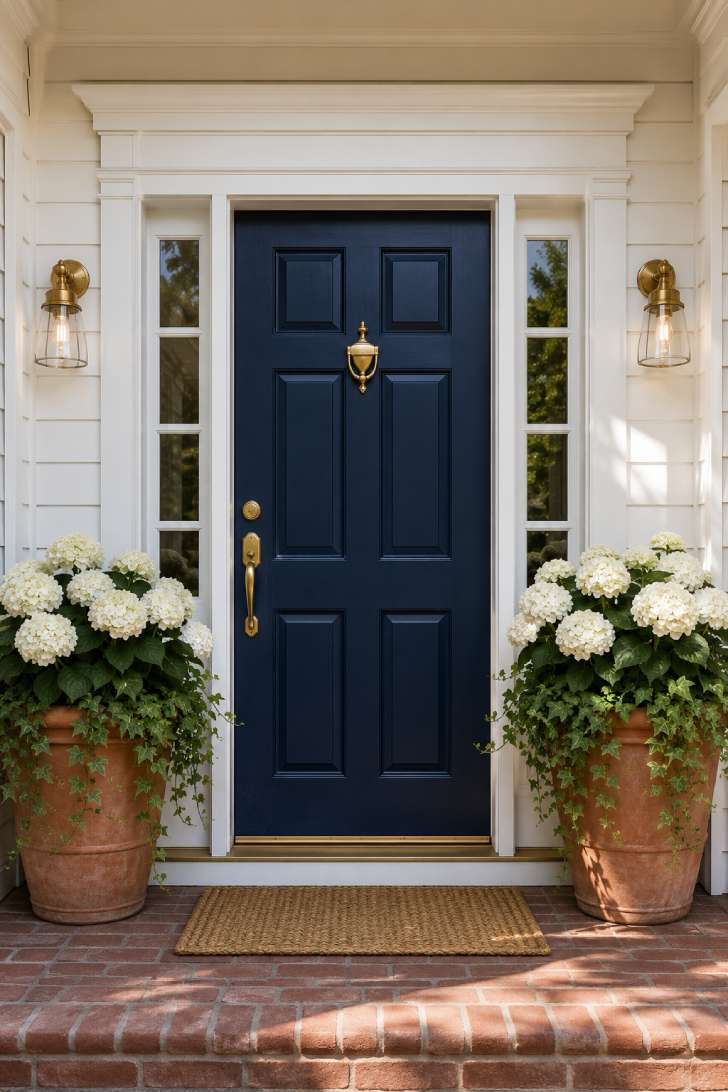
Two matching planters on either side of a front door might be the oldest trick in the curb appeal playbook.
It still works because symmetry communicates care.
Your eye reads a balanced entry as orderly and intentional, which is why hotels and high-end shops lean on this approach so heavily.
For small porches, the key is scale: the planters should be large enough to feel anchored but not so wide that they block the walkway.
Terracotta ages well and develops a patina over time, which keeps things from looking too rigid.
White hydrangeas paired with trailing ivy give you height, volume and movement in one container — and hydrangeas are surprisingly forgiving for container gardening porch setups.
The navy front door color behind them deepens the contrast, making those white blooms pop even more.
Style Blueprint:
- Two matching terracotta or concrete planters (16-18 inch diameter)
- White hydrangeas for seasonal blooms
- Trailing English ivy for year-round green
- Woven natural-fiber doormat
- Matching wall sconces in brass or black finish
The Bold Front Door

Changing the color of your front door takes an afternoon and costs less than dinner out.
Yet it completely resets the first impression of your home.
Sage green has been gaining ground as an alternative to the expected navy or black, and the reason is interesting: it reads as both modern and organic at the same time.
A gloss or semi-gloss finish amplifies the color and gives the door a lacquered, intentional look that flat paint can’t match.
Brass hardware warms the green and pulls it away from anything clinical.
On a small porch, the front door is the largest single surface, so its color sets the mood for everything else.
Choose one accent color and let the door carry it.
Then keep the surrounding trim, railings and walls quiet — white or soft gray — so nothing competes.
Style Blueprint:
- Exterior door paint in semi-gloss or high-gloss finish
- Brushed brass or satin brass door handle and kick plate
- Single statement planter with a structural plant (olive tree, boxwood topiary)
- White or light gray exterior trim
- Brass house numbers to coordinate with hardware
String-Lit Ceiling

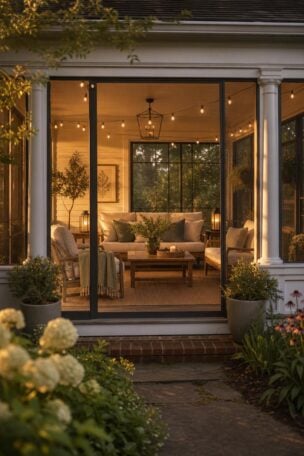
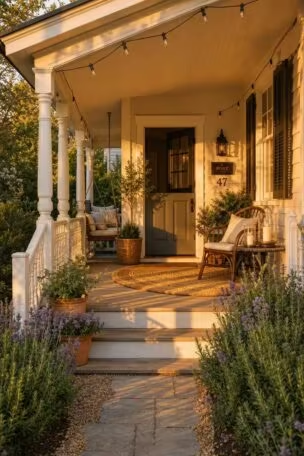
String lights are the fastest route to making a small porch feel like somewhere you’d actually want to spend an hour after dark.
The key is placement: drape them in loose, shallow swags across the ceiling rather than tacking them flat against the surface.
That slight droop gives the light a dimensional quality, almost like a low chandelier broken into tiny points.
A haint blue ceiling behind the lights deepens the evening effect and creates a backdrop that recalls open sky.
This old Southern tradition works just as well on a bungalow in Portland as it does on a shotgun house in Savannah.
The two-chair setup facing outward (toward the street rather than toward each other) is deliberate.
It creates a theater-like quality, a front-row seat to the neighborhood.
And that glass hurricane lantern on the crate between the chairs adds one warm focal point at a lower level, which layers the outdoor porch lighting in a way that feels considered.
Style Blueprint:
- Warm-white outdoor string lights (LED, weatherproof rated)
- Ceiling hooks or cup hooks for draping
- Two compact Adirondack or low-profile outdoor chairs
- Glass hurricane lantern with pillar insert
- Outdoor throw blanket in a neutral tone
Design Pro-Tip: When hanging string lights on a small porch, work from the four corners inward. Anchor each strand at the ceiling edges and let it dip gently toward the center — about six to eight inches of sag per swag is the sweet spot for porch ceilings under ten feet wide.
The Bistro Set Nook

A café table and two folding chairs can claim a porch corner that measures just three feet by three feet.
That’s the beauty of bistro furniture: it was designed for sidewalks in Paris where every inch of space costs a fortune, so it naturally suits the proportions of a small American porch.
Wrought iron reads as more permanent and polished than aluminum, even though both hold up to weather.
The folding aspect matters — on days when you need the full porch width for moving furniture or hosting guests, the chairs tuck flat against the wall.
Cream cushions soften the hard metal and tie the look together.
One small botanical print on the wall behind the set turns a leftover corner into a deliberate scene.
You’re not just putting chairs outside.
You’re creating a room.
Front porch decorating works best when it borrows from interior design thinking: define the space, give it a focal point and add one personal detail.
Style Blueprint:
- Round bistro table (24-30 inch diameter) in wrought iron or steel
- Two matching folding chairs with removable seat cushions
- Small vase or jar for fresh stems
- One wall-mounted frame or decorative element
- Potted herb (rosemary, thyme, or basil) as a functional accent
The Vertical Garden Wall
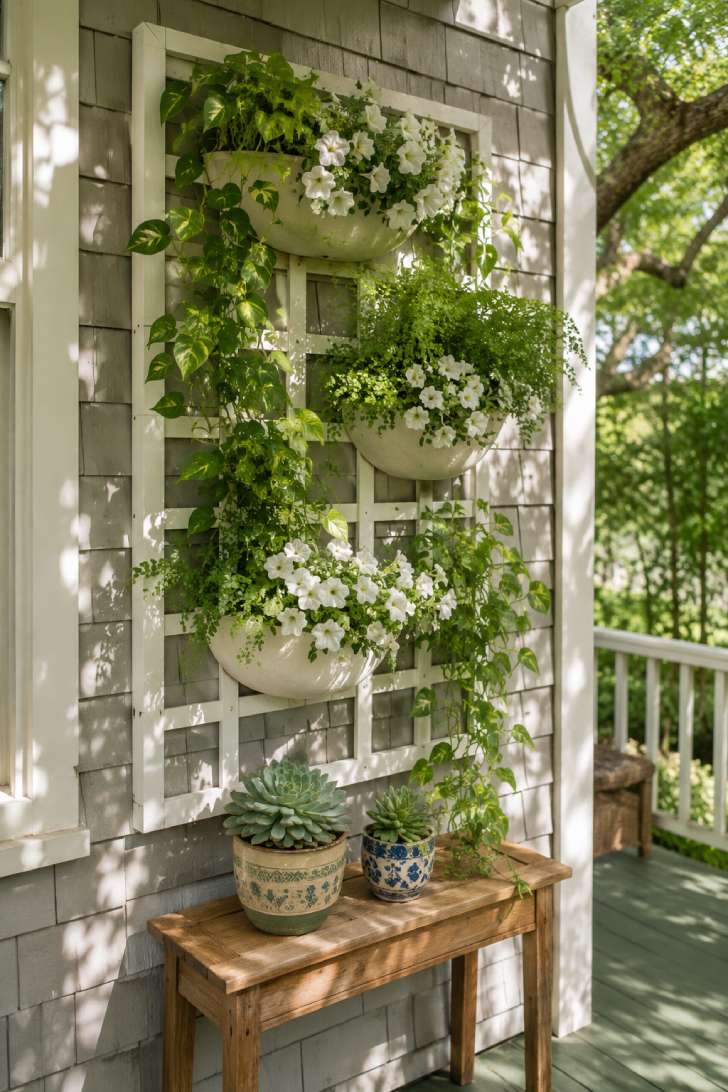
Going vertical is the smartest move you can make when the floor plan won’t give you more room.
A trellis mounted to a porch wall becomes a framework for hanging half-round planters at staggered heights, which creates the impression of a lush garden using exactly zero floor space.
Pothos is nearly indestructible and trails beautifully, which makes it the backbone plant for this kind of setup.
Mix in small ferns for texture variation and seasonal petunias for pops of white or soft pink.
Below the trellis, a narrow console table (twelve inches deep is plenty) gives you a surface for additional plants or a small lantern without blocking foot traffic.
The staggered placement matters from a perceptual standpoint.
Your eye moves upward and across when plants sit at different levels, which stretches the perceived size of a small porch.
Line everything up in a row and the effect falls flat.
Style Blueprint:
- White or natural wood trellis panel (sized to your wall)
- Half-round wall-mounted planters in matching finish
- Trailing pothos or philodendron
- Small ferns and seasonal flowering plants
- Narrow console table (10-12 inches deep) in teak or cedar
The Window Box Display

Window boxes solve a problem that most small porch owners share: you want flowers but have nowhere to put them.
Mounting boxes beneath windows or along porch railings gets the plants up to eye level where they create the most impact, and the porch floor stays completely clear.
Cedar is the preferred material because it resists rot naturally without chemical treatment, and it weathers to a silvery gray that complements almost any exterior color.
The planting formula here follows a time-tested approach: a “thriller” (the geraniums, upright and showy), a “filler” (dusty miller, adding silvery texture in the middle), and a “spiller” (trailing petunias, cascading over the edge).
That combination gives each box fullness and movement.
For container gardening porch arrangements, window boxes often outperform floor-level pots because they sit at the sightline of someone approaching your home.
They’re the first color visitors notice.
Style Blueprint:
- Cedar or composite window boxes (match to window width)
- Heavy-duty mounting brackets rated for wet soil weight
- Upright flowering plant (geraniums, snapdragons, or salvia)
- Filler foliage (dusty miller, licorice plant, or sweet potato vine)
- Trailing plant for the box edge (petunias, lobelia, or calibrachoa)
Farmhouse Bench with Pillows

A bench tells visitors something a chair cannot: you’re welcome to sit for a while.
It feels communal in a way that a single seat doesn’t, even on a small porch where only one person is likely to sit at a time.
A slatted-back bench in white paint against board-and-batten siding reads as farmhouse without tipping into themed territory.
The pillow arrangement here is doing real work.
Three cushions in coordinated but not matching patterns (a stripe, a solid, a subtle floral) create visual interest at a scale that reads well from the street.
That folded throw blanket isn’t just decorative; it invites someone to pull it over their lap on a cool evening.
And the personal details below the bench — the worn boots, the market basket — are what separate front porch decorating from catalog styling.
They suggest someone actually lives here and actually uses this porch.
That kind of authenticity registers even at a glance from the sidewalk.
Style Blueprint:
- Slatted wooden bench (48-60 inches wide) in white or natural finish
- Three coordinated outdoor pillows in mixed patterns
- Weather-resistant throw blanket in a neutral color
- Woven basket for seasonal styling (dried stems, blankets, or books)
- One or two personal items placed casually (boots, a hat, garden gloves)
The Layered Rug Setup

An outdoor rug can do for a small porch what a rug does for a living room: it tells your feet where the room begins.
Layering two rugs — a larger natural-fiber base with a smaller patterned rug on top — adds depth that a single rug can’t match.
The larger jute rug grounds everything in warm, neutral texture.
The smaller geometric piece on top introduces pattern and color without overwhelming the space.
Setting it at a slight angle keeps the arrangement from feeling too tidy, too arranged.
This approach works especially well on painted porch floors, where the contrast between the hard surface and the soft fibers creates a strong sense of transition from outdoors to indoors.
Rattan chairs on a layered rug setup lean toward a bohemian covered porch design, but you could just as easily swap them for Adirondack chairs or a wooden bench and land in a completely different style.
The rug layer is the foundation — what goes on top adapts to your taste.
Design Pro-Tip: Choose outdoor rugs made from polypropylene or recycled plastic for porches exposed to rain. They dry quickly and resist mildew. Jute looks gorgeous but deteriorates fast in wet climates, so reserve it for fully covered porches only.
Lantern Cluster on Steps
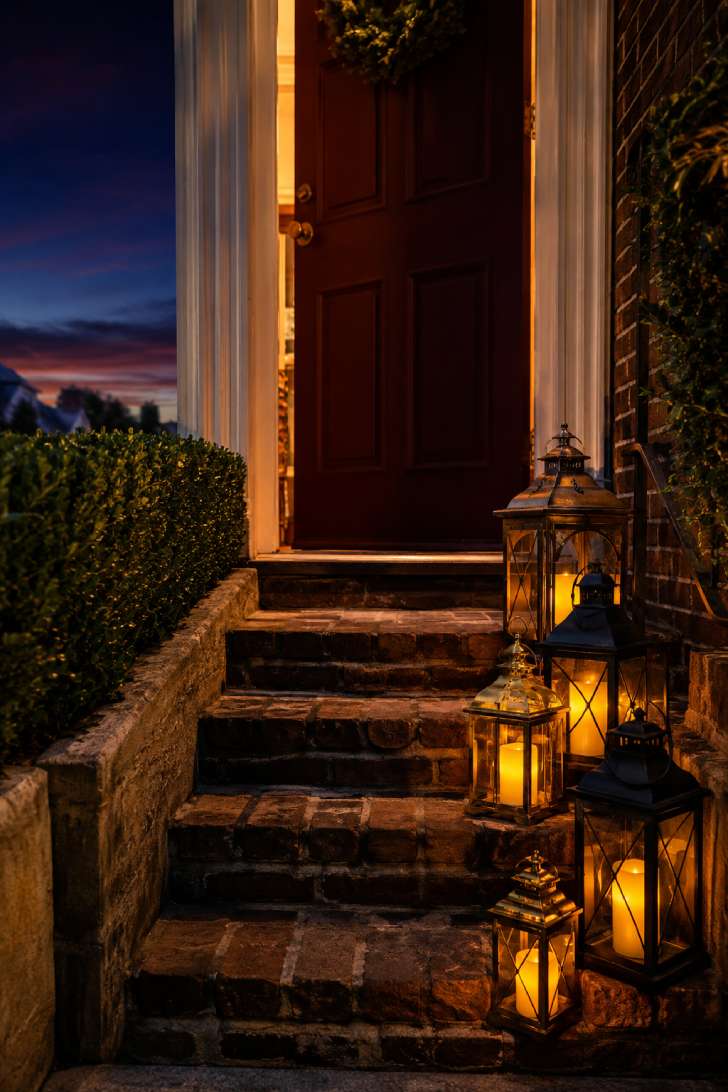
Grouping lanterns on porch steps creates a procession of light that draws visitors upward toward the front door.
The effect is almost ceremonial — each step gets brighter as you approach the entry.
Odd numbers work best for groupings (five lanterns here, though three is fine for narrower stairs), and varying the heights prevents the arrangement from looking like a store display.
Mixing two metal finishes (black iron and weathered brass, for instance) gives the cluster an collected-over-time quality.
LED flickering pillar inserts mimic real flame convincingly now and eliminate any fire concern on a wooden porch.
This is outdoor porch lighting that doubles as sculpture.
During the day, the lanterns sit as decorative objects.
At night, they perform.
That dual function is especially valuable on a small porch where every item needs to justify its presence.
Style Blueprint:
- Three to five lanterns in varying heights (6 to 18 inches)
- Mixed metal finishes (black, brass, or copper)
- LED flickering pillar inserts (battery or solar powered)
- Arrangement placed to one side of the steps, leaving a clear walking path
- Low boxwood or evergreen in a planter to anchor the opposite side
The Hanging Swing
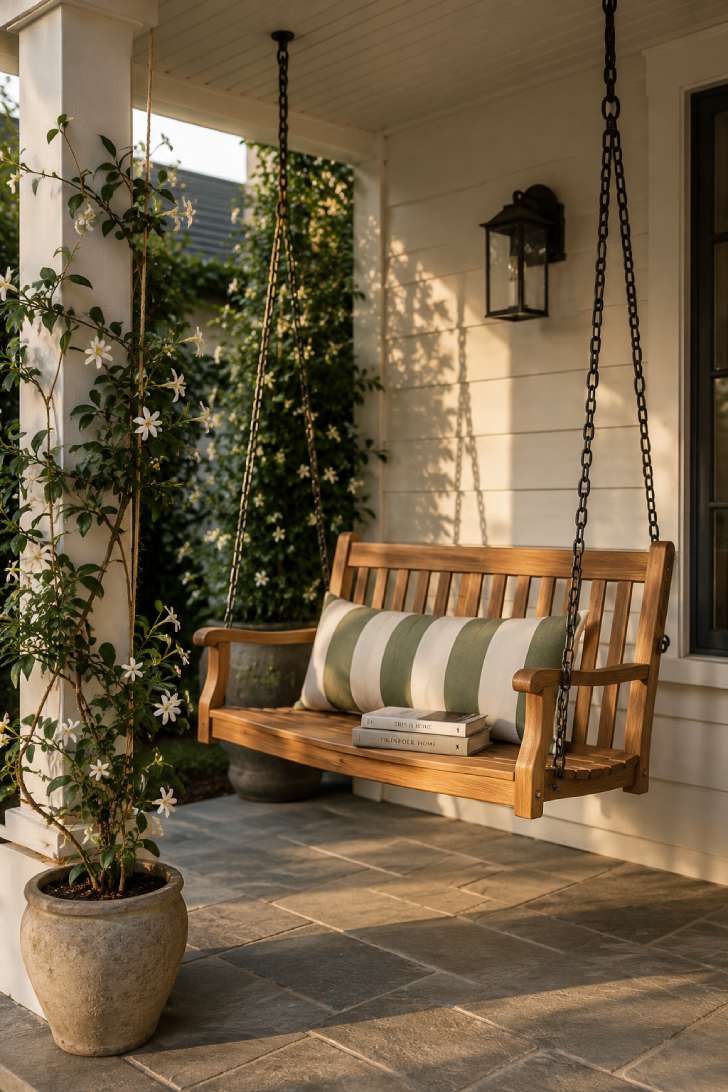
A porch swing on a small porch feels like a luxury, and that’s exactly the point.
It signals that this space is about comfort, not just passage.
The concern most people have — that a swing will overwhelm a tiny porch — disappears when you choose a compact model (four feet wide is enough for one person to sit comfortably or two to squeeze in).
Teak earns its reputation here: it handles moisture without rotting, and its golden tone deepens over seasons.
The single long lumbar pillow is a smarter choice than multiple throw pillows on a swing, because everything stays in place when the seat moves.
Climbing jasmine on the posts does two things at once: it softens the hard vertical lines of the support columns and fills the air with fragrance during blooming season.
That scent is a dimension of porch swing small space design that photos can’t capture but visitors never forget.
Style Blueprint:
- Compact porch swing (48 inches or less) in teak, cedar, or painted wood
- Heavy-duty ceiling hooks and chains rated for swing weight plus occupants
- Single lumbar or bolster pillow in a weather-resistant fabric
- Climbing vine (jasmine, clematis, or mandevilla) trained on each post
- Small stack of books or a folded blanket as a styling touch
Painted Porch Floor
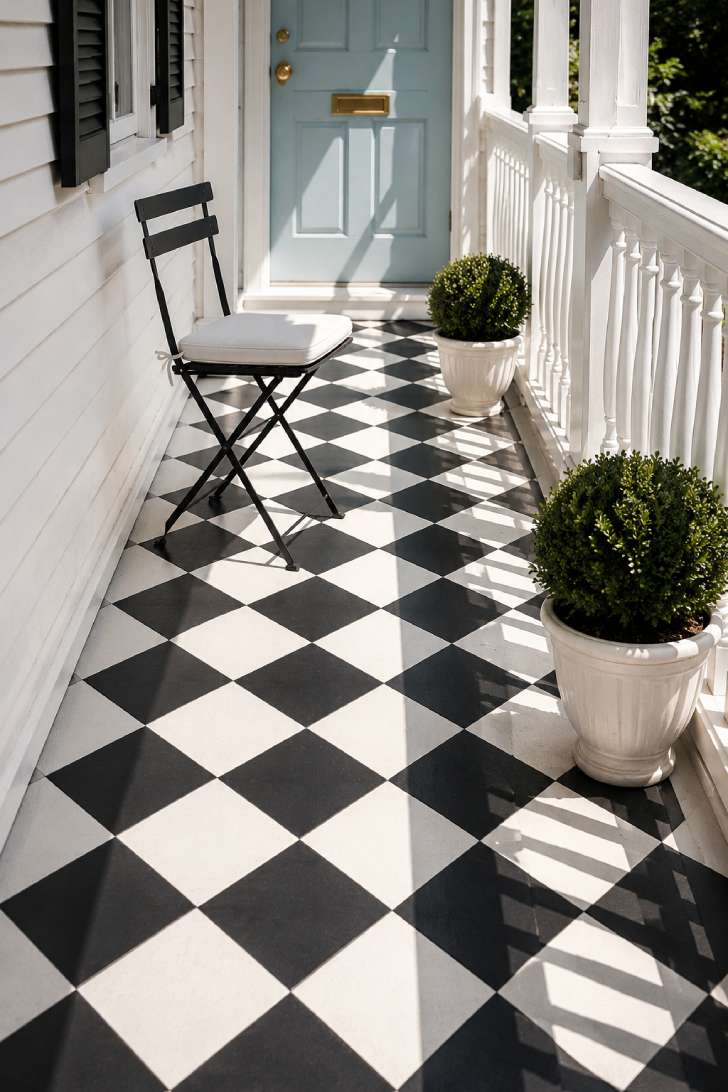
Painting a porch floor is one of the most underused tools in a homeowner’s kit.
For the cost of a gallon of porch paint and a roll of painter’s tape, you can give a tired, worn surface a personality transplant.
The black and white checkerboard is a classic covered porch design that borrows from grand Southern estates and European garden pavilions alike.
On a narrow porch, running the diamonds lengthwise creates a visual corridor that actually makes the space feel longer than it is.
The trick to getting clean lines is patience with the tape and two coats of each color.
Porch and floor enamel is formulated to handle foot traffic and weather, so the pattern holds up far better than regular exterior paint.
White railings and a pale blue door against this graphic floor keep the palette tight.
Everything plays off the same cool, clean tones.
The boxwoods in matching planters repeat the geometry of the floor pattern — circles against diamonds — which creates the kind of interplay that makes designers obsess over details.
Design Pro-Tip: Before committing to a full checkerboard, test your pattern with a 2×2 foot sample in a corner. Live with it for a few days. What looks exciting in a photo can feel busy in person depending on the size of your diamonds relative to your porch width.
The Seasonal Wreath Door
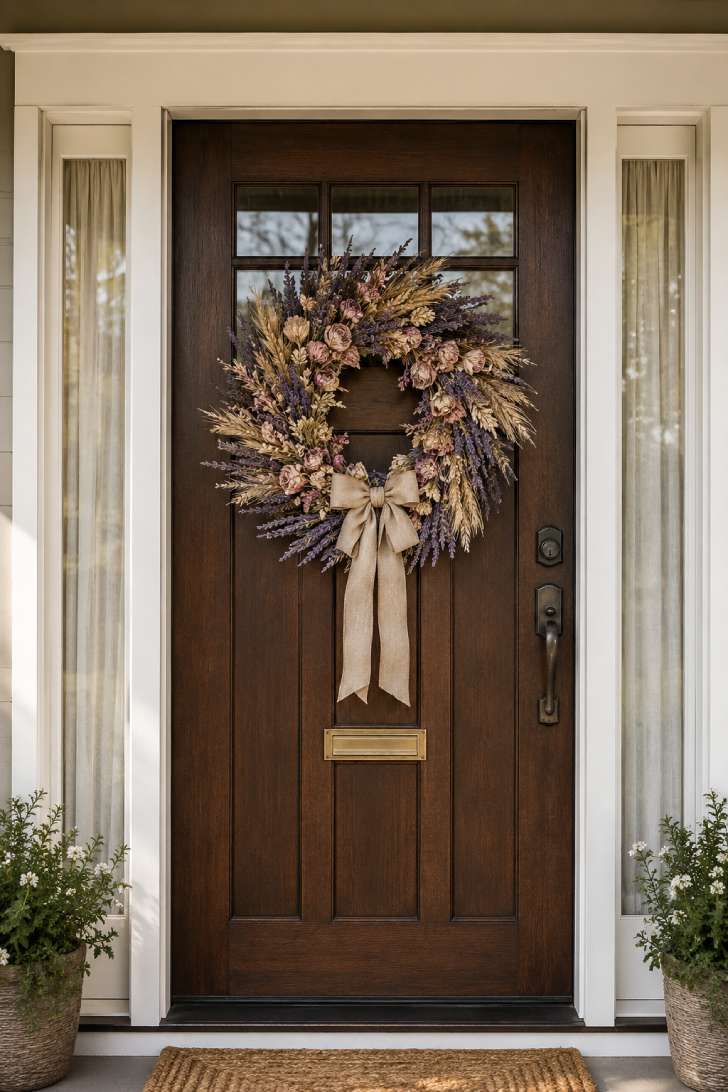
A wreath can shift the entire mood of a porch entrance with one swap.
Spring calls for fresh greenery and pastel blooms.
Summer works with dried lavender, herbs, or a sunflower ring.
Fall is the obvious season — grapevine bases loaded with bittersweet berries, mini pumpkins, or dried corn husks.
Winter brings evergreen boughs, pine cones and red berries.
What makes seasonal porch decor work on a small porch is concentration.
You don’t have room for a full seasonal vignette with hay bales, cornstalks and a carved pumpkin family.
But a single, beautiful wreath at eye level commands attention precisely because it’s the only seasonal element.
The dried lavender and wheat combination here works for late summer through early fall, and it smells as good as it looks.
A wide linen ribbon at the base grounds the arrangement and keeps it from looking like it might blow away.
Style Blueprint:
- Wreath base (grapevine, wire, or straw form, 18-22 inch diameter)
- Seasonal dried or fresh botanicals
- Wide ribbon in natural linen, burlap, or grosgrain
- Over-the-door wreath hanger (avoids drilling into the door)
- Rotate wreaths at least four times per year for a fresh look
Monochromatic Plant Arrangement
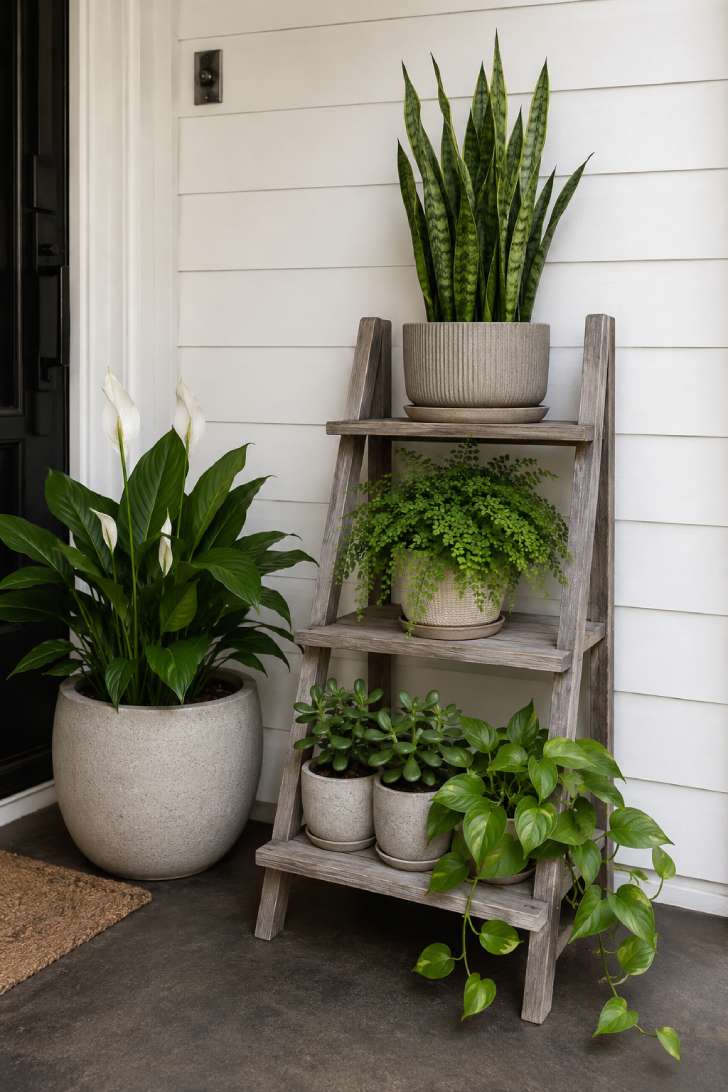
Limiting your porch plants to a single color family might sound restrictive, but the result is anything but.
An all-green arrangement puts the focus on texture and form instead of color — and that’s where plants get interesting.
The waxy, upright blades of a snake plant contrast sharply with the delicate, feathery fronds of a maidenhair fern.
Plump jade leaves sit next to the glossy hearts of a trailing pothos.
Same color, completely different characters.
A tiered plant stand organizes this variety vertically, which again saves floor space on a small porch.
The tallest plant goes on top, cascading varieties on the bottom shelf where they can trail freely.
This kind of curated container gardening porch display reads as sophisticated because of its discipline.
When everything is green, nothing fights for attention and your eye can rest.
The peace lily on the floor anchors the grouping and adds a burst of white when it blooms.
Design Pro-Tip: Group plants with similar light and water needs on the same stand. A tiered shelf in a shaded porch corner suits ferns, pothos, and peace lilies perfectly, but sun-loving succulents would struggle there. Match the plants to the porch’s conditions, not the other way around.
The Cozy Textile Layer
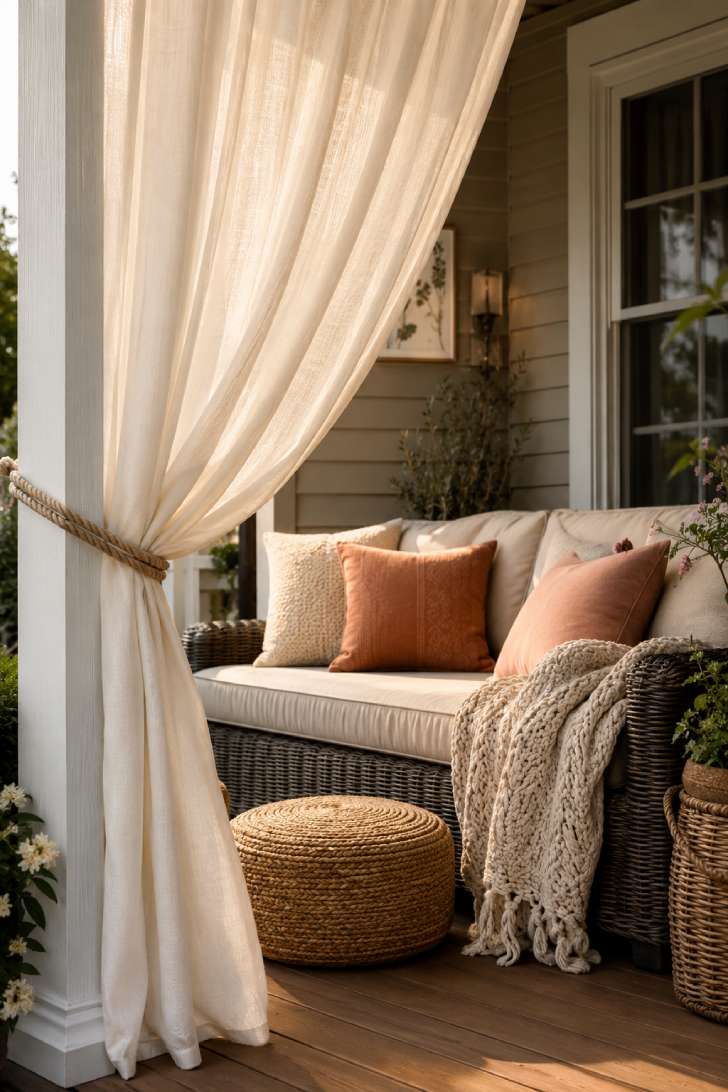
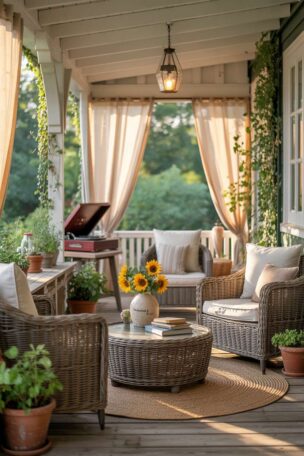
Outdoor curtains on a small porch might seem excessive, but they solve a real problem: most small porches feel exposed.
A single sheer panel tied back to a column doesn’t block the view or the breeze, but it creates a visual boundary that says “this is a room.”
That psychological shift — from open ledge to enclosed space — changes how you use the porch entirely.
You linger longer when you feel some shelter around you.
The wicker loveseat is a two-person seat that works where a full sofa wouldn’t fit.
Layering pillows in tonal variations of the same warm family (sand, terracotta, blush) avoids the carnival effect that comes from mixing too many bright colors in a tight space.
And that chunky knit throw isn’t just for looks.
On a 55-degree evening in early spring, it’s the difference between going inside after ten minutes and staying out for an hour.
The jute pouf at the base completes the living-room-outside feeling and gives you a place to prop your feet.
Style Blueprint:
- Sheer outdoor curtain panel (one per porch column, in ivory or white)
- Rope or jute tiebacks
- Cushioned outdoor loveseat or small sofa (52-60 inches wide)
- Coordinated throw pillows in tonal warm neutrals (3-5 pillows)
- Chunky knit or woven throw blanket
Statement House Numbers
House numbers are one of those functional details most people never think about as a design opportunity.
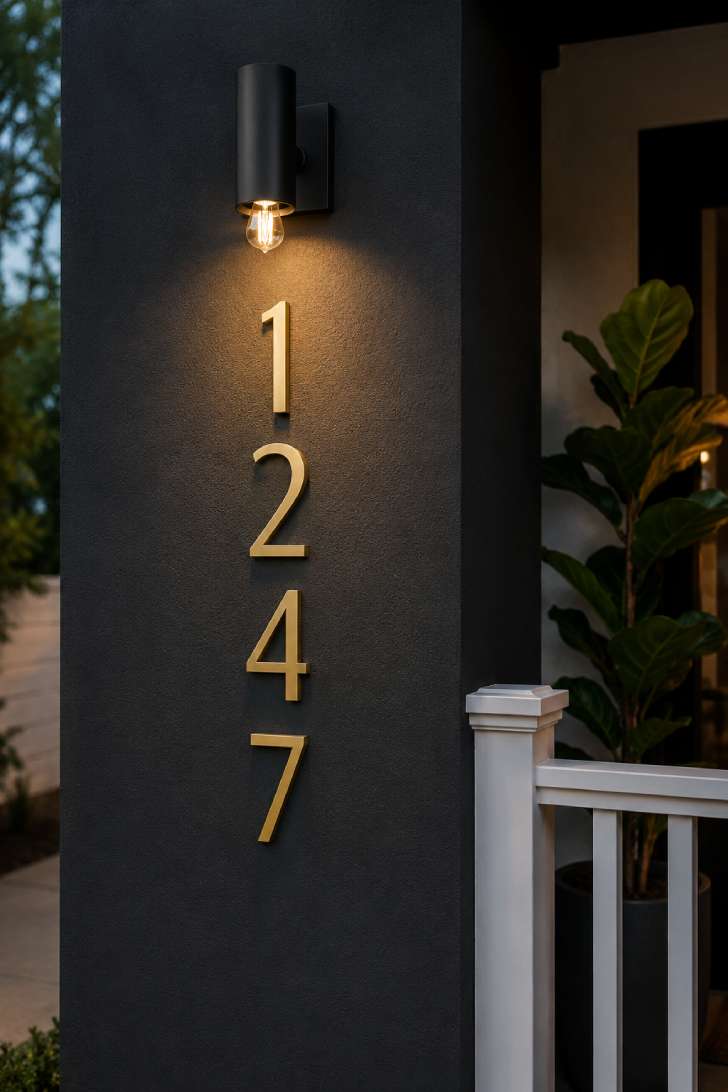
On a small porch, where you can’t rely on a grand facade to create presence, a set of oversized or uniquely styled numbers becomes wall art that happens to serve a purpose.
The vertical column arrangement here breaks from the usual horizontal lineup, which immediately catches attention because it’s unexpected.
Eight-inch brass digits against a charcoal wall have the kind of contrast that reads clearly from the curb — which is, after all, the point of house numbers — but they do it with style.
A single sconce positioned above the top number creates a wash of warm light downward over all four digits in the evening.
This is curb appeal at its most efficient: one small change that costs under a hundred dollars and signals intentional design from fifty feet away.
Brass, matte black, brushed nickel, hand-painted ceramic tiles, backlit LED panels — the range of available styles means there’s a house number treatment for every architectural style.
Style Blueprint:
- Individual house number digits (6-10 inches tall) in brass, black, or nickel
- Mounting template for even spacing
- Small wall sconce or downlight positioned to illuminate numbers at night
- Contrasting wall paint to make numbers pop
- Vertical or staggered arrangement for a modern twist
The Mixed-Material Porch
When everything on a porch matches perfectly — same material, same color, same era — the result can feel flat.
Mixing materials is how you give a small space visual depth.
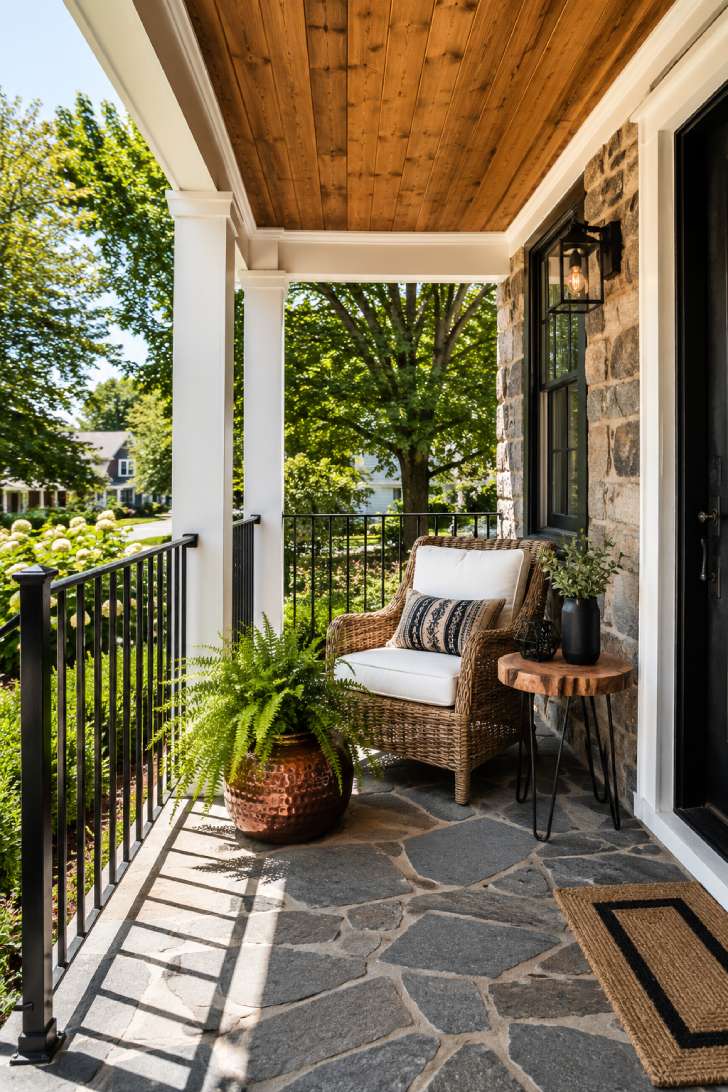
Iron, stone, rattan, wood, copper: each surface catches light differently, which creates movement even when nothing is actually moving.
The black iron porch railing ideas here lean modern, but the rattan chair softens that edge.
The live-edge side table brings an organic line that contrasts with the railing’s geometry.
And the hammered copper planter introduces a warm metallic tone that plays off the cool bluestone floor.
None of these pieces “match” in the traditional sense, and that’s what makes the porch feel collected rather than decorated.
On a small porch, three or four materials is enough to create richness.
More than that can start to feel chaotic in a confined space.
The trick is choosing materials with enough contrast in color and texture to read as distinct, but enough tonal harmony (cool metals with cool stone, warm wood with warm copper) to feel cohesive.
Design Pro-Tip: Pick one material to repeat. In this porch, black iron appears in both the railing and the table legs, which threads the composition together even across different object types. One repeated element gives mixed materials a through-line.
Conclusion
A small front porch is an exercise in editing.
Every piece you choose displaces something else, so each one carries more weight than it would on a sprawling wraparound veranda.
That constraint is actually a gift.
It forces you toward clarity — toward the one rocking chair that fits just right, the single paint color that changes everything, the wreath that rotates with the season.
Start with whichever idea on this list made you pause the longest.
That instinct is worth following.
Buy one thing, rearrange one corner, paint one surface.
A small porch doesn’t ask for a total overhaul.
It rewards small moves, done well.