This post may contain affiliate links. If you make a purchase through these links, we may earn a commission at no additional cost to you.
Your front patio is the handshake your home offers to every person who walks up.
And yet, most of us ignore it — a bare slab, maybe a tired doormat, possibly a forgotten plant pot from three seasons ago.
Here’s the thing: turning that neglected rectangle into a space you actually want to sit in doesn’t cost what you think.
A hundred dollars and a free Saturday afternoon can change everything.
These 13 budget front patio ideas work whether you’ve got a sprawling wraparound or a three-foot-by-five-foot concrete square in front of your apartment door.
Pick one, pick five, mix them up — your front patio is about to become the coziest spot on the block.
Layered Doormats for an Instant Welcome
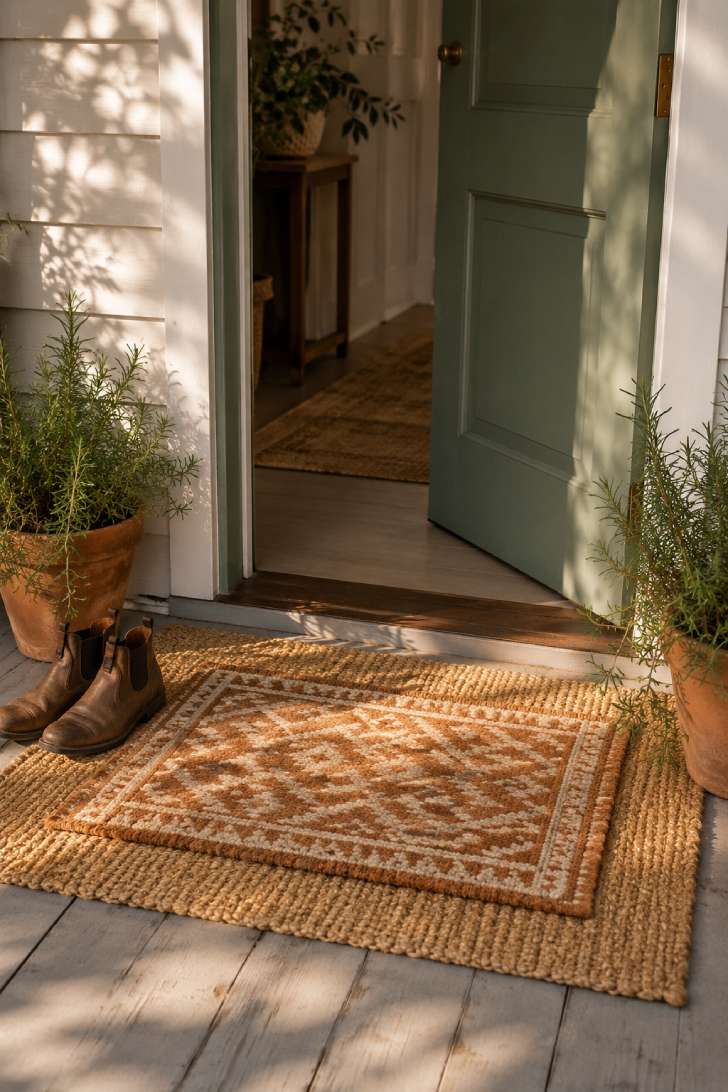
This is the five-minute upgrade that punches way above its weight.
Grab a large natural-fiber mat — jute or coir, around $15 — and set a smaller patterned one on top of it.
That two-layer look creates depth at your doorstep that a single mat never could.
Your eye reads it as intentional, designed, considered.
There’s a reason interior stylists use this trick in every porch photoshoot: layering signals that someone cares about the details.
Even on a cramped small front porch, stacked doormats define the entry zone without taking up any real space.
Swap the top mat seasonally — stripes in summer, something with warm tones come fall — and the entrance always feels current.
Style Blueprint:
- Large natural jute or coir base mat (at least 3′ × 5′)
- Smaller patterned accent mat in a complementary palette
- Matching or coordinating front door color
- Two small potted herbs or trailing plants flanking the doorway
- A simple door knocker or handle in matte black or brass
Oversized Planters Flanking the Door
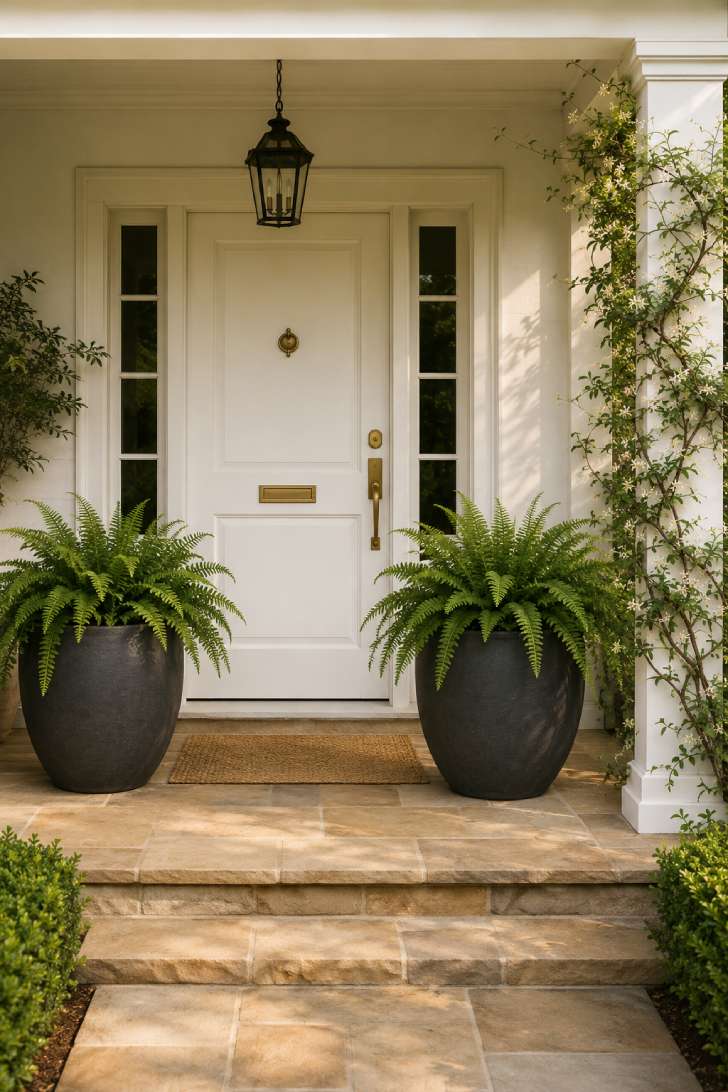
Symmetry does something to the brain that’s hard to argue with.
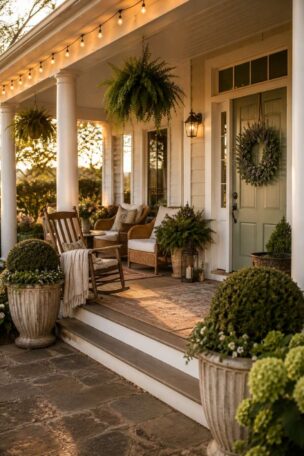
Two matching planters on either side of your front door create a sense of order and intention that immediately lifts curb appeal.
You don’t need to spend $200 on ceramic vessels, either.
Concrete planters from a home improvement store run $25–$40 each, and painted terra cotta pots cost even less.
Fill them with whatever blooms in your zone — petunias and geraniums for sun-drenched south-facing patios, ferns and hostas for shade.
The container garden approach means you can switch out plants as seasons change without ripping anything out of the ground.
One trick that keeps this from looking generic: choose an odd-numbered group of plants inside each pot.
Three plants per container — one tall, one mounding, one trailing — creates a full, layered composition that looks like a professional planted it.
Style Blueprint:
- Two matching planters, 18″–24″ diameter, in concrete, ceramic or painted terra cotta
- Thriller-filler-spiller plant arrangement in each pot
- Coordinating doormat centered between the planters
- House numbers or a porch light that complements the planter finish
- Seasonal blooms rotated every 8–12 weeks
A Tiny Bistro Set for Morning Coffee
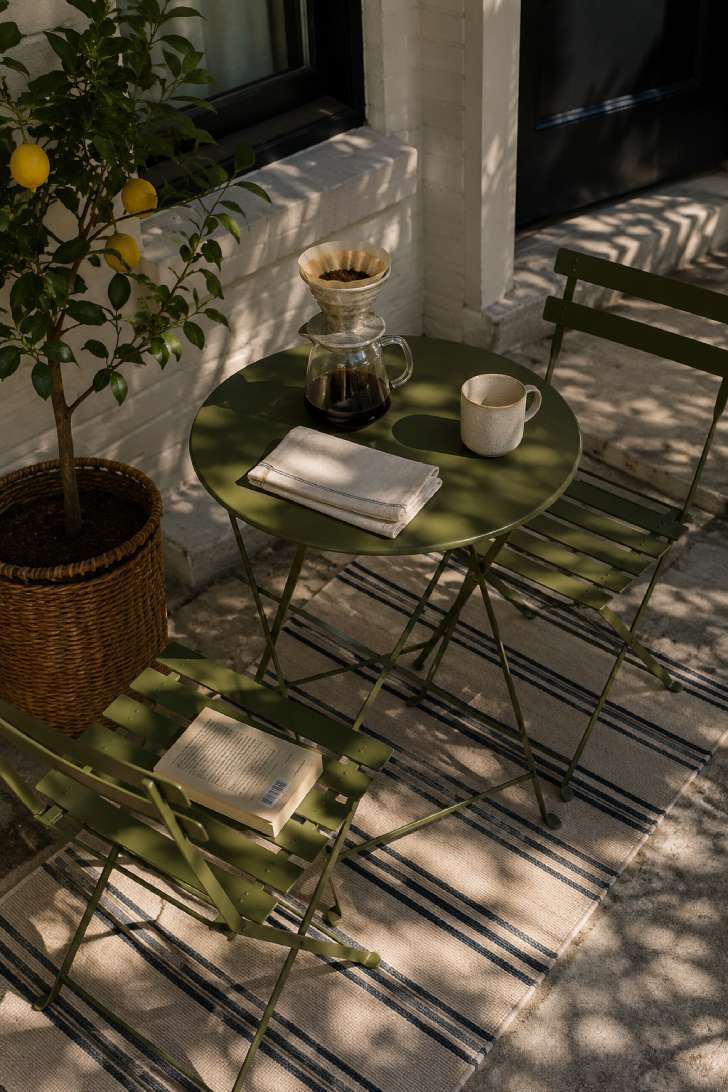
Most front patios go unused because there’s nowhere to sit.
Fix that with a small bistro set — one table, two chairs — and suddenly you’ve got a reason to be out there at 7 a.m. with a cup of coffee.
Metal café sets fold flat and tuck against the wall when you need the space back for foot traffic.
A bistro table takes up about four square feet, which is less than most welcome mats.
Where you place the outdoor seating area matters more than what you buy.
Angle the chairs so they face the street or your garden, not the front door — you want to look outward, not at your own house.
And toss a small outdoor rug underneath to anchor the whole arrangement and give it a “room” feeling, even though the ceiling is the sky.
Style Blueprint:
- Folding or stackable bistro set in weather-resistant metal or resin
- Small outdoor rug (3′ × 5′) in a stripe or solid beneath the set
- A potted plant or herb on the table as a low centerpiece
- Two outdoor seat cushions with removable, washable covers
- A small tray or basket to corral coffee supplies or reading material
A Bold Front Door Color
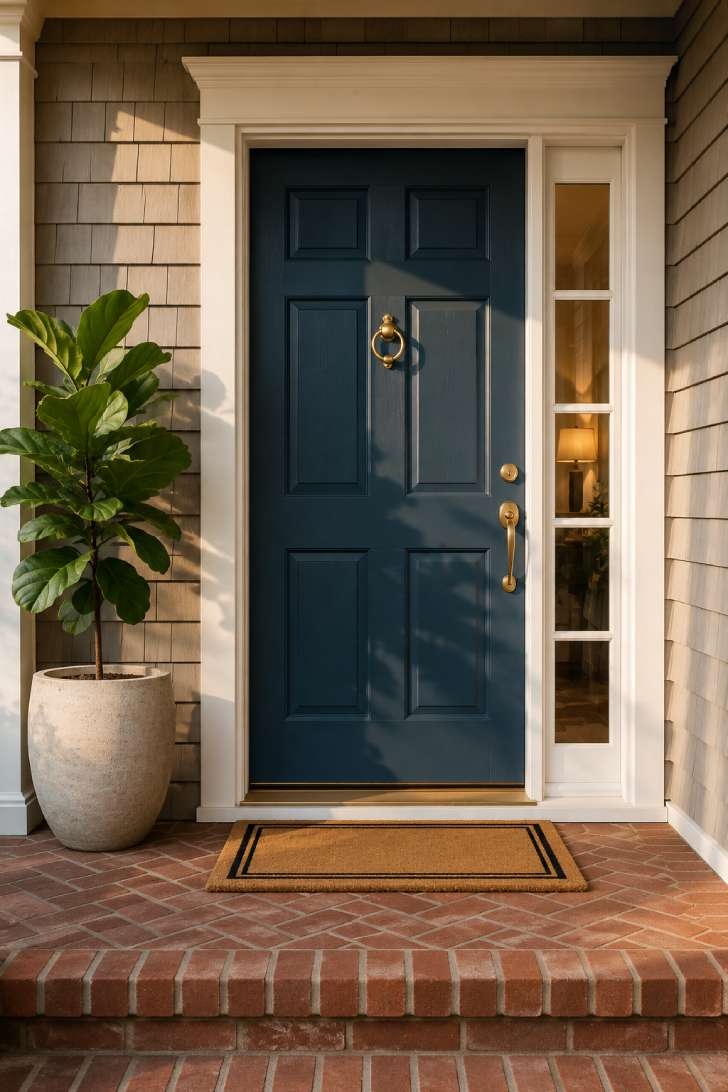
Color at the front door sets the entire personality of your home’s facade, and swapping a faded beige for a deep teal, warm terracotta, or rich navy signals confidence.
The space around the door matters, too — fresh white trim amplifies whatever color you choose and creates a frame that makes the door feel like a statement piece.
Prep takes longer than the actual painting: clean the surface, sand lightly, tape off the hardware and hinges, then apply two coats with a foam roller for a smooth finish.
The whole project wraps up in an afternoon.
Pick a color that contrasts your siding rather than matching it.
Dark doors against light siding create drama; a warm yellow or coral door against dark gray siding feels unexpected and cheerful.
Style Blueprint:
- One quart of high-quality exterior semi-gloss paint in a bold hue
- Painter’s tape and a foam roller for a smooth, brushstroke-free finish
- Updated door hardware (knob or lever and knocker) in a matching metal tone
- Fresh white paint on the surrounding trim for contrast
- A coordinating accent in nearby decor (pillow, planter, wreath) that echoes the door color
Design Pro-Tip: Before committing to a door color, paint a large piece of cardboard and tape it to the door for 24 hours. Colors look completely different under morning sun, midday glare and porch-light glow. What felt perfect at noon might wash out at dusk.
String Lights for Evening Magic
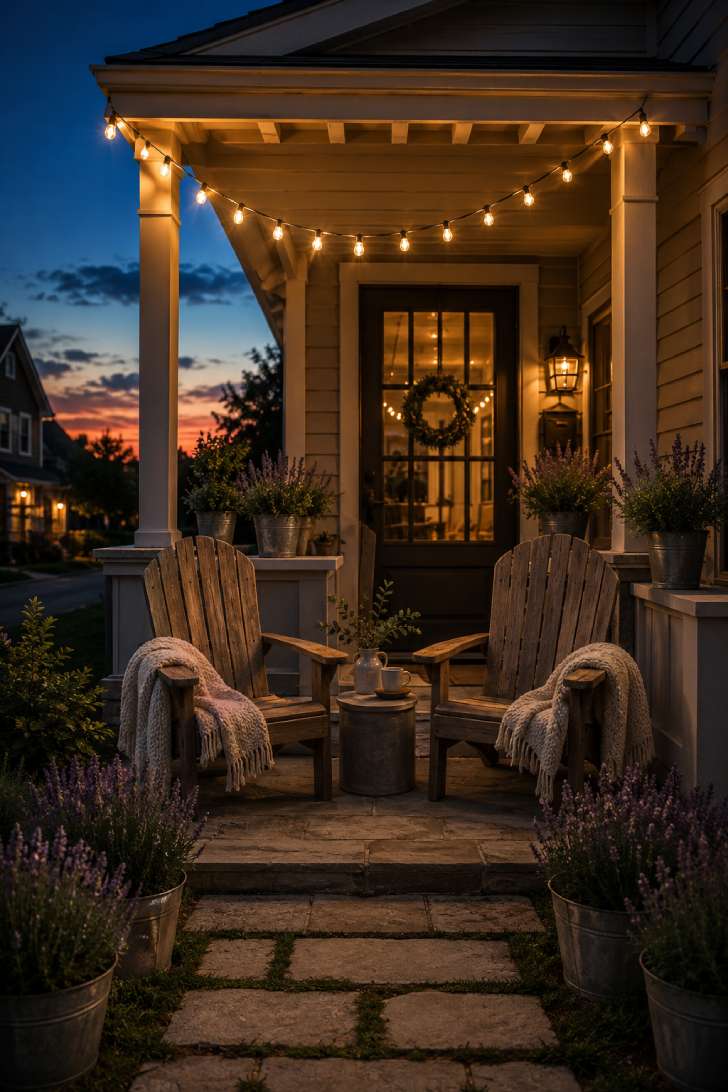
String lights outdoor setups are the single most requested patio upgrade on every home-improvement forum, and for good reason.
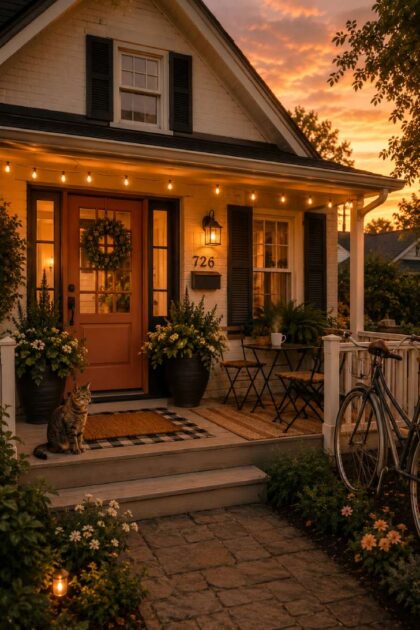
A $15 strand of LED bulbs turns a dark, forgettable porch into a place people actually want to linger after sundown.
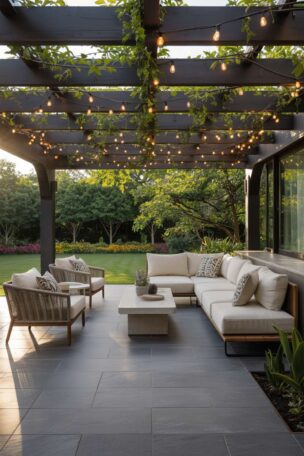
Drape them between porch columns, wrap them along the railing, or run them in parallel lines across the ceiling for a canopy effect.
Warm white bulbs (2700K) mimic the color temperature of a living room lamp, which is why they feel so comfortable.
Cool white or multicolor bulbs read as festive rather than cozy — save those for holiday season.
Solar-powered versions eliminate the need for an outdoor outlet, though they dim faster on overcast days.
Plug-in sets with a timer switch are the most reliable option for consistent evening glow.
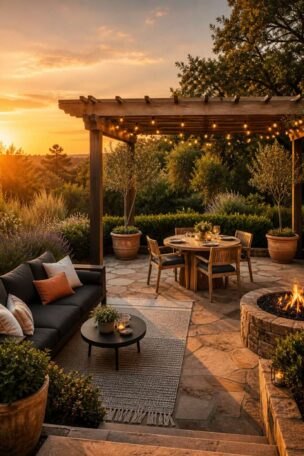
Pair them with a couple of string lights outdoor accessories — a matching lantern or two on the steps — and the front patio becomes an outdoor living room from 7 p.m. onward.
Style Blueprint:
- 25–50 foot strand of warm white LED string lights (2700K color temperature)
- Cup hooks or adhesive clips rated for outdoor use to mount the strand
- A manual or smart-plug timer so the lights come on at dusk automatically
- One or two battery-operated lanterns for tabletop accent light
- A cozy throw blanket on each chair for cool evenings
An Outdoor Rug That Defines the Room
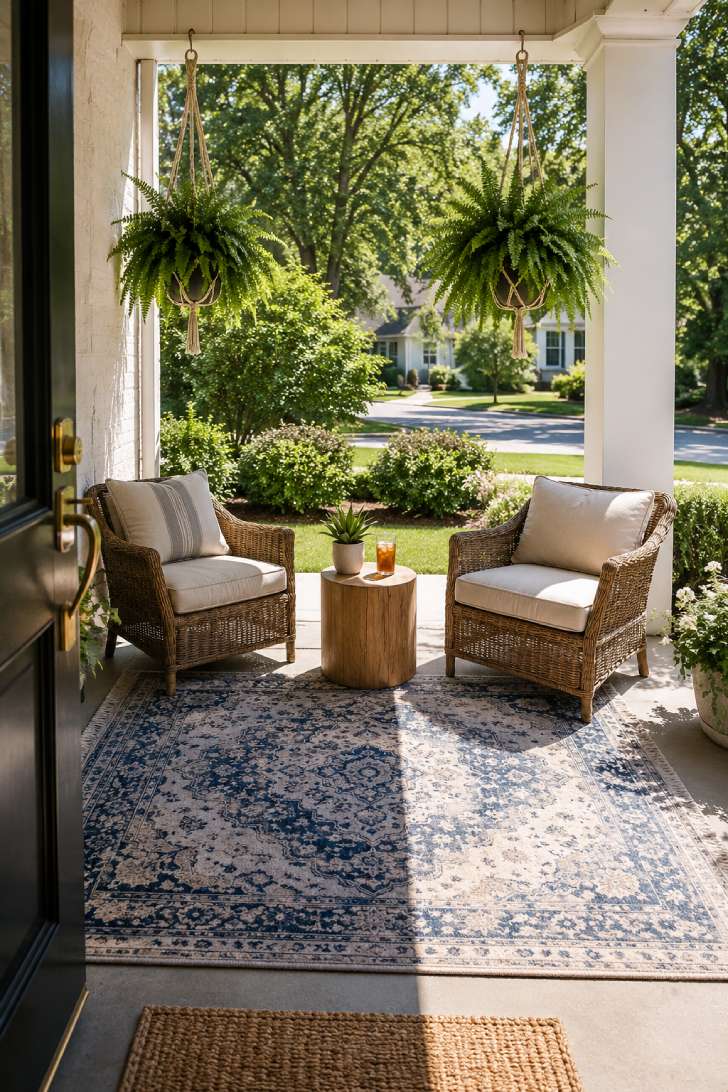
Drop an outdoor rug on bare concrete and the patio suddenly has a center, a boundary, a purpose.
It’s the same principle that makes a living room rug pull furniture together.
This choice gives the room a quieter, softer visual character.
Polypropylene rugs are made for this.
Control moisture and address leaks promptly.
EPA recommends keeping indoor relative humidity below 60% when possible, ideally 30–50%, and drying wet materials within 24–48 hours.
Prices start around $20 for a 4′ × 6′, which is enough to anchor two chairs and a small table.
Light colors and open patterns make a small front porch feel more spacious because they reflect sunlight rather than absorbing it.
Avoid dark, busy patterns in tight spaces — they shrink the visual footprint.
Position the rug so all front furniture legs sit on it, or at least the front two legs of each chair, for that grounded, composed look.
Style Blueprint:
- Flat-weave polypropylene outdoor rug, 4′ × 6′ or 5′ × 7′
- A pattern with no more than two or three colors
- Rug pad or grip tape underneath to prevent sliding on smooth surfaces
- Furniture positioned so legs rest on the rug, not off its edges
- A quick hose-down every two weeks to keep it fresh
A DIY Pallet Bench
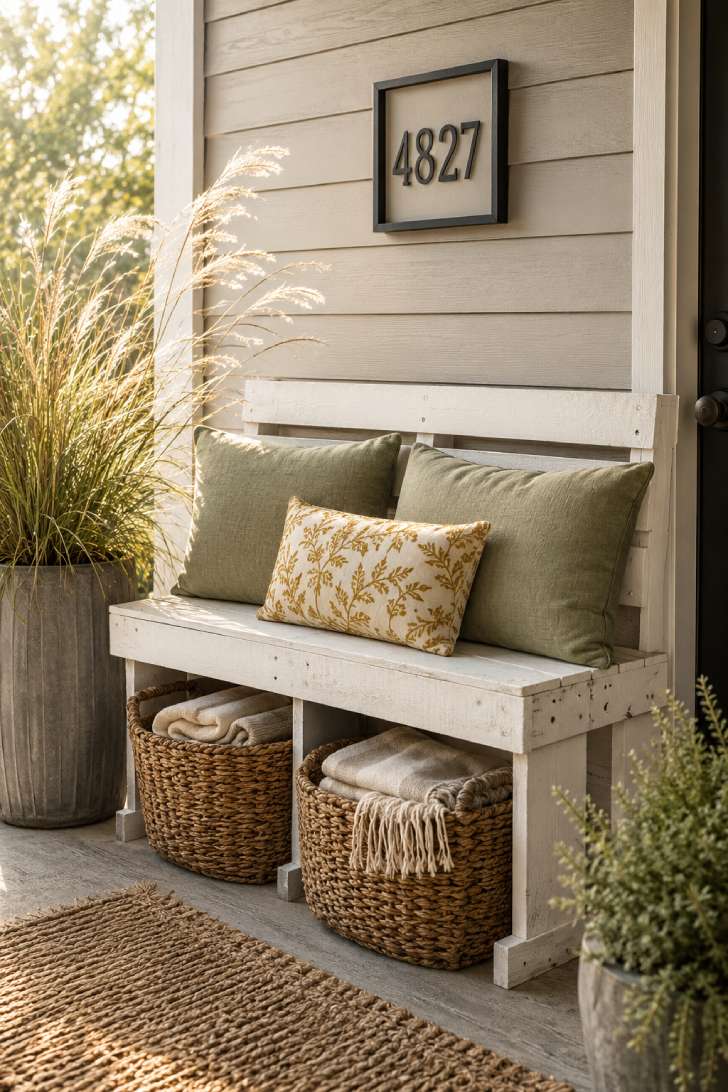
Pallets are free behind most hardware stores and grocery warehouses — ask before you take one, but they’re almost always headed for the dumpster anyway.
Sand the surface to remove splinters, screw two pallets together (one as the seat, one as the backrest), paint or stain the whole thing, and you’ve got a bench that cost you nothing but time.
A DIY patio project like this takes about three hours from start to finish.
The rough, honest texture of reclaimed wood adds character that factory furniture can’t replicate.
Toss two or three outdoor cushions on top and a lumbar pillow against the back, and nobody would guess the base was salvaged.
Mount it against the house wall so it doubles as a drop zone for bags and packages when you come through the door.
Store a couple of baskets underneath for throws, gardening gloves or whatever else collects near the entrance.
Style Blueprint:
- One heat-treated pallet (look for the “HT” stamp — avoid chemically treated ones)
- Exterior wood stain or paint in a color that coordinates with your trim
- Sandpaper (80-grit for rough passes, 120-grit for finishing)
- Two to three weather-resistant outdoor cushions with removable covers
- Baskets or bins underneath for hidden storage
Vertical Planters to Free Up Floor Space
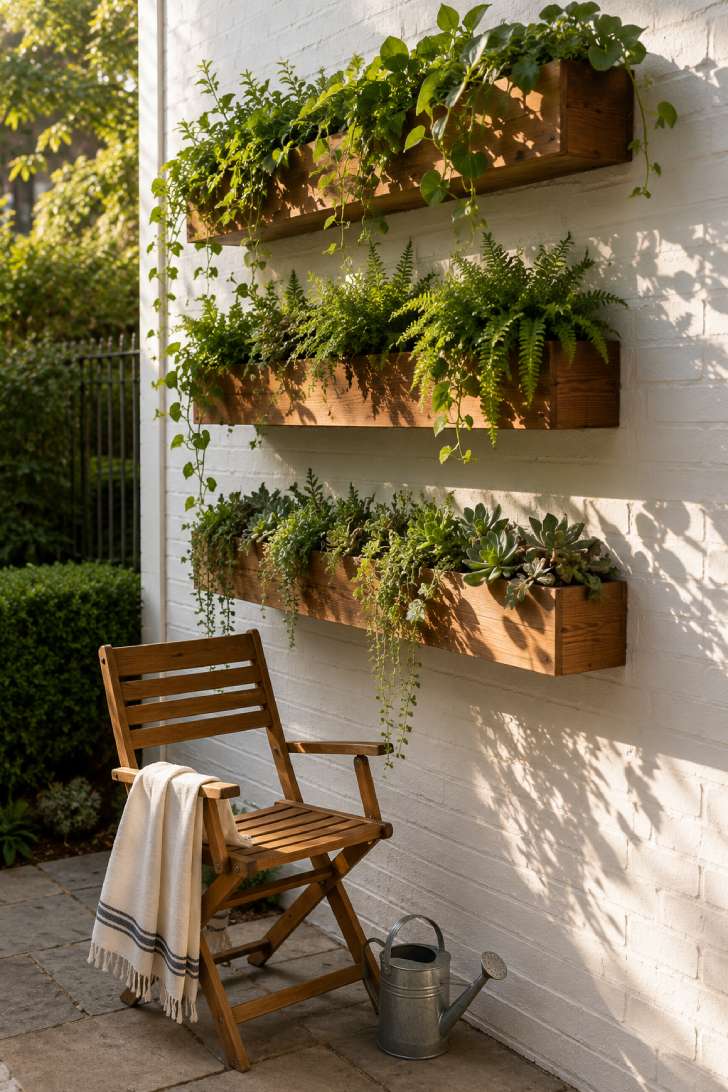
When your patio footprint is measured in inches rather than feet, go vertical.
Wall-mounted planter boxes, railing-hung pots, and hanging baskets move your container garden up off the floor where it competes with furniture and foot traffic.
This approach draws the eye upward, which tricks the brain into perceiving more space than actually exists.
A row of three or four matching planters mounted at staggered heights creates rhythm on an otherwise blank wall.
Trailing plants — pothos, string of pearls, creeping jenny — spill downward and soften the hard lines of siding, brick or stucco.
Railing planters hook over porch railings without drilling and cost around $10–$15 each.
They work best with compact herbs, small flowers or succulents that won’t outgrow the narrow trough.
Vertical gardening is also easier on your back, which anyone who has bent over ground-level beds for an afternoon can appreciate.
Style Blueprint:
- Three to five wall-mounted or railing-hook planters in a matching finish
- A mix of trailing, mounding and upright plants for visual variety
- Mounting hardware rated for outdoor use and your wall material
- A small watering can stored nearby for easy maintenance
- One trailing plant per planter for that cascading, abundant look
Design Pro-Tip: Water runs downhill. Mount vertical planters so the heaviest waterers are at the top — their drip feeds the pots below. It’s not a perfect irrigation system, but it reduces how often you need to reach for the watering can.
Stenciled Concrete for a Faux-Tile Look
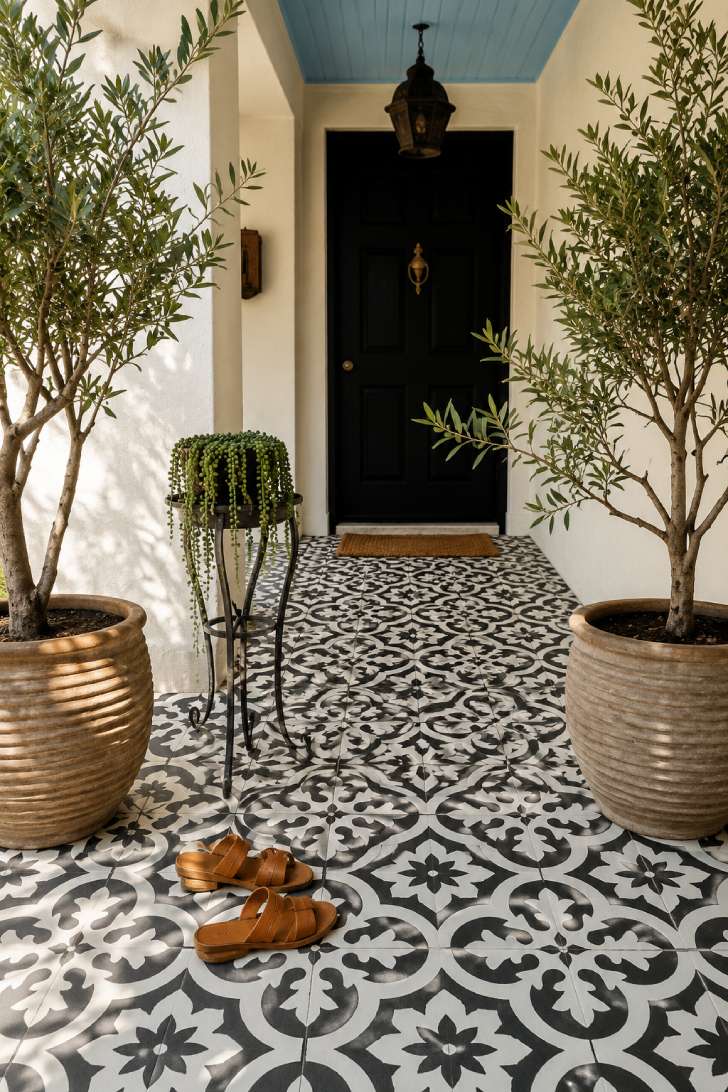
Existing concrete doesn’t have to stay boring.
A stencil and a quart of porch paint turn a plain gray slab into something that looks like hand-laid tile — and the whole project comes in under $75.
Geometric patterns (herringbone, Moroccan lattice, hexagonal) photograph well and create visual texture that bare concrete lacks.
Clean the surface, apply a base coat, let it dry fully, tape the stencil in place, then roll on the contrasting color.
Two coats of clear concrete sealer on top protect the pattern from foot traffic and weather.
The process takes a full day: prep in the morning, stencil in the afternoon, seal the next morning.
Black-and-white delivers the highest contrast and the most graphic impact, but a tone-on-tone approach (cream stencil over warm gray base) reads subtler and suits softer color palettes.
Patio pavers and stenciled concrete together, with the stencil filling the center and pavers framing the edges, create a layered, custom floor that looks far more expensive than it is.
Style Blueprint:
- Large-format reusable stencil in a geometric tile pattern
- One quart each of two contrasting colors of exterior porch and floor paint
- Foam roller for stencil application (brushes bleed under edges)
- Clear concrete sealer (two coats) for durability
- Painter’s tape to secure the stencil and keep lines crisp
A Container Herb Garden by the Door
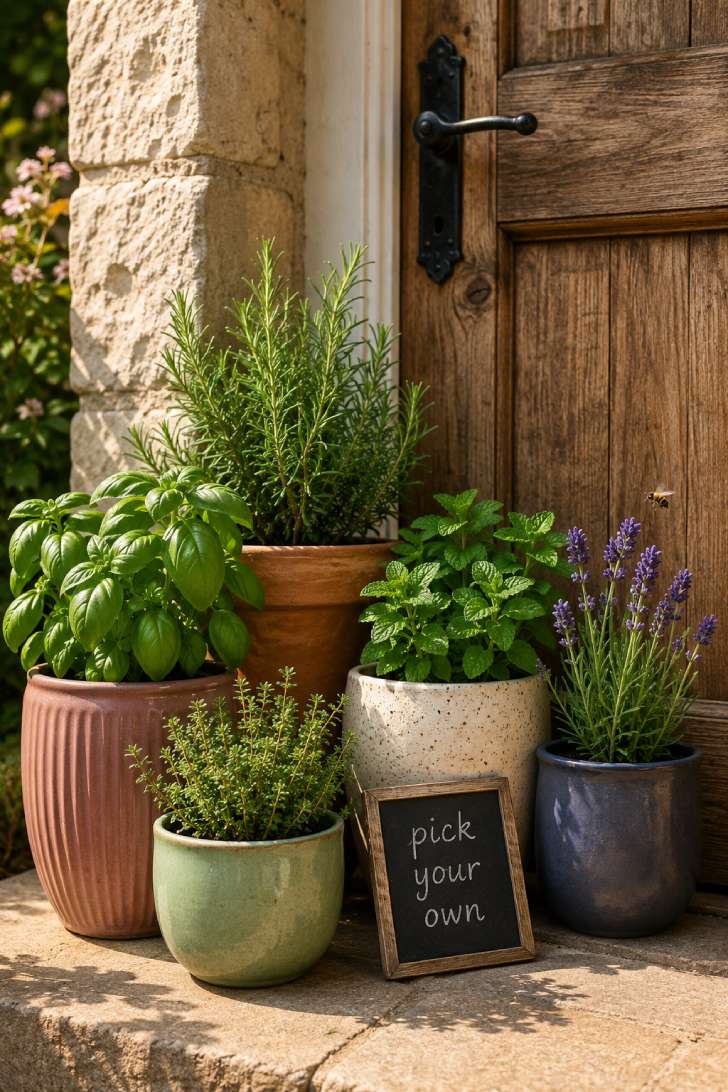
Herbs pull triple duty: they look good, smell good, and end up in your dinner.
A cluster of pots by the front door with basil, rosemary, thyme and mint creates a container garden that’s as practical as it is pretty.
Group pots in odd numbers — three or five — because asymmetry feels more natural than a rigid grid.
Vary the pot heights so the arrangement has a high point and a low point, which gives the grouping dimension even when the plants are small.
Rosemary and lavender prefer full sun and well-drained soil, so they pair well on a south- or west-facing patio.
Basil and mint tolerate partial shade, making them better picks for porches with overhangs that block direct light.
Costs are minimal: a four-inch herb starter from a nursery runs $3–$5, and terra cotta pots cost roughly the same.
The whole arrangement — five herbs, five pots, a bag of potting mix — comes in under $40.
Style Blueprint:
- Five herb plants suited to your patio’s sun exposure
- Mismatched pots in coordinating earthy or muted tones
- A bag of well-draining potting mix with added perlite
- Small saucers under each pot to protect the patio surface
- A chalkboard tag or wooden plant marker for each herb
Solar Path Lights Along the Walkway
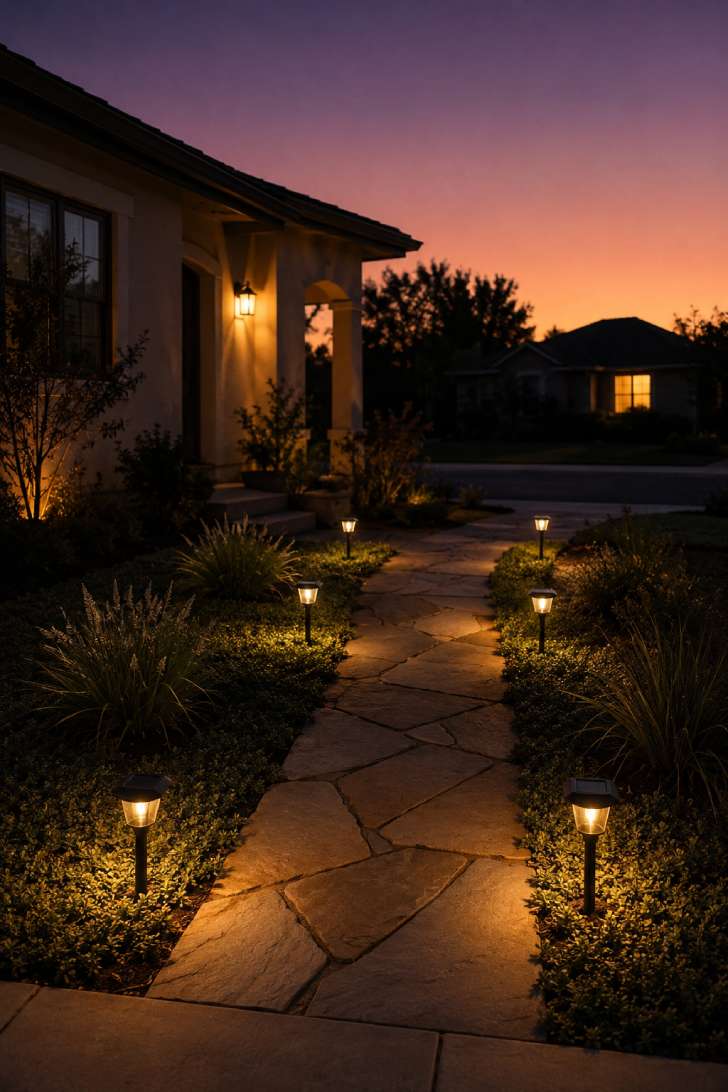
Solar path lights are probably the most set-it-and-forget-it patio upgrade that exists.
Push them into the ground along the walkway, let the sun charge the batteries during the day, and they switch on automatically at dusk.
A set of six costs $15–$25 and lasts two to three years before the rechargeable batteries need replacing.
Spaced 4–6 feet apart, they line both sides of a path and create a runway effect that guides visitors from the sidewalk to your front door.
That guided pathway adds curb appeal after dark, which is something most front patios completely lose once the sun sets.
Warm amber-toned lights feel more welcoming than bright white, which can read as security lighting rather than decoration.
Stagger the lights on alternating sides of the path rather than lining them up directly across from each other for a less rigid, more organic layout.
Style Blueprint:
- Six to ten solar stake lights in warm white or amber tone
- Spacing of 4–6 feet between each light
- Staggered placement (alternating sides) along the walkway
- A style that matches or complements your porch light fixture
- Replacement rechargeable batteries on hand for when they dim
Updated House Numbers and Hardware
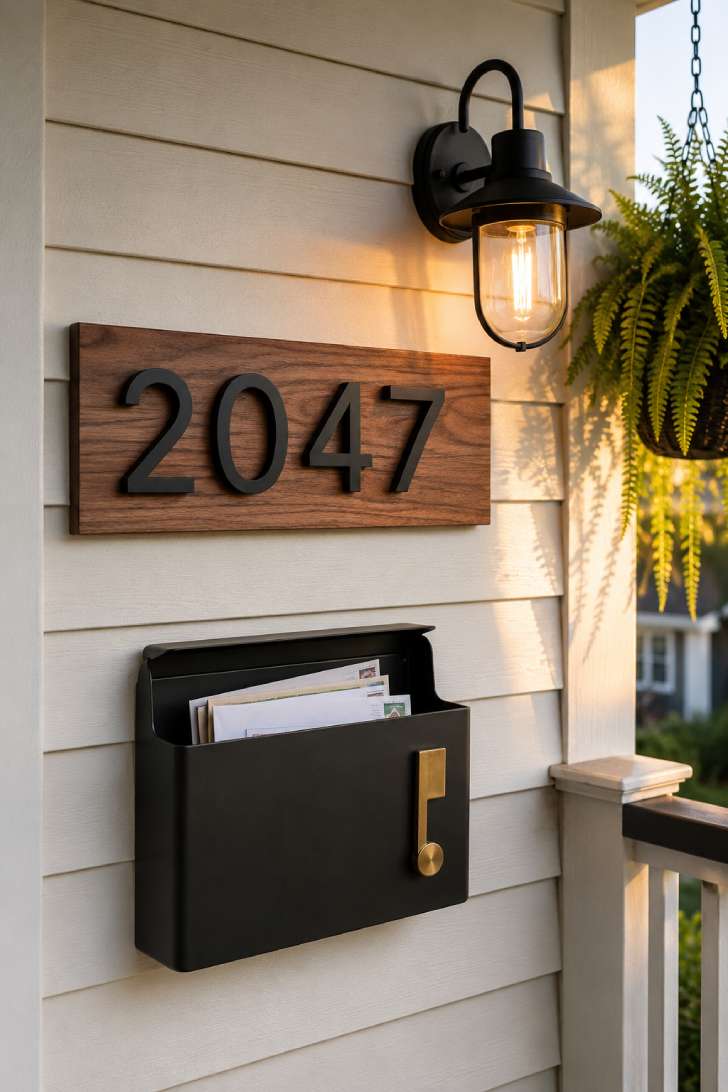
Small details carry more weight at the front of a house than anywhere else.
Swapping standard builder-grade house numbers for modern floating digits — available for $3–$8 per number — takes twenty minutes and reads like a full porch renovation from the street.
Match the finish (matte black, brushed nickel, brass) to your door hardware, porch light and mailbox for a coordinated look.
A new mailbox in the same metal tone adds another layer of polish for $25–$50.
Updating the porch light fixture itself, if it’s a dated builder special, might be the single best $40 you spend on patio furniture and accessories combined, because the light fixture is visible day and night.
These tiny swaps compound — each one alone is barely noticeable, but three or four coordinated hardware changes make the whole facade feel intentional.
Think of it as accessorizing: a watch, belt and shoes in the same leather tone pull an outfit together the same way matched hardware pulls a porch together.
Style Blueprint:
- Floating or flush-mount house numbers in a modern font and finish
- Matching or coordinating porch light fixture
- A mailbox in the same metal family as the numbers and light
- New door hardware (handle, deadbolt, knocker) if the existing set is dated
- A small mounting board (wood or metal) to group the numbers as a single design element
Design Pro-Tip: Stick to one metal finish across all your front patio hardware — light fixture, house numbers, mailbox, door handle. Mixing brass, black and chrome on the same porch creates visual static. One consistent tone reads clean and intentional.
A Seasonal Wreath to Finish the Look
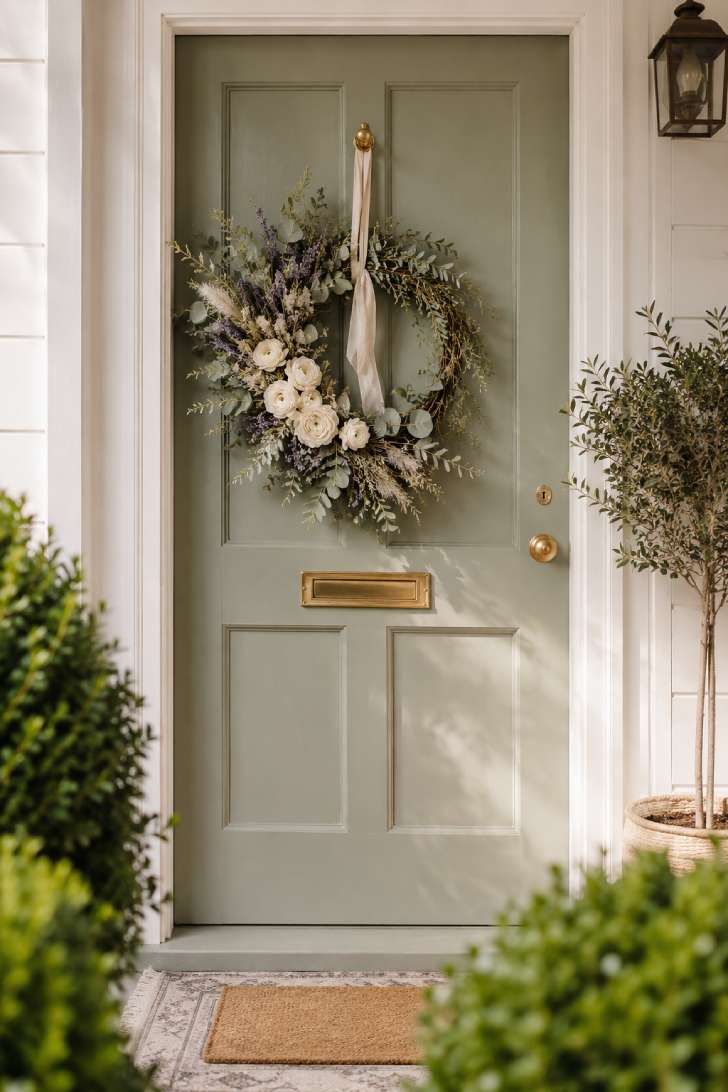
A wreath on the front door is the period at the end of the sentence.
It says the patio is complete, considered, and cared for.
Dried eucalyptus wreaths last six months or longer and cost $20–$35 from craft supply stores — or less if you make one from clippings and a wire frame.
Swap the wreath with the seasons: greenery and white flowers for spring and summer, dried wheat and warm-toned leaves for fall, evergreen and berries for winter.
Hang it from a simple over-the-door hook or a brass nail so you’re not drilling into the door surface.
An asymmetrical wreath (heavier on one side) feels more modern and organic than a perfectly round, evenly distributed design.
This final touch ties together whatever else you’ve done — the planters, the paint, the rug, the lights — into a single composed first impression.
Style Blueprint:
- One wreath in dried or preserved botanicals suited to the current season
- An over-the-door wreath hanger or a single brass hook
- A thin ribbon or no ribbon — bulky bows read holiday-only
- Size proportional to the door (aim for 18″–22″ diameter for a standard door)
- A backup wreath stored flat so you can rotate with the season
Conclusion
Thirteen ideas, and not one of them requires a contractor, a permit, or a four-figure budget.
That’s the real takeaway here — a cozy front patio comes from small, deliberate choices stacked on top of each other.
A layered doormat. A bold door color. String lights that turn on at dusk.
None of these alone would make a magazine cover, but grouped together they create an entrance that feels warm, personal and finished.
Start with the one that excites you most and cost you the least.
Once that first small change lands and you see the difference from the sidewalk, the second and third projects follow naturally.
Your front patio isn’t just an approach to the house — it’s a space worth sitting in, watching the neighborhood go by, and feeling like you’re exactly where you belong.