This post may contain affiliate links. If you make a purchase through these links, we may earn a commission at no additional cost to you.
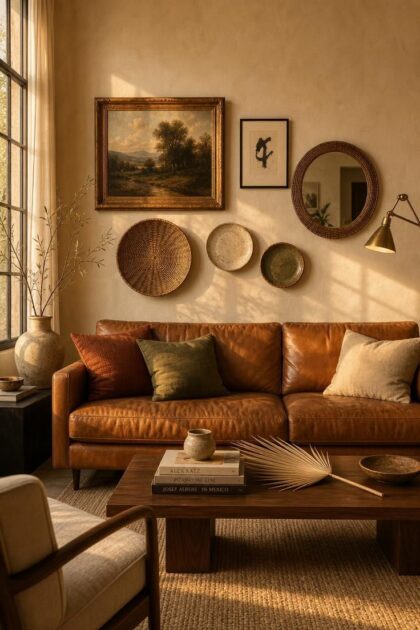
Close your eyes and picture a wall that feels less like a display and more like a memory made visible.
One surface holds a modern ceramic plate beside a Victorian silhouette, a woven basket under an oil landscape, and somehow they speak the same language.
That quiet conversation between unlike things is the heart of eclectic wall decor.
The term describes an intentional blending of styles, materials, and objects united by a single visual thread rather than a random assortment.
A shared finish, a repeated tone, or an echoed shape can turn apparent clutter into a collected surface that rewards close looking.
The ideas ahead explore how contrasting pieces can come together in cohesive wall moments.
Each approach starts with one material, texture, or gesture strong enough to hold the whole arrangement together.
Brass Finishes Repeating Across Frames, Sconces, and Trays
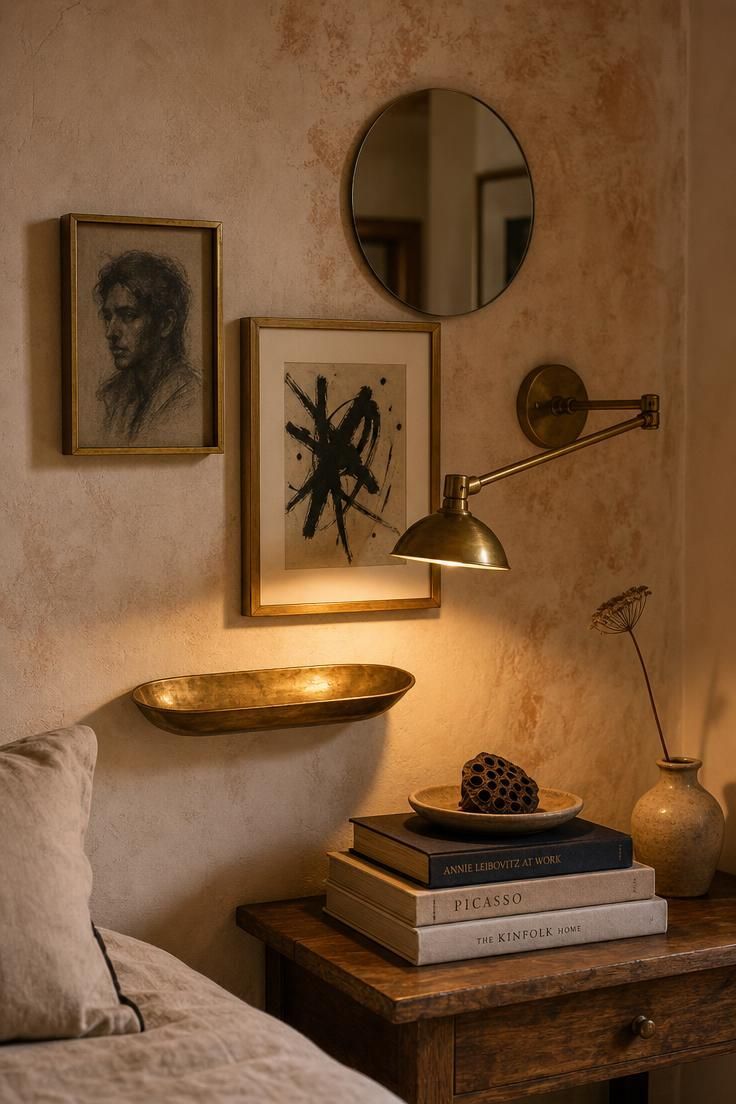
Repeating one finish across unrelated objects is a quiet way to hold an eclectic arrangement together.
Brass, especially unlacquered brass, carries enough warmth to make charcoal drawings, abstract ink work, and a plain round mirror feel like they belong in the same story.
The rhythm comes from changing the frame profiles.
A slim brass rectangle sits next to a heavy ornate oval, while the mirror has no frame at all, just a polished brass edge that acts as a clean circle in the middle of the group.
A brass wall-mounted tray or decorative plate can hang right beside the art and read as sculpture.
Because the material matches the frames and the sconce, the tray stops being a kitchen object and becomes a visual anchor.
Unlacquered brass darkens unevenly over time, developing a patina in the places where fingers touch it and where air moves across the surface.
The wall will shift and deepen instead of staying static, which suits an eclectic room.
Align the visual center of the whole arrangement at eye level.
Let the outer edges wander, with some pieces closer to the cluster and others pushed out a few inches.
Keep the surrounding wall color warm.
Cream, soft plaster, or deep rust all let the brass glow without making the surface feel busy.
Style Blueprint:
- Unlacquered brass frames in two to three different profiles
- One functional brass element such as a sconce, tray, or wall-mounted candlestick
- One unframed brass mirror or polished brass disc
- Artworks sharing one accent color such as charcoal, rust, or olive
- Warm white or plaster wall as the neutral base
Velvet-Covered Mat Boards Paired with Raw Ceramic Forms
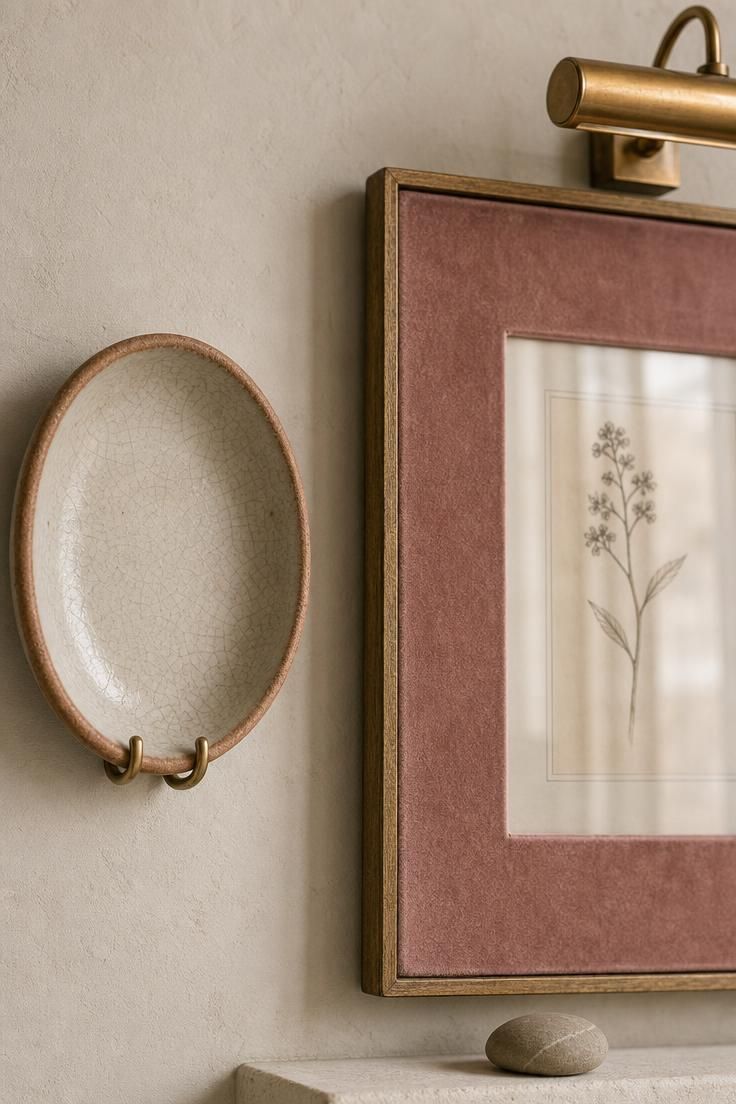
Pairing soft textile surfaces with hard matte ceramic creates a textural tension that keeps a small arrangement interesting.
Velvet mat boards feel wrong until they sit behind glass, where the fabric reads as a tactile secret tucked inside a conventional frame.
A velvet mat works best under glass for protection and visual smoothness.
The fabric's nap catches light differently than paper, giving flat art a strange and appealing depth.
The ceramic form should contrast in scale and surface.
Choose a shallow dish with crackled white glaze and an unglazed terra-cotta edge, hung on a shallow brass hook so it floats just off the wall.
Scale matters in a detail-driven pairing like this.
A ceramic piece at least ten inches in diameter can hold its own next to a sixteen by twenty inch framed work without either object feeling dominant.
Keep the supporting wall neutral.
Off-white or sand keeps the texture story quiet and lets the velvet and raw clay carry the visual weight.
Velvet attracts dust, so the glass front matters more than it might on a paper mat.
Place this arrangement away from high-traffic breezeways and anywhere with ceiling fans blasting downward.
Repeat the velvet color somewhere else in the room.
A nearby pillow, throw, or upholstered chair edge in the same dusty pink pulls the wall into the larger space without feeling matchy.
A small brass picture light or simple sconce aimed at the pairing brings out the ceramic's crackle and the velvet's grain after dark.
Style Blueprint:
- One framed print or drawing with a velvet-wrapped mat board
- One bold ceramic plate or shallow vessel with raw or crackled glaze
- A brass or black iron plate hook
- Soft white or sand wall background
- One accent color repeated in room textiles
A Smoke-Toned Monochrome Wall of Charcoal and Slate Blue
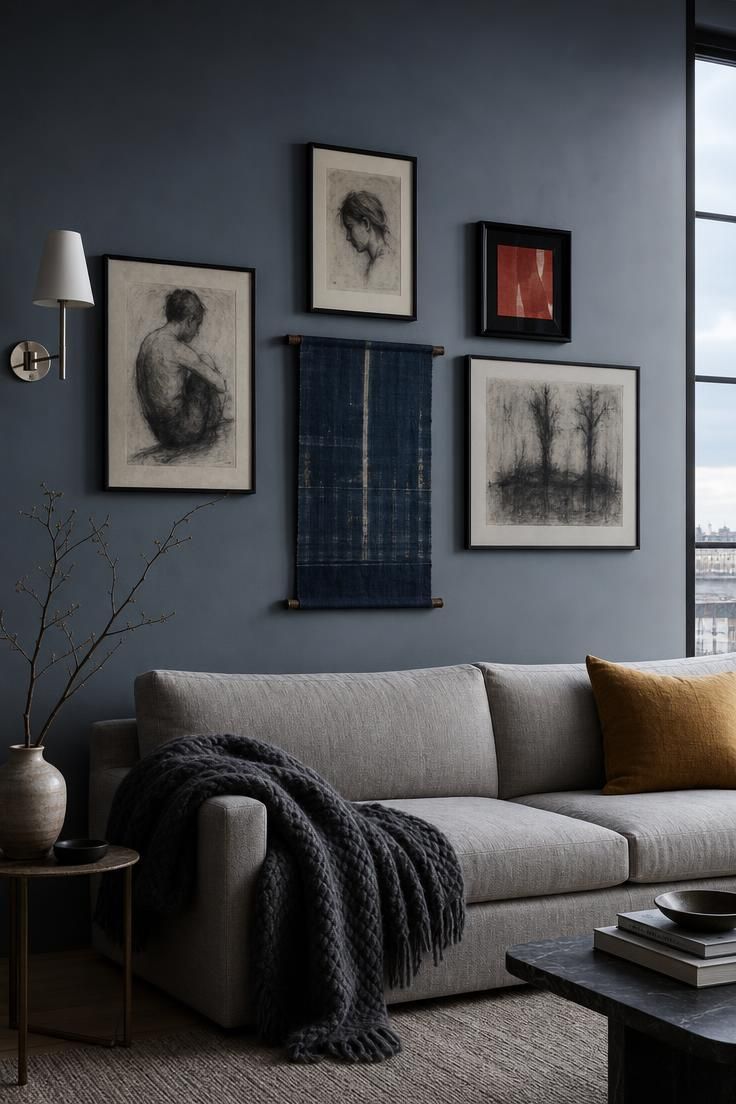
Shifting the palette cool breaks any assumption that eclectic wall decor needs strong color.
A smoke-toned wall can hold monochrome works in charcoal, slate, graphite, and diluted ink while still feeling layered and full.
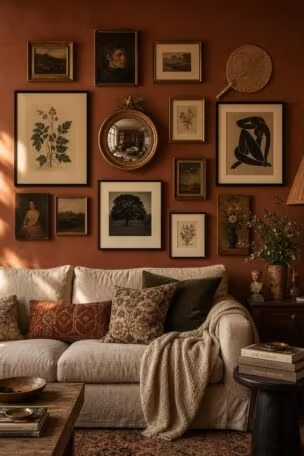
This approach also suits a vintage gallery wall, where faded works gather a moody, collected presence.
Same-tone layering works because the materials do the talking.
A charcoal drawing in a thin black frame, a vintage indigo-dyed fabric panel stretched over a wooden bar, and a single matte black wall-mounted vase all read as one family despite their different origins.
Walls like this work best in rooms with natural light.
The tone shifts across the day, moving from cool gray in morning to deeper blue at dusk, and the art seems to change with it.
Finish variety keeps a monochrome wall from going flat.
Mix one glossy black lacquered frame with a waxed raw wood frame and a brushed nickel sconce, letting reflected light bounce in different directions.
One unexpected accent can lift the whole composition.
A small coral-red abstract print adds tension without breaking the cool atmosphere, a single warm note in a gray field.
Charcoal and pastel works need conservation glass to avoid smudging and fading.
The glass also deepens the blacks and makes the smoke tones feel richer from across the room.
Style Blueprint:
- Walls painted a mid-tone slate blue or gray-blue
- Three or more works in charcoal, graphite, or diluted ink
- One stretched vintage indigo or mud-dyed textile panel
- One small high-contrast accent in coral, rust, or mustard
- A black or brushed nickel wall-mounted light
Oversized Dried Palm Fronds Mounted Directly Across Plaster
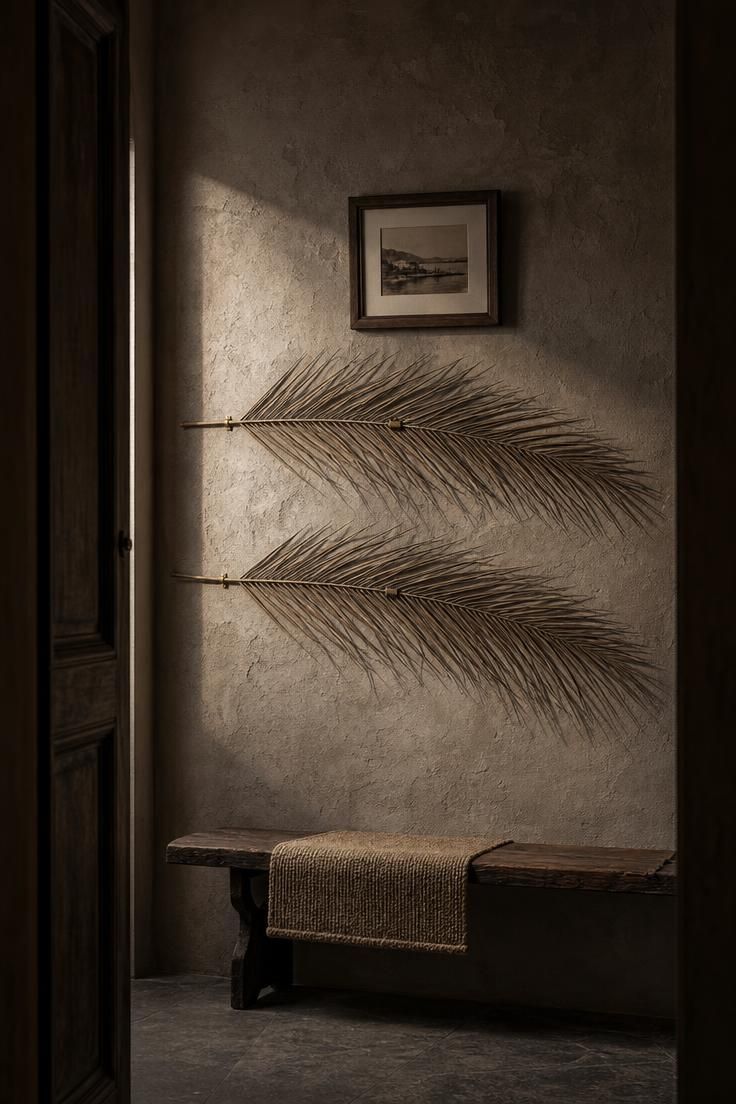
Dried botanicals can act as dimensional sculpture.
A pair of long palm fronds mounted horizontally changes a bare hallway into a quiet installation that moves as the air shifts around it.
This approach also works well within boho wall decor, where organic materials and relaxed compositions feel at home.
Mounting matters here.
Use shallow brass mirror clips or hand-formed wire loops at the stem and mid-vein, keeping the blades nearly flush to the plaster so the fronds read as a single continuous gesture.
Scale determines whether this works or looks like forgotten yard clippings.
Choose fronds that span at least thirty six inches end to end, long enough to anchor the wall on their own.
One small framed object gives the bare fronds a counterpoint.
A vintage photograph or a pressed-botanical specimen in a thin wood frame prevents the wall from feeling unfinished.
The plaster wall texture does half the work.
Rough lime plaster with slight mottling absorbs low light and gives the fronds something to cast shadows against, deepening the moody warmth.
Paint the rest of the hallway in a lighter tone so the dark taupe wall frames the vignette naturally.
The contrast pulls the eye toward the fronds rather than scattering attention down the corridor.
Thoroughly dried palm fronds hold their shape for years if kept away from moisture.
Hallways near bathrooms or exterior doors can expose them to humidity, so place them in dry zones only.
A low wooden bench or muted runner beneath the fronds completes the composition without adding visual clutter.
The bench gives the eye a place to rest and makes the wall feel considered.
Style Blueprint:
- Two or three thoroughly dried palm or fan fronds
- Fine brass or matte black mounting clips
- One small framed photograph or botanical specimen
- Rough lime plaster or textured plaster wall in deep taupe
- Low bench, jute runner, or simple vessel below
Design Pro-Tip: When combining large organic forms with small framed art, anchor the arrangement around a single horizontal line. Set the fronds at eye level, then place the smaller piece slightly above or below that line so the wall still feels organized rather than scattered.
A Blackened Steel Hook Rail Ribboned with Woven Hanging Baskets
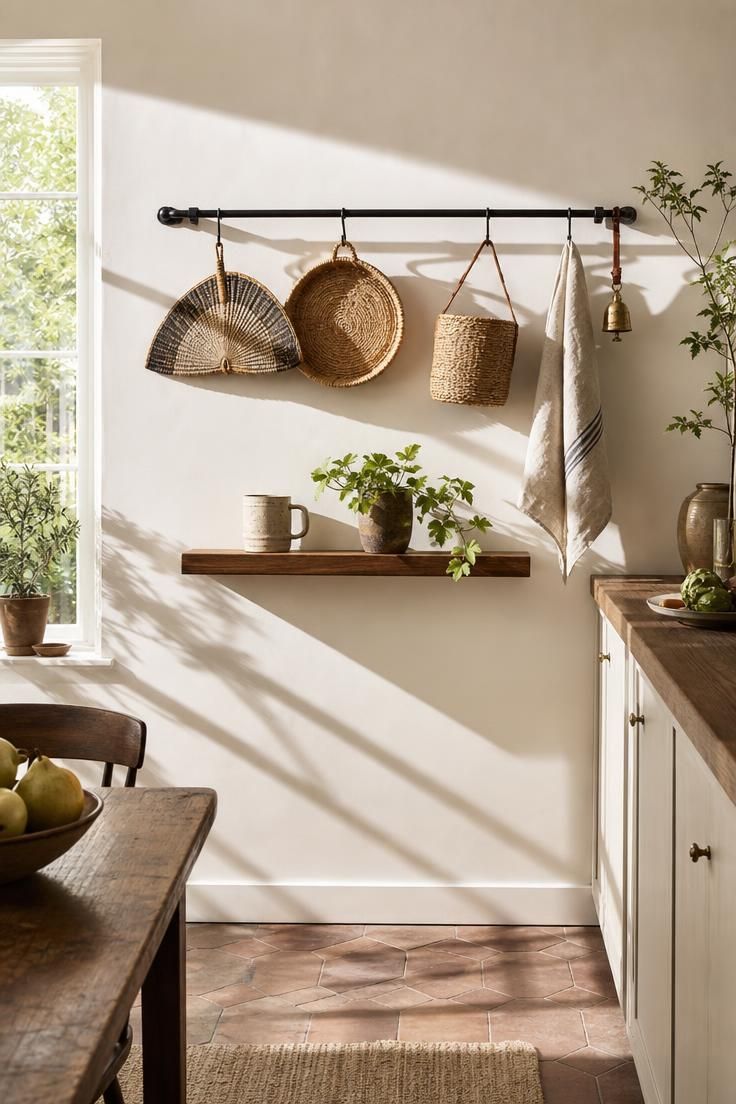
Functional storage can become the most interesting part of a wall.
A blackened steel hook rail acts as a structural through-line, giving disparate hanging objects a shared spine.
This kind of practical display sits within the larger tradition of global wall decor, where daily objects from many places can share one narrative.
The material contrast does the heavy lifting.
Matte black steel against a warm white wall, with natural rattan, flax linen, and unlacquered brass hardware, creates a collected look without feeling decorative.
Variety in basket shape keeps the rail from reading like a display rack.
Hang one flat woven fan, one shallow round tray with a rim, and one slightly deeper cylindrical carrier, each holding negative space differently.
Spacing should feel unplanned.
Let some items nearly touch while others sit eight to ten inches apart, so the wall has the rhythm of daily use rather than a store fixture.
Mount the rail into studs or use heavy-duty toggle anchors.
Baskets can pull forward from the wall, and if you tuck a small plant or rolled towel into one, the weight adds up quickly.
Hang one small framed recipe card or handwritten note directly above the rail.
That single personal object crosses the wall from purely useful into meaningful, which is the whole point of eclectic wall decor.
Style Blueprint:
- Blackened steel or wrought iron hook rail, 24 to 36 inches long
- Three woven baskets in varied silhouettes
- One leather strap or loop holding a small brass object
- Linen hand towel or faded fabric scrap
- Warm white or bone-painted wall
Crackled Gilt Mirrors Confronting Ceramic Botanical Sprays
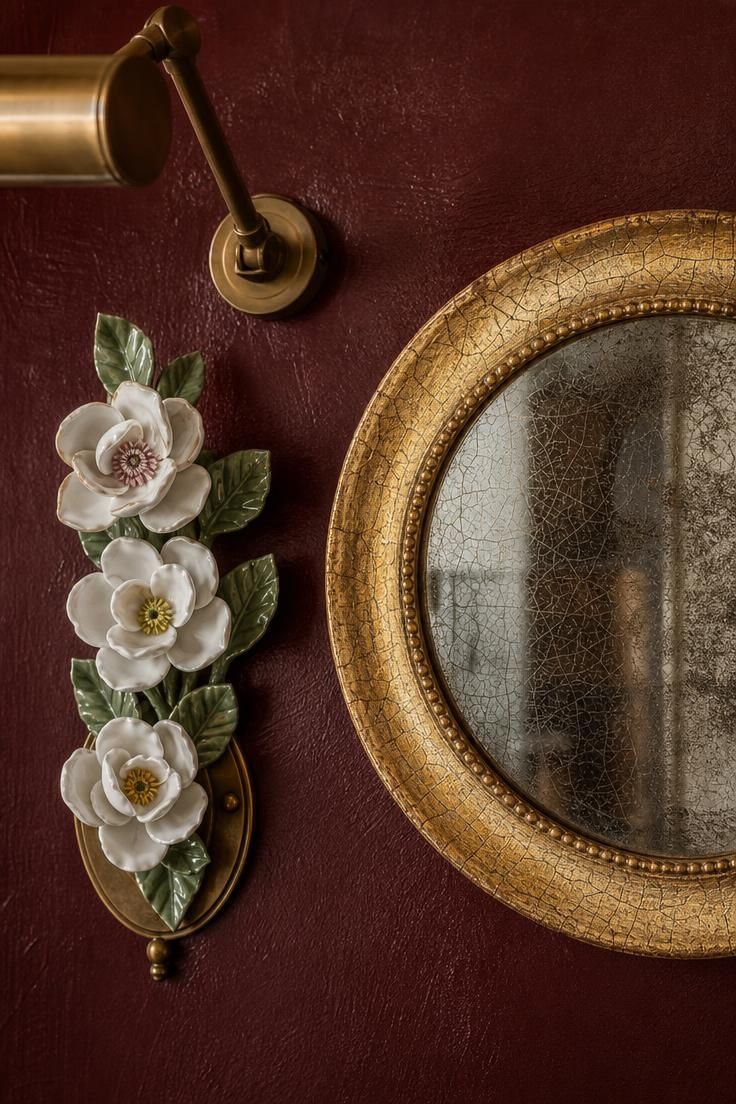
Crackled gilt reads as history rather than maximum polish.
The aged finish warms a dark wall and gives the eye something to wander across, the way it might with an old painting.
A ceramic botanical spray brings a dimensional, almost floral counterpart to the mirror's flat surface.
Individual porcelain flowers with matte white petals and green-glazed leaves climb a small brass backplate like a frozen vine.
The visual echo between the mirror's cracked gilding and the flowers' porcelain surface is what holds the pair together.
Both carry a delicate, aged quality, as if they came from the same cabinet of collected curiosities.
These sculptural wall pieces can stand alone, yet they read stronger when paired with a reflective surface.
Set the pairing against a moody wall color.
Oxblood, burnt umber, or deep claret makes the warm metals and pale porcelain glow without competing for attention.
Keep the mirror small, no larger than fourteen inches in diameter.
That way the botanical spray remains an equal partner rather than a side note.
Hang both pieces with flush-mount keyhole plates instead of wire.
Sitting nearly flat to the wall, the two objects feel like one composition instead of two separate brackets.
A small picture light or candle-sconce beside the arrangement brings out the crackle and glaze at night.
The shadows deepen the gilding's texture and make the porcelain petals seem almost translucent.
Style Blueprint:
- One small crackled gilt or tarnished mirror
- One porcelain botanical spray with wall-mount backplate
- Deep oxblood, claret, or burnt umber wall
- Flush-mount hanging hardware
- One warm accent light such as a picture light or candle sconce
Flat-Leather Strap Shelves Holding Miniature Clay Vessels
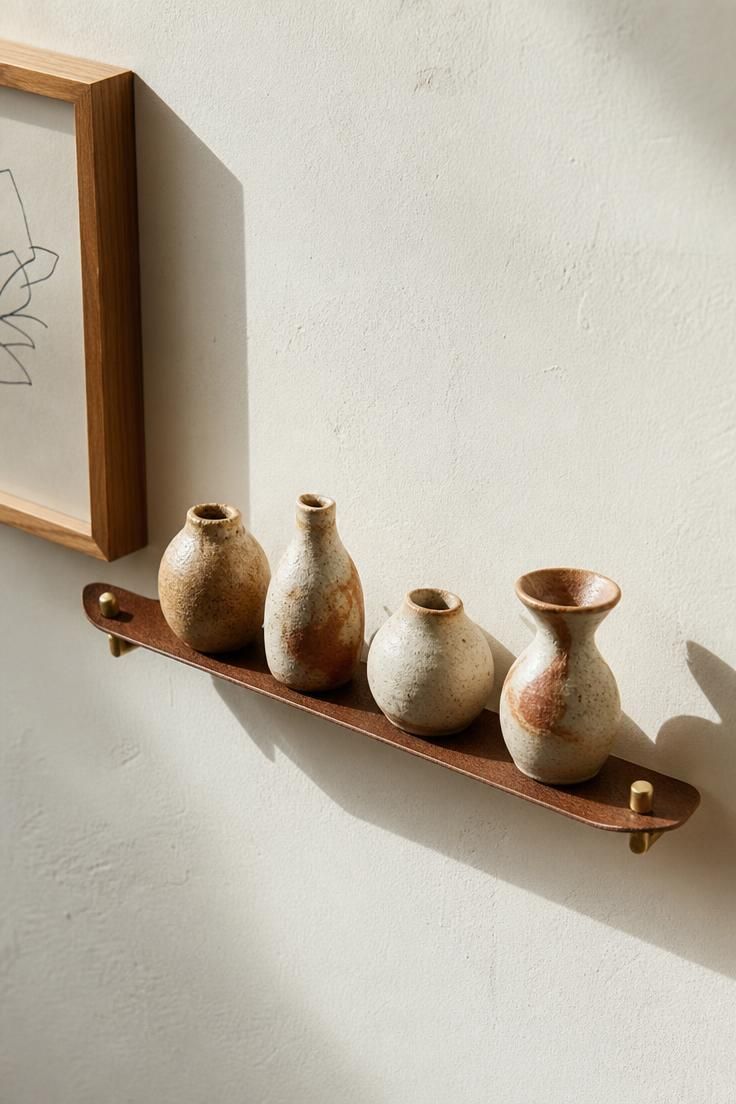
A shelf can act as a tiny stage for hand-held treasures rather than a surface for large displays.
A sliver of leather along the wall becomes a horizontal line that organizes small objects into a quiet gallery.
The construction is almost invisible.
A stiff flat leather strap, roughly one and a half inches wide, gets screwed into brass standoffs so the shelf itself nearly disappears.
This kind of minimal display can anchor a curated wall collection, where the objects matter more than the hardware.
Choose vessels that share a rough hand-pinched surface and a restricted earth-tone palette.
Ochre, chalk white, and iron rust slip washes make four slightly different profiles feel like they were always meant to sit together.
The repetition principle does the work here.
The vessels may differ in height, width, and curve, but their raw stoneware surface and warm mineral tones keep the tight grouping cohesive.
Place the shelf at shoulder height where the pieces can be seen from both standing and sitting positions.
Overhead glances from a chair or sofa give the shelf a second life as you move through the room.
Style Blueprint:
- One flat leather strap or dark leather-topped shelf
- Brass standoffs or minimal brackets
- Four miniature raw or slip-washed clay vessels
- Earth-tone palette in ochre, chalk white, and iron rust
- Neutral wall such as warm plaster or bone white
Layered Geometric Oil Studies Above a Stone Slab Mantel
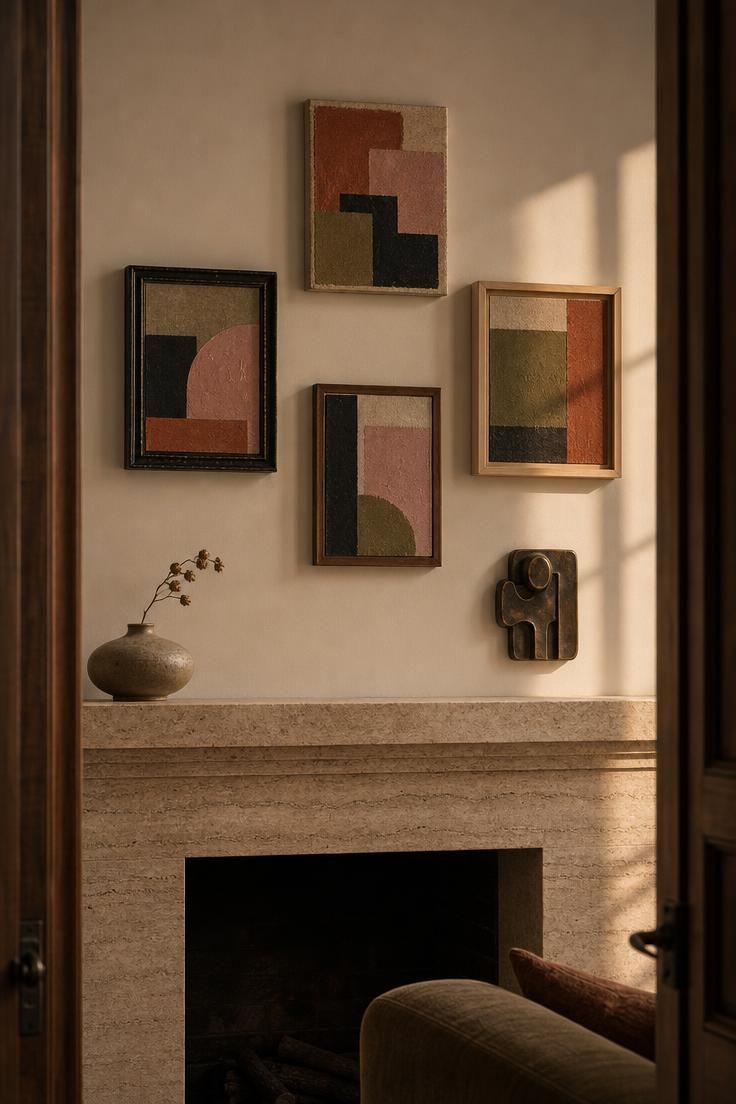
A fixed architectural line like a mantel edge can anchor an eclectic mix.
The four small oil studies above read as intentional because they answer to the stone slab below them, even though their frames and canvases share no exact match.
This pairing of mismatched frames and small canvases is a natural fit for mixed art styles, where contrast becomes the organizing principle.
The paintings themselves should feel intimate.
Small canvases from six by eight to nine by twelve inches, covered in geometric shapes of terracotta, olive, dusty rose, and black on rough linen, hold the wall without overwhelming the room.
Vary the frames deliberately.
One thin walnut, one worn black lacquer, one unfinished maple, and one with no frame at all, just a painted edge, make the group feel gathered over time.
Use a loose diamond shape rather than a rigid salon grid.
The center of the composition sits about eighteen inches above the mantel, and the outer corners drift outward so no lines align perfectly.
Add one three-dimensional counterpoint.
A small bronze or brass abstract wall sculpture placed low beside the grouping breaks the flat plane and gives the eye a pause.
If the travertine mantel sees actual use, seal the stone occasionally.
Candles or small vessels can leave marks on unsealed travertine, and a honed surface shows them faster.
Keep the mantel mostly clear.
One low stoneware bowl or a single candlestick is enough, leaving the wall grouping as the room's dominant story.
A wall-wash or picture light aimed upward from the mantel emphasizes the oil paint's tooth and the frame shadows after dark.
Style Blueprint:
- Four small geometric oil studies on linen or canvas board
- Mismatched frames in walnut, black lacquer, maple, and raw edge
- One small bronze or brass wall sculpture
- Travertine or pale stone mantel
- One low stoneware bowl or candlestick on the mantel
Pressed Grasses Behind Reeded Glass Paired with Copper Wire
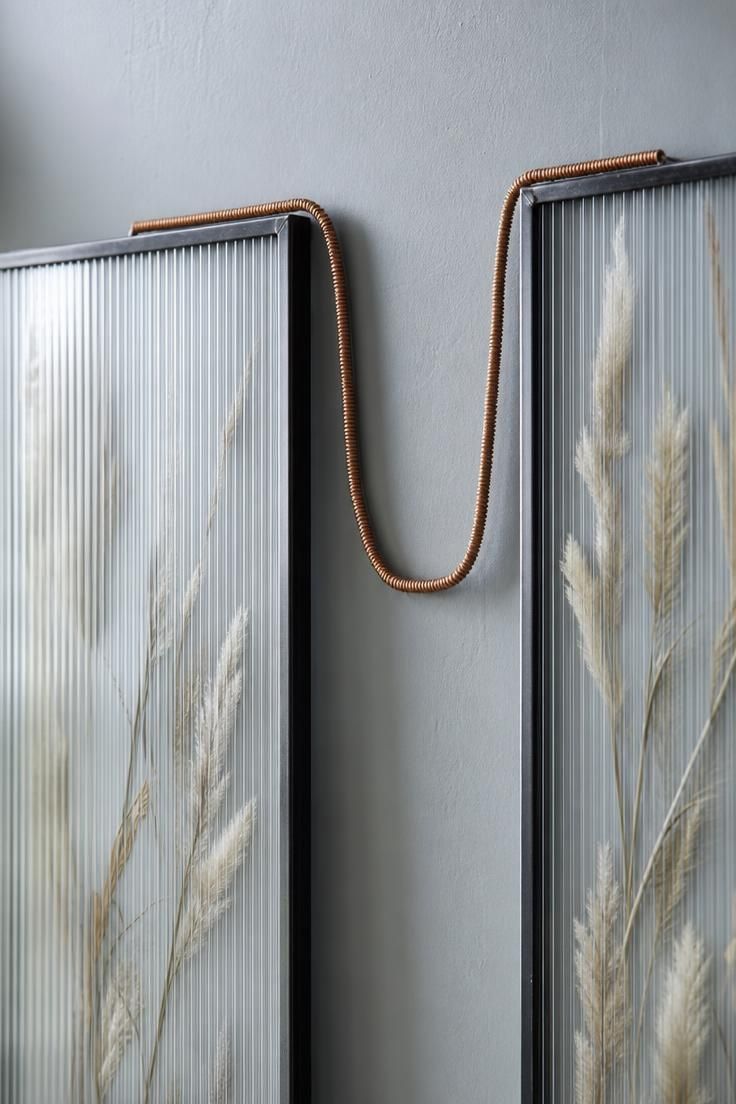
Reeded glass works as a warm-cold material bridge.
Its ribbed surface softens whatever sits behind it while adding texture to the wall, and it turns flat dried grasses into something almost aqueous.
This quiet composition also nods toward textured wall hangings, where surface variation matters as much as the objects themselves.
The grass pressing itself needs care.
Use pale green and gray-blue grasses, fully dried and laid flat between two sheets of reeded glass with a dead-flat backing board so nothing shifts or curls over time.
A hand-coiled copper wire links the two frames visually.
Zigzagged or waved between them, the wire turns separate objects into one continuous wall gesture.
Set the wall in a cool neutral.
Soft gray, pale blue-gray, or cool putty lets the grasses and copper remain the main color moments without competition.
Hang the frames vertically with narrow gaps.
The copper wire should pass behind or over the top edge of each frame so the whole composition reads as one line moving down and across.
This idea suits a narrow wall best.
Entryways, the sliver between windows, or the side of a chimney give the vertical pair exactly the right stage.
The copper will darken over time, taking on a deeper brown-red that only strengthens the connection to the dried grasses.
Style Blueprint:
- Two vertical reeded-glass frames
- Pale dried grasses in blue-gray or bleached green
- Hand-coiled copper wire
- Soft gray or cool putty wall
- Thin brass or copper screws for mounting
A Triple Row of Small Gouache Florals Above a Hook-Laden Coat Wall
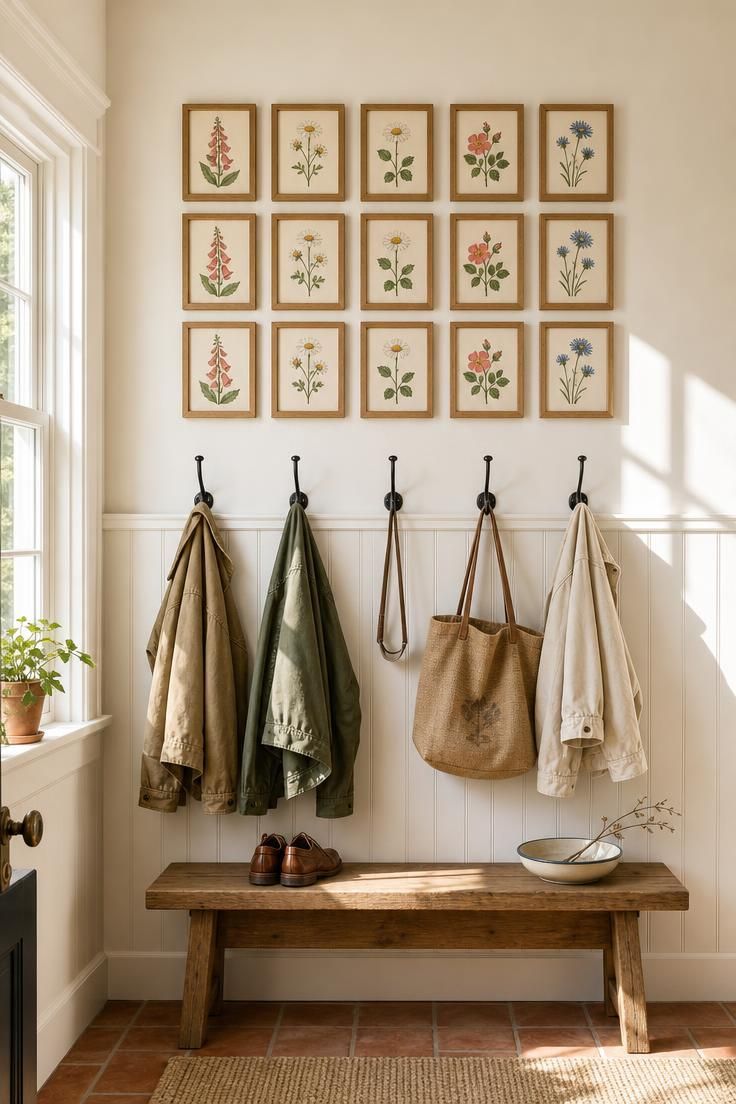
Balancing the practical and the personal turns a working entryway into a wall with two registers.
The upper zone holds art, while the lower zone handles daily objects, and the gap between them gives each room to breathe.
Gouache florals in a small size read as delicate but not precious.
Foxglove, daisy, and wild rose in muted coral, sage green, and slate blue on cream paper bring a soft palette that echoes the natural tones of jackets and bags below.
A matched frame set matters here.
Seven small paintings in matching oak frames repeat their rhythm instead of fighting each other, which lets the floral subjects stay varied.
This tight grouping can also serve as a collector wall display, where small works in repeating frames show a focused eye.
The vertical split keeps the wall from feeling crowded.
The upper triple row sits fifty eight to sixty eight inches from the floor, while the hooks below sit between thirty six and forty eight inches, leaving a clear band of empty wall between art and coat.
Keep the three rows tightly packed with equal two inch vertical gaps but vary the horizontal spacing slightly.
The strip feels collected, as if the paintings were added one by one even though the frames match.
A woven jute or leather bag hanging on the lowest hook echoes the muted tones of the paintings and ties both wall zones into one visual loop.
Style Blueprint:
- Seven small gouache floral paintings in matching oak frames
- Muted coral, sage, and slate blue palette
- Black iron coat hooks, four or five
- Cream or bone wall
- One woven jute or leather hanging bag
A Round Raw-Wood Board Threaded with Black Leather Cord and Ceramic Beads
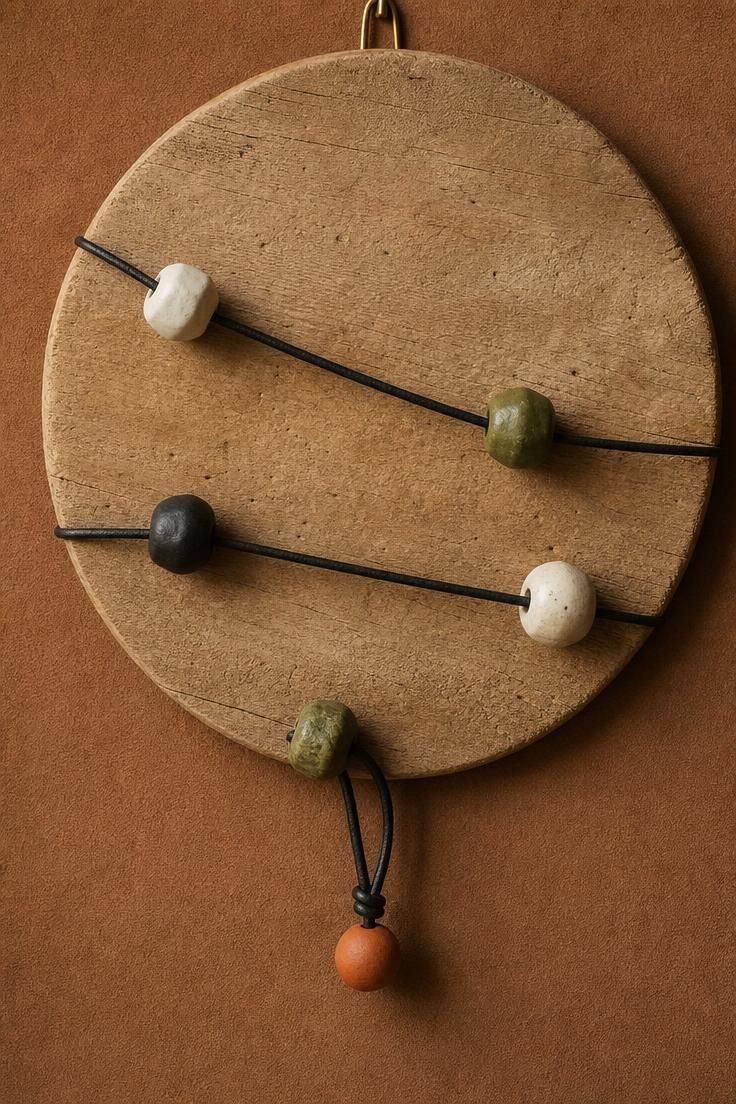
A single round board can anchor a small wall without company.
The object reads as both furniture and art, a slice of raw wood hung like a medallion, with leather and ceramic adding layered wall art detail.
This piece also works as a form of maximalist wall art, where one object carries many textures, colors, and materials at once.
The wrapping does the compositional work.
Black leather cord crosses the board in two diagonal lines, breaking the circle into asymmetrical sections and giving the eye a clear path to travel.
Ceramic beads threaded onto the cord add color without clutter.
Matte cream, moss green, and black beads with irregular hand-formed surfaces sit like small sculpted pauses along the leather line.
Let the cord end in a loop below the board, weighted by one terracotta bead.
That dangling element gives the piece a little movement and prevents it from feeling like a store-bought wall tile.
Hang it against a warm cinnamon-brown wall.
The wall color echoes the raw wood while pushing the cream and green beads forward, and the dark cord stays visible without fighting the background.
Use a simple brass hook at the top so the board floats flush to the wall.
The rawness of the wood does enough work on its own without needing a frame or any other surrounding objects.
This piece works in a small hallway, above a bedside table, or at the end of a corridor.
It asks for a moment of close looking rather than a full-room audience.
Style Blueprint:
- One round raw-wood board, roughly eighteen inches across
- Black leather cord, about three yards
- Handmade ceramic beads in cream, moss green, matte black, and terracotta
- A brass picture hook
- A warm cinnamon-brown or suede-textured wall
Conclusion
Eclectic wall decor succeeds when a visible thread holds unlike objects together.
That thread can be a material, a finish, a palette, or a form, and the moment it disappears the wall starts to feel like noise.
Start small.
Choose one wall, one finish, or one pair of objects to begin, rather than trying to rework an entire room at once.
Texture and scale matter more than matching.
Mixing soft and hard, flat and dimensional, large and small is what separates a flat gallery wall from a surface that feels collected and alive.
The most successful eclectic walls reflect specific choices and personal stories, not a checklist of trends.
Edit ruthlessly and keep only what feels like it belongs to you.
Measure one wall, pull five objects from different rooms, and lay them on the floor to test whether they share a quiet common thread before hanging anything.
You may find the wall you wanted was already living in your house, waiting to be noticed.