This post may contain affiliate links. If you make a purchase through these links, we may earn a commission at no additional cost to you.
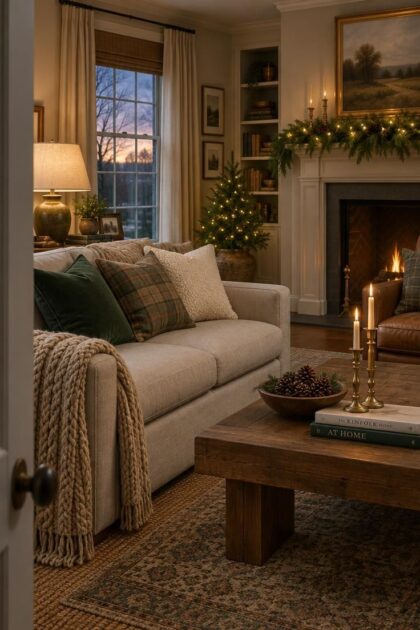
A warm Christmas room begins with texture and soft light rather than one crowded focal point.
Matte natural materials, a few repeated motifs, and small gathered moments at the edges do more for a room than a single elaborate display.
The most welcoming setups feel collected over time and leave some space between things.
This guide covers thirteen separate decorating moments for living rooms, dining nooks, entryways, bedrooms, and kitchen corners.
Scale, placement, and upkeep get the same attention as appearance, so a room can read warm in photographs without turning cluttered in daily use.
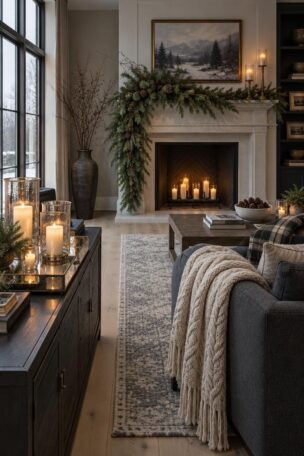
Candle-Light Mantel With Layered Greenery and Brass Holders
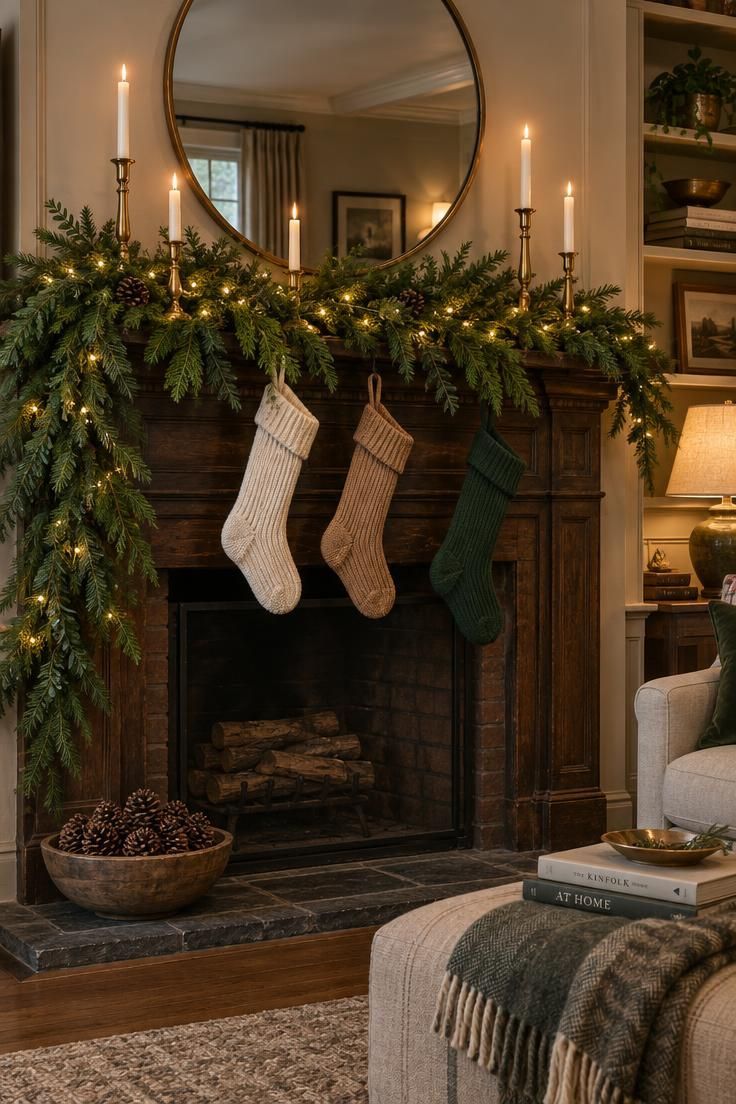
A fireplace mantel gives holiday styling a natural stage, and the goal here is depth rather than symmetry.
A layered mantel garland that pools over the edge reads fuller than one pinned in a straight line, and the slight droop keeps the arrangement from feeling stiff.
Brass candlesticks set at three or four different heights create a stepped silhouette against the greenery.
Two or three stockings hung at uneven intervals finish the composition without filling every inch.
The empty wall space above the garland matters as much as the decor itself, since a mirror or dark-framed print needs room to show.
Stockings in knit and velvet add soft texture right where the eye lands.
The main tradeoff is maintenance.
Fresh greenery sheds needles and dries out over the season, while faux garland collects dust and needs a soft brush before it goes up.
Candles also demand attention: keep open flames clear of textiles and out of reach of children and pets, and use only lighting made for decorative display.
Start with the garland and candlesticks, then add stockings one at a time, stopping when the mantel feels full rather than finished.
A garland roughly one and a half to two times the depth of the mantel edge is a useful visual benchmark, though the right amount depends on the shelf in front of you.
Style Blueprint:
- A full faux evergreen garland with slightly irregular branch tips
- Five brass candlesticks in graduated heights
- A battery-operated warm-white light strand
- Three knit stockings in cream, camel, and forest green
Design Pro-Tip: Limit the mantel to three material groups, such as greenery, brass, and one textile, so it feels collected instead of stuffed.
Reading Chair Corner With a Chunky Knit Throw and Lantern
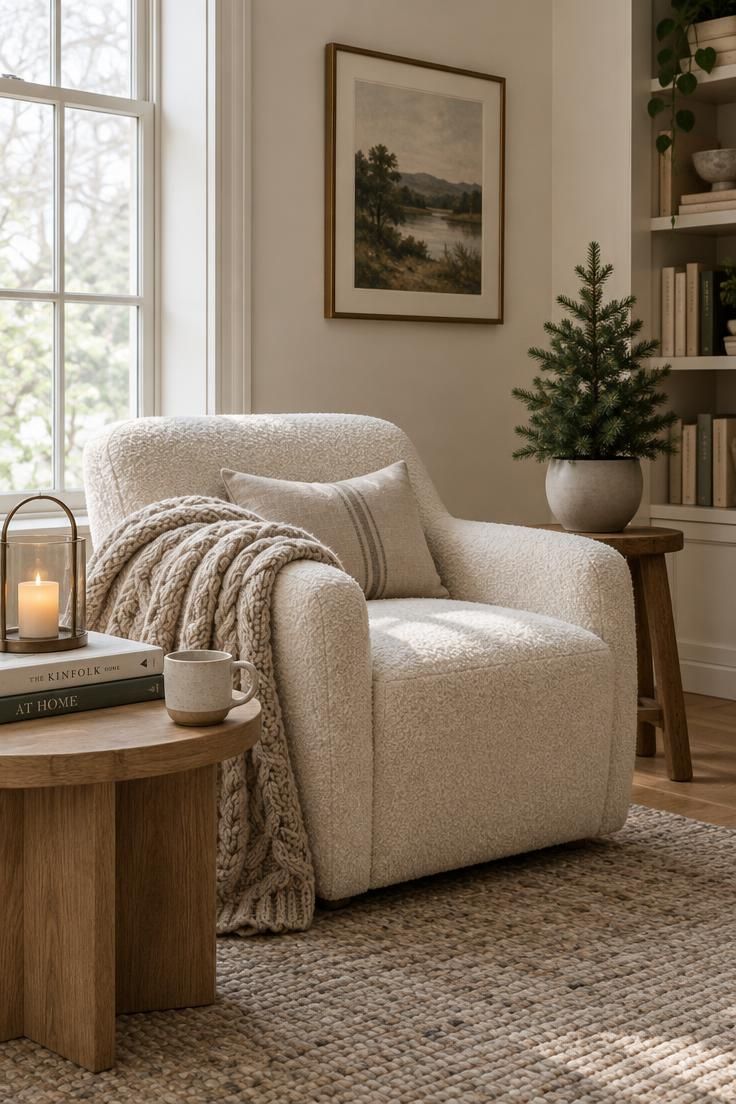
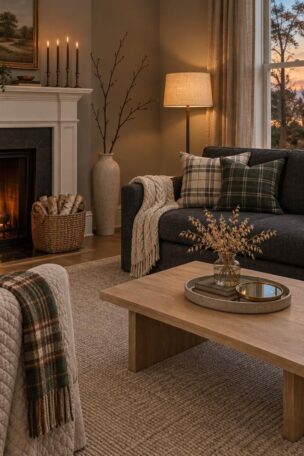
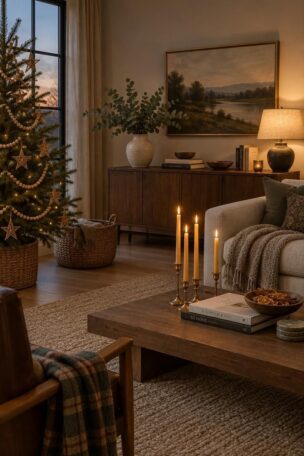
A single chair styled as a winter reading spot works because it defines one activity zone instead of decorating an entire room.
Cozy christmas decor often reads best when it gathers around a place where someone actually sits, and this corner is built around that idea.
The folded throw adds texture at arm height, where the eye rests first.
Leaving the seat cushion empty is deliberate.
A chair piled with pillows and blankets looks generous in a photo and awkward in use, so the clear seat becomes part of the visual calm.
The lantern and books on the low table suggest an evening in progress without pretending the room is staged.
Scale matters more than quantity here.
A stool-height tree should sit below the chair back so it does not compete with the window light, and the side table should stay low enough to reach from the seat.
This is a low-commitment setup that suits apartments and renters who want a seasonal moment without rearranging furniture.
Style Blueprint:
- A cream bouclé or linen-upholstered armchair
- A chunky oatmeal cable-knit throw folded over one arm
- A low oak side table with two books and a glass lantern
- A miniature evergreen in a matte ceramic pot on a wooden stool
Hot-Cocoa Sideboard With Warm White Fairy Lights and Dried Oranges
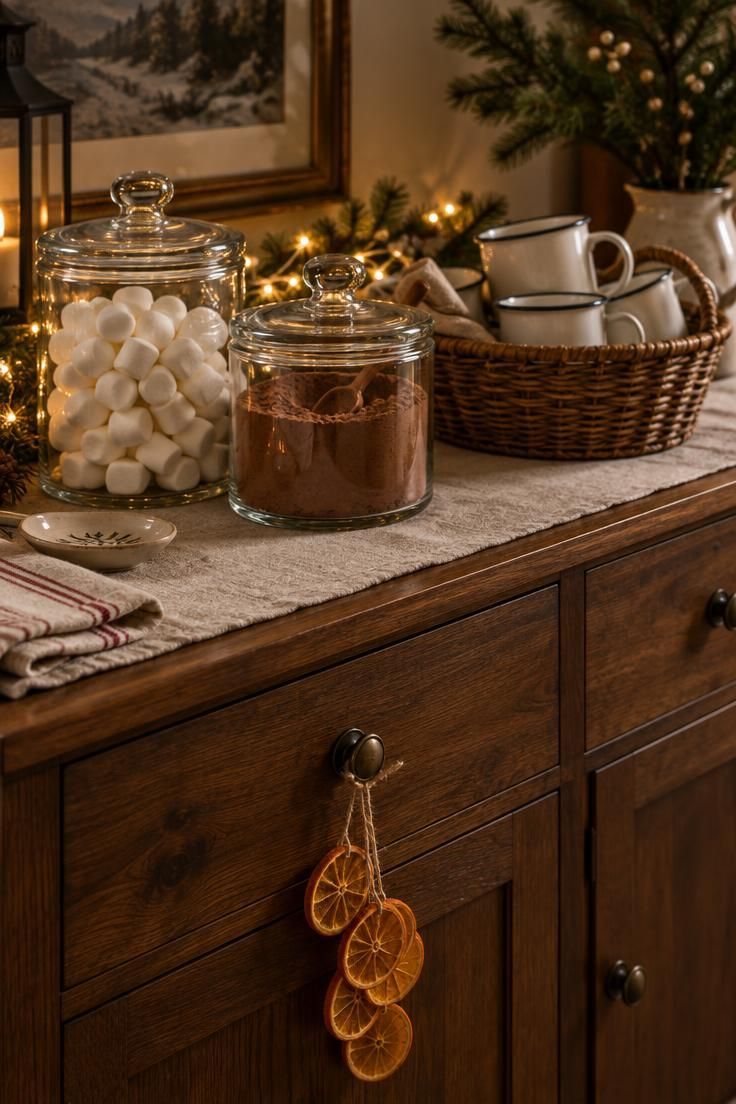
A sideboard or credenza makes a practical home for a cocoa station because the setup can stay corralled on a tray.
Warm white fairy lights tucked behind glass jars cast a soft glow through the contents, which reads warmer than a strand laid across the front edge.
Dried orange slices bring amber color and a faint citrus look to the arrangement without adding bulk.
Keeping everything on a runner or tray means the station clears quickly when the surface is needed for something else.
Glass jars in two or three sizes hold marshmallows, cocoa, and maybe cinnamon sticks, and a small basket of mugs keeps the cup count contained.
The string of dried oranges hanging from a drawer pull is a small detail that gives the setup a handmade edge.
The tradeoffs are ordinary ones: dried citrus fades over a season and glass jars need wiping, and battery strands should be switched off when the room empties.
Those small chores are the price of a display that looks easy to live with.
Place the jars at staggered heights and leave a little bare wood at one end so the composition has somewhere to rest.
A runner slightly narrower than the sideboard keeps the styling from looking like it swallowed the furniture.
Style Blueprint:
- A cream or flax linen table runner
- Three clear glass jars in varied heights for marshmallows, cocoa, and cinnamon sticks
- A battery-operated warm-white fairy-light strand
- A small basket of enamel or stoneware mugs
- A twine garland of dried orange slices hung from a drawer pull
Design Pro-Tip: Nest the light strand loosely behind the jars rather than wrapping the glass, so the glow reads as depth and the strand stays easy to remove.
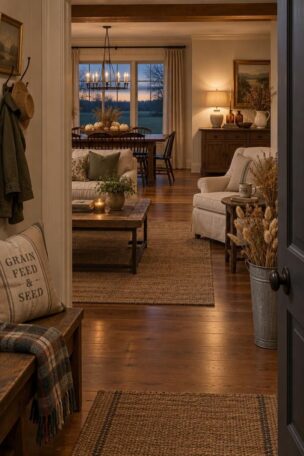
Entry Bench With Plaid Cushion and a Low Wreath
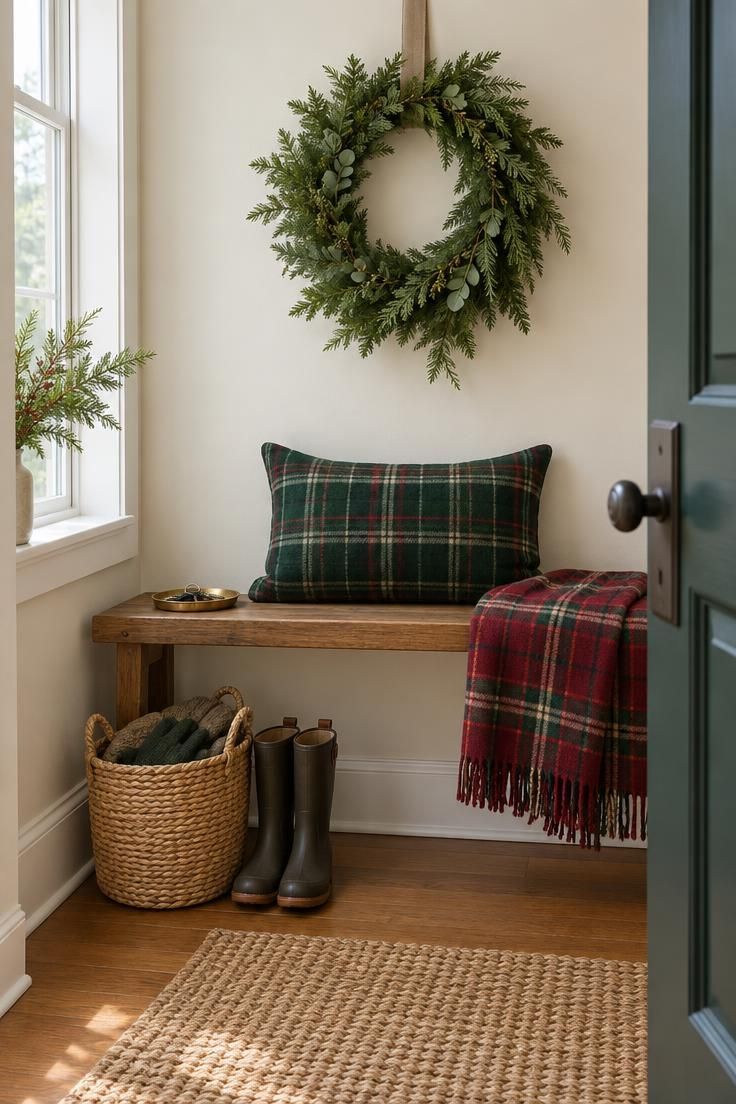
An entry bench styled for winter works because it shows the act of arrival rather than a static display.
Two plaid cushions in muted red and forest green set the palette immediately, and a throw folded over the bench end softens the hard wood.
Hanging a simple wreath low on the wall, or on the inside of the front door, keeps the greeting at eye level as someone walks in.
The bench still has to function, so a woven basket for gloves and a small tray for keys earn their place.
Those practical pieces read as cozy when they match the palette and look chaotic when they do not.
Choose baskets and trays in natural fibers and warm metals to keep the scene cohesive.
Durability matters in a hallway used daily.
Wool plaid resists wear better than thin cotton, and a flat-weave basket shakes out easily.
Rotate the throw to the opposite end every few weeks so the cushion and bench wear evenly.
Test the layout by walking through the door with an armload of bags.
If the wreath hangs where coats brush it or the basket blocks the bench seat, shift the pieces apart before adding anything else.
Style Blueprint:
- A wooden entry bench with a slim profile
- Two plaid wool cushions in muted red and forest green
- A simple fresh or faux greenery wreath hung low
- A woven basket for gloves and a small brass key tray
Dining Nook Wall Niche With a Winter Still Life Shelf
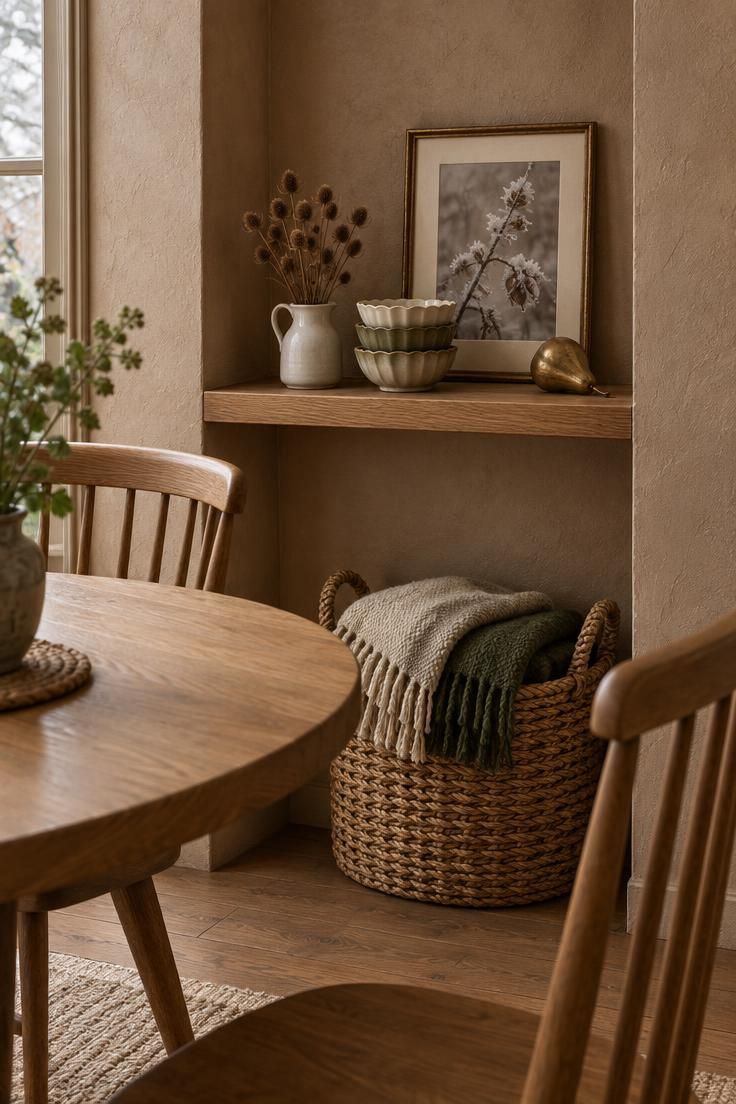
A wall niche near the dining table offers a different kind of winter warmth than a centerpiece.
It draws the eye upward and keeps the table surface open for plates, drinks, and conversation.
A shallow oak shelf holds a few quiet objects that read as a small still life: a pitcher of dried seed pods, stacked ceramic bowls, and a single brass pear.
The framed branch print leans against the wall instead of hanging, which lets the arrangement change with the season without adding holes or hardware.
Below the shelf, a seagrass basket holds folded wool throws in oat and deep green.
The throws serve the room first and soften the niche visually, making the corner feel lived in rather than decorated for a photograph.
Scale matters here.
A niche that holds too many small objects becomes busy, while one large object can look stranded.
Two or three closed forms in different heights work well because the eye can rest between them.
The brass pear adds a small gleam without competing with pendant light or tableware.
This idea suits a breakfast nook where wall space is limited but a bare corner feels unfinished.
The palette stays close to the room’s winter scheme: warm plaster, pale oak, moss and oat textiles, and one restrained metallic accent.
Style Blueprint:
- Shallow oak shelf inside an existing wall niche, drawing the eye upward and keeping the table surface open for plates, drinks, and conversation.
- Compact winter still life on the shelf: a small white pitcher holding dried seed pods or bare branches, stacked ceramic bowls in cream and moss green, and a single brass or bronze fruit form placed on its side.
- Small framed print of a frost-covered branch leaning against the wall instead of hanging, allowing the arrangement to change with the season without adding holes or hardware.
- Woven seagrass basket below the shelf holding folded wool throws in oat and deep green, serving the room first while softening the niche visually.
- Two or three closed forms in different heights with quiet space between them, creating a collected composition without competing with pendant light or tableware.
Open-Shelf Hot Chocolate Tray With Mini Bottle-Brush Trees
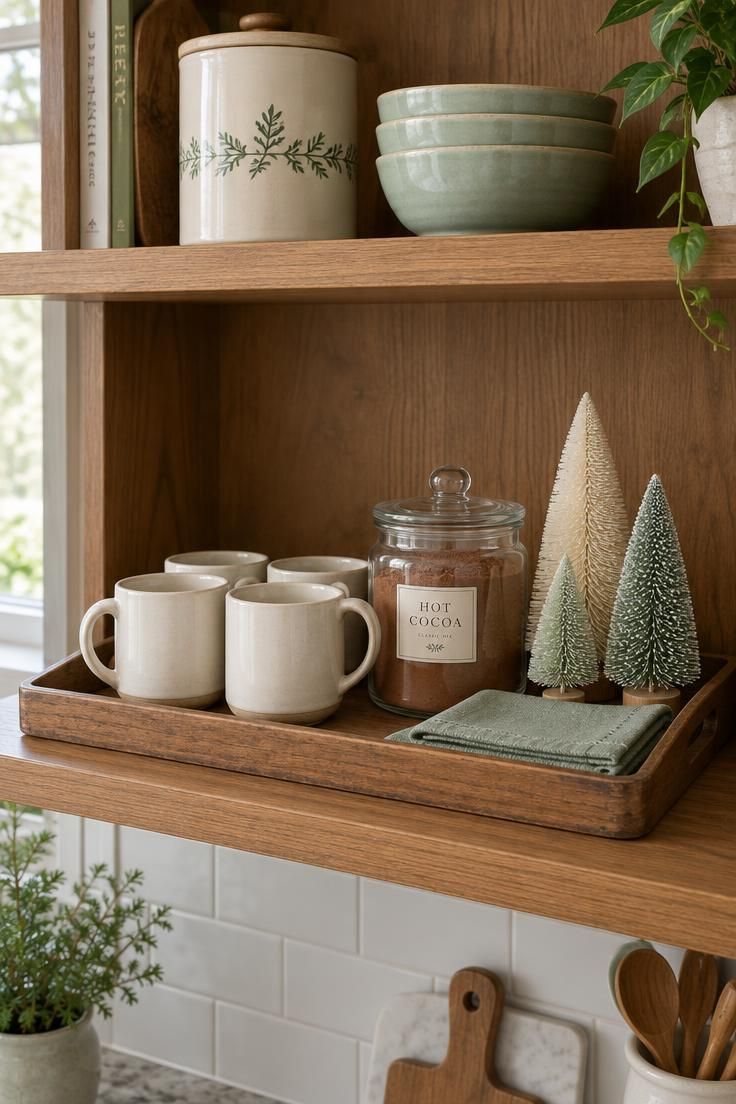
Dedicating one open shelf to a hot chocolate tray keeps mugs and cocoa from spreading across the kitchen counter.
A low wood tray holds four stackable mugs, a lidded jar of cocoa mix, and a short row of mini bottle-brush trees in cream and pale green.
A folded cloth napkin adds a soft square of color without another object.
Sliding the tray toward the shelf front turns the arrangement into a still life visible from the kitchen floor.
The empty space behind the tray matters, since a shelf packed front to back loses the collected quality that makes this idea work.
Keeping the rest of the shelf mostly as it was prevents the kitchen from feeling themed.
The practical limits are worth planning for.
Stackable mugs save room but hide the lower cups, so keep the most-used size on top.
A lidded jar keeps cocoa fresh, and the tray lifts out in one motion when the shelf needs a full wipe-down.
Choose bottle-brush trees that stand on their own bases so they do not tip when the tray slides.
If the shelf sits near a stove, keep the tray toward the far end where steam and splashes are less likely to reach the cocoa jar and the trees.
Style Blueprint:
- A low rectangular wooden tray
- Four stackable cream ceramic mugs
- A lidded glass jar for cocoa mix
- Three mini bottle-brush trees in cream and pale green
- A folded cotton napkin in sage or natural
Window-Sill Winter Scene With Frosted Trees and Battery Candle
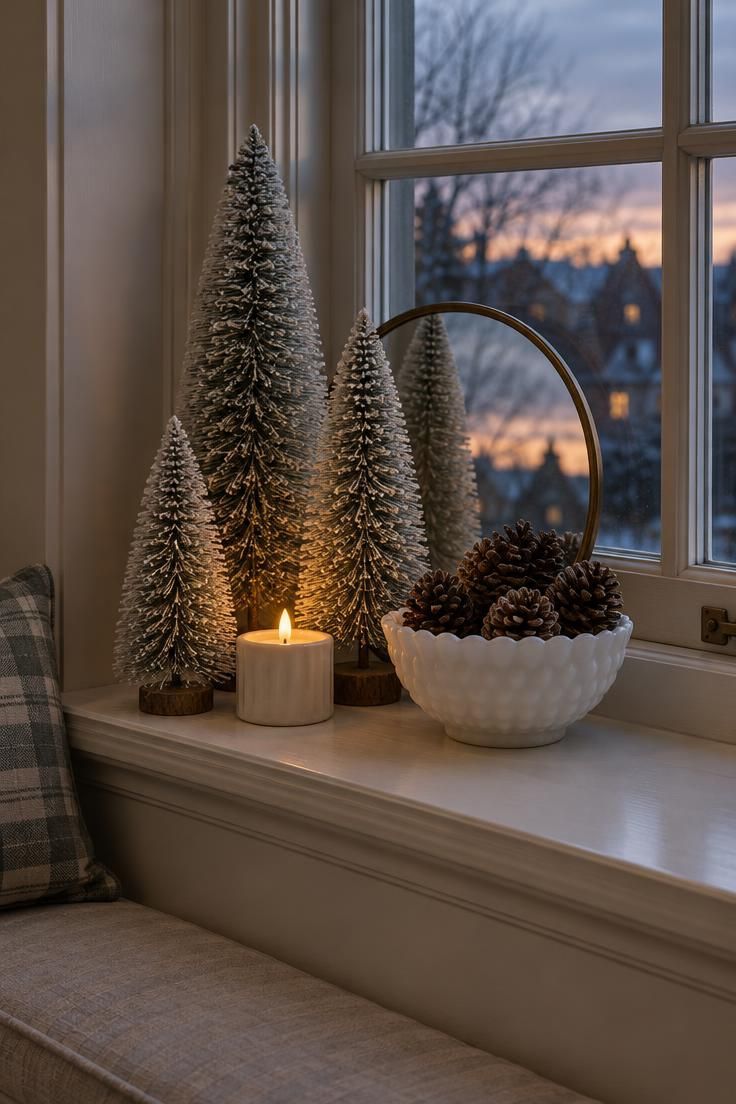
A deep window sill gives a small vignette its own frame, and backlighting at dusk does most of the work.
Two or three frosted trees at different heights stand together with a single battery candle in a milk-glass holder between them.
A shallow bowl of pinecones adds a low, dark note that keeps the pale trees from floating.
A small mirror behind the arrangement catches whatever light comes through the glass, which makes the sill read as a scene rather than a row of objects.
Frosted finishes suit this spot because they hold a soft glow instead of a hard shine.
The setup needs only dusting between seasons, and the battery candle means no flame beside a curtain or sill cushion.
Watch the sill depth before committing.
Curtains that fall across the window need clearance, and a windowsill scene that blocks the latch or the handle becomes a nuisance.
Choose trees tall enough to be seen from the room but short enough to leave glass visible above them.
In a kitchen or hallway window, choose a compact snowy arrangement with frosted trees, a battery candle, and a small bowl of pinecones so the sill still makes a composed seasonal statement without crowding the space.
Style Blueprint:
- Three frosted bottle-brush trees in graduated heights
- A small battery candle in a milk-glass or cream ceramic holder
- A shallow bowl of pinecones
- A small round mirror to lean behind the arrangement
Bookshelf Corner Restyled With a Tiny Tree and Ornament Bowl
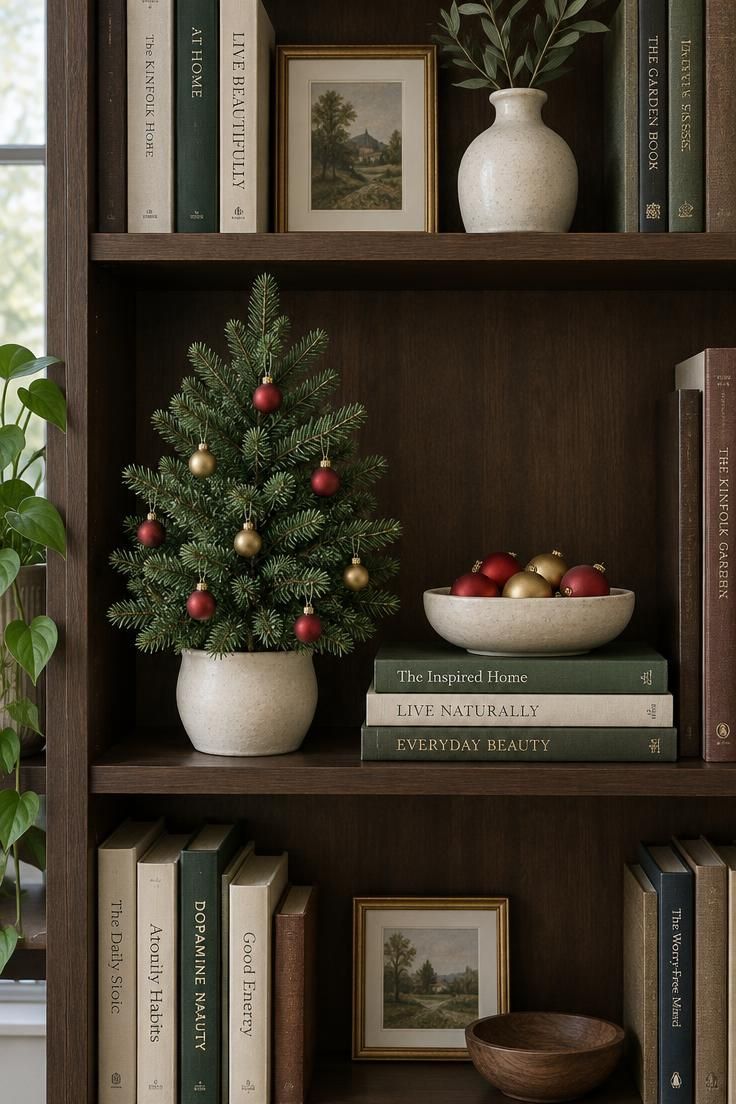
Restyling a single shelf is the lowest-effort way to bring Christmas into a bookcase.
A small tabletop Christmas tree in a burlap or ceramic pot anchors one side, a horizontal stack of two or three books balances it, and a low bowl of matte ornaments fills the gap between.
Matte finishes keep the ornaments from looking like hard candy against the books.
Leaving the surrounding shelves alone is the point.
A festive corner inside an everyday bookcase reads collected, while a fully restyled unit reads like a store display.
The eye finds one warm pocket and the rest of the room stays calm.
Practical limits appear quickly on narrow shelves.
The tree pot should sit well inside the shelf edge, and the ornament bowl should be low enough that books above do not crowd it.
Matte ornaments show fingerprints, so a quick wipe before the season starts keeps them even.
Books chosen for this shelf can stay functional if they match the palette by spine color.
Pull two or three with cream, green, or deep red spines, and let the rest of the bookcase carry on as usual.
Style Blueprint:
- A small tabletop Christmas tree in a cream ceramic or burlap-wrapped pot
- A horizontal stack of three hardcover books
- A low pale bowl of matte red and gold ornaments
Bed Layering With Velvet Cushions and a Wreath Above the Headboard
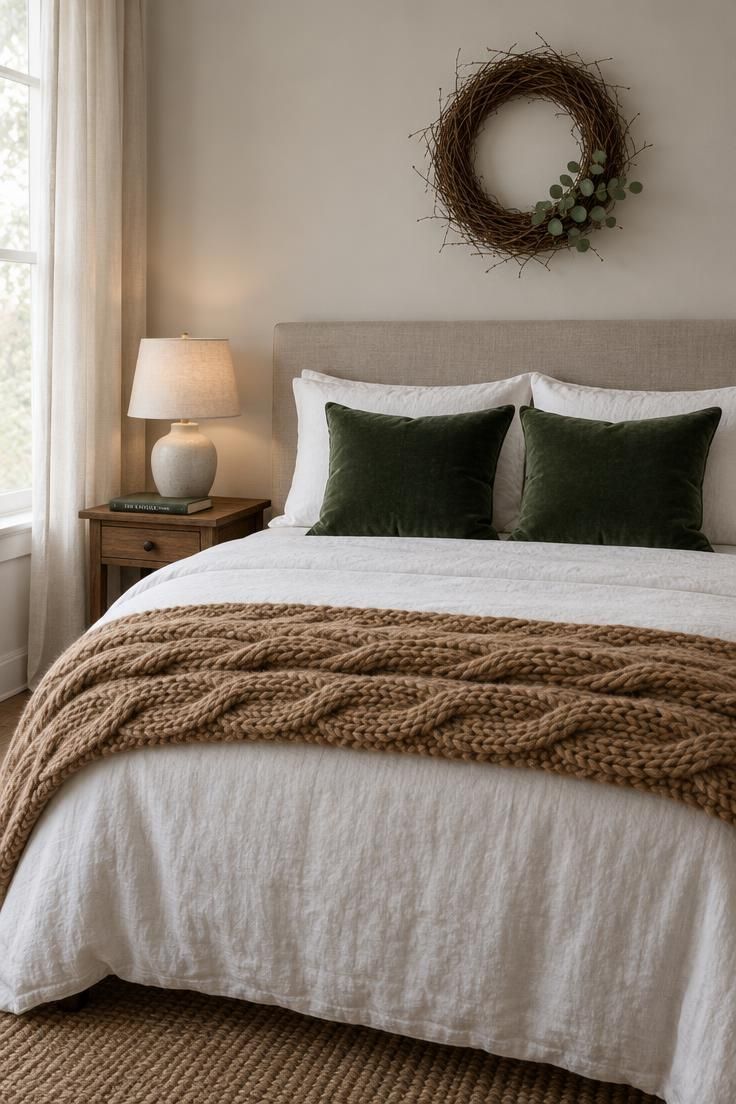
Winter bedding can change the character of a bedroom without a full swap of sheets and duvet.
A chunky knit throw folded across the foot adds weight and texture at the end of the bed, where it catches light and shadow.
Two velvet cushions in deep green or berry set against plain white shams give the bed a seasonal layer that comes off in one motion.
A simple twig or greenery wreath above the headboard works as a visual focal point at the scale of the wall, not the scale of the pillow stack.
Keep it centered and lightweight in look so it reads as part of the headboard composition rather than a separate decoration.
The tradeoffs are texture care and storage.
Velvet crushes and needs a brush to recover its pile, and knit throws stretch if they hang for months.
Rotate the throw to the seat of a chair between uses, and store the velvet cushions flat in a labeled bin once the season ends.
Scale the wreath to the headboard width, not the whole wall, and check that it clears the top of the pillows when the bed is made.
A wreath hung too low crowds the space where someone sits up to read.
Style Blueprint:
- A camel or oatmeal chunky knit throw
- Two deep green or berry velvet cushions
- Plain white or cream linen shams
- A simple twig wreath with a eucalyptus sprig
Design Pro-Tip: Choose one velvet color and repeat it in a small way elsewhere in the room, such as a single cushion on a chair, so the bed layer feels connected rather than isolated.
Kids’ Craft Table With Kraft Paper and a Cookie Tin
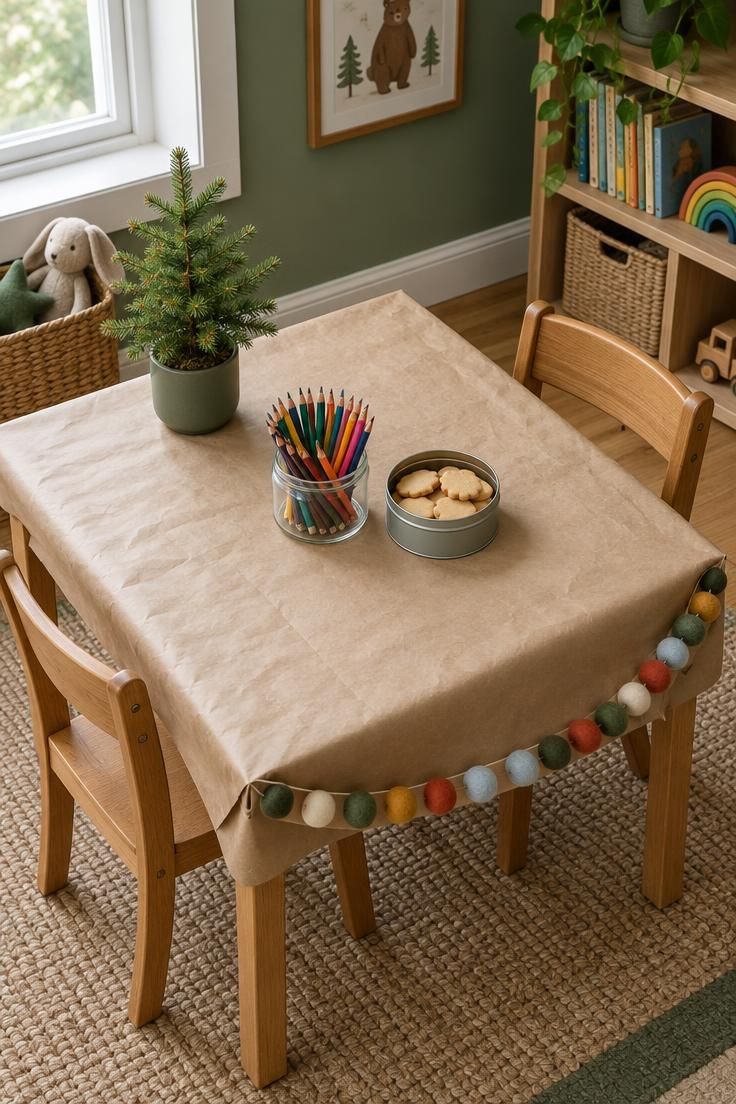
A children’s craft table can carry holiday warmth through activity rather than display.
Kraft paper across the tabletop gives a clean surface that can be drawn on, wiped, or replaced, and it looks intentional rather than protective.
A jar of crayons and a tin of plain cookies anchor the center, and a tiny tree at one corner keeps the table festive without blocking the work area.
Choose wipable cushions and keep decorations low along the table edge.
A felt ball garland draped just off the surface adds color where small hands will not knock it into the crayons.
The low potted tree should sit at the corner farthest from the main drawing zone.
Practical decisions matter more here than anywhere else on this list.
Paper rolls store under the table or in a closet, and a tin with a lid keeps cookies from going stale.
Felt garlands collect dust and lint, so a quick shake outdoors each week keeps them presentable.
Paper marker lines across the tabletop help children divide drawing space, and adults can refresh the paper without clearing the decor.
Keep the crayon jar wide and shallow so pencils go back in easily.
Style Blueprint:
- A roll of kraft paper cut to the table size
- A shallow glass jar of colored pencils
- A small metal tin with a lid
- A tiny potted evergreen in a matte pot
- A felt ball garland along the table edge
Console Behind the Sofa With Winter Prints and a Throw Basket
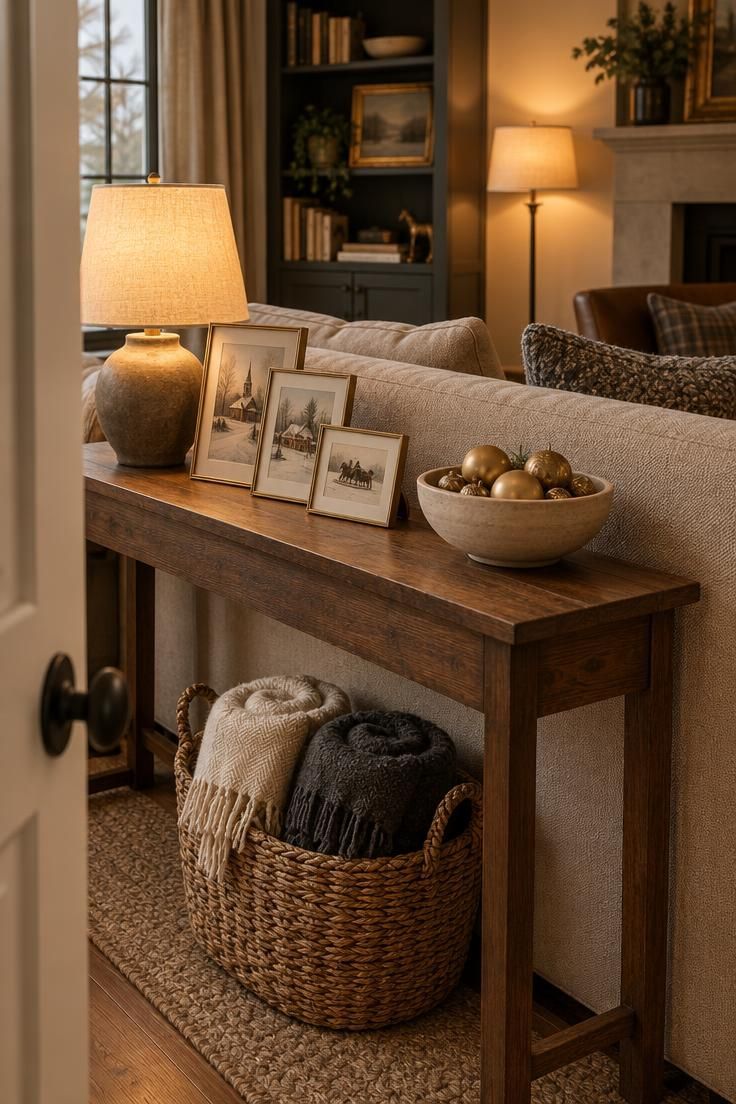
The space behind a sofa often goes unused, which makes it a good place for a background layer of decor.
A narrow console holds a warm-toned lamp, a stack of small framed winter prints, and a low bowl of ornaments in one material.
A basket of rolled throws beneath the console softens the floor line and keeps spare blankets within reach.
This setup works because it adds depth rather than competing with the seating.
The lamp shade should read warm and soft, the frames small enough that three can stack without dominating the wall, and the ornament bowl shallow enough to see over from the sofa.
Leaving a clear stretch of console surface keeps it useful for drinks or remotes.
Maintenance is minimal: frames need dusting, ornaments need occasional wiping, and the basket needs a shake to remove lint.
The bigger consideration is scale.
A console deeper than the sofa back steals floor space, and a lamp too tall blocks the view across the room.
Swap the framed prints seasonally and store the rest flat in a drawer.
Keeping the same frame sizes makes the rotation quick and keeps the console composition stable from year to year.
Style Blueprint:
- A narrow console table sized to the sofa back
- A small lamp with a warm linen shade
- Three small frames with vintage-style winter cards
- A low ceramic bowl of matte gold ornaments
- A woven basket holding two rolled throws
Hallway Niche With a Potted Norfolk Pine and Brass Bells
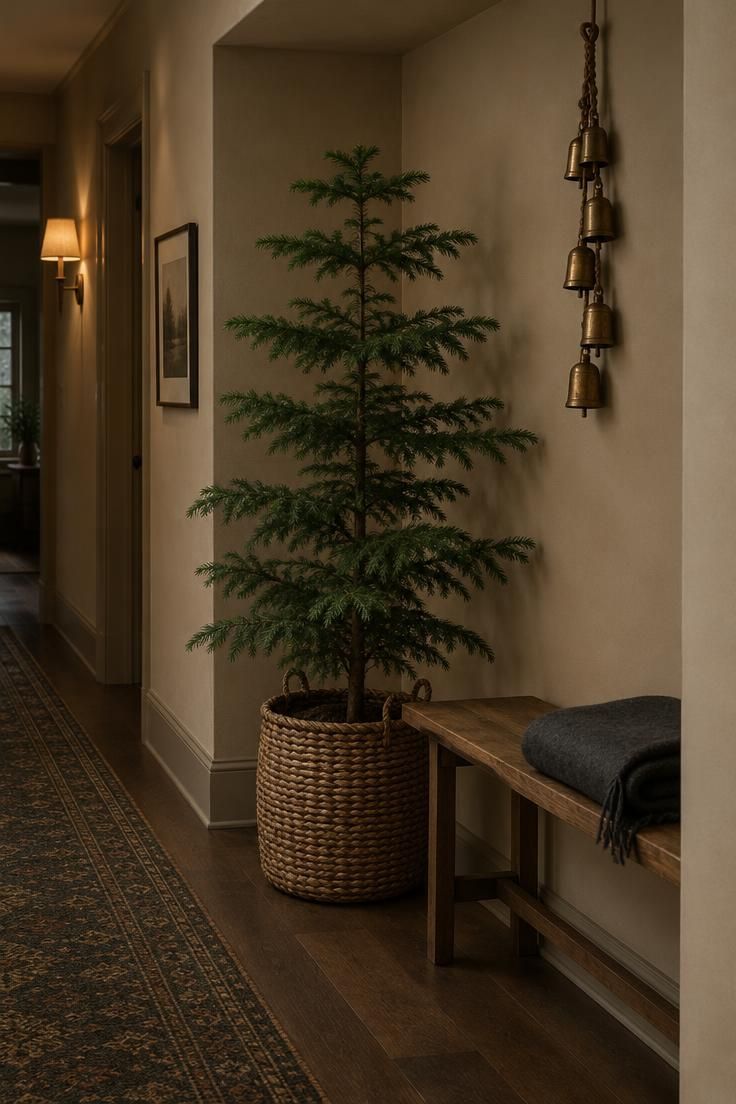
A hallway niche offers a contained spot for a quiet seasonal moment.
One potted Norfolk pine or rosemary topiary in a woven basket gives the niche a living center, and a short strand of aged brass bells along the upper edge adds a festive note without visual weight.
A slim bench beneath holds a single folded wool throw.
Understatement is the point here.
Hallways connect busier rooms, so a niche that stays restrained gives the eye somewhere to rest.
The pine’s deep green and the brass’s aged tone sit well against a warm beige wall, and the charcoal throw keeps the palette from turning too sweet.
Care notes are ordinary but worth planning.
Potted evergreens need watering on a schedule and a saucer to protect the floor, and brass bells dull over time unless wiped.
The bench should stay narrow enough that a passing shoulder does not brush the throw.
Keep the niche below the sightline to adjacent doorways.
A strand of bells that hangs too low catches on coats, and a pine placed too far forward can be knocked by bags carried through the hall.
Style Blueprint:
- A potted Norfolk pine or rosemary topiary
- A woven basket to hold the pot
- A short strand of aged brass bells
- A slim wood bench with one folded wool throw
Doorway Lantern and Potted Evergreen Greeting
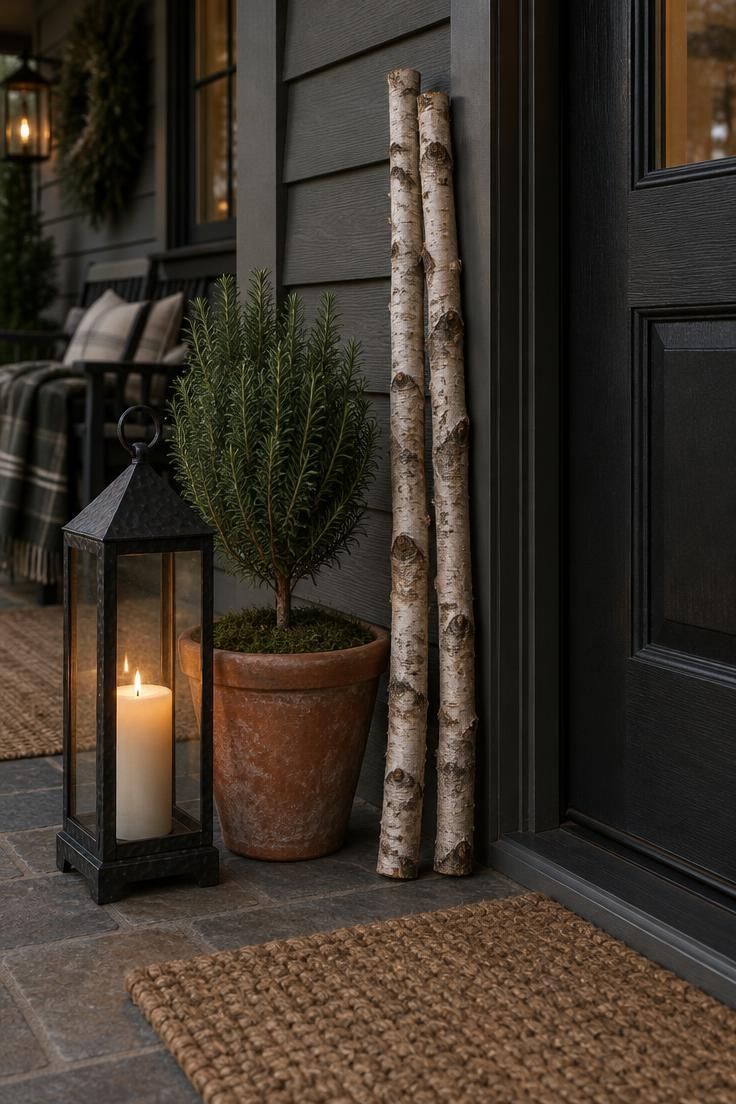
The threshold just inside a door or on a covered porch gives a first and last impression of the home.
A tall black iron lantern with a battery candle sets a warm anchor, a small potted evergreen or rosemary topiary adds green at floor level, and a flat-weave mat grounds the arrangement.
A bundle of birch branches leaning against the wall brings height without another piece of furniture.
Compact scale is the whole trick.
The lantern should leave room for the door to swing fully open, and the pot should sit far enough back that coats and bags clear it.
Birch branches look best leaning in a loose bundle with varied lengths rather than standing perfectly upright.
Weather and traffic decide how much upkeep this spot needs.
Terracotta can crack in a hard freeze, so bring the pot inside during cold snaps, and natural fiber mats need shaking and drying.
Battery candles should be checked before guests arrive, since the glow does most of the welcoming.
Keep the arrangement to three or four pieces so a porch with a lantern, a green plant, a mat, and a branch bundle reads complete rather than crowded near the door swing.
Style Blueprint:
- A tall black iron lantern with a battery candle
- A small potted rosemary or evergreen topiary in terracotta
- A flat natural fiber doormat
- A bundle of three birch branches in varied lengths
Conclusion
Cozy Christmas decor comes down to repeating a few soft materials, warm light sources, and natural accents across the rooms a household actually uses.
Choose two or three of these moments to start rather than all of them, leave negative space around each one so the eye can rest, and store the layers in a labeled bin when the season ends.
The warmest rooms often share a quality that is easy to overlook: a few well-placed textures that look considered from the sofa, the table, and the doorway alike.
Build slowly, check each setup from where people naturally stand, and let the layered details do the rest.