This post may contain affiliate links. If you make a purchase through these links, we may earn a commission at no additional cost to you.
Country Christmas decorating draws from several related traditions: the spare lines of farmhouse style, the worn charm of vintage pieces, and the unfussy texture of natural materials.
Those strands can share a house without competing, as long as each surface gets one clear focal point and one supporting layer.
A porch bench, a mantel, a kitchen shelf, and a table each carry a different piece of the story.
The vignettes below explain the material pairings and editing choices that make a collected look feel calm rather than chaotic.
Weathered Bench Porch Greeting with a Galvanized Bucket
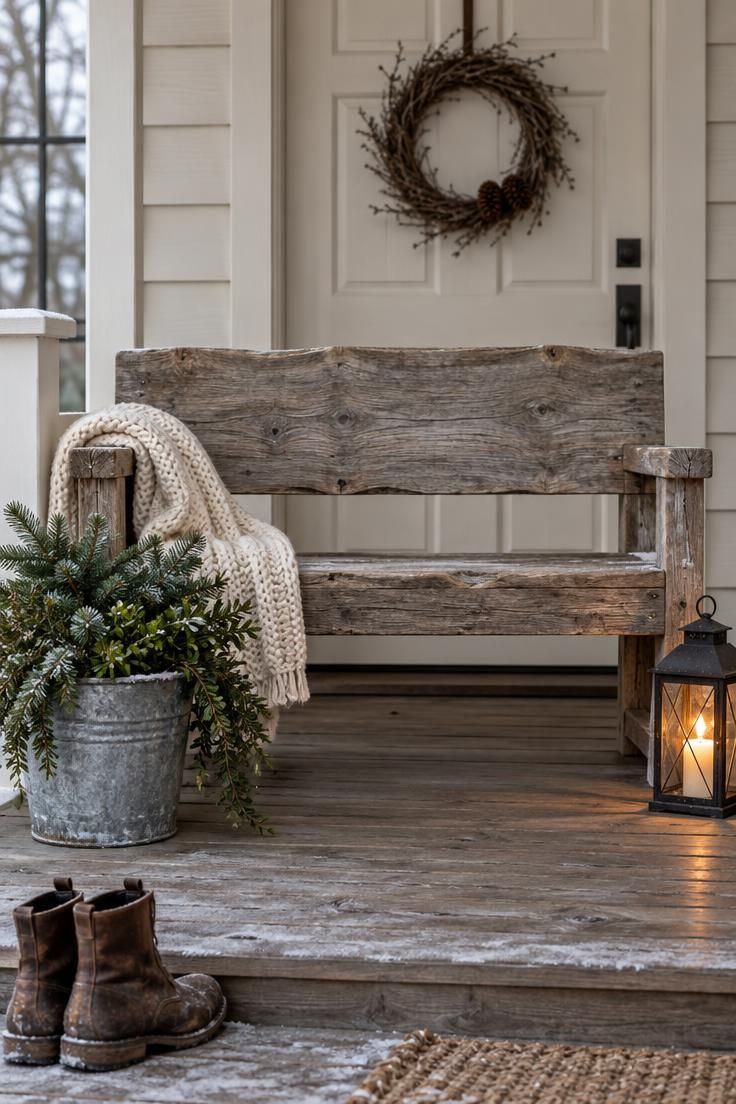
A porch vignette reads best when it looks like one stop on the way inside rather than a full exterior project.
The weathered bench gives the eye a horizontal anchor, and the folded throw softens the hard line of the wood without hiding its grayed grain.
Keeping the bucket close to the bench arm creates the sense that someone set down an armful of branches and stepped away.
The natural evergreen centerpiece here is the bucket itself, kept loose and unforced rather than clipped into a tight dome.
Mixed Fraser fir and boxwood bring two greens that differ in tone, which keeps the foliage from reading as a single flat mass.
A cream throw, forest green branches, and galvanized gray metal form a narrow palette that lets the front door stay the focal point of the facade.
Loose greenery on a porch will drop needles onto the step over the following days.
A sturdy metal bucket that looks intentionally chosen, rather than a temporary bin, absorbs that shedding as part of the arrangement's casual character.
Emptying and refreshing the branches every week or two keeps the display from looking tired.
The door wreath only needs two pinecones and a simple twig base to echo the bucket without repeating it.
Height matters too: the bench sits low, the wreath sits high, and the lantern fills the gap near the floor, so the eye travels in a relaxed diagonal instead of scanning a flat line.
Style Blueprint:
- A chunky cream knit throw folded once over the bench arm
- A matte galvanized bucket with Fraser fir and boxwood
- A raw-edge wood bench that shows grayed grain
- A black metal lantern with a short candle-style light
- A twig wreath with two pinecones on the door
Asymmetrical Mantel Garland with Mercury Glass and Bottle-Brush Trees
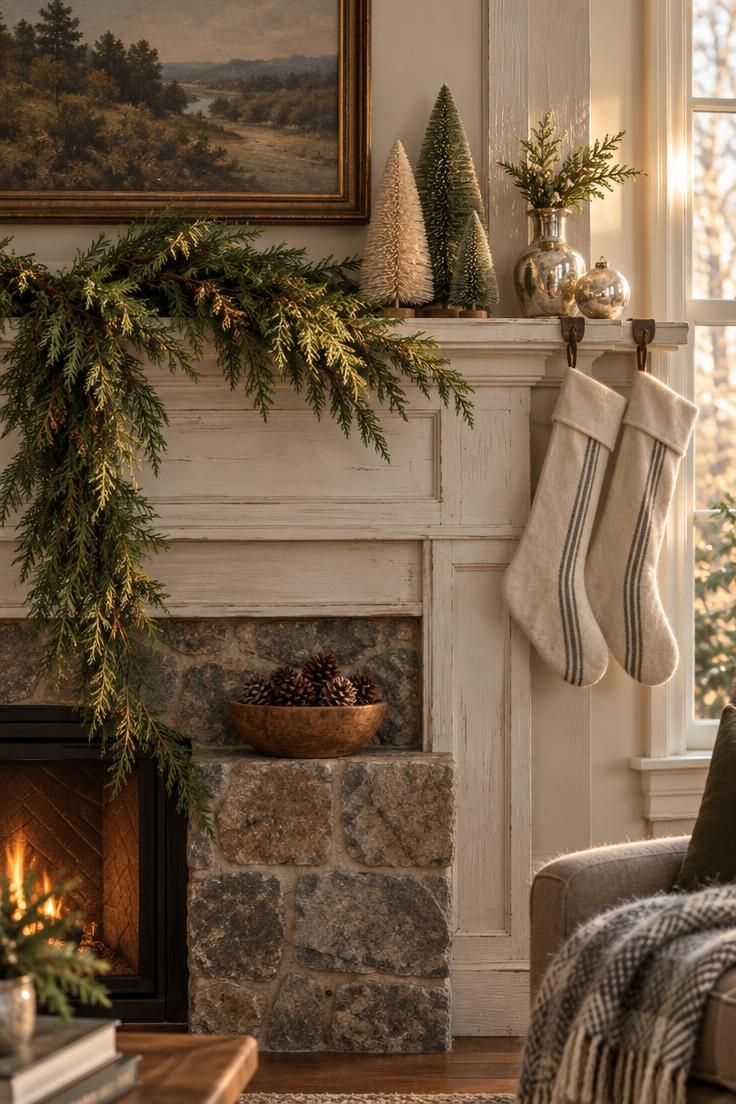
Treating the mantel as a still life means letting one side carry more weight than the other.
A cedar garland draped from the left creates a natural slope, and the three bottle-brush trees group just off-center so the display has a direction rather than a mirror line.
The empty space at one end gives the whole arrangement somewhere to breathe.
A rustic mantel garland works when its drape follows the architecture instead of fighting it.
Letting the cedar fall slightly over the mantel edge, with needles uneven and some stems pointing down, keeps the line soft next to hard stone or painted wood.
Cream repeat across stockings and tree forms acts as a quiet thread, so the mercury glass can add sparkle without turning the mantel busy.
If a large mirror or piece of art already hangs above the firebox, a full drape competes with it.
Reducing the garland to one swag on a single side keeps the display focused.
Consider also how far the garland should travel: a short swag leaves room for stockings, while a longer one can dominate the whole shelf.
Mercury glass earns its place by catching the room's light in small, soft flashes rather than a hard shine.
One vase and one round ornament are enough to bridge the matte greenery and the smooth stockings.
The wood bowl of pinecones near the center ties the brown tones of the cedar stems to the hearth below.
Style Blueprint:
- A cedar garland draped from the left side
- Three bottle-brush trees in cream and muted green
- A mercury-glass vase and one round ornament
- Two off-white stockings with a gray ticking stripe
- A small wood bowl holding pinecones
Dough Bowl Centerpiece with Dried Oranges and a Linen Runner
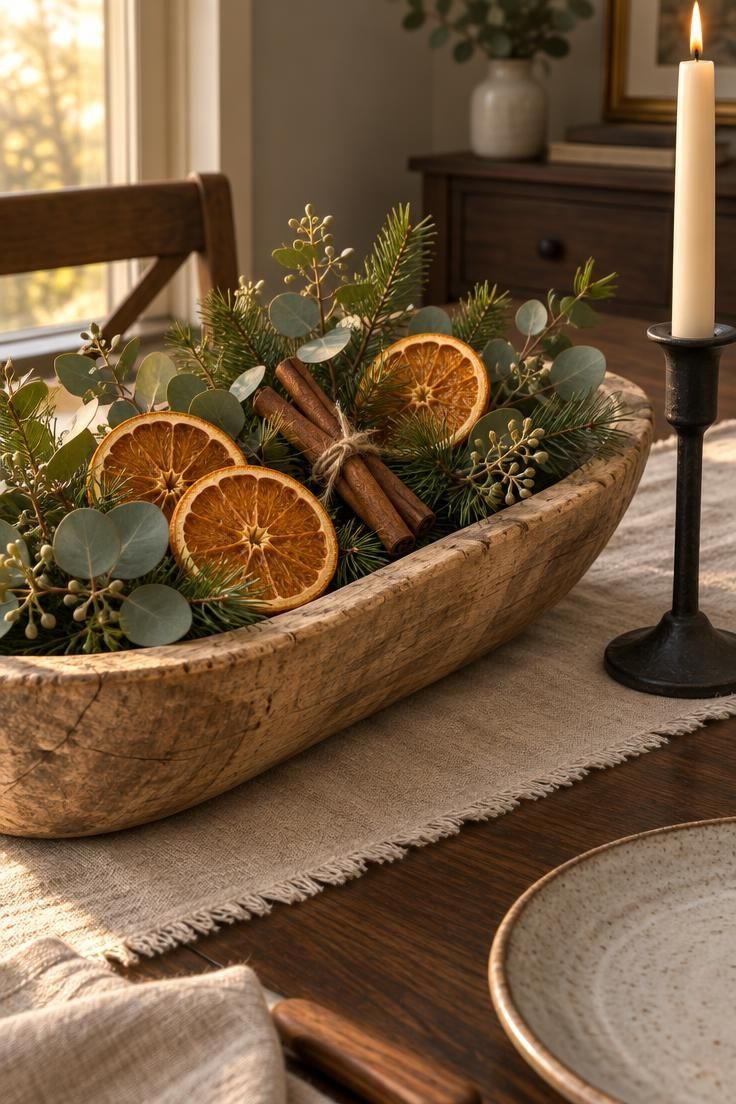
A centerpiece earns its keep when it stays low enough for people to see across the table.
The unfinished dough bowl sits close to the surface, and the greenery spreads sideways rather than upward, so sightlines stay open through the whole meal.
Dried orange slices and cinnamon sticks supply the warm brown tones that keep the green from feeling cold.
A natural evergreen centerpiece mixed with eucalyptus gains depth from two leaf shapes that move differently in the light.
The linen runner underneath softens the transition from bowl to tabletop, and its frayed edge gives the arrangement a relaxed, unstudied look.
One iron candlestick on a single side adds height without blocking the view opposite it.
On a table used every day, choose a narrow bowl that still leaves clear space for plates and glasses when the meal begins.
Dried citrus fades and can grow brittle after a few weeks, but swapping the slices for fresh ones takes only a moment and does not require rebuilding the display.
Cinnamon sticks bundled with twine hold their color far longer than the fruit.
The stoneware plate edge near the frame is a reminder that this centerpiece lives with real tableware, not apart from it.
Keeping the bowl slightly off-center makes room for serving dishes at one end.
Style Blueprint:
- A raw wood dough bowl
- Mixed eucalyptus and pine
- Five dried orange slices
- Three cinnamon sticks bundled with twine
- A cream linen runner with a frayed edge
Vintage Keepers on a Sage Sideboard with an Old Sled and Ice Skates
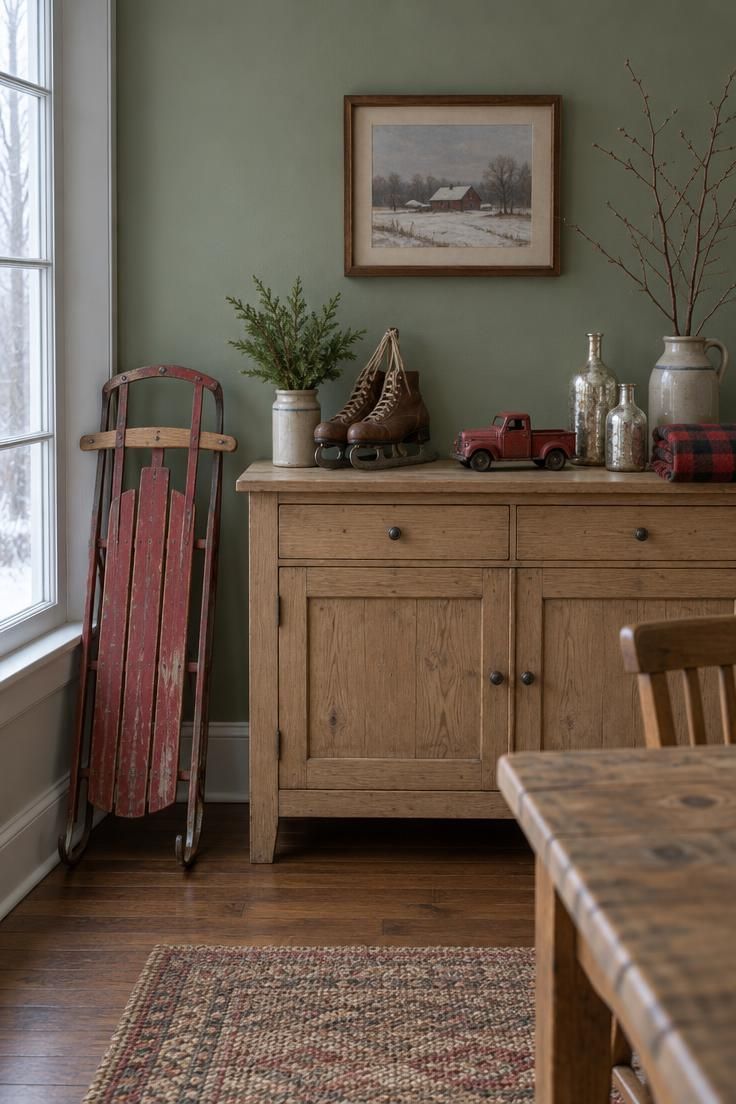
A sideboard set up as a seasonal display can lean collected rather than styled, and negative space is what keeps it from becoming a shelf of small objects.
The sled against the wall provides a tall vertical shape, the skates sit at mid height, and the red truck and bottles group together as one unit.
Sage green behind the faded reds and pale wood gives those warmer tones somewhere calm to sit.
Old pieces carry patina that reads as character rather than damage when the surrounding palette stays muted.
Two or three vintage or vintage-look objects are enough for this surface; every additional item competes with the sled.
The buffalo check decorations here stay limited to one folded blanket, which repeats the red without adding a second pattern.
Worn or old painted items can transfer color onto light furniture if they rub against it.
Resting the sled directly against the sage wall and keeping the truck on a stable section of the sideboard prevents scuffs on the pale wood.
Checking the underside of any vintage piece for loose flakes before placing it nearby is a quick habit worth keeping.
Tying the skate laces together creates a small, tidy detail that reads as care.
The bare branches in a stoneware jug at the far edge echo the sled's vertical line on the opposite side, holding the composition together.
Style Blueprint:
- A child-size wooden sled with worn red paint
- A pair of leather ice skates with laces tied together
- A small red metal truck
- Two mercury-glass bottles
- A folded buffalo-check blanket in muted red
Buffalo Check Balanced on a Neutral Sofa with a Woven Throw
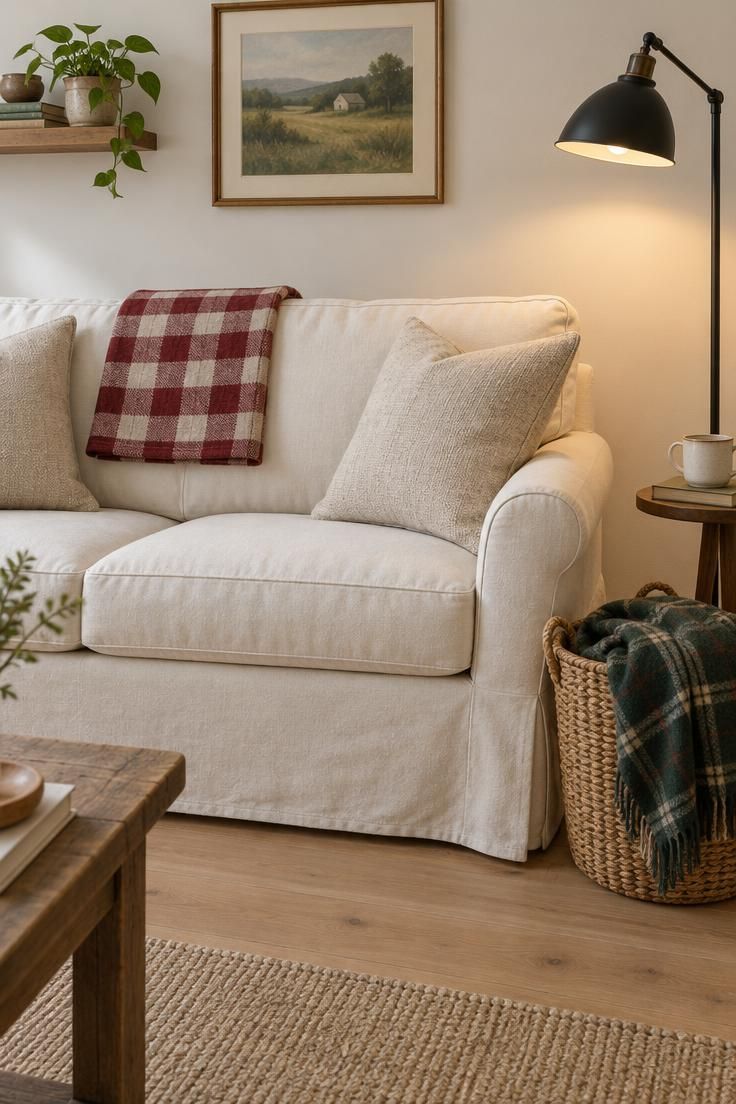
Buffalo check reads clearest when it is the only loud pattern in the seating area.
On a cream slipcovered sofa, one folded throw over the back cushion introduces the pattern at eye level and lets the solid oatmeal pillows keep the rest of the sofa quiet.
A single woven basket holding a forest green plaid blanket repeats the idea of pattern without adding another upholstered surface.
Scale decides whether the check feels charming or overwhelming.
In a small room, a finer check keeps the throw from looking like a graphic banner across the sofa.
Large-scale checks suit bigger rooms with more distance between the sofa and the viewer.
Either way, letting the check appear on one textile and the plaid on another creates a related pair rather than a matched set.
Buffalo check can read too thematic when it lands on throw pillows, a rug, stockings, and a tree skirt all at once.
Picking no more than two applications in one room keeps the pattern feeling intentional.
The black iron floor lamp beside the sofa also supplies a cool neutral that breaks up the warm reds and creams.
The basket on the floor does practical work as well, storing a blanket that gets used on cold evenings while adding height beside the sofa arm.
A ceramic mug on the side table adds a small sign of daily life.
Style Blueprint:
- A cream slipcovered sofa
- One folded throw in muted red buffalo check
- Two solid oatmeal pillows
- A woven seagrass basket holding a forest green plaid blanket
- A black iron floor lamp beside the sofa
Design Pro-Tip: When a checked textile feels too strong for a room, fold it so a solid band of the reverse side faces outward, which lightens the pattern without removing it.
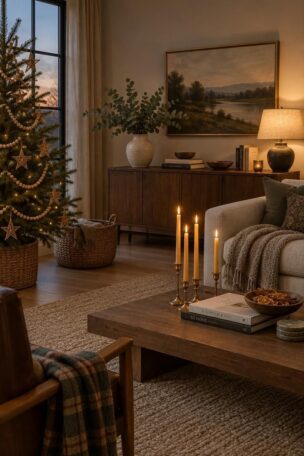
Airy Woodland Corner with a Sparse Frasier Fir and Twine Ties
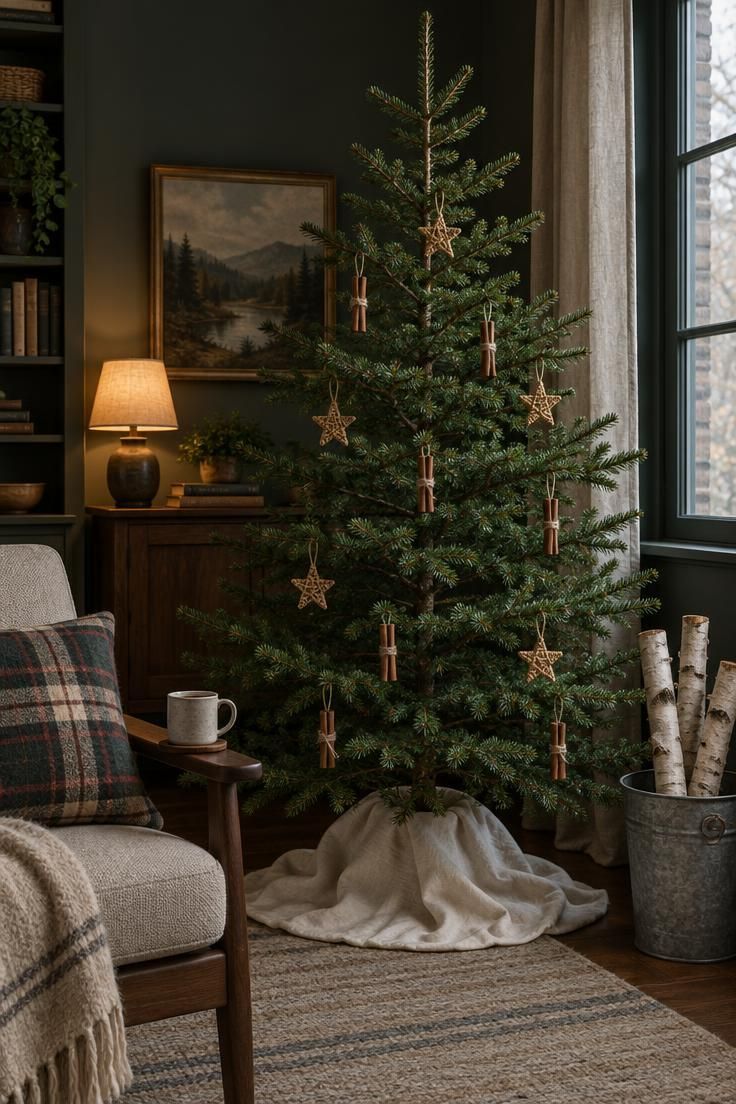
An airy tree works for anyone who prefers the natural side of country Christmas over a densely packed traditional fir.
The sparse Frasier fir shows its branch structure, and a handful of twine-tied cinnamon sticks and woven stars lets the openness carry the look.
Choosing wood, dried, and twine-based ornaments instead of shiny glass keeps the effect quiet and rustic.
The tradeoff is exposure.
An airy tree reveals its trunk and cord more than a full one does, so a cream linen skirt and a galvanized bucket of birch branches at the base give the lower half something to rest on.
Foraged birch or bare branches mixed into the fir can fill the widest gaps without making the whole tree dense.
A galvanized bucket used as a tree collar sidesteps the usual skirt shape and adds a cool gray note against the green.
The plaid cushion on the foreground chair nods to the same country vocabulary in a separate material, so the corner feels connected to the rest of the room.
Moody light suits this vignette as long as the branches, skirt, and rug stay visible in the shadow areas.
Low, warm light from one side emphasizes the gaps between branches, which is the whole point of keeping the tree sparse.
Style Blueprint:
- A sparse Frasier fir
- Six twine-tied cinnamon sticks
- Four woven star ornaments
- A cream linen tree skirt
- A galvanized bucket with a few birch branches at the base
Collected Ornament Tray with Kraft Tags and a Stoneware Crock
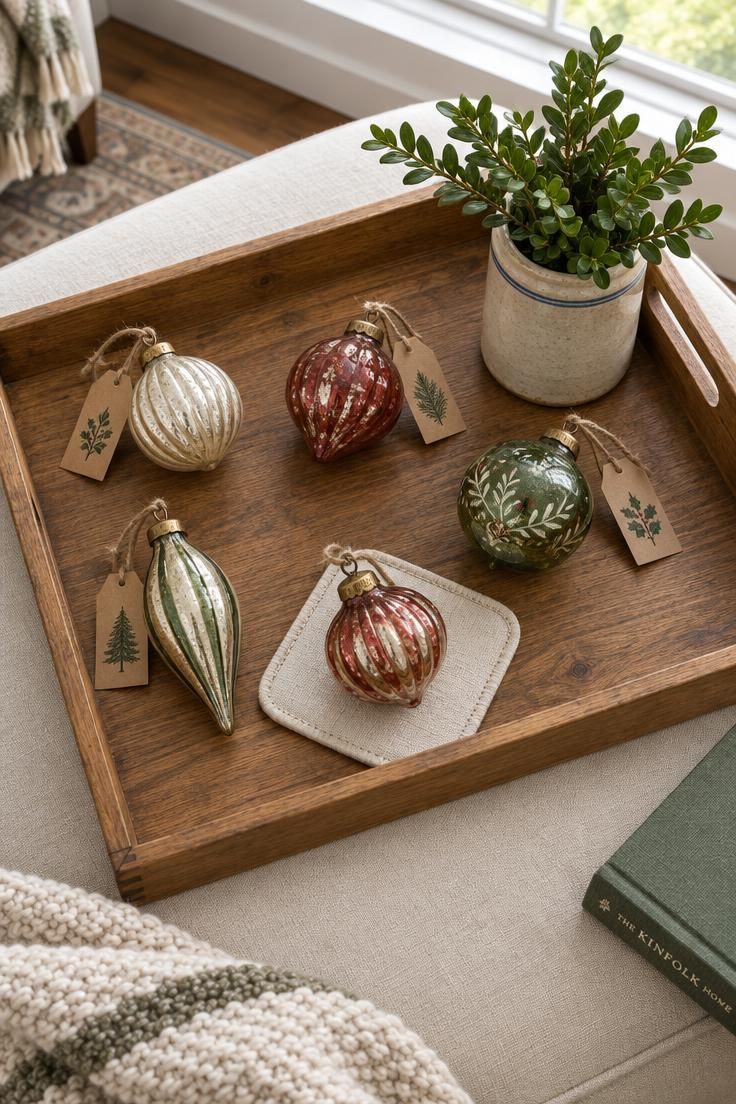
Collected ornaments deserve a spot where they can be seen up close, not only from across the room on a tree.
A shallow wood tray on an ottoman or coffee table lifts them slightly and keeps them from rolling.
Mixing vintage ornaments in cream, muted red, and green in a loose arrangement gives the tray the feel of objects gathered over years.
Kraft-paper tags with twine ties carry the nostalgic note without a printed message.
Tied to a few ornament necks, they suggest the tradition of labeling and storing decorations from season to season.
The small stoneware crock with a boxwood sprig at one end gives the tray a vertical element so the arrangement does not read as a flat scatter.
Ornaments with fragile paint or old string loops need gentle handling and a location away from high-traffic elbows.
Setting the tray on an ottoman rather than a busy coffee table edge keeps the glass out of the way when people move through the room.
Resting one ornament on a cream linen coaster prevents it from rolling against its neighbors.
Bright midday light suits this vignette because it shows the glass reflections honestly, including the small imperfections that make older ornaments interesting.
Style Blueprint:
- A shallow wood tray
- Five vintage-style glass ornaments
- Three kraft-paper tags with twine
- A small stoneware crock with a boxwood sprig
- A cream linen coaster under one ornament
Open Kitchen Shelf with Enamelware and a Bowl of Cranberries
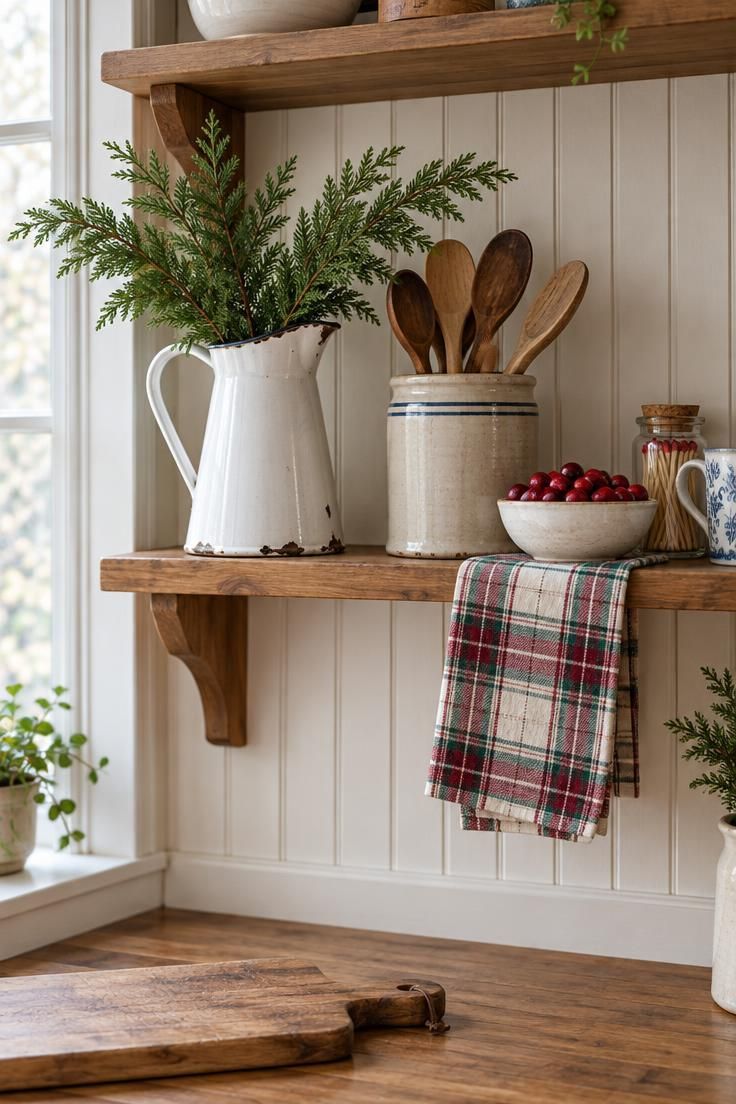
Kitchen touches stay useful when they occupy one shelf rather than spreading across every counter.
An open wood shelf holds a white enamelware pitcher with cedar sprigs, a stoneware crock of wooden spoons, and a small cream bowl of fresh cranberries, and the grouping reads as a single country Christmas moment without changing how the kitchen works.
A folded plaid tea towel over the shelf edge supplies pattern in a place that gets handled daily.
Enamelware suits this setting because its chipped rim and matte white finish look at home beside stoneware and wood.
The cranberries give the shelf a deep red accent that feels seasonal without a printed motif.
Cedar sprigs in the pitcher echo greenery elsewhere in the house while staying contained to one spot.
Fresh cranberries soften and can stain if left too long, so this vignette suits a short display period, perhaps through a holiday week.
Swapping in a small bowl of clementines extends the life of the arrangement with less risk of spoilage.
The wooden spoons in the crock stay within reach for cooking, which keeps the display honest.
Keeping the shelf's proportions in mind matters: the pitcher is tall, the crock is medium, and the cranberry bowl is low, so the three heights step down naturally.
Style Blueprint:
- A white enamelware pitcher
- Three cedar or boxwood sprigs
- A stoneware crock with wooden spoons
- A small cream bowl with fresh cranberries
- A folded plaid tea towel
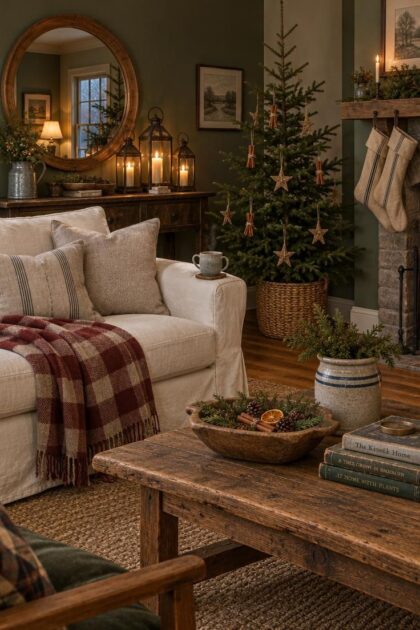
Warm Light Layering with a Lantern Group and Cedar Rope
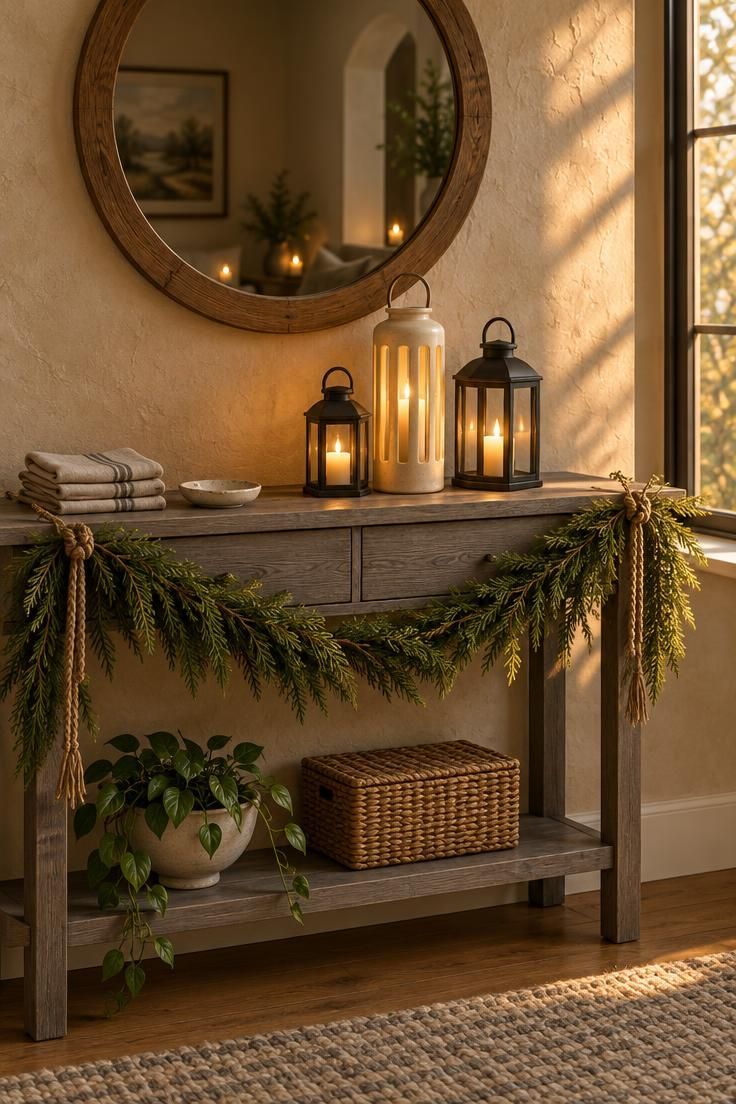
Light can act as a material in a room that otherwise feels flat at night.
Two or three lanterns of different heights on a console, each with a candle-style light, create small pools of warmth at staggered levels.
A cedar rope draped across the console front ties the lights to the greenery used elsewhere in the house, and a round mirror behind the group doubles the glow without adding another fixture.
This setup works especially well in a room without a fireplace, where the lantern group supplies the visual center that a hearth would normally hold.
Keeping the colors around the light source neutral, with creams, tans, and grays, lets the warm glow stand out as the main event.
The taller cream ceramic lantern breaks the black metal pair so the grouping does not look like a matched set.
A small stack of linen napkins and a ceramic dish at one end of the console add daily-use texture without crowding the lanterns.
The mirror's reflection carries the light back into the room, which matters in the evening hours when the window light fades.
Style Blueprint:
- Two small matte black lanterns
- One taller cream ceramic lantern
- A cedar roping swag
- A round wood mirror
- A small stack of linen napkins
Design Pro-Tip: Vary lantern heights by a hand's width or more so each light pool overlaps the next instead of blending into one flat glow.
Repurposed Grain-Sack Stockings with a Crate and Basket Tree Collar
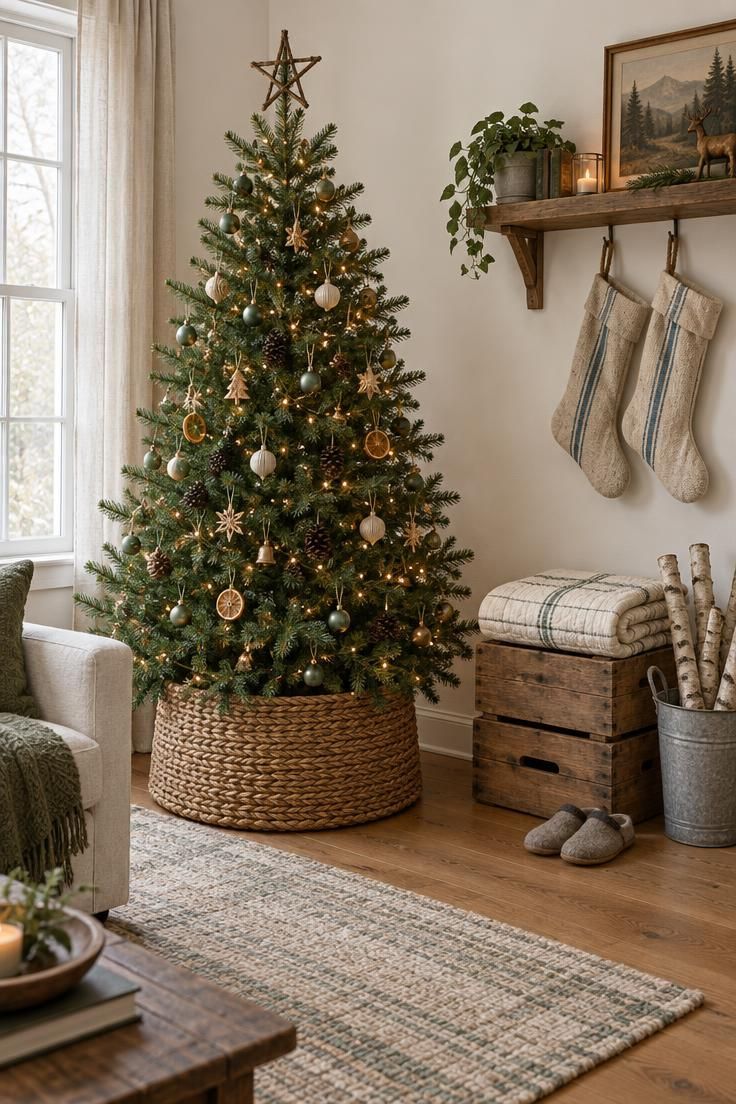
Repurposed objects can carry the farmhouse Christmas decor look without a single new purchase.
Stockings made from vintage-look grain-sack fabric or ticking stripe hang from thick twine loops, and their loose weave contrasts with the tidy tree behind them.
A stack of wooden crates beside the tree replaces a side table, and a large woven basket around the base of the tree reads as a collar rather than a sewn skirt.
The basket collar and the crate stack share a natural fiber and aged-wood vocabulary that keeps the corner from looking too perfect.
A cream quilt folded on the crates adds softness next to the hard edges of the wood, and the galvanized bucket of birch branches ties the arrangement to the greenery used on other surfaces.
Grain-sack fabric is loosely woven and can snag on rough wood or sharp edges.
Keeping these stockings in low-touch spots, away from doorways where coats and bags brush past, helps them last through the season.
The crate tops can also collect dust between the slats, so a quick pass with a soft brush keeps the aged look from reading as neglected.
Placing the tree inside the basket rather than on top of a skirt also removes a fabric layer that would otherwise need to be re-fluffed every morning.
Style Blueprint:
- Two grain-sack stockings with thick twine hangers
- A stack of two small wooden crates
- A large woven basket as a tree collar
- A cream quilt folded on the crates
- A galvanized bucket holding birch branches
Conclusion
Country Christmas reads best when the rooms themselves stay simple and only a few surfaces carry the story.
Weathered wood, galvanized metal, soft plaid, and natural greenery move from the porch to the mantel to the kitchen shelf without asking the whole house to change.
That handful of materials works because each vignette keeps a clear focal point and lets the space around it stay open.
Choosing one pattern, one metal, and one repeated shape per surface leaves room for the details that make a home feel lived in.