This post may contain affiliate links. If you make a purchase through these links, we may earn a commission at no additional cost to you.
Winter front porch decor can make a home feel welcoming before anyone steps inside.
A good entry reads as one composed welcome rather than a pile of seasonal pieces, and the winter season asks for warmth in both color and texture.
This list covers a range of porch looks, from holiday-forward displays that peak in late November through early January to neutral winter arrangements that carry through February.
Each idea notes which parts of the porch it occupies, what it is made of, and where it asks for a little extra upkeep.
Adapt any of them to the size, exposure, and traffic of your own front entry.
Snowshoe and Skis Door Leaner
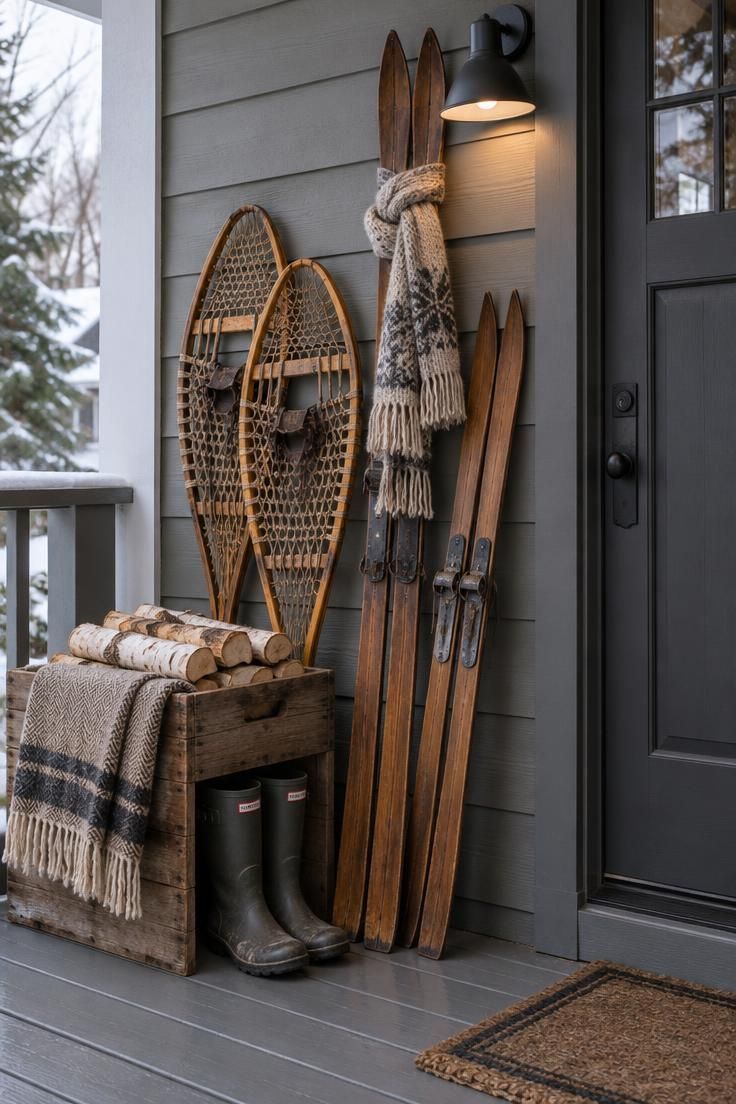
Snowshoes and wooden skis turn a bare stretch of porch wall into a winter arrangement without hanging anything from the siding.
For an evergreen garland for a front door, the leaner sits at the edge of the walking path, so the tall shapes frame the door while keeping the latch side open.
Old wood with leather bindings and rawhide lacing adds a rougher texture than wreaths or ribbon and works especially well on a covered porch where the pieces stay dry.
The grouping reads as a small still life when the heights vary.
Two tall snowshoes crossed at the tips, one shorter ski, and a low crate of birch logs create a triangle that leads the eye from the porch floor up toward the door hardware.
The crate gives the arrangement a practical anchor and keeps the gear from sliding on a smooth board surface.
Material contrast does most of the work here.
Pale wood set against a charcoal or deep green door stays visible from the street, while woven wool and leather soften the harder edges.
Switch the scarf or blanket color with the season and keep the palette limited to two neutrals and one warm accent.
Unused winter gear ages best in the covered entry zone.
Open porches expose rawhide lacing and old wood to repeated wetting, which can warp boards and discolor the weaving over repeated seasons.
Style Blueprint:
- Two wooden snowshoes with visible rawhide or leather lacing
- One pair of vintage skis in a shorter, lighter finish
- A low wooden crate holding split birch logs
- A chunky knit scarf or wool blanket in cream, rust, or olive
- Rubber snow boots tucked beside the crate
Design Pro-Tip: Cross the snowshoe tops at the handle side and rest the tails slightly apart so the pair stands without sliding; a braided jute loop around the upper frames keeps the crossing point tidy.
Neutral Winter Porch Styling
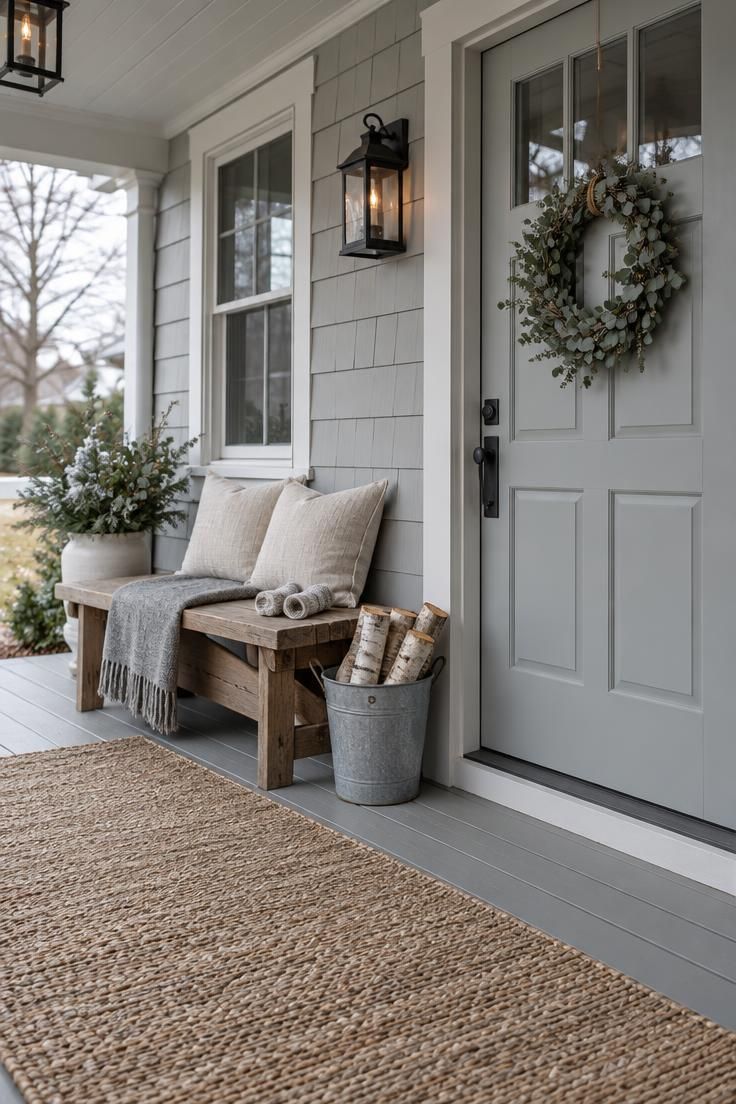
Neutral winter porch styling trades red-and-green for cream, gray, warm wood, and dusty green.
The palette lets doors, railings, and porch flooring stand out instead of competing with the decor.
For a look that stays past the holidays, it leans on shapes that read as winter rather than Christmas, such as wreaths, logs, and woven texture rather than trees and reindeer.
Eucalyptus works in this scheme because its gray-green leaves hold their color and look refined even on a pale door.
Birch logs bring in warm bark tones, and white berry sprays add a light accent without drawing attention to themselves.
A jute or natural fiber rug grounds the arrangement and softens a hard floor.
Upkeep favors dried and preserved materials.
Dried naturals last longer than fresh greenery through a cold, dry season, and dust shakes out of wreaths and branches with a quick pass.
Store the cushions and throw indoors during wet spells to keep the bench looking composed.
Style Blueprint:
- Eucalyptus or magnolia leaf wreath in muted green
- Low wooden bench with cream cushions
- Galvanized bucket of birch logs
- Woven natural fiber rug
Flocked Branches and Birch Logs
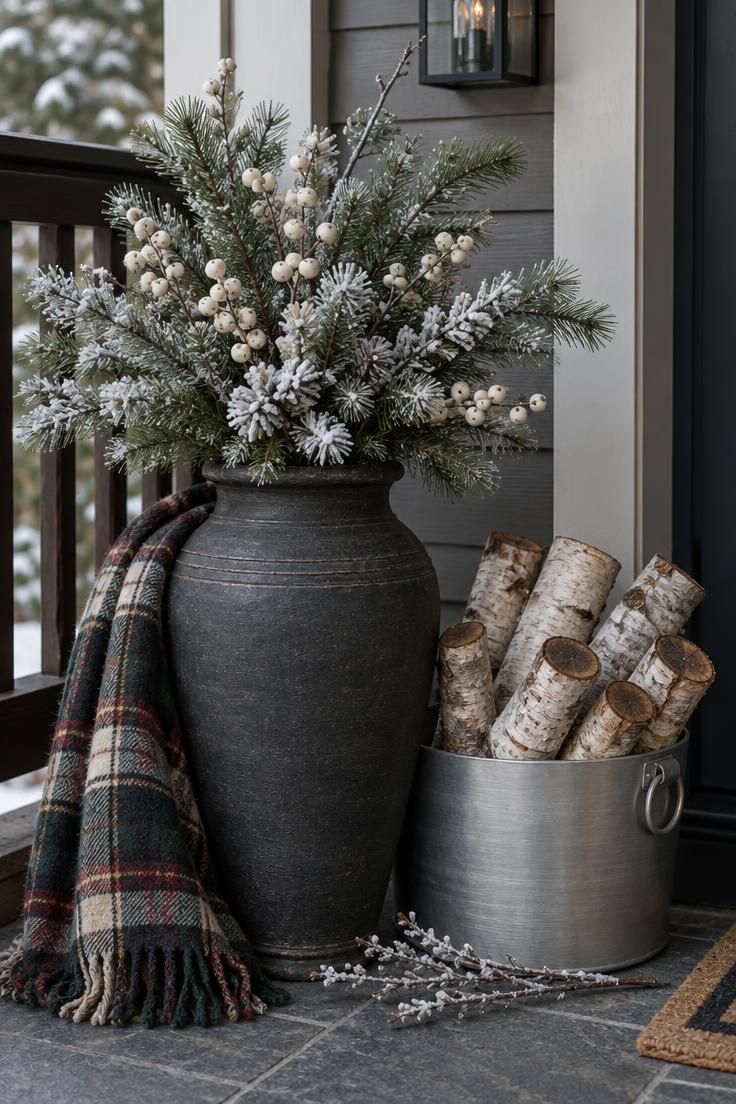
For flocked branches and birch logs, flocked branches bring a settled snow look to the porch even when the season stays dry.
Set against rough birch rounds, the soft frosting and the hard pale bark give the eye two very different winter textures.
The result suggests snow and woodland without leaning on overt holiday motifs.
Staggering container heights builds a vertical rhythm.
One tall vessel of frosted stems rises beside a low bucket of logs, and the pair reads as a considered arrangement rather than two separate props.
Place the taller vessel slightly back so the low stack stays visible from the walkway.
Flocking does shed fine material, and the flakes settle on floors and mats over time.
Sheltered spots suit flocked stems best, and a quick shake before placing them helps.
Birch logs are more forgiving and can sit outdoors through frost and thaw.
Three pieces of each material keep the grouping balanced, and an odd count reads as intentional.
Balance one dark urn with two lighter birch bundles and vary the heights of the logs so the bucket rim is visible.
Style Blueprint:
- Tall dark urn for frosted stems
- Low metal bucket or tub
- Cut birch logs with visible ring ends
- Frosted berry stems for a pale accent
- Wool throw or scarf for a soft touch
Design Pro-Tip: Group flocked stems and birch logs so the tallest container sits off center; an offset arrangement reads as a porch corner rather than a matched set.
Lanterns and Ribbon Porch Accents
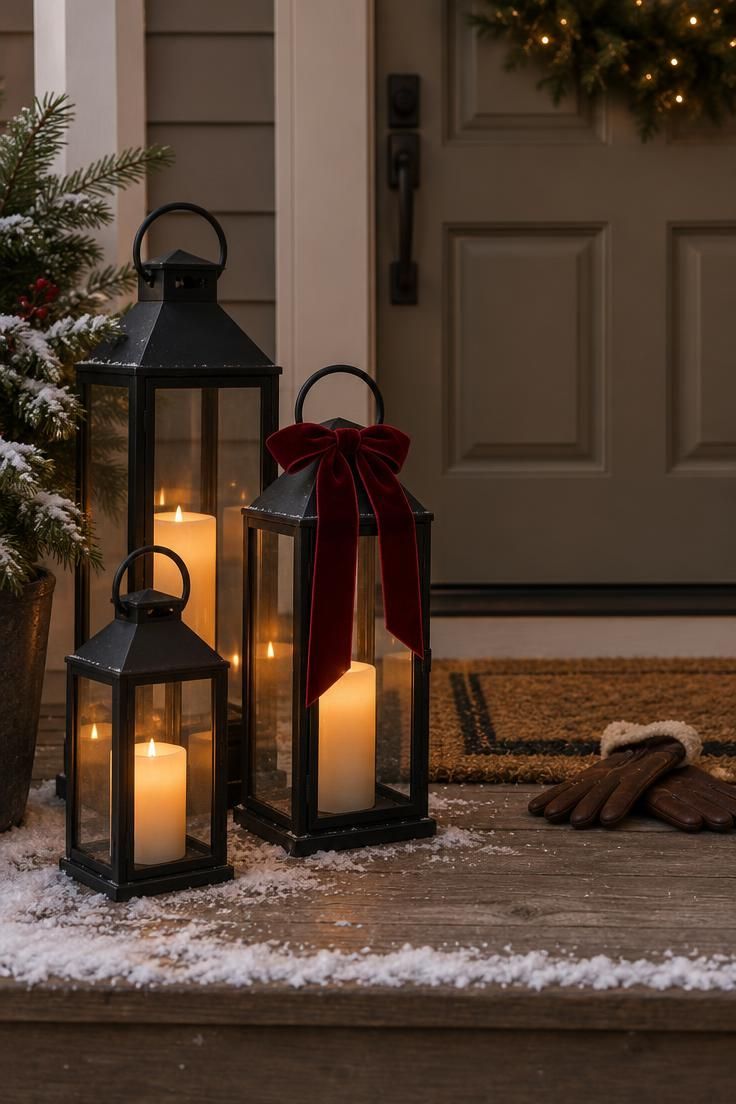
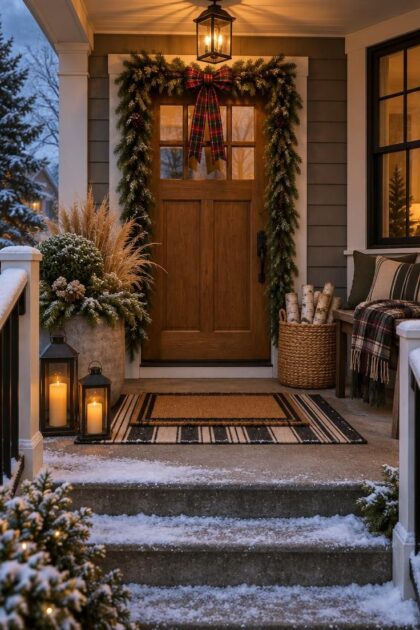
Lanterns and ribbon porch accents carry a porch into the evening.
A cluster of lanterns with warm glowing inserts gives the entry a focal point after dark, while the ribbon adds a strip of color and shine during the day.
Matte black reads crisp and modern, oil-rubbed bronze feels traditional, and galvanized metal leans rustic, so the finish sets the whole mood of the step.
Grouping choices change the impression.
A symmetrical pair of lanterns to either side of the door feels formal and even.
Three lanterns of staggered heights on one side feel relaxed and draw the eye along the step.
In both cases, warm candle-style LED inserts glow steadily without the attention an open flame would ask.
Ribbon is the easiest part to change.
A wide velvet bow suits a holiday stretch, and a narrower burlap or plaid ribbon shifts the look toward a quieter winter arrangement.
Swapping ribbon costs little and refreshes the entire grouping.
Watch how weather treats each material.
Velvet softens and darkens if it stays wet, while metal lanterns hold up well through freeze and thaw.
Bring fabric ribbon inside during long wet spells to keep it looking crisp.
Three heights work better than two, and slight variations in spacing keep the cluster from looking store-bought.
Leave the walkway clear so the lanterns sit beside the path rather than in it.
Style Blueprint:
- Three metal lanterns in staggered heights
- Flameless candle inserts with a warm glow
- One wide velvet or plaid ribbon bow
- Woven doormat beneath the cluster
- Neutral door as the backdrop
Design Pro-Tip: Tuck a short piece of ribbon inside each lantern beside the candle insert to echo the bow and tie the grouping together.
Dried Grasses in Porch Planters
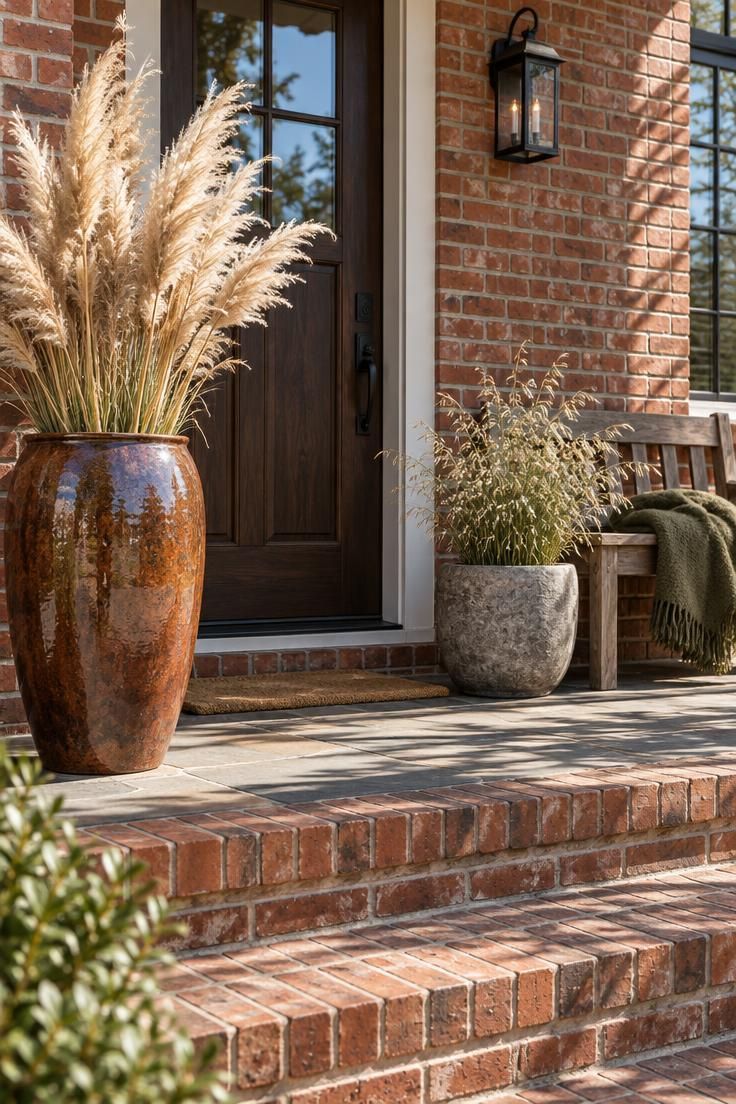
For dried grasses in porch planters, dried grasses give an entry a tall, soft line that moves in the wind.
Pampas, wheat, and oats keep their shape through winter without water, and a light breeze sends a visible rustle through the plumes.
Two or three planters of grasses beside the door make the entry feel finished before any holiday pieces go up.
Matching planters read tidy and formal, while mismatched pots suggest a collected look.
A rough clay pot beside a smooth metal one sets up a texture contrast that keeps the grouping from feeling flat.
Finishes that echo the brick or siding tie the pots to the house.
Placement matters for daily use.
Put the taller stems in a corner planter where they can rise against the wall, and keep a shorter bundle near the door so the walkway stays open.
Grasses at eye level would block the view of a wreath, so keep the tallest plumes to the sides.
Weather exposure sets the limits.
Dried grasses hold up in cold and dry air, though long soaking rain softens the plumes and wind can bend them.
In an open, gusty spot, choose a wider pot and a denser bundle to keep the shape from splaying.
Style Blueprint:
- Two planters in contrasting finishes
- Beige pampas stems for height
- Fine oat or wheat stems for a lower accent
- Weathered bench or stool nearby
Design Pro-Tip: Mix pot finishes on purpose, pairing a rough clay planter with a smooth glazed or metal one so the grasses have two distinct backdrops.
Magnolia and Berry Wreath with Plaid Ribbon
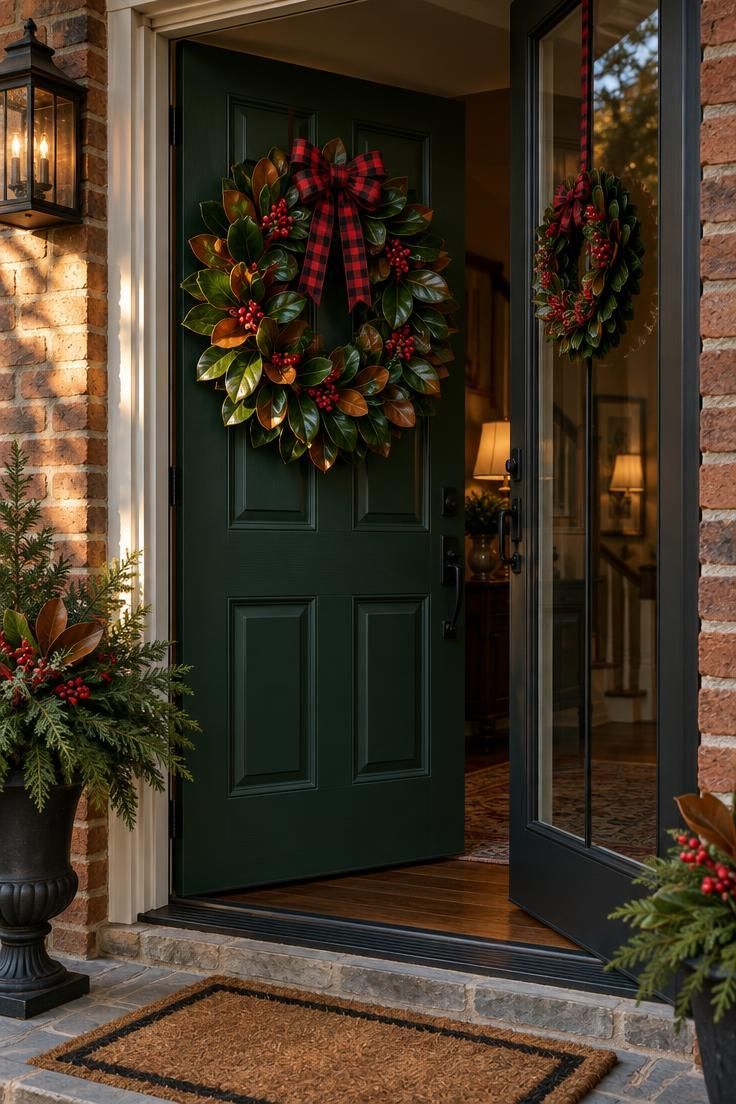
Magnolia leaves have a broad, glossy surface that gives a wreath weight and presence.
Brown undersides show when leaves curl, so a mixed-angle wreath looks natural and full.
Berry clusters and a plaid or buffalo check ribbon push the look toward holiday without turning cartoonish.
The combination suits both sun and cold.
Magnolia leaves stay flexible for a stretch after cutting, which makes them more forgiving than thinner greens.
Berries fade faster than ribbon, so plan on swapping berry sprigs partway through the season or choosing faux clusters that keep their color.
Layering two wreaths, one large on the door and a smaller one on the storm door, creates a custom look at two depths.
On a double door, a trio of wreaths across the pair makes a balanced arrangement.
Keep the ribbon bow large enough to read from the street.
Aim for a wreath that clears the storm door when both are closed, and choose a flatter bow if the gap is tight.
Style Blueprint:
- Magnolia leaf wreath with visible brown undersides
- Red berry sprigs in small clusters
- Buffalo check or plaid ribbon bow
- A second smaller wreath for the storm door
Bare Branch Bundles in a Tall Vessel
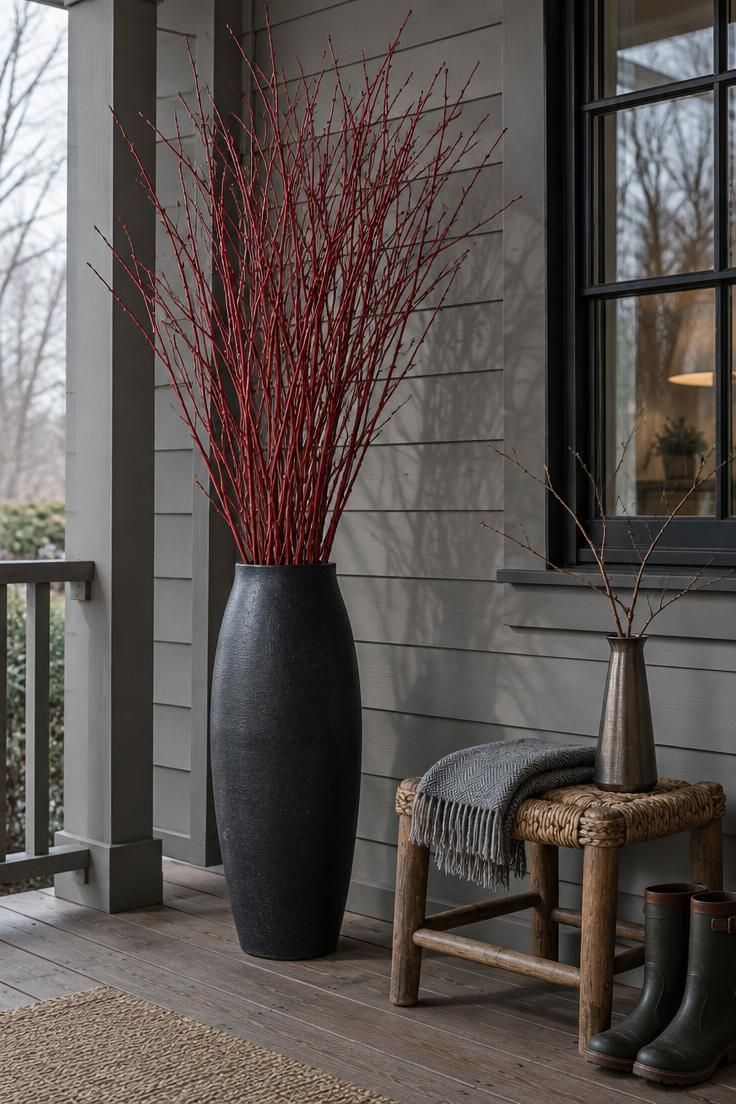
Bare branches fill a porch corner with line and shadow.
Curly willow, red twig dogwood, and birch all read as winter, and their thin silhouettes cast delicate patterns in low afternoon light.
A tall bundle in a floor vase reaches the height of the door and draws the eye upward.
Keep the base of the arrangement simple so the branch shape stays the focus.
A narrow-necked vase naturally holds stems upright, and a layer of river rock at the bottom can steady a wider vessel.
Colorful or patterned containers compete with the branches.
Wind exposure changes the choice of material.
In an open, gusty spot, a dense bundle stands up better than a few loose stems, and a shorter, wider vessel holds its ground.
A covered corner tolerates taller, airier arrangements.
Branches also bring a decision about reuse.
Bare stems dry well and can return next year with a light dusting, which makes them a low-effort piece to build the corner around season after season.
Check the stems for breakage before storing them.
Style Blueprint:
- Tall floor vase with a narrow neck
- Dense bundle of red twig dogwood or willow
- River rock or a simple base filler
- Small stool with a secondary twig vase
Citrus and Cinnamon Stick Door Hanger
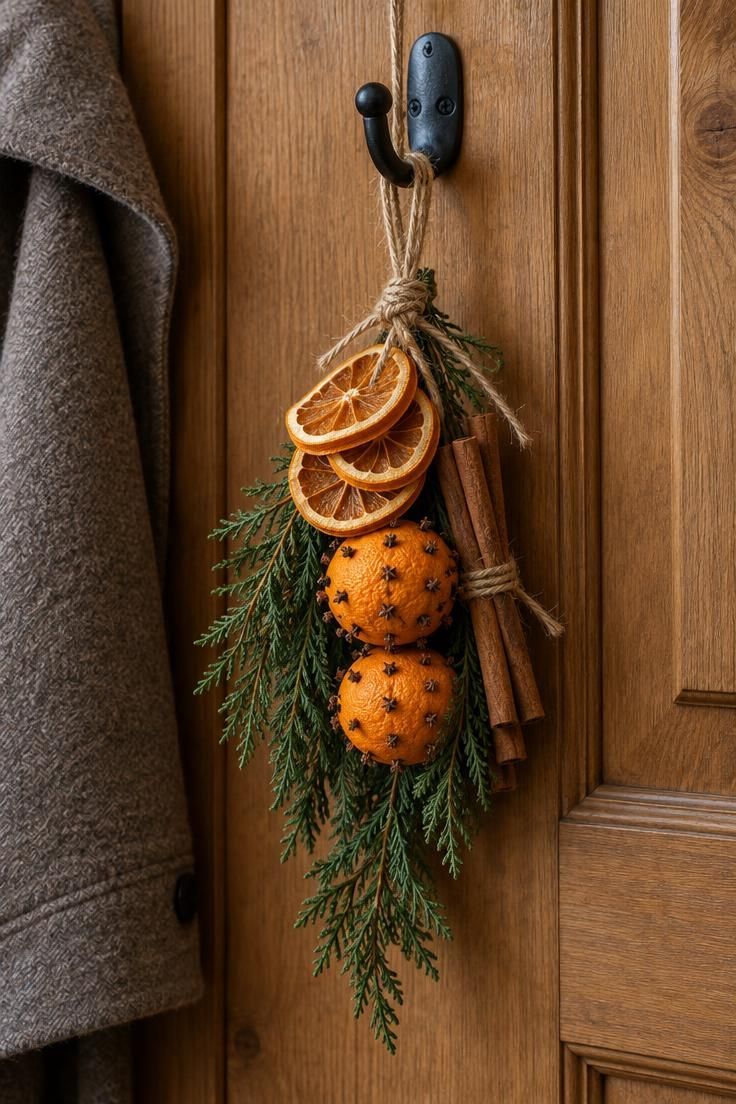
Dried citrus and cinnamon sticks bring a warm amber tone to a door that reads as winter without any red or green.
Whole oranges studded with cloves sit beside dried slices and cedar sprigs, all tied together with twine.
Hanging the bundle from a hook or tucking it into a wreath gives the entry a handmade accent.
This look suits a covered door.
Real citrus dries and shrinks over time, and direct rain can leave it soft or spoiled.
Faux citrus keeps its shape through the season but carries no scent.
If the door sits under an overhang, real fruit can last for weeks.
A long ribbon makes the bundle easy to reposition.
Tie it to a door knocker, a wreath frame, or the handle of a storm door, and swap the ribbon color to shift the mood.
Shorter bundles suit a narrow strip of door, while longer ones work on a tall panel.
Plan on replacing the fruit if the bundle hangs in open air.
Check for softness at the base of the oranges, and refresh the cedar sprig when it dries.
Style Blueprint:
- Dried orange slices and whole oranges
- Whole cloves for studding the fruit
- Cinnamon sticks for warm texture
- Cedar sprig and rough twine
- Ribbon or hook for hanging
Boxwood Planters with White Frost Accents
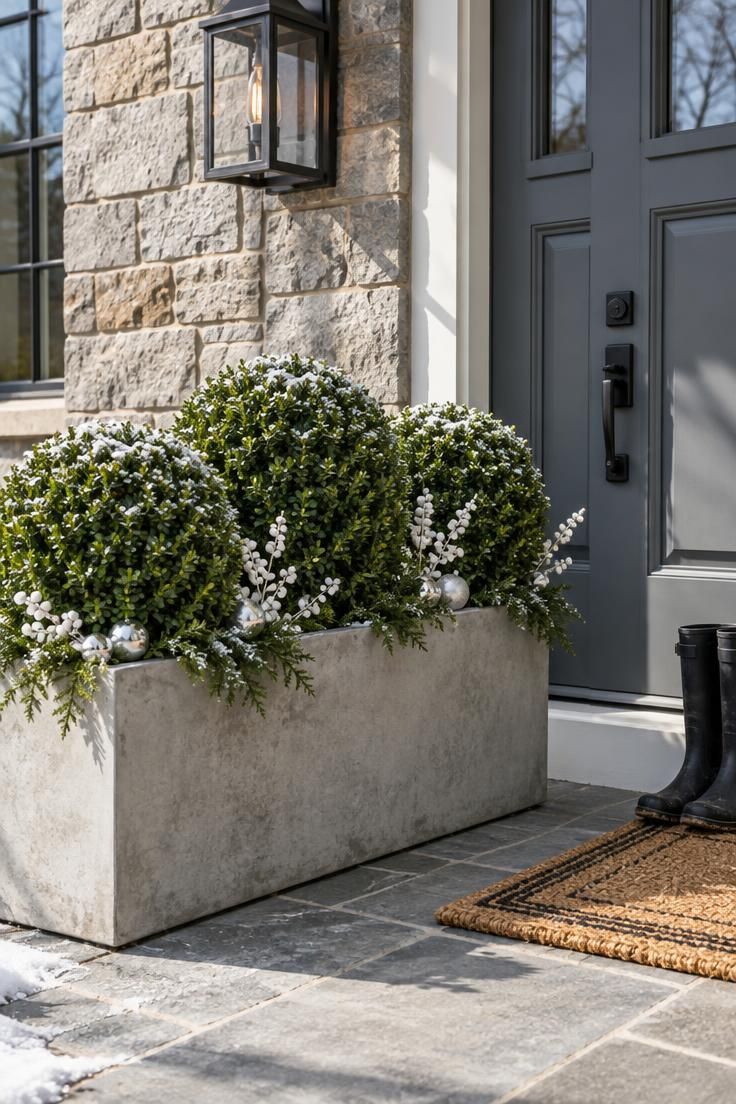
Boxwood brings a clipped, geometric shape that contrasts with softer winter textures.
Low planters or window boxes filled with round boxwood balls and a single tall cone give the entry a formal but friendly outline.
Faux snow, white berry picks, and small frosted ornaments top the shrubs and carry the frost theme.
Height mixing is what keeps the arrangement from looking like a row of bushes.
Two same-height rounds with one taller cone creates a center lift, and an asymmetrical version with the tall cone at one end feels more relaxed.
Set the planter beside the door rather than in front of the walkway.
The contrast that makes this work is hard against soft.
Tight-cut boxwood sits beside airy berry sprays and pale ornaments, and each texture stands out because the shapes are so different.
A concrete or stone planter reinforces the clipped, neat appearance.
Upkeep is light.
Faux snow sheds a little, and the berries and ornaments need occasional rearrangement after wind.
Choose faux snow or frost accents that hold up in cold and damp, and wipe the planter rim clean between seasons.
Style Blueprint:
- Low concrete or stone planter box
- Rounded boxwood shrubs with one tall cone
- Faux snow or frost accents
- White berry sprays
- Small silver ornaments
Design Pro-Tip: Lay white-painted twigs across the surface of the planter so they read as frost creeping over the soil without adding more flocking.
Birch Log and Pinecone Door Basket
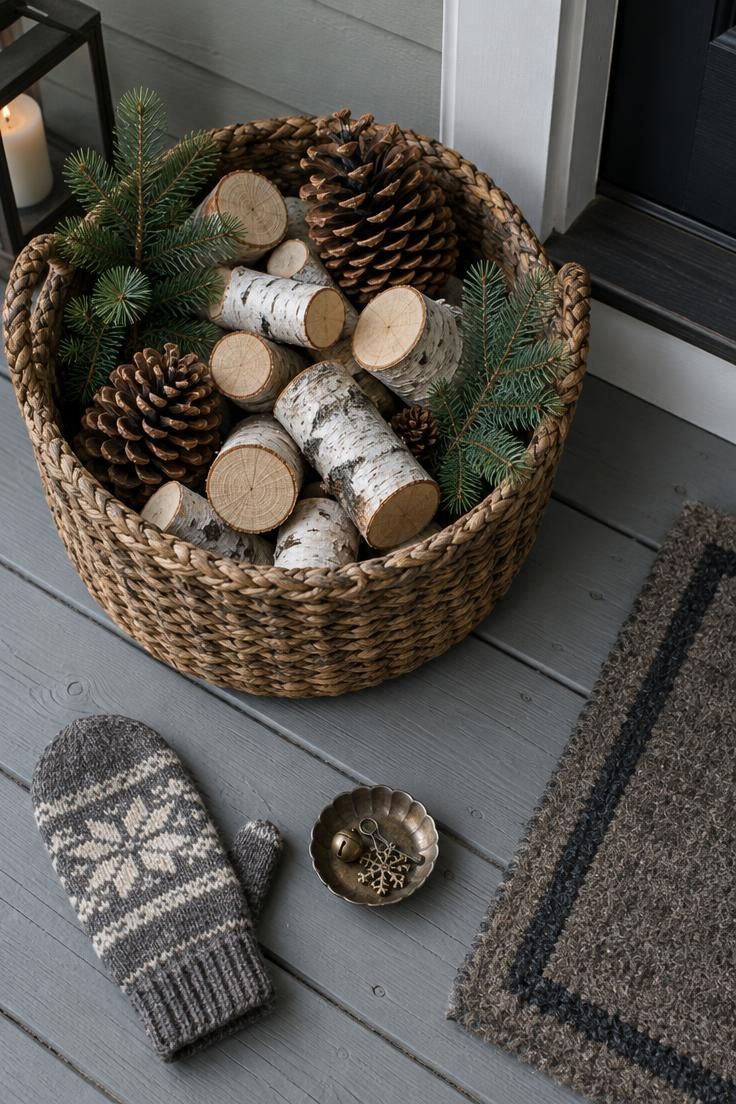
A low basket of birch rounds and pinecones brings a foraged feel to the porch floor.
Stacked logs show their pale bark and dark ring ends, and pinecones fill the gaps with a rough, natural texture.
Two fir sprigs tucked at the edge keep the arrangement from looking like a woodpile.
This look works from early winter through late February.
Its materials do not depend on holiday shapes, so it can stay in place after the tree comes down.
The basket doubles as a place to tuck a spare doormat or a small cushion when the porch is being tidied.
Moisture is the main practical concern.
Sit the basket on a small square of wood or a spare mat rather than directly on snow or damp soil, and let the logs dry before restacking.
Pinecones close up when wet and open again as they dry.
Overhead viewing favors a wide, shallow basket with a clear rim.
Keep the basket to one side of the door so the walkway stays visible from above and at foot level.
Style Blueprint:
- Low woven basket or wooden crate
- Thin birch rounds for pale bark texture
- Large pinecones for rough contrast
- Two fir sprigs at the edge
- Gray coir doormat
Winter Welcome Mat and Riser Baskets
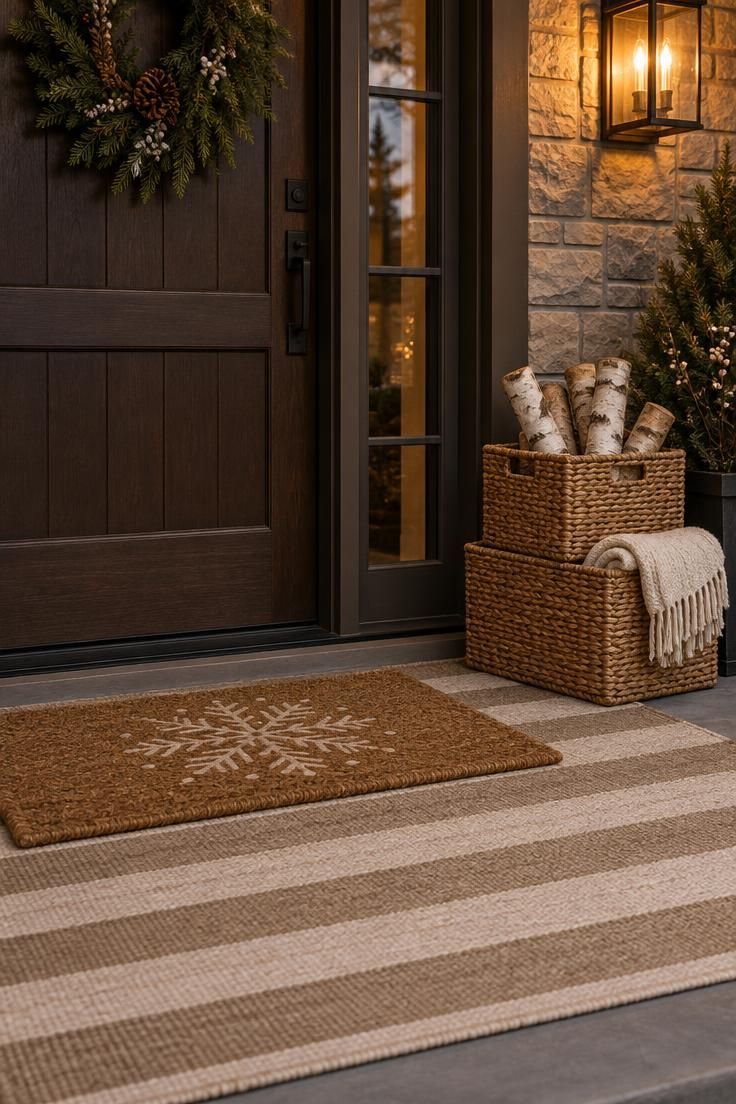
Layering a large outdoor rug under a smaller coir mat builds a visible frame at the door.
The striped rug warms a cold concrete or wood floor, and the mat marks the transition where visitors wipe their boots.
Winter front porch decor benefits from this kind of layering because the floor becomes part of the composition rather than a blank surface.
Riser baskets extend the idea upward.
Two stackable rectangular baskets on one side of the door can hold firewood, rolled throws, or everyday outdoor items, and stacking them keeps smaller pieces off the ground.
The result looks like a deliberate staging area rather than storage.
Color choices hold the scheme together.
Barn-wood gray or warm tan works as a winter staple that does not fight wreaths or planters, and a cream stripe lightens a dark porch.
A patterned coir mat can echo snowflakes or simple geometry without carrying a holiday theme.
Watch the edges during wet weather.
Striped outdoor rugs dry faster than dense pile, and coir mats can curl at the corners if they stay soaked.
Shake the mats after rain and lift the corners to let them dry.
Style Blueprint:
- Large tan-and-cream striped outdoor rug
- Smaller patterned coir or rubber mat
- Two stackable rectangular baskets
- Birch logs or a rolled cream throw
Design Pro-Tip: Choose a rug with a distinct border color and repeat that color in the mat or basket weave, so the layered floor reads as one arrangement.
Conclusion
The strongest winter front porch decor repeats a few materials across different zones and heights.
Evergreen, birch, dried grasses, metal lanterns, and ribbon each carry a winter tone, and using two or three of them ties the door, the step, and the floor into one welcoming entry.
Choose motifs that suit your porch’s exposure and your willingness to refresh them as the season moves from holiday to January.
Balance visual warmth with practical limits such as open or covered space, daily foot traffic, and how long each material holds up.
Start with a single anchor piece, a garland, a planter, or a lantern cluster, and add only what supports a clear, composed welcome.