This post may contain affiliate links. If you make a purchase through these links, we may earn a commission at no additional cost to you.
December arrives with its usual pull toward a dressed-up home, yet the season’s spending has a way of crowding out the fun of making.
A generous look does not demand a generous outlay.
Most of the charm in a holiday room comes from repetition, texture, and a few well-chosen focal points, and those are things paper, twine, foraged clippings, and jars from the cupboard supply at almost no cost.
This collection treats cheap materials as a design problem worth solving, with an eye on how each arrangement sits in a real room and what it asks of your time.
Pick a couple of ideas that suit your space, settle on a tight palette, and let the making become part of the season.
Paper Snowflake Window Display
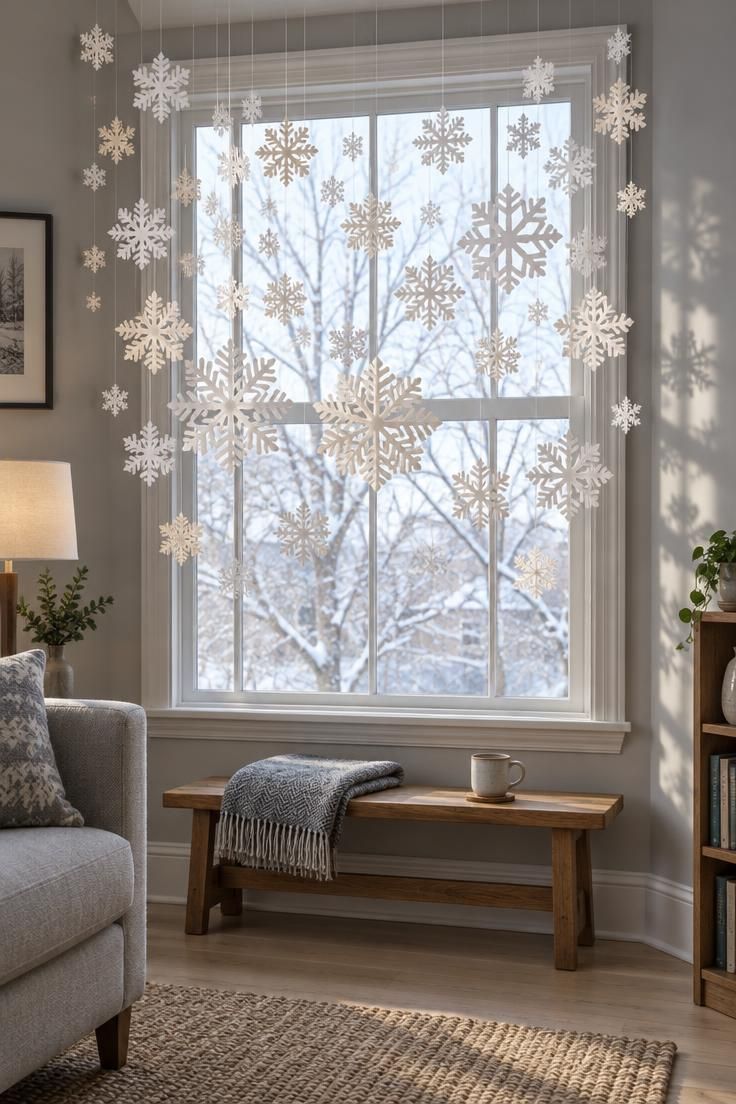
The matte surface of cut paper does the quiet work here, softening the hard rectangle of a window with dozens of pale shapes that shift as daylight moves.
Cutting snowflakes in mixed sizes and suspending them at uneven heights keeps the arrangement from reading as a rigid curtain, and a cluster pushed toward one side leaves open glass for the eye to rest on.
Backlighting turns each flake into a faint silhouette, and the overlapping layers cast soft shadows onto the wall and sill below.
Quantity matters more than anyone expects.
A handful of large snowflakes floats awkwardly in a big window, while dozens of small and medium ones build the density that makes the display look intentional.
Limiting the paper to white or a white-and-cream pair keeps the cluster cohesive against almost any wall color, which is a useful principle for anyone planning christmas decoration on a budget: restraint in color lets cheap material read as a considered collection.
Hang the largest flakes near eye level and taper the sizes toward the top and outer edges so the cluster feels grounded rather than top-heavy.
Uneven spacing, with some flakes nearly touching and others drifting apart, mimics how real snow gathers.
This kind of window treatment suits renters and small apartments especially well, since it turns glass into the display surface and needs no tree at all.
Storage is simple if the paper is stored flat between sheets of cardstock or inside a large folder, and the flakes return year after year as long as they stay dry.
Keep the scissors and a folding chair handy for touch-ups, since a stray flake that slips sideways is easy to nudge back into place.
Style Blueprint:
- White and cream cardstock cut into snowflakes in three or four sizes
- Near-invisible thread hung from the upper window frame
- A cluster concentrated toward one side, open glass left clear
- Largest flakes placed at eye level
- Flat storage between sheets of cardstock for reuse
Design Pro-Tip: Hang the largest snowflakes at eye level and taper sizes toward the top and edges so the cluster feels anchored.
Single-Color Paper Chain Garland Swagged on a Mantel
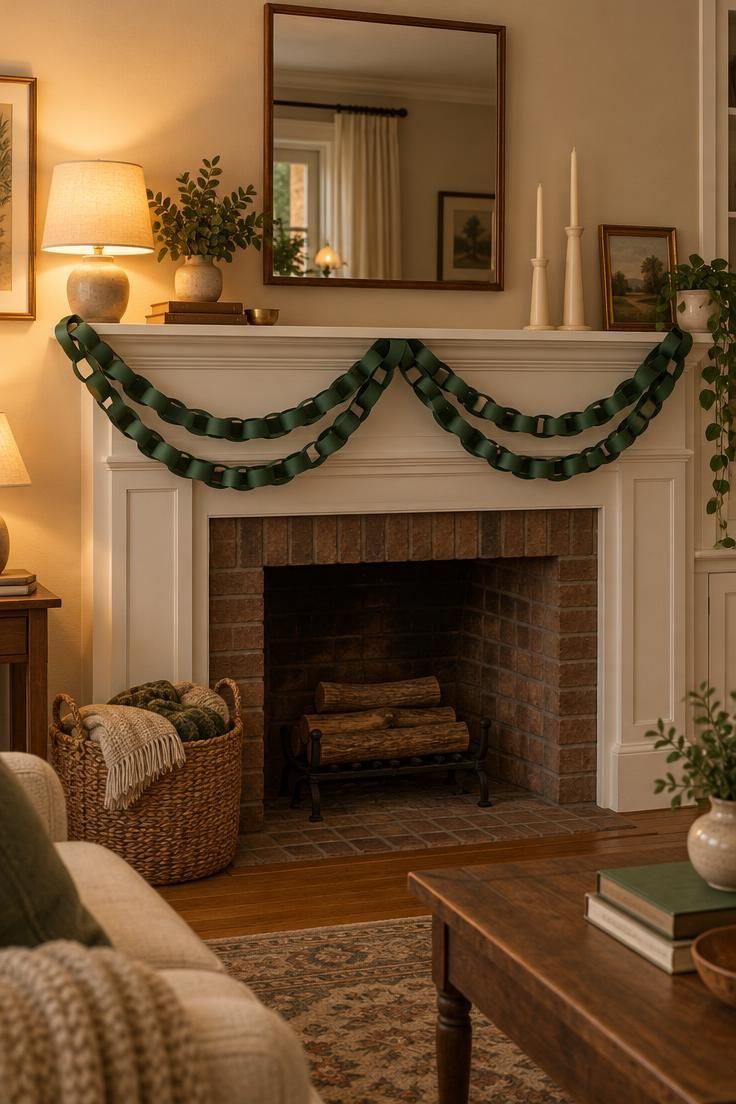
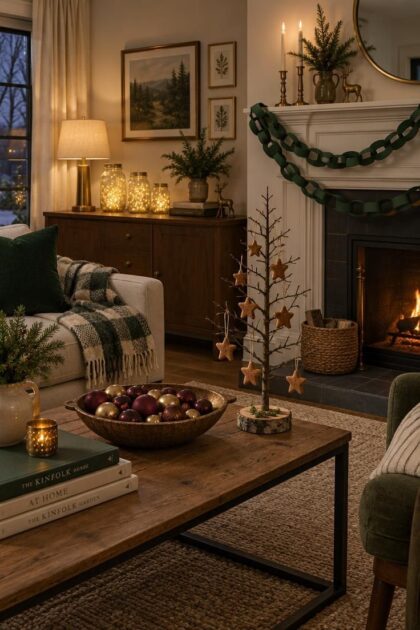
A paper chain in one deep color reads as a graphic line rather than a craft project, and doubling or tripling the strand gives a mantel the visual weight of ribbon or evergreen.
The swag should dip generously in several places; a taut chain stretched straight across loses all its softness.
Two or three parallel runs, staggered slightly in their curves, build depth without any added material cost.
Matte cardstock holds its shape and picks up lamplight with a gentle sheen, while glossy paper looks thin and creases at the folds.
Measure the mantel before cutting or folding so the run finishes where planned rather than stopping short, and add a little extra length for the dips.
A neutral or deep tone such as forest green, ink blue, or burgundy sits calmly against most wall colors, and its restraint is part of what makes a paper snowflake window display and this garland feel related rather than competing.
Time is the honest cost of a long paper chain.
A double run across a wide mantel takes most of an evening to assemble, so size the project to the length you actually need and treat the making as part of the evening rather than a chore.
The paper crushes if stored loosely, so coil each strand in a wide loop and set it in a box at the end of the season.
Style Blueprint:
- Deep forest green matte cardstock cut into uniform links
- A double or triple run swagged in soft, generous dips
- Plain cream candlesticks for contrast
- A small framed mirror centered above the mantel
Foraged Evergreen Sprigs in Mismatched Glass Bottles
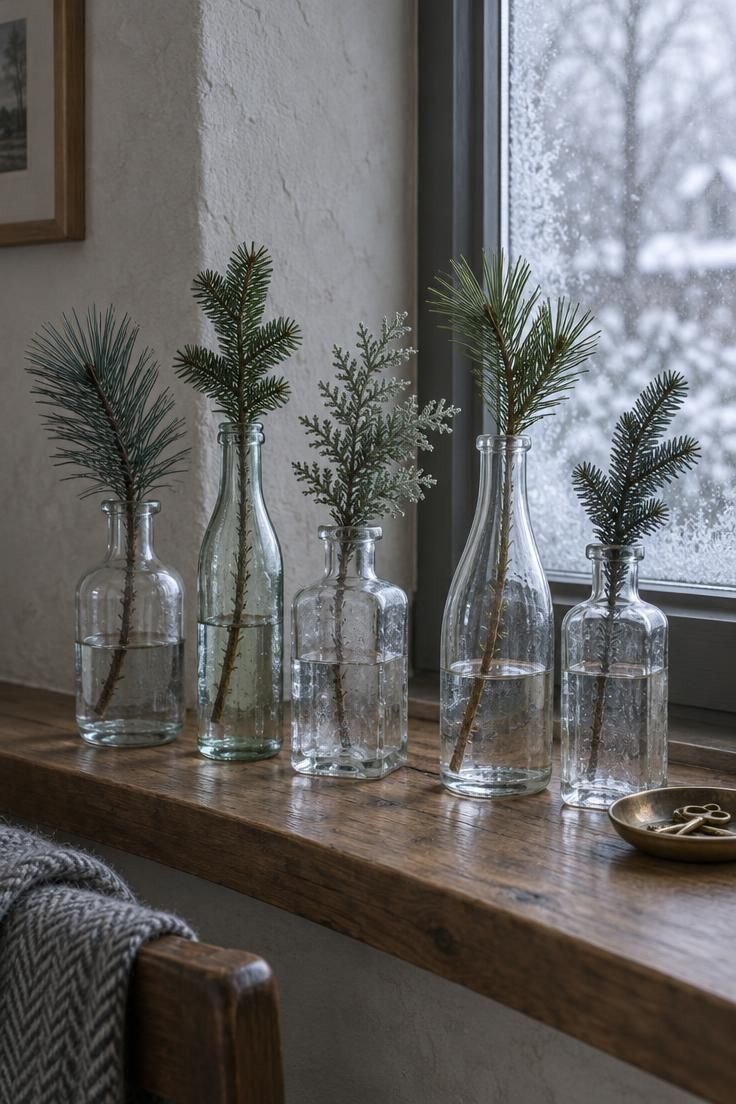
Mismatched glass bottles turn a foraged evergreen sprig arrangement into a small still life, with each irregular silhouette adding a note of informality.
Bottles from the kitchen, old medicine jars with labels soaked off, and syrup bottles all work, and the variation in height and width is part of the appeal.
Choose sprigs in different shades of green so the row reads with depth instead of as one flat band of foliage.
The contrast between matte needles and glossy glass gives the row its visual interest, and keeping the bottles close together on a sill or a narrow runner makes the grouping feel intentional.
Fresh greenery fades within days to a couple of weeks, so treat the display as a short window of its own and plan to replace the sprigs rather than expecting them to last the whole season.
Shorter clippings suit small bottles best, and longer branches belong in a taller vessel where they can spread.
A few sprigs of holly or dried grasses among the evergreens break up the repetition without cost.
Keep water levels low in the bottles so stems sit just at the surface, and refresh the water every few days to keep the arrangement looking crisp.
Style Blueprint:
- Mismatched clear glass bottles with labels removed
- Short evergreen sprigs in several shades of green
- Bottles grouped close on a windowsill or narrow runner
- A small dish or tray to anchor the row
- Fresh sprigs swapped in every few days
Design Pro-Tip: Gather clippings from your own yard or from shrub trimmings to keep this display at zero cost.
Cinnamon-Dough Star Ornaments on a Twig Tree
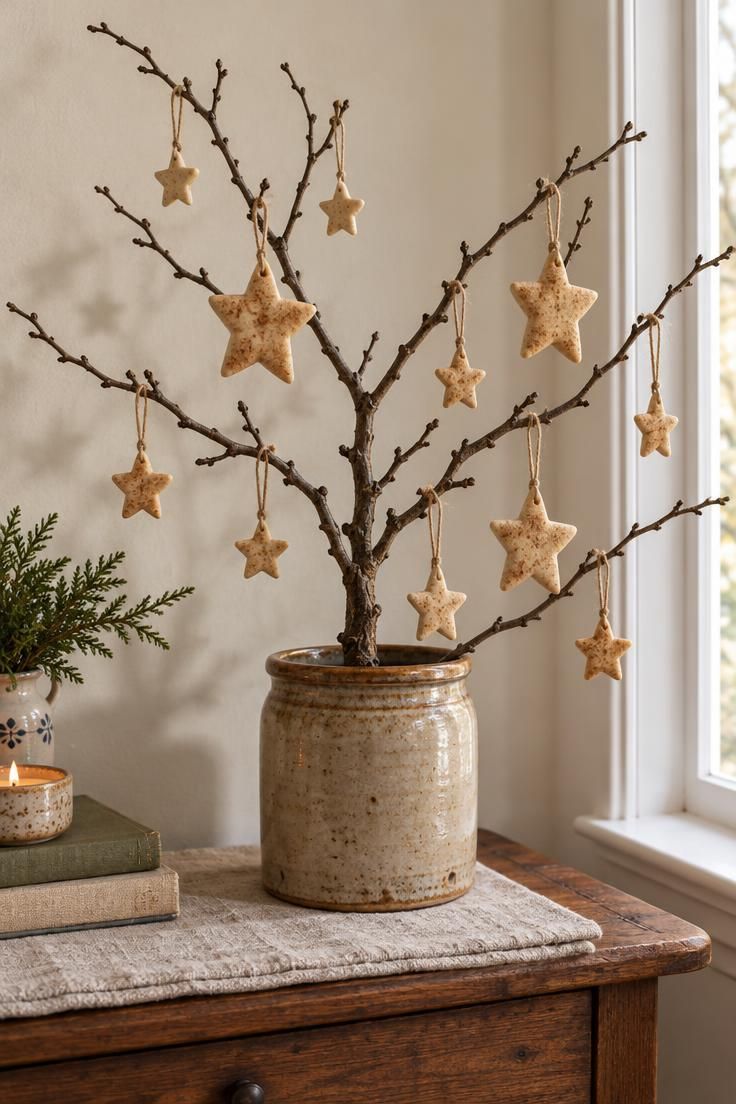
Cinnamon-scented dough stars have a soft matte surface that contrasts nicely with the rough, dark twigs behind them, and a dense cluster of simple shapes echoes the bare branches in a way that feels collected rather than decorated.
Grouping the stars in two sizes on the same branch creates a visual rhythm, with larger pieces near the base and smaller ones toward the tips.
Natural twine loops keep the hanging light and informal.
The material cost is low when the ornaments come from a basic flour-and-cinnamon dough, and a small cookie cutter plus a straw for the hanging hole covers the shaping.
The dough’s visible speckle and grain give each star a slightly different face, and cream, tan, or pale white all sit comfortably against a plain wall.
Keep the stars away from high-traffic edges, since baked dough is fragile and a knocked ornament cracks at the loop.
This is a good tabletop stand-in for households in small apartments or rentals where a full tree is not practical, and the crock can be swapped for a basket or a stoneware pitcher at no cost.
Store the ornaments flat in a tin so the loops stay intact; a crack at the hole is easy to reinforce with a dab of glue and a fresh twine loop.
Style Blueprint:
- A bare twig tree set in a ceramic crock or stoneware pitcher
- Pale tan cinnamon-dough stars in two sizes
- Natural twine loops for hanging
- A folded linen runner beneath the base
- Flat storage in a tin between seasons
Eucalyptus-and-Branch Coat Rack Wreath
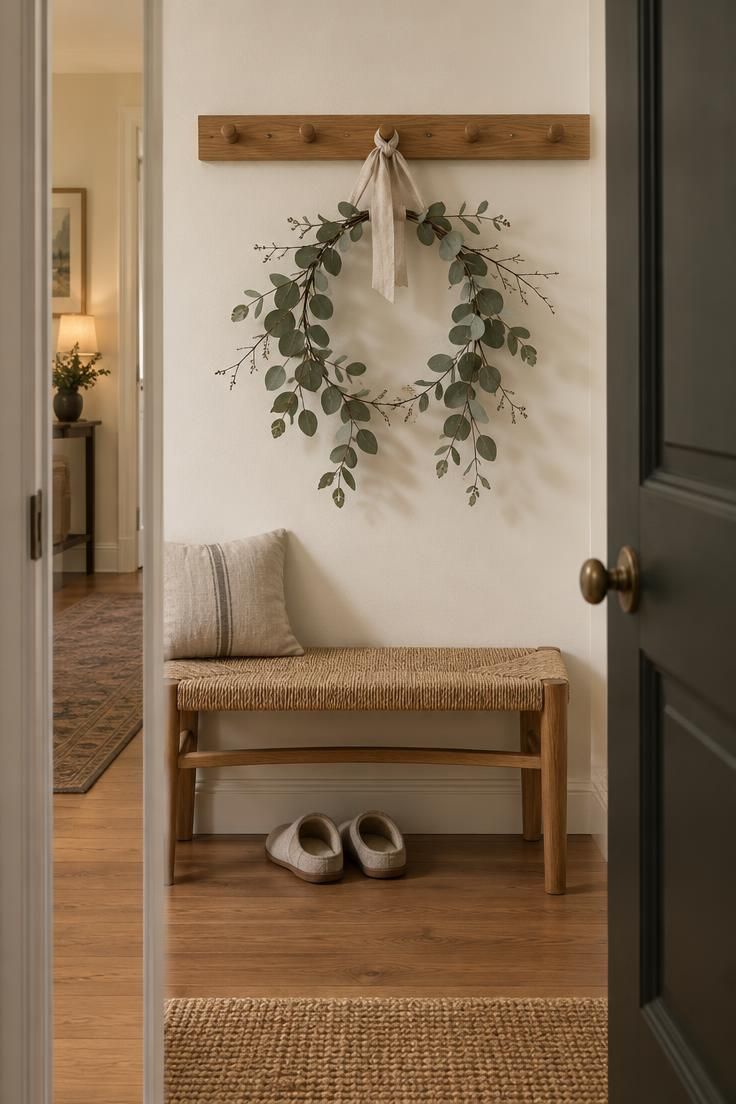
A loose ring of eucalyptus and twigs around an existing coat rack or peg rail reads as a soft architectural accent, hugging the hooks rather than covering them.
The open, airy structure lets the wall show through in places, which keeps the arrangement from feeling like a heavy door wreath fighting the hallway.
Silvery-green leaves against warm white paint or natural wood create a quiet color contrast that holds up across the season.
The practical benefit is that no new hanging point is needed; the peg or hook already on the wall serves as the anchor, and the linen ribbon at the top is purely decorative.
This treatment suits an entryway, a mudroom bench, or a hallway wall where a full wreath would feel too dense.
Drape the ring so it sits slightly off-center, with a few stems trailing longer on one side, to avoid a perfectly round, formal look.
Eucalyptus dries gracefully, fading to a soft muted green-gray over several weeks, and individual sprigs can be replaced in small bunches rather than redoing the whole piece.
Refresh the ribbon now and then, and shake the ring outdoors to loosen any fallen leaves.
Style Blueprint:
- Eucalyptus stems and small bare twigs
- An existing peg rail or coat rack as the hanging point
- An open, airy ring rather than a dense wreath
- A pale linen ribbon tied at the top hook
Battery String Lights in Grouped Glass Jars
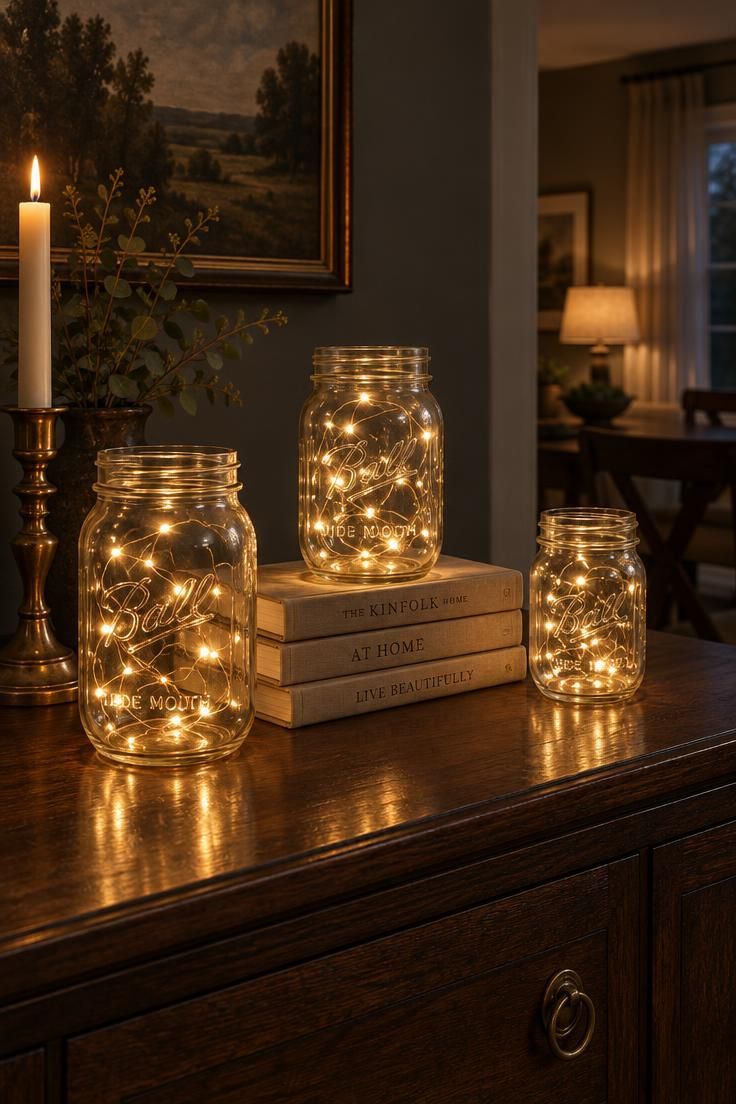
Small battery string lights in jars make a low-cost lantern when grouped in odd numbers, since three jars at staggered heights read as a vignette rather than a scattered pair.
The bare bulbs sparkle against the glass, and the warm glow picks up neighboring wood and metal surfaces, giving a dim corner a point of interest without much material cost.
A stack of small books under the middle jar adds height, so the trio gains a gentle stair-step rhythm across the sideboard.
Warm-white lights feel more cohesive than multicolor in an otherwise unlit corner, though multicolor reads as playful and nostalgic if that matches the room.
Keep the glass clean and free of labels, and tuck each battery pack out of sight behind or beneath its jar so the bulbs stay the focus.
A short coil of lights per jar is enough, because overfilling makes the arrangement look tangled and reduces the bare-bulb sparkle against the glass.
Reuse the jars in the kitchen between Decembers and store the light coils loosely so the wires do not kink.
Style Blueprint:
- Three clear mason jars in graduated sizes
- Short coils of warm-white fairy lights
- A small stack of books to vary height
- A dark wood or painted sideboard as the base
Bowl of Ornaments as a Coffee-Table Centerpiece
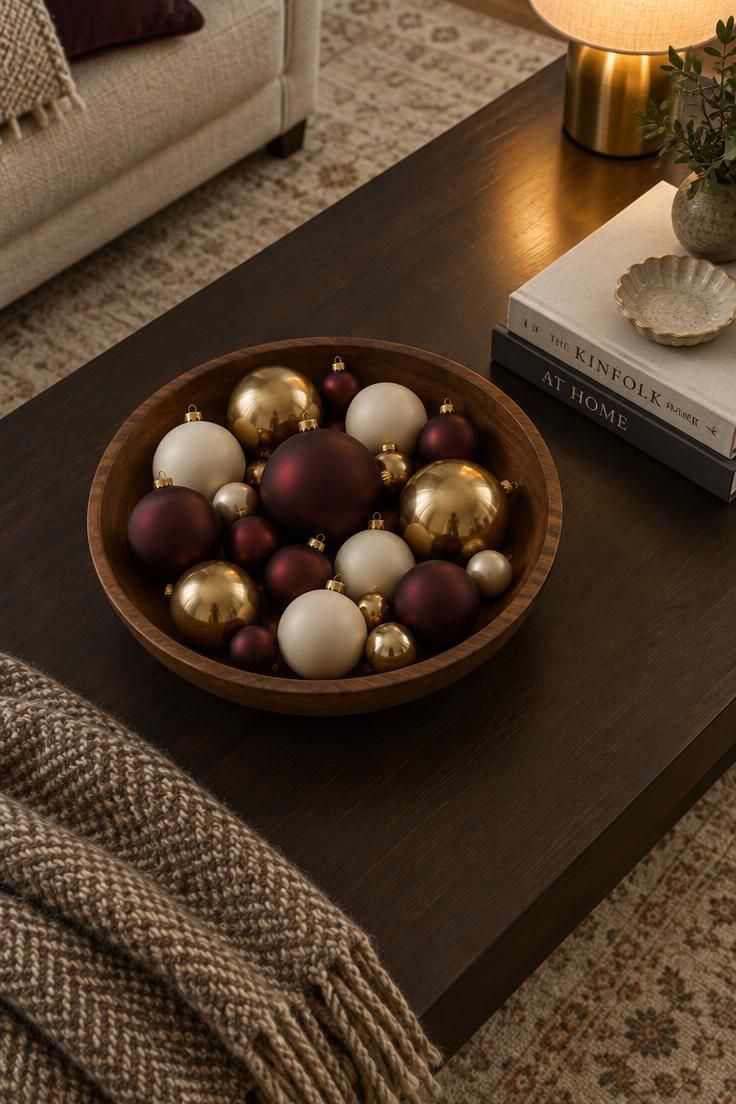
A wide shallow bowl filled with spare ornaments makes a quick centerpiece with real visual weight, and sorting the ornaments into two or three colors turns an odds-and-ends collection into a deliberate composition.
Brass and matte finishes catch lamplight differently, giving the bowl a subtle sparkle without glitter or tinsel.
Leaving orphans and oversized ornaments in the bowl is often better than forcing them onto sparse tree branches.
Match the bowl to a material already in the room, such as wood, ceramic, or black metal, so the centerpiece belongs to the table rather than sitting on it.
The ornaments can be arranged with their hanging loops tucked down or left visible; either way, avoid a perfectly level fill so the top layer has soft dips.
A wide bowl keeps the display from looking like spare clutter, while a small bowl on a large table disappears.
Style Blueprint:
- A wide low wooden, ceramic, or black metal bowl
- Ornaments in two or three coordinated colors
- A tray beneath to anchor the display
- A stack of books nearby for scale
- Hanging loops tucked or left visible, arranged unevenly
Design Pro-Tip: Set the bowl on a tray to visually anchor it and make the centerpiece feel intentional on a big table.
Book-Page Cones and Rosettes on a Bare Branch Arrangement
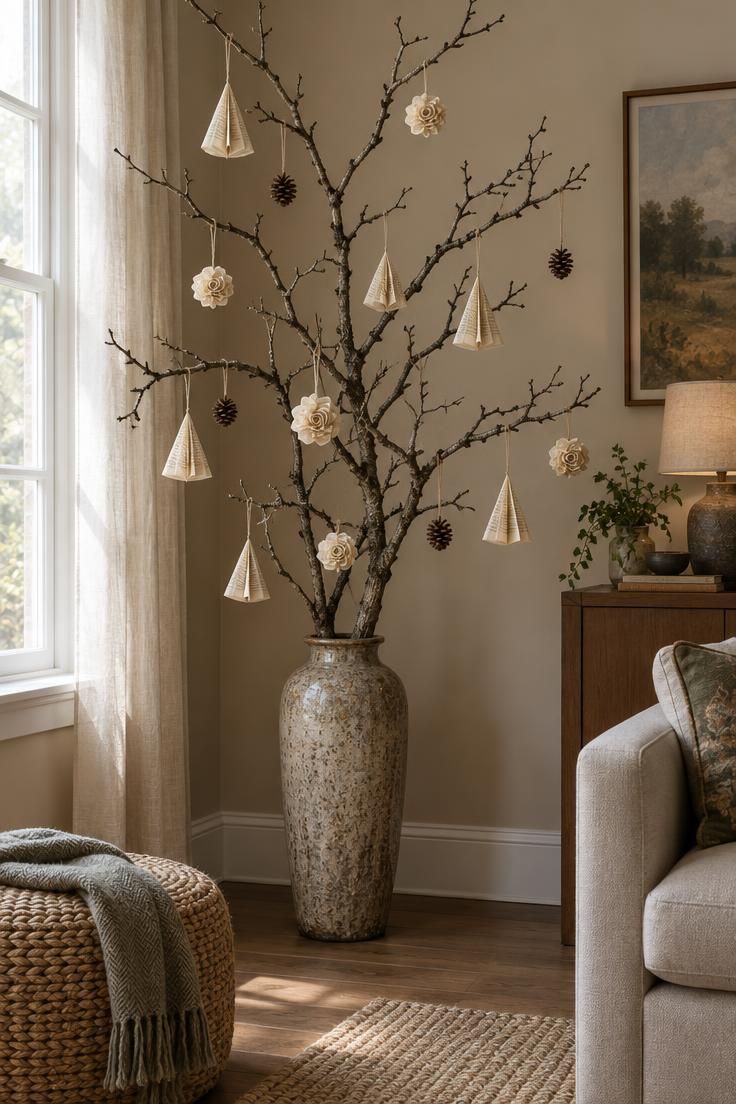
Bare branches in a tall vase or crock carry a sculptural quality on their own, and folded book-page cones and simple rosettes add a light, brittle layer against the dark, rough wood.
The contrast between pale paper and dark bark is what gives the arrangement its depth, and the paper pieces rotate slightly with air movement, so the arrangement never looks static.
Pages from an already damaged book or sheet music keep the material cost near zero.
Scale matters more than detail.
A branch with three cones reads as accidental, while a branch with a dozen reads as a collection, so aim for generous quantity and vary the heights where the pieces hang.
This arrangement works as a floor piece in a corner or on a sideboard, and it suits small apartments as a stand-in for a tree.
Treat the arrangement as delicate and place it where it will not be bumped, since the paper pieces crush easily and the branch can be knocked off balance.
Store the cones flat in a box, and reshape any bent pieces gently with your fingers when they come out next December.
Style Blueprint:
- A tall ceramic vase or crock
- Bare manzanita-like branches
- Cones and rosettes folded from cream book pages
- Twine loops for hanging at varied heights
- A woven pouf or folded throw at the base
Framed Printable Holiday Cards as a Hanging Cluster
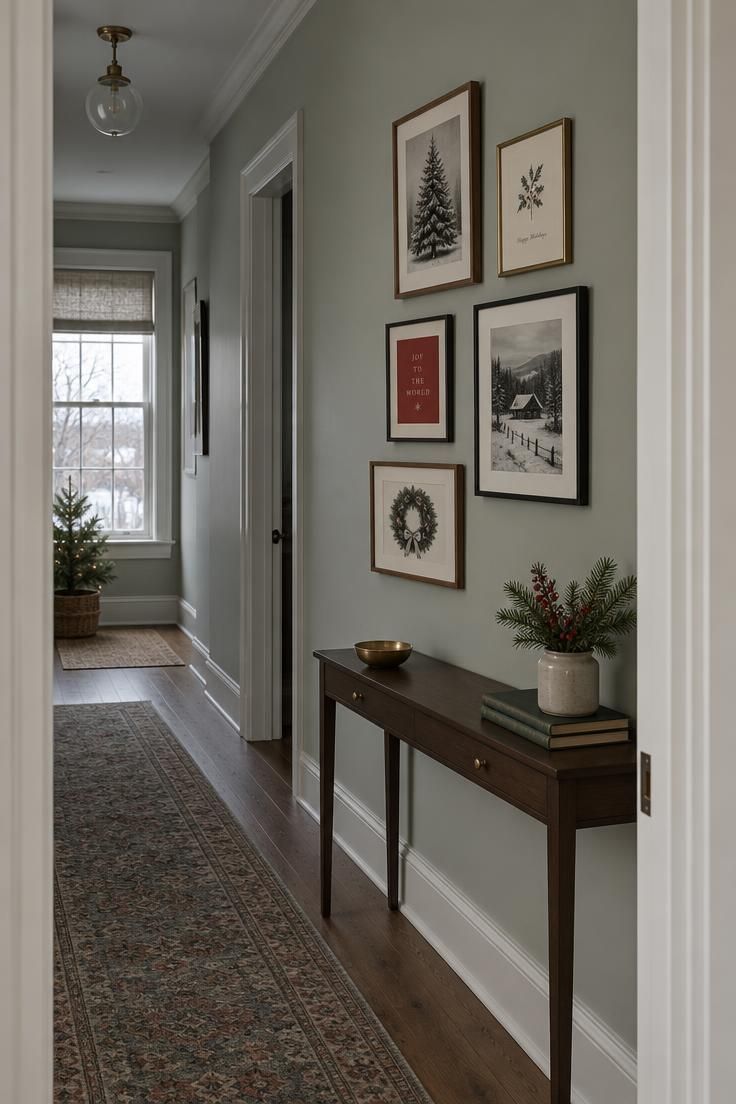
A wall cluster of framed holiday cards, handwritten notes, or simple cut-paper lettering makes a strong seasonal display from frames already tucked in a drawer.
The mix of finishes works when the cards share a paper tone, so warm cream or bright white throughout keeps the group from looking chaotic.
A mat gives each card breathing room, while no-mat framing makes the group feel tighter and more graphic.
The layout is where this idea earns its keep.
A stair-step arrangement, following the shape of a staircase or a stepped console below, reads as deliberate even with mismatched frame sizes.
Printed cards will fade slightly near direct sun, so a hallway or an interior wall suits the display better than a bright south-facing window.
Plan the spacing on the floor first with paper templates cut to each frame’s size, then transfer the arrangement to the wall.
Keep the cluster compact and resist spreading frames across a whole wall, since a concentrated group reads as a feature while a scattered one reads as clutter.
When the season ends, swap the holiday cards for everyday art and keep the frames up.
Style Blueprint:
- Five mismatched frames in wood, black, and brass
- Holiday cards and prints in a shared cream or white paper tone
- A compact stair-step layout
- Paper templates for spacing on the floor
Stacked Wrapped Empty Boxes as a Hearth or Floor Vignette
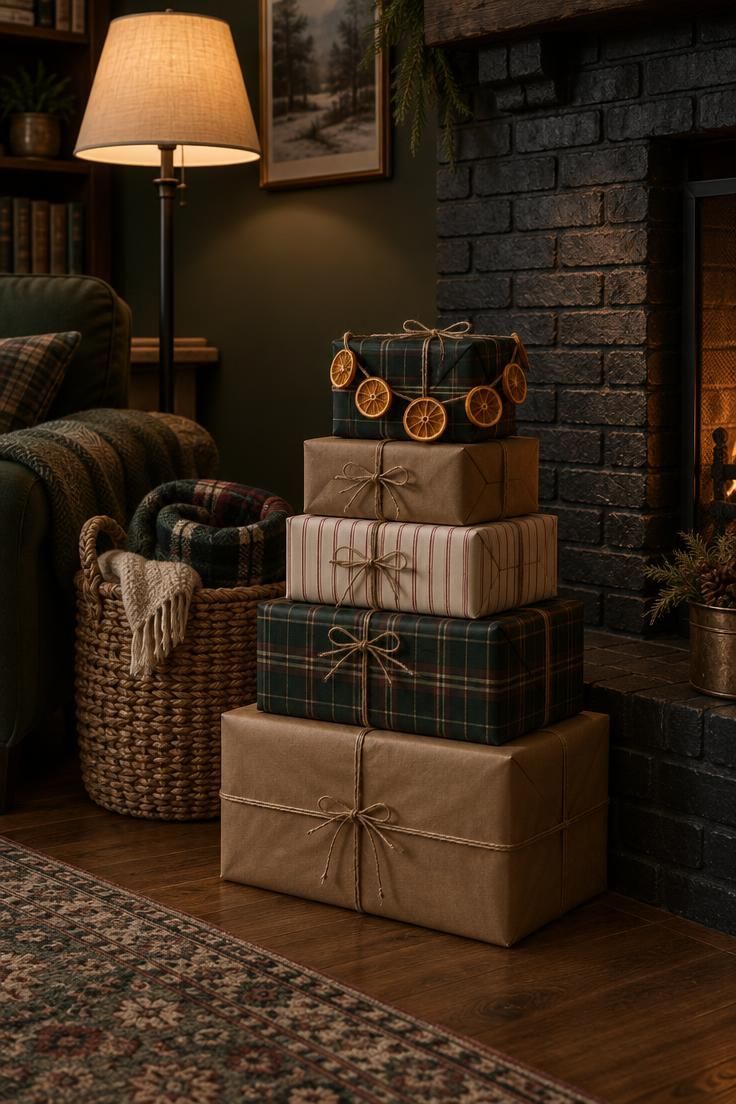
Empty boxes wrapped in leftover paper turn into a sculptural stack when arranged in varied sizes, and the low pile fits rooms that have no mantel at all.
Limiting the papers to two or three patterns keeps the stack coherent; mix kraft, a plaid, and a striped sheet, and tie each box with twine so the arrangement reads as a deliberate vignette rather than a pile of parcels.
A dried orange slice garland draped across the top adds a warm note against the paper.
Weighing the largest box at the bottom lightly keeps the stack stable if it sits on the floor, and a small ornament or a single sprig on the top box finishes the composition without cluttering it.
The boxes can be kept collapsed and rewrapped next year, though paper shows wear if handled often, so choose the patterns you are willing to set aside carefully.
Place the stack beside a hearth, at the foot of a staircase, or in an unused corner, and let it be one of the season’s two or three focal points rather than adding more pieces around it.
When the season is over, flatten the boxes and store the paper rolls in a box against the wall.
Style Blueprint:
- Five empty boxes in varied sizes
- Kraft, plaid, and striped wrapping papers, limited to three
- Natural jute twine for each box
- A dried orange slice garland across the top
- The largest box weighted lightly at the bottom
Cinnamon-Stick Bundles Tied with Twine as Hanging Ornaments
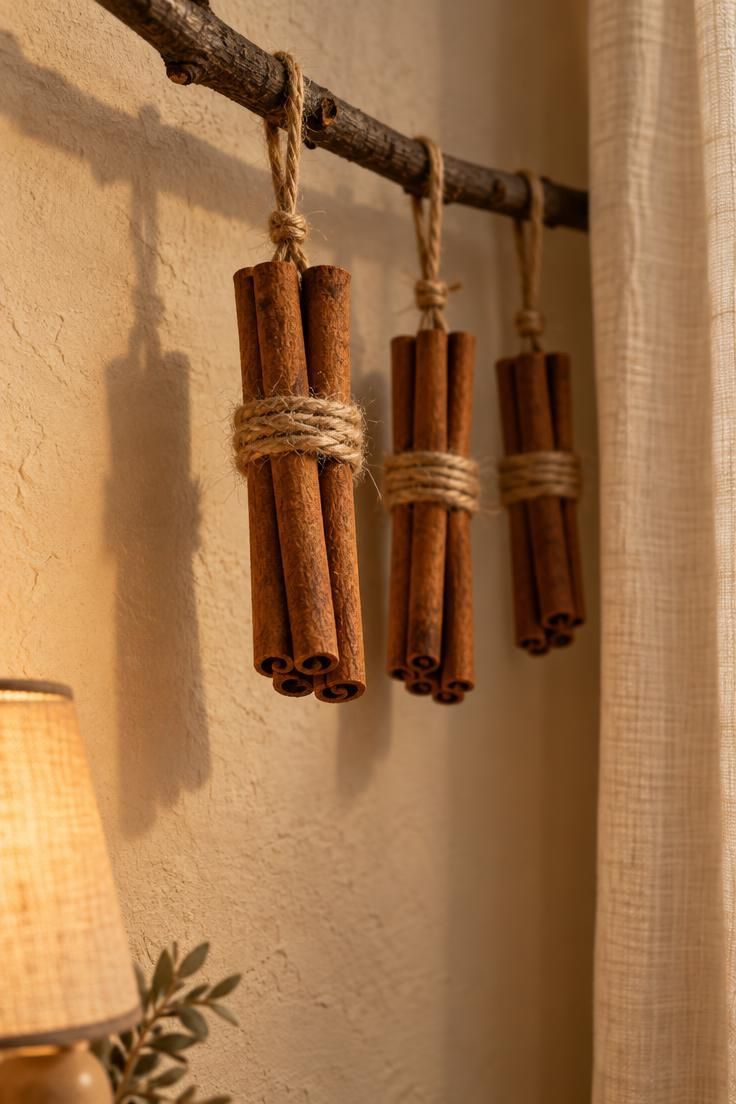
Small bundles of three or four cinnamon sticks wrapped with twine hang from tree branches, cabinet knobs, or a garland, and their warm brown matte surface holds up well through the season.
The bundles spin slightly and catch light as they turn, giving a tree a quiet movement that a heavier ornament does not.
The texture is part of the appeal, so tie the twine twice to keep the bundle from slipping and let the ends show.
Cinnamon sticks can be sourced inexpensively in bulk, and a whole bag yields dozens of bundles for a long garland or a full tree.
The scent fades after the first season, though the visual remains unchanged, so keep the bundles in the rotation even when they no longer smell.
Hang them where they can be touched, such as at hand height on a tree or beside a door, since the appeal is tactile as well as visual.
Store the bundles in a small box and re-tie any loose twine at the start of December.
Grouping them with dried orange slices or a sprig of greenery turns a simple craft into a small seasonal collection.
Style Blueprint:
- Three or four whole cinnamon sticks per bundle
- Natural jute twine tied twice
- Hanging at hand height where the texture shows
- Stored in a small box between seasons
Single-Shape Felt Cutout Garland Across a Doorway
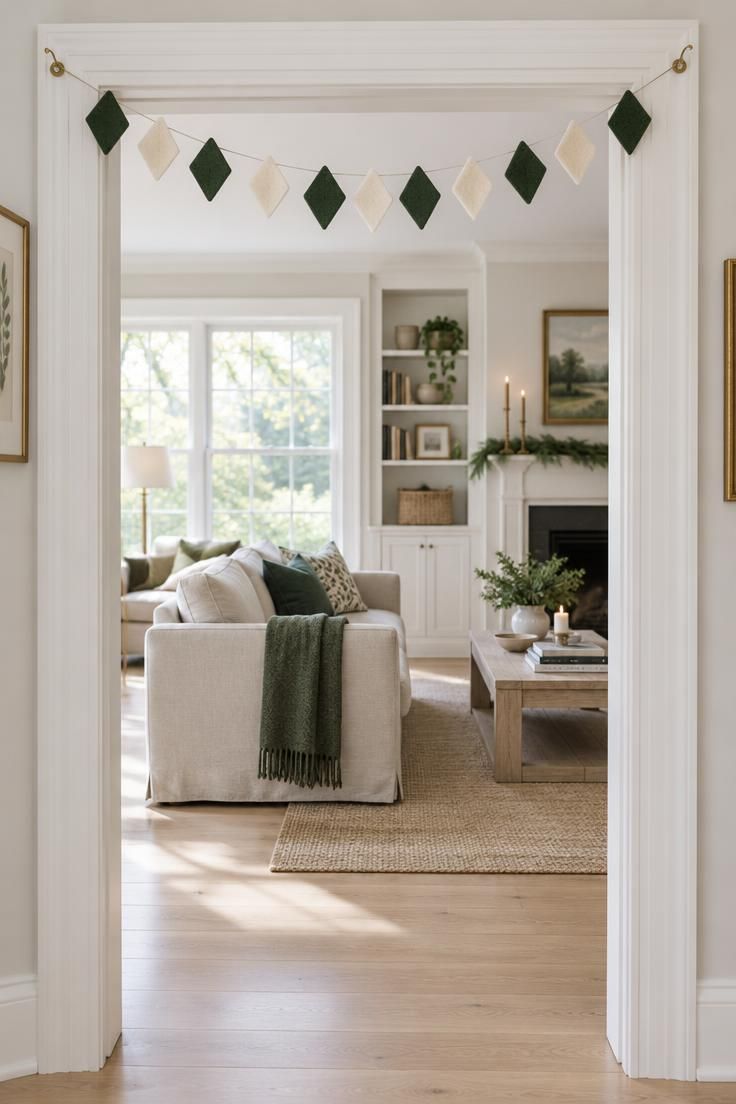
One repeated shape cut from felt reads as a deliberate graphic line across a doorway, and a simple diamond, circle, or star keeps the cutting quick.
The matte softness of felt suits a graphic line well, since it does not glare under bright daylight and holds a clean edge.
For a single-color paper chain garland, a few sheets of craft felt go a long way, and the color scheme can echo the room’s existing accents, such as deep red, forest green, and cream.
A longer run looks better than a short one, so measure the doorway or headboard and cut more shapes than you think you need.
Spacing the shapes evenly but not perfectly keeps the garland from looking machine-made.
The felt can be sewn or knotted, though knots leave visible thread ends that are easy to trim close to the shape.
This is a good renter-friendly option because it hangs from small hooks at the top corners and leaves the wall untouched.
It also works across a headboard in a small bedroom, where a full-size tree would not fit.
Store the shapes in a small bag and re-string the garland next December; the felt will hold up for several seasons.
Style Blueprint:
- Craft felt in deep red, forest green, and cream
- One repeated shape, cut with a simple template
- Small brass hooks at the doorway corners
- Even but not perfect spacing along thin thread
Citrus-and-Clove Pomanders in a Shallow Bowl
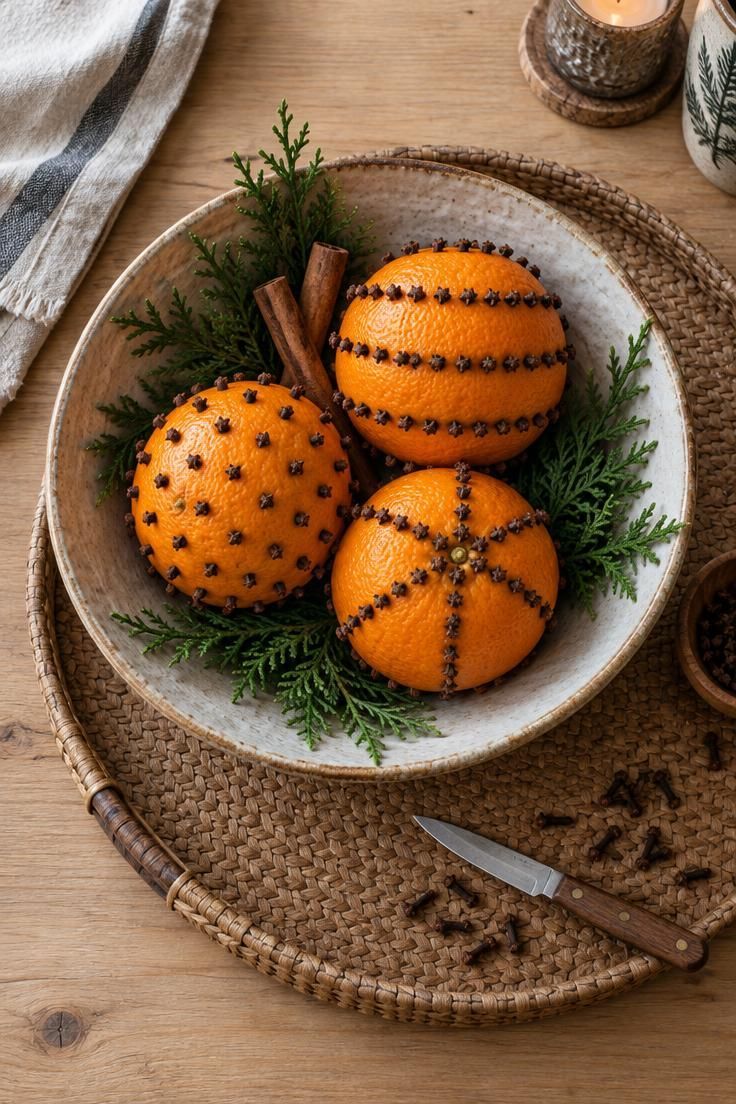
Clove-studded oranges in a wide shallow bowl make a low focal point, with the dimpled orange skin and dark cloves creating texture and contrast that needs nothing else.
Simple bands of cloves or all-over patterns both work, and tucking a few cedar sprigs and cinnamon sticks among the fruit adds a second shade of green and a warm brown note.
The bowl sits well on a tray, which anchors the display on a large table.
Thinner-skinned oranges hold up better over a week, when the fruit dries and shrinks slightly, and the display usually lasts through the season’s early parties.
The work of studding the fruit is part of the appeal, so set out a small knife and an open dish of cloves and let the bowl look like it is mid-project.
This is an edible-adjacent display and will draw attention from curious pets and children, so place it out of easy reach when needed.
Style Blueprint:
- Three oranges with whole cloves
- A few cedar sprigs and two cinnamon sticks
- A wide ceramic bowl on a round woven tray
- A small knife and loose cloves on the tray
Design Pro-Tip: Later, thread a loop of twine through a whole clove to turn a pomander into a hanging ornament.
Conclusion
A small budget works best when the decorations share a repeated material, shape, or color and sit concentrated in two or three strong focal spots.
Paper, foraged greens, dried citrus, spare ornaments, and glass jars from the cupboard carry the visual weight, while an evening with scissors and twine replaces most spending.
Keep the reusable pieces stored flat and place the best materials where eyes land first, and the same decorations will serve through many Decembers.