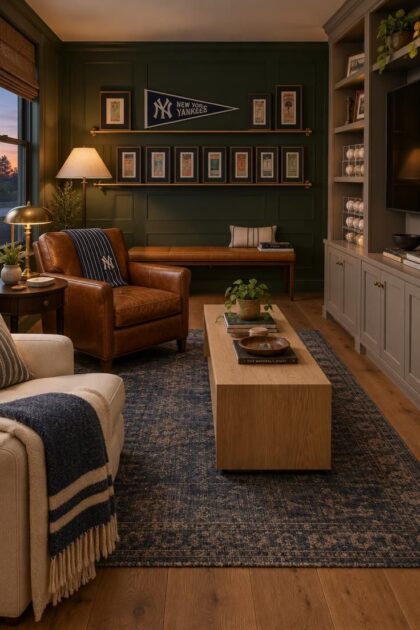
This post may contain affiliate links. If you make a purchase through these links, we may earn a commission at no additional cost to you.
The phrase baseball man cave often brings to mind a dark, loud room covered head to toe in logos.
This guide takes a warmer route.
It centers on materials that already belong to the game: leather, wood, felt, canvas, and stitched textiles.
The goal is a retreat that feels collected rather than cluttered, with each display area earning its place.
A few thoughtful choices can turn a spare room, finished basement, or even a modest corner into a room you want to stay in long after the final out.
Deep Field-Green Wall with Brass Display Rails
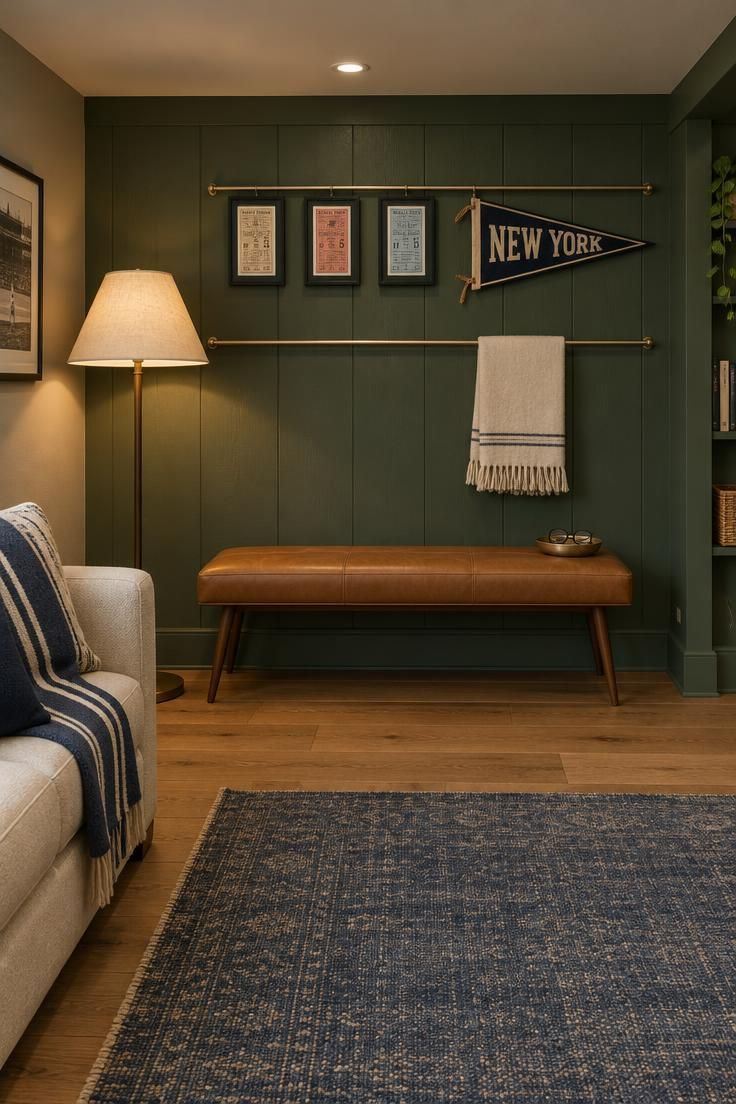
A muted field green belongs on one long, unobstructed wall in a basement or den, where the color can read as the room's main event rather than another accent.
Everything around it stays quiet: warm gray walls, white trim, and a floor that does not compete.
The two brass rails do the display work at eye level, which keeps the arrangement legible from a seated position.
A cap display rail can run at the same height as the upper brass rail, turning a single horizontal line into a tidy place for a few everyday favorites while the framed paper pieces stay protected in frames.
Spacing matters more than quantity here; three small frames and one pennant read better than a crowded shelf.
A low upholstered bench in tan leather sits just beneath the rail and gives the space a second function as a place to drop a jacket or tie a shoe.
Choose a bench with tapered wood legs so the green wall remains the dominant vertical plane.
A floor lamp with a wide fabric shade lets light wash down the wall rather than spotlight any single object.
That soft, spread light keeps the green from turning flat and gives the frames a gentle halo without the cost of picture lights.
The tradeoff is dust.
Open rails collect more of it than glass-front cabinets, and the paper pieces still need protection from direct sun.
Rotating the small framed items by season or by whichever team is playing keeps the wall from going stale.
Style Blueprint:
- Muted field-green matte paint on one long wall
- Two narrow brass picture rails at seated eye level
- A tan leather bench with tapered wood legs beneath the rail
- A floor lamp with a wide natural linen shade
- Warm gray walls and white trim everywhere else
Locker-Style Cubbies Under a Cap Display Rail
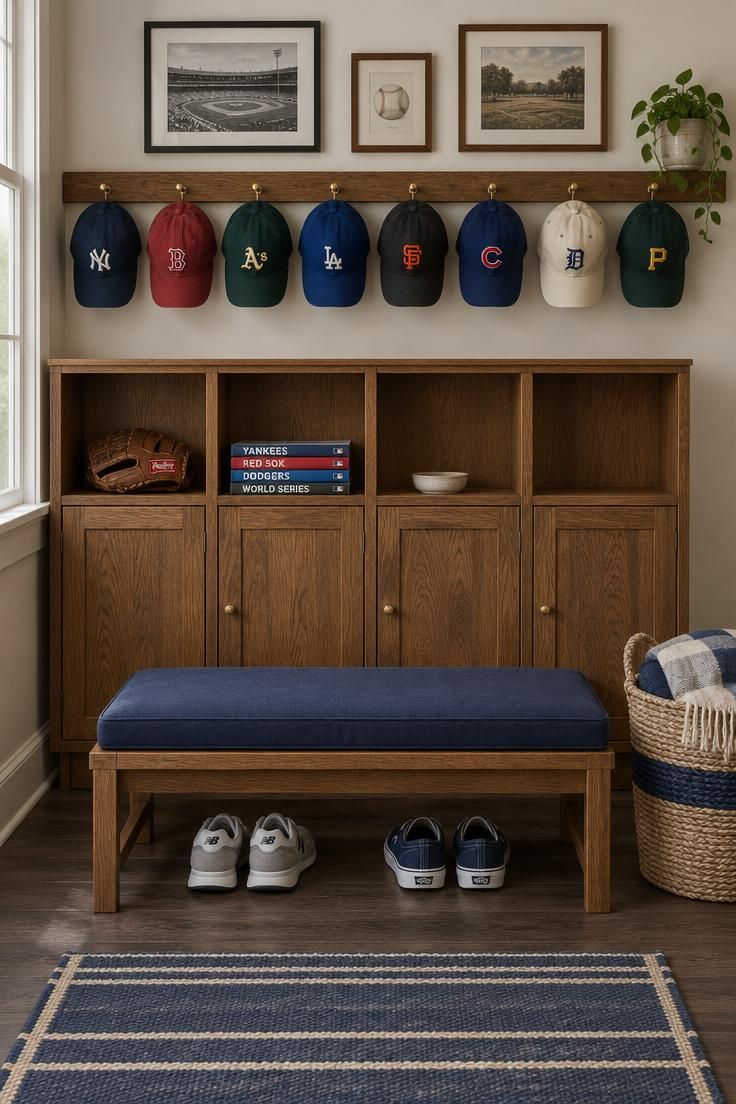
Locker-style storage cubbies give a den a clean horizontal rhythm that most freestanding shelving cannot match.
The open tops handle gloves, programs, and a rotating handful of objects, while the closed bottoms take throws, board games, and spare chargers out of sight.
That mix is what keeps a collection room usable week to week.
Keep one cubby empty or nearly empty.
A perfect grid of objects starts to read as a retail shelf rather than a home, and the gap gives the eye somewhere to rest.
Choose cabinet fronts in stained oak or painted navy rather than raw metal.
Warm wood and painted finishes sit better against drywall and carpet, and they age more gracefully in a room that also gets everyday use.
The cap display rail above the cubbies keeps eye level uncluttered.
Caps sit in a single row instead of stacking, and the ledge itself is shallow enough that it does not crowd the wall.
If the run is short, place a bench in front of the lower cubbies so the room still works as a place to sit and talk.
Watch the height relationship between the rail and the bench back.
Caps should be easy to reach without stooping, and the top of the bench should not brush the lowest caps when someone leans back.
A short bench with a slim cushion solves most of that in one move.
Style Blueprint:
- Four wood-front cubbies in stained oak or painted navy
- Two open tops for display, two closed bottoms for storage
- A shallow cap rail with small brass pegs above
- A short bench with a navy canvas cushion in front
- One intentionally empty cubby to break the grid
Design Pro-Tip: Leave the lowest shelf of a locker run empty on purpose, then use it as a landing spot for keys, a cap, or a book so the display does not become a clutter magnet.
Leather and Wood Lounge Seating in a Neutral Corner
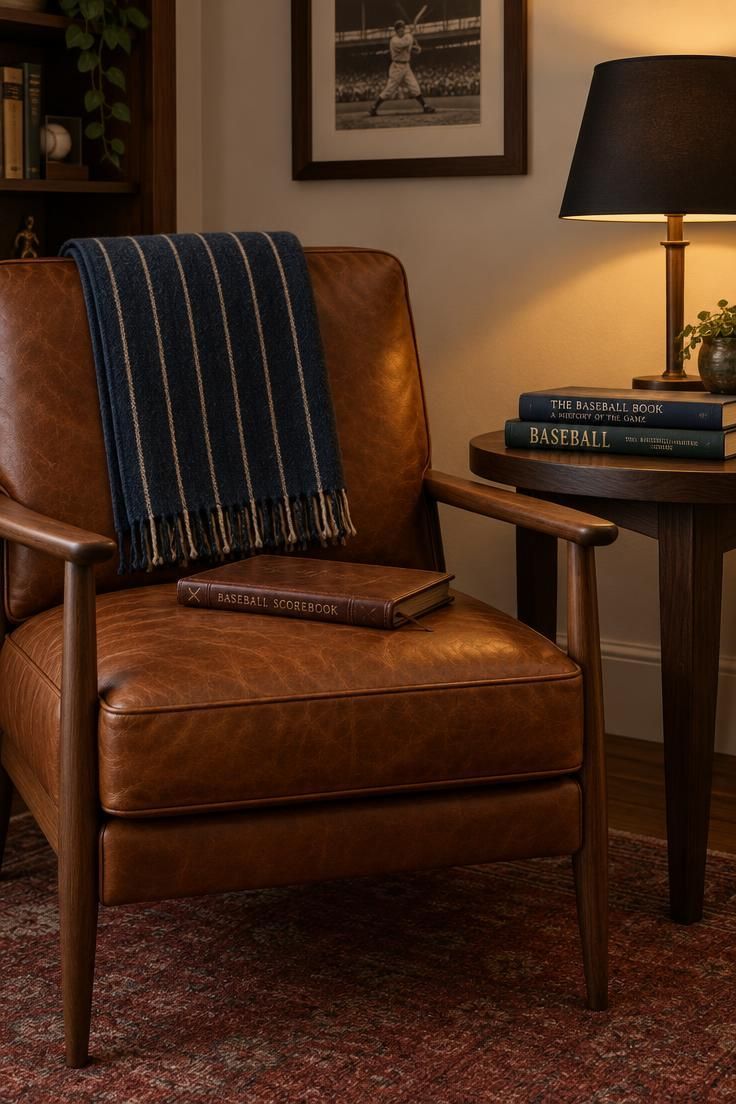
This is the quietest look on the list, and it suits a baseball man cave that whispers the theme rather than shouting it.
A single cognac leather chair or a small two-seat sofa with visible wood trim anchors the corner, and the wall behind stays bare or carries one large unframed canvas map.
The seating itself becomes the visual anchor, so nothing else has to work hard.
The palette stays limited to cognac, walnut, cream, and matte black.
That restraint is what makes the corner feel considered rather than sparse.
A patterned wool throw in a subtle pinstripe, folded over one arm, adds the only repeat motif the corner needs.
Leather shows scuffs and conditioner streaks in direct light, so place the chair across from a window or beside it rather than facing one straight on.
A low-pile wool rug in a faded brick color softens the floor without stealing attention from the chair.
A dark walnut side table with one drawer and a lower shelf holds a single table lamp and a small stack of baseball books.
The drawer hides a remote or a pair of readers, and the lower shelf keeps a folded blanket within reach.
Style Blueprint:
- One cognac leather chair or small two-seat sofa with visible wood trim
- A dark walnut side table with a drawer and lower shelf
- A table lamp with a black shade
- A pinstripe wool throw folded over one arm
- A low-pile wool rug in faded brick
Vintage Stadium Wall Paneling with a Simple Screen Layout
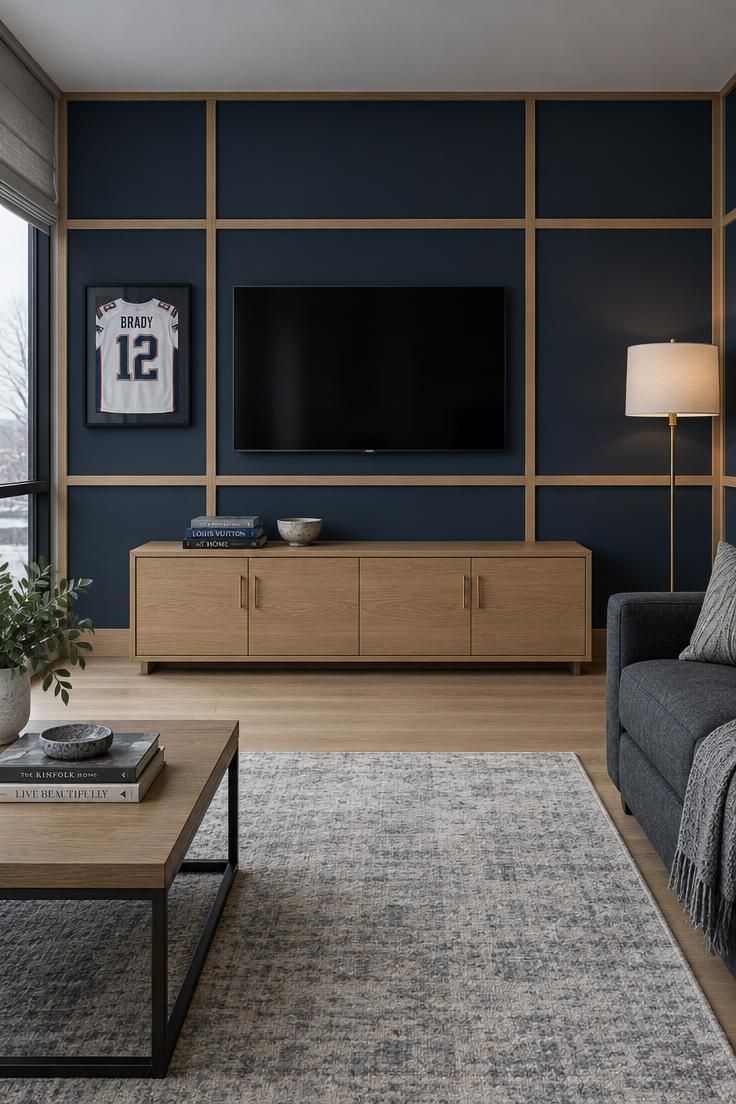
Treating one wall as a stylized nod to vintage stadium wall paneling gives a media room structure without copying any specific park.
Paint the wall a deep navy or charcoal, then apply narrow wood battens in a grid.
Keep every batten the same width and spacing, and stop the grid a foot or so from the ceiling so the wall does not feel weighted at the top.
Because the grid is regular, the screen reads as a dark panel within the wall rather than an object bolted onto it.
That relationship is what makes the arrangement feel intentional, and it is why proportion matters more than collection size here.
This is a stronger commitment than a plain painted accent wall, and it works best in a room with higher ceilings where the grid has room to breathe.
A painted grid using two tones of matte navy is the softer route, giving the same rhythm without the wood texture.
Add one framed jersey in a slim black frame to the left of the screen so the baseball reference stays explicit but restrained.
One good jersey reads as well as six, and the single frame keeps baseball room decor from tipping into full team-shop territory.
A low white oak console below the screen holds the everyday clutter out of sight.
Closed doors mean remotes, cables, and game-day snacks disappear between uses, which keeps the grid wall visually clean.
Style Blueprint:
- Deep navy or charcoal matte paint as the base
- Narrow white oak battens in an even grid
- A flat screen centered at seated eye level
- One framed jersey in a slim black frame
- A low white oak console with closed doors
Pennant Wall with a Long Dugout-Style Bench Below
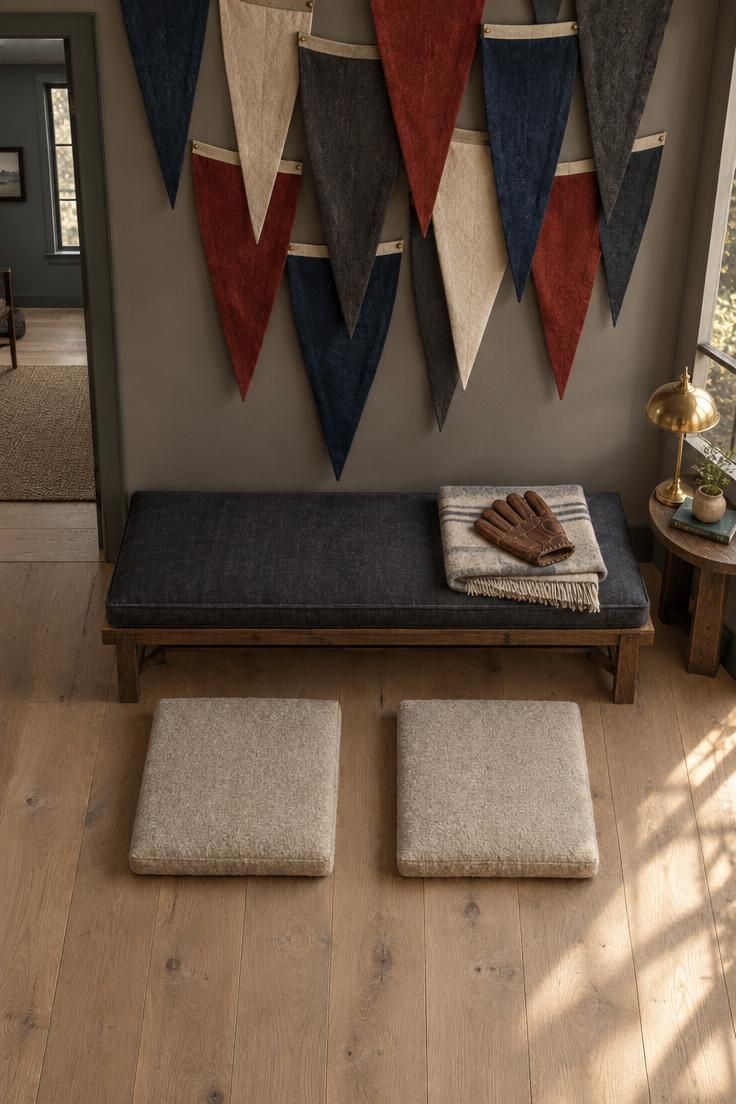
Dedicating one wall to a loose, overlapping arrangement of cloth pennants keeps this look low-cost and low-commitment.
The palette is the workhorse: navy, cream, brick red, and charcoal.
Anything outside that group gets left out or framed in another room.
Do not align the pennants perfectly.
A slightly staggered pattern keeps the wall from reading like a store window, and a few overlapping edges give the arrangement depth.
Below the pennants, a long bench with a simple upholstered seat in dark cotton canvas acts as both extra seating and a visual base.
Without the bench, the pennants float; with it, the wall has a clear bottom edge and the room has a place to sit.
This is the highest clutter risk on the list.
Ruthless palette editing is the fix.
Mount the pennants with a rail system or small clips so they can be rotated without leaving pin holes behind.
Keep the bench low, around 16 to 18 inches high, and add two small floor cushions in felt or canvas for anyone who prefers back support.
The arrangement reads best in a room with a door or window to the side, so the wall is not the only surface doing work.
Style Blueprint:
- A loose, overlapping pennant arrangement
- A restricted four-color palette
- A long low bench with dark canvas upholstery
- Two felt floor cushions for back support
- Clip or rail mounting for easy rotation
Design Pro-Tip: Lay the pennants out on the floor first to refine the overlaps and spacing before committing to hooks, so you can adjust the arrangement without patching holes.
Floating Bat Rack with a Single-Glove Shelf Below
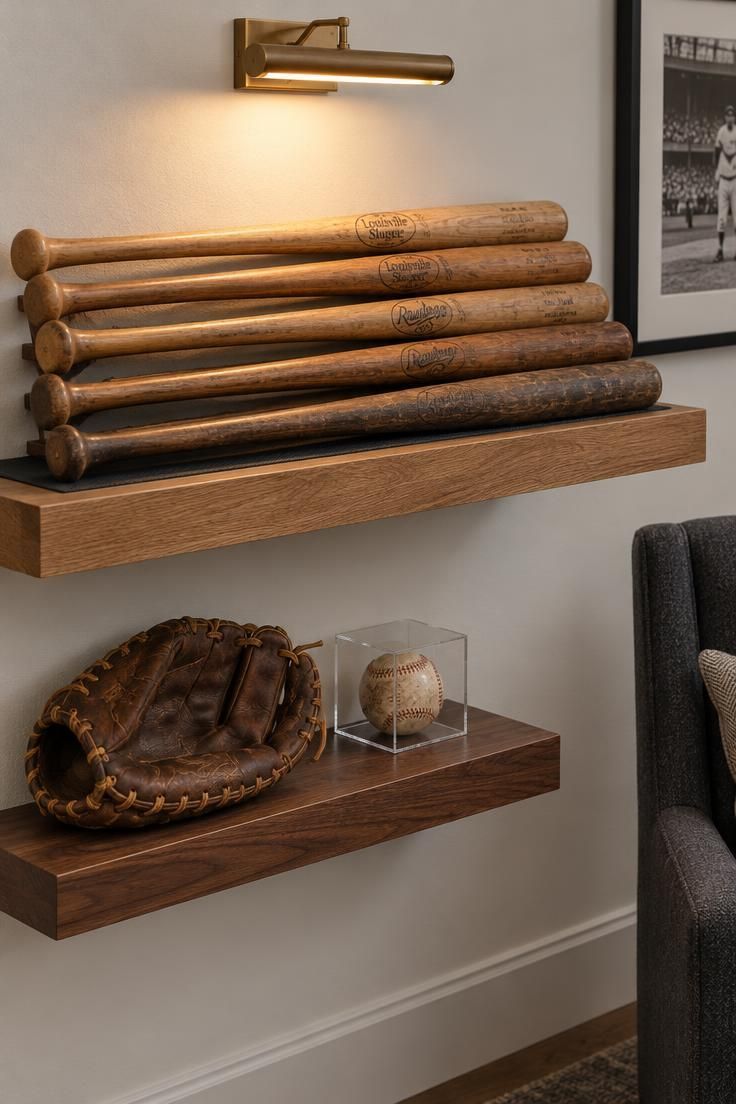
A narrow floating shelf about five feet long holds a horizontal row of vintage or replica bats, each resting in a small leather-lined cradle or simply laid flat on rubber shelf liner.
The liner keeps the bats from sliding and protects the shelf finish from repeated contact.
Below it, a second shorter shelf holds exactly one leather ball glove, placed flat or gently cupped, plus a single ball in a cube.
The glove becomes the focal point precisely because it is alone.
This look favors rooms with clean, uncluttered walls.
A busy pattern behind the bats will make the display look messy, and the shelves themselves need to stay shallow so the wall does not eat into the walking lane.
Choose wood for the shelves that matches another tone in the room, such as the floor or a side table.
Repeating a wood tone across two or three surfaces is what makes a display read as designed rather than assembled.
One tradeoff to plan around: floating shelves have a comfortable reach limit, so the bat rack belongs no higher than eye level.
If the room has high ceilings, add a third empty shelf above to create intentional negative space rather than filling the gap.
Style Blueprint:
- A long oak floating shelf for five bats
- A shorter walnut shelf below
- One leather glove and one ball in an acrylic cube
- A small brass picture light above
- An empty third shelf on high ceilings
Warm Gray Built-In with Acrylic Ball Cubes and a Small Desk
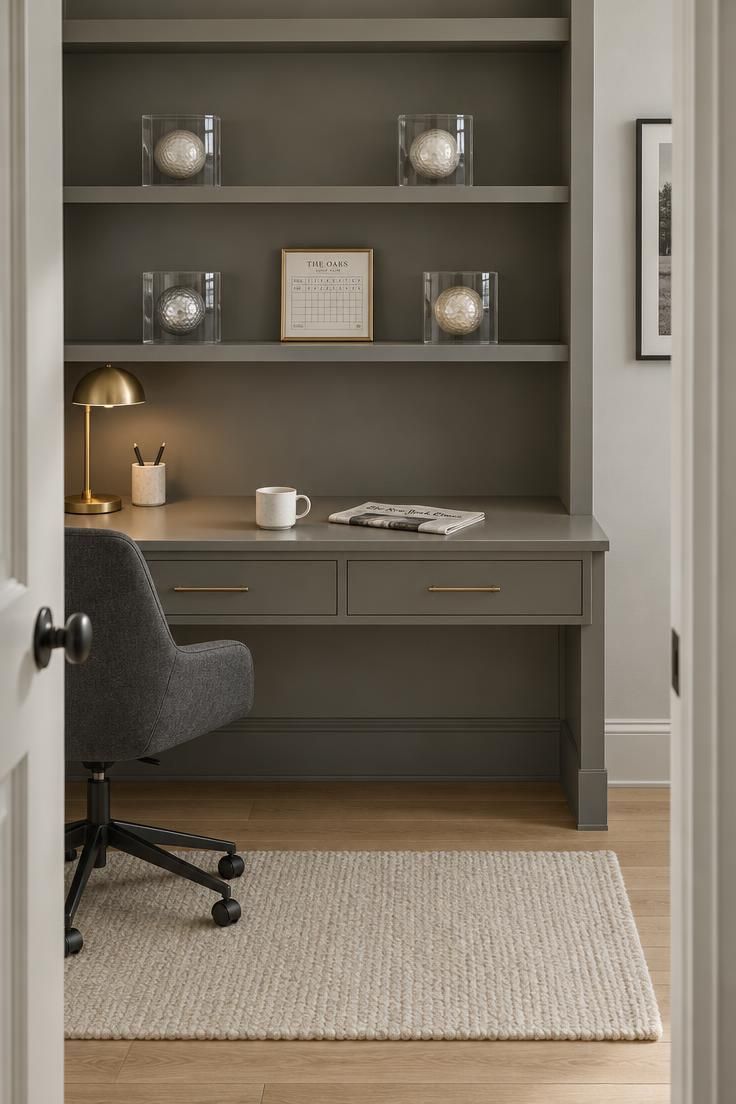
A built-in run of painted cabinetry in warm gray or greige replaces the usual freestanding desk and shelf.
One wall carries a desk surface with two drawers below and two open shelves above, and the open shelves hold only acrylic ball cubes and one or two small framed scorecards.
The acrylic protects the balls and unifies the display.
Closed drawers hide paperwork and cables, which matters in a room that doubles as an occasional home office.
This is the most functional direction on the list.
The built-in also makes a small room feel larger because the furniture does not break the wall plane the way separate pieces do.
The tradeoff is cost and commitment; built-ins are a bigger project than a desk and a shelf, but they read as more permanent.
Warm gray is the safest cabinet color because it bridges warm wood and cool gray walls, allowing the balls and paper to be the only true white accents.
A small brass reading lamp keeps the light source low and local, which suits late-evening paperwork.
Skip a screen on the desk if the room also serves as a lounge.
Tuck a tablet or a paper notebook into the top drawer instead, and the desk reads as a place for writing, sorting, or setting down a drink rather than a second workstation.
Style Blueprint:
- Warm gray or greige painted built-in cabinetry
- Two closed drawers below the desk surface
- Two open shelves holding acrylic ball cubes
- One or two small framed scorecards
- A small brass desk lamp for local light
Canvas Curtain Divide with a Compact Locker Bench
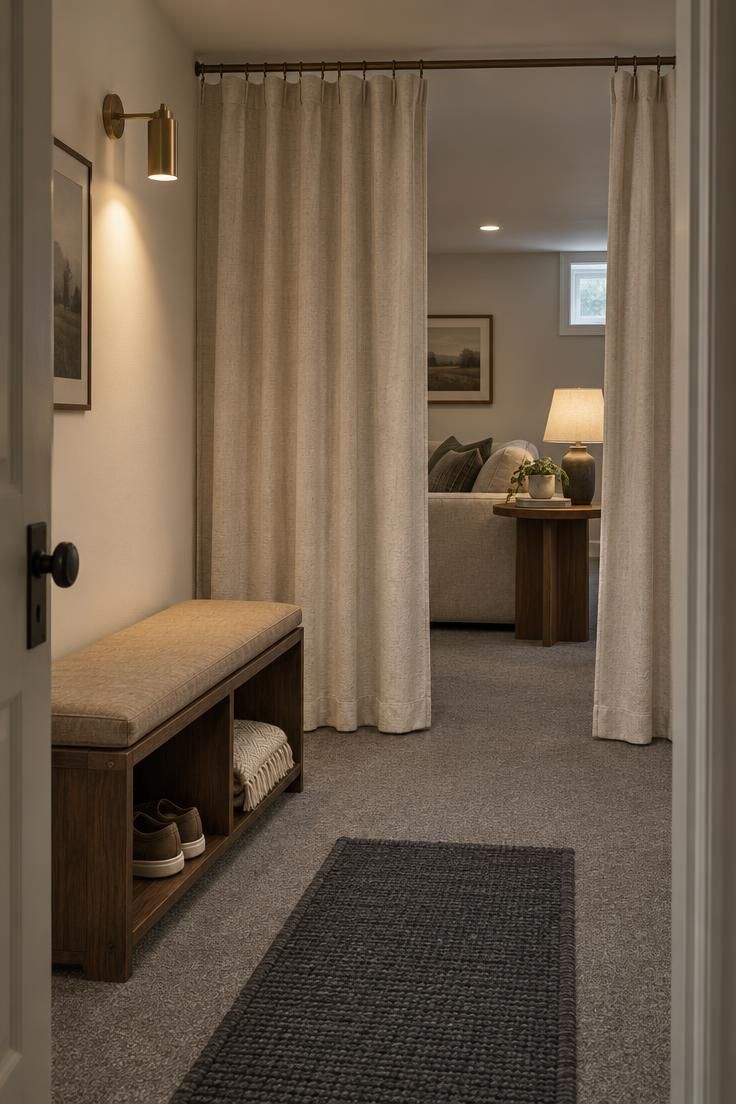
For a basement, long den, or oversized bonus room, a ceiling-mounted canvas curtain in a natural or navy tone can divide the space without a full wall.
A heavy duck canvas softens the boundary and hides the messier end of the room while still letting light move through the gap.
On the open side, a small locker bench gives the divided zone a clear function.
The bench is a low cabinet with a cushioned top and one or two cubbies below, sized for shoes, gloves, or folded throws.
It stays visually light because the footprint is small.
This works well in rooms that host more than one person at once, so one person can watch a game while another reads or works behind the curtain.
Neutral canvas that matches the trim keeps the arrangement flexible, whereas a team color locks the room into a single scheme.
One caution specific to this idea: curtains draw the eye to a horizontal line across the room, and a dark rod or track can make that line too harsh against a pale ceiling.
A slim track in a color close to the ceiling keeps the divide quiet.
Consider ceiling height when ordering the fabric.
In a room with standard eight-foot ceilings, the curtain should stop an inch or two above the floor to avoid dragging.
A narrow wall sconce just outside the curtain on the seating side makes the transition feel considered rather than improvised.
Style Blueprint:
- Ceiling-mounted natural or navy duck canvas curtains
- A slim track in a ceiling-matching tone
- A compact locker bench with a tan cushion
- One or two cubbies for shoes and throws
- A slim brass sconce on the seating side
Design Pro-Tip: Hang curtain panels so they overlap by several inches at the center, which softens the seam between the two sides of the room and gives the divide a more finished look.
Shadow Box Grid with Stitched Leather Accent Chairs
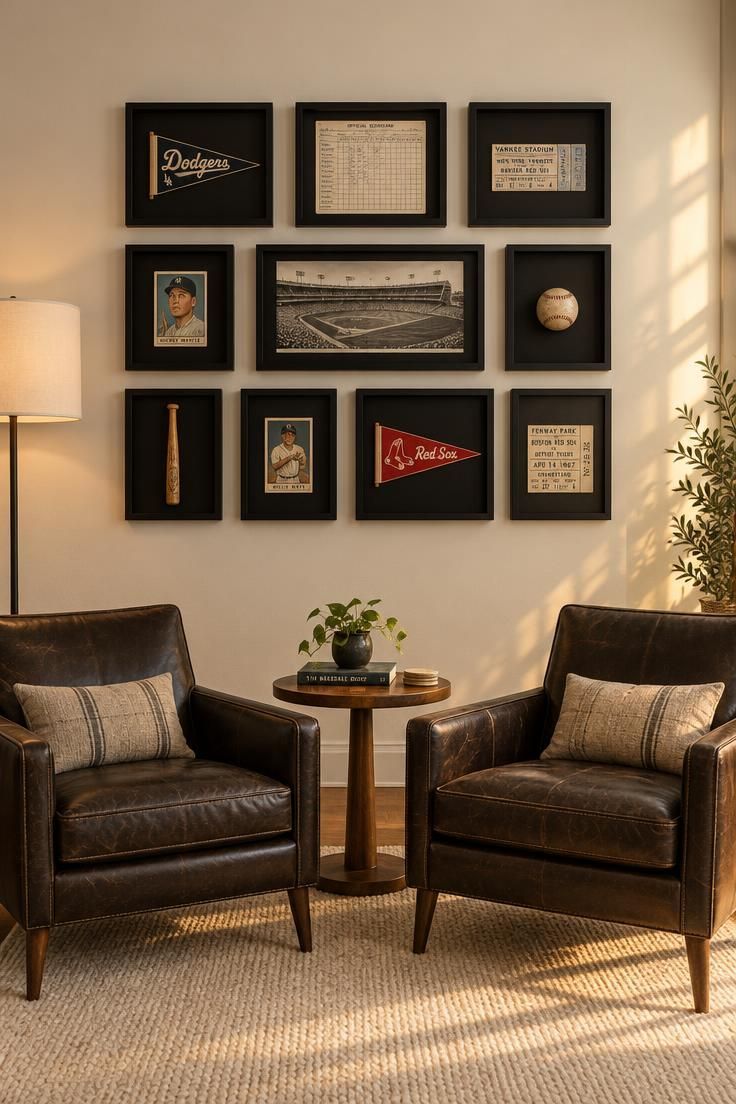
A modular grid of matching shadow boxes in flat black frames, using a mix of square and horizontal formats, turns a scattered collection into one visual statement.
Fill the boxes with objects that share a material language: a small pennant, a scorecard, a ticket stub, a baseball card, a miniature bat.
Keep every frame the same depth so the grid reads as a single unit rather than a group of unrelated pieces.
This look protects paper pieces better than an open pennant wall, and it makes rotating items easy without repainting anything.
The grid works best on a solid light wall in a room that already has some color.
An all-black grid on a navy wall will disappear, so reserve it for warm white, cream, or pale gray surfaces.
Below or beside the grid, two accent chairs in dark leather or a stitched wool blend echo the stitched lines in the frames and give leather and wood lounge seating a place in the composition.
The chairs face each other with a small round table between them, which keeps the arrangement conversational rather than oriented toward a screen.
Visual weight is the tradeoff.
A large grid of black frames can feel heavy in a small room.
Limit the grid to about twelve boxes in a standard room and use an odd but balanced layout, such as a three-by-four rectangle with one wider horizontal piece in the center.
Style Blueprint:
- Flat black shadow boxes in matching depths
- A three-by-four grid capped at about twelve frames
- A mix of square and one wider horizontal format
- Two dark leather accent chairs with visible stitching
- A small round walnut table between the chairs
Little-League Trophy Shelf with a Wooden Nameplate
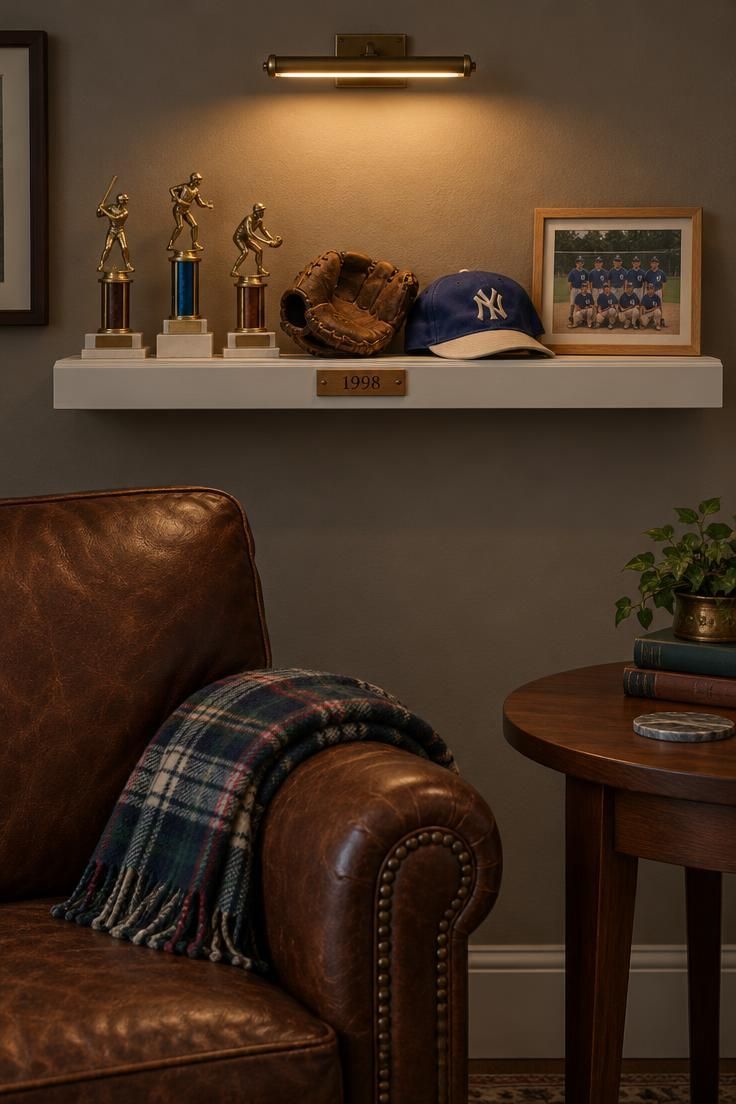
One wall or one prominent shelf can be reserved for personal history rather than team memorabilia.
A small cluster of childhood trophies, a first glove, a worn cap, and one or two dated team photos carries more weight than a larger assortment of anonymous pieces.
Place them on a single floating shelf painted the same color as the wall, so the objects themselves provide the color.
Below the shelf, a small wooden nameplate or a framed index card with a year or league name anchors the grouping.
Editing is the whole game here.
A shelf of eight trophies reads as clutter; three or four read as a collection.
Stands and small risers vary the height, and keeping the palette to the objects themselves means the room does not fight the display.
A pale wall color such as chalky white or warm gray works best because it lets the faded gold, wood, and leather speak.
Place the shelf near the seating so it is visible from the main chair rather than hidden in a corner.
This shelf may not be the room's dominant visual feature, and that is the point.
It does the quiet work of making the room feel lived in, and it pairs naturally with leather and wood lounge seating nearby.
A small battery-operated picture light above the shelf keeps the trophies visible without any wiring.
Style Blueprint:
- One floating shelf painted to match the wall
- Three or four objects, no more
- Risers and stands to vary height
- A small wooden nameplate or framed year card
- A battery-operated picture light above
Conclusion
The best baseball man cave ideas tend to share one quality: they keep the room livable.
A wall of caps, a single well-placed bat, or a shelf of childhood trophies can feel more personal than a room covered in every logo.
The concepts here work because they borrow the material language of baseball, leather, wood, felt, canvas, and stitched textiles, and let those surfaces carry the theme.
Choose one or two moves that fit the room's actual size and use rather than trying to include everything at once.
The goal is a retreat that feels like a place to watch a game, read a box score, or just sit for a while, not a storage room for a collection.