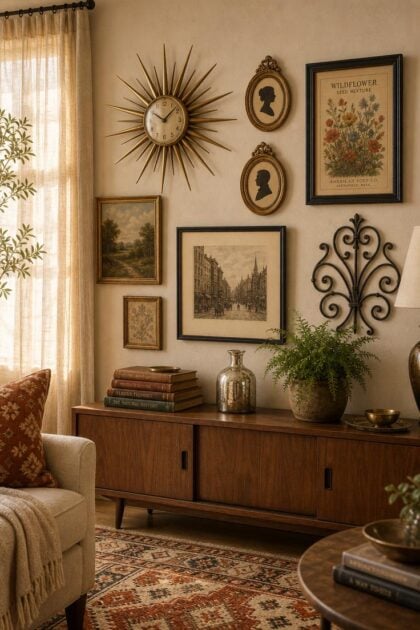
This post may contain affiliate links. If you make a purchase through these links, we may earn a commission at no additional cost to you.
The best rooms tell a story, and nothing writes that story faster than what hangs on your walls.
Vintage wall decor brings a layer of warmth and history that brand-new pieces simply cannot replicate.
Whether you lean toward mid-century modern wall art or prefer the quiet charm of farmhouse antiques, the right piece turns a blank surface into the most interesting spot in the house.
These 10 vintage wall decor ideas pair specific materials, finishes, and color palettes with styling tips you can put to work today.
An Art Deco Starburst Clock in Brushed Brass Above a Velvet Sofa
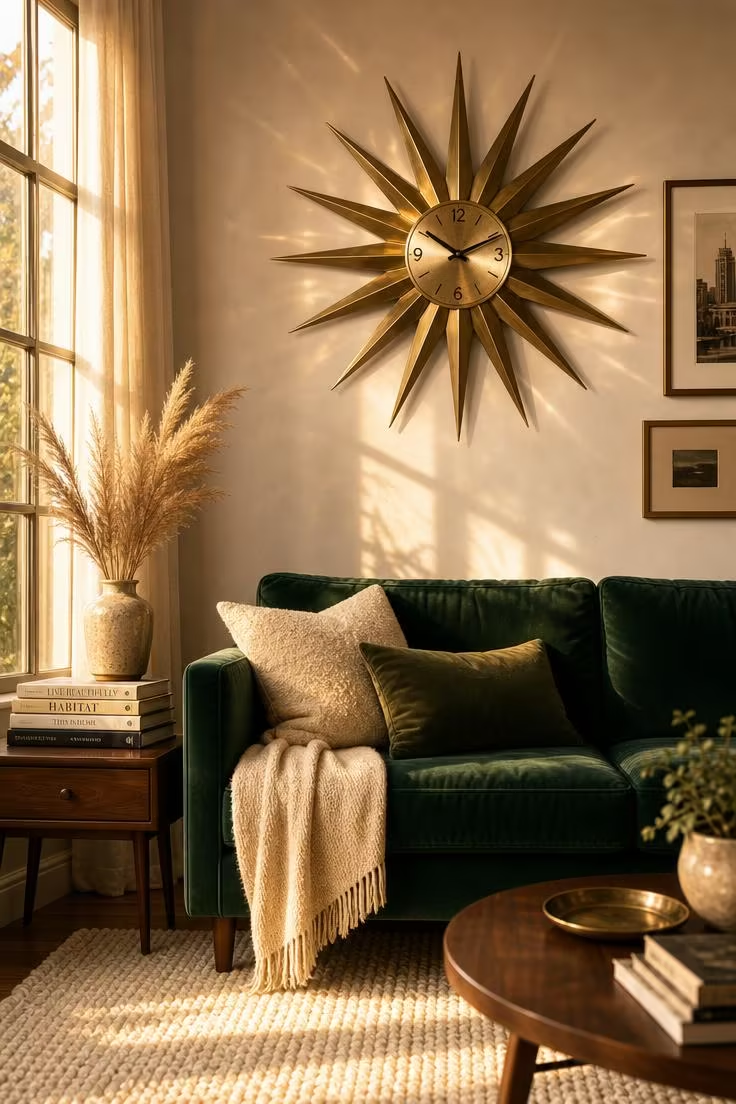
A single oversized clock does what a dozen smaller pieces struggle to do: it anchors the wall without clutter.
The brushed brass finish pairs naturally with jewel-toned upholstery because both carry visual weight, and neither overwhelms the other.
Art Deco design relies on symmetry and bold geometry, so placing the clock dead center above the sofa frame satisfies that principle.
The warm golden tones of brass also pull warmth into a room that might otherwise lean cool from green velvet alone.
When sourcing, look for clocks with real metal rays rather than molded plastic, since the patina that builds over years is half the appeal.
Reproductions from the 1960s and 1970s are more affordable than true 1930s originals, and they carry much of the same character.
A starburst clock like this works best as the only major wall piece in its section of the room, giving it space to breathe.
Style Blueprint:
- Brushed brass starburst clock, 24-30 inches in diameter
- Jewel-toned velvet sofa in emerald, navy, or sapphire
- Cream or warm white wall paint as a neutral backdrop
- Walnut or dark wood side table for contrast
- One small organic accent, like dried pampas or eucalyptus, nearby
A Row of Framed Vintage Seed Packet Prints on a White Beadboard Wall
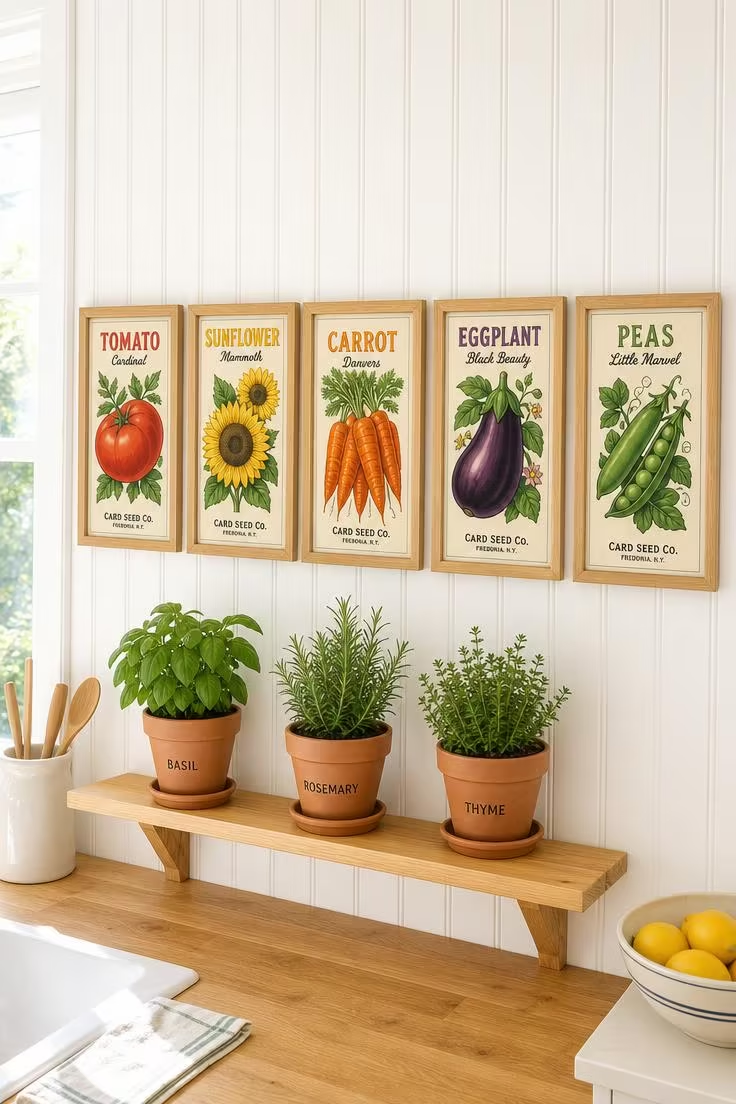
Color is the first thing your eye grabs in a room, and vintage seed packet prints deliver it in concentrated bursts.
The slim oak frames keep the look grounded, preventing the bright illustrations from reading as too playful or childish.
Beadboard behind the frames adds a second layer of texture that makes the flat prints feel more dimensional by contrast.
This arrangement works especially well in kitchens and mudrooms because the subject matter, vegetables and garden flowers, belongs in those spaces without any forced styling.
Hanging all five prints at the same height in a tight row creates a visual rhythm that feels intentional, almost like a piece of antique wall art in itself.
Flea markets and online vintage sellers carry original seed packets from the early 1900s, though high-quality reproductions printed on cotton rag paper look nearly identical once framed.
Design Pro-Tip: When hanging a horizontal row of small frames, set the spacing between each frame at exactly the width of the frame itself. This creates a visual cadence that reads as deliberate rather than random, and it holds up better at a distance.
Style Blueprint:
- 5 vintage seed packet prints (originals or cotton rag reproductions)
- Slim natural oak frames, all matching
- White beadboard wall panel behind the row
- Narrow pine shelf with terracotta herb pots
- Bright, well-lit wall (near a window for natural light)
Salvaged Wrought Iron Gate Panel Mounted on a Warm Plaster Wall
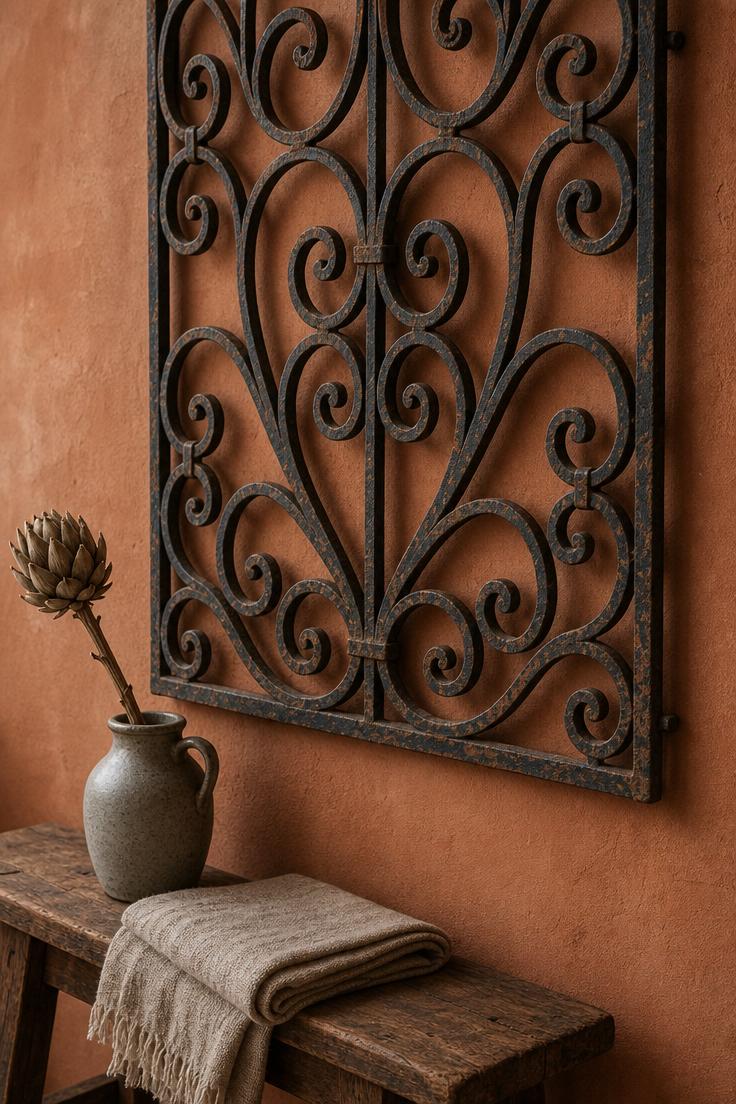
Architectural salvage carries a presence that manufactured wall art cannot match, and wrought iron gate panels are among the most striking pieces you can mount.
The scale matters here: a gate section that stands three to four feet wide commands the wall the way a painting would, but with far more physical depth and shadow play.
Iron scrollwork against warm plaster creates a tension between hard and soft that keeps the eye moving across the surface.
Leaving the original rust and paint chips intact is the right call, since cleaning and repainting removes the very thing that makes the piece worth hanging.
The weight of wrought iron means you need proper wall anchors rated for at least 50 pounds, drilled into studs rather than drywall alone.
Entryways and dining rooms suit this type of piece best because they have the vertical wall space and the formality to carry something this bold.
Mounting the panel flush against the wall, with small spacers behind it, allows light to slip behind the ironwork and cast shadows that shift through the day.
Pairing the iron with a simple bench below it prevents the area from looking like a museum display and grounds it in everyday life.
Style Blueprint:
- Salvaged wrought iron gate panel, 3-4 feet wide
- Warm plaster wall in terracotta, ochre, or clay
- Heavy-duty wall anchors rated for iron weight
- Simple wooden bench or console below
- One organic accent (dried artichoke, olive branch, or wheat bundle)
A Display of Mercury Glass Bottles on a Reclaimed Pine Shelf
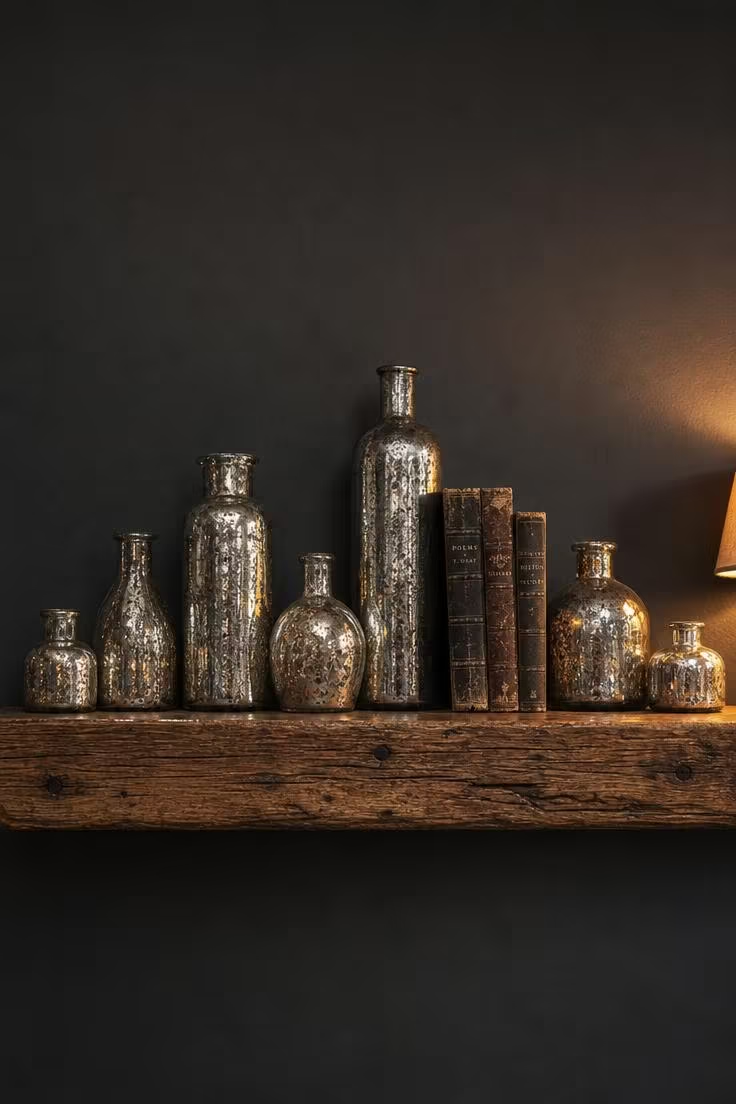
Mercury glass picks up whatever light is in the room and sends it back in scattered fragments, which is why it looks best in low, directional light rather than bright overhead fixtures.
The silvered surface of each bottle carries slight imperfections, bubbles, cloudy patches, dark spots, and those irregularities are exactly what separates a genuine vintage piece from a modern reproduction.
Grouping bottles in odd numbers, five or seven, creates a more pleasing arrangement than even counts because the eye settles on the center piece and then drifts outward.
Reclaimed pine as the shelf material adds a rough, warm counterpoint to the cool reflective glass, preventing the display from feeling precious or untouchable.
A charcoal wall behind the collection deepens the contrast and makes the silver tones pop forward, which would be lost against a pale background.
This kind of retro wall decor works well in hallways, bedroom walls, or living room alcoves where the lighting can be controlled with a lamp or sconces rather than overhead.
Design Pro-Tip: Group your vintage mirror and glass collections on shelves that face a window or a lamp, never on walls that stay in shadow all day. Reflective surfaces need a light source to work, and even a single candle-height lamp transforms a dead shelf into a glowing display.
Style Blueprint:
- 5-7 mercury glass bottles in varied heights (4-12 inches)
- Reclaimed pine floating shelf, 36-48 inches long
- Deep charcoal or navy wall paint behind the display
- Small table lamp or wall sconce for directional light
- One non-glass accent (antique books, a brass dish, or a dried flower)
Victorian Cameo Portraits in Oval Gilded Frames on a Sage Green Wall
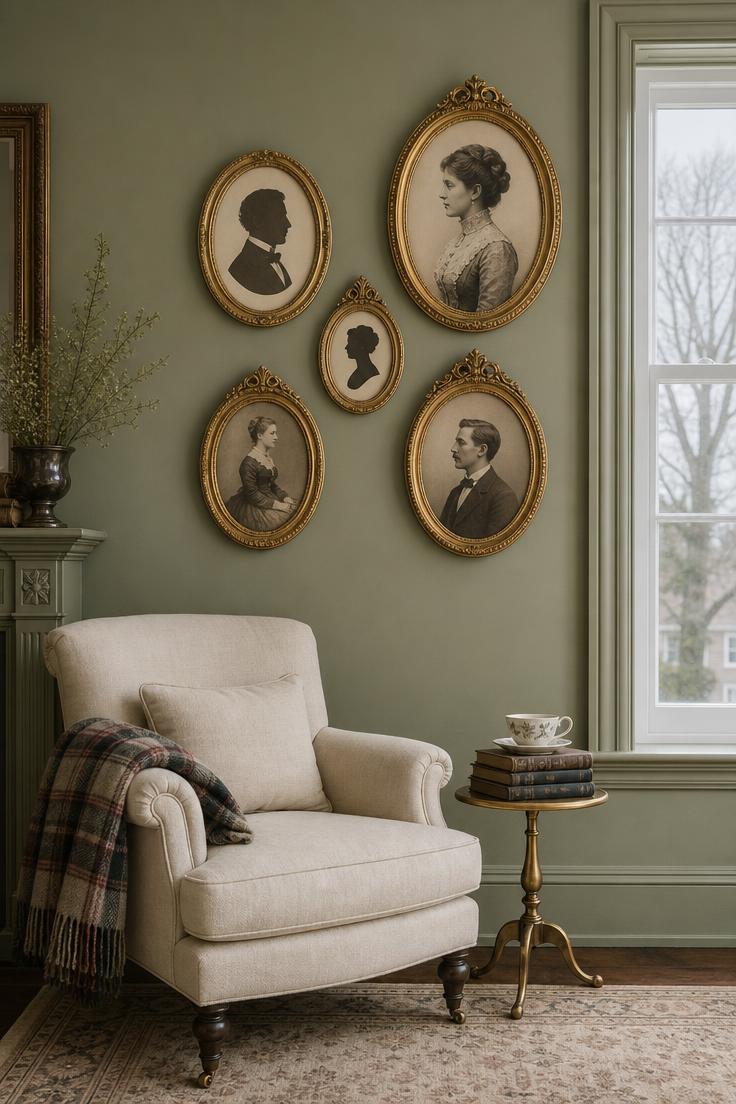
Oval frames read differently than rectangular ones, and that shape alone signals a different era the moment someone enters the room.
Gilding adds formality without heaviness when the frames are small to medium in size, and the gold tones warm up a cool sage wall.
Asymmetrical hanging, where the frames are grouped loosely rather than in a strict grid, mimics the way vintage picture frames collected over a lifetime would naturally end up on a wall.
Cameo portraits and silhouettes carry a quiet elegance that suits rooms where conversation happens, living rooms, sitting areas, and reading corners.
Sage green as the background color is specific and intentional: it sits cool enough to contrast the warm gilt but is not so dark that it swallows the small frames.
The even, shadow-free quality of overcast light is ideal for this arrangement because it lets the gilding shine without harsh glare spots.
Hanging the largest frame off-center, slightly higher than the rest, gives the cluster a clear anchor point without making the arrangement feel rigid.
Mixing genuine antique frames with newer reproductions is perfectly fine, since a coat of gold leaf ages quickly and blends within months.
When browsing estate sales, look for frames with original glass and backing, as these are harder to replace and add to the authentic feel.
Style Blueprint:
- 5 oval gilded frames in varied sizes (6×8 to 12×16 inches)
- Cameo portraits, silhouettes, or sepia prints for the inserts
- Sage green wall paint (matte or eggshell finish)
- Low cream or ivory upholstered chair below
- Brass accent table with a few vintage books
A Faded French Grain Sack Stretched Over a Cedar Frame
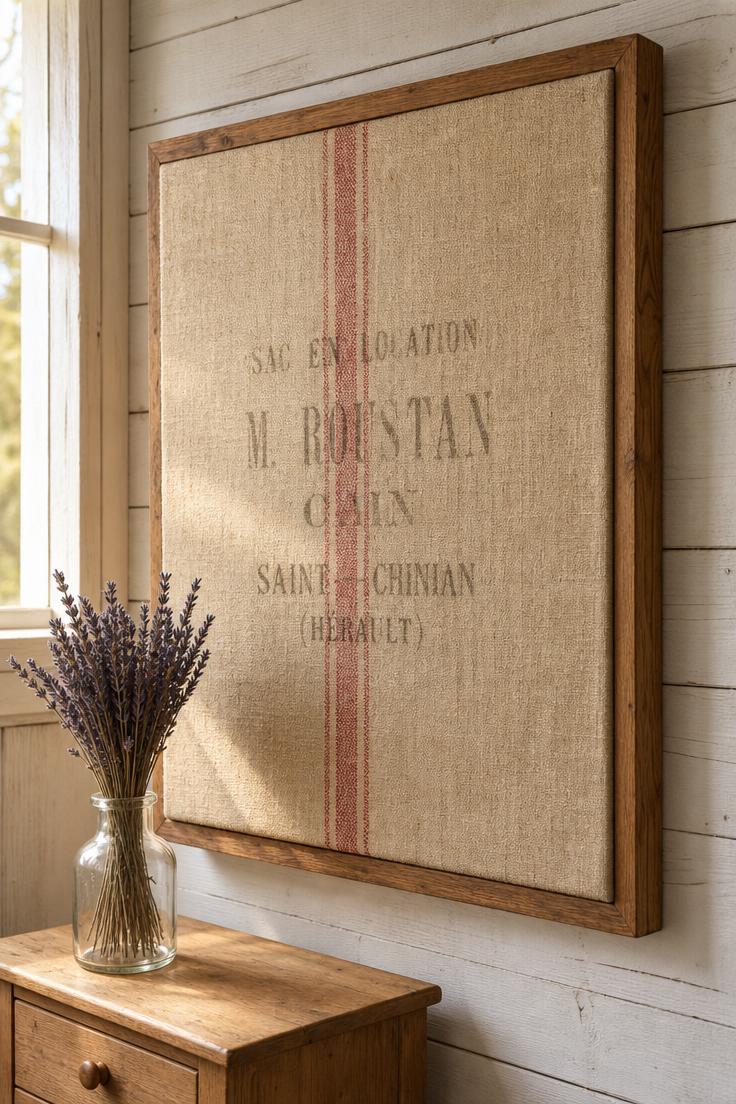
French grain sacks were made to carry weight, and that durability shows in the dense, nubby weave that no modern linen quite replicates.
The faded typography and center stripe are the visual heart of the piece, telling you where it came from and roughly when it was made.
Stretching the sack over a cedar frame turns a flat piece of fabric into something that hangs and reads like a canvas painting, with the added warmth of textile texture.
Cedar is a better choice than pine for the frame because its reddish grain complements the faded red stripe without competing.
This kind of farmhouse wall decor works especially well in bedrooms and guest rooms where the quiet, worn quality of the fabric matches the slower pace of those spaces.
Pairing it with whitewashed shiplap doubles down on the farmhouse mood, but a clean white plaster wall would work equally well for a more edited look.
Sourcing tip: genuine French grain sacks from the 1800s-early 1900s are still available at European flea markets and specialty online sellers, with prices rising as supply dwindles.
Style Blueprint:
- Authentic vintage French grain sack with center stripe
- Simple cedar stretcher frame (custom or DIY)
- Whitewashed or plain white wall behind
- Small pine nightstand or shelf below
- One dried botanical accent (lavender, wheat, or cotton stems)
Mid-Century Ceramic Starburst Tiles Arranged in a Diamond Grid
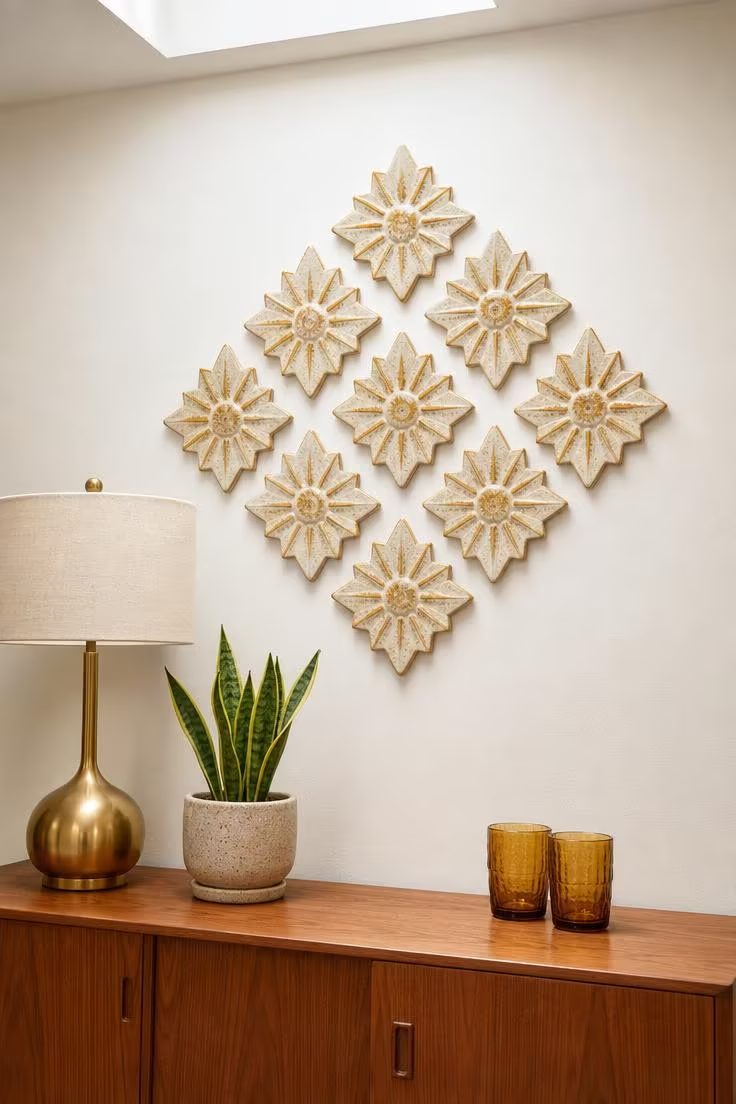
Ceramic tiles from the 1950s and 1960s carry a handmade quality that factory-produced pieces from later decades lack, and you can feel the difference in the weight and glaze.
Arranging them in a diamond rotation rather than a standard square grid gives a familiar shape an unexpected twist, which is the entire point of mid-century modern wall art.
The gold glaze on each starburst catches overhead light differently depending on the angle, creating a shifting pattern as you move through the room.
Nine tiles in a three-by-three formation is large enough to register as a deliberate installation rather than a few scattered decorations.
Teak furniture below the tiles is the natural companion because both materials come from the same design era and share that warm, honey-toned character.
A skylight or overhead fixture works better here than side lighting because it hits the glazed surfaces at the angle that reveals the most color depth.
If original tiles prove hard to find, several ceramic studios produce faithful reproductions using the same hand-pressing and glaze techniques.
Spacing between tiles should match the width of one tile, keeping the diamond geometry clean without crowding.
Design Pro-Tip: Tile and ceramic pieces mounted on walls benefit from small rubber bumpers on the back corners. These prevent the piece from shifting when doors close or people walk past, and they protect the wall surface from scuff marks over time.
Style Blueprint:
- 9 ceramic starburst tiles in cream with gold glaze
- Diamond grid arrangement with even spacing
- Warm white wall paint behind
- Teak credenza or sideboard below
- Brass accent lamp and one or two era-appropriate accessories
A Vintage Barometer and Compass Pair Flanking a Porthole Window
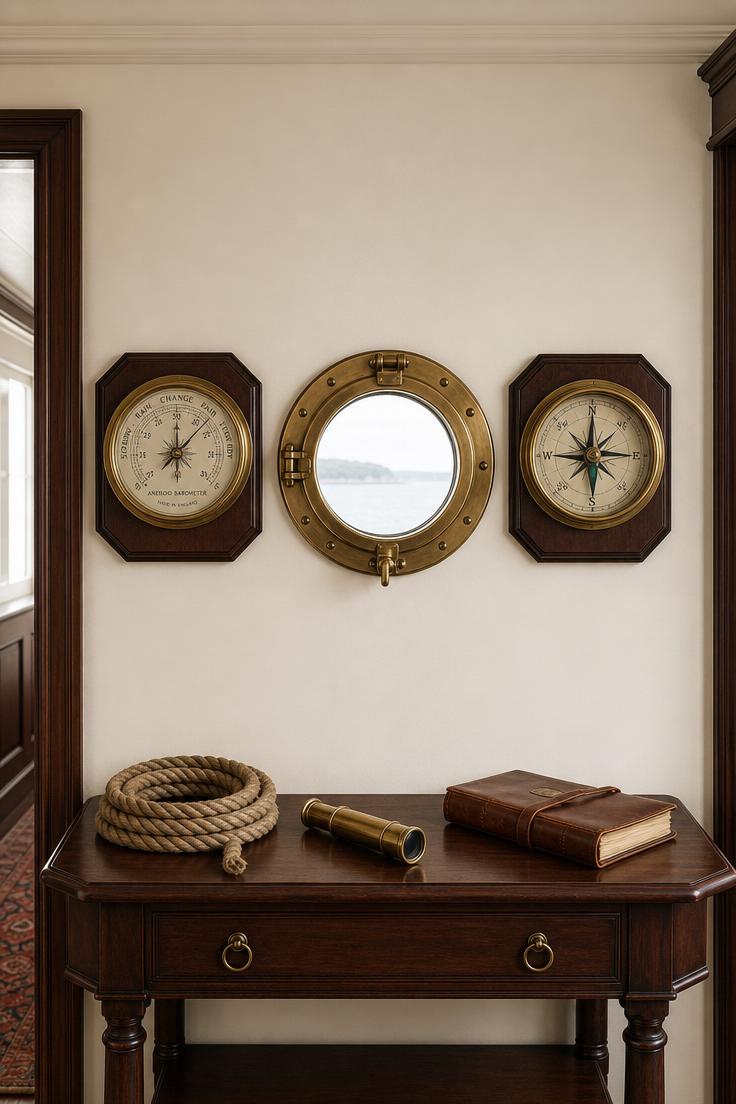
Symmetry is the driving force behind this arrangement, and it works because all three elements, barometer, window, and compass, share the same round shape.
The dark mahogany backboards give each instrument enough visual weight to hold its own beside an actual window, which is a harder task than it sounds.
Brass patinas differently depending on whether the piece spent its life near salt air or in a library, and mixing those patina levels adds character to the pair.
This look suits a hallway, study, or bathroom, anywhere the nautical reference reads as collected rather than themed.
Keeping the console accessories to three or four small objects prevents the area from sliding into a maritime gift shop, which is the risk with any themed grouping.
Style Blueprint:
- Vintage brass barometer on a mahogany backboard
- Matching brass compass on a mahogany backboard
- Porthole window or round mirror as the center element
- Dark wood console table or narrow shelf below
- Two or three small nautical objects (rope coil, spyglass, leather journal)
Hand-Tinted Daguerreotype Reproductions in Mismatched Copper Frames
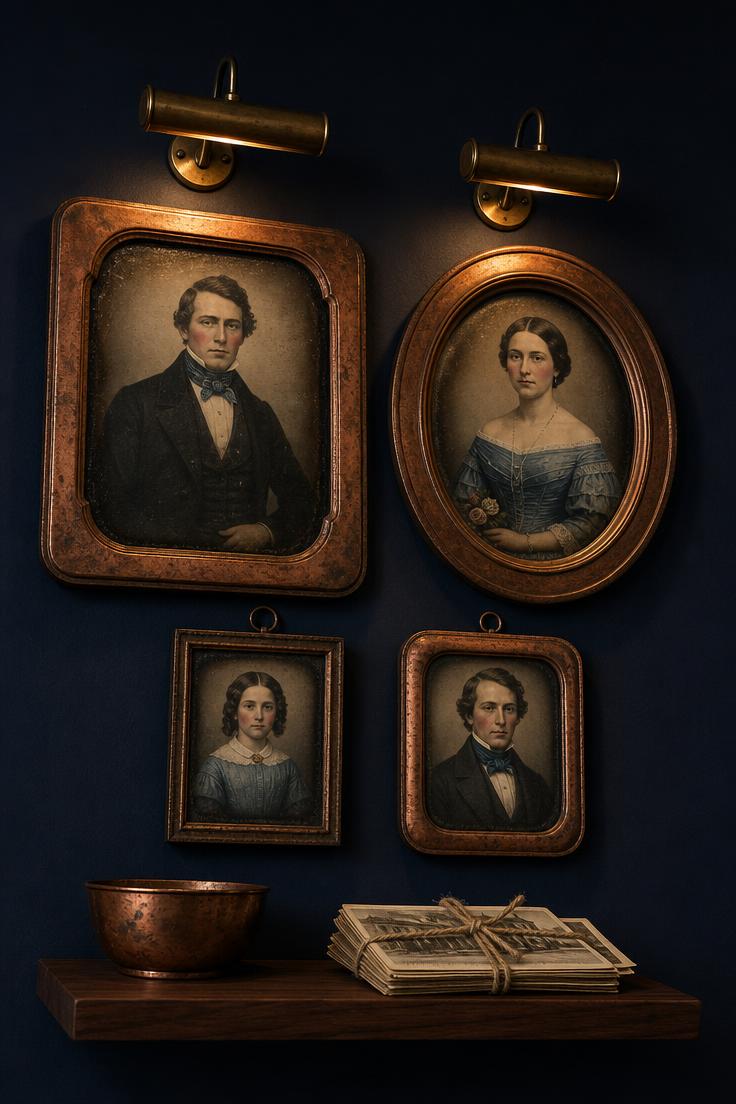
Hand-tinted photographs from the mid-1800s carry a softness that modern color photography never quite captures, and reproductions printed on period-appropriate paper hold much of that same quality.
Copper frames patinate into greens, browns, and rusts over time, and no two frames age the same way, which is why mismatching them adds to the collected feeling.
A deep navy wall pushes the warm copper and soft portrait tones forward, creating a layered depth that a lighter wall would flatten.
Brass picture lights above the frames do double duty: they direct the eye to the art and add a warm glow that makes the hand-tinted colors come alive in the evening.
This kind of gallery wall works well in libraries, hallways, and dining rooms where the mood can be kept intimate and slightly moody.
Grouping four frames in a loose cluster, rather than a grid, lets you adjust the spacing based on each frame’s size and shape.
Vintage botanical prints or antique maps in copper frames make a good alternative if portraits feel too personal for your space.
Style Blueprint:
- 4 hand-tinted daguerreotype reproductions (print-on-demand or antique shop)
- Mismatched patinated copper frames in varied sizes
- Deep navy or charcoal wall paint (matte finish)
- Brass picture lights (battery-operated or hardwired)
- Floating walnut shelf with one or two copper accent pieces
A Retro Enamel Diner Sign With Chrome Brackets on Exposed Brick
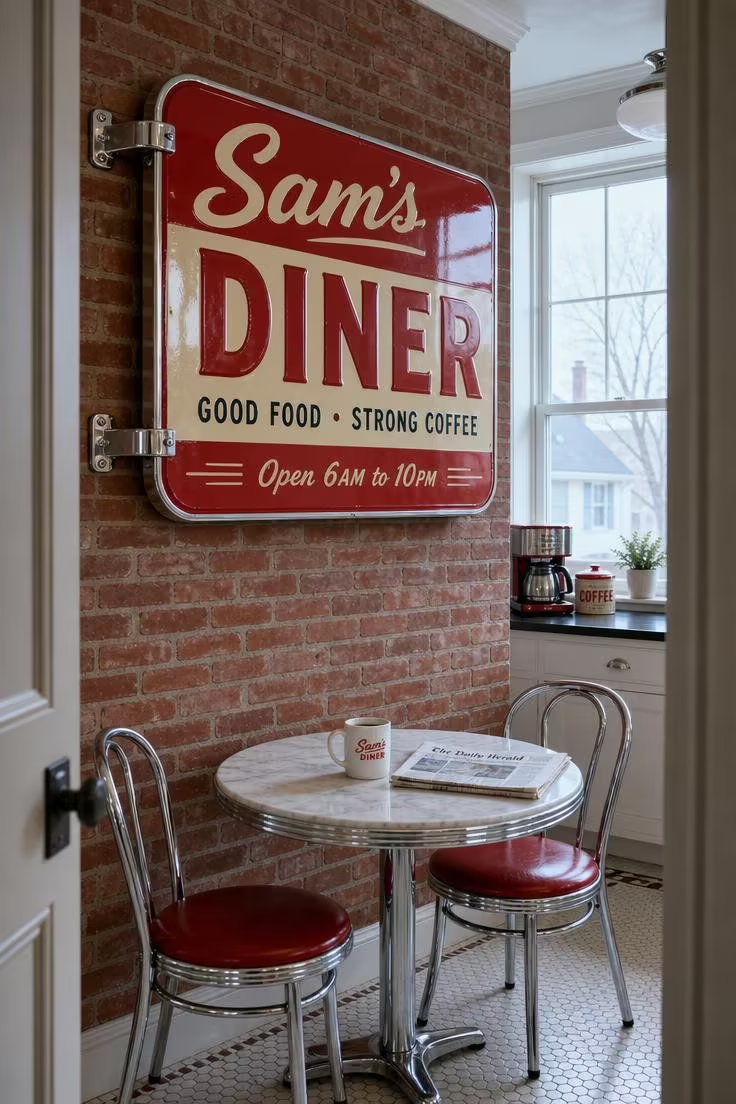
A single bold sign on a brick wall does what a complicated gallery wall arrangement cannot: it stops you mid-stride and makes you look.
Enamel signs from the 1940s through 1960s were built to withstand weather, which means the ones that survived carry a toughness in their finish that modern reproductions rarely match.
Red and cream is the classic color combination for these signs, and it pops against the warm orange tones of exposed brick without clashing.
Chrome brackets serve as both the mounting hardware and a style detail, picking up the retro diner aesthetic and tying it to the chrome chair frames below.
The cool, even quality of overcast daylight brings out the glossy enamel surface better than warm light would, since warm tones tend to flatten red into orange.
Breakfast nooks, kitchen walls, and home bar areas all suit this look because the diner reference makes sense in spaces tied to food and gathering.
Style Blueprint:
- Vintage enamel diner sign in red and cream (or blue and white)
- Polished chrome L-brackets for mounting
- Exposed brick wall (natural or faux brick panel)
- Small round bistro table with chrome or iron base
- One or two simple props (coffee mug, vintage newspaper, glass bottle)
Conclusion
Every piece of vintage wall decor you bring into your home carries a history that new products from a catalog cannot replicate.
The ideas above cover a wide range of eras and styles, from Art Deco brass to farmhouse grain sacks to mid-century ceramic tiles, so there is something here no matter where your taste falls.
Start with one piece that speaks to you, hang it on a wall that gets good light, and build from there.
Flea markets, estate sales, and architectural salvage yards are where the best finds turn up, often for less than you would spend on mass-produced alternatives.
A macrame wall hanging beside a starburst clock might sound like a clash on paper, but mixed vintage pieces tied together by a shared color palette or material create a gallery wall that looks collected, not confused.
Trust the patina, trust the imperfections, and let your walls tell the story of what you have gathered over time.