This post may contain affiliate links. If you make a purchase through these links, we may earn a commission at no additional cost to you.
Vintage Christmas decorating begins with a feeling of long use and gentle wear rather than a single shopping trip.
Soft pastels, warm creams, and tarnished metallics replace the usual bright red and green, and texture matters more than shine.
A home holds the look best when small collected objects sit in a few deliberate spots instead of covering every surface.
This guide walks through arrangements for a tree, a shelf, a windowsill, and a hallway wall, each built around pieces that read as old at a glance.
Flocked Tabletop Tree with Pastel Ornaments
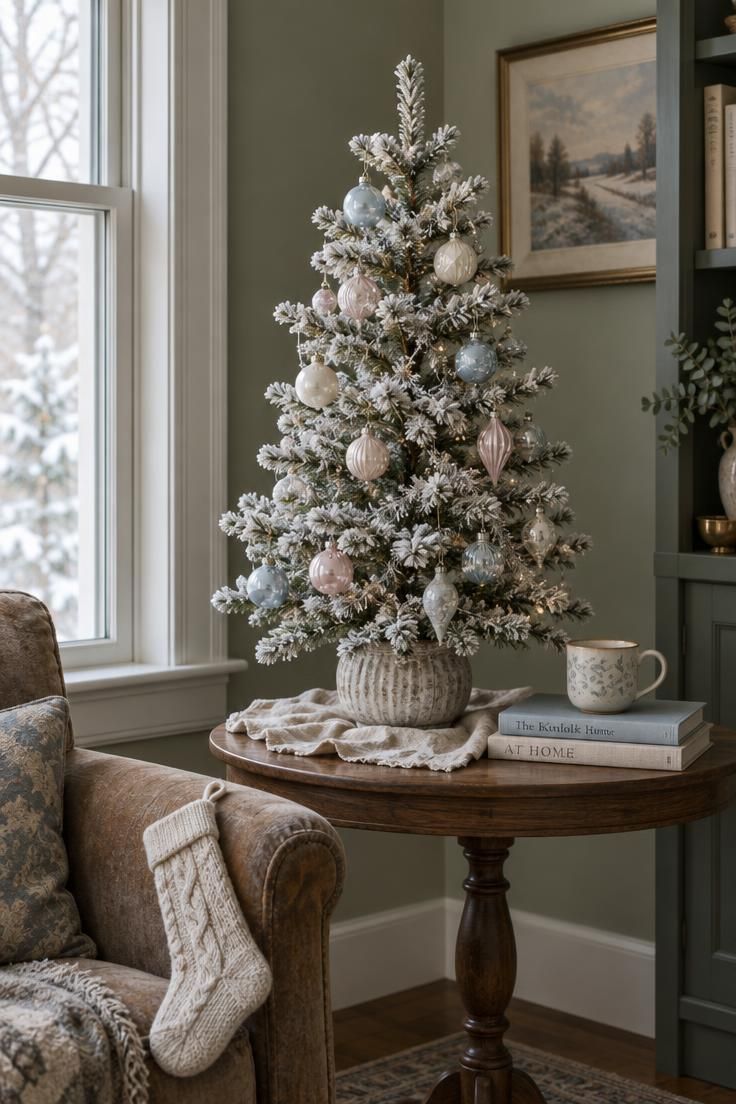
The snowy flocked finish does most of the work here, turning a small artificial tree into a soft white silhouette that stands out against painted walls.
Pastel glass balls in powder blue and soft pink keep the color story quiet, and a few strands of fine tinsel add a slightly rumpled metallic texture.
Aging is part of the appeal: a flocked surface that has yellowed a little reads as genuinely old rather than newly bought.
Placement matters more than quantity.
A single tree near a reading chair or on an entry console gives the eye one clear holiday focal point, and leaving open space around the base keeps the vignette from feeling crowded.
Strong daylight and direct heat can age the flocking faster than a reader might want, so a spot with indirect light preserves the finish longer.
For continuity, a pair of blow mold figures can stand on the floor beside the table at a smaller height, tying the vignette into the rest of the room without adding another busy surface.
The flat-backed figures sit naturally against a wall and repeat the faded look of the ornaments.
Small clip-on birds in aged cream or silver work well near the top, where their silhouettes stay readable against the white branches.
Keep the ornament count modest so the flocking remains visible between the pieces.
Style Blueprint:
- Small flocked tabletop tree with a slightly uneven snowy finish
- Glass ball ornaments in powder blue, blush, and cream
- Fine silver tinsel strands, left slightly loose
- Oatmeal linen runner and two or three clip-on birds
- A worn armchair or console nearby for context
Framed Sheet Music Carolers on a Buffet
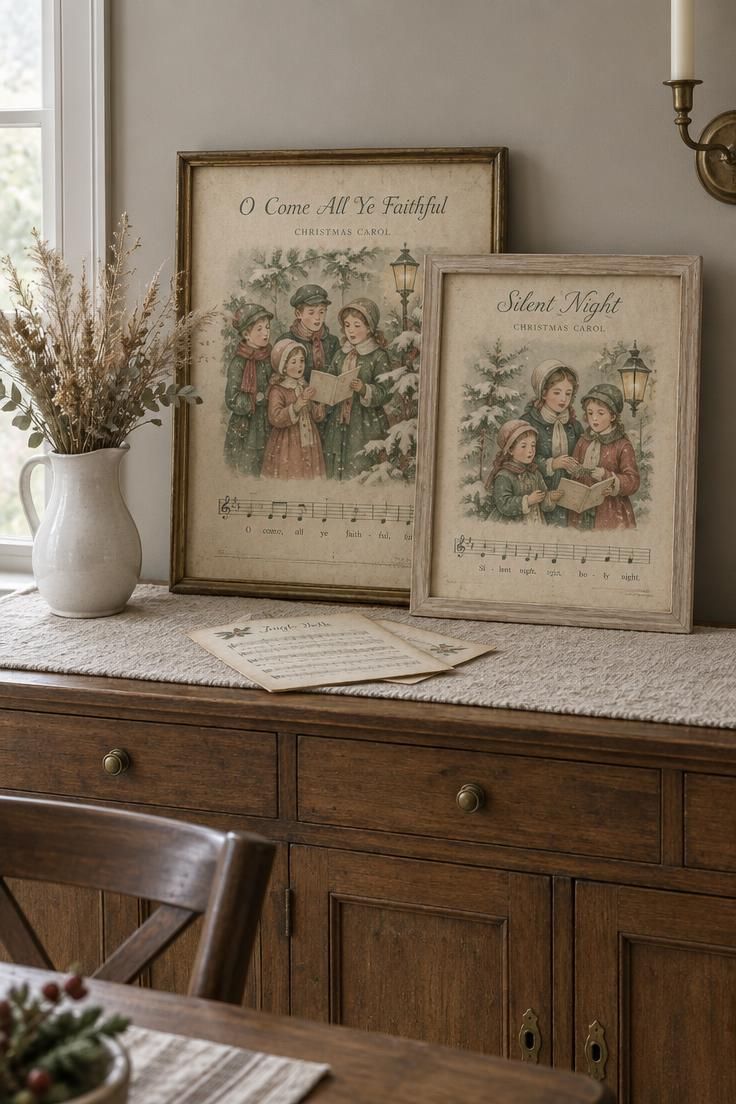
Hanging old Christmas sheet music in simple frames turns a narrow buffet wall into a quiet gallery moment without competing with the table setting below.
Look for caroler covers, title pages, or even interior pages with block lettering and muted ink, then pair no more than two or three frames so the display reads as a collected pair rather than a crowded set.
The trick is letting the materials carry their age.
A pale wood frame next to an aged brass one feels more natural than a matched pair, and propping the frames directly on the buffet surface keeps the arrangement low and easy to change.
A short stack of unframed sheets laid flat beside the frames extends the idea without adding another vertical surface to maintain.
Tuck the stack under a small pitcher of dried grasses so the paper does not slide or curl at the corners.
For a dining room that sees regular meals, choose frames with glass or acrylic fronts so splashes stay off the paper.
Interior pages from worn songbooks often cost less than cover art and still offer the same muted ink and age-toned color.
Style Blueprint:
- Two vintage Christmas sheet music pages in muted ivory, sage, and rose
- Mismatched frames in pale wood and aged brass
- Frames propped directly on the buffet rather than hung
- One small stack of unframed sheets laid flat
- A white ceramic pitcher with dried grasses as a soft anchor
Bottle Brush Tree Cluster on a Windowsill
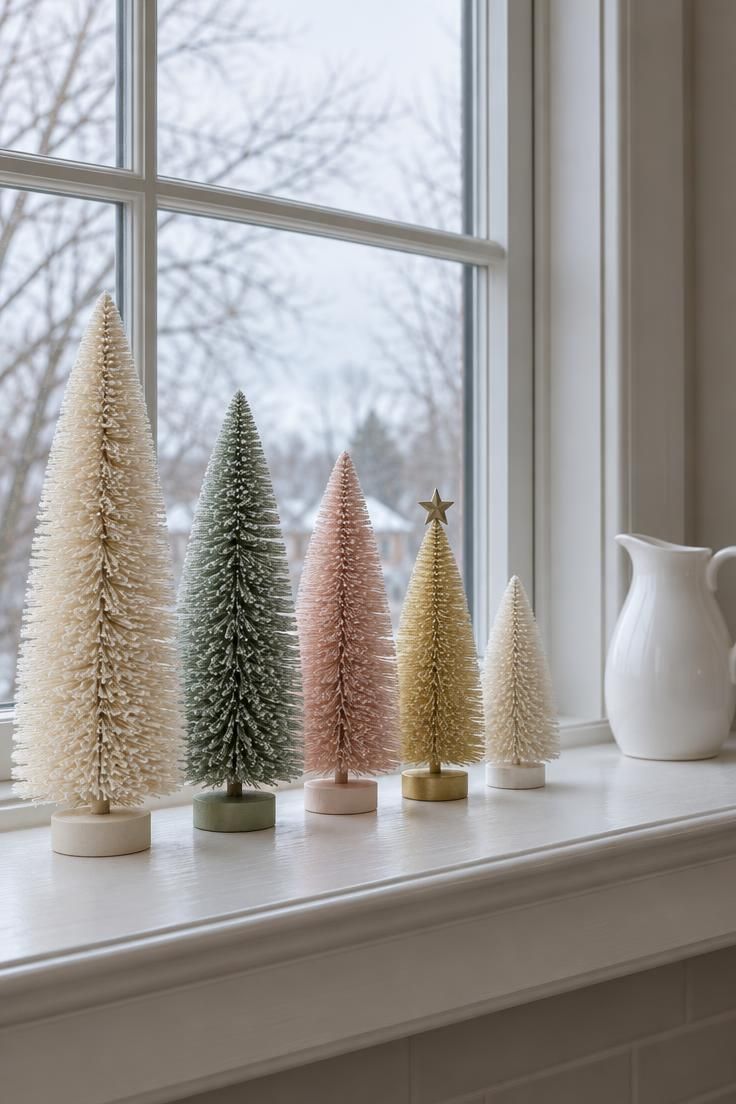
A windowsill lined with bottle brush trees in graduated heights turns a narrow ledge into a miniature winter forest.
Cream, sage, dusty pink, and pale gold bristles give the group a faded, collected character, and one small tin star on the tallest tree creates a quiet focal point.
The appeal comes from silhouette and bristle texture, so the sill works best when nothing else shares it.
Cool daylight through the glass backlights the trees and separates each cone shape from the one behind it.
A kitchen or hallway window with steady daylight suits the arrangement better than a sill in a dim room.
Bristles flatten when squeezed, so these trees store best in a roomy box with space between them rather than packed tight.
Painted wooden bases can chip at the edges, which fades the color slightly and adds to the aged look rather than spoiling it.
Keeping the tallest tree at one end and stepping down in height gives the row direction.
Slight gaps between the trees let each silhouette stay distinct.
Style Blueprint:
- Five bottle brush trees in cream, sage, blush, and pale gold
- Graduated heights with the tallest at one end
- One small tin star topper on a single tree
- A clear, uncluttered painted windowsill
Ceramic Christmas Tree on a Bedside Table
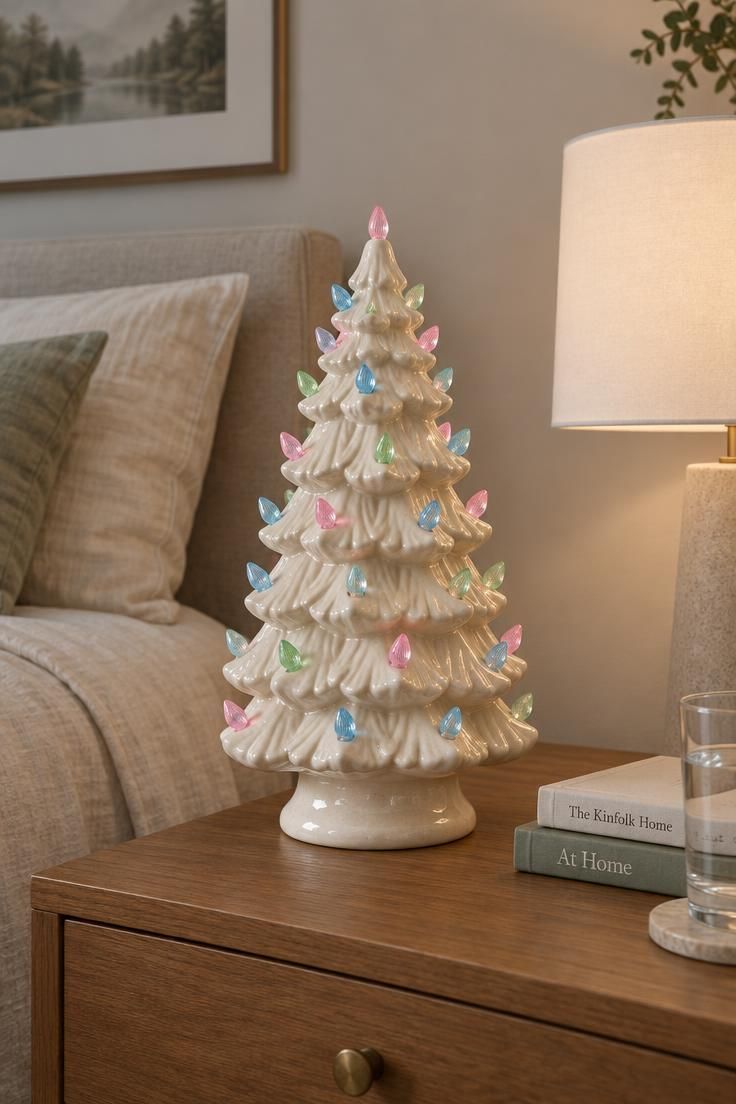
A single vintage christmas tree in molded ceramic brings the holiday into a bedroom without much fuss, and a cream or pale green glaze with pastel tips reads quieter than the classic bright green version.
The molded branches and small colored tips give it a distinctive silhouette that needs no companion objects.
Clear space around the tree does the most for the look.
A bedside table already holds a lamp, a book, or a glass of water, so the tree works best when those items stay sparse and the ceramic piece becomes the room's only seasonal accent.
The small scale keeps the arrangement calm.
Ceramic trees come in a wide range of sizes, so judging the tabletop area before choosing one prevents a piece that overwhelms the surface.
A tree with a modest footprint leaves room for the lamp and keeps the table usable.
Reproductions are common and often match the vintage silhouette closely, which makes building a consistent look easier.
A small chip or glaze irregularity on an older piece usually goes unnoticed at this scale.
Style Blueprint:
- Cream or pale green ceramic tree with pastel bulb tips
- A small wooden bedside table with clear surface space
- One simple white or linen lampshade nearby
- Neutral bedding as a quiet backdrop
Tinsel and Mercury Glass Tabletop Tree
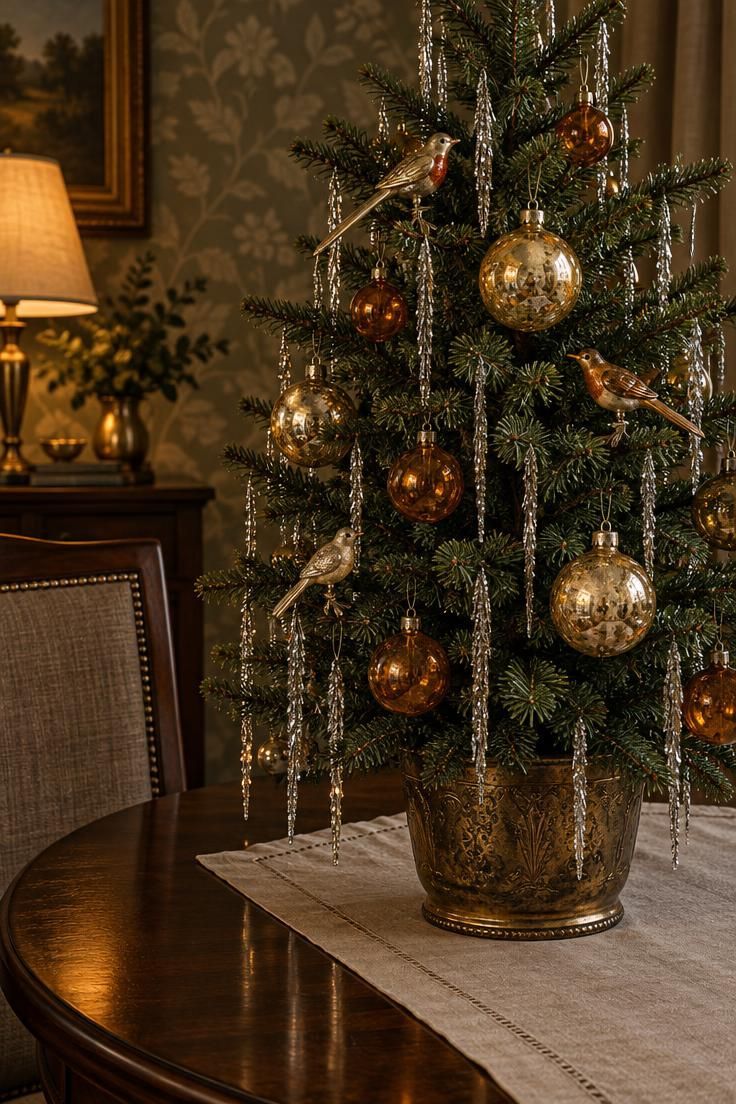
Fine icicle tinsel and mercury glass balls give a small tabletop tree a slightly messy, convincingly old character.
Silver and gold strands catch lamp light from one side, and the mottled ornament finishes send small reflections across the branches instead of one even shine.
The imperfection is the point, so tinsel left in loose, uneven strands reads better than tinsel smoothed into tidy lines.
A low table in a hallway or dining room gives the tree a place where its metallic sheen can add holiday light without introducing bright color.
Amber and gold ornaments warm the palette, and a few glass clip-on birds add a small figural note.
Tinsel is difficult to remove and reuse once it has settled into the branches, so this tree may become a dedicated seasonal piece with its own storage box.
That tradeoff buys a look that is hard to copy with other materials.
Lamp light placed to one side creates the soft directional reflections the arrangement depends on.
Overhead light alone flattens the metallic surfaces and loses much of the effect.
Style Blueprint:
- Small artificial tabletop tree with open branches
- Fine silver or gold icicle tinsel, left slightly uneven
- Mercury glass balls in gold and amber
- Two or three small glass clip-on birds
- A low table and a nearby lamp as the light source
Blow Mold Figures Grouped by the Hearth
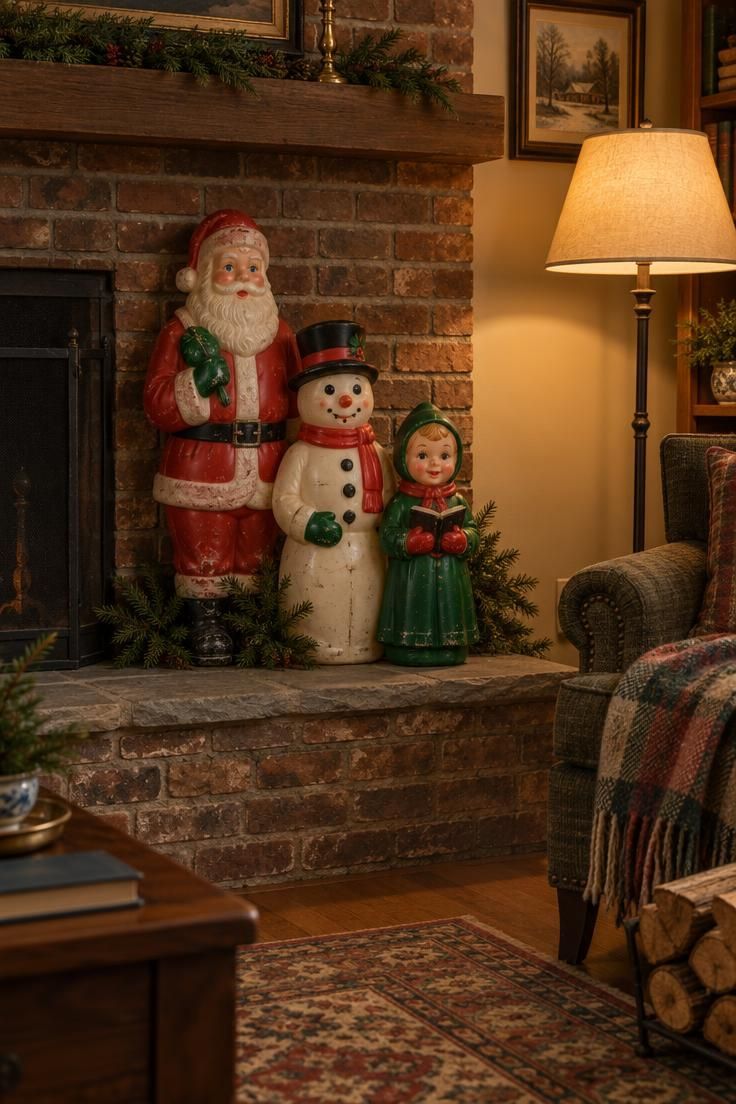
Flat-backed blow mold figures bring an unmistakable mid-century note to a room, and a small group arranged at staggered heights reads as one collected unit.
For a ceramic Christmas tree, faded red, cream, and green plastic keeps the palette soft, and the molded shapes of a Santa, a snowman, or a candle carry the holiday reference without needing a tree nearby.
Tight grouping is the key decision.
Figures set close together with their flat backs toward the fireplace surround form a single vignette, while figures spread across a wide hearth lose the relationship between them.
Small evergreen sprigs tucked at the base soften the transition to the stone.
Newly painted or very shiny versions look out of place beside faded pieces, so matching the level of wear across the group matters.
The figures are lightweight and easy to shift, which helps when rearranging them for a different room.
A non-working fireplace or a low hearth gives the group a natural stage away from foot traffic.
The arrangement also suits a room that has no space for a full tree.
Compared with a ceramic tree or a tabletop village, a hearth grouping holds its shape better in a busy living room because the figures sit at eye level and the brick backdrop keeps stray holiday clutter from reading as unrelated pieces.
Style Blueprint:
- Two or three flat-backed blow mold figures in faded red, cream, and green
- Staggered heights within a tight grouping
- A brick or stone fireplace surround as the backdrop
- Small evergreen sprigs at the base
- A floor lamp for warm side light
Retro Christmas Card Display on a Ribbon
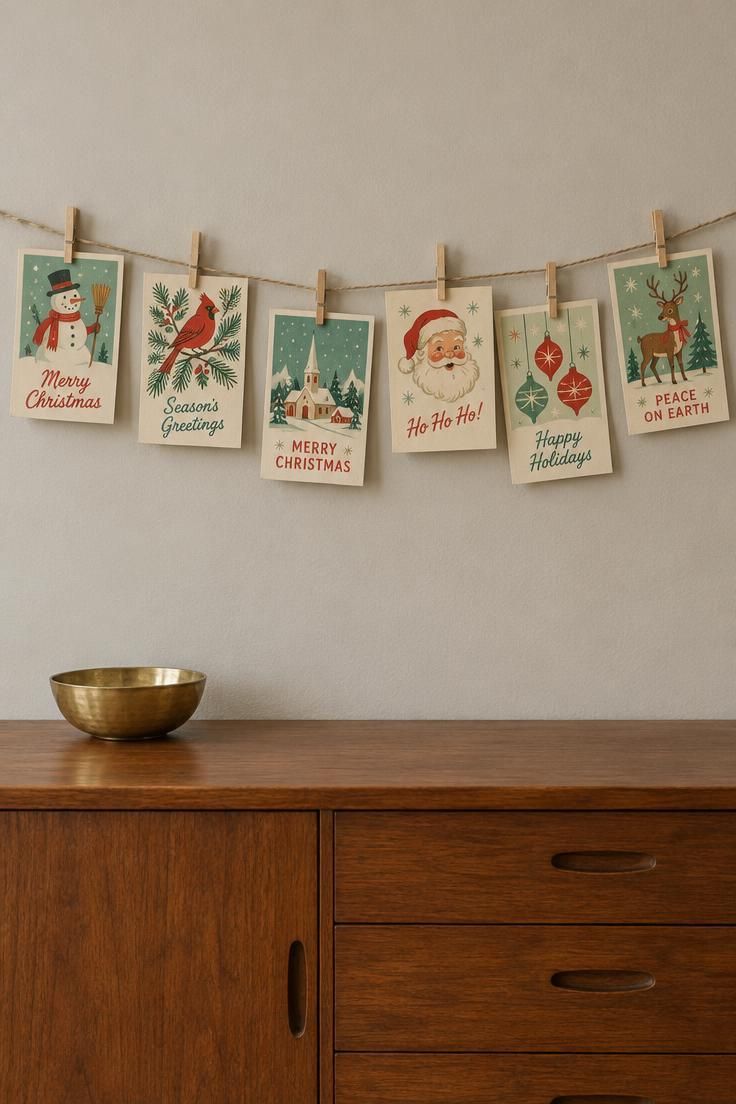
A length of twine or narrow ribbon clipped with vintage-style cards turns a plain wall into a soft seasonal accent, and the repetition of small rectangles creates a graphic pattern that carries the eye across the space.
For a retro Christmas card display, mid-century illustrations in faded red, mint, and cream keep the display within a muted palette.
Small wooden clothespins set the cards at slightly varied heights for a casual look, and the whole arrangement can be moved or changed without leaving marks.
A narrow wall above a sideboard or in a hallway gives the display a natural home.
Paper cards curl and fade in strong daylight, so a position away from a bright window keeps the illustrations crisp through the season.
Leaving open wall space around the twine keeps the display from competing with nearby furniture.
Choosing cards that share two or three faded tones unifies the group even when the illustrations differ.
A single ribbon reads more collected than several overlapping strands.
Style Blueprint:
- Jute twine or narrow cotton ribbon in a natural tone
- Six vintage-style cards with mid-century illustrations
- Small wooden clothespins at varied heights
- A plain wall and a clear sideboard below
Paper Honeycomb Decorations Hanging in a Corner
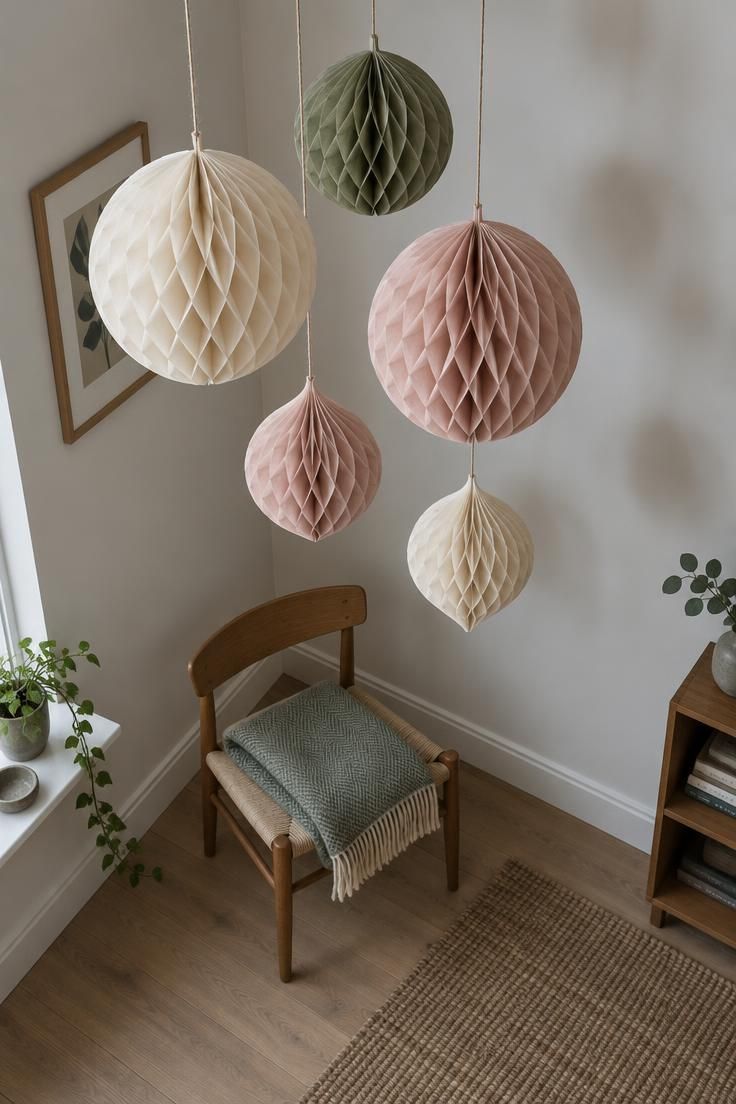
Honeycomb balls, bells, and fans in faded cream, dusty pink, and sage bring soft volume to a corner without any weight on a table or shelf.
The matte tissue-paper texture and slightly crinkled edges give the vintage feel, and the shapes appear to float at different heights.
Three to five pieces at varying heights make a cluster that reads as one arrangement.
Mixing sizes keeps the group from looking uniform, and a corner above a small chair or bench gives it a natural destination.
Paper decorations crush easily, so they store best flat in a box with nothing heavy on top, and they should hang where a passerby will not brush them.
The same fragility makes them a budget-friendly way to fill vertical space.
Shadows cast onto the wall behind the shapes add depth to the display.
A corner with some daylight or a nearby lamp produces the softest effect.
Style Blueprint:
- Five paper honeycomb shapes in cream, blush, and sage
- Mixed sizes at staggered hanging heights
- A room corner with a small chair or bench below
- A box for flat storage between seasons
Vintage Cookie-Cutter Garland Across a Kitchen Shelf
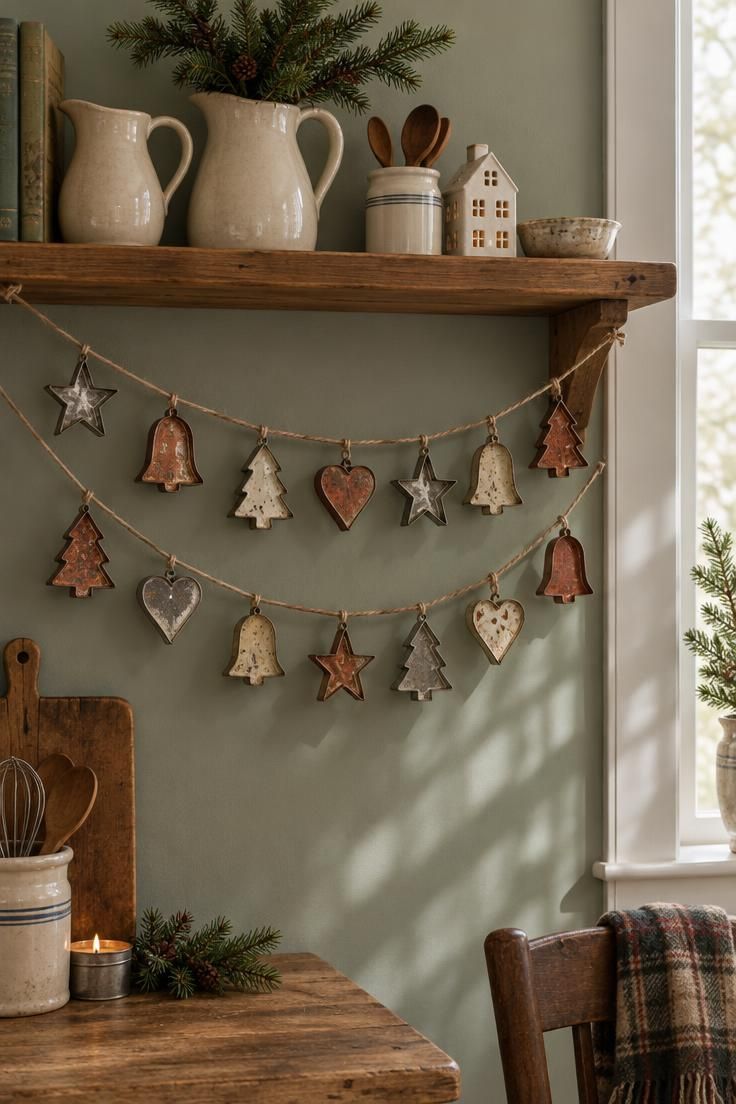
A string of old tin cookie cutters does not need to stay in a drawer until baking day.
Shapes like bells, stars, hearts, and trees carry the worn finish that faded paint and light tarnish bring, and they look right at home stretched beneath a kitchen shelf.
The metal pieces catch soft daylight without turning shiny, so the garland reads as a quiet collection rather than a bright display.
Pairing them with a plain jute cord keeps the arrangement folk-like and avoids a busy store-bought feel.
This idea works especially well where wall space is limited because it uses the front edge of a shelf as the display line.
The garland can dip low enough to be noticed from across the room without interrupting everyday use of the shelf.
Mixing cutter sizes and slightly varied shapes prevents the row from looking repetitive.
Leaving a few cutters unpainted while others show cream or copper flakes adds the uneven character that makes vintage pieces appealing.
Style Blueprint:
- Old tin cookie cutters in bells, stars, hearts, and trees
- Natural jute or twine cord strung through the cutter openings
- Dull silver, copper, and chipped cream finishes
- Two relaxed swags beneath an open wood or painted shelf
- Plain pitchers, crocks, or a small evergreen sprig on the shelf above
Tin and Painted Metal Accents Under the Tree
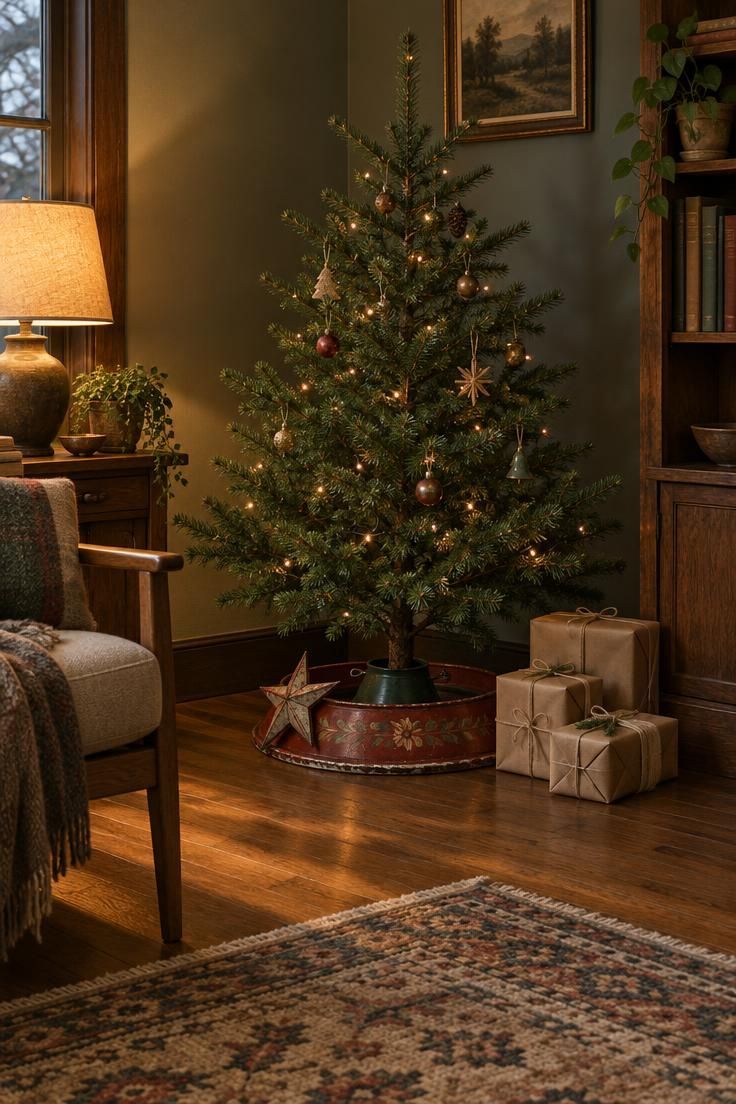
A few tin pieces with worn paint give a modest tree a grounded base.
A large round tray in faded red under the stand catches needles and adds a muted metallic circle, while a small tin star leaned against the tray edge introduces a second shape without clutter.
The slightly worn paint finish is the vintage cue, and one or two pieces are enough.
Stacking several tin objects tends to look busy and hides the simple shapes that make the material appealing.
Painted tin chips at the edges, so handling the pieces gently when moving them preserves the finish.
A kraft-wrapped gift or two beside the tray extends the palette with a natural paper tone, and a softly lit corner lets the faded red read as warm rather than bright.
Low, quiet surroundings allow the tray and star to register without competing with the tree itself.
Style Blueprint:
- Round painted tin tray in faded red or cream
- One small tin star or painted sign
- Kraft paper gifts with cotton twine
- A modest evergreen in a simple stand
Retro String Lights on a Mantel
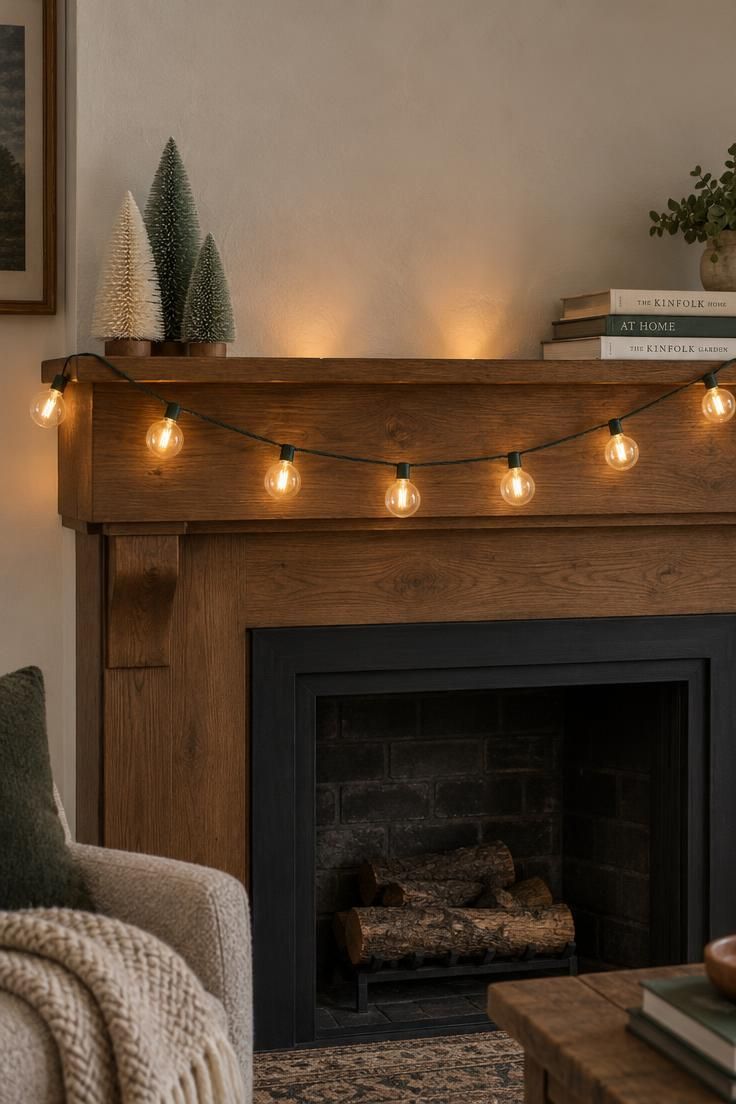
A single strand of round-bulb lights in warm white draped across a mantel gives an old-fashioned glow, and bulbs that look slightly larger and warmer than standard mini lights carry the retro reference.
Letting the cord show in a gentle swag keeps the arrangement casual rather than tightly pinned.
Warm light reflecting on the wall above the shelf extends the effect into the room, and a small cluster of bottle brush trees at one end balances the long horizontal line of the strand.
The look depends on color temperature more than bulb count.
A room that is otherwise softly lit suits this treatment.
Bright overhead lighting flattens the glow and makes the warm bulbs read as ordinary.
This is a styling idea only, focused on where the strand sits and how it drapes.
The visual goal is a relaxed line of warm light with visible cord and a few small objects for company.
Style Blueprint:
- One strand of round-bulb lights in warm white
- A relaxed swag with the cord left visible
- A cluster of three bottle brush trees at one end
- Soft ambient room light to support the glow
Tinsel Wreath Framed Around a Hall Mirror
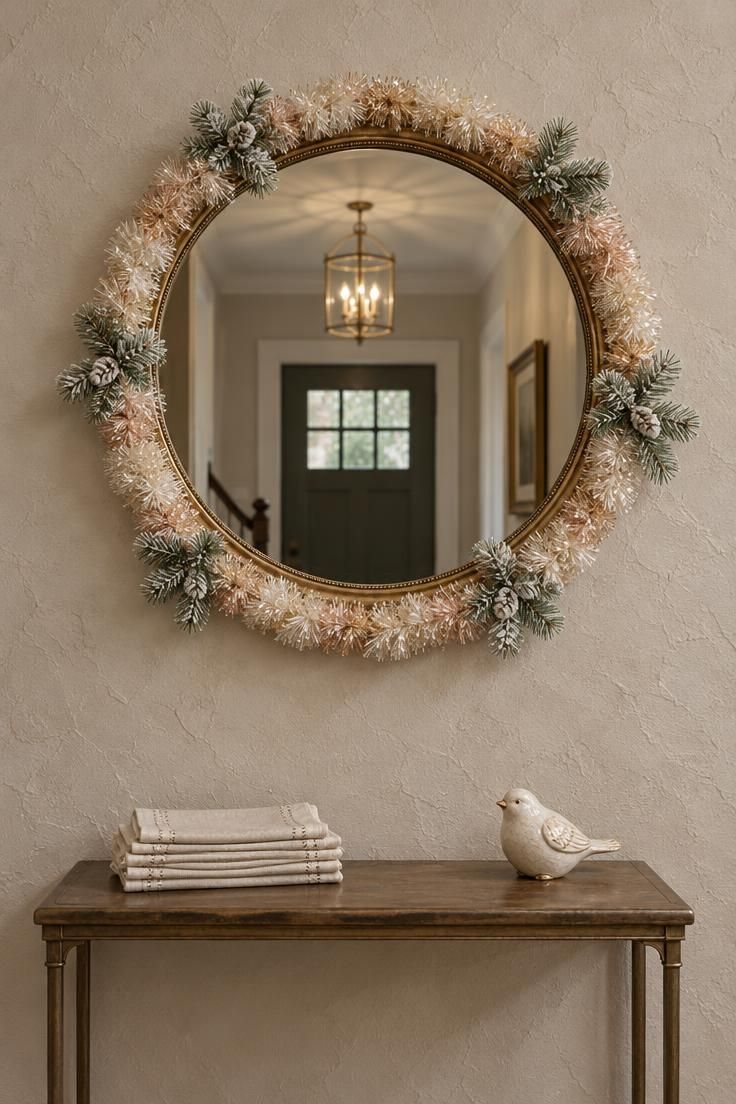
A round hall mirror framed with tinsel brings the holiday palette to a spot that often gets overlooked.
Ivory, champagne, and pale peach tinsel wraps the existing mirror frame, leaving the center glass open so the entry still feels bright and practical.
Tucking small flocked pine sprigs into the tinsel keeps the wreath from reading as a single shiny band.
Uneven placement works better than even spacing, since vintage holiday decor rarely looked perfectly measured.
Tinsel sheds small metallic strands, so this idea is best for a surface that can be wiped easily after the season.
A lower-traffic hall mirror does better than one where coats and bags brush against the display.
Layering the mirror over a console table with a few quiet objects, such as cream linen napkins or a ceramic bird, gives the entry a composed feel without adding much color.
Style Blueprint:
- Round or oval mirror with an existing thin frame
- Tinsel in ivory, champagne, and pale peach
- Flocked pine sprigs tucked at uneven intervals
- A narrow console table below with one or two pale objects
- A spot that is easy to wipe when tinsel sheds
Mixed-Era Mantel Shelf in a Muted Palette
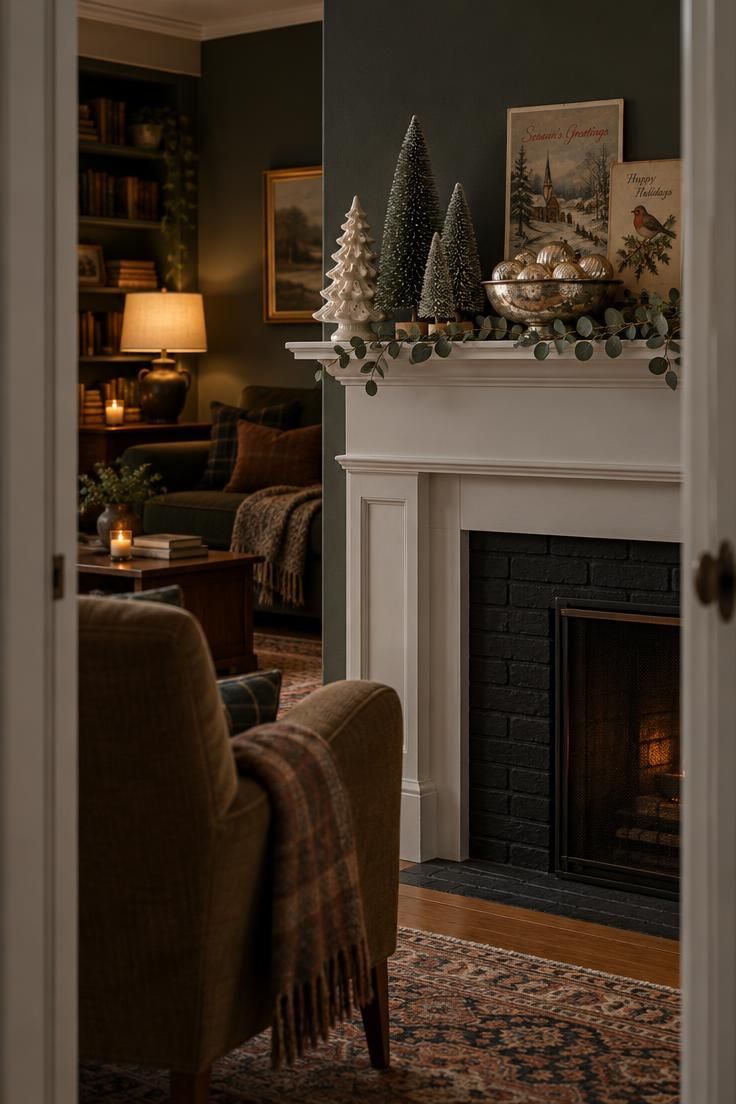
A single mantel shelf can hold a ceramic tree, a bottle brush cluster, a bowl of mercury glass ornaments, and a few retro cards as one cohesive display.
Repeating the same faded tones across each object unifies the grouping, and the mix of ceramic, bristle, glass, and paper supplies the visual variety.
Asymmetry keeps the shelf from feeling staged.
A low garland of dried eucalyptus or cotton stems along the front adds a base layer, and uneven spacing lets each object hold its own space.
Editing is the main decision.
Empty space on the shelf keeps the objects from competing, and a crowded mantel loses the distinct character of each piece.
This approach suits a reader with a small collection spread across several rooms, since it gathers everything into one considered display.
Reproductions and true vintage pieces can sit together when the palette stays consistent.
Style Blueprint:
- A ceramic tree as the tallest element
- Three bottle brush trees in matching faded tones
- A shallow bowl of mercury glass ornaments
- Two retro cards propped behind the arrangement
- A low garland of dried eucalyptus across the front
Vintage-Style Advent Calendar on a Hall Wall
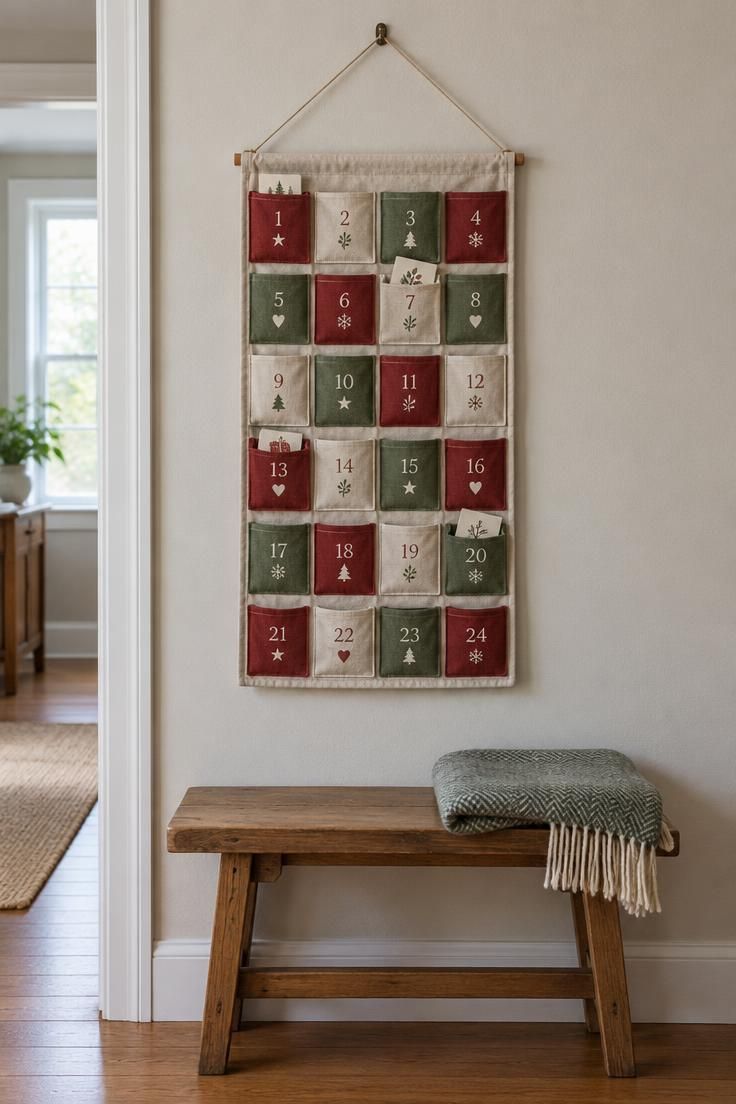
A cloth Advent calendar with small pockets in faded red, cream, and sage hangs on a hall wall as a daily visual check-in.
A simple rectangular shape with minimal embroidery or printed numbers keeps it within the muted palette, and small paper cards or tiny ornaments tucked into the pockets add small points of interest.
Leaving the surrounding wall clear lets the small details stay visible.
A hallway or kitchen wall suits the calendar when tabletop space is limited, and the fabric folds flat for storage after the season.
Lightweight and non-breakable, the calendar is an easy choice for a busy hallway where objects on a table might be knocked aside.
The quiet daily ritual of checking a pocket comes without taking up floor space.
Simple printed numbers and a restrained color story keep the calendar looking collected rather than craft-fair.
A wooden bench below gives the wall a practical companion without crowding the design.
Style Blueprint:
- Rectangular cloth Advent calendar with 24 small pockets
- Muted red, cream, and sage fabrics with minimal detail
- Small paper cards or tiny ornaments for the pockets
- A clear hallway or kitchen wall with a bench below
Conclusion
A muted vintage Christmas comes together through texture and repetition more than volume: flocked branches, bristle cones, mottled glass, and worn painted tin, all held within a narrow range of faded tones.
The ideas above move from single objects on a bedside table to full mantel shelves and wall displays, so the look can scale to whatever space a home allows.
Start with two or three pieces that share a color, then let the surfaces and silhouettes carry the rest.
Mixing true vintage with reproductions keeps the collection practical while the overall effect stays gently seasonal.