This post may contain affiliate links. If you make a purchase through these links, we may earn a commission at no additional cost to you.
A rustic Christmas tree draws its warmth from materials that show their texture and their origins.
Branches, wood slices, dried fruit, and coarse fabric give a tree a relaxed character that sits comfortably in cabins, cottages, and city apartments alike.
The look depends on a few simple elements combined with care, with irregular edges and uneven spacing left visible on purpose.
What follows is a set of ways to dress a tree with that hand-gathered, lived-in quality while keeping the room easy to live in, from a wide burlap ribbon to a flannel skirt.
Each direction rests on one material story, so the finished tree feels intentional rather than busy.
Twig, Pinecone, and Dried-Orange Garland Tree
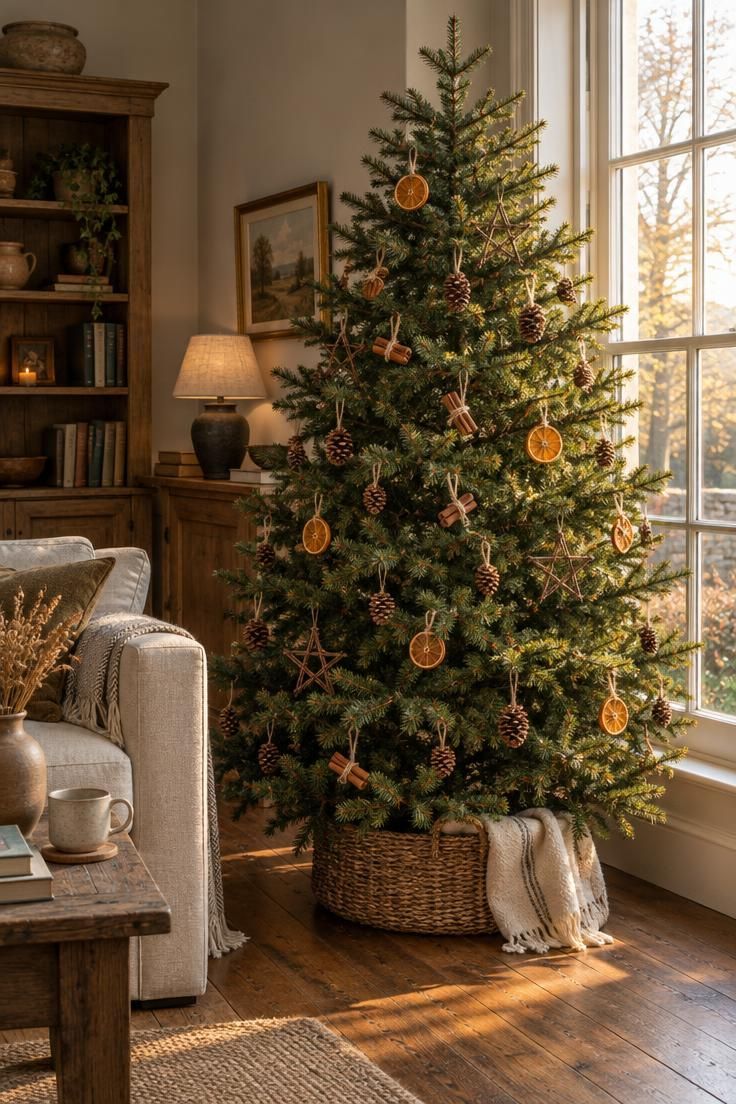
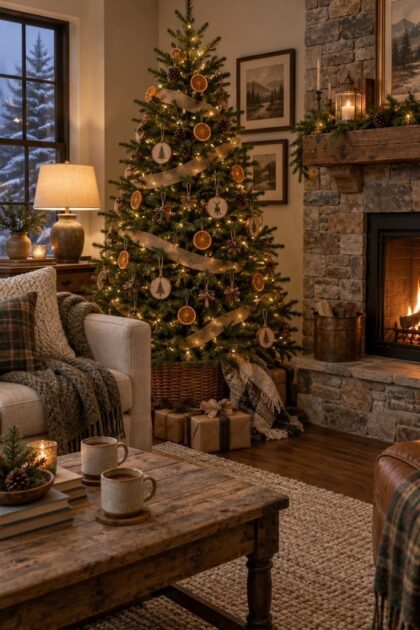
The collected forage look works best on a tree with visible branch openings, because each pinecone, twig star, and dried orange slice needs room to read as a separate object.
A full, dense tree pushes the same pieces to the surface, which turns a gathered arrangement into a solid wall of decoration.
Placement should stay loose and slightly uneven, with pieces clustered here and left sparse there, so the tree echoes the way materials come together on a woodland floor.
Capping the palette at three tones, such as brown, cream, and the amber of dried orange, keeps the mixed textures from competing with one another.
Dried orange slices and pinecones do shed as the season wears on, so a basket base or a generous skirt beneath the tree gives the fallen bits somewhere to land between cleanups.
In a small room, this fuller collected style can start to feel busy near seating or a walkway, and thinning the clusters on the side that faces the room usually settles it.
Style Blueprint:
- Green fir with visible open branches
- Twine-tied pinecones mixed with dried citrus and twig stars
- Three-tone palette of brown, cream, and amber
- Woven basket base with a wool throw at the edge
Wide Burlap Ribbon Woven Through Open Branches
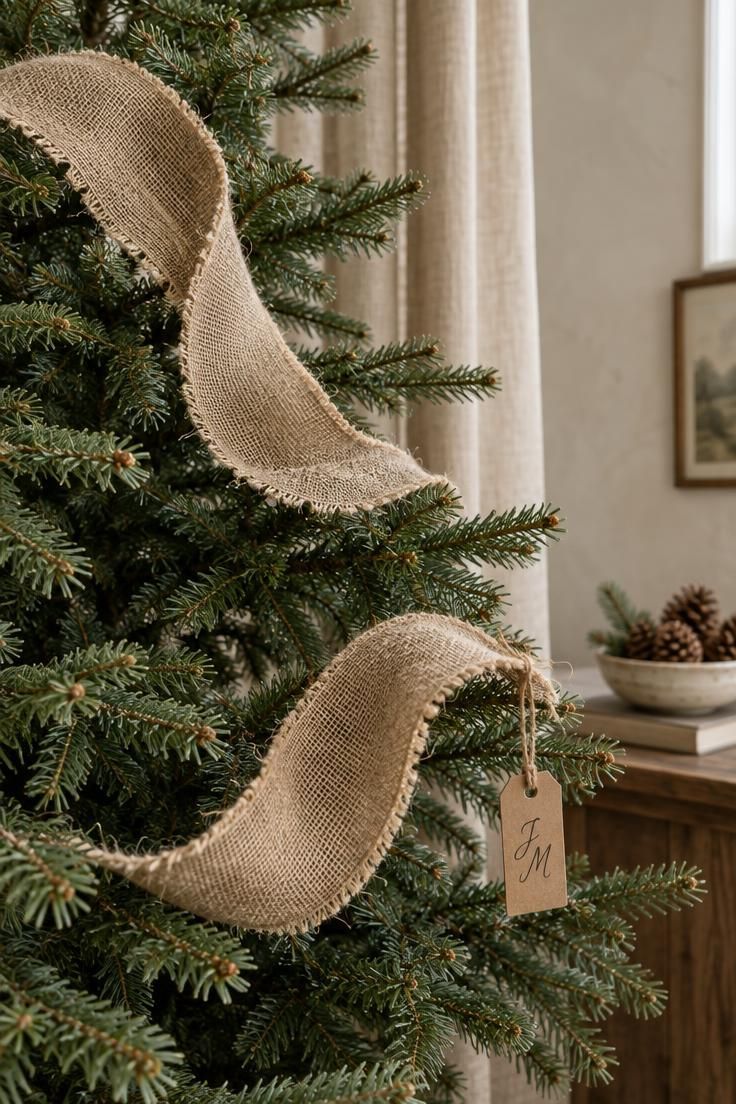
Burlap earns its place as the primary dressing here because its raw fringe and uneven weave soften the tree's outline in a way that smooth fabric cannot.
Looped loosely through the branches rather than wrapped in tight rings, the ribbon becomes a wandering line, and the tree keeps its natural shape.
A satin ribbon, by contrast, reflects light and creates crisp bands, so the two choices pull the same tree in opposite directions.
The hand technique is simple: form a loose S-curve against a branch, tuck the end back toward the trunk, and move on without measuring.
Leaving every third branch bare keeps the tree from becoming one solid band of fabric.
Burlap does fray with handling and can look tired after a season or two, which makes this a look to refresh rather than store for years, and a rustic christmas tree built around a fabric that ages visibly suits that expectation.
Style Blueprint:
- Wide natural burlap ribbon with visible fringe
- Loose S-curves tucked toward the trunk
- Kraft paper tags on twine
- Every third branch left bare
- Matte finishes only, with no satin or gloss
Design Pro-Tip: Cut burlap ribbon ends on a slight diagonal and let them fray naturally, then roll the ribbon instead of folding it so it hangs without creases next season.
Wood Slice Ornaments with Burned or Painted Lettering
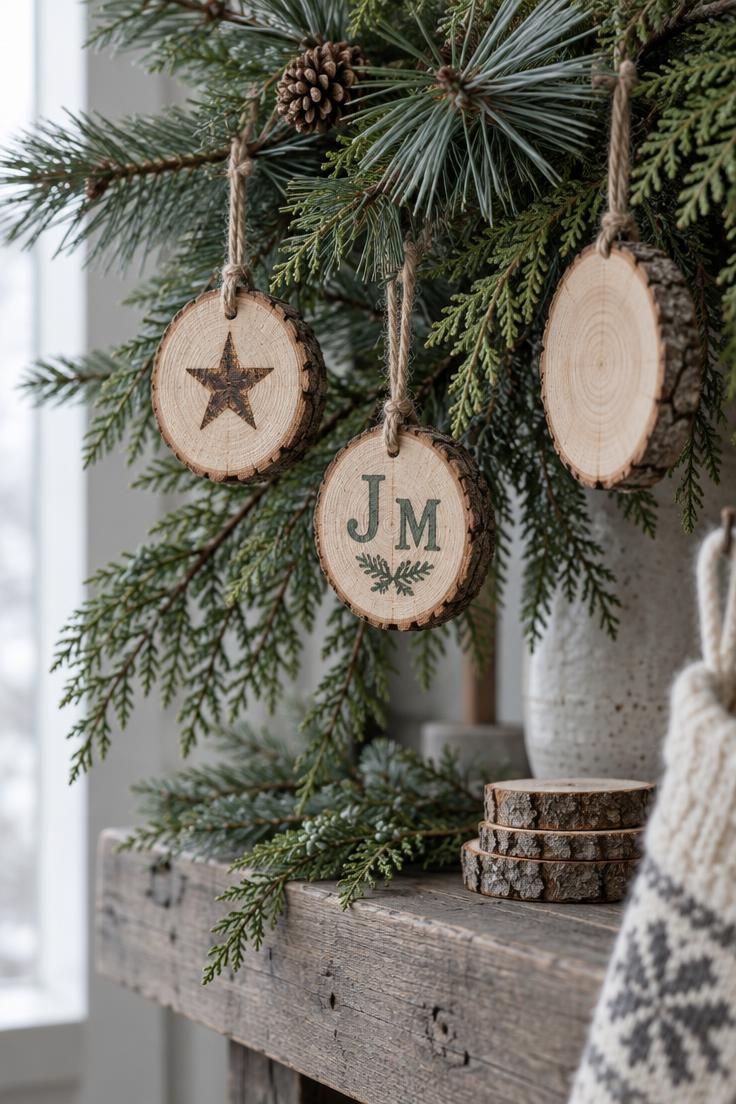
A deliberately sparse tree, where branch slices and small reclaimed shapes carry the ornament load, lets the matte surface of wood stand apart from shiny baubles.
A pale tree or one with open structure gives each slice room to be seen, and the grain of every piece stays distinct.
Plain slices can be combined with a few lettered pieces, using burned or painted initials, short words, or year marks as handmade accents.
Wood slice ornaments do hang differently from glass, since the pieces sit heavier on thin branches, and placing larger slices closer to the trunk keeps the outer tips from drooping outward.
Simple warm-white lights placed behind the ornaments rather than in front give the wood a soft halo and keep the grain readable.
Style Blueprint:
- Wood slices with bark edges on jute loops
- A mix of plain slices and a few lettered pieces
- Sparse open tree with visible branch structure
- Warm-white lights tucked behind the ornaments
Cranberry and Cinnamon Picks Tucked Near the Trunk
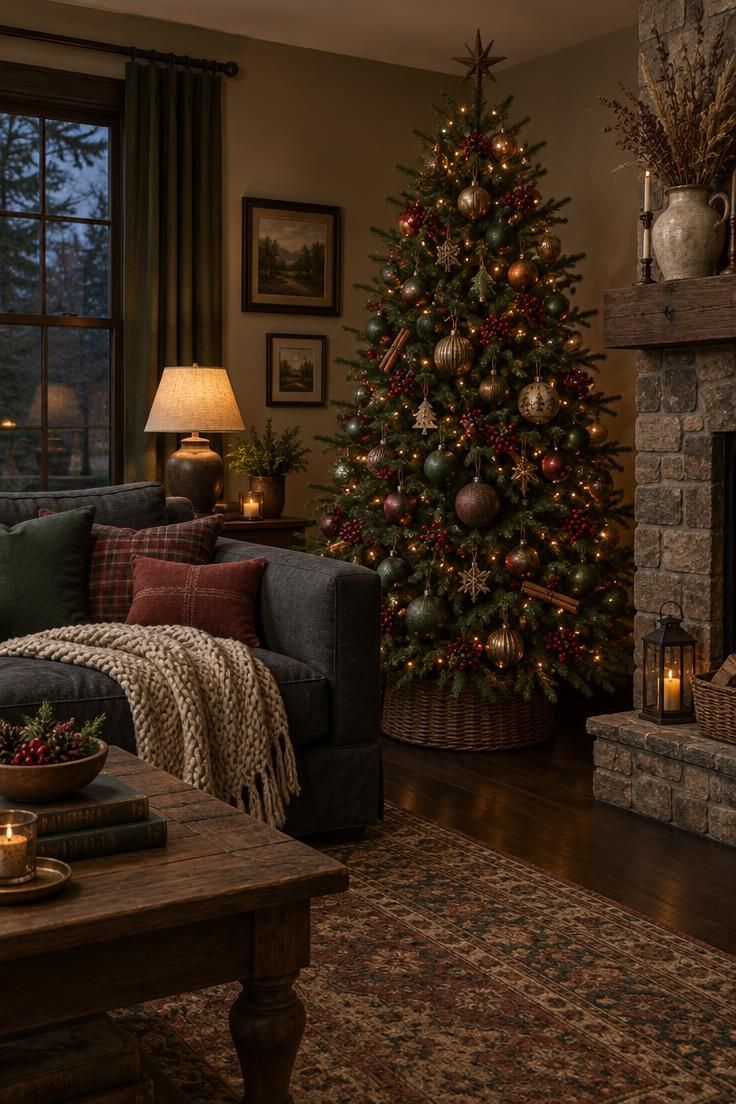
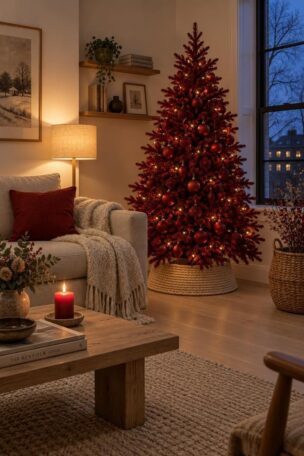
Pushing berry and cinnamon stick picks into the tree's interior rather than setting them at branch tips adds an inner layer that makes the tree look fuller without hiding the natural greenery.
This reads very differently from a branch-tip all-red tree, where every decoration sits at the outer edge and the arrangement seems to float on the surface.
Limiting the picks to the lower two-thirds keeps the top lighter and lets the eye travel upward without clutter.
Cinnamon sticks are not long-term objects and can shed, so this approach works as a one-season accent or as a warm spice note for a tree near a kitchen, and spacing the picks roughly a hand's width apart with greenery crossing in front gives a collected rather than placed effect.
Style Blueprint:
- Red berry and cinnamon picks set near the trunk
- Larger ornaments reserved for outer branches
- Warm mini lights placed behind the picks
- Picks limited to the lower two-thirds
Flannel Tree Skirt as the Soft Grounding Layer
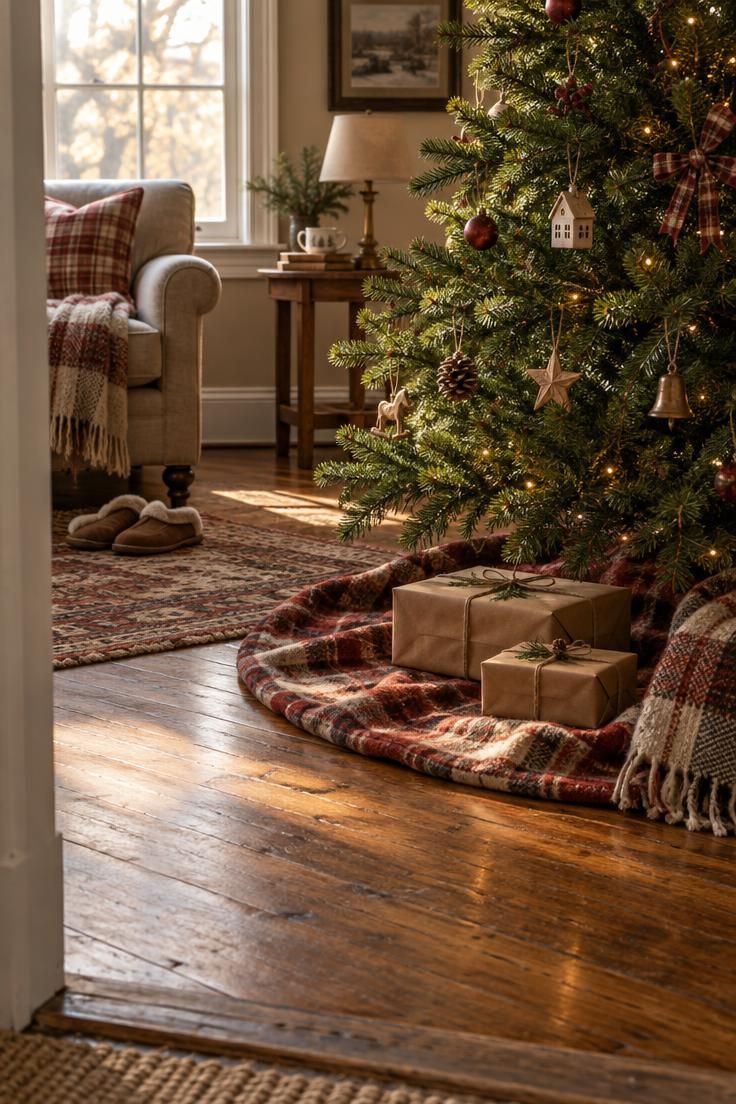
An oversized, slightly wrinkled circle of flannel or brushed cotton changes the bottom of the tree into a soft, casual element that sits low and easy against the floor.
A flannel tree skirt carries the material story downward, connecting the branches to the rug and the gifts in a way a stiff or glossy fabric cannot.
Comparing it with a wooden crate or woven basket base helps define the choice: the flannel gives a fully soft look, while the structured base reads more farmhouse and hides the reservoir of a real tree.
Care matters with brushed fabric, since flannel collects needles and lint, so shaking it out regularly keeps it looking fresh, and the skirt suits a tree that is not watered in place.
Folding rather than wrapping the skirt creates a more relaxed drape with visible pleats and soft folds.
Letting a corner of a wool throw or a couple of kraft-wrapped gifts sit on top continues the same material language at the base.
Style Blueprint:
- Oversized flannel skirt folded, not wrapped
- Brushed cotton or wool plaid in muted tones
- Two kraft-paper gifts tied with twine on top
- A wool blanket corner draped across
- A textured rug beneath to catch needles
Basket and Linen Sack Base with Kraft Gift Wrap
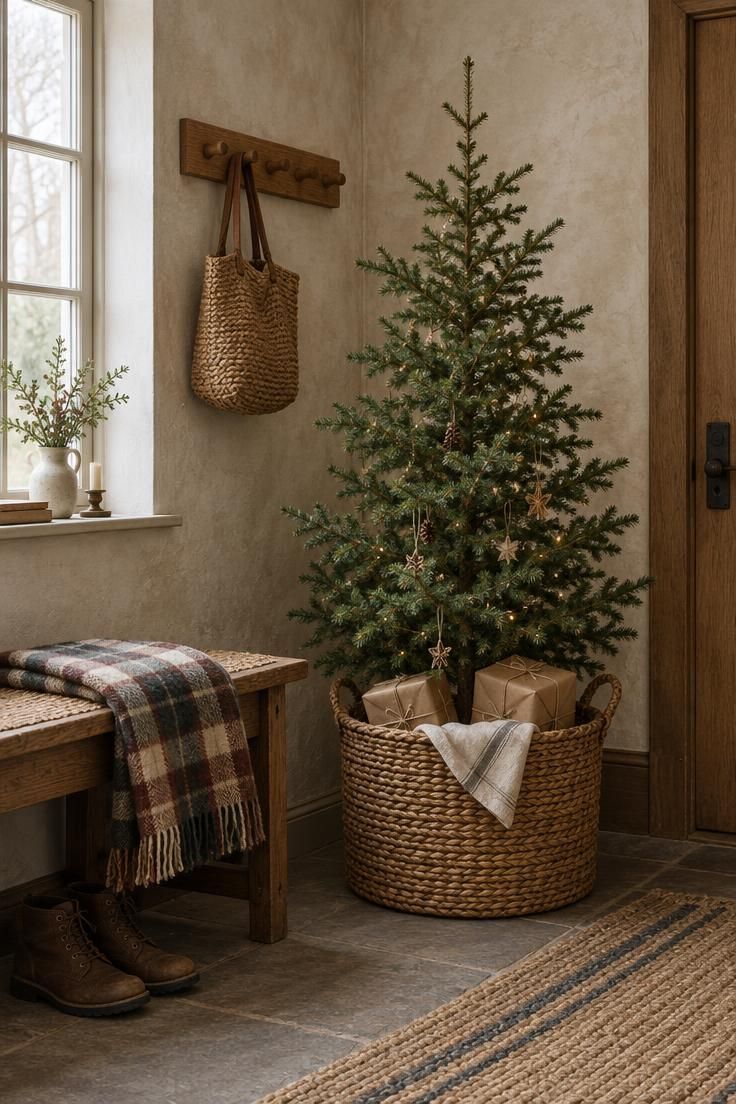
Replacing the tree skirt entirely with a large woven basket, wooden crate, or oversized linen sack anchors a small or slim tree and gives the whole vignette a farmhouse character.
The structure does two jobs at once: it raises the tree a few inches so it sits off the cold floor, and it creates a natural place to tuck wrapped presents, spare blankets, or a folded fabric scrap.
Basket weave color matters more than it seems, since a dark basket pulls the look earthy while a pale one keeps the base light, and the choice should follow the room's floor and walls.
If the tree is real, the basket edge also conceals the water reservoir, which solves a practical problem for a room where the base would otherwise look cluttered.
Floor clearance is worth checking before committing, since a wide basket reads larger than a skirt and can crowd a narrow entry.
Style Blueprint:
- Wide woven basket with a visible rim
- Slim green tree set inside
- Kraft paper packages with twine
- Linen cloth draped over the basket edge
- Plaid blanket on a nearby bench
Dried Orange and Star Anise Garlands for a Kitchen Nook
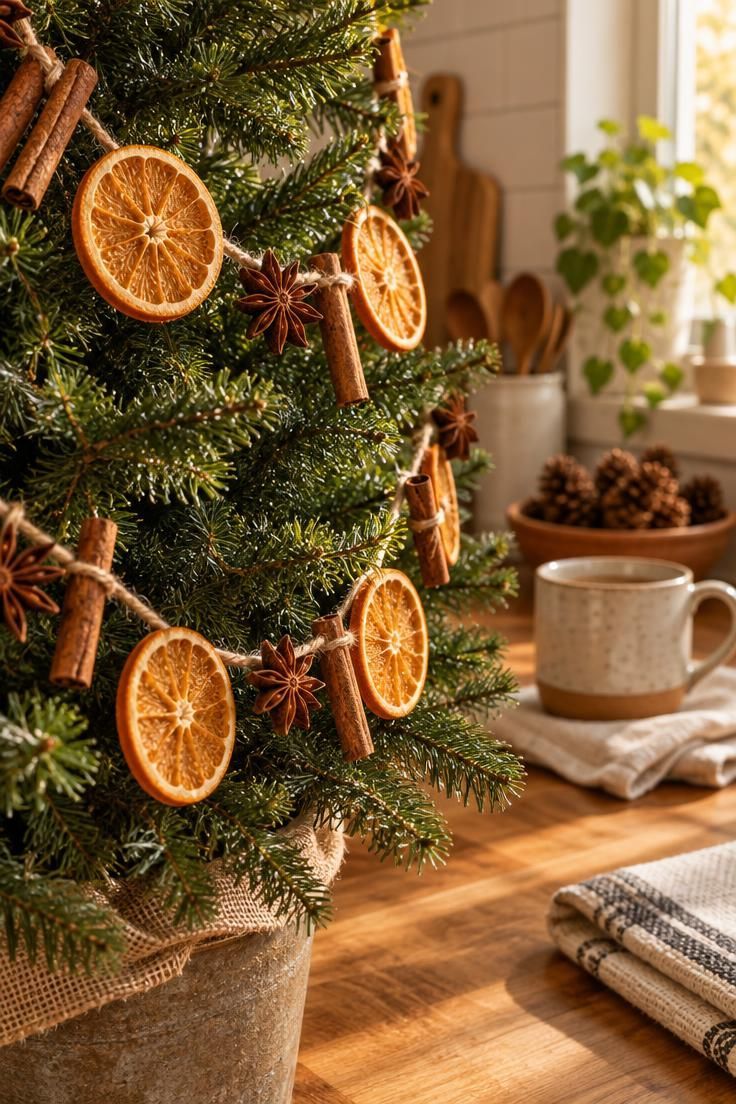
Threading dried orange and apple slices with star anise and cinnamon sticks onto twine or thin jute creates garlands that can be looped in shallow swags rather than wrapped tight, so the tree keeps its shape.
In a small kitchen, dining, or breakfast nook, this idea should stay smaller and simpler than a living room tree because it shares space with everyday tasks like making coffee and setting the table.
A tabletop or slim floor tree keeps counters and walkways clear, and that choice matters more than ornament count in a room where people move through constantly.
Dried slices can soften in steam from cooking, so sealing them before hanging helps them hold their shape through the season.
The spice colors of amber and deep brown warm up a mostly neutral tree, and the garlands can move to a shelf or window after the holiday without looking out of place.
A narrow ledge or the top of a small cabinet often suits the tree better than a crowded counter.
What makes this version of a rustic christmas tree practical is the way it keeps its material list short enough to fit between a kettle and a fruit bowl.
Style Blueprint:
- Dried orange and apple slices on jute twine
- Star anise and cinnamon sticks spaced between the fruit
- Shallow swags rather than tight wraps
- A tabletop or slim floor tree
- A clay bowl of pinecones nearby
Flocked Tabletop Tree with Birch Logs and Linen Ribbon
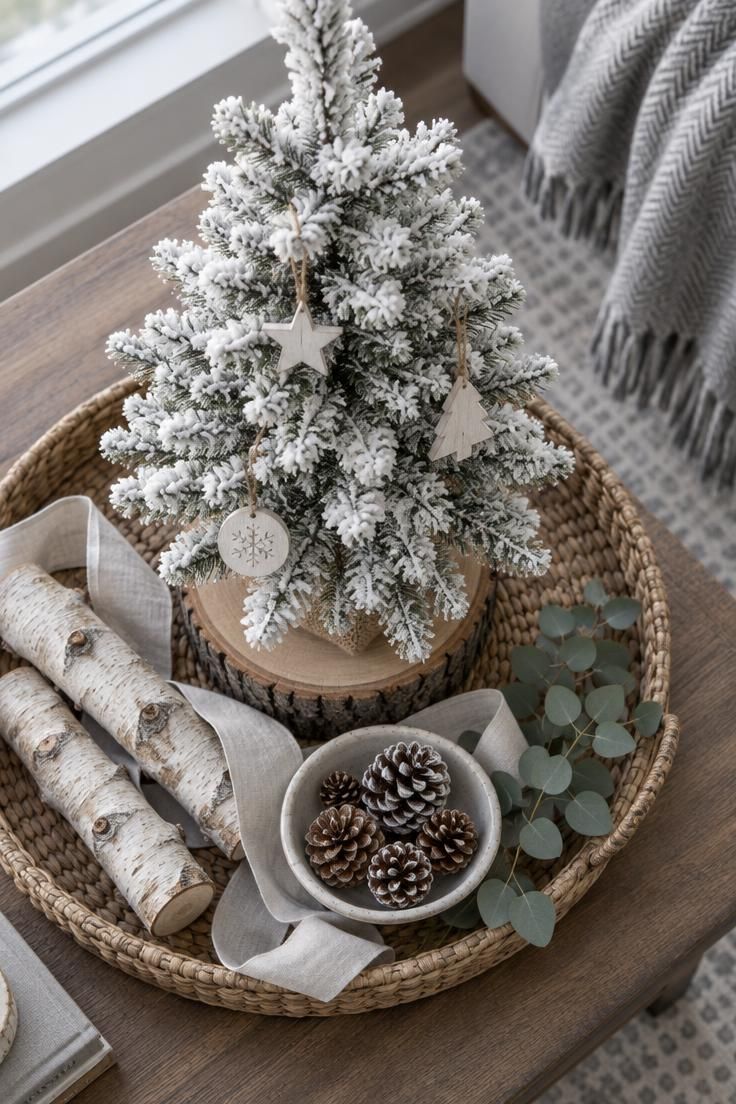
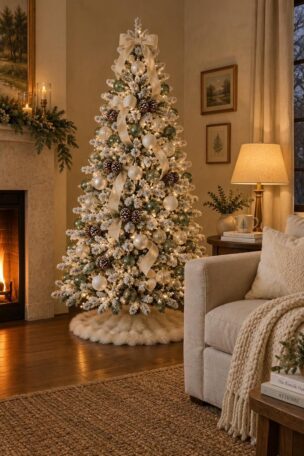
A flocked or white-toned small tree opens a paler, snowier rustic direction, and the tabletop scale lets the idea work in an apartment, a bedroom, or a home office without taking floor space.
The visual weight needs to rest on birch logs, whitewashed wood slices, and undyed linen ribbon, because those materials carry the rustic read even when the tree itself lacks green branches.
A composition where the tree sits on a wood slab or a short stack of books, with a few birch branches leaning behind it, keeps the scene grounded and readable from above.
Keeping the palette to cream, bark brown, and soft gray lets the flocking sit quietly with the birch rather than competing with it.
A low woven tray beneath catches flocking dust and loose ribbon threads, which matters with a pale tree in a room where the surface is visible from above.
If the room is dark, a lighter flocked tree will need a spot near a window to keep the cream tones from going murky, and a length of burlap ribbon at the base adds a warmer rustic counterpoint without crowding the composition.
Style Blueprint:
- Small flocked tree on a round wood slice
- Birch logs leaning behind the base
- Undyed linen ribbon in soft loops
- Whitewashed wood ornaments
- Low woven tray to catch flocking and threads
Design Pro-Tip: Lay out the tabletop arrangement on the tray before setting the tree, so the birch logs, wood slice, and ornaments can be shifted as a single composition instead of one piece at a time.
Coppery Metal Bells and Dark Wire Hooks on Bare Branches
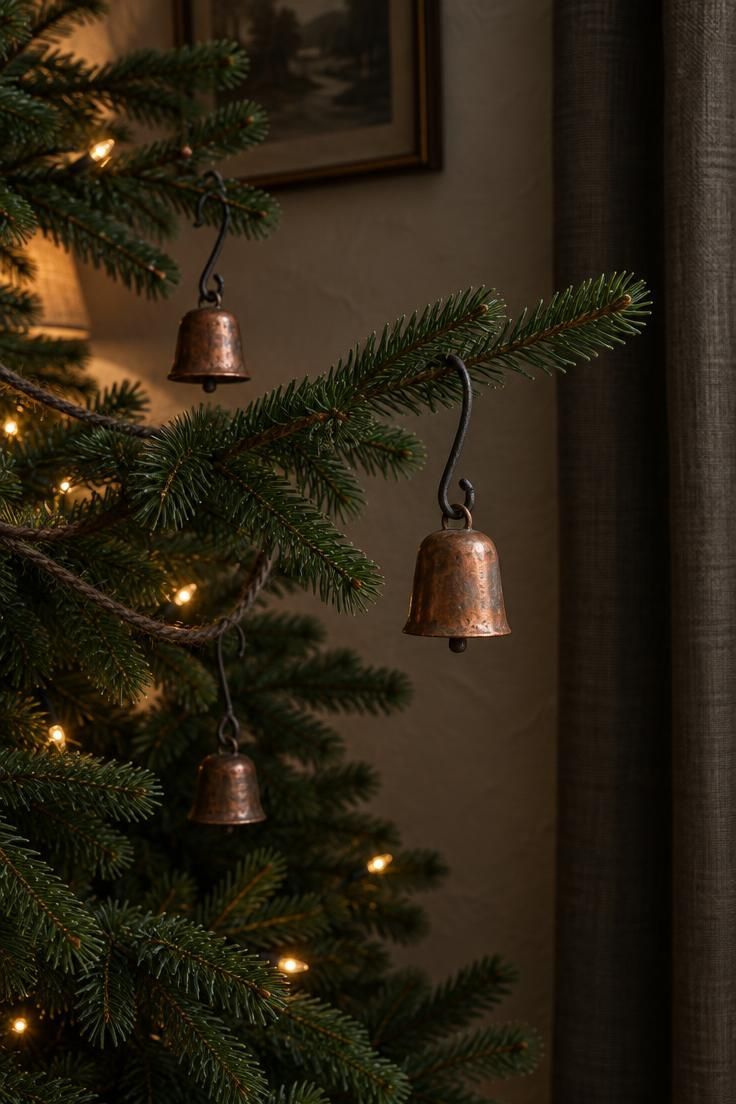
A restrained metal accent suits readers who want rustic texture without adding more fabric or wood, and small aged-copper or dark-iron bells, stars, and wire hooks spaced widely on a tree with open branches keep the effect quiet.
The metal pieces catch the warm lights and create small points of shine, which is a very different result from a fully glossy metallic tree.
Comparing this with a fully natural tree shows the shift: the metal adds weight and a faint gleam without introducing a new color family.
Tarnished or waxed finishes harmonize with bark and undyed textiles better than polished ones, since they share the same low-sheen quality.
Hanging the first bells near the trunk and building outward moves the eye from the dark branches toward brighter metal at the tips, and that direction keeps the arrangement from feeling random.
Style Blueprint:
- Small aged-copper or dark-iron bells
- Dark wire hooks rather than bright metal hangers
- Wide, even spacing on open branches
- Warm mini lights glowing from behind
Eucalyptus and Red Berry Garland Softening a Corner Tree
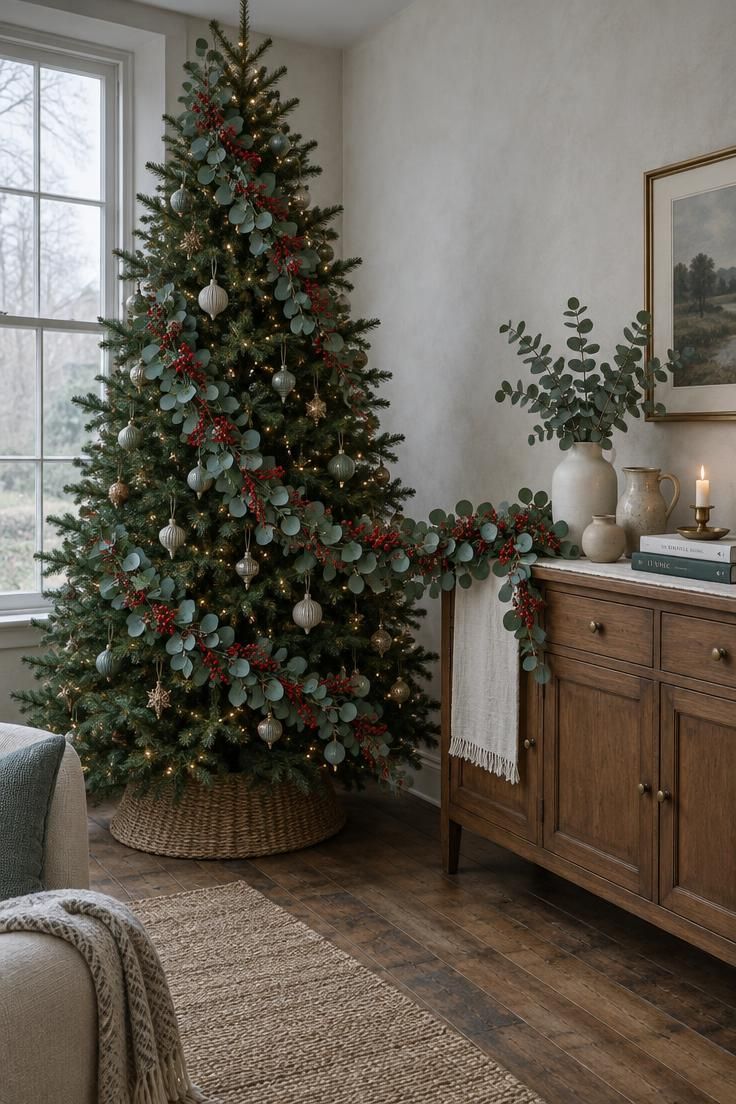
Swagging faux or dried eucalyptus and red berry sprays through the branches softens the tree's silhouette so the edge looks less like a perfect cone and more like a gathered arrangement.
A corner placement makes this especially useful, since one side of the tree is seen most and can carry more garland without the whole tree becoming heavy.
The muted blue-green of eucalyptus sets off the warm red berries and separates visually from the tree's own needles, and that three-way contrast is what keeps the swags readable.
Extending a strand of garland onto a shelf or mantel connects the tree to the room rather than leaving it isolated in its corner.
Dried eucalyptus does drop small leaves, so a rug, a tray, or a low basket under the tree makes cleanup simpler.
Style Blueprint:
- Eucalyptus and red berry sprays in swags
- One side of the corner tree carrying more garland
- A cream linen runner on the adjacent sideboard
- A rug or tray beneath to catch dropped leaves
Miniature Rustic Tree in a Stoneware Crock for a Side Table
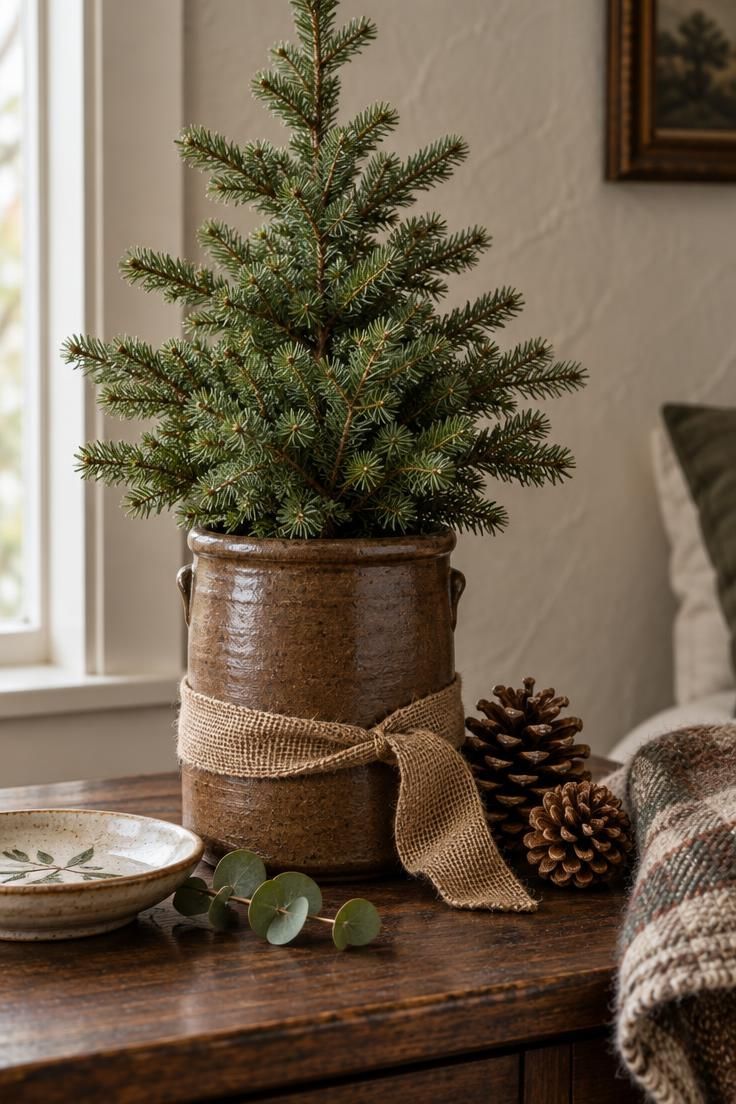
A tabletop or miniature tree in a stoneware crock, wooden bucket, or clay pot brings the rustic material list to a bedside table, entry console, or kitchen shelf without a second full-size tree.
The scale change is the whole point: a tabletop rustic tree works best with only three or four materials and a diagonal sash of ribbon rather than a wrap, so the tree stays legible at a small size.
A low arrangement around the base, with a small pinecone cluster or a sprig of eucalyptus, gives the vignette a finished edge without adding more ornaments.
Picking a vessel with a matte or weathered finish keeps the look in line with the tree's bark and burlap.
A real miniature evergreen will need water and a bright spot near a window, so a darker room may suit a good faux stem better.
Style Blueprint:
- Small rustic tree in a matte stoneware crock
- A single burlap ribbon tied as a loose sash
- A few pinecones beside the crock
- A low side table or console as the setting
Design Pro-Tip: Give a miniature tree a single focal ornament at eye level when seated nearby, and let the vessel and base carry the rest of the rustic character.
Conclusion
The most useful approach with this style is to pick one material as the anchor, whether that means burlap ribbon, wood slices, a flannel skirt, dried fruit, or aged metal, and then add only what supports the chosen material story.
Keeping the palette limited to roughly three tones and letting the tree's shape stay slightly irregular will do more for the look than any matched ornament set.
Room by room, the arrangement should follow how the space is actually used: a tabletop tree for a kitchen nook, a basket base for a narrow entry, a full forage tree for a family room corner.
Choose the idea that fits the room's everyday demands, store the fragile pieces with care, and let the warm, plain surfaces do the talking.