This post may contain affiliate links. If you make a purchase through these links, we may earn a commission at no additional cost to you.
A staircase asks more of a Christmas arrangement than a mantel does.
It is walked past, leaned on, and carried up at night, so decoration has to hold its shape from the hallway floor while staying out of the way.
The trick is to treat the rail, the balusters, and the newel post as the design, then add greenery and ribbon that follow those lines instead of burying them.
Get that structure right and the stairs look finished from the first step to the landing.
Why Staircase Structure Changes the Decorating Equation
A mantel gives you one flat shelf and a wall behind it.
A staircase gives you three separate cues at once: the long diagonal of the handrail, the repeated uprights of the balusters, and the newel post that marks the bottom.
Each one carries the eye differently, and each one competes for attention if you decorate all three heavily.
The rail reads as a drawn line from the front door.
Follow it with garland or ribbon and the whole staircase gains a single sweeping gesture.
Break that line with too many side elements and the arrangement starts to look like several small projects sharing one staircase.
Balusters set the tempo.
Their even spacing is already a rhythm, so decorations placed against them either echo that beat or fight it.
A bow on every third spindle feels deliberate; bows placed by eye at uneven gaps feel accidental, even when the same number of bows is used.
The newel post is the visual full stop.
It is the point where the diagonal meets the floor, which makes it the natural place for a bow, a cluster of bells, or the top of a floor-level arrangement.
Rail decoration that ends above the post, with nothing below, tends to look suspended rather than anchored.
Viewing angle shapes every choice.
Most people see the staircase from the bottom, looking up and slightly to the side, so the underside of the rail and the outer edge of the treads are more visible than the tops.
Garland placed along the outer edge reads fuller from that vantage point than garland laid across the top of the rail.
Narrow stairwell holiday decorating turns these rules into a tighter brief.
In a confined stairwell the decoration is seen close up, so texture matters more than volume, and anything that narrows the walking path becomes obvious within a day.
Reducing garland depth and keeping ornament off the treads preserves both the look and the daily function.
A staircase also has more usable zones than a mantel: rail, spindles, tread edges, landing, and the floor beside the newel post.
The temptation is to use all of them.
Choosing two, or even one, usually produces a stronger result than spreading decoration across every surface.
Climbing Wrap or Draped Swag: Choosing the Rail Treatment
Two treatments sit at the heart of nearly every good staircase scheme, and the choice between them shapes everything that follows.
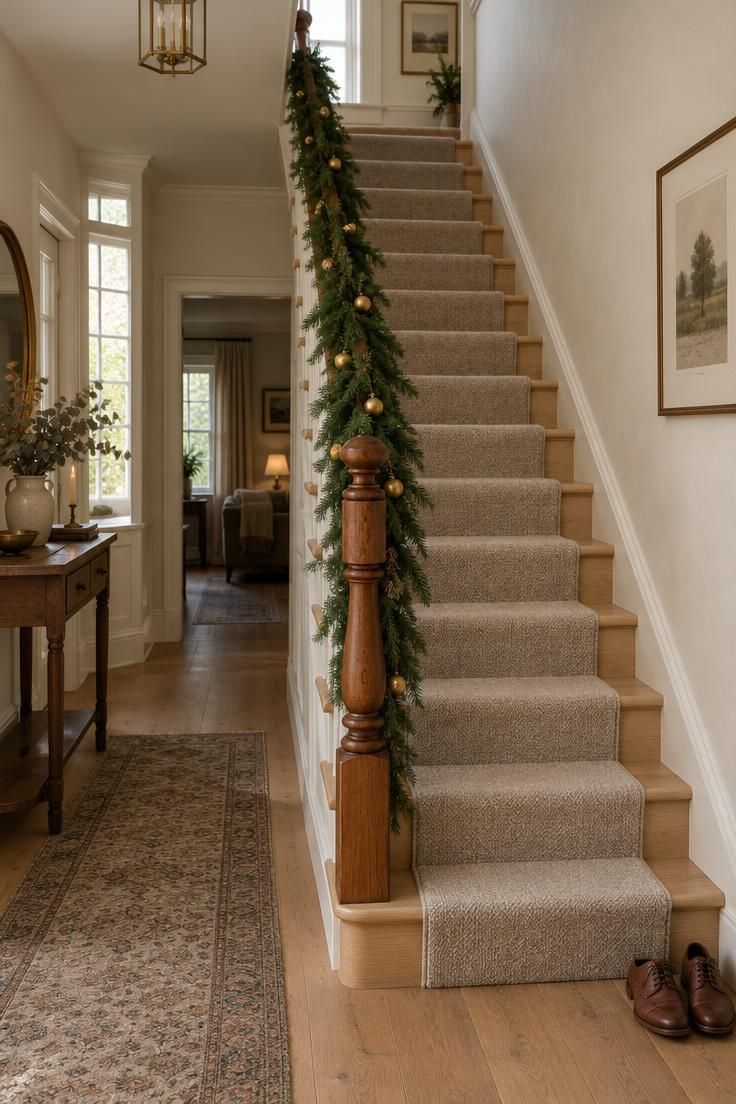
The climbing wrap spirals garland along the rail, crossing over the top at regular intervals.
The draped swag runs along the outside edge and sags in soft drops between fixing points, with branch tips falling vertically.
A climbing wrap reads tidy and traditional.
It suits straight runs, uniform balusters, and a house where the staircase is already a strong architectural feature.
The regular crossings create their own rhythm, so the garland can be relatively simple and still look complete.
The risk with a tight spiral is mechanical repetition.
When every crossing sits at the same angle and every loop is the same size, the rail starts to look wrapped rather than decorated.
Varying the tightness slightly, or letting a few sprigs escape the spiral, softens that effect without losing the neatness.
A draped swag reads softer and older, closer to the way garland sits on a mantel or a doorway.
It works well on curved staircases because the drops follow the sweep of the rail, and it carries heavier ornament such as bells or large bows without looking overfilled.
The cost of a drape is material.
A deep swag uses noticeably more garland than a pulled-tight spiral over the same run, and the lower points of each drop hang closer to hand height.
In a narrow stairwell those low points can intrude into shoulder clearance, so the drop depth becomes a practical limit rather than a stylistic one.
Consider how the rail meets the post.
A spiral tends to end abruptly at the newel post unless a bow or cluster finishes it, while a drape can flow into a final larger swag that lands exactly on the post.
That ending often decides which treatment feels more resolved in a given hallway.
Christmas staircase garland ideas are worth collecting before committing, but sort them by these two categories rather than by theme.
A photograph of a spiral wrap tells you nothing useful about a swag on a curved rail, even if both use the same greenery and ribbon.
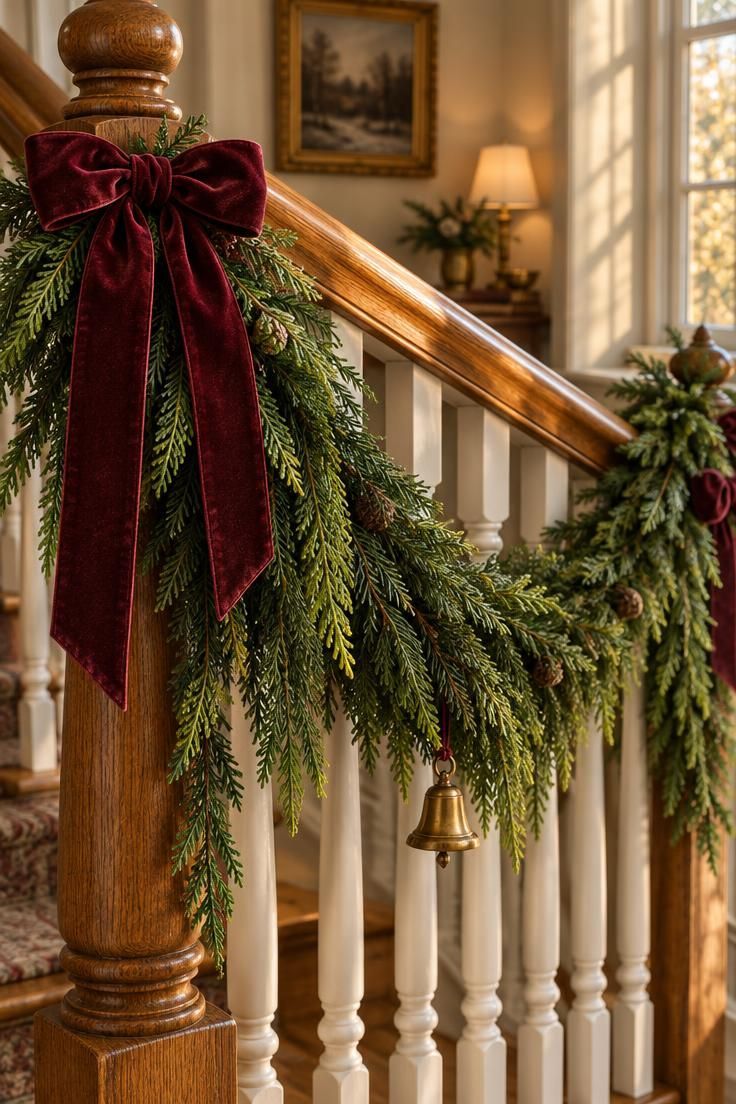
Spacing by Counted Structure, Not Guesswork
The arrangements that read as decorated rather than assembled share one habit: even repetition of a single element set against a small amount of deliberate variation.
Bows every few balusters, swags at matching intervals, ornaments at consistent spacing.
The irregularity comes from tail length, drop height, or ornament size, not from uneven gaps.
Counting beats measuring here.
Balusters, rail crossings, and steps are already visible units, and spacing that follows them looks correct from the bottom of the stairs, which is where most of the looking happens.
A tape measure produces numbers that can still look wrong because the eye is reading structure, not distance.
Pick one dimension for variation and leave the rest regular.
Ribbon tails of slightly different lengths create movement without disturbing the rhythm.
Bell drops at graduated heights add an antique note.
Changing spacing and drop length and ornament size at once produces the cluttered result people usually blame on too much decoration.
Spacing should also account for the viewing distance.
A staircase seen from a hallway floor needs slightly bolder repetition than one seen only from a few steps away, because fine intervals compress at distance and start to blur into a continuous band.
The top of the run deserves early attention.
Starting at the bottom and working upward keeps the arrangement from running short at eye level, which is the most visible part of the staircase from the front door.
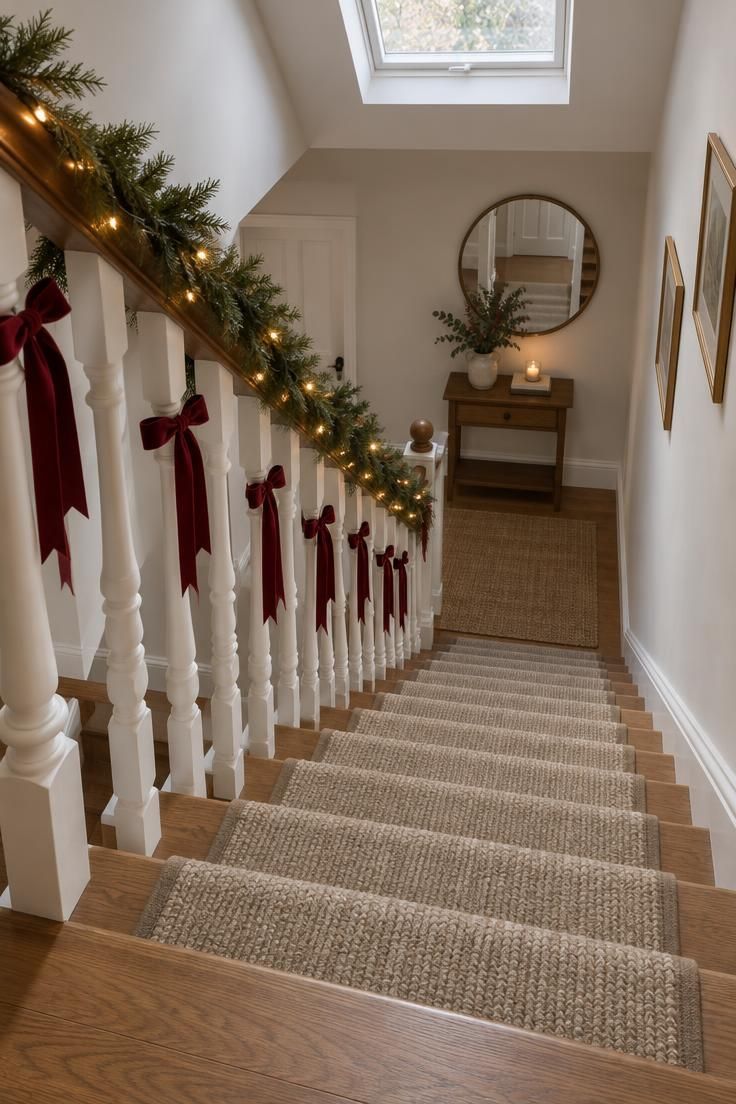
Layering Garland, Ribbon, and Ornaments Without Overload
Build in order and the arrangement stays controlled.
Garland goes on first as the structural bulk, because it defines the line and sets the volume that everything else has to sit against.
Ribbon follows at transition points: the newel post, the top landing, a mid-run point where the eye pauses.
Ornaments come last and in small numbers.
The temptation to put a bow at every step is strong and rarely pays off.
Bows at three or four points across a full flight carry more weight than a bow at every tread, and they leave the greenery visible between them.
The same logic applies to ornament clusters: two or three baubles in one spot read as a decision, while a dozen evenly scattered baubles read as filler.
Negative space does real work on a staircase.
Leaving some balusters bare, or keeping a stretch of handrail free of garland, lets the architecture remain visible and keeps a narrow stairwell from feeling closed in.
Decorating one system fully and leaving the others mostly clear is the most dependable version of restraint here.
That single-system approach also solves the tread problem.
Garland and ribbon on the rail, nothing on the steps, and the stairs stay usable without any daily adjustment.
It is a cleaner look than it sounds, and it photographs and lives better than a fuller scheme that has to be stepped around.
A draped garland on a handrail can be the entire arrangement.
With a good bow at the post and warm lights woven through, it reads complete because the rail line is long enough to carry the composition on its own.
Ribbon-only schemes deserve more credit than they usually get.
Simple bows in one color, spaced along the balusters with no greenery at all, suit modern hallways, small rentals, and anyone who wants the staircase back to normal quickly in January.
Baluster-only schemes work the same way with small hung ornaments and a bare rail.
Mixing all three layers is fine when the staircase is generous and the palette is tight.
On a narrow or heavily detailed staircase, two layers usually look better than three, and one layer often looks best of all.
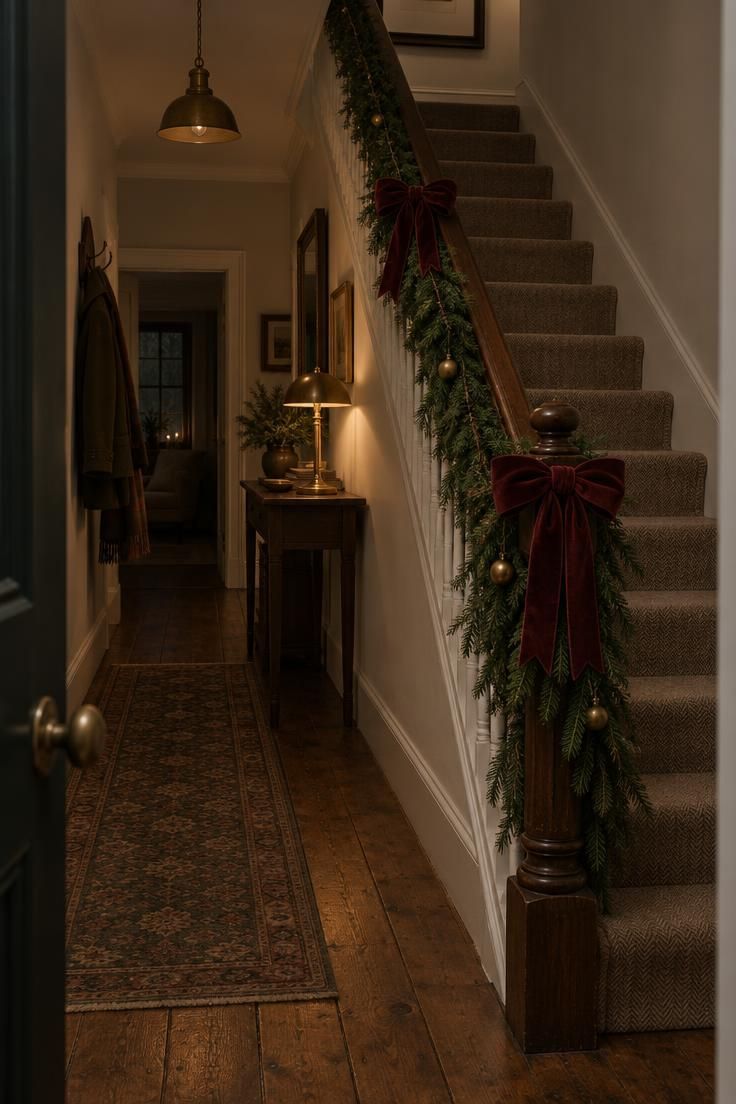
For a moody, evening-heavy look, keep the lighting soft and low and let the velvet and greenery carry the depth.
Dark schemes still need enough light on the rail to show texture, so a few warm sources at the base or on the landing help the arrangement read after dark.
Anchoring the Base So the Arrangement Lands
A garland that stops at the newel post and goes no further looks unfinished, even when the rail above is decorated well.
The eye follows the diagonal down and expects something to receive it.
That is the composition problem the base has to solve.
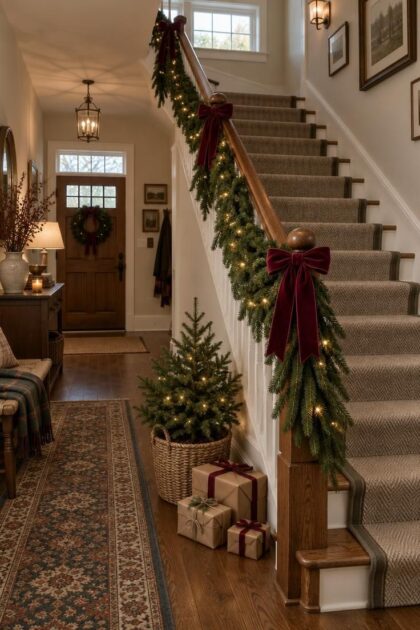
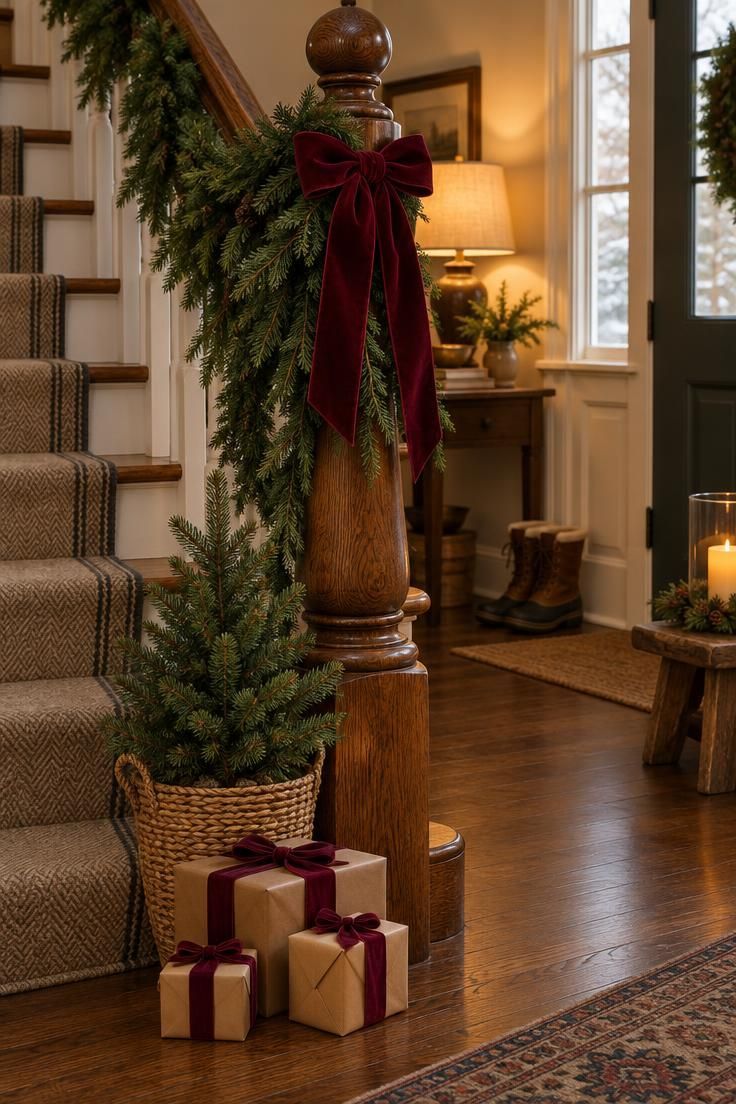
Anchoring stair decor at the newel post can be as simple as one oversized bow, a cluster of graduated bells, or a single large ornament that repeats a finish used above.
The job is to mark the endpoint clearly so the rail decoration feels resolved rather than cut off.
Floor-level arrangements do the heavier work.
A small potted tree, a bench, a chair, a stack of wrapped boxes, an urn, or a lantern beside the post all give the staircase a base and make the hallway feel furnished rather than just decorated.
They also keep the decoration out of the walking path.
Repetition ties the two zones together.
Carrying one material from the rail into the floor arrangement, whether that is the ribbon color, the greenery type, or an ornament finish, makes the rail and the base read as a single scheme instead of two separate displays.
Scale needs to match the hallway, not the staircase alone.
A tall urn beside a narrow front door crowds the arrival point, while a low stack of boxes can disappear in a double-height entry.
Check the base arrangement from the front door, since that is how guests will first see it.
Flameless candles in glass hurricanes or lanterns belong in this floor zone, grouped beside the post or on a landing table.
They give warm glow without an open flame near greenery, ribbon, or finished wood, which makes them the practical choice for a staircase setting.
Fitting the Scheme to Your Staircase Type
Learning how to decorate stairs for christmas starts with reading the staircase in front of you.
The same garland and ribbon behave differently on a narrow straight run, a curved sweep, and a set of open metal spindles, and matching the treatment to the structure saves a lot of adjustment later.
Narrow stairwells reward a rail-hugging treatment.
Deep swags narrow the visible opening and drop into shoulder space, so a tight wrap or a slim garland pinned close to the rail keeps the stairwell feeling open.
Ribbon-only schemes and small swags work well here for the same reason.
Curved staircases suit drapery.
A draped garland following the outside edge preserves the sweep of the rail, which is usually the best feature of a curved stair.
Running the garland along the base of the handrail rather than over the top keeps that curve visible, and overlapping sections at the turns hides the joins.
Open metal balusters change the balance.
Their thin lines are part of the design, so thick garland can swallow them entirely.
A slimmer garland leaves the spindles readable, and small hung ornaments on alternate balusters decorate the staircase without hiding its structure.
Dark wood and painted white staircases ask for different palettes.
Dark wood carries warm metals, deep greens, and velvet well because those tones sit clearly against it.
White architecture supports contrast, such as deep green with black accents, or a tonal scheme in cream, flocked greenery, and gold.
Rentals and outlet-free hallways push toward removable, packable choices.
Battery lights, paper ornaments, and ribbon-only arrangements all store flat, and none of them leave the staircase changed once the season ends.
Landings and half-turns need their own small decision.
A landing table with a lantern, a small arrangement, or a single large ornament gives the eye a resting point mid-climb and keeps a long staircase from looking like one uninterrupted run.
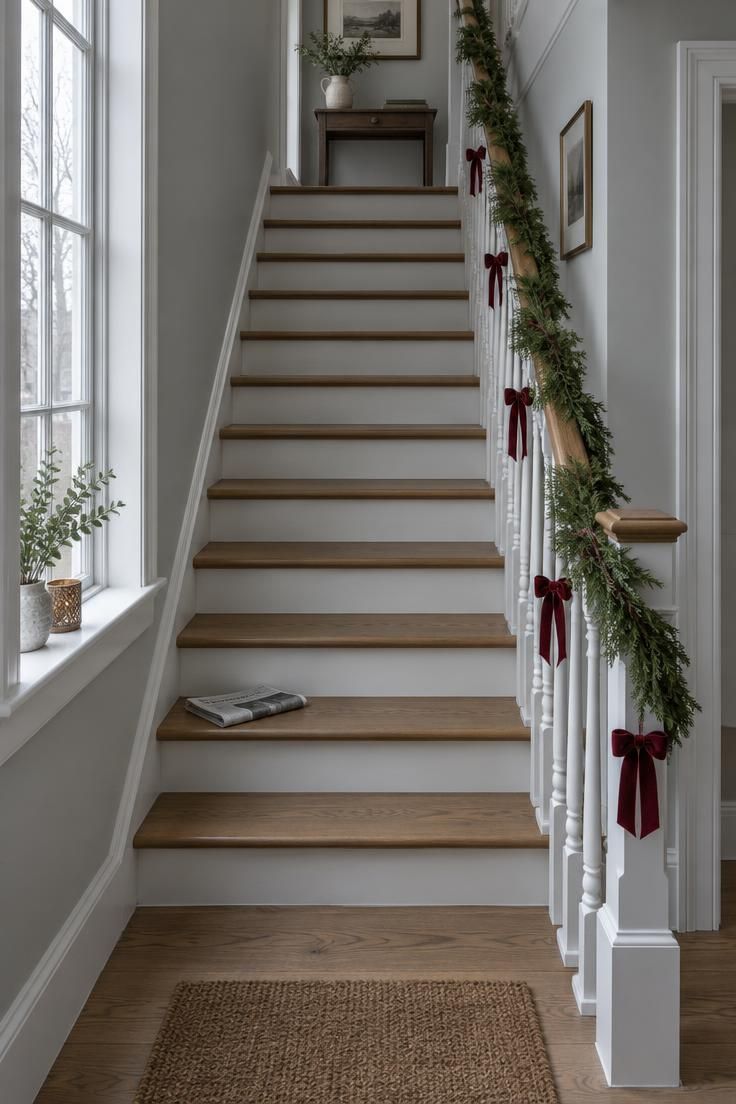
Palette Discipline and Texture as the Safer Source of Variety
Most staircase schemes that hold together use about three notes.
Deep green with aged metal and burgundy is one familiar combination.
White architecture with deep green and gold is another.
Black, forest green, and white is a third that suits more modern hallways.
The working method is to choose a dominant, a secondary, and a small accent, then stop.
The dominant is usually the greenery or the painted woodwork.
The secondary is the ribbon or the metal.
The accent is whatever appears in the smallest quantity, such as a single ribbon color on the bows or a particular ornament finish.
Texture carries the variety that additional colors would otherwise supply.
Velvet absorbs light and shows pile.
Satin catches it and shows creases.
Flocked greenery reads matte and soft against dark wood.
Brass and aged metal add warmth without adding another hue.
This matters on a staircase because the architecture is already busy.
Balusters, rail profiles, trim, and tread edges all contribute lines and shadows.
A tight palette lets those structural details read, while a wide palette competes with them and makes the whole hallway feel crowded.
Repeating one finish between the rail and the base strengthens the scheme.
Brass bells at the newel post echoed by a brass lantern on the floor, or a burgundy ribbon repeated on wrapped boxes, gives the eye a thread to follow from the top of the stairs to the door.
Holding to three notes also makes the scheme easier to extend next year.
Adding a second ribbon color or a new ornament finish to an existing set is simple when the underlying palette is disciplined, and much harder when the original arrangement already used five.
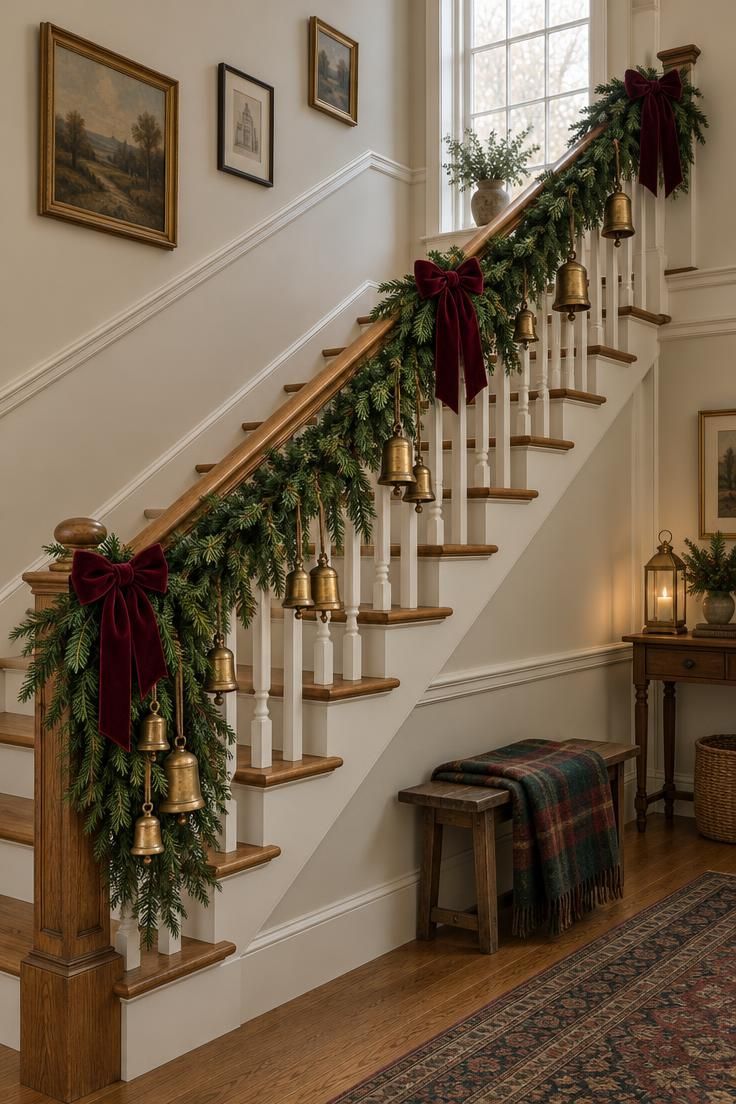
Upkeep, Storage, and Teardown for a Working Staircase
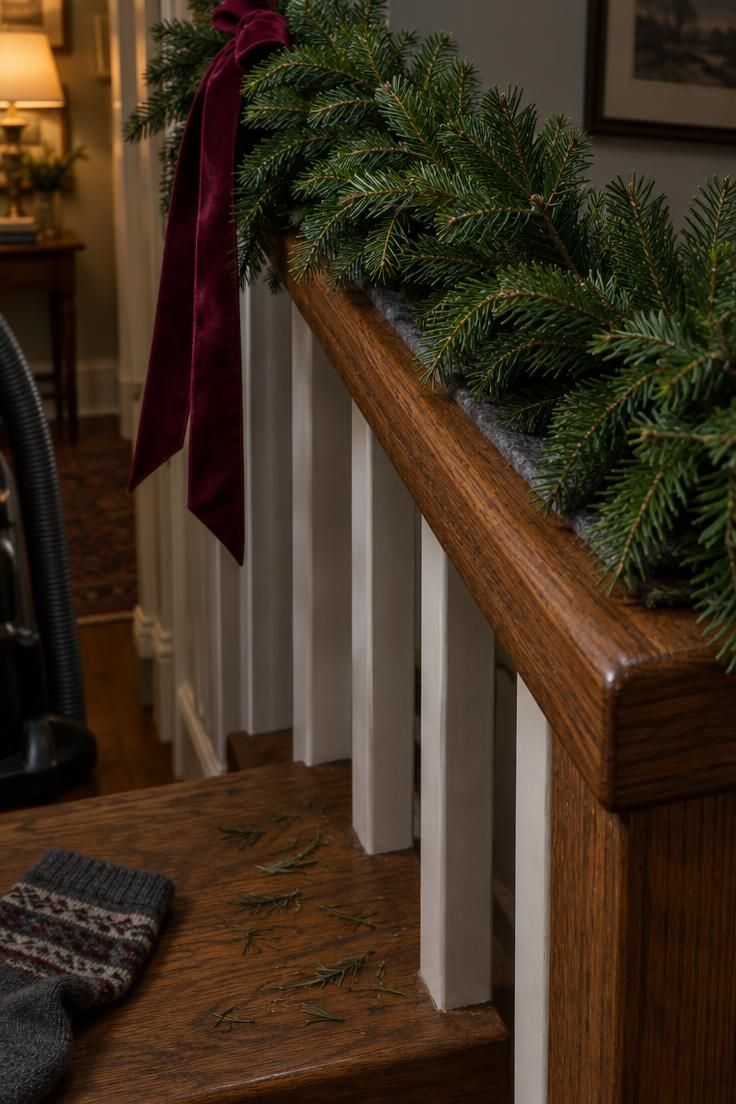
Stair decoration lives in a high-traffic zone, so it collects dust and sheds onto the treads.
Flocked garland can dust a fine white powder, tinsel drops strands, and faux berry clusters lose pieces when brushed.
A quick vacuum of the treads every week or so keeps the debris from migrating through the house.
Fresh greenery has its own timeline.
Indoors it dries and drops needles within a few weeks, and it can leave sap or dye marks where it rests on finished wood over that period.
A felt pad or a strip of barrier fabric between the greenery and the rail is a low-cost precaution worth building in from the start.
Mixing fresh and faux solves several problems at once.
Faux garland gives the structural bulk and holds its shape for the whole season, while fresh sprigs tucked into the most-viewed points, such as the top curve and the newel post, supply scent and realism.
Those fresh pieces can be replaced partway through the season without rebuilding the arrangement.
Ribbon bows for stair banisters need careful storage to survive to next year.
Wired ribbon should be rolled rather than crushed so the loops hold their shape, and unwired ribbon stores best loosely folded.
Paper ornaments, honeycomb stars, and lightweight swags all pack flat, which makes them the easiest elements to live with in a small home.
Teardown order matters as much as installation order.
Removing decorations from the top down keeps falling needles and dust from landing on sections that are already cleared.
Working bottom-to-top on the way up and top-to-bottom on the way down is the least messy sequence.
Conclusion
The staircase decorations that hold up through December are the ones that follow the rail line, respect the baluster rhythm, and finish at the newel post with something that meets the floor.
Choose a climbing wrap if you want tidy and traditional, or a draped swag if you want softer and older, then set spacing by counting balusters rather than reaching for a tape measure.
Before buying anything, stand at the bottom of your stairs and decide which single system you will decorate: the rail, the balusters, or the base.
That choice sets the garland quantity, the ribbon scale, and the ornament count all at once, and it prevents the half-finished look that comes from starting in the middle.
Then limit yourself to three palette notes and one texture-driven accent.
The first thing to try is the simplest: run one garland along the rail, place a single bow at the newel post, and put a small potted tree or a stack of wrapped boxes on the floor beside it.
If that reads finished from your front door, you have found the right amount of decoration for the space, and anything more can wait for next year.