This post may contain affiliate links. If you make a purchase through these links, we may earn a commission at no additional cost to you.
A powder room hosts one ritual, repeated: rinse, reach, dry.
The ring beside the sink sits squarely in that moment, yet its position is often copied from a generic height chart instead of fitted to the actual room.
The better approach matches the ring to how a hand moves, how the towel hangs, and what the wall already holds.
Treat it as a small design problem with real constraints, not a number to look up.
Practical Distinctions That Determine the Position
Start with the object itself.
For a towel ring height above a vanity counter, a towel ring is a hand-towel accessory: a loop suspended from a wall bracket, sized for one folded hand towel rather than a bath towel.
That shape drives everything downstream.
The opening holds a thin fold of fabric, the bracket projects the towel slightly away from the wall, and the hanging hem dictates how much clearance the ring needs below it.
Load a bath towel onto that loop and the mismatch shows immediately: the fabric bunches, dries slowly, and looks unresolved.
A towel ring works best as a single-purpose piece rather than a stand-in for a larger towel holder.
Powder rooms punish clutter more than most rooms.
In the smallest bathrooms, removing obstructions matters more than almost any decorative choice.
Even a small piece of hardware jutting into the entry path can disrupt movement and make the space feel more crowded.
Adopt one test before any measuring: hold the actual towel against the wall where the ring might go.
The fabric’s real drop tells you more than a floor-to-center figure ever will.
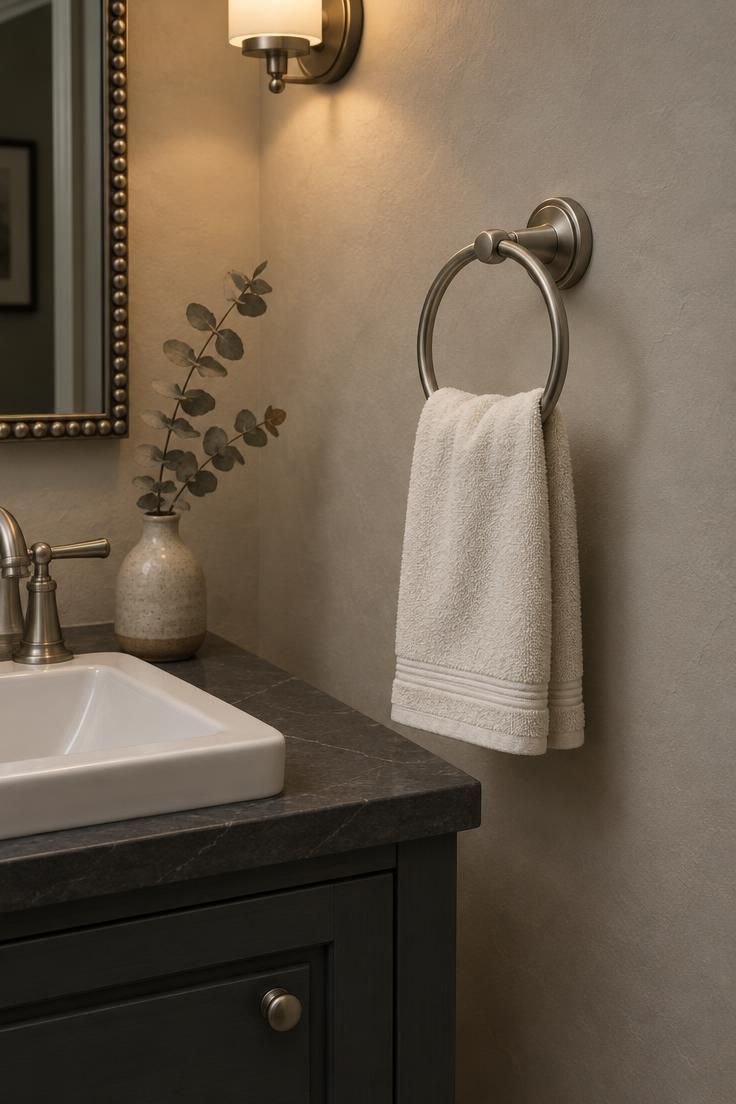
Choosing a Side and Sit Without a Formula
Height tends to dominate the conversation, yet the horizontal decision decides whether the ring is genuinely convenient.
Retail guidance suggests offsetting the ring roughly 8 to 12 inches from the faucet so the towel hangs clear.
Read that range as a starting zone, not a verdict.
The reasoning is about splash: a ring directly in the faucet’s spray line keeps the towel damp, and the towel ring clearance from the faucet splash zone matters more in a shallow basin or with an aerator that throws water wide.
Equally, a ring placed too far away forces a dripping walk.
One homeowner discussion described the target as a single short, dry motion from rinsing to drying, warning that a distant ring leaves a trail of water across the floor.
Which side of the sink?
Let the room answer.
A towel ring can work to the left, to the right, or on the vanity’s side wall, with layout, mirror width, and the toilet’s position driving the choice rather than a universal rule.
Door swing deserves early attention.
A towel bar that juts into the entry path can easily catch an elbow on the first step into the room.
Relocating it to the opposite wall may be the simplest fix.
Try this sequence at the basin: stand where a guest stands, mimic rinsing one hand, and notice where the hand naturally pauses before reaching for fabric.
That pause point is your candidate spot.
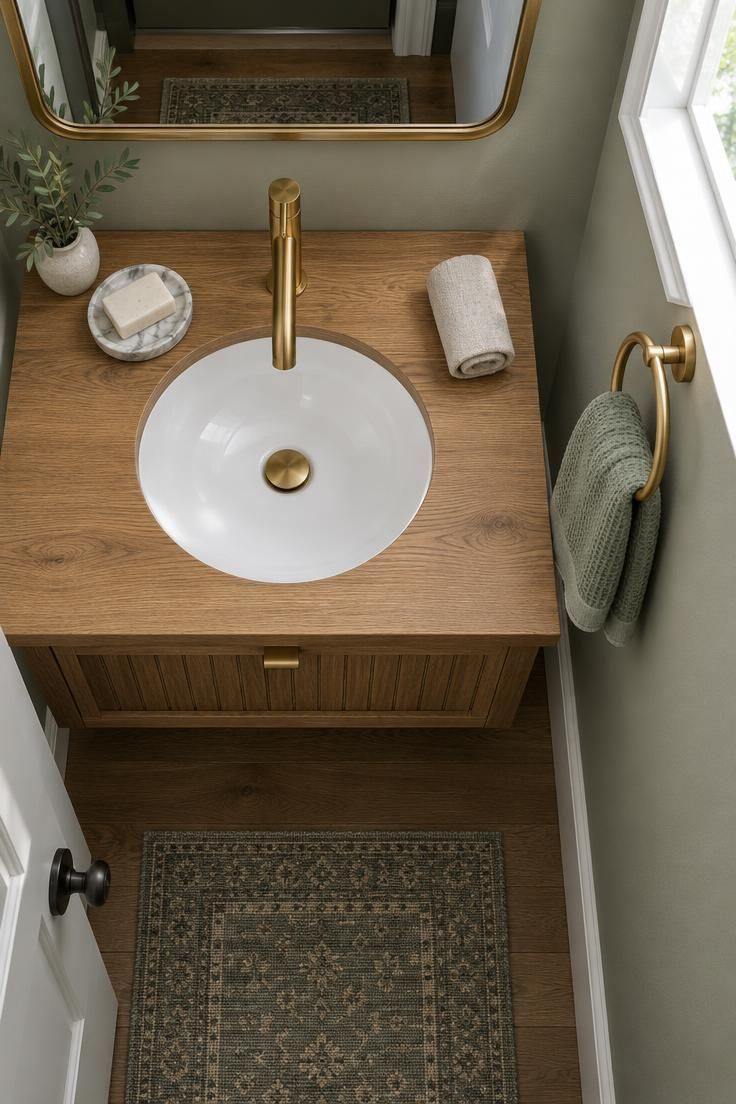
Making the Height Work for the Actual Towel
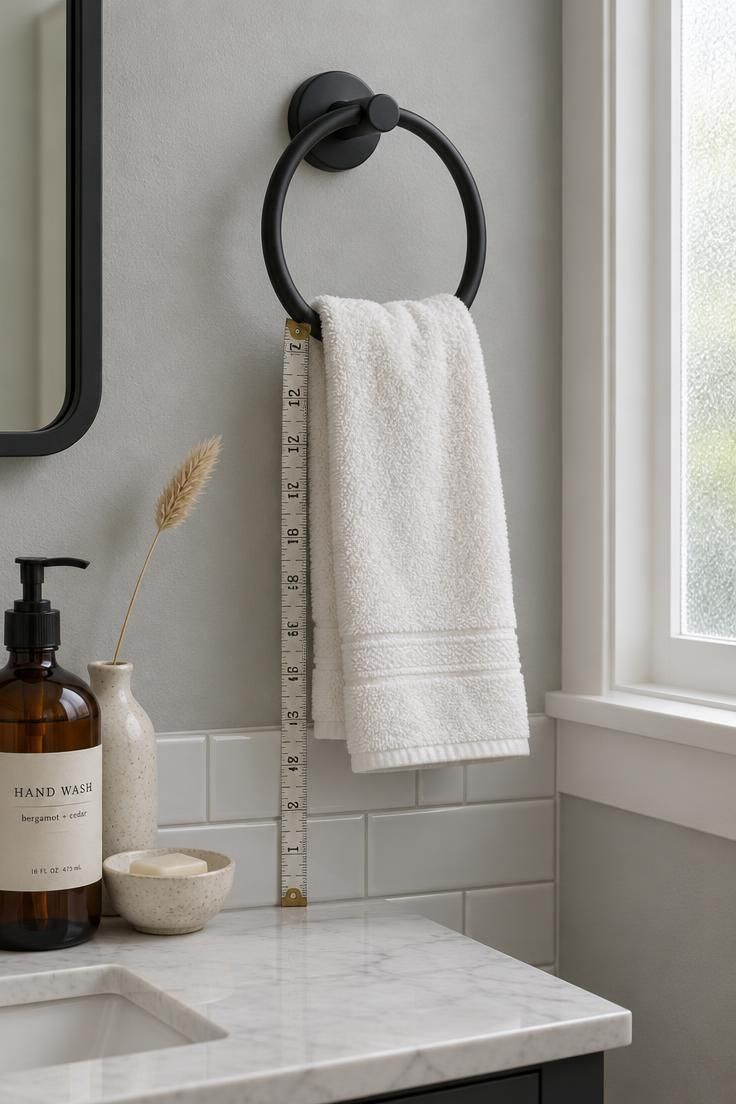
There are two practical ways to determine towel ring height, and each measures from a different starting point.
One sets the ring’s center roughly 50 to 52 inches above the floor, a common placement for adult use that allows the towel to hang clear of the counter.
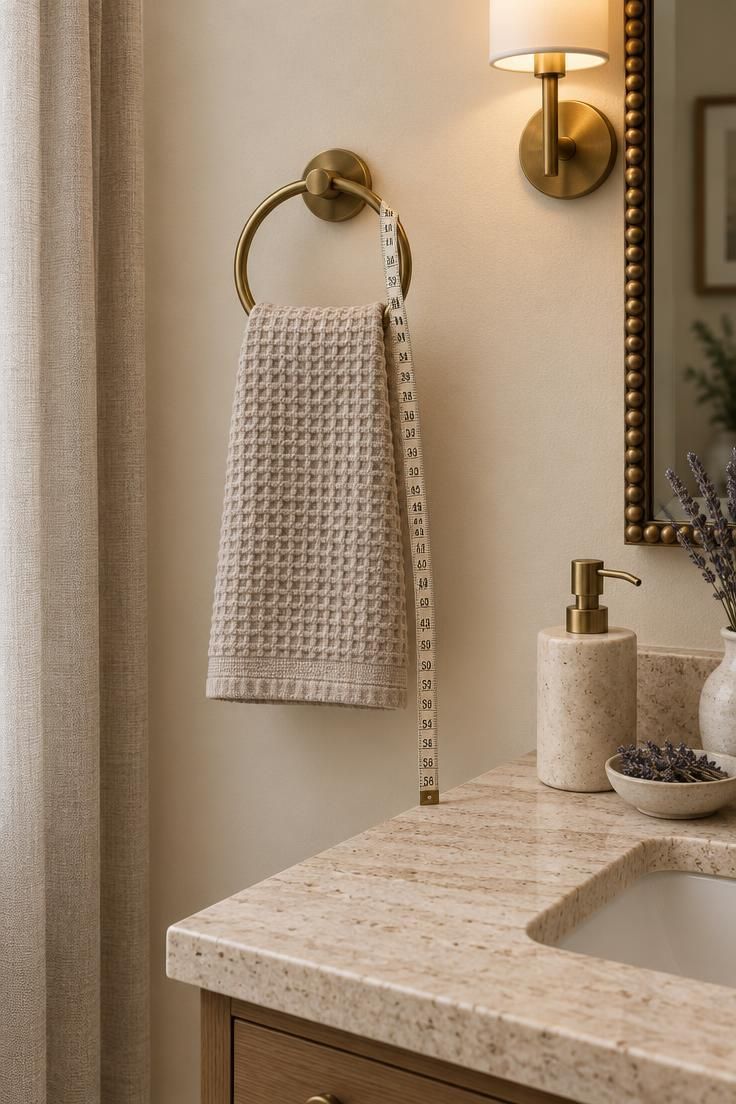
The other measures from the vanity upward: place the bottom of the ring about 16 to 20 inches above the vanity edge.
This approach accounts for the length of the towel itself, since hand and fingertip towels commonly run about 20 to 30 inches long.
In a powder room, the second method often serves better, because hand-towel length varies more than vanity height does.
Whether a towel ring or towel bar for a powder room is the right accessory, the towel’s relationship to the counter is what a guest sees and feels.
Household height adjusts the number, too.
For shorter households and children, a lower placement of around 44 to 48 inches can provide a more comfortable reach without compromising appearance.
Fold the exact towel to be used, hold it where the ring would sit, and slide it up or down until the bottom hem clears both counter and backsplash.
That trial height beats any chart.
Checking Conflicts That Make a Good Spot Fail
Before any trial height, walk the room and list what the wall already holds.
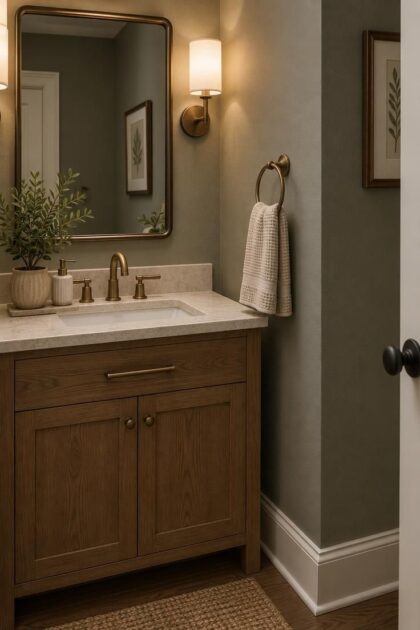
The mirror’s bottom edge and width set how much wall remains beside the sink, and a ring crowded against a frame looks squeezed in from the start.
Electrical outlets cause recurring trouble.
Forum threads contain repeated complaints about towels hanging over outlets, making the outlet awkward to use and putting damp fabric right beside it; the advice is to shift the ring high enough or far enough sideways that the towel hangs clear.
Order the check by what cannot move: door swing first, then the mirror, then outlets and switch plates, then the toilet zone, then sconces.
Fixed conflicts eliminate positions faster than measurements approve them.
If the only remaining wall puts the towel over an outlet, change the fixture choice or the height rather than accepting the conflict.
A dry run from door to sink to exit catches most of these before anything is fixed to the wall.
When a Ring Is the Wrong Tool: Bars, Hooks, and Baskets
The placement question is entangled with the accessory question, and the tradeoffs are worth considering.
A ring keeps the towel folded over the loop, which slows drying compared with fabric spread wide.
A towel bar spreads the towel for faster drying but needs more horizontal wall width and projects differently; some powder rooms have room for a short bar where a ring feels fussy.
A hook is the most forgiving option, since the towel need not be folded neatly.
In a small powder room, mounting a hook above counter height allows the towel to hang higher, so any drips land on the counter rather than the floor.
Household rhythm can settle the matter.
A guest bath used daily by one household member may benefit more from a short bar than a ring, since daily fabric rotation favors a spread towel.
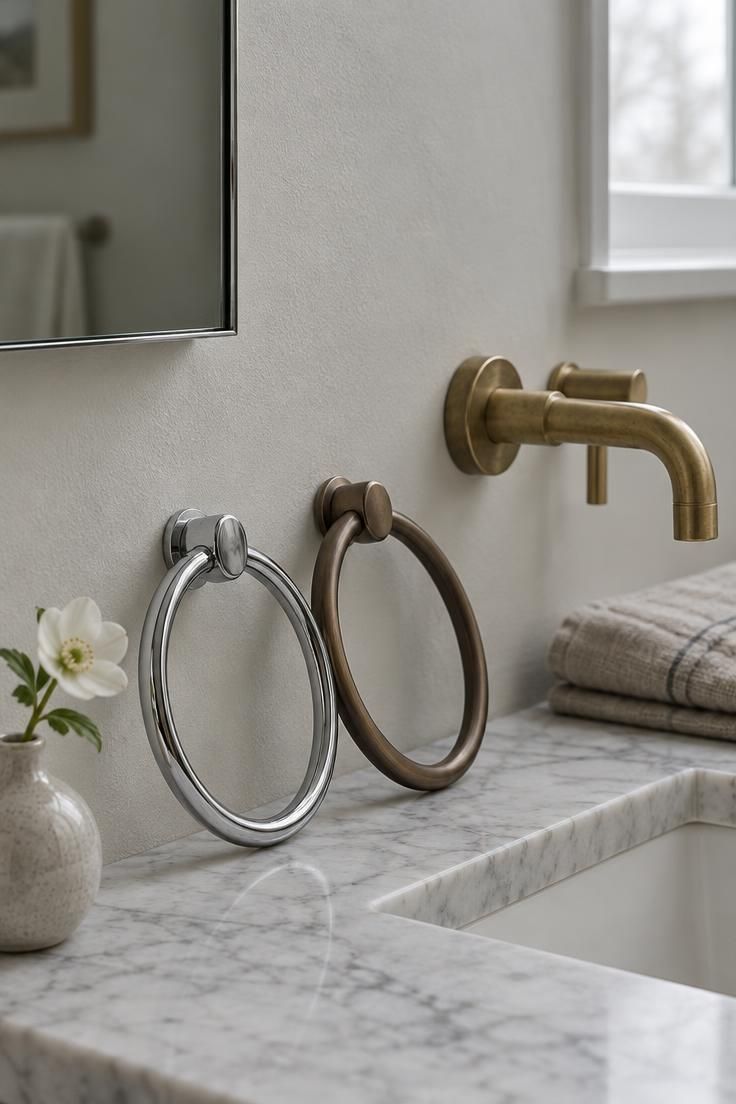
Towel ring finish matching bathroom fixtures belongs in this decision, not a separate shopping trip.
Hardware that reads as one set, faucet and ring and paper holder together, looks intentional, while a mismatched finish can make one piece look like a later replacement.
Decide the accessory first, because a ring, a bar, and a hook each hang and project differently.
The placement that suits one may fail another, and measuring twice starts with knowing what you are measuring for.
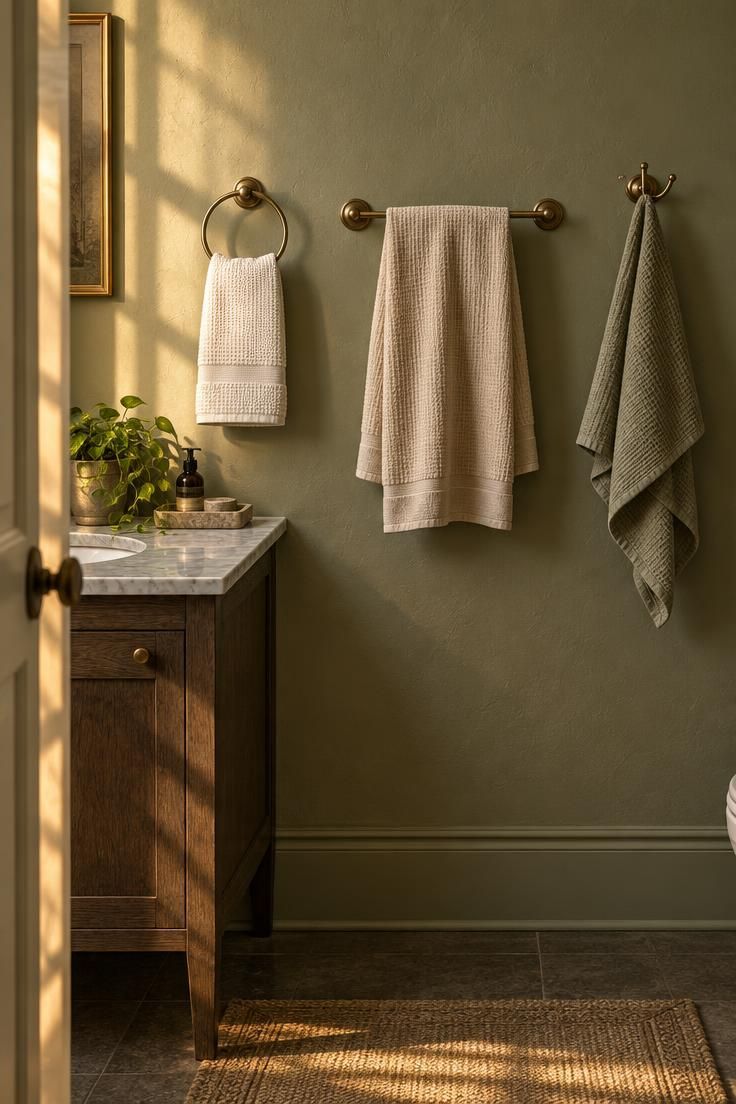
Making Drips and Drying the Test, Not the Afterthought
Water goes somewhere when wet hands reach for fabric, and the ring’s position decides where.
Forum contributors noted that drips land below and beside the ring, favoring placement above a counter or a waste bin over open floor.
The reasoning is plain housekeeping.
Drips on a hard floor leave a slick patch a guest may not see, and drips on cabinetry take more effort to wipe up than a quick pass over a counter.
Pedestal sinks break the pattern.
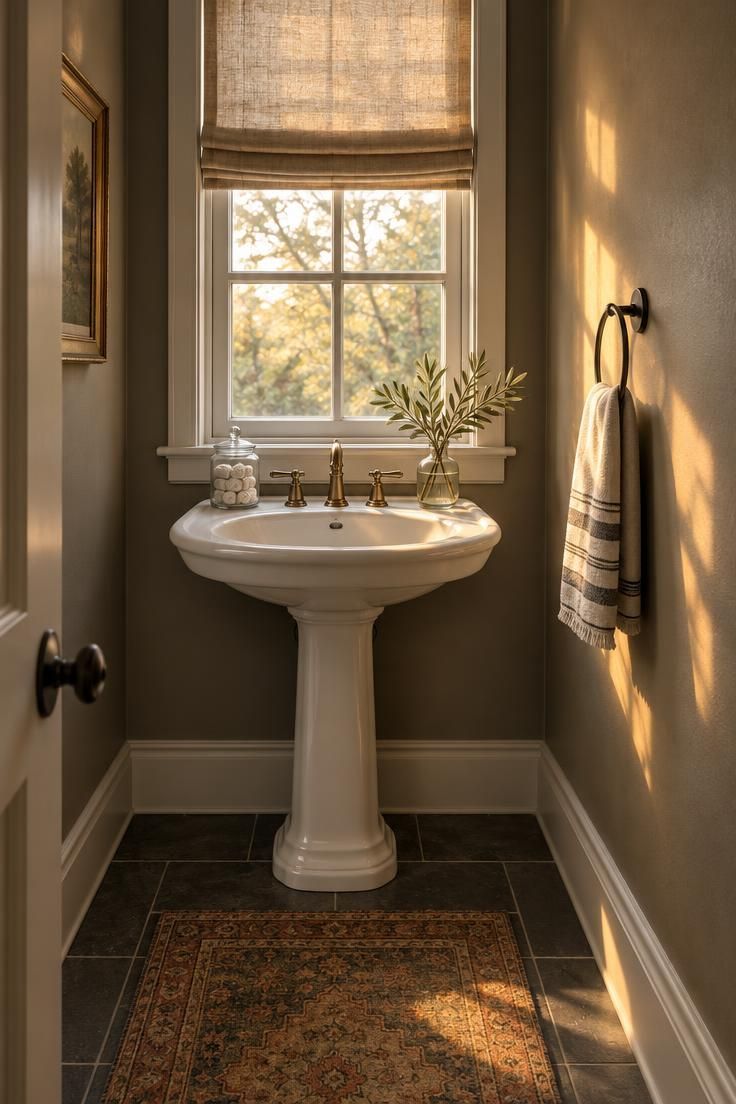
With no counter to catch water, the ring usually goes on the nearest wall at a comfortable reach, and the drop path may end on the floor, which makes a small rug or wall adjacency worth considering.
The accessory shape shifts the pattern as well.
A round ring holds a tidy single fold, while a hook allows looser draping that changes where the wet hem sits.
If the drop path is not acceptable, move the ring or change the accessory; that verdict settles more debates than any chart.
Why the Finish Needs to Be Chosen Alongside the Placement
In a powder room, the towel ring is one of only a few pieces of visible hardware, sharing the stage with the faucet, the paper holder, and perhaps a robe hook.
That scarcity makes finish coordination a placement consideration, not an afterthought.
With so few fixtures in view, even subtle differences in finish or style can affect the room’s overall balance.
Silhouette matters just as much.
A slim, simple ring can sit closer to a mirror or sconce without visual conflict, while an ornate or oversized ring needs breathing room, which pushes its position outward along the wall.
Small rooms reward restraint.
The compact scale of a powder room often favors a single strong design element, such as a distinctive wall covering or an unusual mirror, with accessory hardware supporting that choice rather than competing with it.
A practical pairing: choose the finish first, then test candidate spots at eye level with the actual hardware in hand.
A ring that matches beautifully but crowds the mirror has not solved the problem.
Adapting to Awkward Powder Room Layouts
Pedestal sinks remove the counter reference entirely.
The ring usually moves to the nearest wall at a comfortable reach, set slightly to one side so the towel does not block access to the basin, and the drip question shifts to the floor below.
Very narrow rooms sometimes leave the vanity’s end panel as the only candidate wall.
In that spot, choose a position where the towel can be reached easily from the basin and hangs above the floor without trailing.
A window over the sink rewrites the wall composition.
In such a room, the usual mirror-over-sink arrangement may no longer apply, allowing accessory placement to follow the window’s position rather than compete with it.
Daily household use tips the choice away from a ring.
A half bath near a home office or living area gets steady traffic, so durability and drying matter more, and a short bar or hook may serve better than a loop.
A shower added to a larger half bath creates a second, separate towel problem: the bath towel near the shower needs its own position, while the hand towel at the sink should remain accessible and independent of that arrangement.
Each irregular layout keeps the same test sequence, only with different reference points.
Good powder room towel ring placement comes from re-reading those points, not from ignoring them.
Why the Placement Still Matters in the Age of Disposable Towels
Some households stock the powder room with disposable guest towels, a basket of rolled washcloths, or a stack of clean cloths, which changes the ring’s role.
It shifts from the primary drying spot to a backup or a purely decorative element, depending on how the household prefers to provide towels for guests.
If the ring is decorative, placement still shapes the wall composition and the room’s first impression, though reach and splash offset matter far less.
A ring displayed with a crisp folded towel can carry a wall the way a small artwork would.
If the ring is the only drying spot, every earlier consideration returns in force.
Ask what the household actually leaves in this room, and whether the ring still earns its place on the wall.
Running a Final Placement Dry Run
Consolidate everything into one rehearsal before anything is marked or fixed.
Choose the accessory first, then list the realistic wall positions: beside the vanity, on the cabinet end panel, or on the adjacent wall.
Eliminate any position in the door swing or crossing the toilet zone.
Check the fixed conflicts next, including the mirror edge, sconce, switch plate, and outlet, and note how much clearance each one leaves.
Set a trial height from the 50-to-52-inch convention or the 16-to-20-inch counter reference, adjusting for the household’s height and the vanity’s height.
Hang the actual towel and confirm the hem clears counter and backsplash.
Walk the full use path: enter, approach the sink, rinse, reach.
This is the moment where to hang a hand towel beside a sink becomes obvious, because the hand finds the fabric or it does not.
Watch for the two most common failures, a towel hanging too low and a towel sitting in the splash zone.
If either appears, shift the position before committing, and check the finish against the room’s other hardware one last time.
Conclusion
Good powder room towel ring placement passes one visible test: a guest finds the towel without searching, dries a hand without dripping across the room, and never moves fabric out of the way.
If any of those fail, the position is still wrong.
Choose the accessory before the spot, let the room’s walls and fixtures narrow the candidates, and treat standard height numbers as starting points.
A dry run with the actual towel, standing where guests stand, settles the question faster than any chart.
Start with the one thing that exposes every conflict at once: hold your real towel against each candidate wall, walk the path from door to sink, and watch where the drips would land.
The first spot that survives that rehearsal is the one to keep.