This post may contain affiliate links. If you make a booking or purchase through these links, we may earn a commission at no additional cost to you.
Most people walk into a bathroom and immediately notice the vanity, the tile, or the fixtures.
But the detail that quietly shifts the entire room is underfoot.
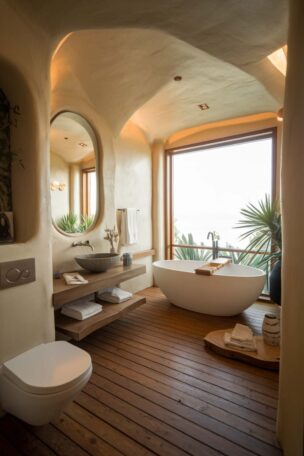
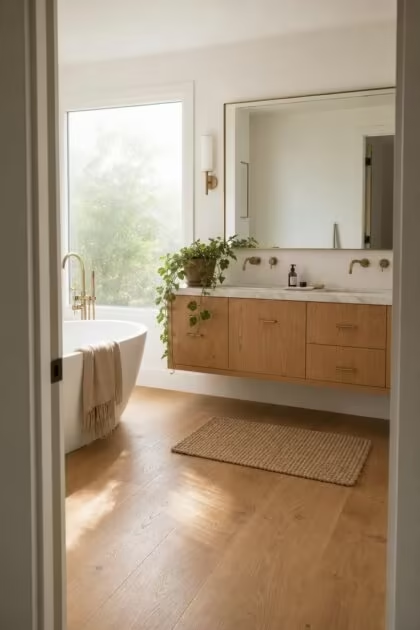
A bathroom with wooden floor does something no other surface can: it makes a cold, functional space feel like somewhere you actually want to linger.
The gap between wanting that warmth and believing wood can hold up in a wet room is narrower than most homeowners realize.
The Warmth Gap No Tile Can Close
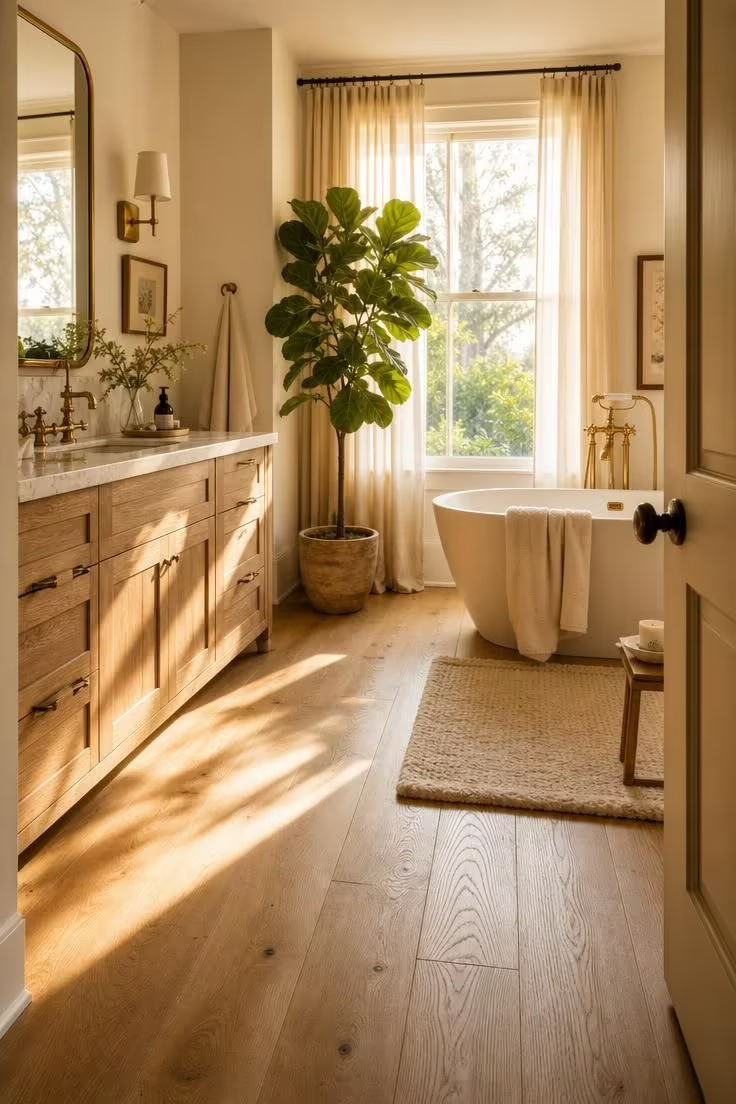
Seventy-five percent of design professionals now confirm that warm, earthy tones are the dominant direction in bathroom color and material choices.
That number alone tells a story about what people crave in a room that used to be defined by cold porcelain and hard edges.
Tile can be beautiful, precise, and endlessly varied in color and shape.
But it reads as cold underfoot, and that single sensation can undercut every other warm detail in the room.
A wooden floor recalibrates the mood from the ground up, introducing a tactile softness that stone and ceramic simply cannot replicate.
This shift connects directly to biophilic bathroom design, a movement rooted in the measurable psychological comfort people experience when surrounded by natural materials.
The result is a bathroom that does not just look warmer but genuinely feels like a different kind of space.
Why Engineered Hardwood Outperforms Solid Planks in Wet Spaces
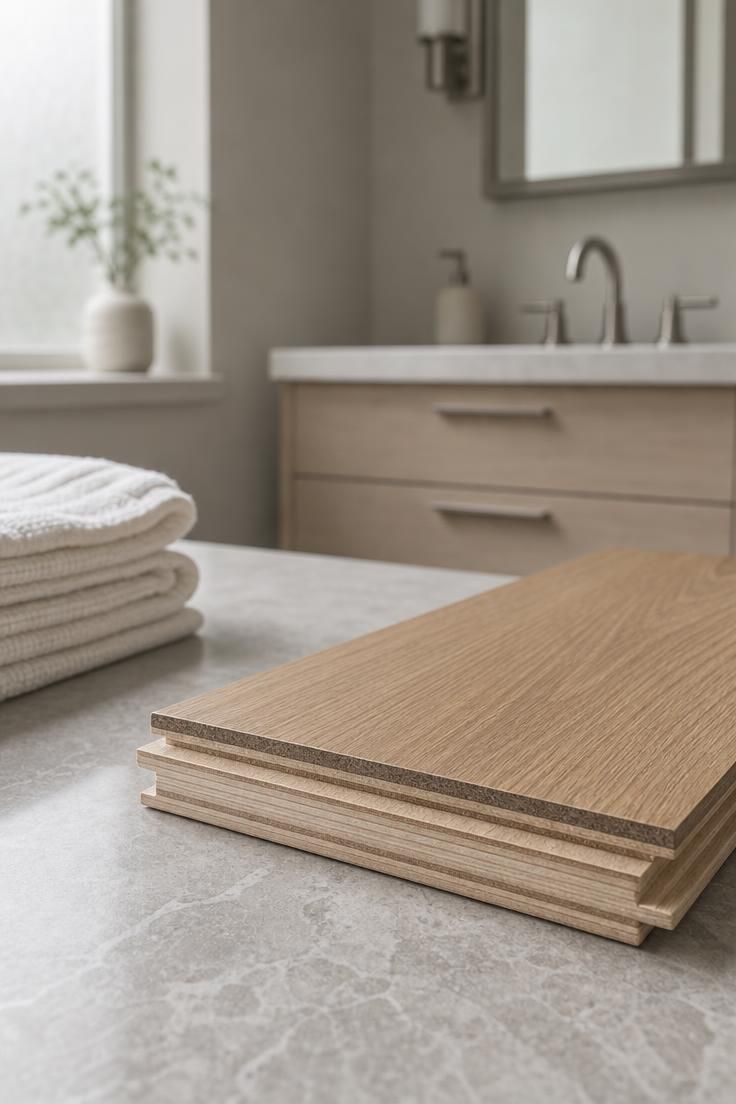
Solid wood planks expand and contract with every shift in humidity, and a bathroom puts that instability under constant pressure.
An engineered hardwood bathroom floor solves this with its multi-layer plywood core construction, which resists dimensional movement far more reliably than a single slab of wood.
The top layer is real hardwood, so the look and feel remain authentic.
Beneath it, cross-laminated plywood layers pull in opposite grain directions, canceling out the tendency to warp or cup when moisture levels rise.
Factory-applied UV-cured finishes add another layer of defense, with aluminum oxide coatings that outperform anything brushed on by hand during installation.
A vapor barrier installed beneath the flooring prevents moisture from migrating upward through the subfloor, which is where most hidden damage begins.
Proper subfloor preparation matters just as much as the wood itself, because uneven surfaces create gaps where water can pool undetected.
The technology behind an engineered hardwood bathroom floor has matured to the point where the practical barrier has nearly disappeared, leaving only the design decision.
The Species That Survive and the Ones That Struggle
Teak bathroom flooring sits at the top of the performance list for a reason: its natural oils make it one of the most moisture-resistant hardwoods available.
With a Janka hardness rating around 1,070 pounds-force, teak resists denting while its oil content repels water at a cellular level, a combination that explains its long history in marine construction.
White oak flooring earns its reputation through a closed-grain cellular structure that physically blocks water infiltration, making it a far better bathroom candidate than red oak.
Hickory, one of the hardest domestic hardwoods, brings extreme density that minimizes noise underfoot and resists the daily impact of foot traffic in bare feet.
Ipe, often called Brazilian walnut, pushes the Janka scale to roughly 3,510 pounds-force and is nearly impervious to rot and insect damage, though its density makes it harder to cut and install.
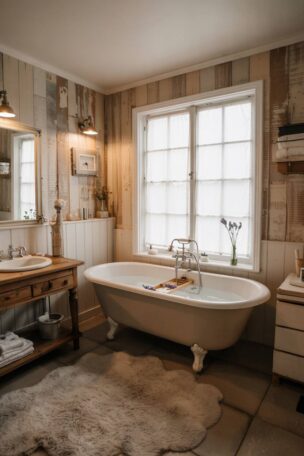
Reclaimed wood deserves a separate mention because its existing patina absorbs additional weathering without showing visible change, making the aging process an asset rather than a liability in a wet room.
Herringbone, Wide Plank, and the Layout Patterns That Change a Room’s Proportions
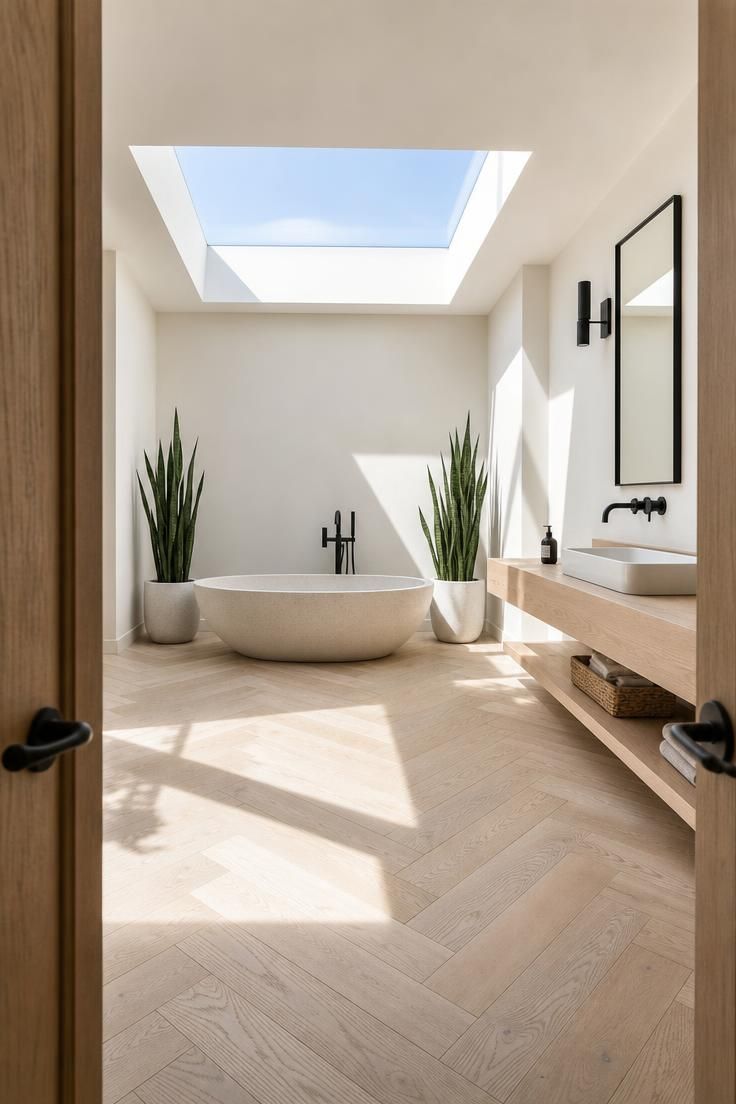
Wide planks stretch a small bathroom visually by reducing the number of seam lines the eye has to process, creating an unbroken surface that reads as larger than its actual footprint.
A herringbone floor pattern does something different: it introduces controlled directional movement that draws the gaze forward without creating visual chaos.
Chevron layouts push that energy even further, with each plank meeting at a clean point that creates a sense of deliberate speed across the floor.
The direction you lay the pattern interacts directly with your natural light source, and aligning the leading edge toward a window will make the room feel both longer and brighter.
Doorway sightlines matter just as much, because the first glimpse of a bathroom floor sets the mood before you fully enter the room.
Narrow planks in a running bond pattern work well in compact powder rooms where a herringbone would feel too busy for the scale.
Mixing plank widths within a single layout adds a reclaimed, collected quality that makes the floor feel like it has a history rather than an installation date.
Diagonal layouts, where planks run at a 45-degree angle to the walls, break the predictable grid of most bathroom architecture and create an unexpected sense of spaciousness.
Whichever pattern you choose, the grout-free or near-continuous installation of wood planks will always feel quieter and more unified than a tiled floor with visible grout lines.
Design Pro-Tip: “Lay your herringbone pattern so the point faces the window. Natural light follows the grain direction, and the room will feel longer and brighter without changing a single fixture.”
Sealing, Finishing, and the Maintenance Routine That Buys You Decades
A waterproof wood finish is the single most important factor in determining whether a wooden bathroom floor ages gracefully or falls apart within a few years.
Marine-grade polyurethane sealants, originally developed for boat decks, create a film barrier that prevents water from penetrating the wood surface even during prolonged exposure.
Penetrating oil finishes take a different approach, soaking into the wood fibers to build water resistance from within rather than creating a surface coating that can chip or peel.
Factory-finished floors carry a clear advantage here because their coatings are cured under UV light in controlled conditions, producing a harder and more uniform seal than any on-site application can achieve.
Resealing a bathroom wood floor typically needs to happen every two to three years, though the exact timeline depends on traffic, ventilation, and how consistently spills are addressed.
Daily habits matter more than most homeowners expect: placing a bath mat near the tub and shower, wiping standing water within minutes, and running a bathroom exhaust fan for at least twenty minutes after each shower.
With this level of attention, a properly sealed wooden floor can last thirty years or longer in a bathroom, which puts it on a timeline comparable to high-quality tile.
What Wood-Look Alternatives Actually Get Right and Where They Fall Short
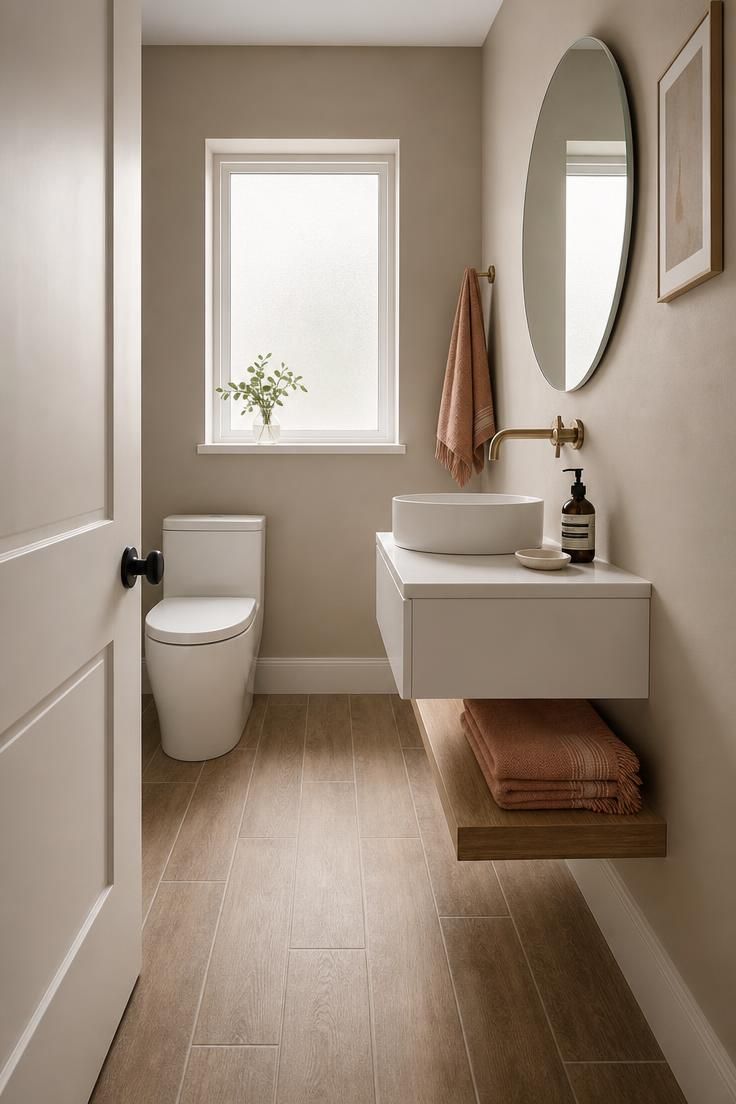
Wood-look porcelain tile has become remarkably convincing in its visual grain, with digital printing technology that captures the variation and knot patterns of real hardwood.
Luxury vinyl plank flooring adds a softer feel underfoot than tile and installs quickly as a floating floor, making it a popular choice in rental properties and budget renovations.
Waterproof laminate occupies a middle ground, offering wood texture at a lower price point with decent moisture resistance that holds up in powder rooms and low-splash zones.
Where every alternative falls short is in the tactile dimension: real wood responds to bare feet differently than any synthetic surface, with a warmth and slight give that printed surfaces cannot reproduce.
The sound is different too, because wood absorbs footfall noise in a way that tile and vinyl bounce back.
These alternatives make sense in specific contexts, including rental bathrooms, secondary baths with heavy foot traffic, and spaces where the budget does not support the sealing and maintenance a real wood floor requires.
The Color Pairings That Let a Wooden Floor Lead the Room
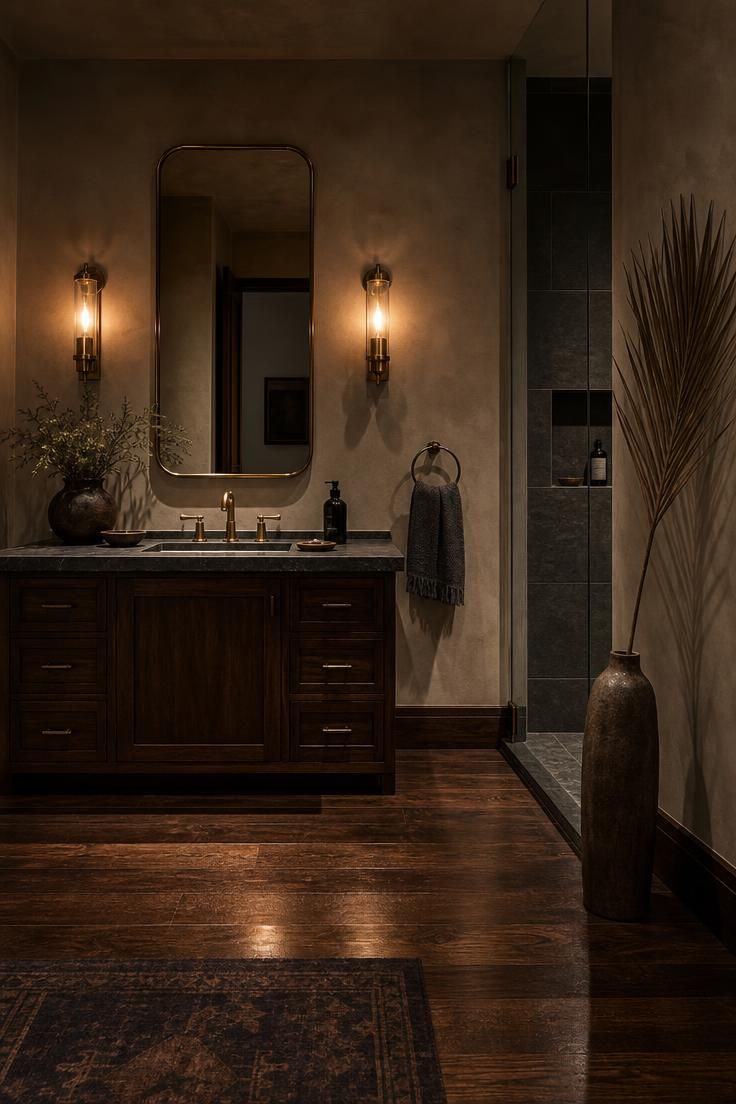
A warm bathroom palette built around wood flooring starts by letting the floor set the tonal anchor for every other surface in the room.
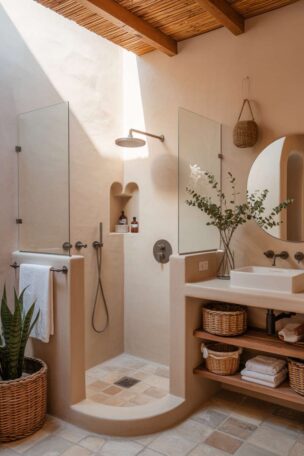
Honey oak pairs naturally with matte brass fixtures and warm plaster walls in cream or soft sand tones, creating a layered warmth that never feels heavy.
Walnut floors, with their deeper chocolate-brown grain, call for cooler metals like brushed nickel and supporting surfaces in greige or soft slate to keep the room from tipping too dark.
Teak’s golden warmth responds well to bronze fixtures and cream stone surfaces, building a spa-inspired bathroom atmosphere that feels grounded rather than sterile.
The broader shift away from cool grays toward sand, taupe, and muted terracotta as supporting tones means that wood floors now sit at the center of the most current design direction rather than working against it.
High-contrast pairings, like a light ash floor against jet-black walls, can look striking in magazine spreads but often feel uncomfortable in daily life because the eye has nowhere to rest.
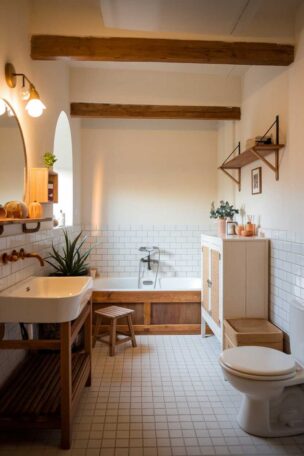
The most livable bathrooms let the wood floor lead quietly, with surrounding surfaces pulling from the same tonal family rather than competing for visual attention.
A natural wood vanity that matches the floor species creates a grounding effect that ties the entire room together without needing a single bold statement piece.
Design Pro-Tip: “Pull your accent metal directly from the floor’s undertone. If the wood runs warm and golden, reach for unlacquered brass. If it leans cooler and ashy, brushed nickel keeps the room feeling cohesive from fixture to floor.”
Why This Detail Matters More Now Than Five Years Ago
Five years ago, a wooden floor in a bathroom was still treated as a risk, something adventurous homeowners attempted with a mix of hope and worry.
The practical barriers were real: sealant technology was less reliable, engineered hardwood options were limited, and most flooring professionals actively discouraged it.
That has changed on every front.
Waterproof wood finish formulations now borrow directly from marine and commercial applications, creating barriers that hold up under daily bathroom conditions without frequent reapplication.
The biophilic bathroom design movement has also shifted expectations, with architects and interior designers treating natural materials as the default rather than the exception.
Quiet luxury, the defining aesthetic of current high-end interiors, depends on surfaces that feel rich through material quality rather than decorative excess, and nothing delivers that sensation more directly than a well-chosen wood floor.
This is not a trend cycling in and out with seasonal color palettes or fixture fashions: it represents a permanent shift in how people define what makes a bathroom feel like a finished, intentional space.
Conclusion: The Floor Sets the Feeling
Every decision in a bathroom with wooden floor narrows to three choices: species, pattern, and finish.
For species, teak bathroom flooring and white oak flooring offer the strongest combination of moisture resistance and visual warmth, with engineered hardwood construction as the structural foundation.
For pattern, a herringbone floor pattern adds movement and architectural interest, while wide planks create calm, open surfaces that stretch small rooms visually.
For finish, a factory-applied waterproof wood finish with marine-grade sealant gives you the most durable starting point, with a reseal every two to three years to maintain the barrier.
The warmth a wooden floor brings to a bathroom is something you feel every morning before you fully register what changed, and that quiet, repeated comfort is the definition of a detail that earns its place.