This post may contain affiliate links. If you make a purchase through these links, we may earn a commission at no additional cost to you.
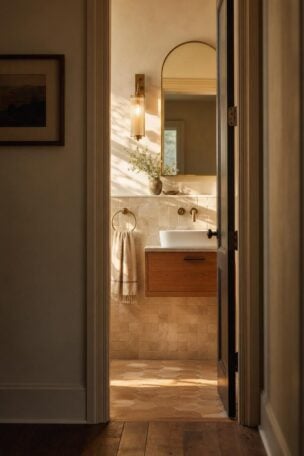
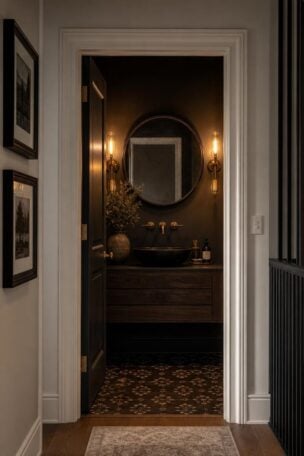
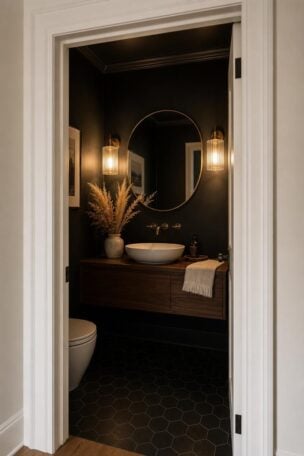
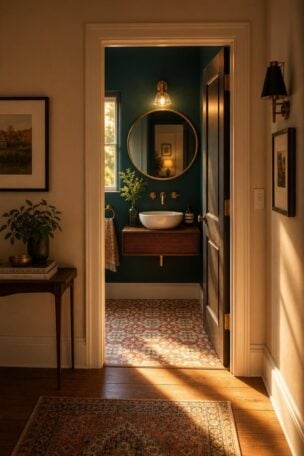
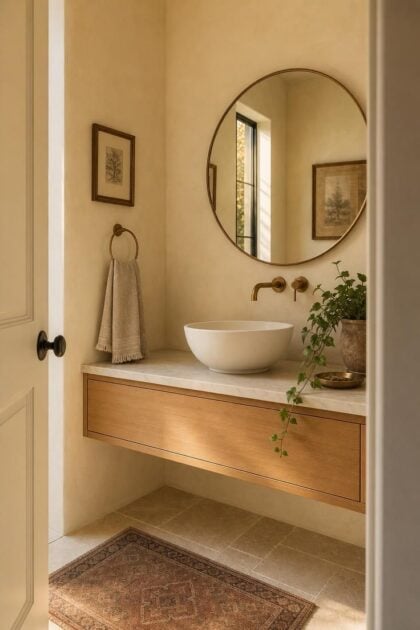
A modern powder room earns more attention per square foot than any other space in the house.
The compact footprint means every material choice, every fixture, and every color reads at close range, so nothing hides.
That concentrated scale is exactly what makes the powder room such a rewarding place to take risks with finish, texture, and proportion.
The 13 half bathroom design ideas ahead cover everything from micro-cement walls and poured resin floors to ribbed glass partitions and handmade ombre tile, each one built around a single strong visual move that turns a small room into the most memorable one in the home.
Whether you are starting from bare drywall or refreshing tired tile, these approaches prove that limited square footage and bold style go together naturally.
Micro-Cement Walls With a Slim Cantilevered Stone Vanity Shelf
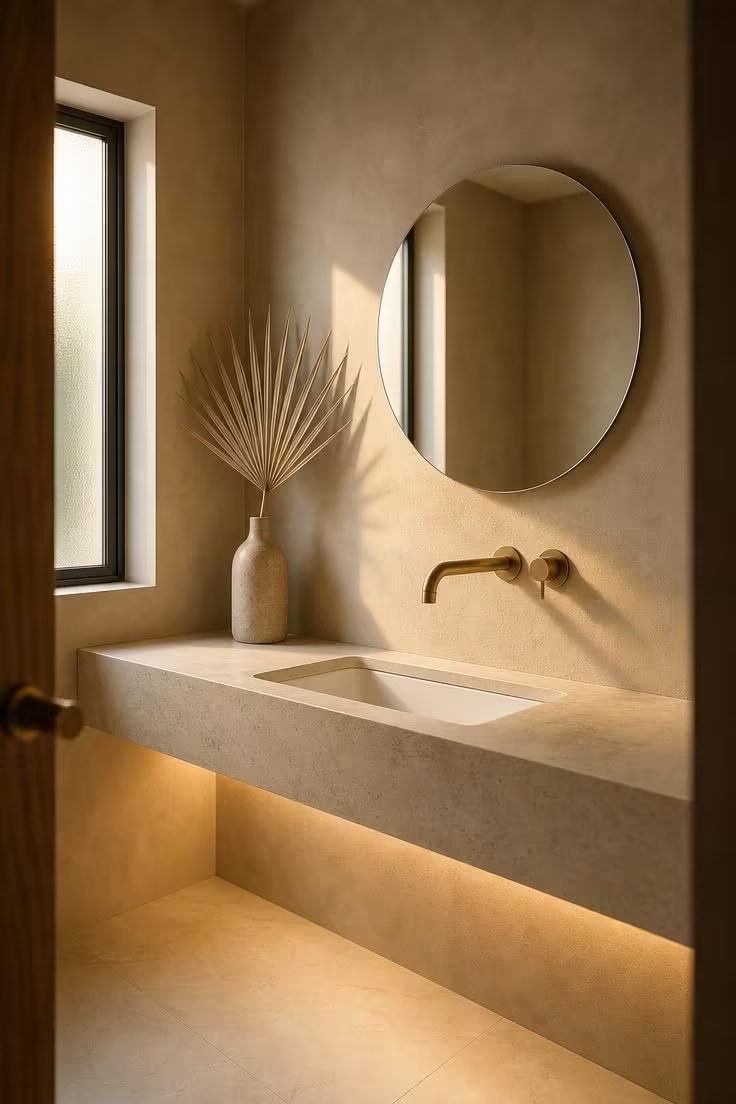
There is a particular calm that comes from walking into a room with no visible seams, no grout lines, and no hard edges breaking the surface.
Micro-cement gives you that uninterrupted plane across all four walls, and in a modern powder room this size, the effect is almost meditative.
The cantilevered limestone shelf floats without visible brackets, which keeps the visual weight low and the floor easy to clean.
Use concealed support designed for the actual stone, wall construction, basin, fixture arrangement, and expected loads, with mounting details supplied by the fabricator or installer.
Mounting the faucet directly to the wall frees the stone surface for a single styled object and nothing else.
That restraint is what separates a finished room from a decorated one.
The LED strip beneath the shelf adds a warm floating glow that softens the hard mineral surfaces after dark.
Pair it with appropriate ambient or task lighting rather than assuming the concealed strip alone will provide sufficient illumination for every handwashing setup.
Style Blueprint:
- Micro-cement wall finish in a warm mushroom or oat tone, sealed with a matte topcoat
- Honed limestone cantilevered shelf, 28 to 30 inches wide, with concealed support specified for the stone, wall construction, basin, fixtures, and expected loads
- Matte brass wall-mounted faucet with single lever handle
- Recessed LED strip (warm white, 2700K) mounted under the front lip of the shelf
- Round frameless mirror, 24 to 28 inches in diameter
Ribbed Glass Partition With a Poured Concrete Pedestal Sink
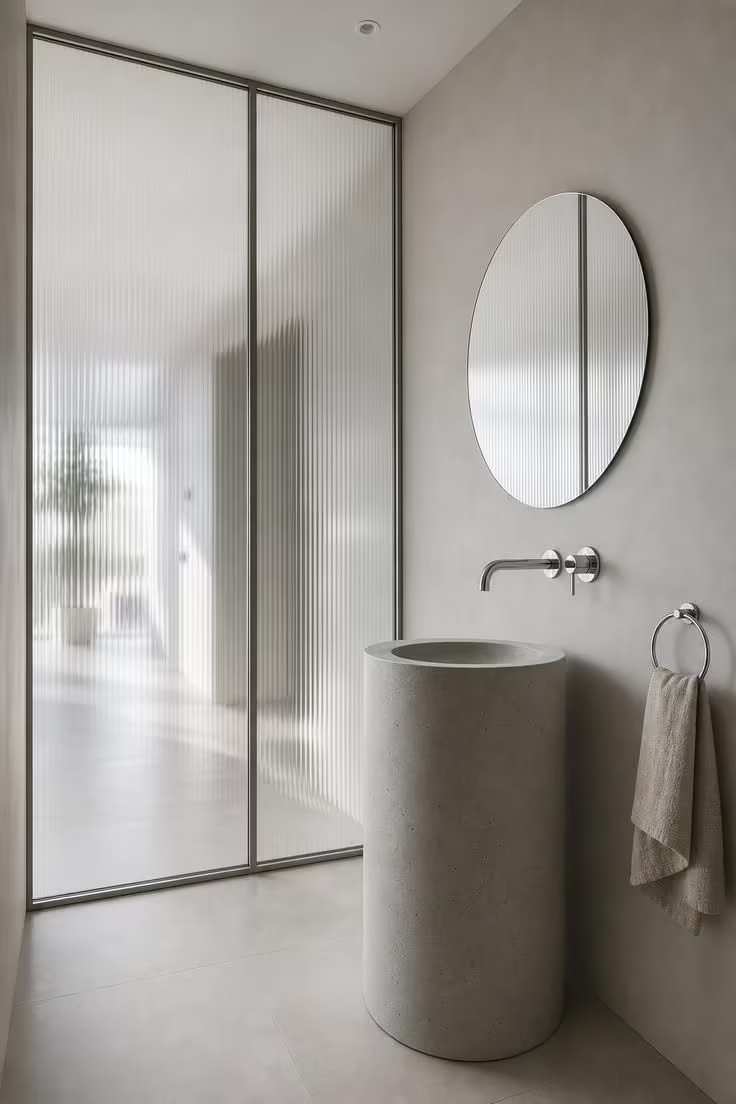
Ribbed glass does something no other partition material can manage: it borrows light from the next room without borrowing the view.
The vertical fluting distorts shapes just enough to keep the powder room private, yet the brightness of the hallway still reaches the interior, cutting the need for heavy overhead fixtures during the day.
Against that diffused backdrop, the concrete pedestal sink reads like a gallery sculpture rather than a plumbing fixture.
Its raw, mineral surface absorbs sound in a way that hard tile walls never do, giving the room an unexpectedly quiet atmosphere.
Polished chrome hardware works here because it picks up the cool tones already present in the glass and concrete without competing for attention.
Keeping the mirror frameless and the floor a single large-format tile reinforces the room’s deliberate simplicity.
Every object in the room earns its place by doing one job well and staying out of the way.
Style Blueprint:
- Floor-to-ceiling ribbed (reeded) glass panel, tempered, 3/8-inch thick
- Poured concrete pedestal sink sealed with a penetrating matte sealer
- Polished chrome wall-mounted faucet with cross handles
- Large-format honed porcelain floor tile (24 x 24 inches) in a pale gray
- Round frameless mirror, 30 inches in diameter
Cork Wall Panels Behind a Brushed Nickel Wall-Mounted Faucet
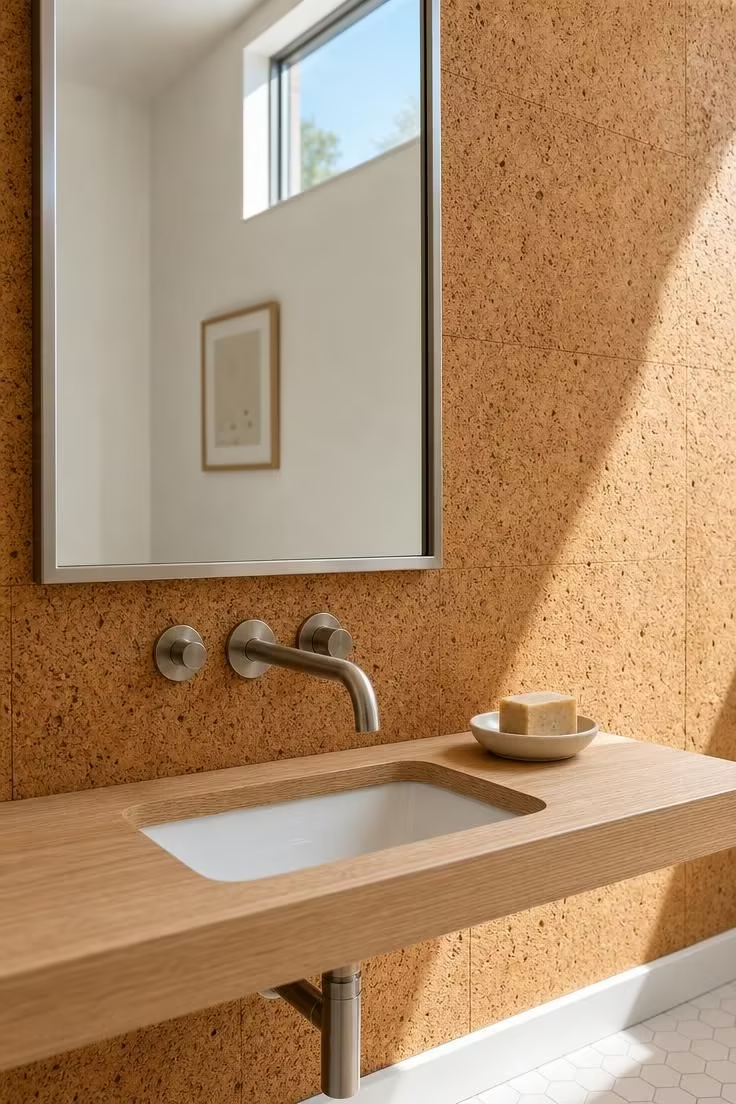
Cork is one of those materials people associate with pinboards and wine bottles, so using it as a full accent wall in a guest bathroom resets expectations the moment someone opens the door.
The surface is warm to the touch, absorbs ambient noise, and has a fine organic texture that catches midday light in a way smooth plaster simply cannot.
It pairs surprisingly well with brushed nickel hardware, the cool silver picking up on the tiny flecks of lighter grain running through the cork.
Beneath the panels, a slim floating white oak shelf vanity keeps the footprint compact and lets the wall treatment remain the star.
White hexagonal floor tile below grounds the warmer tones and prevents the room from feeling like a sauna.
Because cork is naturally antimicrobial and moisture resistant at the splash-zone level of a half bath, it holds up far better than fabric wallcoverings.
A thin coat of clear matte sealer every two years is the only upkeep it asks for.
A flush-mount frosted glass ceiling light fills in the shadows on cloudy days without flattening the texture of the cork.
Style Blueprint:
- Natural cork wall panels (12 x 24-inch tiles), sealed with a matte water-based polyurethane
- Brushed nickel wall-mounted faucet, single handle
- Floating white oak shelf vanity, 24 to 28 inches wide, with one soft-close drawer
- White hexagonal porcelain floor tile (2-inch hex)
- Large rectangular mirror with a thin brushed nickel frame
Skinny Herringbone Porcelain Tile With a Matte Black Oval Mirror
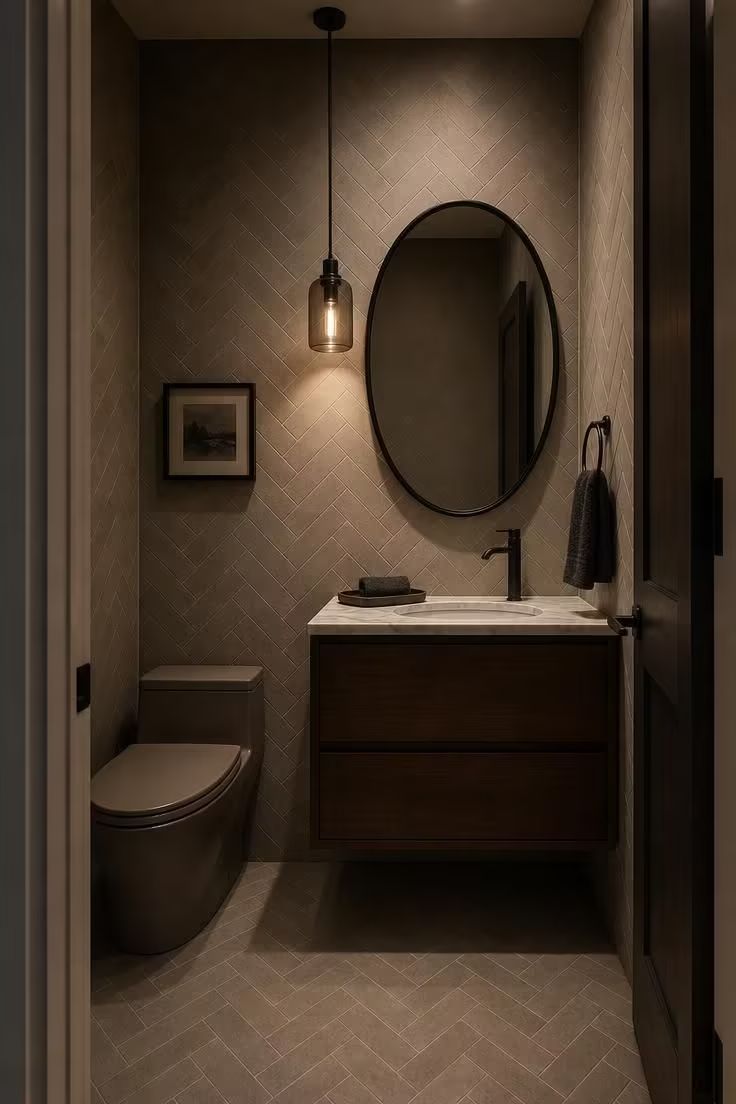
Stepping through a doorway into a fully tiled room shifts your sense of scale immediately, and the skinny herringbone pattern amplifies that effect by drawing the eye upward along its diagonal grain.
Warm taupe is a forgiving neutral here, rich enough to read as intentional under low light but not so dark that the small room feels cramped.
The matte black oval statement mirror breaks the pattern with a single clean shape, giving the eye a place to rest.
Pairing it with a dark walnut floating vanity and matte black hardware keeps the palette disciplined to two material families: warm wood and black metal.
A single pendant light, rather than a pair of sconces, creates a pool-of-light effect that makes the room feel intimate rather than uniformly lit.
This is one of the strongest small bathroom ideas for anyone who wants tile without the sterile clinical look that large white rectangles sometimes produce.
Style Blueprint:
- Skinny herringbone porcelain tile in warm taupe (2 x 10-inch format), floor to ceiling
- Matte black oval mirror, approximately 20 x 30 inches
- Dark walnut floating vanity, 24 inches wide, with honed white marble top
- Matte black single-handle wall-mounted faucet
- Smoked glass pendant light with a warm-filament bulb
Design Pro-Tip: When you tile a powder room floor to ceiling in a single material, choose a grout color within one shade of the tile itself. Contrasting grout turns every joint into a visible line, which can make a small space feel busier than it should. Tone-matched grout lets the pattern do the talking.
Hand-Troweled Clay Plaster and a Raw Brass Towel Ring
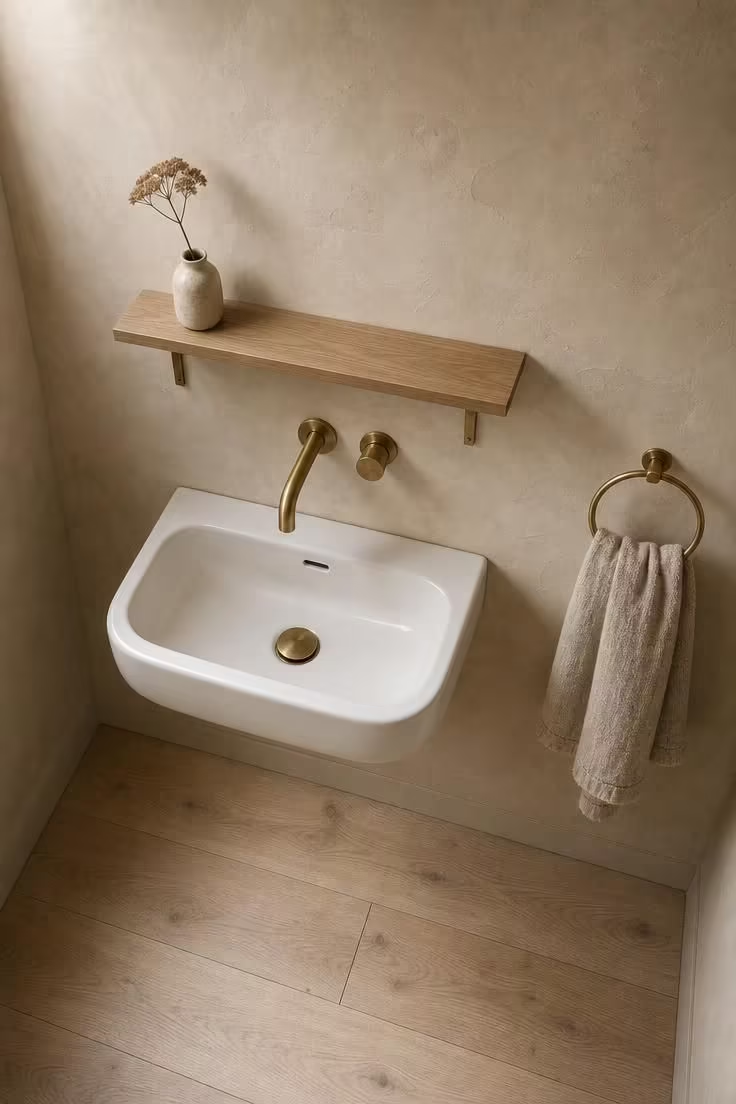
Clay plaster does something unusual in a modern powder room: it slows you down.
The surface is not smooth, not rough, but somewhere in between, and the tiny irregularities in the trowel work catch soft light in a way that makes the wall feel alive rather than flat.
Pale sand is a good starting tone because it holds warmth without competing with the brass hardware.
Raw brass ages in place, developing a patina that deepens month over month, which means the room looks slightly different every time someone visits.
Matching the faucet, towel ring, and shelf bracket in the same raw brass finish ties the hardware together without making the room feel coordinated to the point of being stiff.
A wall-hung porcelain basin, rounded at every edge, adds a softness that balances the mineral grit of the plaster.
Wide-plank pale oak flooring running in from the hallway makes the transition smooth and avoids a threshold strip that would interrupt the flow.
A woven jute pendant above would add a fiber layer, but keeping the ceiling simple and recessed lets the wall remain the entire story.
Even the single dried stem in the bud vase is deliberate, just enough life to suggest someone uses this room without cluttering the shelf.
Style Blueprint:
- Hand-troweled clay plaster in pale sand (products like Clayworks or Limestrong)
- Raw brass wall-mounted faucet, towel ring, and shelf bracket set
- Wall-hung porcelain basin with rounded profile
- Arched mirror with a slim white or natural wood frame
- Wide-plank pale oak flooring (5 inches or wider)
Full-Height Sage Green Tile With a Curved White Vessel Basin
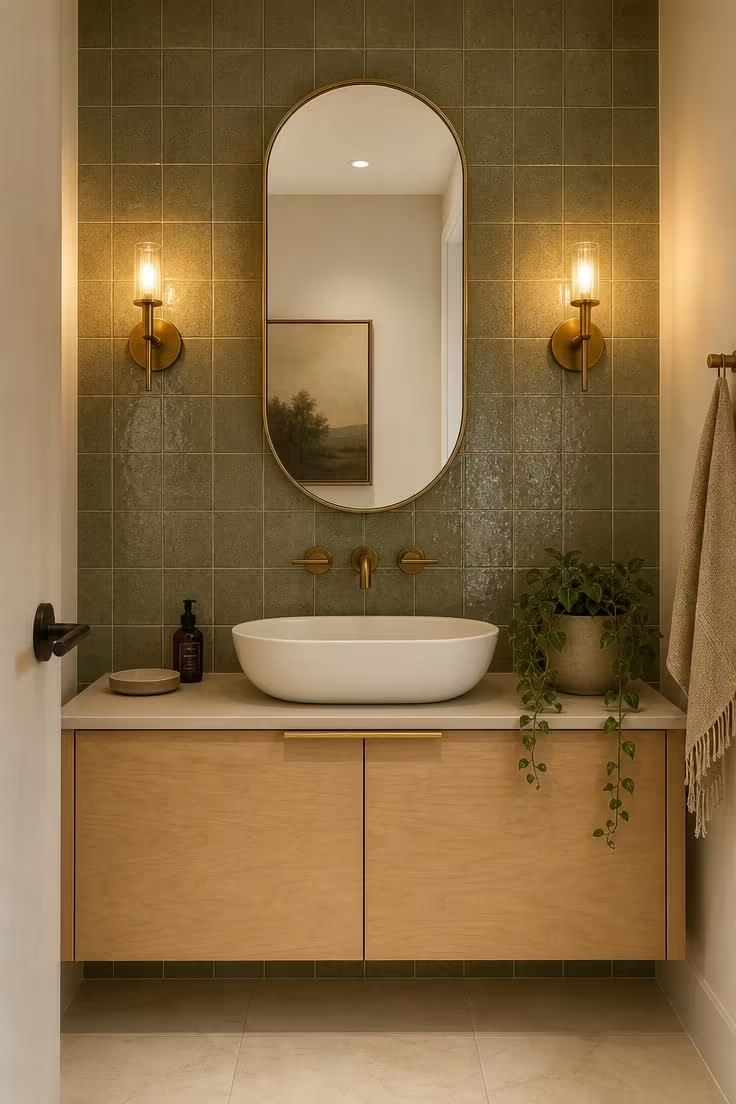
Green tile in a powder room changes the feeling of the space more than almost any other single surface decision.
Sage sits at a comfortable midpoint between warm and cool, so it flatters skin tones in the mirror better than a stark blue or a saturated emerald.
The crackle glaze on each tile catches the sconce light differently across the wall, creating a slight shimmer that a flat matte tile would miss.
A curved white vessel sink on top of the birch vanity introduces a rounded form that softens all the square tile geometry surrounding it.
Satin brass hardware warms the palette further without the high reflectivity of polished brass, keeping the mood relaxed.
This powder room vanity setup works especially well in homes where the adjacent rooms lean neutral, because the green reads as an event you walk into rather than a color you live with all day.
A trailing potted plant on the vanity corner echoes the green on the wall and connects the mineral tile to something organic and alive.
Style Blueprint:
- Square sage green tile with crackle glaze (4 x 4-inch or 6 x 6-inch format), full height
- Curved white ceramic vessel basin
- Pale birch slab-door vanity, 24 inches wide
- Satin brass wall-mounted faucet and matching sconces
- Pill-shaped mirror with thin brass frame
Stacked Natural Stone Ledger Panel With a Teak Floating Shelf
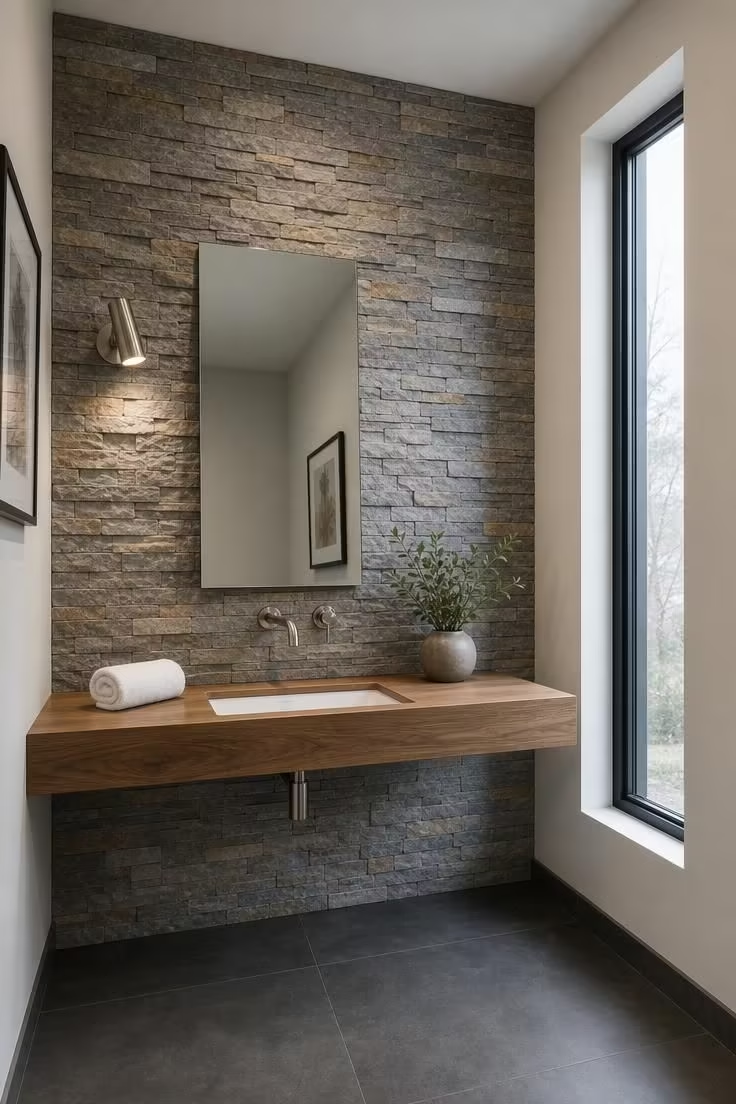
Stacked stone in an interior space can go wrong quickly if the room is too large, because the texture overwhelms the furnishings.
A powder room is the opposite problem, and that works in your favor: the compact scale lets you stand close enough to appreciate the split-face grain of each stone piece.
Mounting a teak floating shelf directly to the stone face creates a material conversation between mineral roughness and smooth, oiled wood.
Polished nickel hardware picks up the cool gray veining in the stone without introducing a competing warm tone.
Leaning the mirror rather than mounting it flat adds a casual tilt that catches more of the ceiling light and feels less formal than a center-hung mirror.
A matte charcoal floor recedes beneath the textured wall, keeping the room’s visual weight anchored to one surface.
Cool, even light from a narrow window flatters this particular material combination, because directional sun would create harsh shadows across the ledger profile.
A slim reading-style sconce on the adjacent wall fills in where the natural light falls short, casting a warm cone onto the sink area.
Style Blueprint:
- Stacked natural stone ledger panel in gray and tan split-face (6 x 24-inch strips)
- Teak floating shelf vanity, 30 inches wide, sealed with teak oil
- Polished nickel wall-mounted faucet with lever handle
- Frameless rectangular mirror, leaning style
- Matte charcoal large-format porcelain floor tile (24 x 24 inches)
Geometric Cane Webbing Panel With a Pale Terrazzo Counter
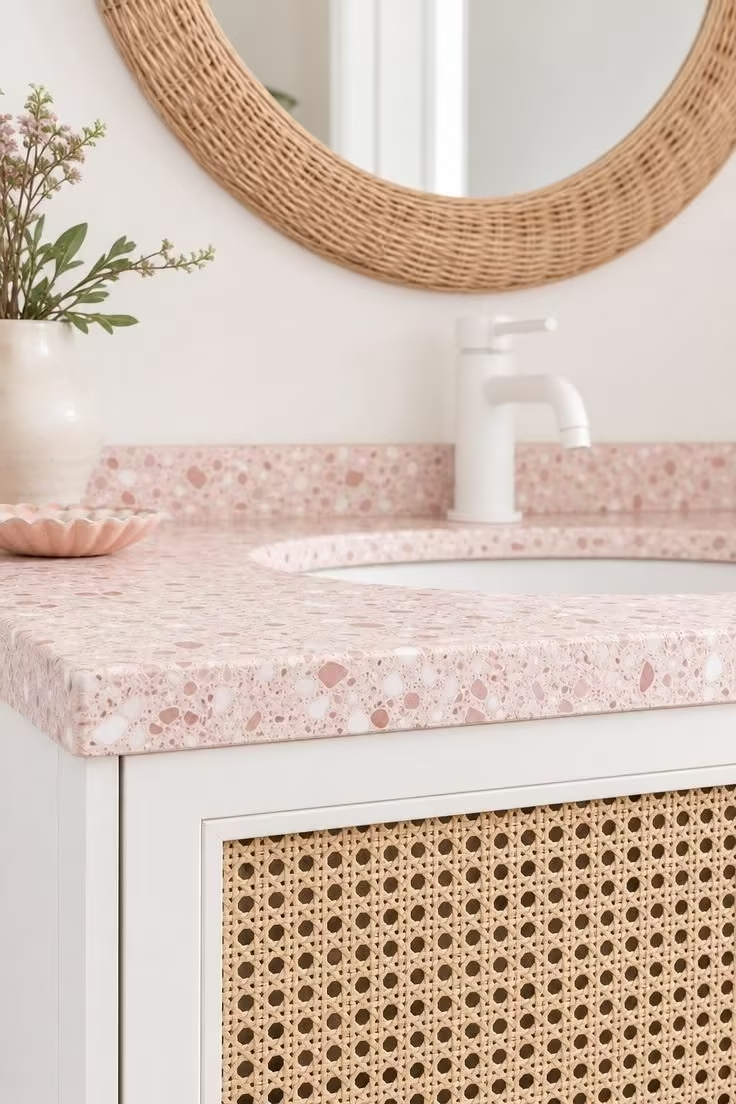
Cane webbing on a vanity door is an unexpected material in a bathroom context, and that surprise is exactly what gives this combination its charm.
The woven grid introduces a handcraft quality that balances the polished terrazzo surface above it.
Pale pink terrazzo with blush and white aggregate is soft enough to feel neutral but distinct enough to register as a deliberate choice under bright light.
A matte white faucet disappears against the wall, letting the materials hold attention without hardware competing for the spotlight.
The rattan-framed mirror overhead repeats the woven texture at a different scale, linking the lower and upper halves of the room.
Style Blueprint:
- Geometric cane webbing panel inset into a painted wood vanity door frame
- Pale pink terrazzo countertop with white and blush aggregate, honed finish
- White undermount basin with simple rounded edges
- Round mirror with a natural woven rattan frame, 24 inches in diameter
- Matte white single-handle faucet
Ombre Glazed Tile Wall With a Pill-Shaped Brass Mirror
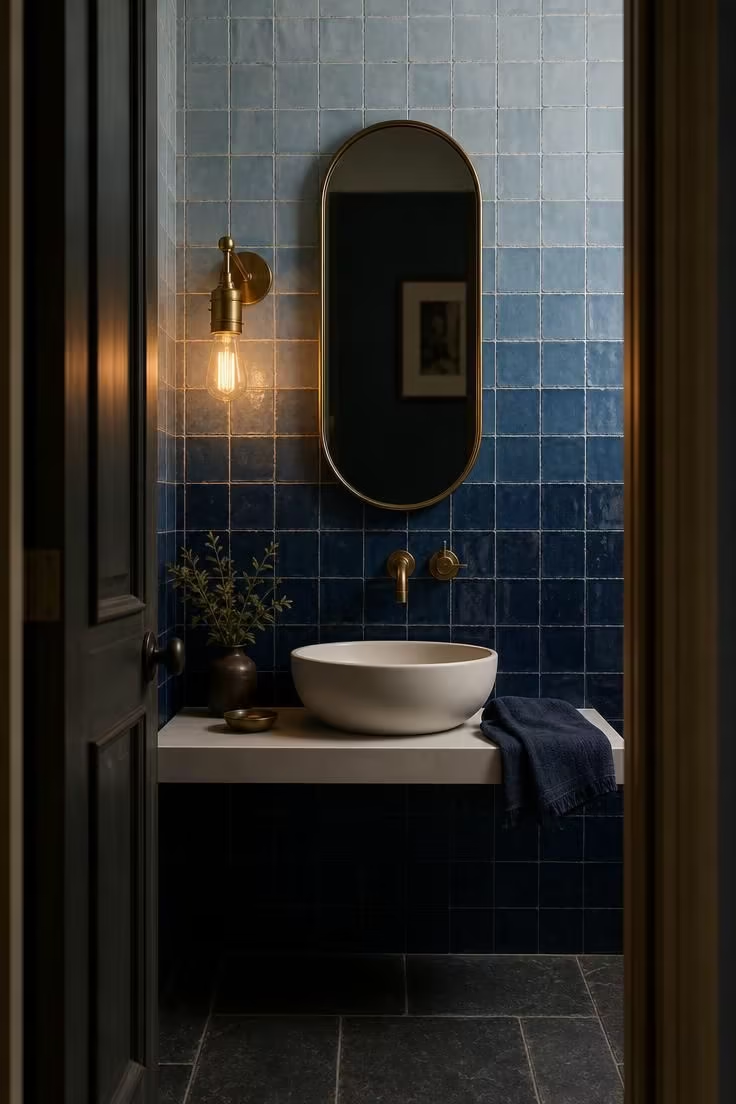
Walking into a room where the walls change color as your eye travels upward is a disorienting pleasure, the kind of detail that makes guests pause and look twice.
Handmade glazed ceramic tiles in an ombre gradient require careful row-by-row selection, but the payoff is a surface that no printed powder room wallpaper can replicate.
Navy at the floor anchors the room with weight, and the gradual shift toward sky blue at the ceiling lifts the proportions, making the space feel taller than its actual dimension.
The pill-shaped solid brass mirror is the right companion here because its warm metallic surface contrasts the cool tile without sharp corners competing with the horizontal tile lines.
Aged brass, rather than polished, brings a softness that complements the handmade quality of the glazed surface.
A single filament-bulb sconce casts just enough warm light to bring out the glaze variation without flooding the gradient into flatness.
Dark slate on the floor disappears beneath the navy base row, letting the ombre wall claim every ounce of attention.
Style Blueprint:
- Handmade glazed ceramic tile in ombre gradient (navy to sky blue), 3 x 6-inch format
- Pill-shaped solid brass mirror, approximately 18 x 36 inches
- Slim white floating vanity shelf, 24 inches wide
- Aged brass wall-mounted faucet, cross-handle style
- Dark slate floor tile in a 12 x 12-inch format
Design Pro-Tip: If you are working with handmade tile, dry-lay at least four rows on the floor before committing to the wall layout. Glaze variation across tiles from different production batches can shift the ombre effect, and sorting tiles by tone before installation saves costly rework.
Poured Resin Floor With a Wall-Mounted Trough Sink in Matte White
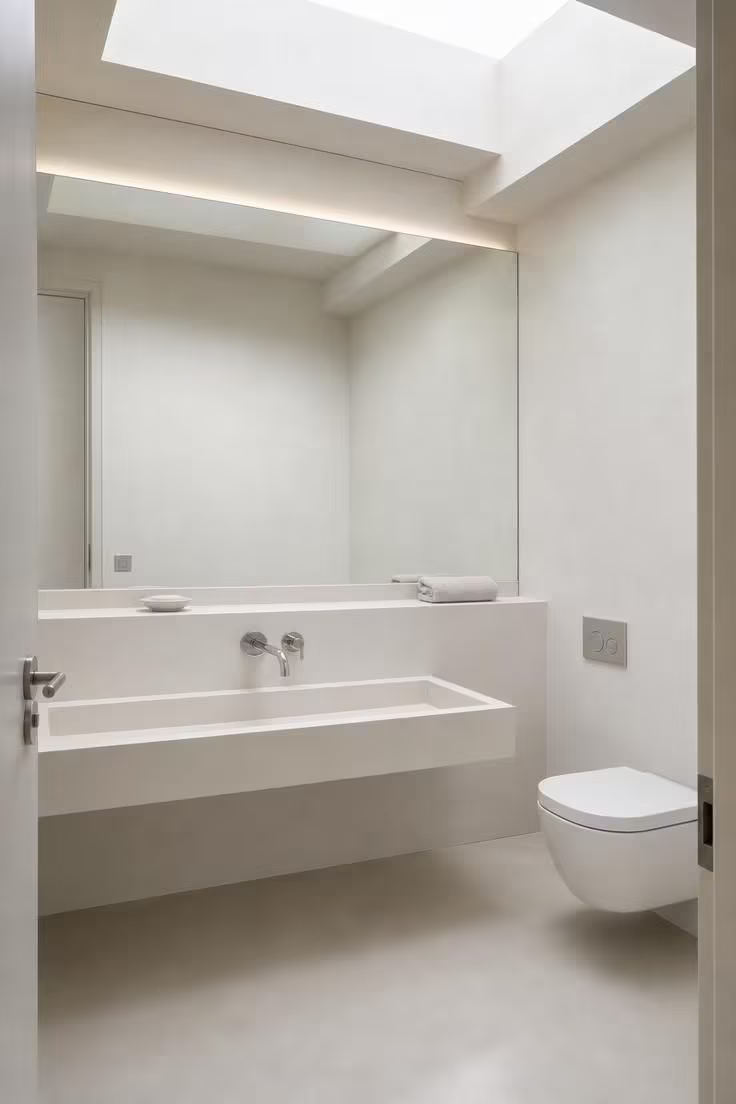
A completely unbroken floor changes the acoustic of a small room, absorbing the tap of shoes instead of bouncing sound off grout channels the way tiled surfaces do.
Poured resin in dove gives the room a gallery quality, a continuous neutral field that lets the wall-mounted trough sink act as the sole visual event.
The trough profile is wider and shallower than a standard basin, which creates a sense of openness across the vanity zone even though the room itself may be no more than four feet wide.
Mounting the faucet to the wall and using a concealed-cistern toilet keeps every plumbing connection hidden, reinforcing the clean-lined ethos from floor to ceiling.
A full-width frameless mirror amplifies the room’s depth and reflects the recessed LED strip above it, doubling the perceived light without adding another fixture.
White plaster walls, dove floor, matte white porcelain, and polished nickel: the entire palette operates within a three-tone range, which is what gives the room its controlled, deliberate atmosphere.
A thin floating shelf with a single soap dish and folded towel is all the surface needs, any more and the monochrome effect starts to fracture.
Soft light from a recessed skylight is the ideal source here, because it falls evenly across the continuous floor without creating a glare point on the resin surface.
The result is a room that photographs well and feels even better in person, because the silence of the materials is something you notice only when you are standing inside.
Style Blueprint:
- Continuous poured resin floor in dove or pale warm gray, matte finish
- Wall-mounted matte white trough sink (rectangular, approximately 36 inches wide)
- Polished nickel wall-mounted faucet, single lever
- Full-width frameless mirror spanning the vanity wall
- Concealed-cistern wall-hung toilet with slim profile
Vertical Cedar Slat Partition With a Concrete Cube Pedestal Sink
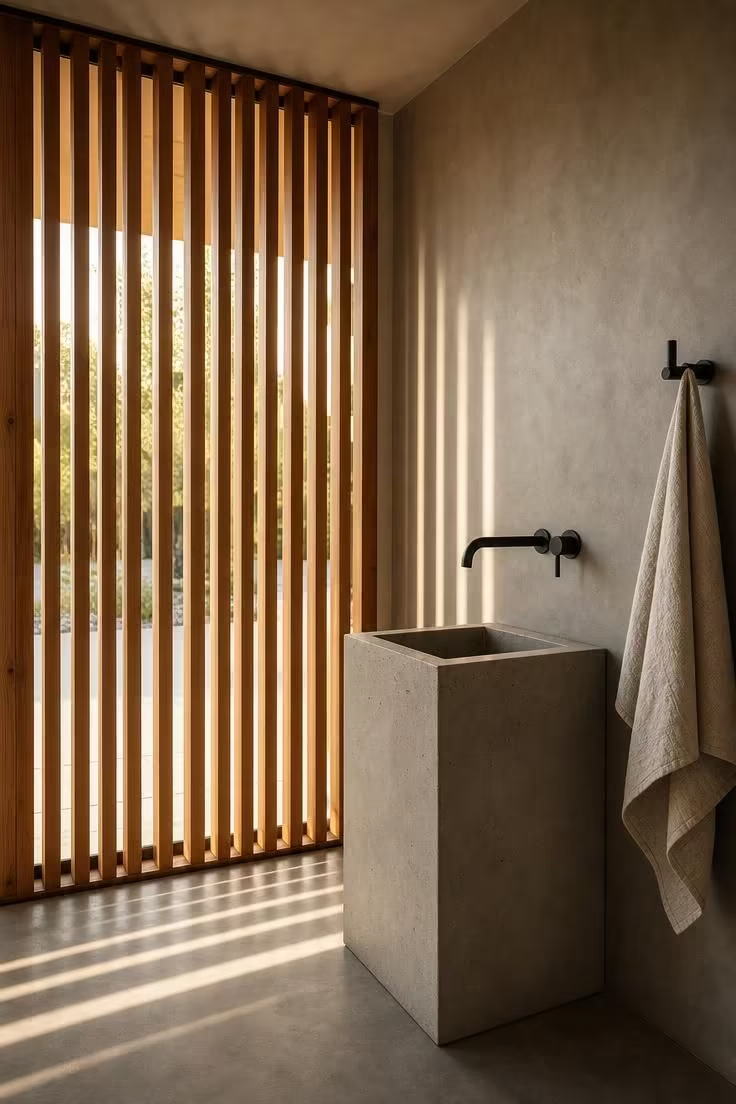
Cedar slats as a partition do two things at once: they mark the threshold of the powder room without closing it off, and they create a light pattern on the floor that changes throughout the day as the sun shifts.
Those moving stripe shadows give the room a sense of time passing, which is an unusual quality for such a small space.
The concrete cube pedestal sink is a counterweight to the warm wood, all squared edges and mineral cool against the organic grain of the cedar.
Matte black hardware reads as a thin graphic line against the gray concrete, sharp enough to anchor the composition without bulk.
A warm gray micro-topping on the floor bridges the two dominant materials, lighter than the concrete sink but cooler than the cedar overhead.
Keeping the room free of a mirror on this wall lets the slat partition remain the first thing you notice, and moving the mirror to the adjacent wall creates a secondary focal point that unfolds as you step inside.
Style Blueprint:
- Vertical cedar slats (1.5 inches wide, 1-inch spacing), sealed with a clear matte exterior-grade finish
- Concrete cube pedestal sink with integrated square basin, sealed with penetrating sealer
- Matte black wall-mounted faucet, single lever
- Warm gray micro-topping floor finish
- Matte black wall-mounted coat hook
Polished Plaster Archway Niche Housing a Round Backlit Mirror
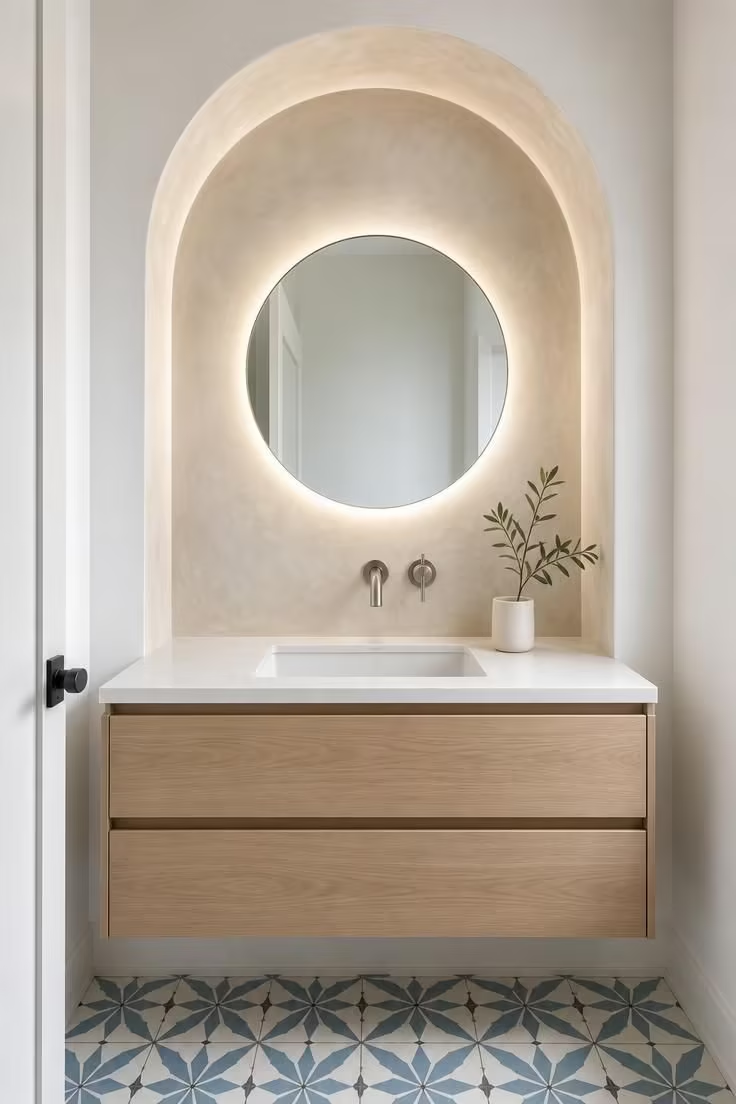
An archway niche turns a flat wall into architecture, and when you line the interior with polished plaster, the curved surface catches light in a continuous sweep that flat drywall never achieves.
Housing the mirror inside the niche rather than mounting it flush to the wall creates depth, pushing the reflection a few inches further back and making the room feel wider than it is.
The backlit LED halo does most of the heavy lifting for task light, illuminating the face evenly from all sides and eliminating the harsh under-eye shadows that a single overhead fixture produces.
Warm ivory plaster in the niche interior works because it bounces that LED light back into the room with a soft warmth, preventing the halo from reading too clinical.
Below, a floating pale oak vanity and white quartz top keep the lower half simple, so the arch above gets full visual priority.
Patterned cement tile on the floor adds a secondary layer of interest at ground level, preventing the room from feeling top-heavy.
A satin nickel faucet and matching towel bar provide just enough metallic continuity without pulling focus from the plaster.
The result is a guest bathroom with built-in drama that doesn’t rely on paint color or wallpaper to create an impression.
Style Blueprint:
- Recessed archway niche (approximately 24 inches wide, 36 inches tall), framed in drywall and finished with polished plaster
- Round backlit LED mirror, 20 to 24 inches in diameter, recessed or surface-mounted inside the niche
- Floating pale oak vanity with white quartz countertop
- Satin nickel wall-mounted faucet and matching towel bar
- Patterned cement tile floor in a muted geometric design
Woven Rattan Light Shade Above a Slim Marble Console Sink
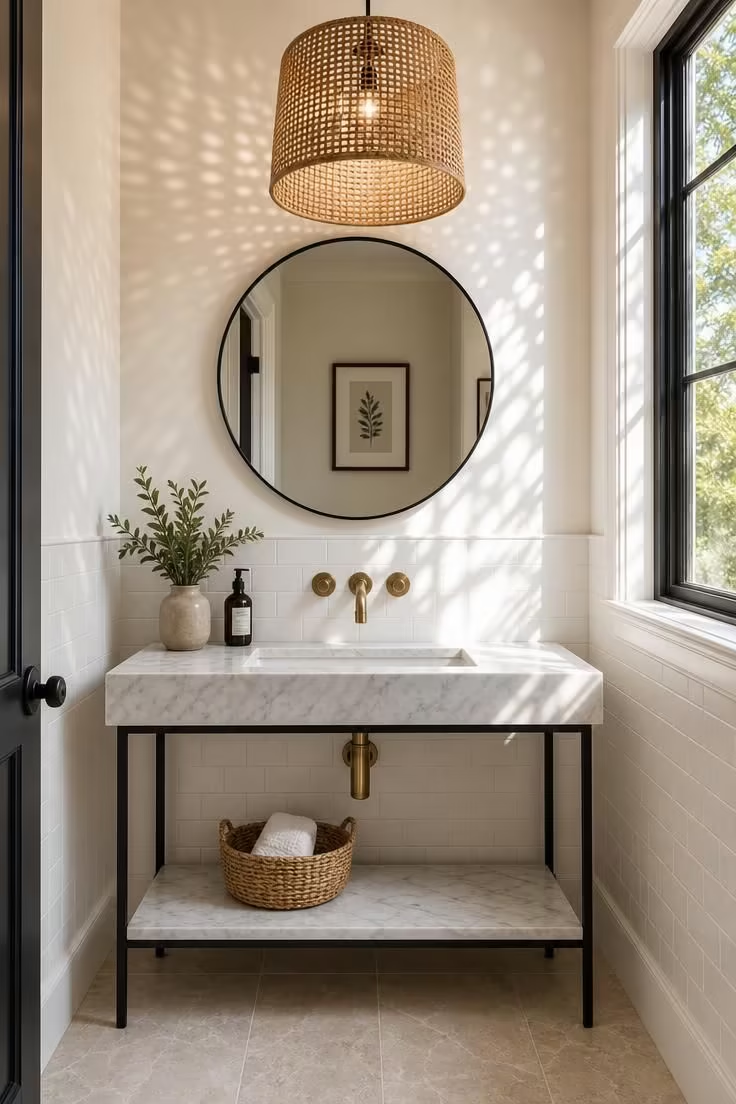
A woven rattan pendant works in a powder room the way a good hat works on a person: it changes the character of everything underneath it.
The dappled light pattern it casts across the subway tile and upper wall shifts throughout the day, giving the room a lively quality that fixed recessed lights cannot match.
Marble on a console frame with black metal legs is a lighter alternative to a closed-cabinet vanity, and in a room this small, seeing through to the floor beneath the sink makes the space read as larger.
Brushed brass on the faucet picks up the warm honey tone of the rattan without matching it exactly, which is the right level of coordination for a modern room.
White subway tile running halfway up the wall as a wainscot protects the splash zone and adds a classic horizontal rhythm that contrasts with the round shapes above.
A light natural stone-look porcelain floor tile keeps things grounded and easy to maintain.
This combination of rattan, marble, brass, and simple tile proves that mixing natural materials across different price points creates a modern powder room that feels collected over time rather than purchased in a single order.
Style Blueprint:
- Woven rattan drum pendant shade, 12 to 16 inches in diameter
- Slim marble console sink with thin black metal legs and lower shelf
- Brushed brass wall-mounted faucet, single lever
- White subway tile wainscot (3 x 6-inch format), installed to 42-inch height
- Large round mirror with a slim black metal frame, 28 to 30 inches in diameter
Design Pro-Tip: In a room with a pendant light, mount the fixture so the bottom edge of the shade sits at least 78 inches above the finished floor. Any lower and it crowds the headroom, especially in a compact powder room where the ceiling may already be standard eight-foot height. If your ceiling is lower than eight feet, consider a flush-mount version of the same woven material.
Conclusion
A modern powder room does not need a large footprint to carry serious design weight.
Each of the 13 ideas above starts with a single material or structural move, whether that is micro-cement, ombre tile, ribbed glass, or a plaster archway, and builds outward from there with restrained hardware and intentional lighting.
That focused approach is what keeps a small space from feeling cluttered or overworked.
Pick one wall treatment that excites you, one fixture shape that feels right, and let the room tell a short, clear story rather than trying to fit every trend into 25 square feet.
The best modern powder rooms feel like they were designed by someone who made a few strong decisions and then stopped.