This post may contain affiliate links. If you make a purchase through these links, we may earn a commission at no additional cost to you.
A nursery can look calm and still fail the only test that matters at three in the morning.
The room reads beautifully at noon, yet the wipes are two steps from the changing pad and the clean onesies live in a basket across the floor.
Minimalist nursery organization answers that gap.
It treats reach, not emptiness, as the organizing principle, and it asks where each item lives in relation to a caregiver’s actual body position.
The ideas below draw on named designers, real household accounts, and practical layout reasoning.
They stay with storage logic, furniture choices, and honest tradeoffs rather than a color scheme alone.
What Makes It Work: Reach Defines Layout in Real Residences
Accessibility should be at the center of nursery planning, keeping diapers, cream, and a feeding spot within easy reach rather than scattered around the room.
That single priority explains why some small rooms feel workable and others do not.
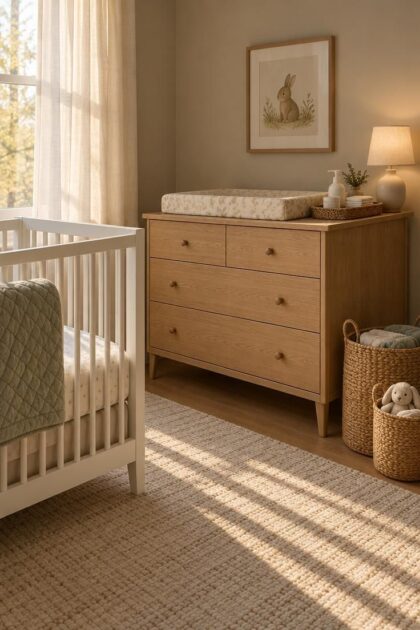
A practical solution is a sturdy chest of drawers as a long-lived investment, a piece that outlasts the diaper stage and adapts as clothing and bedding change.
The reasoning is easy to follow: a solid drawer stack holds a lot, hides a lot, and does not need to be replaced in two years.
Two core pieces, a crib and a changing table, can also provide valuable storage underneath for clothes, diapers, and creams.
Prioritizing storage frames minimalism as function, not empty space.
The reach zone itself is simple to define.
Start from the primary caregiving spot, whether that is the changing surface, the feeding chair, or the crib, and treat the space within a short arm movement as the home for items used most often.
Items used once a day can live farther away.
Seasonal clothing, spare bedding, and gifts not yet opened belong in a closet or a higher drawer, where they do not compete for space near the caregiver’s hands.
There is a limit worth naming.
Without a reliable place for incoming items, a minimalist system can quickly become cluttered, which is why the reach zone also needs a designated landing spot for the diaper bag, the mail, and the odd gift.
Design Pro-Tip: Before buying a single bin, set three cardboard boxes in the room labeled change, feed, and sleep, then place the items you actually use over two days into the matching box. Where the boxes end up tells you where storage belongs.
The Nursery Storage Baskets and Bins Question: Open Versus Closed
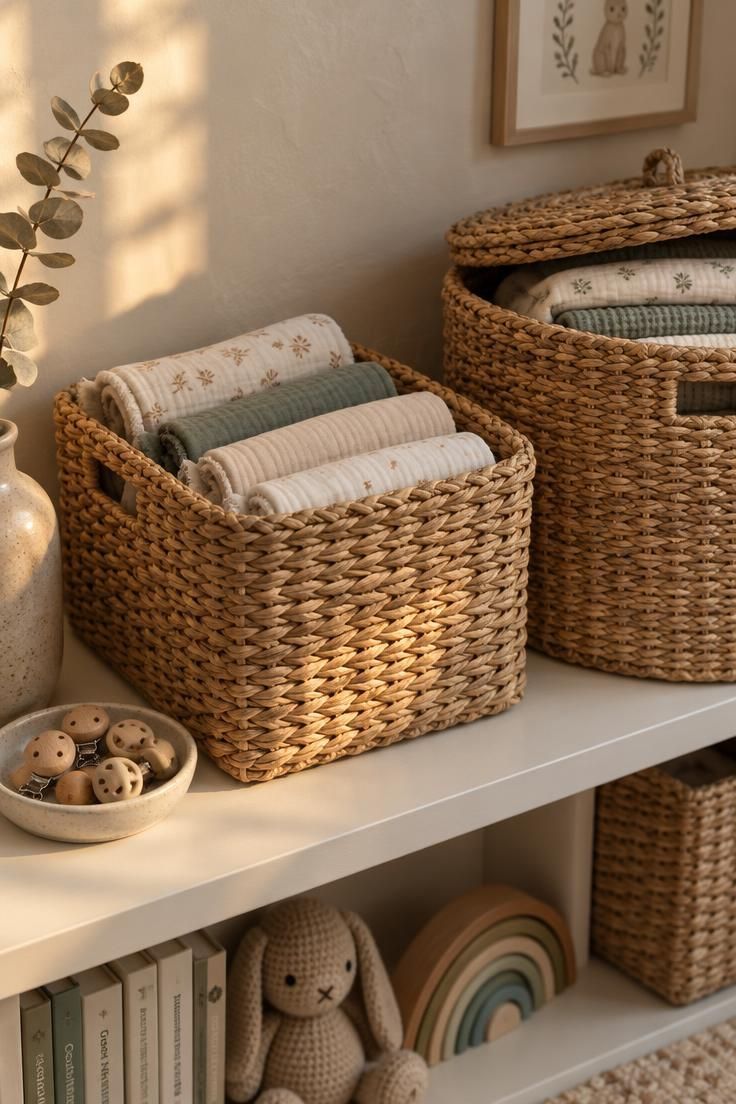
Baskets and bins recur in well-planned residential nurseries because they contain clutter without hiding everything from view.
The choice between open and closed versions does more visual work than most people expect.
Open baskets suit soft items and current-size clothing.
A woven basket of folded muslins or a week of onesies stays readable, and the texture adds warmth that a plastic tub cannot.
Closed bins suit small, visually busy objects.
Socks, pacifier parts, nail clippers, and the loose pieces of daily care disappear behind a lid, and the surface above stays clear.
The same principle applies to toys and other nursery essentials.
Keeping these items behind cupboard doors or inside closed containers helps maintain a tidy, uncluttered appearance, even when the room is used throughout the day.
For nursery storage baskets and bins, closed storage does most of the visual work in a minimalist room, while one or two open baskets act as a controlled release valve.
The tradeoff is maintenance.
Baskets and bins make cleanup easier as a nursery gradually evolves into a toddler’s space, but open containers require more frequent attention to maintain their organized appearance.
A simple decision rule keeps the mix honest.
If an item is used daily, give it an easy-open container; if it is seen daily, give it a lid.
Closed Storage for Nursery Toys Without a Playroom Overflow
Toys arrive faster than any other category and leave the floor slower than anyone hopes.
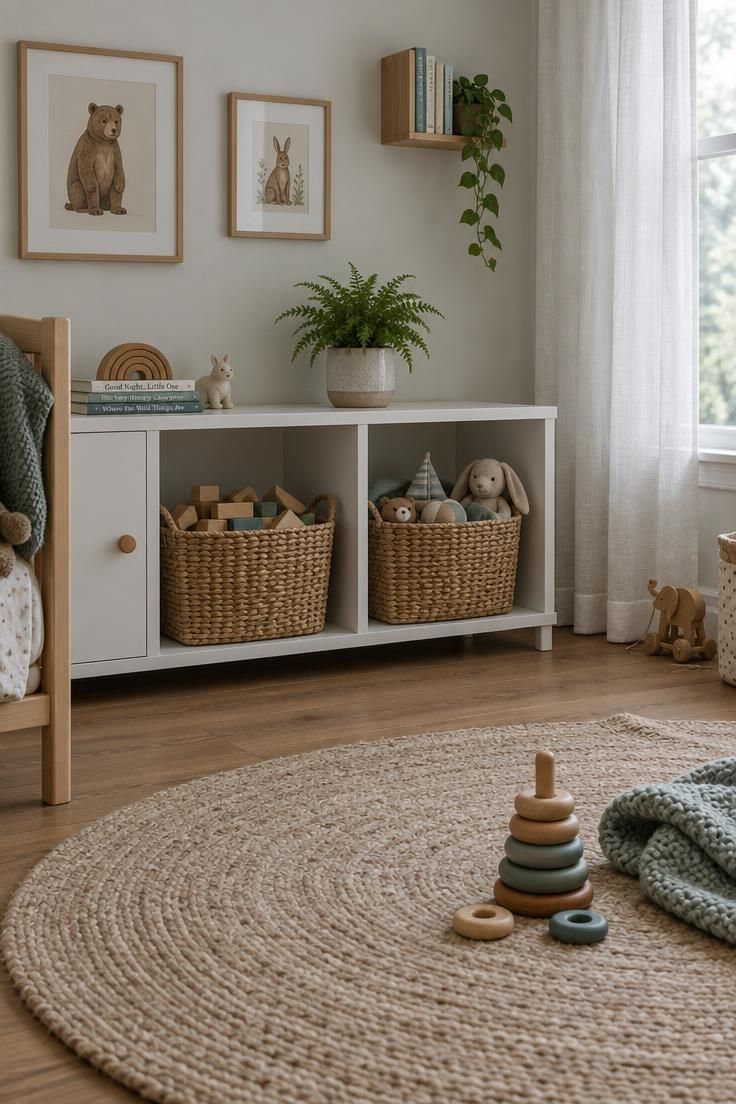
Closed storage for nursery toys is usually the first line of defense against the visual noise they create.
A practical approach is to keep storage simple, accessible, and consistent with the room’s design.
A few large, matching closed baskets or a low cabinet swallow the daily toy rotation, and the floor stays clear enough for play.
The habitual side matters as much as the container.
When every toy has a designated home, putting things away becomes a natural part of the daily routine, which is the quiet mechanism behind a room that stays calm before and after play.
Closed storage removes the pressure to style a shelf of wooden rainbows and plush animals.
The room can read as calm without a perfectly arranged display, and the household is spared the daily task of making it look intentional.
A useful count helps.
Young children often return to a handful of favorite toys throughout the day, so a low cabinet with two large bins and a closet shelf for the rest covers the rotation without turning the nursery into a warehouse.
The limitation is real.
Closed storage encourages an out of sight, out of mind pile if no system exists, and a bin that only receives items becomes a mystery box within weeks.
A one-in, one-out reset during naptime helps prevent most of it.
When a new toy enters the cabinet, an older one leaves for the donation box, and the bin stays at a size a small hand can dig through.
Dresser with Changing Pad Setup: Why It Earns the Footprint
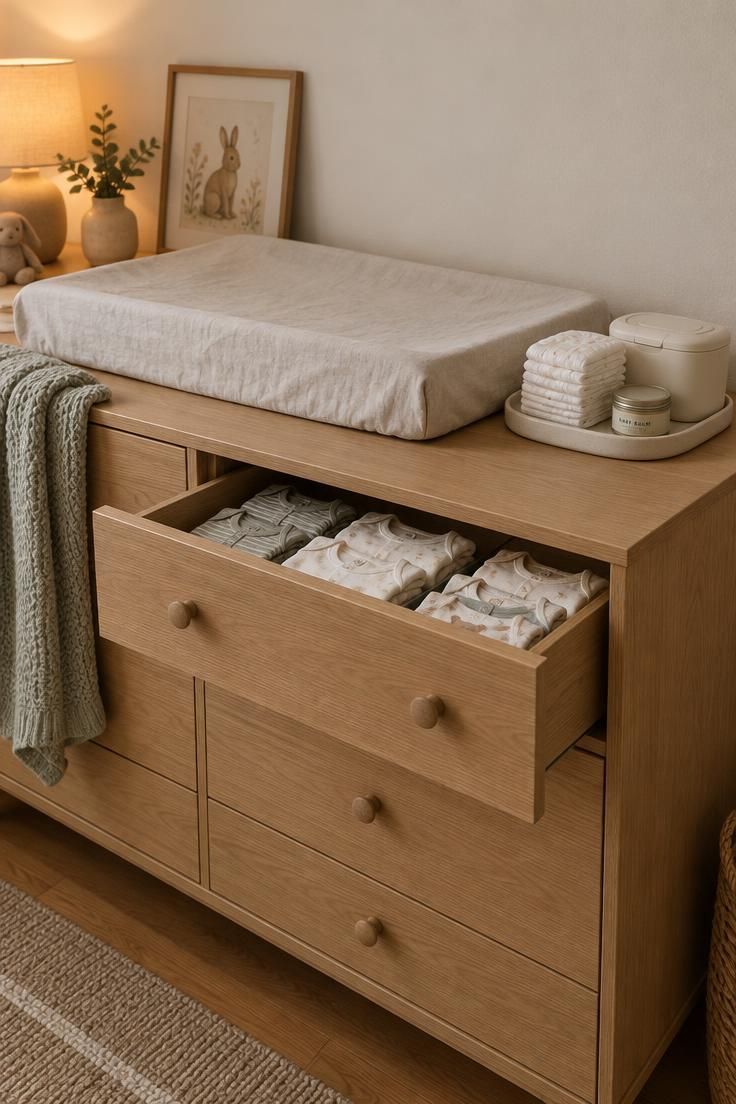
A dresser with changing pad setup replaces a dedicated changing table in many minimalist households, and the trade is easy to justify.
One piece of furniture does two jobs, diapers and clothing sit in the same place, and floor space stays open.
A sturdy chest of drawers offers a practical alternative to a traditional changing table, combining everyday storage with a convenient care surface.
The drawer stack earns its footprint because it keeps working after the diaper stage, when a changing table has no obvious second act.
A changing table with storage underneath applies the same thinking in a slightly different form.
In both cases, the care surface and its supplies are one object rather than two.
The arrangement also adapts as a child’s needs change.
A dedicated changing table may become unnecessary within the first few years, while a dresser typically stays in service through the toddler years and beyond.
Placement inside the dresser follows use.
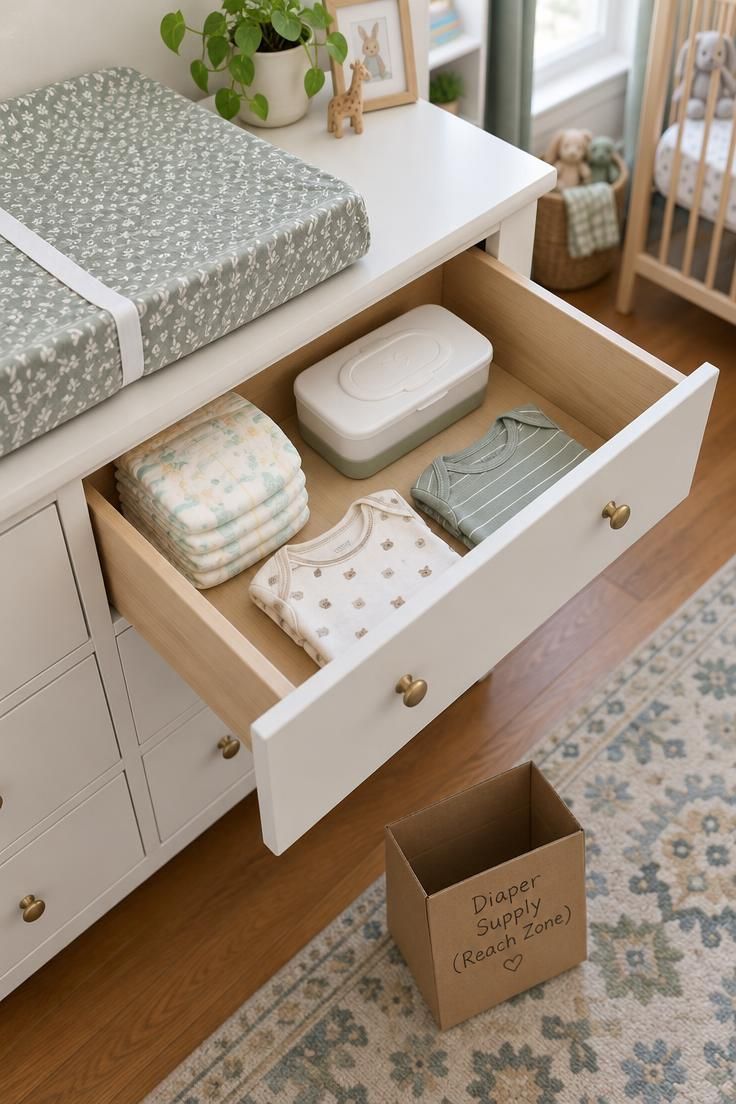
Diapers, wipes, and two outfits belong in the top drawer, where a caregiver can reach them without stepping away from the pad, while larger clothing and blankets live below.
One practical note belongs with any furniture in a young child’s room.
Anchoring the dresser securely to the wall helps prevent tip-over accidents, while a properly secured changing pad and constant adult supervision make the changing area safer.
The setup also needs a top surface discipline.
A small tray for diapers, wipes, and balm keeps the pad clear, and everything else moves into the drawer rather than spreading across the dresser top.
Nursery Furniture That Grows with the Child: The Buy-Once Tradeoff
Families increasingly want spaces that evolve with their children rather than requiring a full redesign every few years.
That wish is the practical case for nursery furniture that grows with the child.
The priority comes down to three qualities: functionality, versatility, and flexibility.
Storage is equally important, reinforcing the point that a piece should hold different belongings over time, not one narrow category.
A crib convertible to a toddler bed, a stylish bookshelf with a few select items, a dresser, and dimmable lamps can provide everything needed for a functional nursery.
The list is short on purpose, and each piece has a job that survives the transition out of babyhood.
Convertible furniture carries a real cost tradeoff.
Multi-purpose and convertible pieces usually cost more upfront, so the saving only appears if the piece genuinely survives the child’s next stage and the family’s next home.
A sofa bed with built-in storage, for example, can later become the child’s regular sofa, showing how versatility can move a piece across rooms rather than out of the house.
That kind of second life is the test worth applying before purchase.
A simple decision criterion helps.
Name at least two future uses for the piece in the same residence; if none are concrete, a less expensive single-purpose option may serve better.
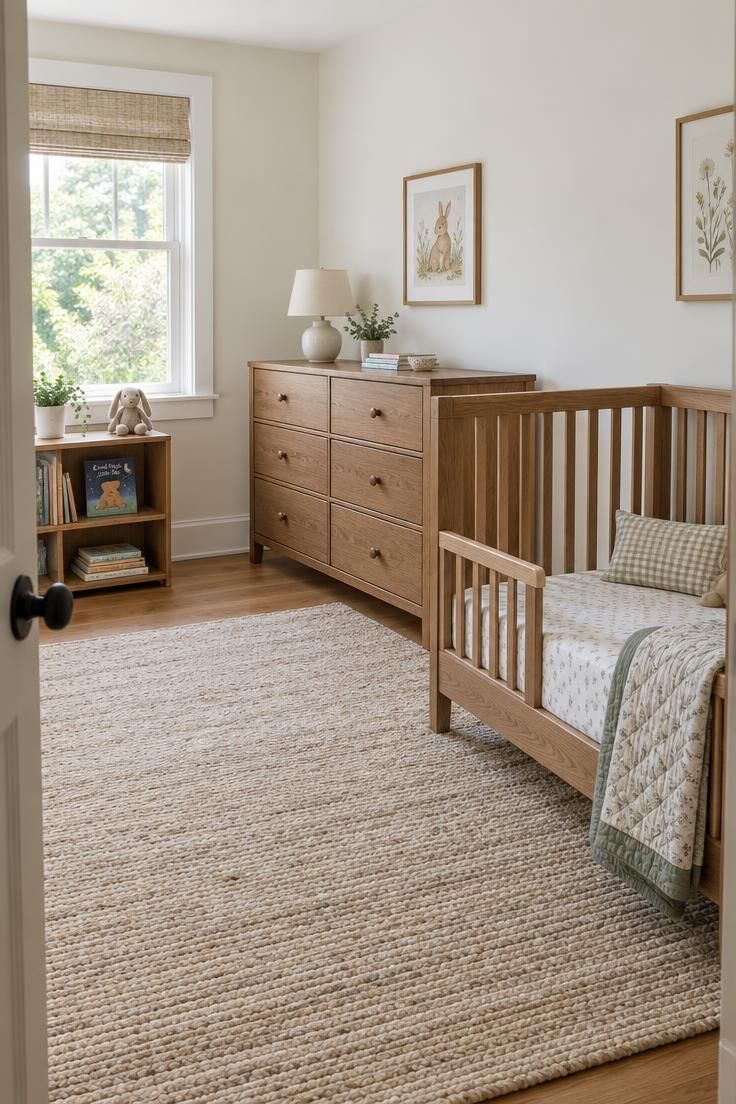
Small Nursery Reach Zone Layout: One-Hand Operation as the Test
When planning a small nursery layout, one practical question can guide every decision: can the primary care task be done one-handed in low light?
For a small nursery reach zone layout, that question replaces the usual floor plan exercise.
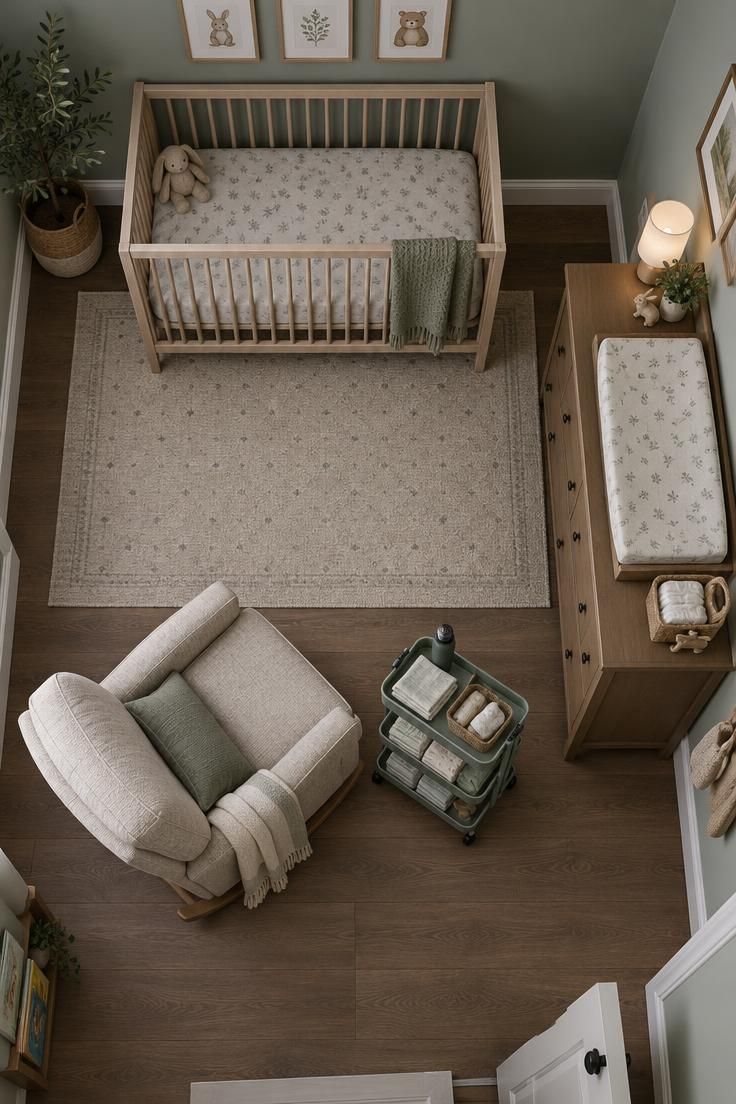
A reach zone is defined by the caregiver’s body position during feeding, changing, and settling.
It is not the room’s perimeter, and it does not follow the furniture arrangement on a mood board.
Next to the changing surface, keep diapers, wipes, and a fresh onesie.
Next to the feeding chair, keep burp cloths, a water bottle, and a phone charger.
Near the crib, keep a sleep sack within the caregiver’s reach and a small nightlight positioned away from the sleeping area.
Not every household needs a dedicated nursery.
A cot in the parents’ bedroom or a designated play area in the living room can work just as well when the reach zones themselves are organized, rather than relying on the existence of a separate room.
The common error is spreading storage across too many pretty but distant baskets.
Centralized reach beats distributed storage, because a single step away from the changing pad or chair breaks the one-hand rule.
Concealment inside the zone matters as much as proximity.
A drawer beside the changing pad holds more than a row of labeled jars on a shelf, and it keeps the surface clear for the task at hand.
Design Pro-Tip: Test a layout with a rolled towel standing in for the baby. Walk through the nighttime routine once, from crib to changing pad to chair, and note every moment you would need to let go or turn away. Move storage before you buy anything.
Why Now: Organizing with Purpose Beyond the Beige Trend
The “sad beige baby” trend gave a name to the stark neutral children’s rooms that became popular on social media, reflecting a broader preference for calm, understated spaces.
Part of the trend’s rise can be understood through pandemic-era parents wanting calm, shared spaces, which is a design motivation rather than a color rule.
Beyond the palette, one of the biggest concerns for parents remains storage.
Small urban residences, multi-use rooms, and the cost of outfitting a nursery that must change every six months keep the organizational question current.
Those pressures do not depend on a trend cycle, and they explain why reach and concealment stay useful.
Visual overstimulation often comes from too many things layered together with no place for the eye to rest, making one or two accent colors paired with softer tones a practical approach.
The point is editing, not the absence of color.
A single soft yellow blanket, a coral lampshade, or a pair of patterned curtains can carry the accent role in an otherwise quiet room.
The palette stays calm and the eye still has somewhere to land.
The case for the room is organizational rather than aesthetic.
Reach, concealment, and multi-function work whether the walls are beige, cream, sage, or white.
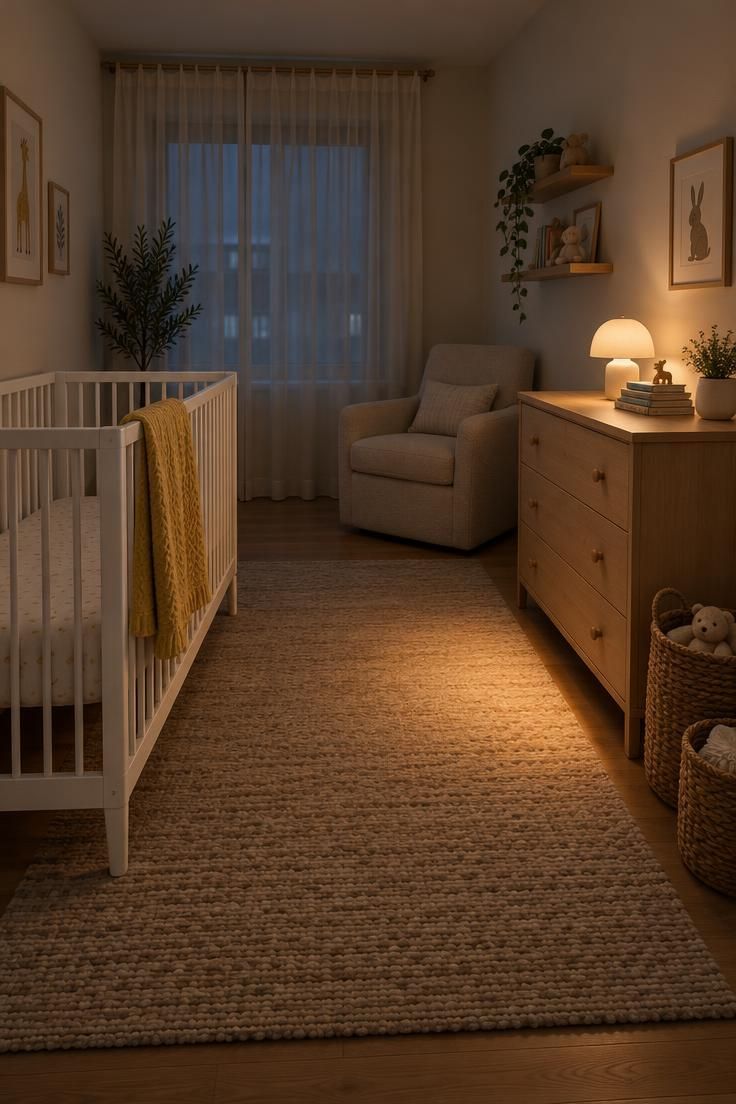
What Can Go Wrong: The Limits of the Minimalist Nursery
Minimalism fails in a nursery when storage is under-provisioned.
Without somewhere to put things, the system can quickly collapse, and the room returns to its starting clutter.
Open shelving is a specific risk.
The curated look demands constant maintenance, and in a real home with a baby, that time usually does not exist, leaving a shelf that starts tidy and ends as a pile.
Neutral palettes carry their own tradeoff.
They rely on texture and proportion for warmth, and copying a social media design without adapting it to the family’s routine is a common mistake.
A minimalist nursery works best when planned with intention, where each item has a function, which is a different standard from an empty room.
A holding box helps with decisions about what to keep.
A practical approach is the six-month rule: if an item has not been needed or missed in six months, it may be time to pass it on to someone else.
The nursery makes that rule easier to apply than a whole house because the number of belongings is smaller and the stages of childhood move quickly.
Outgrown clothes and unused gifts are easy candidates for the box.
A dedicated nursery is a choice, not a requirement.
Small homes can organize childcare without a separate room, whether by placing a cot in the parents’ bedroom or creating a comfortable play area in the living room.
The essential lesson is that minimalism needs a place for everything and a habit of putting things back.
Remove either one, and the room drifts back toward clutter regardless of the palette.
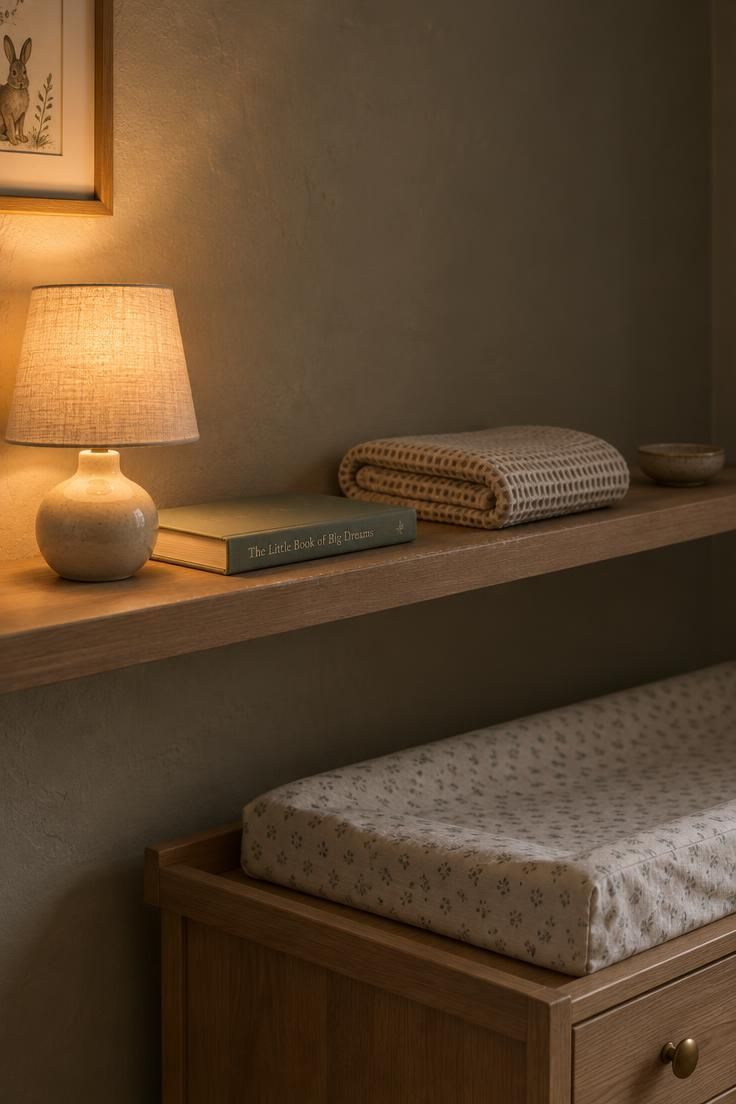
Maintaining the System: Edit, Return, Repeat
Once the room is set, the system depends on small repeated actions rather than another purchase.
When everything has a designated home, putting things away becomes easier, and daily organization gradually turns into a habit.
A five-minute nightly reset does most of the work.
Return the day’s items to their drawer, bin, or hook, and the room opens the next morning in the state it was left.
The edit rhythm follows the child’s stages.
Storage needs change without much warning as a newborn becomes a sitter and then a toddler, so a staging bin in the closet for outgrown clothes and unused items keeps the reach zone from filling with things the household no longer uses.
A simple six-month review helps identify items that are no longer needed or used regularly.
The nursery holds a small enough set of objects that a seasonal pass through the closet and the lower drawers makes it easier to decide what can go.
Organization is not a one-time styling project.
The real system is the return habit, and the room stays calm because items go back rather than because the setup was clever at the start.
A weekly ten-minute task keeps drift in check.
Move anything out of place back to its bin, drawer, or hook, and place anything without a home into a decision box for the next pass.
The maintenance work is modest, and it is the difference between a room that looks organized on the day it is finished and one that stays that way through the toddler years.
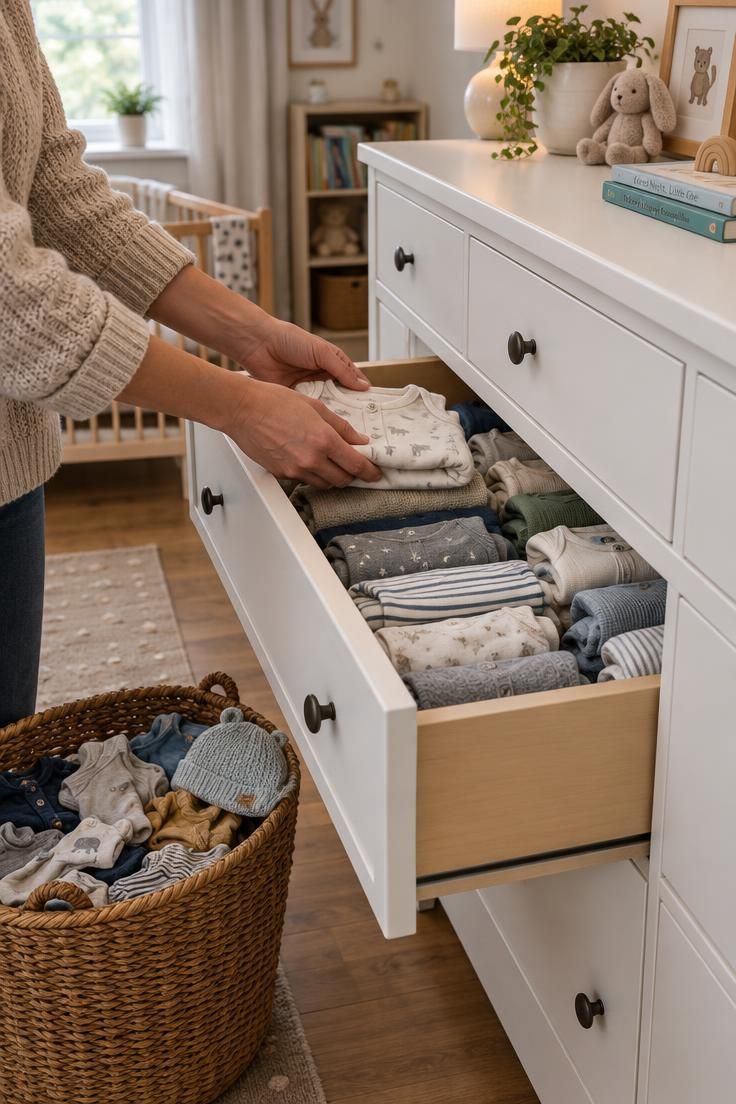
The First Drawer Test: Build the Reach Zone Before Buying More
The first move in a nursery is not a purchase.
It is an observation of where feeding, changing, and settling actually happen, followed by a decision about what belongs in each of those spots.
Start with the last two days.
Place only the items used in that window inside the reach zone, and move everything else to a holding box or a higher shelf.
The room tells you quickly whether the zone is honest.
Three common approaches miss the mark.
Too many open baskets spread across the room defeat the one-hand test, a dedicated changing table with no long-term use adds footprint without a second act, and a layout that reads well in a photo can fail in low light with one hand occupied.
A more practical approach is to wait until a genuine need appears before buying more, keep receipts for items that may go unused, and resist the temptation to accumulate everything suggested on a baby registry.
This reasoning suits the nursery, where gifts often arrive before the household knows what it actually uses.
The goal is a room where every item has a function and a home near its use.
A stripped bare room is not the target, and a room full of matching containers is not the target either.
A decision readers can make today is small and useful.
Empty one drawer or shelf, return only the items used in the last two days, and move everything else to a holding box for one week.
Conclusion
Minimalist nursery organization is less about removing belongings and more about deciding where each belonging lives in relation to the family’s routine.
A practical approach centers on a few simple principles: anchor the layout in the reach zone, use closed storage to reduce visual noise, choose furniture with a future purpose, and treat the system as a daily habit rather than a styling project.
Before adding another bin or shelf, run the one-hand, low-light question in the real room.
Start by emptying the drawer nearest the changing pad and returning only what the last two days required, then let that small test guide everything else.