This post may contain affiliate links. If you make a purchase through these links, we may earn a commission at no additional cost to you.
Most kitchens treat the sink as a stage, leaving every sponge, brush, and bottle of dish soap in view as though the basin were an altar to daily use.
The assumption runs deep: the area around the sink has to collect the debris of cooking and cleaning, so why fight it?
A different question changes the arrangement entirely.
What can leave the sink zone, so that the few items remaining are the only ones that genuinely need a home in sight?
The answer is not a better organizing tray.
It is a smaller inventory and a stricter test for what earns a place near water.
The Under-Sink Mix Nobody Planned Around
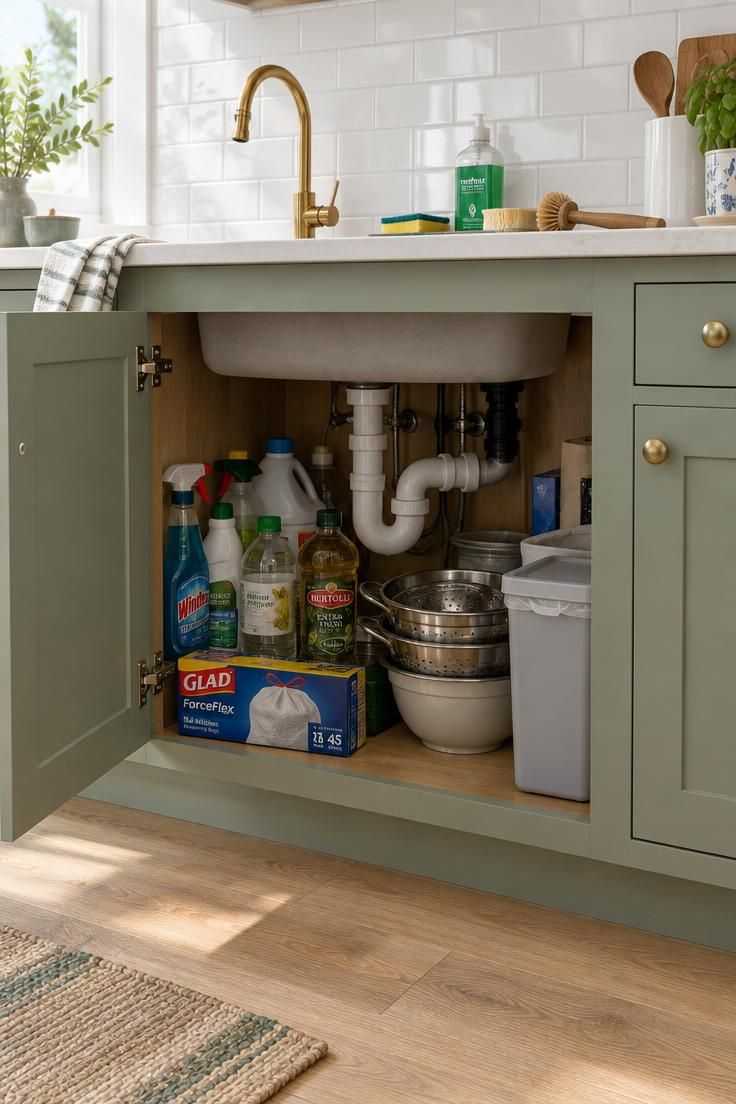
A 2024 study published in Konya Sanat photographed 50 residential under-sink cabinets and catalogued what was actually inside them: cleaning chemicals and bleach next to vinegar, dish soap, and buckets, plus foodstuffs, small appliances, assorted pots and trays, kitchen waste bins, and water filtration units.
Of those cabinets, 40 percent had a single internal shelf and 60 percent had none at all.
That is the reality a minimalist reset has to address.
The cabinet beneath a home kitchen sink is a mixed-use volume that most households never planned, and no amount of matching bins will fix a space holding oil, a colander, and a waste bin side by side.
This makes the sink zone a subtraction task before it is a storage-product purchase.
The useful starting sequence is straightforward: empty the area around the sink and the cabinet below completely, sort what comes out by category, remove duplicates and anything not used in the past month, and keep only items used weekly at the sink itself.
The reason to be strict is practical.
Every object kept near the basin has to be moved, wiped around, and put back during ordinary cooking and cleaning, so unnecessary inventory creates unnecessary handling.
A single decision rule carries most of the work: if an item is not used at the sink during cooking or cleaning, it does not belong under that basin.
The Clear-Counter Exceptions That Actually Work
A clear counter around the sink is a deliberate choice with a short list of legitimate exceptions.
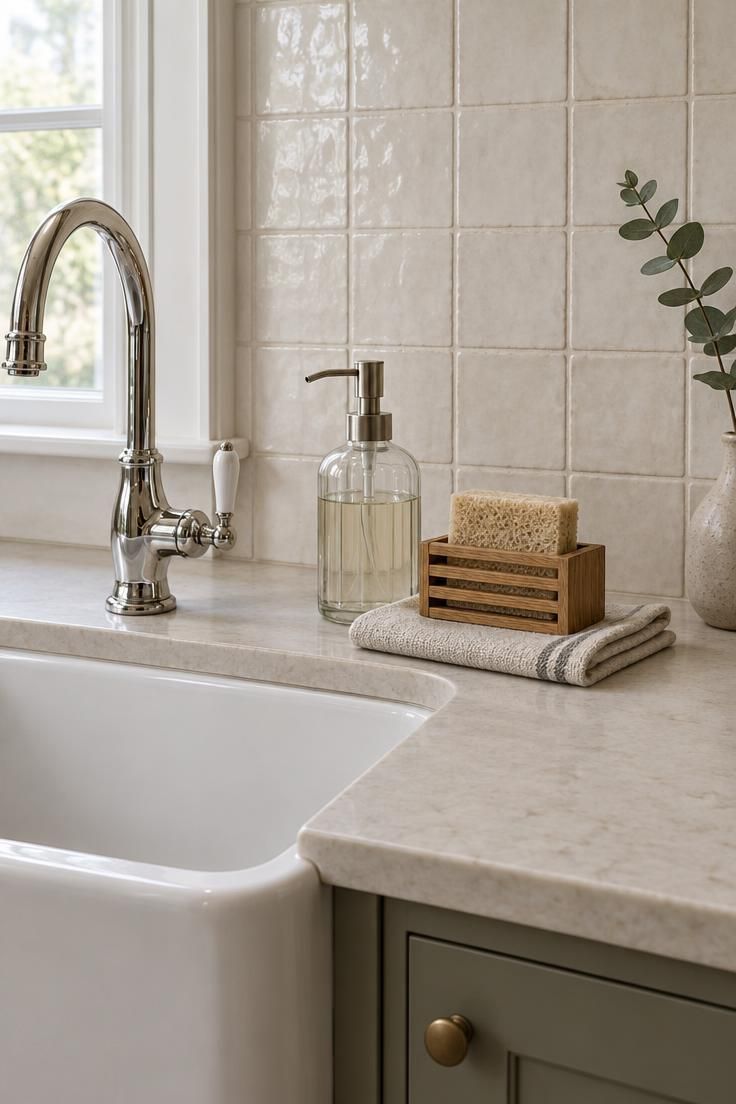
The most defensible pair is one neutral soap dispenser and one draining sponge holder with an inclined surface, because both are used multiple times a day at the basin and both can be wiped dry in seconds.
That is the test worth applying to everything else.
An object earns counter space by being handled at the sink during cooking or cleaning, not by being sink-related in the abstract.
Households where water spreads across the counter can add a splash mat or a faucet guard, both of which keep the surrounding surface from staying wet without adding visual weight.
Notice what the exception list excludes.
A decorative bottle of hand lotion, a row of dish brushes in four colors, and a sponge caddy shaped like a vegetable all fail the same standard: they are things the sink is associated with, not things used at the sink.
The narrower the exception list stays, the less daily tidying the counter requires.
What Lives Under the Sink Must Survive Water
Once the removable items are gone, moisture becomes the deciding criterion for everything that stays.
The space beneath a sink collects splashes, drips, and condensation, so fabric baskets and porous organizers are poor candidates no matter how well they match the kitchen.
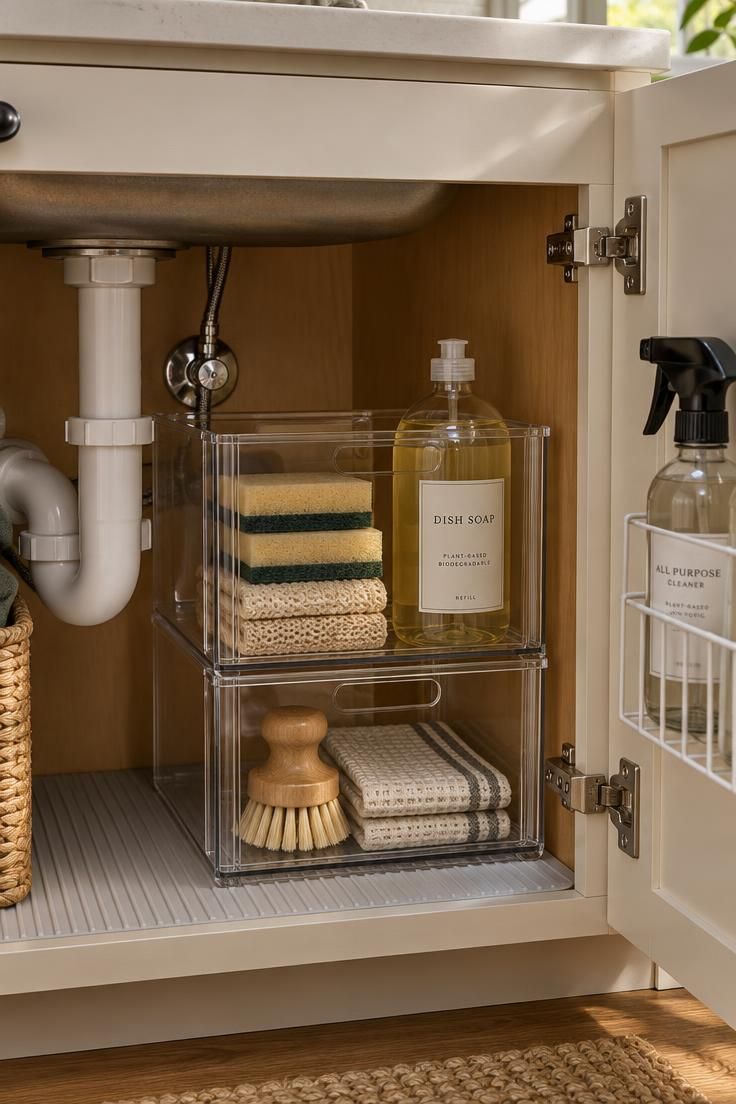
Waterproof under-sink organizers solve the material problem.
Rigid plastic bins, coated wire, and sealed containers all wipe clean and tolerate damp shelves, while woven or cloth versions absorb what lands on them and hold it.
Transparency matters as much as material.
Clear, stackable, or tiered containers let contents stay visible and make the full depth of the cabinet usable, which matters in a space where pipes interrupt the middle of the volume.
Measurement comes before any purchase.
Note the cabinet’s width, depth, and clear vertical space, and mark where the pipes, supply lines, and any disposal sit, because the most common mistake is choosing a tall pull-out that cannot clear the drain trap.
The same study that documented the mixed-use cabinet found users improvising with door-mounted baskets and in-cabinet organizers to make up for missing shelving, a reminder that added structure helps most where the cabinet offers none.
One storage limitation deserves attention in the source material: oil and bleach stored side by side can interact if containers topple or leak, which argues for keeping cleaning chemicals and foodstuffs in separate zones rather than sharing a bin.
A Working Sequence for a Lean Sink Zone
Architect and interior designer Katarina Šauperl describes functionality as her first principle: the person cooking should not take unnecessary steps, the sequence from refrigerator to sink to stove should be logical, items should be as close at hand as possible, and her working rule is that space should be usable first and beautiful second.
She also advises that the sink and dishwasher sit near each other without the dishwasher blocking access to the basin.
That principle translates directly into a filter for what stays at the sink.
A colander used once a week belongs in a lower cabinet even though it is a sink task, because frequent handling is what justifies proximity.
A sink-side brush used every evening earns its spot, since it is touched during nearly every cleaning session and would otherwise cost a step each time.
The test is frequency and location together.
An item used daily at the basin is a keeper; an item used daily across the kitchen is not, because its real home sits elsewhere.
Apply the same logic across the whole work zone rather than only the sink.
When the paths between refrigerator, sink, and stove stay clear of stored objects, the counter around the basin stays clear as a byproduct of the layout rather than through repeated tidying.
Concealment as a Spectrum, Not a Luxury
Concealment is the visual signature of the minimalist sink, and it spans a wide range of approaches and budgets.
The goal at every level is the same: keep the necessities close while removing them from view, so the counter reads as an open surface.
Under-sink cabinet storage ideas begin with the simplest level, which is ordinary cabinet doors.
Standard fronts hide the contents completely, cost nothing extra, and require only that the interior be organized well enough to close comfortably.
The middle level uses skirted fabric or paneled fronts that soften the cabinetry line and suit older homes and small kitchens where custom millwork is out of budget.
The third level is touch-latch full-height panels, where storage reads as plain cabinetry until a door is pressed open.
This approach appears in higher-end residential kitchens where appliances and sinks are hidden behind retractable surfaces, a technique documented in luxury kitchen design as open-plan living has made kitchens more visible from living areas.
The same article notes a useful counterpoint: designer Athena Calderone keeps her folding doors open most of the time and is skeptical of hyper-minimalist slickness, a reminder that concealment works best when daily access is easy.
That tension is the tradeoff at every level.
The more completely something is hidden, the more deliberately it must be arranged to open, reach, and put back, or the concealment becomes a daily obstacle rather than a design choice.
A historical anchor is worth keeping in mind.
A 1916 Women’s Home Companion tip described a homeowner who had a carpenter build white-painted latticework with a door beneath the sink to conceal “unsightly paraphernalia,” calling it the most effective piece of furniture in the house.
Hiding under-sink necessities while keeping them reachable is an old residential instinct rather than a recent fashion.
The Washable Sink Skirt: Hiding Without Building
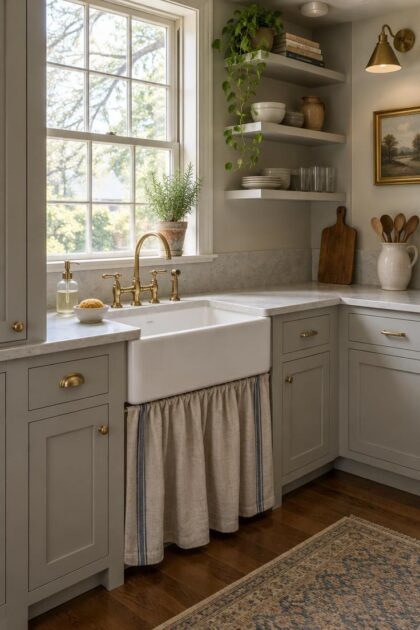
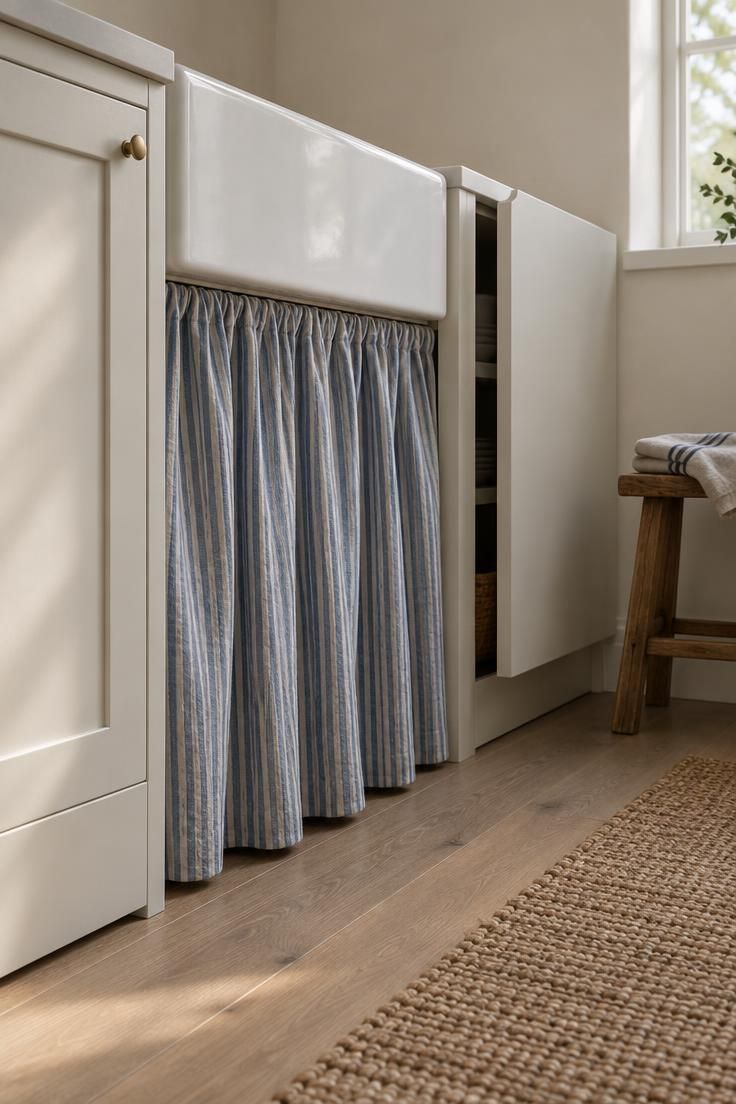
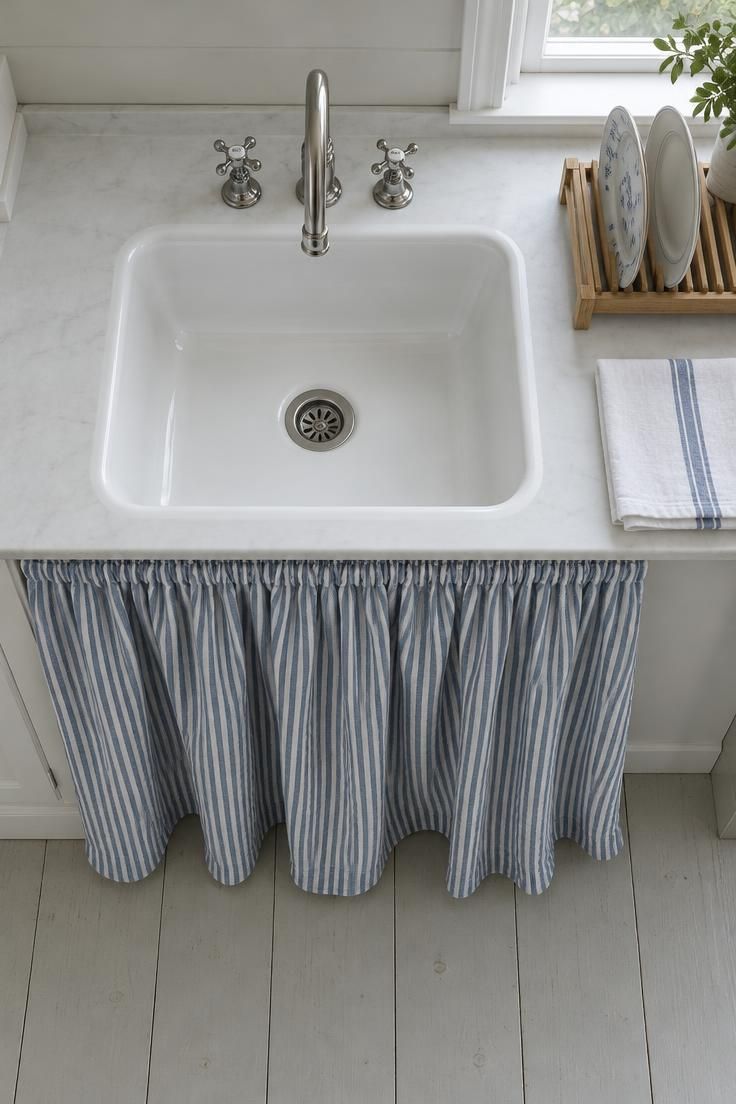
The sink skirt is the low-cost, reversible version of concealment, and it has returned to residential kitchens as a softening counterpoint to sleek cabinetry.
A fabric panel hung beneath the basin hides cleaning products and bins while giving easy access to the under-sink area, and it suits older homes and small kitchens where custom cabinetry is out of reach.
Material choice decides whether the skirt remains practical.
Lighter-weight linen, cotton, or blends in a decorator weight work best, while silk stains easily and upholstery-weight fabric is bulky and does not gather well.
A washable sink skirt addresses the main objection to fabric in a wet zone.
Designer Meredith Heron cautions that a fabric-draped sink can trap mess and odor, which makes a removable, machine-washable skirt the sensible specification rather than an afterthought.
Kitchen conditions reinforce that guidance.
A skirt near the basin is likely to be splashed with dishwater, cleaning supplies, and cooking ingredients, so machine-washable and water-resistant fabrics are worth prioritizing, and a tension rod may outlast hook-and-loop tape under frequent laundering.
The seasonal swap is a side benefit.
Changing the fabric offers a visual refresh without altering the cabinetry, and using the same fabric as window curtains creates continuity between the sink base and the rest of the room.
When Dishware Moves Out of the Cabinet
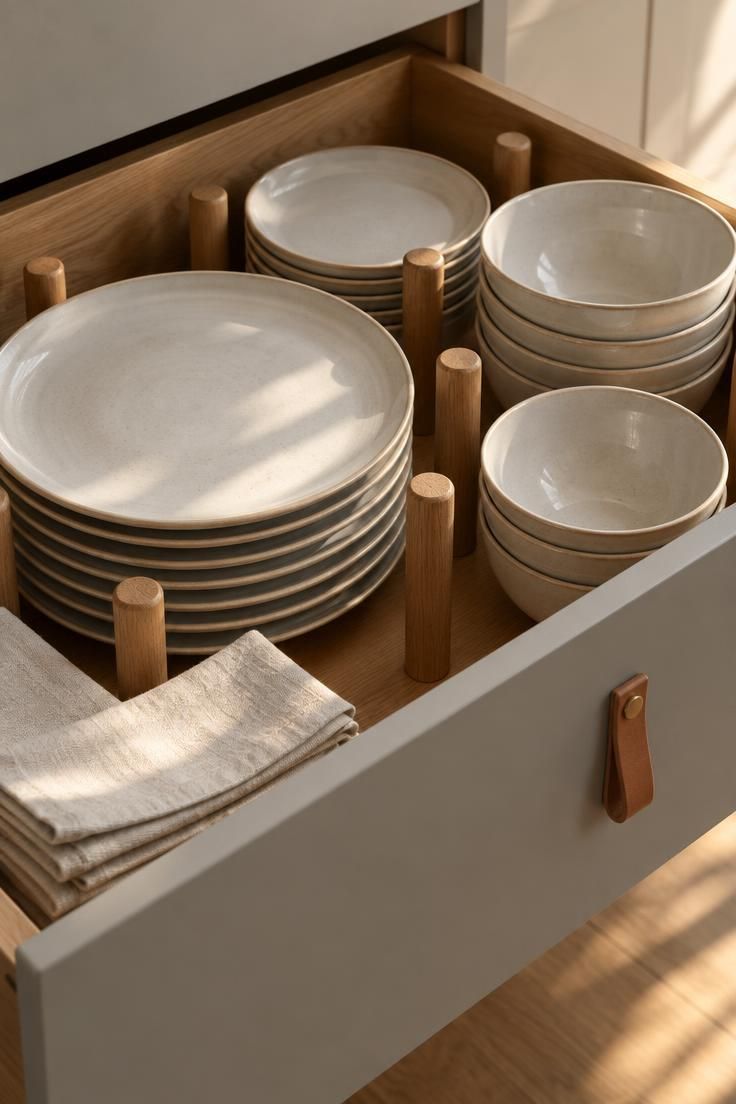
Dish storage in pegged drawers offers a different route to the same clear counter.
Designer Lauren Sullivan built her kitchen around living and hosting rather than daily cooking, storing dishes in drawers fitted with pegs rather than in cabinets, a choice she describes as really accessible.
The pegs hold plates and bowls upright and separated, so each piece lifts out without disturbing the stack beside it.
That arrangement removes the need for a wall of upper cabinet doors and keeps the visual field around the sink simpler.
Matching storage to the household matters more than matching storage to a photograph.
A home that cooks heavily needs different sink and storage provisions than one built around entertaining, which is why Sullivan’s own integrated marble sink came with a candid qualification: it would probably be a little impractical for someone who cooks regularly because of chipping and cracking risk.
The same honesty applies to pegged drawers.
They work well for a modest collection of dishes kept near the table or dishwasher, and they become less convenient for a household running through many place settings each day.
The larger point is that removing dishware from upper cabinets is a real minimalist strategy rather than a compromise, and it changes what the sink area has to compete with visually.
Why Now: The Open-Plan Visibility Problem
Kitchens are more open and visible than they used to be, a shift that consultant Sharon Dranko connects directly to concealment becoming a defining feature of high-end residential design.
When the kitchen sits in the sightline of the living and dining areas, sink clutter becomes part of the room rather than a private corner problem.
That visibility explains why minimalist kitchen sink organization has moved from a preference to a practical concern for many households.
The counter around the basin is now viewed from the sofa as often as from the stove.
Renters and small-apartment dwellers feel the shift more sharply, because their kitchen often sits within a single main room where there is no separate wall or doorway to buffer the view.
A cluttered sink becomes the first thing seen on entering the apartment.
The response does not require custom millwork.
A smaller inventory, a closed cabinet, and a short exception list achieve the same visual calm in a fraction of the footprint, which keeps the approach within reach for households that cannot remodel.
The Five-Minute Reset That Keeps It Clear
Maintenance at the sink is a short routine rather than a test of character.
Wipe the counter after dishwashing, do a brief evening wipe of the basin and the surrounding surface, and every few weeks empty the under-sink cabinet to check for leaks and for items that crept back in.
The point of kitchen sink countertop decluttering is not a daily deep clean.
It is returning the sink to the same baseline, so that the counter starts and ends every day in roughly the same state without a full reset.
Dry surfaces make that baseline easier to hold.
A sink zone that stays dry needs only a wipe, while a wet zone invites buildup that turns a small habit into a larger project.
Watch for the drift that brings items back.
A stirring spoon, a vegetable peeler, or a second sponge often arrives during a single cooking session and stays for weeks unless the exception list is checked occasionally.
The periodic empty-and-check is the only maintenance task that requires more than a minute, and it catches the slow accumulation before it becomes a full decluttering session again.
Conclusion
The decisive question for a minimalist sink is not which organizer to buy but which object may stay.
Start with the cabinet below and the counter above, empty both once, and sort by what is used at the sink during cooking or cleaning.
Give the keepers one of three homes: a waterproof, stackable under-sink bin, a pegged drawer for dishware, or a washable skirt that hides whatever must remain.
Keep the exception list short, with one soap dispenser and one sponge holder, and end each day with a dry counter.
The first step to try is the empty-and-check of the under-sink cabinet, because that single action reveals how much of the clutter never belonged there.
Look for non-cleaning categories sharing space with the bleach and soap, and move them to a better home before choosing any container.