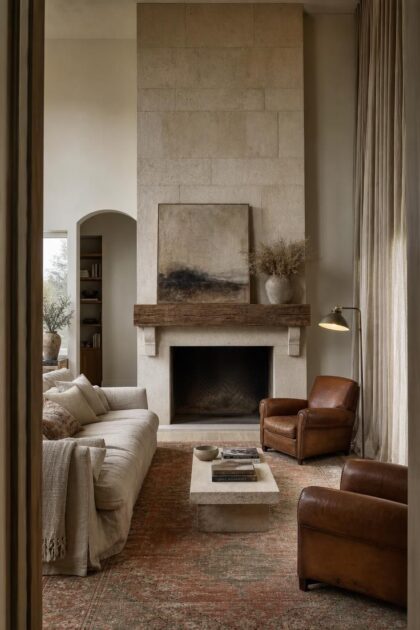
This post may contain affiliate links. If you make a purchase through these links, we may earn a commission at no additional cost to you.
A fireplace does not make a living room look good on its own.
It makes every decision around it more visible, from the rug angle to the mantel objects to the wall color.
Some rooms read as warm and intentional.
Others read as decorated rather than designed.
The difference rarely comes down to what the fireplace cost.
It comes down to a handful of repeated choices that most people do not notice until they see them side by side.
The Data That Explains Why Fireplaces Make or Break a Living Room
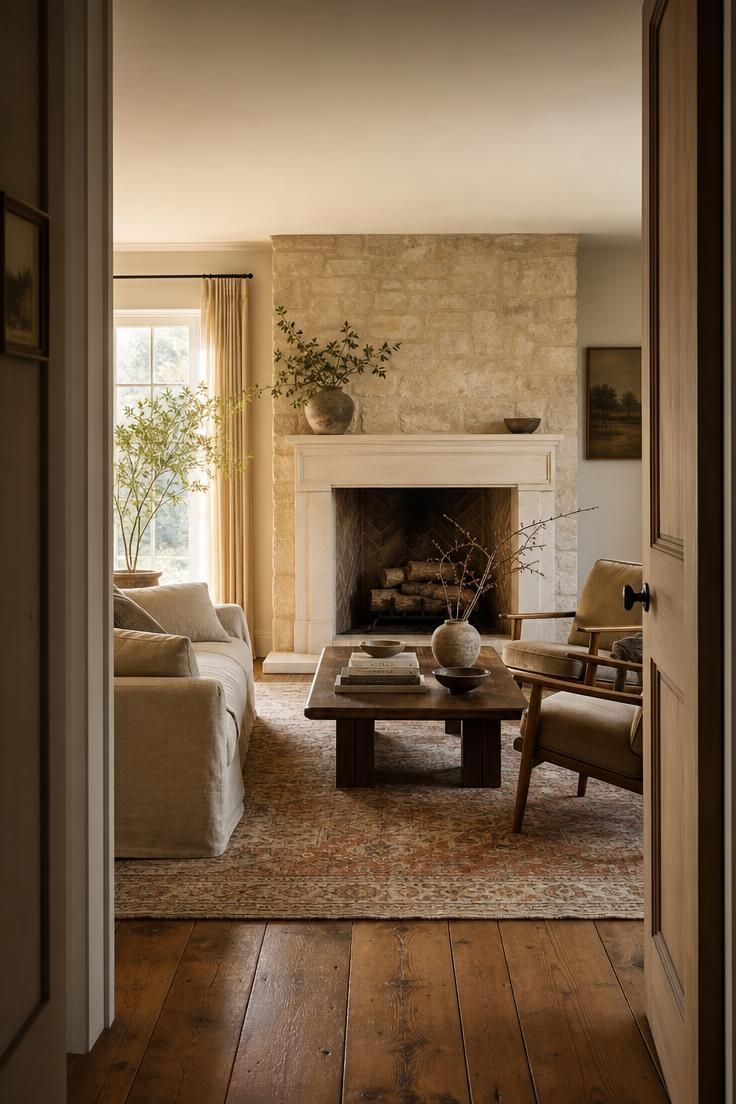
Houzz reported a 339% year-over-year increase in searches for family rooms with TV over fireplace.
That surge reveals how many people are actively looking for solutions to a difficult wall, but it does not mean the resulting rooms are working well.
A 2017 survey of 2,000 new-construction consumers found that 97% of buyers were open to having a fireplace and 68% called it a must-have.
Buyers arrive primed to value the feature.
That priming makes a clumsy surround, a crowded mantel, or a disconnected seating plan feel especially costly.
In a House Digest poll, 35.74% of respondents selected the fireplace as their preferred living-room feature, ahead of vaulted ceilings, floor-to-ceiling windows, and gallery walls.
The fireplace was the single element people wanted most.
The same polling showed that a feature wall was the most popular fireplace treatment at 20.59%, with a minimalist approach close behind at 19.12%.
That split explains a lot of living rooms that fail.
Bold statement walls need strong proportion and material restraint.
Minimal surrounds need the rest of the room to supply warmth and presence.
A fireplace feature wall can anchor a room when the surround, color, and furniture all work together.
The Houzz search growth is a trend indicator, not a satisfaction measure.
More searching can mean more frustrated attempts, more second-guessing, and more screens placed too high on a wall that never had a plan.
Because so many people want the fireplace to anchor the room, the mistakes around it are widely shared.
The saving grace is that these mistakes are also fixable without rebuilding the wall.
The First Mistake Is Treating the Fireplace as a Feature Instead of an Organizing Idea
The most frequent error designers identify is treating the fireplace as an isolated feature rather than connecting it to the rest of the room.
An isolated fireplace has a bold surround, a rug, and a mantel vignette that exist without any logical relationship to the seating, wall color, or lighting.
The room looks like a stage set arranged around a prop.
Historically, the fireplace was the organizing center of the home.
Ancient central hearths determined where people cooked, slept, and gathered.
Medieval and early modern fireplaces anchored the wall and set the rhythm for furniture, light, and daily movement.
Modern rooms often invert that logic.
The fireplace competes with televisions, open shelving, accent walls, and oversized sectionals for attention.
When nothing is subordinate, nothing feels anchored.
A fireplace becomes an organizing idea when it dictates the axis of the room, the placement of seating, and the rhythm of wall elements around it.
The hearth does not need to be perfectly centered, but it should be the starting point.
One practical test from the research is simple.
If you removed the fireplace, would the room still make sense as a composition?
If it would, the fireplace was never organizing anything.
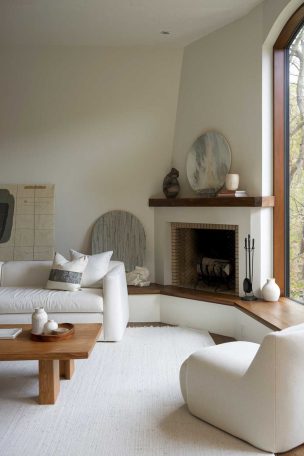
Corner fireplaces present a harder case.
The organizing principle shifts rather than disappears.
An angled sectional or two chairs turned toward the unit can pull the room around the hearth even when the architecture refuses a central placement.
Color, texture, and furniture should support the fireplace rather than match it.
Surrounding materials should stay limited so the fireplace material remains the visual anchor.
The fireplace should direct the viewer’s eye without demanding an entire decorated stage around it.
Design Pro-Tip: Choose one material from the fireplace surround and repeat it somewhere else in the room. A wood tone, a stone finish, or a metal accent makes the fireplace feel inevitable rather than installed.
Why a Generic Layout Makes Even Expensive Surrounds Look Cheap
A sofa flattened against the far wall, a coffee table marooned in the center, and two chairs pushed against opposite walls with no relationship to the hearth: this layout cheapens even a beautifully detailed surround.
Designers consistently caution against pushing every piece of furniture against the walls.
The practice leaves a dead zone in the middle and severs the connection between seating and fire.
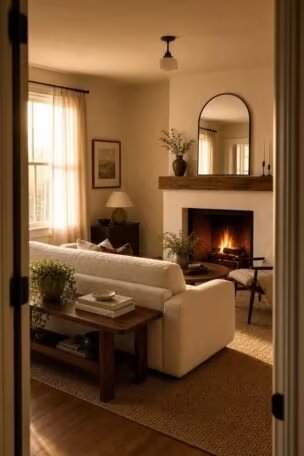
The strong alternative is a main seating piece facing the fireplace directly, with secondary chairs angled to build a conversation zone around it.
The room begins to work as a social space rather than a waiting room.
Trend reporting aligns with that view.
Formal, symmetrical layouts are losing ground to relaxed arrangements that keep the fireplace visually dominant without looking staged.
Scale compounds the problem.
Furniture that is too small makes the fireplace feel oversized and disconnected.
Oversized pieces dwarf a modest surround and make the room feel crowded and short of air.
Leaving some space around furniture helps the room breathe.
It also respects the practical clearance zone near the hearth, which is a safety requirement, not a styling quirk.
Fireplace seating arrangements benefit when the main piece faces the hearth and secondary chairs angle inward.
Seating should be close enough to make the fireplace part of the conversation.
When a sofa sits too far away, the hearth becomes a distant showpiece and the room loses its intimacy.
Small living room with fireplace layouts follow the same principles with smaller profiles, raised legs, and a clear walking path.
Compactness should not mean pushing everything outward.
A small room needs the furniture pulled in even more deliberately.
The Television Tension: Why the Wall Above the Mantel Is a Trap
Homes & Gardens reports that designers are increasingly moving televisions off the fireplace wall entirely.
The screen competes with the fire, raises viewing height, and flattens the fireplace’s architectural presence.
Mounting a television above the mantel creates two problems at once.
Visually, a large black rectangle cancels the warmth of the surround.
Ergonomically, the screen sits too high for comfortable viewing, forcing necks upward and making the fire an afterthought.
The strongest alternatives place televisions on adjacent walls, behind cabinet doors or artwork, on projectors, or in separate media zones.
A room can still support regular viewing without sacrificing the hearth as its primary focus.
Many living rooms cannot separate the two.
In those rooms, a lower-impact compromise is to mount the television at a reasonable height with a minimal surround, rather than building the entire wall around both.
Doing that creates a giant black-and-stone collage that helps neither element.
The search-driven trend of TV over fireplace should be tested, not copied.
A 339% increase in searches means people are looking, not that the arrangement is working well once installed.
The principle is simple.
If the television and the fireplace are competing for the same focal point, one of them will win.
In most cases, the fireplace loses.
The Mantel Is Not a Display Case: Clutter, Scale, and Silence
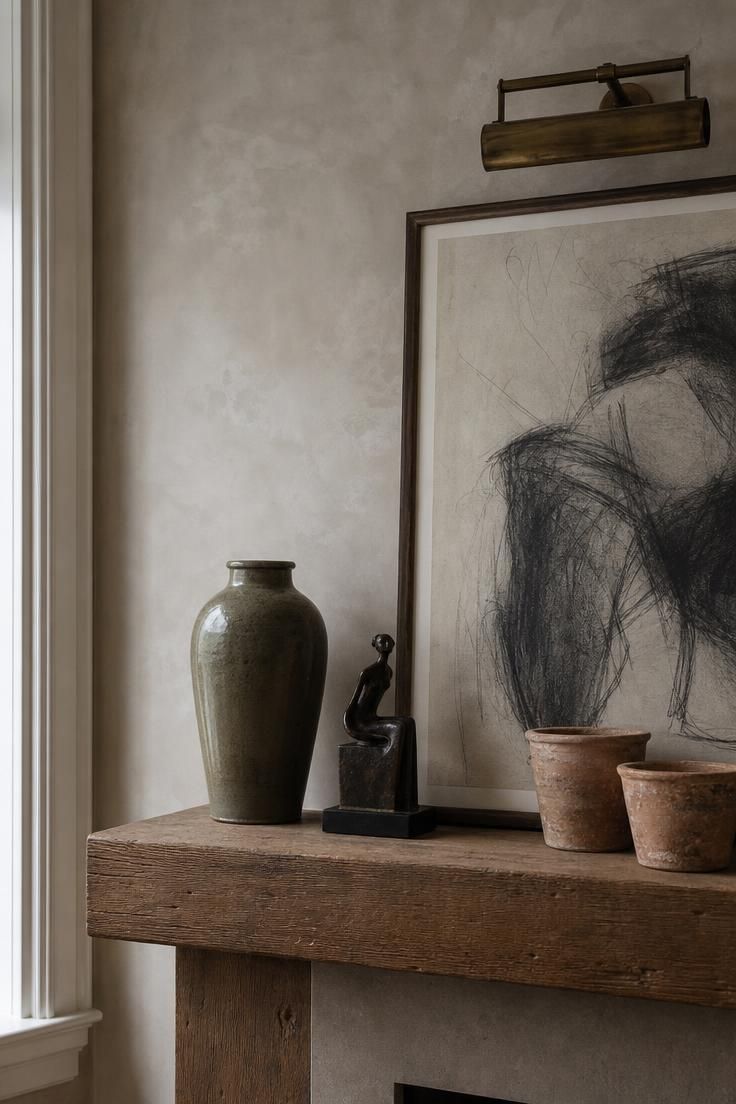
Designers advise using a few large objects in varying heights rather than many small accessories.
An overcrowded mantel reads as decorative anxiety, not personal style.
Dozens of tiny objects dilute the fireplace surround and draw attention away from the fire itself.
The wall becomes visual noise.
The opposite mistake is also common.
A completely bare mantel can make an otherwise finished wall feel unfinished or clinical, as if someone removed the decoration and never returned.
One larger item should anchor the mantel composition.
A mirror or one large artwork works well because it gives the eye a resting point.
Fireplace mantel styling works best when one object leads and a few supporters follow.
Supporting pieces might include a vase, candlesticks, or one sculptural object, with real negative space around them.
The goal is composition, not collection.
Repeating one or two materials from elsewhere in the room on the mantel builds cohesion without creating a matched set.
The mantel can shift lightly with the seasons, but the underlying principle stays constant: one anchor and a few supporters, never a crowd.
Design Pro-Tip: Before styling the mantel, remove every object and add back only five things. One large, two medium, two small. Then pause and live with it for a day.
Materials That Read as Temporary Instead of Grounded
Natural stone, tactile plaster, brick, and wood dominate current fireplace design.
Glossy, faux-luxury finishes are losing favor.
Mass, texture, and visible variation signal permanence.
A thin, highly polished veneer surround reads more like a television backdrop than a hearth.
Designers recommend choosing surround materials based on the home’s architecture rather than shifting style trends.
A rustic stone surround can feel wrong in a sleek urban loft, just as smooth plaster can feel cold in a nineteenth-century townhouse.
Current material pairings gaining momentum include limestone with oak, plaster with antique wood, soapstone with walnut, brick with linen, marble with dark wood, and handmade tile with limewashed walls.
Each pairing works because the materials share a tactile presence.
The problem with thin or overly polished surrounds is that they lack that presence.
They look like a temporary treatment rather than part of the house.
Veined marble or full-height limestone can anchor a room and become the principal artwork.
The same material in a thin band around a small insert reads as an afterthought.
If the surround is bold, the rest of the wall and nearby fabrics should be quieter.
A strong material needs room to breathe.
Color-drenching around a dramatic fireplace can help the surround feel part of the architecture.
Houzz data shows rising interest in mushroom, taupe, olive, and muted rust palettes for exactly this purpose.
A modern fireplace surround in plaster or stone can feel grounded when the material has real depth and texture.
Material choice is not purely aesthetic.
Some materials require clearing distances, special installation, or regular maintenance, and those practical needs should shape the decision from the start.
The Color Problem: Undertones, Drenching, and the Wrong Neutral
Houzz emerging trends data shows a clear rise in color-drenching and warm, immersive palettes.
Fireplaces benefit from that shift when the chosen color supports the surround’s undertone.
A fireplace surround that fights the wall color can make a room feel permanently unsettled.
The cheapening effect is subtle but consistent.
A warm brick surround against a cool gray wall often makes the brick look dirty and the wall look stark.
The two elements refuse to speak the same language.
Recommended warm neutrals include cream, taupe, warm gray, muted green, terracotta, and soft brown.
These colors support the fireplace’s warm character rather than working against it.
Living room color schemes rooted in warm undertones help brick, stone, and wood surrounds feel settled.
Color-drenching can make the fireplace feel part of the wall rather than a tile appliqué.
One color across walls, trim, and built-ins creates a continuous architectural plane.
Matching everything exactly can flatten the room.
One deliberate variation in tone or texture adds depth without breaking the envelope.
A bold surround calls for a restrained palette elsewhere.
A simple surround allows stronger color in furniture and textiles.
The fireplace sets the terms.
The right neutral is not simply beige or gray.
It is a neutral with the correct undertone to support the specific fireplace material.
Scale and Proportion: Why Small Decisions Around a Large Feature Fail
A fireplace should be visually large but not overwhelming for its room.
The most common failure point is the mantel: too shallow, too deep, or too narrow in relation to the surround, making the fireplace look accidental.
Ceiling height, room width, and window placement should affect the size and proportion of the surround.
A tiny mantel under a tall ceiling reads as an afterthought.
A massive surround in a small room swallows everything else.
Furniture scale matters in relation to the fireplace.
Seating too far from the hearth makes the room feel disconnected, as if the two were designed in separate meetings.
The hearth, rug, and ceiling fixture can reinforce the central axis or intentionally break it in an open-plan room.
Those elements should agree on where the room’s center lies.
Practical measuring helps.
Test the layout with painter’s tape on the floor before purchasing furniture or committing to a mantel size.
The tape reveals circulation paths and sightlines no mood board can show.
Small mistakes in proportion accumulate quickly.
A mantel two inches too narrow, a sofa one foot too far back, a rug that ends before the hearth: these details determine whether the room reads as designed or assembled.
Why This Matters Now: Warmth, Discovery, and the 2026 Living Room
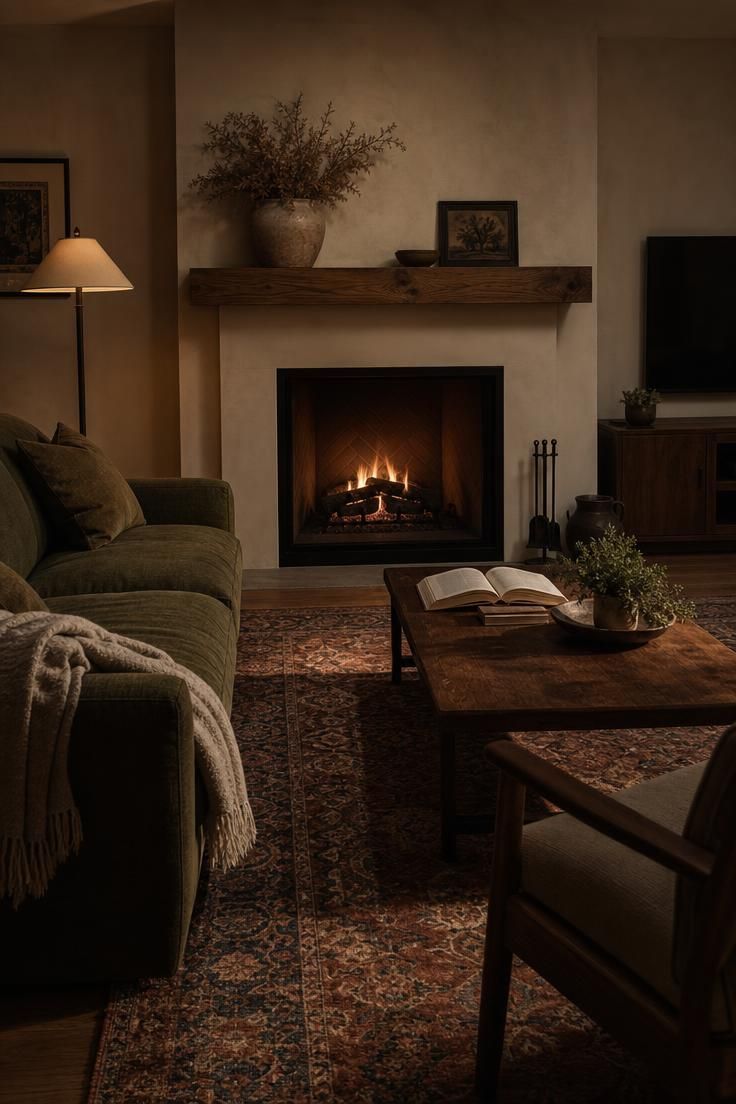
Reports point to a decisive shift away from sterile, highly coordinated living rooms toward warmer, personal, and layered interiors.
The post-minimalist moment has arrived.
2026 trends emphasizes relaxed layouts, varied seating heights, and rooms that look comfortable rather than staged.
The showroom look now reads as dated as the beige-on-beige room it replaced.
This shift matters for fall and winter gatherings.
The fireplace room is where guests will linger, and weak styling choices become more visible in low light and close conversation.
The rising vintage and collected movement supports a more personal approach.
Houzz notes increased searches for vintage-informed rooms and personality-led design, suggesting that people want spaces that feel gathered over time.
Natural stone and tactile materials reflect a broader desire for permanence and authenticity after years of flat, high-gloss surfaces.
The fireplace is the most natural place to express that desire.
Rustic fireplace decor with natural wood and stone fits this shift toward warmer, more personal interiors.
The television-separation trend connects to changing media habits.
People increasingly want social spaces that do not default to a glowing screen above the mantel.
These shifts make the fireplace room the most culture-defining space in the home right now.
It is also the most likely place to reveal dated or cheap-looking choices.
Design Pro-Tip: Treat the fireplace room as the one space you update every few years by changing seating angles, lamp placement, or mantel objects. Do not replace the surround. Work around it.
A Better Fireplace Room in Seven Checks
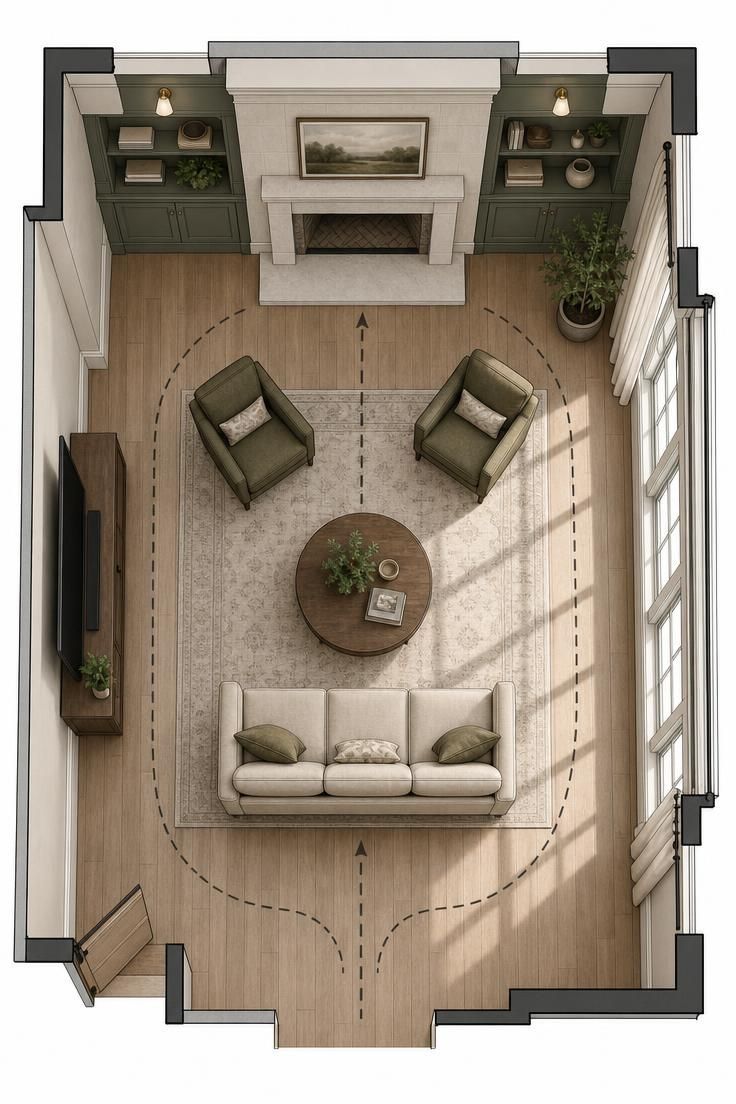
The clearest research-backed process for a future-friendly fireplace room starts with one durable surround material that the room can absorb.
Check the seating first.
The main piece should face or engage the fireplace, with chairs angled for conversation rather than pushed flat against walls.
Decide television placement before finalizing the fireplace wall.
The two elements should not compete for the same focal point.
Fireplace lighting ideas work best when layered across ceiling, floor, table, and accent sources.
The room should move from daytime practicality to evening warmth without a single glaring overhead fixture.
Repeat one surround material somewhere else in the room.
That single echo makes the fireplace feel part of the space rather than a separate feature.
Keep the mantel edited and test the layout and proportions with tape before buying anything.
Seven checks, applied in order, will catch most of the mistakes that make living room designs with fireplace look cheap.
The Takeaway: Expensive-Looking Is a Discipline, Not a Budget
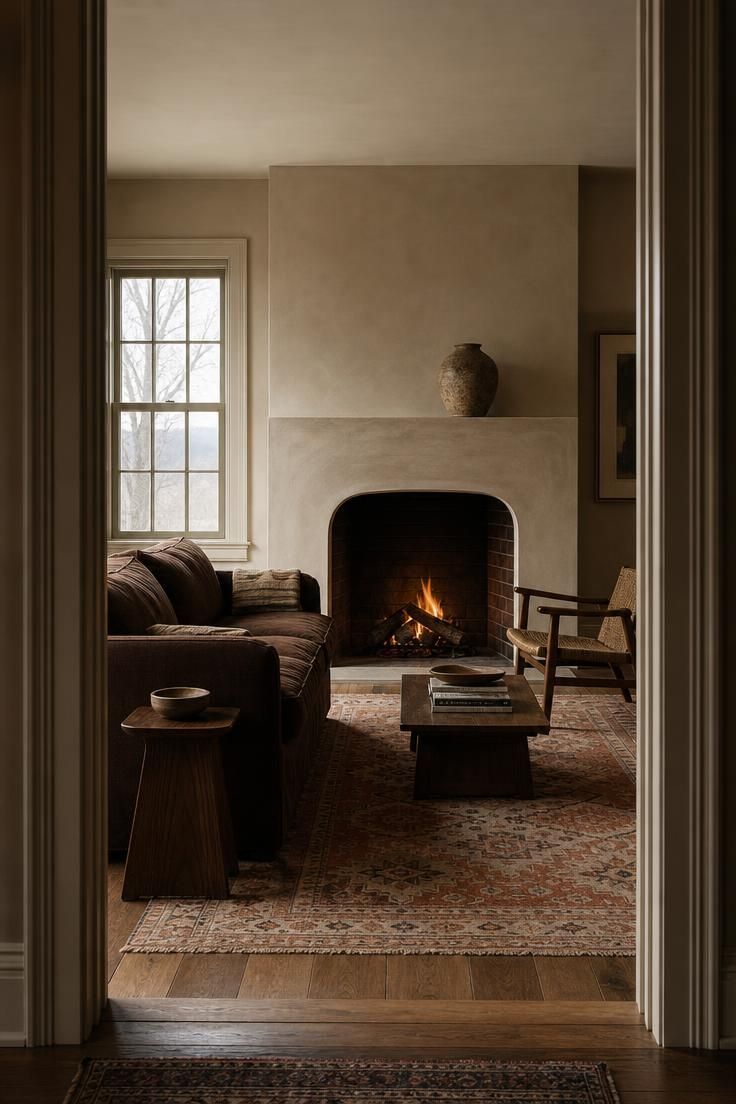
The difference between cheap and expensive rarely comes from what was spent on the fireplace itself.
It comes from whether the room around it was designed or decorated.
The core mistakes are consistent: isolated treatment, walls-hugging furniture, television competition, cluttered mantels, mismatched undertones, and temporary-feeling materials.
People value fireplaces enormously.
The surveys and trend data confirm it.
That value makes the room around the hearth deserve deliberate design rather than decorative shorthand.
The goal is not a showroom.
It is a room that feels collected, warm, and organized around the fire, with seating that invites conversation and objects that have room to breathe.
Start with one change.
Lower the television, clear the mantel, or pull the sofa closer.
That single move will reveal what else needs attention before any larger renovation begins.
Let the fireplace establish the mood without dictating every decision.
A fireplace accent wall can establish that mood when the surrounding material and seating support it rather than compete with it.
Cozy living room ideas succeed when the fireplace anchors the room without dominating every choice.
Safety, clearance, and practical use must always sit beneath the aesthetic layer.
The hearth is not purely decorative, and the most beautiful room still needs to function.
The fireplace rewards restraint, material honesty, and patience more than any single expensive purchase.
Expensive-looking is not a budget category.
It is a discipline.