This post may contain affiliate links. If you make a purchase through these links, we may earn a commission at no additional cost to you.
The quietest square footage in your home might be standing right in front of you.
It hides behind a door you open twenty times a day.
That narrow vertical plane between door and wall offers usable depth without stealing a single inch of floor space.
A well-chosen hanging organizer can turn a blank slab into a functional layer that holds the items you reach for most.
For anyone renting a compact apartment, door hanging storage removes the pressure to drill into tile or plaster.
A slim over the door pantry organizer can hold dinner prep staples in a kitchen where cabinets are already full.
In a shared bathroom, over the door bathroom storage keeps hair tools and cotton rounds off the only visible counter.
The visual trick is to treat the back of the door as a small room of its own.
One material, one finish, and one disciplined category of objects can make a utility rack feel like a built-in fixture.
The door’s front face stays clean.
The room reads larger.
The clutter lives somewhere you never have to look at directly.
A Slim White Oak and Brass Hook Rail for Entryway Bags and Hats
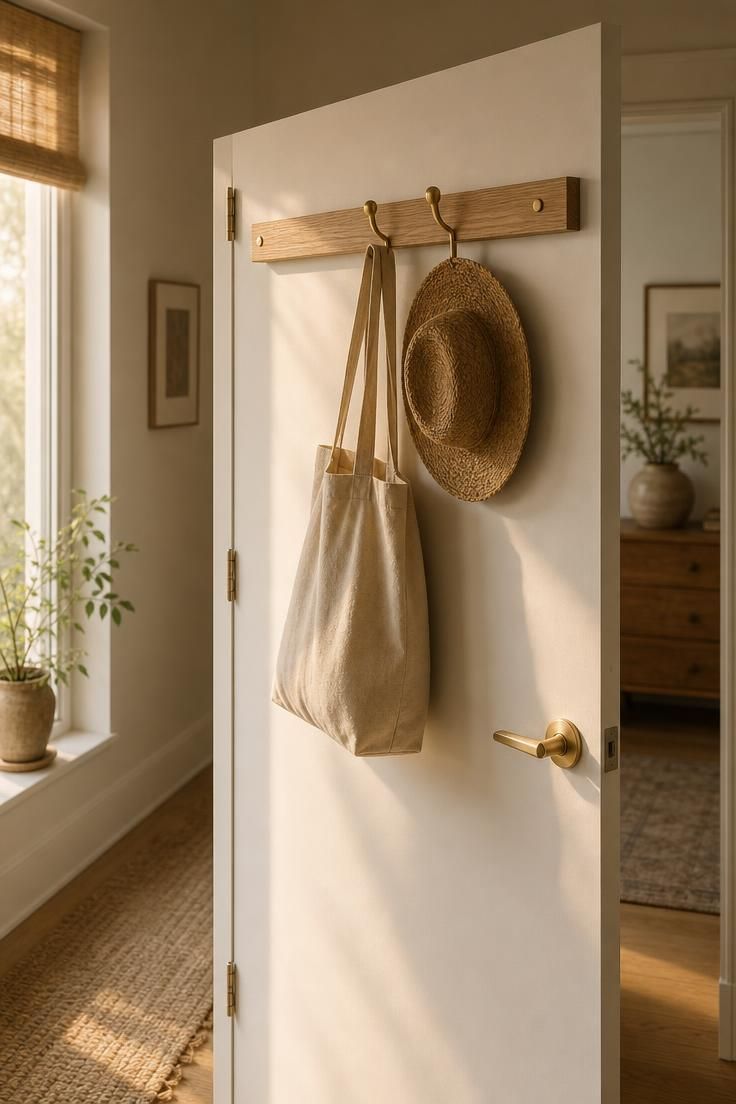
A flat-slab door reads as quiet and modern, so a narrow wooden rail becomes the only visible gesture on its surface.
White oak has a fine, even grain that picks up warm light without looking busy.
An oiled matte finish keeps the rail understated and helps the wood feel more integrated with the door’s existing hardware rather than like a glossy new addition.
Two hooks hold everything this entryway needs on a given day.
A canvas tote sits on the front hook, its soft handle curved over the brass without creating bulk.
On the second hook, a woven straw hat rests just below the rail, adding texture and a hint of seasonal personality.
Brass matters here because it warms the white door immediately.
Unlacquered brass will patina slowly, and that subtle shift can make the hooks feel collected rather than store-bought.
Matching the hooks to the door’s existing lever handle creates a line that reads as intentional.
The rail measures only three-quarters of an inch deep.
That slim profile helps keep the bags from swinging against the painted surface when the door opens or closes.
A small clear bumper on the lower back edge of the rail can help prevent contact with the wall paint behind it.
A felt-lined channel sits over the door top, and two tiny screws into the top edge help prevent the rail from sliding sideways.
That detail matters in a high-traffic entryway where a bag may be grabbed every morning.
The system should feel as stable as something permanently mounted.
Style Blueprint:
- Solid white oak rail, 18 inches wide, lightly oiled, with a 3/4-inch depth
- Two brushed brass hooks rated for 8 lbs each, matching the door lever
- One natural canvas tote in oatmeal or warm tan
- One woven straw hat with a tonal leather band
- Small clear adhesive bumper placed on the lower back edge of the rail
A Matte Black Steel Basket Tier for Pantry Overflow With Labeled Jars
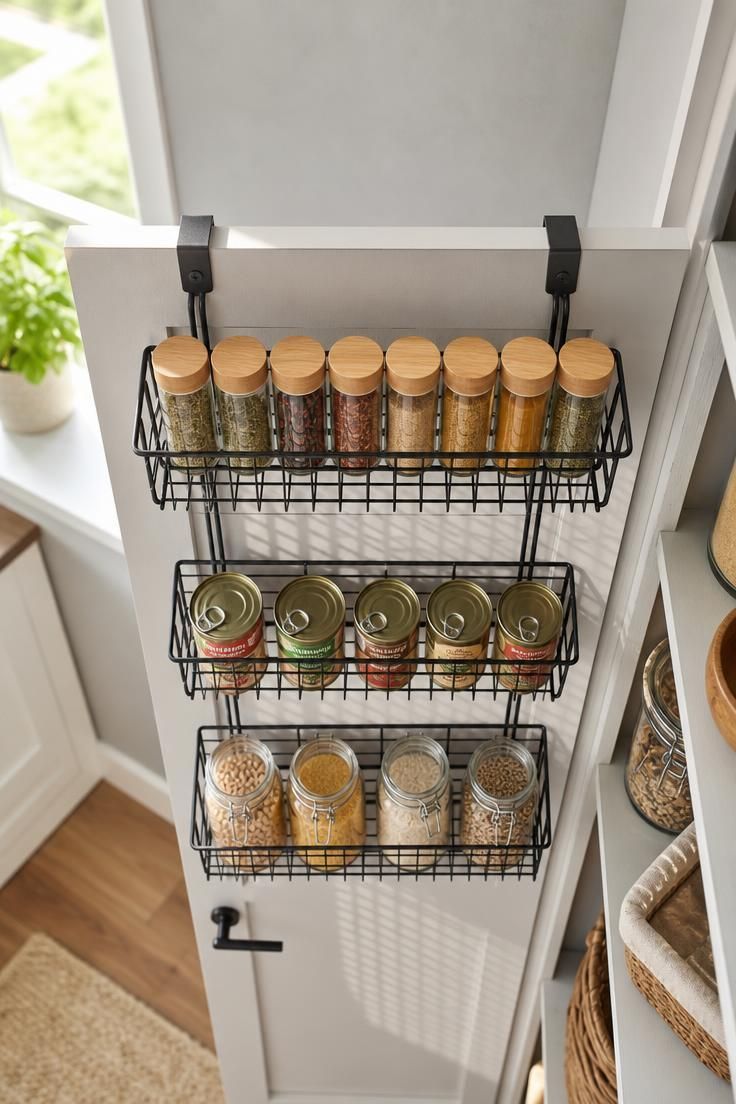
Pantry doors often hide a narrow gap of unused air between the door and a nearby wall.
A three-tier steel basket system uses that gap without consuming any shelf space inside the pantry itself.
A matte black finish works well in this spot because it disappears into shadow and reads more like hardware than plastic utility storage.
The system uses a pair of hook-over brackets at the top edge, with a lower strap wrapping around the door’s bottom.
That strap keeps the whole unit from swinging outward when the door opens quickly.
Before buying, check the top clearance to confirm the door has enough space for the bracket thickness. A simple coin can help gauge the available gap.
Each tier can hold one category of pantry overflow.
The bottom basket can carry glass jars of grains, the middle can hold small canned goods, and the top can hold spice bottles with matching bamboo lids.
Keeping categories separated makes frequently used items easier to locate during meal preparation.
Uniform jars do much of the visual work here.
When every jar shares the same bamboo lid, the rack looks calm even when it is full.
Leaving about an inch of visible space above the top basket can help the door look organized rather than overfilled.
Heavy jars belong in the bottom and middle tiers.
The top tier is better suited to small bottles because placing more weight higher on the door can make it harder to open and increase strain on the mounting hardware.
If the system is rated for 18 pounds across all three tiers, treat that figure as the maximum permitted load and follow the manufacturer’s weight and installation instructions.
A flat-slab painted door with a black hinge pairs naturally with a black rack.
The front of the pantry door remains completely clean, so the kitchen can retain a minimal appearance.
In this layout, the populated baskets limit the door’s opening to about 95 degrees. That clearance works where approximately 28 inches of unobstructed swing space is available.
Style Blueprint:
- Matte black three-tier steel basket system with lower stabilizing strap
- Glass jars with uniform bamboo lids for grains, spices, and small dry goods
- Small canned goods grouped in the middle tier only
- Black interior door hinge and matte black door handle to match the rack
- One inch of visible space left above the top basket at all times
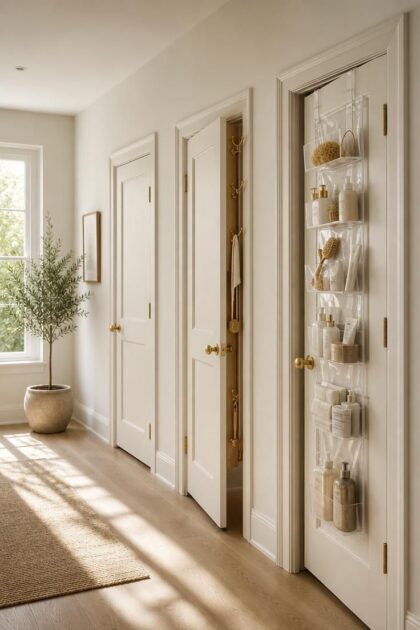
A Clear Acrylic Pocket Organizer for Bathroom Hair Tools on a White Panel Door
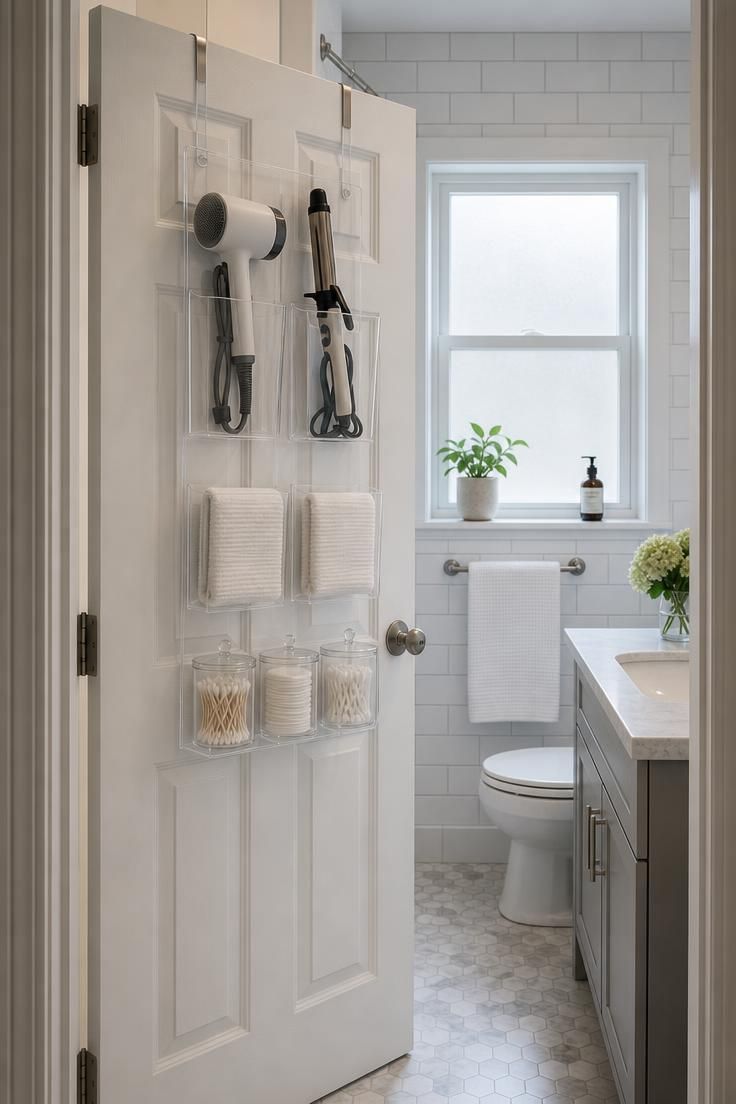
A classic six-panel door brings structure to a small bathroom.
The recessed rectangles break up the visual plane, so anything mounted on the door reads as a series of neat compartments rather than one flat board.
Against that backdrop, a clear acrylic organizer feels almost architectural.
Clear acrylic can be a practical alternative to fabric pockets in humid rooms.
Unlike absorbent fabric, acrylic provides a hard, nonporous surface that keeps stored items visible without requiring zippers or flaps.
The pockets vary from two to six inches deep, which means flat cotton rounds can sit near the top while bulkier hair tools rest lower.
Keeping each pocket only about 70 percent full leaves enough open space to prevent the organizer from looking swollen or chaotic.
The two largest tools can sit in the lowest pockets to keep more of the stored weight toward the bottom of the organizer.
Positioning the organizer on the door’s pull-side can also help keep it farther from the shower’s direct spray and steam.
Leaving the bathroom door open after a shower can improve airflow around the organizer.
A small silica packet placed behind the organizer may provide additional moisture control if the product is suitable for that use and kept safely away from children and pets.
Clear acrylic pairs especially well with chrome or polished nickel fixtures.
The cool transparency of the pockets visually echoes the shine of a chrome faucet or towel bar.
Limiting the visible contents to white, gray, and clear items can also keep the surface visually quiet.
A hook-over system with PVD-coated steel hooks and clear silicone pads can help protect the top edge of a painted door from direct metal contact.
That makes this type of setup particularly suitable as a rental-friendly door storage solution because it can be removed without permanently attaching an organizer to the door.
The top two pockets can remain empty or hold only flat, lightweight items.
Keeping heavier jars or bottles in lower pockets avoids concentrating unnecessary weight near the top of the organizer and can make the arrangement look more balanced.
Leaving the upper pockets relatively open also creates a cleaner view from across the bathroom.
Style Blueprint:
- Clear acrylic pocket organizer with six pockets, 4 mm thick, rounded corners
- Slim hairdryer and wide-barrel curling iron stored in the two lowest pockets
- Two folded white microfiber towels
- Three clear jars of cotton swabs, cotton pads, and small bath accessories
- Silica packet hidden behind the organizer to reduce humidity
A Linen and Brass Valet Strip for Jewelry and Scarves in a Walk-In Closet
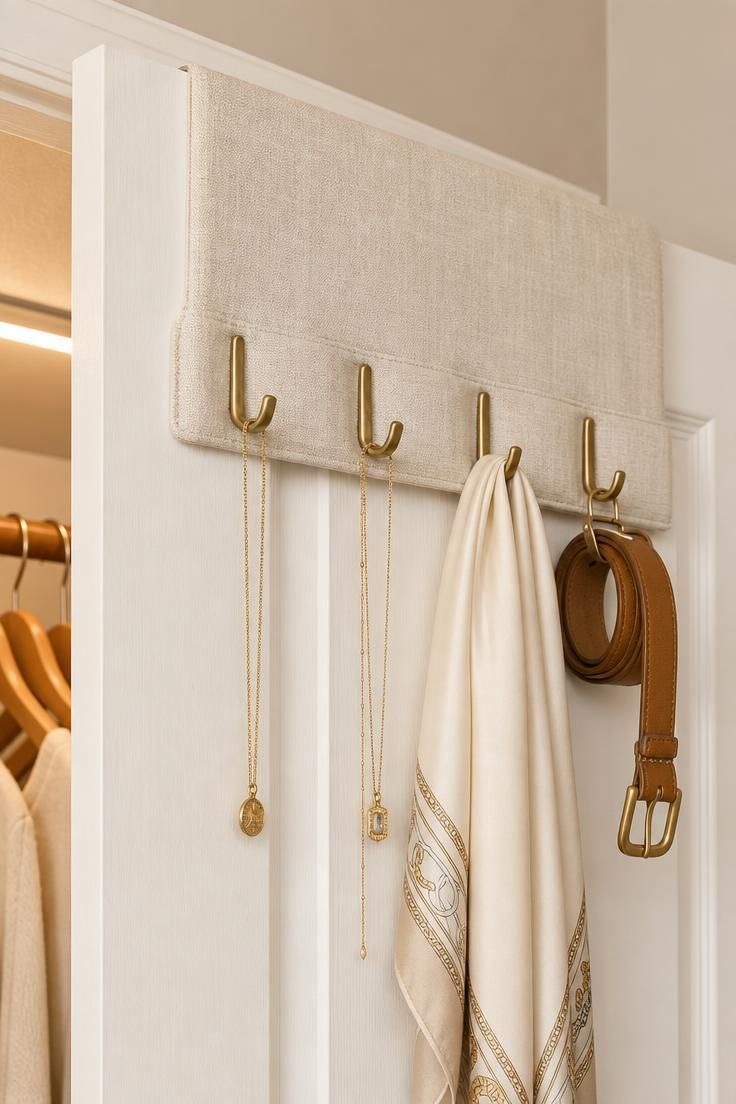
A walk-in closet should feel more like a dressing room than a storage unit.
A small valet strip can make that shift happen, especially when the materials feel as considered as the contents.
This strip pairs a solid brass bar with a removable cream linen sleeve, and the combination reads as part of the closet’s wardrobe.
Five polished brass hooks hold a rotating cast of accessories.
Three fine-gauge gold necklaces hang separately so they never tangle.
One silk scarf drapes across two adjacent hooks, and a leather belt coils on the lowest point.
Brass works well in a closet because its warm finish contrasts with the white door and can create continuity with wood hangers nearby.
Unlacquered brass develops patina over time, which can make the strip look less like a new tool and more like an established fixture.
The hook points can be polished occasionally without restoring the entire surface to a bright gleam.
The hollow-core door carries less than four pounds total in this arrangement, keeping the setup lightweight.
Two shallow hook-over brackets with felt pads distribute the load across the top of the door.
The linen sleeve is removable and washable, which is useful when makeup or dust transfers from accessories over time.
Each hook receives one category of object.
Necklaces get one, scarves get two, and the belt gets one.
That organization keeps the strip looking styled rather than cluttered, and it makes each category easy to locate.
An over the door closet organizer like this valet strip works best when the door’s back face remains visible.
The hollow-core door’s white surface becomes a quiet backdrop for the brass and linen.
Style Blueprint:
- Brass valet strip, 2 inches wide, with five integrated hooks
- Removable cream linen sleeve for the brass bar
- Unlacquered brass finish allowed to patina naturally
- Three fine-gauge gold necklaces hung individually
- One ivory silk scarf and one tan leather belt
Design Pro-Tip: Replace the standard hook pads on metal hangers with thin adhesive felt or cork strips. This adds a micro-layer of protection on the door’s top edge and eliminates the metallic rattle every time the door closes.
A Perforated Aluminum Spice and Jar Rail for a Pantry Door With Drop-Down Baskets
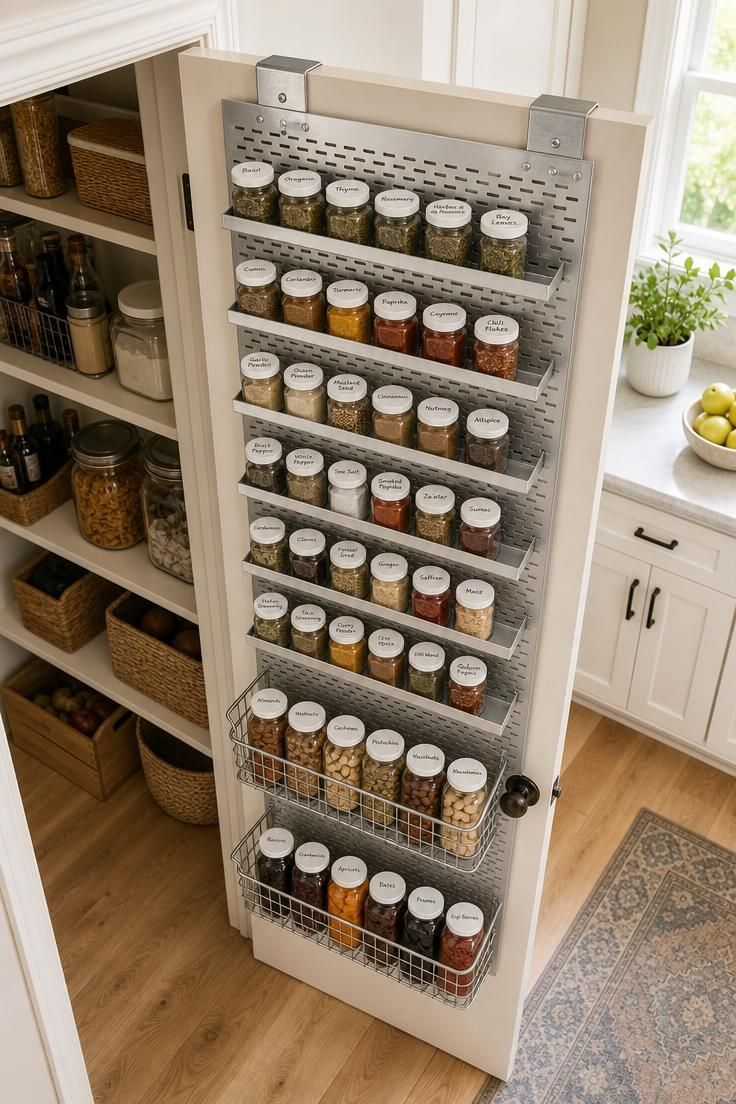
A full-height door panel can hold more than a few jars if the material stays light and the load stays low.
This perforated aluminum system covers most of the door’s back face without adding visual weight.
The brushed aluminum, powder-coated in warm white, blends into the surrounding cabinetry and keeps the pantry from feeling industrial.
Two drop-down wire baskets sit near the bottom of the panel.
They hold small jars of nuts and dried fruit, items that are dense but small enough to grab easily.
Above them, six angled spice rails keep glass jars tilted slightly forward so labels stay readable at a glance.
Every spice jar matches in height, with a white enamel lid and a handwritten label.
That consistency turns the panel into a visual rhythm rather than a collection of mismatched bottles.
Updating the labels periodically helps keep the lettering crisp and the jars visually consistent.
The panel weighs about nine pounds empty and roughly fourteen pounds loaded.
The brackets are two inches wide and lined with cork tape, which helps distribute contact across the door’s top edge.
A clear vinyl strap wraps around the lower door corner and hooks into a rubber anchor.
The anchor helps limit panel movement when the pantry door opens quickly.
The door still opens to about 100 degrees, and the adjacent wall stays free of furniture so the swing path remains clear.
Perforations in the aluminum leave open space behind the spice jars and keep the panel visually lighter than a solid backing.
The small holes also provide attachment points for S-hooks, allowing a pair of measuring spoons to hang from the panel.
Keeping heavier honey and syrup jars on the lower rails places more of the weight toward the bottom of the panel.
The upper rails remain reserved for dried herbs and small spice bottles.
A thin rubber bumper on the panel’s bottom edge helps prevent it from tapping the baseboard when the door closes.
The result is a space-saving door storage system that turns an overlooked pantry door into a working pantry wall.
The front of the door remains clean and unmarked, so the kitchen still feels open.
Meanwhile, dinner staples remain close at hand.
Style Blueprint:
- Brushed aluminum panel, powder-coated warm white, with staggered 1-inch perforations
- Two drop-down wire baskets for nuts, dried fruit, and small jars
- Six angled spice rails for matching jars with white enamel lids
- Cork tape lining the bracket interiors to protect the door top edge
- Clear vinyl bottom strap with rubber anchor to prevent swinging
A Japandi Bamboo Shelf Trio for Folded Linens and Hand Towels on a Laundry Door
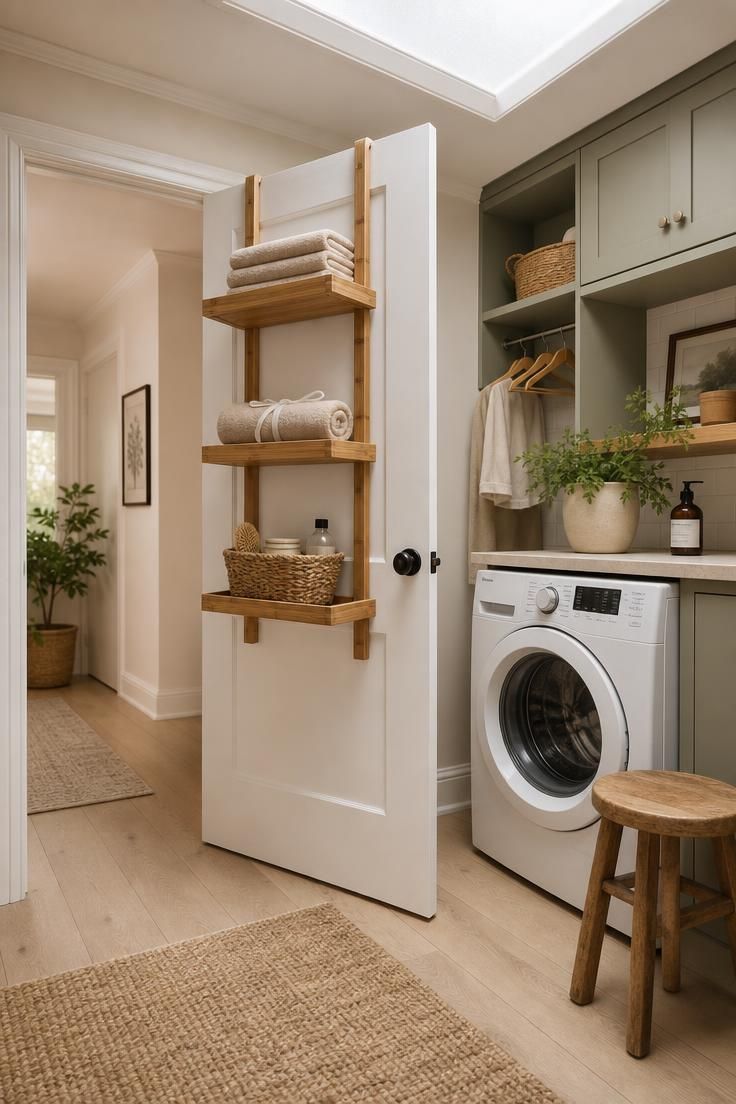
Laundry rooms tend to collect fabric faster than any other room in the house.
A bamboo shelf trio on the back of the laundry door gives those textiles a place to land between washes.
The warm caramel tone of bamboo softens a white laundry room and ties in with any wood accents nearby.
Three shelves offer three distinct ways to store linens.
The top shelf holds a stack of folded hand towels in warm beige.
The middle shelf holds two rolled bath towels tied with twill tape, a simple gesture that breaks up the monotony of flat folds.
The bottom shelf carries a small seagrass basket for lint rollers, clothespins, and small laundry tools.
Leaving the front inch of each shelf completely clear keeps the bamboo lip visible, reinforces the shelf’s structure, and prevents the arrangement from feeling overstuffed.
Rolled towels on the middle shelf add height and texture without making the door feel crowded.
The frame uses two steel hook-over channels lined with cork.
Cork protects the door’s top edge from scratches and helps keep the frame from shifting sideways.
Because bamboo can respond to changes in humidity, the shelves can be maintained according to the manufacturer’s care instructions and the finish used on the material.
The open shelf design also allows air to move freely between the towels.
The over-the-door hooks are integrated into the bamboo frame, so there are no visible metal brackets interrupting the warm wood line.
Matching the bamboo to a nearby wooden stool creates continuity without requiring an exact color match.
This hanging door organizer becomes part of the room’s furniture rather than an add-on.
The door still opens fully against the washing machine wall, with nothing protruding into the main walkway.
The front of the door remains plain white, so the laundry room keeps its clean, quiet character.
All the useful storage remains on the side visible only when the door is closed.
Style Blueprint:
- Solid bamboo shelf trio, three shelves, 14 inches wide and 4 inches deep
- Folded beige hand towels in two warm tones on the top shelf
- Rolled ivory bath towels tied with twill tape on the middle shelf
- Small seagrass basket on the bottom shelf for laundry accessories
- Wooden stool in a matching warm wood tone near the washer
A Space-Saving Hanging Door Organizer for Kids’ Books and Bedtime Essentials
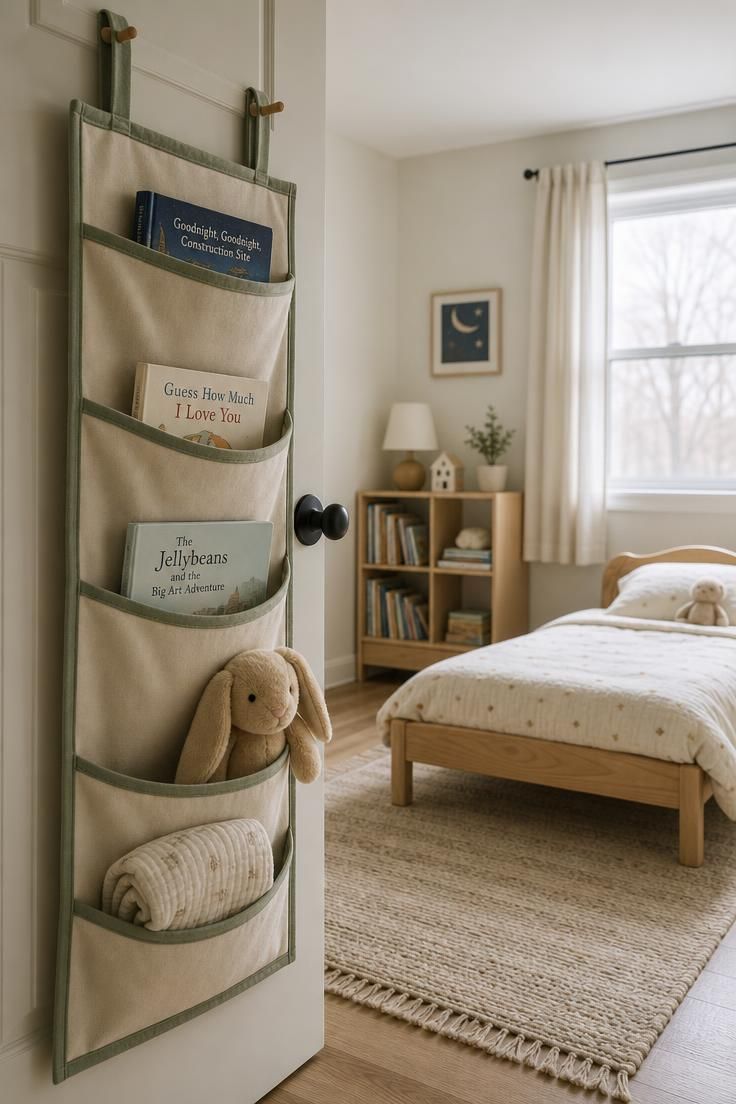
A child’s bedroom door often stays open during the day and closed at night.
That makes the back of the door an ideal place for the objects that carry a child from daytime play to bedtime calm.
A natural cotton canvas organizer with four deep pockets works better in this room than metal or acrylic, because the fabric softens the whole scene.
The organizer hangs from two sturdy hook channels over the door top.
The cotton canvas has a sage green trim that feels restful without adding visual noise.
Four deep pockets hold a rotating selection of books and comfort items.
Three picture books sit with their spines visible, which encourages a child to choose a story independently.
One small plush rabbit peeks out from the second pocket, and a folded muslin blanket fills the lowest pocket.
The arrangement feels personal, not merchandised.
Canvas is a forgiving material in a kid’s room.
It absorbs the small bumps of daily life and can be washed when needed.
The hollow-core door carries only a few pounds, so the organizer creates no stress on the hinges or the top edge.
The lower camera angle matters because it shows how a child experiences this storage system.
The books are reachable, the plush is visible, and the whole unit feels like part of the room rather than an adult’s organizational tool.
Keeping the palette to cream, sage, and natural wood lets the door recede when open.
The room still feels airy, even with storage on the door.
An over the door shoe rack made from the same cotton canvas could hold slippers or small shoes nearby, keeping the floor clear for play.
This is space saving door storage that works with a child’s rhythm instead of against it.
Style Blueprint:
- Natural cotton canvas over the door organizer with four deep pockets
- Sage green trim or piping for a soft, restful accent
- Three picture books with colorful but coordinated spines
- One small plush rabbit or similar soft toy
- One folded muslin blanket in cream or pale green
Design Pro-Tip: In a child’s room, mount the hanging organizer so the lowest pocket stays at least six inches above the floor. This makes the contents easy for small hands to reach while preventing the fabric from collecting dust along the baseboard.
Conclusion
Every door in your home holds unused capacity.
The difference lies in matching the right hanging organizer to the right door type, finish, and load limit.
A slim brass rail on an entry door feels entirely different from a bamboo shelf trio on a laundry door, and that specificity is what makes the storage disappear into the room.
The most effective over the door storage does not announce itself.
It echoes the hardware around it, holds one disciplined category of objects, and leaves the door’s front face untouched.
When the door is closed, the room reads as composed.
When the door opens, the function appears exactly where you need it.
Start with one door and one category of objects.
Choose one material that already exists elsewhere in the room, whether that is brass, bamboo, black steel, or clear acrylic.
That single decision will carry the entire system from rented utility to intentional design.