This post may contain affiliate links. If you make a purchase through these links, we may earn a commission at no additional cost to you.
Halloween decorating often arrives as a wave of orange plastic, printed novelty motifs, and crowded surfaces.
A quieter approach treats the season as a shift in silhouette, material, and light instead.
Modern minimalist halloween decor leans on a tight palette, negative space, and one clear focal point per room.
The pieces themselves stay few, so setup is quick and the look reads as deliberate rather than unfinished.
Each idea below works with furniture and surfaces a home already has, which makes the seasonal layer easy to add and just as easy to remove.
Flat black bat silhouettes sweeping one pale wall
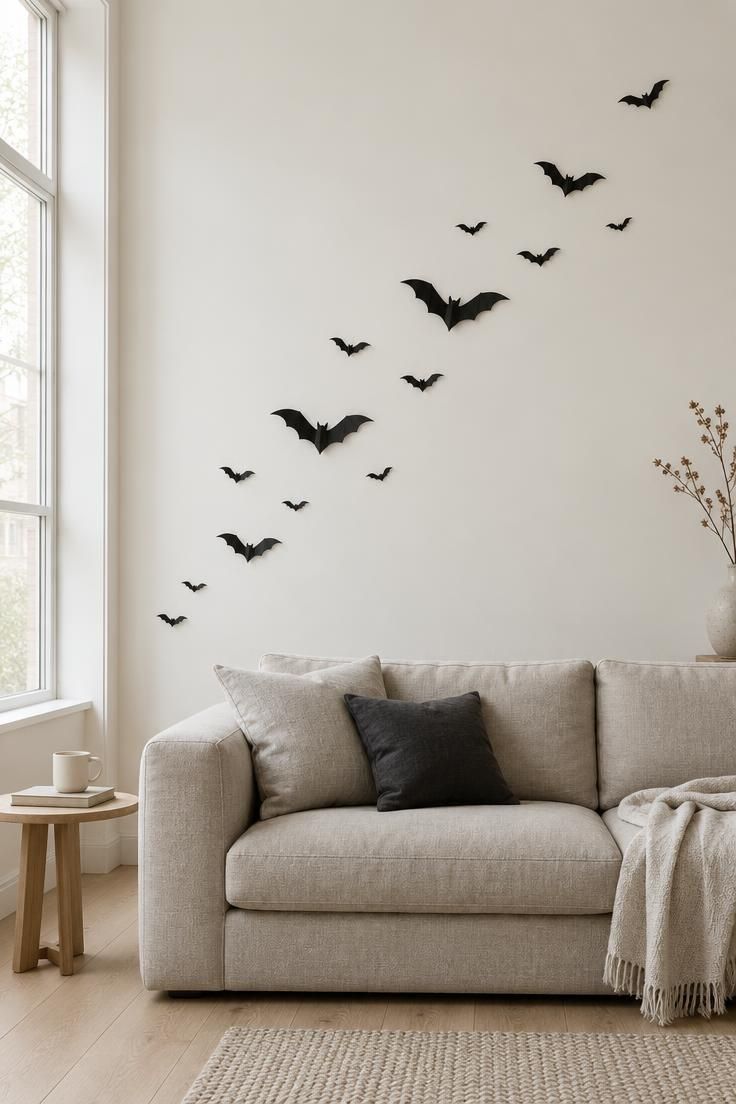
A single wall can carry the whole seasonal idea when the shapes are flat, black, and loosely spaced.
Cut paper or thin card bats arranged on a diagonal create movement across an otherwise empty plane, and the pale wall becomes part of the composition rather than a background to fill.
Working with three sizes of the same shape builds rhythm without introducing a second motif.
The surrounding surface stays clear so the negative space does the work that extra props would do in a fuller scheme.
Placement matters more than quantity here.
A cluster that drifts from upper corner toward the center suggests flight, while an evenly spaced grid starts to look like wallpaper.
Keeping most of the wall empty makes each shape read clearly from across the room.
A narrow, topic-specific note: removable adhesive products hold best on smooth, clean painted surfaces, so a freshly washed matte wall performs better than a textured or dusty one.
For readers who also want a low tabletop accent, simple black taper candle grouping ideas, such as three thin candles in mismatched glass holders on a nearby console, carry the same graphic weight without repeating the bats.
The arrangement stays temporary by design.
Paper shapes lift away at the end of the season and leave the wall as it was.
Storage takes almost no space, and the whole effect can be adjusted after a week if the spacing feels off.
Renters and anyone who prefers to avoid permanent changes will find this the easiest version of the look to reverse.
Style Blueprint:
- Matte black card or paper bat shapes in three graduated sizes
- Removable adhesive dots rated for lightweight paper
- A smooth, clean, pale painted wall with no competing art
- A low neutral sofa or bench to anchor the space below
Design Pro-Tip: Vary the spacing between bats more than the sizes, since uneven gaps read as accidental movement while even ones read as a pattern.
Three small white pumpkins on a wide wooden bowl
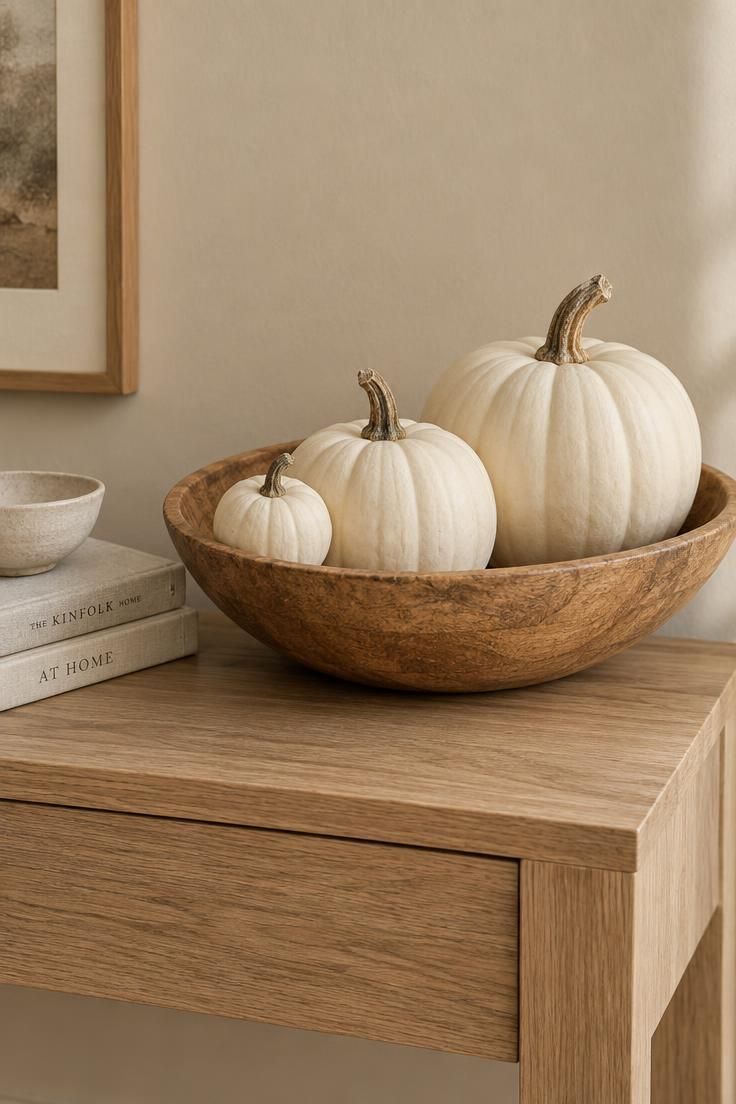
A wide, low bowl turns three separate objects into one contained arrangement.
The rim holds the grouping together visually, so the console reads as a single styled moment instead of a scatter of small items.
Graduated sizes give the eye a direction to travel, from the smallest pumpkin to the largest, and white or cream tones keep the palette quiet enough to sit out for weeks.
Natural stem texture supplies the organic detail that an all-black scheme would lack.
Real pumpkins do have a limited display window.
They can soften or mark depending on the room's humidity and warmth, so a bowl placed away from direct heat and strong sun lasts longer.
Painted or artificial pumpkins remove that concern and hold their color, though they trade away the surface variation that makes a real gourd pleasant to look at up close.
Either version works in the same bowl, so the decision comes down to how long the display needs to stay.
For a dining surface, this bowl concept scales up into a moderately spooky Halloween table setting by repeating small pale pumpkins at each place and leaving the center of the table bare.
The restraint is what keeps the table usable for actual meals.
A wood bowl also travels easily from console to table to kitchen counter, which makes it a flexible base for a single seasonal object.
Design Pro-Tip: Let one pumpkin lean against another instead of lining all three up, which keeps the grouping from looking measured.
Style Blueprint:
- A shallow wide wood bowl with a visible grain
- Three white or pale cream pumpkins in close graduated sizes
- A plain wall or neutral backdrop behind the console
- Painted or artificial pumpkins if the display needs to last past a few weeks
Black taper candles in mismatched glass holders
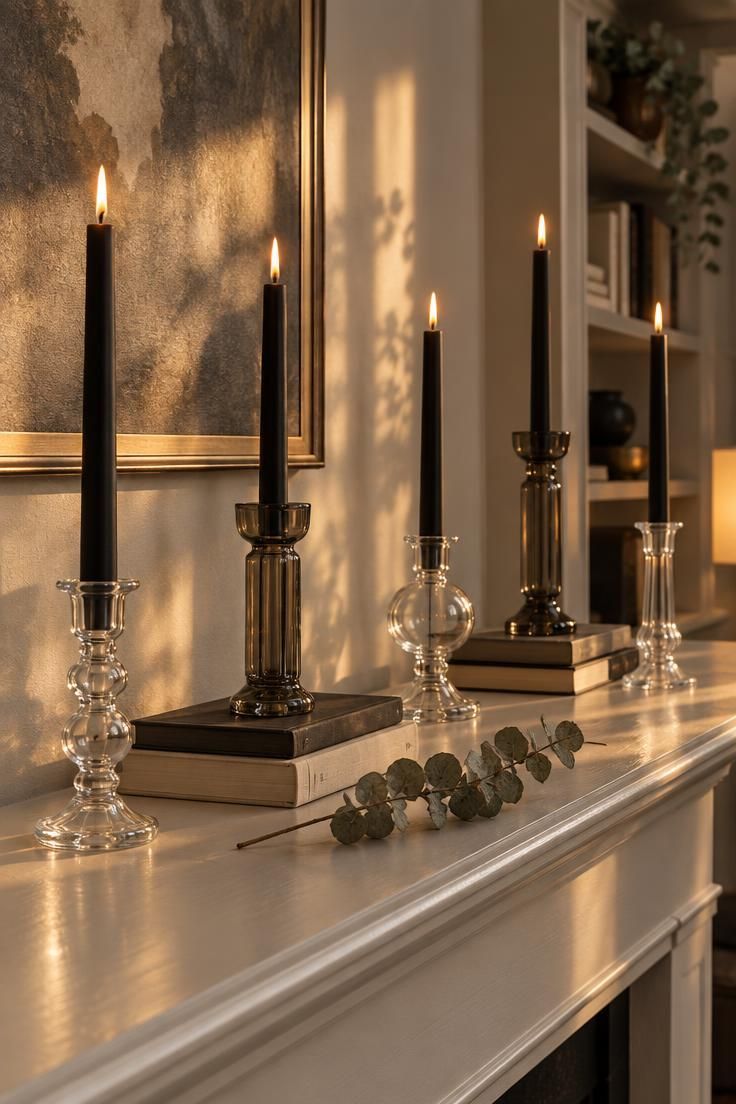
Thin black tapers give a shelf or mantel a quiet evening focal point that holds its shape even before anything is lit.
The dark wax reads as a graphic vertical line against a pale wall, and mismatched glass holders add small variations in reflection and height without introducing a new color.
Grouping an odd number, three or five, keeps the row from feeling paired off, and leaving wide gaps between candles preserves the emptiness the rest of the room depends on.
Mixing holder heights is easier than it looks.
Small stacked books, a low wooden riser, or a stoneware saucer under one holder shifts a candle up a few inches and breaks the flat line.
Keep the tallest candle near one end rather than in the middle so the row has a direction.
During the day the unlit tapers work as sculpture.
In the evening, lit candles need ordinary supervision and clear space away from paper, dried botanicals, and fabric, and they should never be left burning unattended or within reach of children and pets.
A minimalist Halloween mantel display often comes down to one decision: how much of the shelf stays empty.
Here, the answer is most of it.
The candle row occupies the center third, and the remaining surface holds nothing but the single dried stem.
That ratio is what separates a considered mantel from a cluttered one, and it also makes the display quick to clear when the season ends.
Style Blueprint:
- Five thin black taper candles in odd-numbered grouping
- Mismatched clear, smoke, or amber glass holders
- Small stacked books or a wooden riser for height variation
- One dried eucalyptus or seed-head stem laid flat in front
- A mantel or shelf kept at least two-thirds empty
Design Pro-Tip: Keep the holders deliberately unmatched in shape but similar in tone, so the row feels collected rather than coordinated.
A single oversized matte-black cat silhouette on a bookshelf
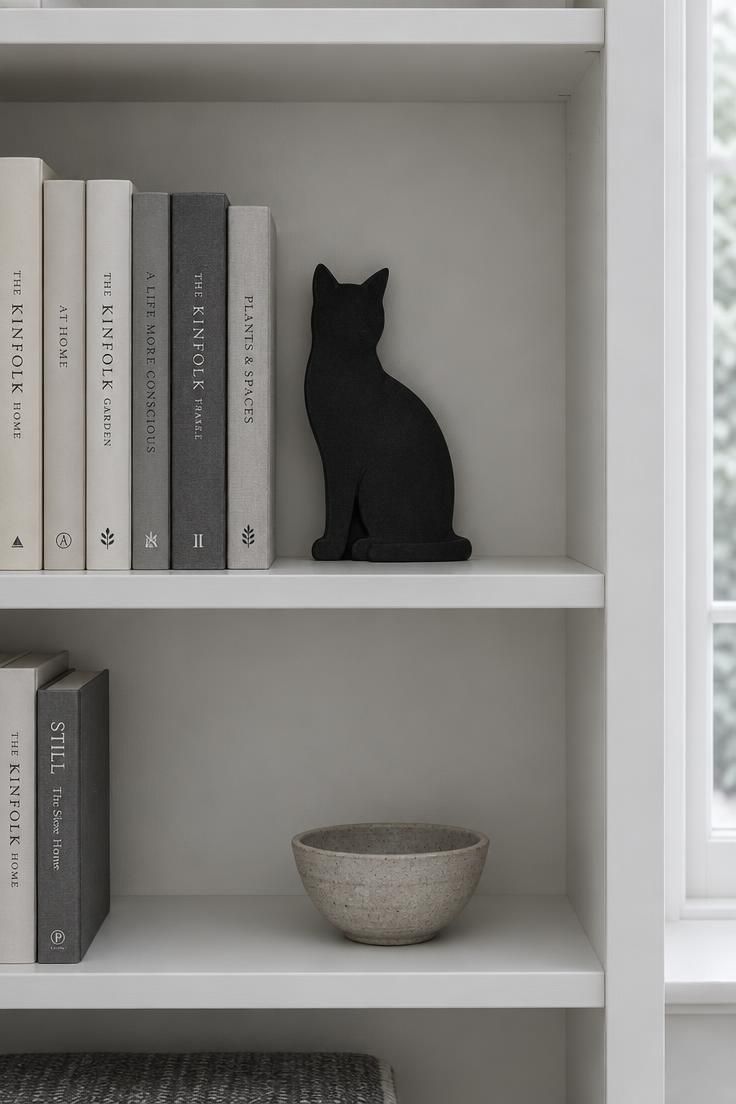
Scale can replace quantity.
One flat black cat shape, larger than a typical shelf ornament, does the seasonal work of several small objects because the eye lands on it immediately.
Placing it among neutral books keeps the silhouette as the only outlined form on the shelf, and the surrounding emptiness gives the shape room to be read.
A wooden or painted card form leans against the shelf back, so nothing needs to be attached.
Position matters as much as size.
Setting the cat at eye level, roughly where a small decorative object would normally sit, makes it feel like part of the room rather than an afterthought pushed to a high corner.
Books in cream, gray, or beige keep the shelf monochrome so the black shape stays the single point of contrast.
This is one of the most adaptable examples of modern minimalist halloween decor, because the entire display fits in one hand and moves between rooms, making silhouette-driven Halloween styling easy to repeat without extra clutter.
The tradeoff is that a single object has nowhere to hide.
If the finish looks flat or the proportions are off, that becomes the whole impression.
Choose a shape with a clean outline and a genuinely matte surface, and avoid glossy card that will catch glare.
Style Blueprint:
- One matte black cat silhouette, oversized relative to shelf decor
- A leaning card or wooden form with no visible hardware
- A tight stack of cream, gray, or beige book spines
- An otherwise bare shelf at eye level
Design Pro-Tip: Keep the books beside the cat in a single tight row, since a loose scatter of spines competes with the one outlined shape on the shelf.
A black paper silhouette runner on a pale entry console
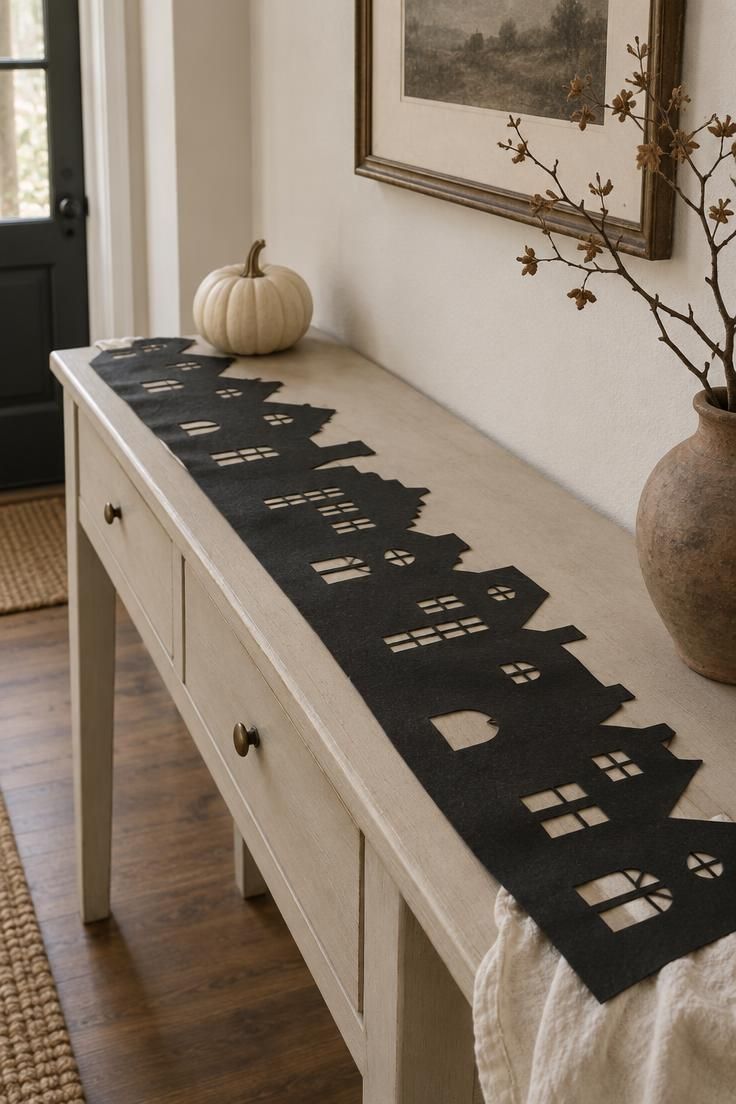
A cut-paper runner brings the graphic quality of Halloween shadows down to table height while keeping the surface calm and uncluttered.
One long strip of heavyweight black paper, cut with a utility blade into a connected row of simple rooflines and arched openings, turns an ordinary flat surface into a low horizon line that still leaves most of the console visible.
The pale wall and table surface do the visual work that patterned fabric or painted accessories would usually take on.
Working with paper keeps this idea temporary, inexpensive, and easy to trim for a shorter or longer console.
The runner can be cut freehand to match the room's proportions, and any uneven cuts read as part of an intentionally rough paper silhouette.
Layering it over a thin cloth or runner that shows a little at the edges softens the line between the black paper and the wood or painted surface below.
Paper collecting dust along a hallway is the main tradeoff.
A dry soft brush or a slightly damp cloth works for a coat of everyday dust, but the runner should sit away from keys, water, and anything that might leave a scratch or stain.
Storing it flat between sheets of cardboard keeps the cut edges crisp for another year.
Style Blueprint:
- One continuous black kraft paper strip cut by hand
- A simple repeated roofline or arched opening motif with negative space
- A pale console surface left mostly visible beneath the runner
- One low object, such as a small white pumpkin or clay pot, for weight at one end
Design Pro-Tip: Cut the paper runner as a single connected band so the cutouts stay aligned and the long dark shape reads as one intentional surface rather than scattered paper decorations.
A single dark gourd under a clear glass cloche
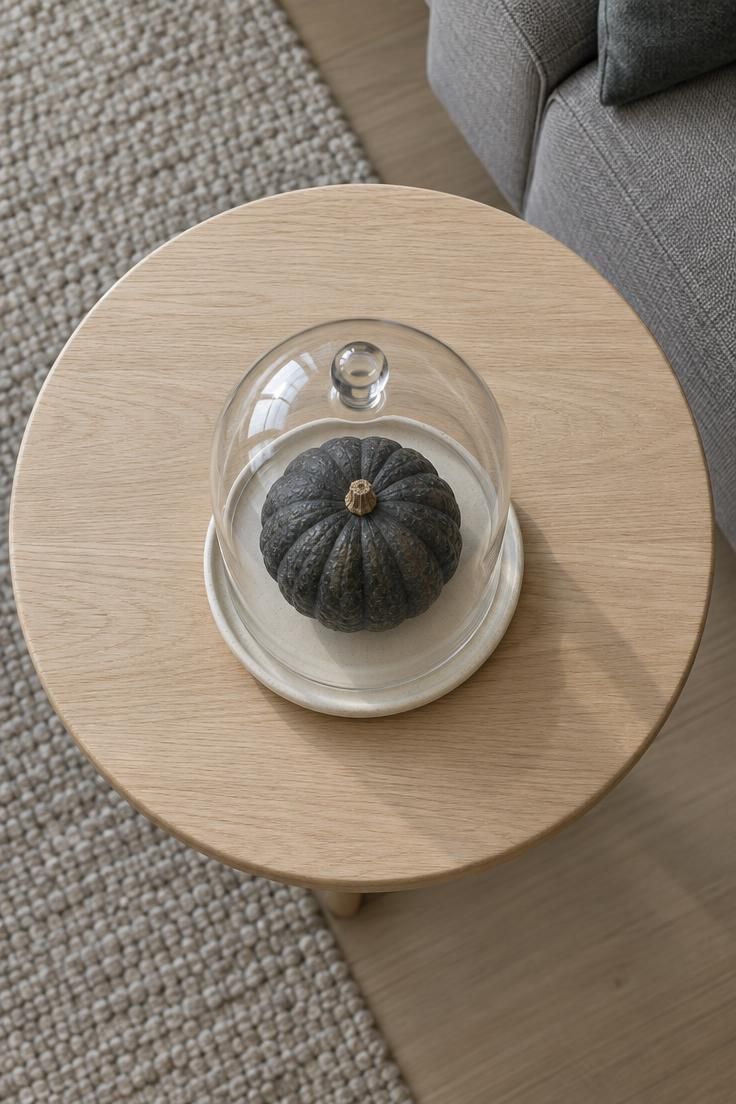
A glass cloche turns one small object into a framed display.
The dome creates a boundary around the gourd, so a single piece reads as intentionally presented rather than casually set down, and the clear glass adds a curve and a soft highlight without contributing color.
One dark, muted gourd on a plain saucer is enough.
The contrast between the charcoal surface and the pale wood tabletop does the rest.
Because the gourd sits under glass, the choice between real and artificial matters less than it would in the open.
A real gourd is protected from casual handling but can still soften over time, and moisture trapped under the dome can encourage marks.
An artificial or papier-mache form holds its appearance indefinitely and removes any question about perishability.
Either way, the dome needs occasional wiping inside and out, since fingerprints and dust show quickly against a dark object.
Keeping the surrounding tabletop empty is what makes this composition work.
A coaster, a second gourd, or a small stack of books beside the cloche would break the single-focal-point logic.
On a narrow shelf the same setup reads well at eye level, though the dome should sit where it will not be knocked.
This is a useful idea for a small home, since the whole display occupies about the footprint of a dinner plate.
Style Blueprint:
- A clear glass cloche with a simple dome shape and no ornament
- One dark charcoal or deep green gourd, real or artificial
- A plain cream or stoneware saucer underneath
- A small round side table with a bare surface
- A soft cloth kept nearby for wiping the glass
Design Pro-Tip: Leave the tabletop around the cloche entirely empty so the dome edge stays the only visible boundary on the surface.
Black ceramic skulls as bookends on a monochrome shelf
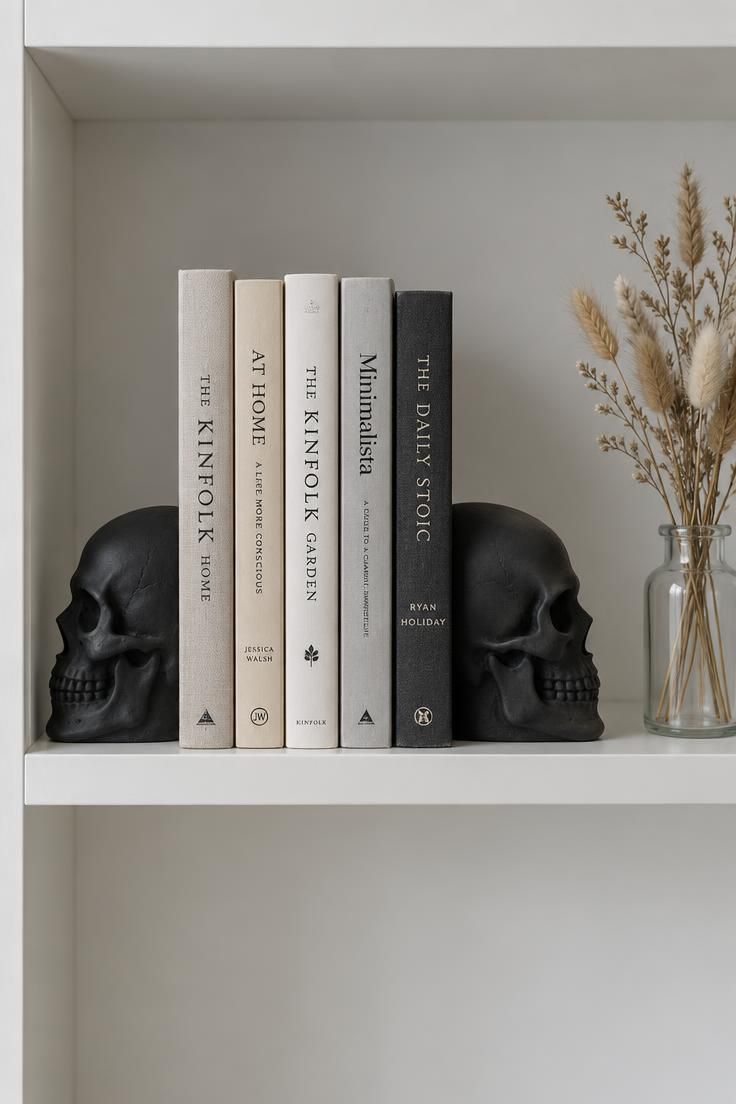
Bookends do two jobs at once.
Two matte black ceramic skull forms hold a row of books upright while adding a seasonal reference that reads as sculpture rather than prop.
The dark ceramic against pale spines gives a clear edge to the row, and the functional role means the objects belong on the shelf even after the season ends.
A single glass jar of dried grasses at the far end balances the composition without adding a second motif.
Skull forms sit at the more overt end of the silhouette spectrum.
Compared with a bat shape or a plain gourd, they carry a stronger Halloween signal, which suits a home that wants the reference to be unmistakable and can feel heavy-handed in a room styled around soft neutrals.
If the rest of the space is quiet, one pair at each end of a book row is usually enough.
Choosing book spines in white, gray, or beige keeps the skulls visible as the dark point of contrast instead of letting colored spines compete with them.
Ceramic holds up well across seasons, wipes clean, and stores without shedding or fading.
The practical caution is weight: dense ceramic bookends can be heavy, and a shelf that already carries a full row of hardcovers may not be the right home for them.
Keeping the row to a modest run of books keeps the shelf comfortable and the arrangement visually tidy.
Style Blueprint:
- Two matte black ceramic skull bookends with a uniform finish
- A row of white, gray, or beige book spines
- One small glass jar with a few dried grass stems at the far end
- No additional seasonal objects on the shelf
Design Pro-Tip: Keep the book spines in a narrow tonal range so the skulls stay the only dark shapes in the row.
A narrow floor mirror reflecting a pumpkin and candle pair
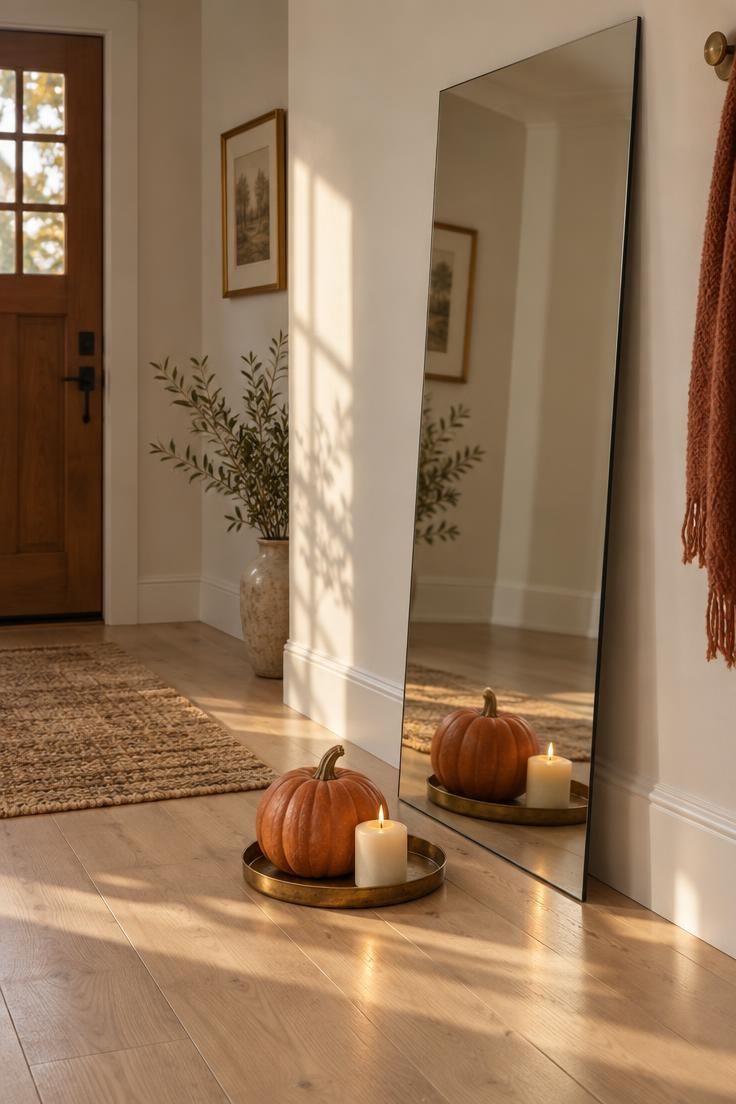
A floor mirror doubles a small arrangement without adding a single prop.
One pumpkin and one candle in front of the glass become two of each in the reflection, which fills a tall vertical stretch of wall that a single low object could not cover.
The muted orange keeps the seasonal reference soft, and a brass tray under both pieces protects the floor and gives the pair a shared base.
Offsetting the pumpkin slightly to one side of the mirror rather than centering it keeps the reflection from looking symmetrical and static.
The candle should stay unlit in this position, since the glass sits close enough to catch the flame's heat and any nearby fabric or dried material.
A true pillar candle, or a battery version if the display is left in place, handles the low light without the flame.
The mirror has to be sturdy and stable on its own footing, and a high-traffic entry is the wrong spot if it could be bumped.
In a quieter corner or beside a console, it works well.
This idea suits a narrow hallway because the vertical glass uses wall height that would otherwise stay blank, and both objects lift away at the end of the season, leaving the mirror in place as everyday decor.
Style Blueprint:
- A tall, simple floor mirror with no elaborate frame
- One muted orange or rust-toned pumpkin
- A low cream or ivory pillar candle
- A small brass or dark metal tray as a shared base
- A quiet corner with a pale wall behind the mirror
Design Pro-Tip: Shift the pumpkin a few inches off center from the mirror so the reflection reads as depth rather than a symmetrical repeat.
A plain door wreath of dried eucalyptus and one black ribbon
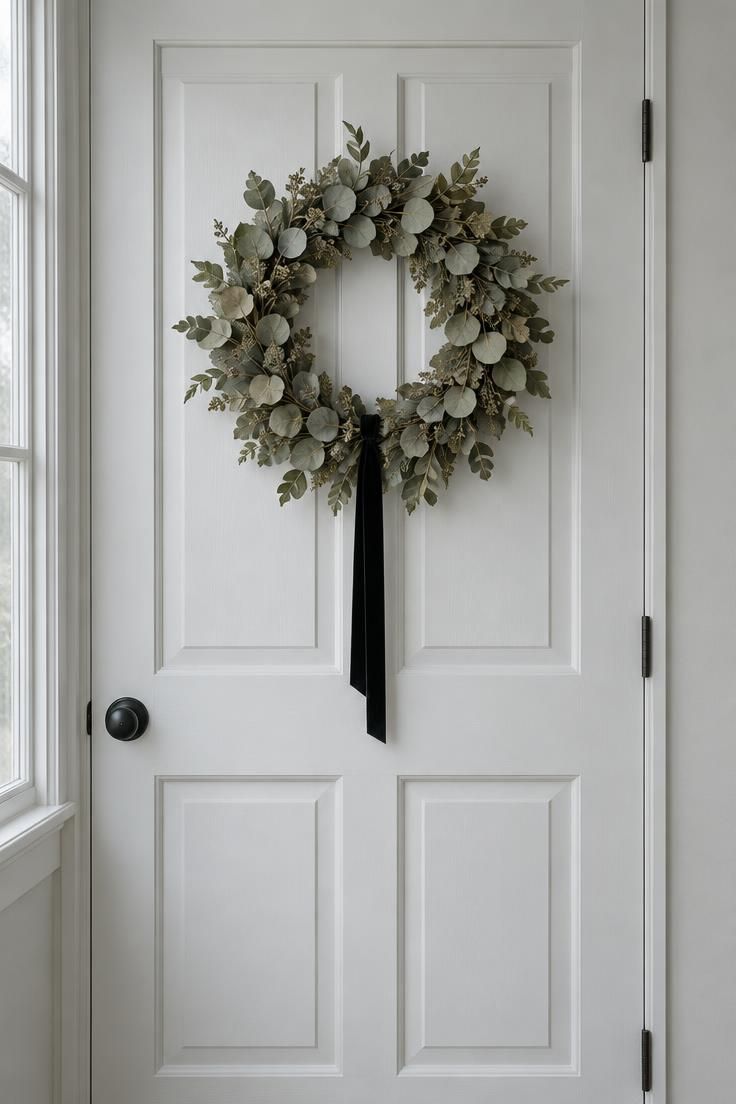
A wreath reads as seasonal through one detail here: a thin black velvet ribbon.
The rest of the form is plain dried eucalyptus, so the arrangement keeps the gray-green tone of natural foliage and avoids the bright color and printed accents that a fuller seasonal wreath would carry.
Hanging it on an interior door at eye level places the texture where it is noticed without crowding an entry wall.
Dried eucalyptus does drop small leaves, especially on a door that opens and closes often.
A flat-backed wreath form, where the stems lie against a shallow base rather than wrapping around a thick ring, sheds less and sits closer to the door.
Sweeping beneath the door every few days keeps the floor tidy.
Handle the wreath by its base rather than the ribbon when taking it down, since dried stems can snap.
The single black ribbon should hang long enough to move a little when the door swings, without trailing where it could catch.
Removing the wreath at the end of the season leaves a bare door that returns to everyday use, and the dried form stores flat in a box or bag with little bulk.
For a rental or a home where wall changes are not an option, a door wreath is one of the simplest ways to mark the season.
Style Blueprint:
- A round dried eucalyptus wreath on a flat-backed form
- One thin black velvet ribbon tied at the bottom
- A plain interior door at eye level with nothing around it
- A shallow storage box for off-season keeping
Design Pro-Tip: Hang the wreath at eye level and leave the ribbon slightly long, so it shifts with the door instead of pressing flat.
A row of three muted orange pumpkins under a narrow shelf
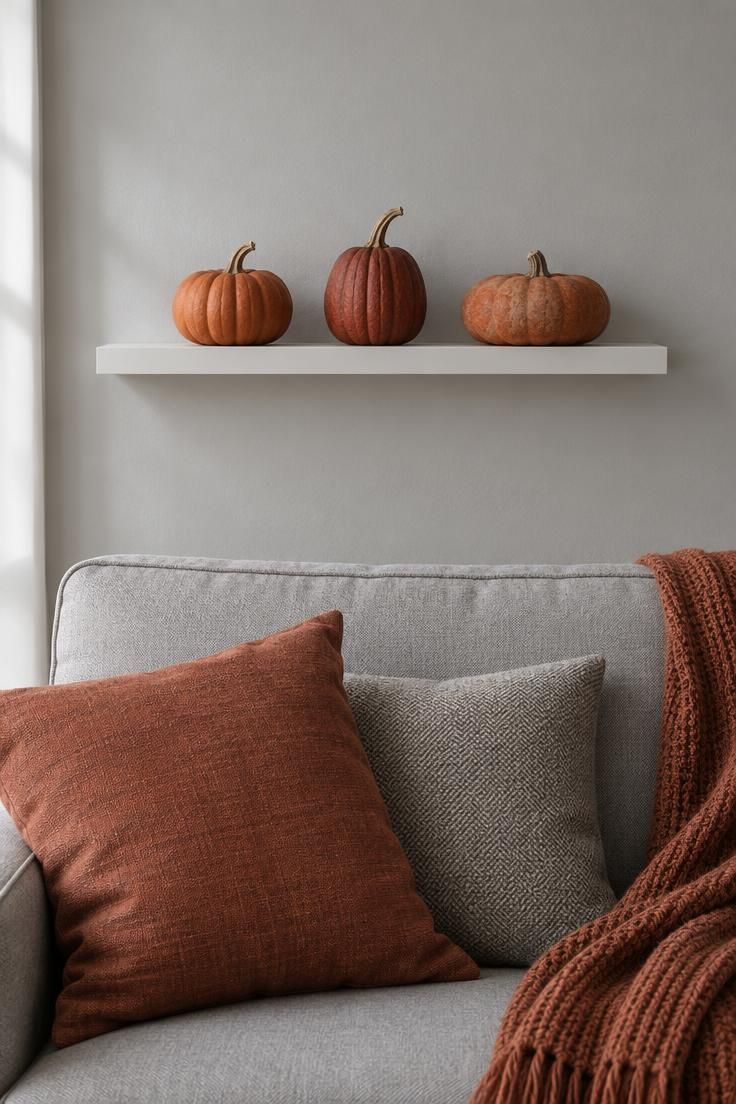
Three pumpkins in a row along a narrow shelf create a horizontal rhythm that a crowded display would lose.
Spacing them a few inches apart keeps each shape separate, and keeping the shelf otherwise bare lets the muted orange and black palette stay the only color event in the room.
A low shelf above a sofa or an entry bench places the pumpkins near eye level, where their varied tones and slight size differences are easy to see without handling them.
Matching width but varying height is the useful rule here.
Three pumpkins of nearly the same diameter sit evenly on the shelf and read as a set, while differences in height keep the row from looking mechanical.
Painting real pumpkins in a single matte tone unifies shades that would otherwise vary from gourd to gourd, and it also extends the display life compared with untreated ones that will eventually soften indoors.
Artificial pumpkins hold their color season after season, at the cost of the surface texture real ones provide.
A single shelf keeps cleanup simple, since everything sits in one line and lifts off in one pass.
The main caution is placement: pumpkins arranged on a shelf above a seat should sit back far enough that a rising head or a thrown cushion will not send them off the edge.
Choosing smaller sizes and keeping the shelf edge clear handles that easily.
Style Blueprint:
- Three small pumpkins in muted orange, rust, or terracotta
- Matte paint in one tone if the real shades vary too much
- A narrow shelf kept otherwise empty
- Even spacing of a few inches between each pumpkin
- Pumpkins of similar width but different heights
Design Pro-Tip: Match the widths but not the heights of the three pumpkins, so the row reads as a set instead of a repeated shape.
Conclusion
Restraint is what makes these ideas work together rather than compete.
A limited palette, a handful of objects, and one focal point per surface let the season show through silhouette, material, and light instead of volume.
The pieces are small enough to pack into one box, which suits apartments, rentals, and anyone who wants the room back quickly.
When the last pumpkin and candle come off the shelf, the space returns to its everyday state without a full reset.