This post may contain affiliate links. If you make a booking or purchase through these links, we may earn a commission at no additional cost to you.
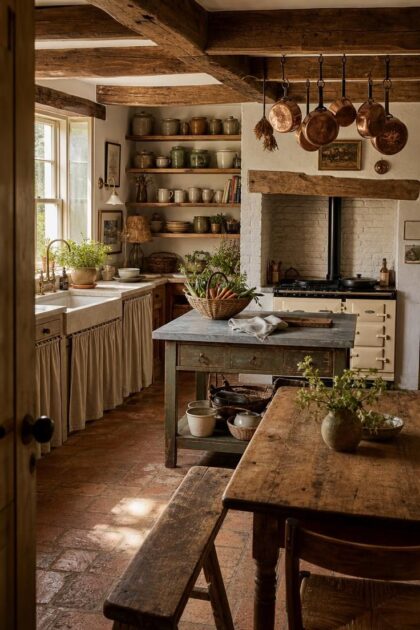
A french cottage kitchen never looks like it was finished all at once.
The best ones feel gathered, as if every shelf, every worn surface, and every clay pot arrived at its own pace over years of slow mornings and long dinners.
That quality, the sense of a room that has been lived in rather than decorated, is exactly what makes this style so hard to imitate from a catalog and so satisfying to build from real materials.
These 13 french cottage kitchen ideas focus on specific combinations of stone, wood, iron, and linen that give a cooking space the warmth of a French countryside home.
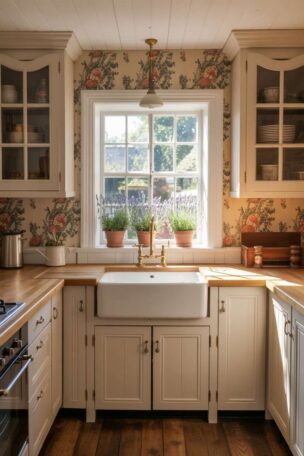
A Limestone Slab Sink Surround With Raw Linen Café Curtains Below
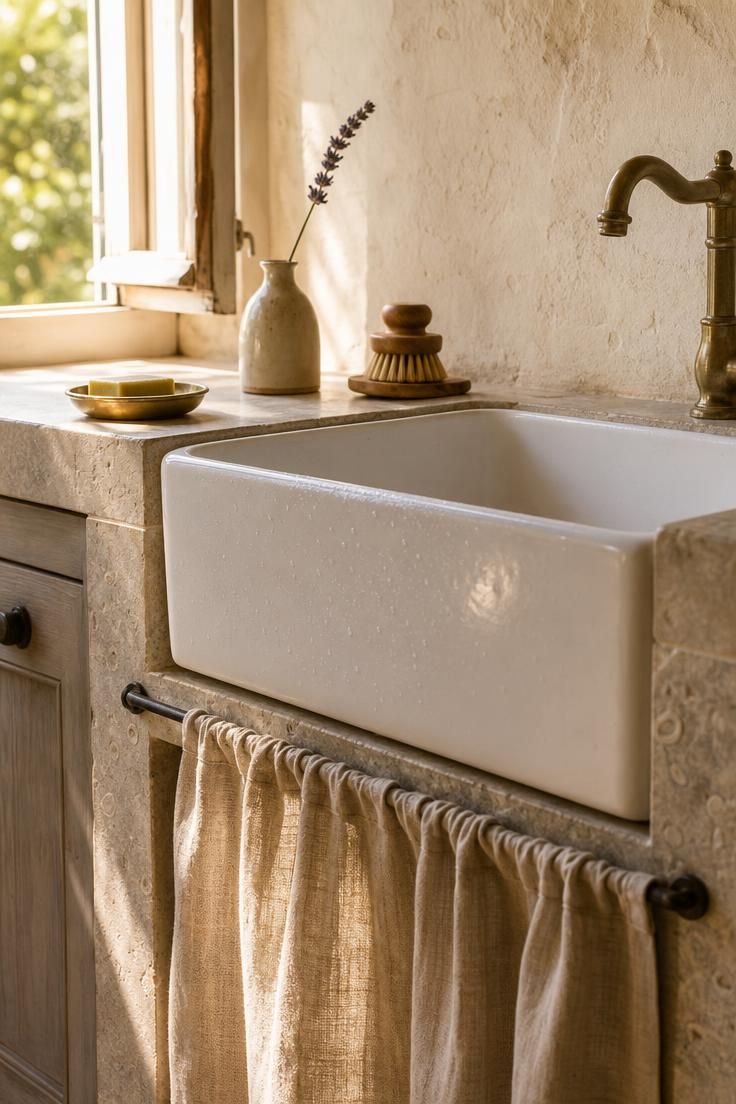
There is something deeply reassuring about a kitchen where the heaviest surface in the room sits right next to the softest one.
A limestone slab around a farmhouse sink does the kind of work that no composite countertop can replicate, because its weight is visible.
You can see the density of the stone, the way it absorbs water slowly instead of beading it off, and that slow absorption makes the whole kitchen feel grounded.
The raw linen curtain below the sink hides cleaning supplies and plumbing, but it also introduces a texture that moves.
When a breeze comes through the casement windows, the fabric shifts, and the room feels alive in a way that a closed cabinet never allows.
The combination works because both materials age well, and a french cottage kitchen earns its character through materials that look better after years of daily contact with water, sunlight, and hands.
Brass hardware beside the sink will develop a patina that matches the linen’s gradual softening, so the whole corner of the room mellows together over time.
Style Blueprint:
- Honed limestone slab countertop, minimum 3 cm thick, with a raw unpolished edge
- White fireclay apron-front sink, single basin
- Unbleached raw linen café curtain on a wrought iron tension rod
- Brass soap dish and olive wood brush
- Stoneware bud vase with dried lavender
Unglazed Terracotta Floor Tiles in a Running Bond Pattern
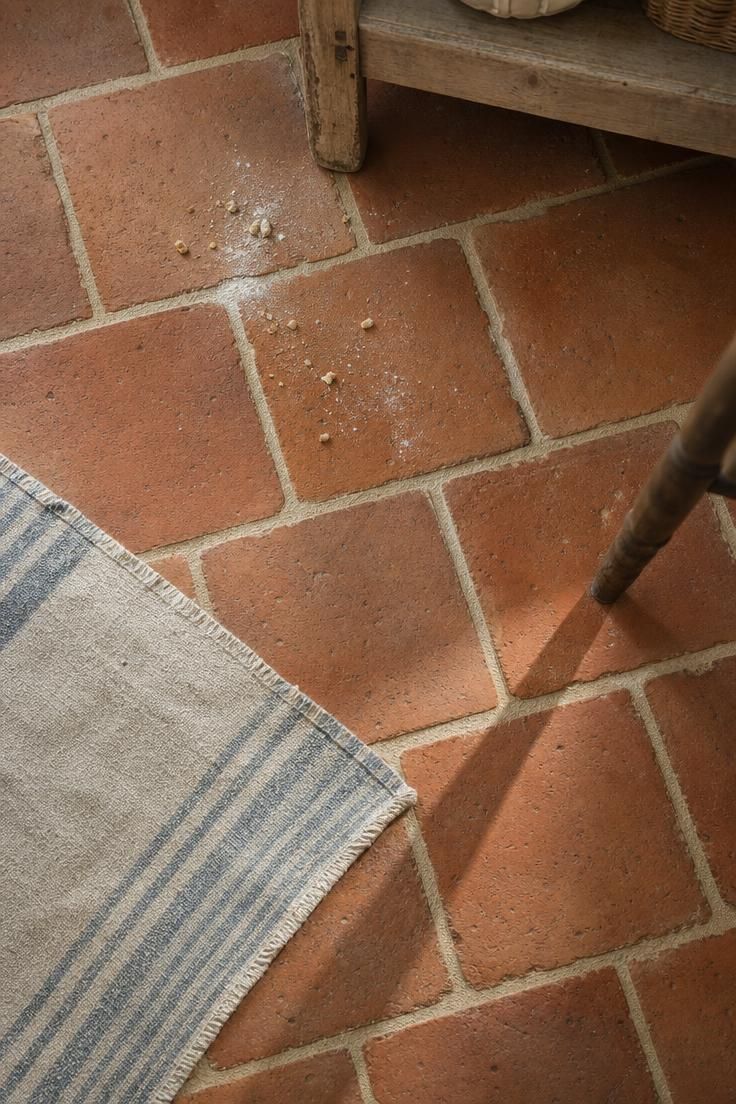
Terracotta tile is one of the oldest flooring materials in French domestic architecture, and its appeal has never depended on precision.
The color shifts from tile to tile, salmon here, rust there, a paler clay tone near the window where years of sun exposure have bleached the surface.
A running bond layout, where each row offsets by half a tile, gives the floor a sense of movement without the rigidity of a grid.
The matte surface absorbs light rather than reflecting it, and that single quality changes the feel of the entire kitchen.
Open shelving and exposed ceiling beams overhead look warmer when the floor beneath them pulls light downward instead of bouncing it back.
These tiles are unglazed, which means they stain, and that is part of the point.
A drop of olive oil, a splash of red wine, the ring from a wet terracotta pot, all of these become part of the floor’s record over time.
Sealing the tiles with a penetrating wax rather than a topical glaze protects them while preserving the chalky, dry texture that makes terracotta feel distinctly French.
Style Blueprint:
- Handmade unglazed terracotta tiles, 15×30 cm, in running bond layout
- Sandy off-white grout, slightly recessed
- Penetrating wax sealant, not topical glaze
- Woven cotton runner in muted stripes for high-traffic zones
A Freestanding Oak Plate Rack Mounted Above a Copper Basin
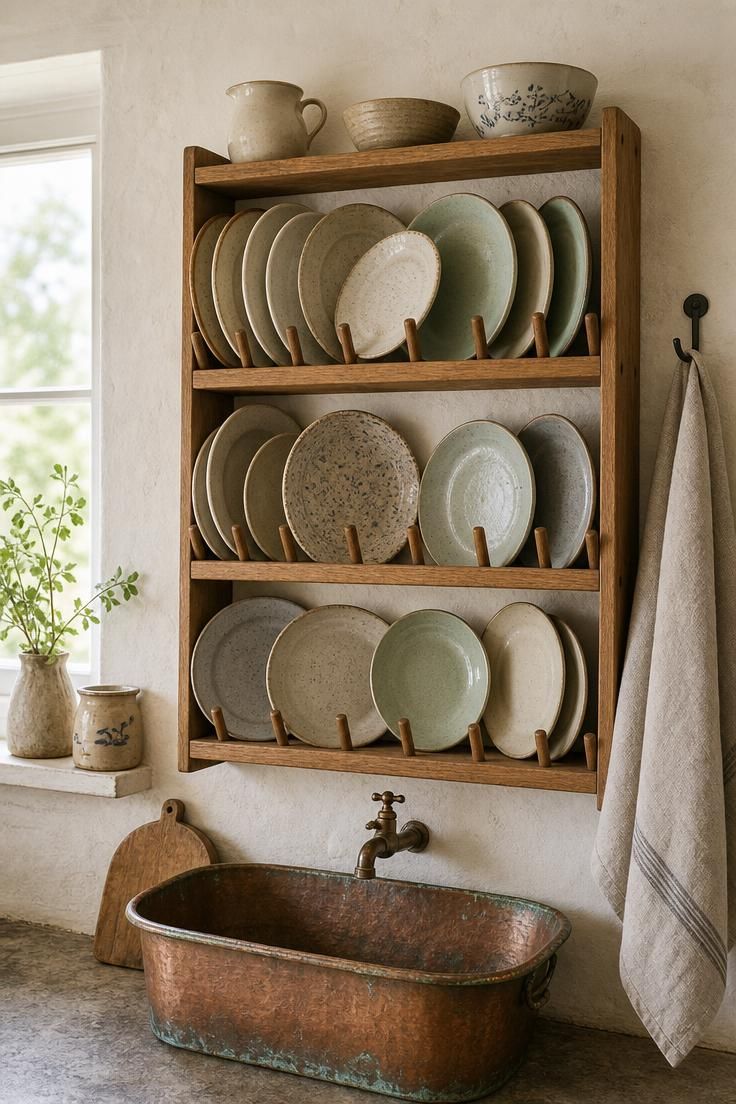
A plate rack on the wall changes how a kitchen functions at the most basic level: dishes go from the wash to the rack and back to the table without ever passing through a cabinet.
That loop, wash to rack to table, is one of the small daily rhythms that makes a french cottage kitchen feel like a working room rather than a showpiece.
Oiled oak ages to a deep honey tone over years, and the dowel pegs wear smooth where plates slide in and out.
The copper basin below catches drip water, and its patina shifts from bright penny to verdigris green in the spots that stay damp longest.
Mismatched stoneware is the right choice here, not a matched dinner set, because the variation in glaze color and shape gives the rack visual texture.
A folded linen towel on an iron hook beside the rack completes the corner without adding clutter.
Style Blueprint:
- Wall-mounted oak plate rack with turned dowel pegs, oiled finish
- Hammered copper drip basin, small, wall-hung
- Assorted stoneware plates in cream, gray, and celadon
- Iron wall hook with linen dish towel
- Lime-washed plaster wall
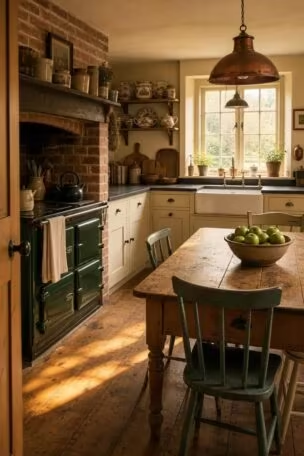
Whitewashed Brick Alcove Housing a Cream Enamel Range Cooker
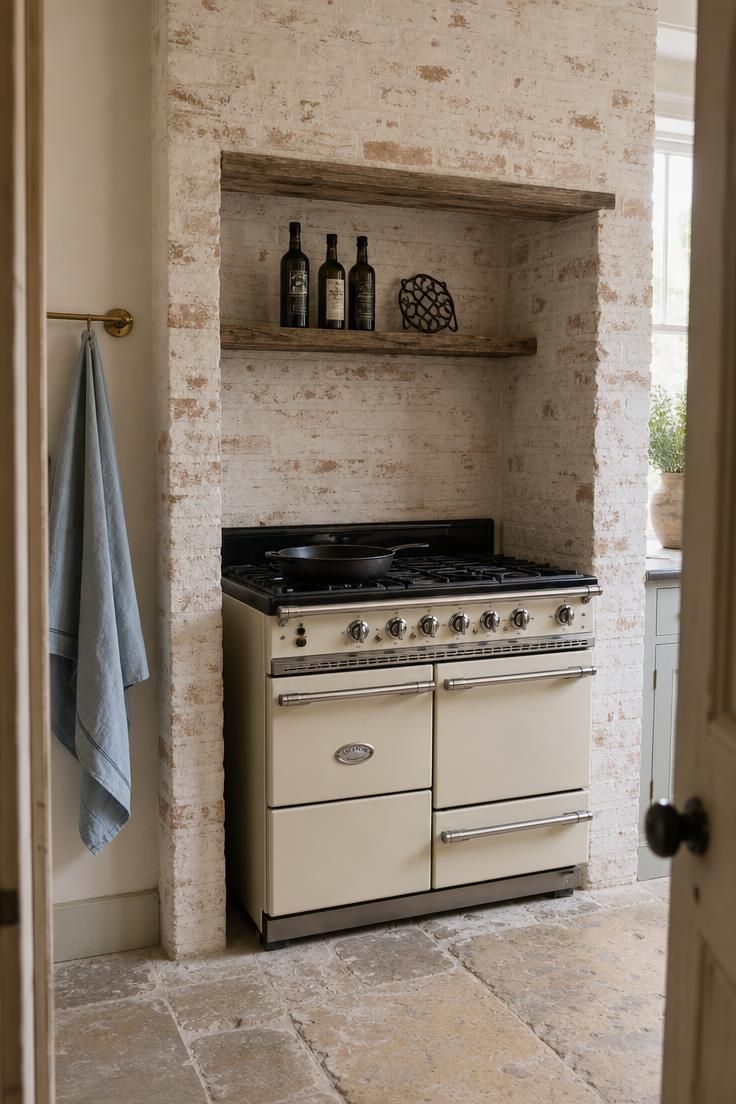
The alcove arrangement borrows from a much older tradition, when the cooking hearth was literally built into the wall of the house.
A whitewashed brick surround recreates that sense of enclosure without the full depth of a historical fireplace, and it gives the range cooker an architectural frame that no freestanding installation can match.
The whitewash matters because a thin coat lets the brick texture remain visible while softening the color to something close to the plaster walls around it.
A thick, opaque paint would flatten the surface and lose the point entirely.
The cream enamel of the cooker picks up the warmer undertones in the brick, creating a tonal relationship that holds the whole alcove together.
Above the range, a narrow shelf of reclaimed wood is the right scale for this space, deep enough for oil bottles and a trivet, shallow enough that it does not crowd the alcove visually.
Stone countertop surfaces on either side of the range tie the alcove into the broader kitchen, and the cooler gray of the limestone plays well against the warmth of the brick.
Copper pots hanging nearby catch the soft light and add a reflective accent that the matte surfaces of brick and enamel cannot provide on their own.
A cast iron skillet left on the front burner signals that this is a kitchen meant for daily cooking, not weekend entertaining.
Style Blueprint:
- Whitewashed brick alcove with visible texture, thin-coat application
- Cream enamel range cooker with chrome knobs
- Narrow reclaimed wood shelf above the range
- Dark glass oil bottles and iron trivet
- Worn limestone floor at the alcove threshold
Design Pro-Tip: When whitewashing brick, dilute the paint to roughly 50 percent with water and apply it with a rag rather than a brush. The rag lets you control how much original clay color shows through on each brick, and the slight inconsistency is what makes the finish look centuries old instead of freshly painted.
Rough-Hewn Chestnut Ceiling Beams With Iron Meat Hooks
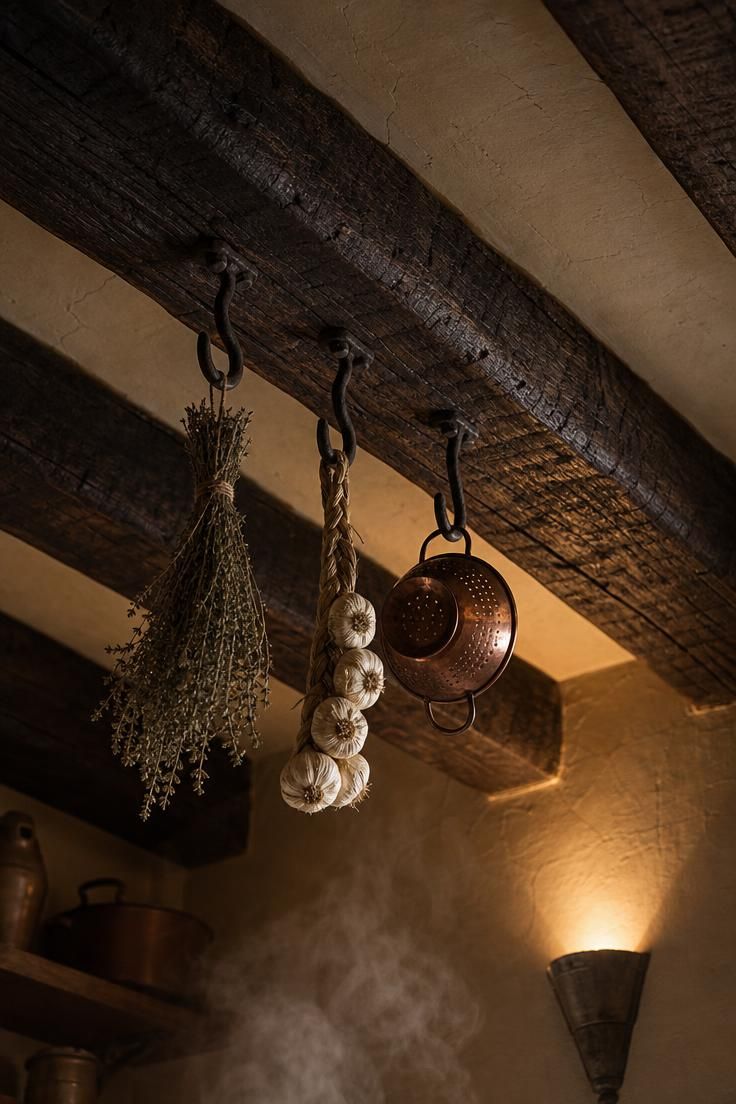
Exposed ceiling beams in a french cottage kitchen do more than add visual warmth overhead; they compress the vertical space in a way that makes the room feel protected.
Chestnut is a traditional choice in French rural construction because the wood is naturally resistant to insects and moisture, and it darkens with age to a color that no stain can replicate.
The adze marks on rough-hewn beams are a record of the hand that shaped them, and that visible labor is part of what separates a cottage interior from a production-built home.
Iron meat hooks bolted into the beam undersides are a functional inheritance from an era when cured meats and dried herbs hung from the kitchen ceiling as a matter of preservation, not decoration.
Today, a braid of garlic, a bundle of dried thyme, and a small copper colander hanging from those hooks keep the tradition alive without pretending to be something they are not.
The low light from a wall sconce pushes warm amber upward, catching the waxy surface of the beams and leaving the spaces between them in soft shadow.
That play of light and darkness across the ceiling gives the room a sense of depth that flat, uniformly lit ceilings cannot produce.
Style Blueprint:
- Rough-hewn chestnut beams, adze-marked, with natural wax finish
- Forged iron meat hooks, bolted to beam undersides
- Dried herb bundles, braided garlic, and a small copper colander
- Warm amber wall sconce for upward-directed accent lighting
A Zinc-Topped Worktable With Turned Legs and a Lower Basket Shelf
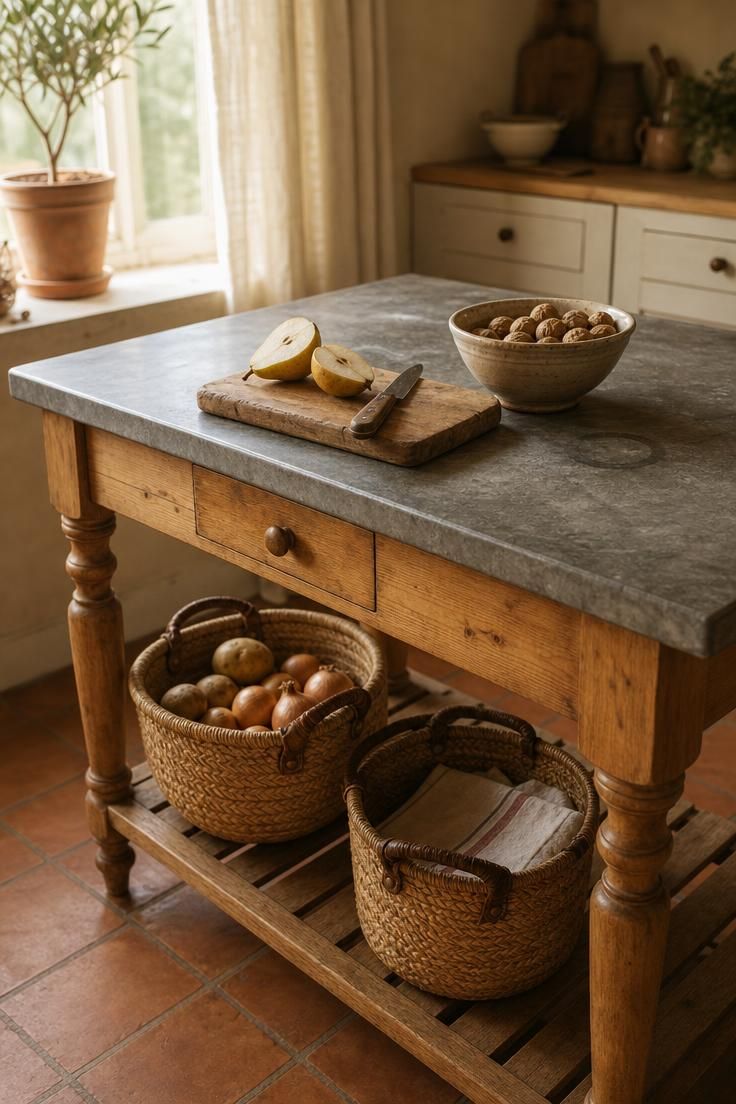
A freestanding worktable in the center of the kitchen changes the room from a corridor of countertops into a place where you can approach the work from any side.
The zinc top is the surface that tells this story best, because zinc reacts visibly to everything it touches.
Water leaves dark rings, acidic fruit juice etches pale spots, and over months the entire surface develops a mottled patina that records how the kitchen is actually used.
That patina cannot be faked, and it gives the table a history that butcher block and stone develop more slowly.
The turned legs in waxed pine carry the weight of the zinc without competing with it visually, and the honey tone of the wood connects the table to the chestnut beams and oak shelving elsewhere in the room.
A slatted lower shelf holding woven market baskets keeps root vegetables and linen napkins within reach without closing them behind doors.
The baskets themselves are part of the french country kitchen vocabulary, carried to the market and back, their handles wearing smooth with each trip.
A worktable like this is never pushed against a wall; it belongs in the center of the room, with space to walk around it on all four sides.
Style Blueprint:
- Zinc-topped worktable, freestanding, with naturally aging surface
- Turned legs in waxed pine, honey finish
- Slatted lower shelf for basket storage
- Two woven market baskets, one for produce, one for linens
- Stoneware bowl and wooden cutting board as surface props
Reclaimed Pine Shelving Styled With Stoneware Crocks and Glass Jars
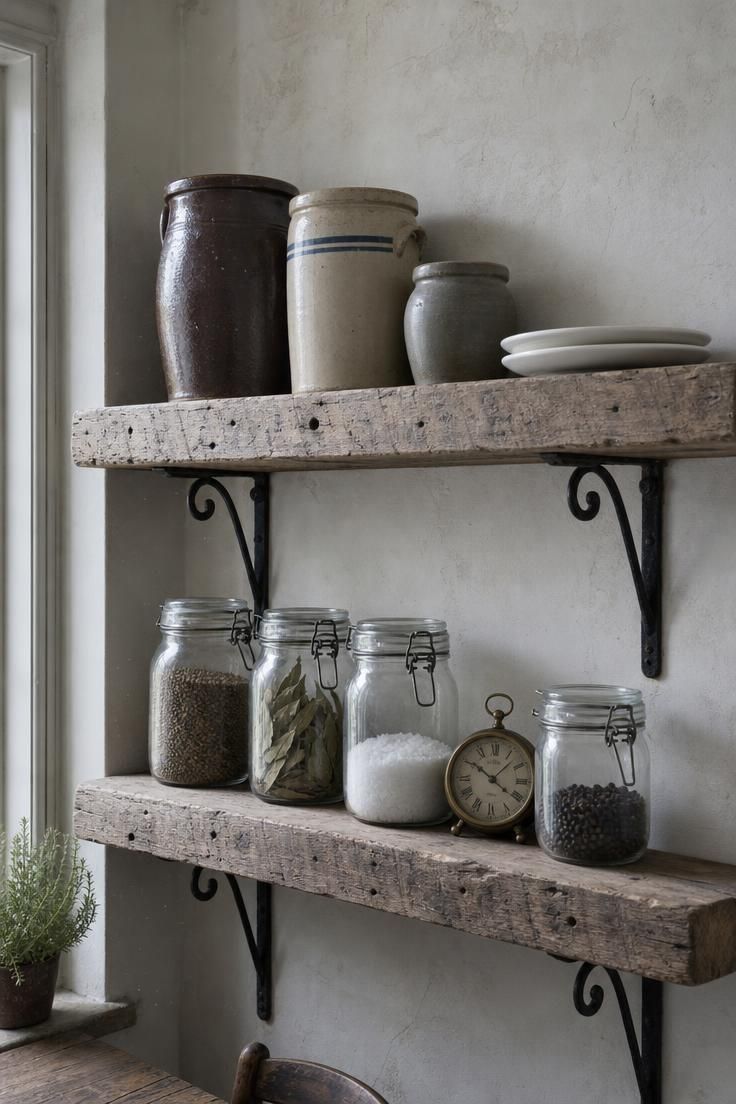
Open shelving in a french cottage kitchen works because it turns storage into composition.
The objects on these shelves are not decorative; they are the actual containers used for cooking and preserving, and their arrangement follows a logic of reach and frequency rather than symmetry.
Reclaimed pine has a surface quality that new wood cannot match, silvered by sun exposure, pocked with old nail holes, and slightly rough where a hand plane skipped.
Wrought iron brackets hold the weight of stoneware without flexing, and their dark finish against the chalky plaster wall creates a graphic contrast that anchors the shelves visually.
The crocks hold things that need to breathe, salt, dried herbs, and wooden spoons, while the glass jars keep lentils and peppercorns visible so you know when to refill them.
A small brass clock leaning against the wall at shelf level is the kind of quiet, personal detail that separates a collected kitchen from a styled one.
Style Blueprint:
- Reclaimed pine planks, 4-5 cm thick, with silvered surface
- Wrought iron shelf brackets, matte black finish
- Stoneware crocks in mixed sizes and glazes
- Wire-bail glass preserving jars for dry goods
- Small brass clock as a personal accent
A Cast Iron Pot Rack Suspended From Forged Chain Links
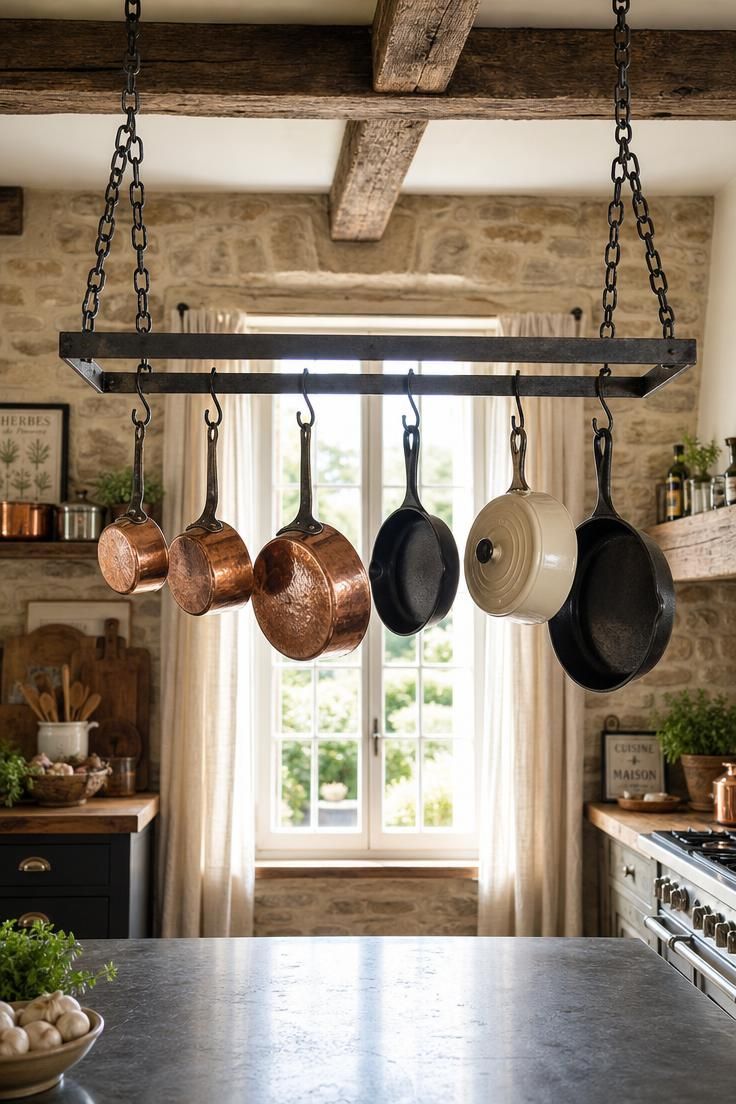
Hanging cookware from the ceiling solves two problems at once: it frees up cabinet space, and it puts your most-used pans within arm’s reach of the stove.
A cast iron frame suspended from forged chain links is the most direct version of this solution, with no unnecessary ornament and no moving parts.
The S-hooks along the rack’s length let you rearrange the pans depending on what you cook most often, and the spacing between hooks keeps handles from tangling.
Copper pots are the classic choice for a french country kitchen, and their warmth overhead changes the color temperature of the entire room.
New copper is almost pink; aged copper shifts to a deep amber, and eventually to a reddish brown where heat has darkened the base.
Mixing copper with black cast iron on the same rack gives the arrangement a tonal range that neither material provides alone.
The forged chain links connecting the rack to the exposed ceiling beams are worth noticing, because their visible hammer marks echo the adze marks on the beams themselves.
Bright midday light from a large window makes the copper glow and throws soft reflections onto the plaster ceiling between the beams.
A pot rack like this works best when it hangs low enough to reach without stretching but high enough to walk beneath comfortably, roughly 180 cm from the floor to the bottom of the rack.
Style Blueprint:
- Rectangular cast iron pot rack, flat bar construction
- Forged chain links with visible hammer marks, four points of attachment
- S-hooks in blackened iron
- Copper pots and cast iron skillets in mixed sizes
- Cream enameled Dutch oven as a color accent
Pale Blue Tongue-and-Groove Paneling Behind a Stone Prep Counter
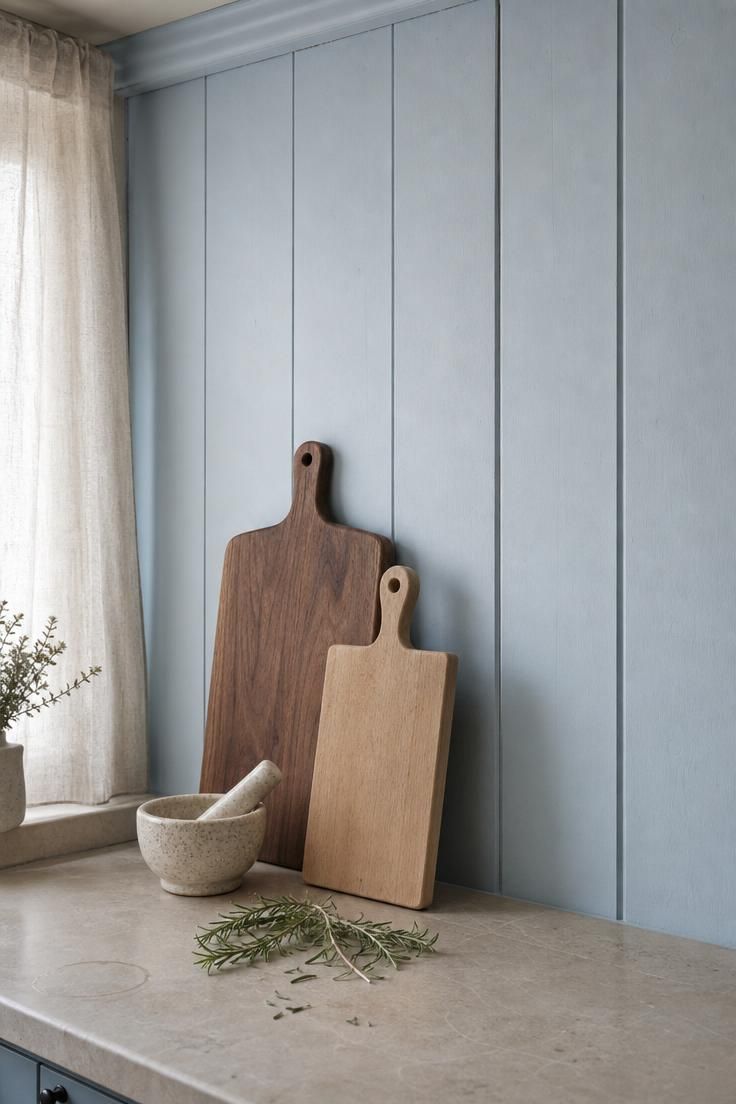
Color in a french cottage kitchen tends to arrive on the walls rather than the cabinetry, and tongue-and-groove paneling is the surface that carries it best.
The vertical grooves break a large wall into narrow strips, and each strip catches light at a slightly different angle, creating a subtle stripe effect even within a single color.
Pale blue is a historically grounded choice in French interiors, where it appears in everything from shutters to armoire interiors, and it reads as cooler and more restful than the dominant warm tones of wood and stone elsewhere in the room.
A honed limestone prep counter in front of the paneling offers that temperature contrast in material form: warm stone below, cool painted wood above.
Wooden cutting boards leaned against the paneling fill the junction between counter and wall without requiring a backsplash tile, and their darker wood tones ground the lightness of the blue.
A stone countertop surface that shows scratches and water marks belongs in this setting, because it signals a kitchen where food is actually prepared, not a kitchen preserved for photographs.
Fresh rosemary sprigs scattered on the counter add a green note that bridges the blue wall and the warm stone, pulling the two temperatures together.
Style Blueprint:
- Vertical tongue-and-groove paneling, painted pale blue, matte chalky finish
- Honed limestone prep counter with natural wear marks
- Walnut and beech cutting boards, leaned against the wall
- Ceramic mortar and pestle in speckled cream
- Simple flat molding at the paneling top edge
Design Pro-Tip: When choosing a blue for kitchen paneling, hold the paint sample against your stone countertop and your wood cabinetry at the same time. The blue should feel like it belongs to the same family of muted tones rather than standing out as the one bright surface in the room. If the blue looks vivid next to your stone, mix a tablespoon of raw umber into the quart to knock it back.
A Deep-Set Casement Window With a Potted Herb Garden on the Sill
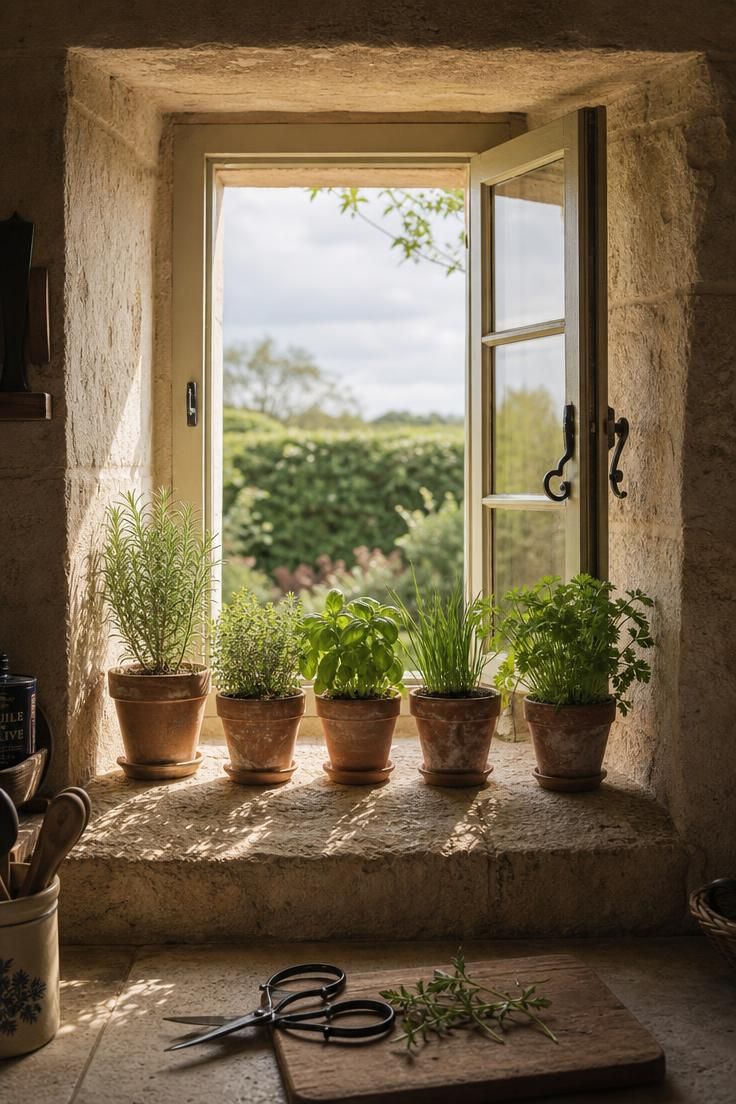
The depth of a stone window reveal is a feature that modern construction almost never replicates, and it is one of the details that makes a french cottage kitchen feel rooted in its building.
A 30 cm stone sill is wide enough to hold a row of terracotta pots without crowding, and deep enough that the pots sit within the thickness of the wall itself.
That depth creates a micro-environment for herbs: the stone stays cool, the casement windows open for ventilation, and afternoon light reaches the plants at a low angle that highlights their leaf structure.
Rosemary and thyme are the most forgiving choices for a kitchen sill because they tolerate the dry warmth that rises from cooking and the cooler drafts from an open window.
Basil needs more consistent warmth and will bolt in cooler months, so rotating that pot with the seasons keeps the sill productive year-round.
Kitchen shears on the counter below the window close the loop between growing and cooking, and the few snipped stems on the cutting board suggest that this herb garden is used daily, not admired from a distance.
The iron casement hardware, a curved latch and simple hinges, is the kind of functional detail that adds character without any decorative intent.
Linen curtains are absent here on purpose: the deep stone reveal frames the view and filters the light on its own, and adding fabric would block the herbs from the sun they need.
Style Blueprint:
- Deep-set stone casement window with 25-30 cm sill depth
- Five small terracotta pots with rosemary, thyme, basil, chives, and parsley
- Dark iron casement hardware with curved latch
- Kitchen shears with wooden handles on the counter below
- No curtains, allowing full light for the herbs
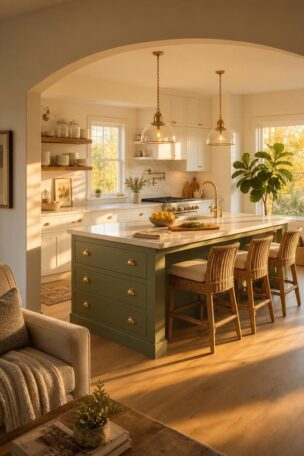
Waxed Walnut Butcher Block Island With a Single Pendant Lamp
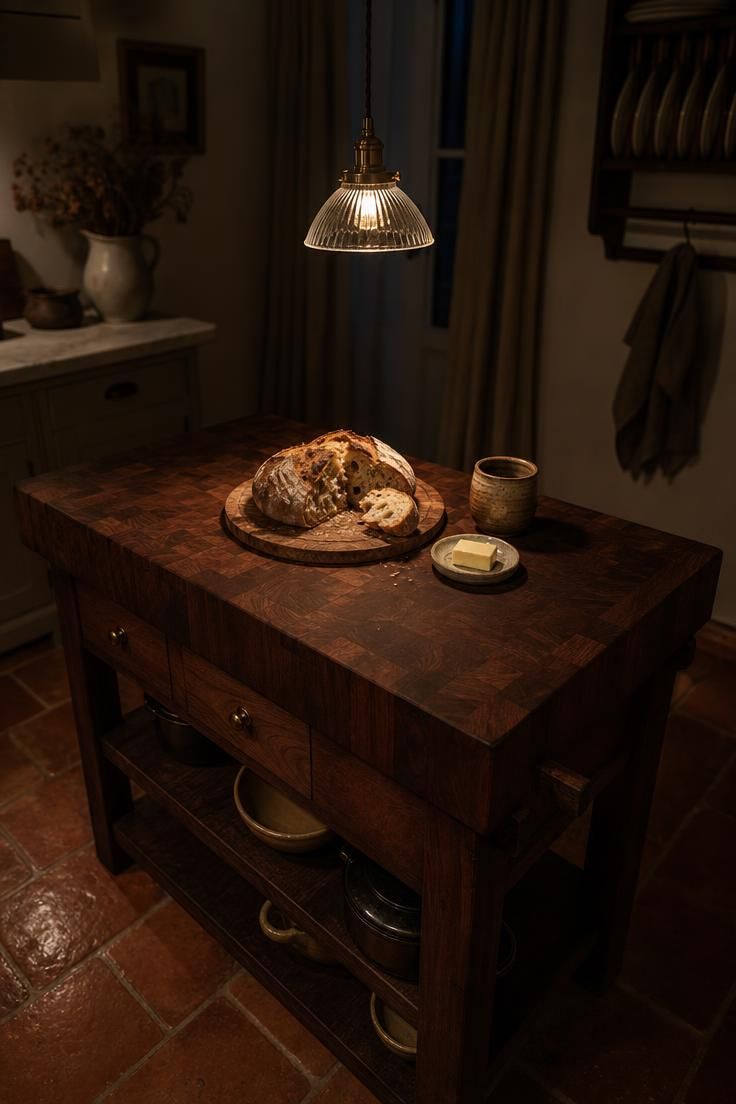
A freestanding island in dark walnut anchors the center of the kitchen with a weight that lighter woods cannot achieve.
Walnut’s grain pattern is tighter and more complex than oak or pine, and when the surface is cut as end-grain butcher block, those patterns multiply into a mosaic of natural geometry.
A wax finish rather than a polyurethane seal keeps the wood alive to the touch, slightly warm, slightly tacky, and responsive to moisture in a way that a sealed surface resists.
The single pendant lamp above the island is a deliberate choice against the cluster of three or four pendants that contemporary kitchens default to.
One lamp creates one pool of light, and that concentration draws people to the island the way a fire draws people to a hearth.
In the evening, with the rest of the kitchen in soft shadow, the island under its pendant becomes the room’s center of gravity.
Style Blueprint:
- End-grain walnut butcher block island, freestanding, waxed finish
- Single brass pendant lamp with glass shade on cloth cord
- Hanging height approximately 70 cm above the island surface
- Round wooden bread board and stoneware serving pieces
Handmade Encaustic Cement Floor Tiles in a Geometric Motif
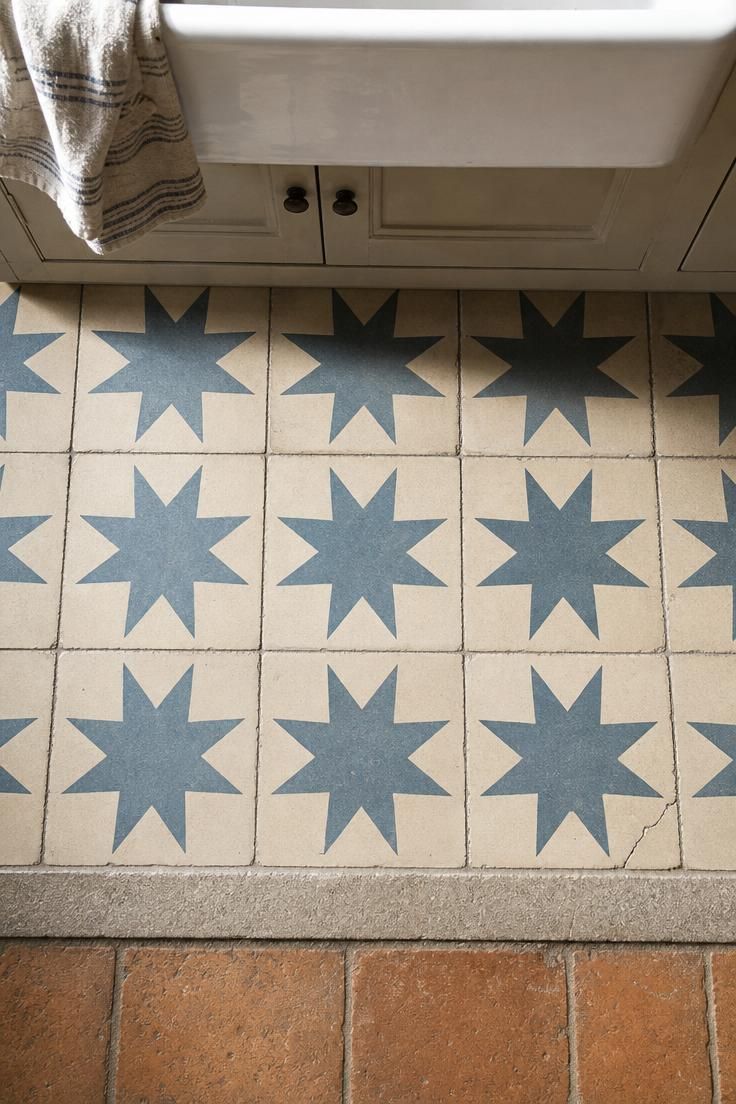
Encaustic cement tiles carry their color through the full thickness of the tile rather than sitting as a glaze on the surface, which means the pattern remains visible even as the tile wears down over decades.
This is not a subtle distinction: it changes the relationship between use and appearance entirely, because foot traffic reveals rather than destroys the design.
An accent strip of patterned tiles in front of the sink or range marks the spot where you stand longest, and that marking adds a visual anchor to the most functional part of the kitchen.
The blue and cream palette connects to the pale blue tongue-and-groove paneling elsewhere in the room without repeating it exactly, keeping the color story cohesive but not matched.
Each tile’s slight variation in color saturation is a signature of the hand-pouring process, and that variation gives the floor a handwoven quality that machine-printed ceramic cannot approach.
A stone border strip at the transition between the patterned cement tiles and the surrounding terracotta tile creates a clean edge that reads as intentional rather than improvised.
The matte, chalky surface of these tiles benefits from the same penetrating wax treatment used on the terracotta, building a protective layer that deepens the color slightly without adding shine.
Style Blueprint:
- Handmade encaustic cement tiles in blue and cream geometric pattern
- Accent strip installation in front of sink or range
- Stone border strip at the transition to adjacent flooring
- Penetrating wax sealant to deepen color and protect surface
- Matte finish, no topical glaze
A Grain Sack Cushion on a Worn Elm Bench at a Scrubbed Pine Table
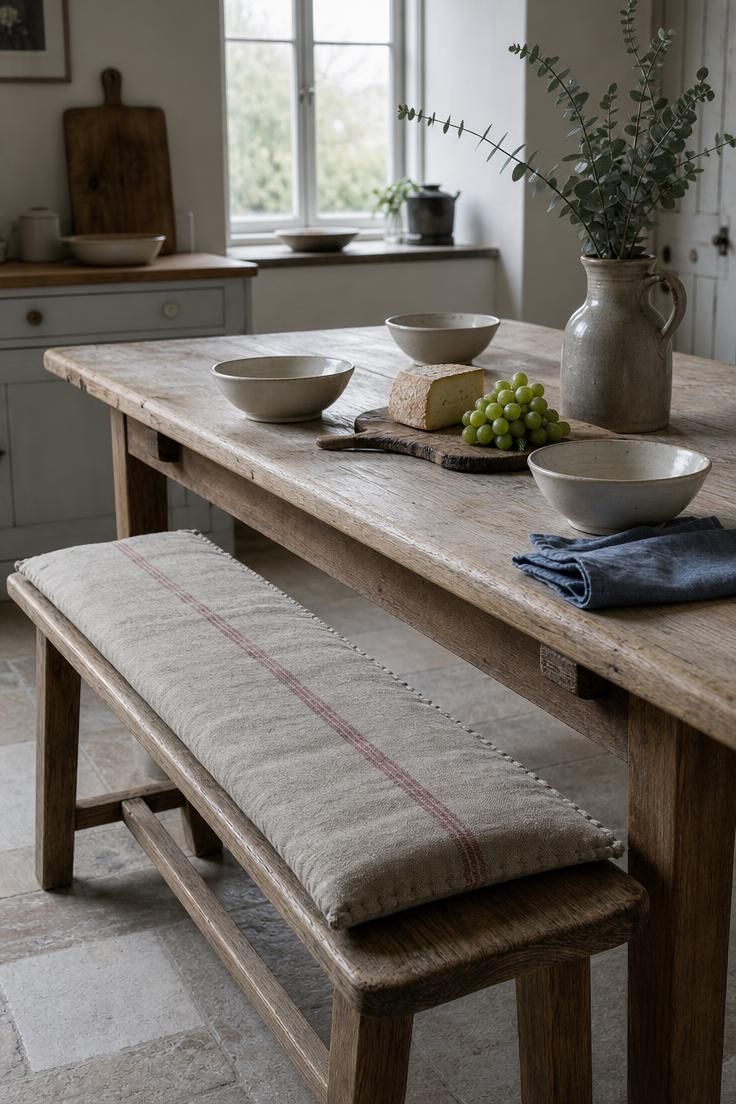
A french cottage kitchen often puts its dining space inside the cooking room rather than in a separate area, and the bench at the table is the seating that belongs there most naturally.
Elm is harder and more resistant to splitting than pine, which makes it the better choice for a bench that will bear weight daily for decades.
The smooth, rounded edges of a well-worn elm bench cannot be sanded into existence; they come only from years of people sliding along the seat, and that wear pattern is a form of comfort made visible.
A grain sack cushion adds a layer of seated comfort without introducing the plushness of upholstery, which would feel out of place in a room built from stone, iron, and raw wood.
Vintage grain sacks carry their provenance in their weave: the red or blue center stripe, the printed or stamped markings, and the hand-stitched seam closures all speak to a specific origin and era.
The scrubbed pine table across from the bench has been cleaned so many times that the softer grain has worn away, leaving the harder growth rings raised like low ridges across the surface.
That texture is pleasant under the hands and under ceramic bowls, and it gives the table a visual depth that a smooth, sealed surface would lack.
A stoneware pitcher with a single branch of eucalyptus is the kind of centerpiece that a french cottage kitchen gravitates toward, simple, seasonal, and easily replaced with whatever is growing outside the door.
Style Blueprint:
- Worn elm bench with naturally rounded edges, minimal remaining wax
- Vintage grain sack cushion with center stripe, hand-stitched edges
- Scrubbed pine farmhouse table, raised grain texture
- Stoneware pitcher for seasonal branches or flowers
- Ceramic bowls in cream and gray for daily table setting
Design Pro-Tip: When sourcing a grain sack cushion, look for sacks with hand-stitched closures rather than machine-sewn seams. The hand stitching is a reliable indicator of age and authenticity, and the slight irregularity of the stitch line adds a texture that catches the eye from across the table. If the red stripe has faded to a salmon pink, that is a sign the sack has been washed and sun-dried many times, which is exactly the kind of patina that belongs in this setting.
Conclusion
A french cottage kitchen is not a style you install; it is a room you accumulate.
The limestone gets its first water stain the day you use the sink, and the zinc worktable starts recording your cooking habits from the first week.
Every surface here, the terracotta tile, the copper pots, the waxed walnut, the grain sack linen, is chosen because it responds to contact rather than resisting it.
That willingness to age, to show use, to soften and darken and wear smooth in the places where hands rest most often, is what gives these kitchens their warmth.
None of these 13 ideas require a renovation; a plate rack, a linen curtain, a market basket on a lower shelf can begin the shift toward a kitchen that feels more French, more cottage, and more like home.