This post may contain affiliate links. If you make a purchase through these links, we may earn a commission at no additional cost to you.
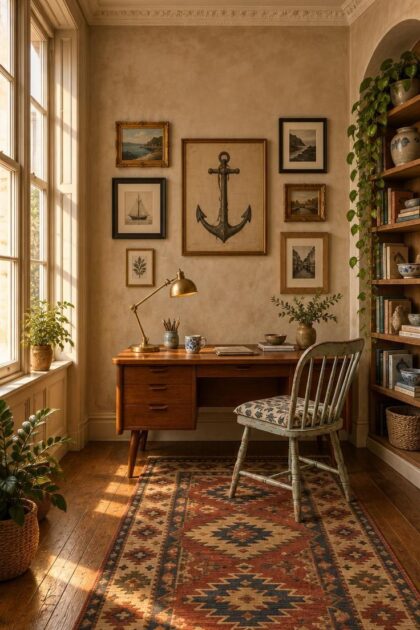
Historic rooms arrive with half the work already done.
Moldings, plaster walls, uneven floorboards, and old windows supply the vintage character that an eclectic home office would otherwise have to manufacture.
What remains is the mixing: layering contrast across eras, materials, and textures without losing the room's original voice.
The entries below treat each arrangement as a visual recipe, breaking down what sits in the frame, why the combination reads as deliberate, how it supports actual work, and one honest tradeoff.
One or two repeating elements across dissimilar pieces carry the whole scheme.
A Painted Farmhouse Desk Paired With a Blackened Steel Task Lamp
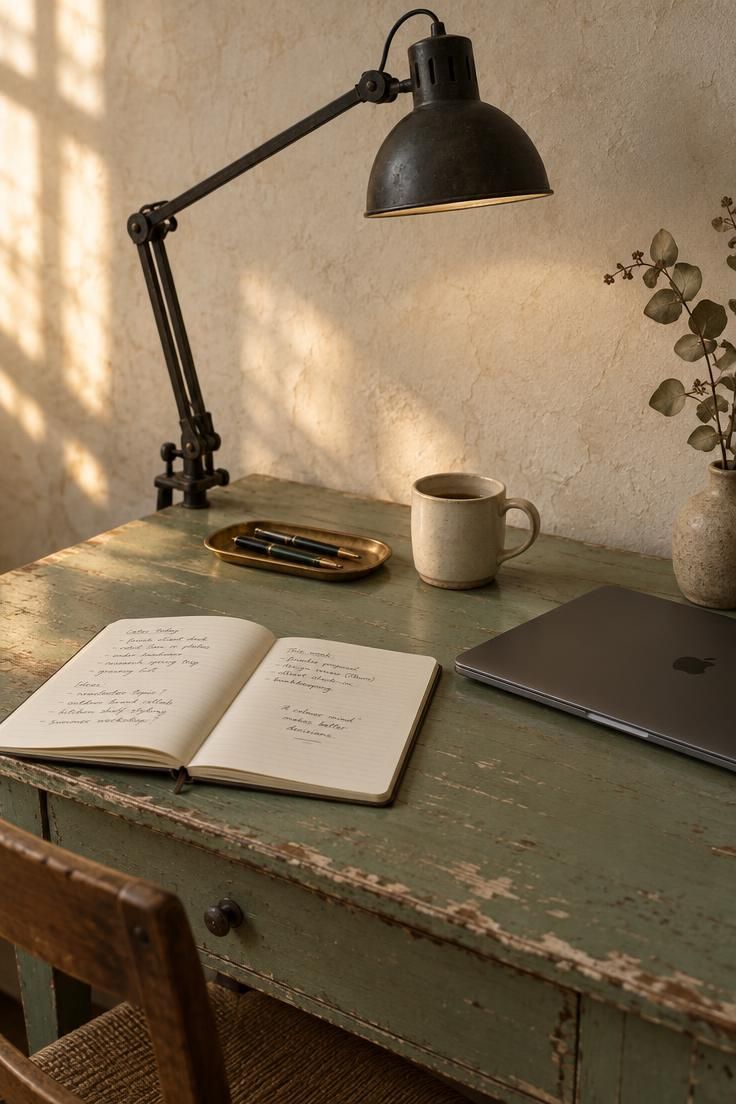
The two dominant pieces share a flat, non-reflective finish in two very different materials, and that shared quality is what makes the pairing read as one decision.
Pale painted wood and near-black metal pull in opposite directions on warmth, but the dry surface of each pulls them back together.
An adjustable lamp head lets light land on paper, keyboard, or a book without moving the base, and the reach of the arm matters more here than the silhouette.
A clamp-mounted version keeps a low window sill clear when the desk sits beneath one.
Chipped paint sheds slowly over the years, and a clear matte sealer on the desk slows that without making the surface look sealed.
Because painted wood and matte metal both sit at low reflectivity, the pairing stays quiet even with a laptop and notebook on the desktop.
Style Blueprint:
- One painted wood desk with visible brush texture in sage, ochre, or brick red
- One blackened or matte black metal lamp with no gloss and no brass
- One small brass or oxidized-metal accessory to echo the lamp's darkness without matching it
- One plain wall surface behind, with no art, so the desk's paint chips do the talking
Vintage Wood Desk Under a Gallery Wall of Mixed Frames
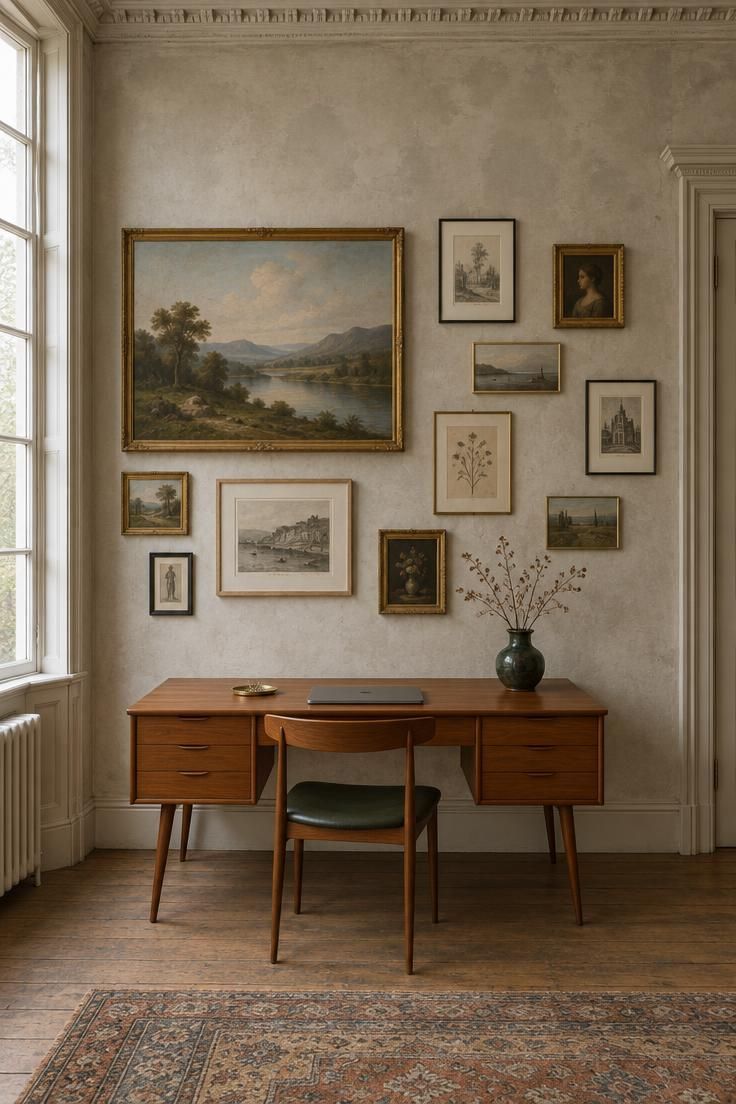
Placing the oversized landscape at roughly one-third height and slightly off-center gives the wall a natural resting point, with smaller frames clustered around it rather than spaced evenly.
Anchoring the group matters more than the count of frames, because without a dominant piece the eye has no place to settle.
Historic molding lines often sit lower or higher than expected, which can push the visual anchor down or up to keep the group from crowding the trim.
Keeping the monitor or laptop screen below the anchor frame lets the wall read as background instead of a second focal surface during work.
Every frame edge collects dust, so fewer large frames mean a shorter cleaning round than many small ones.
In a narrow study, one oversized frame with two small satellites at varied heights reads as a full gallery arrangement without covering much wall.
A focal painting centered above the desk turns a gallery wall office into a composition with one clear resting point.
Consider a mismatched chair desk pairing, where the seat, back, or legs differ in finish so the workspace gains a collected personality.
Draping a soft runner along the opposite edge of the desk and adding a low woven pouf nearby introduces layered textiles office warmth without disturbing the frame arrangement.
Style Blueprint:
- One gallery wall built around a single oversized anchor frame set off-center
- Three to four frame finishes maximum, with one finish repeated at least twice
- A mostly clear desk surface so the wall carries the visual load
- A plain desk chair so the patterned frame edges are not competing with a patterned seat
- Wall hooks or a picture rail where the historic room already has one
A Jewel-Toned Velvet Chair Beside a Raw Pine Work Table
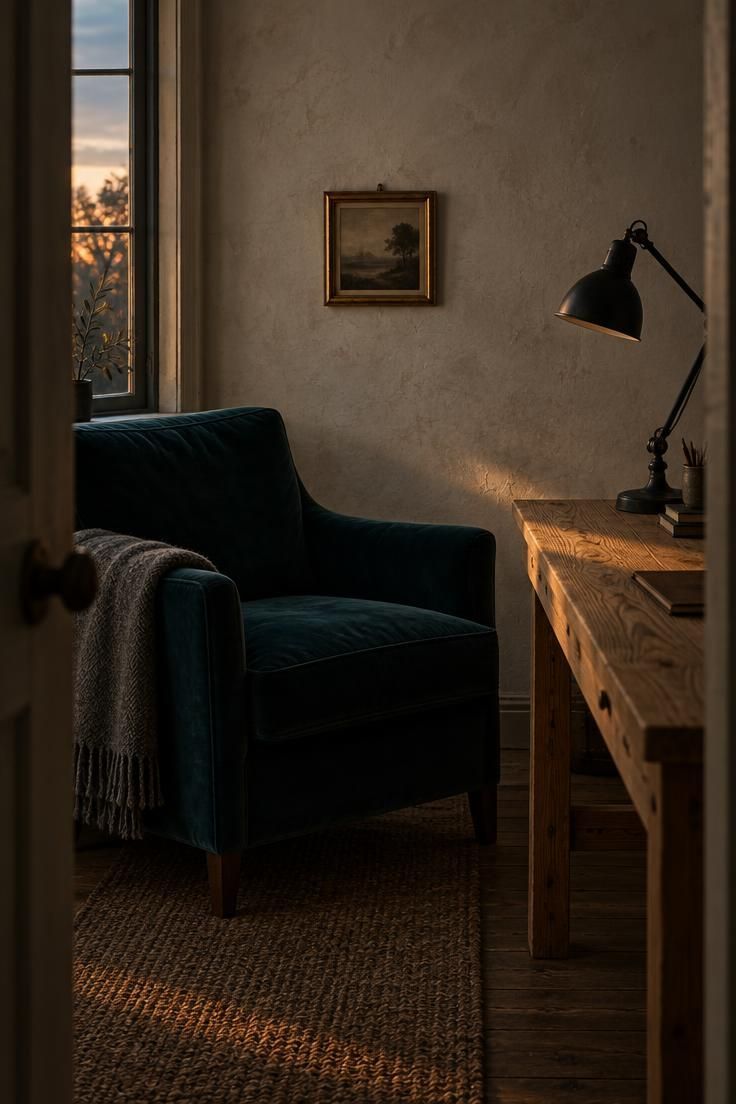
Dark saturated velvet, pale rough wood, black metal, and a single brass glint hold this corner together by contrast of tone rather than of era.
Velvet reads older and more formal, while the raw pine table reads workshop or studio, and the two threads tie at the shared depth of their tones.
The plain wall is doing structural work in the composition, giving the teal one quiet surface so it is not fighting anything else.
Velvet stays comfortable for shorter sessions, and a firm cushion or a second hard chair extends that for longer workdays.
Turning the chair fifteen to thirty degrees off the desk axis reads as deliberate rather than accidentally angled.
Velvet shows dust, pet hair, and creases readily, and a low-pile or matte velvet is easier to keep looking clean than a crushed, high-sheen one.
Skipping the armchair and applying the same palette to a single upholstered desk chair brings the two-material split into a smaller footprint.
Mixed wood tones let the pale pine table sit against a darker chair frame without either piece looking out of place.
Style Blueprint:
- One upholstered chair in a saturated jewel tone in matte or low-sheen velvet
- One unfinished or lightly oiled wood work surface with visible grain and knots
- One black or dark metal lamp to repeat the chair's depth of tone
- One small brass accent, such as a frame, drawer pull, or vessel, as the only warm note
- A wall kept in a quiet pale or aged plaster finish
Design Pro-Tip: When mixing a saturated piece with raw wood, keep every other surface in the frame at least two tones quieter, because the mix needs one loud voice to feel chosen.
Open Shelving in an Awkward Historic Alcove Styled With Books, Stoneware, and a Trailing Plant
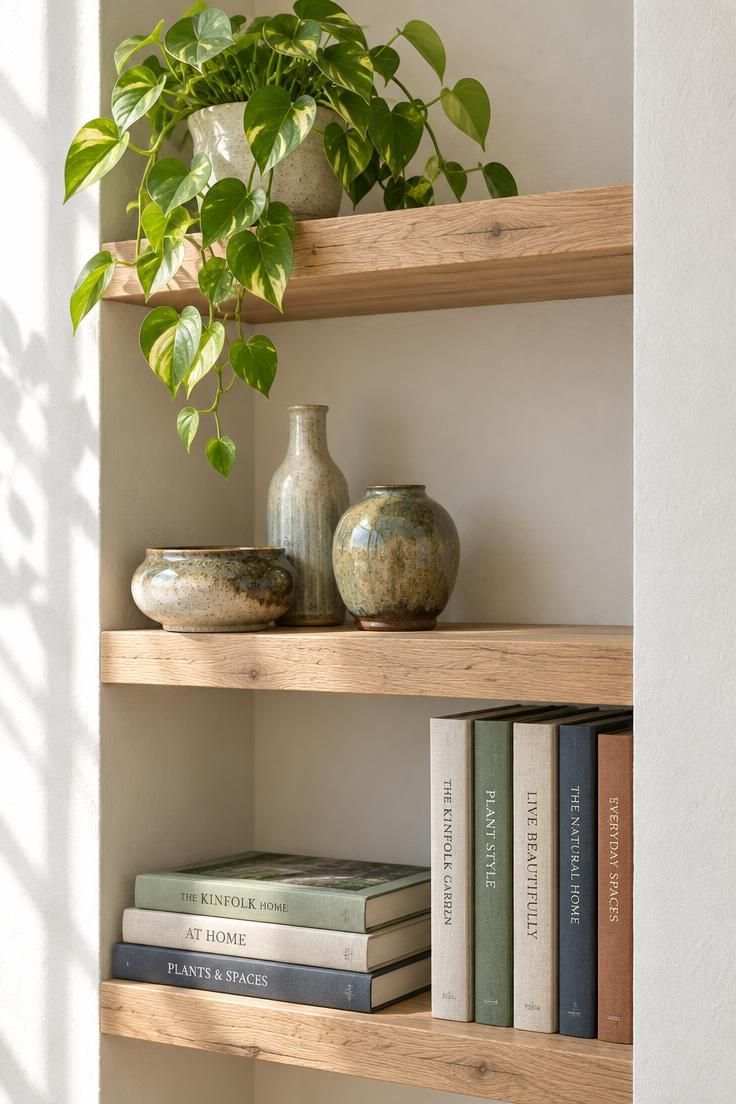
Historic rooms often have recesses that a freestanding bookcase would fill awkwardly, and shelves cut to the alcove's actual width let the room's bones do the framing.
Variation in object height and material carries the eclectic read, while keeping a single shelf material in raw wood gives the composition its binding thread.
One empty horizontal stretch on the middle or lower shelf works as a visual pause, which keeps the group from reading as storage overflow.
Daily-use reference books stay at arm's height, with decorative objects higher or lower depending on how often they need to be reached.
Every object on an open shelf collects dust, so a low total count keeps the cleaning job short.
This is often the highest-return vertical move in a small historic room, because it uses recess rather than floor area.
Style Blueprint:
- Simple open shelves sized to the alcove's actual width in raw or lightly oiled wood
- Books arranged in at least two orientations, upright and stacked flat, to break the shelf rhythm
- Three to five stoneware or ceramic objects in mixed glazes and heights
- At least one empty horizontal stretch on the middle or lower shelf
A Kilim Runner Under a Metal Filing Cabinet Repurposed as a Desk Return
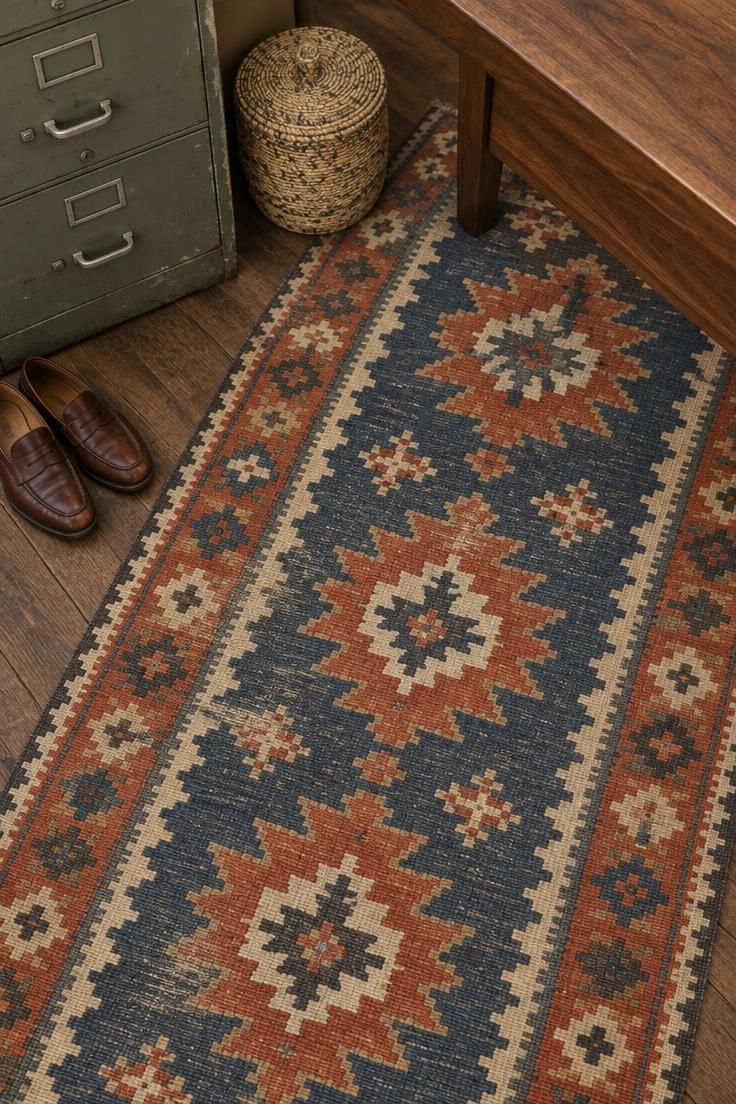
Pattern density at floor level carries the anchor here, with muted painted metal as the era contrast and warm walnut as the neutral bridge between them.
Placing the metal cabinet at the desk's side rather than behind it changes the room's read, turning the cabinet into a visible working companion instead of a backdrop.
Closed storage is the practical advantage a filing cabinet offers over open shelving, and its top works as a side surface for a tray or a stack of notebooks.
Cords crossing a patterned rug become visually busy, and a lidded basket tucked beside the cabinet keeps them out of view between sessions.
Flat-woven rugs are less cushioned underfoot than pile, and a thin rug pad changes that without affecting the pattern's read.
Uneven floorboards in older houses can make a stiff rug wander, and pattern helps disguise the shift even when the rug needs repositioning.
Sizing the runner so the chair stays on the rug rather than straddling its edge keeps the chair from catching during movement.
A two-by-three-foot kilim-style mat under just the chair zone brings the same pattern into a tight room.
A kilim rug desk pairing works when the runner sits directly beneath the repurposed filing cabinet, so the cabinet reads as part of the same layered composition.
Open shelving styling above the cabinet keeps reference books and a small ceramic lamp within reach while the metal body below stays clear.
Style Blueprint:
- One flat-woven runner or area rug with a geometric or kilim-style pattern
- One vintage metal cabinet, filing or flat-file, in a muted painted finish
- One wood desk element in a contrasting tone
- One lidded basket or fabric box to hide cables and small devices
- A rug sized so the chair stays on the rug rather than straddling its edge
A Brass Pharmacy Lamp on a Burl Wood Desk With a Patterned Shade
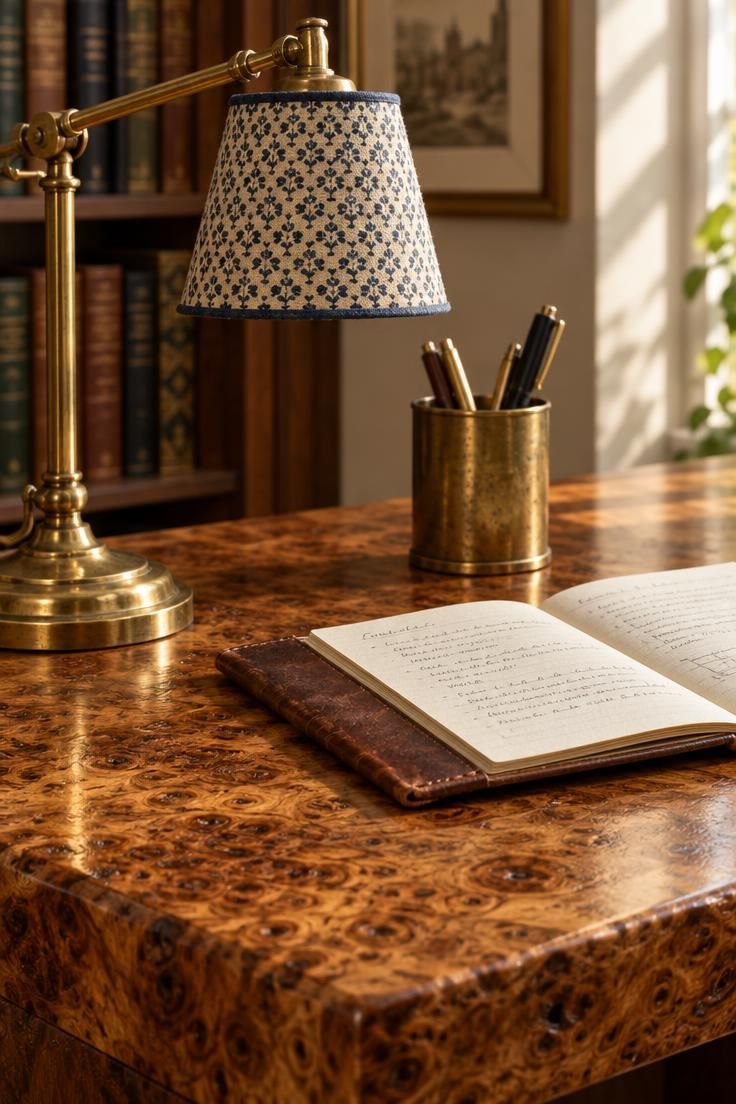
Burl grain already reads as a pattern, which means the shade's print must work at a different scale to avoid a visual clash.
One repeated finish, brass, ties the lamp body and pen cup together, while the two patterns play against each other.
An adjustable arm lets light land on paper, keyboard, or a book without moving the base, and the arm's reach matters more than the shade's silhouette.
Burl hides scratches well but shows dust and fingerprints more than plain grain, and a yearly light oiling keeps it looking even.
A clamp-mounted version of the same lamp frees the desktop entirely when space is tight.
Style Blueprint:
- One burl or highly figured wood desk surface, where the grain is the pattern
- One brass or aged brass lamp with an adjustable arm
- One patterned fabric shade in a small-scale print that does not match the grain direction
A Pegboard Panel Painted the Wall Color, Pinned With Tools, Notes, and Small Art
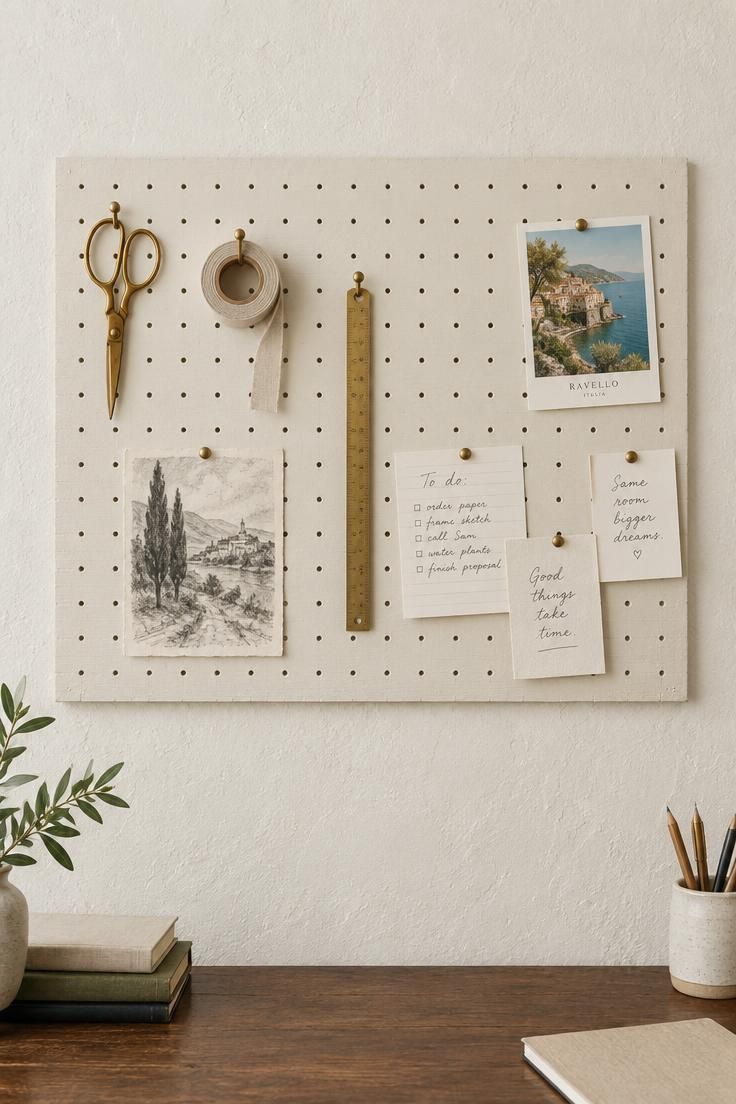
Notes sit at eye height, tools at arm's height, and decorative pieces fill whatever space balances the composition.
A functional tool surface treated as a display surface carries the eclectic read here, because the pins and clips mix utilities with pinned art.
Painting the panel the same color as the wall reduces visual clutter even when many objects are on it, since the background recedes rather than competing.
This replaces a traditional pinboard for current references while also holding the daily tools that would otherwise crowd a desk drawer.
An unpainted or brightly painted pegboard reads as workshop, while a wall-colored one reads as intentional display, even though it is the same object underneath.
This surface treatment does not modify the wall's finish, which matters more in rooms with original plaster.
A single narrow pegboard strip above the desk delivers the same function in less wall space.
Style Blueprint:
- A pegboard panel painted the same color as the wall so the mix reads as one surface
- A mix of functional clips and decorative pins rather than all-metal hardware
- Two or three flat objects pinned in, such as a sketch, a postcard, or a torn page
- Space left at the bottom of the panel so it does not crowd the desk below
A Cane-Back Chair With a Wool Throw Beside a Glass-Topped Writing Table
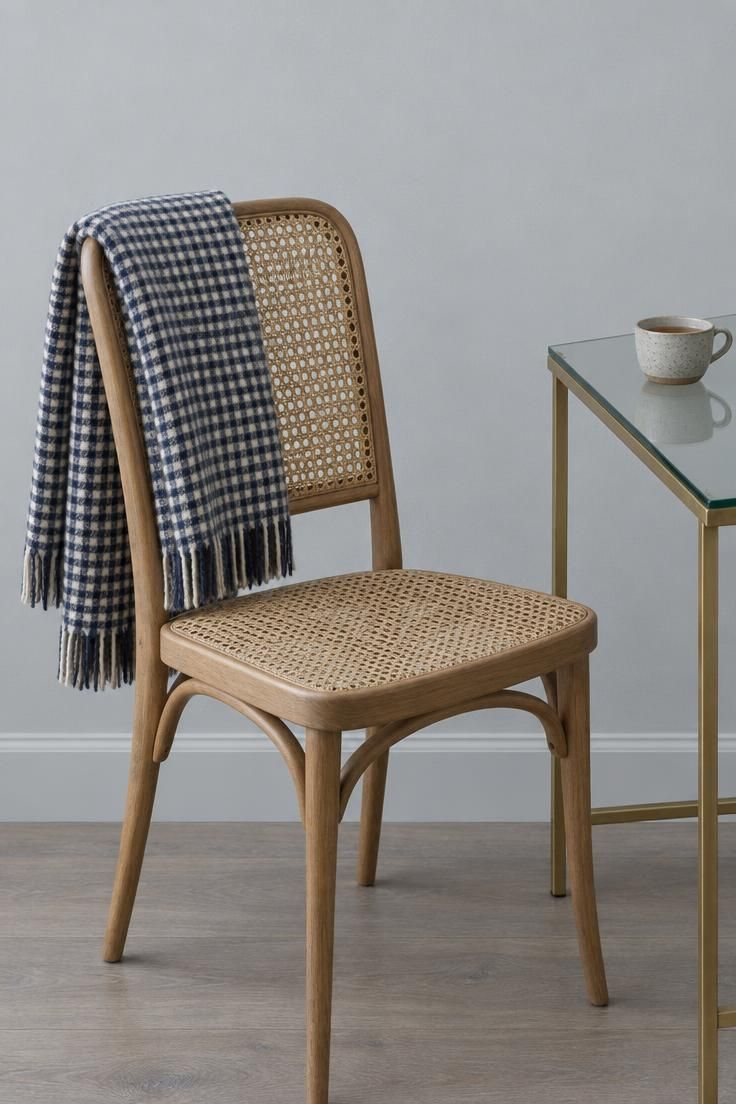
Woven cane, wool, glass, and thin brass all read light, and the mix here is about density rather than era.
Three periods meet in this corner: Victorian cane, mid-century glass table, contemporary wool, and the pale palette plus thin profiles tie them together.
A glass top shows every cable and mark beneath it, which is the tradeoff for its visual lightness.
A small tray or felt pad under the keyboard keeps typing quiet on the glass.
Cane backs and wool throws both collect dust and are slower to clean than upholstery or painted wood.
This pairing takes up less visual weight than a solid wood desk and upholstered chair, which matters in a narrow historic room.
Style Blueprint:
- One cane-back or woven-seat chair in a natural or lightly painted frame
- One glass or acrylic table top on a thin metal base
- One wool throw or blanket in a small-scale check or stripe, folded rather than draped
A Cluster of Vintage Clocks and a Single Modern Clock Above the Desk
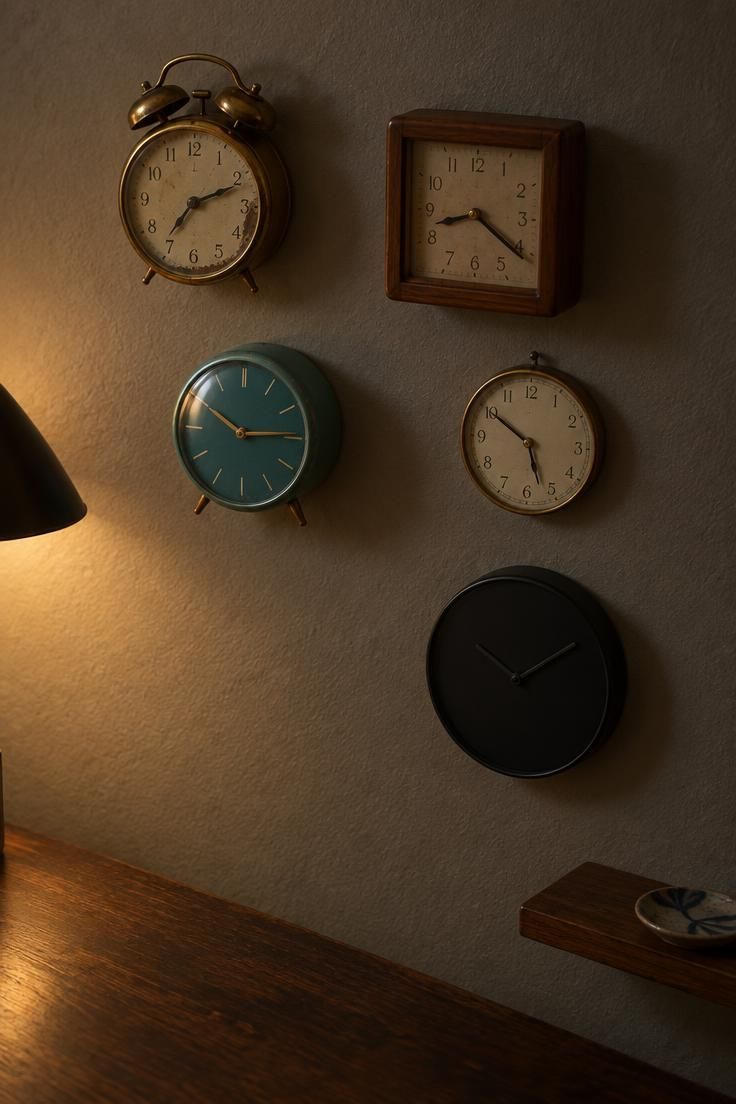
Clock face sizes and case depths create natural step variation on the wall, which keeps the group from reading as a single repeated object.
A repeated object category across eras, interrupted by one contemporary piece, carries the eclectic read here.
The clocks can serve as actual time references in a workspace, with the most legible face positioned in the sightline from the desk chair.
Multiple clocks running at slightly different times is visually charming and functionally useless, and expecting to sync them or accepting the mismatch is part of owning the arrangement.
Two clocks, one vintage and one modern, read as the same idea at a fraction of the wall coverage.
An office that leans on vintage desk ideas can carry the same mix of eras upward, letting an old wooden clock sit beside a newer one without either needing to match.
Style Blueprint:
- Three to five vintage clocks of mixed materials and sizes
- One modern clock with a plain face as the anchor
- An arrangement built off-center, with the modern clock sitting lower and to one side
- A quiet wall behind so the clock faces read clearly
Design Pro-Tip: When two patterns share one frame, make one large-scale and one small-scale, because similar pattern densities read as noise rather than as mix.
A Patterned Block-Print Curtain Squeezed Between Historic Trim and a Low Bookcase
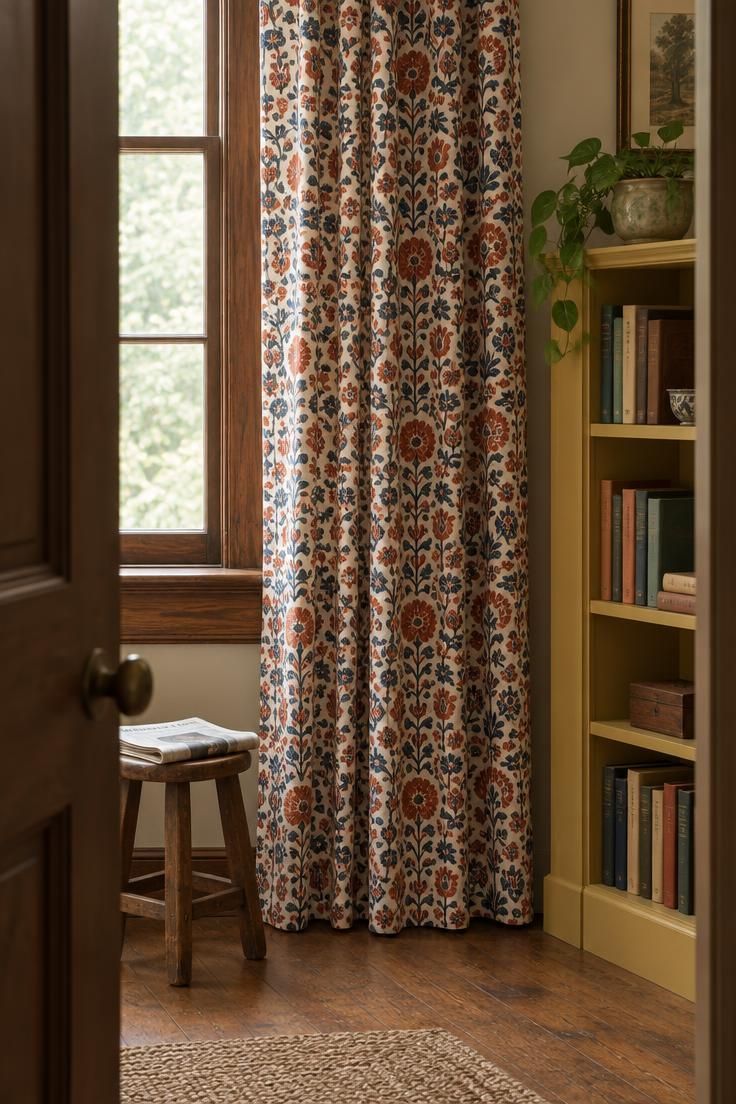
The curtain's colors, the trim's aged tone, and the bookcase's painted finish meet in one sightline, and the pattern's density is doing most of the decorative work.
Textile pattern at architectural scale against painted wood furniture is the mechanism here, and the low bookcase gives the eye a plain surface to rest on next to the pattern.
A dense pattern works in a historic room when its scale stays smaller than the room's existing ornament, so the two don't compete.
A floor-length curtain beside a desk addresses window glare without needing a blind.
The most common visual snag is a misaligned repeat, and checking how the pattern meets the trim before committing is worth the extra step.
Block-print textiles fade in direct sun and typically need dry cleaning, and a lined panel slows both.
A window casing that is out of square will show against any patterned panel, which is one of the honest reasons to choose a plainer textile when the trim is very uneven.
A single panel rather than a pair, or a café-height panel that stops at the sill, brings the idea into a tight historic room.
Style Blueprint:
- One dense-pattern textile used at full height as a curtain, so the pattern reads as a wall
- A pattern scale that stays smaller than the window trim's proportions
- Trim left in its historic finish rather than painted to match the curtain
- One plain surface directly beside the pattern to give it a visual pause
- Curtain hardware kept visually simple so the pattern carries the focus
A Brass Picture Light Over One Oversized Abstract, With the Desk Facing the Wall
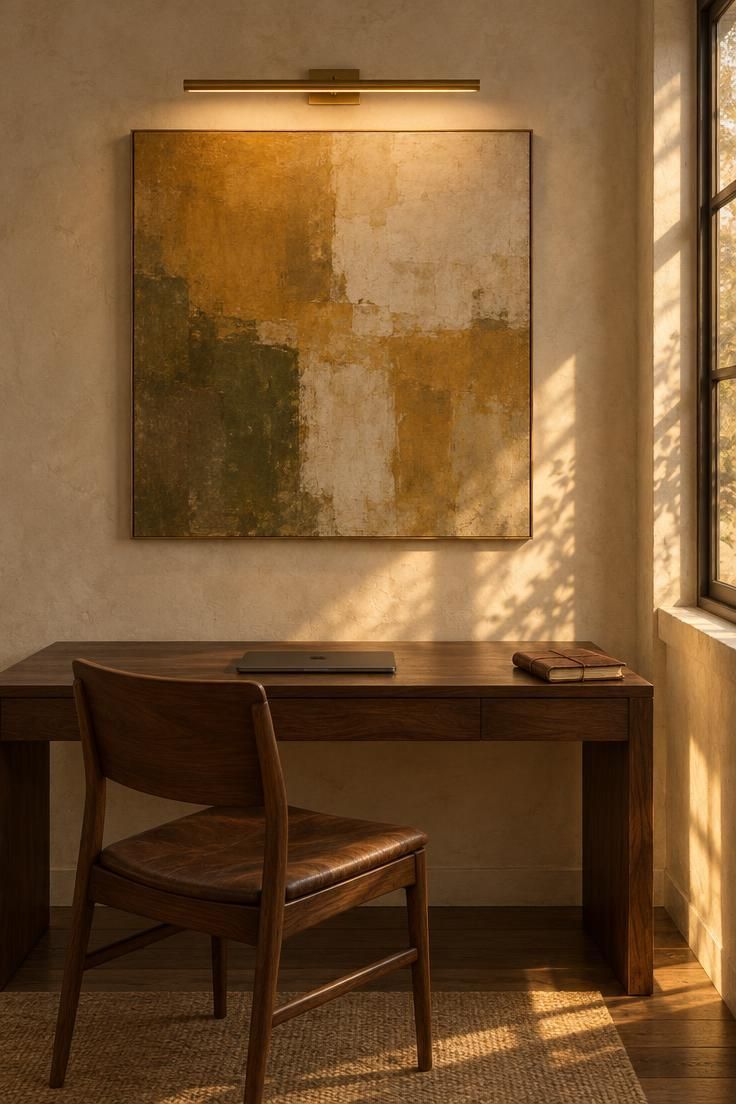
Art scale relative to the desk and the picture light's horizontal proportion do most of the composition work here, reinforced by the sightline from the desk chair.
A single statement object carries the room's decorative role, with everything else held back to let it breathe.
A picture light keeps the desktop free of a lamp base and casts a soft glow at the wall rather than a beam on the desk, so it works alongside a separate task light for close work.
Picture lights need a power source at the wall, which in many historic rooms means a visible cord unless an existing outlet happens to sit in the right place.
A brass picture light will patina over time, and deciding whether that is the goal before buying a lacquered version saves a replacement later.
The same single-artwork approach works on a smaller canvas above a wall-mounted shelf when there is no room for a full desk.
Style Blueprint:
- One oversized artwork with a width close to the desk's width
- One long, thin picture light in brass or aged brass, mounted above the art rather than on the desk
- A restrained desk surface so the art reads as the primary wall feature
- Desk positioned facing the wall so the art is in the sightline
A Woven Wall Hanging Hung Loose Over Plain Plaster, Beside a Slim Metal Shelf
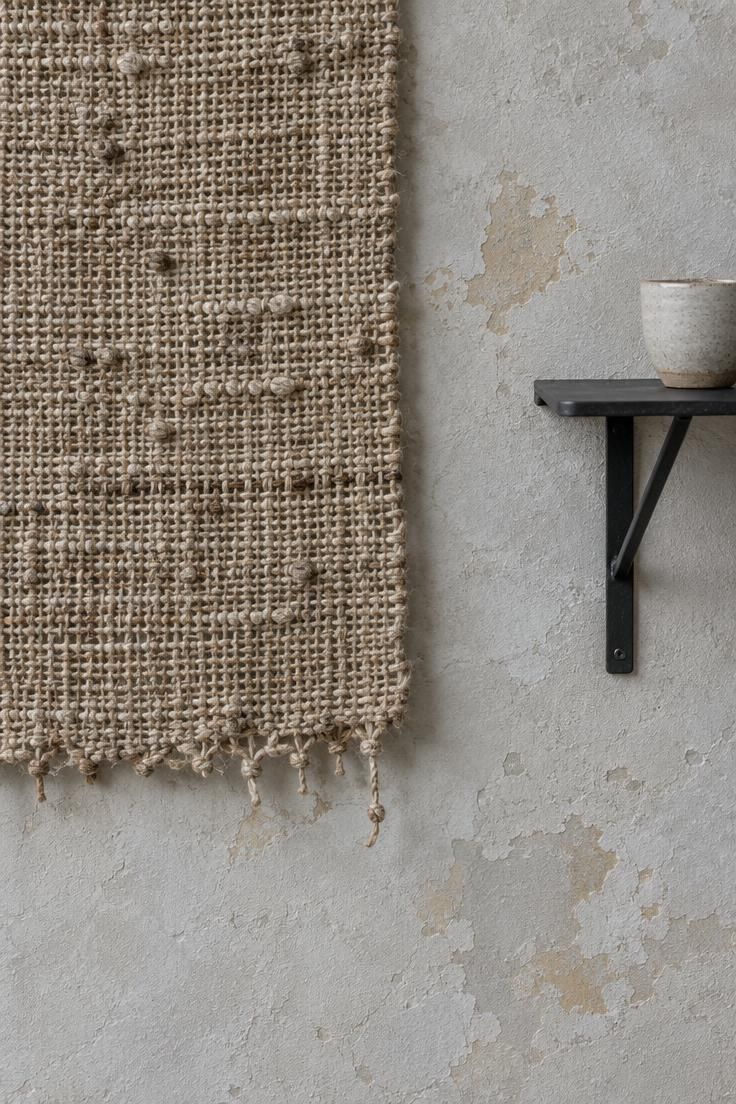
Fiber texture, plaster surface, and the crisp line of the metal shelf edge hold this composition together.
Soft textile against hard metal, both in simple forms at different scales, carries the eclectic read without needing many objects.
A wall hanging does not use desk or floor space, and the adjacent shelf carries the actual workspace function for the corner.
Fiber hangings collect dust and can droop over time, and periodically reshaping the fringe slows the shift.
This pairing works with uneven plaster rather than hiding it, which makes it a natural fit for rooms where the wall surface has age.
A narrow hanging above a wall-mounted shelf brings the same soft-against-hard contrast to a tight wall.
Style Blueprint:
- One handwoven or macramé fiber hanging with visible irregular edges
- Plaster or painted wall left plain around it
- One slim shelf in thin black metal or blackened steel to the side
Design Pro-Tip: Hang a patterned panel and live with it for a day before buying anything else for the room, because the pattern's colors will tell you which two accent tones the rest of the mix should repeat.
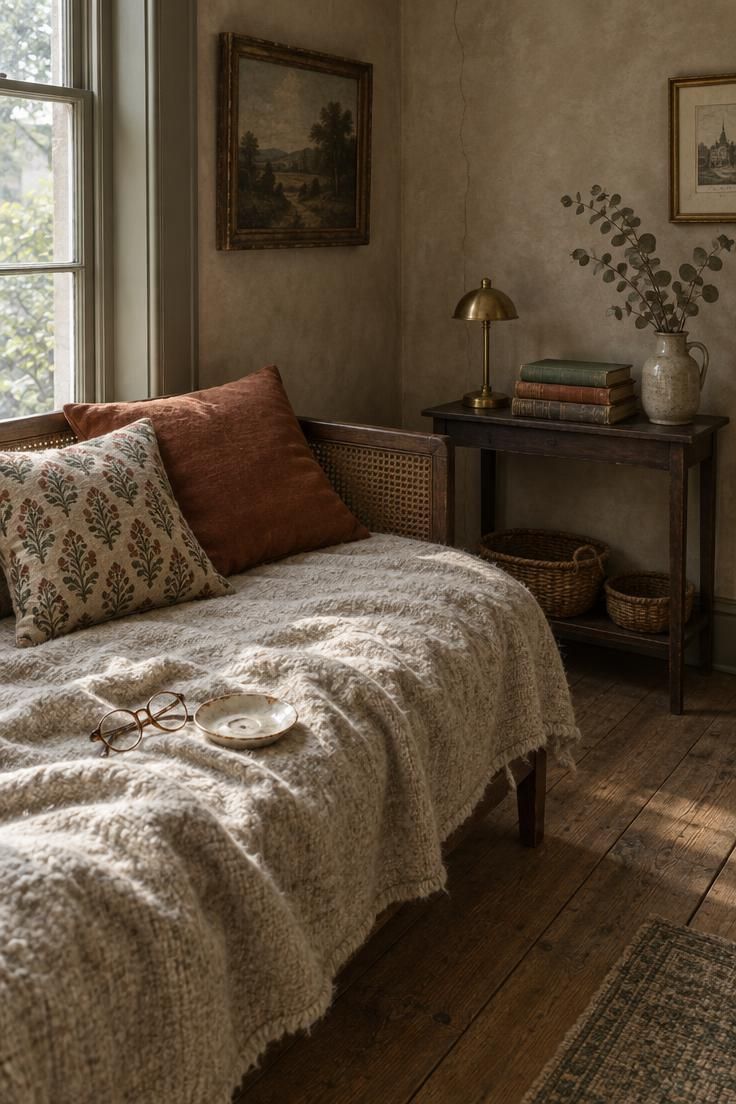
A Low Daybed Corner That Doubles as a Reading and Rest Spot
A narrow daybed tucked into a corner gives an eclectic home office a second purpose without adding another full piece of furniture.
Use it as a place to read through printed drafts, spread out swatches, or set a tray of tea while sorting mail.
Against historic plaster, a low profile keeps the sightline toward tall windows and crown molding clear.
Choose a frame in a finish that already appears somewhere else in the room, such as aged brass, dark walnut, or painted iron.
Layer a wool or cotton coverlet over the mattress and let one end stay slightly rumpled for a lived-in feel.
A pair of mismatched pillows, one patterned and one solid, softens the corner and ties the palette together.
Keep the space beneath open or fill it with two shallow baskets for paper, cables, and office supplies.
A slim side table at the daybed's head holds a small lamp, a stack of books, and a dish for keys.
If the corner sits far from the desk, add a second light source so the area reads as usable rather than decorative.
This is one of the more forgiving eclectic home offices arrangements because it works in alcoves, beside chimneys, and under sloped ceilings.
For anyone collecting home office decorating ideas, the daybed corner earns its place by absorbing overflow seating, storage, and quiet reading in one footprint.
Layered textiles and mismatched cushions round out eclectic home office decor while keeping the daybed comfortable for long reading sessions.
Design Pro-Tip: Treat the daybed as a horizontal counterweight to vertical elements nearby, such as a bookcase or a tall window.
Balancing one long, low shape against several upright ones keeps a historic room from feeling top-heavy.
Style Blueprint:
- Frame finish repeated from the desk or lamp
- One patterned pillow plus one solid pillow
- Coverlet in a muted tone drawn from the rug
- Two shallow baskets stored underneath
- Small side table with a lamp and stacked books
Conclusion
A warm eclectic home office in a historic room is a composition strategy rather than a shopping list.
One binding element, one restrained anchor, deliberate imbalance, and enough negative space make the mix read as intentional.
Not every entry needs to be adopted.
Borrow the one or two mechanisms that suit the room's existing character and let the rest go.
Add pieces gradually, evaluate them in the room's actual light, and treat every arrangement here as design inspiration rather than a finished project to replicate exactly.