This post may contain affiliate links. If you make a purchase through these links, we may earn a commission at no additional cost to you.
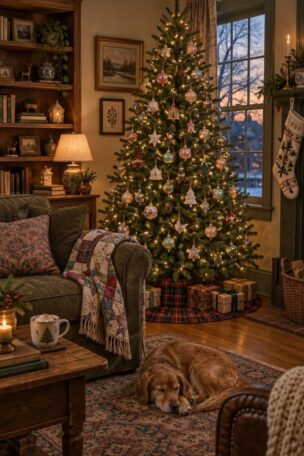
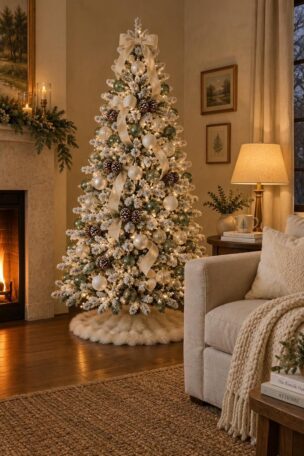
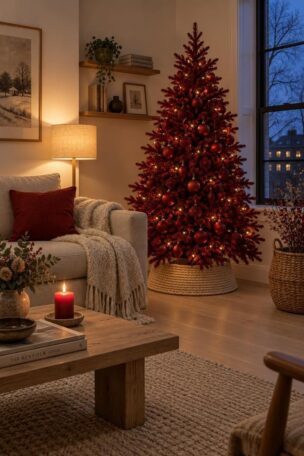
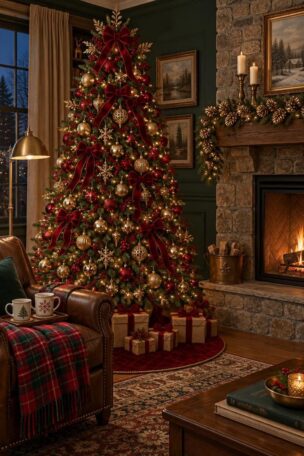
An eclectic Christmas tree gathers objects from different eras, materials, and color stories into one collected display.
The goal is a tree that feels personal and accumulated, not matched from a single set.
Each of the ideas below works in a modest home and leans on mixing strategies: pairing old with new, handmade with polished, and bright with neutral.
A repeated light color, ribbon, finish, or background holds that variety together.
Neutral Backdrop with a Deliberate Color Clash
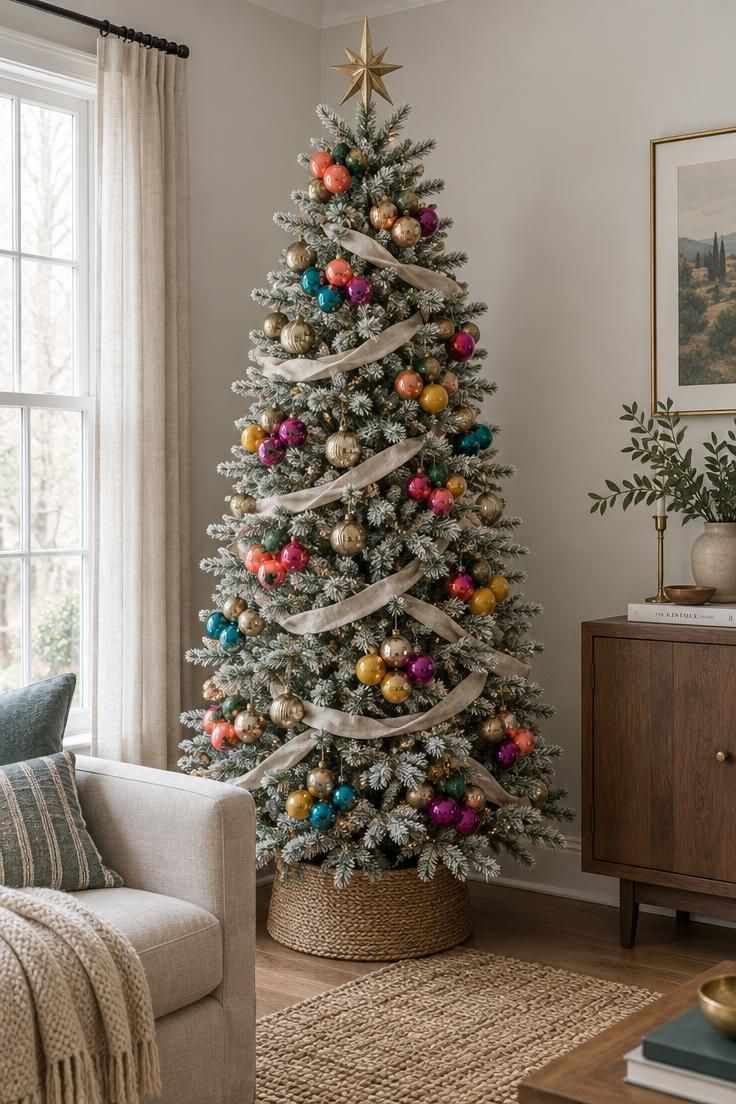
A lightly flocked tree gives bright ornaments a quiet canvas to sit against.
Coral, teal, mustard, and magenta can share the branches when one metallic finish repeats throughout the display.
Antique brass works well here: it appears in a few baubles, a star, and a small clip-on piece, tying the loud colors into a single story.
Clustering matters more than even spacing.
Group three to five small ornaments on one branch, leave a gap, then build another cluster nearby, so the eye moves in pauses rather than a steady sprinkle.
An oatmeal or flax fabric garland wound loosely through the branches gives the bright zones somewhere to rest.
This approach suits a room where the tree carries the bold color and the walls, rug, and sofa stay calm.
On a compact tabletop christmas tree, the same logic scales down nicely: fewer clusters, one brass finish, and a short garland run keep the look deliberate rather than crowded.
Style Blueprint:
- Lightly flocked tree as the neutral backdrop
- Coral, teal, mustard, and magenta ornaments clustered in small groups
- One repeated antique brass finish across baubles and clips
- Oatmeal or flax fabric garland wound loosely through the branches
Design Pro-Tip: Before hanging anything, sort ornaments into small piles by color on the floor, then build one cluster per pile so no color dominates a single side of the tree.
Vintage Glass and Ceramic Mix with Warm-White Lights
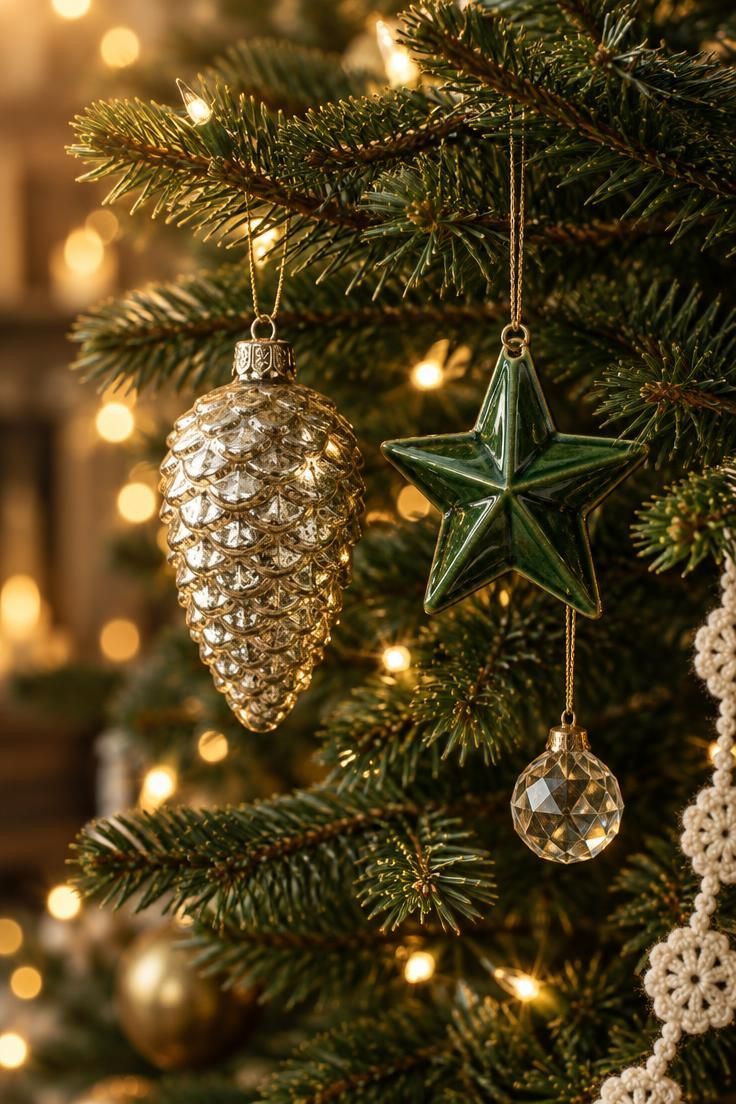
Blown-glass shapes from different decades sit comfortably beside handmade ceramic discs and a few faceted gems when the light temperature stays constant.
For a vintage ornament mix, warm-white lights let ornament color and texture carry the display, so a mercury-glass pinecone and a matte clay star can share a branch without competing for attention.
Place larger vintage pieces deeper on the sturdier inner branches, where they read as a dense middle layer, and let smaller, lighter pieces fill the outer tips.
An ivory crocheted garland softens the transition between eras and adds a handmade note that keeps the arrangement from feeling like a shop display.
A roughly even ratio of glass to ceramic is the practical target.
Too much glass and the tree reads as a single vintage collection; too much ceramic and the shine disappears.
Counting isn’t necessary, but stepping back to check the balance is worth the pause.
Style Blueprint:
- Blown-glass ornaments from mixed decades
- Handmade ceramic discs and stars in muted glazes
- A few faceted glass gems for sparkle
- All warm-white lights, one temperature throughout
- Ivory crocheted garland as a soft transition
Handmade Paper and Wood Trims on a Slim Tree
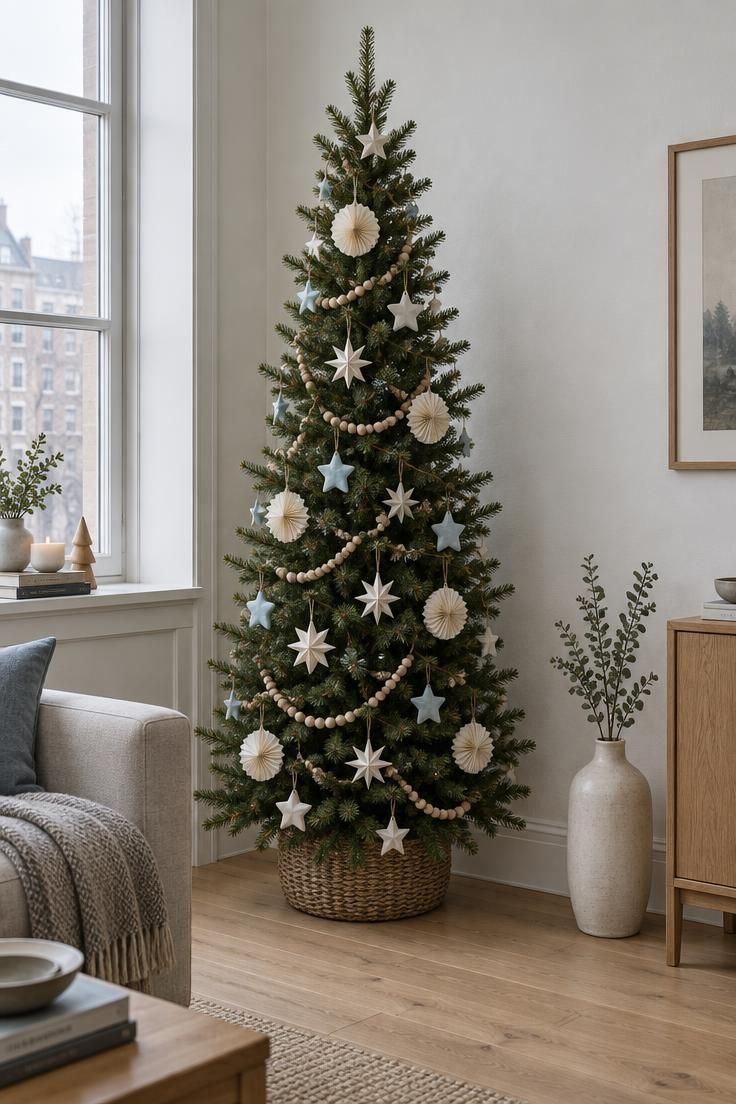
A narrow floor tree against a white wall suits paper fans, folded stars, and small wooden beads, because the slim profile keeps varied textures from feeling heavy.
Alternating matte and glossy paper adds depth without changing the palette, so a cream fan and a cream folded star still read as two different objects.
A simple jute or cotton string threaded with wooden beads makes a garland that looks crafted rather than purchased.
Tuck a few air-dry clay stars painted in one soft color, such as pale blue, among the paper shapes to break up the neutral tones.
This mix works best when the paper pieces stay small and the wooden elements stay natural.
Oversized fans on a slim tree crowd the silhouette, and stained wood competes with the paper.
The appeal here is quiet texture, not volume.
Style Blueprint:
- Narrow-profile tree against a light wall
- Small paper fans and folded stars in matte and glossy finishes
- Wooden beads threaded on jute or cotton string
- A few air-dry clay stars in one soft color
Single Finish, Many Colors with All-Glass Ornaments
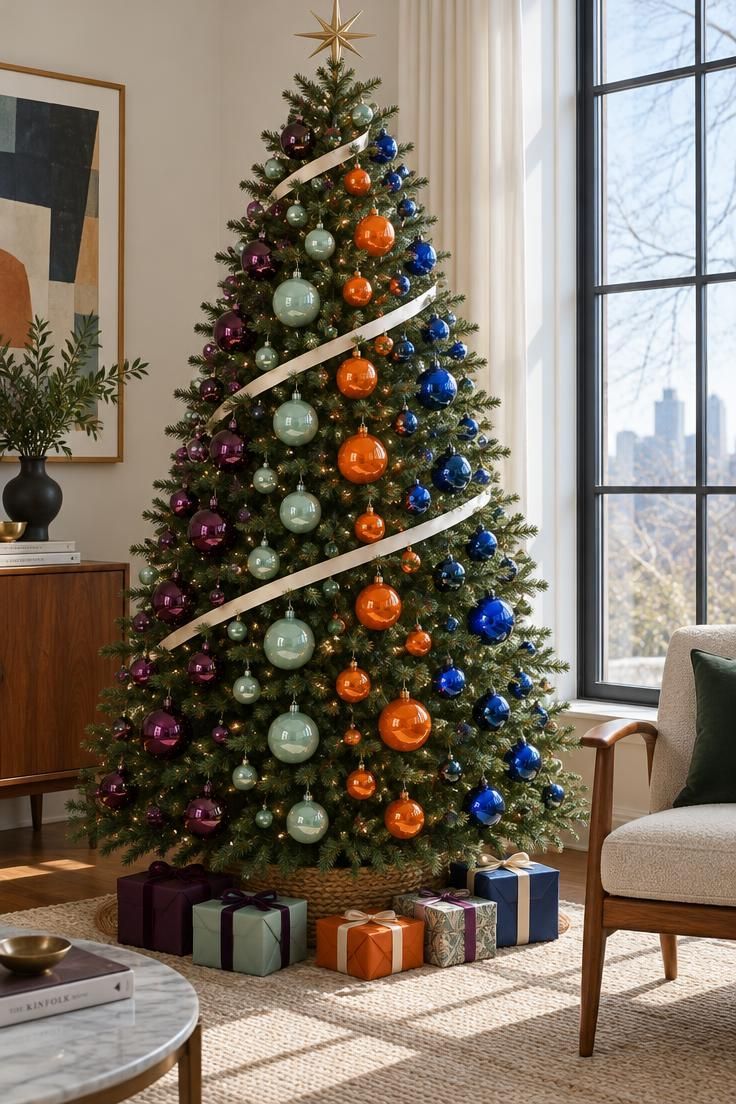
One finish across a wide color range is the easiest way to keep a mixed palette under control.
All glossy glass, from deep plum to seafoam to tangerine, reads as a collection rather than a clash because every ornament reflects light the same way.
All matte glass works the same way with a softer result.
Grouping same-color ornaments in loose vertical bands or small clusters gives the tree structure that scattered placement lacks.
A single neutral grosgrain ribbon, wound once around the tree, adds texture without introducing another finish.
This is a reliable starting point for anyone nervous about mixing too many materials at once.
The tradeoff is shine: glossy glass multiplies every light source, so a room with many lamps can look busy, and matte glass absorbs light and can feel flat in a dim corner.
Style Blueprint:
- One finish across every ornament, all glossy or all matte
- A wide color range grouped into loose vertical bands
- A single neutral grosgrain ribbon
- No additional materials beyond glass and ribbon
Mixed Ribbon Garland in Three Contrasting Widths
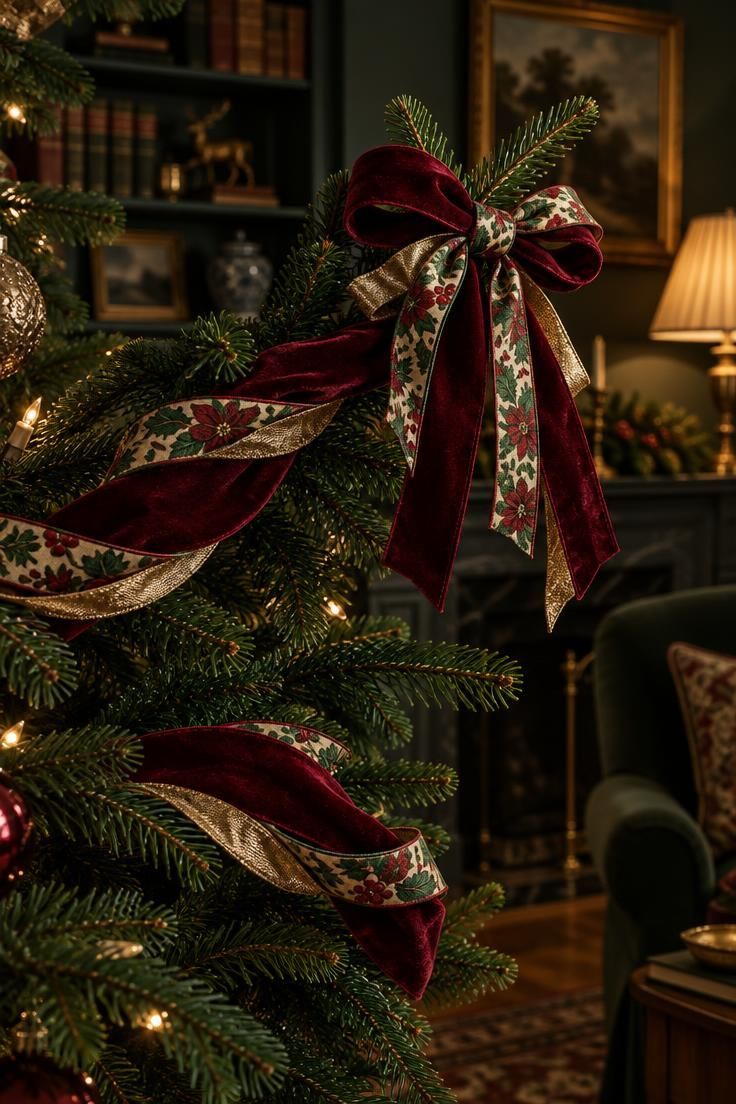
Twisting three ribbons into one garland lets width and pattern do the work of variety.
A wide velvet, a narrow metallic, and a printed cotton braided together create contrast at every turn, while repeating the same trio on each pass keeps the whole tree coherent.
A mixed ribbon garland built this way carries visual weight on its own, which makes it useful on a tabletop tree as much as a full-size one.
Use the same three ribbons for a few bows at branch tips instead of adding a separate topper.
The repetition connects the garland to the rest of the tree and avoids the look of two unrelated decorations sharing one space.
Color choice is the decision point.
Pick ribbon colors that each appear in at least one ornament elsewhere, so the garland feels woven into the tree rather than laid on top of it.
Too many ribbon patterns, or four or five widths, turns the garland into noise.
Style Blueprint:
- Three ribbons in contrasting widths and patterns
- One wide velvet, one narrow metallic, one printed cotton
- The same trio repeated for bows at branch tips
- Ribbon colors echoed in at least one ornament each
Non-Ornament Objects as Tree Decorations
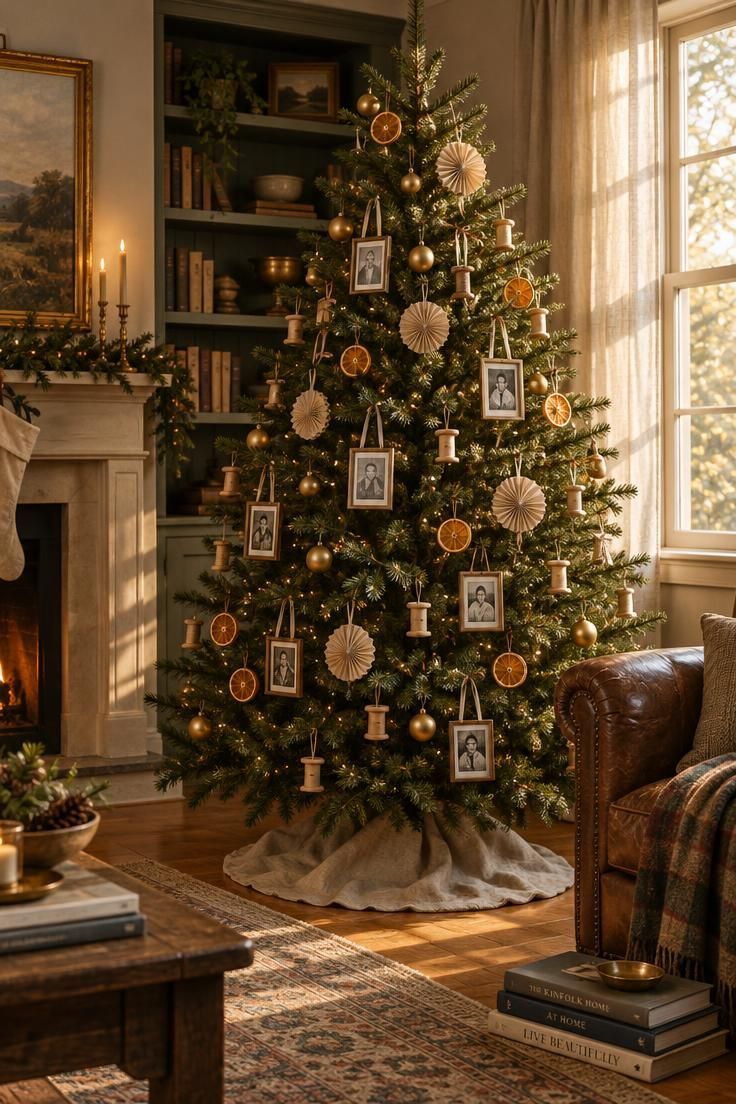
Small framed photos, pressed paper fans, dried orange slices, and miniature wooden spools can hang from branches when they stay small and relatively light.
Placing them at mid-level branches puts these non-ornament tree decorations at eye height, where guests can actually look at them.
A few standard baubles in one matching color tie the unusual pieces into the tree, so the photos and dried fruit read as part of a scheme rather than stray objects.
Matte gold works well for this job: it echoes the warm tones of dried citrus and doesn’t compete with the frames or paper.
A neutral tree skirt or basket grounds the busy mix at the base.
This option suits a memory tree that includes souvenirs, family photos, and small keepsakes, though it asks for restraint: a dozen unconventional pieces reads as a collection, and three dozen reads as clutter.
Style Blueprint:
- Small framed photos hung on thin ribbon at eye height
- Pressed paper fans and dried orange slices
- Miniature wooden spools or similar keepsakes
- Matte gold baubles in one color as the connector
- A neutral skirt or basket at the base
Design Pro-Tip: Weigh a keepsake in your hand before hanging it, and reserve the front mid-level branches for the pieces you most want people to notice up close.
Cluster Topper Instead of a Single Star
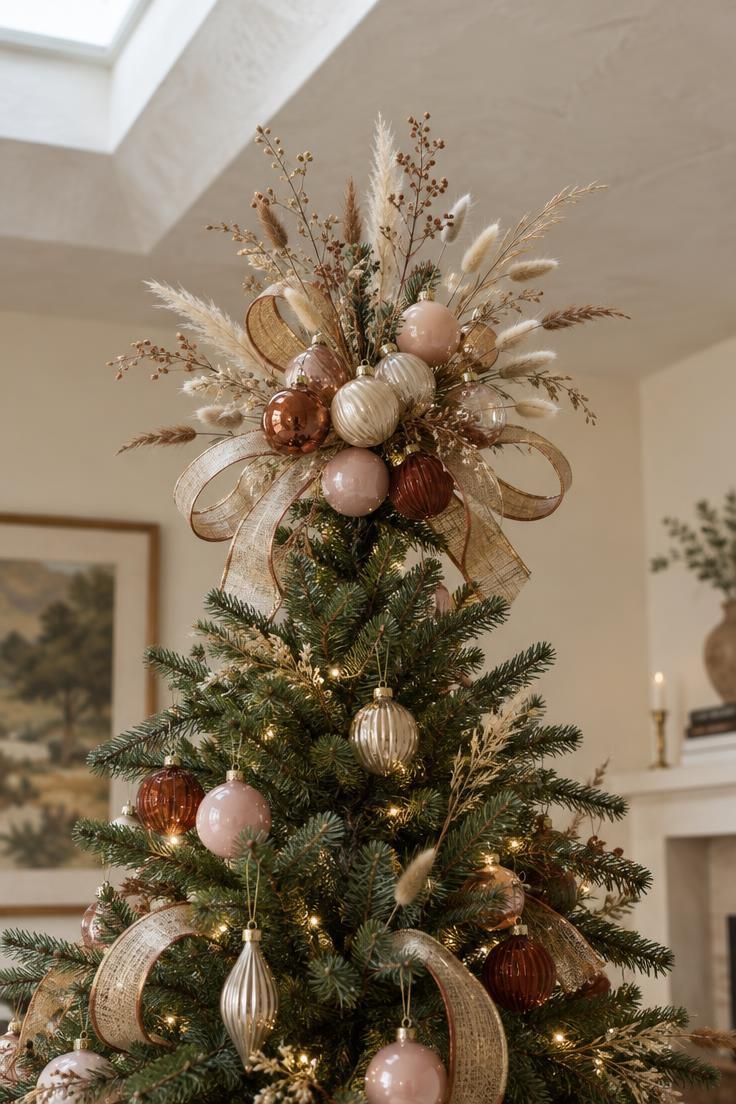
A gathered cluster of small ornaments, dried grasses, and wired ribbon loops replaces the usual star or angel and turns the top of the tree into another collected element.
Five to seven pieces in slightly different sizes but one color family, such as blush, cream, and rust, read as a loose bouquet rather than a single ornament.
Tucking the cluster into the top branches so it sits low and full keeps it from looking like a hat perched on the tree.
On a tree that already carries heavy ornament variety, a compact cluster balances the composition without adding a competing focal point.
Scale is the practical limit.
On a small tree, three or four pieces are enough; a wide cluster overwhelms a narrow silhouette.
The color family should echo at least two ornaments lower on the tree so the topper feels connected to the rest of the display.
Style Blueprint:
- Five to seven small ornaments in one color family
- Dried grass stems tucked into the cluster
- Thin wired ribbon loops for a loose bouquet shape
- Cluster seated low and full in the top branches
Basket Base as the Tree’s Anchor
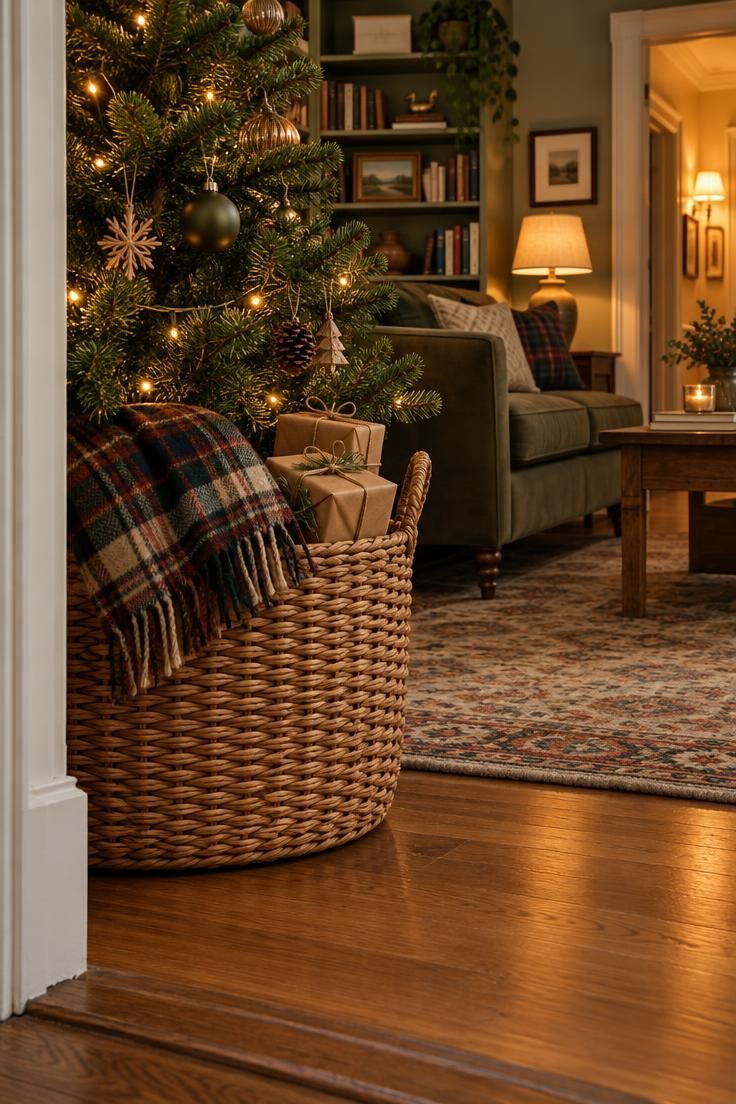
A large woven basket set around the tree base becomes part of the styling and removes the need for a traditional skirt.
Natural wicker or seagrass texture contrasts nicely with glass and ribbon above, and the basket adds visual weight that makes a small tree look intentional.
A christmas tree in a basket also simplifies cleanup, since the basket hides the stand and any fallen needles collect inside.
Choose a basket with a wide, stable base and a low profile so the tree doesn’t appear to float above the floor.
Fill visible gaps around the trunk with a folded plaid throw, a couple of wrapped boxes, or a length of burlap.
Leave a little room between the lowest branches and the basket rim so the tree doesn’t look crowded into the container.
The tradeoff is floor space: a wide basket reaches farther than a fabric skirt.
In a tight corner, measure the basket footprint against the tree’s spread before committing, and consider a narrower basket for a slim tree.
Style Blueprint:
- Wide, low woven basket in natural wicker or seagrass
- A folded plaid throw filling gaps around the trunk
- Two or three small wrapped boxes at the base
- Space left between the lowest branches and the basket rim
Tabletop Tree with Mixed Miniature Ornaments
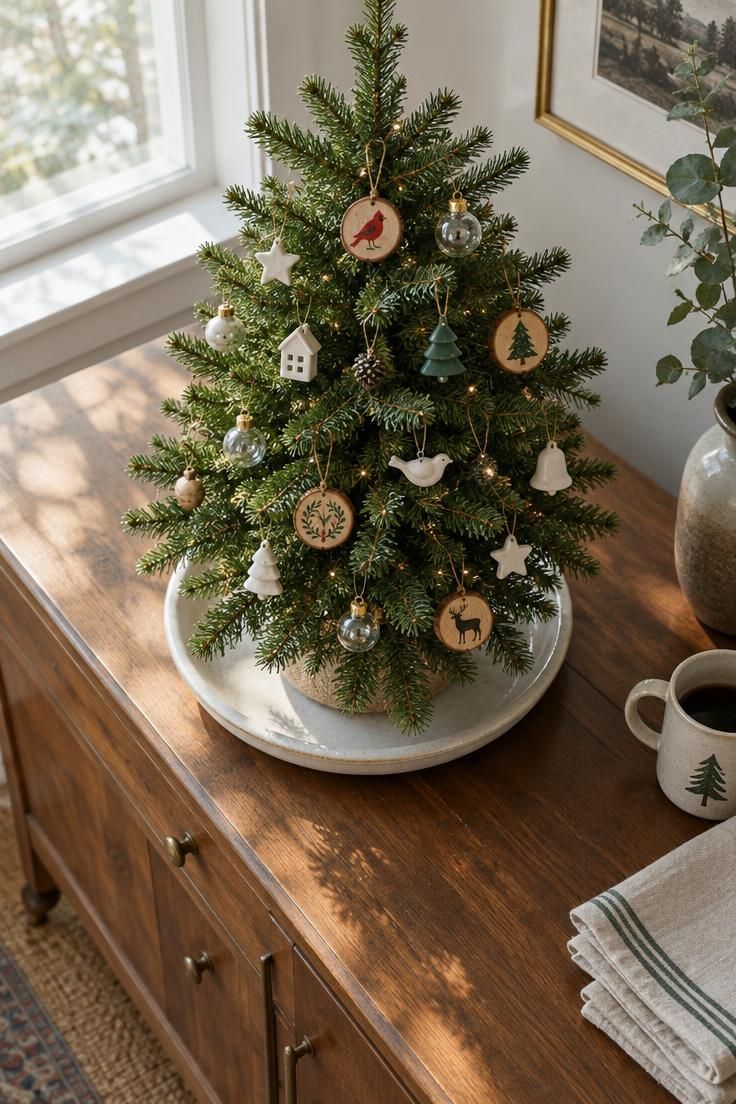
A twenty-four to thirty-inch tabletop tree makes a concentrated canvas for a small, mixed ornament collection.
Rotate matte ceramic shapes, tiny glass balls, and hand-painted wood slices across the branches, keeping each type visible in its own zone.
Placing the tree on a sideboard or low bookcase puts the top near eye level, where miniature pieces read clearly.
A shallow ceramic tray underneath catches fallen dried pieces and gives the arrangement a defined edge.
This is a practical way to test an eclectic christmas tree combination before scaling up, since a small tree shows quickly whether a palette and mix of finishes hold together.
The main limitation is quantity.
A tabletop tree holds maybe two dozen small ornaments, so each piece needs to earn its spot, and a single oversized bauble can throw off the proportions.
Sticking with miniatures keeps the scale consistent.
Style Blueprint:
- Twenty-four to thirty-inch tabletop tree
- Miniature matte ceramic shapes and tiny glass balls
- Hand-painted wood slices in one or two colors
- A shallow ceramic tray underneath
- Placement at eye level on a sideboard or low bookcase
Dried Citrus and Cinnamon Stick Accents
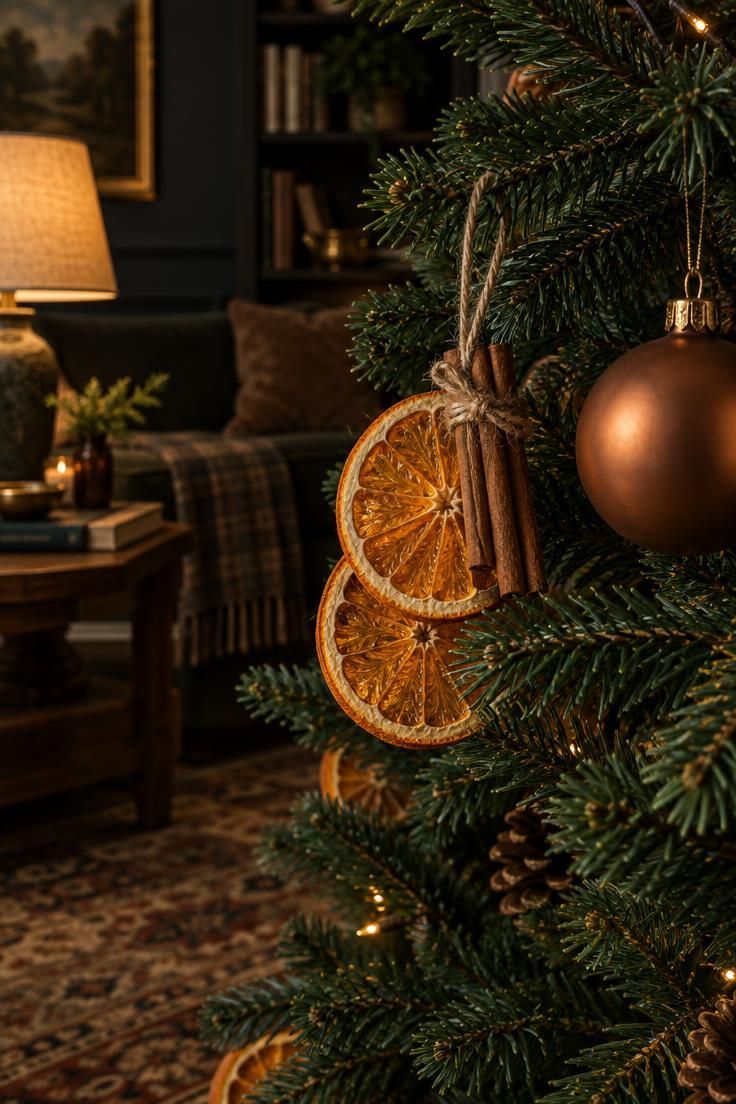
Dried orange and grapefruit slices hung on outer branches catch light and glow when it shines through them.
Cinnamon sticks tied in twine bundles of three to five read as a deliberate accent rather than stray debris, and matte copper or bronze ornaments echo the warm tones without competing with the fruit.
This pairing works best on a tree with a neutral or green base, where the citrus is the color story.
Layering citrus over a tree already full of bright ornaments muddies the effect, so keep the rest of the palette quiet.
Expect a little shedding from dried fruit as the season progresses.
A dark tree skirt or basket catches fallen bits and hides them between cleanups, and checking the dried pieces occasionally keeps the display looking cared for.
Fresh citrus should be fully dried before hanging so it doesn’t drip.
Style Blueprint:
- Dried orange and grapefruit slices on outer branches
- Cinnamon sticks tied in twine bundles of three to five
- Matte copper or bronze ornaments as echoes
- A dark skirt or basket to catch fallen bits
- A neutral or green tree base behind the warm tones
Multicolor Lights with Retro Ornaments and Tinsel
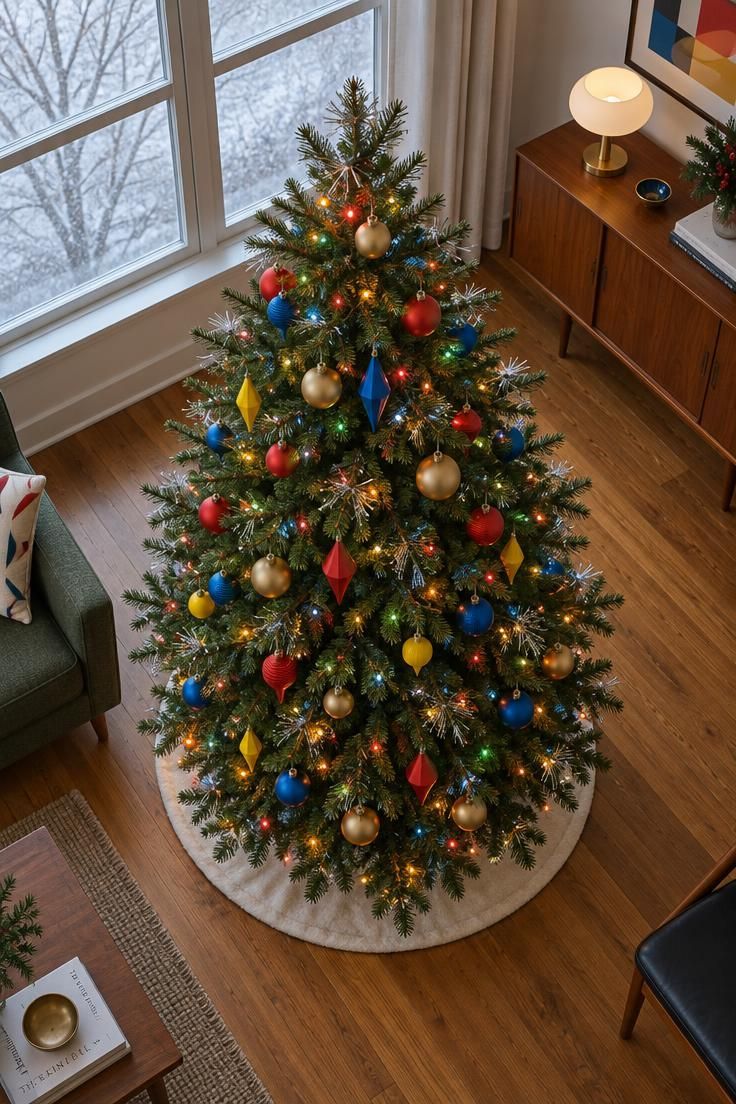
Multicolor string lights set the palette, so added ornament colors stay close to red, blue, yellow, and green.
Retro-style shapes, from vintage-style Santas to simple satin balls, lean into nostalgia, and one repeating matte gold accent keeps the busy colors from scattering.
Hanging tinsel sparingly, a strand or two per branch tip, avoids a cluttered look while preserving the retro feel.
This tree suits a room with warm wood tones, where the multicolor glow picks up the amber in the furniture.
A simple white or natural skirt keeps the base quiet so the lights stay the focus.
The tradeoff is visual noise: multicolor lights plus retro ornaments plus tinsel can tip into chaos without the matte gold repeating through the branches as an anchor.
Style Blueprint:
- Multicolor string lights as the color anchor
- Retro-style ornaments in red, blue, yellow, and green
- One strand or two of silver tinsel per branch tip
- Repeating matte gold balls for cohesion
- A simple white or natural tree skirt
Conclusion
The trees that hold together repeat one visible anchor, whether that is a light color, a finish, a ribbon, or a neutral base, while the rest of the decorations range across eras and materials.
Start with one mixing strategy that feels manageable, such as all-glass ornaments in many colors or a basket base with a single textured throw.
Add unusual objects in small numbers and move them around until the tree reads as collected rather than chaotic.
A few deliberate contrasts on a small tree often look more intentional than a large tree overloaded with pieces.