This post may contain affiliate links. If you make a purchase through these links, we may earn a commission at no additional cost to you.
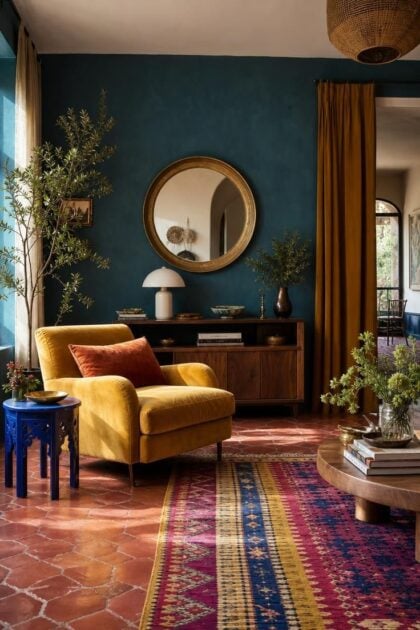
A colorful eclectic home turns the ordinary rulebook of matching sets and safe neutrals into a playground of visual rhythm.
The trick is not accumulating more color, but placing it with enough control that each clashing pattern or vintage find feels inevitable.
This list explores concrete moments where paint, material, and collected objects can change a room into a joyful composition.
Each idea is built around a distinct image that proves eclecticism is a discipline, not an accident.
Talavera Tile Risers on a Painted Mint Staircase
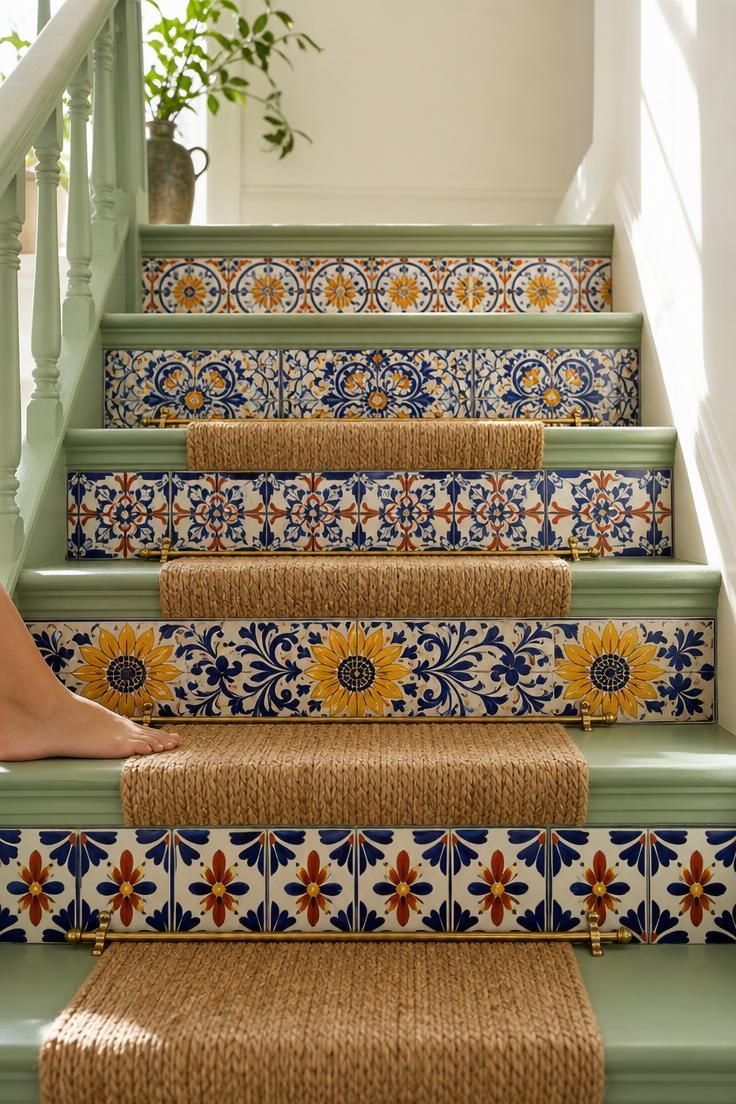
Talavera tiles on stair risers give a functional zone the energy of a vertical gallery.
The glaze variation from hand-painted tile creates a collected, Old World surface that changes as light moves across each step.
Using a flat mint green on treads and balusters frames the busy tile instead of fighting it.
The plain warm white wall at the landing gives your eye a short pause between floors.
Keeping the handrail in natural oak with a satin finish anchors the saturated run of color.
This small decision keeps the stairs readable as an architectural feature rather than a decorative jumble.
Style Blueprint:
- Paint treads, stringers, and balusters in a flat mint or sage green to create a calm frame for the busy tile.
- Choose Talavera tiles in a shared palette of cobalt, sunflower yellow, and terracotta, alternating floral and geometric motifs.
- Leave the adjacent landing wall plain warm white to give the eye a rest between floors.
- Add a single woven seagrass runner secured with brass stair rods to introduce texture without competing pattern.
- Keep the handrail in natural oak with a satin finish to anchor the vertical color run.
High-Gloss Magenta Interior of a Built-In Walnut Bookcase
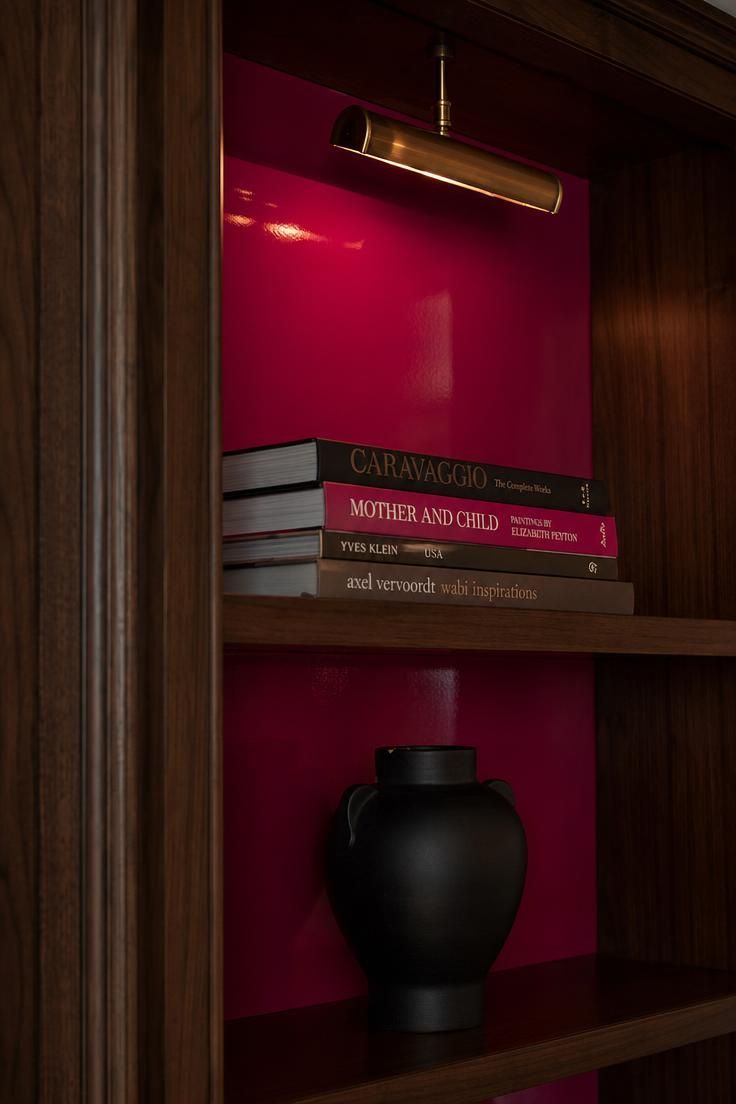
A dark walnut case can feel too brown until you paint its interior in a saturated finish.
Glossy magenta on the back panel makes each shelf act as a small glowing cove.
The key is leaving the outer case in oiled walnut.
That contrast keeps the magenta from taking over the whole wall.
Styling shelves with at least one magenta, fuchsia, or berry tone repeated in glass, book spines, or ceramic helps the painted surface feel deliberate.
A matte black vessel placed directly against the gloss shows how two finishes can intensify each other.
Sparse styling on a couple of shelves lets the painted back read as a clean color block.
Style Blueprint:
- Use a semi-gloss or high-gloss magenta alkyd paint only on the inside back of the bookcase; leave the outer case in oiled walnut.
- Style shelves with objects that contain at least one magenta, fuchsia, or berry tone repeated in glass, book spines, or ceramic.
- Place a small brass picture light at the top to bounce warm light off the glossy surface and deepen the color.
- Keep shelf contents sparse on two of five shelves to let the painted back read as a color block.
- Position one matte black ceramic vessel directly against the magenta to show how gloss and matte intensify each other.
Design Pro-Tip: Repeat a bold painted accent at least three times in the room, once in the millwork, once in a textile, and once in a small object, so the eye reads it as intentional rhythm rather than a one-off mistake.
Velvet Patchwork Armchair Beside a Raw Oak Stump Stool
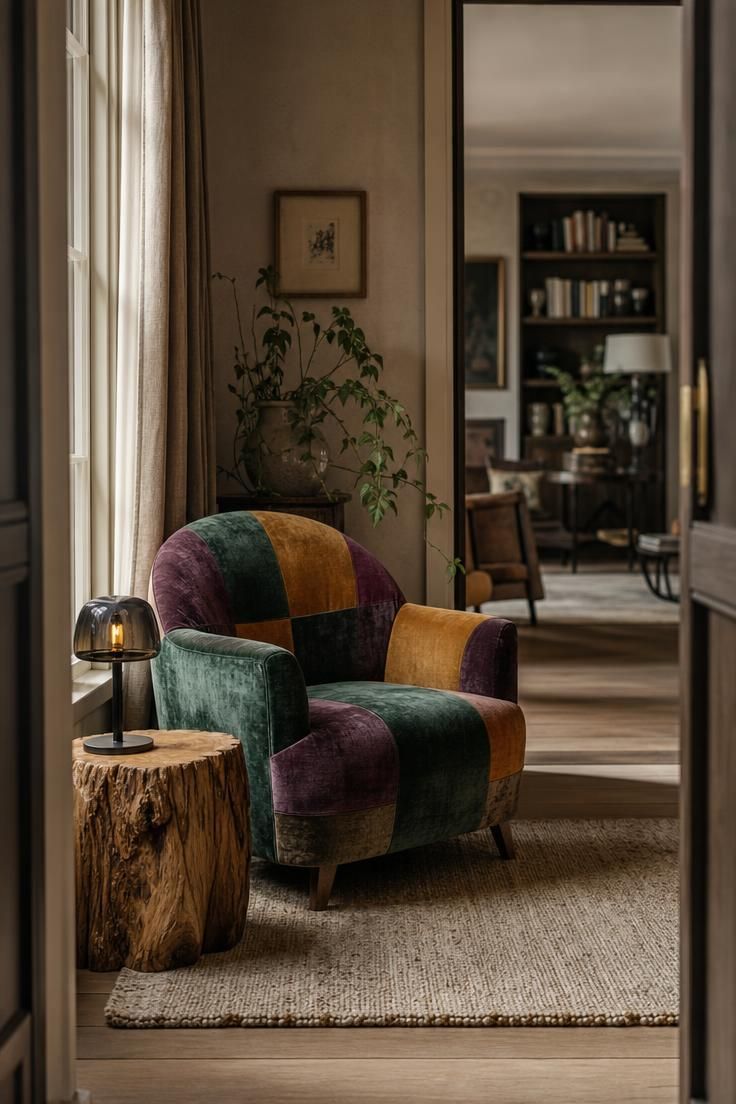
The contrast between soft patchwork velvet and a raw oak stump is what makes this corner work.
Upholstery texture changes as light hits each panel differently, giving the chair a shifting surface.
A faded oatmeal rug underneath quiets the composition enough to let the jewel tones breathe.
Without it, the corner would feel like a small pile of loud objects.
A smoked glass table lamp on the stump keeps the top from looking too heavy.
The thin lamp base creates a floating effect against the wide polished wood surface.
The trailing plant behind the chair adds an organic shape that softens the strong verticals of the lamp and stump.
Style Blueprint:
- Upholster the chair in a patchwork of emerald, ochre, and aubergine velvet, each panel slightly different in texture or nap direction.
- Place the chair on a faded oatmeal wool rug that visually quietens the composition.
- Use a large polished slice of oak, bark edge left intact, as the side table at chair height.
- Set a smoked glass table lamp on the stump, its base thinner than the stump’s top to create a floating effect.
- Zone the corner with a single trailing plant in a stoneware pot, placed on the floor behind the chair.
Cobalt Blue Painted Dining Table With Satin Brass Knuckle Feet
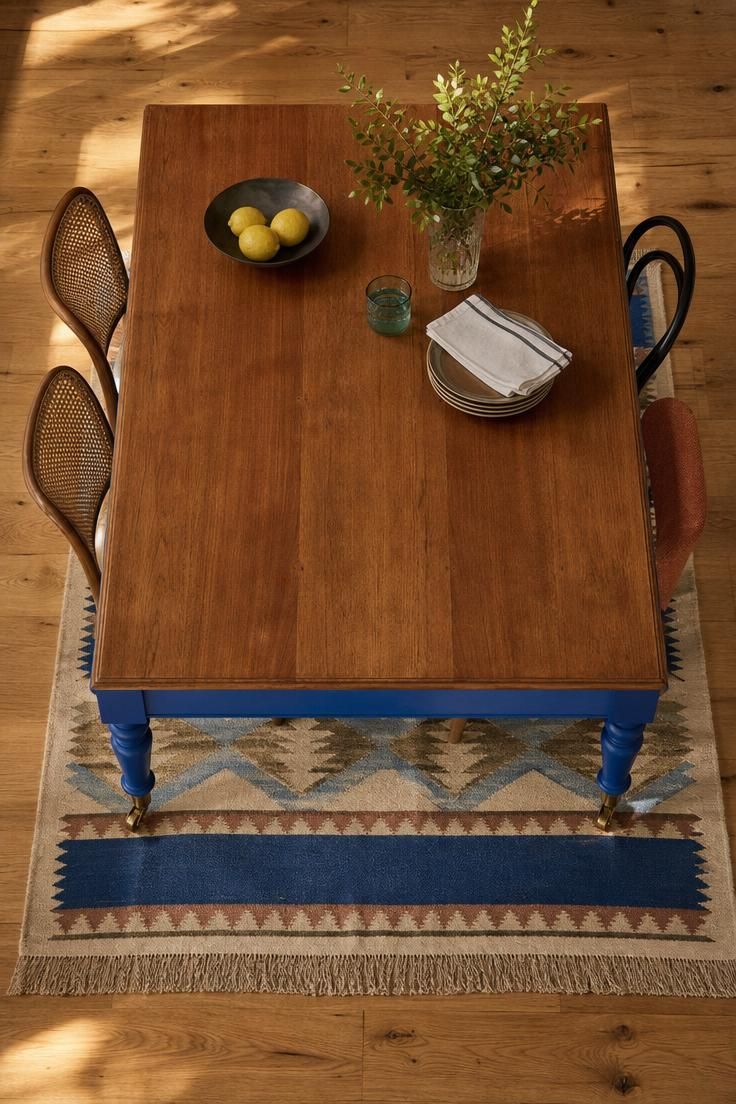
Painting only the base and apron leaves the tabletop in natural wood, which keeps the piece functional for meals without losing its saturated impact.
The cobalt blue satin finish reads as one confident object in the room.
Brass feet that are polished but not lacquered will develop a patina over time.
That slow change gives the table a sense of age, like a flea market find that was always this color.
Four mismatched dining chairs around one strong table create a collected feel.
The cane-back, bentwood, and linen chairs share no matching silhouette, yet the cobalt table holds them together.
A kilim with one cobalt band ties the floor to the table without repeating the hue too loudly.
This approach also supports the wider practice of eclectic interior design color, where one saturated case piece anchors a room of mixed furniture.
Style Blueprint:
- Paint the table base and apron in a durable satin cobalt enamel, leaving the top in natural teak or lightly oiled walnut for contrast.
- Use brass knuckle or sabots on the feet, polished but not lacquered, to allow patina to develop.
- Pair with four mismatched dining chairs, two cane-back, one black bentwood, one upholstered in rust linen.
- Suspend a single oversized conical pendant in matte white above the table so the blue remains the dominant saturated object.
- Layer a flatwoven wool kilim under the table with at least one cobalt band that mirrors the table color.
Framed Gustavian Bench in Oxblood Under a Round Brass Sunburst
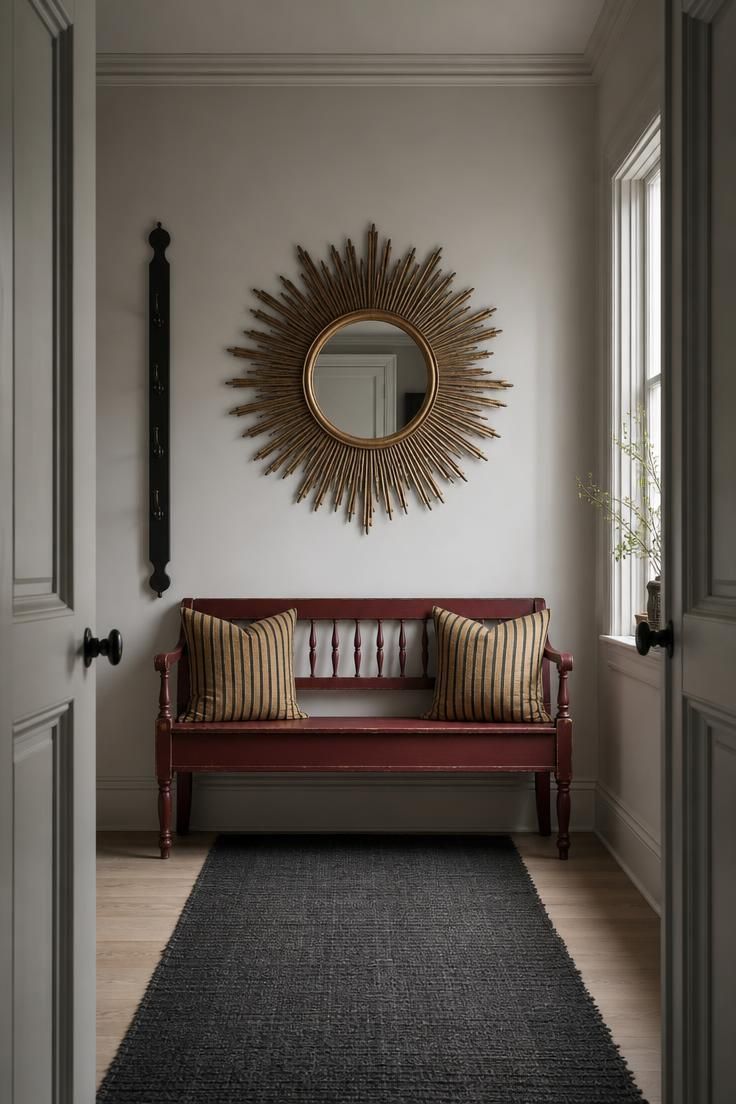
One red bench can command a whole room when surrounded by strict neutrals.
The flat oxblood finish absorbs light, making the red feel deep rather than bright.
A round brass sunburst mirror hung close above the bench creates a strong vertical focal point.
The symmetry of the doorway view gives the small entry hall a formal but relaxed presence.
Yellow-and-black ticking cushions lean against the wall and interrupt the red without adding another saturated color.
Their graphic pattern reads almost as a neutral in this composition.
The charcoal jute runner grounds the scene with a dark, low stripe underfoot.
It gives the eye a place to land before moving upward toward the mirror.
This arrangement is a favorite starting point for boho eclectic style because the vintage bench and brass mirror carry the room without extra furniture.
Style Blueprint:
- Paint the bench in a flat oxblood red with slight distressing at the edges to suggest age.
- Hang an oversized brass sunburst mirror so its lowest ray just clears the bench top by six inches.
- Place two square cushions on the bench in a yellow-and-black ticking stripe, leaning against the wall.
- Add a single tall black vertical coat hook strip to the left of the mirror, painted to disappear into a shadow line.
- Use a narrow charcoal jute runner on the floor to create a neutral, ground-level stripe.
Marbleized Plaster Hearth With Curved Lilac Banquette
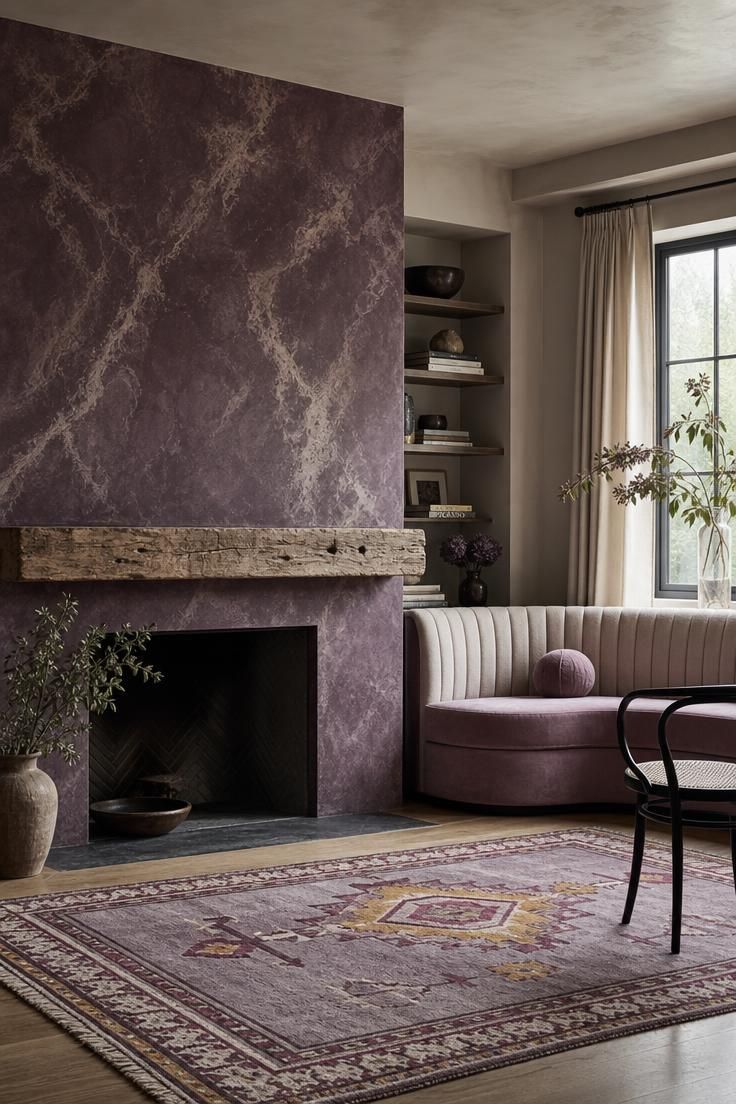
Marbleized plaster in deep aubergine and cream brings movement to the fireplace wall.
The dark value in the veining keeps the lilac banquette from reading as too sweet.
A raw reclaimed beam as a mantel introduces a rough, unfinished edge against the smooth plaster.
That contrast in texture is the quiet glue holding this scene together.
The curved lilac velvet banquette wraps the corner and softens the hard lines of the fireplace.
Its blush tone plays against the dark hearth without competing for attention.
An ebony bentwood chair beside the banquette adds a single sharp black line.
That graphic interruption stops the room from drifting into all-soft pastel territory.
Style Blueprint:
- Trowel a lime-based plaster tinted with aubergine and cream to imitate marble veining on the chimney breast.
- Add a simple raw reclaimed beam as a mantel, left unfinished with visible saw marks.
- Install a curved banquette in blush-lilac velvet with a low back of channel-tufted linen beneath the window.
- Lay a hand-knotted geometric rug with a lilac field but magenta and yellow accents in front of the fireplace.
- Place one ebony-painted bentwood chair beside the banquette, breaking the room’s softness with a graphic black line.
Peacock Blue Lacquered Ceiling Above a Pale Walnut Bed
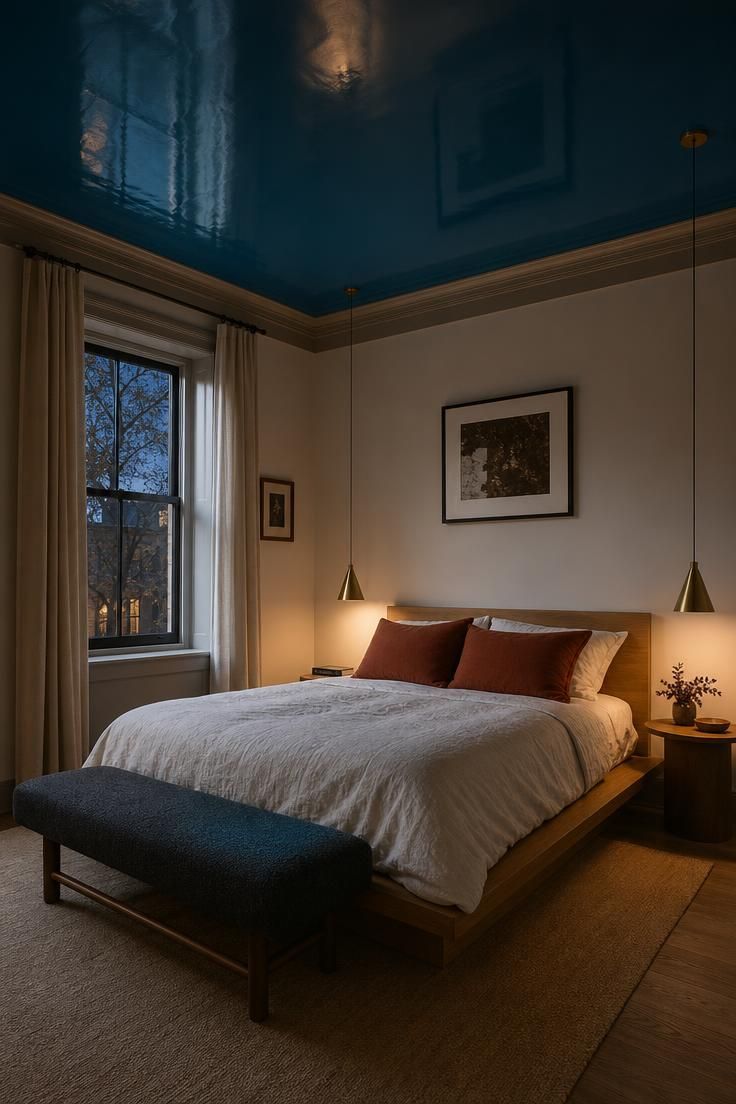
Placing the saturation on the ceiling makes a small bedroom feel taller and more intimate without crowding the walls.
The peacock blue high-gloss finish acts like a canopy of color over the pale walnut bed.
Warm ivory walls keep the lower half of the room calm.
The eye travels upward, so the blue feels like a surprise rather than a constant pressure.
Two small brass pendants hung at different heights beside the bed replace table lamps.
Their warm glow reflects off the glossy ceiling and deepens the blue at night.
A charcoal wool bench at the foot of the bed picks up the subtle blue reflection.
That single dark horizontal piece gives the room a grounding line.
Style Blueprint:
- Lacquer the ceiling in deep peacock blue with a high-gloss finish; keep walls in warm ivory or soft greige.
- Select a pale walnut platform bed with visible grain and minimal profile.
- Use only two pillow shams in a solid rust or terracotta, placed on a white Belgian linen duvet.
- Hang two small brass cone pendants from the blue ceiling at different heights beside the bed, replacing standard table lamps.
- Add a low charcoal wool bench at the foot of the bed to catch the ceiling’s subtle blue reflection.
Design Pro-Tip: In any room with a loud surface or pattern, create one deliberate “visual rest zone”, a plain wall, a solid sofa, or an empty floor area, so the saturated elements can breathe and the eye can pause between clashing moments.
Chartreuse Powder Room Basin on a Travertine Console
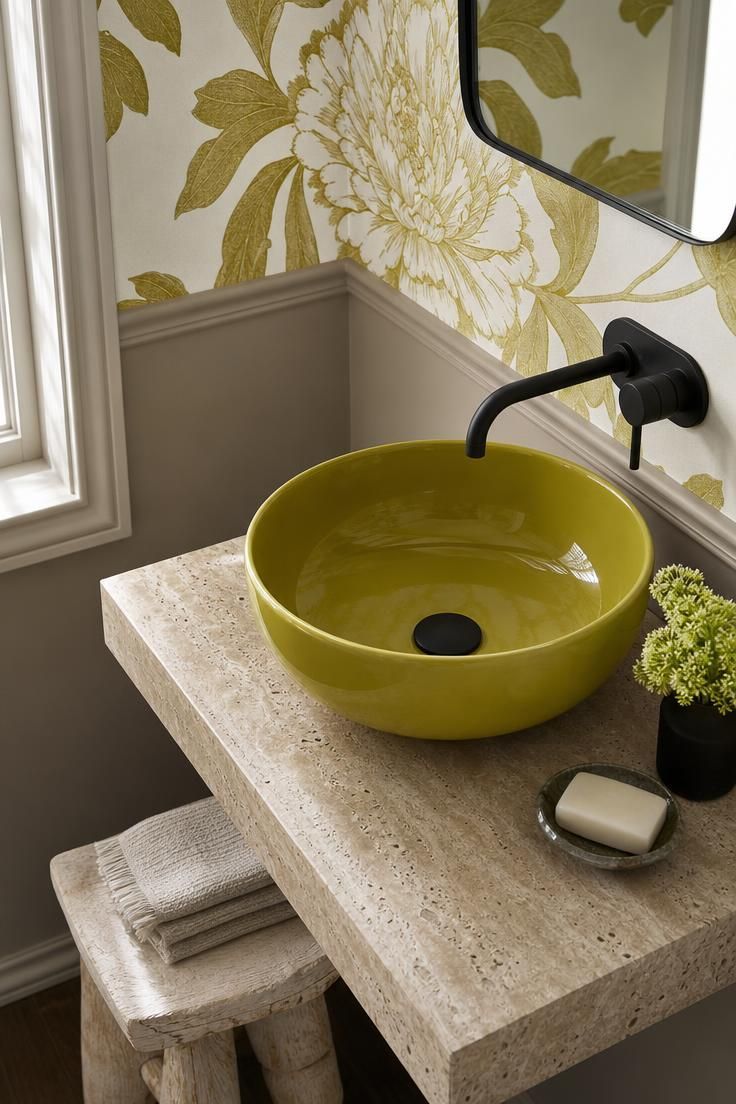
A powder room can handle a high-saturation fixture because the scale is small and the exposure time is brief.
A glossy chartreuse basin on a travertine slab becomes a small sculptural event.
The travertine acts as a neutral pedestal for the ceramic color.
Its matte, pitted surface makes the basin’s gloss feel even more liquid.
Matte black wall-mounted fixtures introduce a crisp industrial note against the warm stone.
The single lever keeps the faucet profile minimal so the basin remains the focus.
An oversized floral wallpaper with a chartreuse leaf behind the basin repeats the accent color without dominating the room.
The lower greige wall keeps the pattern from wrapping the entire space.
This room shows how eclectic wall paint colors can frame a single bold fixture and turn a compact space into a memorable bohemian colorful home moment.
These choices also connect directly to colorful home decor ideas that rely on one saturated piece instead of many competing accents.
Style Blueprint:
- Mount a rectangular travertine slab as a minimalist floating vanity at standard basin height.
- Set an oversized round or oval vessel sink in high-gloss chartreuse ceramic directly on the slab.
- Use a wall-mounted matte black single-lever faucet with the spout reaching over the vessel.
- Paint the lower wall in a warm greige and the upper wall in a single oversized graphic floral wallpaper with a chartreuse leaf.
- Place one low wooden stool in raw birch below the slab to house extra hand towels.
Ochre Corduroy Curtain Wall Dividing a Studio Alcove
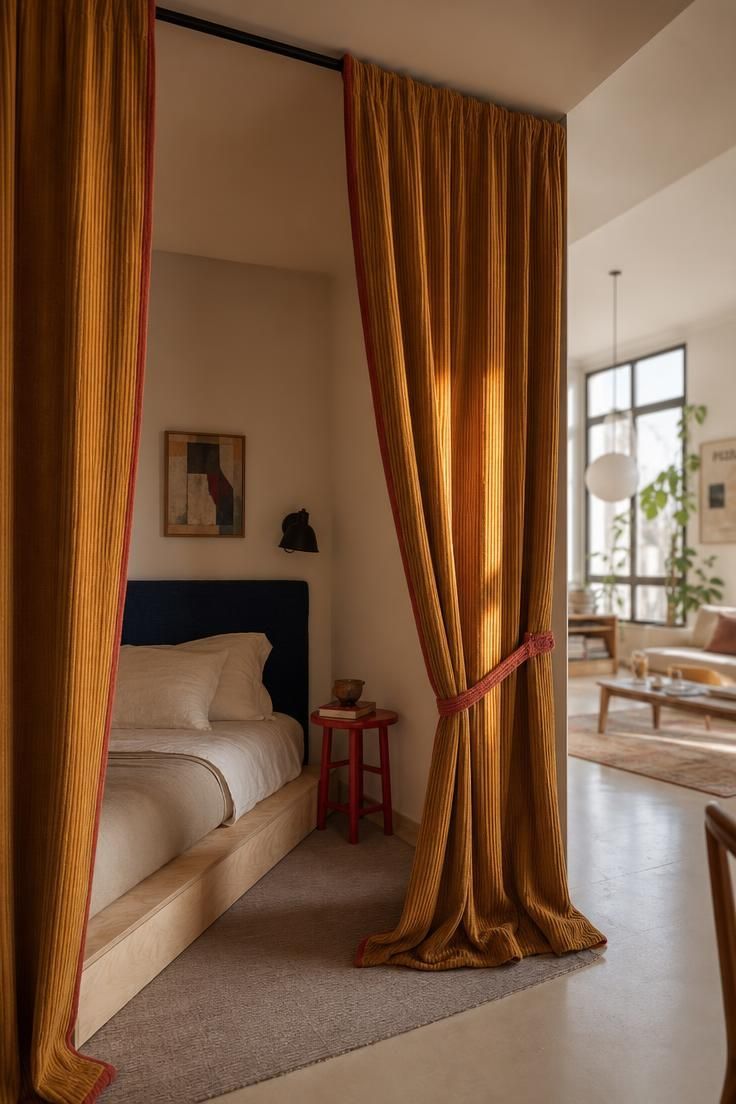
Corduroy catches light differently at every fold, which makes it a far more interesting divider than a flat panel.
The ochre reads warm in direct sun and almost brown in shadow.
A black iron ceiling track keeps the hardware minimal and architectural.
The curtain itself becomes the soft wall, changing the room’s shape without any permanent construction.
Inside the alcove, a deep indigo headboard against the warm ochre creates a strong but calm color pairing.
The red stool as a nightstand adds one small sharp accent that repeats in the curtain tie-backs.
This approach is renter-friendly and easily changed, yet the heavy fabric gives the alcove a real sense of enclosure.
Color mixing in home decor feels low risk here because the ochre and indigo share a muted warmth.
Style Blueprint:
- Hang wide-wale ochre corduroy from a thin black iron ceiling track, extending the track beyond the alcove edges.
- Keep the fabric pooling slightly on the floor to soften the divide and add mass.
- Place a low birch plywood platform bed inside the alcove with a deep indigo linen headboard.
- Use a single red-painted wooden stool as a nightstand, its red repeated in the curtain’s selvedge edge tie-backs.
- Layer a flat taupe cotton rug under the bed to keep the floor calm below the saturated curtain.
Saffron Lacquered Ladder-Back Chair Against a Grid of Vitrine Shelves
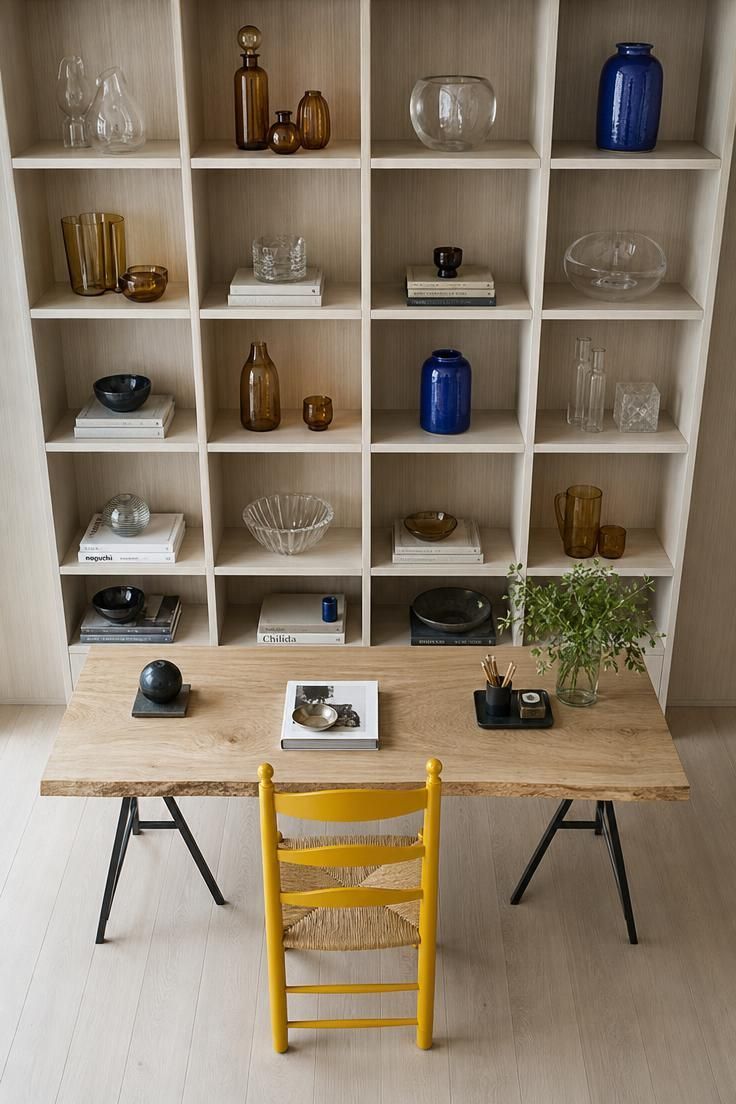
A single lacquered chair in a disciplined grid of pale ash shelves becomes a sculpture.
The strict vertical and horizontal lines of the shelving create a neutral frame for one bright object.
Keeping the rush seat natural warms the saffron and stops the chair from feeling too synthetic.
The contrast between glossy paint and woven rush is a small but important texture shift.
The shelves hold mostly clear and amber glass with one recurring cobalt vase.
That repetition of a single blue object creates a visual pulse without competing with the yellow chair.
Putting nothing else bright yellow in the room except one small ochre line in a textile on the desk keeps the chair as the sole saturated anchor.
Style Blueprint:
- Lacquer a single traditional ladder-back chair in high-gloss saffron yellow, leaving the rush seat natural.
- Install pale ash open shelves in a strict vertical and horizontal grid behind the desk, unpainted and lightly oiled.
- Populate the shelves with mostly clear and amber glass objects and one recurring cobalt ceramic vase.
- Use the desk as a simple white oak slab supported by two black steel trestles.
- Keep nothing else yellow in the small room except a single ochre line in a small framed textile on the desk.
Roughened Plaster Wall in Smoky Teal With a Single Coral Alcove
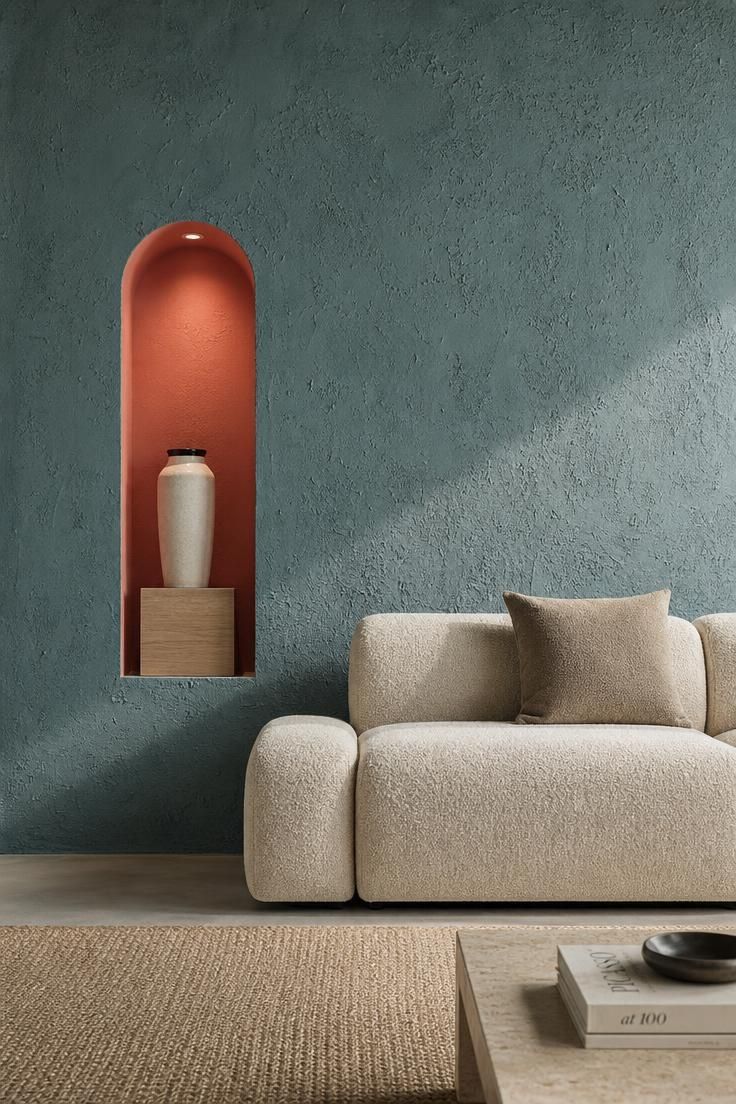
Two saturated but non-adjacent hues on different planes create energy without pattern.
The smoky teal wall and the coral alcove interior speak to each other across a small distance of shadow.
The roughened plaster gives the teal wall a tactile quality that flat paint cannot match.
Skip marks and aggregate catch light unevenly, adding movement to an otherwise still surface.
A simple white oak cube inside the alcove supports one tall stoneware vessel.
Keeping the object count to one lets the coral recess read as a complete composition.
The oatmeal bouclé sofa pulled eight inches forward leaves a shadow line between the furniture and the wall.
That gap prevents the sofa from blending into the teal and gives the room a lighter feel.
Style Blueprint:
- Trowel plaster with visible skip marks and lime aggregate on the main wall, tinted smoky teal; leave the adjacent walls pale putty.
- Paint only the inside of a small arch alcove in flat coral; do not add trim.
- Place a simple white oak cube inside the alcove, supporting a single tall matte stoneware vessel in cream with a black rim.
- Light the alcove with a tiny recessed adjustable spot, creating a warm internal glow on the coral.
- Arrange a low modular sofa in oatmeal bouclé against the teal wall but pulled eight inches forward, so a thin shadow line forms.
Lemon Yellow Rolled-Arm Tuxedo Sofas in a Charcoal Paneled Room
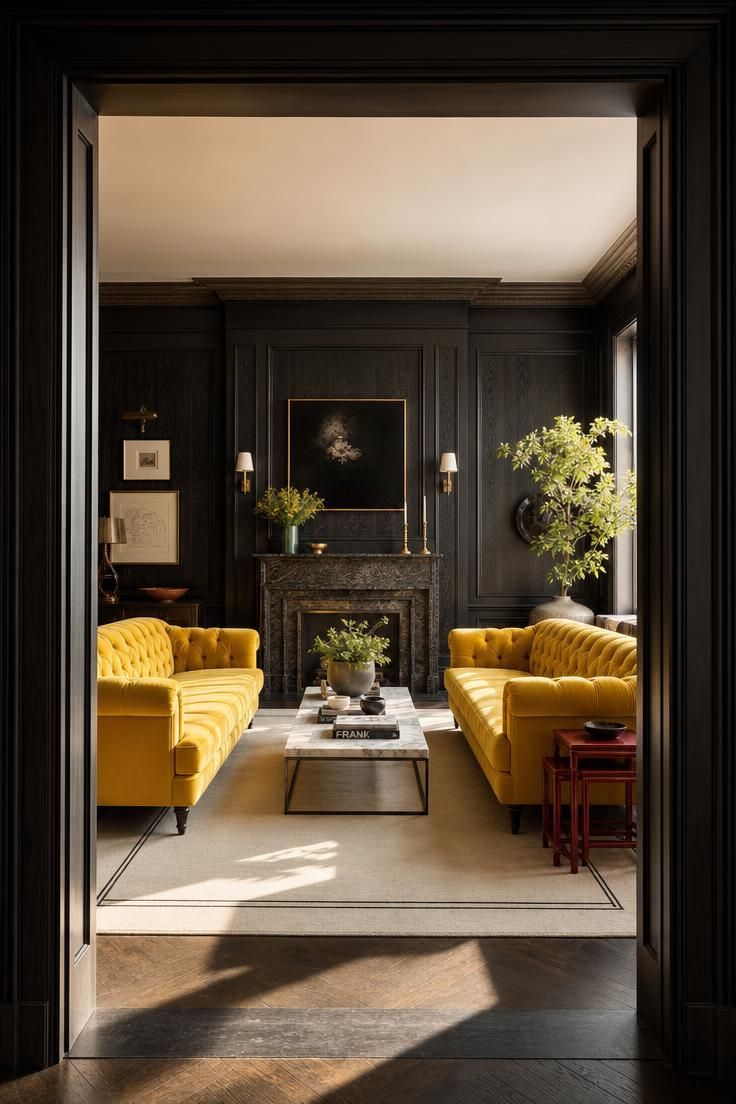
Two identical statement sofas in bright yellow against a dark, static backdrop create symmetry that lets the color feel maximal without chaos.
The charcoal paneling absorbs light and makes the velvet glow.
The white marble coffee table with a blackened steel base sits between the sofas like a cool anchor.
Its veining adds a soft pattern that does not compete with the strong upholstery.
Two red lacquered nesting tables beside one sofa interrupt the yellow-and-charcoal dialogue with a single sharp accent.
Their small scale keeps them from pulling focus away from the main seating.
An ivory rug with a thin black double border gives the floor a clean frame.
It also stops the dark paneling from making the room feel too heavy.
This living room is a clear example of a vibrant living room eclectic palette held together by repetition and dark frames.
The result also reads as a bold patterned home because the paneling, rug border, and tufted upholstery create a layered geometry.
Style Blueprint:
- Upholster two vintage tuxedo sofas in a saturated lemon yellow cotton velvet with button-tufted backs.
- Panel the walls in lightly stained charcoal oak or ash, with the grain still visible under the stain.
- Set a white marble slab with visible veining on a raw blackened steel base as the central table.
- Add two small red lacquered nesting tables beside one sofa to interrupt the yellow-and-charcoal dialogue.
- Lay a low-pile wool rug in warm ivory with a single thin black double border under the entire arrangement.
Design Pro-Tip: To mix clashing patterns successfully, match their scale contrast rather than their motifs, place a large floral next to a small tight geometric, and make sure at least one color appears in both patterns to hold them together.
Unprimed Linen Wall Covering and a Fused-Glass Inset Panel
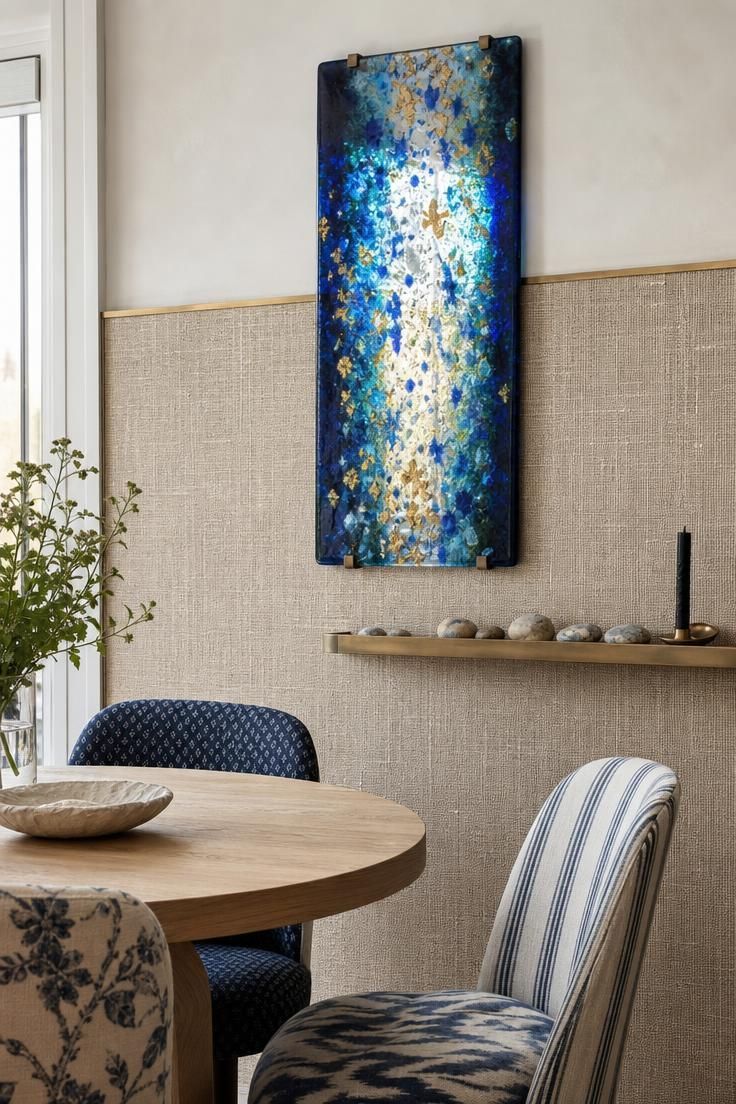
Unprimed natural linen on a wall provides a textured neutral that makes colored glass read as jewelry.
The visible slub in the weave adds an organic roughness under the smooth translucent panel.
A fused-glass panel with cobalt, teal, and gold leaf inclusions acts as a light catcher.
Cool diffuse daylight passing through it changes the dining corner’s mood throughout the day.
The brass edging at the linen seam gives the wall covering a clean, defined finish.
It frames the transition between fabric and plaster without adding another strong color.
Three mismatched chairs sharing a cobalt thread tie the seating to the glass panel above.
The round oak pedestal table stays simple and warm beneath the composition.
With the linen, brass, and glass all working together, this corner also fits the idea of colorful vintage home decor through collected pieces rather than loud pattern.
Style Blueprint:
- Cover the lower two-thirds of the wall in a woven natural linen with visible slub, held by thin brass edging.
- Hang a single rectangular fused-glass panel, dark at the edges and bright with cobalt and gold inclusions, at eye level.
- Place a round white oak pedestal table below the panel, surrounded by three different chairs in mismatched patterns sharing a cobalt thread.
- Run a low picture shelf in raw brass along the linen seam to hold small beach stones and one black candle.
- Keep the floor bare or covered in a thin flat wool rug in warm greige, avoiding further pattern.
Waxed Burgundy Clay-Tile Floor Under a Zinc-Topped Bistro Table
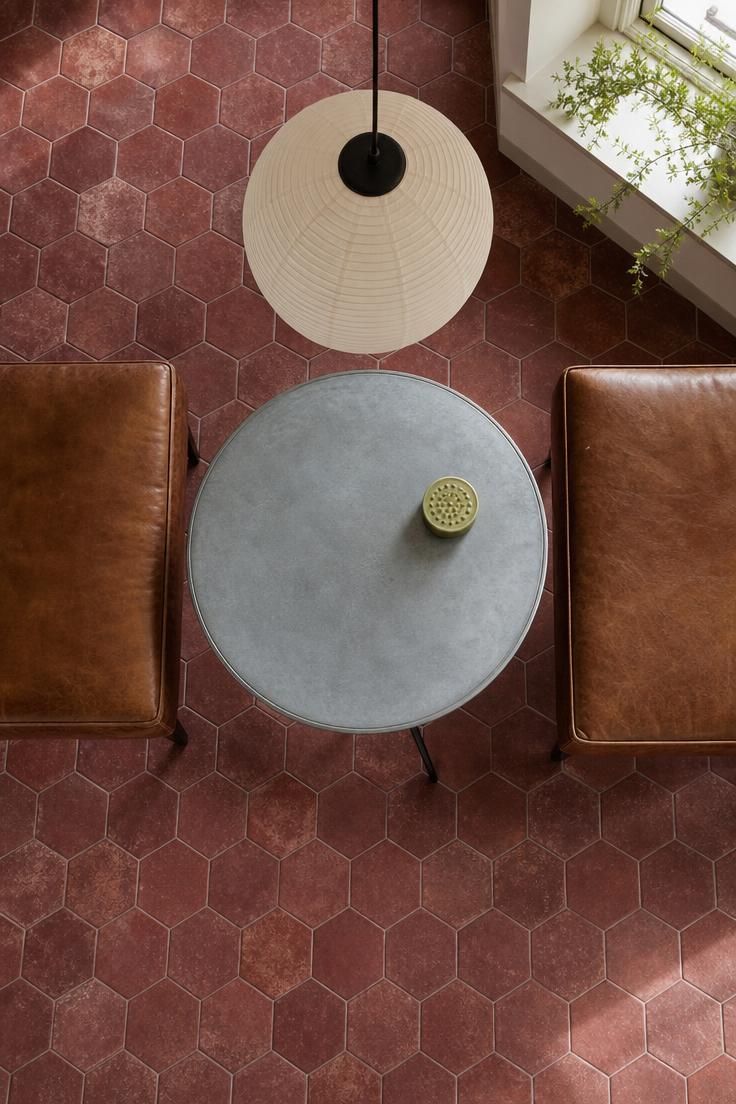
A saturated floor is an underused strategy in eclectic homes.
Waxed burgundy clay tiles absorb light instead of reflecting it, which gives the breakfast nook a soft, leather-like base.
The matte zinc top of the bistro table offers a cool gray contrast to the warm burgundy floor.
Its black steel tripod base disappears visually, so the table feels light above the strong color.
Two low tobacco brown leather benches sit on opposite sides with no pattern or ornament.
Their simple shape lets the tile pattern carry the visual weight.
A cream paper globe pendant hangs low above the table, creating a warm focal point.
The single chartreuse match striker on the tabletop adds one small cold accent against all the warmth.
In this nook, eclectic furniture colorful in mood comes from the floor and small objects more than from the table itself.
Style Blueprint:
- Lay hexagonal or square clay tiles in a mottled burgundy and deep rose, finished with a wax sealer rather than high-gloss for a leather-like sheen.
- Choose a small bistro table with a matte zinc top and a black steel tripod base.
- Arrange two low upholstered benches in a tobacco brown leather, one on each side of the table.
- Add a single cream paper globe pendant above, hanging low enough to create a warm focal point.
- Place one chartreuse stoneware match striker on the table to repeat a cool accent against the warm burgundy floor.
Conclusion
The most joyful colorful eclectic homes treat curation as a visual language, not a storage problem.
Small painted interventions, unexpected material pairs, and deliberate color repetition are enough to turn a mismatched collection into an inevitable whole.
Begin with one wall, one chair, or one painted recess, then let each room’s palette expand through shared hues and contrasting textures.
The goal is not more color; it is color placed with enough restraint to make every loud choice feel like structure.