This post may contain affiliate links. If you make a purchase through these links, we may earn a commission at no additional cost to you.
Vintage fall decor ideas work best when every piece in the room looks like it arrived over decades rather than in a single shopping trip.
The patina on a copper bowl, the faded threads of a hand-stitched quilt, the uneven glaze on old pottery: these are the textures that make autumn feel personal.
Mass-produced seasonal items disappear after November, but a collected room only grows richer each year.
These 15 vintage fall decor ideas pair specific antiques, second-hand finds, and handmade textiles with the muted warmth of the season.
A Tarnished Copper Bowl Filled With Heirloom Squash and Dried Sage
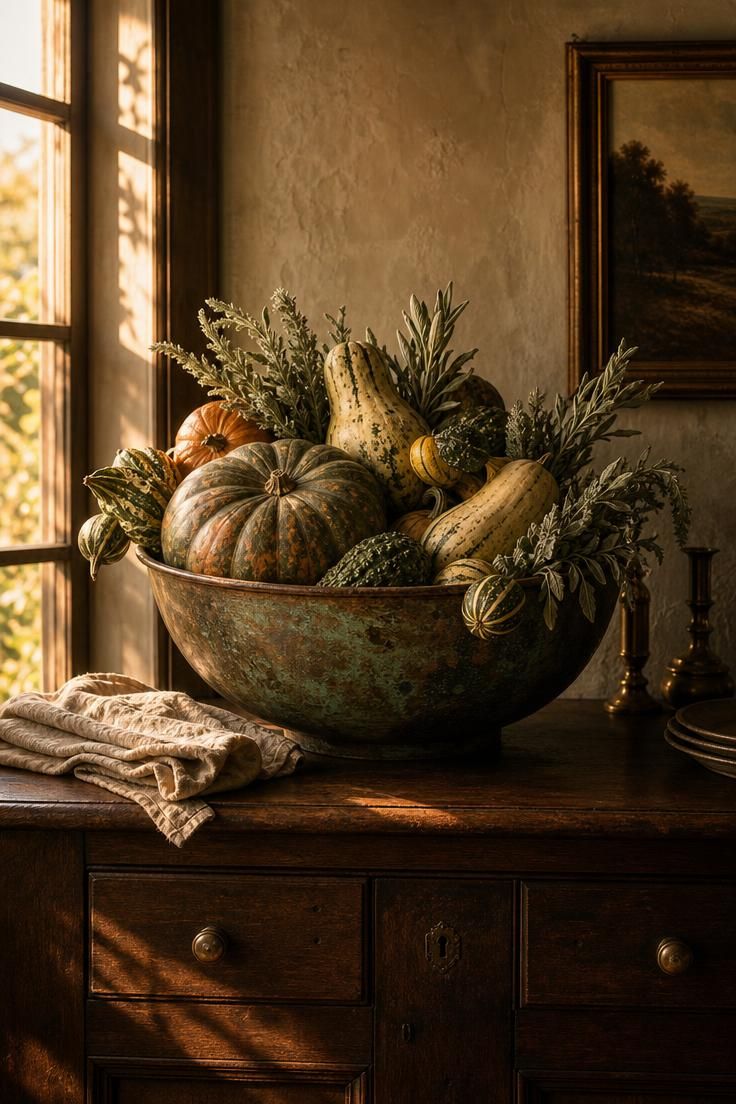
The copper bowl is the kind of piece that disappears into a room for most of the year and then suddenly makes sense in September.
Its patina shifts from reddish-brown to verdigris depending on where it has aged, and those uneven surface tones mirror the color range of the squash inside it.
Heirloom varieties like delicata, acorn, and buttercup bring irregular shapes and color mottling that mass-produced decorations cannot replicate.
Tucking dried sage between the squash adds a layer of scent and texture that lifts the arrangement from static display to something you notice each time you walk past.
This kind of rustic autumn decor works because the container does the heavy lifting: a single antique object with enough character to anchor a room.
The sideboard itself stays bare except for the bowl, so the arrangement reads as intentional rather than cluttered.
Style Blueprint:
- A large copper bowl with visible patina and verdigris tones
- Three to five heirloom squash in mixed shapes and muted colors
- Dried sage bundles tucked between the squash
- A dark wood sideboard or console table cleared of other objects
Stacked Vintage Hardcovers as Risers for Ivory Beeswax Pillars
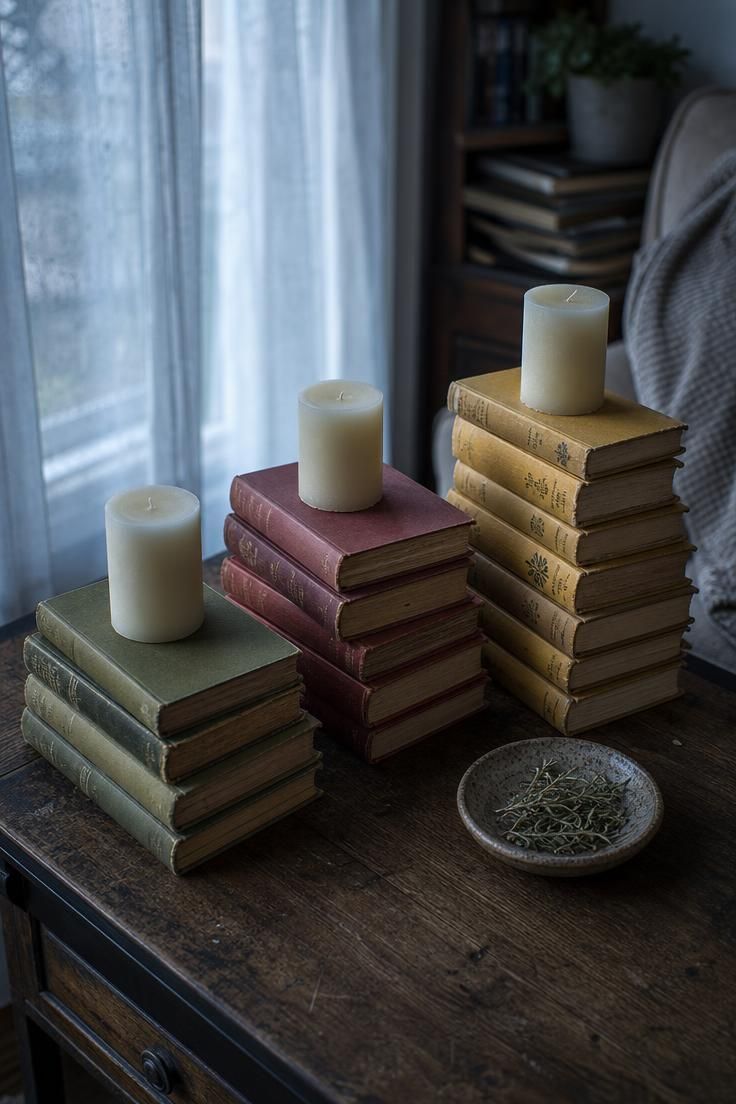
Old books with cloth covers in deep seasonal colors function as a readymade autumn color palette without needing paint or fabric swatches.
The spines themselves become color blocks: olive green beside wine red beside harvest gold, a palette that reads as deliberate even though the books were likely bought separately over years.
Stacking them at different heights creates visual movement on a flat surface, turning a coffee table or nightstand into a layered vignette.
Foxed pages and faded lettering carry the same philosophy as tarnished metal or chipped pottery: the wear is the point.
Beeswax pillars add a warm ivory tone that sits well against the darker book covers without competing for attention.
A stoneware dish or brass trinket tray beside the stacks gives the arrangement a functional edge, as if someone set it down and forgot it there.
The entire setup costs almost nothing at a thrift store and takes minutes to arrange, which makes it one of the most practical antique fall decorations you can try.
Style Blueprint:
- Three to four stacks of vintage hardcovers with cloth covers in olive, burgundy, or mustard
- Ivory beeswax pillar candles for the top of each stack
- A small stoneware dish or brass trinket tray
- A dark wooden coffee table or nightstand as the base surface
A Weathered Wooden Dough Bowl Overflowing With Velvet Pumpkins and Acorns
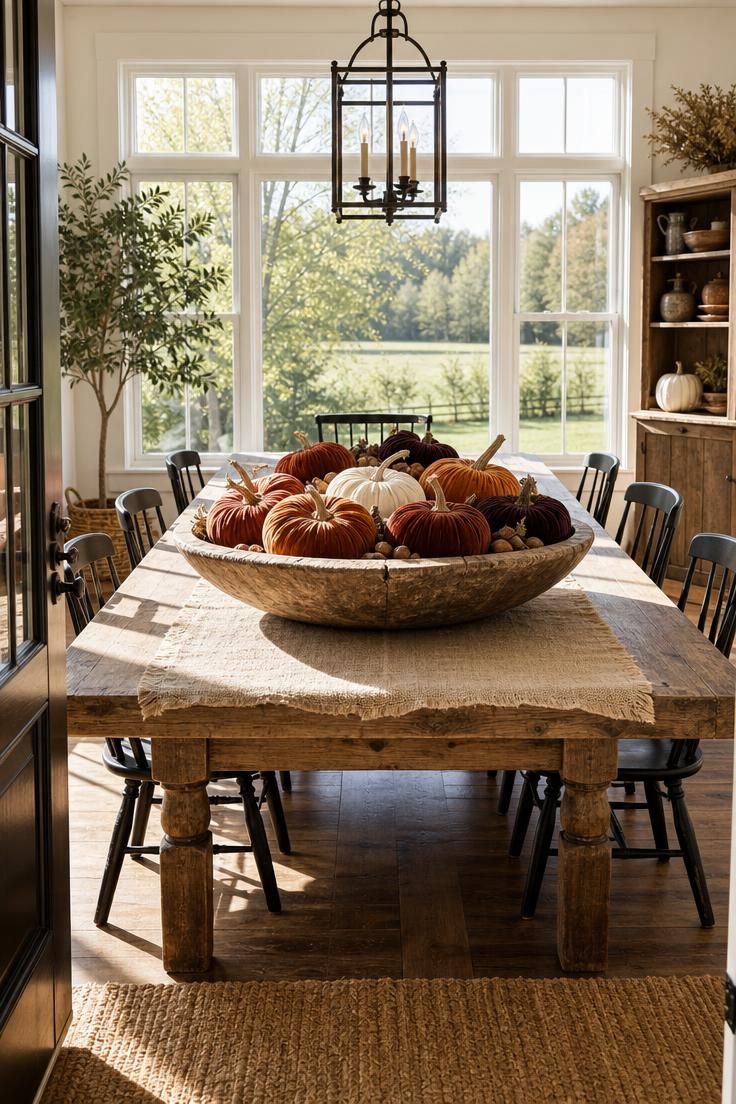
The dough bowl brings a scale and presence that smaller containers cannot match, and its rough, flour-caked surface tells a story that a new wooden tray never will.
Velvet pumpkins sit at the intersection of handmade textile and seasonal shape, and their soft fabric catches light differently than real pumpkins, adding a visual richness to the arrangement.
Mixing real mini pumpkins among the velvet ones creates a dialogue between raw nature and craft that defines the vintage approach.
Acorns scattered around the base of the pumpkins fill the visual gaps and add a layer of natural texture that grounds the softer velvet shapes.
The plum tones among the rust and cream push the autumn color palette past the expected orange-and-brown range into something more complex.
A vintage pumpkin display like this one anchors the center of a table without blocking sightlines across the room, since the bowl’s wide, low profile keeps everything below eye level.
The rough linen runner beneath adds one more texture layer, and its neutral color keeps the focus on the bowl and its contents.
Dough bowls with visible cracks and uneven edges tend to hold the most character, so look for ones that have clearly been used rather than lightly aged reproductions.
Style Blueprint:
- An oversized weathered wooden dough bowl with visible cracks or flour residue
- Handmade velvet pumpkins in rust, cream, and plum
- Natural acorns and a few real mini pumpkins
- A rough linen runner beneath the bowl
- A long farmhouse table as the display surface
A Reclaimed Shutter Leaning Against the Wall With Hung Dried Wreaths
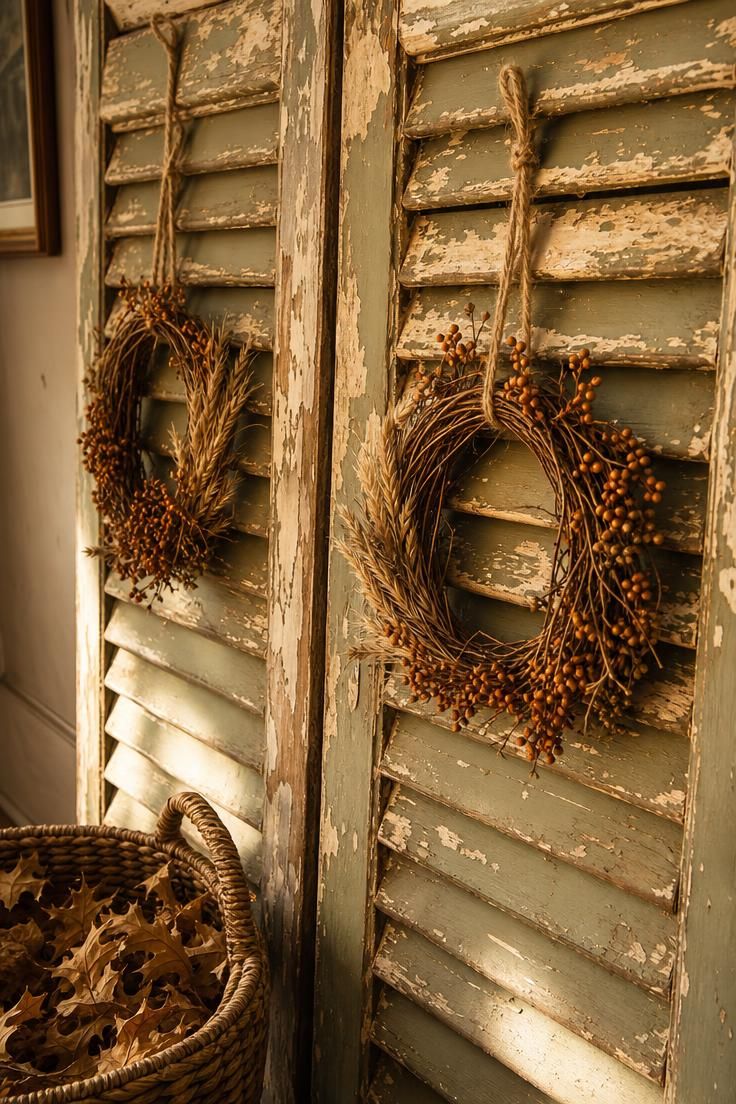
Shutters pulled from old houses carry decades of paint layers and weathering that no reproduction can fake.
Hanging small dried wreaths from the slats turns a salvaged architectural piece into a seasonal display surface without any permanent alteration.
The peeling paint in muted tones, whether sage, cream, or dusty blue, becomes part of the autumn palette rather than a flaw to fix.
This approach to fall porch decor or hallway styling uses vertical space that most seasonal arrangements ignore.
Bittersweet vine and wheat make particularly strong wreath materials because their colors deepen and dry beautifully over the season.
The entire arrangement can lean, move, and shift with the room, making it far more flexible than a wall-mounted piece.
Style Blueprint:
- A pair of old wooden shutters with peeling paint in muted tones
- Small dried wreaths of bittersweet vine and wheat
- Natural jute twine for hanging
- A woven basket at the base for dried leaves
Design Pro-Tip: When layering vintage pieces against a wall, leave at least one inch of space between the wall and the object. The shadow gap creates visual depth that makes even a flat arrangement feel three-dimensional.
Vintage Fall Decor Ideas Inside an Old Six-Pane Window Frame
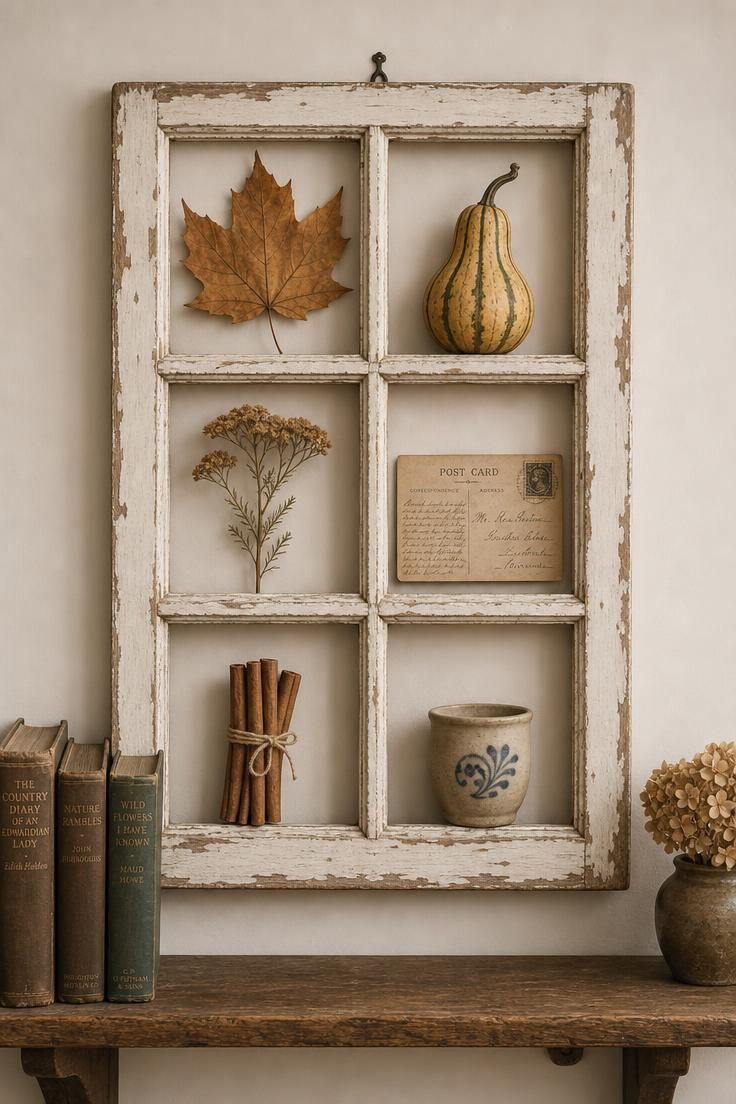
The old window frame works as a grid that gives structure to objects that would look scattered on a shelf.
Each pane opening becomes its own display case, and the visual rhythm of six evenly spaced compartments creates order from a collection of mismatched seasonal items.
A pressed maple leaf beside a vintage postcard beside a bundle of cinnamon sticks: these objects have nothing in common except the season and the frame that holds them.
That is what makes this arrangement more interesting than a standard shelf display, where everything blends into a single line.
The dried yarrow and small gourd add color and organic shape, while the stoneware cup and postcard introduce handmade and paper textures that break the natural-only pattern.
Frames with chipped paint or visible nail holes carry more visual weight than clean, newly distressed ones.
Look for six-pane or nine-pane frames at architectural salvage yards, where they often sit in stacks for a few dollars each.
Wire strung across the back of each opening or small wooden ledges screwed to the frame’s interior create invisible support for the objects without blocking the view.
This is one of those vintage fall decor ideas that costs very little but fills a large wall space with personality.
Style Blueprint:
- A six-pane or nine-pane vintage window frame without glass
- Small autumn objects: pressed leaves, mini gourds, dried yarrow, vintage postcards
- Wire or small wooden ledges inside each pane for support
- A wall hook or picture hanging hardware rated for the frame weight
McCoy Pottery Lined Up on a Rough-Hewn Mantel With Dried Hydrangeas
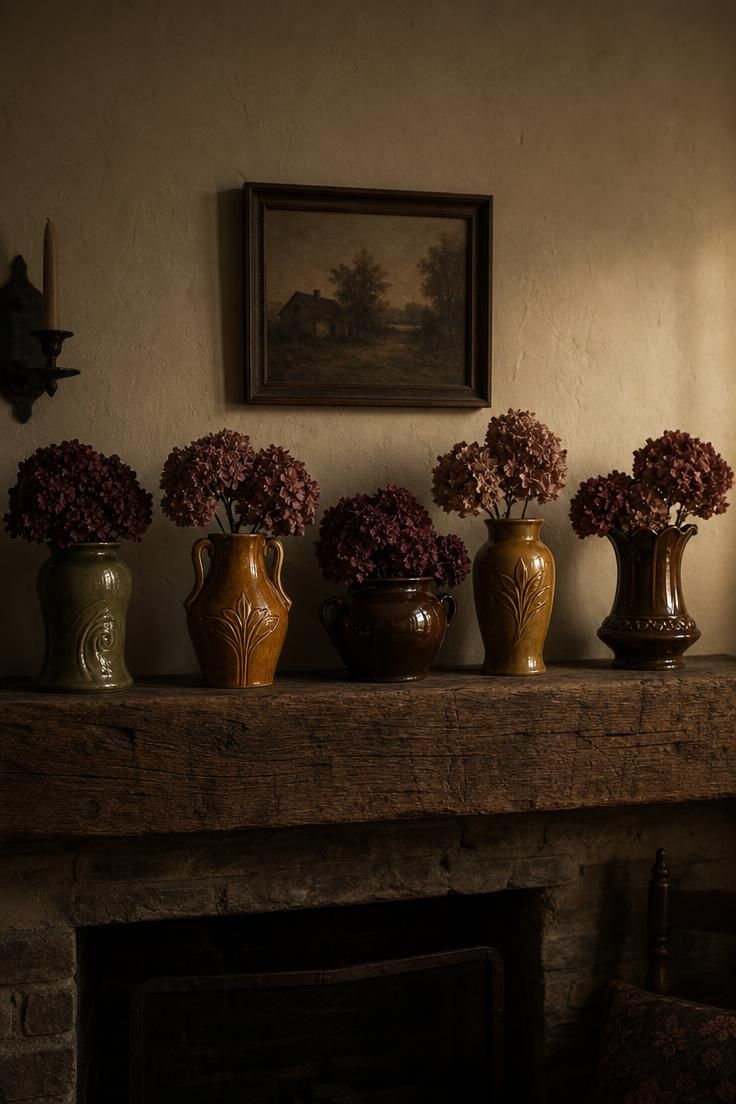
McCoy pottery from the mid-twentieth century comes in a range of earth-toned glazes that feel purpose-made for autumn, even though they were produced as everyday household ceramics.
Lining multiple pieces across a mantel creates a collected look that a single statement vase cannot achieve, and the slight variations in glaze color and shape make each piece distinct.
Dried hydrangeas are one of the few dried flower arrangement options that retain their shape and color depth for months without falling apart.
The burgundy and faded rose tones of the dried heads sit naturally against the olive and mustard glazes, building a color story without any forced coordination.
This is fall mantel styling at its most grounded: no garlands, no letters, no themed accessories, just pottery and dried flowers arranged with enough space between them to breathe.
The rough-hewn mantel surface adds a textural contrast that polished or painted wood cannot provide, and its irregularities give each pottery piece a slightly different resting angle.
Mixing vases, planters, and pitchers from the same pottery line keeps the arrangement cohesive while avoiding the look of a matched set.
Style Blueprint:
- Four to five pieces of McCoy pottery in olive, mustard, and brown glazes
- Dried hydrangea stems in burgundy and faded rose
- A rough-hewn wooden mantel or shelf as the display surface
- Enough spacing between pieces to let each one breathe
A Brass Candelabra Centered on a Raw Linen Runner for a Fall Dinner
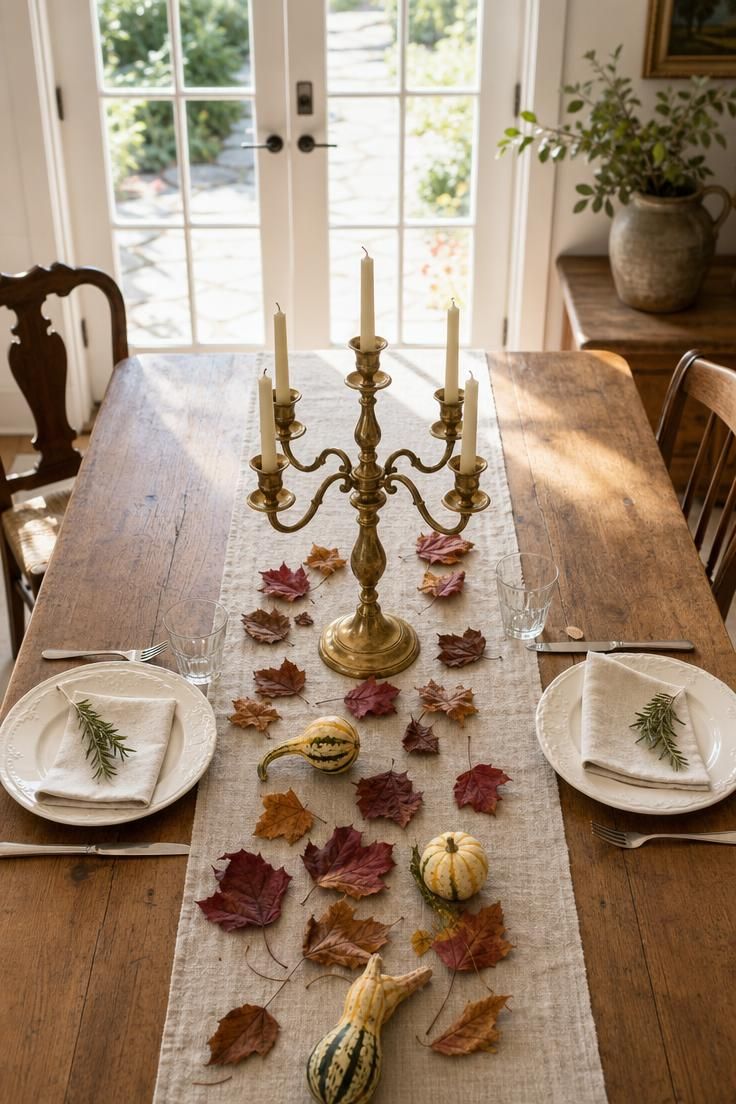
One brass candelabra does the work that an entire scatter of decorations tries to accomplish: it creates a vertical focal point, introduces a metallic warmth, and anchors the table in a single move.
The tarnish on the brass is what separates a vintage piece from a reproduction, and that uneven surface catches light at different angles across each arm.
Scattered dried leaves and small gourds around the base keep the autumn tablescape feeling organic rather than staged, as if the season blew in through an open window.
A raw linen runner in oatmeal or natural flax provides just enough fabric to define the table’s center axis without covering the wood grain beneath it.
Vintage brass accents like this candelabra pair particularly well with ironstone plates, since both materials share a warm, slightly imperfect surface quality.
The overhead camera angle reveals the full table composition at once, showing how the candelabra, runner, leaves, and place settings relate to each other as a single harvest centerpiece.
A casual Sunday lunch atmosphere comes from leaving gaps in the arrangement, so the table never feels overloaded or precious.
Keep the gourds small and irregularly shaped, since large, uniform pumpkins shift the mood from collected vintage to seasonal retail display.
Style Blueprint:
- A five-arm brass candelabra with visible tarnish
- A raw linen runner in oatmeal or natural flax
- Small striped gourds and dried leaves in rust and burgundy
- Ironstone plates and linen napkins for the place settings
- Beeswax taper candles in cream or ivory
Clusters of Amber Apothecary Bottles on a Reclaimed Wood Console
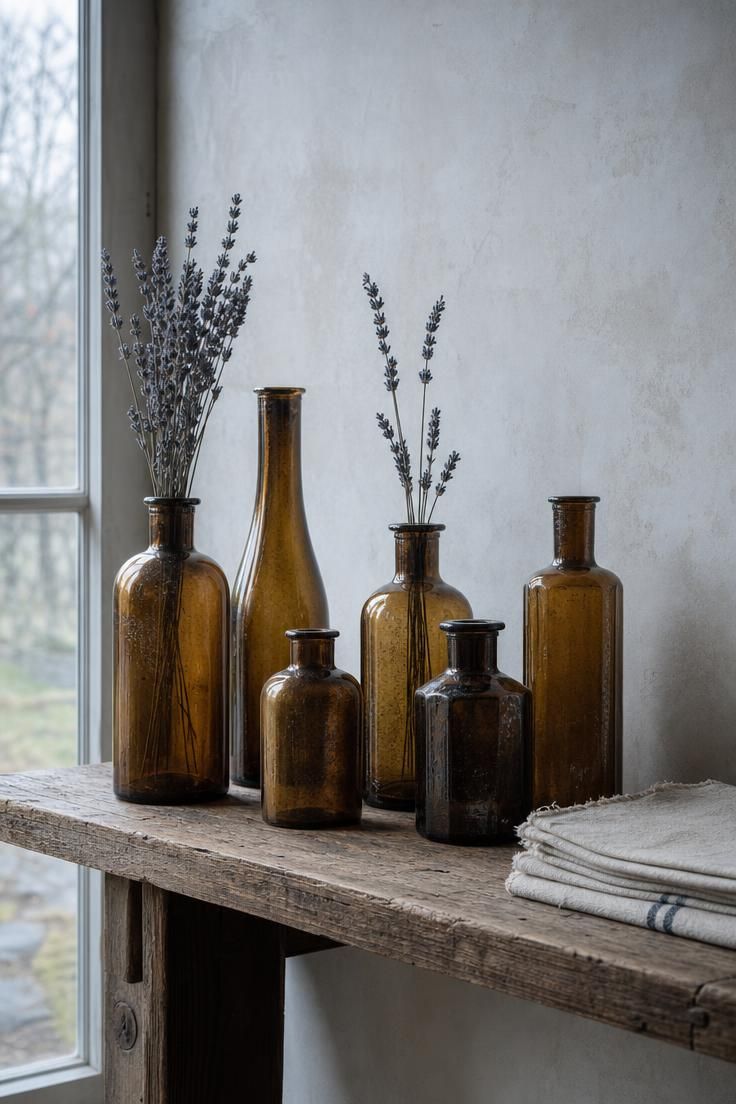
Apothecary bottles in brown-tinted glass have a translucency that solid ceramics and metals lack, and that quality makes them particularly responsive to whatever light fills the room.
On an overcast morning, the glass takes on a cooler tone, and on a bright afternoon, the same bottle glows from within.
Clustering five to seven bottles at staggered heights creates a skyline effect on a narrow console, filling vertical space without spreading across the surface.
Leaving some bottles empty and placing single dried stems in others builds a rhythm of full and void that feels more natural than filling every vessel.
The reclaimed wood surface of the console adds a roughness beneath the smooth glass that keeps the arrangement from looking like a store display.
Style Blueprint:
- Five to seven apothecary bottles in varying heights and brown-tinted glass
- A few single stems of dried lavender or wheat
- A narrow reclaimed wood console table
- A small stack of old linen napkins as a side accent
Design Pro-Tip: When arranging a collection of vintage glass, group the pieces in odd numbers and vary the spacing between them. Three bottles close together beside two with more room between them creates a visual rhythm that even numbers and uniform spacing cannot.
A Faded Cross-Stitch Sampler Hung Above a Row of Stoneware Crocks
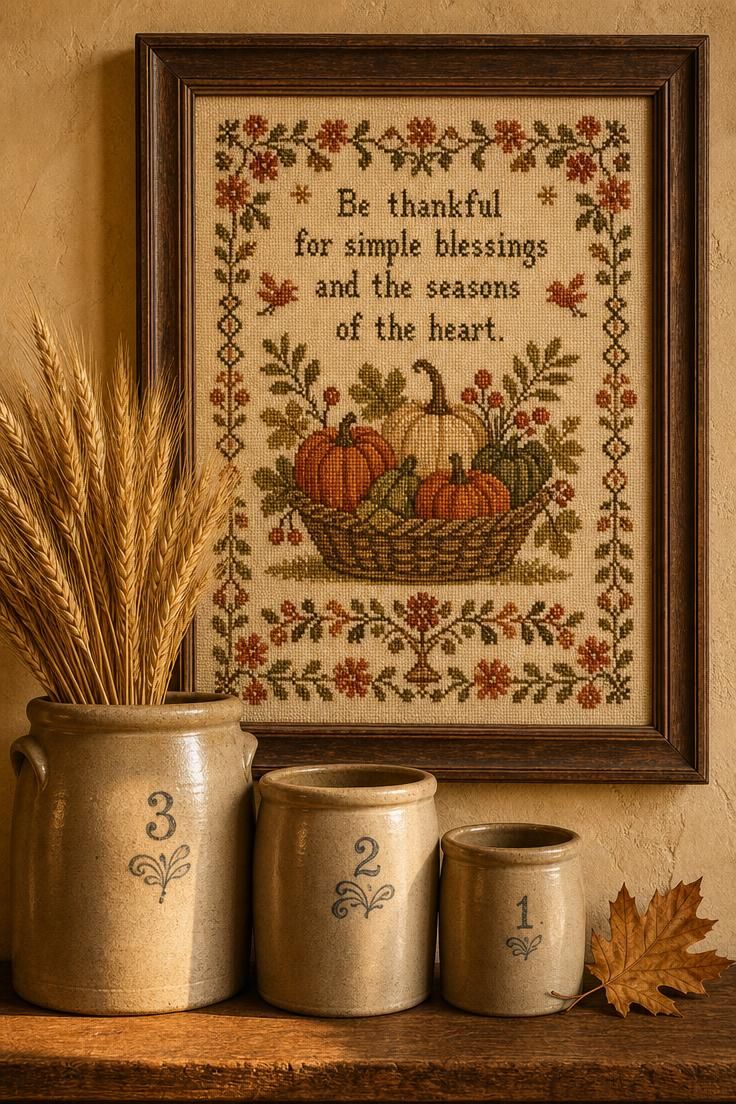
Cross-stitch samplers carry the hand of the person who made them in every stitch, and a faded one with slightly uneven lettering or off-center motifs tells a more compelling story than a pristine reproduction.
The autumn harvest basket motif connects the sampler to the season without relying on generic fall symbols like leaf garlands or pumpkin cutouts.
Hanging it above a row of stoneware crocks builds a vertical composition where the handmade textile conversation continues downward into the handmade ceramic.
Stoneware crocks from the nineteenth and early twentieth centuries were kitchen staples, and their heavy, salt-glazed surfaces ground the lighter sampler above them.
Placing a bundle of dried wheat in the largest crock adds a seasonal element that links the display to the harvest theme without overloading the arrangement.
The graduated sizing of the three crocks, large to small, creates a natural visual flow that guides the eye across the shelf.
A single dried oak leaf beside the smallest crock is the kind of small, considered touch that makes a vintage arrangement feel lived-in rather than decorated.
Style Blueprint:
- A framed cross-stitch sampler with an autumn harvest motif
- Three stoneware crocks in graduated sizes
- A bundle of dried wheat for the largest crock
- A wooden wall shelf sturdy enough to hold the crocks
- A dried oak leaf or acorn as a finishing accent
Vintage Brass Candlesticks at Staggered Heights Down a Farmhouse Table
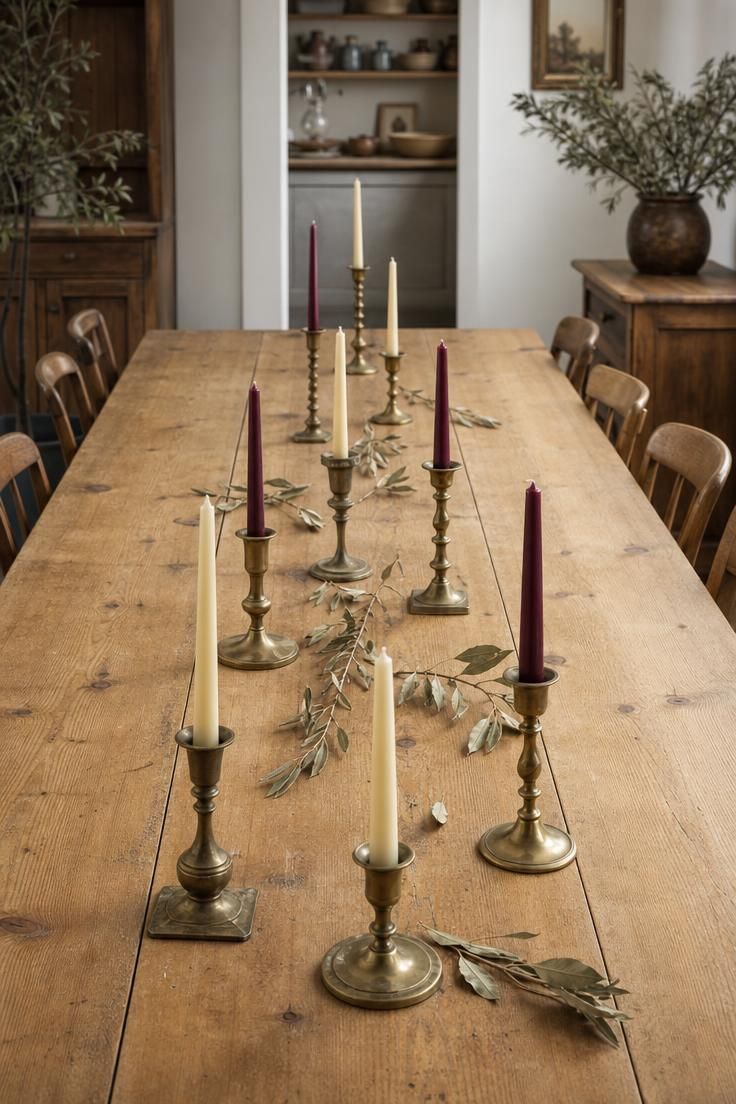
Mismatched brass candlesticks collected from different decades and different makers create a visual rhythm that a matched set cannot produce.
The height variation, from a squat four-inch holder to a tall twelve-inch column, builds a landscape down the center of the table that draws the eye along its full length.
Some pieces will be brightly polished, others nearly black with tarnish, and that range of surface finish adds depth to what would otherwise be a single-material display.
Cream and burgundy tapers continue the autumn color palette without introducing any new materials, keeping the table composition focused on brass and fabric.
Dried bay laurel branches scattered between the holders add a green, aromatic note that softens the metallic dominance and introduces an organic irregularity.
This arrangement works as both a daily table centerpiece and a more formal autumn tablescape, depending on whether you set plates around it or leave the table bare.
The farmhouse pine surface, with its knots and grain variations, provides a warm, imperfect base that complements the imperfect brass above it.
Seven or eight candlesticks might sound like a lot, but at staggered heights, they occupy the center without blocking conversation across the table.
Each candlestick comes with its own history, and part of the pleasure of this arrangement is knowing that no two pieces on the table share an origin.
Style Blueprint:
- Seven to eight mismatched vintage brass candlesticks in varying heights
- Slim taper candles in cream and burgundy
- Dried bay laurel branches for scattering between the holders
- A long pine farmhouse table with visible wood grain
A Cast Iron Kettle Beside Pine Cones and Cinnamon Sticks on a Stone Hearth
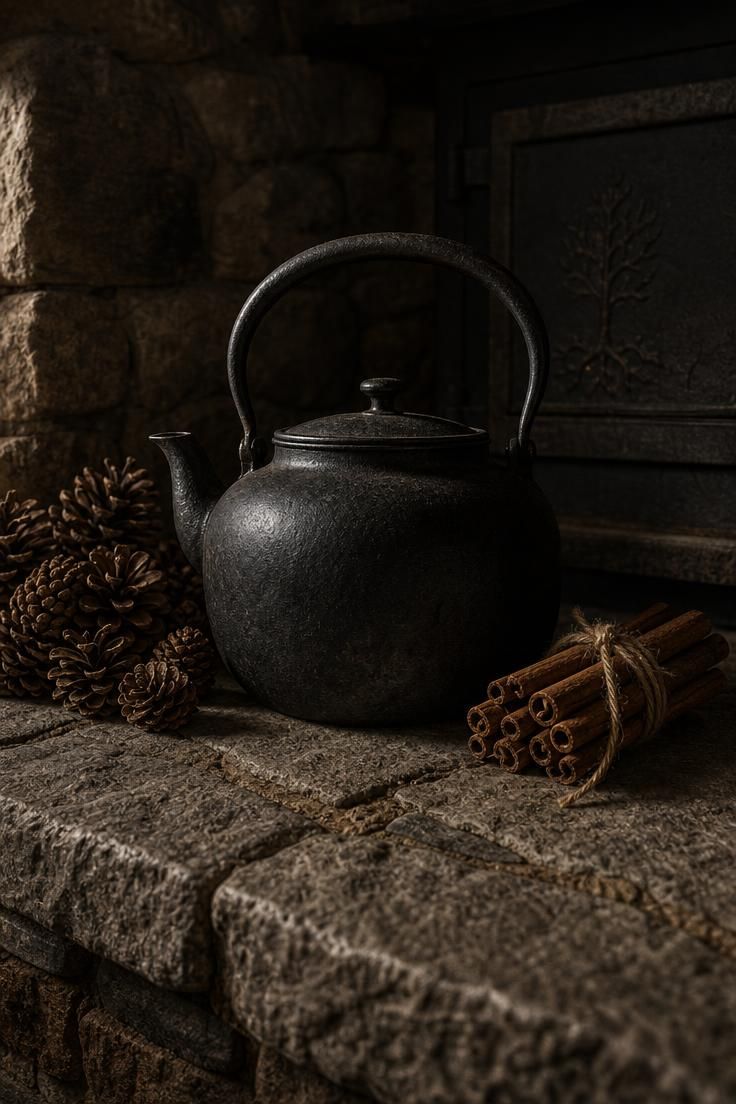
Cast iron carries a weight and darkness that lighter materials cannot replicate, and on a stone hearth, that heaviness feels correct.
The kettle’s curved handle creates the only arc in a scene otherwise dominated by the horizontal plane of the hearth, making it a natural focal point without any effort.
Pine cones gathered from the yard and cinnamon sticks from the pantry are the kind of no-cost seasonal materials that connect a room to the season without any retail involvement.
The jute twine binding the cinnamon sticks adds a handmade quality that reinforces the old-world character of the iron and stone.
Moody, low light is the right atmosphere for this kind of arrangement, since bright light would flatten the shadows that give the scene its depth and drama.
This hearth vignette works as a grounding counterweight to brighter, more colorful vintage fall decor ideas elsewhere in the room.
Style Blueprint:
- An old black cast iron kettle with a curved handle
- A pile of pine cones gathered from the yard
- A bundle of cinnamon sticks tied with jute twine
- A stone hearth or fireplace surround as the display surface
An Ironstone Pitcher Beside a Cutting Board With Dried Thistle Stems
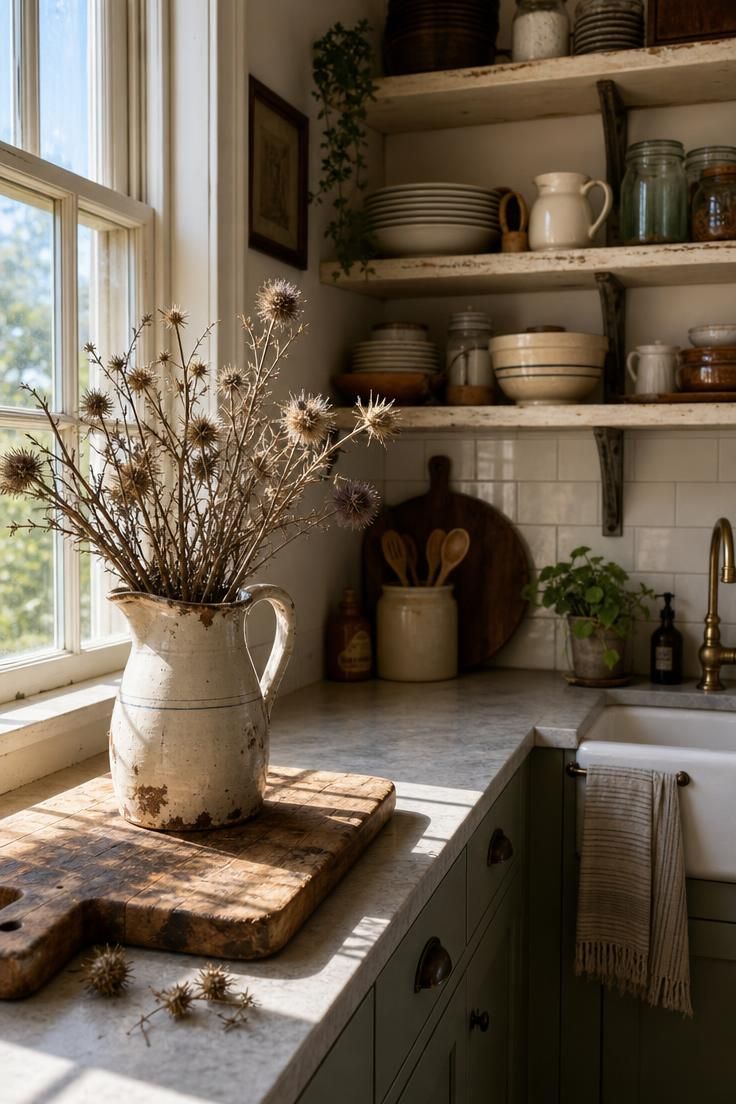
The chipped ironstone pitcher has a presence that newer ceramic vessels lack, and that chip or hairline crack marks it as something that has lived through actual use.
Dried thistle stems hold a sculptural quality that softer dried flowers do not, with their stiff branching forms and textured seed heads creating angular shapes inside the pitcher.
Setting the pitcher on a vintage cutting board layers two functional antiques together, and the knife marks and dark staining on the board’s surface tell their own story of decades in a working kitchen.
This is the kind of dried flower arrangement that belongs in a kitchen because it does not look out of place beside a sink or a stovetop.
A few loose thistle heads scattered on the counter suggest that the arrangement is a living part of the room rather than a staged display.
The bright midday light pouring through the window turns the white ironstone surface into the brightest object in the frame, giving it a natural prominence.
Ironstone pitchers from the late nineteenth and early twentieth centuries are still widely available at flea markets and antique malls, often for a few dollars.
Their thick walls and heavy bases make them sturdy enough for daily kitchen use, which means they can rotate between holding flowers in fall and pouring cream in summer.
Style Blueprint:
- A chipped ironstone pitcher from the nineteenth or early twentieth century
- Dried thistle stems and a few seed pod branches
- A vintage cutting board with visible knife marks and staining
- A kitchen counter near a window for natural light
Design Pro-Tip: Pair antique objects with other antique objects rather than mixing them with brand-new accessories. A vintage pitcher on a vintage cutting board reads as collected and real. The same pitcher on a slick marble tray reads as styled and self-conscious.
Vintage Fall Decor Ideas in a Crocheted Afghan on a Spindle-Back Chair
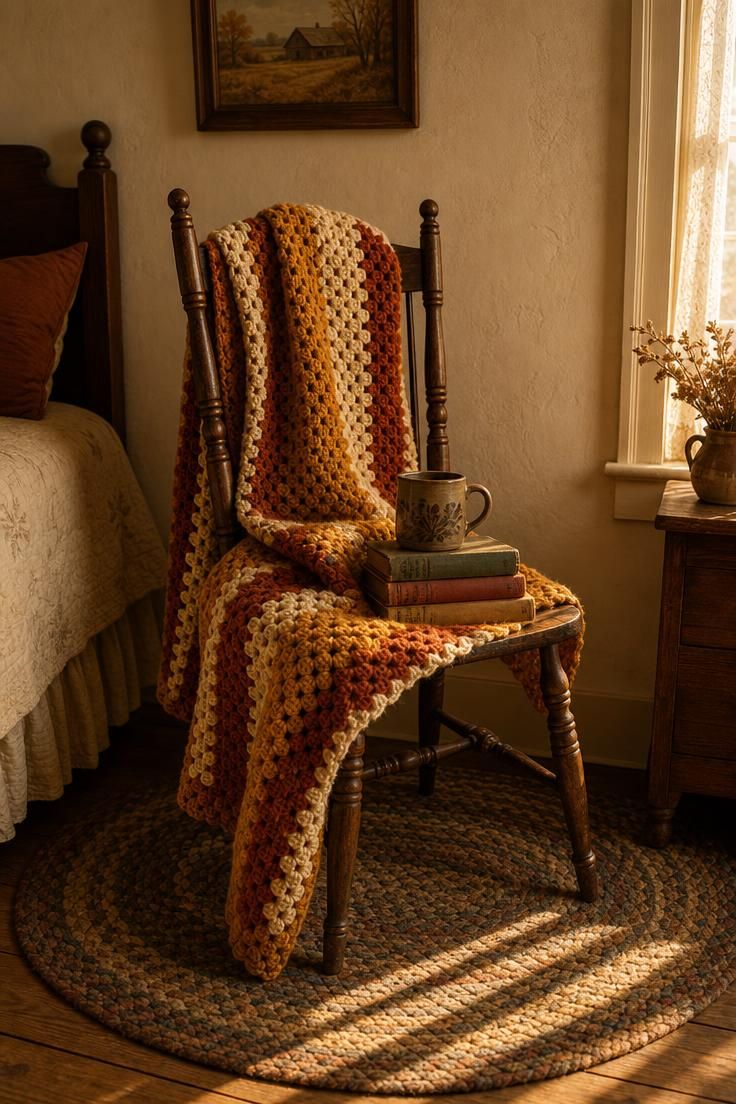
The crocheted afghan is one of those objects that carries a specific person’s handwork in every stitch, and its value as fall decor has nothing to do with its retail price.
Harvest gold, rust, and cream are the most common vintage afghan colors from the 1960s and 1970s, and those tones happen to sit perfectly within an autumn palette.
Draping it over a dark-stained spindle-back chair creates a contrast between the soft, looping yarn texture and the rigid, turned wood spindles that makes both materials more interesting.
A small stack of old books and a pottery mug on the chair seat beneath the afghan fold suggests that someone was just sitting there, reading, and stepped away.
That suggestion of recent use is what separates a room that feels lived-in from one that feels arranged.
The spindle-back chair itself is a common thrift store and estate sale find, often priced low because it does not match any current dining set.
Used as a standalone bedroom or hallway accent, it gains the kind of importance it never had at a table.
Style Blueprint:
- A hand-crocheted afghan in harvest gold, rust, and cream
- A dark-stained wooden spindle-back chair
- A small stack of old cloth-bound books and a pottery mug
- A braided wool rug beneath the chair
Vintage Flour Sack Towels Draped on a Wrought Iron Pot Rack
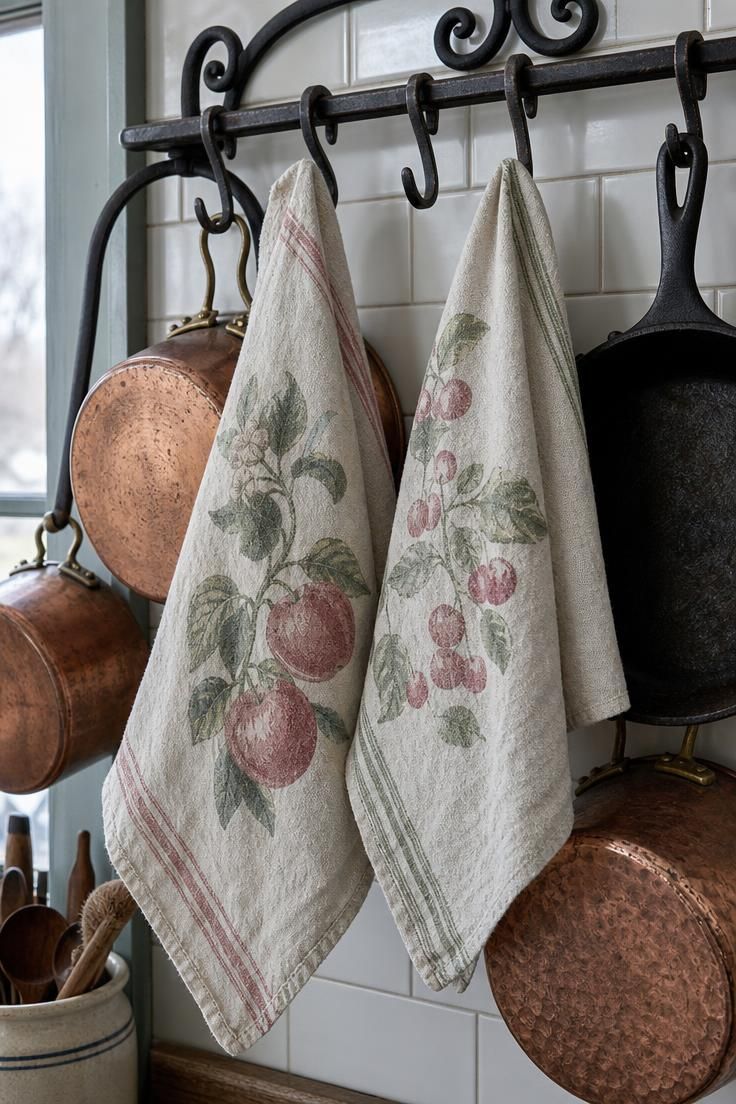
Flour sack towels printed with fruit, botanical, or wheat illustrations were kitchen staples through the early and mid-twentieth century, and their faded prints carry a seasonal charm that new seasonal towels cannot match.
The muted reds and greens of old fruit-motif prints sit comfortably within a fall kitchen palette without screaming “autumn” the way an orange towel with printed leaves would.
Hanging them from a wrought iron pot rack alongside copper pots and cast iron creates a functional display where the textiles become part of the kitchen’s working landscape.
This is practical vintage decor that does not require any extra wall space, shelf room, or surface area to achieve its effect.
The cool overcast light brings out the blue undertones in the wrought iron and the soft patina on the copper, tying the metals together visually.
Flour sack towels are among the most affordable antique fall decorations at flea markets, often bundled in stacks for a few dollars.
Style Blueprint:
- Two to three printed flour sack towels with faded botanical or fruit motifs
- A wrought iron pot rack mounted on a kitchen wall
- Copper pots and a cast iron skillet to hang alongside the towels
- A white subway tile or beadboard wall as the backdrop
A Depression Glass Collection in Olive and Ochre on an Open Kitchen Shelf
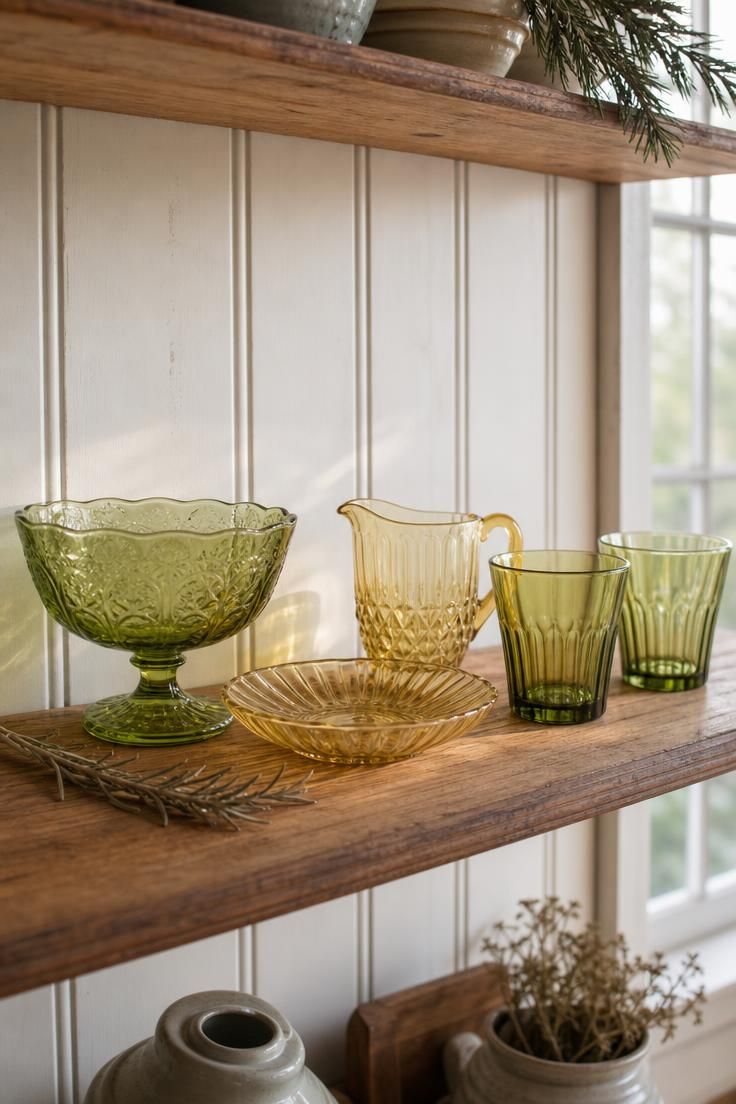
Depression glass in olive and ochre introduces the autumn color palette through transparency rather than through solid pigment, and that quality makes the collection responsive to whatever light fills the kitchen.
On a bright day, the glass glows from within, casting colored shadows on the shelf behind it.
On a dim afternoon, the same pieces recede into deeper, moodier tones that feel appropriate for the shortened days of fall.
Mixing patterns within a single color family, hobnail beside ribbed beside floral pressed, adds visual texture without disrupting the color story.
A footed bowl, a creamer, and a few tumblers represent the most common surviving Depression glass forms, all widely available at antique shops and online vintage sellers.
The open kitchen shelf is the right display surface for translucent glass because it allows light to reach the pieces from behind, which a closed cabinet blocks entirely.
A dried sprig of rosemary beside the glass is a minimal seasonal touch that connects the display to the kitchen’s function without adding visual clutter.
This kind of open-shelf arrangement works particularly well as a complement to heavier vintage fall decor ideas in other rooms, offering a lighter, more delicate counterpoint.
Style Blueprint:
- Four to six Depression glass pieces in olive green and pale ochre
- An open wooden kitchen shelf with enough depth for the pieces
- A white beadboard or plaster wall behind the shelf for contrast
- A dried sprig of rosemary or thyme as a minimal seasonal touch
Conclusion
These 15 vintage fall decor ideas share a single principle: the best autumn rooms are built from objects that already carry their own stories.
A tarnished copper bowl or a crocheted afghan does not need a seasonal theme to feel right in October, it just needs the context of dried flowers, warm light, and earthy tones to click into place.
The work of vintage fall decorating is mostly done before you start arranging, in the months and years of collecting pieces that caught your eye at estate sales, thrift stores, and family attics.
Once those pieces are in your home, the season simply gives you a reason to bring them forward.