This post may contain affiliate links. If you make a purchase through these links, we may earn a commission at no additional cost to you.
A holiday table for two, three, or four people can still feel generous and layered.
The trick is to let the decorations share the limited surface with the food instead of fighting for it.
Height, perimeter placement, and pieces that also serve a purpose keep the setting from feeling crowded.
Natural textures and a narrow color range help the whole arrangement read as calm and deliberate.
Each direction ahead pairs a specific visual look with a note on what happens when the turkey lands.
Single Off-Center Branch Arrangement in a Narrow Ceramic Vase
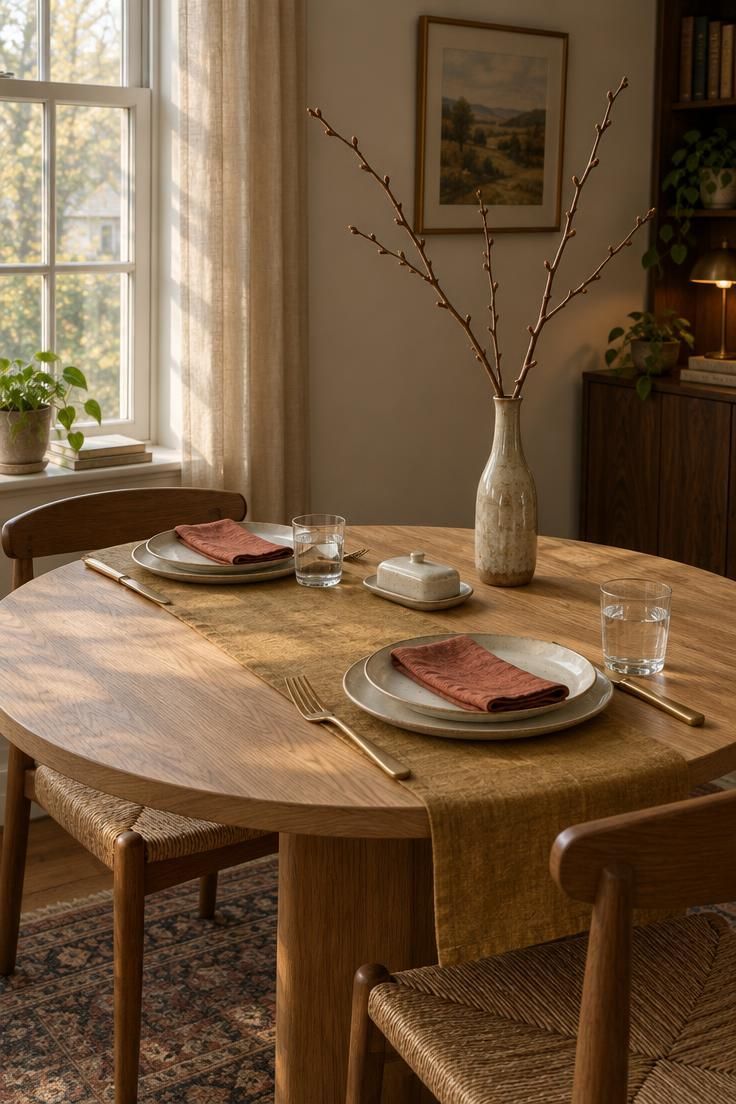
A slender cylinder of glazed stoneware, a few bare maple or oak branches, and a corner of a small table are all this look needs.
The vase sits just off center toward the back corner, so the vertical line rises into air rather than across the tabletop.
A branch or two left with dried leaves in a faded tan picks up the color of a linen runner.
Placement does the heavy lifting here.
A two-person or small square table benefits most, since the arrangement gives the center to plates and a small bowl of butter.
Push the vase slightly toward the back corner and no one’s view crosses a tangle of twigs.
For a table seating four, a slimmer vessel and taller branches keep sightlines open.
On a small thanksgiving table decor scheme like this, one strong vertical element can carry the whole setting.
The tradeoff is fragility: bare branches shed small bits onto the table, and a vase with a narrow base can tip against a passing sleeve.
A weighted, slightly wider foot helps it stand its ground without taking more surface.
Clear-away time runs under thirty seconds.
Lift the vase to a sideboard or window ledge as the serving dishes arrive, then set it back once the plates are cleared.
Style Blueprint:
- A slim glazed stoneware cylinder vase with a weighted foot
- Three bare branched stems, two left with dried tan leaves
- An ochre linen runner kept narrower than the table width
- Brushed brass flatware and cream stoneware for contrast
Narrow Burlap Runner with Scattered Amber Glass Votives and Nuts
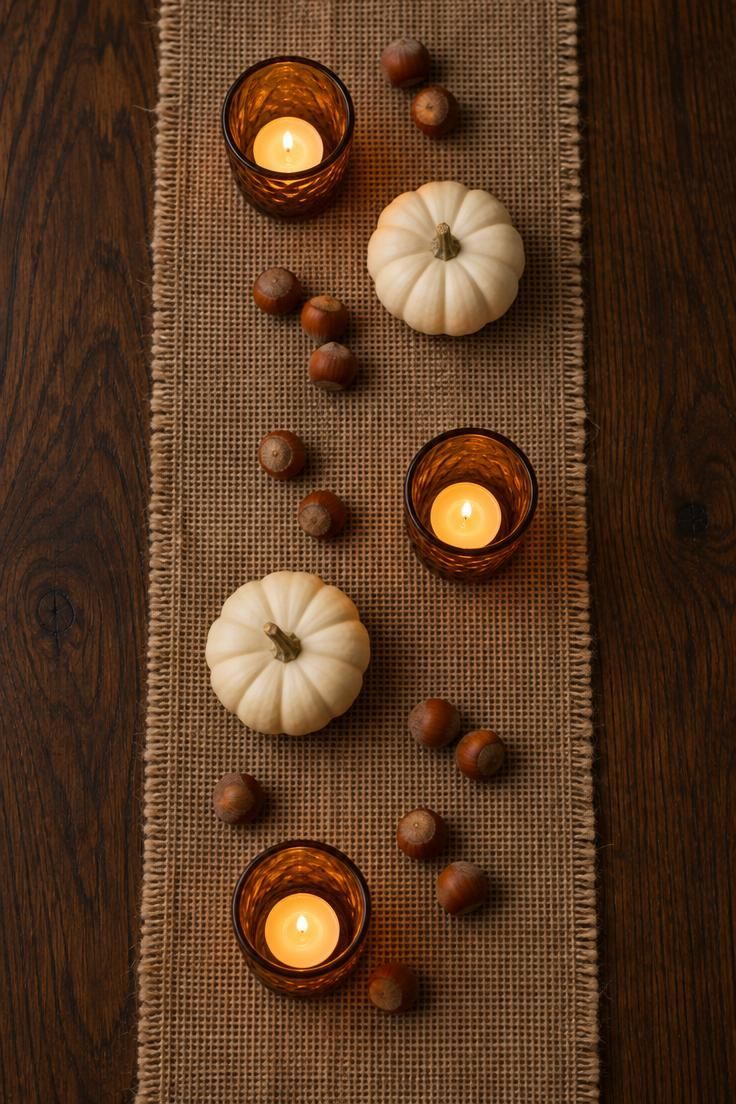
Burlap brings a coarse open weave that pairs naturally with amber glass and nuts in their shells.
A runner of modest width down the center of a dark oak table gives the arrangement a spine, and loose spacing keeps it from reading as a formal garland.
Small white pumpkins tucked between votives add pale punctuation.
Open amber votives read as real candlelight rather than a lantern glow, which suits a holiday evening.
Space the holders unevenly so the eye travels the length of the runner instead of locking onto a repetitive pattern.
This is one version of small dining table decor that looks finished before the meal and empties in one motion afterward.
The nuts deserve a decision.
Shelled hazelnuts can double as a snack and get eaten during drinks; unshelled nuts look better but stay decorative.
Keep the edible and decorative piles separate so nobody confuses the two.
Cleaning is the honest downside.
Wax drips work into burlap fibers, and a stray cranberry or two from a nearby dish leaves a mark.
Take the runner outside and shake it after dinner rather than scrubbing it wet.
Style Blueprint:
- A narrow burlap runner with visible open weave
- Three open amber glass votive holders
- Shelled hazelnuts or whole nuts kept in separate piles
- Two miniature white pumpkins placed off the centerline
Design Pro-Tip: Keep lit candles clear of dried arrangements, paper goods, and loose sleeves, and never leave them unattended.
Perimeter Mini Vases with Dried Wheat Stems at Each Place Setting
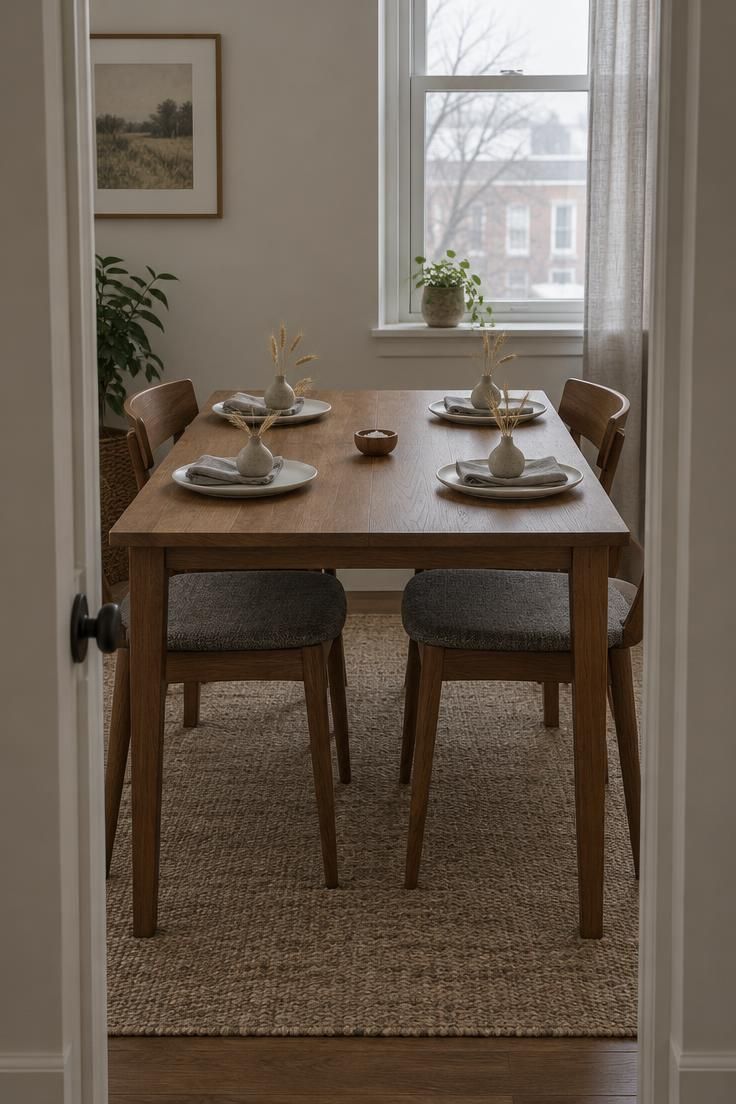
Individual bud vases put the decoration at the edge of the table and leave the middle empty.
A two-inch unglazed stoneware vase holding two or three dried wheat stems sits just beyond the bread plate, one per guest.
The wheat nods to harvest themes without the width of a mixed bouquet.
Unglazed and speckled pottery keeps the look handmade rather than formal, which suits a relaxed family meal.
Because the vases repeat at each setting, the table reads as decorated even with an empty center, and serving bowls can land wherever they fit.
Room to breathe matters here.
This works for four people when the table is wide enough that the vases do not crowd the plates, and relative spacing is the guide rather than an exact inch count.
Stoneware is also durable, so a bumped vase stays in one piece.
These apartment holiday table ideas suit rented dining nooks where the table itself is small and the floor space around it is limited.
The vases move with the napkins when guests sit, and they make small takeaway gifts at the end of the evening.
Storage is simple: wrap them in a towel and stack in a drawer.
Style Blueprint:
- Four matching unglazed stoneware bud vases
- Dried wheat stems trimmed short
- Folded gray linen napkins at each setting
- A bare center with only a small wooden salt cellar
Two-Tier Wooden Stand with Persimmons Below and Taper Candles Above
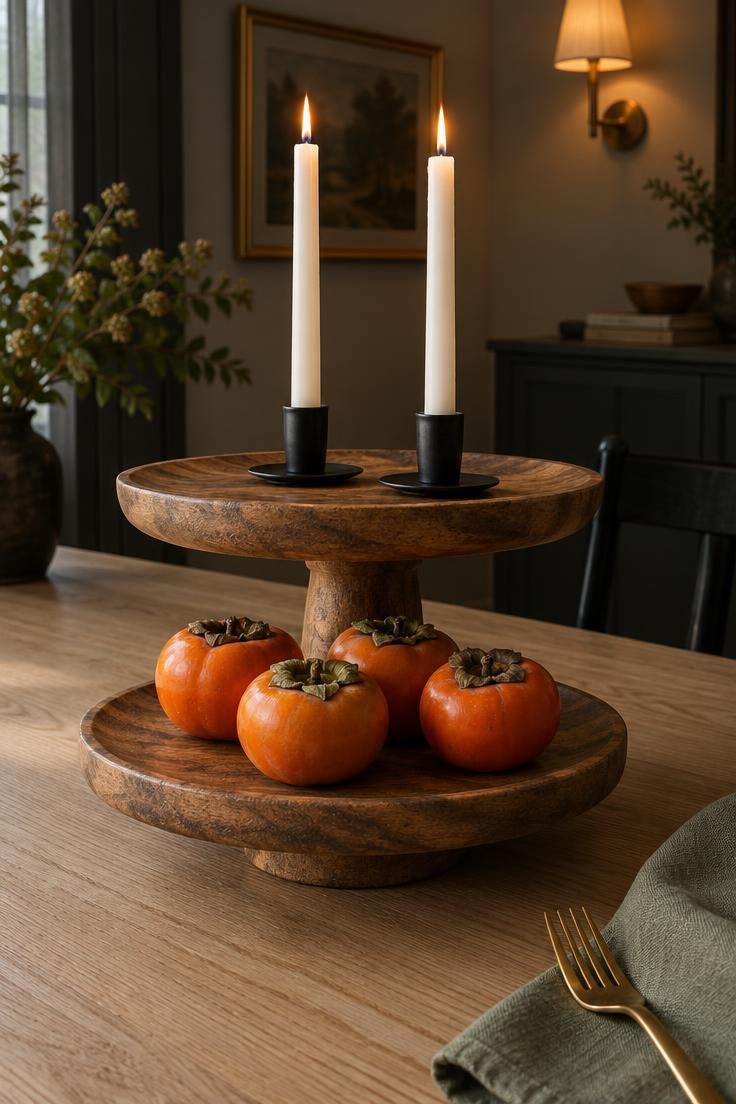
A round two-tier stand of natural mango wood stacks the centerpiece into airspace rather than across the surface.
Persimmons on the lower tier and two slim taper candles in black metal holders on the upper tier form a compact Thanksgiving centerpiece with a footprint roughly the size of a dinner plate.
The layering draws the eye upward, and the black candlesticks give a quiet graphic contrast against pale wood and orange fruit.
Because the candles sit on the upper tier, they stay above napkins and reaching arms.
Choose tapers that stand well above the fruit so the flames read clearly.
The fruit earns its place.
Persimmons sliced for dessert or returned to a bowl afterward mean the stand is not purely ornamental.
When the meal arrives, lift the whole stand to a counter in one move.
Dust collects on the tier edges, and wax can drip onto the upper surface.
Wipe the wood with a dry cloth after the holiday rather than soaking it near the candle area.
Design Pro-Tip: Trim taper candles so their tops sit well above the upper tier, keeping the flame line above plates and napkins.
Style Blueprint:
- A round two-tier natural mango wood stand
- Four persimmons on the lower tier
- Two slim tapers in minimalist black metal holders
- A sage green linen napkin beside the stand
Wooden Cutting Board Base for Candles, Gourds, and a Dish of Olives
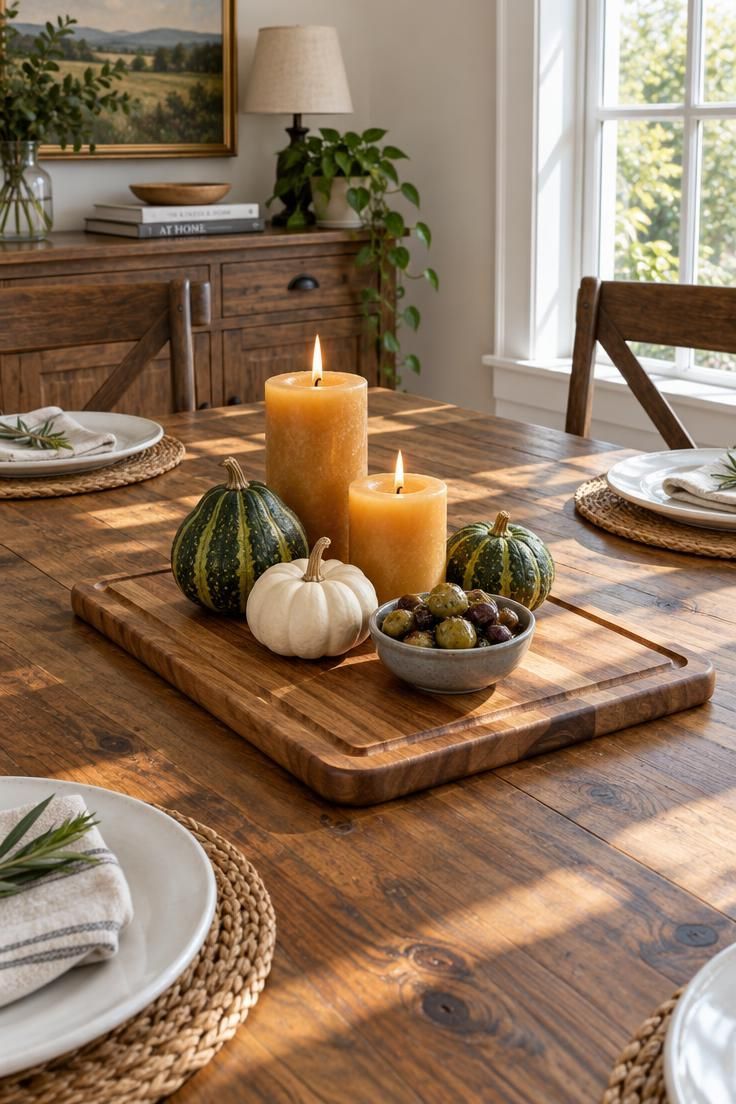
An acacia cutting board becomes a staging platform for a whole cluster of small decorations.
Honey-colored pillar candles at two heights, mixed mini gourds, and a small gray ceramic dish of marinated olives sit together on the board, consolidated in one movable unit.
The board keeps the table from looking scattered and can be carried to the kitchen when the main course arrives.
Choosing a board with a shallow juice groove means stray brine from the olives stays on the wood rather than running toward a place setting.
The olives are food, not a prop, so they disappear naturally over drinks.
That is the useful test for anything edible on a table: if it will be eaten, it earns its place.
Bright midday light suits this arrangement because the wood and the glossy olives both benefit from clear illumination.
A farmhouse table with a medium brown finish and four partly visible place settings grounds the scene.
The candle wax on the board is easy to scrape off once it cools, which makes this one of the lower-maintenance small dining table decor choices.
Pillar candles burn down over time, so plan for extra tapers or replace them between courses.
Style Blueprint:
- A rectangular acacia board with a shallow juice groove
- Two honey-colored pillar candles at different heights
- A small ceramic dish of marinated olives
- One white and two green mini gourds for color contrast
- A farmhouse table left mostly bare around the board
Layered Mini Gourds Wrapped in Brass Wire at Each Napkin
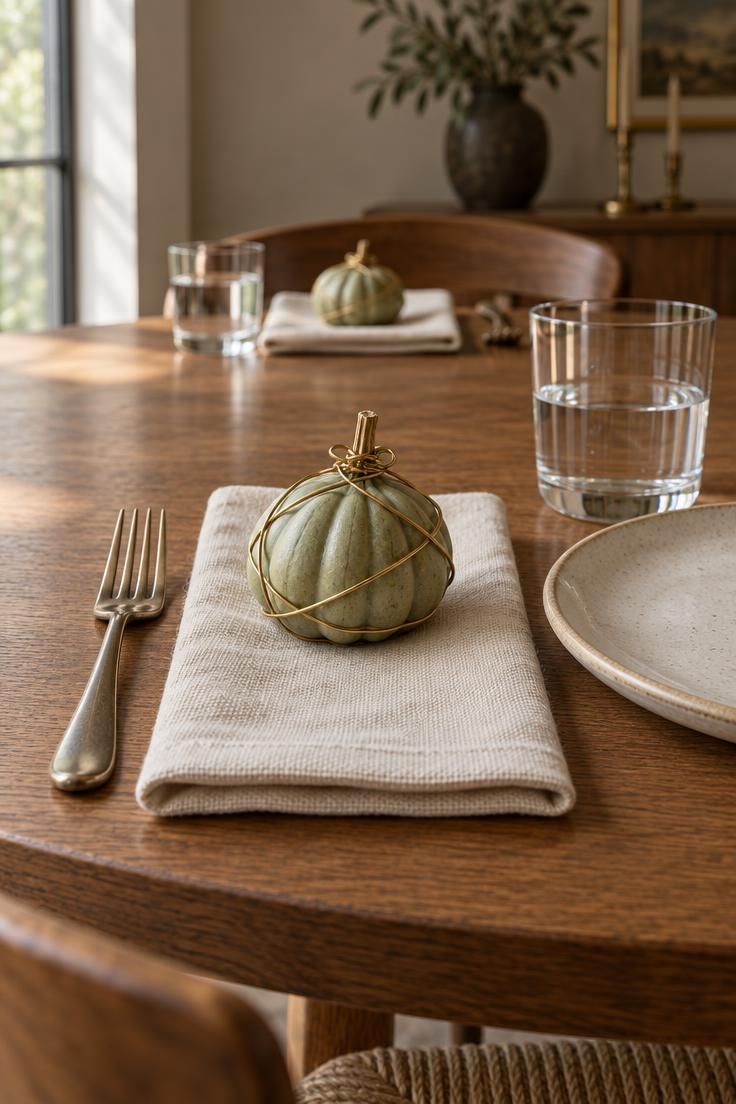
Small ornamental gourds wrapped with thin brass wire replace a shared centerpiece and treat every chair as its own focal point.
The wire crosses the gourd twice, then loops into a soft curl at the top, catching light without moving around during the meal.
Pale sage, cream, and rust tones on the gourds keep the arrangement tied to the warm harvest palette already on the table.
A single gourd rests on each pressed linen napkin, tucked just above the fork so the setting still has room for a plate and glass.
This spread-out approach suits a small table because it decorates without narrowing the shared serving space in the middle.
Clear the gourds after the meal with a dry cloth to lift any fine dust that gathers in the ridges.
Stems stay intact for the season and the pieces tuck flat into a drawer for the next November table.
Style Blueprint:
- One small ornamental gourd per place setting
- Thin brass wire crossed twice and curled at the top
- Pale sage, cream, and rust gourd colors
- Cream pressed linen napkins and simple ceramic plates
- Same wire finish repeated at four settings around a round oak table
Handwritten Place Cards Tucked into Mini Pumpkins on Torn-Edge Paper
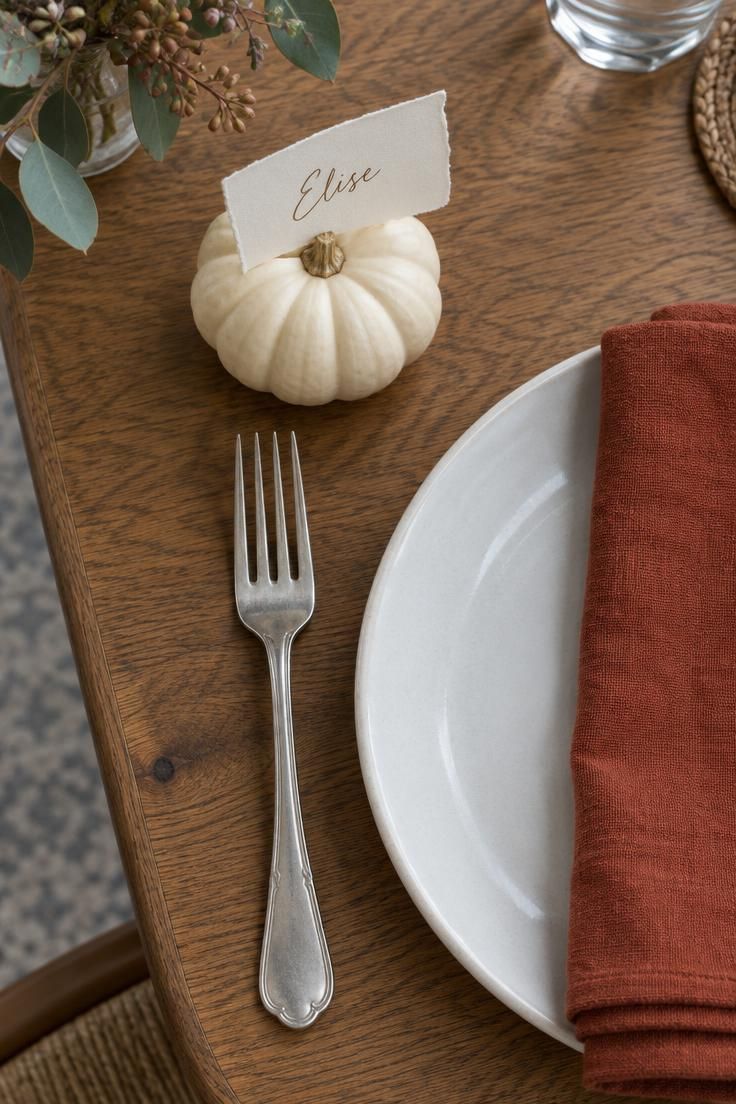
This direction skips the centerpiece and makes each place setting its own display.
Names written in fine brown ink on torn-edge ivory cardstock sit in a slit cut into a small white pumpkin, and each pumpkin rests on a folded napkin.
The effect is personal and low to the table, with almost no surface taken up.
Small-scale script matters because legibility drops fast on a mini pumpkin.
A fine-point pen and a few practice lines keep the names clean.
Torn edges feel relaxed next to stoneware, and the pumpkins stay on the table as tiny takeaways after the meal.
Thanksgiving place setting ideas often lean on printed cards, and the pumpkin slot is a small variation that adds a natural object without a centerpiece.
Setup and removal are equally quick: the pumpkins move with the napkins when guests sit.
Style Blueprint:
- Small white mini pumpkins, one per guest
- Torn-edge ivory cardstock and a brown fine-point pen
- Rust or similarly warm napkins folded flat beneath
- Simple silver flatware and white ceramic plates
Shallow Dough Bowl Holding Pears, Persimmons, and Dried Eucalyptus
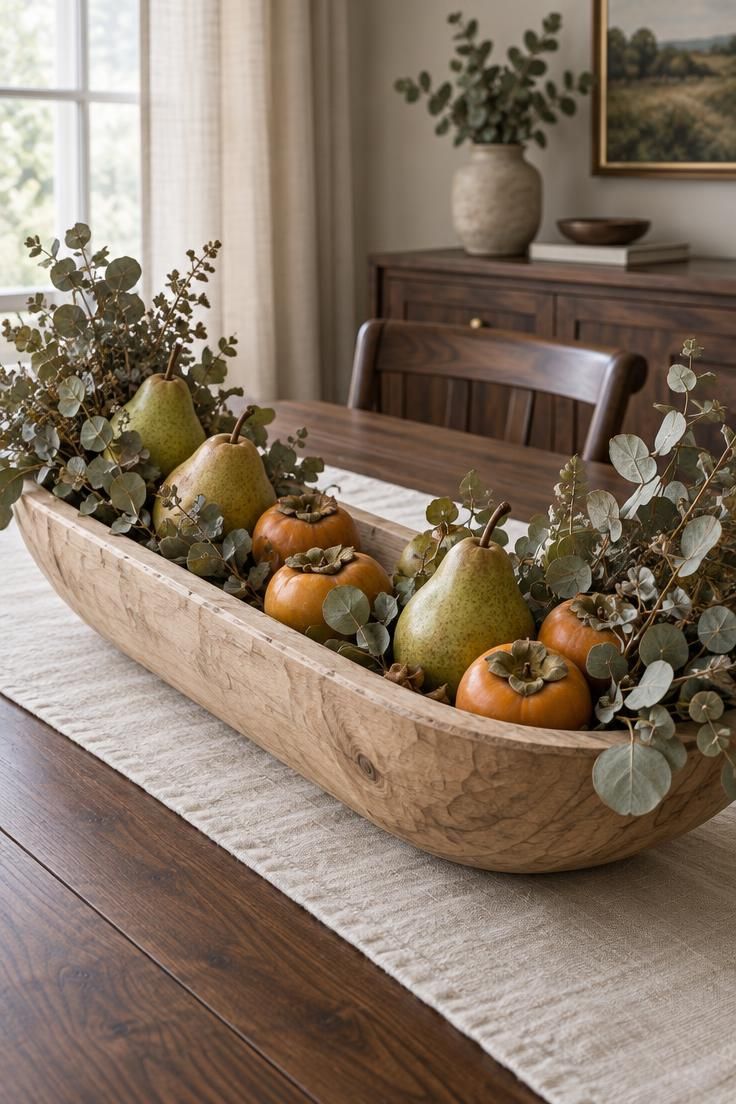
A low wooden dough bowl filled with pears, persimmons, and dried eucalyptus spreads the centerpiece horizontally instead of upward.
Arrange the fruit higher at the ends and lower in the middle so the bowl reads as a soft band rather than a floral tower.
On a dark walnut table with a cream linen runner behind, the pale wood and warm fruit stand out clearly.
The bowl’s low profile keeps sightlines open, which matters on a table where people sit close.
Because it is one piece, it slides to a nearby counter before carving.
The fruit can be rinsed and served, and the eucalyptus goes back into storage for next year.
Longer than it is tall, this piece suits a rectangular table better than a small round one, where it might crowd the near plates.
Check that the bowl leaves clear space at each setting before committing to it.
Style Blueprint:
- A shallow wooden dough bowl with visible grain
- Pears and persimmons arranged high at the ends
- Two sprigs of dried eucalyptus tucked between the fruit
- A cream linen runner extending past the bowl
Small Ceramic Pitcher with Curly Willow Branches and Tiny Copper Bells
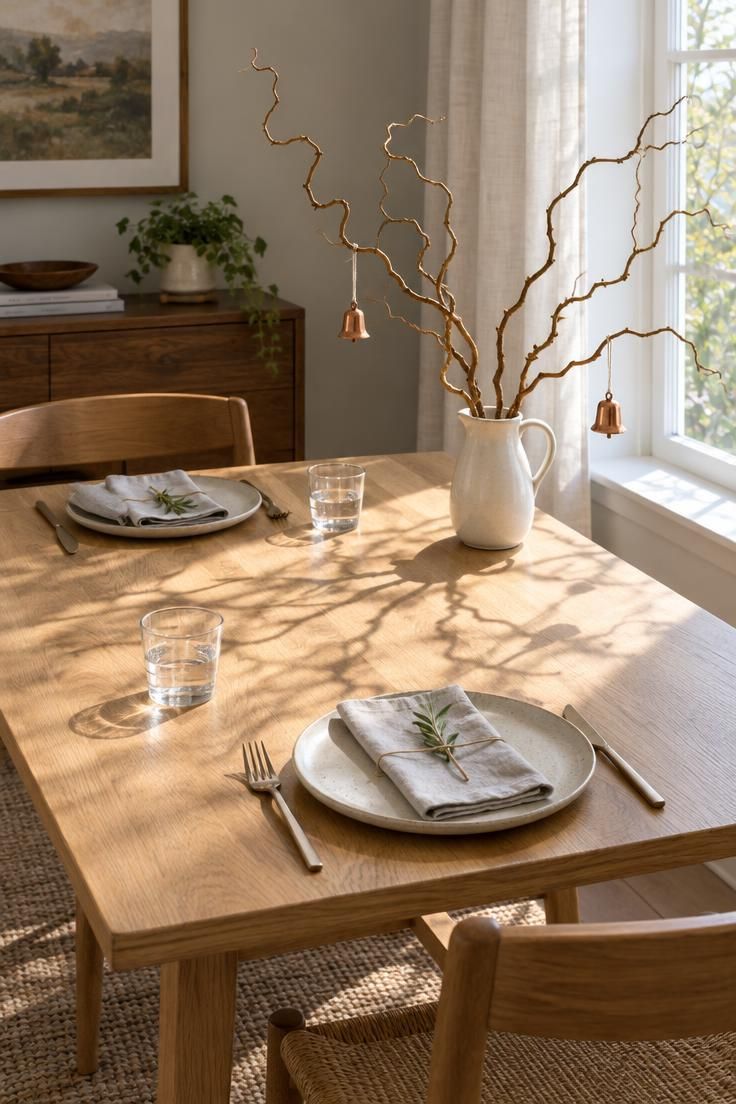
A single white ceramic pitcher near the back edge of a rectangular light oak table holds five or six bare curly willow branches.
Two tiny copper bells hang from the lower branches on short lengths of neutral cotton thread.
The branches stay airy and see-through, so the arrangement does not block conversation across a small table.
The pitcher’s narrow base and rounded belly keep its footprint near the size of a soup bowl, and the white glaze contrasts with the oak.
A low Thanksgiving table runner effect comes from the branches themselves, which curve along the back rather than rising straight up.
For two people it is an easy focal point; for four, trim the branches well above seated shoulder height or shift the pitcher to a shelf when the meal starts.
The copper bells add a small metallic accent that echoes candlelight.
This version of small dining table decor needs a steady surface because the pitcher is top-heavy when full of branches.
Keep it centered between the two near place settings and away from the serving side.
Style Blueprint:
- A small white ceramic pitcher with a narrow base
- Five or six bare curly willow branches
- Two tiny copper bells on neutral cotton thread
- Pale gray napkins and cream stoneware plates
All-Cream Table with Unfinished Wood Chargers and No Centerpiece
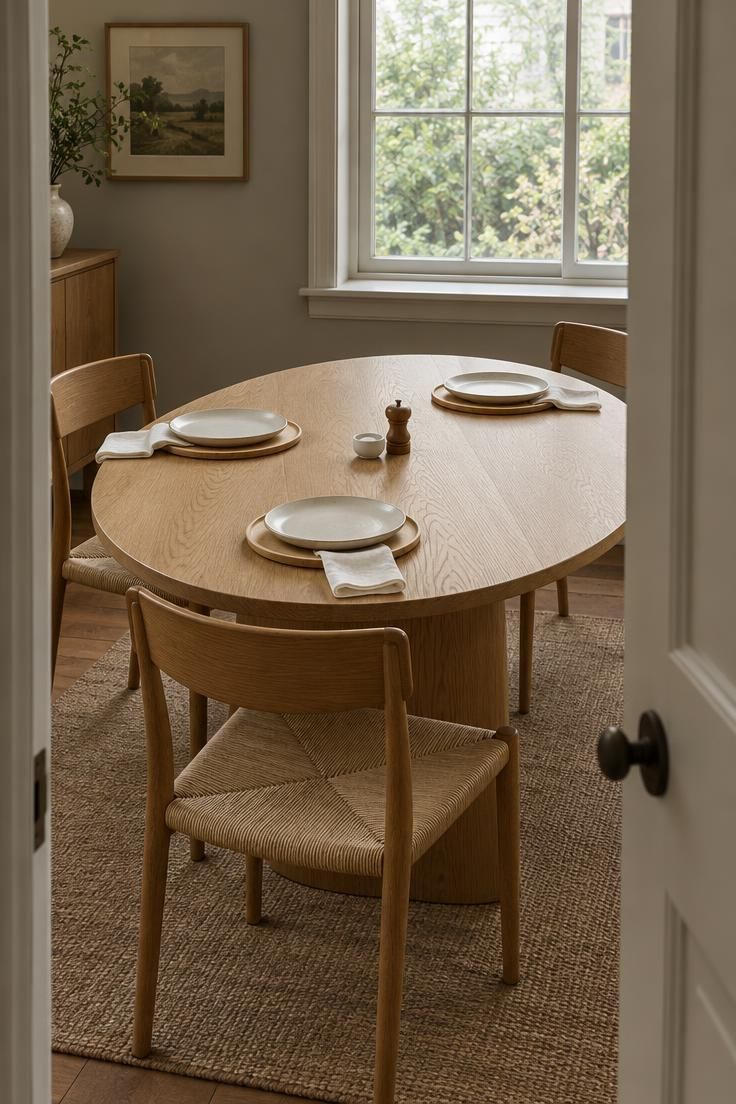
Sometimes the strongest table has no centerpiece at all.
Ivory linen napkins, cream stoneware plates, and pale birch wood chargers set an oval pale oak table, with only a small white salt cellar and a wooden pepper grinder at the center.
The visual rest comes from the narrow palette of cream, ivory, and natural wood.
Chargers that stay in place mean the setting does not need to change when the meal arrives, and the serving bowls become the only centerpiece.
A table with beautiful grain deserves to show, which is the quiet argument for skipping a tablecloth.
A doorway or threshold view reveals how the whole room holds together with so little.
Choose chargers with a slight lip so plates settle in, and keep the pepper grinder small enough that it reads as part of the setting rather than clutter.
When the meal ends, the bare arrangement wipes down in seconds.
Style Blueprint:
- Cream stoneware plates and ivory linen napkins
- Pale birch wood chargers with a slight lip
- A small white ceramic salt cellar and wooden pepper grinder
- A pale oak table left bare to show its grain
Conclusion
A small table rewards one clear idea executed well over a dozen competing decorations.
Branches, a single tiered stand, a low dough bowl, or simply beautiful chargers can each carry the setting on their own.
The real test is how easily the table clears for serving and how much open surface each piece gives back.
Let the dishes finish the picture, and the warmth stays without the crowding.