This post may contain affiliate links. If you make a purchase through these links, we may earn a commission at no additional cost to you.
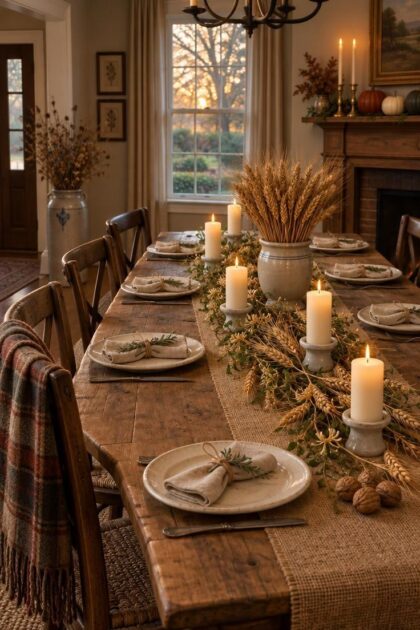
A Thanksgiving table can feel finished with a handful of well-chosen natural materials rather than a room full of new purchases.
The looks ahead share a loose palette of oat, rust, sage, and warm brown, and they lean on wood grain, woven cloth, dried stems, and matte stoneware.
Each idea can stand alone or join the others, so a table, a sideboard, and an entry can carry one continuous harvest note.
Most of these arrangements also move easily from the table to a console once the plates come out.
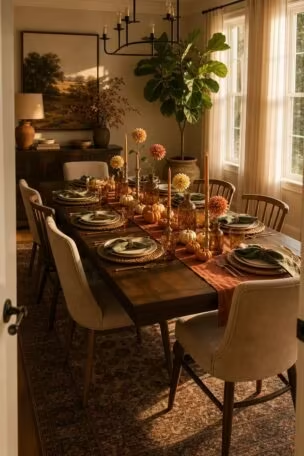
Burlap Table Runner With a Low Wheat and Candle Line
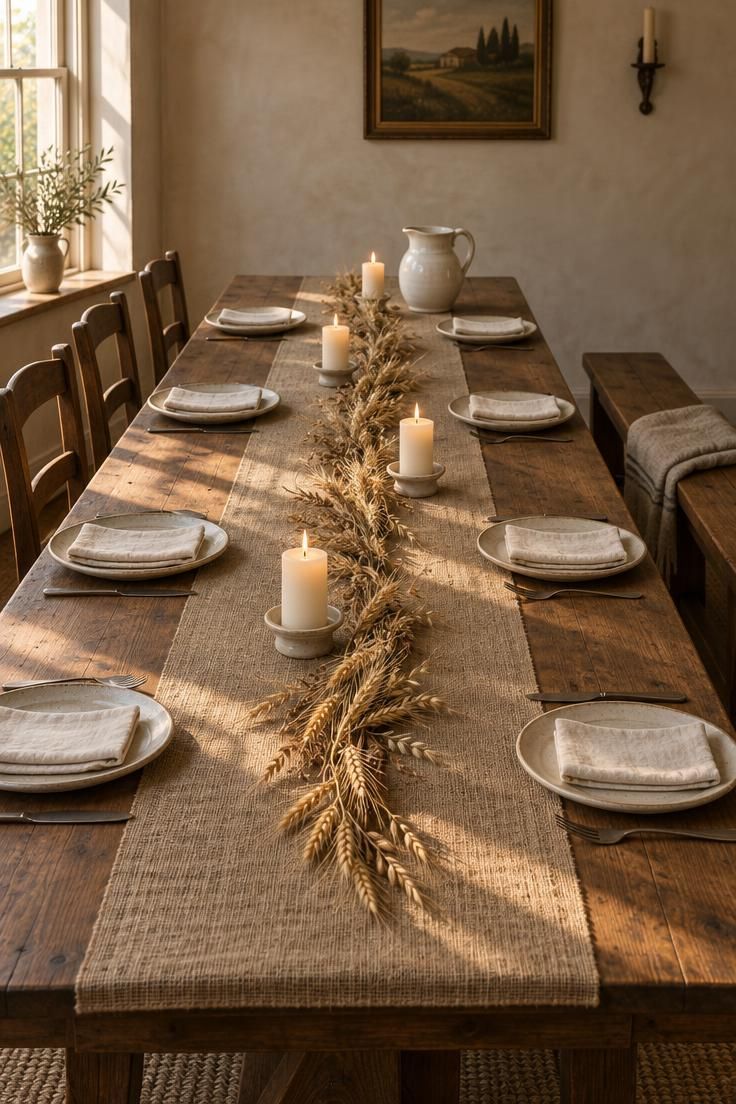
The runner establishes the base layer of the table before a single object goes on top.
A natural burlap or jute in oat or stone soaks up light rather than reflecting it, and the visible weave gives the table a texture that reads well beside plain ceramic and wood.
Width matters more than length here.
A runner that stops a hand-span short of each table edge reads as a path down the middle, while one that reaches the edges starts to behave like a tablecloth and narrows the usable setting space.
Along the center, a continuous low line of dried wheat and honeysuckle vine keeps the arrangement flat, and tucking the stems so the whole strip stays under eight inches high leaves room for plates and platters on both sides.
Five slim beeswax or cream pillar candles in ironstone holders at uneven intervals break up the wheat line without interrupting it.
Pulling one candle slightly off the line gives the table a gathered rhythm rather than a measured one, and swapping in wood slice candle risers under a few holders varies the heights without tall candlesticks that would cut into sightlines.
Style Blueprint:
- Natural burlap runner in oat, kept narrower than the table
- Dried wheat stalks and honeysuckle vine laid in a low center line
- Five cream beeswax pillar candles in ironstone holders
- Cream stoneware plates and flat linen napkins
- Wood slice candle risers for varied candle heights
Wood Slice Candle Risers Over a Honeysuckle Runner
For a burlap table runner, after the runner, the candle group itself deserves variation.
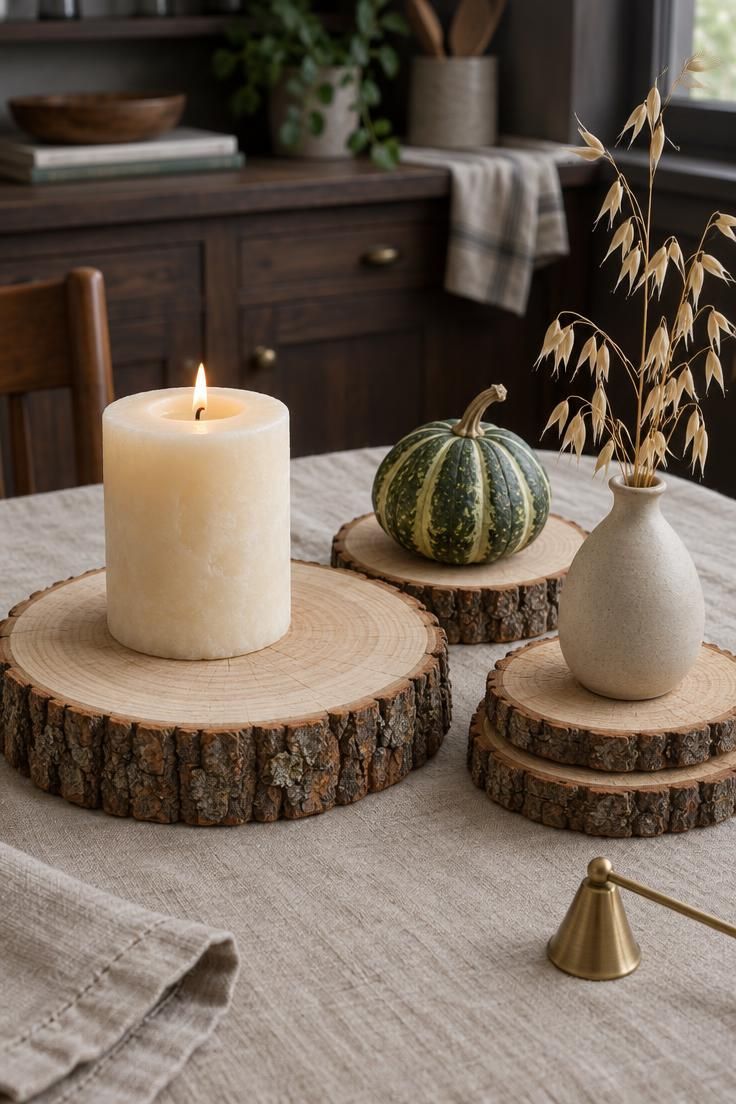
Round cross-sections of ash or pine work as risers, with a large slice under a jute-wrapped pillar and a smaller one under a squat gourd, and two stacked slices beside a stoneware bud vase of dried grasses.
The bark edge is the point.
Keeping it visible and accepting the slight unevenness of each cut surface makes the cluster look collected rather than bought as a set.
Set the group slightly off-center and leave the far end of the table open for a serving board or bread basket.
This formula suits a sideboard better than a center table when plates need the full width, and a striped gourd added to the group ties the wood tones back to the rest of the harvest palette.
Style Blueprint:
- Ash or pine wood slices with bark left intact
- One chunky cream pillar candle wrapped in jute
- Matte stoneware bud vase with dried oat stems
- One small green-striped gourd for contrast
Dried Wheat Bundle Centerpiece in a Footed Stoneware Crock
A round or square table often resists a long linear arrangement, and one strong central object works better in that geometry.
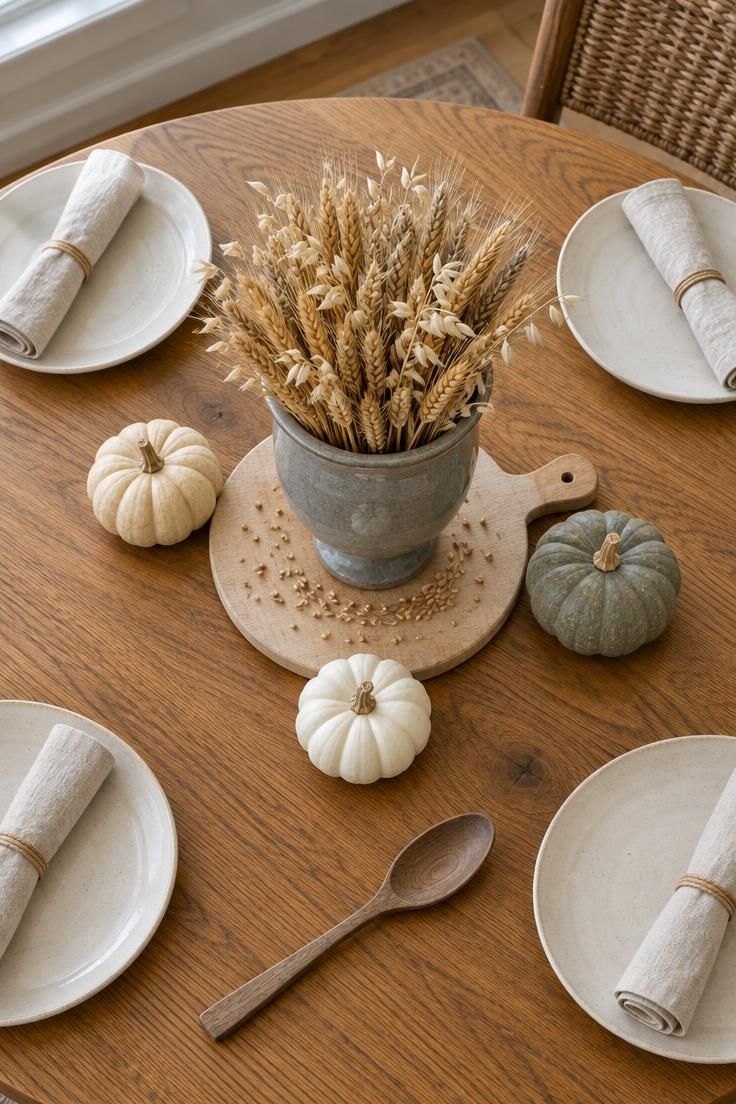
Choose a footed stoneware or aged ironstone crock about the height of a rolled napkin, then fill it with a tight dried wheat bundle centerpiece of wheat, oat grass, and a few brown millet stems.
Cut the stems so the tips fan only a few inches above the rim.
That proportion keeps the arrangement from towering over the table while still giving it presence from across the room.
Set the crock on an oval wood breadboard to catch dropped grains and anchor the shape, flank it with three mini pumpkins in cream and sage at equal distance, and leave the space directly in front clear for shared dishes.
Style Blueprint:
- Footed gray stoneware or aged ironstone crock
- Tight bundle of dried wheat, oat grass, and brown millet
- Oval wood breadboard underneath to catch grains
- Three mini pumpkins in cream, sage, and white
Dough Bowl Centerpiece With Pumpkins, Pears, and Walnut Branches
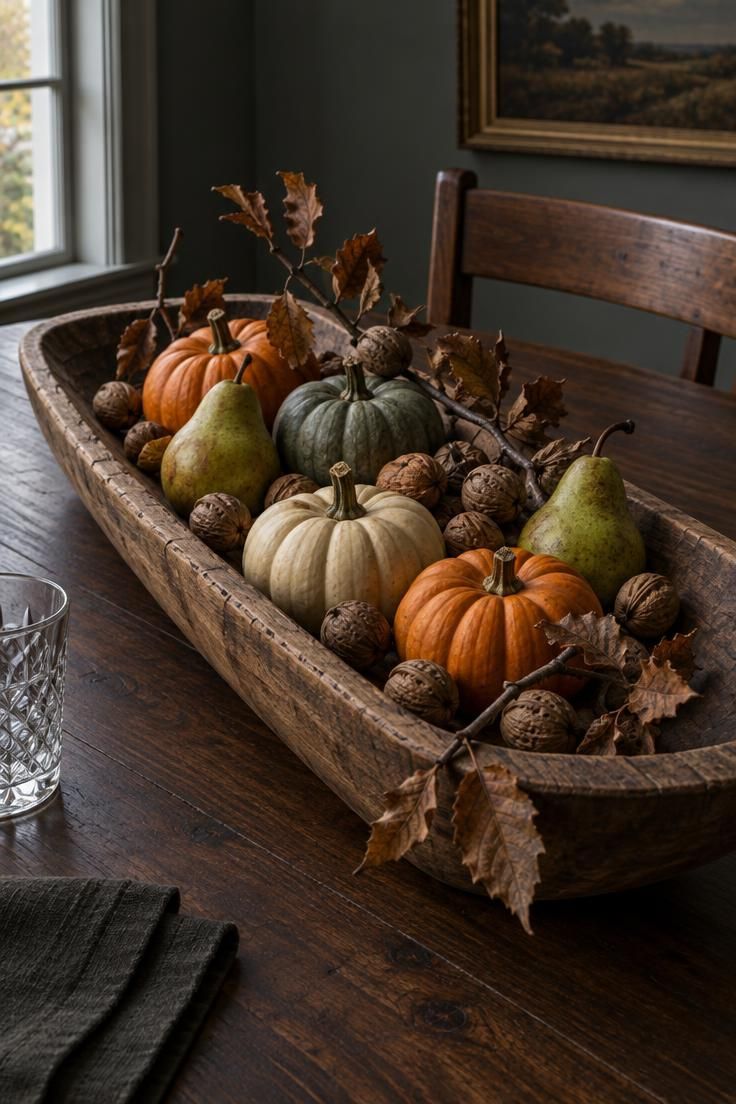
A rough-hewn wood dough bowl holds a compact harvest fill without spilling over the edges, which makes it one of the calmest rustic thanksgiving decorations to live with through a long meal.
Layer unshelled walnuts and small pinecones at the bottom, then nestle three to five pumpkins in varied dusty tones with two green pears between them.
Tuck a few bare walnut or apple branches into the back so their tips rise above the bowl but stay lower than the eye line of the nearest diner.
That keeps the arrangement sculptural without interrupting conversation across the table.
The curved shape contains the whole grouping and makes it easy to lift away when serving dishes need the space.
Choose a bowl with visible tool marks or a dry, unpolished finish, since a glossy surface would work against the wood and dried elements around it.
Style Blueprint:
- Carved dough bowl with visible tool marks
- Small pumpkins in orange, sage, and cream
- Green pears and walnuts in the shell
- Bare walnut or apple branches tucked toward the back
- Two or three small pinecones at the base
Place Setting With Twine-Wrapped Napkin and a Cinnamon Stick Sprig
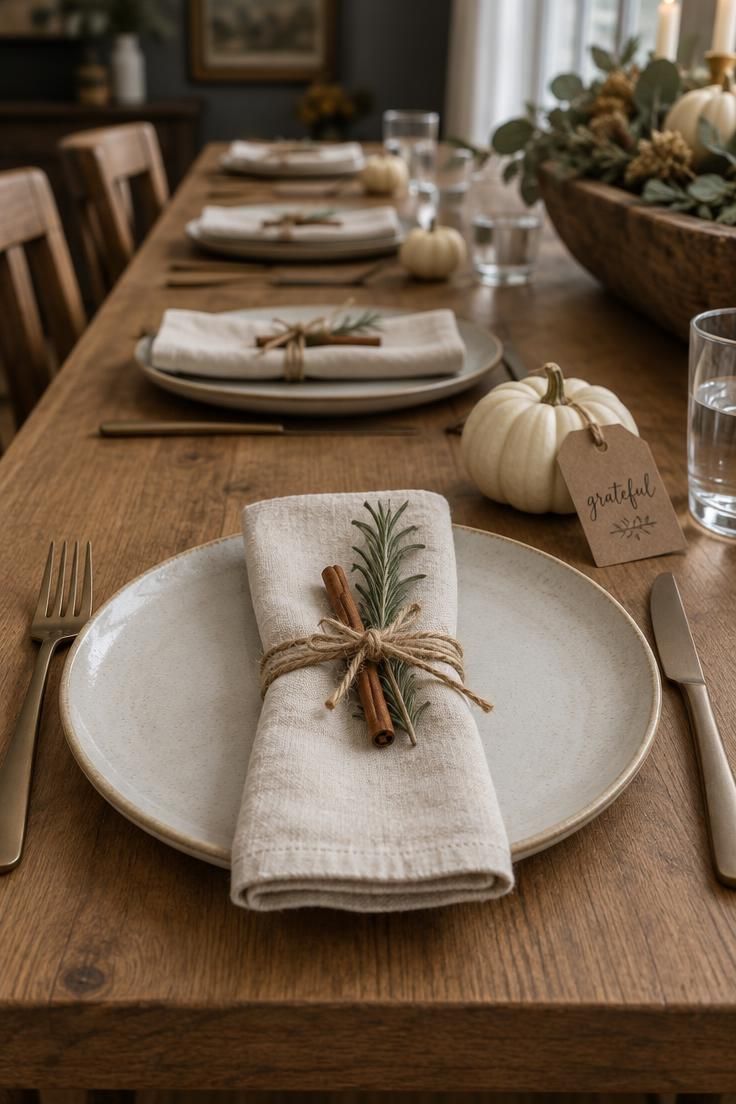
Repetition around the table does quiet work that a big centerpiece cannot.
Start with a plain cream or oatmeal linen napkin folded into a long rectangle, tie it with jute twine, and slide a cinnamon stick and a small sprig of dried rosemary under the twine.
Rest a small round gourd, white or muted orange, just above the knife to the right of each plate, and write each guest’s name on a kraft paper tag looped over the napkin tie.
Keeping the tag on the twine rather than on the gourd means the place card stays put as people sit down.
These place-setting details also echo a dough bowl centerpiece at the middle of the table, because the twine, spice, and gourd repeat the same materials at a smaller scale.
The repeated punctuation of twine and spice unifies the table without adding height or clutter.
Style Blueprint:
- Cream or oatmeal linen napkins folded into long rectangles
- Jute twine ties with cinnamon sticks and dried rosemary
- Kraft paper name tags with handwritten script
- One small white or muted orange gourd per setting
Pumpkin and Branch Mantel With Brass Candle Holders
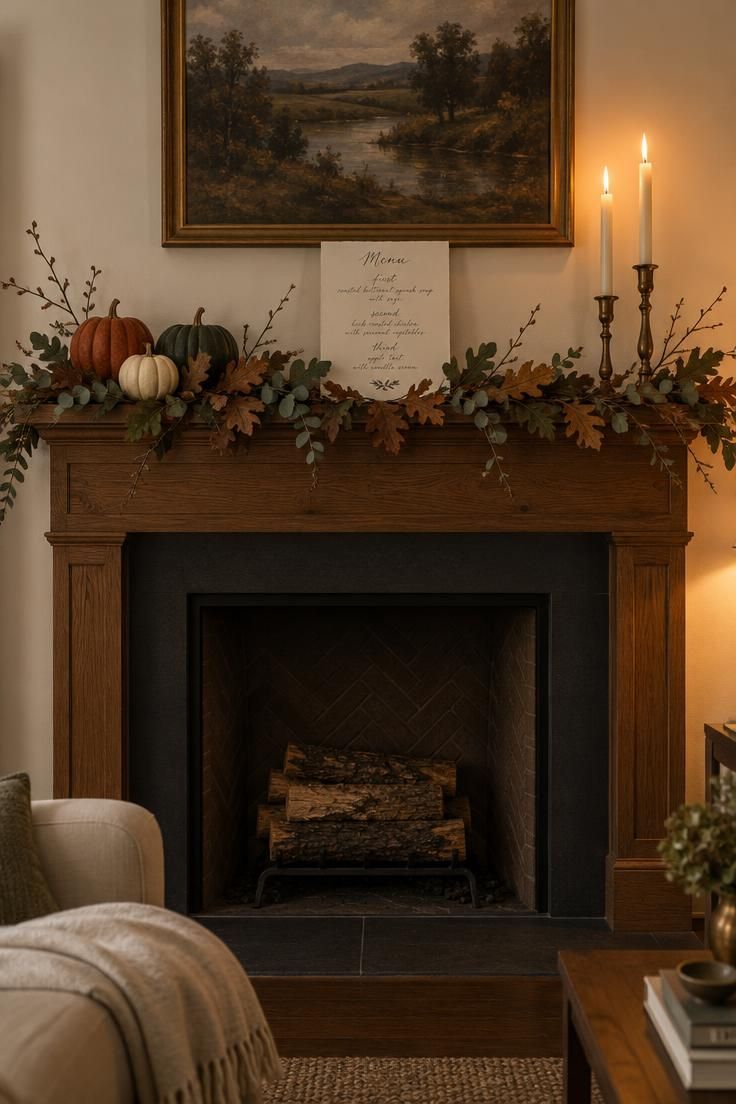
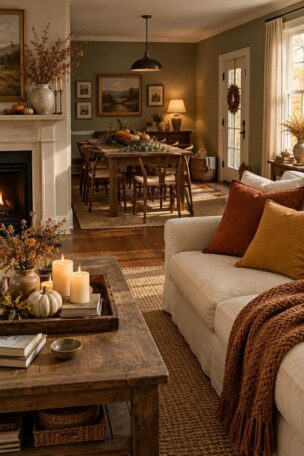
Carrying the table palette upward to a living room or open-dining mantel makes the whole room read as one holiday space.
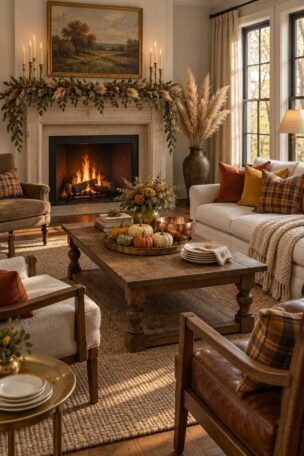
Start with a garland of preserved oak and eucalyptus laid across the mantel, letting the stems trail unevenly.
This pumpkin and branch mantel works through grouping rather than symmetry.
Rest three pumpkins in rust, cream, and deep green at one end, and set two tarnished brass candlesticks holding taper candles on the opposite side, so the two visual weights balance without matching.
Tuck a few bare branch tips into the garland so their shape interrupts the horizontal line, and leave the center open for a small framed family note or handwritten menu.
That open center keeps the mantel from feeling like a store display.
The repetition of wood, grain, and autumn color from the nearby table makes the two surfaces read as parts of one arrangement rather than separate decorating projects.
Style Blueprint:
- Preserved oak and eucalyptus garland along the mantel edge
- Three pumpkins in rust, cream, and deep green
- Two tarnished brass taper holders with cream candles
- Handwritten menu card held in the open center
- A few bare branch tips tucked into the garland
Serving Sideboard With Copper Pot and Stacked Stoneware
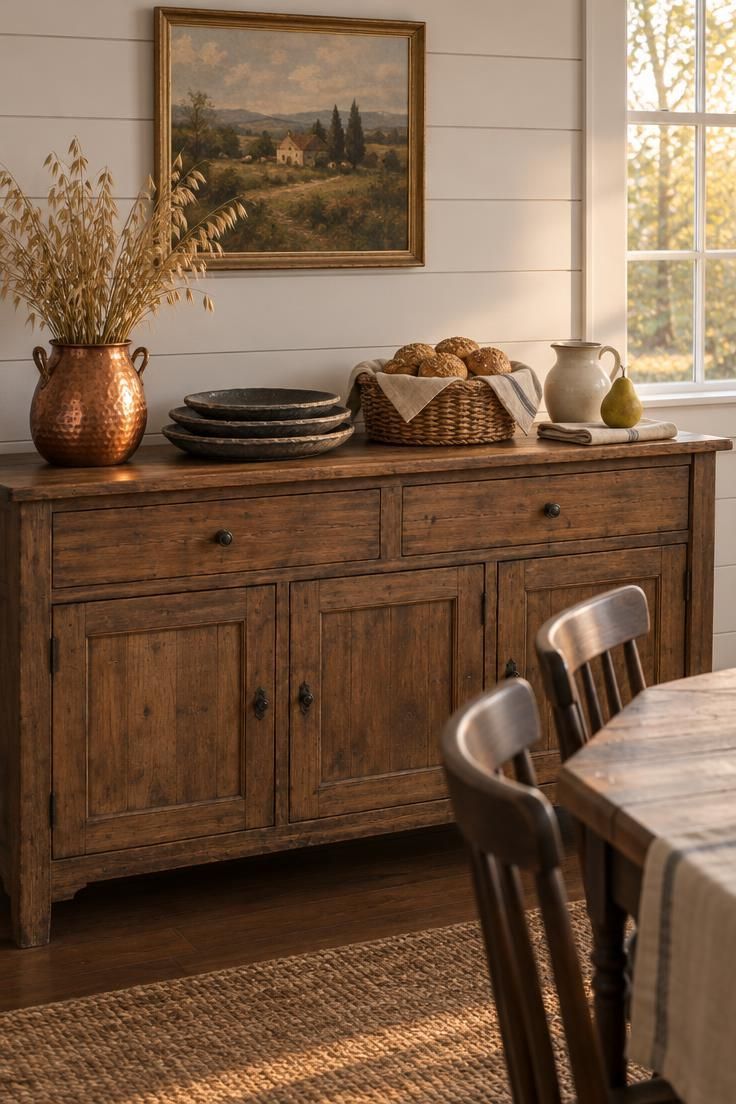
A sideboard becomes part of the decor when it is composed as a still life rather than filled as storage.
Place a hammered copper or brass pot at one end, empty or holding a small bundle of dried stems, and stack three matte stoneware platters in the center so their rough rims show.
Add a shallow woven basket of rolls wrapped in a linen napkin and rest a small ironstone pitcher of water beside it.
Keep the whole grouping low and wide so the surface still holds overflow serving dishes once the meal begins.
Limiting the materials to two metals and one wood tone keeps the grouping from turning into a mixed-metal display, and a single green pear on the surface ties the sideboard to the table’s harvest palette.
Style Blueprint:
- Hammered copper or brass pot with dried stems
- Three stacked matte stoneware platters with rough rims
- Woven basket lined with linen for rolls
- Small ironstone pitcher and a single pear
Entryway Dried Wheat Crock With a Handwritten Welcome Board
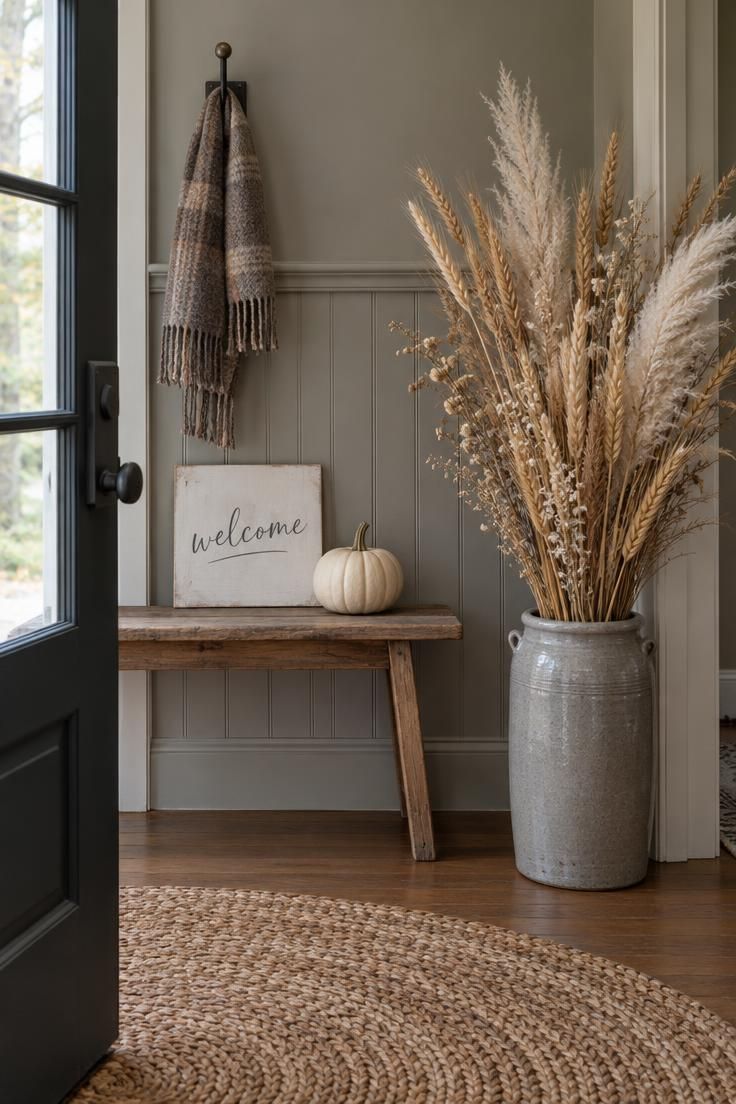
A narrow entry table or bench gets vertical presence from a tall dried arrangement.
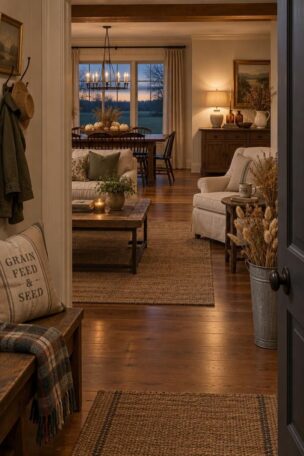
Use a glazed stoneware crock or a galvanized bucket as the vessel, and fill it with a mix of dried wheat, pampas, and oat grass cut to roughly twice the vessel’s height.
Place the crock on the floor beside the table rather than on top of it so it stays out of the walking path and cannot crowd the surface.
On the table or bench, lean a small painted board with a simple handwritten “welcome” in cream or black paint and rest a single small pumpkin beside it.
The vertical grain bundle and the horizontal sign anchor the spot without needing a full console vignette.
Keep the arrangement against a wall so passersby do not brush the dried stems as they come through the door.
Style Blueprint:
- Tall glazed stoneware crock set on the floor
- Dried wheat, pampas, and oat grass cut to twice the vessel height
- Small painted board with a handwritten welcome
- One cream pumpkin on the bench
Kraft and Twine Favors Along a Wood Bench
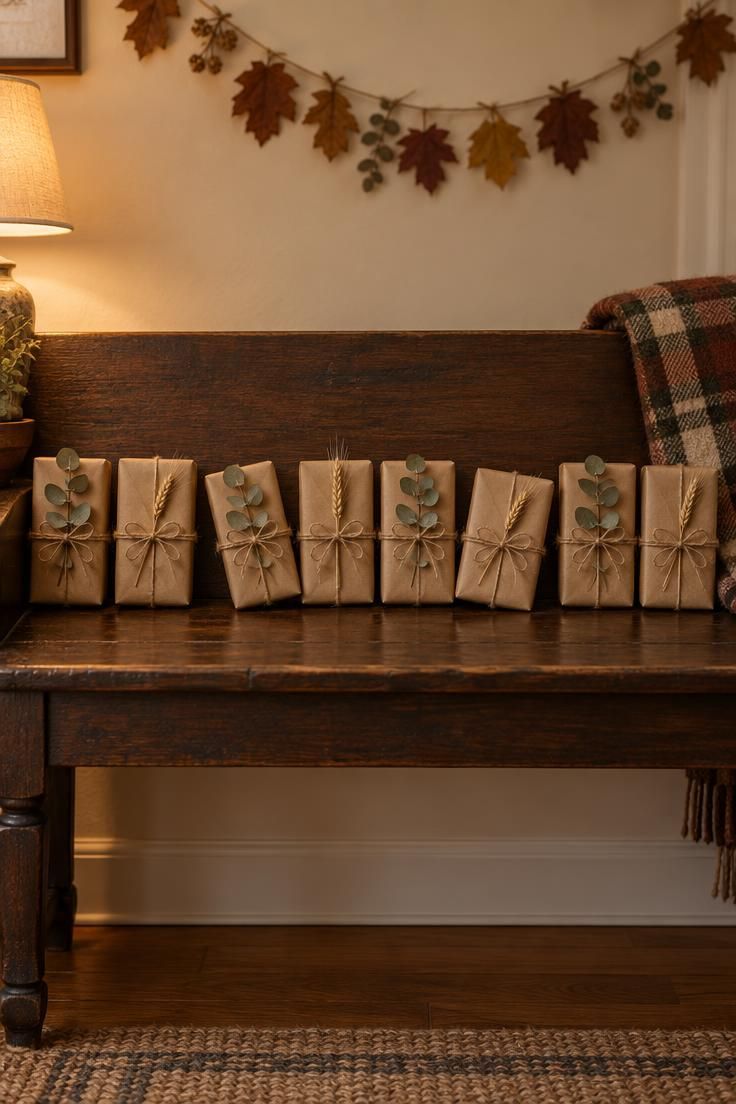
Small wrapped parcels read as part of the table rather than as an extra task on a busy day.
For each guest, fill a small kraft paper bag or fold a square of parchment around a few candied nuts, a mini bundle of cinnamon sticks, or a small beeswax candle.
Tie the top with jute twine and slip a sprig of dried eucalyptus or a single wheat stem under the tie.
Set the favors in a line along the back of the table or on a bench beside the entry, spaced evenly so they form a repeating pattern.
Swap the contents for reusable place-card holders with the same kraft and twine wrapping to keep the visual repetition without leaving parcels behind.
Style Blueprint:
- Small kraft paper bags or parchment squares
- Jute twine ties with dried eucalyptus or wheat sprigs
- Candied nuts, cinnamon sticks, or small beeswax candles inside
- Even spacing along a bench or the back of the table
Console Table With a Pillar Candle Line and a Mini Gourd Cluster
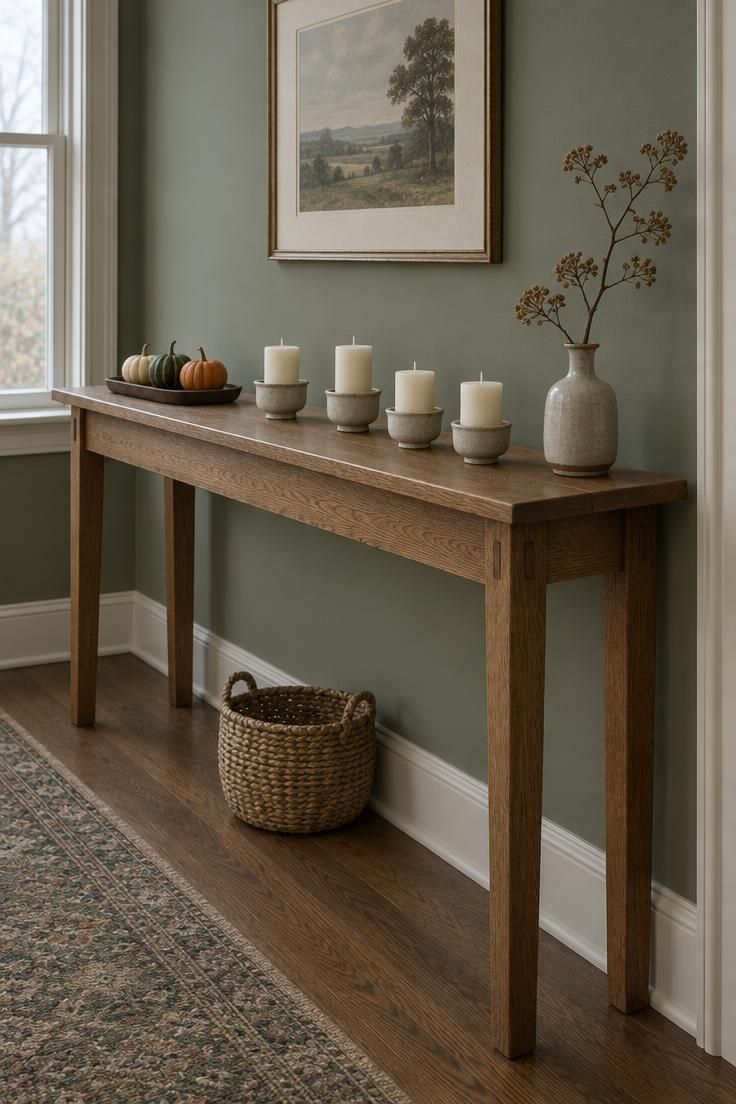
A slim console in a hallway or mixed-use room can carry a row of pillar candles as a low light source when no one needs to reach across them.
Use three to five unscented or lightly scented pillars in mismatched stoneware or ironstone cups, all under six inches tall, spaced about a hand width apart.
At one end, group three tiny gourds, no larger than a plum, on a small wood tray.
At the other end, rest a single dried branch or a leftover wheat stem in a low vase.
The arrangement reads as a simplified version of the main table and is easy to light in the evening.
Choose candles without prominent labels, or wrap the base of each in twine so the line of cups feels unified.
The low height keeps the console useful for keys or mail during the days around the holiday.
Style Blueprint:
- Three to five short ivory pillar candles in ironstone cups
- Small dark wood tray with three tiny gourds
- Short stoneware vase with a single dried branch
- Twine wrapped around any labeled candle bases
- A small woven basket on the floor beneath
Hanging Dried Corn Bundle With Burlap Ties on a Pantry Door
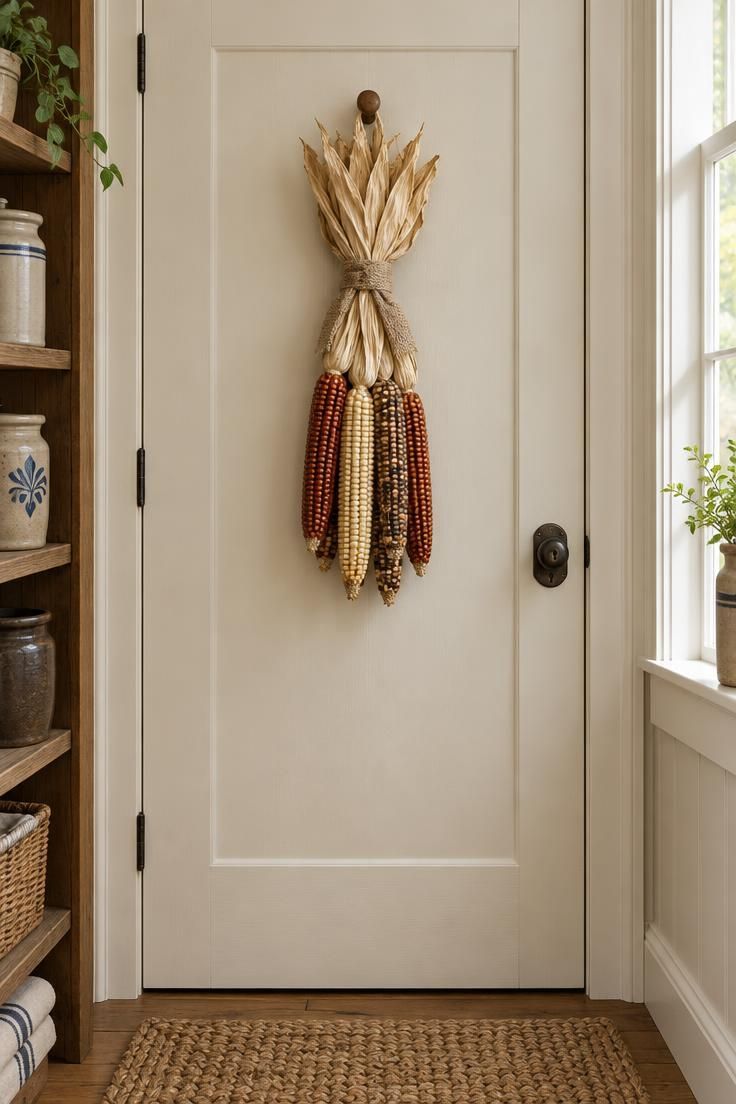
A bundle of dried Indian corn hanging on a pantry or hallway door gives a harvest accent without needing a flat surface below it.
Tie three to five ears together at the husk with burlap strips or jute twine, then loop the tie over a simple wood peg or hook on the door.
Choose corn in deep rust, cream, and heirloom speckled tones that match the pumpkin colors on the table.
Keep the bundle compact and hang it high enough that the ears fall in a tight column rather than fanning wide, which keeps the shape reading as one object.
The coarse husk texture and dry kernels echo the grain and wood used elsewhere without repeating the wreath shape, and the bundle stores flat once the season ends.
Style Blueprint:
- Three to five ears of dried Indian corn
- Burlap strips or jute twine tied at the husk
- A simple wood peg on the pantry door
- Rust, cream, and speckled ear tones
Design Pro-Tip: Before lighting candles on any table, set the plates and serving dishes in place first, then adjust candle positions so nothing sits in the path of passing platters.
Conclusion
A gathered Thanksgiving table does not need a full overhaul of the room.
Repeating the same few materials, wood, dried grain, stoneware, burlap, and a narrow range of pumpkin tones, creates a stronger rustic impression than many unrelated objects.
Keep the center low, place tall stems where no one must look around them, and use repeated place-setting details to carry the harvest idea around the table.
When the table, mantel, sideboard, and entry share just two or three of these elements, the whole home feels ready for a long meal.
The best version is the one that still leaves room for the food and the people.