This post may contain affiliate links. If you make a purchase through these links, we may earn a commission at no additional cost to you.
A small, cozy room does not have to give up a holiday tree.
Treating the tree as a deliberate design choice, rather than a traditional centerpiece, makes the difference between a cramped corner and a composed one.
Match the silhouette, color, and base treatment to the floor space you actually have and to the palette already in the room.
A slim tree can sit beside a reading chair, and a tabletop tree can turn a side table into a holiday moment.
The directions below focus on visual composition, ornament editing, and practical tradeoffs.
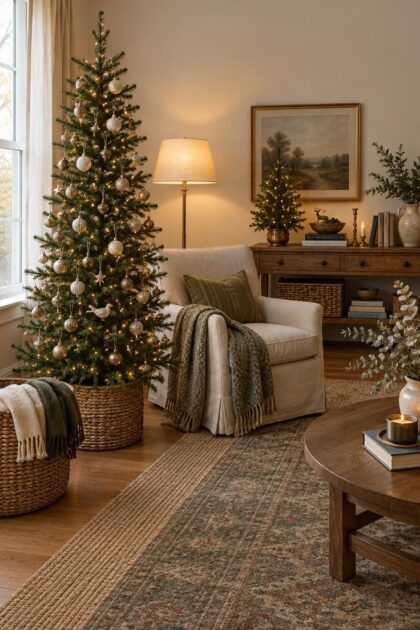
Sparse Open-Branch Tree with Brass Accents
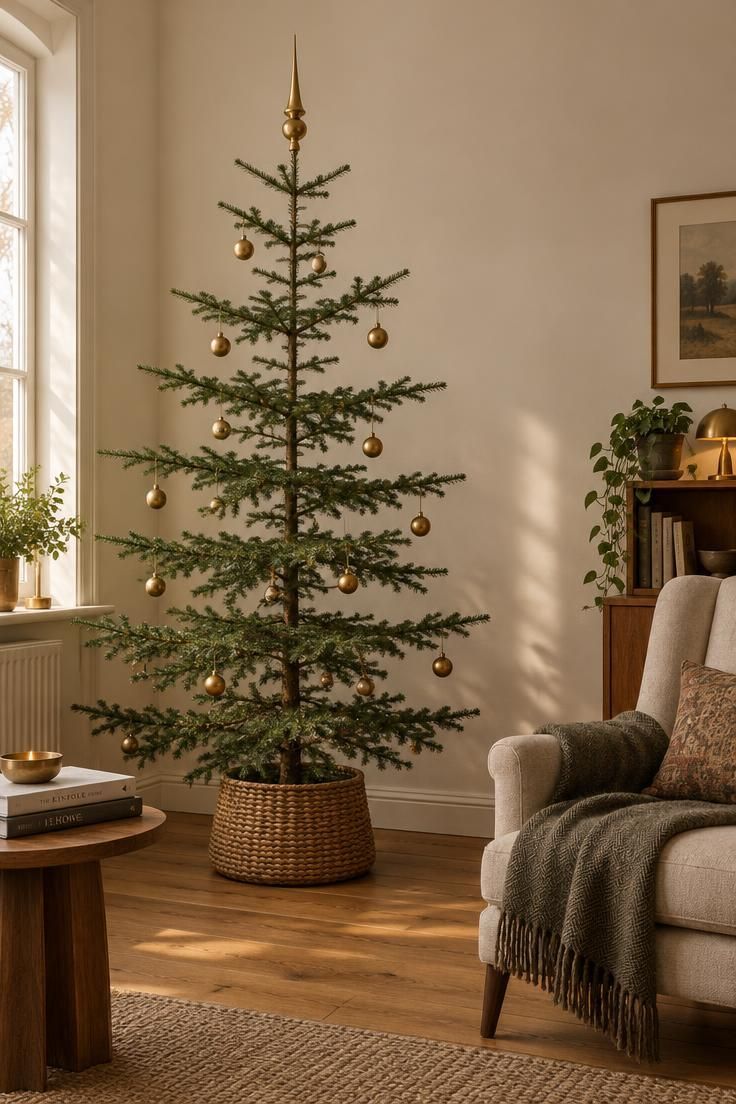
An open-branch tree carries its character in the gaps.
Widely spaced branches let the wall behind show through, which keeps a small corner from feeling blocked, and the silhouette does more work than the decoration.
That makes ornament placement the main design decision: a small set of brass pieces in similar sizes, spaced with visible rhythm, reads as intentional, while a crowded tree erases the airiness that made the look worth choosing.
Brass works here because it catches light without adding a second color story.
A simple brass spire at the top and a woven basket holding the trunk finish the composition, and the basket doubles as the tree skirt and base vessel, so no fabric pooling is needed on a tight floor.
Keep the backdrop plain and let the chair nearby suggest the tree is part of daily life rather than a display.
This direction suits a secondary tree or a quiet corner piece.
A household that prefers dense, many-layered decoration may find it underdone, and that is a fair tradeoff to weigh before committing.
Choose it when the room already has strong furniture and you want the tree to sit lightly among it.
Style Blueprint:
- Open-branch tree with visible gaps between limbs
- Small brass ornaments in two similar sizes, spaced with rhythm
- Brass spire topper
- Low woven basket as the base
- Plain light wall behind the tree
Design Pro-Tip: Cluster two or three ornaments at a few branch tips instead of distributing them evenly everywhere; the small concentrations emphasize the tree’s structure while leaving plenty of open space.
Flocked Slim Tree with Soft Blue Ornaments
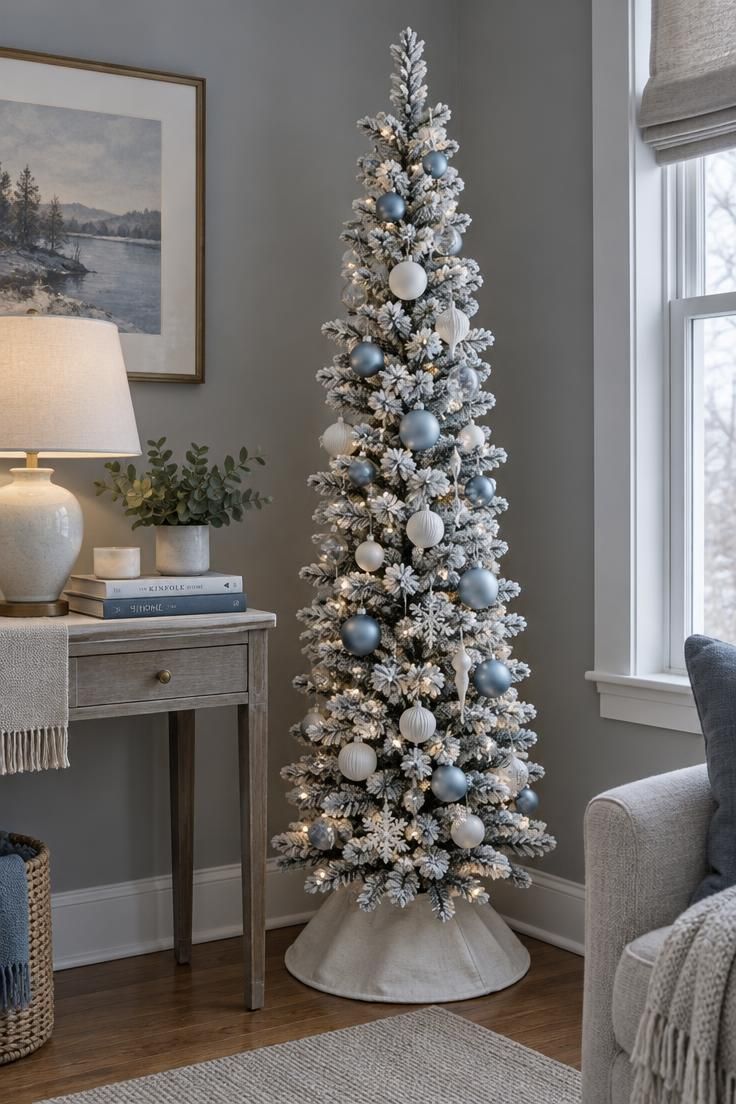
A slim pencil Christmas tree earns its place in an apartment corner by taking up little floor width, and the flocked finish adds a snow-dusted surface that plain green branches do not offer.
The narrow profile rewards restraint: soft blue and matte white ornaments in a limited range keep the tree cohesive, and the frosted branches supply texture so the palette does not need variety to stay interesting.
A short pale fabric skirt grounds the base without adding bulk, which matters when the tree stands beside a console.
Against a cool gray wall the blue and white read cleanly, while a busy backdrop would compete with the textured branches.
The flocked surface shows handling wear and dust more readily than plain foliage, so careful storage between seasons protects the look.
Treat this as a tree for rooms with cool or neutral palettes.
Warm-toned rooms can still use it, though the blue will read as a deliberate contrast rather than a blend.
Style Blueprint:
- Slim pencil-profile tree with flocked branches
- Soft blue and matte white ornaments only
- Short pale fabric skirt
- Cool gray or neutral wall behind
- Low console or side table alongside
Midnight Blue Tabletop Tree with Starched Linen Garland
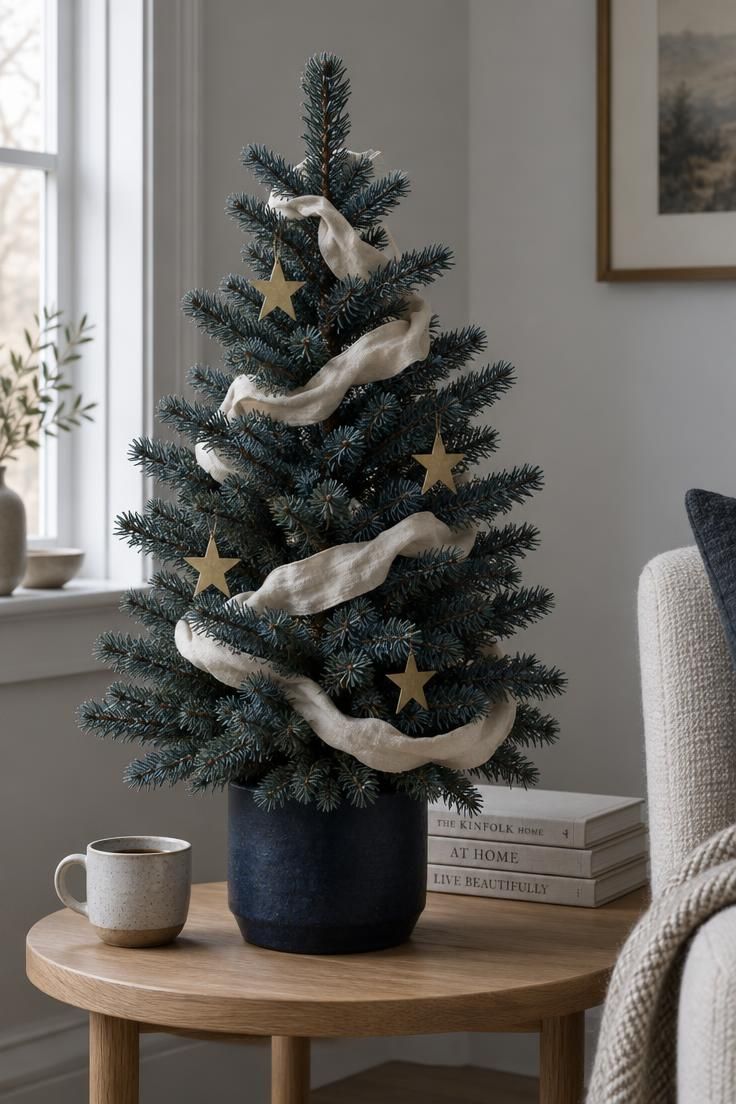
A midnight blue tree gives a room the graphic depth of black without blocking every bit of ambient light.
The deep navy holds its shape against a pale wall, yet still separates from the shadows on a dark winter afternoon.
A starched ivory linen garland is the quiet counterweight, wound around the branches in a loose, irregular line rather than a perfect spiral.
This modern christmas tree works best when it does not try to be a full-size centerpiece.
Placing it on a round side table at chair height keeps the display close enough to notice the fabric folds and brass star edges.
The garland becomes the main decorative layer, so ornament count can drop to four or five pieces.
One practical tradeoff is dust settling into the linen weave over several weeks.
A gentle shake outside or a clean soft brush keeps the fabric looking crisp through December, though the tree is easier to refresh when the garland is left in one long piece.
Style Blueprint:
- Midnight blue tabletop tree with open branch structure
- Starched ivory linen garland wound at uneven intervals
- Flat brass star ornaments in two or three sizes
- Round pale wood side table near a window
- Low seating nearby, not a full tree skirt arrangement
Tabletop Tree in a Ceramic Pot with Paper Ornaments
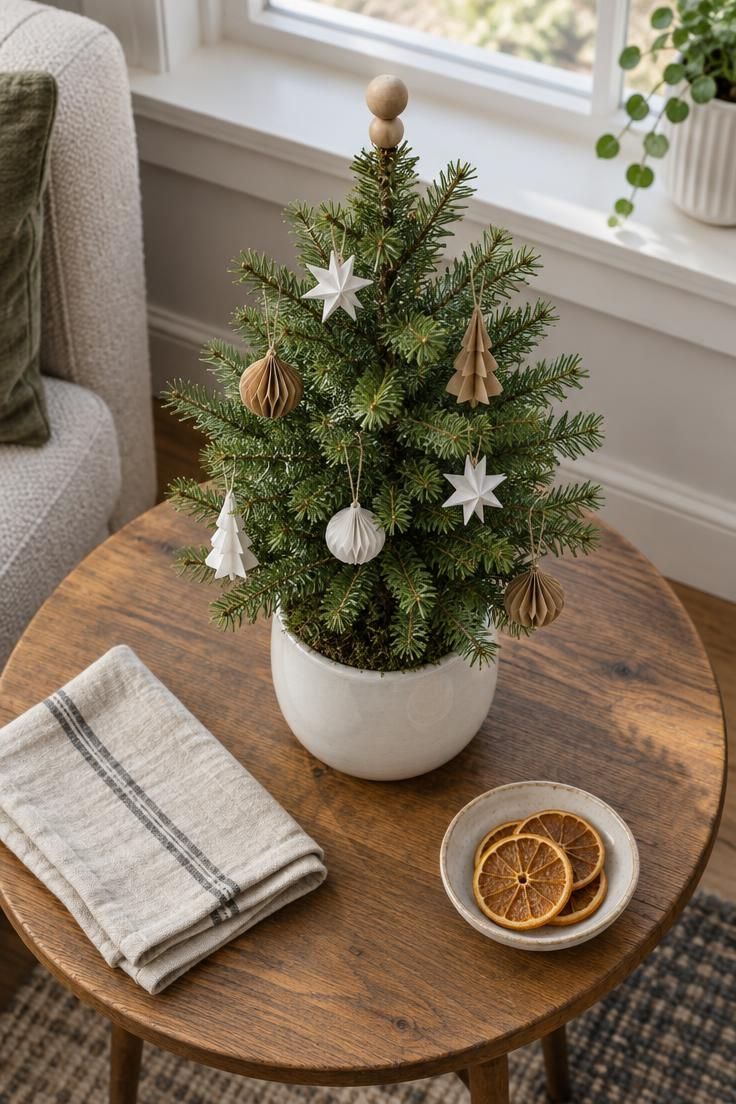
Tabletop Christmas tree styling turns a side table, shelf, or entry console into a holiday moment without spending any floor space.
The tree becomes a styled object rather than a room anchor, so the composition is about scale relationships: a miniature tree in a simple ceramic pot, paper ornaments in white and kraft tones, and one small topper such as a wooden bead.
Scale is the deciding factor.
Ornaments should stay small enough to read as details, roughly walnut-sized at most, or they will overwhelm the tree and the table beneath it.
Paper keeps the look light and slightly handmade, which suits a cozy room better than glass or metal at this size.
A single tabletop tree can feel lost in a large room unless it is paired with other decor, so treat it as one note in a composition rather than the whole statement.
In a small room, that same modesty is exactly the point.
Style Blueprint:
- Miniature green or branch-form tree
- White ceramic pot or shallow bowl as the base
- White and kraft paper ornaments
- One small topper, such as a wooden bead
- A wooden side table or console surface
Silver Tinsel Tree with Ribbon Garland Bands
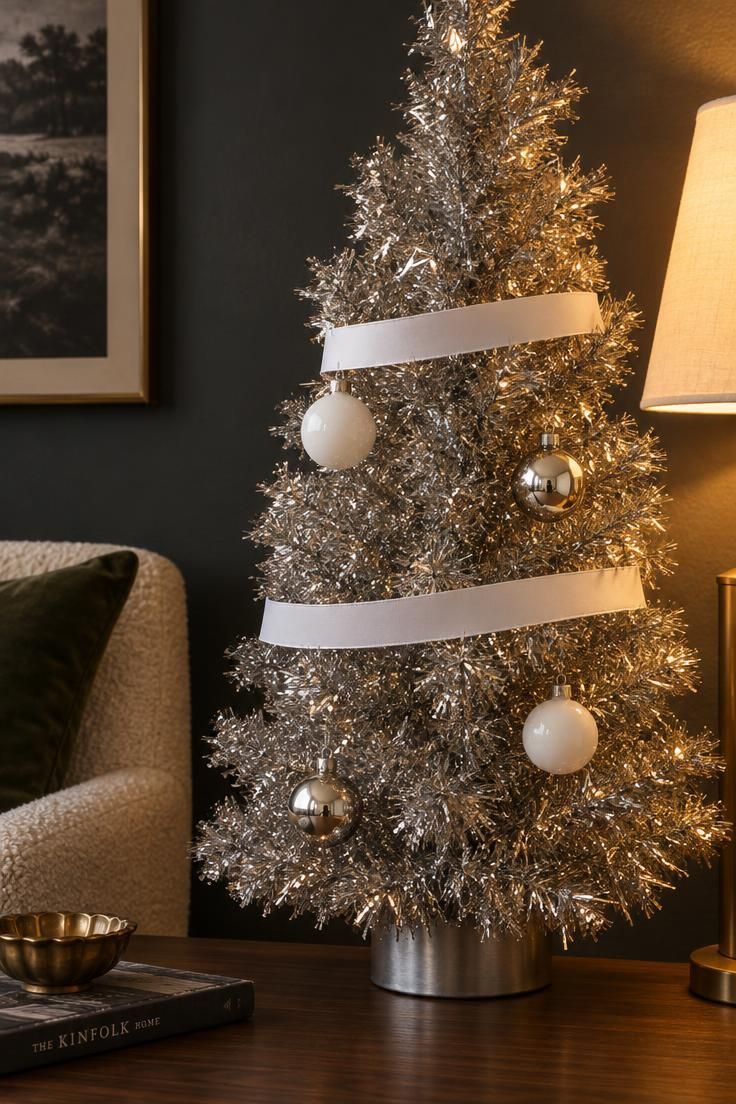
A silver tinsel tree brings a reflective, mid-century note to a small cozy room, and its branches already supply the shine.
That means ornaments should step back: a few solid white or silver balls are enough, and the ribbon becomes the main decorative gesture.
Two or three horizontal bands wrapped around the tree create a graphic line that contrasts with the tinsel’s shimmer.
Keep the base tidy with a simple silver stand or a wrapped box, and keep the lighting warm and low so reflections stay soft rather than harsh.
This tree works on a tabletop or as a slim floor version, which gives it flexibility in tight rooms.
The tradeoff is stylistic rather than practical.
A household that prefers natural foliage will find tinsel too artificial, and no amount of ribbon changes that.
For a room with modern or retro furniture, the material contrast is the appeal.
Style Blueprint:
- Silver tinsel tree, tabletop or slim floor size
- Two or three crisp white ribbon bands, horizontal
- A few solid white or silver ball ornaments
- Simple silver stand or wrapped box base
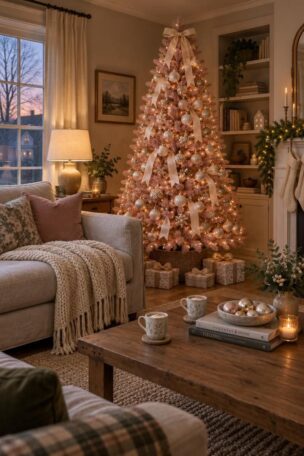
Blush Tree Dressed with Dried Flowers and Paper Fans
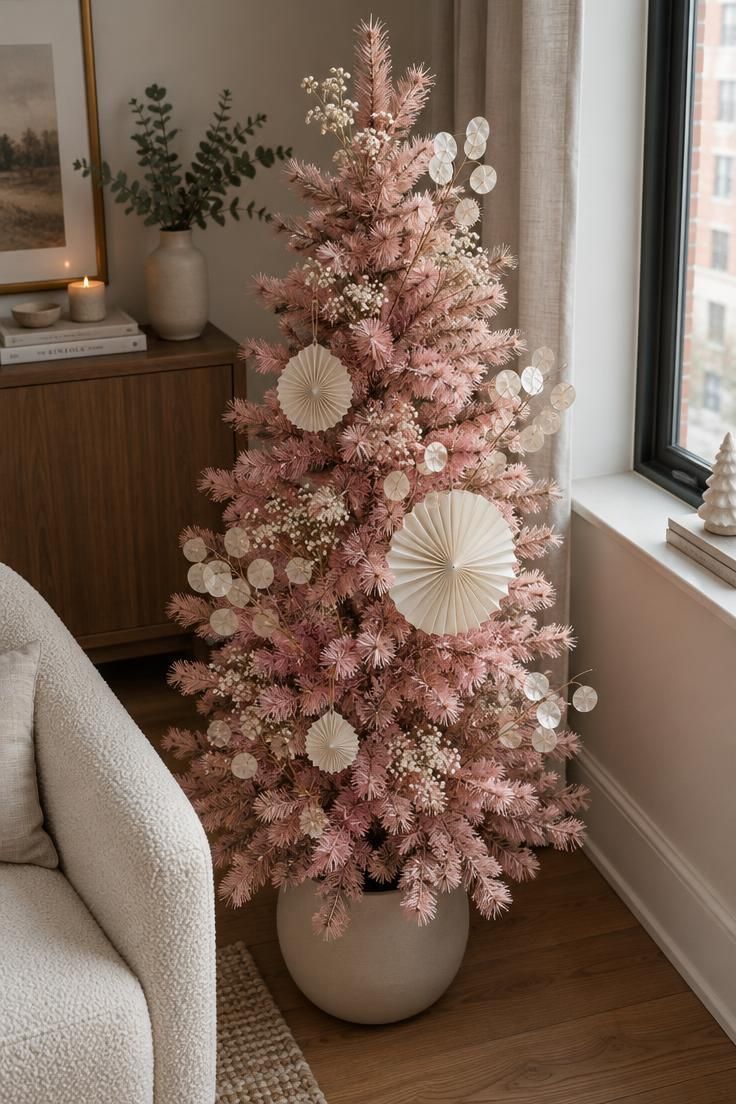
A dried-flower approach changes the function of a blush tree from ornament display to textural garden arrangement.
Lunaria branches echo the opaque, silvery side of the pink palette, while small preserved gypsophila reads more like a soft botanical filler than holiday trim.
Paper fans in ivory and cream do the work of traditional round ornaments without adding metallic shine.
Their flat shape keeps the tree from feeling heavy in a corner, and their matte surface pairs naturally with dried plant material rather than competing with it.
A smooth sand-toned ceramic pot replaces a fabric skirt and gives the base a calmer, year-round object quality.
This version suits a room where the same pot and dried stems could work as part of the warm neutral decor even after the tree comes down.
Dry stems can shed a little when the tree moves, so a quick pass with a dusting brush after unpacking helps keep the surrounding floor clean.
Style Blueprint:
- Slim blush or pale pink tree
- Dried lunaria and preserved gypsophila tucked into branches
- Cream and ivory paper fans in varied sizes
- Matte sand ceramic pot at the base
- Warm neutral chair or upholstery nearby
Natural Branch Tree on a Wall-Mounted Form
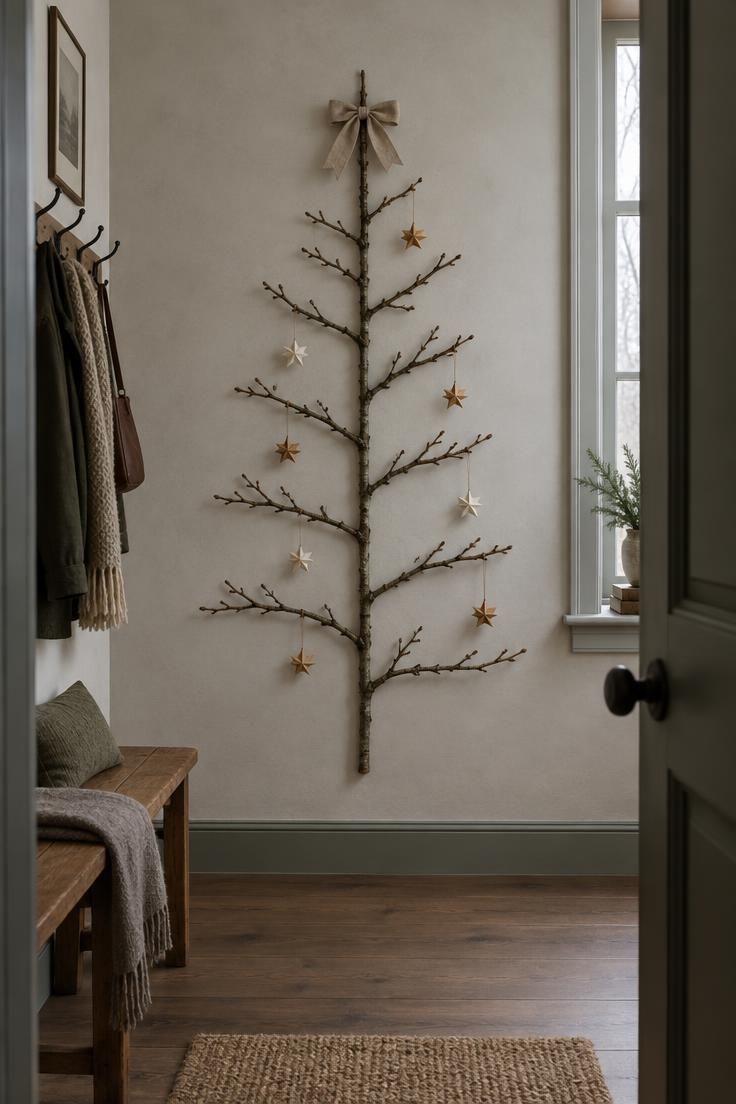
A wall-mounted branch arrangement, sometimes called a half tree or tree-shaped wall art, solves the tightest rooms by giving up the floor entirely.
A central vertical branch acts as the trunk, with shorter branches arranged along its length to trace a tree silhouette against a plain wall.
Decoration stays light and few: paper stars or small wooden shapes, plus a simple bow or star at the top to give the eye a resting point.
Because the form is graphic rather than full, it reads as a gesture toward a tree rather than a substitute for one, which is why a blank wall behind it matters so much.
This option suits a hallway, a doorway threshold, or a very small room where clear floor space is the priority.
It lacks the fullness of a real tree, and a household that wants that fullness will notice the difference every evening.
Arrange it where nothing else competes for attention.
Style Blueprint:
- Central vertical branch with shorter branches along its length
- Small paper star or wooden ornaments, used sparingly
- Fabric bow or simple star at the top
- Plain, uncluttered wall behind
Sculptural Steel-Wire Tree with Single Oversized Star

For monochrome Christmas tree decor, a steel-wire tree in a spare spiral silhouette keeps the modern Christmas tree idea visible without taking up visual space, which helps in a small room where a dense evergreen shape would crowd the corner.
One oversized star in brushed brass becomes the whole point, so the tree reads as sculpture rather than a seasonal prop.
The scale works best on a side table, credenza, or narrow shelf where the wire outline can sit against a plain wall and let the shadow pattern do part of the decorating.
A matte ceramic base in charcoal or deep umber adds just enough weight to stop the slender form from feeling flimsy.
The tradeoff is that this style offers little ornament surface, so it suits a room that already has enough texture and pattern elsewhere rather than one expecting the tree to supply all the holiday detail.
Style Blueprint:
- Thin steel-wire body in black or graphite
- Spare spiral or open silhouette with visible negative space
- One oversized brushed brass star as the only ornament
- Matte ceramic base in charcoal or deep umber
Design Pro-Tip: Place the tree slightly off-center against a plain wall, and let a floor lamp or picture light cast the wire shadow sideways across the wall for a second, softer outline at night.
Green Pencil Tree with Wrapped-Present Base Display
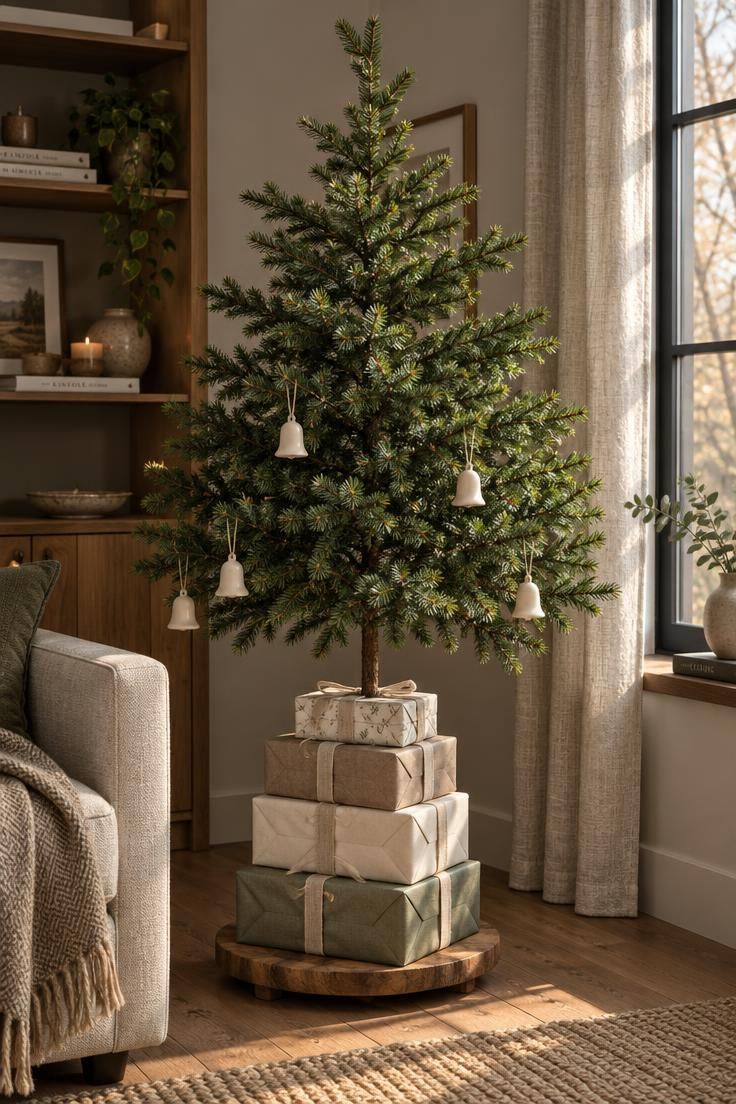
A green pencil tree can double as a display surface for wrapped presents when the base becomes part of the composition.
This modern Christmas tree idea gives a small room extra holiday storage without adding another piece of furniture.
The narrow trunk passes through a compact stack of gifts, and the wrappers are chosen to echo the room’s existing soft neutral palette.
Use cream, taupe, and muted sage papers with thin linen ribbon ties instead of glossy bows.
The stack sits lower than the tree’s first branch so the wrapped forms read as a foundation rather than a pile placed in front by chance.
A low round plinth or a flat woven tray beneath the stack helps contain the arrangement and gives the narrow tree a slightly wider visual footing without taking up floor space beyond the corner.
Keep the tree itself understated with a few unglazed ceramic bell ornaments in soft ivory.
The palette stays green, cream, and pale wood tones, and the wrapped gifts carry the pattern interest.
This approach works best when the paper colors repeat somewhere else in the room, on a cushion, a throw, or a framed print.
Style Blueprint:
- Green pencil-profile tree with bare upper branches
- Four wrapped presents in cream, taupe, and muted sage
- Thin linen ribbon ties in matching or slightly deeper tones
- A few unglazed ivory ceramic bell ornaments
- Low round wooden plinth or flat woven tray under the stack
White Flocked Tree with Wooden Bead and Ribbon Details
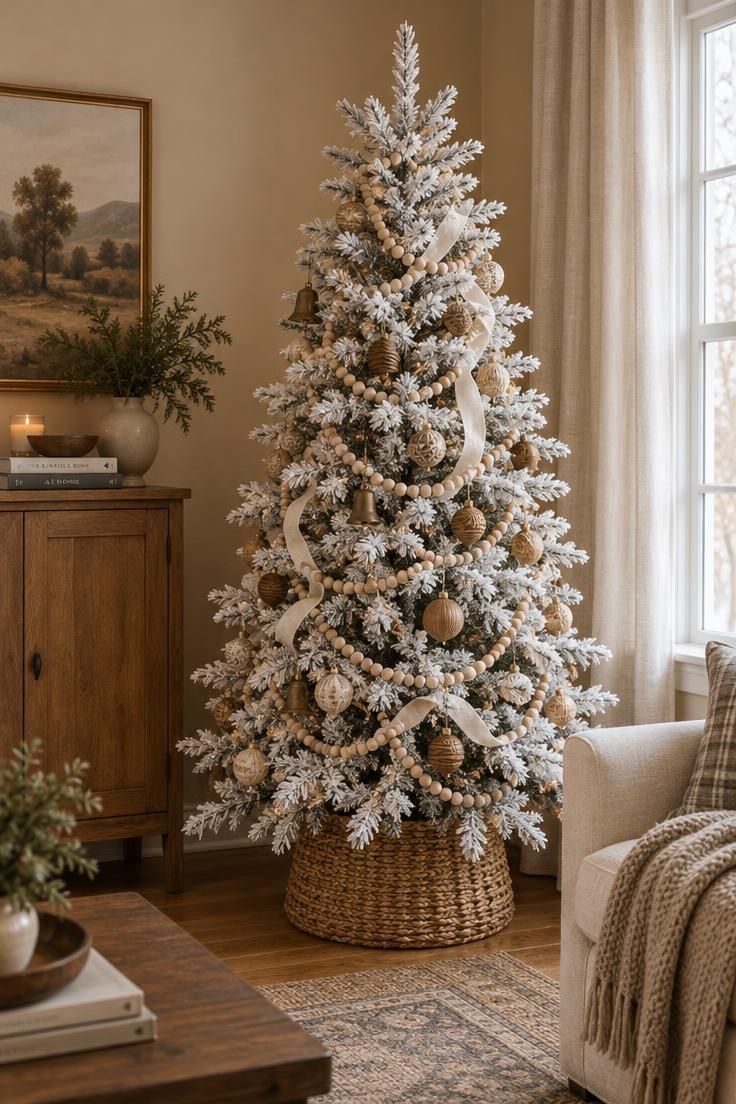
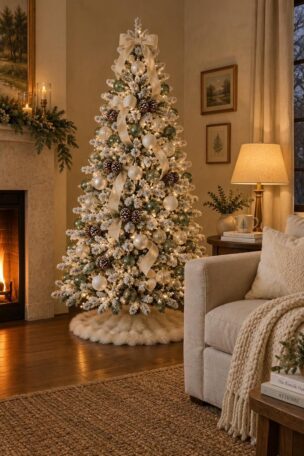
A white flocked Christmas tree brings a snowy, soft texture to a small cozy room, and the risk is that it reads cold.
Wooden bead garlands, cream ribbon, and a few tan or light brown ornaments add warmth without breaking the white palette, while a woven basket or natural fabric skirt sets an organic contrast against the frosted branches.
This mix of white and wood reads as modern without feeling clinical, especially in rooms with warm wood furniture or neutral upholstery.
The flocked finish can shed slightly, so a skirt that catches loose material helps, and handling the branches less keeps the surface even between seasons.
Curtains and rugs in cream or oatmeal continue the softness, while a woven basket ties the base to the room’s natural textures.
Keep the surroundings quiet so the frosted texture remains the focus, since a busy backdrop would compete with it.
Style Blueprint:
- White flocked tree
- Small wooden bead garlands
- Cream ribbon
- Tan and light brown ornaments
- Woven basket or natural fabric skirt
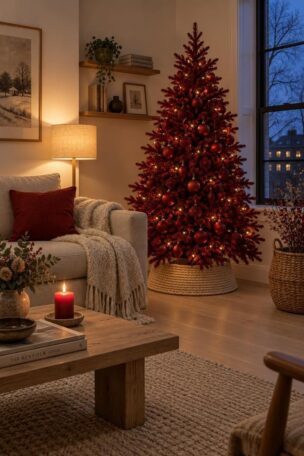
Copper and Bronze Tree with Dark Berry Accents
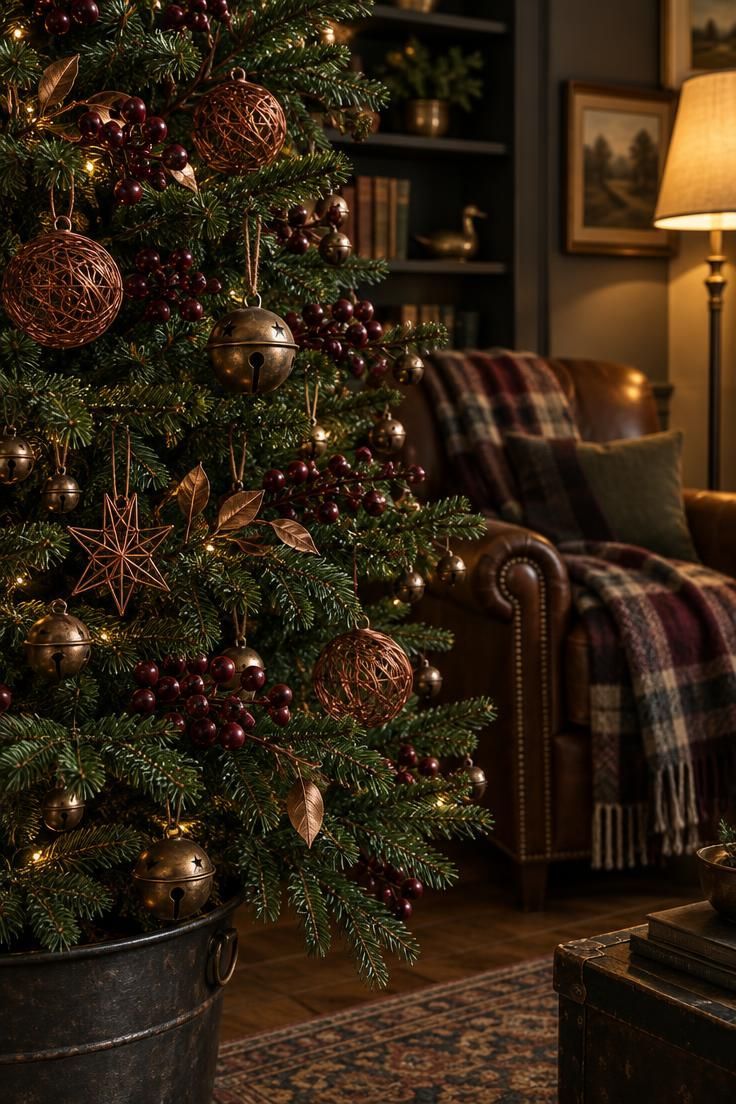
Copper, bronze, and dark berry tones bring a rich warmth to a small reading nook or den, and the palette works best when the room already leans toward warm lighting and earth tones.
Start with a green or black tree, then layer copper wire ornaments, bronze bells, and deep red or burgundy berry picks, keeping matte and metallic finishes in balance so the texture does not go flat.
A dark metal bucket or urn as the base ties the composition together and gives the rich palette a grounded finish.
The most common pitfall is overcrowding: leave some branches bare so the metallic tones can catch light, and the tree will read as considered rather than packed.
This palette rewards a room with a leather chair, wool, or dark wood nearby.
In a bright, cool-toned room, the copper may feel heavy, so judge it against the furniture before committing.
Style Blueprint:
- Green or black tree as the base
- Copper wire ornaments and bronze bells
- Deep burgundy berry picks
- Matte and metallic finishes mixed
- Dark metal bucket or urn base
Conclusion
Choose a direction based on the floor space you have and the visual weight you want the tree to carry.
Slim, tabletop, and wall-mounted options keep tight rooms feeling open, while bold colors and dense ornament arrangements work when the tree is the room’s main focus.
Pay attention to the base and the topper, since those small choices often decide whether a look reads as modern or traditional.
Editing with intention helps most of all: a few bare branches can make a design feel more considered than filling every inch.