This post may contain affiliate links. If you make a purchase through these links, we may earn a commission at no additional cost to you.
Your kitchen walls are doing nothing right now.
Bare drywall between the cabinets and the ceiling, maybe a clock that came with the house, possibly a faded calendar from two years ago.
People spend months picking out countertops and cabinet hardware but leave the vertical surfaces completely blank — and that blank space is costing the room half its personality.
The good news? Kitchen wall decor doesn’t require a contractor or a five-figure budget.
These 17 ideas range from a Saturday afternoon thrift-store project to a full-height tile installation, and every one of them will make you look at your kitchen differently.
Zellige Tile Extended to the Ceiling in Warm Ivory
Most backsplashes stop at the bottom of the upper cabinets.
That horizontal line where tile meets painted drywall chops the wall in half and makes the room feel shorter than it is.
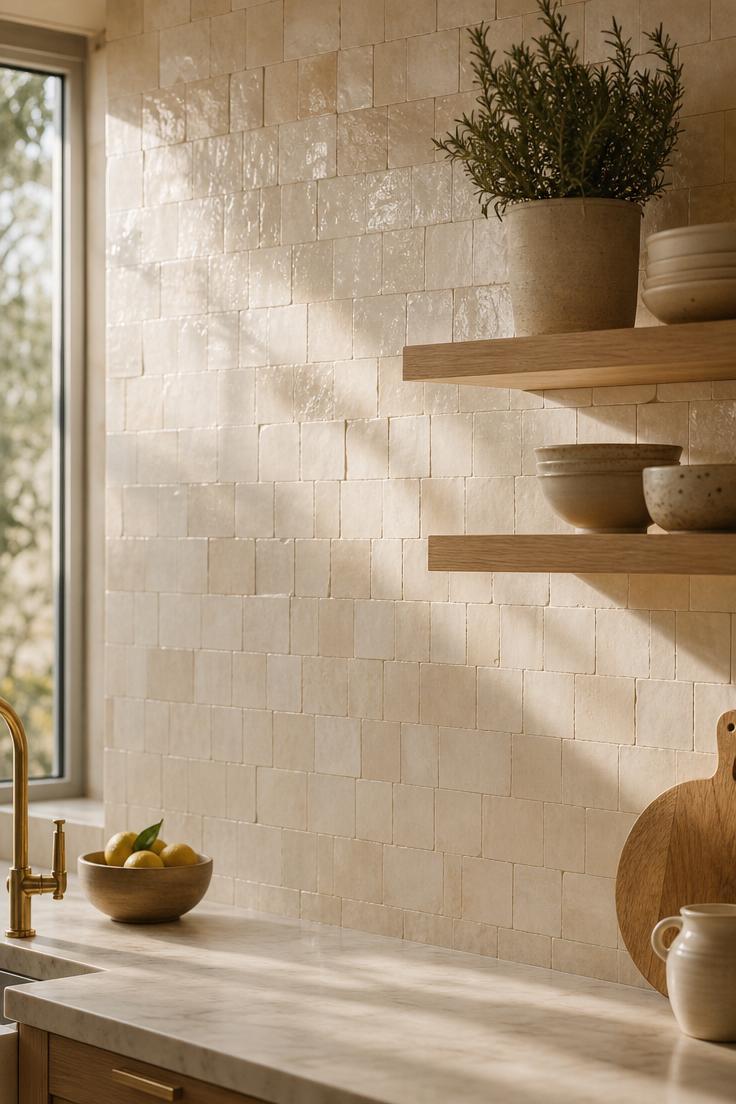
Running zellige tile all the way to the ceiling erases that break and turns the entire wall into a single textured surface.
The irregularity of zellige is what makes it work here — each tile sits at a slightly different depth, and the glaze pools unevenly, so the wall catches light differently throughout the day.
Morning sun hits it flat and the surface looks almost uniform. By 4 p.m., those tiny ridges throw enough shadow to make the whole wall shimmer.
It’s an investment, sure — handmade zellige runs more per square foot than standard ceramic. But covering one wall, not four, keeps the cost realistic and the effect concentrated.
Style Blueprint:
- Handmade zellige tile in ivory or warm white (square format, 4×4 inches)
- Unsanded grout in off-white for a continuous, uninterrupted look
- Brass or unlacquered brass shelf brackets
- White oak floating shelf, 36 inches minimum
- Honed natural stone countertop to complement the matte tile finish
A Grid of Thrifted Ironstone Platters on Navy Paint

White on dark — it never gets old, and it never looks accidental.
Ironstone platters from estate sales and antique malls cost between three and fifteen dollars each, which makes this one of the most affordable kitchen wall art options on this list.
The key is choosing platters that share a general color (white or cream) but differ in everything else — rim shape, size, pattern, age.
A too-perfect grid of identical plates looks like a catalog page. Slight variation in spacing and a mix of round and oval shapes keeps it looking collected rather than purchased.
Navy paint behind them does the heavy lifting. The contrast sharpens every edge and curve, and the dark background makes even the plainest white platter look deliberate.
Disc plate hangers from the hardware store are invisible once mounted, and each one costs under two dollars.
Style Blueprint:
- 5-7 white ironstone platters in mixed sizes (thrift stores, estate sales)
- Invisible disc plate hangers rated for the weight
- Navy or dark charcoal matte wall paint (accent wall only)
- Painter’s tape and a level for grid alignment
- Small finishing nails or picture hooks
Brass Picture Ledge with Rotating Art Prints Above the Sink
Committing to one piece of wall art in the kitchen feels permanent. What if you get tired of it in three months?
A picture ledge solves that problem entirely.
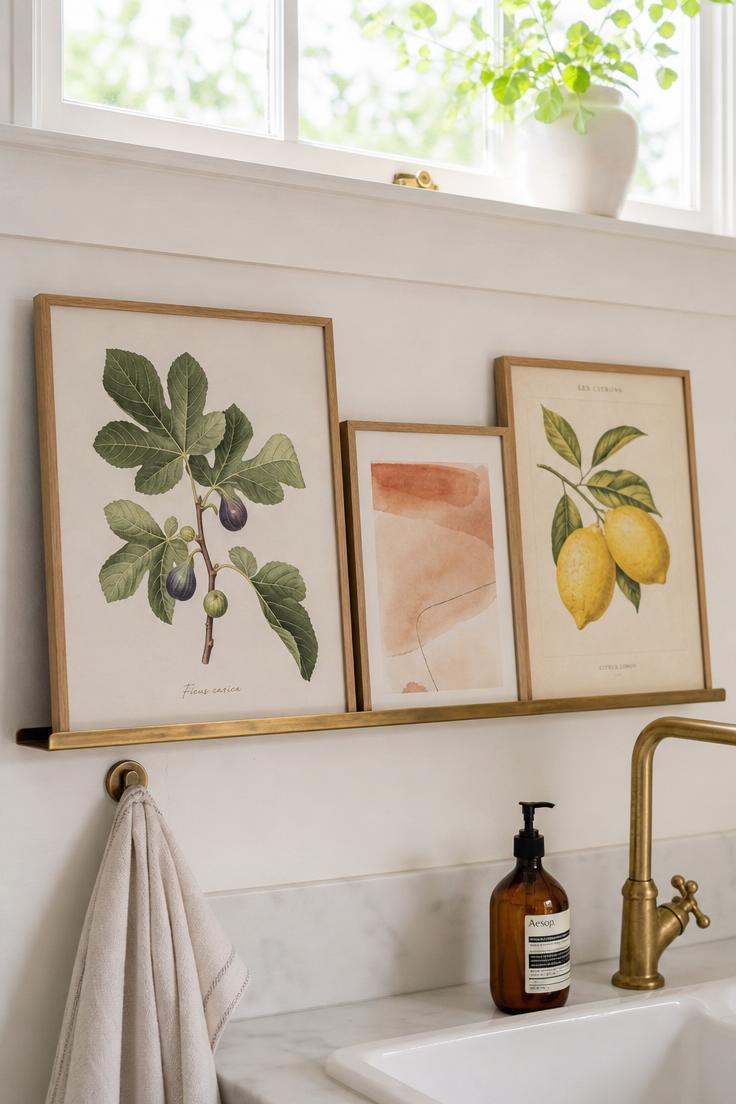
One slim brass channel screwed into the wall above the sink gives you a spot to lean prints, postcards, small framed photos, or whatever catches your eye — and swap them out whenever the mood shifts.
Seasonally, this works especially well. A citrus print in summer, a fig branch in fall, something snowy or evergreen in winter.
The brass adds a warm metallic note without competing with the art, and the ledge itself is shallow enough (two inches deep) that it doesn’t interfere with anyone doing dishes.
Three prints is the right number for a 36-inch ledge. Two looks sparse, four gets crowded.
Style Blueprint:
- Brass picture ledge, 24–36 inches long
- 3 art prints in thin wood or brass frames (mix sizes between 5×7 and 8×10)
- Prints with kitchen-adjacent subjects: botanicals, food, still life, abstract
- Small brass command hook for a linen towel below
- Amber or green glass soap dispenser as a shelf-level accent
Oversized Round Rattan Mirror Between Two Windows
That narrow strip of wall between two windows is a dead zone in most kitchens.
Too small for a cabinet, too awkward for a standard rectangular frame.
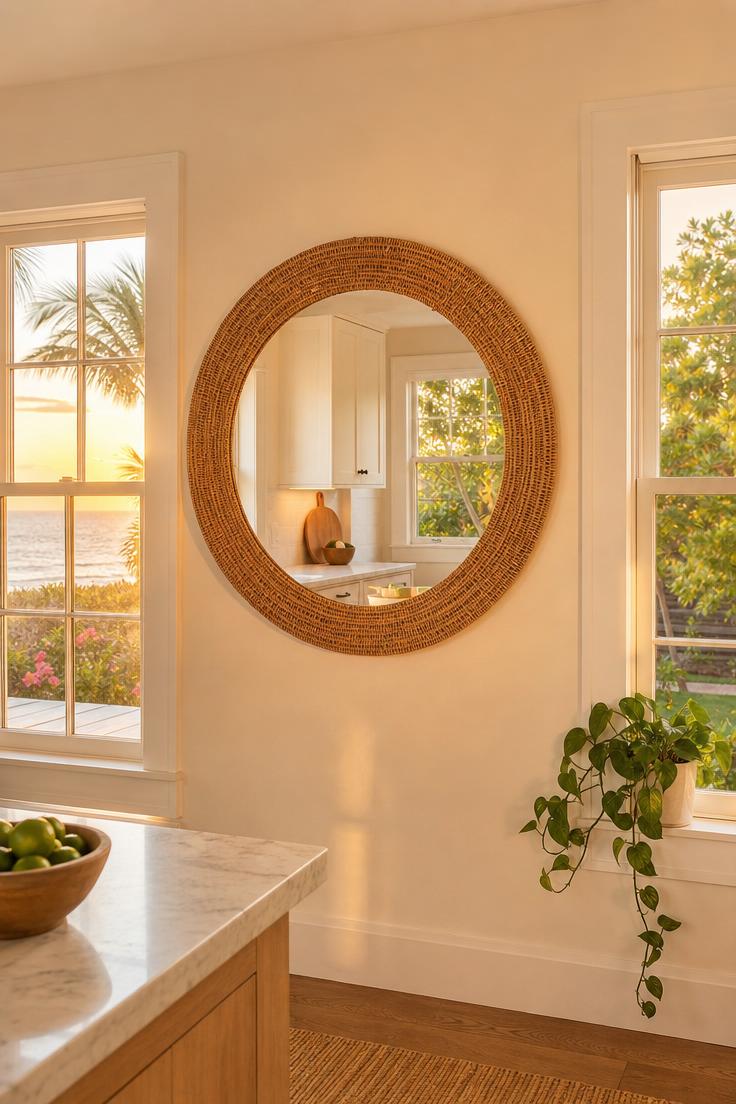
A round mirror fills that space without fighting the vertical lines of the window trim, and the circular shape softens a room full of right angles.
Rattan adds a layer of texture that reads differently depending on the light — golden and warm in the evening, cooler and more graphic in the morning.
Functionally, a mirror in the kitchen doubles the light in the room. Whatever comes through those flanking windows bounces back into the space and brightens corners that overhead lighting misses.
It also makes a narrow galley kitchen or single-wall layout feel twice as wide.
Style Blueprint:
- Round rattan mirror, 30–36 inches diameter
- Wall anchors rated for the mirror’s weight (rattan-framed mirrors can be surprisingly heavy)
- Cream or warm white wall paint as a backdrop
- Small trailing plant on an adjacent windowsill
- Avoid hanging directly above a heat source
Design Pro-Tip: When hanging anything between two windows, center it by measuring from the inside edge of each window frame — not from the outer trim. Centering from trim-to-trim is the most common mistake, and it makes the piece look slightly off even though you can’t immediately tell why.
Hand-Painted Portuguese Cement Tile as a Focal Panel
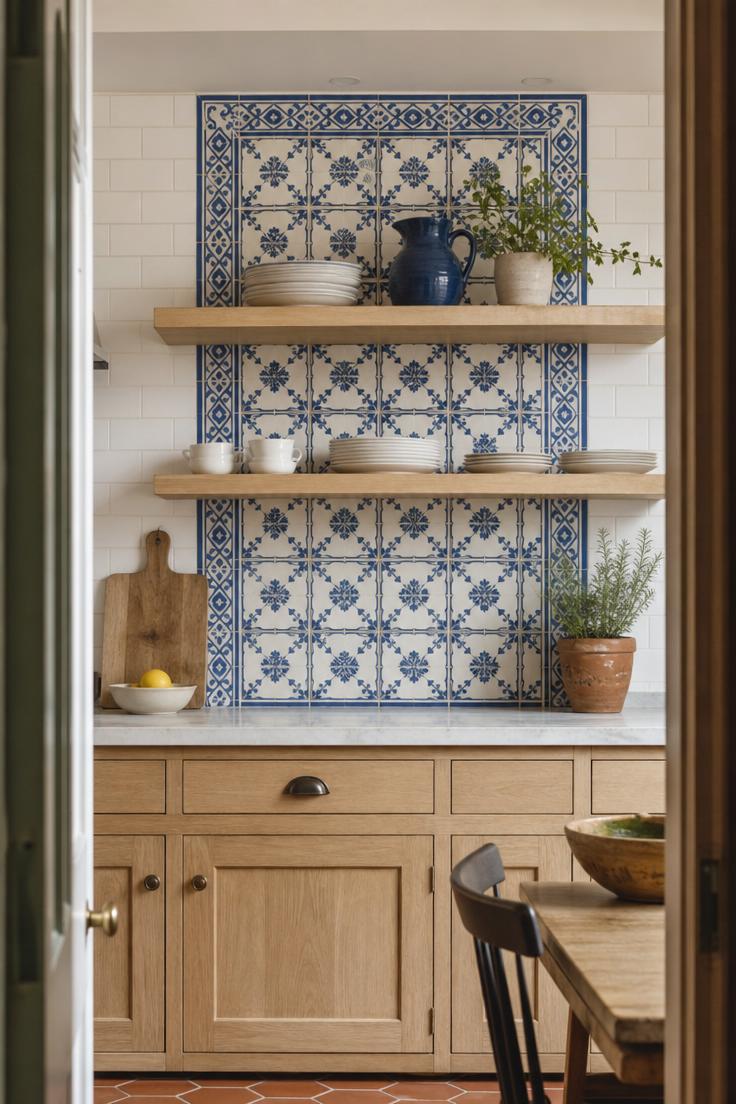
One small section of patterned tile can anchor an entire kitchen the way a single painting anchors a living room.
Portuguese cement tiles — azulejos and their geometric cousins — carry enough visual weight in a 3×4-foot panel to make everything around them feel intentional.
The trick is framing the patterned section with something plain on either side. White subway tile, painted plaster, or even bare wall creates a visual border that keeps the pattern from overwhelming the room.
Behind open shelving works perfectly because the shelves partially obscure the pattern, revealing it in glimpses between the plates and bowls. It creates a layered depth that a fully exposed tile wall doesn’t achieve.
These tiles are thicker than standard ceramic and need a proper thinset application, so this is more of a weekend project than an afternoon one.
But a single panel — say, 12 to 15 tiles — costs far less than tiling an entire backsplash.
Style Blueprint:
- Hand-painted cement tiles in blue-and-white or earth-toned geometric pattern (12–15 tiles for a focal panel)
- Plain tile or painted wall flanking the panel for contrast
- Light wood open shelving with simple L-brackets
- White and blue ceramics on shelves to echo the tile palette
- Professional thinset adhesive and sealer (cement tiles are porous)
Pegboard Painted in Forest Green with Brass Hooks
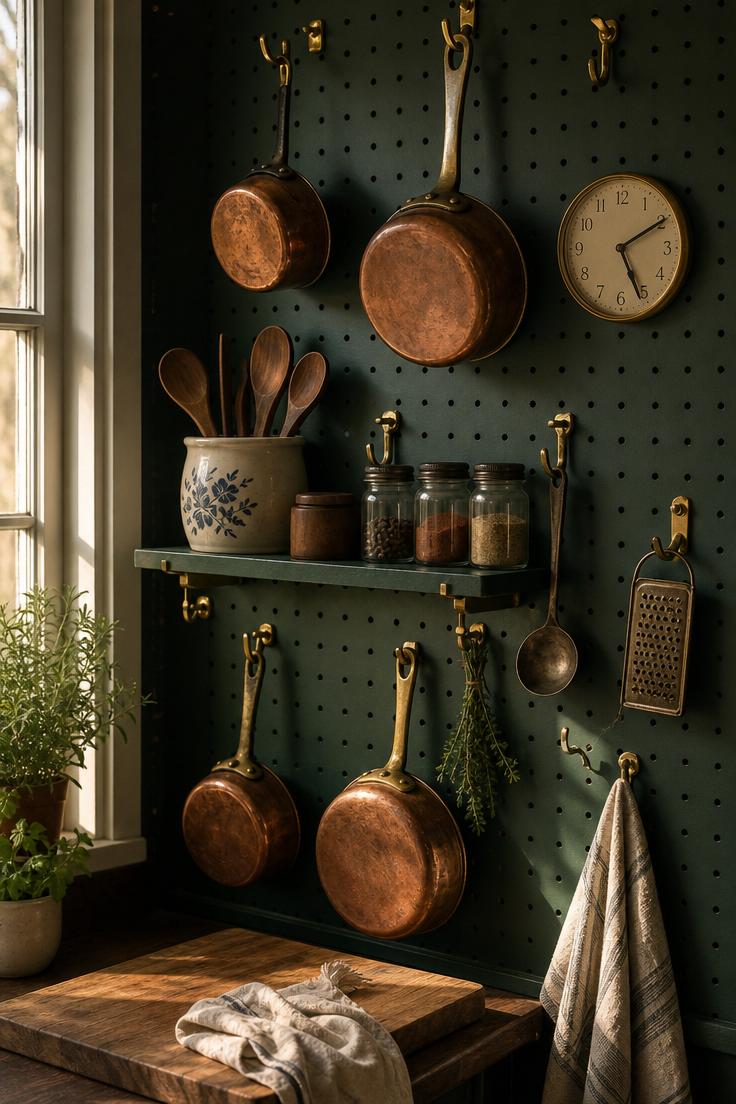
Pegboard gets dismissed as a garage solution, and that’s a shame.
Painted in a saturated color and fitted with brass hardware, it becomes a living wall that stores and displays at the same time.
Forest green works especially well because it reads as both earthy and refined — dark enough to make copper and brass pop, warm enough to avoid feeling cold or industrial.
The beauty of pegboard is the flexibility. Hooks move, shelves shift, and the whole arrangement can change with the seasons or whenever you bring home a new find from the flea market.
Brass S-hooks look ten times better than the standard zinc ones that come in the hardware aisle, and the upgrade costs maybe twenty dollars total.
One full sheet of pegboard (4×8 feet) runs under thirty dollars at any building supply store. Add a quart of paint and a handful of brass hooks, and the entire project comes in under a hundred.
Style Blueprint:
- One sheet of 4×8 pegboard (tempered hardboard, ¼-inch thick)
- Forest green or deep teal matte paint
- Brass S-hooks and brass pegboard shelf brackets
- Copper-bottomed cookware or wooden utensils for display
- Small brass-framed clock or mirror as a focal point on the board
A Single Oversized Charcoal Still Life Drawing
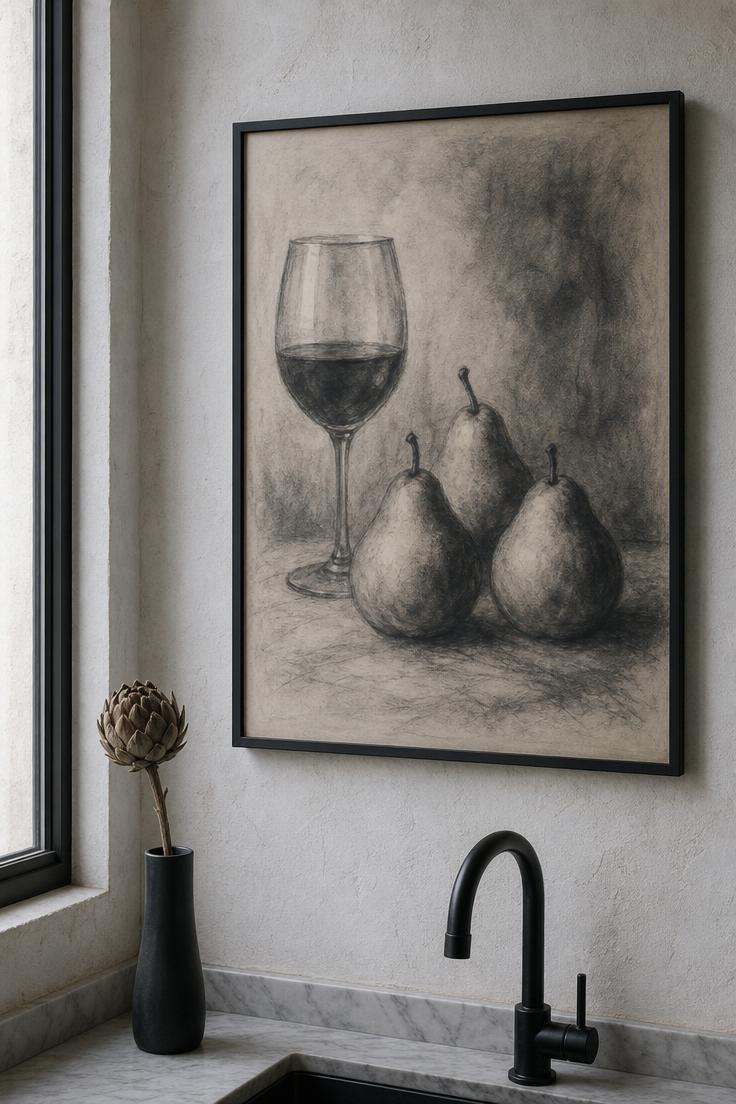
One piece. One frame. Done.
There’s a common instinct to fill kitchen walls with collections — groups of prints, clusters of objects, rows of things. Sometimes the most striking move is a single drawing that holds the wall by itself.
Charcoal has a softness that photographs and digital prints don’t. The edges bleed, the values shift, and up close you can see the grain of the paper through the medium.
A still life subject — fruit, a bottle, a simple vessel — connects to the room without being literal or kitschy. It’s kitchen wall art that feels like it belongs in a gallery, which is exactly why it works.
The frame should be thin and dark so it doesn’t compete. Thick ornate frames belong in dining rooms and hallways; here, the frame just contains the piece and disappears.
Size matters more than subject. Going bigger than you think feels right — a 24×30 minimum — fills the wall with a single confident gesture.
Style Blueprint:
- Original or high-quality giclée charcoal still life, 24×30 inches or larger
- Thin black gallery frame with mat
- Pale plaster, off-white, or light gray wall
- Museum-quality hanging wire and D-ring hardware
- One simple object on the counter below to ground the composition (a vase, a bowl)
Reclaimed Barn Wood Floating Shelf with Stoneware Collection
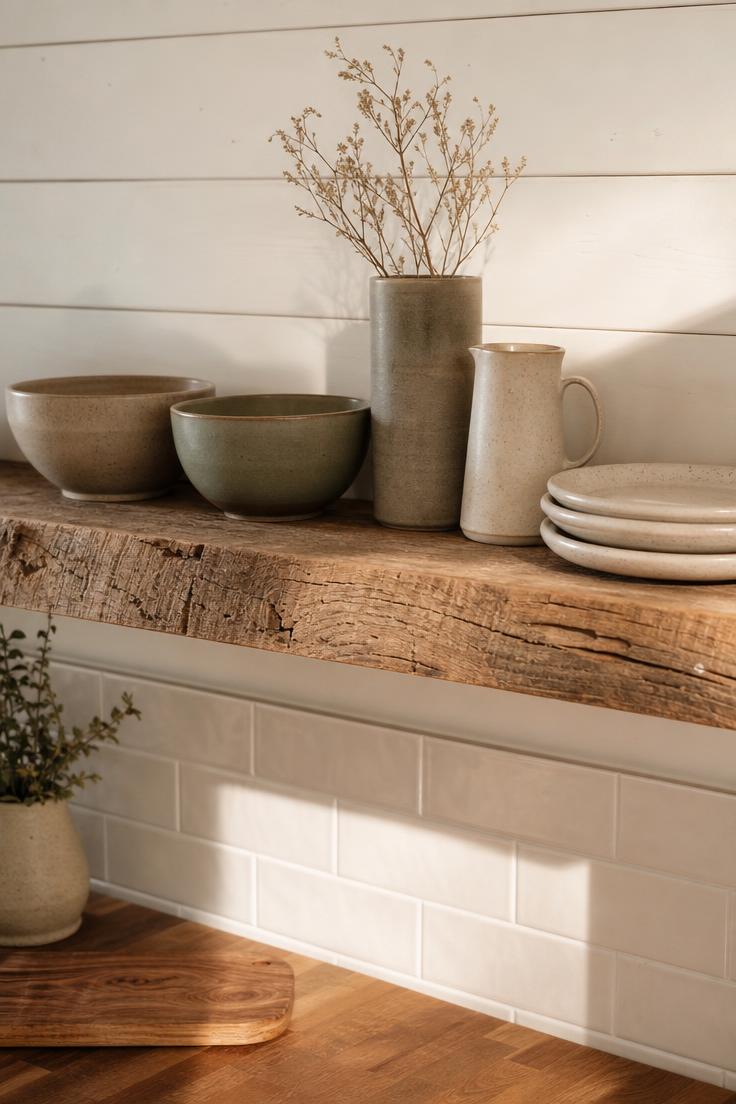
One shelf. That’s all you need to shift the entire feel of a kitchen wall.
Not three matching floating shelves loaded with identical items — one rough-hewn barn wood plank carrying a few pieces that look like they were chosen over years, not ordered in a single cart.
The texture of reclaimed wood against smooth shiplap or painted drywall creates the kind of contrast that expensive kitchens spend thousands engineering into their cabinetry.
Stoneware is the right partner here because it shares that handmade, imperfect quality. Factory-produced dishware would look out of place on a shelf with visible saw marks and nail holes.
Spacing between pieces matters. Leave at least three inches between objects so each one reads individually. A crowded shelf looks like storage; a spaced shelf looks like a display.
The warmth of this look comes from restricting the palette — mushroom, sage, cream, warm gray — and letting texture do the talking.
Style Blueprint:
- Reclaimed barn wood plank (at minimum 2 inches thick, 36–48 inches long)
- Heavy-duty concealed floating shelf bracket
- 4–6 handmade stoneware pieces in earth-tone glazes
- White or off-white wall as a backdrop
- No bookends or shelf accessories — the pieces should stand on their own
Design Pro-Tip: When arranging objects on a single shelf, place the tallest piece off-center — roughly one-third from either end. Centering the tallest object makes the arrangement feel symmetrical and rigid. Off-center placement creates movement, which is why your eye finds it more interesting even if you can’t articulate the reason.
Vintage French Enamel Signs Clustered Above a Doorway
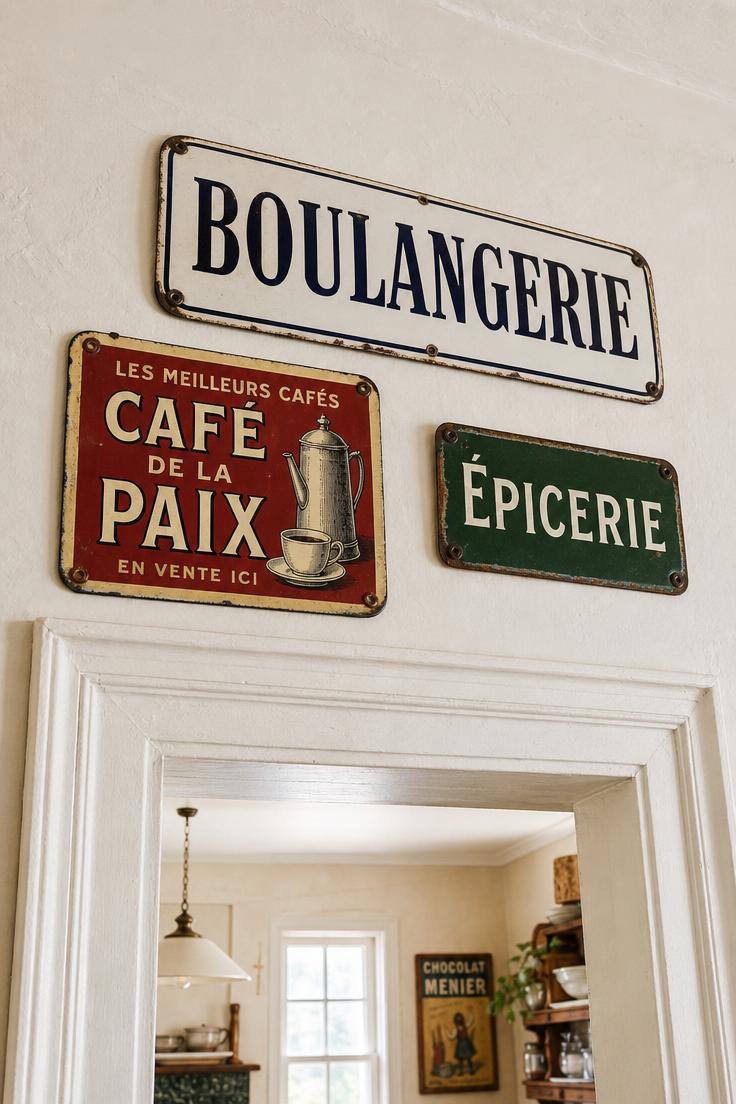
The space above a doorway is the most wasted real estate in any kitchen.
It’s too high for open shelving, too narrow for a standard frame, and most people just leave it blank.
Vintage enamel signs fit this awkward space perfectly because they’re slim, lightweight, and designed to be read from below — exactly the angle you’d see them from across the room.
French enamel advertising signs from the early and mid-twentieth century have a color saturation that modern reproductions can’t match. The baked enamel process produces colors that glow rather than sit flat.
You can find originals at estate sales, online auction sites, and European antique dealers. Reproductions are fine too — several companies make them using traditional enamel methods — but the real ones have chips and patina that tell a story.
Three is the right number for an above-door cluster. One looks lonely, two looks intentional but sparse, and four starts to compete with the doorframe.
Style Blueprint:
- 2–3 vintage or reproduction French enamel signs (aim for varied sizes and colors)
- Small finishing nails or sawtooth hangers (enamel signs are light)
- Warm off-white or plaster-toned wall paint
- Clean doorframe paint (white or cream) to anchor the arrangement
- At least 4 inches clearance above the doorframe before the first sign
Woven Seagrass Baskets Arranged in an Asymmetrical Cluster
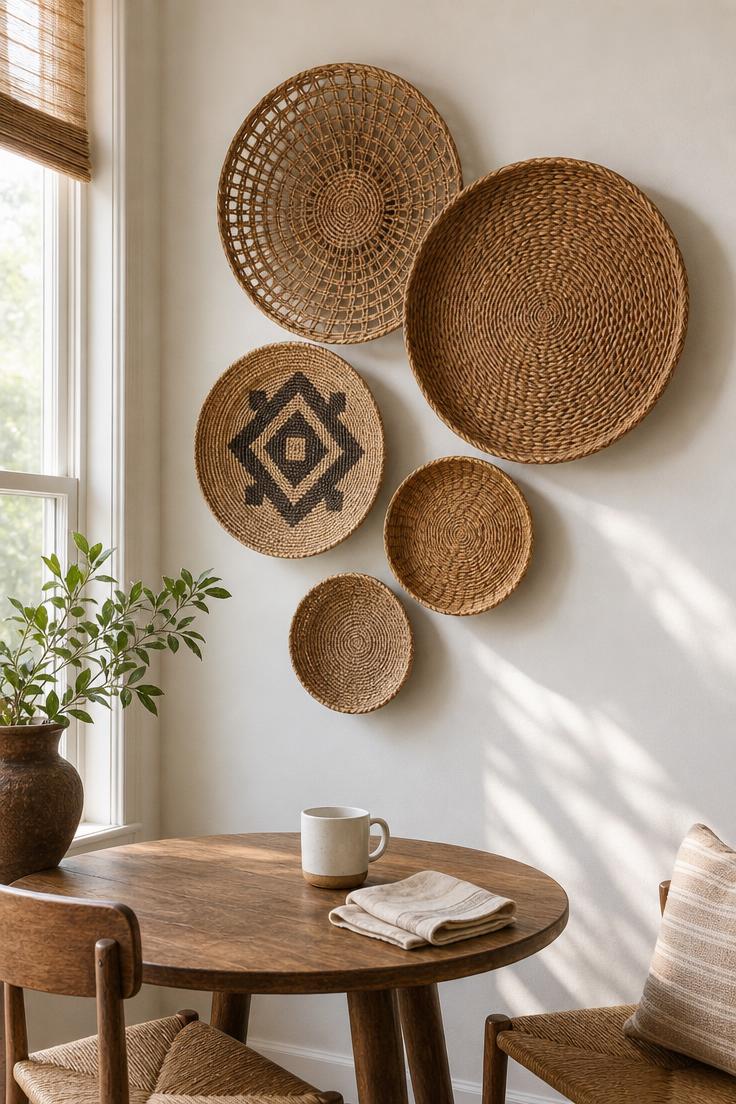
Flat woven baskets on a wall bring something that framed art can’t — actual three-dimensional texture that changes depending on where you stand and how the light hits.
The weave creates tiny shadows that shift throughout the day, giving the wall a quality that flat prints and paintings don’t have.
Seagrass and raffia baskets are lightweight, inexpensive, and available everywhere from home goods stores to online artisan marketplaces. African and Indonesian woven baskets tend to have the most interesting patterns and the most variation in weave density.
The arrangement should feel organic, not geometric. Start with the largest basket slightly left or right of center, then build outward, letting edges almost touch or overlap in places.
A common mistake is spacing them too evenly, which makes the cluster look like it was plotted on graph paper. Step back, squint, and ask whether it looks like it grew there or was measured there.
Hanging is simple — a single nail per basket, hooked through the weave on the back. No special hardware required.
Style Blueprint:
- 5–7 flat woven baskets in varying sizes (8 to 22 inches diameter)
- Mix of weave patterns: tight spiral, open lattice, geometric center motifs
- Natural golden and tan tones with one or two darker accents
- White or cream wall for maximum contrast
- Single finishing nails for hanging (one per basket)
Black Steel Magnetic Knife Strip on an Exposed Brick Wall
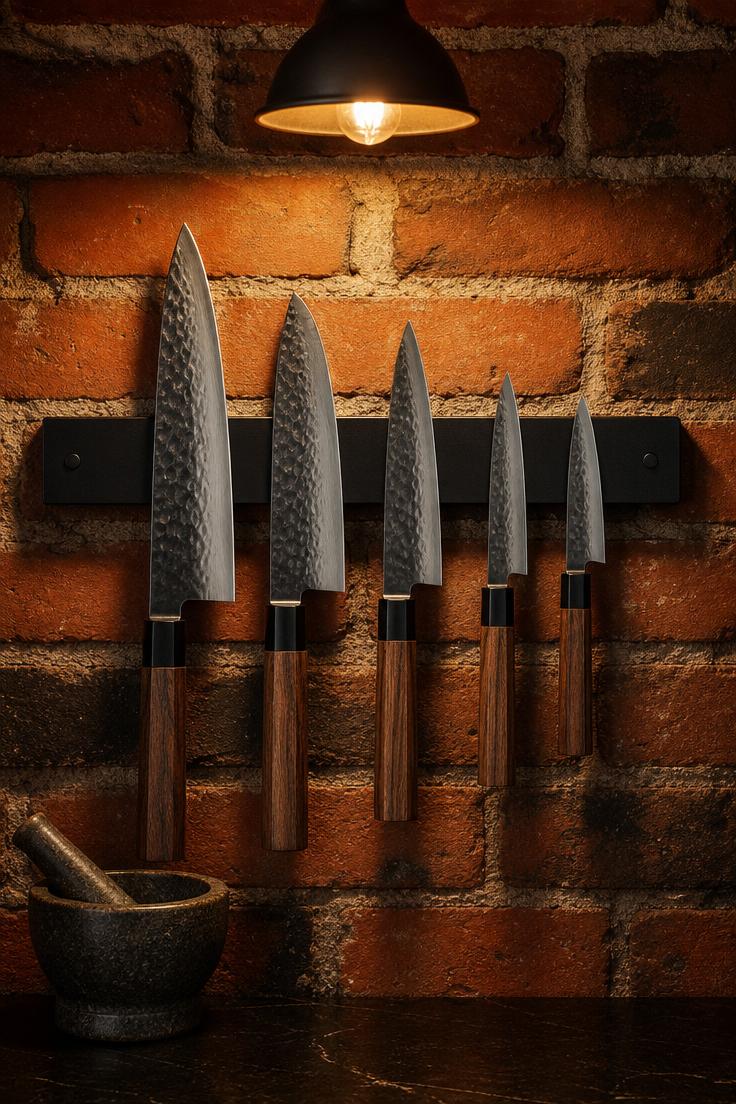
A knife strip on brick is functional kitchen wall decor that doesn’t try to pretend it’s decorative — and that honesty is exactly what makes it look so good.
Exposed brick has enough texture and color variation to serve as its own backdrop. Adding a single horizontal element — one clean black line — creates a contrast between the precision of the steel and the roughness of the masonry.
Japanese knives with wooden handles bring an additional material layer. The warm wood against cool steel against rough brick gives you three textures in about 18 inches of wall space.
Mounting on brick requires masonry anchors, not drywall screws. This is a fifteen-minute job with a hammer drill, but it does need to be done right because a loaded knife strip can weigh several pounds.
Beyond looking sharp (literally), wall-mounted knives stay sharper than knives stored in a drawer where edges knock against each other. The magnetic strip is the most knife-friendly storage method available.
Style Blueprint:
- Black steel magnetic knife strip (16–18 inches)
- Masonry drill bit and expansion anchors for brick mounting
- Japanese-style knives with wooden handles (or any quality knives with visual appeal)
- Exposed or faux brick wall surface
- Pendant lamp or directional spotlight above for dramatic lighting
Pressed Botanical Frames in a Vertical Column Beside the Pantry
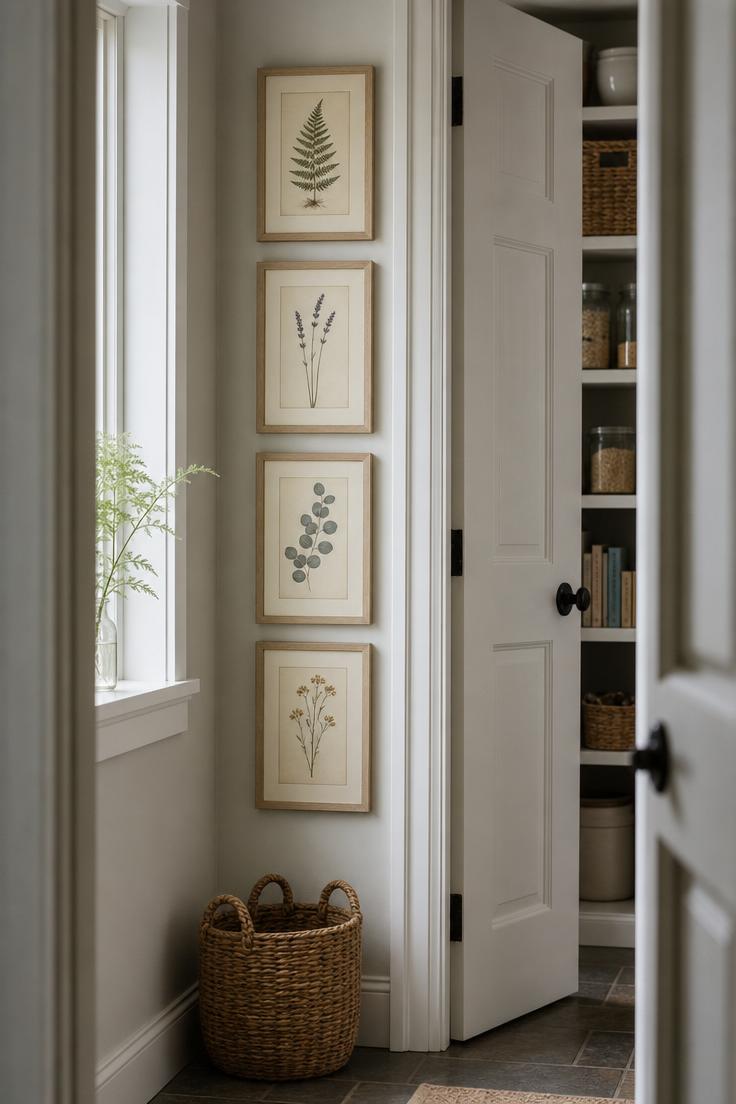
That sliver of wall between the pantry door and the corner of the room? It’s narrower than a standard frame, which is why most people ignore it.
Vertical stacking solves the width problem. Four slim frames (8×10 or smaller) arranged in a single column fit a wall that’s only 12 inches wide and turn dead space into a feature.
Pressed botanicals have a subtlety that printed art doesn’t. The actual plant material sits under the glass, and up close you can see veins in the leaves, the texture of a dried petal, the way a stem curves from being pressed between book pages.
Making your own is half the fun. A heavy book, some parchment paper, and two weeks of patience produces specimens that are specific to your garden or your neighborhood walks.
Consistency in the frames matters here. Because the arrangement is a strict vertical line, matching frames create order. Save the mismatched-frame look for larger, more freeform arrangements.
Style Blueprint:
- 4 slim frames in light wood or white (uniform size, 5×7 or 8×10)
- Pressed botanical specimens on cream or white archival paper
- Narrow wall section (12–18 inches wide)
- Picture wire and small hooks for even vertical spacing
- 3–4 inches between each frame for breathing room
Limewash Accent Wall in Warm Terracotta Behind Open Shelves
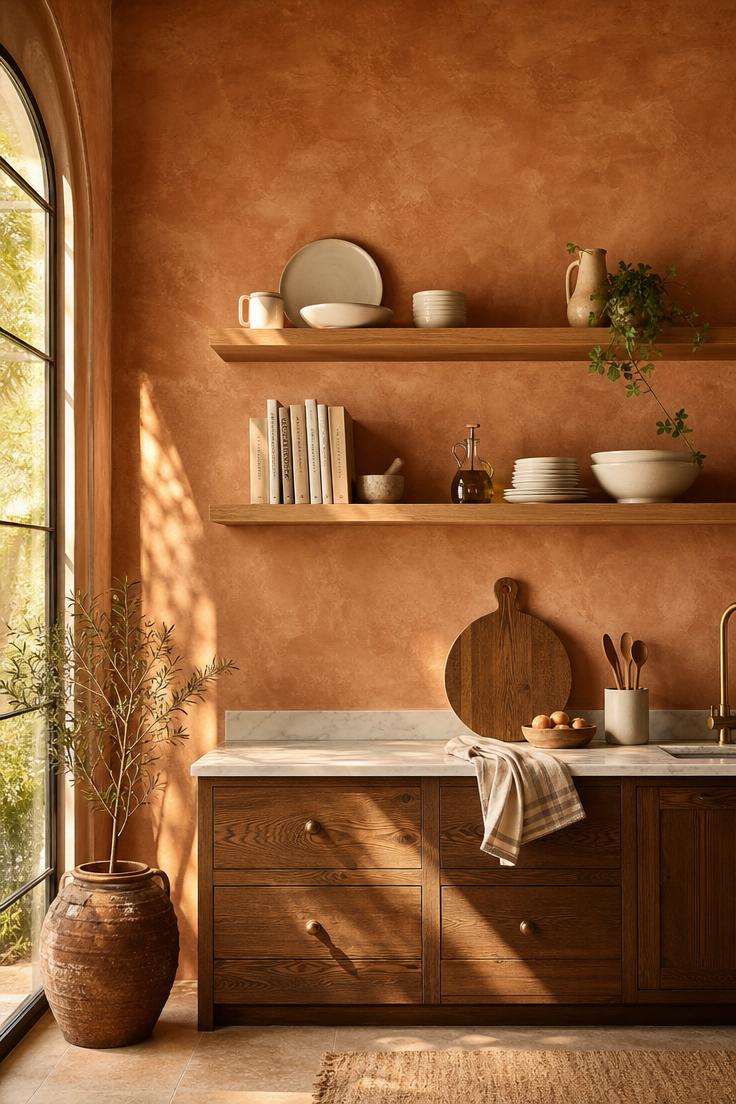
Limewash isn’t paint. That distinction matters.
Paint sits on top of the wall and dries to a uniform finish. Limewash soaks into the surface and dries in layers, creating a depth and movement that flat paint can never achieve.
In warm terracotta, the effect is like sunbaked Italian plaster — some areas are slightly darker where the wash pooled, others are lighter where the brush moved quickly. The whole surface shifts depending on the light.
Behind open shelves, this texture becomes a backdrop that changes the way every object on those shelves looks. White ceramics glow warmer against it. Wooden cutting boards pick up the earthy undertones. Green herbs in small pots look almost electric.
Application is straightforward — limewash goes on with a wide brush in overlapping, irregular strokes. The imperfection is the point. A beginner’s first wall often looks better than an expert’s because the less controlled the application, the more organic the finish.
One gallon covers about 300 square feet, so a single kitchen accent wall uses a fraction of a bucket.
Style Blueprint:
- Mineral-based limewash in terracotta or warm clay (not acrylic faux-limewash)
- Wide masonry brush for application
- White oak floating shelves with concealed brackets
- White ceramics and natural materials on shelves to contrast with the warm wall
- Clean primed wall surface (limewash needs a porous base, not glossy paint)
Design Pro-Tip: Limewash deepens in color as you add layers. Start with one coat and live with it for a full day before deciding whether to add a second. Most people overdo it on the first attempt because the wet color looks much lighter than the dry result. One coat is often enough.
Hanging Dried Eucalyptus Bundles from a Wrought Iron Rail
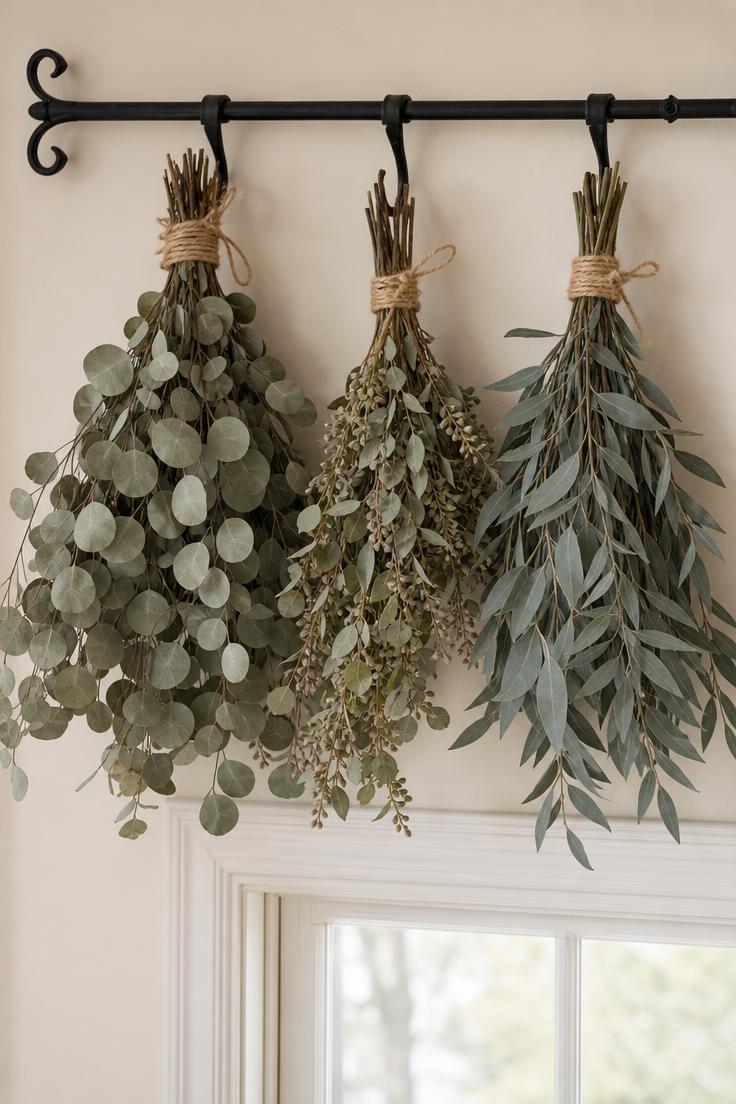
Dried eucalyptus does something no other kitchen wall hanging can — it fills the room with scent for weeks after it’s hung.
The oils in the leaves release slowly as they dry, and the fragrance is clean, herbal, and faintly medicinal in a way that works with cooking smells rather than against them.
A simple wrought iron rail — the kind designed for hanging towels or tools — provides the structure. Three bundles tied with jute twine and hooked over the rail is all it takes.
Varying the eucalyptus species adds visual texture. Silver dollar eucalyptus has round, flat leaves that read almost like coins. Seeded eucalyptus brings small berries that add a dotted texture. Baby blue has the classic elongated shape most people picture.
Fresh eucalyptus from a florist dries beautifully in place — hang it green and it fades to sage and silver over two to three weeks. No need to buy pre-dried bundles unless you prefer the muted palette from day one.
This is a five-minute, under-twenty-dollar kitchen wall decor idea that punches well above its price.
Style Blueprint:
- Black wrought iron towel rail or utility rail (18–24 inches)
- 3 bundles of fresh or dried eucalyptus (mix species for variety)
- Natural jute twine for tying bundles
- Cream, white, or light gray wall
- Mounting screws and wall anchors appropriate for your wall type
Tin Ceiling Tiles Repurposed as a Backsplash Panel
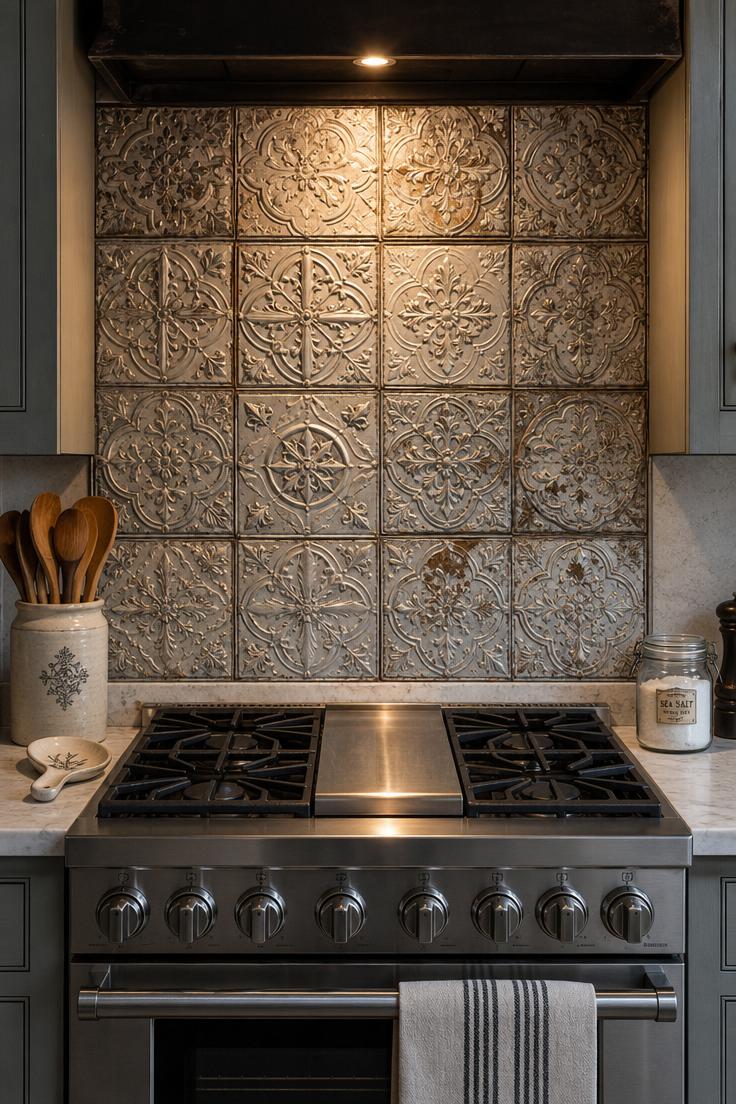
Pressed-tin ceiling tiles from demolished buildings and renovation salvage yards are one of the most underused kitchen wall decor materials available.
Each tile carries the pattern vocabulary of a specific era — Victorian florals, Art Deco geometrics, Eastlake-style fans and scrolls — pressed into sheet metal with enough depth to cast real shadows.
Behind the stove is the ideal spot. The tiles are heat-resistant, easy to wipe down, and the raised pattern is visible from across the room.
Leaving the original patina intact — the slight darkening in recesses, the spots where paint has worn to bare metal — gives the wall a depth that new materials can’t replicate.
If you can’t source originals, reproduction tin tiles are widely available in two-foot squares. They’re thinner than the originals but carry the same patterns and can be painted or left in their raw metal finish.
Installation is straightforward: construction adhesive on a clean, flat wall surface. No grout, no thinset, no special tools.
Style Blueprint:
- Salvaged or reproduction pressed-tin ceiling tiles (enough to cover the backsplash area behind the stove)
- Construction adhesive or small finish nails for mounting
- Original patina finish or matte clear coat for protection
- Directional lighting (recessed or under-cabinet) that catches the pressed pattern
- Simple, unadorned countertop accessories to let the tin be the focus
A Row of Small Oil Paintings on a Plate Rail Shelf
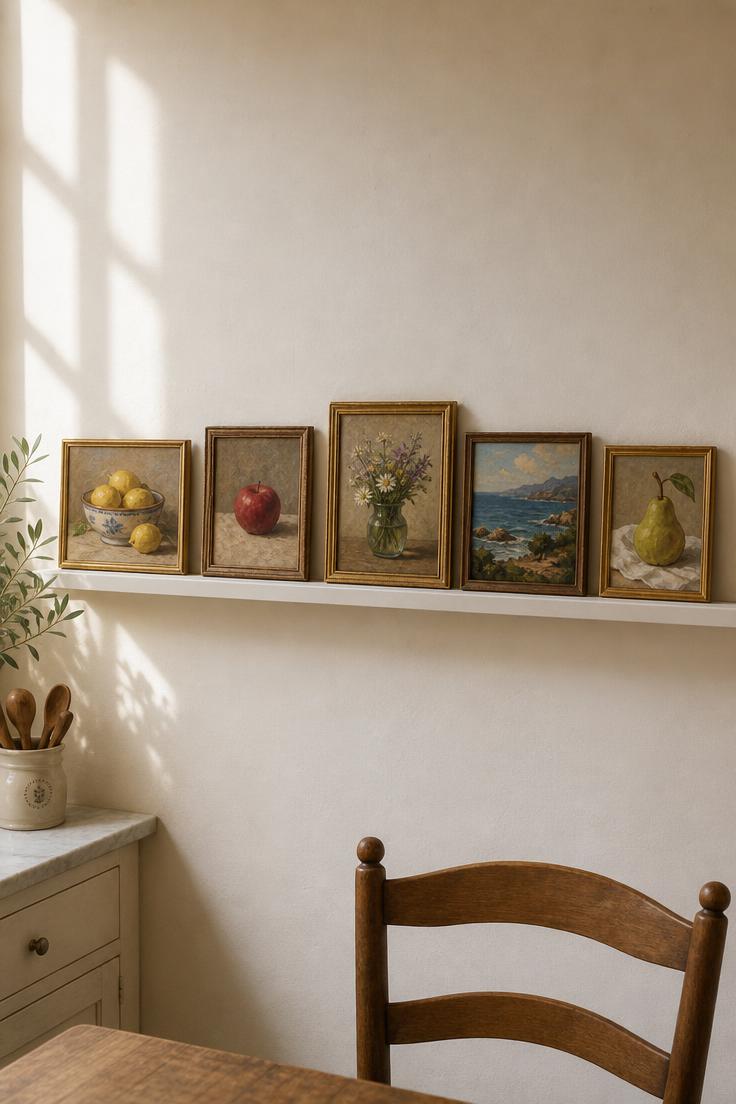
Small oil paintings have a presence that prints don’t.
Even at 4×6 inches, the texture of actual brushstrokes on canvas creates a surface that catches light differently from every angle. A print is flat. An oil painting has topography.
A plate rail — that narrow shelf with a small lip along the front edge — lets you line up five or six small paintings at eye level where you can actually see the brushwork up close while standing at the counter or sitting at the table.
Subject matter should lean toward the casual and domestic. Fruit, flowers, simple landscapes, a single vessel. This isn’t the place for ambitious large-scale work — the scale and the setting call for the painterly equivalent of a quiet conversation.
Original small oil paintings are more available and more affordable than most people think. Online art marketplaces, local art fairs, and student shows sell small originals for forty to two hundred dollars — less than a framed poster from a home decor chain.
Mixing frame styles slightly (one gold, one natural wood, one painted) keeps the row from looking like a matched set.
Style Blueprint:
- 4–6 small original oil paintings (4×6 to 6×8 inches)
- Narrow white plate rail shelf (36–48 inches, with front lip)
- Mix of thin frames: gold leaf, natural wood, and painted
- Eye-level mounting (center of shelf at 57–60 inches from the floor)
- Warm white or cream wall to let the painting colors stand out
Turkish Kilim Runner Mounted on a Wooden Dowel as Wall Art
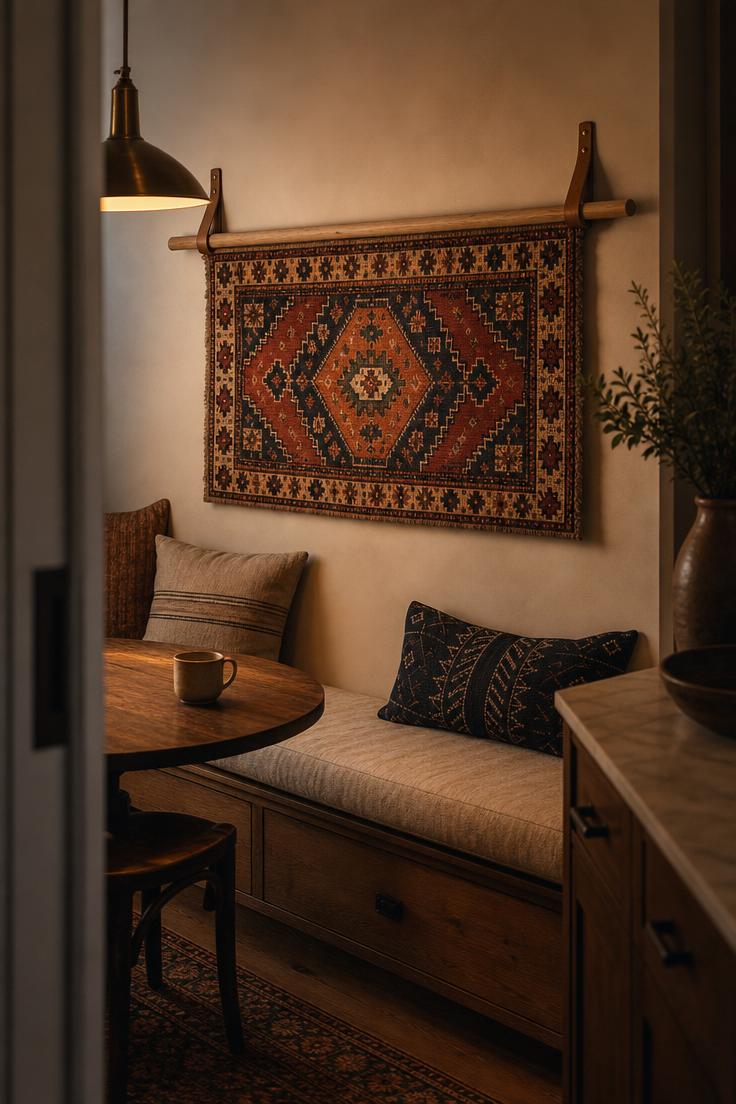
A textile on the wall absorbs sound and adds warmth in a way that no hard surface can match.
Kitchens are full of hard, reflective materials — tile, stone, metal, glass — and a woven textile breaks that acoustic pattern and makes the room feel quieter and more human.
Vintage kilim runners are flat-woven, lightweight, and narrow enough to fit above a bench, a window, or a run of lower cabinets without overwhelming the space.
Hanging method is simple: a wooden dowel threaded through a folded-and-stitched rod pocket on the back, or — easier — clipped to the dowel with small curtain rings. Leather straps screwed into the wall hold the dowel, and the whole assembly takes ten minutes.
The colors in a well-aged kilim — vegetable-dyed reds that have softened to rust, indigos that have faded to denim, creams that have yellowed to parchment — are impossible to fake with new production.
Every kilim has a slightly different palette based on its region, age, and the specific dyer’s recipes, which means yours will be the only one exactly like it.
Style Blueprint:
- Vintage Turkish kilim runner (approximately 2×4 feet, flat-weave)
- Natural oak or walnut dowel (¾ to 1 inch diameter, cut to runner width plus 2 inches)
- Leather hanging straps with brass rivets or screws
- Wall anchors appropriate for your wall type
- Warm-toned pendant or sconce lighting to bring out the textile colors
Conclusion
Kitchen wall decor works best when it looks like it happened over time rather than all at once.
Start with one piece from this list — the brass picture ledge or the basket cluster or the single charcoal drawing — and sit with it for a few weeks before adding the next.
The best-decorated kitchen walls share a common quality: they feel collected, not decorated. A thrifted ironstone platter next to a wall finished in hand-applied limewash, or a vintage kilim hanging above a bench where you drink your morning coffee.
Mix a twenty-dollar find with one piece that took some thought. Layer textures — woven next to smooth, rough next to polished, matte next to gleaming.
Treat your kitchen walls like a gallery that changes with the seasons, your travels, and your taste. The walls are ready whenever