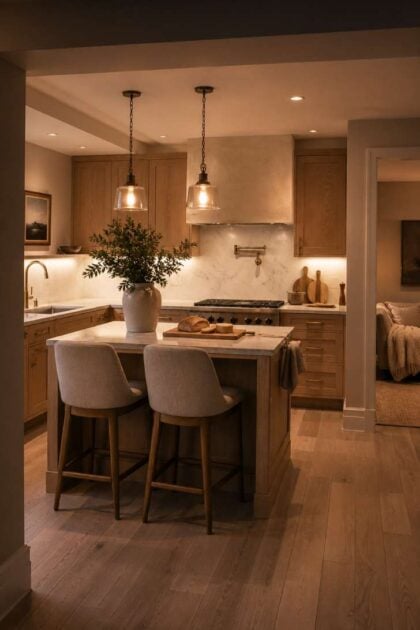
This post may contain affiliate links. If you make a purchase through these links, we may earn a commission at no additional cost to you.
A basement with nothing but storage boxes and a dusty treadmill? That’s wasted square footage.
Adding a kitchen below grade turns dead space into the most used room in the house — a place to cook, pour drinks for friends, or just grab a snack without climbing stairs.
Whether you have room for a full cooking setup or just a slim countertop with a sink and mini fridge, the 15 ideas here cover every size and budget.
Let’s get into it.
The Bright Minimalist One-Wall Kitchen
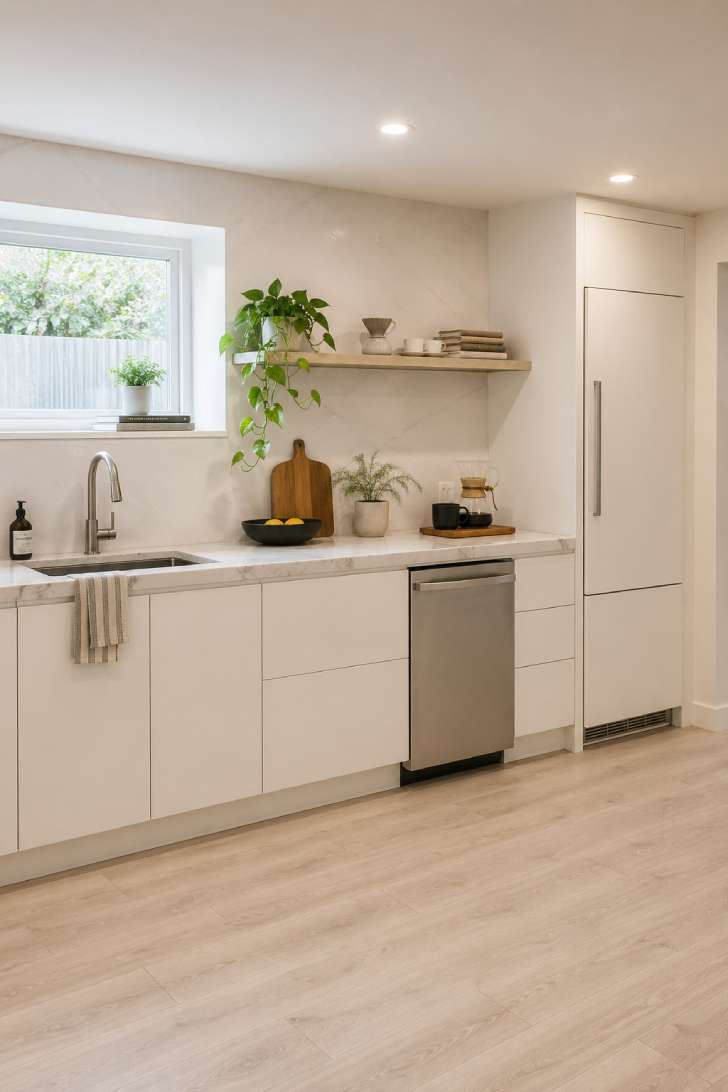
Going all-white in a basement might sound counterintuitive — there’s not much natural light to bounce around down here.
But that’s exactly why it works.
Light-colored surfaces act like mirrors for whatever ambient glow exists, and recessed LEDs do the rest.
A one-wall layout keeps plumbing and electrical on a single run, which means lower installation costs and faster build timelines.
The trick is choosing the right white — something with a warm undertone (think cream or soft ivory, not blue-white) so the room doesn’t feel clinical under artificial light.
Flat-panel doors in a slab style push the look firmly into contemporary territory without adding visual noise.
When your eye travels along an unbroken line of cabinetry with no ornate molding, the room reads as bigger than its actual dimensions.
That psychological expansion matters underground, where low ceilings can make things feel compressed.
Style Blueprint:
- White flat-panel slab cabinets with soft-close hinges
- Calacatta quartz or solid surface countertop in a warm white
- Wide-plank LVP flooring in ash or light oak
- Recessed LED ceiling fixtures on a dimmer switch
- One trailing green plant on a floating shelf for a living accent
Moody Navy Galley Kitchen
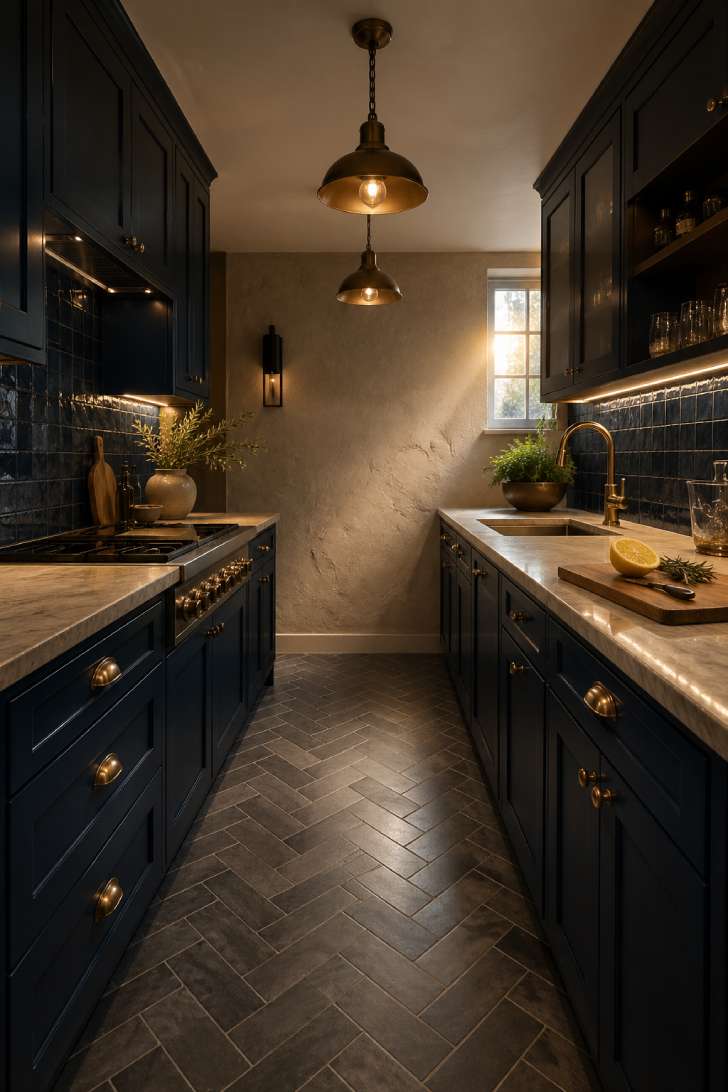
Dark paint in a room with almost no windows sounds like a risk.
It’s actually a power move.
Navy cabinetry stops fighting the basement’s naturally dim personality and leans all the way in, creating a cocoon-like space that feels intentional rather than gloomy.
The galley layout — two facing countertops with a walkway between — is one of the most space-efficient configurations you can build.
Every appliance and utensil sits within arm’s reach, which professional kitchens figured out decades ago.
Brass hardware and warm metallic pendant lights keep navy from tipping into cold or cave-like.
Metal catches whatever light hits it and scatters it across the room in tiny warm spots, which is exactly the kind of layered glow a basement needs.
Handmade zellige tile on the backsplash introduces subtle color variation that gives the walls depth, so they don’t look flat or painted-on.
Style Blueprint:
- Navy shaker cabinets with brushed brass cup pulls
- Honed quartzite countertop with warm veining
- Handmade zellige backsplash tile in midnight blue
- Two aged-brass pendant lights over the walkway
- Herringbone porcelain floor tile in warm charcoal
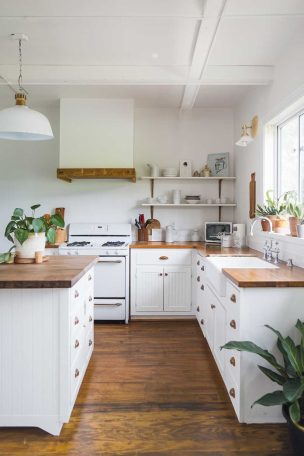
Rustic Farmhouse Kitchenette
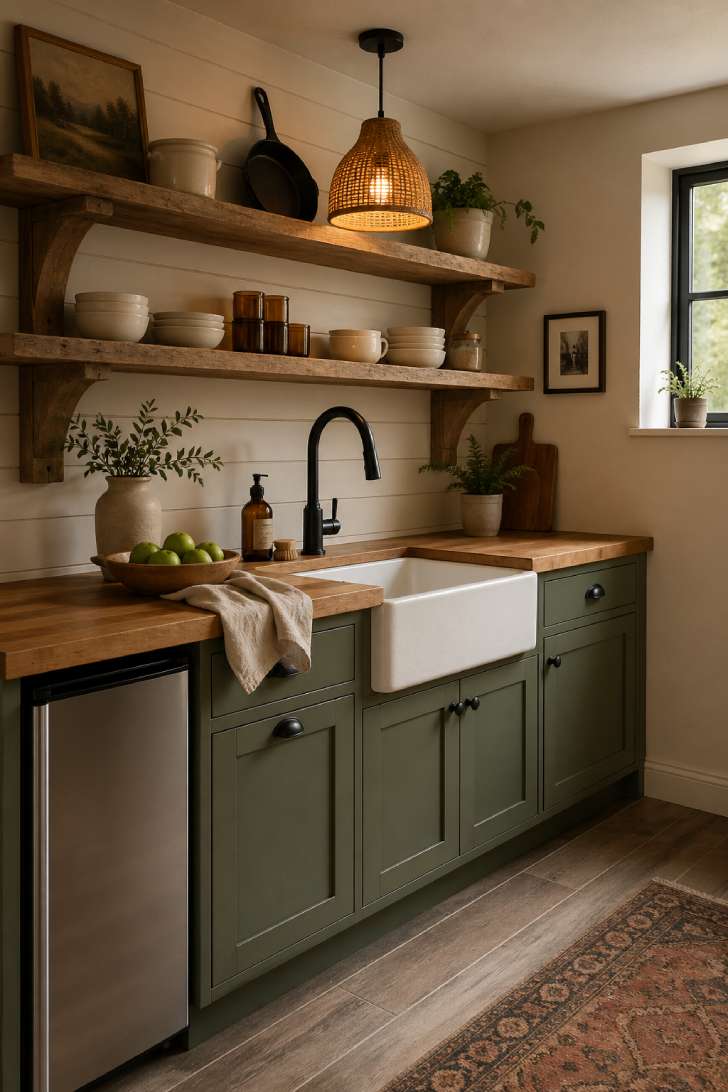
Farmhouse style works in a basement because it already carries a sense of shelter and warmth baked into its DNA.
Thick butcher block on the counter introduces a material you want to touch — grainy, warm, alive.
That tactile quality changes how the room feels the second you walk in.
Open shelving instead of upper cabinets keeps the walls from closing in, and it forces you to edit what you own down to the things you actually use (and enjoy looking at).
A fireclay apron-front sink is the visual anchor of this layout.
It draws the eye and signals “kitchen" even when the space is small enough to miss otherwise.
Sage green on the lower cabinets nods to the farmhouse palette without defaulting to the expected all-white.
Green reads as an organic, restful color — and research in color psychology backs that up, linking muted greens to lowered stress responses.
Style Blueprint:
Design Pro-Tip: Keep your open shelves to two rows max. Three or more rows start to look cluttered and collect dust faster than you’ll want to clean them.
- Sage green lower cabinets with black iron knobs
- Butcher block countertop sealed with food-safe oil
- White fireclay apron-front sink with matte black faucet
- Reclaimed wood open shelving (two rows)
- Rattan pendant shade for warm, diffused light
Sleek L-Shaped Entertaining Kitchen
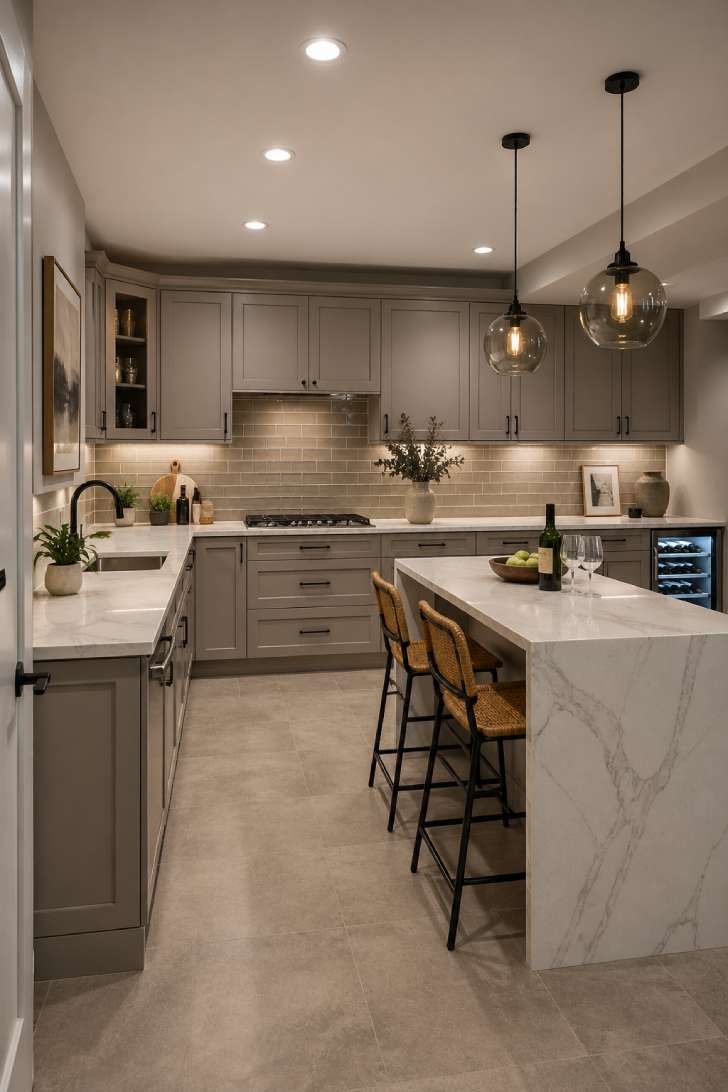
An L-shaped layout creates two distinct zones: one arm handles cooking, the other handles prep or serving.
That separation means two people can work the kitchen at the same time without bumping elbows, which matters when you’re hosting.
The waterfall island — where the countertop slab bends down to the floor on one side — doubles as a visual room divider.
It tells the eye where the kitchen ends and the lounge area begins, without blocking sightlines.
Tucking a wine fridge under the counter on the short arm of the L keeps bottles at the right temperature and within reach, but completely out of the way of actual cooking.
Guests grab a glass without crossing into the cook’s zone.
Smoked glass pendant lights hung at different heights add a layer of visual rhythm overhead.
When your ceiling is only seven or eight feet above the floor, staggering fixtures draws the eye upward and gives the illusion of a taller room.
Style Blueprint:
- Dove-gray shaker cabinetry with thin brass pulls
- White-and-gray veined quartz with waterfall island edge
- Built-in 15-inch wine fridge with glass door
- Smoked glass pendant lights at staggered heights
- Matte porcelain floor tile in warm concrete tone
Industrial Loft-Style Kitchen
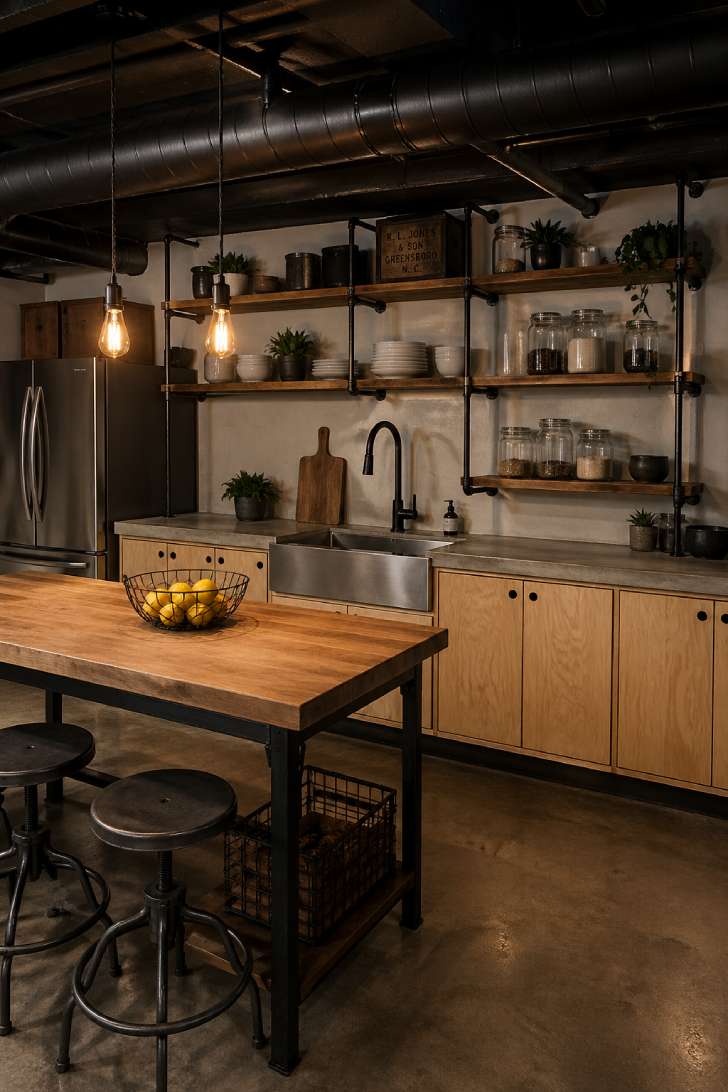
Basements come with exposed pipes, ductwork, and concrete floors already in place.
Instead of hiding all that behind drywall and a drop ceiling, the industrial approach paints it black and calls it a feature.
That single decision can save thousands in finishing costs while giving the space a character you can’t fake with applied finishes.
Poured concrete countertops pick up the raw-material theme.
They develop a patina over time — small marks and slight color shifts — that makes the kitchen feel more personal the longer you use it.
Raw birch plywood for the base cabinets adds warmth to all that metal and concrete.
Seeing the edge grain of the wood is a deliberate choice: it signals craft and honesty, the opposite of a laminate veneer pretending to be something it’s not.
Edison-style filament bulbs cast warm amber light that softens every hard surface in the room.
The color temperature of those bulbs — around 2200K — sits close to firelight, which is why the room feels inviting even with concrete underfoot.
Style Blueprint:
Design Pro-Tip: Seal concrete countertops with a food-safe penetrating sealer before first use. Without it, they stain within a week. Reapply once a year.
- Black steel pipe and reclaimed wood open shelving
- Poured and sealed concrete countertops
- Raw birch plywood base cabinets with edge grain showing
- Edison-bulb pendant lights on black cloth cords
- Polished concrete floor (existing slab, sealed)
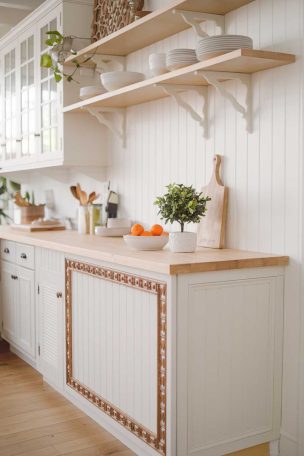
Cozy Cottage Breakfast Nook Kitchen
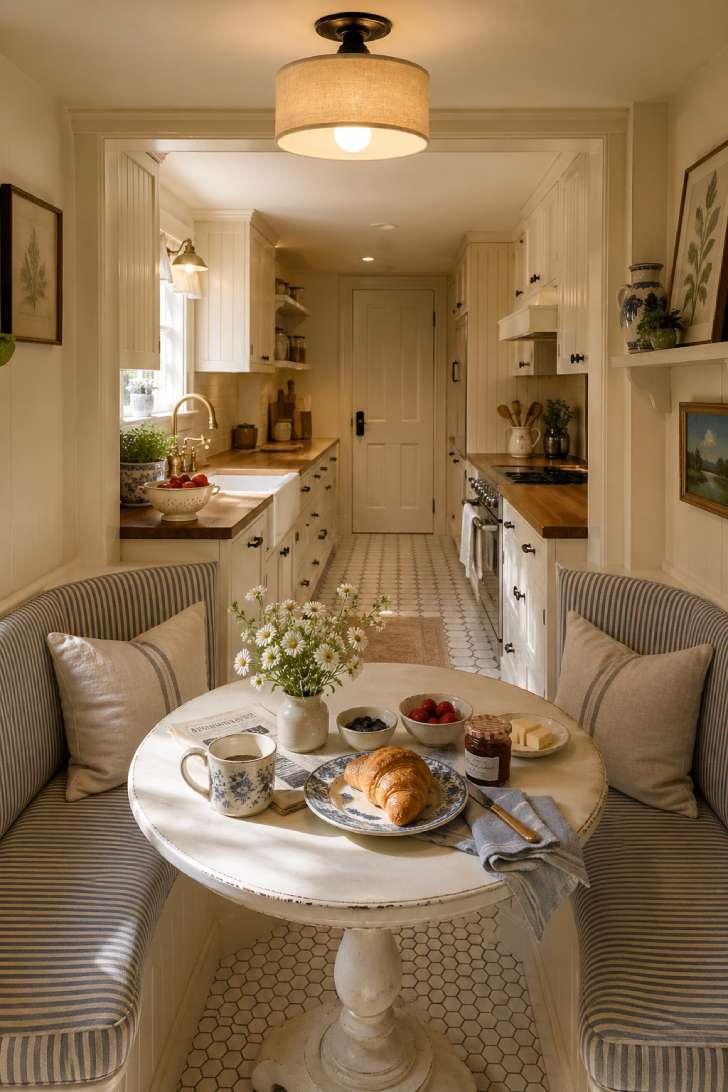
Combining a small cooking zone with a built-in eating area makes the basement feel like a self-contained apartment — complete and livable, not like an afterthought tacked onto a rec room.
The banquette does double duty as seating and hidden storage (lift the seats and you’ve got bins underneath for table linens or bulk pantry items).
Beadboard cabinet fronts bring texture to flat planes.
Those thin vertical grooves catch light differently depending on the angle, creating subtle shadow lines that make cream-colored doors look richer than a plain slab.
Ticking stripe fabric on the banquette nods to a specific tradition — it was originally mattress ticking — which gives the room a story without you having to explain anything.
That’s how good textiles work: they communicate history and comfort on contact.
Honey-toned wood counters warm up all the cream and white.
Without them, the palette risks looking washed out under basement lighting; the wood grounds everything.
Style Blueprint:
- Cream beadboard cabinets with small brass knobs
- Honey-toned wood counters (maple or birch)
- Built-in U-shaped banquette in ticking stripe fabric
- Small round pedestal table in distressed white
- Hexagonal white ceramic floor tile with dark grout
Modern Wet Bar and Snack Station
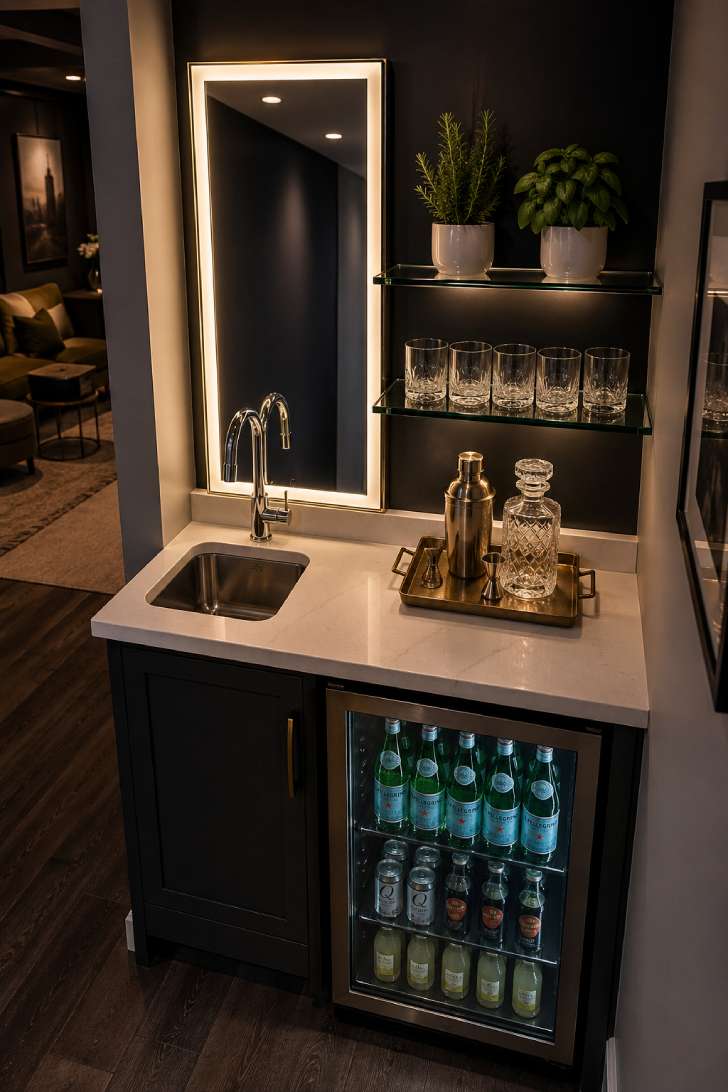
Not every basement needs a full kitchen.
Sometimes a narrow wet bar tucked against one wall does everything you actually need — a sink for rinsing glasses, a fridge for cold drinks, and enough counter to set up a snack spread.
The whole thing can run as little as six feet wide and still feel complete.
A charcoal accent wall behind the bar creates depth.
Dark colors recede visually, so the wall seems to push backward, making the counter area feel more open than its dimensions suggest.
Glass-front cabinetry and floating glass shelves add storage without visual weight.
You see through them, which means they don’t block sightlines or shrink the perceived space.
A backlit mirror does the work of a window in a room that doesn’t have one — it bounces light and creates the sensation of another surface behind the wall.
Style Blueprint:
Design Pro-Tip: Run a dedicated 20-amp circuit to the wet bar area. A mini fridge, an ice maker, and a blender pulling power at the same time will trip a shared circuit faster than you’d think.
- White quartz countertop on a slim 24-inch-deep cabinet run
- Glass-front mini fridge (15-inch width fits tight spots)
- Floating glass shelves for glassware display
- Charcoal-painted accent wall behind the bar
- Backlit rectangular mirror as a light-bounce element
Scandinavian-Inspired Basement Kitchen
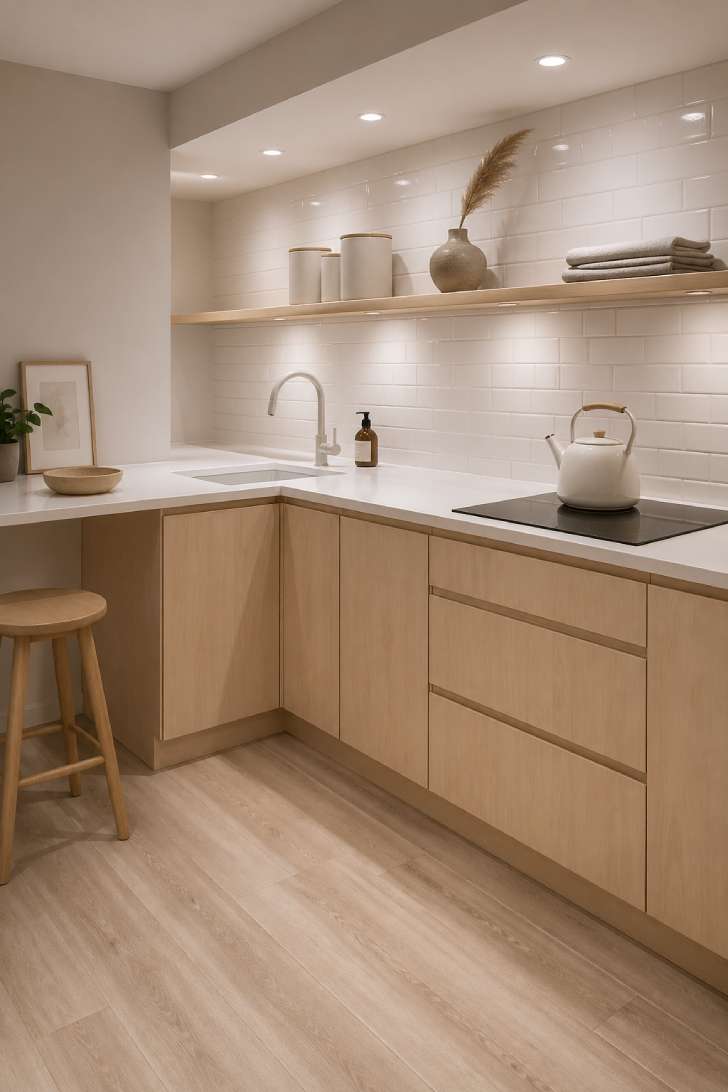
Scandinavian design was built for dark climates and small rooms — two things basements have in abundance.
The whole philosophy centers on pulling as much warmth and light as possible from minimal resources.
Light birch plywood cabinets hit that balance between pale (reflects light) and warm (golden wood tone).
They’re brighter than oak but less stark than painted white, and the visible wood grain adds the kind of organic texture that keeps a minimal room from feeling sterile.
Routed-edge handles — a shallow finger pull cut directly into the door edge — eliminate hardware entirely.
No pulls, no knobs, no visual interruption.
The cabinet fronts read as clean planes of wood, which is exactly the point.
A two-burner induction cooktop built flush with the counter saves space and stays cool to the touch seconds after you turn it off.
In a compact kitchen where every inch matters, a cooktop that doesn’t demand clearance on all sides is a practical win.
Style Blueprint:
- Light birch plywood cabinets with routed-edge handles
- White matte laminate countertop
- White ceramic subway tile backsplash
- Two-burner induction cooktop (flush-mount)
- Light-toned vinyl plank floor in birch finish
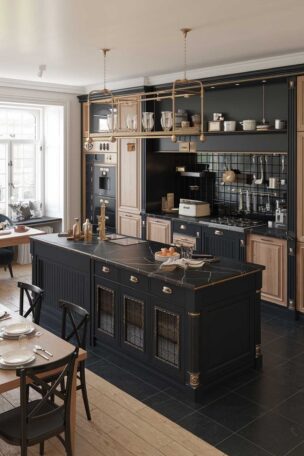
Dark and Dramatic Chef’s Kitchen
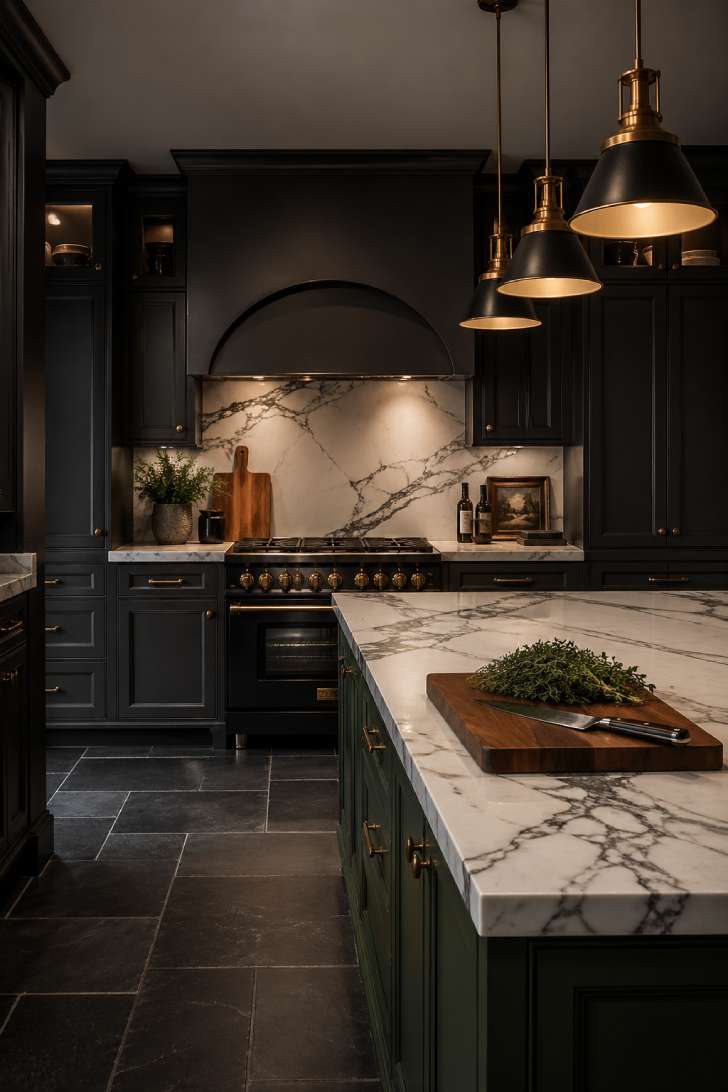
This is the basement kitchen for someone who actually cooks — not reheats, not assembles, but cooks.
A 36-inch gas range with brass knobs is the room’s heartbeat.
Everything else supports it: generous counter space on both sides, a prep island within two steps, and a plaster hood that pulls grease and steam out through a dedicated exterior vent.
Charcoal cabinets from floor to ceiling create a cocoon effect.
The room wraps around you, and the darkness pushes the colorful food — the red of a tomato, the green of fresh herbs — into the foreground.
It’s the same principle galleries use: dark walls, spotlit art.
The forest green island base breaks the monochrome palette just enough to keep the eye moving.
Green and charcoal sit next to each other on the color wheel’s cooler half, so they harmonize without competing.
Calacatta marble counters bring veining that reads like brushstrokes — no two slabs identical, which means this kitchen can’t be replicated exactly by anyone else.
That uniqueness is part of what makes natural stone worth the maintenance.
Style Blueprint:
- Charcoal floor-to-ceiling shaker cabinets
- 36-inch professional gas range in matte black
- Calacatta marble countertop and slab backsplash
- Forest green painted island base
- Three brass-and-black pendant lights over the island
Budget-Friendly IKEA Basement Kitchenette
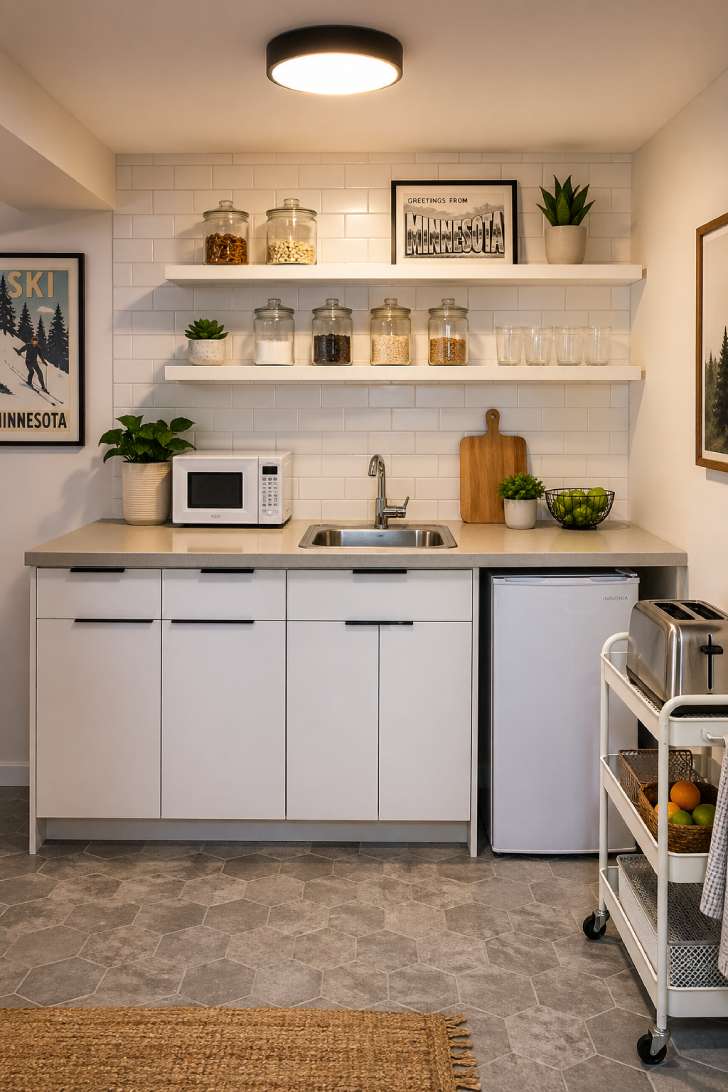
You don’t need a contractor’s budget to get a functional basement kitchen.
Stock cabinetry from IKEA — or any flat-pack brand — brings the cost of a six-foot cabinet run to well under $1,000 including hardware.
Laminate countertops in quartz-look patterns have improved dramatically in the last few years; from a distance of three feet, most people can’t tell the difference.
Peel-and-stick subway tile on the backsplash goes up in an afternoon with no mortar, no tile saw, no mess.
It’s removable, too, which means renters can use it without losing a security deposit.
The rolling cart is the secret weapon here.
It adds prep surface and storage without a single screw in the wall, and you can wheel it out of the way when the kitchen isn’t in use.
Style Blueprint:
Design Pro-Tip: Swap the overhead fluorescent tube (if your basement still has one) for a warm-toned LED flush-mount. That one change shifts the room from “unfinished utility space” to “someone lives here and likes it.”
- White slab-front stock cabinets (flat-pack, budget-friendly)
- Light gray laminate countertop in a quartz-look finish
- Peel-and-stick subway tile backsplash
- Narrow rolling cart for extra prep space
- Warm-toned LED flush-mount ceiling fixture
Basement Coffee Bar and Morning Kitchen
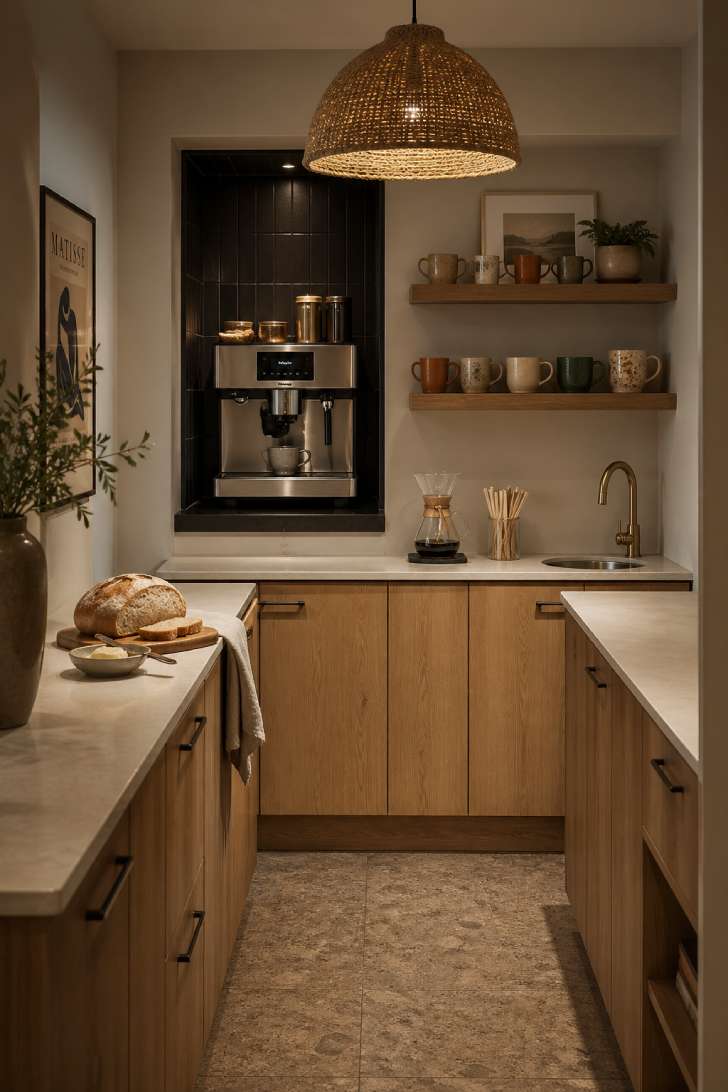
A dedicated coffee bar in the basement means nobody has to climb stairs before caffeine.
That alone makes this idea worth the build.
Recessing the espresso machine into a tiled niche keeps the counter clear and gives the appliance a built-in, permanent look.
It also contains the steam and splatter in a wipeable zone instead of spreading it across the wall.
Handmade ceramic mugs on open shelves serve a double purpose: functional storage and visual warmth.
Mass-produced white mugs all look the same; a shelf of one-of-a-kind ceramics in varied earth tones gives the eye places to rest and things to notice.
Cork flooring underfoot is soft, warm, and naturally antimicrobial — three things that matter in a room where you’ll stand barefoot at 6 a.m. waiting for a shot to pull.
Cork also absorbs sound, which keeps the space quiet in a way that tile or concrete never will.
Style Blueprint:
- Built-in espresso niche lined with matte black tile
- Light oak base cabinets with white quartz counter
- Warm walnut floating shelves for mug display
- Compact round sink with brushed gold faucet
- Cork tile flooring for warmth and sound absorption
Open-Concept Kitchen for Basement Entertaining
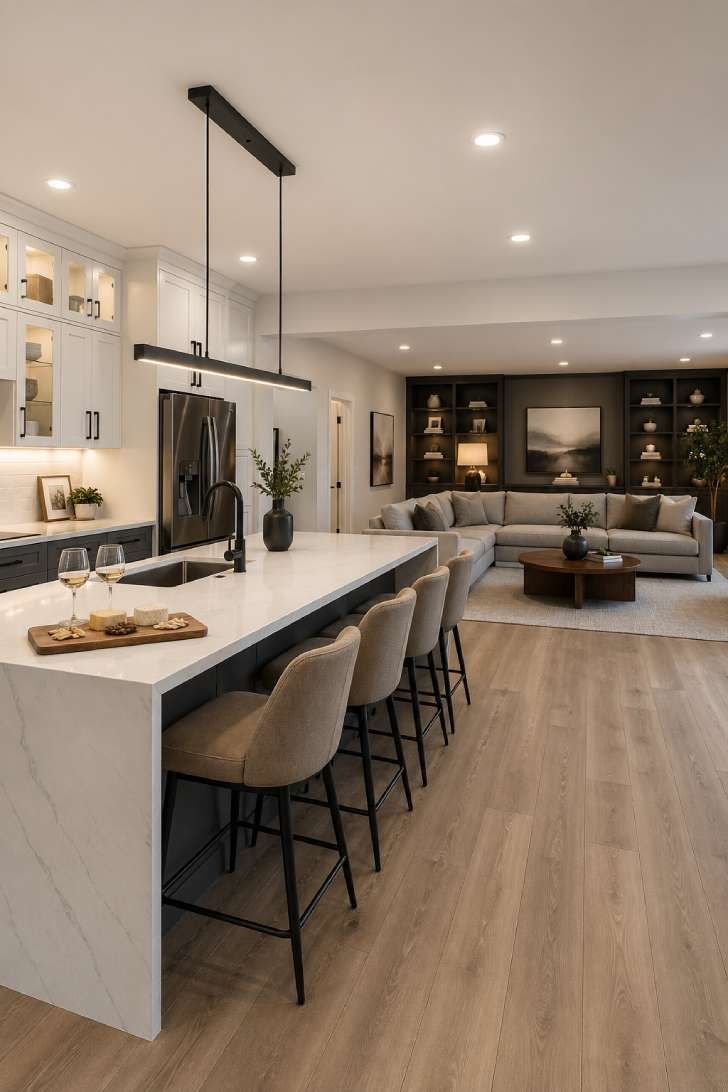
Removing walls between the kitchen and the living area turns a compartmented basement into one generous room.
The island becomes the boundary — visible but permeable, a surface you lean against from either side.
Four stools along the outer edge give guests a place to sit and talk to the cook without getting underfoot.
That arrangement keeps the social energy in one spot instead of splitting it between two separate rooms.
Two-tone cabinetry — white uppers, charcoal lowers — prevents the long wall of cabinets from reading as a solid block.
The lighter color on top lifts the eye upward; the darker base anchors the room to the ground.
Continuous flooring from kitchen through living area is a small detail that makes a big perceptual difference.
When the same plank runs wall to wall without a transition strip, the brain reads the space as one room, not two zones stitched together.
Style Blueprint:
Design Pro-Tip: Choose a linear pendant over the island rather than a cluster of small globes. A single long fixture creates a clean horizontal line that echoes the island’s shape and keeps the ceiling from looking busy in a low-clearance basement.
- Two-tone cabinetry (white uppers, charcoal lowers)
- Large island with white quartz waterfall countertop
- Four low-back upholstered stools in taupe
- Linear matte black pendant light over the island
- Continuous wide-plank LVP throughout both zones
Mediterranean-Inspired Lower Level Kitchen
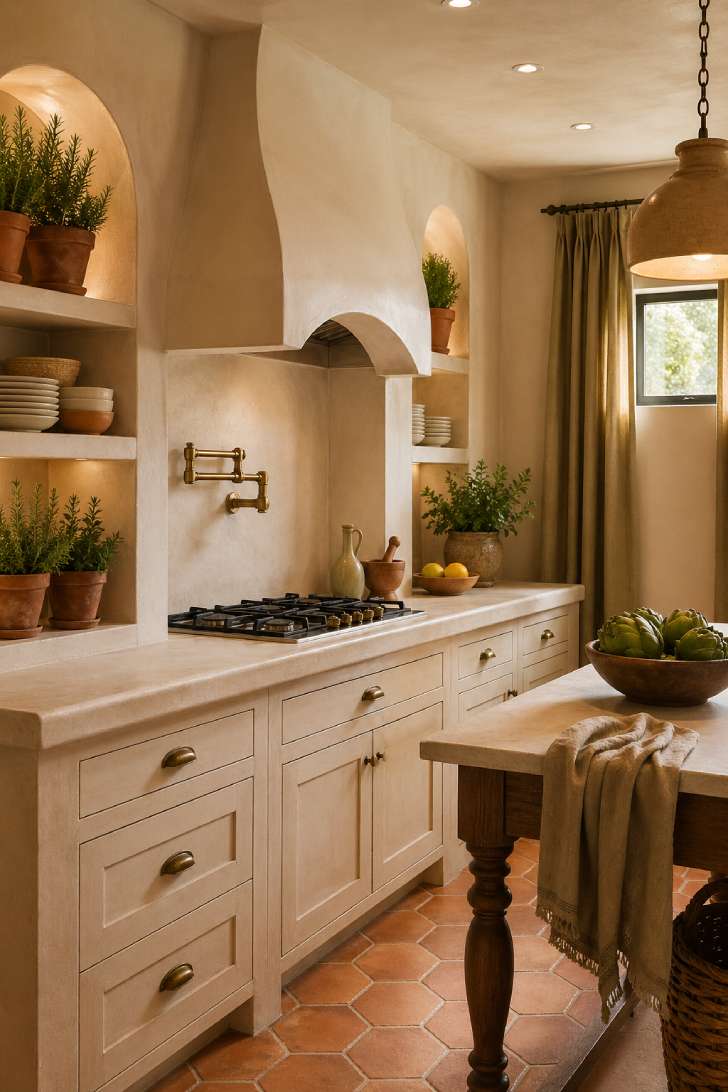
Mediterranean kitchens trade sharp angles for soft curves — arched niches, rounded hood profiles, countertop edges with a gentle bullnose.
Those curves change how your body moves through the room; you slow down, your shoulders relax, your pace matches the room’s rhythm.
Terracotta tile on the floor absorbs warmth from underfloor heating and releases it slowly, keeping feet comfortable for hours.
The unglazed surface has a matte, earthy look that improves as it ages and develops a patina.
Honed limestone counters share that same ability to age with grace — a few water rings and knife marks add character, not damage.
Growing herbs in the arched niches connects the kitchen to its purpose in the most literal way: food, cooking, nourishment.
The scent of fresh rosemary when you brush past it on the way to the stove is a sensory experience no air freshener can replicate.
Style Blueprint:
- Plaster-effect cabinets with arched open niches
- Honed white limestone countertop with bullnose edge
- Terracotta hexagonal floor tile (pair with radiant heat if possible)
- Brass pot filler faucet above the cooktop
- Fresh herb plants in terra cotta pots on the shelves
Compact Kitchen with Hidden Appliances
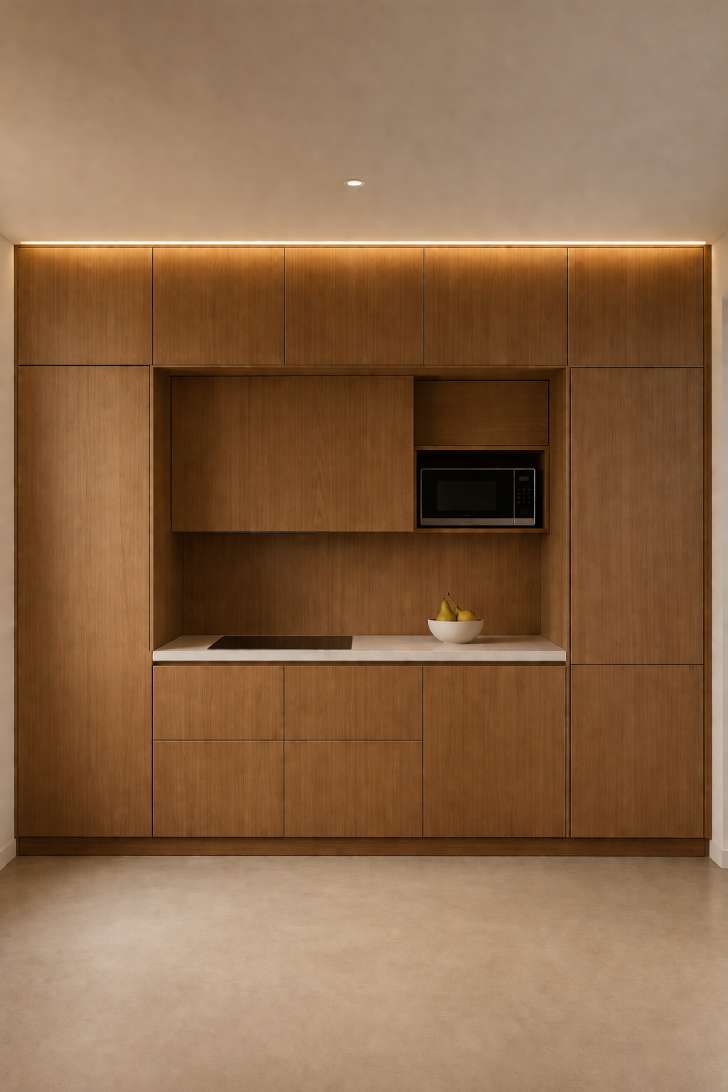
This idea is for the homeowner who wants the basement to look like a lounge — until it’s time to cook.
Panel-ready appliances hide behind cabinet doors that match the surrounding millwork.
Close everything up and the kitchen vanishes into a wall of warm wood.
That visual trick is powerful in a basement where you might use the space for movie nights or guest sleeping more often than cooking.
Push-latch mechanisms replace traditional pulls and knobs.
Press the door, it pops open; press again, it clicks shut.
No hardware means no visual anchors telling your brain “this is a kitchen.”
A thin-profile engineered stone counter — only about an inch thick — reinforces the floating, weightless aesthetic.
Thick countertops read as sturdy and traditional; thin ones read as modern and precise.
The pocket door above the counter that conceals the microwave niche is a small detail with outsized impact.
Microwaves are visual clutter in any kitchen — hiding one behind a sliding panel keeps the room’s clean lines intact.
Style Blueprint:
- Warm medium-oak panel cabinetry floor to ceiling
- Panel-ready refrigerator and dishwasher (fully integrated)
- Thin-profile engineered stone counter in warm white
- Flush-mount induction cooktop with no raised edges
- Push-latch door mechanisms (no visible hardware)
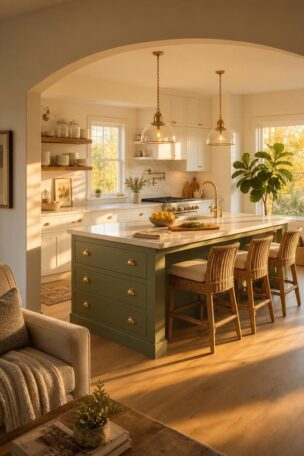
Transitional Family Kitchen with Island Seating
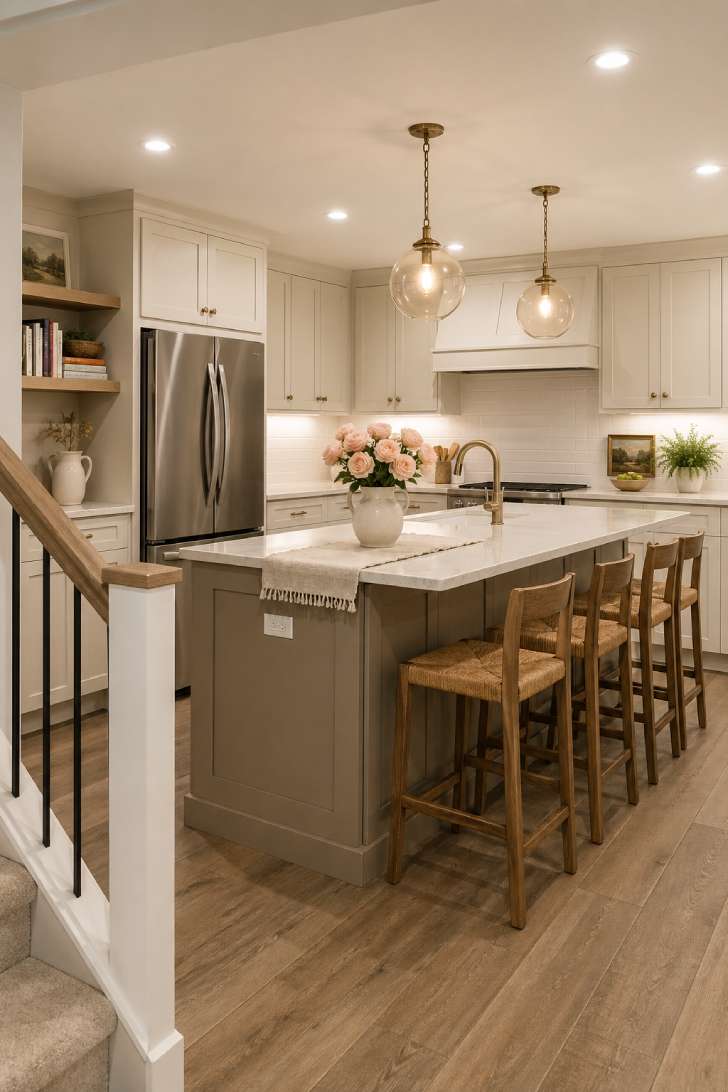
Transitional style splits the difference between traditional and modern — shaker doors signal the first, clean quartz counters signal the second, and the room never commits fully to either camp.
That flexibility means the kitchen won’t feel dated in five years when one trend fades.
The island is the heart of this layout.
Three stools along the far side turn it into a breakfast bar, a homework station, a wine-and-appetizers perch.
Woven rush seats add a textural element that upholstered seats can’t match — they’re casual, they breathe, and they wipe clean after a spill.
Warm greige on the island base separates it visually from the white perimeter cabinets, making the island feel like a freestanding piece of furniture rather than a built-in extension.
That subtle color break keeps the room from reading as a single monotone block.
Glass globe pendants in a warm amber tone cast a diffused, shadow-free light across the island surface.
They’re gentle enough for a long conversation over dinner and bright enough to read a recipe by.
Style Blueprint:
- Creamy white shaker perimeter cabinets with brass knobs
- Warm greige painted island base
- Thick white quartz countertop with soft gray veining
- Three wooden counter stools with woven rush seats
- Two warm glass globe pendant lights over the island
Conclusion
Fifteen ideas, and not one of them requires a mansion-sized basement.
A single wall of cabinetry with a sink and mini fridge can change how you use your lower level — no more running upstairs for a glass of water during movie night.
A full chef’s kitchen with a gas range and marble counters can turn the basement into the best room in the house.
The layout you choose depends on your space, your budget, and whether you’re feeding a family or mixing cocktails for two.
Pick the idea that matches how you actually live, not the one that looks best on a screen.
Then start with the plumbing — everything else builds around where the water goes.