This post may contain affiliate links. If you make a purchase through these links, we may earn a commission at no additional cost to you.
A bed can look finished without being fussy, and calm without feeling cold.
Most attempts at bedroom minimalism fail at the layers, not the frame or the wall color.
Fewer pieces, chosen with more care, solve the problem faster than any shopping spree.
The result should welcome you when you come home in the evening and take a minute to remake in the morning.
Why Bed-Making Starts with Subtraction, Not Addition
Designer Colin King describes the tidy, folded-back coverlet look as clean and tidy, simple but elegant, giving a room the serene feeling most people want from a bedroom.
His method begins with removal: strip every pillow from the bed and flatten the top sheet completely.
Lay the coverlet flat and smooth the surface before making any folds.
Only then does the structure appear.
The sequence that follows is a coverlet folded over standard pillows, and it is easier than it sounds.
Fold the top of the coverlet down about a third of the way, place two standard pillows flat side by side with a small gap between them, and pull them slightly over the crease.
King uses a few inches past the fold as his proportion for a relaxed finish, a styling cue rather than a rule.
Lift one side of the coverlet over the pillows toward the headboard, repeat on the other side, then smooth the fabric so it pools naturally around the base.
What this produces is a bed with a clear horizontal line and no pile of cushions to relocate before sleep.
Many over-styled beds demand a small ritual of unstacking shams and decorative squares every night, then restacking them every morning.
King’s approach removes that chore entirely.
The tradeoff is honesty about fabric.
A coverlet shows its wrinkles and its drape, so a smooth first pass matters more than a tight tuck.
Letting the excess fall where it wants reads as relaxed rather than sloppy.
King notes the look works in any type of bedroom, from a small rental to a primary suite.
That flexibility comes from the method rather than the materials, which makes it a useful starting point before any shopping.
Design Pro-Tip: If your coverlet is tucked into a platform bed and cannot wrap the pillows, use a long cylindrical cushion against the headboard and a large folded quilt at the foot instead.
The Coverlet-First Method: A Practical Sequence for Tidy Layers
The coverlet-first approach treats the top layer as the foundation of the whole bed rather than an afterthought.
Laying it flat and smoothing it first creates a clean visual line, and it avoids the lumpy silhouette a duvet can introduce.
Everything else, the pillows and the folded edge, sits on top of that base.
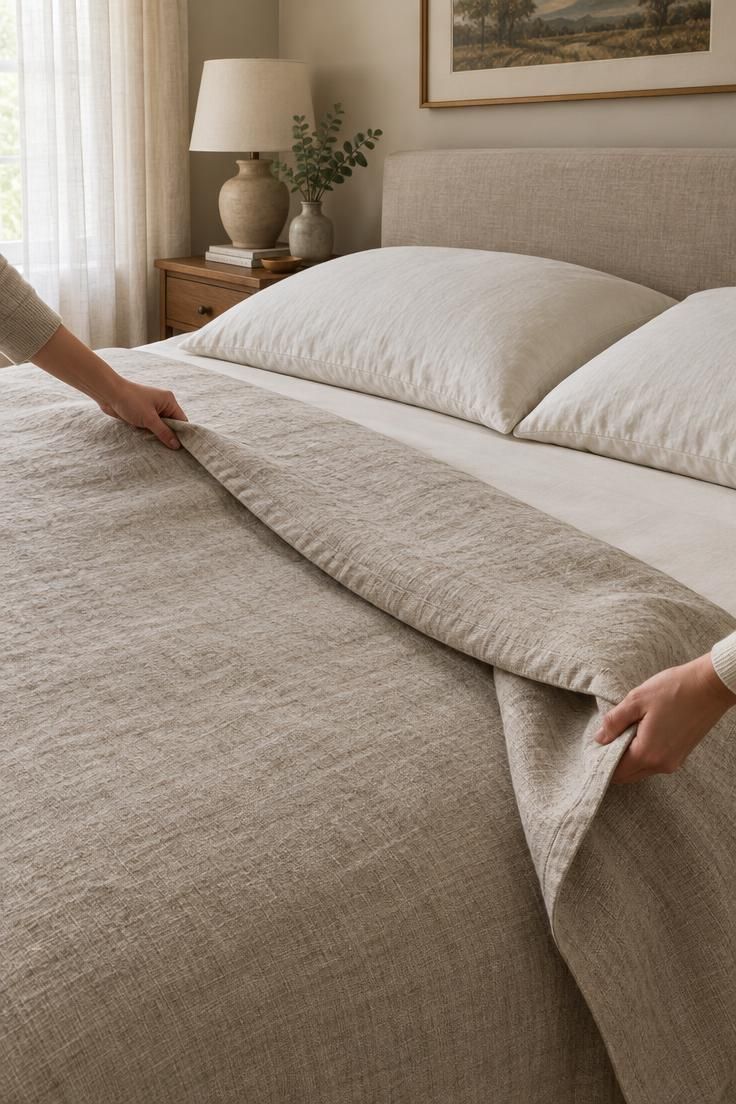
Start by spreading the coverlet across the mattress with even overhang on both sides.
Run a hand across the surface to release any creases, then fold the top down roughly a third of the way.
This single fold adds a horizontal band of interest without introducing another textile or another object to manage.
Two matching pillows, laid flat and side by side with a small gap, create symmetry without stacking.
Pull them down slightly over the fold so they sit partly on the folded band, then wrap each side of the coverlet over them like an envelope.
The wrapping step is the heart of the monastic bed-making technique, and it is what produces the tidy, hotel-like line across the head of the bed.
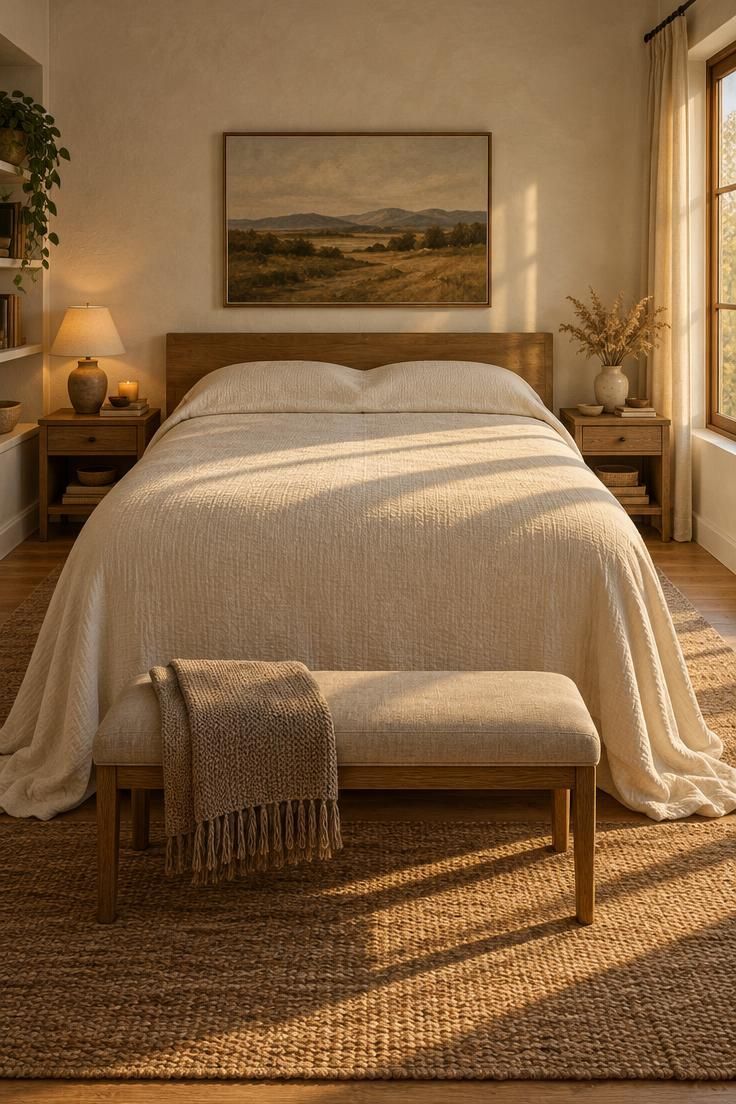
Finish by letting the fabric pool around the base rather than forcing a crisp tuck.
A natural fall reads as calm, and it takes seconds to reestablish the next morning.
This method works with any bed size and any coverlet, from quilted cotton to washed linen to a lightweight wool blend.
The alternative documented by Domino takes a different route to the same calm result.
Bring the quilt up over the pillows first, then place a single long cylinder pillow in front, so the bed reads as one continuous horizontal plane.
Both approaches reduce the number of separate objects on the bed, which is the shared logic behind the trend.
Choosing between them comes down to how you sleep.
The wrapped coverlet keeps two usable pillows in place and suits people who read in bed.
The single cylinder pillow arrangement is even quieter visually but asks you to keep a sleeping pillow within reach.
How Texture Replaces Pattern in a Neutrally Dressed Bed
Once pattern and bright color step back, texture carries the visual interest.
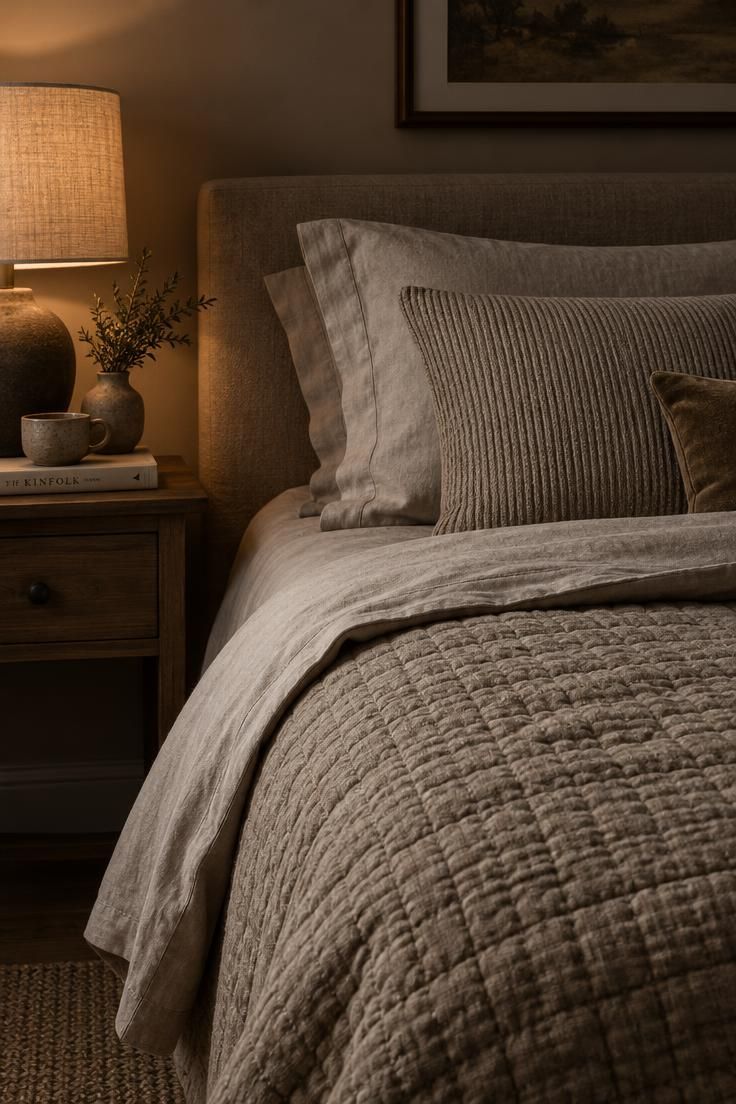
Linen, brushed cotton, fine bouclé, and soft wool blends each add depth without introducing competing elements.
A bed built from these materials reads as rich rather than empty, which is the balance the style depends on.
Rose Uniacke’s description of her own bedroom as monastic, no colour, but strong, not too polite, points to the role quality plays here.
When there is no pattern to look at, the hand of the fabric becomes the thing you notice.
A slightly wrinkled linen coverlet does more visual work than a printed duvet ever could.
Designer Patrick Williams offers a subtle way to add a small surprise without breaking the calm.
He layers a ticking stripe sheet in pink and blue beneath an otherwise neutral ochre linen set, creating a moment of discovery when getting into bed.
The pattern stays hidden at the edges, so the overall bed still reads as neutral.
Quilts bring a sculptural quality that flat covers lack.
Cinny Aumonier notes that the combination of down and detailed stitching gives a quilt a plump, presence-giving quality.
A minimalist bedroom with layered quilts gains softness from that stitching and loft, so the bed looks generous rather than thin.
Texture also hides the small imperfections that come with daily use.
A smooth sateen shows every crease, while a slubby linen or a quilted cotton absorbs them into the overall surface.
That practicality matters as much as the look.
Design Pro-Tip: Mix no more than two or three textures on one bed, such as a quilted coverlet, a smooth linen top sheet, and a ribbed lumbar pillow, so the effect stays quiet.
Pillow Reduction: From Cushion Piles to One Intentional Accent
The pillow pile is the first thing to go.
Designer Alvin Wayne puts it plainly: nobody wants to go to a space where they have to remove all the pillows just to lie down on the bed.
Adam Charlap Hyman compares a bed with a million pillows to a department store display, where moving cushions onto the floor feels chaotic.
Both descriptions point at the same problem: decoration that interferes with sleep.
The research documents two main low-pillow arrangements.
The Colin King method keeps two flat standard pillows wrapped under the coverlet, so the bed reads as one tidy unit.
The approach brings the quilt over the pillows and places a single oversized round cushion across the width of the bed.
Both leave the surface calm and both take seconds to arrange.
Heidi Caillier’s variation suits a double bed and offers a middle path.
She uses four sleeping pillows, two per side and stacked, plus a single decorative pillow.
That gives each sleeper two usable pillows without returning to the cushion pile.
Oversized lumbar pillow styling becomes the finishing accent rather than the main event.
A lumbar pillow is where you can have some fun.
Julia King suggests using it to introduce something playful into the room without committing to a whole scheme, favoring solid bedding with a patterned or contrast-corded pillow.
Alvin Wayne notes that covers can be swapped without replacing the bedding set, so one pillow can shift with the seasons.
Size matters when there is only one accent pillow.
A long lumbar pillow that spans most of the bed’s width reads as intentional and architectural, while a small square can look lost against a large coverlet.
Match the pillow’s scale to the bed rather than to the cushions you removed.
There is a real limitation to the one-pillow approach.
A single long lumbar cushion does not support sitting up to read, so anyone who uses the bed as a place to work or unwind at night may want an extra pillow kept at the foot or within arm’s reach.
The style should serve your evenings, not the other way around.
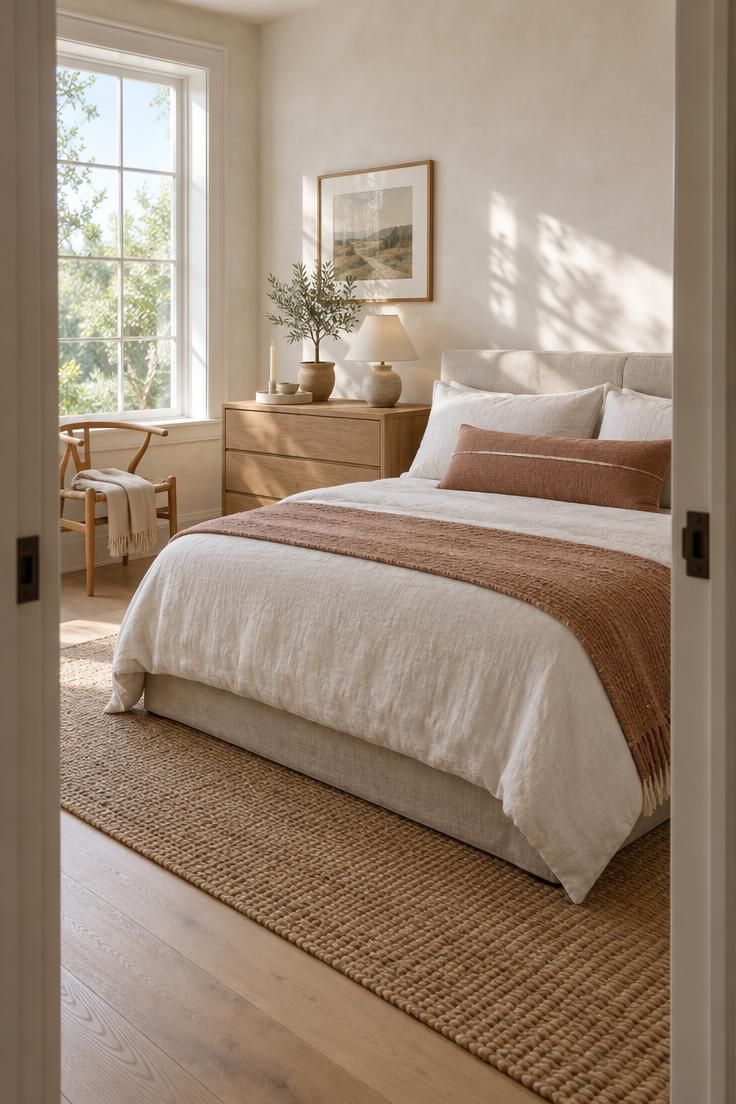
Layering Quilts and Throws for Warmth Without Visual Weight
A flat top cover handles the look; warmth layers handle the nights.
Heidi Caillier avoids duvets entirely in favor of layered quilts and blankets, which she finds less lumpy and more comfortable to sleep under.
Her approach shows how to make a cozy minimalist bed without reverting to a puffy top layer.
The practical sequence is simple.
Start with a fitted sheet, add a light cotton quilt as the main warmth layer, then place a heavier folded blanket or coverlet over the lower half or the foot of the bed.
Folding the top layer down at the foot keeps the pillows clear and makes each layer visible without covering the head of the bed in fabric.
The Standard notes that an oversized linen throw can disguise mismatched sheets beneath it.
The catch is that such a throw needs to be tucked snugly under the pillows to stay in place through the night, so treat the tuck as a practical styling move rather than a decorative flourish.
A three-layer build works for most households: a fitted sheet against the mattress, a quilt for the main warmth, and a folded blanket or coverlet at the foot for extra weight and visual depth.
The folded layer also gives the bed a grounded, finished appearance from the doorway.
Byron Risdon points out that multiple thin layers give sleepers options for temperature changes through the night.
The advantage is choice, not a guarantee, and it suits households where two people run warm or cool at different times.
Removing or adding a folded quilt is easier than swapping a duvet in the dark.
Weight and drape matter as much as warmth.
A heavy wool blanket folded in thirds holds a crisp edge, while a lightweight cotton quilt drapes softly.
Combining one of each, with the heavier layer at the foot, keeps the bed looking layered rather than burdened.
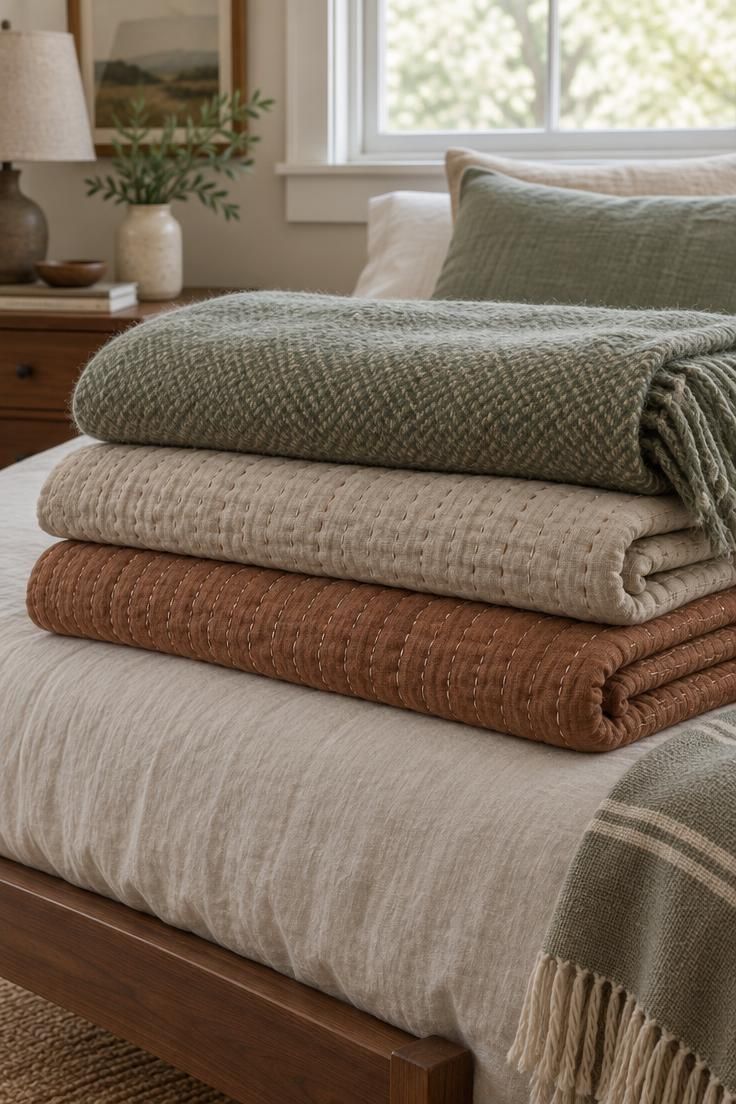
Warm Neutrals That Keep Minimalism from Feeling Cold
The biggest fear about minimalism is that it reads as sterile.
House & Garden warns that paring things back too much can produce a cold scheme rather than a calm one, and that a bare room quickly becomes punishing.
The palette is where that risk gets managed.
Warm whites, stone, oat, bone, taupe, and clay form the backbone of the look.
These shades sit slightly off pure white, so they read as soft rather than clinical.
Linen bedding in warm neutral tones brings a subtle depth that a crisp optic white cannot, and the texture of the linen adds another layer of warmth.
Low-contrast layering is the technique that makes the palette feel considered.
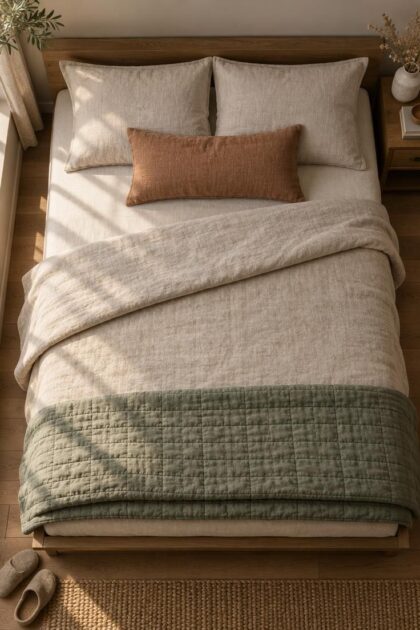
An oat linen coverlet over a stone-washed top sheet, with a clay-toned lumbar pillow, creates separation between the layers without introducing a second color family.
The eye reads the shifts in tone as depth.
Repeating the base tone across the bed and the room ties everything together.
If the bedding leans warm beige, echoing that tone in the wall color or a woven rug keeps the composition coherent.
Slightly deeper or lighter versions of the same neutral handle the folded quilt and the accent pillow.
A single muted accent can anchor the scheme.
Soft sage, aged terracotta, or a dusty rose on one pillow or one folded blanket adds a point of interest while staying inside the warm family.
More than one accent begins to compete with the calm the bed is meant to keep.
Design Pro-Tip: Choose one warm neutral as your base and repeat it in the sheets, coverlet, and wall color, then use slightly deeper or lighter versions of that same tone for the folded quilt or lumbar cover.
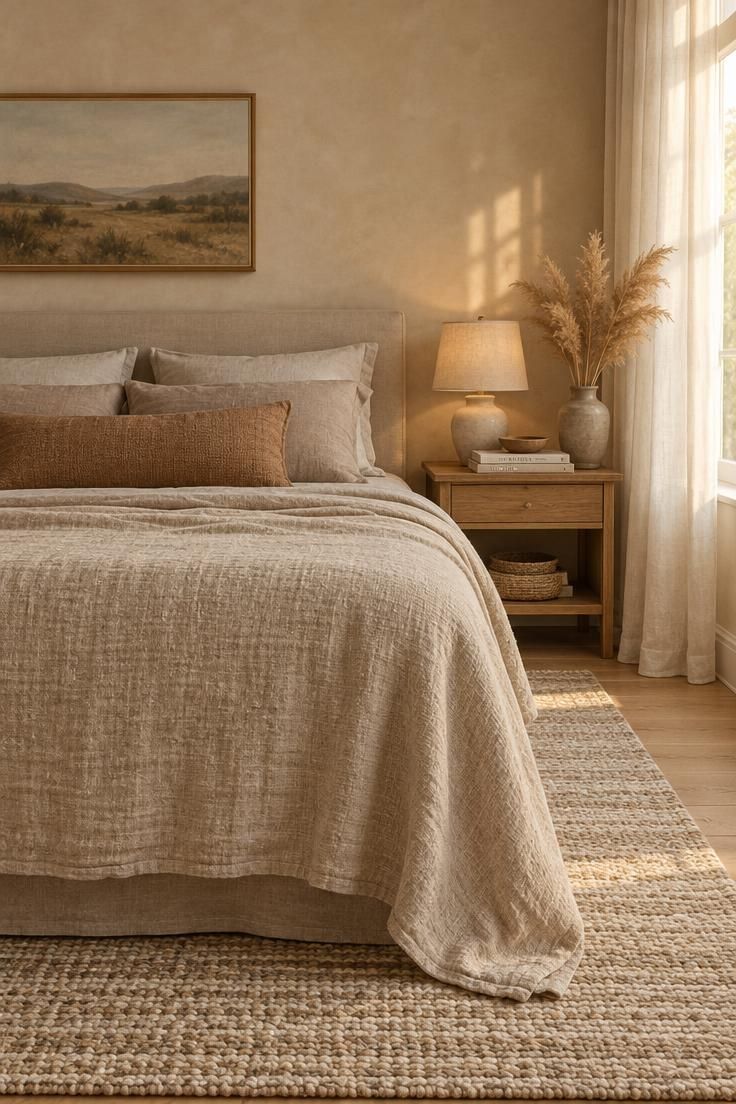
Keeping the Cozy-Minimal Bed Looking Good Between Laundry Days
A low-object bed is easier to maintain than a heavily styled one, provided the few pieces in use get a light daily reset.
Linen and cotton show wrinkles, and in this style that works in your favor as long as the top cover is smoothed.
The relaxed texture reads as intentional rather than neglected.
The daily routine takes under a minute.
Flatten the top sheet, straighten the coverlet so the folded line sits level, and fluff only the pillows actually in use.
There is no stack of cushions to arrange, which is precisely why the style holds up on busy mornings.
An oversized throw or folded quilt may need occasional re-tucking under the pillows to stay where you placed it.
A quick adjustment when you make the bed keeps it from sliding through the night.
Treat it as part of the same minute, not a separate task.
Washing schedules vary by household and by how the bed is used, but sheets typically need more frequent laundering than coverlets and quilts.
Pale fabrics show marks readily, so a spot-clean habit helps extend the time between full washes.
Keep a mild detergent on hand for the occasional mark.
Swapping a lumbar pillow cover is the cheapest way to refresh the look.
Alvin Wayne points out that covers can be changed without replacing the whole bedding set, so one pillow can carry a seasonal shift in color or texture.
A single new cover does more than a whole new set.
The old model demanded constant fluffing of multiple decorative pillows, and any lapse showed.
The reduced version forgives a rushed morning, because there is less to rearrange and fewer objects to align.
That resilience is part of the style’s practical appeal.
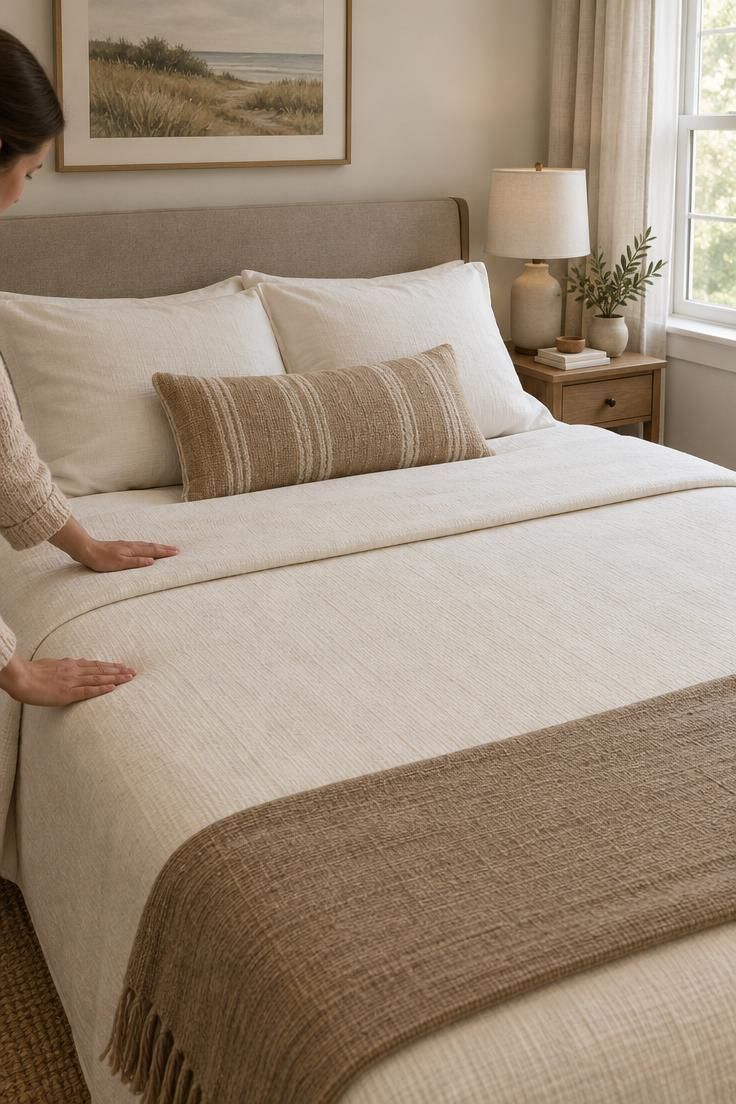
Conclusion
Three decisions carry the whole look: cut the pillow count to what you actually use, make a coverlet or quilt the top layer instead of a fluffy duvet, and let texture and warm neutrals do the visual work.
Each one is reversible, which makes experimenting low-risk.
Start with the change that requires nothing new.
Fold your existing coverlet back over two flat pillows and see how the bed reads from the doorway.
If the surface feels too plain, add a single lumbar pillow in a contrasting texture or a folded quilt at the foot rather than a stack of cushions.
Judge the result by how it feels at night, not only how it looks at noon.
A bed you can get into without moving anything is the one worth keeping.
Try the coverlet fold first, then adjust the layers one at a time until the bed feels calm, warm, and easy to remake.