This post may contain affiliate links. If you make a purchase through these links, we may earn a commission at no additional cost to you.
The mantel is where autumn announces itself first.
Long before the dining table is set or the front door wreath is hung, this narrow shelf of wood or stone pulls a room toward the season.
A few dried stems, a heavier candleholder, one unexpected color shift, and the whole gathering space feels warmer.
The best fall mantels never look like a store display.
They read as a small collection of things someone chose slowly, touched often, and left room around.
The ideas ahead treat the mantel as a composed vignette, with light, texture, and empty space doing much of the work.
For readers searching for fall fireplace mantel decorating ideas, these approaches offer flexible starting points for seasonal mantel styling.
A Tarnished Bronze Wall Mirror Anchoring Dried Bittersweet Vines and Blackened Iron Candlesticks
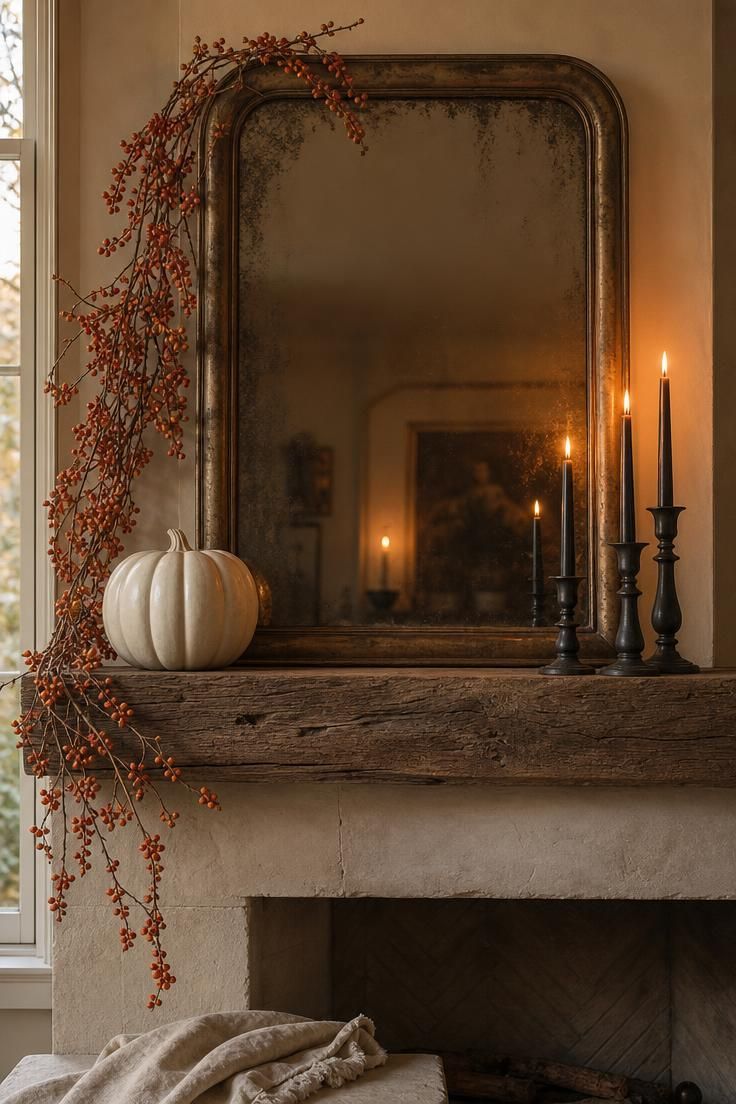
The tarnished bronze mirror does the heavy lifting here.
Its mottled surface reads like fallen leaves, so the whole vignette feels autumnal before a single pumpkin appears.
The bittersweet vine breaks the hard top line of the mirror and draws the eye down toward the candles.
Placing those iron candlestick holders at the front edge creates a shadow gap behind them, which gives the arrangement real depth.
The cream pumpkin is small enough to feel like a punctuation mark rather than a theme.
This look works especially well in a room with warm wall tones, since the bronze mirror will absorb and return that glow all evening.
Style Blueprint:
- Oversized tarnished bronze mirror with irregular, aged surface
- Dried bittersweet vine with orange-red berries draped from the upper left
- Three blackened iron taper candlesticks at graduated heights on the front edge
- One matte cream ceramic pumpkin overlapping the mirror frame
- Raw wood mantel shelf left mostly visible beneath the arrangement
A Charred Cedar Trough Filled With Wine-Red Amaranthus and Warty Blue-Gray Gourds
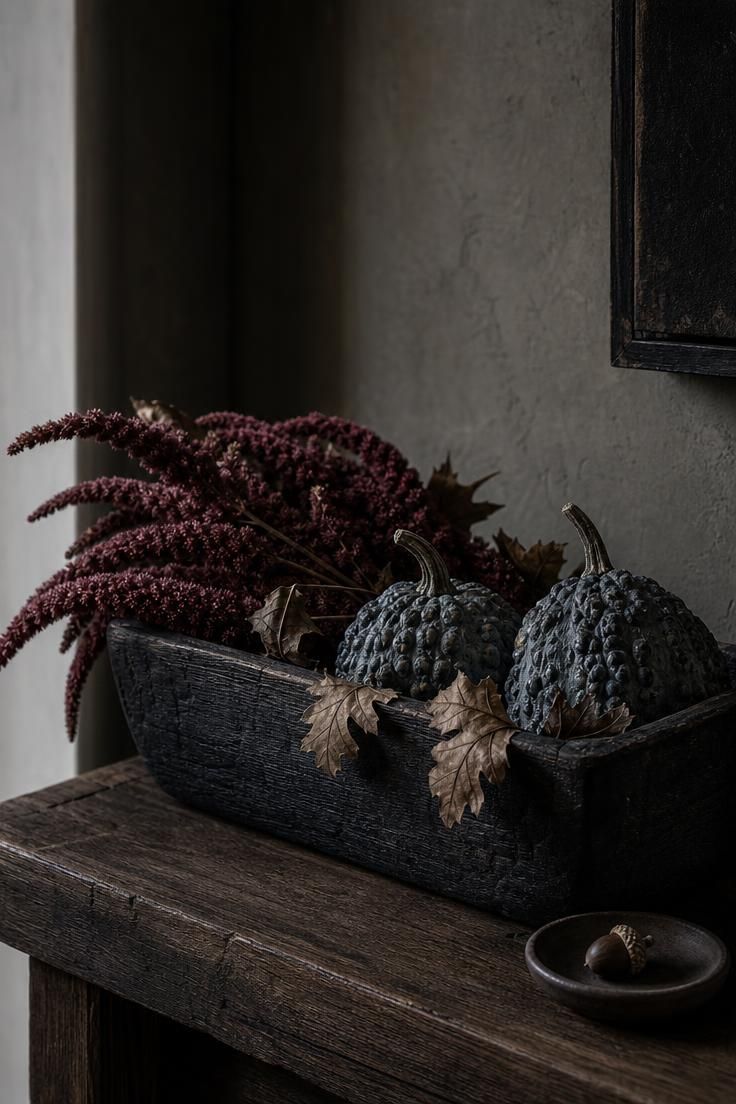
This combination feels like late October without trying too hard.
The charred cedar trough has a smoky depth that makes the wine-red amaranthus recede and the blue-gray gourds stand forward.
The cool tones slow the whole composition down, giving the mantel a heavier, more contemplative mood.
Those warty gourds have an almost mineral quality against the wood, like stones with stems.
Leaving the back wall visible is the quiet decision that keeps the arrangement from turning into a pile.
This is a mantel for a room where the fireplace itself still works and the hours after dinner stretch long.
Style Blueprint:
- Low rectangular charred cedar trough
- Wine-red dried amaranthus stems leaning left
- Two warty blue-gray gourds placed forward in the vessel
- Preserved oak leaves with browned edges overhanging the rim
- Negative wall space behind the trough retained
A Tall Zinc Urn of Curly Willow and Dusty Green Hydrangeas Flanking One Side of a Limestone Mantel
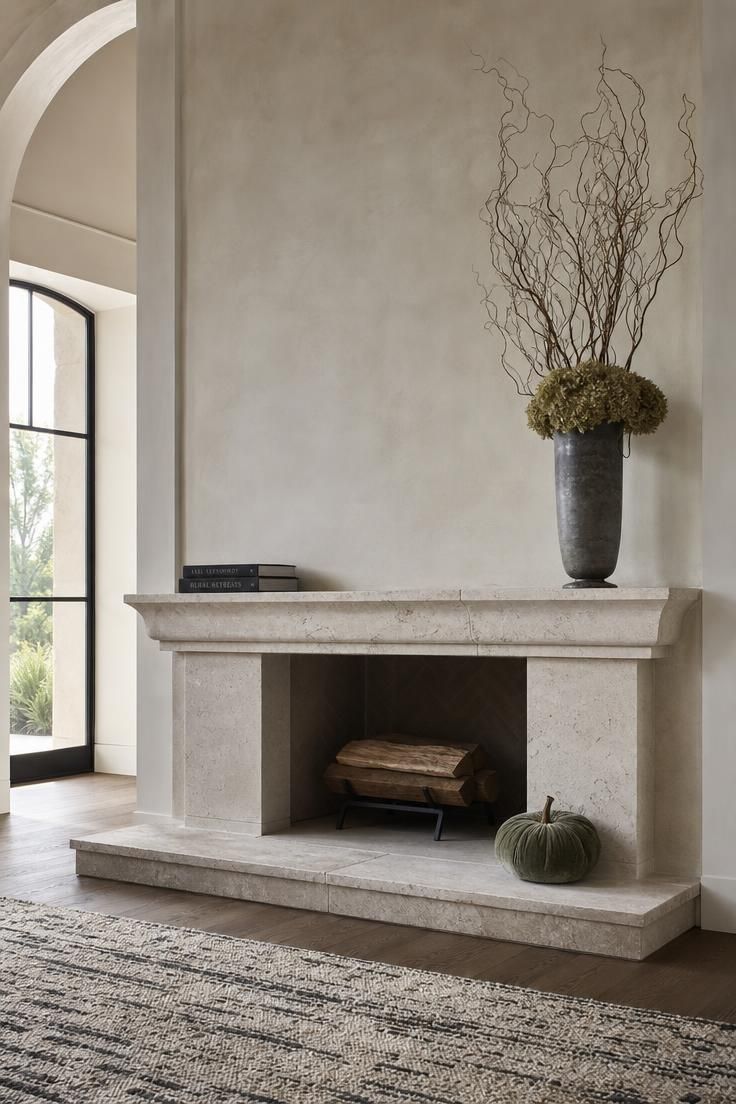
Scale is the lesson in this room.
The tall urn and extended willow branches give the right side vertical reach, while the low book stack on the left keeps the composition from tipping.
The dusty green hydrangeas feel like a faded memory of summer, not a bright refusal to let go.
The sage green velvet pumpkin on the hearth repeats that cool botanical note at floor level, connecting the mantel to the whole fireplace wall.
Limestone has a soft, porous surface, so the zinc urn and papery hydrangeas almost look like they grew there.
This arrangement proves that one strong vertical element can carry an entire mantel.
Style Blueprint:
- Tall narrow zinc urn with mottled gray patina
- Curly willow branches extending fourteen to eighteen inches above the urn
- Preserved dusty green hydrangea heads tucked low at the vessel mouth
- Two hardcover volumes with charcoal cloth spines stacked on the opposite side
- Sage green velvet pumpkin resting on the hearth floor
A Woven Seagrass Basket Mounded With Dried Miscanthus Beside a Stacked Birch-Log Firebox
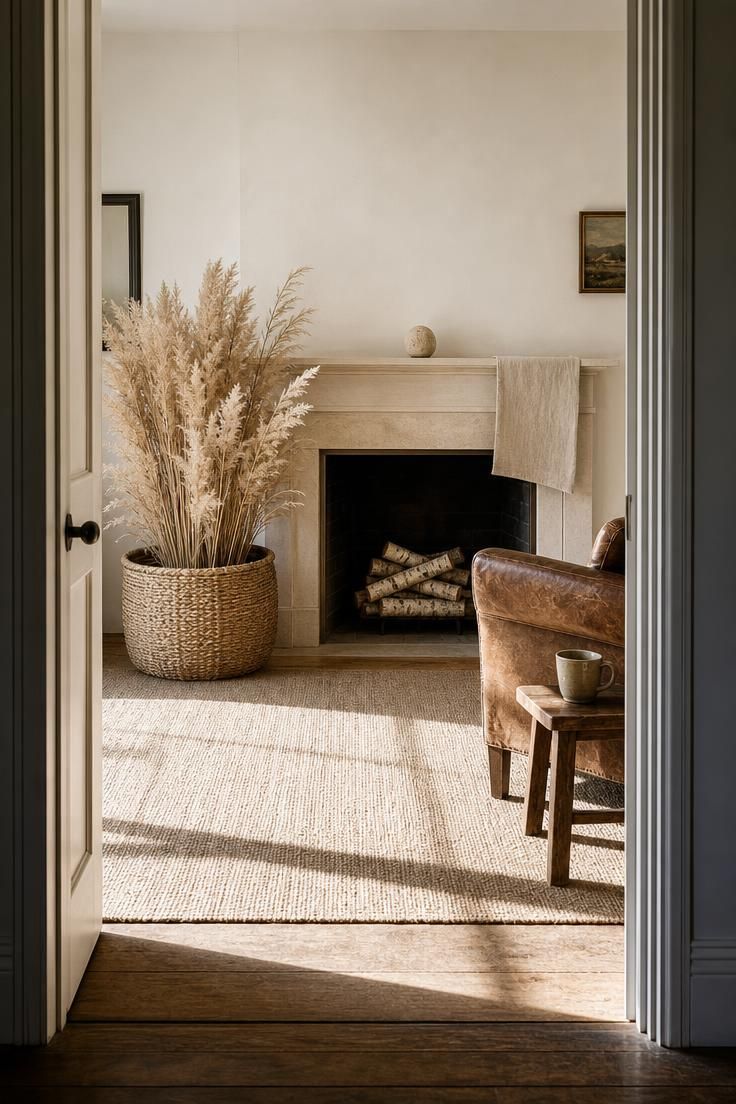
Here the mantel steps back and lets the hearth do the talking; the restraint of a single linen runner and one stone sphere on the shelf works because the floor below holds all the seasonal weight.
The birch logs inside the firebox are so effective because their pale bark cools the dark opening and makes the hearth feel deeper.
Dried miscanthus in that large basket gives the left side a full, brushed texture that moves with any small shift in air.
This harvest decor approach suits someone who wants autumn in the room without ever feeling decorated.
It reads like a winter prep that happened naturally over a weekend.
Style Blueprint:
- Oversized woven seagrass basket on the hearth floor
- Dried miscanthus plumes, airy and vertical
- Neat cross-stack of birch logs with papery white bark in the firebox
- Flax linen runner draped asymmetrically over the front edge
- Unpolished travertine sphere at the mantel center
Design Pro-Tip: Pull the outermost objects to the front edge and push the tall background pieces against the wall. This 50 to 75 percent depth rule creates a shadow line that makes the whole vignette feel layered, not lined up in a flat row.
A Long Slate-Gray Stoneware Bowl of Dried Lunaria and Smoked Birch Candles
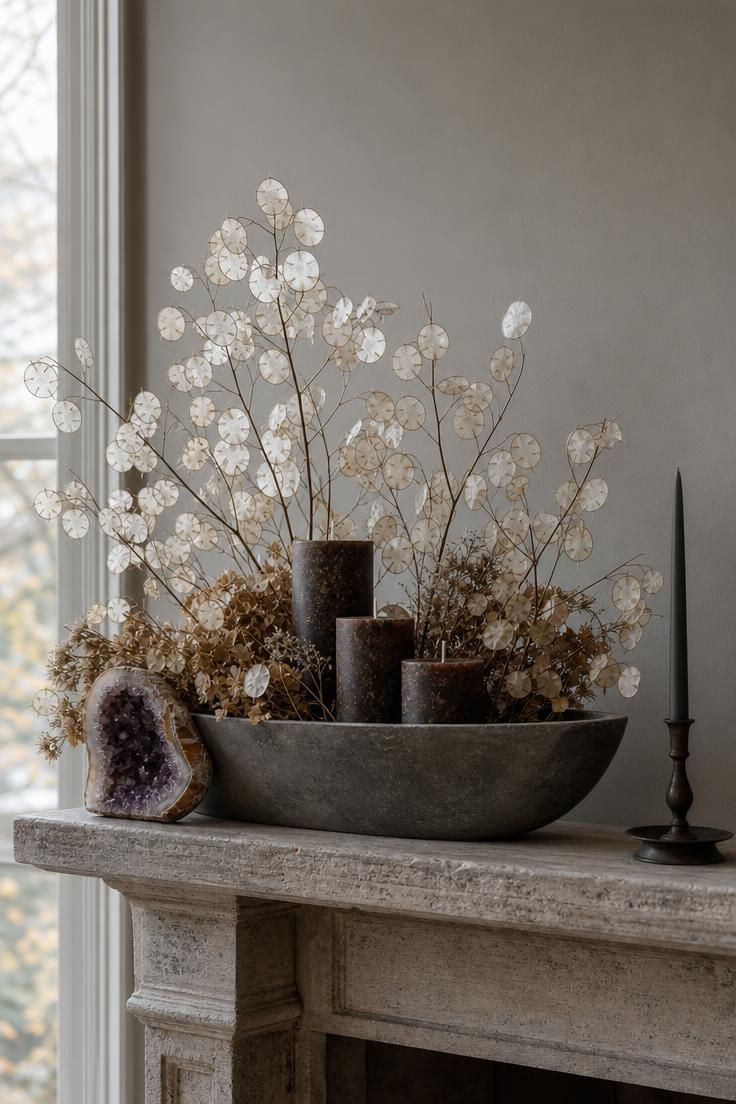
The lunaria is the secret star of this mantel; those translucent pods hold light even on the grayest afternoon, so the arrangement never feels flat or heavy.
The smoked birch candles anchor the composition with dense, almost charred weight while the stoneware bowl keeps its cool mineral tone.
The amethyst geode is a small surprise, a bit of raw crystalline texture that makes the whole mantel feel like a cabinet of collected curiosities rather than seasonal decor.
A single taper on the right is enough to balance the long bowl without competing.
This arrangement would work beautifully in a room with blue-gray walls or heavy linen curtains.
Style Blueprint:
- Long shallow slate-gray stoneware bowl
- Dried lunaria branches with translucent seed pods
- Three smoked birch pillar candles nested in the arrangement
- Amethyst geode slice leaning against the bowl’s left front rim
- One dark charcoal taper in a small iron holder on the far right
A Faded Indigo Linen Runner Under a Row of Terracotta and Mustard Ceramic Pumpkins
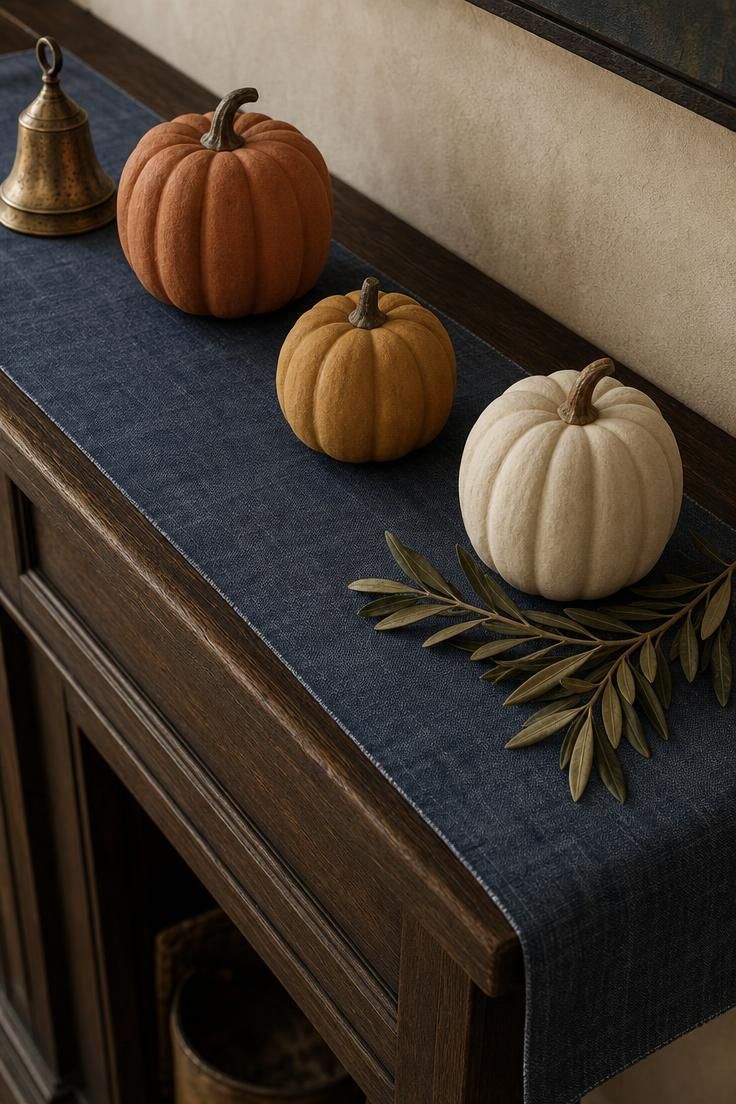
Color chemistry is everything in this pairing; the faded indigo textile cools the terracotta and mustard just enough to keep the mantel from turning into a harvest cliché.
The runner does the visual work of unifying the pumpkins, so each one can sit at its own angle and depth like a small sculpture.
The olive sprig is a quiet bridge between the green-blue linen and the warm ceramics.
That aged brass bell adds a tiny metallic note without shouting.
This pumpkin decor arrangement shows that a single piece of cloth can organize the whole shelf more effectively than symmetry.
Style Blueprint:
- Faded indigo linen runner with exposed selvage
- Three matte ceramic pumpkins in terracotta, muted mustard, and pale cream
- One sprig of dried olive branch tucked beneath the right pumpkin
- Small aged brass bell at the far left corner
- Off-set depths to create a gentle zigzag rhythm
A Weathered Oak Block With Flameless Tapers and a Single Quince Branch
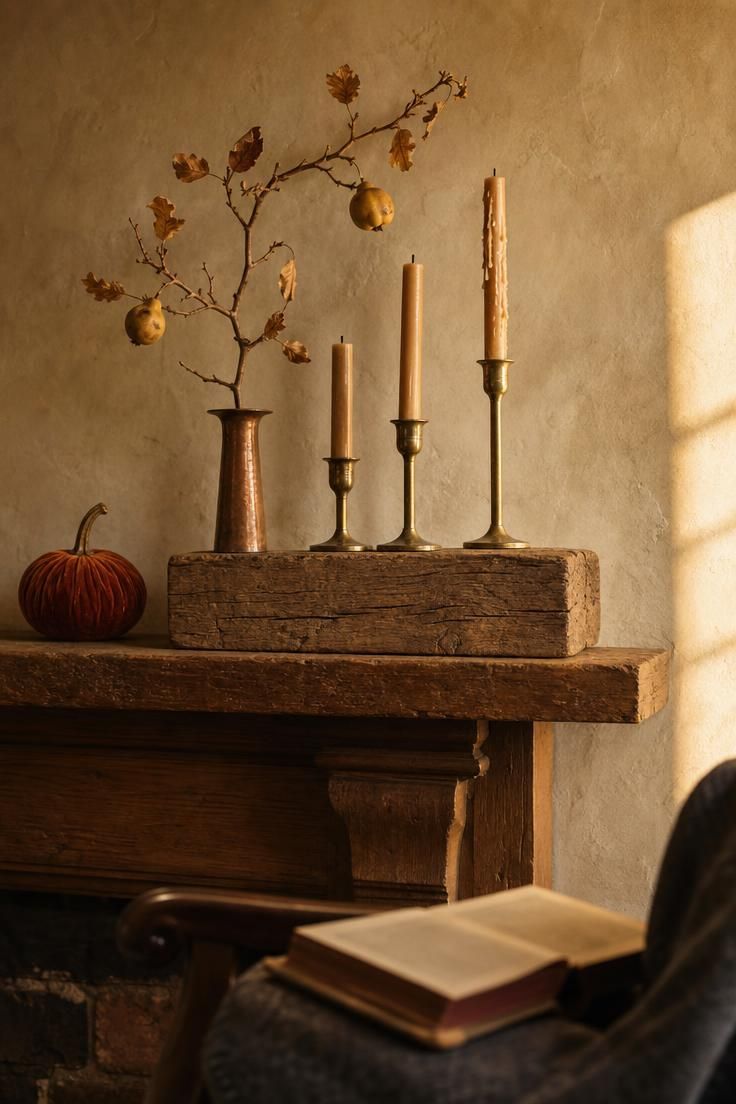
There is something deeply satisfying about the oak block as a raised stage for the candles.
It turns a simple cluster into an intentional still life with its own architecture; the quince branch springs upward from behind the brass holders, giving the right side a living line that feels unforced.
The rust velvet pumpkin on the left is just enough softness to keep the wood and metal from feeling cold.
The wax drip on one taper is a detail worth keeping, because it tells a story of an evening already spent here.
This mantel would suit a room with old plaster walls and a well-worn leather chair nearby.
Style Blueprint:
- Rough-hewn oak block with visible tool marks
- Three oxidized brass taper holders set into the block at staggered heights
- Single quince branch in a narrow copper bud vase
- One rust velvet pumpkin at the far left for soft counterweight
- Candle wax drip left unpolished on one taper
A Black Iron Fireplace Screen With a Dried Magnolia Wreath Hung on Raw Plaster
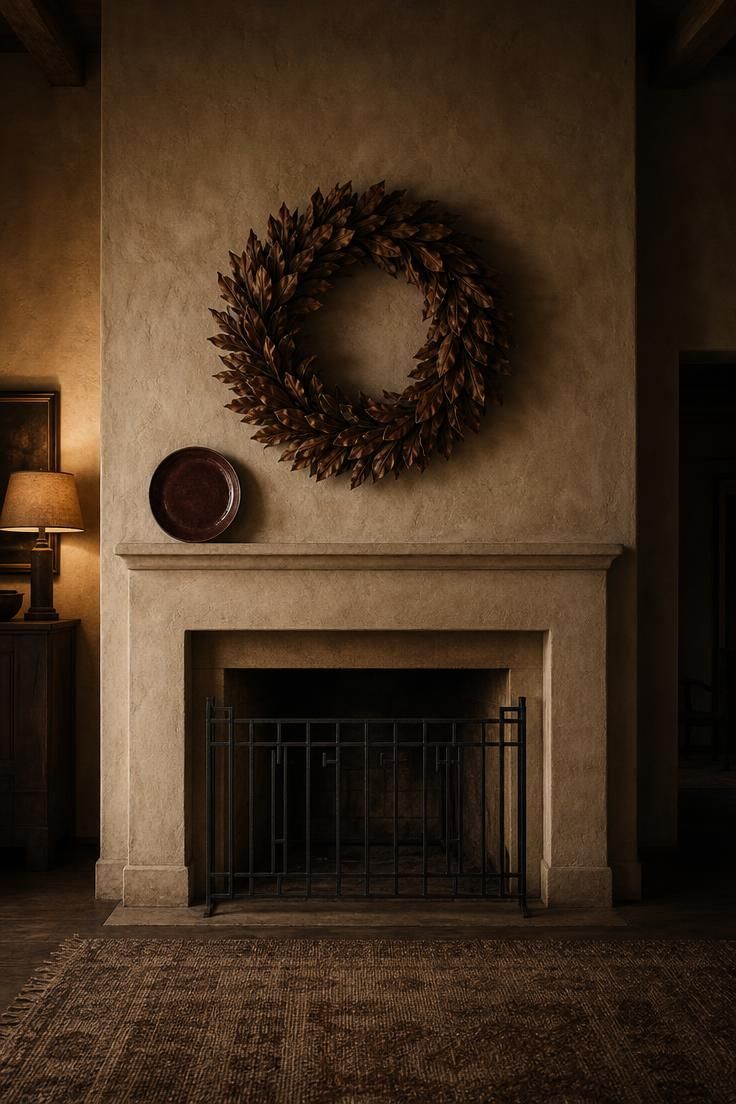
The magnolia wreath is the entire room here; its glossy brown leaves and circular form do all the work, so the mantel can stay almost bare and still feel complete; the confidence of leaving that shelf empty makes the wreath and the black iron screen feel like a matched pair of sculptural objects.
The oxblood charger leaning at the far left is a small punctuation mark that keeps the scene from becoming too stark.
Raw plaster has a soft, human surface, so the wreath’s sheen becomes more pronounced by contrast.
Fall wreaths like this one work beautifully for a mantel that favors shadow over clutter.
Style Blueprint:
- Dried magnolia wreath with leathery brown leaves as the wall anchor
- Nearly empty mantel surface for negative space
- Low black iron fireplace screen with geometric bars
- One hand-thrown oxblood ceramic charger propped at the far left
- Raw plaster wall left visible and rough
A Stacked Slate and Soapstone Totem Beside Dried Oak-Leaf Hydrangeas in a Travertine Vase
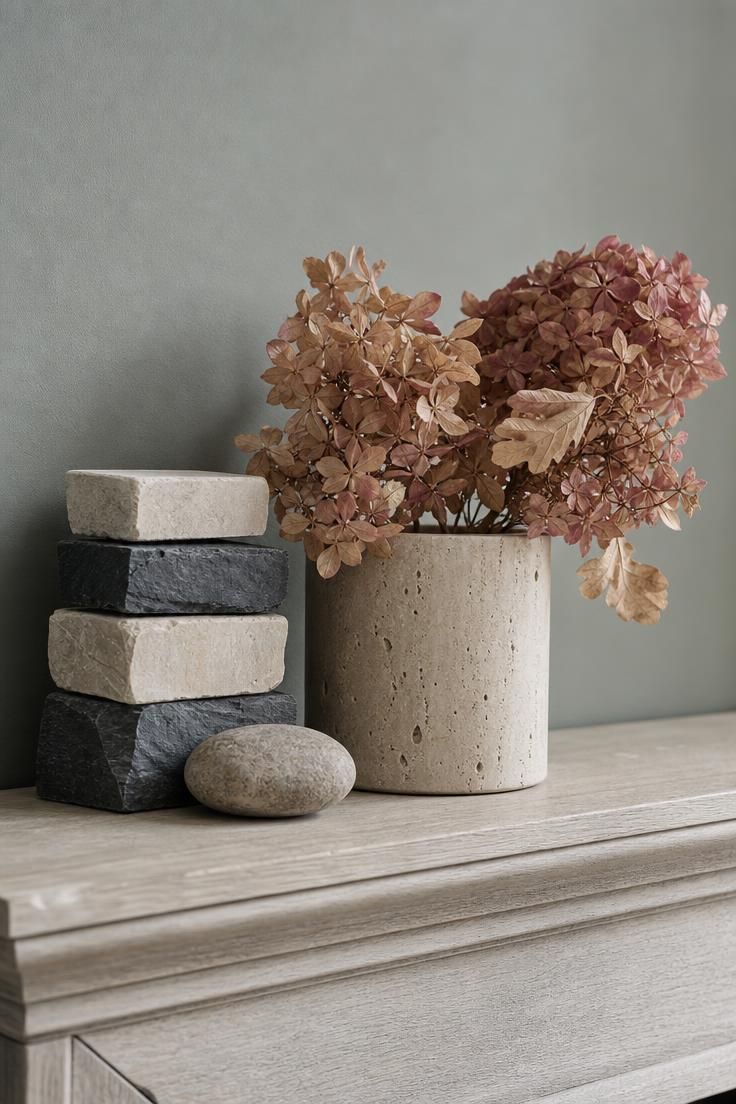
Stone takes center stage here, and the result is oddly tender.
The totem of slate and soapstone feels like a small cairn, a marker of time passing.
The hydrangeas echo that message with their papery faded heads.
The travertine vase has enough pitting and warmth to keep the cool palette from going icy.
The single river stone at the base is a tiny grounding detail that makes the whole grouping feel inevitable.
Everything stays low, which lets the mantel read as a continuous horizontal line rather than a series of competing peaks.
This arrangement suits a room with modern furnishings and a quieter approach to autumn mantel decor.
Style Blueprint:
- Alternating slate and soapstone tile totem
- Travertine vase with natural pitting
- Dried oak-leaf hydrangeas in parchment and dusty rose
- Unpolished river stone at the totem’s base
- Height capped under fourteen inches for horizontal continuity
Design Pro-Tip: Create a single 8 to 12 inch cascade over the mantel’s front edge, a trailing vine, a draped linen, or an overfilled basket. It breaks the hard horizontal line and guides the eye down to the hearth.
A Hammered Copper Plate Behind a Cluster of Fig-Scented Beeswax Candles and Dried Persimmons
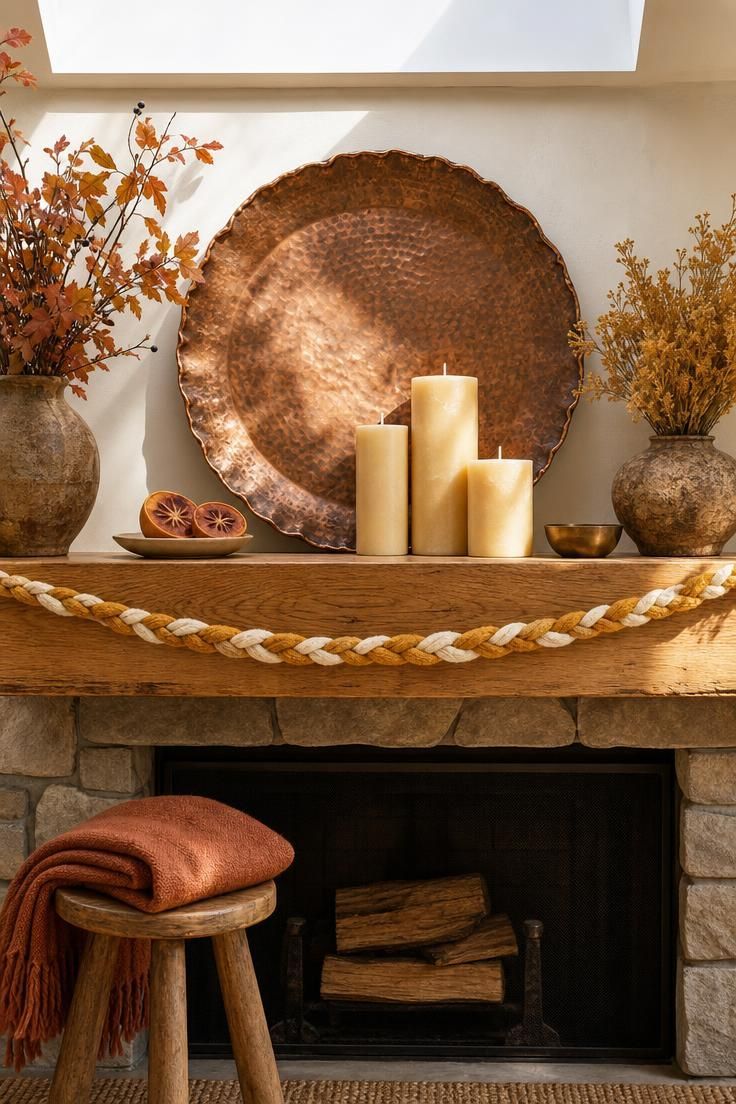
The hammered copper plate shines like an autumn sun without ever feeling forceful.
The candles are real beeswax, meant to be lit, and their fig scent introduces an invisible layer of season.
The dried persimmons are a small, unexpected touch that speaks of food and preservation rather than craft-store autumn.
That braided wool garland across the front lip gives the shelf a soft finishing line, like a collar on a coat.
There is a quiet abundance to this mantel that makes me want to sit below it with tea and a book while the afternoon fades.
For anyone collecting fireplace decor ideas, this composition shows how dried botanicals and candlelight can work together.
Style Blueprint:
- Large hammered copper plate propped against the wall
- Three fig-scented beeswax pillar candles in staggered heights
- Two dried persimmon halves on an oat-colored ceramic dish
- Thin braided wool garland in mustard and cream across the front lip
- Candles intended for burning during evening hours
A Stoneware Crock of Dried Oat Stalks and a Single Bronze Apple on a Dark Wood Mantel
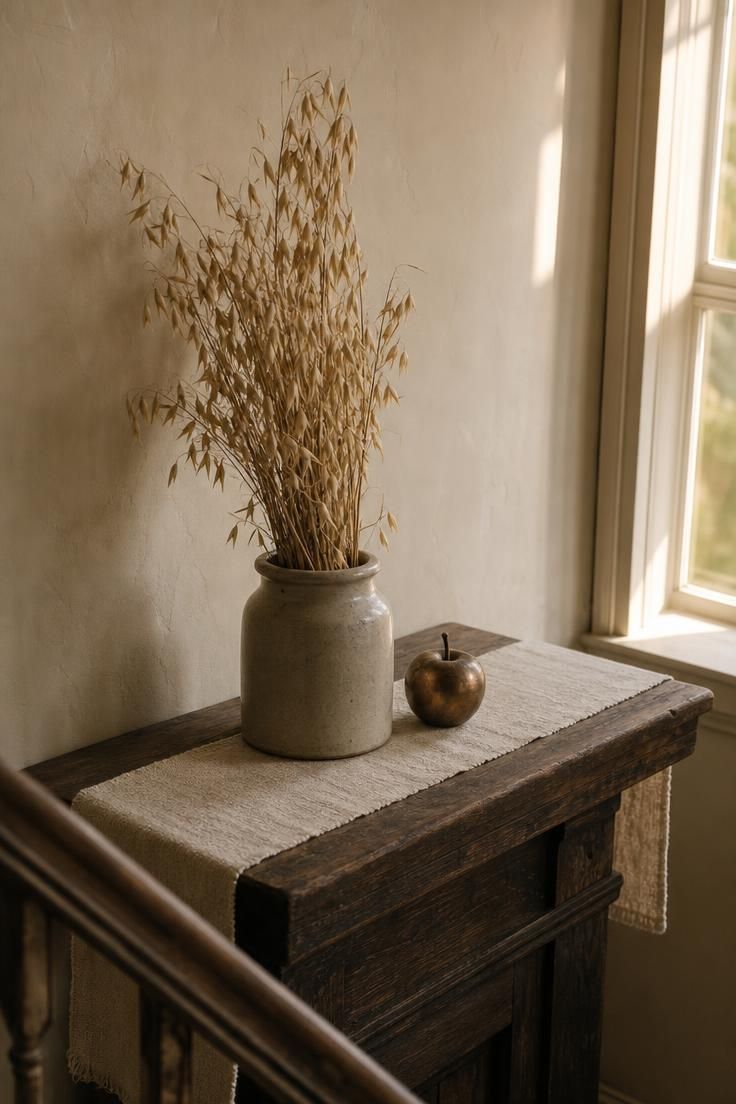
Dried oat stalks bring a soft, grassy movement to this mantel without adding more color.
The bronze apple is the single object that pulls the whole arrangement into autumn, and its worn surface keeps it from feeling like a prop.
The narrow linen runner gives the dark wood shelf a lighter top edge, almost like frost on a branch.
This fall home decor approach is about subtraction, not accumulation.
Two objects and one textile are enough when the materials have weight and history.
Style Blueprint:
- Squat stoneware crock in warm gray
- Loose bundle of dried oat stalks
- Single bronze apple with worn patina
- Undyed oatmeal linen runner
- Bare mantel surface as active negative space
Conclusion
Fall mantel styling succeeds when the materials shift toward dried botanicals, muted metals, stone textures, and textile surfaces rather than relying on a row of identical orange pumpkins.
Each image here shows a distinct composition built on a central anchor, whether that is a mirror, a plate, a wreath, or a long low vessel, with asymmetry and negative space doing the structural work.
The best starting point is a single vertical element, one textured textile, and one seasonal botanical, then a step back to check the spacing before adding more.
Most of these arrangements can move into winter with minimal changes, swapping gourds for pinecones and leaving dried grasses, candlestick holders, and the anchoring framework intact.