This post may contain affiliate links. If you make a purchase through these links, we may earn a commission at no additional cost to you.
The front door is the first handshake your home offers.
Yet most fall doorways default to the same visual script season after season.
What was once charming has calcified into cliché, leaving entryways that feel more like seasonal obligation than intentional welcome.
This article examines why certain fall door decoration approaches have lost their impact and offers researched, designer-backed alternatives that restore a sense of surprise and craft.
The goal is not more decoration.
It is a sharper, more personal point of view at the threshold.
The Decline of the Orange Monolith: What Data and Designers Reveal About Color Fatigue
National retailer documentation and recent trend reporting both point to a clear shift away from monochromatic orange displays.
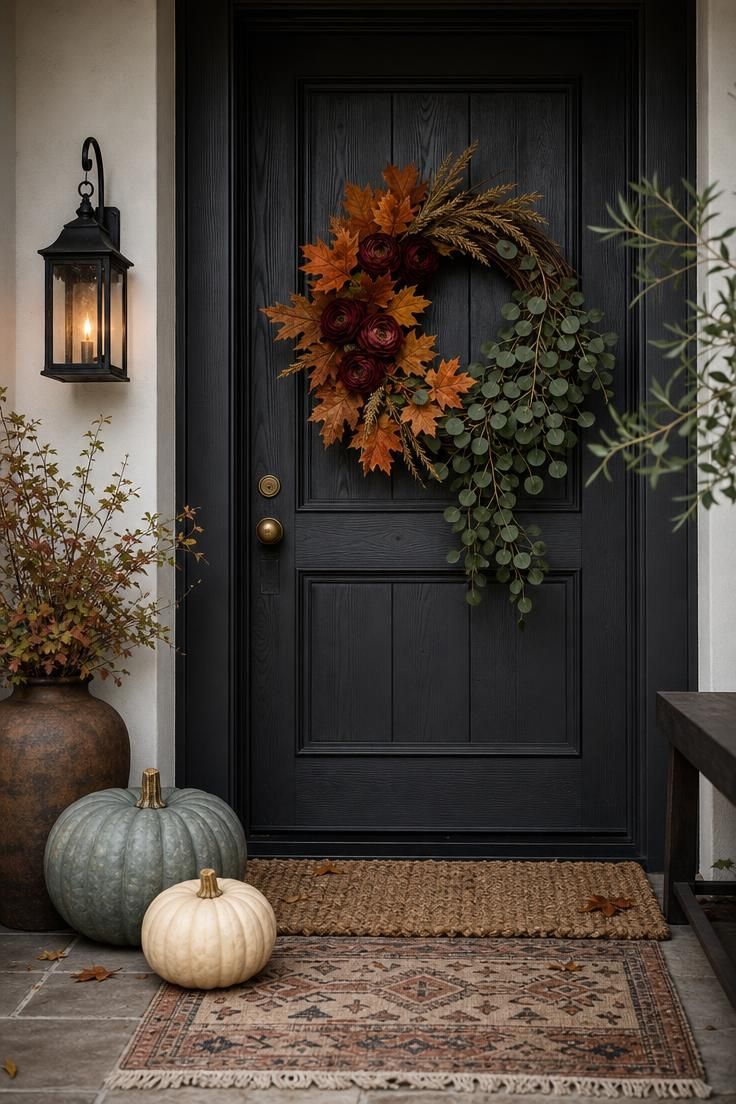
Homes & Gardens has documented fall door wreaths now showing traditional amber, burgundy, and brown alongside pink florals, purple-green combinations, wheat, and jewel tones.
A designer interviewed in that coverage described the all-orange approach as visually exhausting, noting that the eye stops registering repetition as warmth and begins reading it as noise.
Saturated repetition can quickly feel visually overwhelming without adding meaningful interest.
The expanded palette now preferred includes caramel, tan, and warm brown for transitional fall.
Burgundy, plum, and aubergine suit elevated styling, while cream, ivory, and white work for minimal looks.
Blue-gray and dusty blue fit heirloom-pumpkin aesthetics, and mustard, amber, and ochre anchor harvest styling.
Pink, mauve, and soft gold complete eclectic designs.
A restrained mixed palette photographs better because it creates depth through contrast rather than volume through saturation.
The caution here is avoiding the opposite failure of color chaos.
Without a single anchoring tone, even an expensive arrangement can read as a patchwork rather than a composition.
The Generic Scarecrow Problem: Why Literal Seasonal Icons Are Losing Ground
The mass-produced scarecrow has become the clearest emblem of the overdone fall door.
Generic scarecrows and excessive “Welcome Fall” signage now signal low-effort decorating rather than seasonal warmth.
Pinterest’s 2025 fall trend report documented a broader market preference for handmade, vintage, secondhand, and story-driven décor, a direction that literal seasonal icons directly contradict.
A scarecrow bought from a big-box display does not tell the story of the house it adorns.
Designers consistently emphasize that successful fall door decorations should feel inviting, balanced, and connected to the surrounding architecture.
Literal symbols fail on all three counts because they assert theme over place.
National Retail Federation data from 2025 reveals the scale of the seasonal decorating market: 51% of American adults planned to decorate for Halloween, with total expected holiday decoration spending reaching $4.2 billion.
The sheer volume of mass-produced seasonal merchandise has made differentiation through store-bought icons nearly impossible.
The decline of literal symbols connects to a wider preference for subtlety and texture.
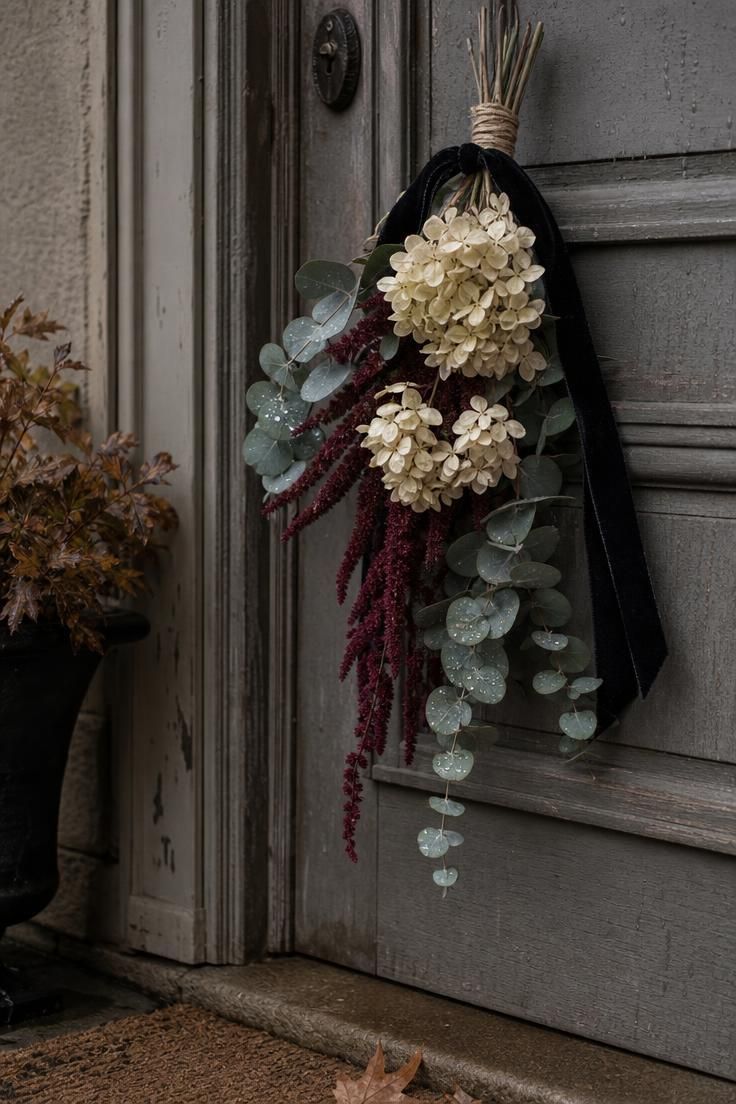
A door with preserved grasses, a single vintage urn, and an asymmetrical grapevine wreath says “fall” without shouting it.
What replaces the scarecrow is a curated material palette that implies the season through form, texture, and restrained color rather than through cartoonish representation.
From Single Wreath to Full Doorscaping: The Composition Shift That Changes Everything
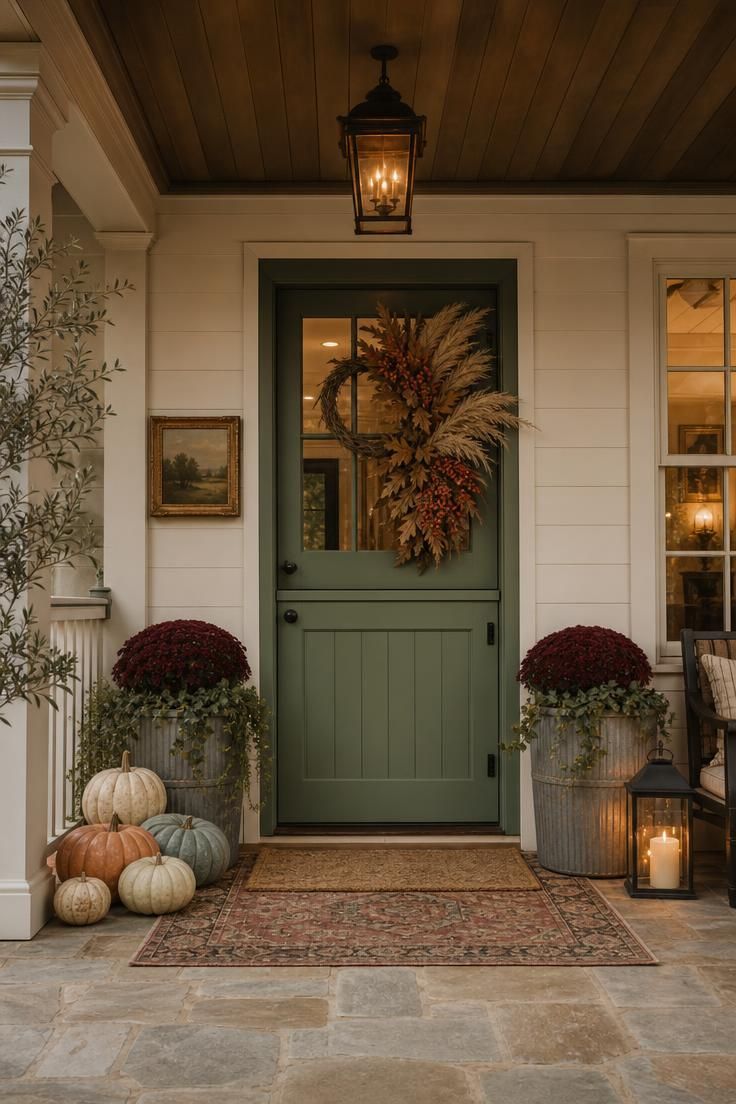
Doorscaping treats the door and entryway as one coordinated visual scene rather than a single surface for a single object.
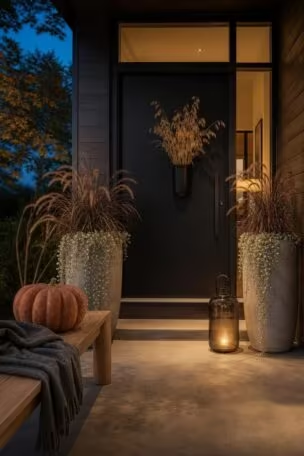
Current displays combine oversized wreaths or swags with door garlands, asymmetrical foliage, lanterns or warm outdoor lighting, layered doormats, coordinated planters and pumpkins, seasonal signs, and decorative door baskets.
The shift has become especially visible in celebrity-home styling and 2026 Halloween coverage, where the entire threshold is designed as one composition.
Houzz’s 2025 U.S. Fall Design Trends Report supports this direction, with design professionals reporting growing interest in handcrafted materials, character-rich surfaces, and integrated, clutter-free design.
The practical guidance from designers begins with the color of the door and the architecture of the home.
From there, the design builds outward with layers: a focal piece, coordinating planters, and subtle accents such as lanterns or seasonal foliage.
The risk of over-layering is real.
The most successful doorscaping ideas maintain a clear visual story with texture, height, and warmth rather than maximum inventory.
Doorscaping feels fresher than single-decor dominance because it acknowledges the doorway as an experience, not a hook.
The composition can draw the eye downward to a layered mat, outward to planters, and upward to architectural details that a lone wreath never engages.
Design Pro-Tip: Before adding anything to your door, photograph the bare entryway and study it as a stranger would. If the photo already feels busy, one focal piece will outperform five supporting layers.
The Scale Mistake: Why Most Fall Wreaths Are the Wrong Size
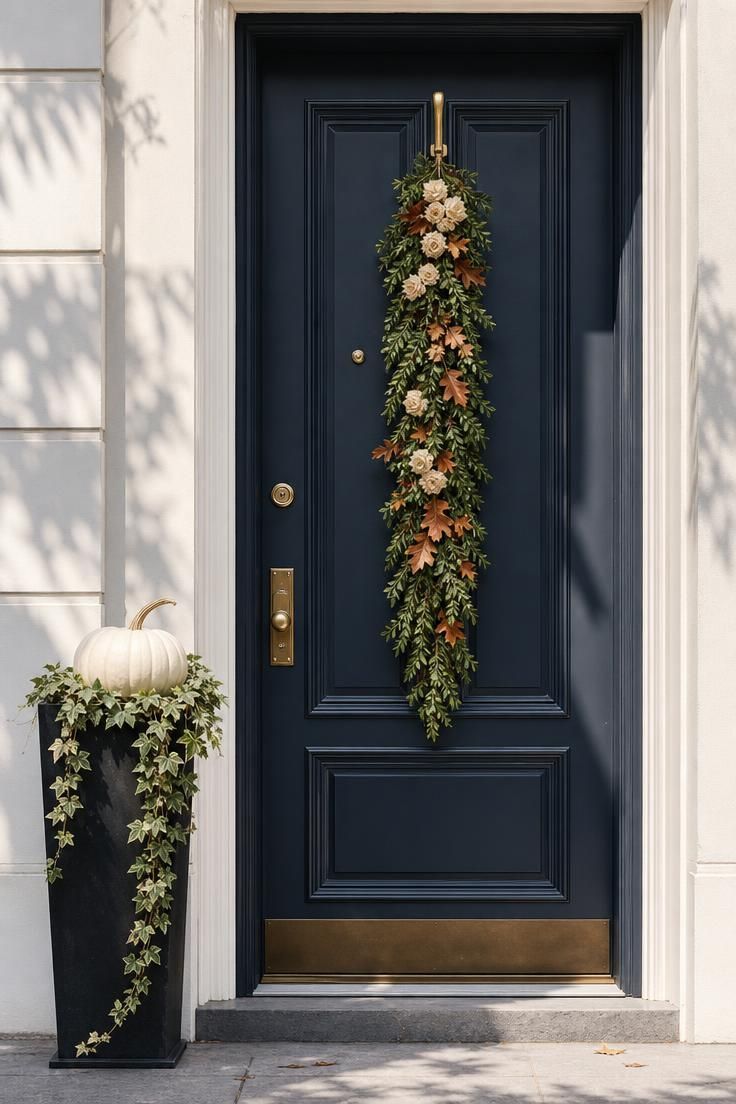
Scale guidance from the research is specific: a standard front door calls for a wreath around 20 to 24 inches wide.
Larger or double doors can support 28 to 36 inches or a matching pair.
Narrow doors often look better with a vertical swag or a smaller wreath.
That fact is one many homeowners overlook.
The common mistake works in both directions.
Wreaths too small to read from the street signal timidity.
Wreaths too large to allow the door to function become obstructions dressed as decoration.
Clearance considerations extend to door hardware, handles, peepholes, storm doors, and doorbells.
A wreath that forces a visitor to dodge foliage to ring the bell has failed its practical test.
Scale also relates to the visual weight of the entire doorscape composition.
A modest wreath can anchor a generous doorscape if the planters and lanterns carry proportionate mass.
An oversized wreath can overwhelm even a well-edited arrangement.
Most overdone door displays suffer from either timid scale or overwhelming scale, rarely from the material itself.
The remedy is measurement, not taste.
Knowing your door’s width and choosing with that number in mind resolves more design failures than any palette decision.
Plastic Pumpkin Clusters and the Texture Problem
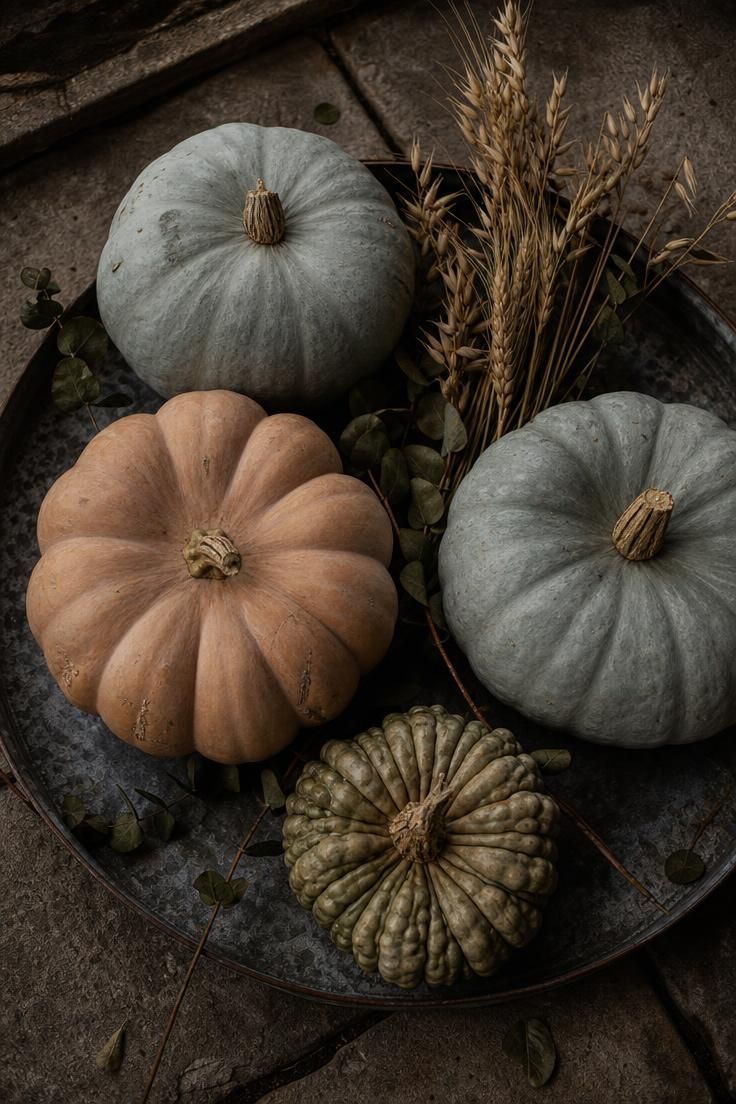
Mass-produced plastic pumpkin clusters have become a core marker of the overdone fall door.
The material shift is toward dried botanicals, preserved leaves, eucalyptus, wheat, grasses, pinecones, acorns, branches, and real pumpkins.
University of Minnesota Extension guidance lists dried hydrangeas, eucalyptus, boxwood, juniper, pinecones, birch, dogwood, and willow as preferred materials for wreaths and porch décor.
Durability requires attention to exposure.
For fully exposed doors, faux foliage, preserved grasses, plastic pumpkins, artificial berries, metal signs, and sealed wood offer practical weather resistance.
Natural dried materials work best under an overhang, away from prolonged direct rain.
Clear floral or craft sealant should be applied where appropriate, and periodic inspection for insects should occur before bringing them indoors.
The textural appeal of current pumpkin door decor comes from grapevine and rattan, velvet or grosgrain ribbon, weathered wood, galvanized or zinc metal, stoneware, matte black metal, and warm brass.
These materials create a visual complexity that plastic cannot imitate.
Texture, not theme, is what makes a door display feel expensive.
Why Now: The Seasonal Timeline and the Demand for Displays That Last
Consumers are seeking décor that transitions from September through Thanksgiving rather than looking specifically Halloween-themed.
The practical timeline runs from early September, with leaves, wheat, sunflowers, apples, and neutral greenery.
October brings pumpkins, darker colors, black ribbon, and Halloween accents.
Early November calls for removal of overt Halloween imagery and emphasis on gourds, corn, foliage, and harvest colors.
Late November turns toward evergreen, pinecones, and berries.
The economic rationale is strong.
NRF data shows that 49% of consumers begin Halloween shopping in September or earlier.
The buying cycle starts far before the holiday itself.
A display that only works for one week in late October represents poor value across that extended window.
Numerator’s research found that 74% of Halloween decorators cited personal enjoyment and creativity as their primary motivation.
A versatile display extends that enjoyment across the full season.
Neutral wreath bases with removable accessories have emerged as the most economical approach for homeowners who want one display to work across multiple fall moments.
AP-NORC data from October 2025 indicates that 32% of U.S. adults planned to display Halloween door decorations.
That share is meaningful but not dominant, suggesting that broad fall appeal remains the larger market opportunity.
One versatile base display refreshed across the season answers both the aesthetic and economic demands.
Design Pro-Tip: Choose a neutral wreath base and swap only the ribbon and a single accent cluster between September, October, and November. You will save money and the door will look intentionally current all season.
The Matching Set Trap: Coordinated Without Being Designed
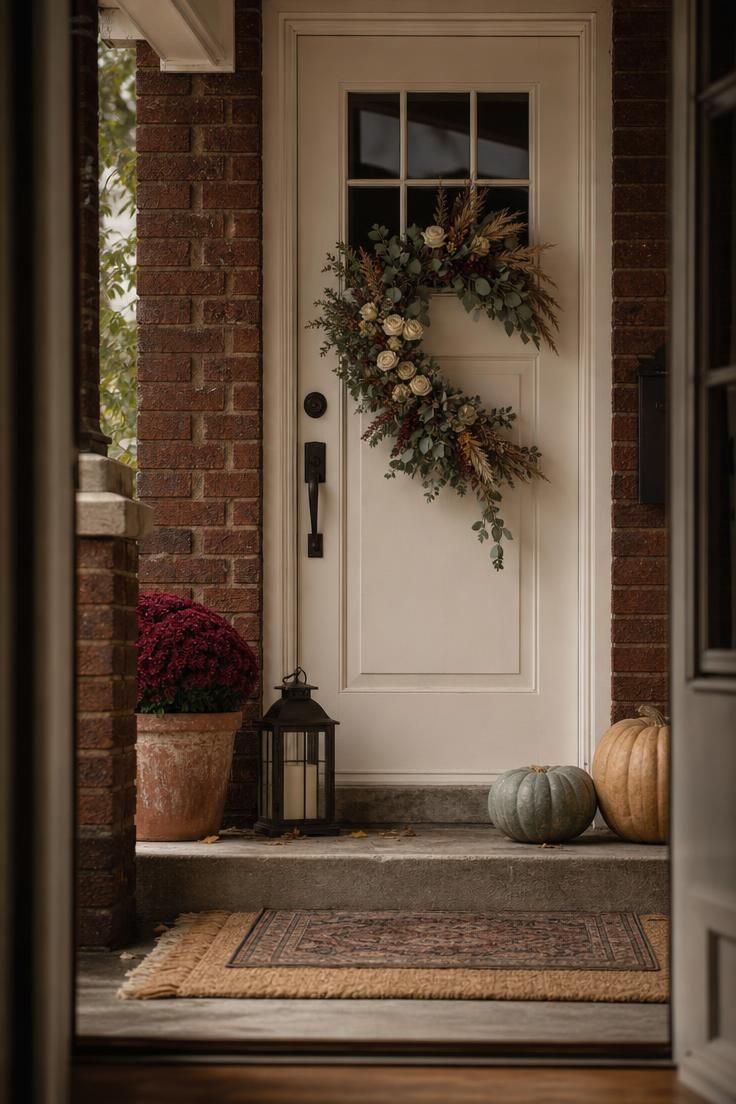
Perfectly matching wreath, mat, sign, and pillow sets are a primary source of the overdone look.
The problem is that perfect matching reads as store-bought rather than styled.
A coordinated set purchased in one transaction signals that no decision was made, only a purchase.
The designer alternative is one focal piece plus two or three supporting layers.
That composition frames the entrance rather than cluttering it.
Intentional asymmetry creates visual hierarchy.
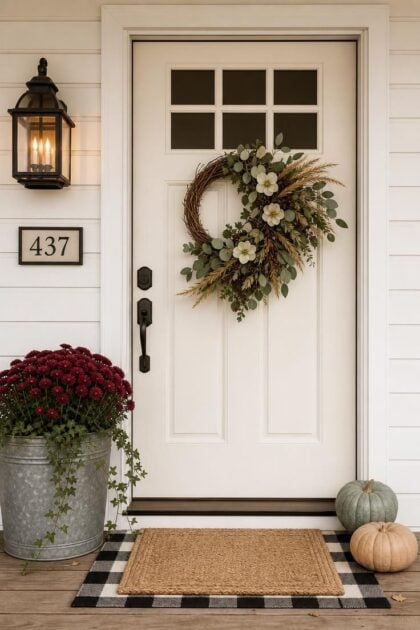
The most current approachable style combines a 28 to 32-inch asymmetrical wreath in eucalyptus, wheat, burgundy berries, and cream florals.
Two real heirloom pumpkins in blue-gray and tan join a burgundy mum or fern in a weathered planter.
A black lantern and a simple layered mat complete the arrangement.
The goal is not to use every fall decoration available.
Restraint creates the impression that the entryway was composed by a person with a point of view, not assembled from a catalog page.
A DIY fall wreath with preserved stems and dried wheat can anchor this same composition without feeling homemade.
Specialty Pumpkins and Intentional Grouping: Replacing Scatter with Structure
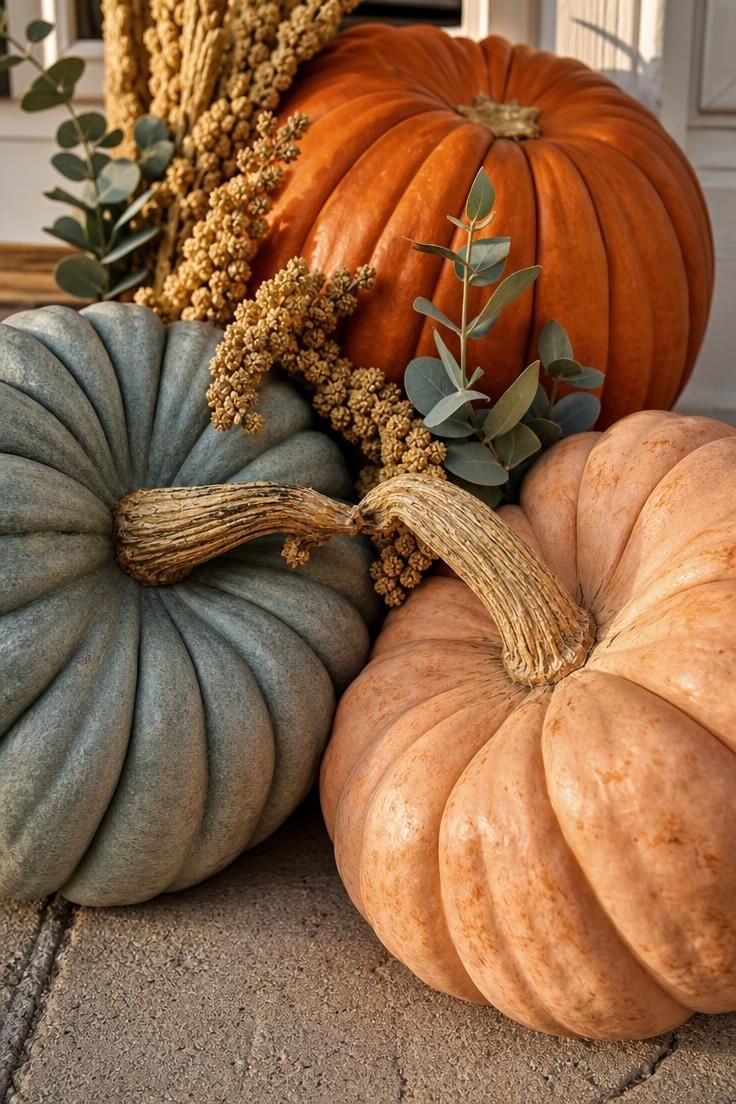
Heirloom and specialty pumpkins have emerged as the strongest replacement for the all-orange pumpkin display.
Specific varieties gaining traction include blue-gray Jarrahdale, peachy-pink Cinderella, tan Long Island Cheese, white or cream pumpkins, Knucklehead and other textured varieties.
One or two classic orange pumpkins serve as visual anchors.
The preferred arrangement style is grouped and layered rather than scattered randomly.
Intentional grouping aligns with broader fall porch decorating guidance favoring composition over unstructured placement.
Fewer, better pumpkins read as curated rather than chaotic.
The variation in color and texture does more visual work than repetition ever could.
The pumpkin itself was never the problem.
The repetition was.
Safety and Attachment: What Overdone Displays Often Get Wrong
Many failed or overdone front-door displays are as much a safety issue as a style issue.
Attachment methods for lightweight wreaths should begin with padded over-the-door wreath hangers with felt or rubber padding.
Check that the hanger does not prevent the door from closing tightly.
Metal doors can accommodate strong removable magnetic hooks tested with the full weight of the decoration before extended use.
Glass or smooth surfaces call for appropriately rated suction hooks or removable adhesive hooks applied to cleaned, dried surfaces without exceeding weight ratings.
Heavier displays may require screw eyes or other permanent hardware, with permission obtained before drilling in rental properties.
The NFPA recommends battery-operated candles or glow sticks rather than open flames for pumpkins and lanterns.
The U.S. Fire Administration advises keeping decorations at least three feet from heat sources.
Ribbons, dried grasses, and foliage should never hang near light fixtures or heating vents.
The rule that matters most is simple.
Decorations should never block latches, catch fingers, or obstruct emergency exits.
A front door must remain a door first.
A fall door hanging placed too close to a light fixture creates a hazard that no seasonal display justifies.
Design Pro-Tip: Walk away from your finished door display, then come back and try to actually use the door with both hands full. If you hesitate or have to adjust anything, the display has already failed.
The Budget Fallacy: Why Expensive Looking Doesn’t Require Expensive Buying
A designer-quality door display is achievable without a large budget.
The recommended approach begins with one strong focal point and builds around it thoughtfully.
A beautiful wreath, a pair of seasonal planters, and warm lighting can create a polished look without overwhelming the doorway.
Reusing decorations from previous years is common practice, and no data suggests consumers feel pressure to purchase new decorations annually.
The handcrafted, vintage, and secondhand preferences documented by Pinterest support budget-friendly sourcing directly.
Product and retail directions most promising for makers and decorators include interchangeable wreath systems, premium asymmetrical wreaths, compact apartment-door kits, and reusable doorscape bundles.
Restraint is both the cheapest and the most current design decision.
Historical Context: The Door Decoration Tradition You Did Not Know You Were Inheriting
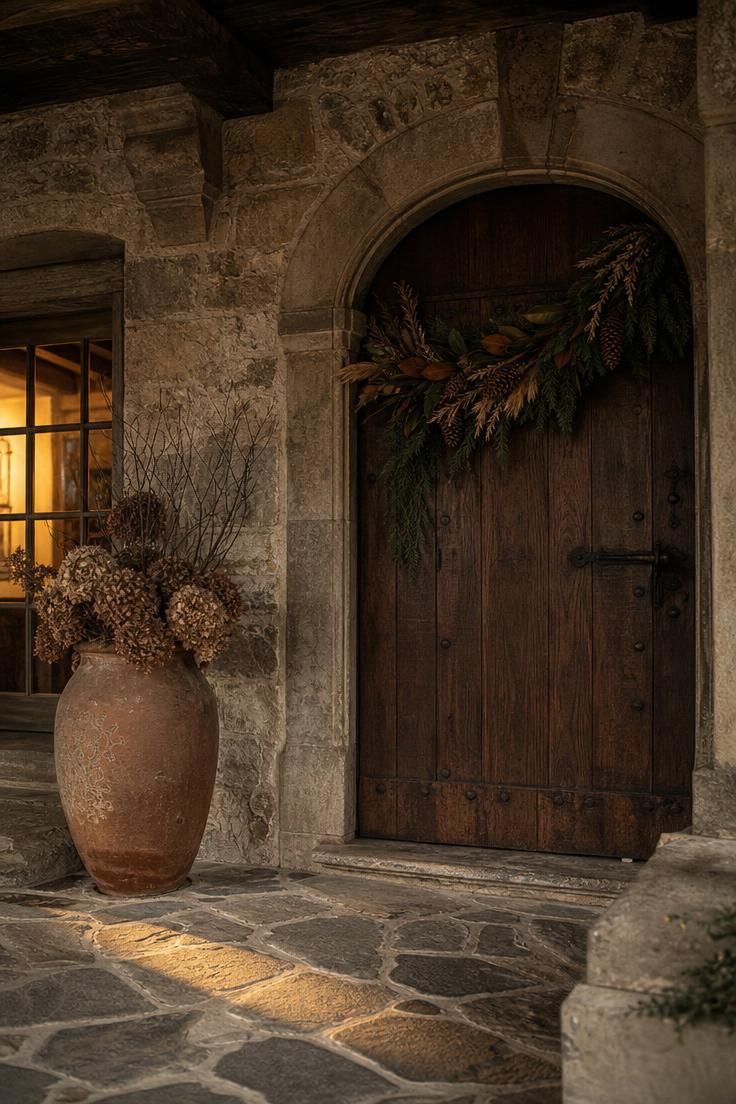
Wreaths originated as circular arrangements of leaves, flowers, or branches in ancient Greece and Rome.
There they represented victory, status, celebration, religious observance, and honor.
Different plants carried different associations.
Olive, laurel, pine, ivy, and celery were used for assorted ceremonies and athletic contests.
In ancient Greek and Roman marriage customs, garlands were used to decorate the bridegroom’s doorway; ancient sources also describe a chaplet hung over a household entrance to mark the birth of a child.
The familiar decorative wreath on a house door became especially popular in the nineteenth century, when “welcome rings” were commonly made from evergreens, holly, ivy, pinecones, and ribbons.
Modern fall décor draws heavily on harvest imagery: wheat, corn, gourds, apples, nuts, berries, leaves, and dried flowers symbolizing abundance, gratitude, preparation for winter, and the close of the growing season.
Today’s fall door decoration is a seasonal welcome display, not a single ancient tradition.
There is no historical obligation to keep repeating the same visual tropes year after year.
The Two Directions for October: Gothic Luxury and Subtle Spooky
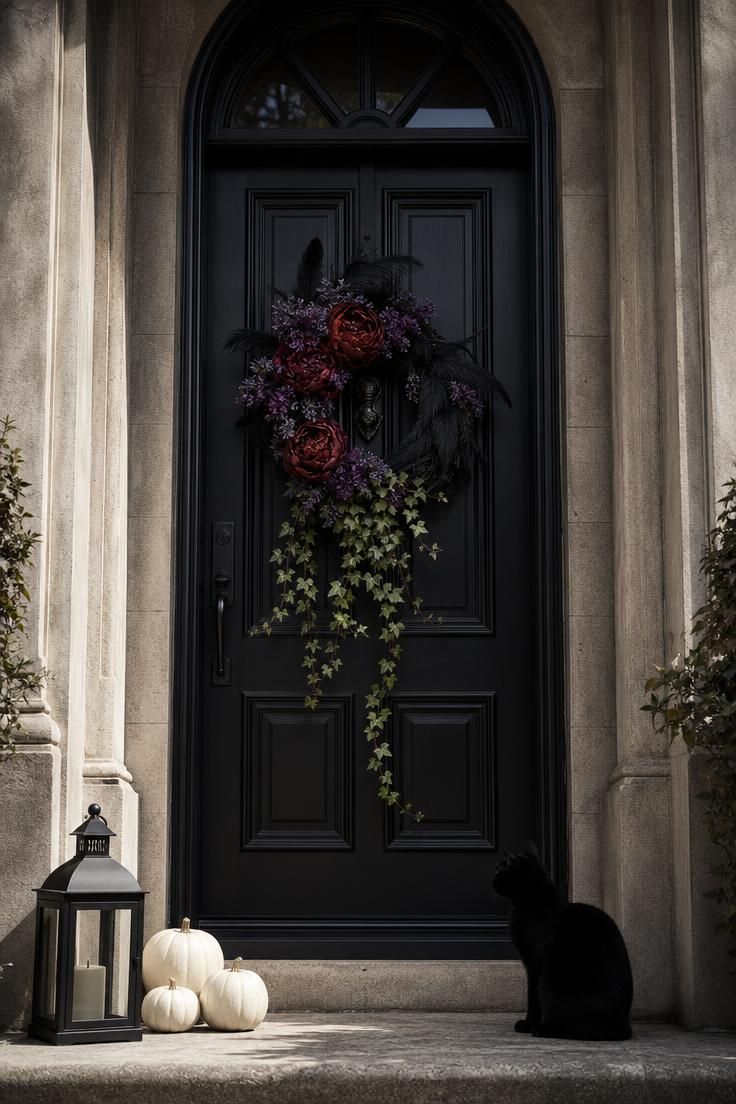
The Halloween-specific split has replaced the generic overdone October display with two distinct directions.
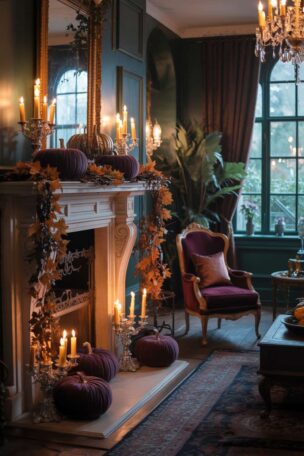
The first is high-impact gothic luxury, characterized by black, deep red, oversized spiders, dramatic lighting, and sculptural forms.
The second is subtle spooky styling featuring black cats, ghost wreaths, witch hats, dark florals, and small illuminated accents.
Lighting is particularly important because doorscape displays are intended to work after dark.
The NFPA safety guidance for battery-operated candles or glow sticks applies directly to these evening scenes.
The broader seasonal color shift that supports both directions includes burgundy, plum, aubergine, black, and bronze.
Those tones read equally well in daylight and low light.
Specific product directions in trend reporting include lit ghost wreaths, black cat décor, sculptural witch hats, dark botanical swags, and gothic lanterns.
The practical distinction is between Halloween-specific décor and décor that transitions into Thanksgiving.
The strongest recommendation is to choose one direction rather than blending both half-heartedly.
A split focus rarely produces a clear visual story.
A restrained black ribbon against warm neutrals can signal subtle spooky styling without requiring a full Halloween display.
A sculptural witch hat in matte black works as a singular statement for gothic luxury.
Design Pro-Tip: If you want subtle spooky styling, use one unmissable black accent, a wreath ribbon, a cat silhouette, or a lantern, against warm neutrals. A single dark note reads as intentional; a scattered assortment reads as random.
Successful Fall Door Decorations: The Criteria That Separate Current from Cliché
The display should frame the entrance rather than obscure or complicate it, leaving clear access to the door, hardware, and walkway.
Materials should trend toward natural, preserved, or convincingly realistic textures rather than mass-produced plastic icons.
The color palette should be mixed and intentional rather than monochromatic orange or random, with one anchoring tone holding the composition together.
Scale should match the door and architecture, with enough clearance for full function.
The display should transition across multiple fall moments without appearing Halloween-only.
The composition should have one clear focal point plus two or three supporting layers, never a matching set or a scattered assortment.
The strongest practical takeaway is a specific configuration: a 28 to 32-inch asymmetrical wreath in eucalyptus, wheat, burgundy berries, and cream florals.
Two real heirloom pumpkins in blue-gray and tan join a burgundy mum or fern in a weathered planter.
A black lantern and a simple layered mat complete the arrangement.
This captures the major current directions while remaining fully functional and welcoming.
A modern fall wreath can anchor the entire entryway without dominating it.
Fall entryway decor works best when one restrained palette connects the door, threshold, and surrounding surfaces.
A fall door hanging with preserved stems and a single ribbon can refresh the same display across the whole season.
Autumn front door decor benefits from an intentional grouping rather than a scattered assortment.
Conclusion: A Sharper Threshold Starts With Subtraction
Look at your current fall door decorations and ask which elements earn their place.
If the answer is a matching set bought in one trip, it may be time to subtract before you add.
The first move is to choose one focal piece that holds its own without companions: a well-scaled wreath, a dramatic urn, a strong heirloom pumpkin group.
From there, add only what the doorway needs to feel layered, not crowded.
Start by photographing your bare entryway and comparing it to the doorscapes you admire most.
Identify the gap: too much orange, too little texture, wrong scale, no lighting.
Then make one change before the season begins rather than attempting a full overhaul.
A neutral wreath base with a single black velvet ribbon can carry an entryway through September, October, and into November with quiet authority.
A DIY fall wreath with preserved eucalyptus and dried wheat offers the same versatility as a store-bought piece.