This post may contain affiliate links. If you make a booking or purchase through these links, we may earn a commission at no additional cost to you.
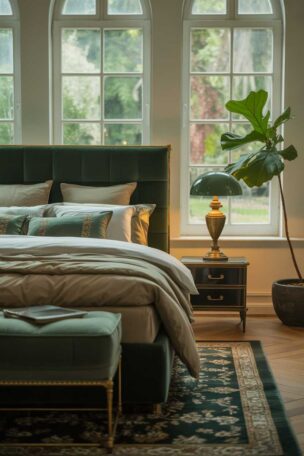
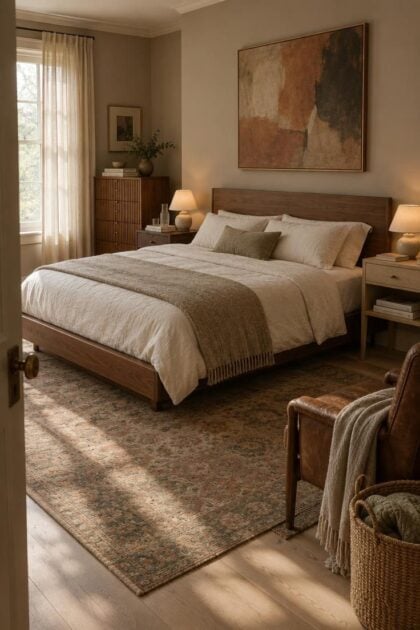
A bedroom with dark wood furniture promises the warmth of an old library and the polish of a boutique hotel.
The trouble is that “dark wood” describes at least six different materials, price points, and care stories.
Each one lands differently depending on the light, the walls, and how many dark pieces share the same view.
Dark Wood Is Back, but the Term Covers Very Different Pieces
Trend reporting across 2025 and 2026 points to a renewed interest in dark wood and richer bedroom interiors, part of a broader shift away from the pale, Scandinavian-inspired woods that dominated previous years toward warmer, more layered and character-rich spaces.
Walnut, smoked oak, espresso, and dark-stained wood appear repeatedly among the named finishes.
Walnut gets called the most versatile of the group because its grain stays visible and its brown reads warm rather than flat.
The category itself spans deep brown, reddish-brown, espresso, and near-black finishes.
Darkness can come from the natural timber, a stain, a painted finish, a veneer layer, or a protective topcoat.
That range means an antique mahogany bedstead and a contemporary espresso-look dresser can sit under the same label while sharing almost nothing in construction.
Walnut, mahogany, stained oak, and teak form the classic group.
Ebony and ebonized wood push toward black.
Lower-cost options include dark-stained pine, rubberwood, and engineered wood with a dark finish applied over it.
The distinction matters the moment a reader starts shopping.
Solid walnut, a veneered case piece, and a printed wood-look finish differ in appearance, price position, and what they ask of you over time.
A dark finish can make all three look similar under showroom lighting.
Current applications reported in the trend material lean toward walnut platform beds, dark wood four-poster and canopy beds, floating nightstands, sculptural dressers, slatted or fluted drawer fronts, and matched wood headboards with bedside tables.
The recurring shape is a solid dark anchor piece surrounded by lighter, softer elements.
A bedroom with dark wood furniture does not have to be an all-dark room.
Reported styling pairs solid dark pieces with light bedding, tactile fabrics, warm neutrals, and soft lighting.
The boutique hotel, library, and quiet luxury references describe design intent, an atmosphere the room is composed to suggest rather than a measured outcome.
One caveat belongs here.
The trend material labels its own long-term conclusion as an inference drawn from the convergence of designer surveys and market reporting, not a measured forecast.
Treat the direction as reported context rather than a durable rule.
Why the Look Reads as a Return Rather Than a Novelty
Early and medieval European furniture, plus early American colonial pieces, was built for permanence and daily use.
Local oak, pine, or walnut did the work, often angular and heavily built with carving, moldings, or turned components.
Wooden beds, chests, cupboards, and benches served sleeping and storage needs at once.
Dark woods became associated with wealth and refinement as cabinetmakers developed veneers, polished surfaces, inlay, and sophisticated joinery.
Walnut was especially popular in Queen Anne furniture, and walnut bedroom furniture from that period often carried shaped legs, curved chair backs, and figured grain selected for the front faces of case pieces.
Mahogany became fashionable in the Chippendale and later Federal periods, used for chests, dressing tables, highboys, and bedsteads.
Mahogany’s deep color, grain, and workability made it a luxury material and a colonial-era status symbol.
Its historical popularity was also connected to severe deforestation and colonial exploitation in the Caribbean, a point worth naming when the wood comes up in conversation.
By the early nineteenth century, mahogany bedsteads and bedroom suites were associated with affluent interiors.
Duncan Phyfe’s American bedstead designs combined dark wood with carving, veneer, inlay, and classical detail.
The furniture was not simply dark; it was dark and decorated.
Victorian bedrooms could be richly coordinated, with large wardrobes, dressing tables, washstands, chests, carved bedsteads, patterned textiles, and dark finishes.
Revival styles later favored dark or “honest” oak, particularly in Gothic and Arts and Crafts-influenced interiors.
Contemporary interpretations have branched into mid-century walnut, industrial dark wood with black metal, Japandi timber with pale walls, contemporary espresso, and rustic reclaimed surfaces.
The throughline is what matters.
Dark wood’s association with permanence and craftsmanship is genuinely old, which is why the current trend reads as a return rather than a novelty.
Design Pro-Tip: Before buying anything, photograph the room in daylight and in the evening, then place a dark wood sample against the wall, floor, and bedding in both conditions; the same finish can read warm at noon and flat at night.
Reading the Label Before You Commit to a Dark Finish
“Wood” on a furniture label can mean several different constructions.
A dark finish smooths over the differences, and that is exactly where a rushed purchase goes wrong.
The possibilities include solid wood, wood veneer over a stable core, particleboard or MDF with a printed finish, rubberwood or another plantation-grown timber, and reclaimed wood.
That range explains why a shopper can find a walnut bedroom furniture piece at one price and a visually similar cabinet at a fraction of it.
Veneer is not automatically inferior.
High-quality veneer can be durable and attractive, and it has a long history in fine furniture.
Construction quality, edge treatment, and finish stability decide more than the label category alone.
A well-built veneered piece with clean edges and a stable finish can outlast a poorly joined solid piece with a wobbly frame.
The same logic separates a genuine espresso bedroom furniture set built from solid stock from one assembled out of printed panels.
Inspection points you can check without disassembly: solid or well-made veneer construction, dovetailed drawers, smooth drawer movement, strong corner joints, stable legs and frames, and no major veneer lifting or cracking.
Run a hand along drawer edges and corners.
Lift one corner of the piece slightly, if it is light enough, to feel for wobble.
Inspect in natural light.
A dark finish conceals scratches, repairs, and mismatched wood far more effectively than a pale one.
What looks uniform under showroom spots can show three different grain patterns by a window at noon.
Certified wood, reclaimed wood, or manufacturers that disclose timber sources all offer a clearer path for new purchases.
The point matters most for tropical hardwoods such as mahogany, whose historic demand caused major ecological damage.
Preference data adds context without settling anything.
A 2023 Consumer Insights Now survey of 1,868 U.S. consumers planning home-furnishings purchases found that 50% planned to buy a coordinated bedroom group, while 34% planned to mix and match pieces.
The same survey found that consumers overall favored darker wood tones over medium tones, with darker finishes especially popular among younger shoppers, though that finding is reported qualitatively rather than as an exact percentage.
A second dataset tells a different story.
In an online survey of 87 solid-wood-furniture consumers, Wu and Feng reported preferences for plain wood color (70.11%), light wood (44.83%), white (41.38%), dark wood (33.33%), black-brown (18.39%), dark red (16.09%), and dark purple (5.75%).
Because the percentages exceed 100% in total, respondents evidently could select more than one color.
The two surveys used different countries, sample sizes, questions, and respondent groups.
They should not be combined.
What One Designer Says About Balancing Dark Pieces
The guidance in this section comes from a single attributed designer interview, not a consensus finding.
Read it as informed opinion rather than settled best practice.
The interview identifies treating every piece as part of a matching set as the most common mistake.
The designer’s position is that dark wood reads as grounding, warm, and visually weighty, and that it works across traditional, transitional, contemporary, organic, and modern rustic schemes.
That range is wider than most shoppers assume.
Warm neutrals receive the strongest endorsement for walls and accents: ivory, warm white, mushroom, taupe, soft beige, muted greige.
These create contrast without starkness.
Deep green, navy, charcoal, and warm clay appear as dramatic alternatives for readers who want the room to lean moody on purpose.
Bedding recommendations run toward cream, white, oatmeal, soft gray, sage, dusty blue, and muted blush.
The suggested structure is a light base plus one or two richer accents, which keeps the dark furniture as the anchor rather than one voice in a crowd.
Mixing wood tones earns endorsement when undertones are compatible.
Warm walnut with oak or medium-toned wood is the example given.
If existing furniture is already very dark, lighter wood works best in small doses rather than as a competing anchor.
Lighting is described as layered: overhead, bedside, and accent.
Warm bulbs are favored to flatter the wood, and brass, bronze, ceramic, linen, and glass lamp bases are suggested as complements.
Two cautions round out the advice.
Large amounts of cool gray next to reddish wood can fight the warmth, and a room filled exclusively with dark color reads as a deliberate mood decision rather than a default.
Design Pro-Tip: Before buying anything, photograph the room in daylight and in the evening, then place a dark wood sample against the wall, floor, and bedding in both conditions; the same finish can read warm at noon and flat at night.
How Dark Furniture Changes the Visual Weight of a Room
Dark furniture reads as visually heavier than pale furniture.
That weight is not a problem to avoid; it is a quality to manage through contrast, air, and placement.
Start with the largest piece, usually the bed.
Coordinate the other pieces loosely around it rather than matching them exactly.
The room reads as composed rather than catalog-ordered.
A working formula from the source material: one dominant wood tone, one secondary material such as metal, cane, glass, or upholstery, and two or three lighter elements for contrast.
The lighter elements do the work of keeping the dark pieces legible as deliberate choices.
This is also where mixing wood tones in a bedroom earns its keep, since a single lighter secondary wood can break up a run of matching dark surfaces without introducing a new material.
Ways to balance dark furniture visual weight include leaving visible wall and floor area, favoring legs over solid bases where the design allows, and avoiding a lineup of several tall dark pieces on one wall.
Solid bases and tight groupings compound the sense of mass.
Lightening moves matter as much as the dark pieces themselves.
A lighter rug, reflective surfaces, and relatively light window treatments all help, unless the room is intentionally dramatic and the heaviness is the point.
The trend material offers a 60/30/10 proportion as a styling heuristic: roughly 60% light or warm-neutral surfaces, 30% mid-tone texture, and 10% dark wood.
It is a design aid, not a rule, and it bends in rooms with strong architectural features.
Floor and rug direction, offered as design inspiration: light oak, medium-toned wood, natural sisal or jute, pale wool, patterned vintage-style rugs, warm gray carpet.
A rug extending beyond the sides of the bed, or at least beneath the lower two-thirds of the bed, keeps dark furniture from visually sinking into the floor.
Lighting guidance calls for layered ambient, task, and accent light, with lamps on both sides of the bed where possible and an avoidance of relying on a single overhead fixture.
Warm bulbs in the 2700K to 3000K range are recommended to complement dark wood, framed as an aesthetic recommendation rather than a technical specification.
Design Pro-Tip: If a room feels heavy after the dark pieces arrive, remove one dark object before adding anything new; subtractive edits reveal contrast problems that adding a light accessory usually only hides.
The Matching-Suite Trap and What to Do Instead
Half of U.S. bedroom-furniture shoppers in the 2023 survey preferred a coordinated suite.
The designer interview calls treating every piece as part of a matching set the most common mistake.
Both can be true at once, and the tension is worth sitting with before a purchase.
The designer position is one voice, not settled best practice.
The visual reasoning is straightforward.
An all-matching dark suite repeats the same tone, grain, and hardware across the room, and the result reads as flat rather than layered.
That is a composition observation, not a claim about how anyone will feel in the room.
The “one dominant, one secondary, two or three lighter” approach offers a concrete alternative.
A walnut bed anchors the room, a dark wood nightstand in a different finish adds a second note, and lighter bedding and a rug carry the rest.
Hardware and finish play a role when mixing.
Simple hardware on traditional pieces keeps them from feeling dated, and a different metal or a different wood can register as intentional rather than accidental when it repeats at least once elsewhere in the room.
Existing dark furniture can be refreshed without replacement.
Contemporary artwork, streamlined bedding, sculptural lamps, and simple hardware are the suggestions the attributed designer offers, and none of them require moving the heavy pieces.
A reported secondary trend favors fewer, better-made pieces over matched suites.
Texture is doing more of the decorative work: fluted, reeded, burl, and dimpled surfaces, plus linen, bouclé, wool, ribbed glass, and aged brass.
Frame this as reported direction rather than a rule.
Where Dark Wood Still Has to Compete for Attention
Dark wood is one option among several in the bedroom furniture landscape, not the default choice.
Preference data helps place it honestly.
The 2023 Consumer Insights Now survey of 1,868 U.S. home-furnishing shoppers found that about 20% planned to purchase primary-bedroom furniture in the first half of 2023.
Of those, 65% planned to buy a bed or headboard, 58% a nightstand, and 54% a dresser.
Average planned spending landed in the $1,000 to $1,999 range.
Within the same survey, 48% of headboard shoppers preferred wood.
Consumers overall favored darker wood tones over medium tones, with darker finishes especially popular among younger shoppers, stated as a reported qualitative preference rather than a precise percentage.
The Chinese solid-wood color survey of 87 consumers offers a separate view.
Because multiple selections were allowed, the totals exceed 100%, which is expected in that data: natural or plain wood color 70.11%, light wood 44.83%, white 41.38%, dark wood 33.33%, black-brown 18.39%, dark red 16.09%, dark purple 5.75%.
The source’s own synthesis is that dark wood has real appeal but competes with natural and lighter finishes, which in that 87-person sample ranked above it.
That ranking is a snapshot, not a verdict.
Combining the two surveys would be misleading.
Different countries, sample sizes, questions, and respondent groups make the numbers non-comparable, which is why they stay separate and dated here.
Preference data can guide confidence in a purchase, but it does not tell an individual reader what will work in a specific room.
The 87-person sample is small enough to warrant caution on its own.
Making Dark Wood Feel Current in 2025–2026
The reported 2025 and 2026 direction toward warmer, more layered bedrooms gives dark wood a moment.
That moment is trend context, not a long-term forecast.
The attributed color direction from the trend material runs warm white, mushroom, taupe, muted clay, olive, and smoky blue for walls.
Bedding leans ivory, oatmeal, cream, flax, and soft gray.
Burgundy, rust, forest green, and chocolate brown appear as accents.
How those colors interact with dark wood depends on undertones.
A reddish wood and a cool-toned wall can fight each other, while a warm neutral wall lets the wood carry the warmth.
A smoky blue wall next to walnut reads cooler and more composed than the same wall next to mahogany.
Texture keeps dark wood from reading as a single flat plane.
Fluted, reeded, burl, and dimpled surfaces catch light differently across a drawer front.
Linen, bouclé, wool, and ribbed glass introduce softness and reflection at eye level.
The reported “fewer, better-made pieces” direction changes the buying math.
One strong dark anchor piece and two lighter secondary pieces can serve a room better than three matched pieces at the same total spend, especially when the anchor is the piece you touch every day.
Placing the trend inside the older history makes it easier to read.
Dark wood’s association with craft and permanence runs back through Victorian bedrooms, Federal-period mahogany, and colonial oak furniture.
The current direction continues that line rather than breaking from it.
Trend reporting here is described as an inference from convergence of designer surveys and market reporting, not a measured forecast.
Durability should not be read into it.
One decision criterion helps.
If a dark wood piece already anchors the room, adding one compatible element is often more useful than replacing everything.
If starting fresh, use the trend direction as a starting point rather than a target.
Caring for Dark Wood Without Damaging It
The bedroom furniture care habits in this section come from conservation-oriented furniture guidance.
They describe general furniture care, not product endorsements or claims about health or indoor environment.
Museum conservation framing is useful here.
Wooden objects can be damaged by excessive light and unstable environmental conditions, which is the reasoning behind several of the habits below.
Everyday habits stay simple: dust with a soft, dry or barely damp cloth, use coasters, trays, and felt pads, and wipe spills without delay.
Rings and blooms form fastest on finishes that sit wet for hours.
Placement matters as much as cleaning.
Avoid placing furniture directly against radiators or heating vents, and keep pieces away from prolonged direct sunlight.
Dark finishes can fade unevenly in ways that pale finishes often hide better.
Cleaner cautions are worth knowing.
Avoid silicone-heavy sprays and abrasive cleaners, and test any polish on an inconspicuous area first.
A hidden drawer side or the underside of a table works well for the test patch.
Antique-specific guidance is more careful still.
Avoid refinishing or stripping without professional advice, and maintain relatively stable indoor humidity rather than allowing repeated extremes.
That matters most for antique, veneered, or solid-wood pieces, where repeated swelling and shrinking strain the joints and the finish.
Dark finishes hide developing scratches and finish wear better than light ones, which makes periodic inspection in direct natural light worth building into a routine.
A scratch that has been developing for months is easier to address than one discovered after it has spread.
Small Rooms, Low Ceilings, and Other Constrained Bedrooms
Dark wood tends to feel heavier in smaller or lower rooms.
The same dresser can behave differently depending on the room’s proportions and how much daylight reaches it.
The visual moves that hold up in constrained rooms are consistent.
Leave visible wall and floor area, favor pieces with legs over solid bases, and keep tall dark pieces from lining up along one wall.
A dark piece that sits alone reads lighter than the same piece in a row.
Rug scale and placement interact with small rooms in a specific way.
A rug that extends beyond the sides of the bed is often suggested even when the room is small, because a rug that stops short of the bed’s edges lets the dark furniture visually merge with the floor.
Layering light in a constrained room is worth the effort.
Ambient, task, and accent light layered together work better than a single overhead fixture, and warm bulbs in the 2700K to 3000K range are recommended to complement dark wood as an aesthetic choice.
Fewer, larger pieces can read calmer than several smaller dark pieces.
That is a composition observation about how the eye groups similar shapes, not a claim about wellbeing.
A small room can hold dark wood well when contrast and light are deliberate.
A small room filled with adjacent dark pieces against dark walls is a different design decision with a different visual result, and it is worth deciding which one you actually want before buying.
The solid wood vs veneer furniture question matters more here than in a larger bedroom, because a piece that fills a high proportion of a small room’s visible surface draws more scrutiny to its grain and finish.
Design Pro-Tip: Tape the footprint of any candidate dresser or nightstand on the floor before buying; dark pieces often look smaller in a showroom than they will in a room with less surrounding light.
Where Dark Wood Belongs, and Where It Does Not
Dark wood works especially well as a grounding anchor in a room with warm neutrals.
It also works as a focal point in a mostly pale room, and as a continuity piece in a room that already has dark elements such as a floor or a door.
It fits less naturally in rooms already dominated by dark walls, floors, and window treatments with no lighter element to break the pattern.
Rooms with unavoidable cool gray surfaces next to reddish wood present a similar friction.
A reader who owns a dark stained oak bed frame or dresser and wants the room to read current has options that do not require replacement.
Contemporary artwork, streamlined bedding, sculptural lamps, and simple hardware are the suggestions the attributed designer offers.
A reader furnishing from scratch faces a different question: one dominant dark piece or a coordinated suite.
The survey data showing that half of U.S. shoppers preferred a coordinated suite is supporting context rather than direction.
The mixed-wood-tone scenario rewards patience.
Compatible undertones matter more than matching species, and lighter wood works best in small doses if the existing furniture is already very dark.
The decision criterion is simple.
Choose dark wood for the pieces that anchor the room, and choose lighter or textured elements for the pieces that layer on top.
When every surface is dark, the room loses the contrast that makes the dark pieces read as deliberate.
Before You Buy, Check These Five Things
This is a pre-purchase checklist, not a set of installation or structural instructions.
It focuses on what you can see, measure, and ask before the piece enters the room.
First, what the piece is actually made of.
Solid, veneer, printed finish over engineered wood, plantation-grown timber, or reclaimed, and whether the label discloses which one.
A vague answer is itself information.
Second, construction quality visible without disassembly.
Drawer joinery, smooth drawer movement, corner joints, stable legs and frames, and the absence of major veneer lifting or cracking.
Open every drawer.
Move each one through its full travel.
Third, inspection in natural light.
Dark finishes can conceal scratches, repairs, or mismatched wood, and a piece that reads uniform under showroom lighting can show its history by a window.
Fourth, how the piece will sit in the room.
Measure the footprint, consider the visual weight against the walls and floor, and confirm the rug and lighting plan before committing.
A piece that fits the room but crowds the doorway is not a fit.
Fifth, care and material considerations.
What the finish needs for routine cleaning, whether the piece is antique or veneered and so calls for more careful humidity stability, and whether refinishing would ever be advisable.
Certified wood, reclaimed wood, or manufacturers that disclose timber sources offer clearer paths within the fifth check for new purchases, with tropical hardwoods such as mahogany being the most relevant case.
The strongest dark wood purchase is the one whose material, construction, scale, and care needs are understood before it enters the room.
It is not the one that matches the most other pieces.
Design Pro-Tip: Keep a small sample of the finish, a drawer pull, a scrap of veneer, or a manufacturer chip, and store it with your care notes so future cleaning or touch-up decisions start from the actual material rather than a memory of the color.
What This Room Trend Does Not Claim
Dark wood furniture is a visual and material choice.
This article makes no claims about mood, sleep, hormones, or mental health.
Trend language about “restorative” or “cocooning” bedrooms describes design intent and aesthetic atmosphere.
It does not describe a measurable outcome.
The two survey datasets have real limits.
Different countries, sample sizes, questions, and respondent groups, with one sample of 87 people, mean they should not be combined or treated as universal truth.
The designer guidance used here is one attributed interview rather than a consensus.
It should be read as informed opinion, not settled best practice.
Environmental and humidity guidance in this article is conservation-oriented furniture care.
It is not a claim about the room’s effect on occupants.
Structural, electrical, plumbing, gas, fire, pool, and building-code matters sit outside the scope of this piece.
Conclusion: Choosing Dark Wood on Your Own Terms
Dark wood is a category, not a single look.
The room’s result depends on which version you choose and how the surrounding elements are handled.
One dominant wood tone, one secondary material, and two or three lighter elements is a durable starting structure regardless of trend direction.
It survives style shifts because it describes contrast rather than a specific palette.
If dark wood is already in the room, refresh before replacing.
Lighter layered bedding, a rug that extends beyond the bed, and updated bedside lighting are the three low-cost updates the attributed designer suggests, and each one changes the room without a moving truck.
If buying new, check material and construction, inspect in natural light, measure the footprint, and decide whether a single anchor piece serves the room better than a matched suite.
Fewer, better-made pieces are the reported direction for good reason.
The care basics outlast any trend.
Dust gently, use coasters and felt pads, keep pieces away from heating vents and prolonged direct sun, avoid silicone-heavy sprays and abrasive cleaners, and maintain relatively stable indoor humidity.
Dark wood works when the room retains visible contrast, deliberate light, and breathing space around the largest pieces.
When those are missing, adding more dark furniture will not solve it; the next step is to remove one dark object and see what the room reveals.