This post may contain affiliate links. If you make a purchase through these links, we may earn a commission at no additional cost to you.
Tiny homes are legal in many parts of the United States, yet no reliable national list can tell you whether a certain house is permitted on a certain parcel.
A state may regulate tiny-home construction, require cities to permit accessory dwelling units, or recognize tiny-house communities without granting permission for every tiny home in every neighborhood.
The useful question is whether your proposed home, use, and property meet the rules enforced by the city or county with jurisdiction over the site.
This guide replaces simple state rankings with a process for finding an answer you can confirm before buying land, ordering a home, or paying for site work.
Quick Answer
Tiny homes are lawful in many U.S. jurisdictions when the structure, parcel, and residential use fit the applicable rules.
A house on a permanent foundation, a movable tiny house, a manufactured home, and an RV can follow different approval paths on the same property.
Ask the local planning and building departments for written answers tied to the parcel address and the exact type of home you plan to place there.
Tiny-Home Legality Is Usually Decided Locally
State law matters, but zoning authority, building-code administration, utility approval, floodplain rules, septic requirements, and occupancy permits often sit with a city, county, or special district.
One county may permit a small detached dwelling as a primary residence, the next may accept it only as an accessory dwelling unit, and a nearby city may limit a wheeled unit to an RV park.
That local variation makes broad labels such as “legal in Arizona” or “restricted in New York” too blunt for a purchase decision.
A local ordinance can create an approval route that a statewide summary misses, or it can restrict a home type that state law recognizes.
The zoning map for the parcel is more useful than a list of friendly states.
Identify the Legal Type of Tiny Home First
The term “tiny home” describes size and lifestyle, not one legal class.
Before contacting an agency, identify how the proposed structure was built, whether it has a chassis, whether the wheels remain attached, whether it carries a certification label, and whether it will serve as a full-time dwelling.
| Home type | Common approval path | First issue to confirm |
|---|---|---|
| Site-built home on a foundation | Local residential code and zoning | Whether the zone permits a primary dwelling of this size |
| Detached accessory dwelling unit | State and local ADU rules | Whether the lot has or may have a principal dwelling |
| Factory-built modular home | State modular program and local site approval | Whether its plans and certification match the state program |
| Manufactured home | Federal HUD standards plus state and local placement rules | Whether the unit has the required label and the zone permits placement |
| Tiny house on wheels | RV, park-model, movable-unit, or local tiny-house rules | Whether residential occupancy is permitted at the site |
Federal regulations define a manufactured home through features that include transportability, a permanent chassis, residential design, utility connections, and size thresholds, so a small unit on wheels does not automatically belong to that category (24 CFR § 3280.2).
A seller’s use of the phrase “tiny home” does not settle which code, inspection system, title, or placement rule applies.
Ask the seller for the construction standard, certification documents, serial or label information, dimensions in travel mode, and any installation manual before discussing a site with officials.
Foundation Homes and Homes on Wheels Follow Different Paths
A tiny house on a permanent foundation can often enter the same permit system as a larger detached house or an ADU, subject to zoning, adopted building codes, plan review, foundation design, utilities, inspections, and final occupancy approval.
Small-house provisions in a model residential code can address compact stairs, lofts, guards, emergency openings, and related design issues, but a model code has legal force only after the responsible jurisdiction adopts it.
Ask which residential-code edition is in force and whether its tiny-house appendix was adopted, amended, or omitted.
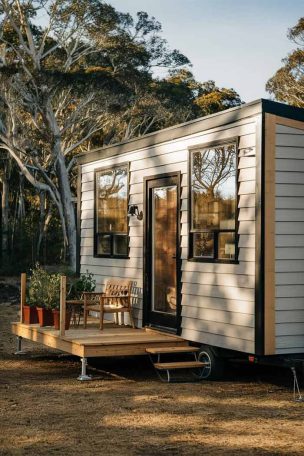
A tiny house on wheels presents a separate land-use question since mobility can place it under RV, park-model, vehicle, temporary-use, or locally defined movable tiny-house rules.
Road registration or RV certification may address transport or construction classification without authorizing full-time residence on private land.
Removing the wheels, adding skirting, or connecting utilities does not automatically convert a wheeled unit into an approved dwelling.
Common Mistake: Treating a builder’s certification or vehicle title as permission to live on a parcel can leave the buyer with a lawful product that has no lawful residential site.
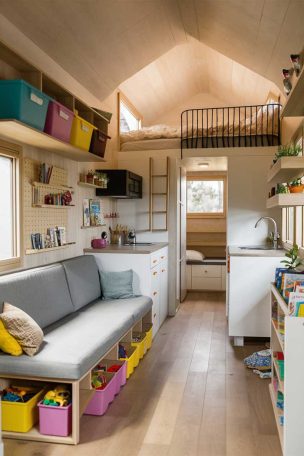
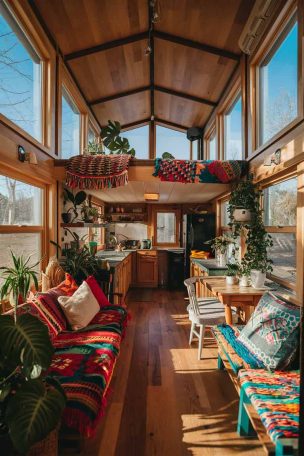
For ideas about planning the interior after a lawful site is confirmed, see these tiny house interior design ideas.
State Laws That Create Useful Paths
Some states have adopted laws that make certain tiny-home arrangements easier to pursue, yet each example still leaves site-level questions to local agencies.
The table below is a starting point, not a substitute for a zoning confirmation or permit review.
| State | Current state-level signal | What it does not prove |
|---|---|---|
| California | State ADU law creates routes for attached and detached accessory units, with current guidance collected by the California Department of Housing and Community Development | That a movable tiny house is accepted as an ADU on a chosen parcel |
| Colorado | State law regulates the manufacture, sale, installation, utility connections, and related standards for tiny homes | That local zoning permits the unit as a residence at a chosen address |
| Maine | State law requires municipalities to allow at least one ADU on qualifying lots and sets a 190-square-foot minimum subject to a different state building standard | That every small primary dwelling or wheeled unit qualifies as an ADU |
| Washington | State law lets cities and towns regulate tiny-house communities and defines covered units as permanent housing built to the state building code | That a city has adopted a community ordinance or permits a stand-alone wheeled unit on any residential lot |
California publishes an ADU handbook updated in March 2026, which should be read beside the ordinance and permit material for the city or county reviewing the project.
Colorado’s enacted HB22-1242 brought manufactured tiny homes into a state regulatory system and directed the state housing board to set standards, but the law does not turn every parcel into an approved homesite.
Maine’s current accessory dwelling unit statute covers location, zoning, size, parking, water, and wastewater matters, with municipal administration still part of the process.
Washington’s tiny-house community statute permits local ordinances for communities and requires covered homes to be built under the state building code.
These laws make California, Colorado, Maine, and Washington useful states to research, but none supports a blanket claim that tiny homes are legal everywhere inside its borders.
What to Check in Any State
The fastest research starts with the parcel rather than the house model.
Use the property address or parcel number to identify the authority that controls land use, then ask its planning department what residential uses the zone permits.
Zoning and Allowed Use
Zoning controls whether the property can host a primary dwelling, an ADU, two dwelling units, an RV, a temporary dwelling, or a tiny-house community.
Ask whether the proposed unit is permitted by right, needs an administrative review, requires a conditional-use permit, or depends on a variance.
Confirm lot area, setbacks, building coverage, height, parking, access, and any rule that sets a minimum dwelling or unit size.
Building Code and Construction Approval
The building department can identify the adopted code edition, local amendments, plan-review process, inspection stages, and documents required for a certificate of occupancy.
For an off-site-built home, ask whether the state modular program, federal manufactured-housing rules, an RV standard, or a local inspection process governs the unit.
Plans prepared for one jurisdiction may need revisions when snow, wind, seismic, wildfire, energy, foundation, or local code requirements differ at the final site.
Water, Sewer, and Septic
A zoning allowance may still fail at the utility stage when the parcel lacks approved water, sewer capacity, or a suitable wastewater plan.
Ask the water provider and sewer authority about connection availability, fees, meter rules, and capacity.
For private wells or septic systems, request the applicable health-department or environmental review before relying on a seller’s estimate.
Private Restrictions
An HOA declaration, deed restriction, lease, land contract, or community rule may impose limits beyond public zoning.
Review recorded restrictions and obtain suitable legal advice when their meaning or enforceability affects the purchase.
Occupancy and Rental Use
Permission to build or park a unit does not necessarily authorize permanent occupancy, short-term rental use, or a separate long-term tenancy.
State and local rules may treat owner occupancy, rental licensing, address assignment, fire access, and length of stay as separate questions.
A Written-Approval Checklist Before You Buy
Bring one clear project description to each agency so the answer applies to the same facts.
- Parcel address and assessor’s parcel number
- Zoning district and current use of the property
- Primary home, ADU, guest unit, rental, or temporary-use plan
- Foundation, movable chassis, manufactured-home label, modular certification, or RV certification
- Exterior dimensions, floor area, loft area, and overall travel dimensions
- Number of occupants and full-time or occasional occupancy
- Water source, sewer connection, or septic proposal
- Electrical service, heating fuel, and other planned utility connections
- Parking, driveway, fire-access, and delivery needs
- Proposed rental use, when any
Send a short follow-up email after a phone call and ask the official to confirm the controlling code section, ordinance section, application type, and next department to contact.
Do: Ask, “May this exact unit be occupied year-round as a dwelling at this parcel under the current code?”
Don’t: Ask only, “Are tiny houses allowed here?”
Save written responses, zoning verification letters, permit records, approved plans, inspection reports, and the final occupancy document with the property records.
Tiny-House Communities Can Reduce Site Uncertainty
An established community may offer lots or pads already planned for a defined unit type, but its approvals still need review.
Request the recorded site plan, zoning approval, permitted unit class, lease terms, utility arrangement, occupancy rules, insurance requirements, and any limits on unit dimensions or certification.
A community marketed for tiny homes may operate as an RV park, manufactured-home community, cottage development, or another land-use class with different rights and restrictions.
Ask whether year-round residence is lawful, whether the home can remain after a sale, and whether a new owner must remove or replace the unit.
A Variance Is Not a Routine Approval Path
A variance is relief from a zoning rule under local legal standards, not a general request for officials to overlook a code mismatch.
The application may require fees, findings, notices, a hearing, and evidence tied to the property rather than the owner’s preferred house design.
Buying a home or land in anticipation of a variance shifts the denial risk to the buyer.
Treat a variance-dependent plan as uncertain until the decision is final and any appeal period has passed.
Plan the Lifestyle After Confirming the Site
After confirming legal placement, these tips for living in a tiny house can help you test storage, privacy, loft access, maintenance, climate, delivery, financing, insurance, resale, and daily fit before committing.
Readers comparing the idea with its wider social context can review what the tiny house movement means, then weigh the pros and cons of tiny house living against their own site and budget.
If compact aesthetics are part of the appeal, these Japanese tiny house interior ideas offer visual references without changing the approvals needed for construction or occupancy.
The Most Reliable Answer Comes From the Parcel
Tiny homes are not simply legal or illegal by state, since the answer changes with the structure, intended use, parcel, zone, adopted code, utilities, and private restrictions.
States such as California, Colorado, Maine, and Washington offer useful statutory paths or regulatory systems, but local permission remains part of the decision.
Define the home’s legal class, verify the parcel’s zoning, check construction and utility approvals, and obtain written confirmation before money changes hands.
That sequence turns a broad search for a tiny-home-friendly state into a documented answer about the one place where you plan to live.