This post may contain affiliate links. If you make a purchase through these links, we may earn a commission at no additional cost to you.
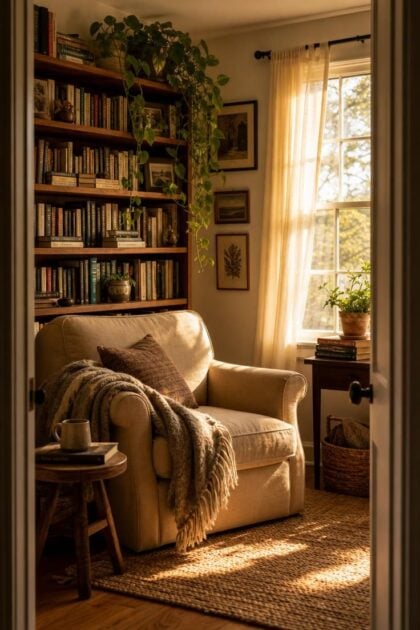
A reading nook room is one of those spaces that sounds like a luxury until you realize it only takes a spare corner, a comfortable chair, and a shelf of books you actually want to read.
The difference between a reading nook room and a chair next to a lamp is intention, where every piece in the room supports the act of sitting down and staying awhile.
These 11 ideas pair specific materials, lighting moods, and reading nook furniture with architectural details to help you build a cozy reading space that fits your home and your reading habits.
Each one is designed around a single photograph you can picture clearly, so you know exactly what to aim for when putting your own reading corner together.
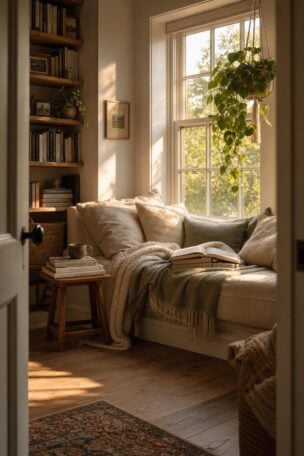
A Slipcovered Linen Daybed Beneath a Row of Clerestory Windows
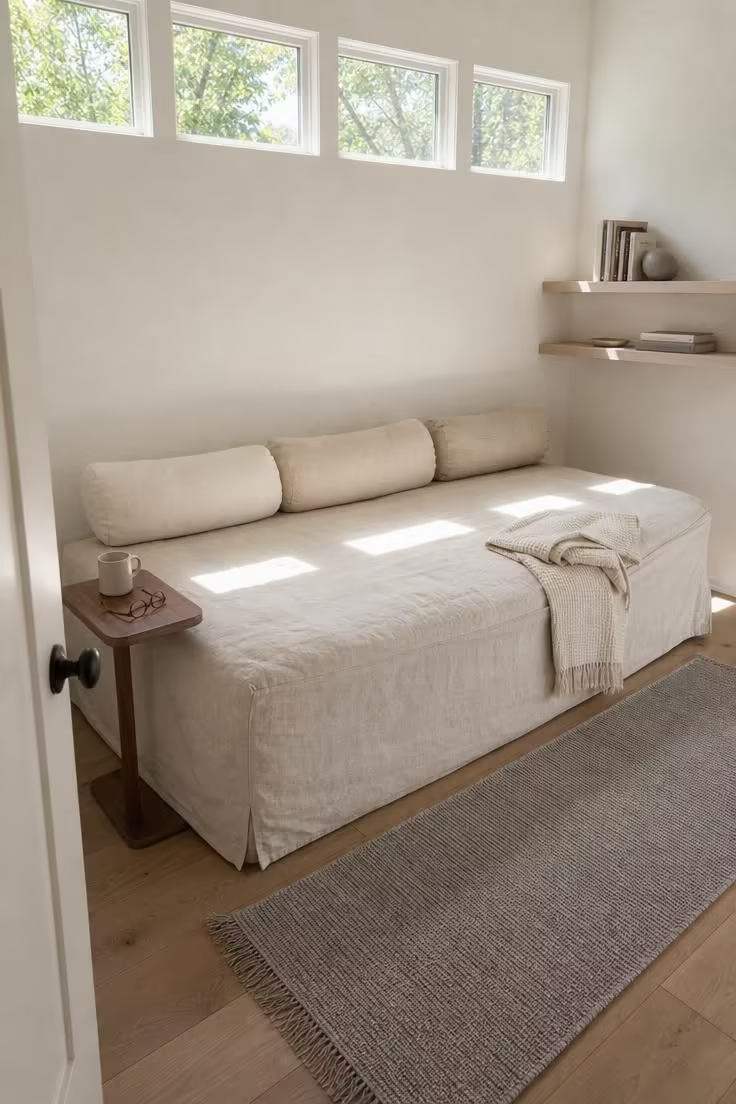
The clerestory window placement is what makes this reading nook room work so well.
Light enters from above, which means you get consistent brightness across the seating area without any direct glare on the page.
Your eyes stay relaxed because the light source never competes with your line of sight.
The oatmeal linen slipcover is a practical choice, easy to remove and wash, and it softens the frame of the daybed into something that feels more like bedding than furniture.
Roll pillows in slightly different shades of the same color family keep the arrangement from looking flat.
That slim walnut tray table earns its spot by holding just enough, a mug, glasses, a bookmark, without crowding the floor.
The floating shelves on the opposite wall pull your eye across the room and give you a reason to stand up, stretch, and pick your next book.
Style Blueprint:
- Slipcovered linen daybed in oatmeal or flax
- Clerestory or high-mounted windows for overhead natural light
- Slim walnut tray table for drinks and reading glasses
- Cotton waffle blanket in a neutral tone
- Low floating shelves in pale wood for a small book display
Moss Green Velvet Armchair Paired With a Blackened Steel Floor Lamp
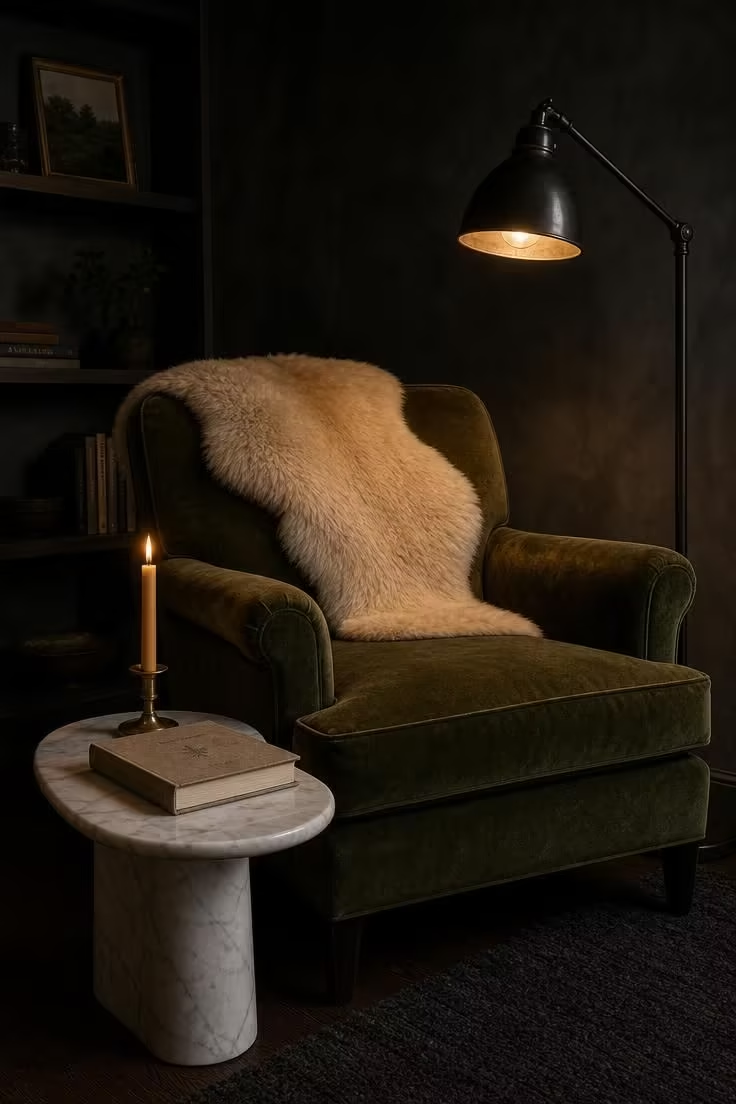
Dark walls do something specific to a reading nook room: they push the edges of the space backward and draw all your attention to whatever the lamp is illuminating.
The moss green velvet catches that warm bulb light and deepens in color, looking almost forest-dark in the shadows and bright olive where the light hits directly.
A pharmacy-style lamp with a blackened steel finish gives you precise control over where the light falls, and its slim profile keeps the reading chair area from feeling cluttered.
The sheepskin draped over the back is not decorative filler here, it is the texture that keeps the chair from blending entirely into the dark wall behind it.
Marble on the side table introduces a cool, smooth surface that contrasts with all the soft textiles around it.
This is the kind of reading corner that makes you want to stay up past midnight with a long novel.
Style Blueprint:
- Deep-seated velvet armchair in moss green or forest
- Blackened steel pharmacy floor lamp with warm bulb
- Dark plaster walls in charcoal or slate
- Sheepskin hide draped over the chair back
- Oval marble side table for a book and a single light source
Raw Plaster Walls With a Cane-Back Settee and Stacked Terracotta Pots
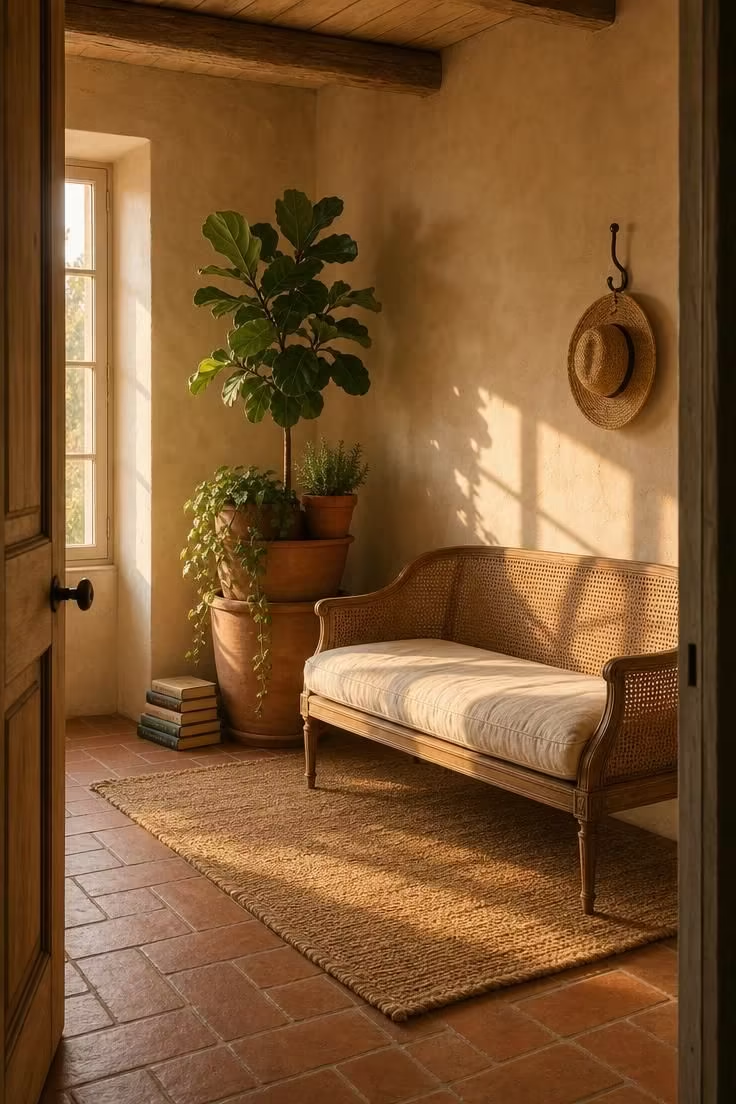
The raw plaster wall is doing most of the atmospheric work in this reading nook room.
It absorbs the golden light rather than reflecting it sharply, which gives the entire corner a soft, amber glow that changes with the time of day.
Cane has a way of filtering light through its weave, and when that weave catches the afternoon sun, it throws a subtle lattice pattern onto the cushion and floor.
The terracotta pots serve a double purpose: they bring height and greenery to an otherwise low-profile arrangement, and their warm clay tone matches the plaster and tile.
Stacking books on the floor beside the pots instead of on a shelf gives the room a relaxed, lived-in quality, like someone set them down mid-read and went to make tea.
A jute rug grounds the settee without competing visually with the terracotta floor beneath it.
The straw hat on the iron hook is a small, specific detail, but it tells a story about the person who reads here.
This kind of reading room decor works best when you let the materials speak and keep accessories to a minimum.
Design Pro-Tip: When your walls have visible texture like raw plaster or limewash, skip artwork entirely and let the wall surface become the backdrop. Textured walls already have visual movement, and adding framed prints creates competition. A single iron hook with one hung object is enough.
Style Blueprint:
- Cane-back settee with loose linen seat cushion in cream
- Raw plaster or limewash walls in mushroom or warm sand
- Stacked terracotta pots with a mix of tall and trailing plants
- Woven jute rug in natural tone
- Terracotta tile or warm stone flooring
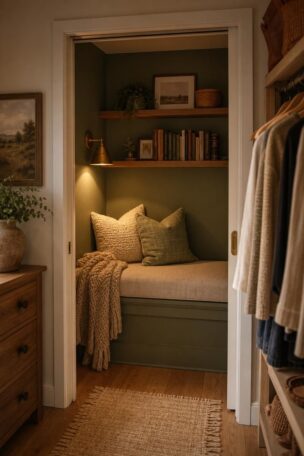
A Converted Pantry With Tongue-and-Groove Walls and a Pendant Globe Light
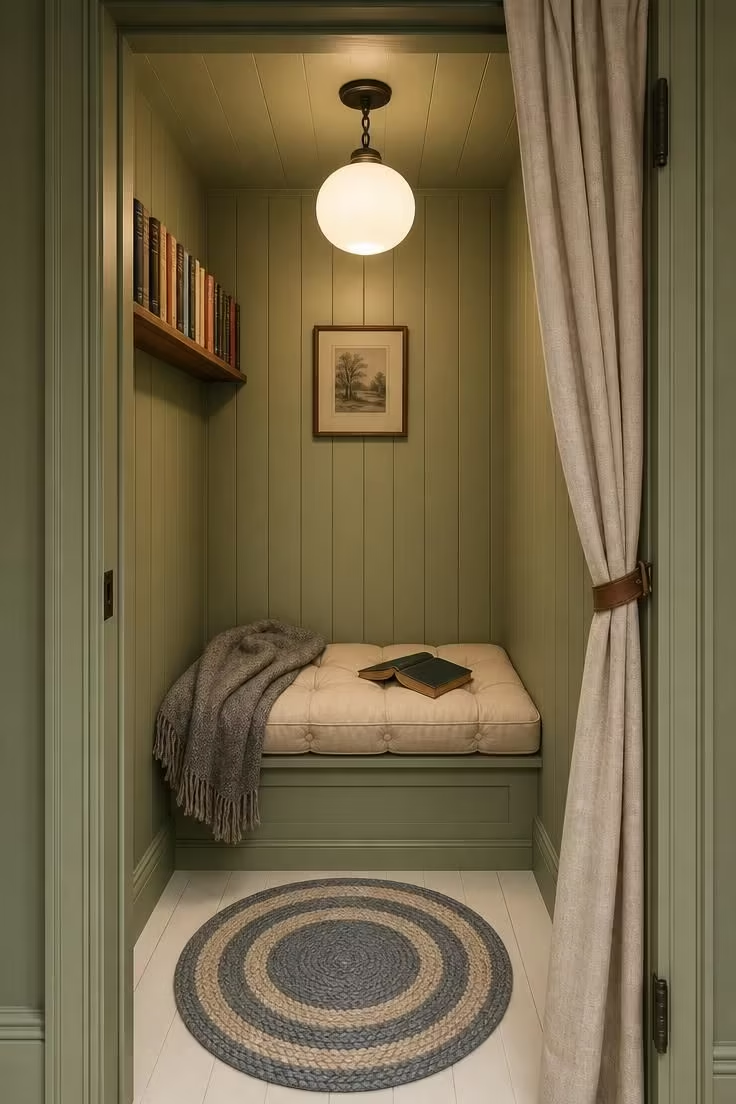
Small rooms have an advantage for reading that large rooms rarely match: enclosure.
When the walls are close enough to reach out and touch, the space wraps around you, and that physical closeness quiets the mind faster than any amount of soft music or ambient noise.
Tongue-and-groove paneling adds vertical rhythm to these tight walls, which prevents the room from feeling like a box.
Painting it in pale sage, a color that reads as both green and gray depending on the light, keeps the space feeling fresh without being cold.
The milk glass globe pendant is the right fixture here because it throws light evenly in all directions, and in a room this small, you only need one source.
A leather strap curtain tie is a small detail, but it adds a material contrast that keeps the linen-and-wood palette from becoming monotone.
This is a book nook that rewards you for stepping inside and pulling the curtain closed.
Style Blueprint:
- Tongue-and-groove paneling painted in pale sage or soft white
- Milk glass globe pendant for even diffused overhead light
- Built-in bench with tufted cotton canvas cushion
- Narrow wooden shelf at shoulder height for paperback storage
- Linen curtain with leather strap tie at the doorway
Herringbone Brick Floor With a Leather Club Chair and Iron Bookstand
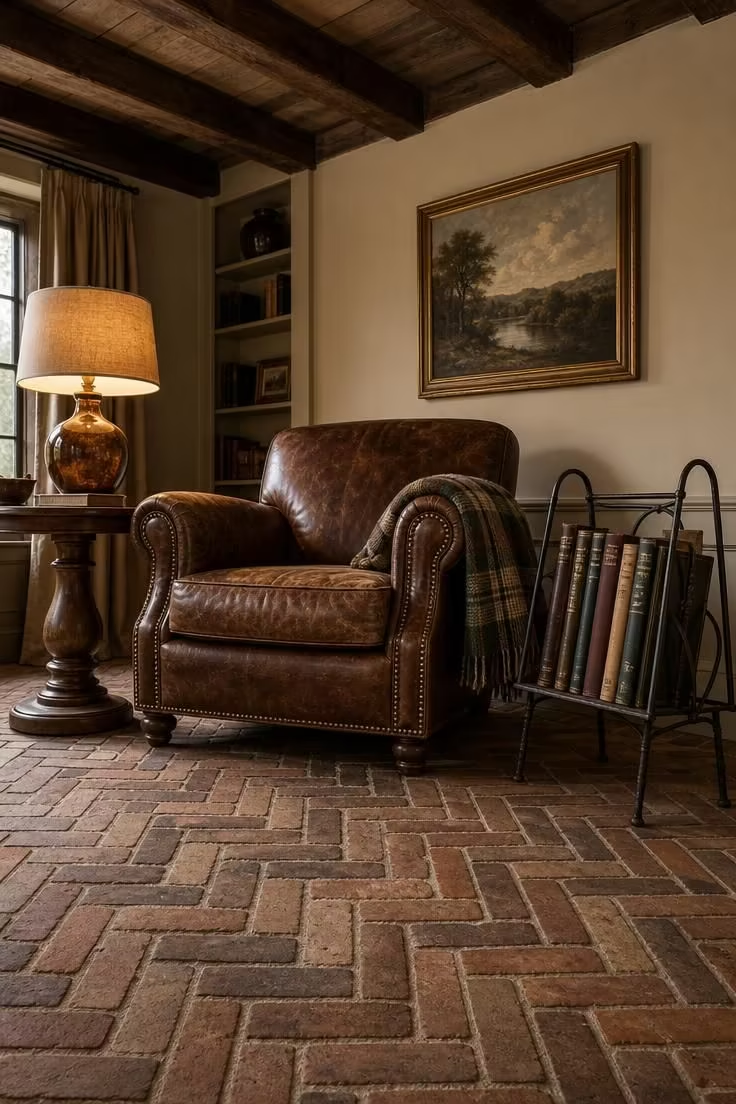
Brick on the floor changes the acoustic quality of a room in ways that carpet and wood do not.
It absorbs sound unevenly, which means the room stays quiet without feeling deadened, and footsteps have a satisfying, muffled weight to them.
The herringbone pattern is more interesting underfoot than a straight stack, and it gives the eye a reason to look down, which actually makes the room feel larger than it is.
A leather club chair on brick is a combination that ages well together, both materials developing a patina over years that makes the room look better the longer you use it.
The iron bookstand keeps your current reads within arm’s reach without requiring wall-mounted shelving, which is useful in rooms where you want to preserve the wall for a painting or a window.
This reading chair becomes the anchor of the entire room, and everything else orbits around it.
Design Pro-Tip: If your reading nook room has hard flooring like brick, stone, or concrete, skip the area rug and let the floor show. Hard surfaces reflect reading nook lighting in ways that carpet absorbs, and the material character of the floor adds warmth that a rug would hide. Add a wool throw to the chair instead for foot-warming comfort.
Style Blueprint:
- Worn leather club chair with brass nail head trim
- Herringbone-pattern reclaimed brick flooring
- Freestanding iron bookstand in magazine-rack style
- Table lamp with amber glass base and linen shade
- Wool tartan throw in muted earth tones
A Skylight Alcove With a Platform Mattress and Linen Roll Pillows
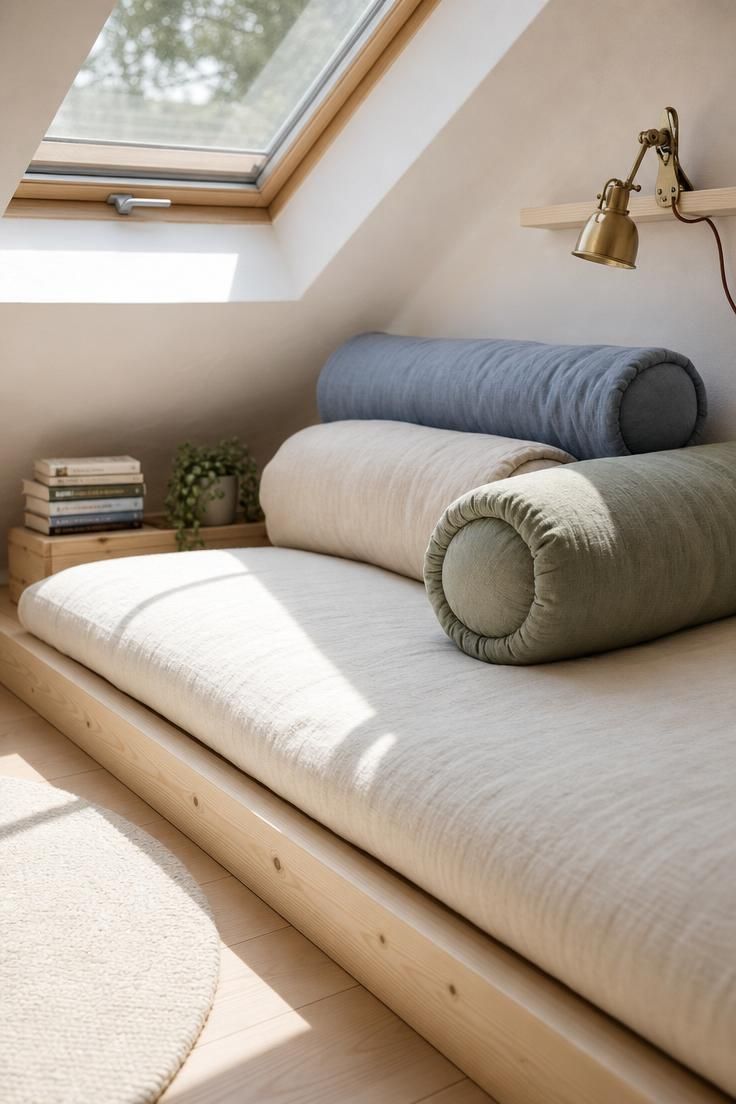
A skylight does something that no vertical window can replicate: it puts the light source directly above you, which is the most natural and comfortable angle for reading.
There is no squinting, no repositioning to avoid a glare patch, just even, overhead brightness that mimics being outside under an open sky.
The platform mattress approach eliminates the need for a frame or headboard, which keeps the sightlines clean and makes the sloped ceiling feel like a deliberate architectural feature rather than a limitation.
Linen roll pillows in three different muted tones give you adjustable back support without the visual weight of throw pillows stacked against a wall.
The wooden crate of books is the right scale for this space, holding just enough for a week of reading without overwhelming the minimal setup.
A brass clip-on light for evenings means you need zero floor space for a lamp, which matters in a tight alcove.
This cozy reading space works because it strips everything down to the bare requirements: light, a soft surface, pillows, and books.
The trailing succulent in the crate softens the geometry of the stacked paperbacks and adds one living element to the arrangement.
Style Blueprint:
- Low pine platform frame with thick natural cotton mattress
- Operable skylight for direct overhead natural light
- Linen roll pillows in three muted tones (sage, oatmeal, dusty blue)
- Shallow wooden crate for book storage at mattress level
- Brass clip-on reading light for evening use
Whitewashed Shiplap With an Indigo Linen Sling Chair and a Rope Shelf
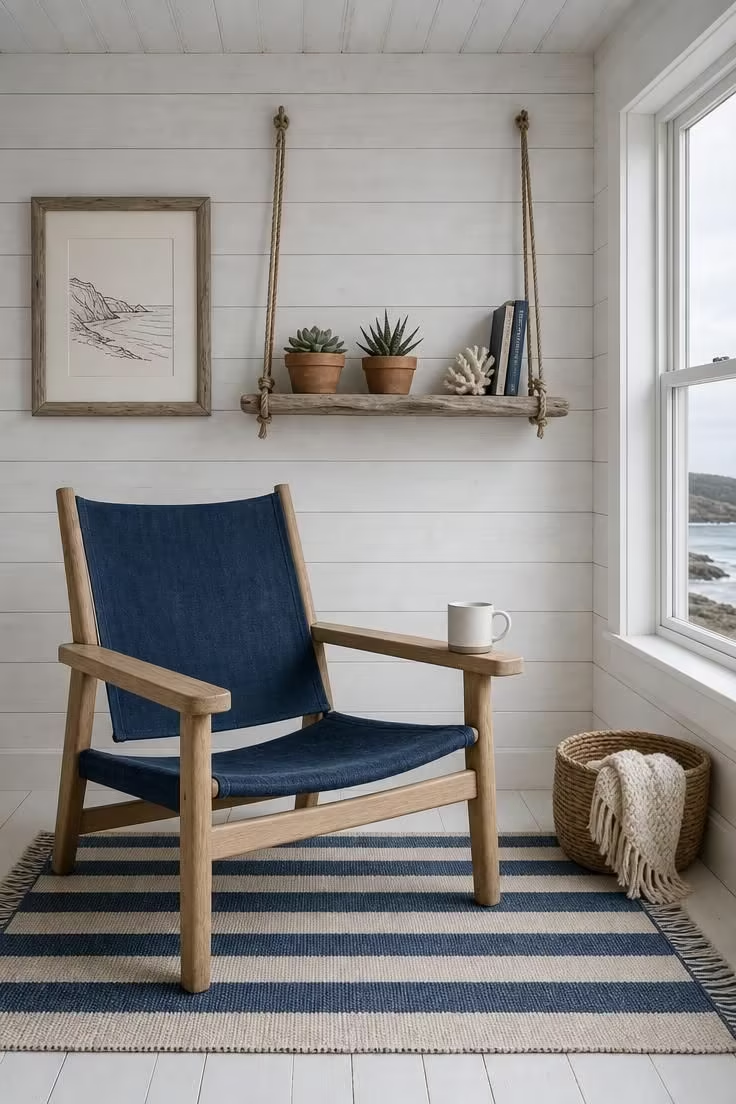
The indigo linen against white shiplap creates a contrast ratio that is strong enough to anchor the room but not so sharp that it feels jarring.
Indigo is one of those colors that reads as both casual and deliberate, depending on the fabric, and in a washed linen sling, it leans firmly toward relaxed.
A rope-and-driftwood shelf is a reading nook furniture piece that most people can build in an afternoon with hardware store supplies, and its handmade quality fits the coastal mood better than anything manufactured.
Cool overcast light is actually the most comfortable light for long reading sessions because it stays consistent for hours without the shifting angles you get from direct sun.
The striped rug does double duty: it adds pattern to break up the all-white floor and walls, and it defines the seating zone within the larger room.
Keeping the mug on the armrest instead of a side table is a deliberate space-saving choice that makes the chair feel self-contained.
This is a reading corner where the salt breeze does half the decorating for you.
Design Pro-Tip: In a room with whitewashed walls, limit yourself to one saturated color (here, indigo) and let it carry the entire palette. Adding a second strong color splits the eye and weakens the coastal calm. If you want variety, vary the shades of white and natural wood instead.
Style Blueprint:
- Indigo-dyed linen sling chair with light ash wood frame
- Whitewashed shiplap walls and beadboard ceiling
- Rope-and-driftwood hanging shelf for plants and books
- Striped cotton rug in navy and cream
- North-facing window for cool, even natural light
A Half-Round Turret Room With Curved Bookshelves and a Chenille Chaise
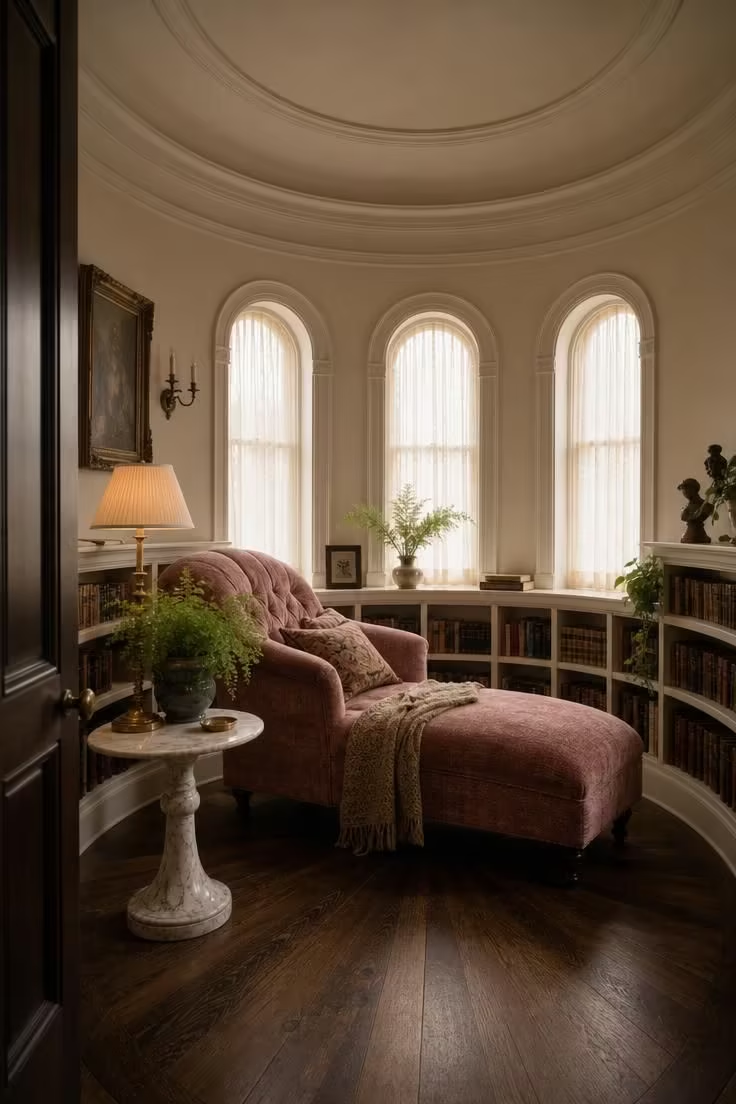
Curved walls change the way a reading nook room feels because they eliminate corners, and corners are where visual tension accumulates.
In a turret room, your eye travels smoothly along the shelf line without stopping, which creates a sense of continuity that rectangular rooms have to work much harder to achieve.
Custom curved shelving is an investment, but it turns an unusual architectural feature into the room’s defining element rather than an obstacle to work around.
The dusty rose chenille chaise is positioned to face the windows rather than the shelves, which means the reader looks out toward light and sky, not inward at walls of book spines.
A maidenhair fern on the pedestal table adds a delicate, living texture that complements the softness of the chenille without competing for attention.
This is a home library in miniature, where the architecture itself becomes the most interesting design element.
Style Blueprint:
- Chenille chaise lounge in dusty rose or blush
- Custom curved bookshelves following the turret wall
- Arched windows with sheer ivory curtains for diffused light
- Small round marble pedestal table with brass reading lamp
- Dark walnut radial-pattern flooring
Concrete Accent Wall With a Camel Wool Lounger and Matte Black Sconces
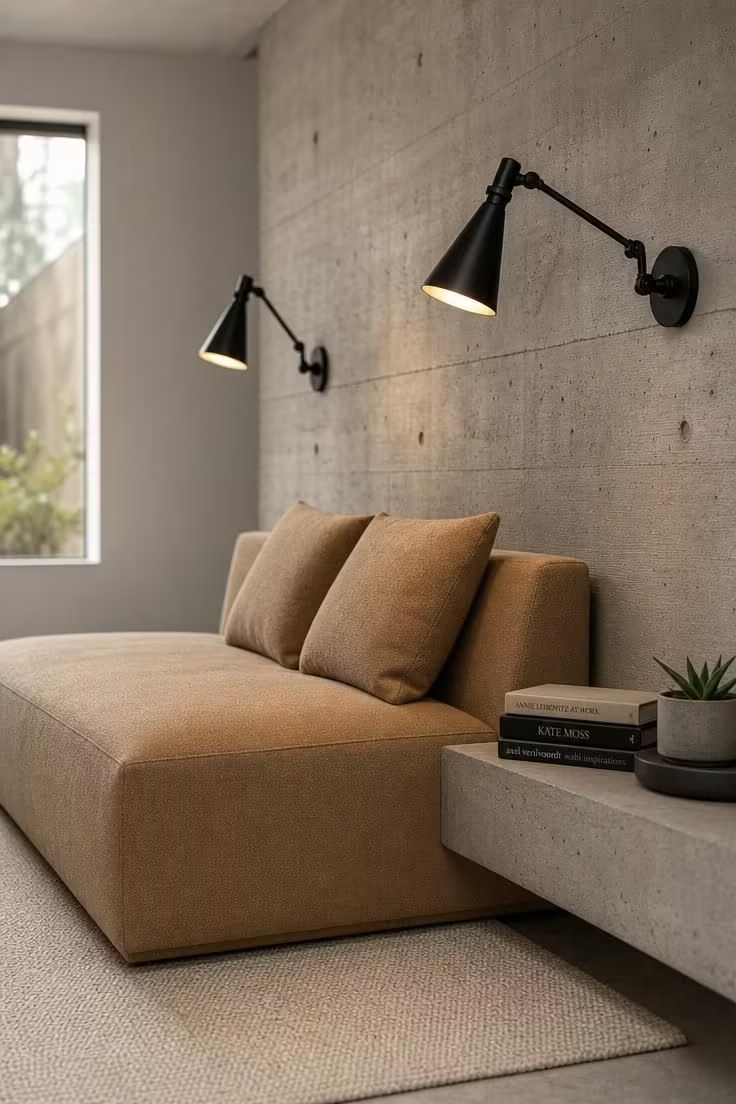
Concrete as a wall material brings a weight and seriousness to a reading nook room that softer materials cannot.
It anchors the space visually and acoustically, absorbing mid-range sound frequencies that make conversation-volume distractions disappear.
The camel wool lounger works against this backdrop because its warm fiber tone and organic texture directly oppose the cool, mineral surface behind it, and that opposition is what makes both materials look better.
Matte black sconces with adjustable arms are the most functional reading nook lighting option for a wall-mounted setup because you can redirect the beam from overhead reading position to ambient wall-wash with a single hand.
Leaving the window uncurtained is a deliberate choice in a concrete room: curtains would soften the industrial character that makes this space distinctive.
The low concrete bench beside the lounger echoes the wall material and keeps the book storage grounded at the same visual weight as the architecture.
A flat-weave rug in cream is the one soft layer on the floor, warm enough underfoot without hiding the polished concrete around it.
This is a reading room decor approach for someone who finds calm in clean lines and raw surfaces rather than in layered textiles.
Style Blueprint:
- Low-profile wool lounger in camel with clean angular lines
- Poured or paneled concrete accent wall
- Pair of matte black adjustable wall-mounted sconces
- Polished concrete floor with flat-weave cream wool rug
- Low concrete bench for book display and storage
Pine Peg Rail With Hanging Tote Bags Above a Gingham Cushioned Bench
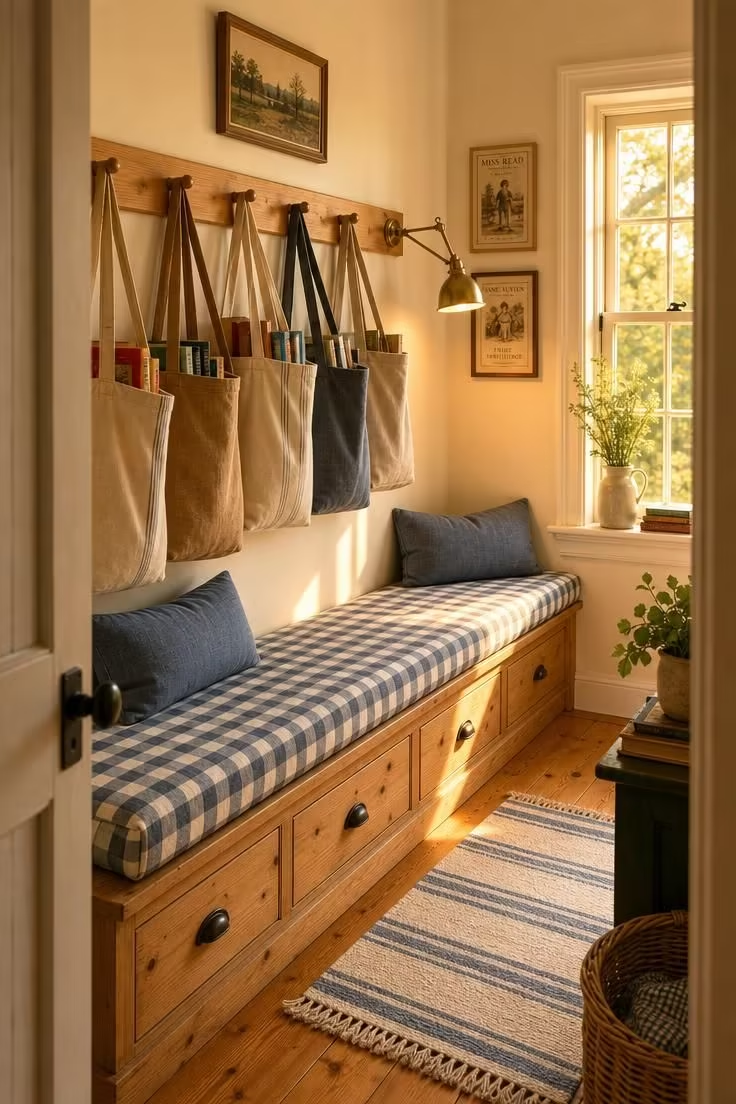
The peg rail is one of the simplest pieces of reading nook furniture you can install, and it solves the book storage problem in a way that built-in bookshelf systems cannot: portability.
Each tote bag becomes a portable reading kit organized by genre, mood, or season, and you can grab one on the way out the door.
Gingham is a pattern that signals comfort without pretension, and in a reading nook room, it sets an immediate tone of relaxed, no-pressure enjoyment.
The brass hook lamp clipped directly to the peg rail is resourceful and charming, using existing hardware to position reading light exactly where you need it without drilling a new hole in the wall.
Golden hour light through a west-facing casement window gives this space about two hours of the warmest, most flattering natural light of the day.
A built-in bookshelf would have been the conventional choice here, but the tote bag system adds personality and color that shelves of spines rarely match.
This is a reading corner where function and character share equal billing.
Design Pro-Tip: Organize your reading nook room books by mood rather than author or genre. A tote labeled “rainy afternoon” or “Sunday morning” helps you pick the right book faster than alphabetical order ever will, and it turns choosing your next read into something that feels personal rather than systematic.
Style Blueprint:
- Simple pine peg rail mounted at shoulder height
- Canvas and linen tote bags for portable book storage
- Built-in bench with thick gingham-check cushion in blue and white
- Brass hook lamp clipped to the peg rail for reading light
- West-facing casement window for warm golden hour light
A Sunken Floor Pit Lined With Wool Cushions and Low Perimeter Shelving
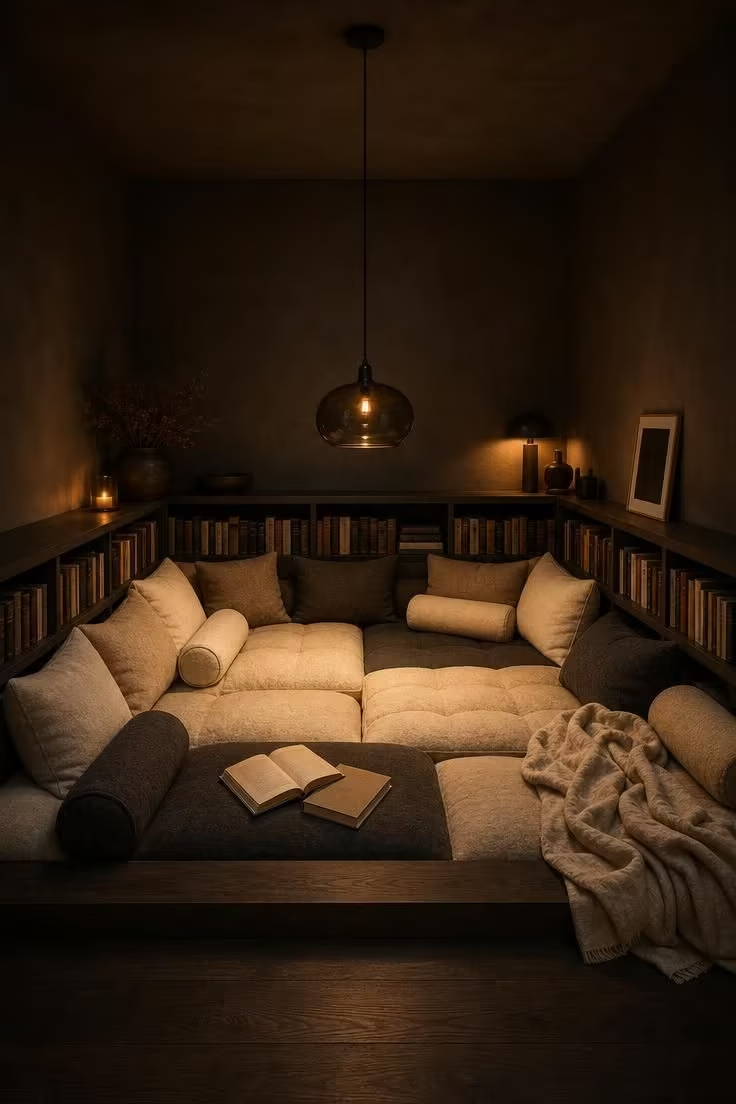
Dropping the floor even a single step changes the psychological relationship between the reader and the rest of the house.
You are literally below the sightline of anyone walking past, which creates a sense of privacy that walls and doors sometimes fail to deliver.
The perimeter shelving at seat height means every book in your collection is within arm’s reach without standing, which keeps you in that reading trance longer.
Wool cushions and roll pillows at floor level let you shift positions freely, from sitting cross-legged to stretching out to leaning sideways against a cylinder pillow, all without committing to a single piece of furniture.
The smoked glass pendant filters the light into a warm amber tone that pools directly over the seating area and fades at the edges, reinforcing the boundary of the space without a physical wall.
Keeping the palette to three tones, cream, oat, and charcoal, prevents the all-textile surface from looking chaotic and lets the texture differences between the wool, linen, and book cloth carry the visual interest.
Conclusion
The reading nook room that works best is the one built around how you actually read, not how a room is supposed to look.
Start with one piece: a reading chair you do not want to leave, a window seat with the right light, or a shelf that holds exactly the books you plan to read next.
Build outward from there, adding a lamp, a throw, a side table, and let each addition earn its place by making your time in the room more comfortable.
Every idea here pairs specific materials with specific light because comfort is not vague, it is a wool blanket at the right weight, a bulb at the right warmth, and a cushion at the right depth.
Your reading nook room does not need to match any of these setups exactly, but it does need to feel like yours.