This post may contain affiliate links. If you make a purchase through these links, we may earn a commission at no additional cost to you.
Minimalist decluttering is often pictured as a house stripped to bare walls and a single chair.
That picture asks most households to give up too much, and it explains why so many clearing attempts stall halfway.
A calmer goal is easier to live with: fewer visual distractions, and a home that still feels unmistakably yours.
The method below treats decluttering as a series of small decisions about what earns space, rather than a race toward owning the least.
What Survey Data Actually Says About Sentimental Clutter
The hardest part of clearing a home is rarely the broken appliance or the duplicate spatula.
The IKEA Store & Organise Report 2026, drawing on a YouGov survey of 31,488 people across 31 markets, found that 82% of people keep items for sentimental reasons, even when those items are rarely used or stored out of sight.
That figure reframes the whole task.
A useful minimalist decluttering plan cannot be built only around utility, because most households are holding on to things that function as memory markers: a grandparent’s teacup, a child’s first drawing, a box of letters from a house the family left years ago.
Those objects live in the same shelves, boxes, and drawers as everything else, and they carry emotional weight that a simple keep-or-toss question cannot resolve.
The sections ahead treat sentiment as a distinct category with its own decision process, because pretending it away is where many clearing plans quietly fall apart.
A Practical Starting Point: One Room, One Zone, One Pass
The most repeated advice from organizers is also the least dramatic: shrink the scope.
Rather than facing a whole house, pick a single zone and finish it before moving on, a method that makes decluttering one room at a time feel achievable for a household with limited time and attention.
Cleaning specialist Laura Mountford recommends being realistic about the size of the task and working from the top of the house downward while ticking spaces off a list.
That top-down order gives each session a natural finish line, so progress accumulates instead of dissolving into half-sorted piles.
Within the chosen zone, start with what is visible.
Surfaces, shelves, and floors come first, then drawers and cupboards, a sequence author Joshua Becker describes as focusing on one room and clearing visible areas before hidden storage.
Visible change is easier to see, and seeing it matters when motivation is the scarce resource.
A second approach suits storage areas especially well.
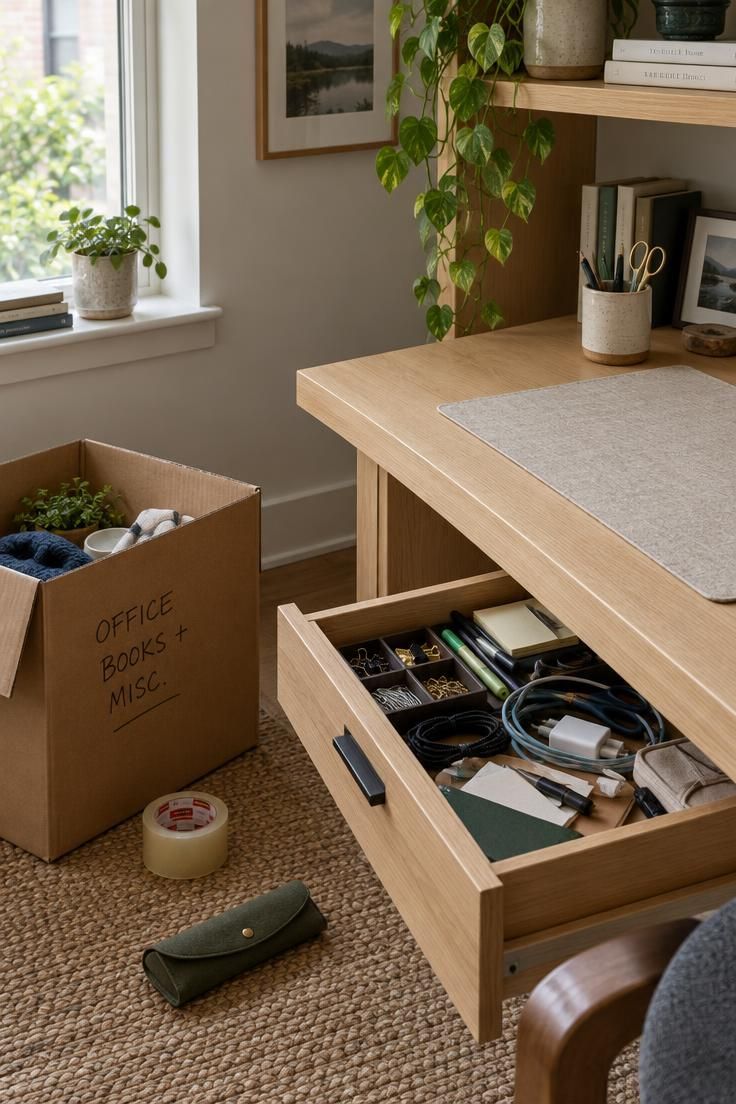
Instead of questioning every item, empty a contained space completely, then return only what the household actively uses or deeply values.
Professional organizer Jessica Beileiter describes this reverse method as keeping the more meaningful items and releasing the rest, so belongings do not simply migrate from one cupboard to another.
Both routes work; the empty-and-return version is often faster for a crowded cupboard or closet.
How to Handle Sentimental Items Without Guilt or Clutter
Sentimental items and decluttering are usually treated as opponents, and the survey numbers suggest why.
If most households keep objects for memory rather than use, then a clearing plan has to make room for feeling without letting every feeling claim shelf space.
A three-part test helps slow the decision enough to make it honestly.
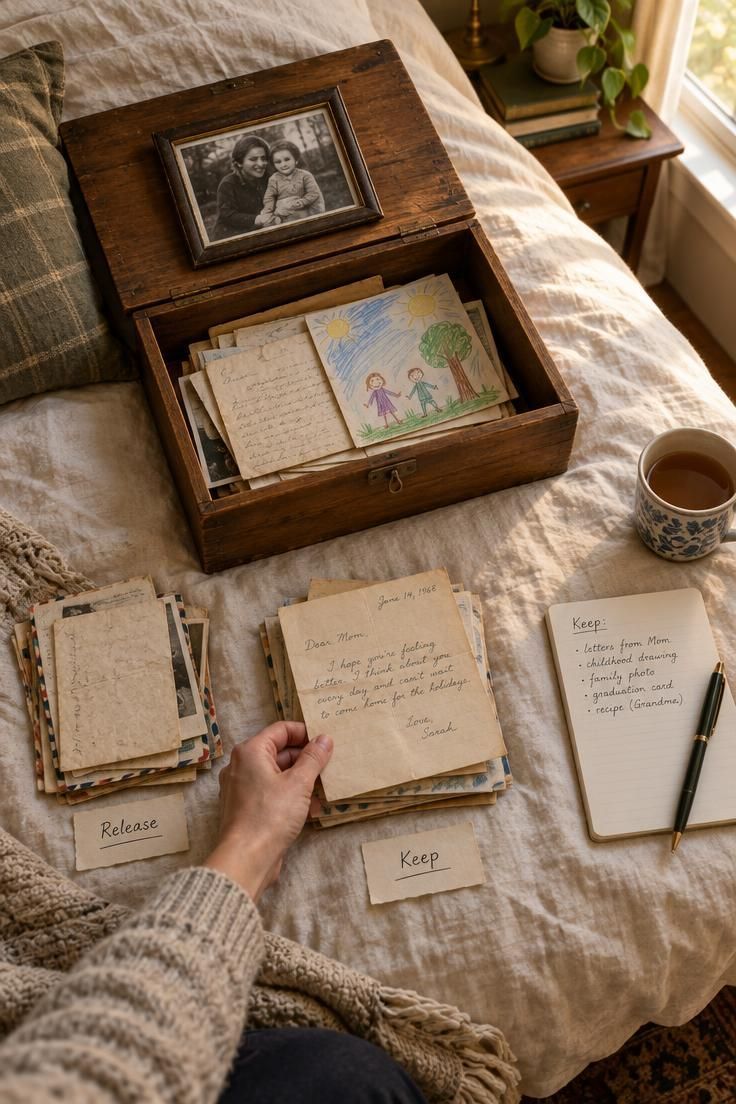
First, ask whether the item holds a memory that cannot live anywhere else: a written note or a photograph often does that job, while a generic souvenir may simply point to a trip already documented.
Second, ask whether a single representative object could honor the same memory as a whole set.
Third, ask whether the item can earn a visible place rather than living indefinitely in a storage box.
An item that stays out of sight for years is not supporting daily life, and giving it a defined display spot, even a small one, turns it from stored weight into part of the room’s character.
This is the opposite of both keeping everything and discarding everything.
Permission matters here.
Keeping a small number of meaningful objects in places where they can be seen is compatible with a calm home, and the reverse-decluttering approach offers one accommodation: keep the deeply meaningful, release the mildly meaningful, and give what remains a defined place.
Warm Minimalism at Home: Texture Instead of Emptiness
Strict minimalism has a well-documented failure mode.
Architectural Digest interviewed three people who adopted it and later reversed course, including designer Brian Patrick Flynn, who removed area rugs, painted floors and walls ultrawhite, and then found the result too silent and reintroduced color.
Warm minimalism at home offers a correction.
Designer Molly Torres Portnof describes it as pairing simplicity and intentionality with warm, earthy tones, layered textures, and natural materials, while Sarah Ellison describes the same idea as sharing the calm restraint of classic minimalism without its austerity.
The practical move is to let material carry the visual interest that decorative objects once provided.
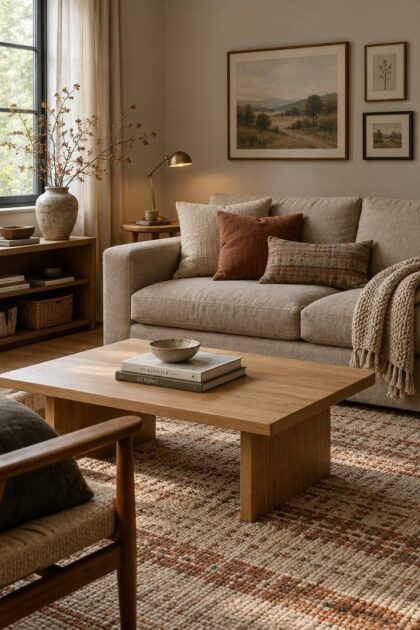
A woven wool throw over a sofa arm, a linen-covered seat, a plaster-finished wall, or a light wood sideboard each add depth through surface and tone rather than pattern or quantity, and wool, linen, natural wood, and stone supply that depth at eye level and underhand.
Grouping works the same way.
Gathering photographs and using similar frames or a single line with clips so a collection reads as one element rather than a scatter.
In a living room, a bedroom, or an entry, a tight row of matching frames or a single ceramic vase with dried grasses does more compositional work than a spread of small accessories, and it leaves the surface calm.
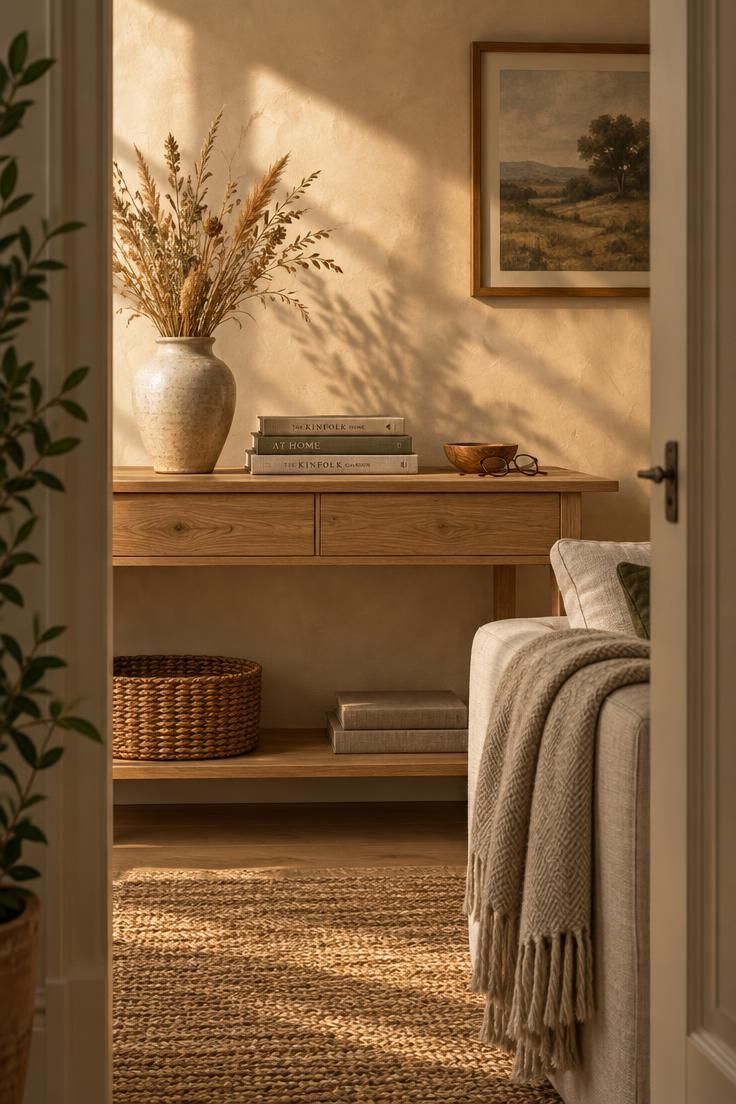
Design Pro-Tip: Before adding any decorative object to a cleared surface, place a textured material in the same spot first, such as a woven basket, a linen runner, or a wooden tray. If the texture alone makes the surface feel finished, you have found the room’s real need.
Small Home Storage Ideas That Support a Calm Surface
Storage does more work in a small home than in a large one, and poor storage is simply clutter with a lid on it.
The useful small home storage ideas share one quality: they make returning an item easier than leaving it out.
Start with the supports that give a place a shape.
Slimline hangers free up a narrow closet and keep clothing visible enough to choose quickly.
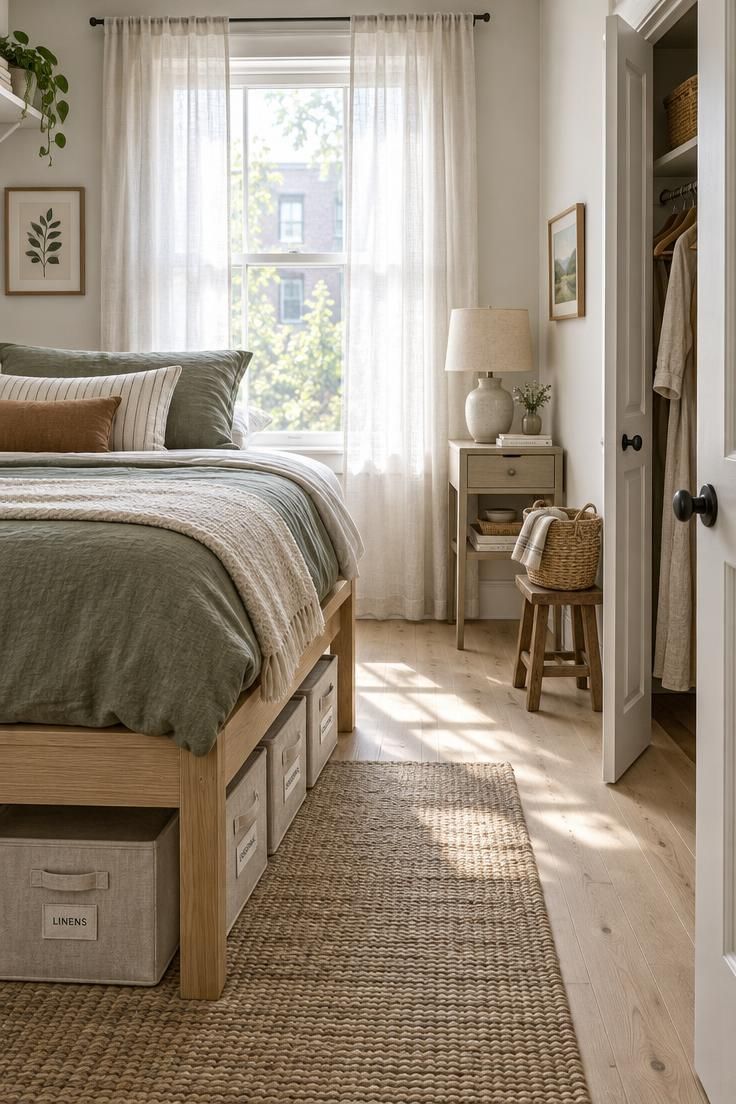
Drawer dividers stop a kitchen drawer from becoming a loose pile, and labeled boxes under a bed give bulky bedding and off-season linens a home that stays identifiable months later.
Mountford recommends slimline hangers, drawer dividers, and under-bed space for exactly these reasons.
Multi-function furniture reduces how many separate objects a room must hold.
A bed that doubles as seating, a storage bench that works as a coffee table, or a side table with built-in shelves each perform two jobs in one footprint, a strategy for keeping a space refreshed without permanent additions.
The shape of the storage matters as much as its existence.
A deep bin with no dividers becomes a new drawer of doom, while a shallow box with a label and a dedicated category stays useful.
Choose containers after deciding what belongs in them, not before.
Fit the system to the household.
A family with young children needs low, reachable storage for toys and frequent rotation, while a single adult in a compact apartment may get more from vertical shelving and a disciplined seasonal swap.
Universal storage advice rarely survives contact with a real home, so test one zone and adjust before buying more containers.
A Clutter Maintenance Routine That Fits a Real Household
A cleared room is not the finish line, and organizers say so plainly.
Becker distinguishes between transforming a home and keeping it that way, noting that some spaces need daily attention, some weekly, and some seasonal.
That tiered view is the backbone of a clutter maintenance routine that survives ordinary weeks.
The daily tier covers high-traffic surfaces: the kitchen counter, the entry drop zone, the coffee table.
A few minutes of tidying each evening is the habit most cited by respondents in an Ipsos iSay survey, followed by immediately discarding junk mail.
Two minutes before bed does more than an occasional weekend overhaul.
The weekly tier handles one drawer, shelf, or small cupboard at a time, which keeps hidden storage from quietly refilling.
The seasonal tier swaps out winter bedding, summer clothing, or holiday decorations and moves what is out of season into labeled storage, a rotation approach Kropovinsky describes as refreshing a space without adding permanent clutter.
Inflow rules belong inside the routine, not after it.
Mountford describes a personal 2-for-1 pledge, where buying one new item means donating or selling two others, and a pause before a purchase does the same work in slower motion.
A household that slows what comes in spends less time clearing what is already there.
Keep the rhythm modest.
A routine that asks for a daily deep clean will be abandoned within a month, while a two-minute reset and one weekly drawer pass can hold for years.
The goal is a home that stays calm between clearings, not a schedule that becomes its own burden.
Where People Get Stuck: Countertops, Drawers, and the Inflow
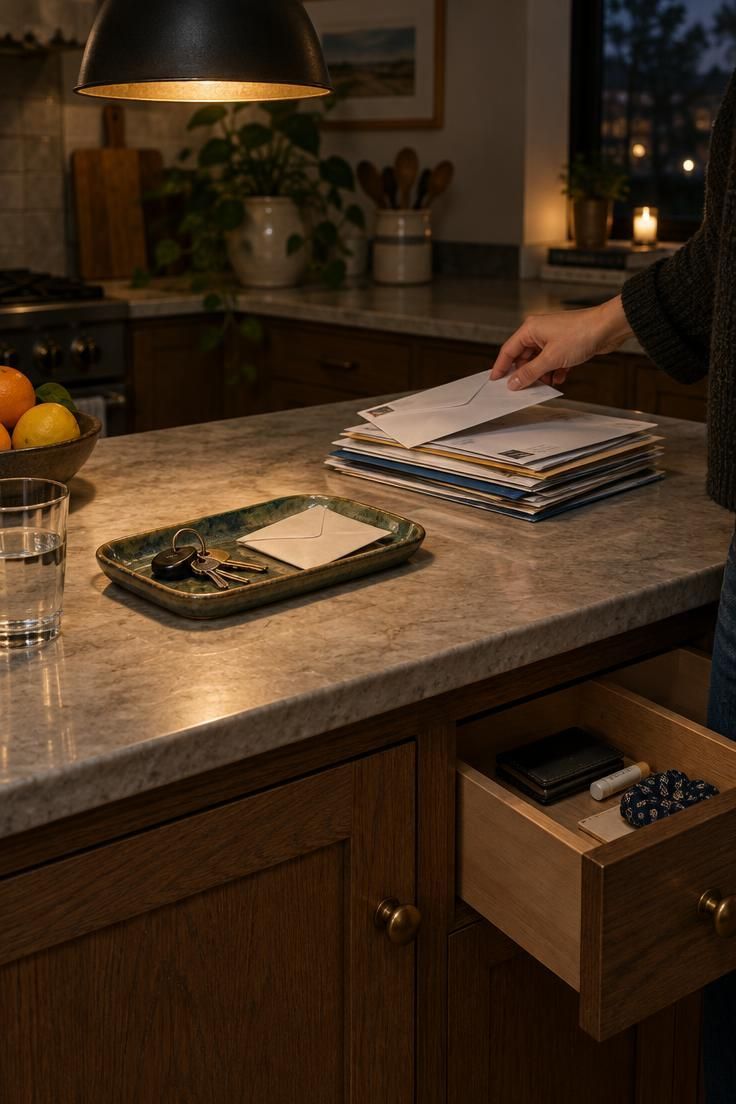
The IKEA report maps exactly where clearing stalls, and the kitchen countertop tops the list.
It is the single hardest surface to keep clear for 24% of respondents and the most likely to cause an argument at 37%.
Countertops fail because they are shared, visible, and constantly receiving new items.
A catch-all tray gives those items a defined landing spot instead of a spread.
Pair it with a short daily review, ideally at the same time each evening, so the tray empties before it becomes a permanent fixture.
The second sticking point is the drawer of doom, a drawer or box holding everything without a home, which the report found in 68% of households, rising to 75% in the U.S..
A monthly emptying of one such drawer, into a sorting tray rather than a new container, keeps it from becoming a permanent mystery.
The third is what the report calls a silent protest: 38% of respondents leave things out hoping someone else will deal with them.
Shared surfaces work best with a household agreement about who resets what, and a quick conversation about the countertop usually settles more than a silent pile ever will.
None of these stalls signal a failed approach.
They are the predictable friction points of a lived-in home, and each one responds to a small, repeated action rather than a larger purge.
Design Pro-Tip: Write your two or three decision rules on a card and keep it in the zone you are clearing. A rule you can read at the moment of hesitation, such as “used in the past year” or “one in, two out,” replaces a long internal debate.
Conclusion
Start today with one zone, not one house: the entry bench, the kitchen counter, or a single drawer.
Decide why the clearing matters, whether that is hosting without moving a pile or finding the scissors without digging.
Write down two or three rules before opening anything, clear the visible surfaces first, then return only what belongs and give each item a defined place.
Recompose one surface with texture or a grouped collection so the space feels finished rather than emptied.
Then set a two-minute daily reset.
Minimalist decluttering works best as an ongoing edit of what earns space, so the result is a home that feels calm, considered, and personal, with the objects and materials that genuinely matter to the people who live there.