This post may contain affiliate links. If you make a purchase through these links, we may earn a commission at no additional cost to you.
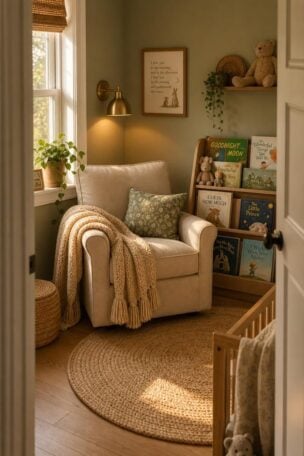
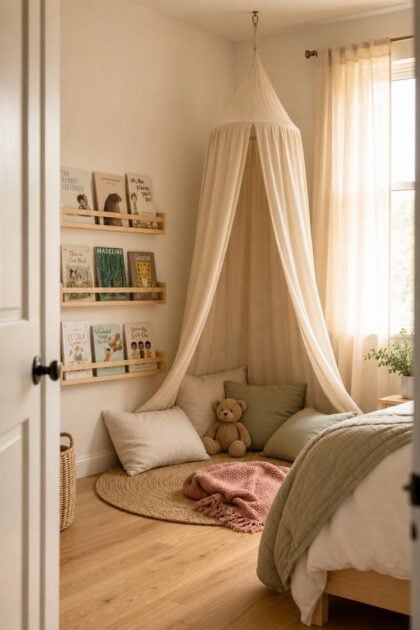
A pile of picture books on the bedroom floor is a good start, but a dedicated reading corner gives a child something better: a spot that belongs to them.
These 13 kids reading nook ideas cover every setup from a draped canopy in a corner to a full closet conversion, all designed for real rooms with real budgets.
Some take an afternoon to build, others need a weekend, and every one of them makes storytime feel like an event worth showing up for.
The right nook turns reading from a task into a habit, and the trick is making the space cozy enough that your child chooses it over the couch.
A Muslin Canopy Draped Over a Round Jute Rug
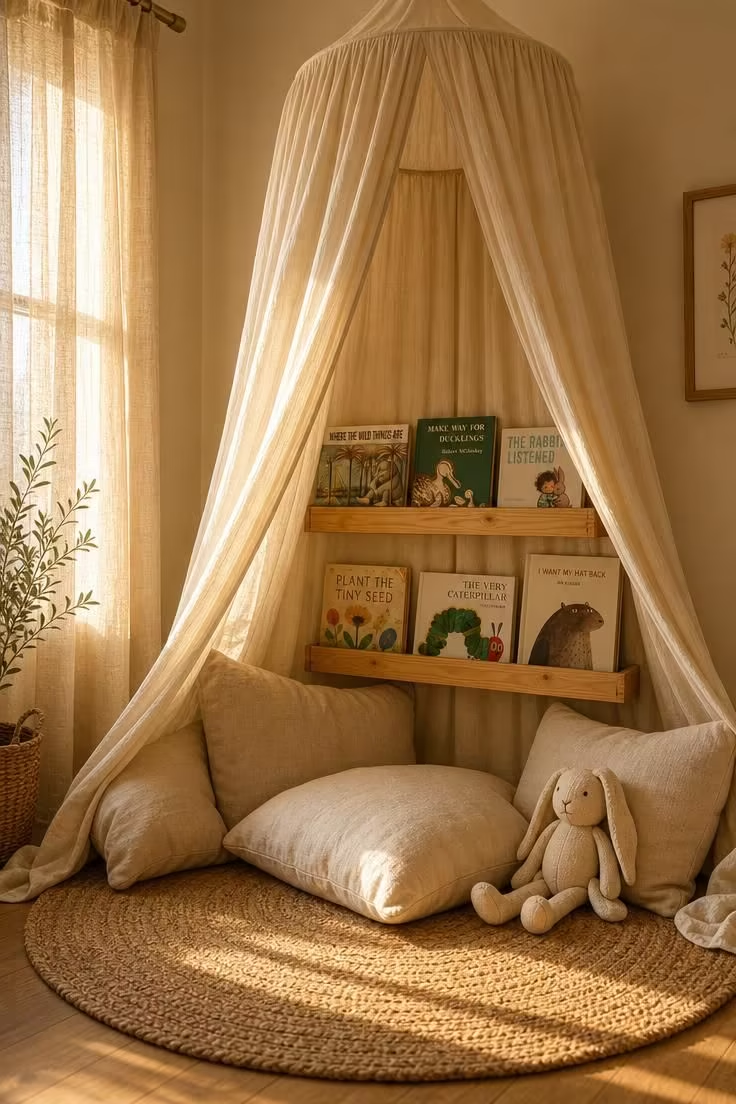
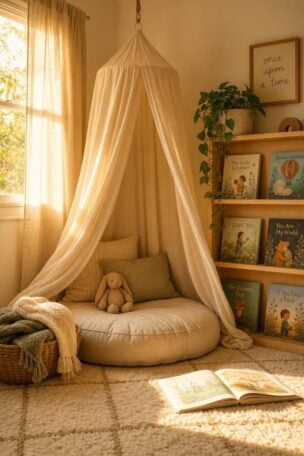
There is something about a fabric canopy that signals to a child: this kids reading nook is mine.
The muslin drapes from a single ceiling hook, creating a cone shape that feels enclosed without being claustrophobic.
A round jute rug underneath defines the floor boundary, giving the nook a clear beginning and end even in an open room.
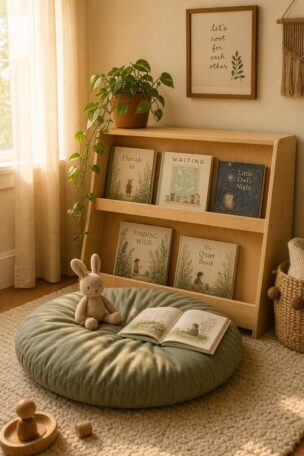
Oatmeal linen floor cushions keep the seating low, which suits toddlers and preschoolers who prefer to sprawl.
The pine book ledges inside the canopy put covers face-out, so a two-year-old can pick a book by its picture rather than trying to read a spine.
Style Blueprint:
- Unbleached muslin canopy (ceiling hook mount)
- Round braided jute rug (4-foot diameter minimum)
- Three oversized linen floor cushions in neutral tones
- Two front-facing pine book ledges at child height
- One small stuffed animal as a reading companion
A Window Seat Reading Nook With Hinged Lid Storage
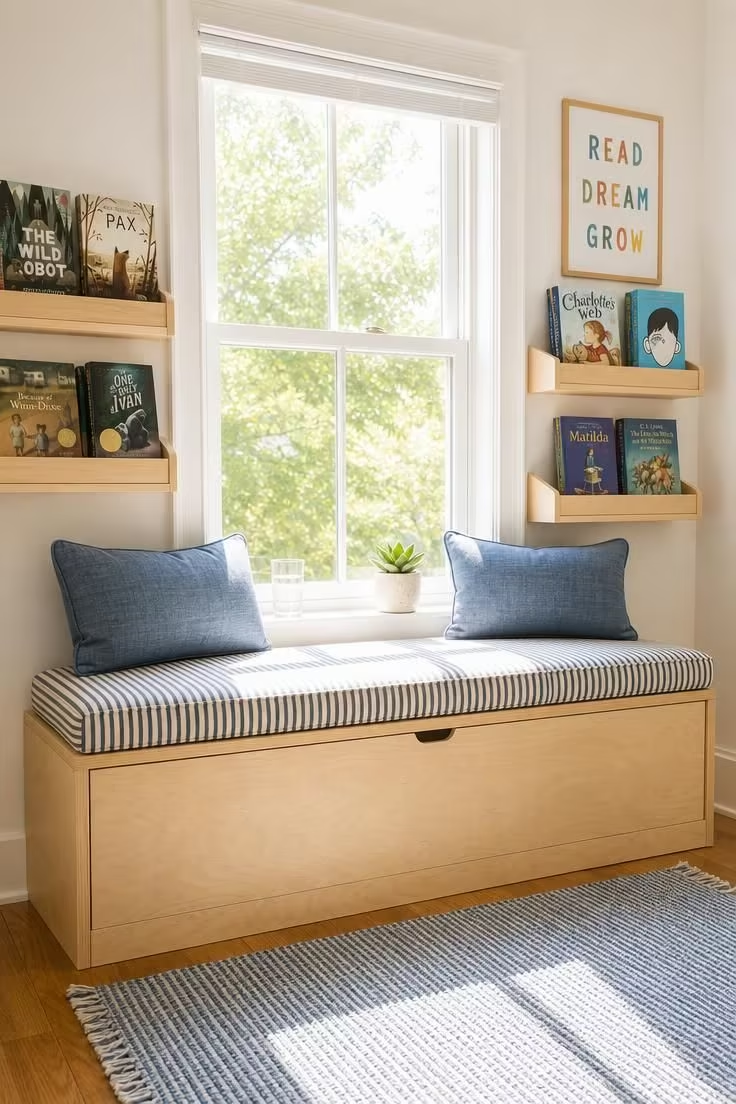
A window seat reading nook solves two problems at once: where to sit and where to store the books.
The hinged lid lifts to reveal a deep compartment that holds blankets, puzzles, or the overflow of paperbacks that never fit on a shelf.
Bright midday light from the window means no lamp is needed during daytime reading hours, and the elevated seat gives a child a perch that feels different from sitting on the floor.
Ticking-stripe fabric in navy and cream is forgiving of dirt and spills, and it avoids the themed prints that children outgrow in a year.
The wall-mounted book ledges on each side of the window frame keep the most-read titles within arm’s reach without cluttering the sill.
This is a book storage for kids solution that doubles as a seat, a storage bin, and a sunny retreat.
Style Blueprint:
- Built-in plywood bench with hinged lid (16-18 inches tall)
- Ticking-stripe cushion in navy and cream
- Two small lumbar pillows in durable fabric
- Wall-mounted book ledges flanking the window
- Woven cotton rug beneath the bench
A Pine A-Frame Tent With Cotton Duck Canvas Panels
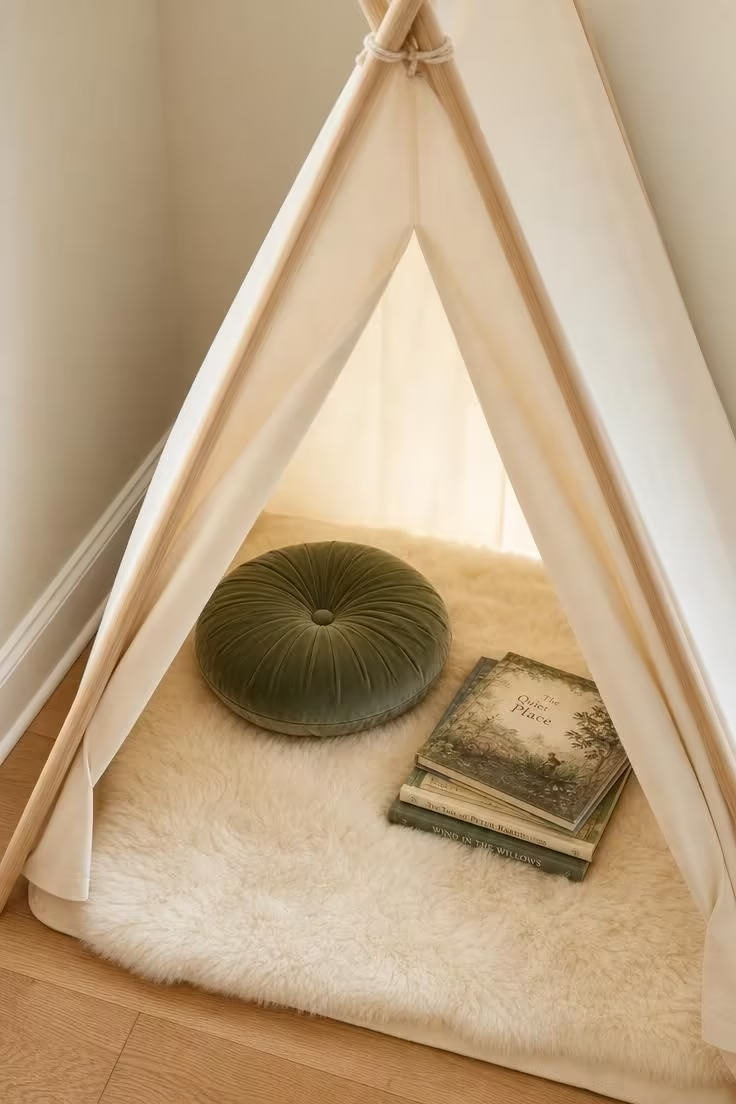
The A-frame shape creates a peaked ceiling that makes a child feel like they are inside a tiny house.
Cotton duck canvas is heavier than muslin, so it blocks more visual noise from the room and holds its shape without constant adjustment.
A sheepskin pad on the floor adds a layer of warmth that a bare rug cannot match, and its texture invites bare feet.
This teepee reading nook folds flat when company comes, which matters in a small bedroom where floor space is currency.
Style Blueprint:
- Pine dowel A-frame structure (approximately 4 feet tall)
- Cotton duck canvas panels in natural off-white
- Sheepskin pad for the tent floor
- One round velvet cushion in a muted accent color
Painted Crate Shelves Stacked Against an Olive Green Wall
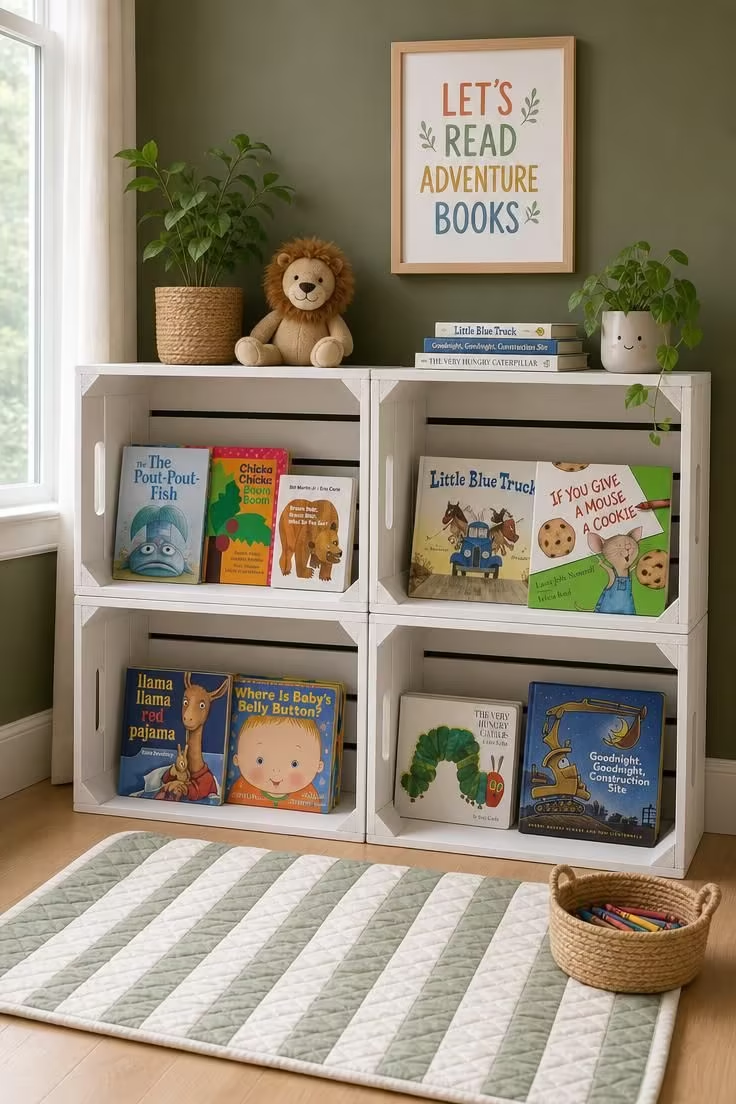
Stacked crates turned sideways become cubbies, and cubbies are the most intuitive storage a young child can use.
The olive green wall behind them gives the arrangement a backdrop that makes the white paint pop without needing any additional decoration.
A quilted cotton floor mat in front tells the child exactly where the reading spot begins.
Painting the crates a single color (white, here) unifies mismatched sizes and makes secondhand finds look intentional, which is a children’s bookshelf solution that costs almost nothing.
This setup works in a bedroom, a hallway nook, or the corner of a playroom reading area with equal ease.
Style Blueprint:
- Four wooden crates (painted white, turned sideways, stacked)
- Matte olive green accent wall (one wall only)
- Quilted cotton floor mat in neutral or two-tone stripe
- Small woven basket for art supplies
- Cool-toned natural light source (north or east window)
A Closet Conversion With Curtain Rod and Pom-Pom Trim
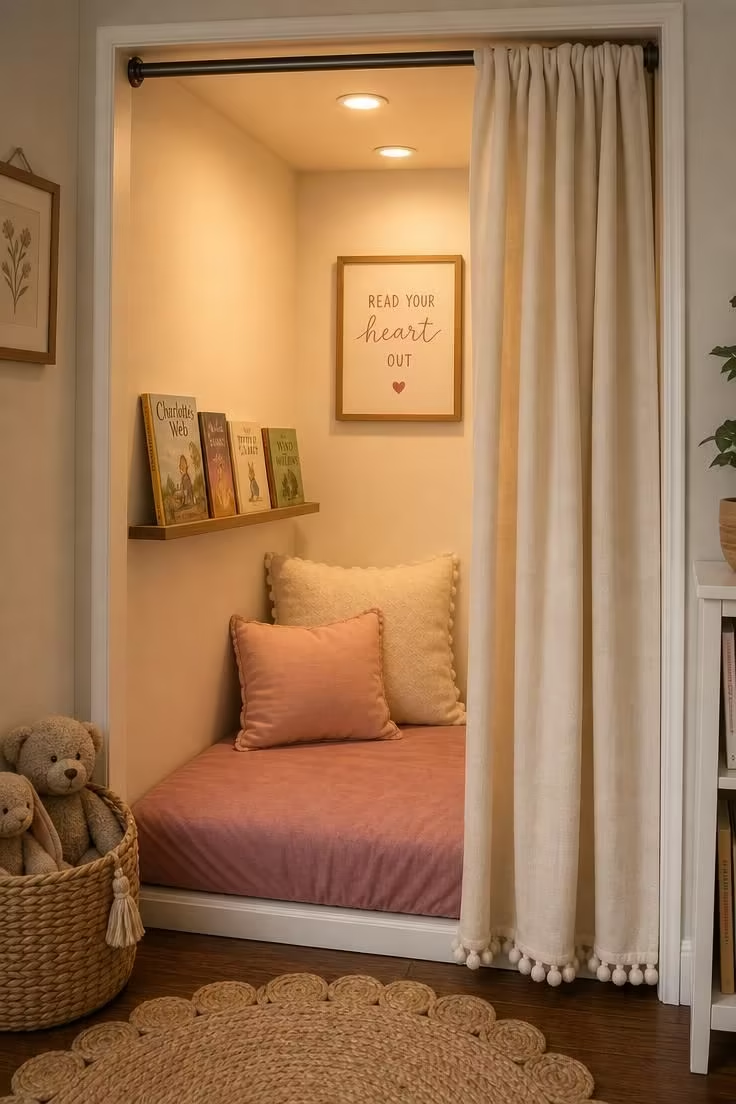
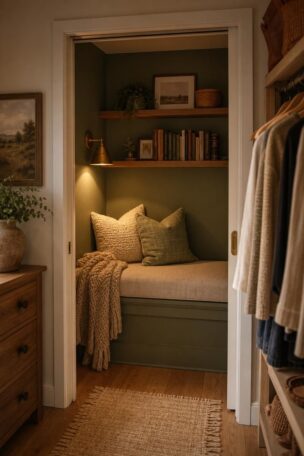
Removing the closet doors changes the space from storage to sanctuary in about ten minutes.
The pom-pom trim on the linen curtain adds a playful detail that signals to a child that this is their territory, not just a repurposed closet.
A foam mattress pad cut to the exact dimensions of the closet floor turns the base into something close to a daybed, firm enough to sit upright but soft enough for lounging.
Battery-operated puck lights on the ceiling solve the lighting problem without any wiring, and their warm tone mimics the golden glow of a bedside lamp.
This is a reading corner for kids who crave privacy, the kind who build blanket forts and read under them with a flashlight.
A narrow floating shelf on the side wall keeps a small rotation of books within reach without crowding the limited floor space.
Style Blueprint:
- Closet with doors removed
- Curtain rod with cream linen curtain (pom-pom trim)
- Foam mattress pad cut to closet dimensions, covered in cotton
- Battery-operated puck lights (warm tone, ceiling-mounted)
- Narrow floating shelf for a small book rotation
Design Pro-Tip: A closet reading nook works best when you remove the doors entirely and replace them with a simple tension rod and curtain, so the child can pull the fabric closed for privacy without the risk of a heavy door swinging shut.
Rattan Hanging Chair Suspended From a Ceiling Beam
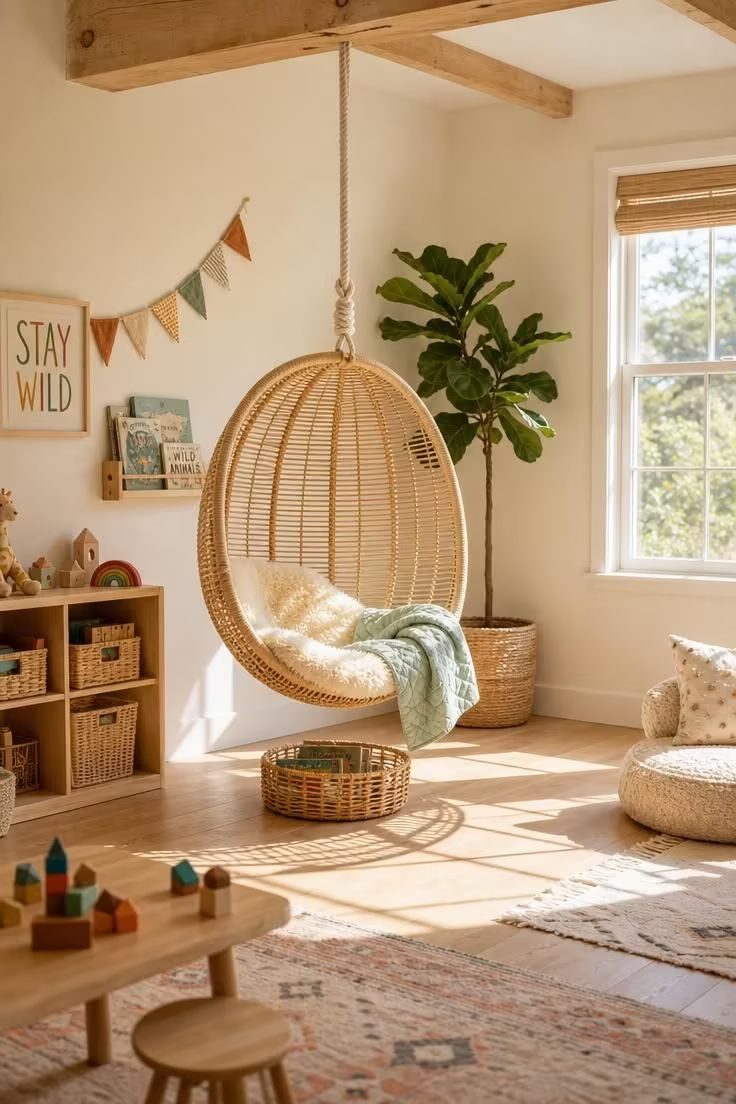
A hanging chair moves, and that movement is the entire appeal for a child between five and ten years old.
The gentle sway makes reading feel less like sitting still and more like an activity, which is why a rattan chair in a playroom reading area gets used more than a stationary bench.
A sheepskin cushion inside the egg shape keeps the hard rattan from pressing into small legs and backs.
The shadow pattern that the woven rattan casts on the floor when the sun hits it adds a visual layer that flat furniture cannot offer.
Style Blueprint:
- Egg-shaped rattan hanging chair with thick cotton rope mount
- Ceiling beam or engineered bracket rated for swinging weight
- Round sheepskin cushion for the chair interior
- Low rattan basket for book storage beneath the chair
A Stepped Plywood Platform With Built-In Cubby Holes
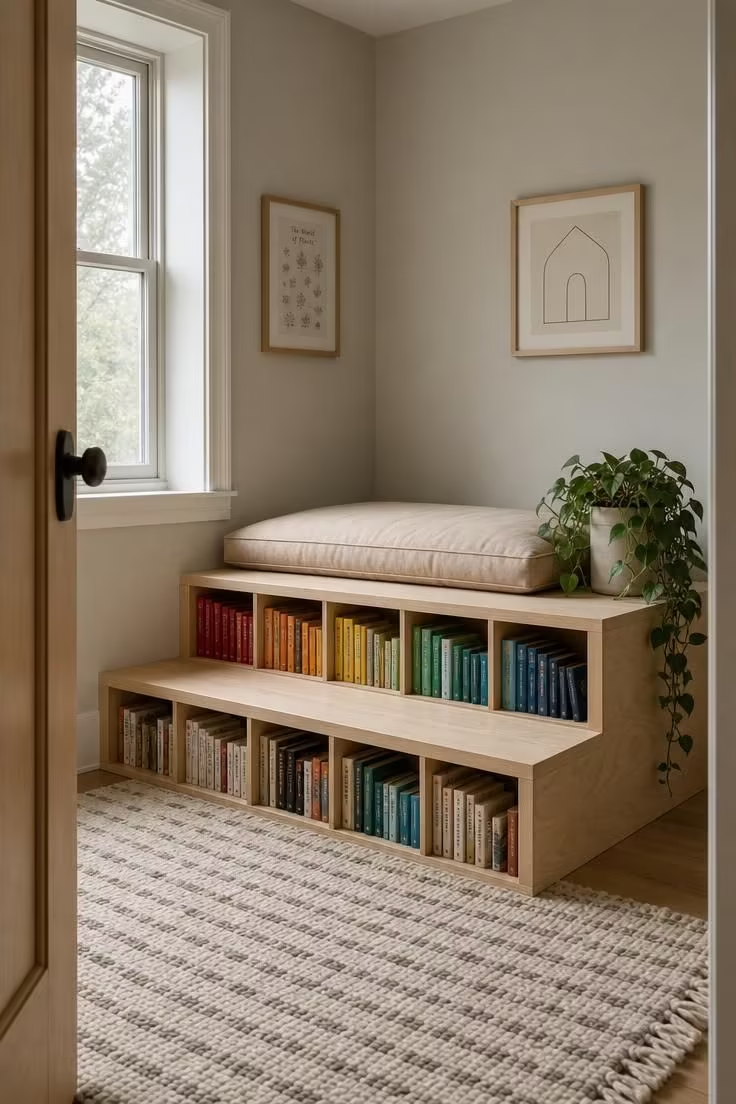
This kids reading nook lifts the seat above the floor, and that small elevation change makes a child feel like they are sitting on a stage.
Cubby holes cut into each riser give every book a visible, reachable home without the need for a separate shelf.
Birch plywood in a natural finish has a clean look that suits a modern room, and it holds up to the scratching and scuffing that children deliver to every surface.
The thick cotton canvas cushion on the top step is firm enough to support sitting upright, which matters for a child who is reading chapter books rather than flipping through picture books.
A north-facing window provides the most consistent daylight, without the harsh glare that a south exposure creates in the afternoon.
Style Blueprint:
- Two-step birch plywood platform (custom-built or flat-pack modified)
- Square cubby holes cut into each step riser
- Thick cotton canvas cushion (firm density, sand or oatmeal tone)
- Woven wool rug in front of the platform
- North-facing window for even, consistent light
Fairy Lights Strung Inside a Sheer Voile Tent
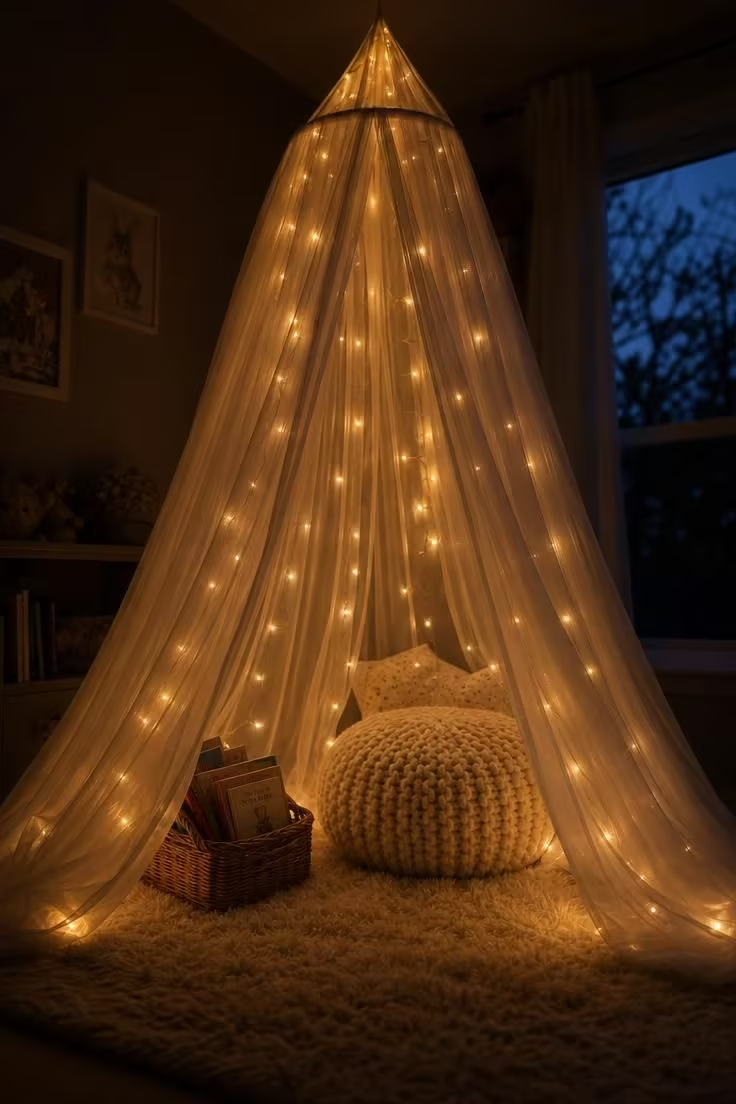
Fairy lights change a kids reading nook from a daytime activity into a nighttime ritual, and bedtime reading is where the habit sticks.
The sheer voile fabric catches the light from each tiny LED, spreading the glow across the entire surface rather than concentrating it in spots.
A chunky knit pouf is soft enough to sink into but structured enough to keep a child upright, and the hand-knit texture adds a warmth that foam or plastic seating cannot.
Inside the tent, the rest of the room disappears, and that visual isolation is what makes a child return to the spot night after night.
The wicker basket beside the pouf holds five or six books at a time, enough for a nightly rotation without overwhelming the small space.
When the room lights go off and only the fairy lights remain, the nook becomes the brightest, most inviting place in the house.
Style Blueprint:
- Sheer white voile fabric gathered at a ceiling hook
- Warm-toned LED fairy lights woven through the voile
- Chunky hand-knit wool pouf in ivory or cream
- Small wicker basket for a nightly book rotation
- Plush cream rug beneath the tent footprint
Cork Board Accent Wall With Pinned Artwork Above a Linen Floor Mat
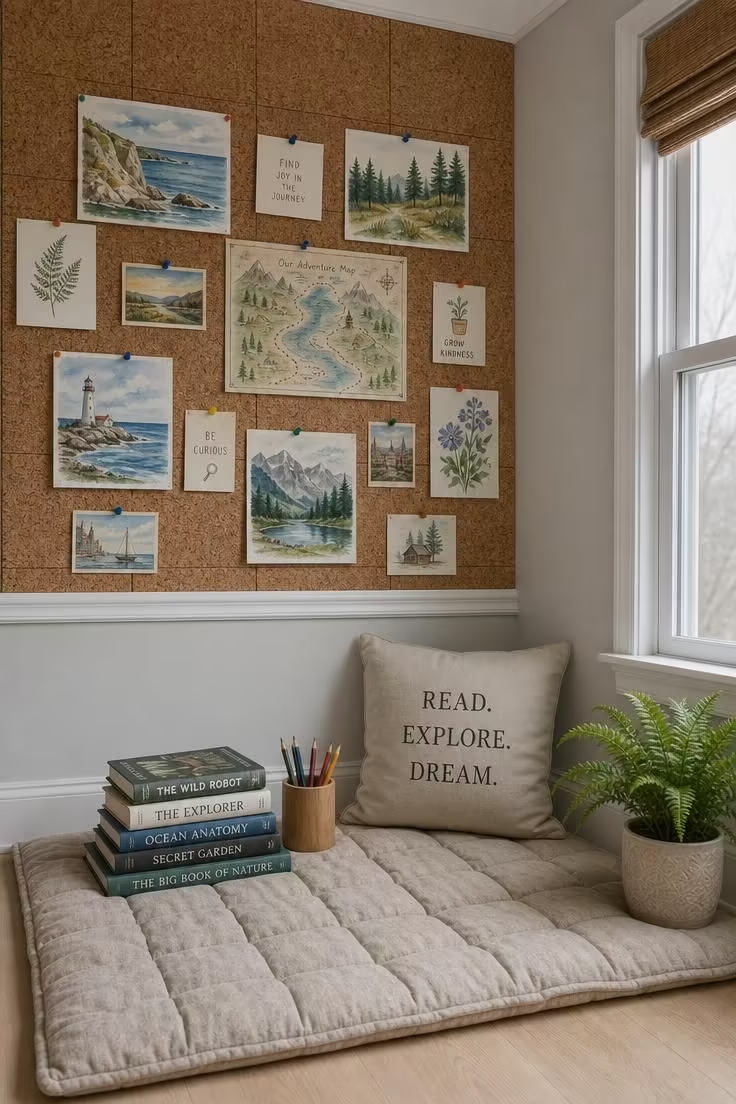
A cork wall turns a reading nook into a gallery, and a gallery gives a child a reason to sit in the space even when they are not reading.
Pinning their own artwork to the wall creates ownership of the spot, which is the single strongest motivator for a child to use a space repeatedly.
The linen floor mat underneath keeps the seating casual and low, removing any furniture that a toddler could climb or tip over.
Cool cloud-filtered light from a nearby window is the best match for a cork wall, because warm direct sun creates a glare on the pushpin heads that can distract a small reader.
A wooden pencil cup beside the book stack invites drawing between chapters, which extends the time a child spends in the nook.
Style Blueprint:
- Cork tiles mounted floor-to-chair-rail on one wall
- Colorful pushpins for artwork display
- Quilted linen floor mat in natural flax
- Wooden pencil cup and small book stack on the mat
- North or east window for cool, even daylight
Design Pro-Tip: Position the reading nook near a north-facing window whenever possible, as north light stays consistent throughout the day and never creates harsh glare on book pages.
A Fabric Sling Shelf Beside a Maple Daybed Frame
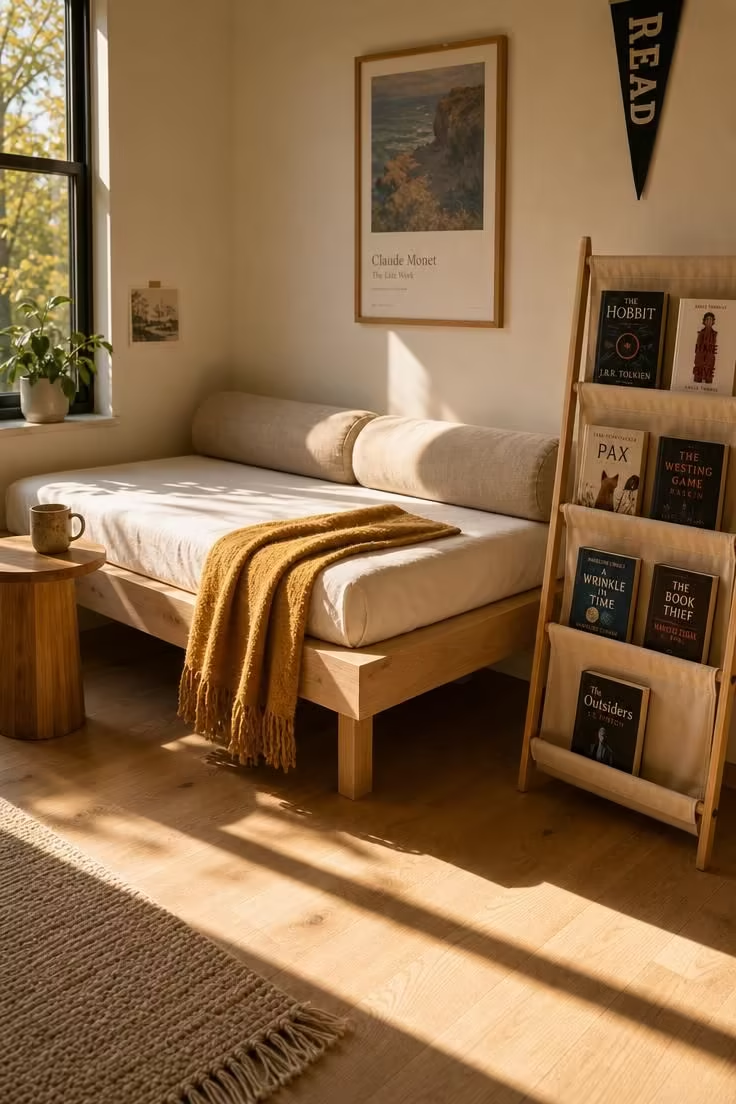
A sling shelf displays book covers the way a wall-mounted book ledge does, but it stands on the floor and moves when the room layout changes.
The canvas pockets hold books upright with their covers out, which matters for the seven-to-twelve age group that chooses books by cover art and title rather than by spine color.
A low maple daybed frame gives older children a seat that feels more like furniture and less like a floor cushion, and that distinction matters to a child who is starting to think of themselves as a “big kid.”
The mustard throw at the foot of the bed adds a color anchor to the neutral palette and signals warmth without overwhelming the clean lines of the maple frame.
Style Blueprint:
- Low-profile maple daybed frame with firm cotton mattress
- Two cylinder pillows in oatmeal linen
- Canvas sling shelf (fabric pockets on wooden frame)
- Mustard woven cotton throw
- Small natural wood side table
Under-Stair Alcove Lined With Peel-and-Stick Wood Planks
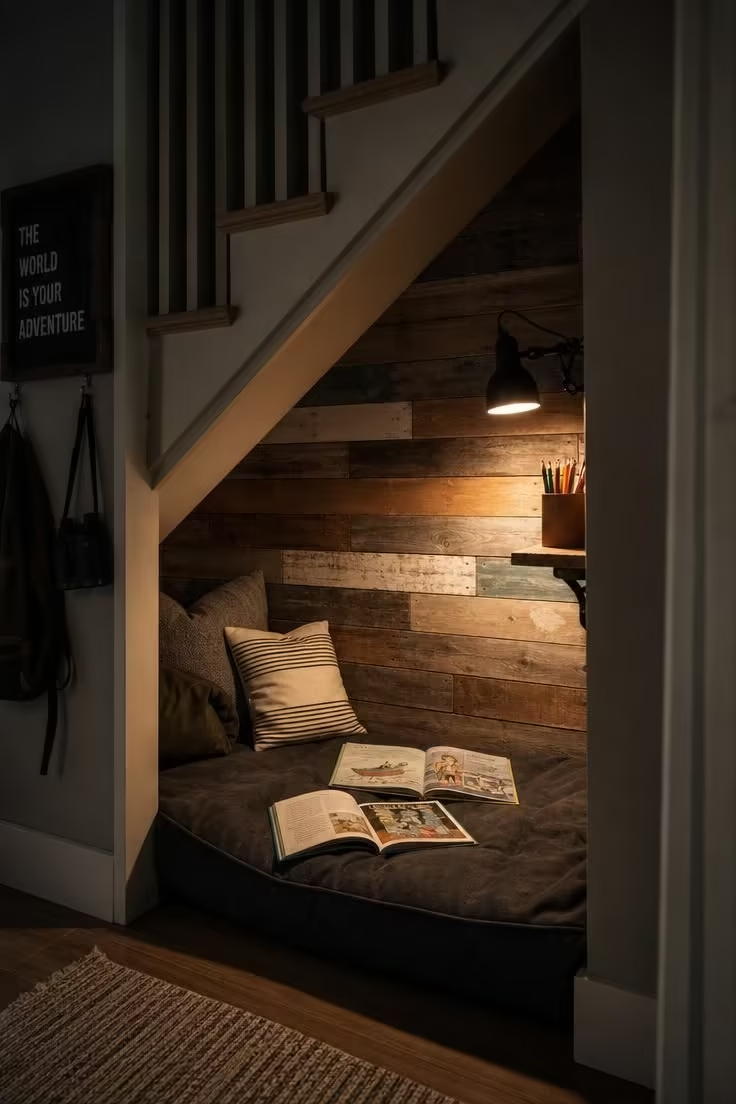
The triangular shape of an under-stair space creates a natural ceiling that slopes down to meet the child, which is exactly the kind of enclosure that makes a reading nook feel like a secret.
Peel-and-stick wood planks on the back wall add texture and depth to what would otherwise be a flat, forgettable surface, and they install in under an hour without tools.
A charcoal cotton canvas floor cushion is dark enough to hide the inevitable juice stains, and its firm density supports sitting cross-legged for long stretches.
The clip-on reading lamp is the only light source, and that focused beam creates a spotlight effect that makes the rest of the room vanish.
This is a kids reading nook for the child who builds blanket forts, crawls behind furniture, and treats every small space as a potential headquarters.
Style Blueprint:
- Under-stair alcove (minimum 3 feet tall at the highest point)
- Peel-and-stick reclaimed wood planks for the back wall
- Thick charcoal cotton canvas floor cushion
- Clip-on reading lamp with adjustable arm
- Small shelf bracket for a pencil cup or book rest
Woven Macrame Wall Hanging Above a Stack of Velvet Floor Cushions
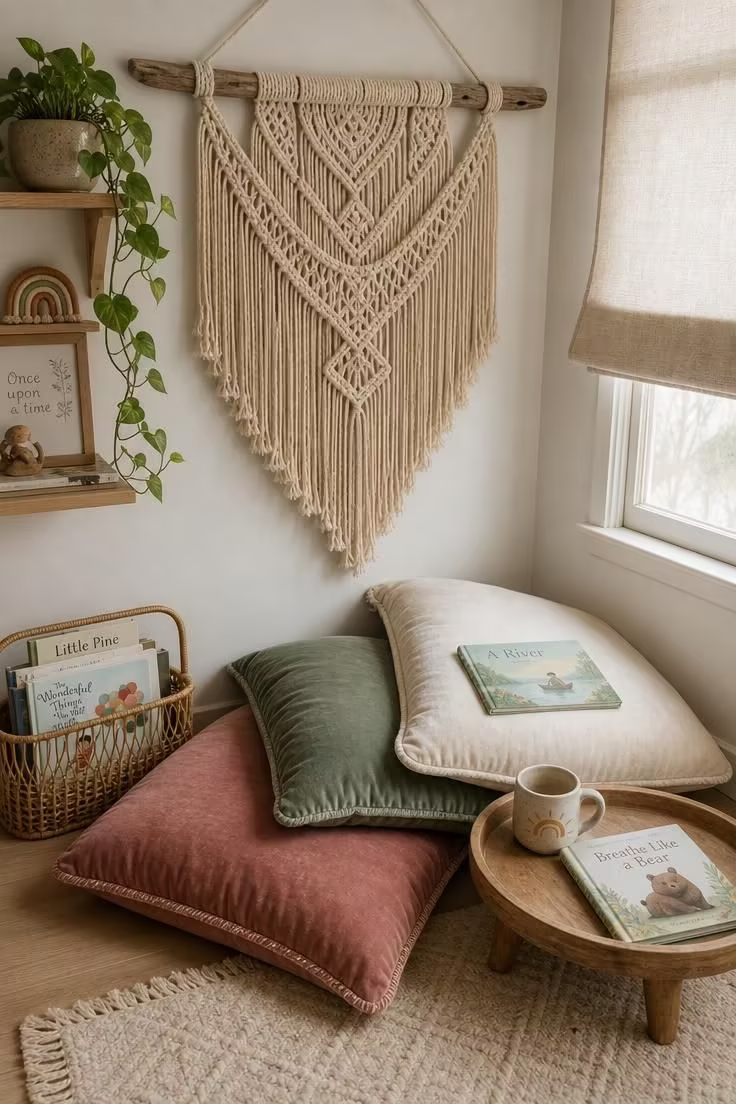
Velvet floor cushions are the kind of seating that a child will drag around the house, which is actually a sign that this kids reading nook is working.
The macrame wall hanging above the cushion stack adds vertical interest to the corner and gives the eye a reason to look up, which makes a small space feel taller.
Three cushions in muted tones (dusty rose, sage, cream) create a color palette that reads as intentional rather than random, and velvet holds its color better than cotton canvas after repeated washing.
The small wooden tray table beside the cushions is a detail that shifts the nook from “floor sitting” to “a place with a purpose,” giving a child somewhere to rest a drink or a bookmark.
A low rattan basket for books keeps the collection contained and portable, so the entire reading corner can move to a different room if needed.
The trailing pothos plant on a nearby shelf brings a living element into the corner, which research in children’s environments links to longer periods of focused, calm behavior.
Style Blueprint:
- Large macrame wall hanging on a driftwood dowel
- Three velvet floor cushions in coordinated muted tones
- Small wooden tray table for a cup or bookmark
- Low rattan basket for book storage
- Trailing pothos plant on a nearby shelf
Design Pro-Tip: Choose washable cushion covers in cotton or linen blends for any floor-level reading nook, because children will spill drinks, drag in crumbs, and use the cushions as trampolines before they use them as seats.
Chalkboard-Painted Half Wall With a Birch Plywood Reading Bench
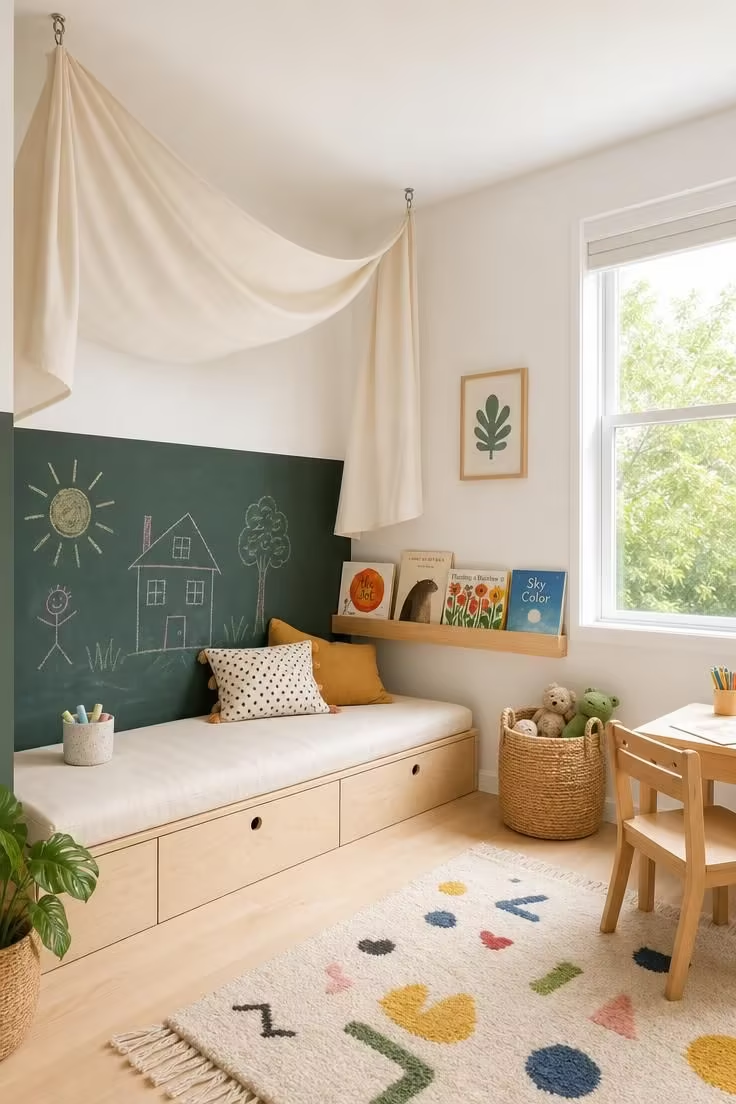
A chalkboard wall next to a reading bench turns dead time between chapters into drawing time, and that combination keeps a child in the nook longer than a book alone would.
The dark green chalkboard paint is less stark than traditional black and blends better with a room that has white walls and light wood floors.
A birch plywood bench at 12 inches tall puts a four-to-eight-year-old at a comfortable sitting height with feet flat on the floor, which matters for posture during longer reading sessions.
The white cotton panel above creates a canopy reading nook effect with minimal hardware: two ceiling hooks and a single length of fabric.
Colored chalk stored in a ceramic cup on the bench invites the child to draw a response to what they just read, turning passive reading into active engagement.
Style Blueprint:
- Dark green chalkboard paint on the lower half of one wall
- Birch plywood bench at child seat height (12 inches)
- Cream cotton canvas cushion for the bench top
- White cotton canopy panel from two ceiling hooks
- Wall-mounted book ledge for a small picture book rotation
Conclusion
A kids reading nook does not need a large room, a contractor, or a furniture catalog.
It needs a corner, something soft to sit on, a few books within arm’s reach, and enough light to read by.
The 13 ideas here range from a ten-minute canopy setup to a weekend plywood build, and every one of them creates a space where a child will sit longer, read more, and come back tomorrow.
Pick the one that fits your room, your child, and your Saturday afternoon, and build it before the motivation fades.
The books will follow.