This post may contain affiliate links. If you make a purchase through these links, we may earn a commission at no additional cost to you.
If your washer and dryer are living in the garage, you already know the struggle.
It feels more like a chore zone than a room — bare concrete, exposed pipes, and zero personality.
But here’s the thing: a garage laundry room can look just as good as anything inside the house.
With the right setup, it can actually be better — quieter for the rest of the home, easier to manage messes, and surprisingly satisfying to walk into.
These garage laundry room ideas run the full range, from a simple curtain fix to a fully built-out room with walls and a door.
Whether you’re starting from scratch or giving a tired space a refresh, there’s something here worth stealing.
Floor-to-Ceiling Cabinets That Mean Business
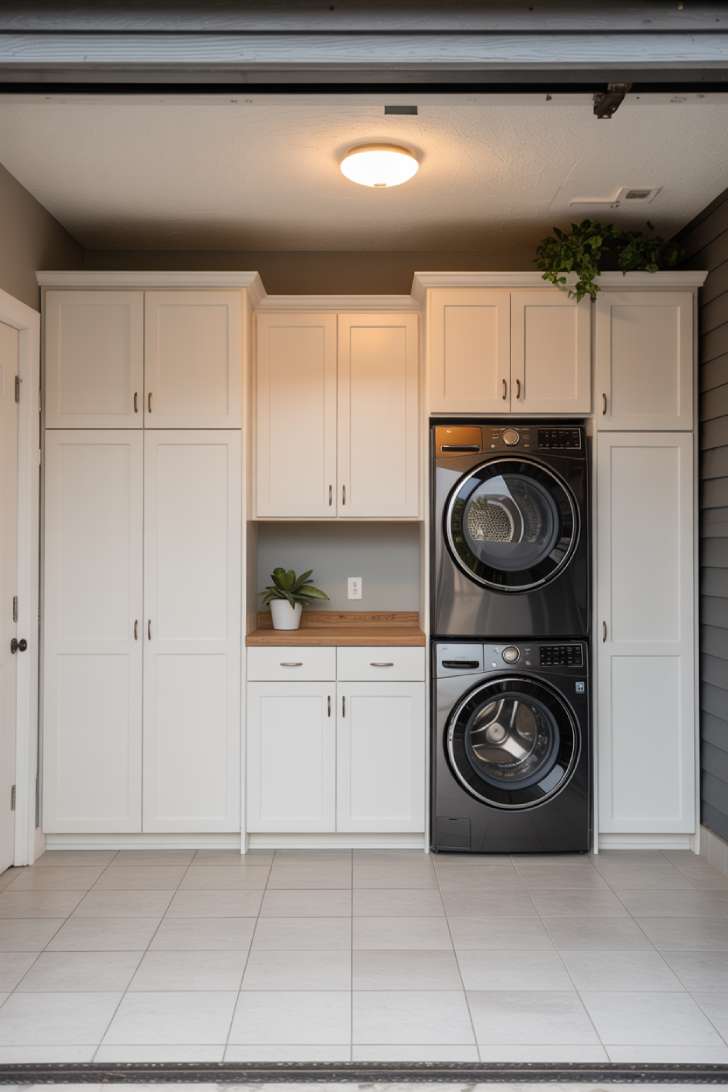
Vertical storage is one of the best gifts a garage can offer.
Unlike interior laundry rooms that are often squeezed into a closet or a hallway, the garage typically has ceiling height to spare.
Floor-to-ceiling cabinets take full advantage of that.
What makes this idea so satisfying is the visual completeness of it — nothing is left exposed, nothing looks temporary.
Closed cabinet doors are especially worth the investment in a garage setting.
Dust, exhaust particles, and general garage grime collect on open shelves constantly, and nobody wants that near their clean laundry supplies.
From a design standpoint, tall vertical lines draw the eye upward, making the space feel larger than it actually is.
Painting the cabinets the same color as the walls is a great trick if the garage laundry room cabinets feel like they’re crowding the space — it makes them recede visually.
Style Blueprint:
- Floor-to-ceiling shaker-style cabinets in white or soft gray
- Brushed nickel or matte black bar pulls
- Stacked washer-dryer unit to free up flanking wall space
- Large-format porcelain tile flooring
- One small plant on top of upper cabinets for a lived-in touch
A Utility Sink That Earns Its Space
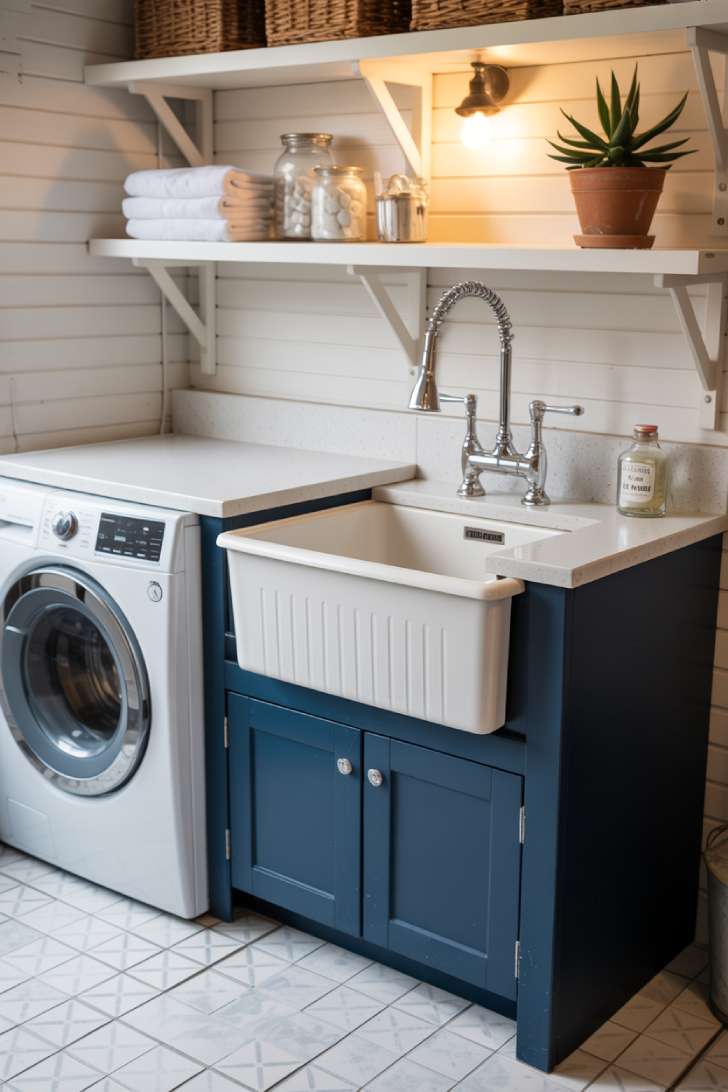
A utility sink changes everything about how a garage laundry room works day to day.
Pre-treating a grass stain, rinsing a mop head, cleaning out a paint brush — these are things that happen in a garage regularly, and having a sink right there makes all of it faster and less messy.
The farmhouse apron-front style shown here does something important beyond function: it makes the sink a design centerpiece rather than an afterthought.
When a practical object is also visually appealing, the whole space feels more considered.
The navy cabinet grounds the otherwise light palette and adds a layer of contrast that keeps things from feeling flat.
Color contrast like that — a dark base cabinet against white walls and appliances — gives the eye a place to land, which makes a small garage laundry room feel more composed rather than cramped.
If budget is a concern, a basic plastic laundry tub on legs gets the job done just as well functionally.
But if style matters to you, the extra investment in a proper cabinet sink is absolutely worth it.
Style Blueprint:
- Deep farmhouse-style utility sink in white or stainless steel
- Painted base cabinet below (navy, forest green, or charcoal work well)
- Tall gooseneck faucet in chrome or matte black
- Patterned cement tile or large-format floor tile
- Pendant light above the sink for task lighting and warmth
Design Pro-Tip: The color you choose for your lower cabinets or base unit has more visual impact than any other single decision in a small garage laundry room. Dark lower cabinets with light upper walls make the space feel grounded and intentional — the contrast tricks the eye into reading the area as a styled room rather than a functional corner.
Stacked Appliances, Smarter Floor Plan
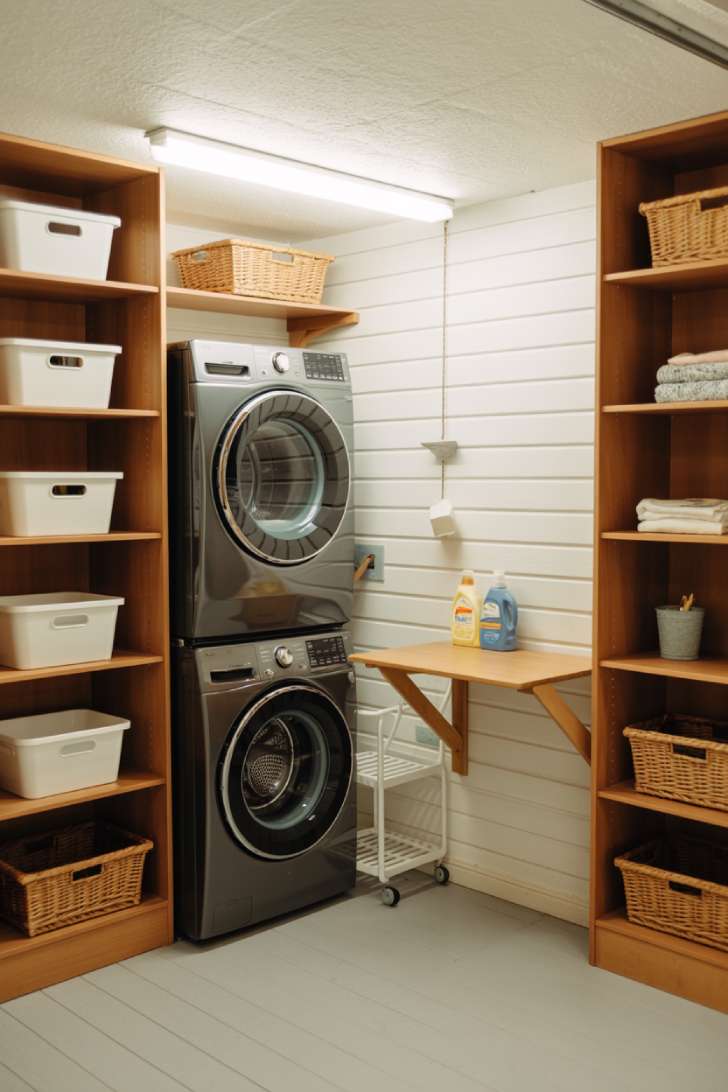
Not every garage is large, and not every garage laundry room gets a full wall to itself.
Stacking the washer and dryer is the single most effective way to reclaim floor space in a tight garage laundry room setup.
The floor area freed up by going vertical can hold a rolling cart, a hamper, or even a utility sink — things that wouldn’t fit if the machines were side by side.
What makes this setup particularly smart is what happens on either side of the stacked unit.
Built-in shelving that runs all the way to the ceiling turns the flanking walls into a storage system, and the visual symmetry of shelves on both sides of the machines makes the stacked pair look like it was always meant to be there.
The fold-down counter is a clever answer to the most common complaint about stacked units: no countertop.
It folds flat against the wall when not in use, so it never crowds the walkway.
Style Blueprint:
- Stacked front-load washer and dryer (or an all-in-one laundry tower)
- Floor-to-ceiling built-in shelving on both sides of the unit
- Slim rolling cart for detergent and supplies
- Wall-mounted fold-down countertop for folding
- White storage bins and woven baskets for shelf organization
A Folding Station That Makes Laundry Less of a Chore
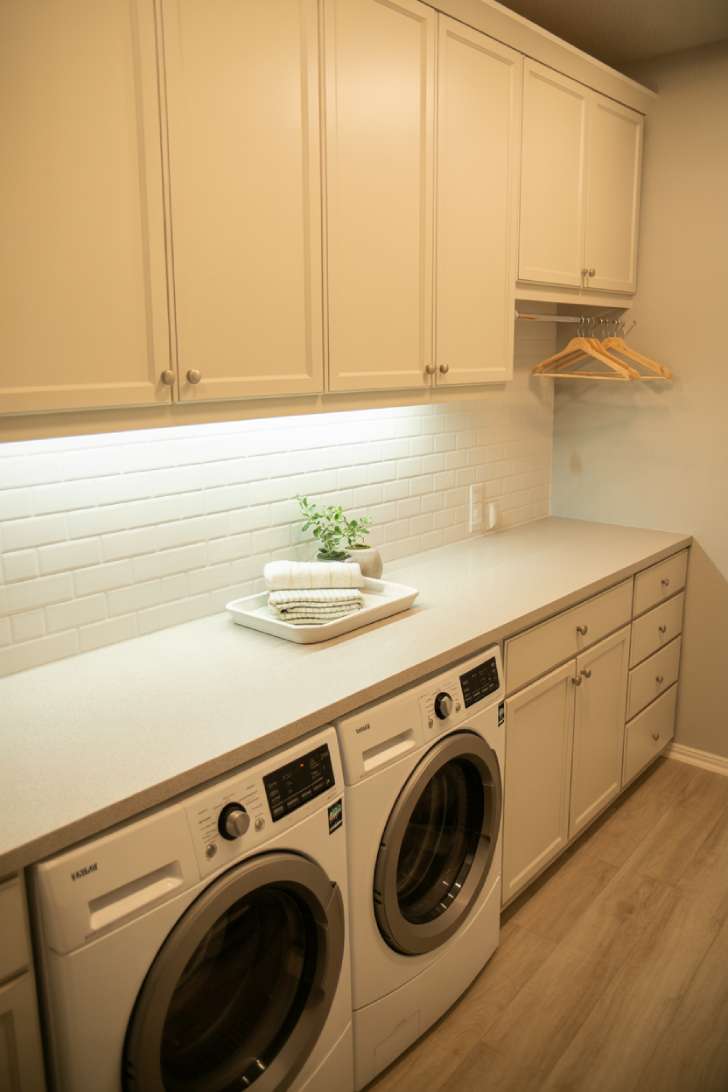
A proper folding surface is the difference between a laundry area that works and one that just exists.
Without it, folding happens on top of the dryer, on the floor, or — let’s be honest — not at all.
A continuous countertop spanning both machines creates a generous workspace that makes sorting and folding genuinely easier.
The under-cabinet LED strips here are doing quiet but important work.
Task lighting positioned directly above a work surface eliminates the harsh shadows that ceiling fixtures create when you’re leaning over clothes, making the whole process more comfortable.
Quartz is the best countertop material for this application — it resists moisture, it’s easy to wipe down, and it photographs beautifully, which matters if you ever want to show the space off.
The hanging rod tucked below the upper cabinets is a small detail with a big payoff.
Shirts and dresses can come straight out of the dryer and onto a hanger before wrinkles set in, which saves ironing time.
Style Blueprint:
- White quartz or laminate countertop spanning both appliances and a side cabinet
- Upper cabinets with matte black hardware above
- Under-cabinet LED strip lighting
- Wall-mounted hanging rod below upper cabinets for air-drying garments
- Light oak vinyl plank flooring
Design Pro-Tip: Mount your hanging rod at least 60 inches from the floor to accommodate full-length garments, and position it on the same wall as your countertop so the workflow moves in one direction — washer to dryer to fold to hang. A linear workflow cuts the time spent doing laundry noticeably.
The Farmhouse Look That Never Gets Old
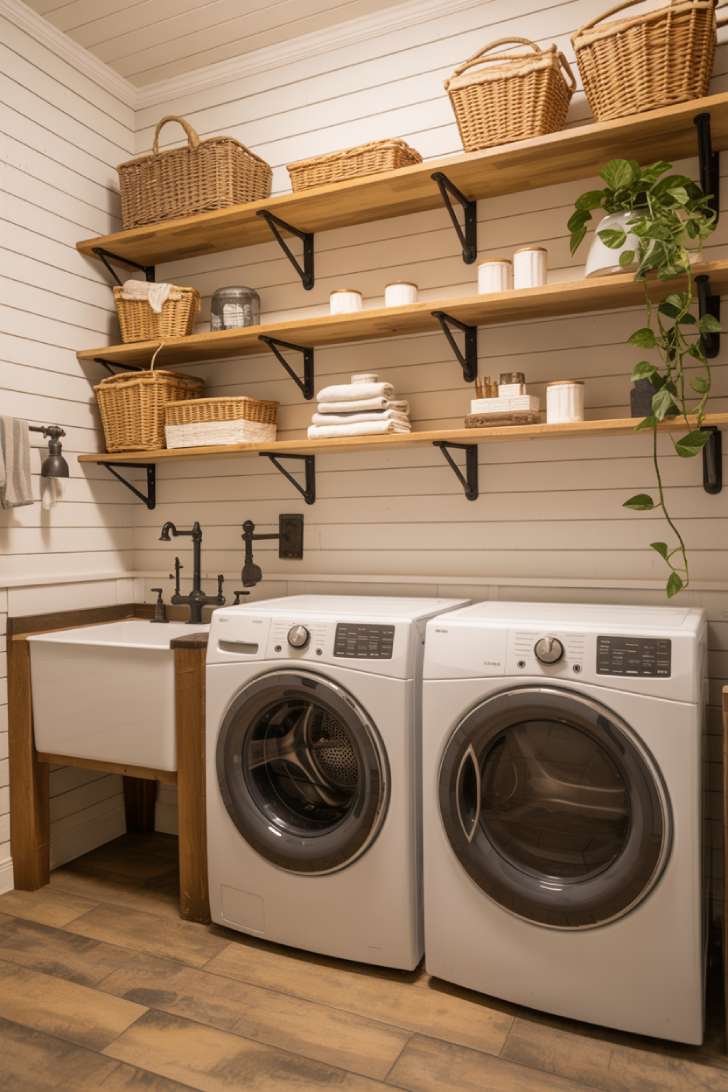
The farmhouse style earns its popularity in a garage laundry room because it turns an industrial space into something that feels genuinely homey.
Shiplap is the backbone of this look, and it works harder than you might think.
The horizontal lines of the planks draw the eye across the wall, making a narrow space feel wider.
The texture of the wood — even painted white — introduces warmth that a flat drywall surface can’t replicate.
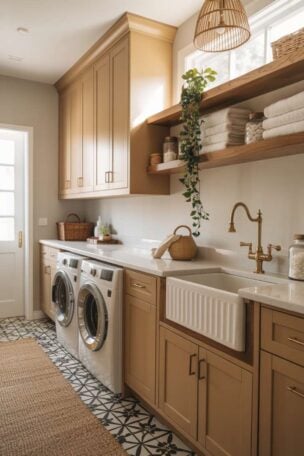
What really makes this laundry room in garage design feel complete is the mix of open shelving with the apron sink.
Open shelves only work when what’s on them is intentional — matching baskets, grouped ceramics, a plant or two.
The greenery is doing something specific here: plants soften angular surfaces and introduce an organic element that makes even a garage feel livable.
Matte black hardware is the detail that ties everything together, appearing on the faucet, the shelf brackets, and the light fixtures.
Repeating a finish throughout a room creates visual coherence without requiring anything to match exactly.
Style Blueprint:
- White-painted horizontal shiplap wall treatment
- Natural wood floating shelves on black iron pipe brackets
- Apron-front utility sink with matte black faucet
- Woven baskets in matching natural tones for shelf storage
- Wide-plank wood-look porcelain tile flooring in a warm honey tone
Industrial Style That Owns the Garage Aesthetic
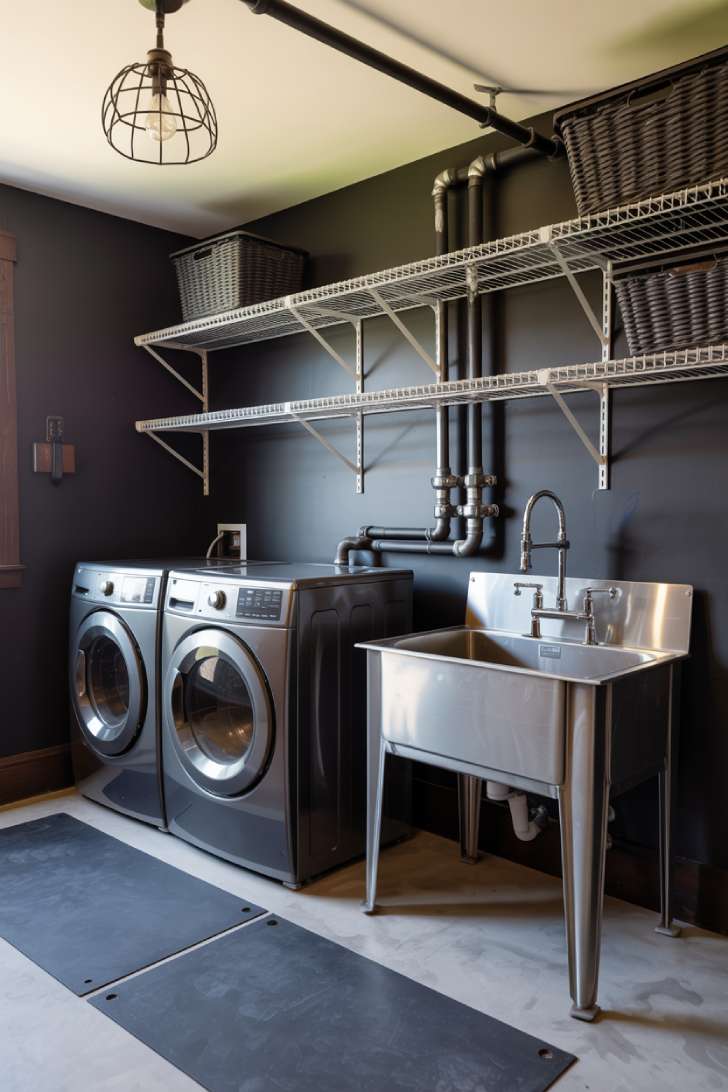
Most garage laundry room makeovers try to hide the fact that they’re in a garage.
This idea does the opposite — and it works brilliantly.
The industrial approach accepts the concrete, the pipes, and the utilitarian bones of the garage and turns them into a deliberate style statement.
Exposed pipes painted matte black stop looking like unfinished construction and start looking like intentional design.
This is one of the most cost-efficient transformations possible, because the “finishing work” is largely just a can of paint.
Dark walls in a small space are counterintuitive but often very effective.
Charcoal or deep gray absorbs light in a way that makes the space feel contained and atmospheric rather than cramped.
The cage pendant lights reinforce the industrial theme and cast a warm, directional glow that works with the dark palette rather than fighting it.
This kind of garage laundry room design is particularly well-suited to people who use the garage as a workspace, because the rugged aesthetic connects both functions seamlessly.
Style Blueprint:
- Charcoal or dark gray paint on walls and ceiling
- Open wire or metal mesh shelving units
- Exposed plumbing pipes painted matte black
- Stainless steel utility sink with an industrial bridge or wall-mount faucet
- Black cage pendant lights on metal conduit
Bold Color That Changes the Whole Mood
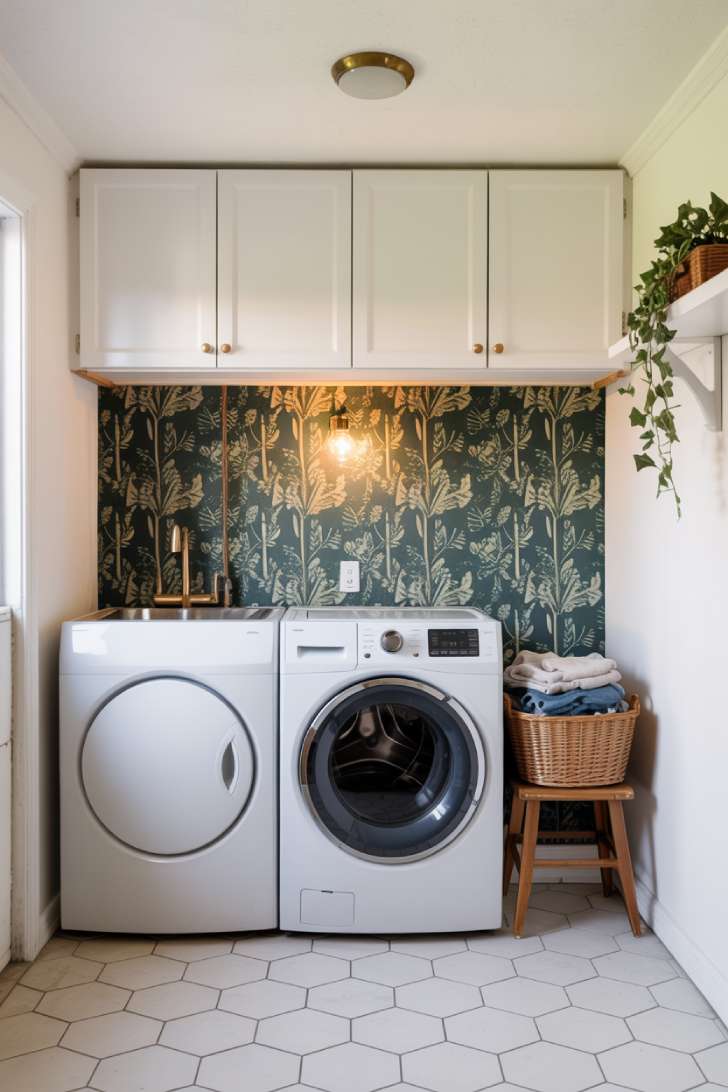
Color is one of the fastest, most affordable tools available in any garage laundry room makeover.
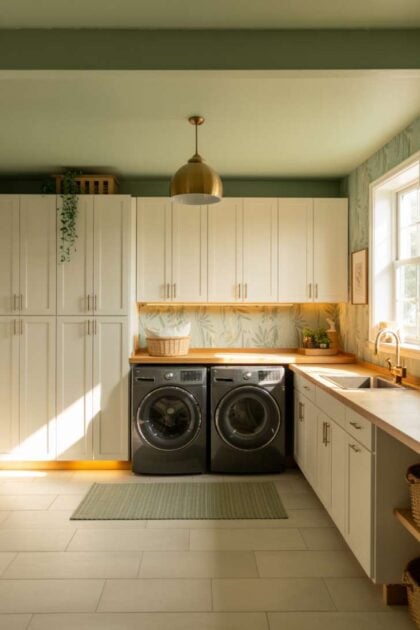
A single accent wall with bold wallpaper costs very little and changes the feel of the entire space.
The botanical print used here is doing something specific from a design standpoint: pattern on one wall creates depth.
When there’s visual interest behind the machines, the appliances stop being the focal point — the wall is — which makes the space feel more like a room and less like a laundry area.
Peel-and-stick wallpaper is worth taking seriously as a material choice.
The quality has improved dramatically in recent years, and in a garage laundry room where the wall behind the machines doesn’t get wet, it holds up very well.
The brass hardware is a small but considered choice.
Brass against deep green is a classic combination that reads as warm and intentional, and repeating the same metal finish on the knobs, the sconce, and the shelf bracket creates a thread of continuity through the space.
Style Blueprint:
- Peel-and-stick botanical or geometric wallpaper on the wall behind the machines
- White upper cabinets with brushed brass knobs
- Large-format white hexagon floor tile
- Brass wall sconce for warm ambient lighting
- One trailing plant on a floating shelf to soften the design
Design Pro-Tip: If you’re using patterned wallpaper in a garage laundry room, keep every other surface completely plain — white walls, simple cabinets, minimal accessories. One bold surface surrounded by calm is striking. Two competing patterns in a small space are exhausting.
The Mudroom-Laundry Combo That Works Overtime
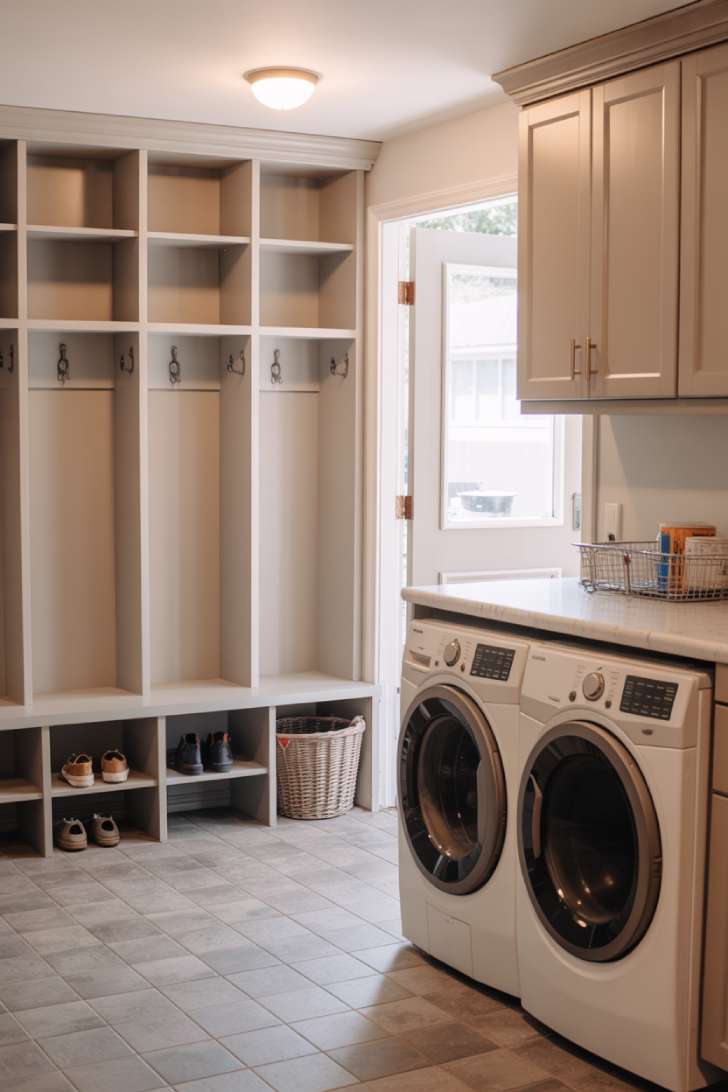
This is one of those ideas that makes you wonder why more homes aren’t built this way.
Placing the laundry room directly beside the mudroom entry from the garage creates a workflow that actually makes sense.
Dirty clothes come off at the door, go directly into the washer, and the whole process stays contained to one zone.
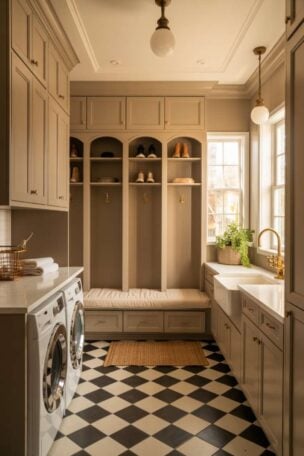
The matching cabinetry across both the mudroom lockers and the laundry area is what makes this work visually.
Repeating the same cabinet style, finish, hardware, and proportions gives both areas a continuous look, so the transition between mudroom and laundry space feels intentional rather than pieced together.
The bench in the mudroom section is worth noting specifically.
Placed at the point where the entry changes from storage to circulation, it gives the composition a clear pause between the door, lockers, and laundry area while also providing a practical place to sit.
A lift-top bench with hidden hamper storage inside takes it one step further, removing the need for a separate laundry basket entirely.
Style Blueprint:
- White built-in locker-style mudroom units with bench and hooks
- Matching white upper cabinets over the washer and dryer
- White quartz countertop spanning the laundry appliances
- Warm gray large-format floor tile used consistently across both zones
- Oversized woven basket under the bench for shoe storage
Flooring That Transforms Everything From the Ground Up
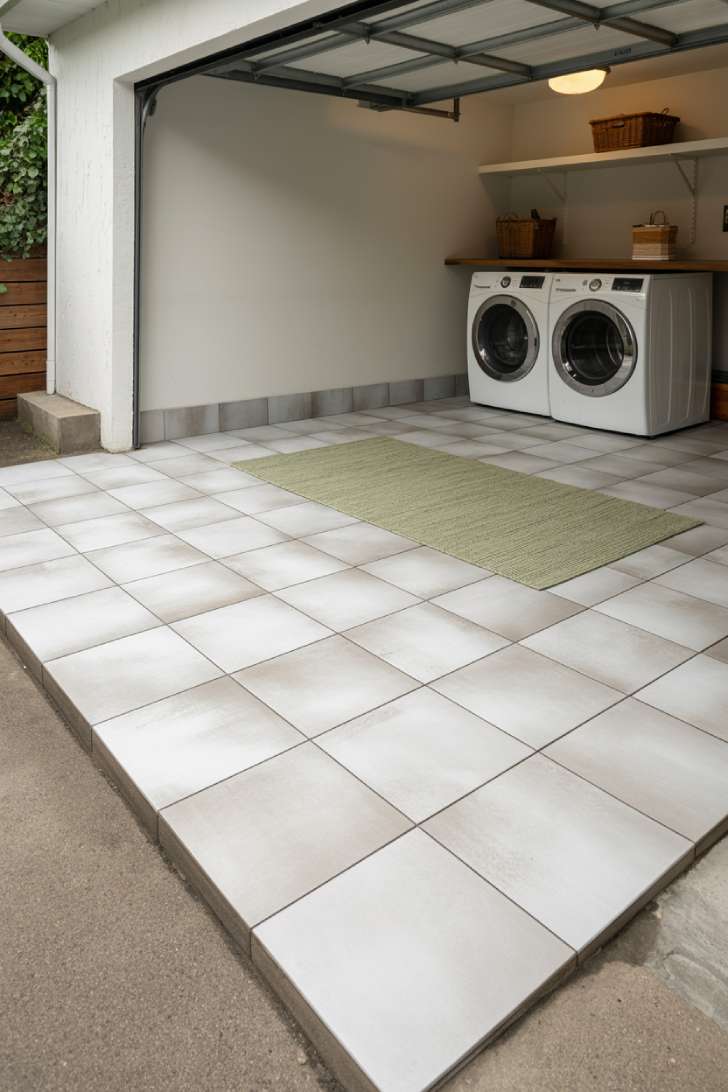
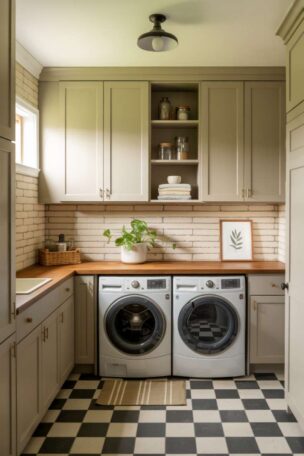
The floor is the first thing that tells a visitor whether a space was thought through or not.
Raw concrete says garage.
Tile says room.
It’s that immediate, and it’s that impactful.
Flooring is the upgrade with the highest return in any garage laundry room design project, and yet it’s often the last thing people budget for.
Large-format tile — anything 24×24 inches or bigger — works particularly well in a garage because fewer grout lines mean a cleaner, more expansive look.
The rug in front of the machines is not just a comfort addition, though it is that too.
It defines the laundry zone within the broader garage floor, creating a room-within-a-room effect that reinforces the psychological separation between the laundry area and the rest of the garage.
Extending the tile a few feet beyond the laundry zone proper is a smart move, because it prevents the area from looking like a patch applied to the concrete rather than a genuine flooring choice.
Style Blueprint:
- Large-format matte porcelain tile in white or warm gray (24×24 or larger)
- Flat-weave cotton or wool rug in front of the machines
- Tile extended beyond the laundry zone into the adjacent garage floor
- White or light-toned walls to let the floor read clearly
- Simple flush-mount LED ceiling fixture for clean, even light
Lighting That Makes the Space Feel Finished
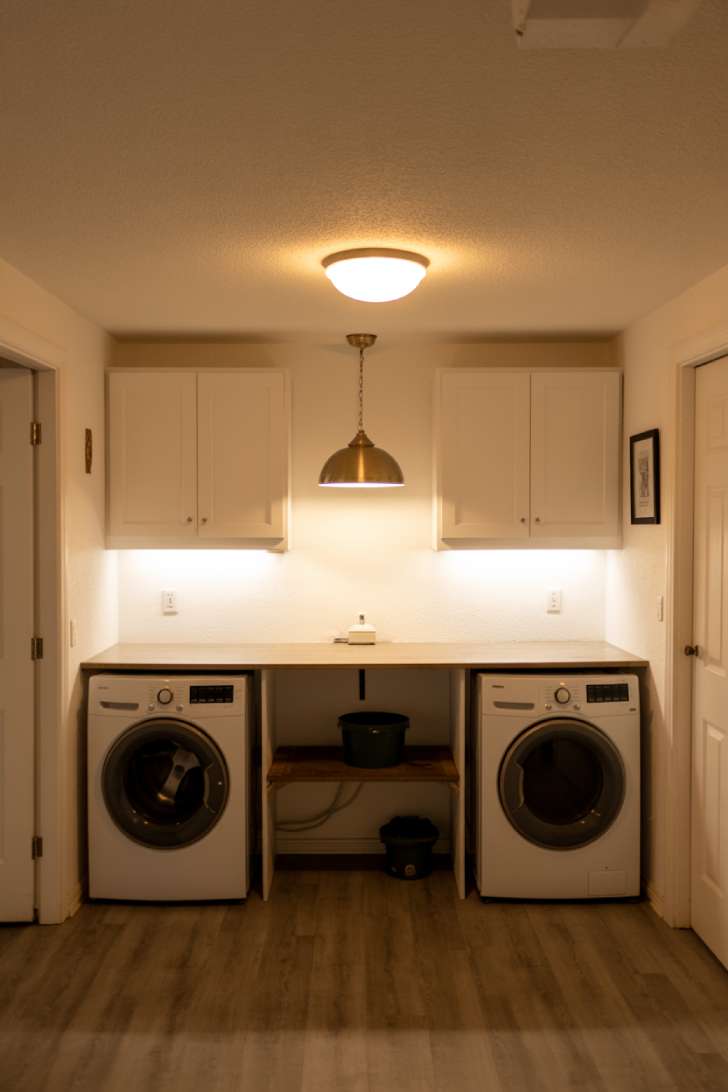
Lighting is almost always the last thing people think about in a garage laundry room, and it shows.
A single overhead fluorescent tube is not enough — not for seeing stains, not for reading care labels, and certainly not for making the space feel good to be in.
Layered lighting solves all of this.
The logic is straightforward: ambient light (from the ceiling fixture) handles the overall brightness of the room, task lighting (from the under-cabinet strips) handles the work surface, and accent lighting (from the pendant) adds warmth and personality.
When all three are present, the room feels complete in a way that’s hard to explain but immediately felt.
The brass pendant here is doing double duty.
It provides directional light over the folding area and it introduces a metallic finish that dresses the space up — one fixture, two jobs.
A motion-sensor switch for the main ceiling light is worth adding if the garage laundry room is accessed frequently with full hands.
The light comes on the moment you walk in, which is one of those small quality-of-life details that makes a garage laundry room organization setup genuinely pleasant to use.
Style Blueprint:
- Brushed brass or matte black dome pendant centered above the folding countertop
- Under-cabinet LED strip lights beneath upper cabinets
- Flush-mount LED ceiling fixture for overall ambient light
- Motion-sensor wall switch for the main ceiling light
- One small framed print or art piece to personalize the wall space
Design Pro-Tip: Install your under-cabinet lighting at the front edge of the cabinet, not the back. Light positioned at the front of the shelf casts forward onto the countertop instead of hitting the wall behind the appliances, which is where you actually need the illumination when you’re folding laundry.
A Fully Enclosed Room That Completes the Transformation
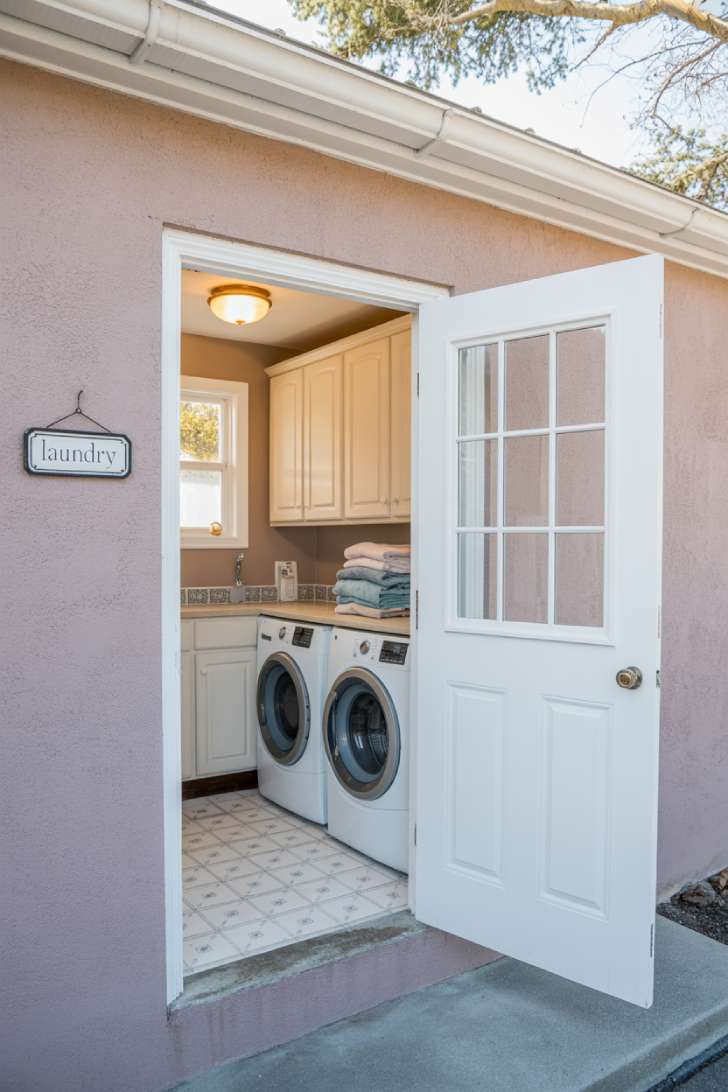
This is the full transformation — and it is absolutely worth it if the garage laundry room is a permanent part of your home’s layout.
Framing walls, adding drywall, insulating, and installing a proper door turns a corner of the garage into a room with a capital R.
The glass panel in the door is a detail that solves a problem many people don’t anticipate: enclosed rooms built in garages can feel like closets if there’s no borrowed light.
Glass in the door allows light to pass between the garage and the laundry room in both directions, keeping the interior bright while making the built structure look more architectural from the outside.
Insulating the walls serves two purposes simultaneously.
It keeps the laundry room temperature-stable — protecting pipes in winter and keeping the space comfortable in summer — and it acts as a sound buffer, so the noise of the machines stays contained within the room.
The “Laundry” sign on the exterior wall is a small but charming touch.
It treats the built structure as a real room in the house rather than a construction project, and that shift in attitude — treating the space with intention — is what separates a good garage laundry room from a great one.
Style Blueprint:
- Framed drywall walls with moisture-resistant paint in white or warm gray
- Interior door with a glass panel insert to allow borrowed light
- White upper and lower cabinets with a continuous countertop
- Patterned floor tile in white and gray for a finished, polished look
- A small window set into the exterior wall for natural daylight and ventilation
The Right Idea Is the One That Fits Your Garage
A garage laundry room doesn’t have to be a compromise.
It can be a curtain on a track or a room with four walls and a door — and everything in between those two options is fair game.
The best approach is to start with what bothers you most about the current setup.
No folding surface? Start with a countertop.
The space looks like a garage? Start with flooring or paint.
Everything feels cluttered and disorganized? Start with cabinets.
One good change leads to another, and before long, the space that used to feel like a chore zone actually feels like somewhere you don’t mind spending time.
That’s the goal — and it’s more achievable than most people think.