This post may contain affiliate links. If you make a purchase through these links, we may earn a commission at no additional cost to you.
Your laundry room doesn’t have to look like a forgotten utility closet.
Japandi design, the mix of Japanese minimalism and scandinavian minimalism, turns even the most overlooked spaces into rooms you actually want to spend time in.
The philosophy is straightforward: pair a muted color palette with natural materials, strip away anything that doesn’t serve a purpose, and let the room breathe.
This post is all about the visuals. Each of the 13 japandi laundry room ideas below comes with a detailed look at why it works and how you can recreate it at home.
Let’s get into it.
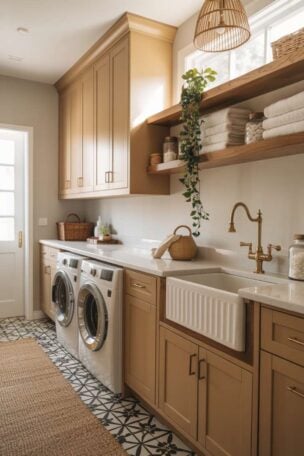
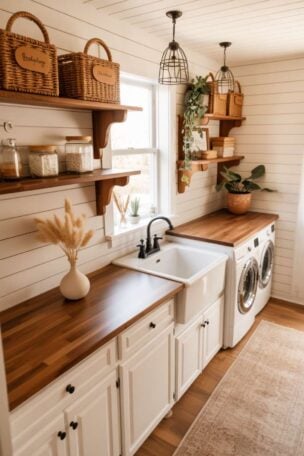
Warm Wood Folding Counter Across the Machines
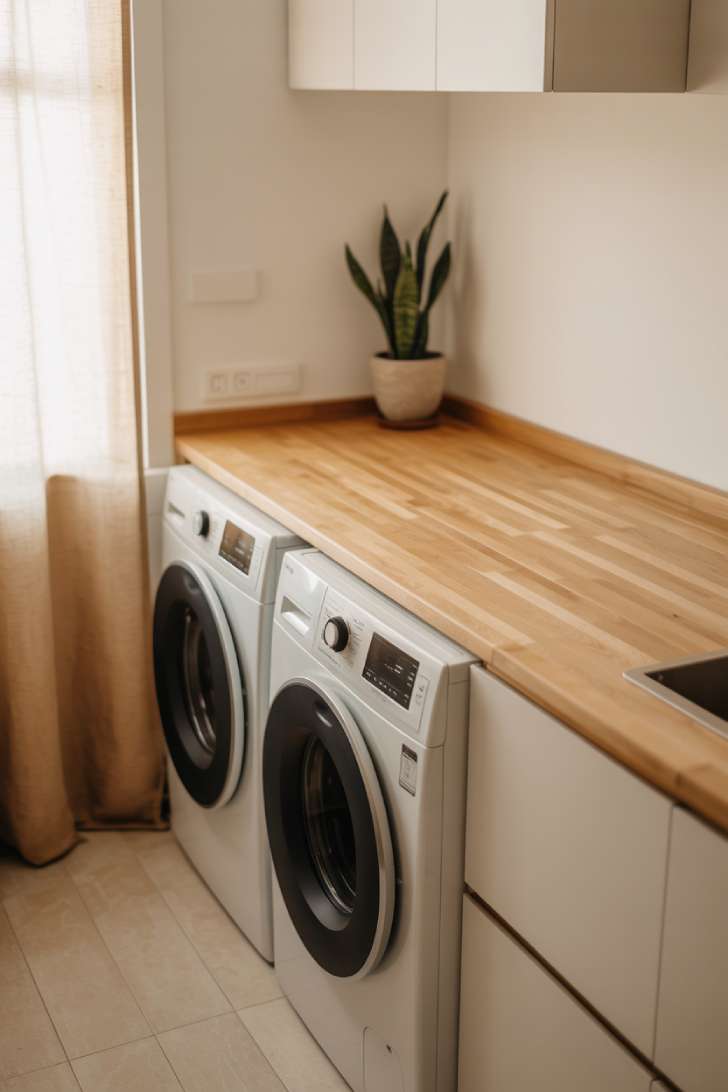
This is the single best upgrade you can make to any laundry room, period.
A continuous wood counter over front-load machines gives you a generous surface for sorting, folding, and treating stains.
Beech, ash, and maple are ideal wood choices here, and they bring warmth and organic texture that cold laminate or wire shelving simply can’t match.
The reason this setup feels so calming has everything to do with how our eyes process horizontal lines. An unbroken countertop creates visual continuity, which makes even a small room feel wider and more organized.
Honed marble or slate work as alternatives if you prefer stone, and they pair beautifully with wabi-sabi design since they develop character with use.
Style Blueprint:
- Beech, ash, or maple butcher block countertop (minimum 25″ depth for comfortable folding)
- Two white or matte black front-load machines
- Matte ceramic planter with a single green plant
- Sheer linen window covering in off-white
- Light porcelain floor tile in a wood-look finish
Flat-Panel Cabinets With Push-to-Open Hardware
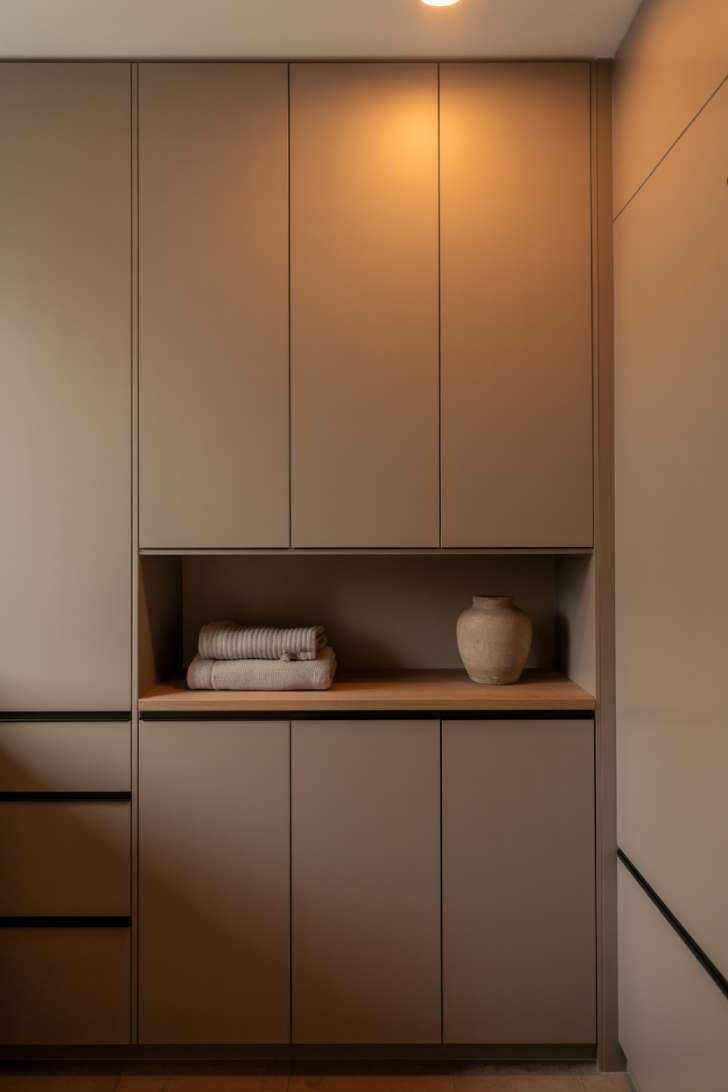
Visible hardware creates visual noise, and in a small room, that noise adds up fast.
Push-to-open doors or recessed finger pulls keep the cabinet fronts completely smooth, which makes the whole wall read as one calm surface instead of a busy grid of knobs and handles.
This look works best in warm gray, taupe, or soft white with a matte finish. Glossy surfaces bounce light in unpredictable ways and feel too “kitchen showroom” for the japandi aesthetic.
Going floor-to-ceiling with cabinetry is a smart move here. It draws the eye upward, makes the room feel taller, and gives you much more laundry room storage solutions than standard upper cabinets.
Your eye rests when there are fewer interruptions on a surface. That’s the whole idea. Remove the hardware, unify the color, and the room immediately feels less stressful.
Style Blueprint:
- Flat-panel cabinet doors in matte taupe or warm gray
- Push-to-open mechanisms (no external handles)
- Full-height installation from floor to ceiling
- One small open shelf section for display items
- Light wood or stone countertop to break up the matte finish
Woven Rattan and Bamboo Storage Baskets
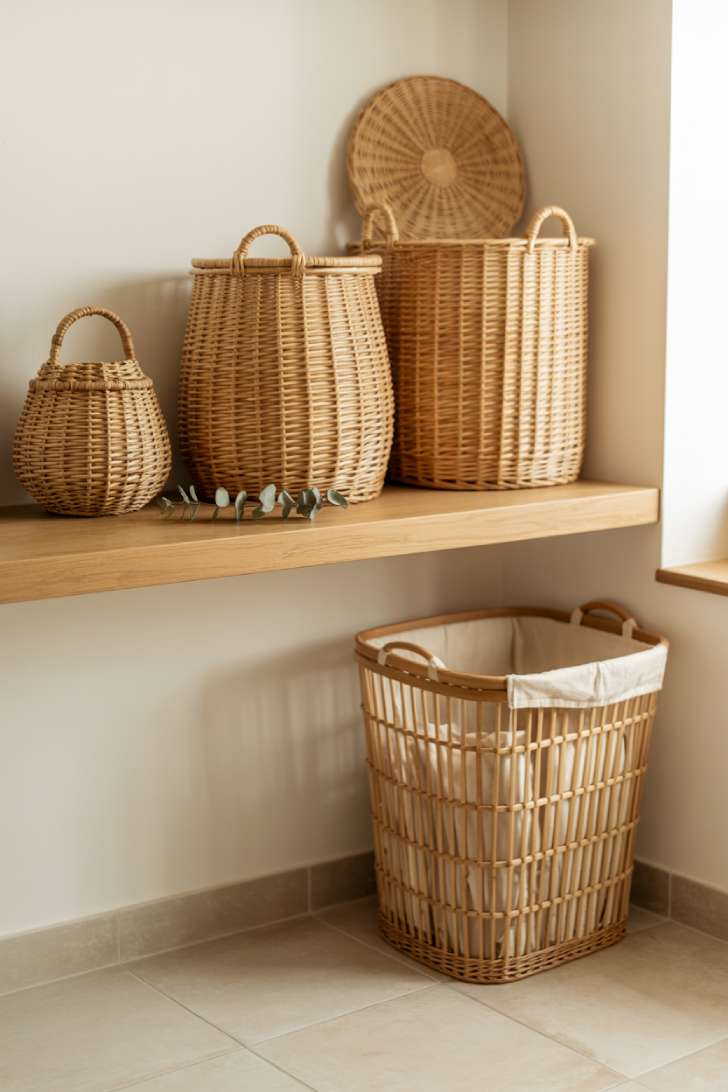
Baskets are doing double duty here.
They hide the mess (detergent bottles, dryer sheets, stain removers) and they bring in the kind of organic, handmade texture that makes a room feel lived-in rather than staged.
Rattan and bamboo are go-to materials in japandi spaces. They’re lightweight, they breathe, and they look better with age. A lidded hamper is worth the small extra cost since it contains odors and keeps the room looking tidy even on busy laundry days.
Texture plays a big role in how a room makes you feel. Smooth, hard surfaces alone can read as cold and clinical. The woven pattern of rattan introduces a rhythm that softens the space and signals warmth without adding any color.
Stick with neutral earthy tones here. Honey-colored rattan or pale bamboo and rattan decor pair perfectly with light wood shelving and white or cream walls.
Style Blueprint:
- Two or three handwoven rattan baskets (varying sizes)
- One lidded bamboo laundry hamper with cloth liner
- Floating shelf in light oak or birch
- Dried eucalyptus or cotton stems as a shelf accent
- Neutral-toned cloth liners for the baskets
Design Pro-Tip: The number one rule in japandi styling is “one in, one out.” Before you add a new basket, plant, or accessory to the room, remove something that’s already there. The style only works when every item has earned its spot. The moment a shelf feels crowded, the whole effect falls apart.
Wall-Mounted Fold-Down Drying Rack
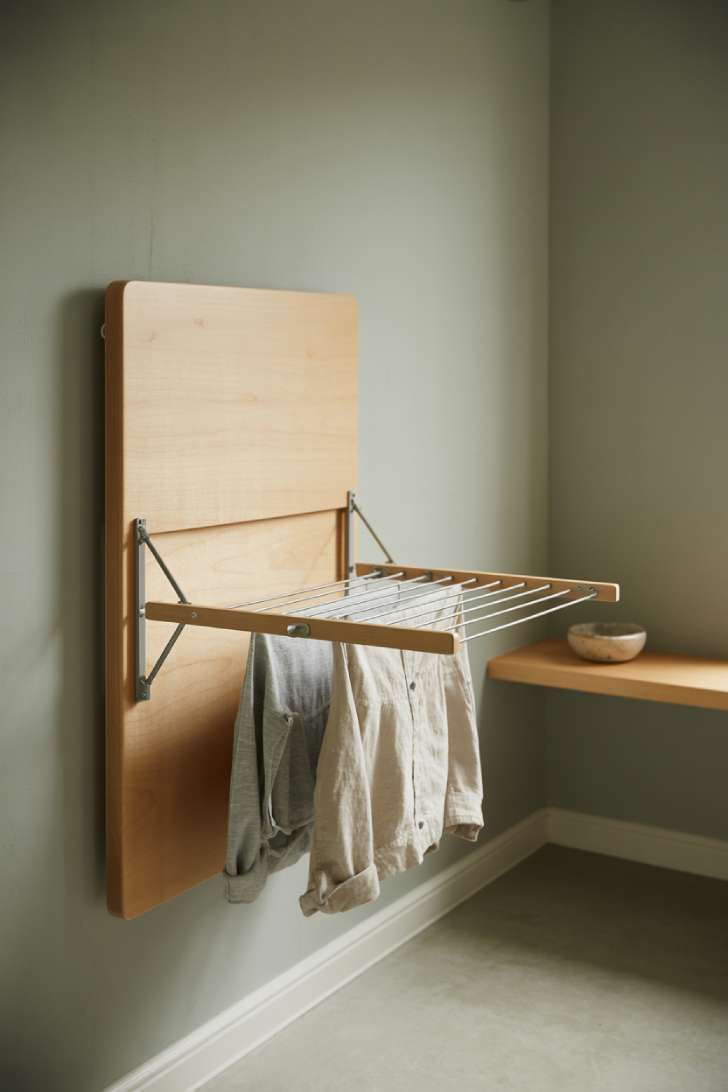
Not everything in a japandi laundry room needs to be visible all the time. That’s the beauty of fold-down fixtures.
A wall-mounted drying rack sits flat against the wall when you don’t need it, then unfolds into a full rack for air-drying delicates.
This piece lives at the intersection of scandinavian minimalism and Japanese spatial awareness. The Scandinavian side demands that it works well. The Japanese side demands that it disappears when it’s not working.
Light maple or birch versions look right at home in this style. Matte black metal frames work too, and they add a touch of contrast if your room runs heavily toward light wood tones.
What makes this so effective in a small space is the principle of “sometimes furniture.” When you can hide functional pieces, the room reads as open and spacious in its resting state, but fully capable when you need it.
Style Blueprint:
- Fold-down wall-mounted drying rack in light wood or matte black metal
- Wall-painted muted sage, warm gray, or soft white
- Two to four thin wooden dowels for hanging
- Slim floating shelf nearby for clothespins or a small dish
- Concealed mounting hardware
A Muted Earthy Palette From Floor to Ceiling
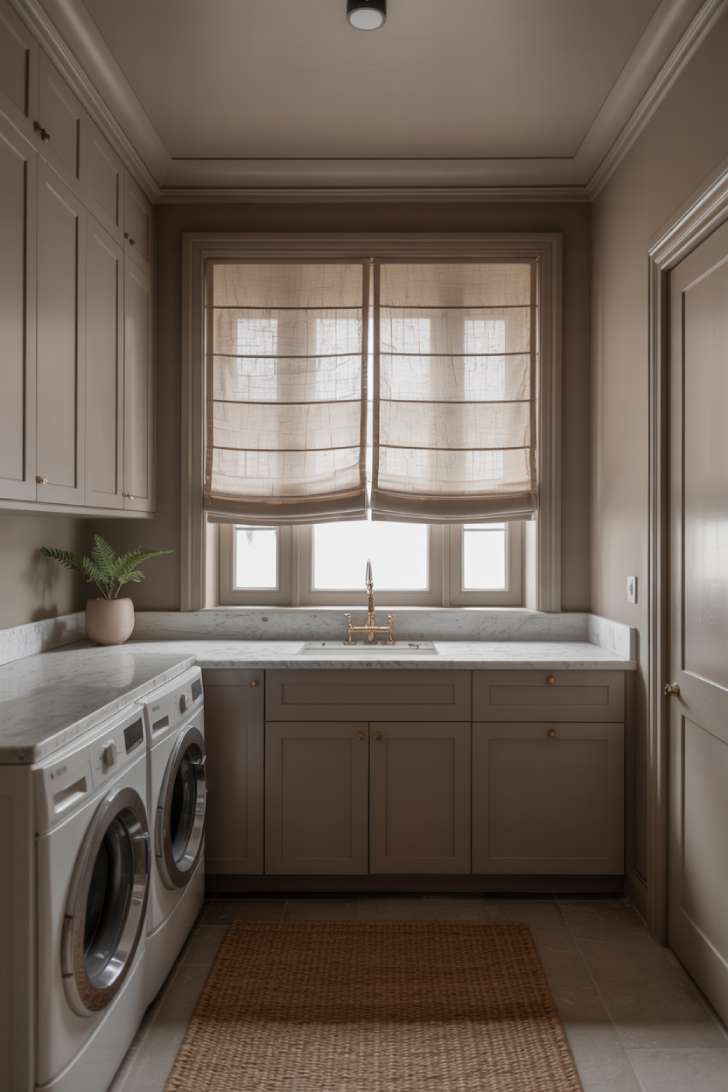
Color is doing more emotional work in a laundry room than most people realize.
Painting walls, ceiling, and trim the same shade creates what designers call a “wrapped” room. It removes the visual break between surfaces, which makes the space feel cocooned and intentional rather than choppy.
The muted color palette for japandi sticks to soft whites, warm grays, taupe, and muted greens. These neutral earthy tones don’t compete with anything in the room. They recede, letting the textures and materials take center stage.
Here’s a useful rule of thumb. North-facing laundry rooms benefit from warmer tones like taupe and cream. South-facing rooms with plenty of natural light can handle cooler shades like pale gray or dusty blue.
The goal is a room that doesn’t shout. The color should feel like it was always there, like the room grew that way naturally.
Style Blueprint:
- Single paint color applied to walls, ceiling, and all trim
- Muted shade in the taupe, warm gray, or sage family
- Linen Roman shade in a tonal match
- Natural fiber rug (jute or sisal) for the floor
- Accent materials in slightly darker or lighter variations of the same tone
Open Shelving With Empty Space on Purpose
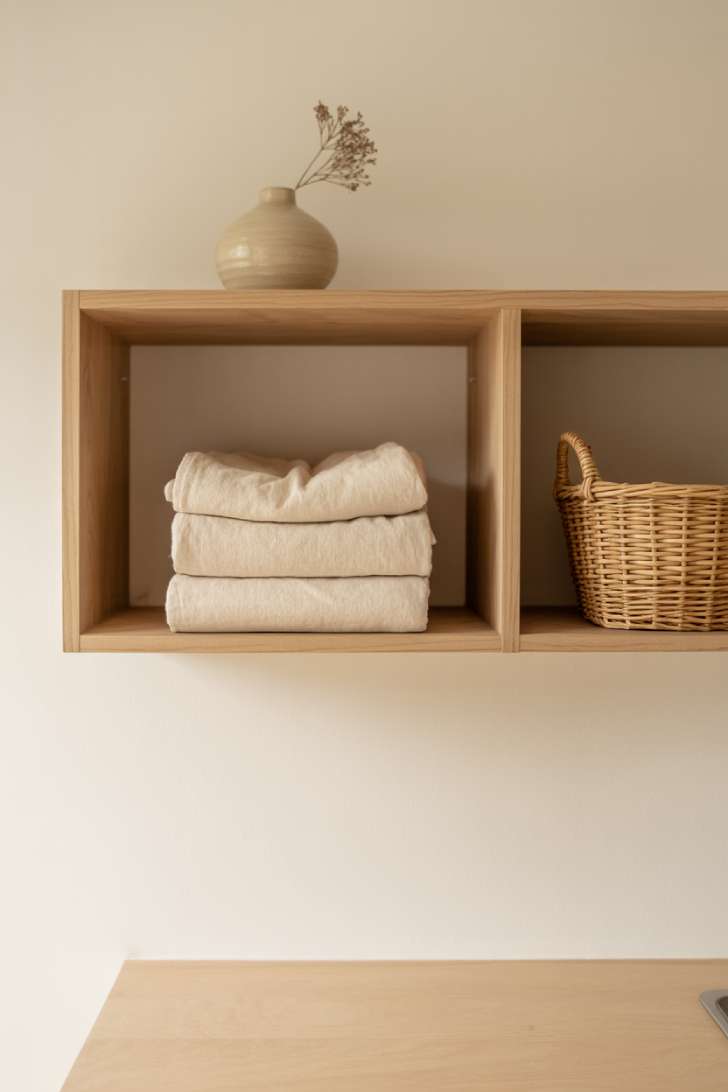
This is the idea that separates japandi from regular minimalism.
It’s not about having less stuff. It’s about leaving breathing room between the things you keep.
The Japanese concept of “ma” is all about the intentional use of empty space. A shelf that’s only two-thirds full looks finished, not empty. That gap is part of the design.
Put a folded stack of towels on one end, a single ceramic piece on the other, and leave the middle open. Done. The empty space creates visual rest, and your brain registers the room as orderly and calm.
Most people’s instinct is to fill every shelf completely. Fight that instinct. The moment you pack a shelf edge to edge, the room starts to feel like a storage unit instead of a designed space.
Style Blueprint:
- Floating shelves in light ash, birch, or maple
- No more than two or three items per shelf
- At least 30% of each shelf surface left intentionally bare
- One natural element (dried stem, small plant, ceramic bowl)
- Concealed shelf brackets for a cleaner look
Design Pro-Tip: If you’re struggling with what to put on open shelves, follow the “1-1-1” formula: one stack of textiles, one organic element (plant or dried flower), and one vessel (a ceramic bowl, a glass jar, a small vase). Three items, three different textures. That’s all you need.
Detergent Decanted Into Clean Glass Containers
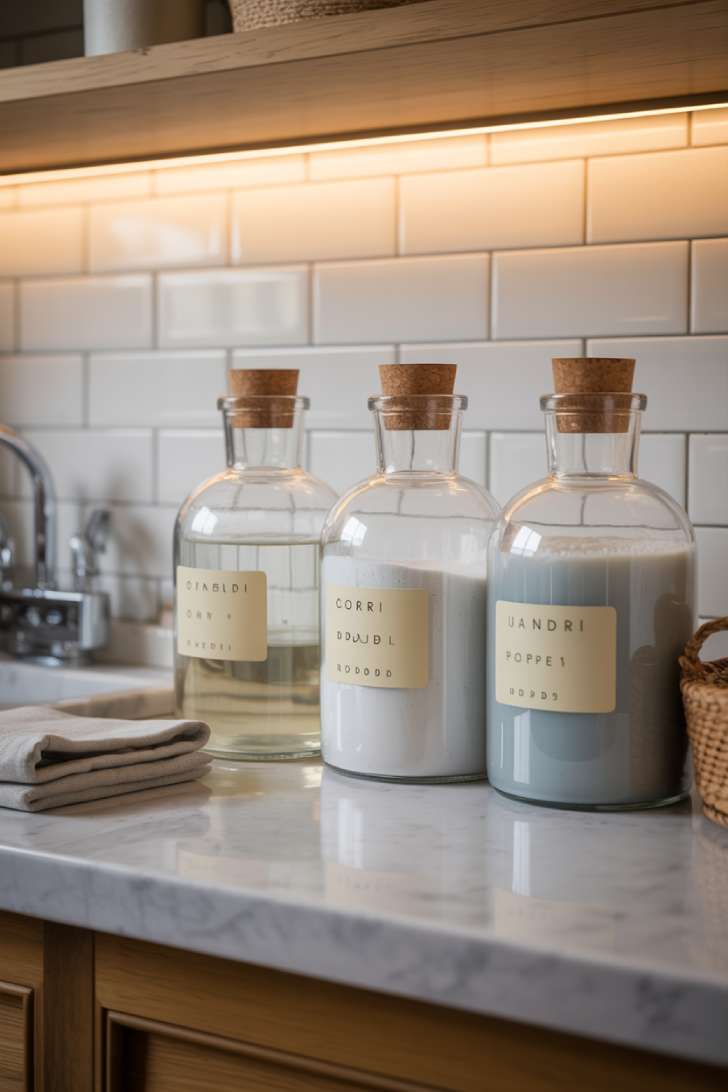
This is one of the smallest changes on the list, but it has an outsized visual impact.
Branded detergent bottles are loud. Bright colors, bold fonts, competing label designs. They instantly break the calm of a japandi space.
Decanting your products into matching glass or ceramic containers brings everything back to a unified look. Cork-topped glass bottles are the classic choice. They look beautiful, they’re easy to refill, and they fit the hygge interior style that runs through japandi design.
The reason this works psychologically is pattern consistency. When the containers on your counter match each other and match the room, your brain processes the whole scene as one thing rather than dozens of competing details.
Simple sans-serif labels in a neutral tone complete the look. Write “detergent,” “softener,” “stain spray” in clean lowercase text. That’s it. No graphics, no logos.
Style Blueprint:
- Three matching glass bottles with cork or bamboo stoppers
- Minimalist adhesive labels in cream or white
- Honed marble, slate, or wood countertop surface
- One folded linen cloth nearby for spills
- A small tray or dish to group the bottles together
One Statement Plant, Nothing More
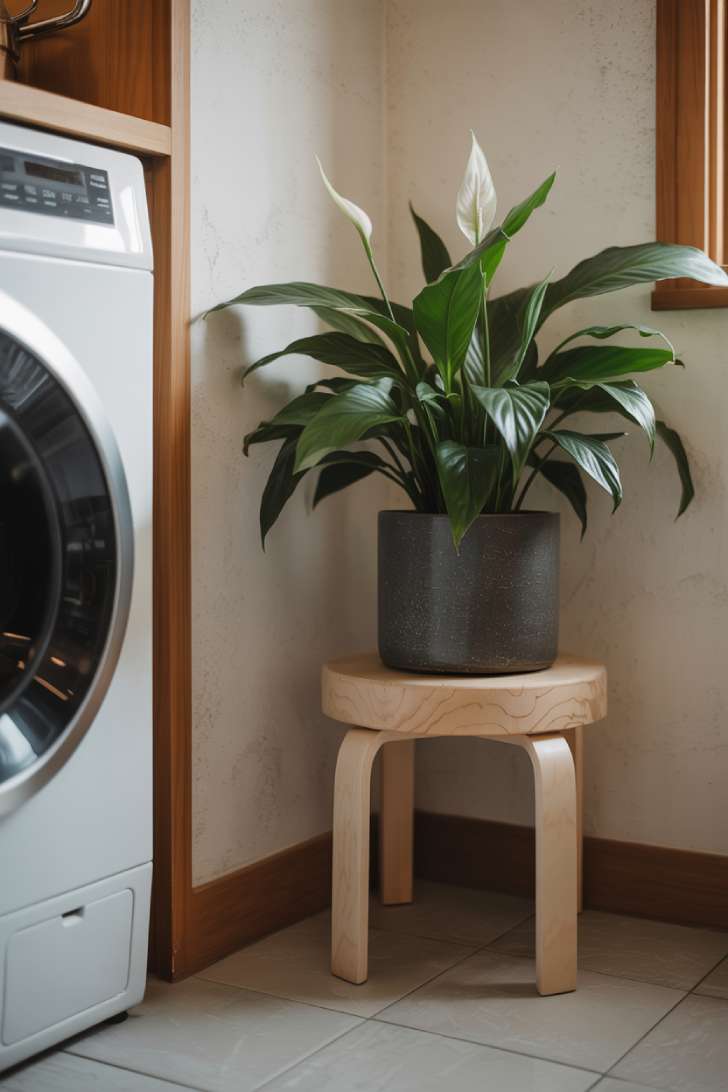
One plant. Just one.
A japandi laundry room isn’t a botanical garden. The goal is to introduce one living element that connects the space to the outdoors without overwhelming the minimalist composition.
Peace lilies, snake plants, and ferns all love humid environments, which makes them ideal for laundry rooms. Eucalyptus is another beautiful option, and it actually releases a fresh scent when exposed to steam.
Placing the plant on a small wooden stool rather than directly on the counter creates a deliberate display. It says “this was chosen” rather than “this was plopped down.”
Green is the one color that feels right in every japandi space. It bridges the gap between the warmth of wood tones and the coolness of gray or white walls, and it brings an immediate sense of life to a room that’s filled with hard surfaces and machines.
Style Blueprint:
- One humidity-loving plant (peace lily, snake plant, fern, or eucalyptus)
- Matte ceramic pot in charcoal, cream, or terracotta
- Small wooden stool or riser in light birch or oak
- Placement in a corner or on a counter edge, never in the center of a work surface
- No plastic pots. Ever.
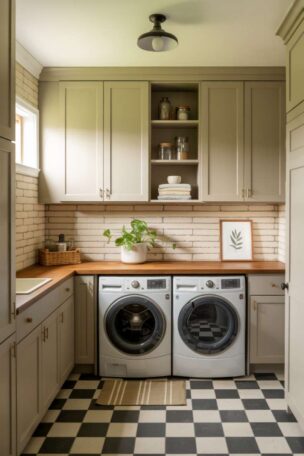
Neutral Subway Tile Backsplash Behind the Counter
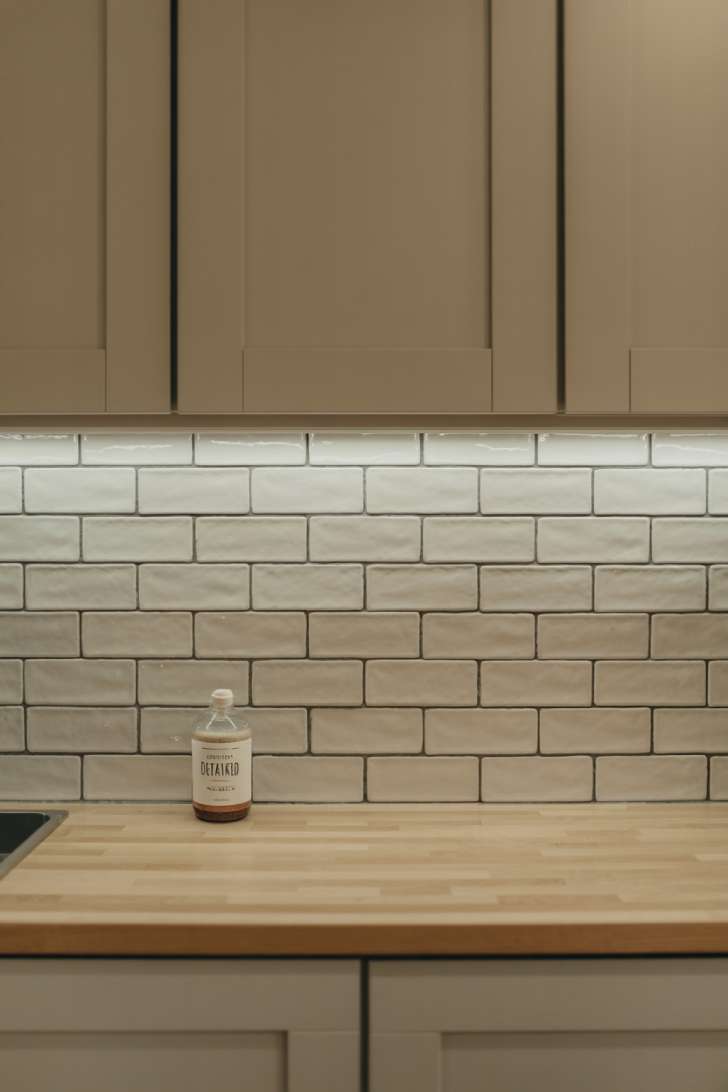
Subway tile has been around for over a century, and there’s a good reason it keeps showing up in well-designed laundry rooms.
The rectangular format creates clean horizontal lines that complement the simplicity of japandi design without competing for attention.
Stick with matte or slightly textured finishes in off-white, pale gray, or warm cream. Glossy white subway tile reads more “classic kitchen” than japandi.
Handmade-look tiles are a particularly good fit here. The slight imperfections in each piece align with the wabi-sabi design philosophy that finds beauty in irregularity.
The backsplash serves a practical purpose too. It protects the wall from splashes during stain treatment and laundry prep, so it’s a functional decision that happens to look great.
Style Blueprint:
- Matte or handmade-look subway tile in off-white or pale gray
- Classic brick pattern installation
- Matching grout in a similar tone (avoid stark white grout with off-white tile)
- Installation height from countertop to the bottom of upper cabinets
- Sealed grout for easy cleaning in a wet environment
Design Pro-Tip: When choosing grout color, go one shade darker than your tile, not lighter. A slightly darker grout creates a soft, barely-there grid pattern that adds depth without creating harsh lines. White grout on white tile looks good for about a month, then becomes a cleaning headache.
Layered Lighting With a Dimmer Switch
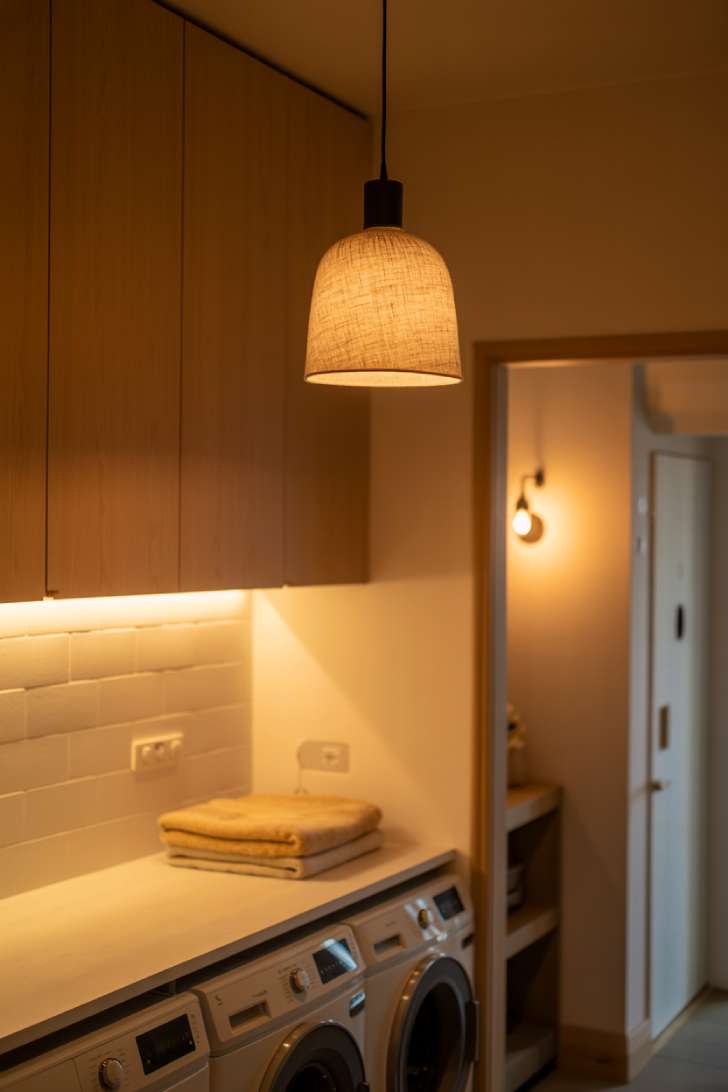
Most laundry rooms have one overhead fluorescent fixture, and it makes the whole space feel like a hospital hallway.
Layered lighting changes everything. Under-cabinet LED strips handle task lighting, so you can actually see what you’re doing when treating a stain or sorting darks from lights. A pendant or ceiling fixture with a warm-toned bulb provides ambient light. And a wall sconce near the entry adds a third layer that fills in shadows.
A dimmer switch is the finishing touch. It lets you dial the brightness down in the evening when you’re just pulling clothes from the dryer. That ability to shift the room’s mood is what turns a utility space into something that feels like the rest of your home.
Stick with fixtures that have clean lines. Matte black metal, natural linen shades, and pale wood frames all fit the japandi aesthetic. Avoid chrome, brushed nickel, or anything ornate.
The color temperature of your bulbs matters as much as the fixtures themselves. Go with warm white (2700K-3000K) across all light sources. Mixing warm and cool bulbs in the same room creates an unsettling visual tension.
Style Blueprint:
- Under-cabinet LED strip lights (warm white, 2700K)
- One pendant or flush-mount ceiling fixture with a linen or paper shade
- One wall sconce in matte black or light wood
- Dimmer switch on the main overhead light
- All bulbs in the 2700K-3000K range
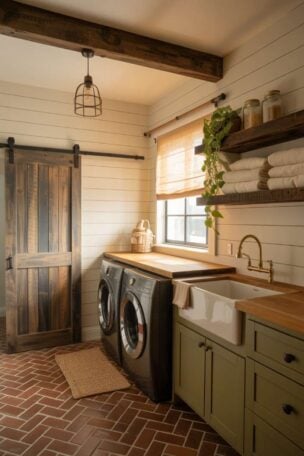
Sliding Door Entry in Light Wood
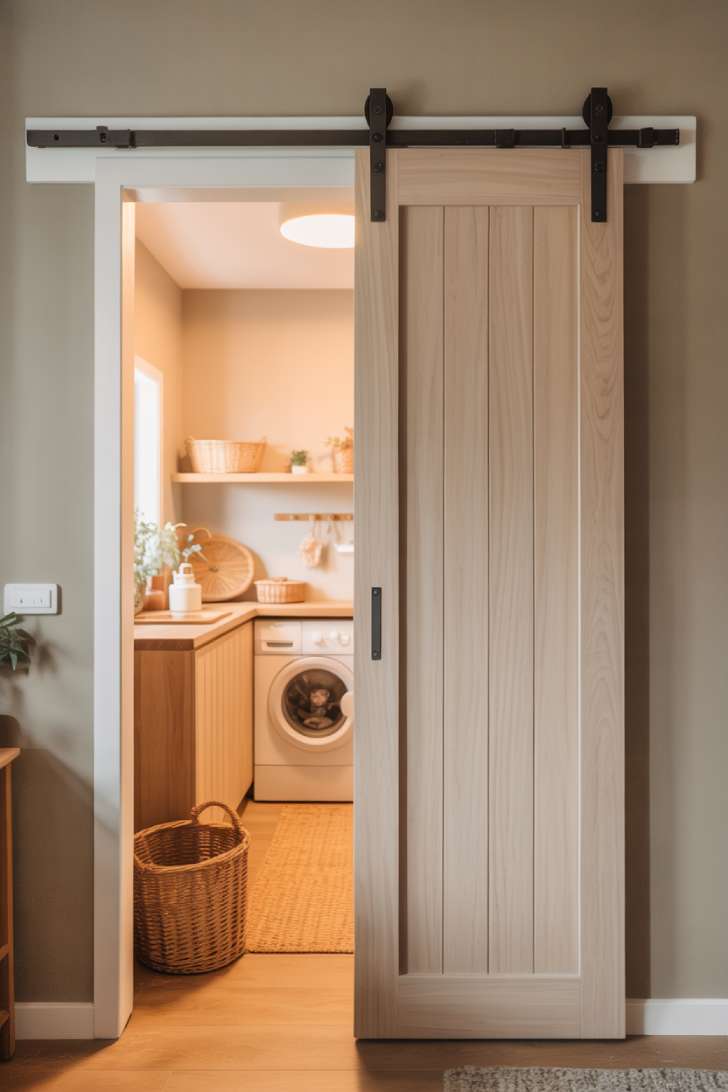
A standard swinging door eats up about 10 square feet of usable floor space. In a laundry room, that’s space you can’t afford to lose.
A sliding door on a simple rail solves the problem beautifully. It tucks flat against the wall when open and becomes a design feature when closed.
The trick for keeping it japandi is restraint. Skip the X-pattern farmhouse barn doors. Go with clean vertical planks in light ash or birch, mounted on a matte black rail. The contrast between the warm wood and dark metal adds just enough visual interest without overdoing it.
This is a spot where the functional laundry layout really benefits from one thoughtful decision. The door itself becomes the room’s first impression, so it sets the tone before anyone steps inside.
If a barn-style door feels like too much of a statement, a pocket door that slides into the wall is the ultimate minimalist option. Out of sight entirely when open.
Style Blueprint:
- Sliding door in light ash, birch, or maple with vertical planks
- Matte black metal rail and roller hardware
- No decorative cutouts or farmhouse details
- Door width matched to the full opening (no peeking around the edges)
- Soft-close mechanism to prevent slamming
Natural Fiber Floor Mat for Warmth
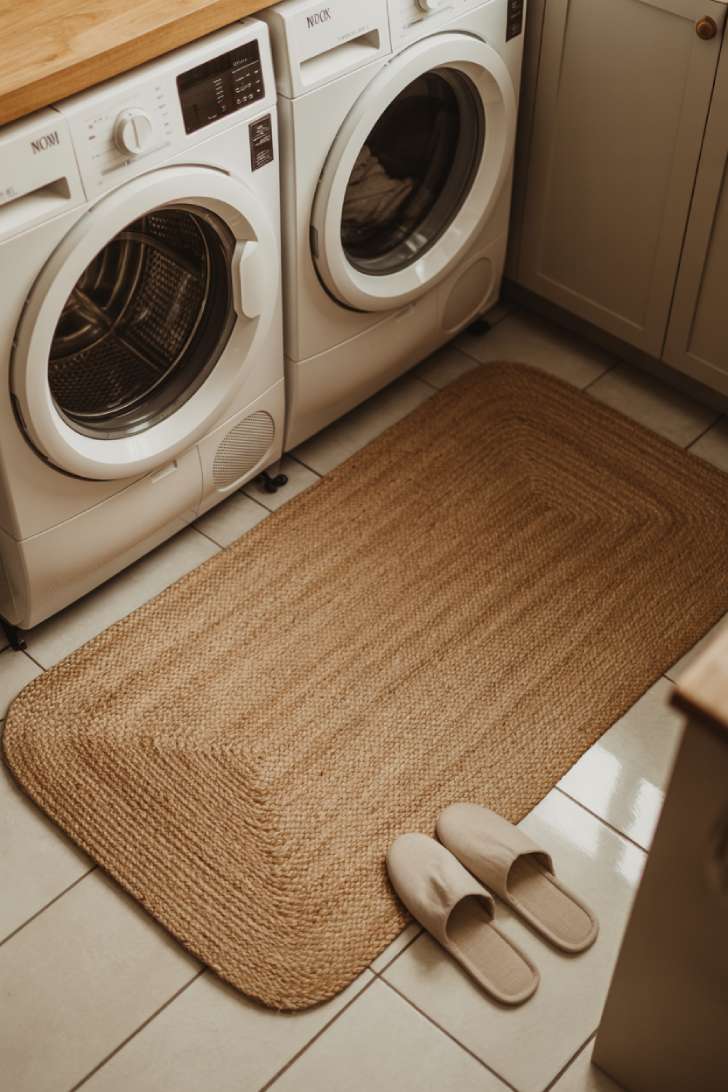
Hard tile floors are practical in a laundry room, but standing on cold porcelain as you fold three loads of towels isn’t exactly pleasant.
A natural fiber rug fixes that immediately. Jute, sisal, and cotton are all durable enough for a utility space, and they add a layer of organic warmth that the room needs.
The texture underfoot changes how you experience the whole room. It’s the same reason people put rugs in kitchens. You’re going to stand there for a bit, so the surface should feel good.
Keep the color in the natural, undyed range. Honey, flax, oatmeal. These tones complement any minimalist laundry organization scheme and age gracefully with foot traffic.
A herringbone or plain weave pattern works best. Anything too busy fights with the clean lines of the rest of the room.
Style Blueprint:
- Handwoven jute or sisal area rug (approximately 2′ x 4′ for in front of machines)
- Natural, undyed color in honey, flax, or oatmeal
- Flat weave or herringbone pattern
- Non-slip rug pad underneath
- Machine-washable cotton rug as a practical alternative
Design Pro-Tip: Put a non-slip rug pad under every natural fiber rug in a laundry room. These rooms see water spills, dropped wet socks, and damp feet. A rug sliding out from under you as you carry a full basket is the kind of accident that happens exactly once before you learn the lesson. Spend the $8 on the pad.
Hidden Appliances Behind Matching Cabinet Panels
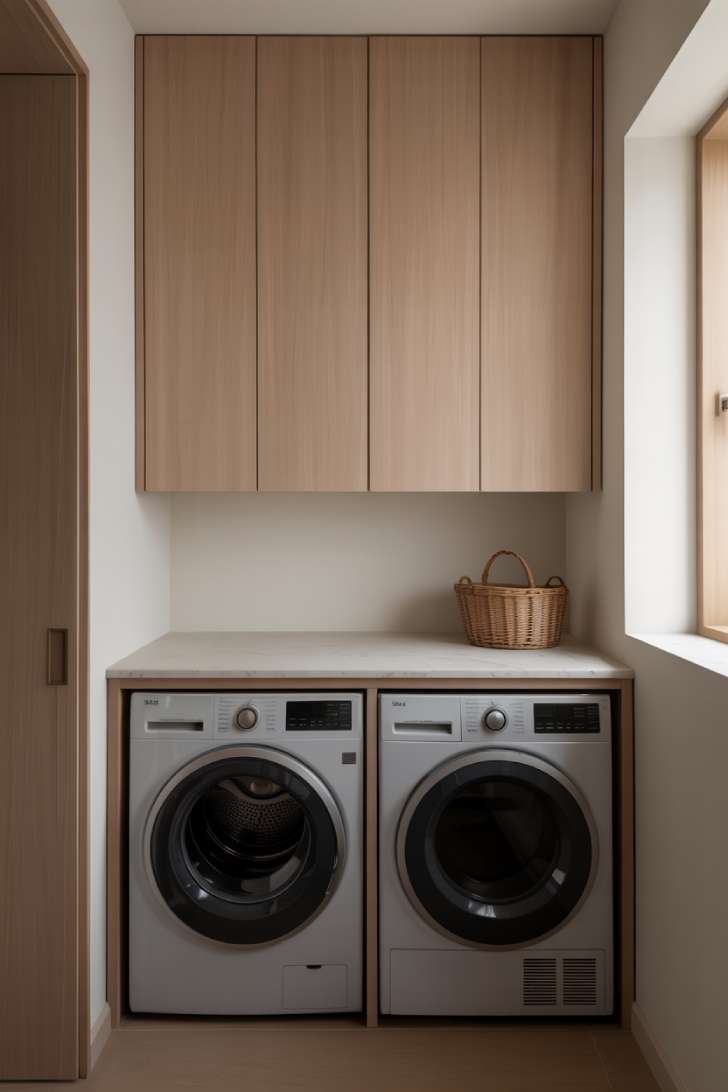
This is the most committed version of a japandi laundry room. And honestly? It’s stunning.
When the washer and dryer disappear behind matching cabinet panels, the room stops looking like a laundry room at all. It reads as a calm, beautiful hallway closet or mudroom. The machines are there when you need them. Gone when you don’t.
This works especially well in homes where the laundry area shares space with a hallway, entryway, or open floor plan. Nobody walking through the house sees utility equipment. They see a wall of warm wood.
The cabinet panels need to match exactly. Same finish, same grain direction, same hardware (or lack of it). Any mismatch and the illusion breaks.
This is one of those ideas where the upfront investment pays off every single day. You interact with your laundry room constantly, and having it feel like a designed part of your home instead of an afterthought changes how the whole space makes you feel.
Style Blueprint:
- Custom cabinet panels in light oak, birch, or ash to match surrounding cabinetry
- Push-to-open or integrated pull hardware for a clean front
- Proper ventilation behind the panels (leave gaps or install vents)
- Honed quartz or wood countertop continuing across the top
- Enough clearance for machine doors to open fully behind the cabinet doors
Wrapping Up
A japandi laundry room is really about editing. Pick two or three ideas from this list, start with what your space and budget allow, and build from there.
You don’t need a full renovation. Decanting your detergent, swapping in a jute rug, and painting the walls a single warm tone can shift the entire mood of the room in a weekend.
The best part about this style is that it gets better as you remove things, not as you add them. So start looking at your laundry room with fresh eyes and ask one question: what can go?