This post may contain affiliate links. If you make a purchase through these links, we may earn a commission at no additional cost to you.
Most people treat bedroom wall decorations as an afterthought, something addressed after the bed, the nightstand, and the rug have already locked the room’s personality in place.
That instinct gets the sequence backward.
The walls are the largest visual surface in any bedroom, and leaving them flat or underdressed is the single fastest way to make an otherwise well-furnished room feel like a staged apartment listing.
These nine wall moves, ranked from a simple swap to a weekend project, are the ones that close the gap between “furnished” and “finished.”
The Shift From Gallery Walls to Scaled-Up Singles
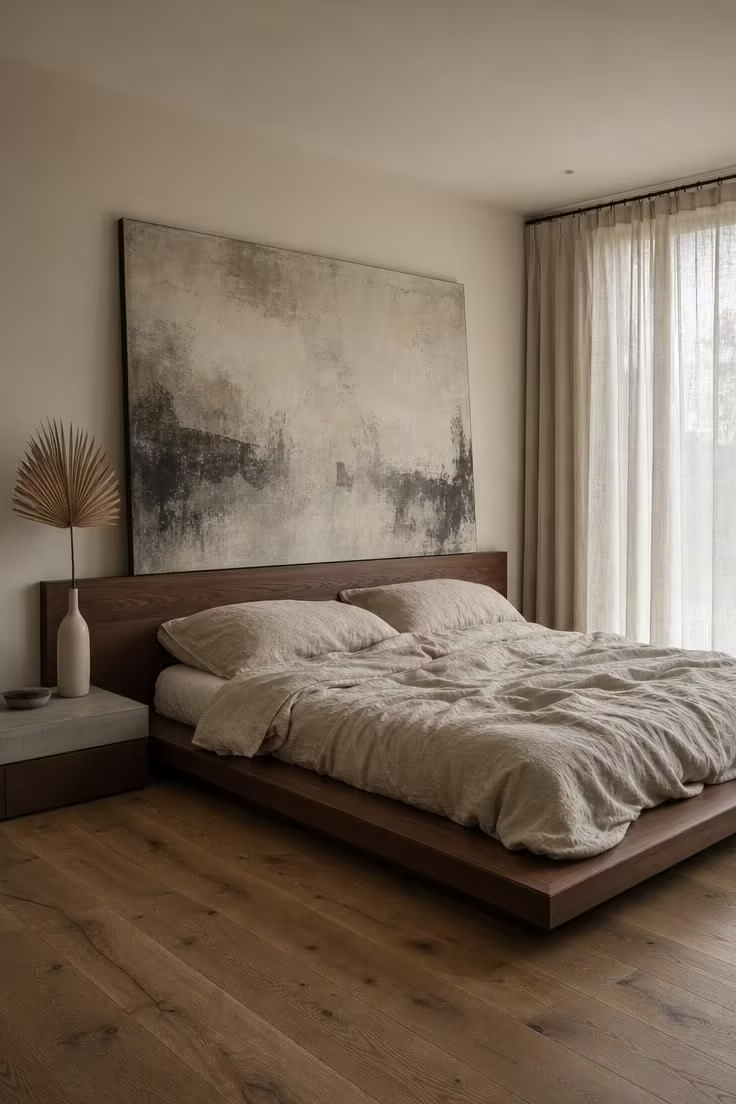
Search data from the first half of 2026 shows a decisive shift: terms like “oversized wall art” and “large wall art” are surging in popularity, outpacing the smaller gallery wall kits that dominated the last decade.
The reason is proportion, not preference.
One large piece reads as “designed,” because the viewer’s eye lands in a single place and rests there.
A cluster of small frames, by contrast, scatters attention across the wall and often reads as decorated rather than deliberate.
Interior designers working on bedroom projects now recommend that art above the bed span at least two-thirds the width of the headboard, a sizing rule that prevents the piece from looking like it floated to the wrong wall.
That proportion guideline matters more than the art’s style, color, or subject, because scale is what tells the eye the placement was intentional.
For bedrooms with limited floor space, leaning an oversized canvas against the wall instead of hanging it adds a grounded, collected quality that a nail-and-wire mount cannot match.
Why Texture Behind the Bed Replaces Paint as the Real Accent
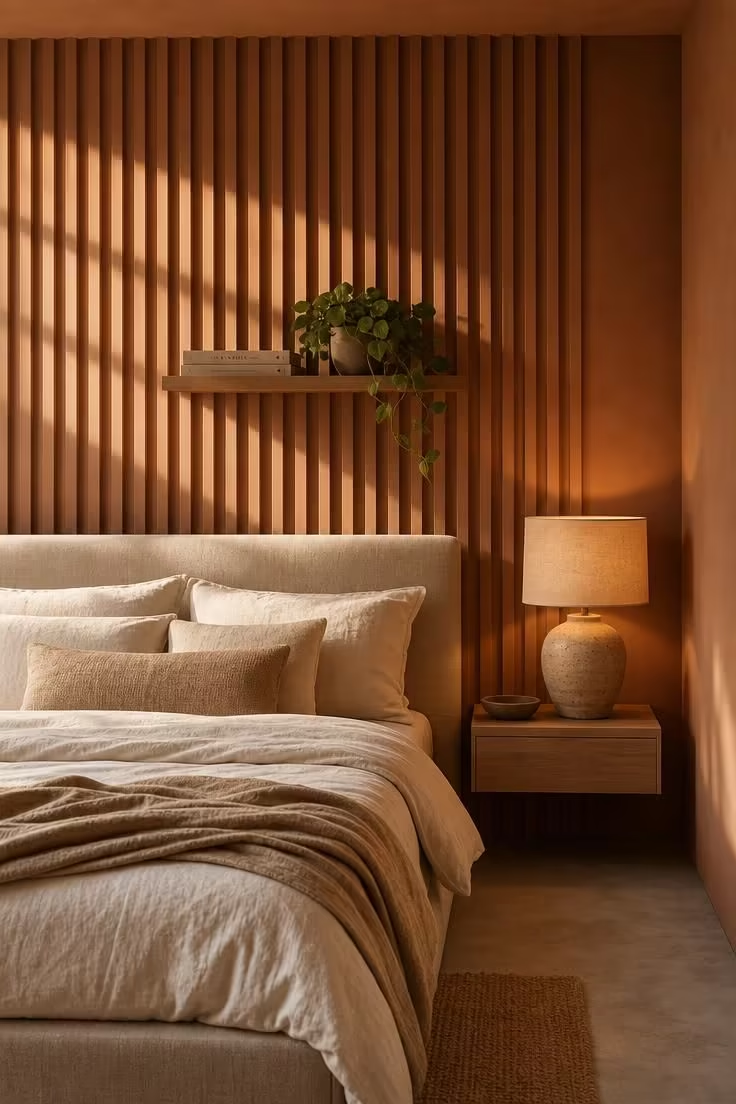
The flat, single-color painted accent wall that defined bedroom design throughout the 2010s has lost its authority.
Designers have moved on to textured surfaces, and the reason is physics as much as aesthetics: a fluted panel, a run of board and batten, or a limewash finish catches and redirects light in ways that flat paint physically cannot.
That interplay of light and shadow across a textured surface is what gives a wall depth, and it changes with the time of day so the room never looks exactly the same twice.
A limewash finish, applied directly over existing drywall, produces a soft, clouded surface with visible brush movement that reads as handmade even in a tract-built bedroom.
Textured wall panels made from lightweight MDF or composite materials now start at roughly $5 per square foot installed, making a full headboard wall project cheaper than replacing a single nightstand.
The most current approach is tonal texture, which means painting the panel the same color as the surrounding wall so the dimension comes from shadow alone, not from a contrasting color block.
This technique is the backbone of the “quiet luxury” look that has been gaining traction in primary bedrooms for the past two years.
For renters or commitment-averse homeowners, peel-and-stick wood-grain panels offer the same layered effect with zero permanent modification to the wall surface.
Design Pro-Tip: When choosing a textured wall panels finish for the bedroom headboard wall, test a sample panel at three different times of day. Textured surfaces shift dramatically between morning side-light, midday overhead light, and bedside lamp glow, and the version you see under showroom fluorescents will not match what you live with.
Wall Moulding That Costs Less Than a New Nightstand
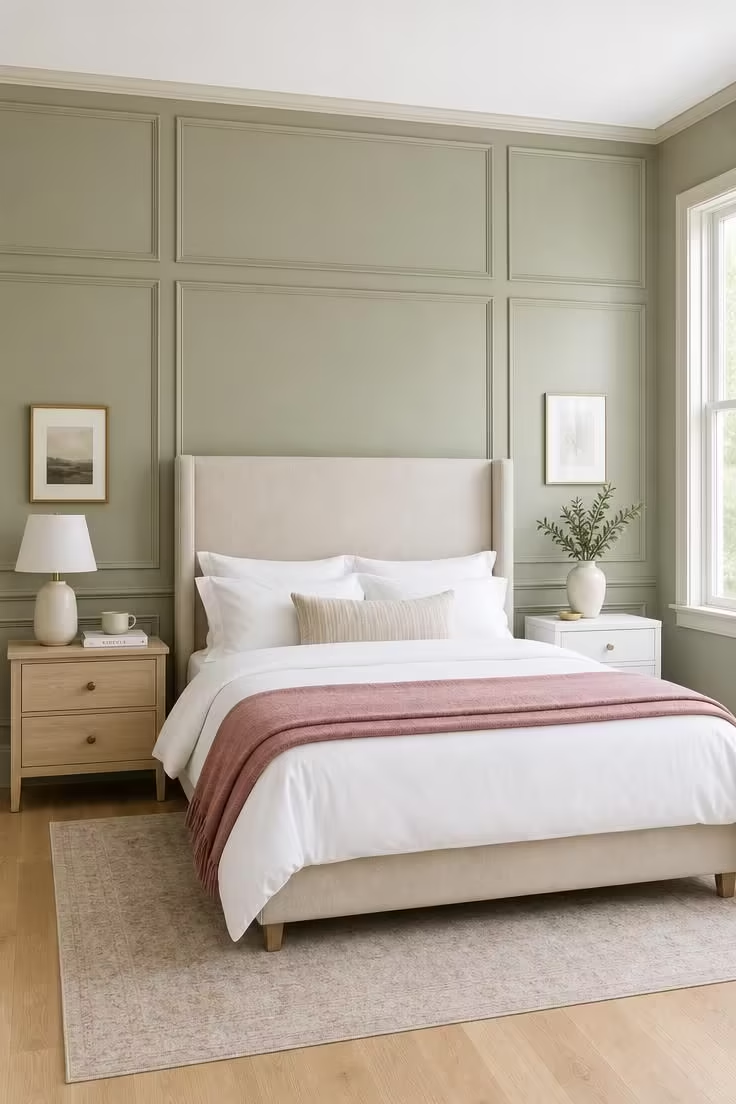
Adding wall moulding to a bedroom is one of the lowest-cost, highest-impact bedroom wall decorations available, and the math behind it is surprisingly simple.
A standard bedroom headboard wall requires about $40 to $70 worth of thin MDF strips from any home improvement store, a tube of construction adhesive, and a single quart of paint to match the existing wall color.
The result looks like architectural millwork that was built into the original construction.
Board and batten, which runs vertical strips from floor to ceiling with a horizontal rail at the base, is the easiest version to execute because the cuts are all straight and the spacing can be measured with a tape measure and a pencil.
Picture-frame moulding, which creates rectangular boxes across the wall, requires mitered corners and more precise measuring but produces a more formal look that suits primary bedrooms.
For anyone renting or unwilling to commit to permanent adhesive, several companies now sell adhesive-backed wall moulding strips that peel off cleanly, leaving the drywall intact when the lease ends.
The Reflective Layer Most Bedrooms Are Missing
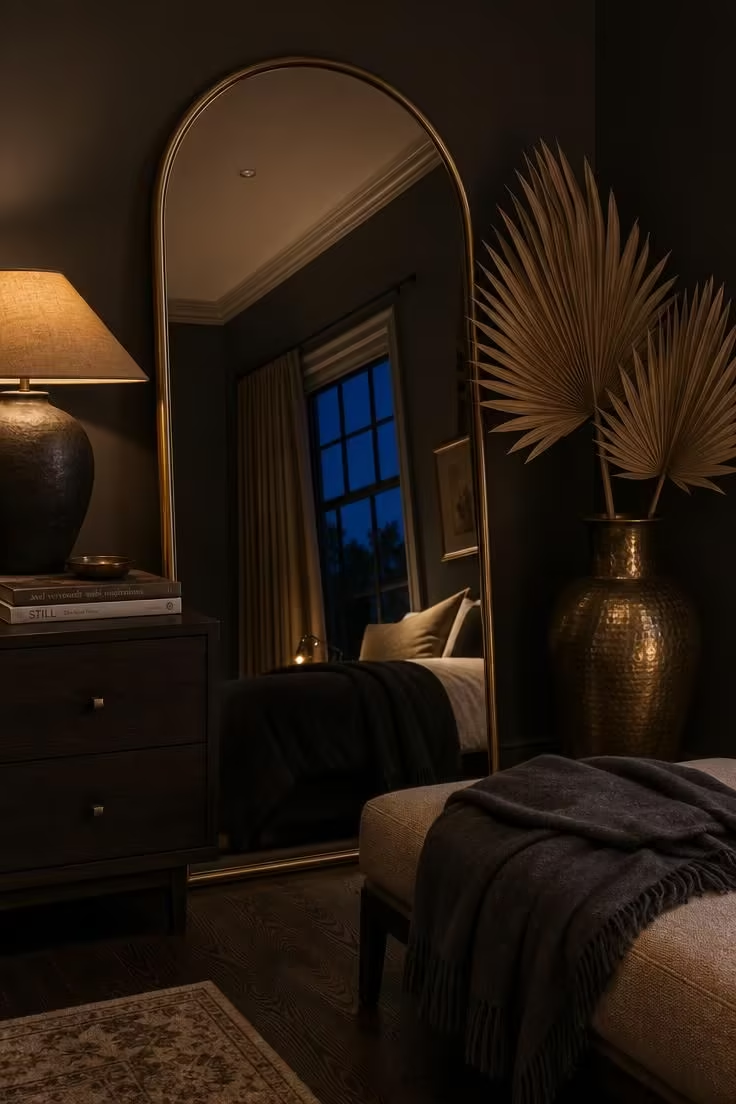
Most bedrooms default to soft, matte, absorbent surfaces: linen, cotton, wool, painted drywall.
That instinct toward softness makes sense for a room built around rest, but it leaves one entire dimension of visual interest on the table.
Reflective surfaces, including mirrors, metals, glass, and polished stone, add a layer of light-catching dimension that matte textures alone cannot produce.
Designer Artem Kropovinsky recommends sticking to one statement reflective piece per bedroom, noting that a single antiqued mirror with character or a pair of warm metal wall sconces over the bed is the cleanest approach.
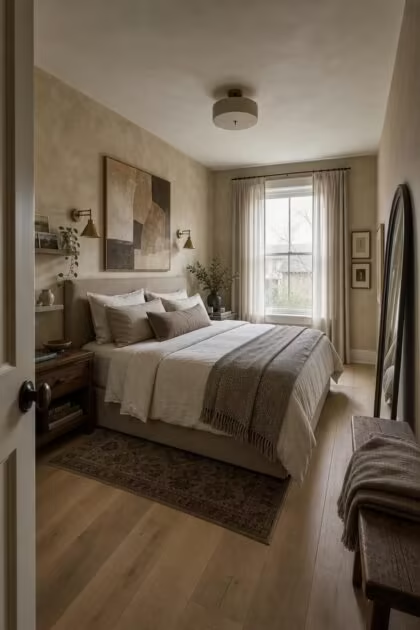
Wall sconces serve a double function here, because they are both bedroom wall decorations and practical reading lights that free up nightstand surface area.
Arched mirrors, convex mirrors, and those made from antiqued glass are the current favorites, because their shapes and imperfections read as collected over time rather than purchased in a set.
Placement matters: a mirror on the wall opposite a window doubles the natural light in the room, and flanking the headboard with sconces draws the eye upward, making standard 8-foot ceilings feel taller.
Why the Right Wallpaper Does Not Look Like Your Grandmother’s House
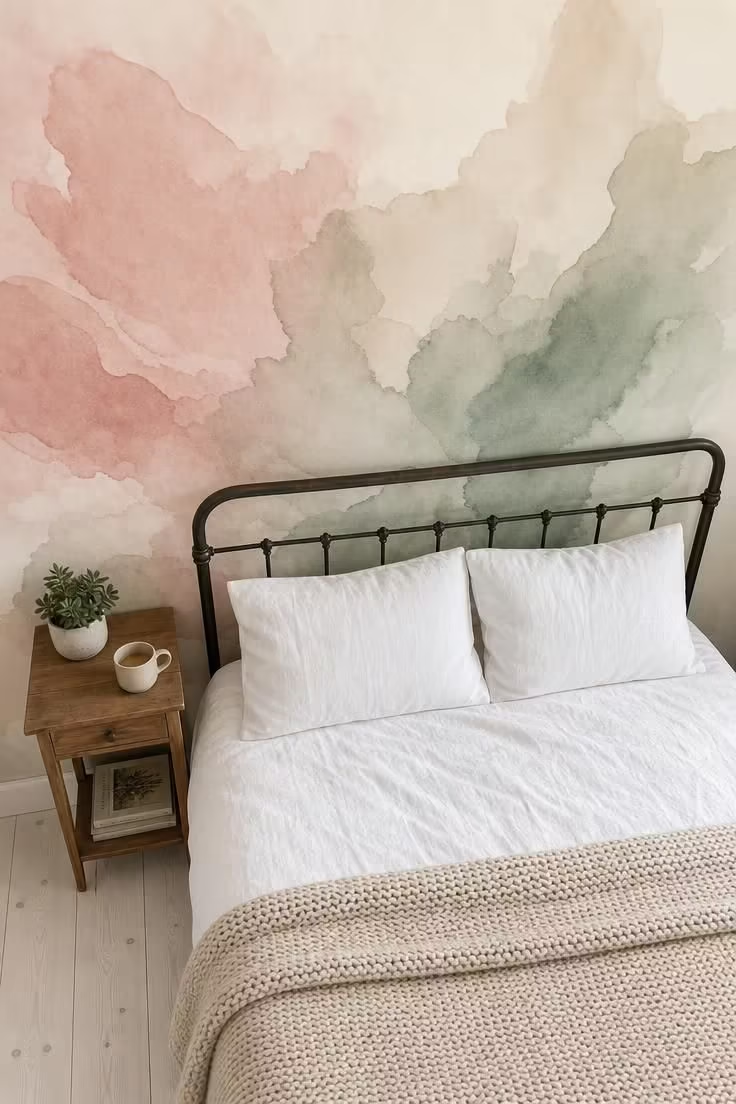
The word “wallpaper” still triggers resistance in a certain demographic, and the reason is a specific memory: heavy floral repeats in dark colors, pasted permanently to dining room walls in houses that last changed hands in the 1980s.
That version of wallpaper is not what is gaining ground in bedrooms right now.
The current generation of wallpaper for bedrooms features sketched botanicals, tonal stripes, metallic line work, and abstract watercolors, all printed on substrates that bear no resemblance to the vinyl-coated papers of decades past.
The “wallpaper box” trend takes this even further by wrapping the ceiling and all four walls in a single pattern, creating a cocoon-like effect that is especially powerful in compact bedrooms where the walls and ceiling feel close together.
Removable wallpaper has become the fastest bedroom accent wall option on the market, with most panels requiring about 30 minutes to apply and peeling off with zero wall damage.
Linen-texture patterns, which mimic the look of raw fabric without adding any physical material, are among the most requested options because they add warmth and grain to flat drywall.
The most common mistake is choosing a pattern with a repeat that is too small for the wall, which creates a busy, wallpaper-forward look rather than an atmospheric one.
A larger-scale pattern with more negative space between motifs reads as architecture, not decoration.
For anyone testing the idea before committing, ordering two sample sheets and taping one to the headboard wall and one to the entry wall reveals how the pattern performs from both the pillow and the doorway.
Design Pro-Tip: Before committing to a full wallpaper install, tape a sample sheet to the bedroom headboard wall and another to the wall you see first from the doorway. The pattern that reads well from both the pillow and the threshold is the right choice, because you will experience both views every single day.
Floating Shelves as a Rotating Display System
Most bedroom wall decorations are fixed once installed, which means the room’s personality is locked in place until someone decides to pull out a hammer and start over.
Floating shelves break that pattern entirely.
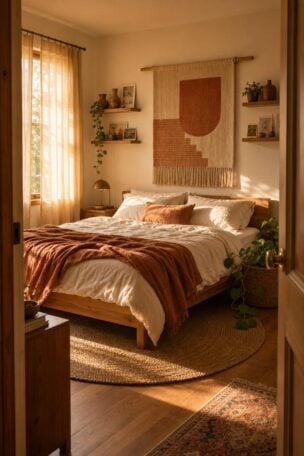
A pair of slim oak or birch shelves mounted above the headboard or along a side wall becomes a display system that changes with the season, the mood, or the weekend flea market find.
The advantage of a rotating display, where postcards, small ceramics, leaned prints, and seasonal cuttings swap in and out, is that the room stays visually alive without requiring any new nail holes.
Slim picture ledges serve the same function with an even lower profile, making them a better fit for smaller bedrooms where a standard-depth shelf would feel top-heavy above the pillows.
The visual rhythm of shelf styling follows a simple rule: odd numbers of objects, varied heights, and at least two different materials per shelf prevent the display from looking like a store merchandise set.
The “Why Now” Behind the Texture-First Bedroom
After roughly a decade of cool minimalism, flat white walls, and interiors that prioritized negative space over personality, the design world has shifted direction.
The current movement favors warmth, sensory richness, and surfaces you actually want to touch, and the bedroom is the room where that shift lands hardest.
Bedrooms are no longer just sleeping spaces; they have become reading rooms, morning coffee corners, and creative retreats, and that expanded function demands more visual character from the walls.
Data from the home improvement sector reflects the scale of this change: the global wall decor market is projected to grow from $32.7 billion to $46.8 billion by 2032, and research from Opendoor found that 77% of homeowners are drawn to accent walls.
The “less is more” principle still holds, but it has been rewritten: less clutter, yes, but more texture, more material variety, and more intention behind every surface.
Bedroom wall decorations are at the center of this recalibration because they sit at the intersection of the trend toward tactile surfaces and the trend toward rooms that feel personally assembled rather than catalog-ordered.
The rooms gaining the most attention on design platforms right now are the ones where the walls have a story, whether that story is a hand-applied limewash finish, a collected arrangement of floating shelves, or a single piece of oversized wall art chosen with enough care that it anchors the entire space.
Three Common Wall Decoration Mistakes That Make a Room Feel Cheaper
The first and most widespread mistake is hanging art too high.
The center of any wall-hung piece should sit at roughly 57 to 60 inches from the floor, which is average eye level for a standing adult.
In bedrooms, where much of the viewing happens from a seated or reclined position on the bed, many designers drop that center point by two to three inches, which brings the art into the sightline of someone propped against the pillows.
The second mistake is choosing art that is too small for the wall.
An undersized piece on a large wall does not make the wall feel decorated; it makes the wall feel emptier, because the small frame only calls attention to how much bare surface surrounds it.
The fix is straightforward: measure the wall width, divide by 1.5, and use that number as your minimum art width in inches.
The third mistake is ignoring the bedroom headboard wall entirely and putting all the wall decorations on the side walls.
The headboard wall is the room’s primary focal point because it is the first surface the eye hits from the doorway.
Leaving it bare and dressing the peripheral walls is like putting all the furniture in the corners and leaving the center of the room empty.
Moving even one strong piece, whether oversized wall art, a textured panel, or a pair of wall sconces, to the headboard wall rebalances the entire room in a single afternoon.
Design Pro-Tip: Measure your bedroom headboard wall width and divide by 1.5. That number is your minimum art width in inches, and anything smaller will look like an afterthought above the bed.
Conclusion
The nine bedroom wall decorations covered here range from a 30-minute removable wallpaper swap to a full weekend of textured wall panels installation, and the right starting point depends entirely on how much time and commitment you are willing to put in today.
For the lowest-effort entry, removable wallpaper or a pair of floating shelves can shift a room’s character in under an hour with no permanent changes to the wall.
The middle tier, which includes wall moulding, a gallery wall replacement with one oversized wall art piece, and strategically placed wall sconces, takes a single weekend and a modest budget but delivers results that look built-in.
At the top of the effort scale, a limewash finish or a full textured panel headboard wall transforms the room at a structural level and gives you a surface that changes with the light every hour.
The common thread across all nine is the same: a plain room becomes custom not through one dramatic gesture but through a few deliberate bedroom wall decorations that read as intentional from every angle in the room.