This post may contain affiliate links. If you make a purchase through these links, we may earn a commission at no additional cost to you.
Your bathroom walls are working unpaid overtime — holding up a mirror, maybe a towel bar, and otherwise just sitting there in builder-grade beige.
They deserve better, and so do you.
Whether it’s a limewash finish that shifts with the light, a single shelf that replaces an entire cabinet’s worth of personality, or an oil painting hung where no one expects one, the right wall decor turns a room you rush through into one you actually notice.
These 15 bathroom wall decor ideas range from a twenty-minute weekend project to a full feature wall — and every one of them will make tomorrow morning’s toothbrushing feel a little different.
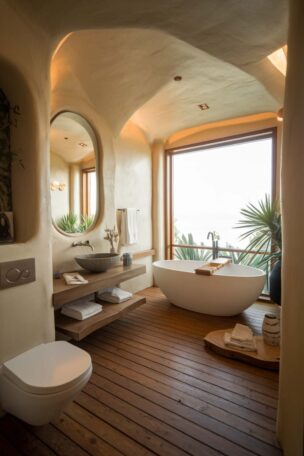
Limewash Plaster Over the Vanity in Warm Ochre
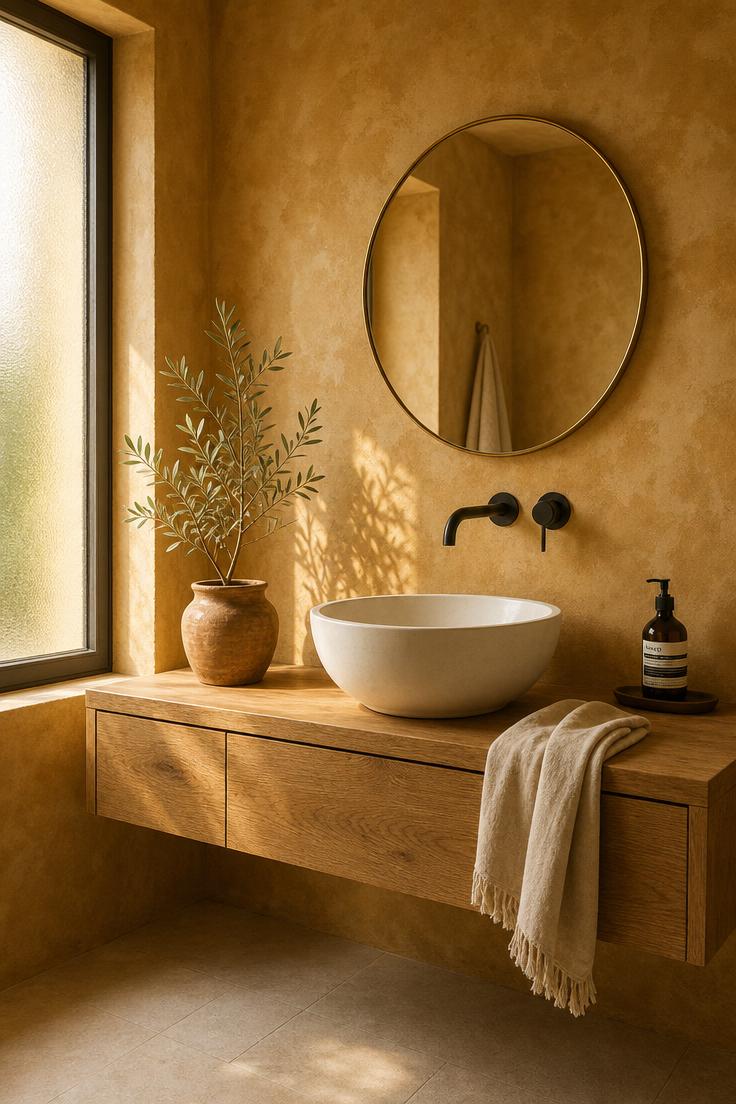
There’s something about a limewash wall that photographs can’t fully capture.
The surface shifts as you move past it — lighter near the window, deeper in the corners where the mineral pigments settle.
Ochre is a color that doesn’t demand attention the way a navy or emerald accent wall does. It just sits there, quietly warming everything around it.
In a bathroom, this kind of wall treatment works because the humidity actually helps the plaster cure over time, deepening its patina month after month.
Pair it with simple fixtures — a matte black faucet, a plain vessel sink — and the wall becomes the only decoration you need.
The unevenness of hand-applied plaster triggers a psychological response tied to natural landscapes. Our eyes read it as organic, which is why it feels calming in a space where you start and end your day.
Style Blueprint:
- Limewash plaster in ochre or sienna tone
- Floating oak or ash vanity with clean lines
- Round brass-rimmed mirror (keep it simple)
- Matte black wall-mounted faucet
- One small potted plant in a clay vessel
A Trio of Mismatched Vintage Mirrors on Beadboard
Most people hang one mirror above the sink and call it done.
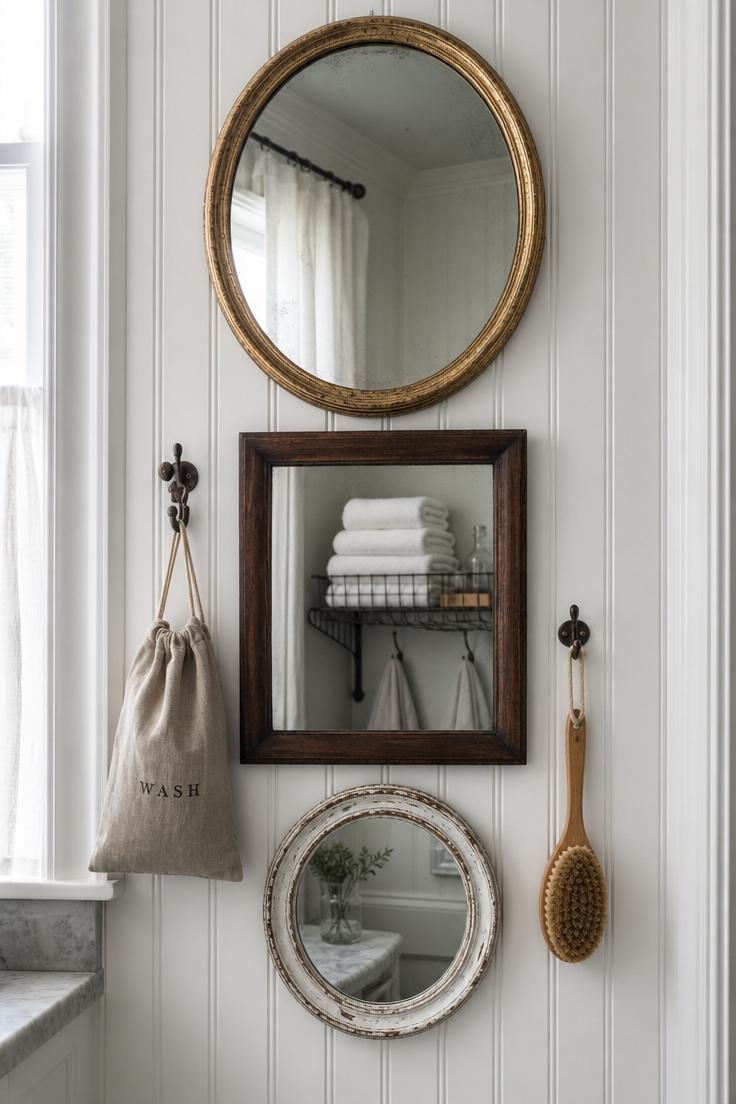
But a cluster of mismatched frames — collected from flea markets, estate sales, your grandmother’s hallway — turns a plain beadboard wall into something that looks like it evolved over decades.
The trick is keeping the frames varied but the spacing tight. Three inches between each mirror, maximum.
Beadboard gives the arrangement a backdrop with its own texture, so the wall never feels flat even in the spaces between frames.
One oval, one rectangular, one round. Different woods, different patinas. That asymmetry is what makes it feel personal instead of catalog-styled.
A collected wall like this tells your brain a story — it reads as memory, not merchandise. That’s why it feels warmer than any single designer mirror could.
Style Blueprint:
- Three mirrors in different shapes and frame materials
- White beadboard paneling (semi-gloss finish holds up to moisture)
- Tight vertical arrangement with 2-3 inch spacing
- Small hooks for hanging functional items between mirrors
- Wire shelf nearby for stacked towels
Hand-Glazed Zellige Tiles in a Shower Alcove Niche
You don’t need to tile an entire bathroom in zellige to get the effect.
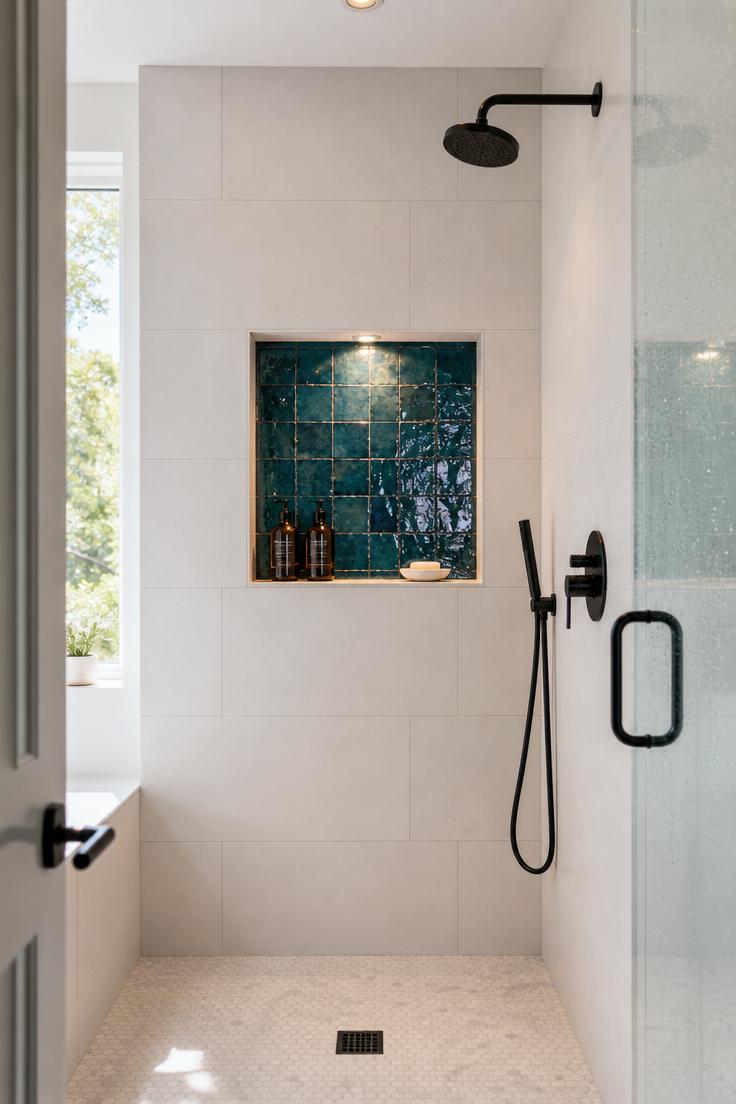
One niche — a single recessed alcove in the shower — is enough.
The beauty of these Moroccan tiles is in their imperfection. Each one is pressed and glazed by hand, so no two surfaces reflect light the same way.
In a deep teal, the glaze shifts between almost-black in the crevices and bright aquamarine where the light hits directly.
Surrounding the niche with plain large-format porcelain makes the zellige pop harder. It’s the contrast between machine-perfect and handmade that creates the tension.
Water actually improves how zellige looks — the droplets catch on the uneven surface and turn each tile into a tiny reflecting pool.
Style Blueprint:
- Hand-glazed zellige tiles in teal, emerald or terracotta
- Recessed shower niche (12×24 inches minimum)
- Large-format matte porcelain for surrounding walls
- Recessed LED niche lighting
- Amber or dark glass bottles for display
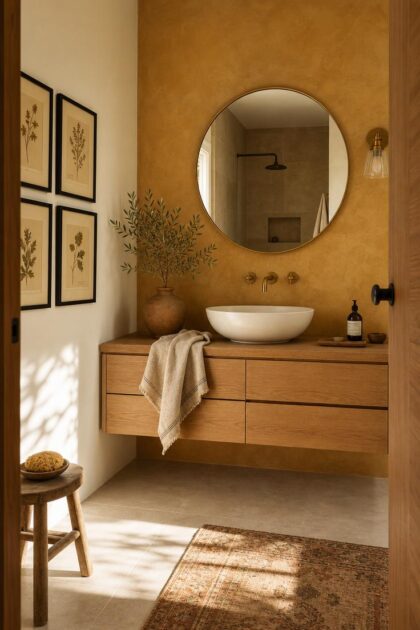
Pressed Botanical Prints in Slim Black Frames
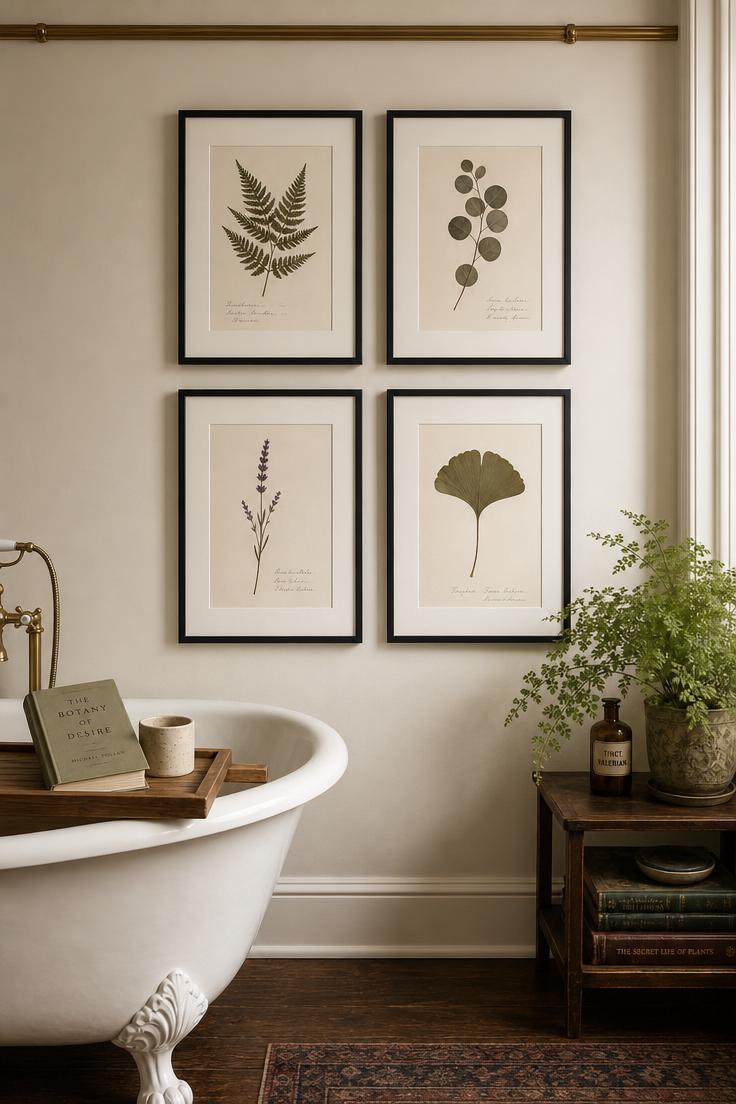
Framed art in a bathroom still makes some people nervous. Won’t the humidity ruin it?
Not if you use sealed frames with a proper mat and backing. The slim black metal frames — the kind with a simple clip backing and glass front — hold up for years.
Pressed botanicals work particularly well because they’re already flat and dry. No paint to crack, no canvas to warp.
The grid arrangement — two by two, evenly spaced — gives a small wall section the gravity of a gallery without overwhelming the room.
Pick specimens that relate to scent or the bath ritual itself. Eucalyptus, lavender, chamomile. That connection between what you see on the wall and what you might actually use in the tub creates a cohesive atmosphere.
A picture rail above lets you swap prints seasonally without putting new holes in the wall each time.
Style Blueprint:
- Four pressed botanical prints with white mats
- Slim matte black metal frames with sealed backing
- Grid arrangement (two rows of two)
- Brass picture rail for easy swapping
- Off-white or warm cream wall paint
Design Pro-Tip: When hanging art in a bathroom, leave at least 18 inches between the bottom of the frame and any water source. Splashback is the real enemy — not steam. A sealed frame handles humidity just fine, but direct water contact will damage any piece over time.
A Teak Slat Wall Behind a Wall-Mounted Faucet
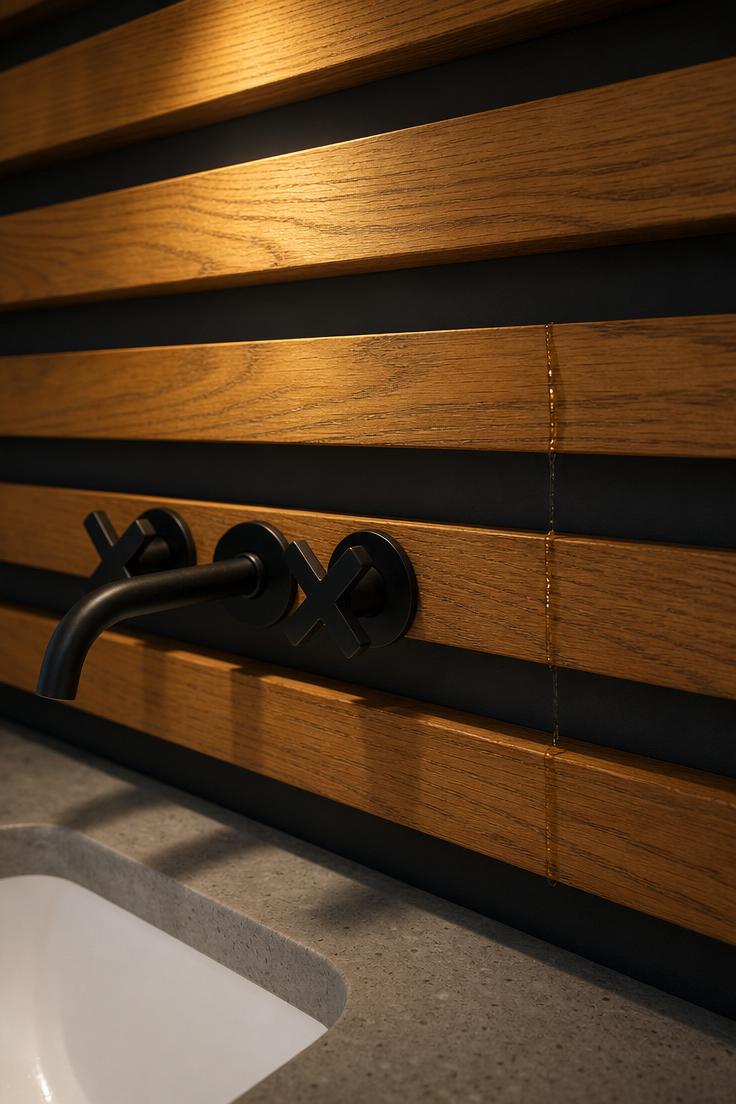
Teak is one of the few hardwoods that actually thrives in wet environments — there’s a reason it’s been used on boat decks for centuries.
Mounting horizontal slats with intentional gaps between them creates a bathroom wall that looks more like a spa than a powder room.
The gaps matter. Behind the slats, paint the wall a dark charcoal or deep navy. That shadow line between each plank adds depth that a solid wood wall can’t match.
Running the faucet directly through the slats — mounted to a backing board behind them — makes the whole installation look intentional and architectural.
Oiled teak darkens over time from honey to a rich amber, so the wall actually gets better looking as the years pass.
The horizontal lines pull your eye sideways, making a narrow bathroom feel wider. That’s not a design trick — it’s how human spatial perception works.
Style Blueprint:
- Teak slats (1×3 inch boards, oiled not sealed)
- 1-inch spacing with dark-painted wall behind
- Wall-mounted faucet integrated through the slat system
- Floating concrete or stone countertop below
- Recessed ceiling downlight to accent the wood grain
Pistachio Green Lacquered Half-Wall With Brass Sconce
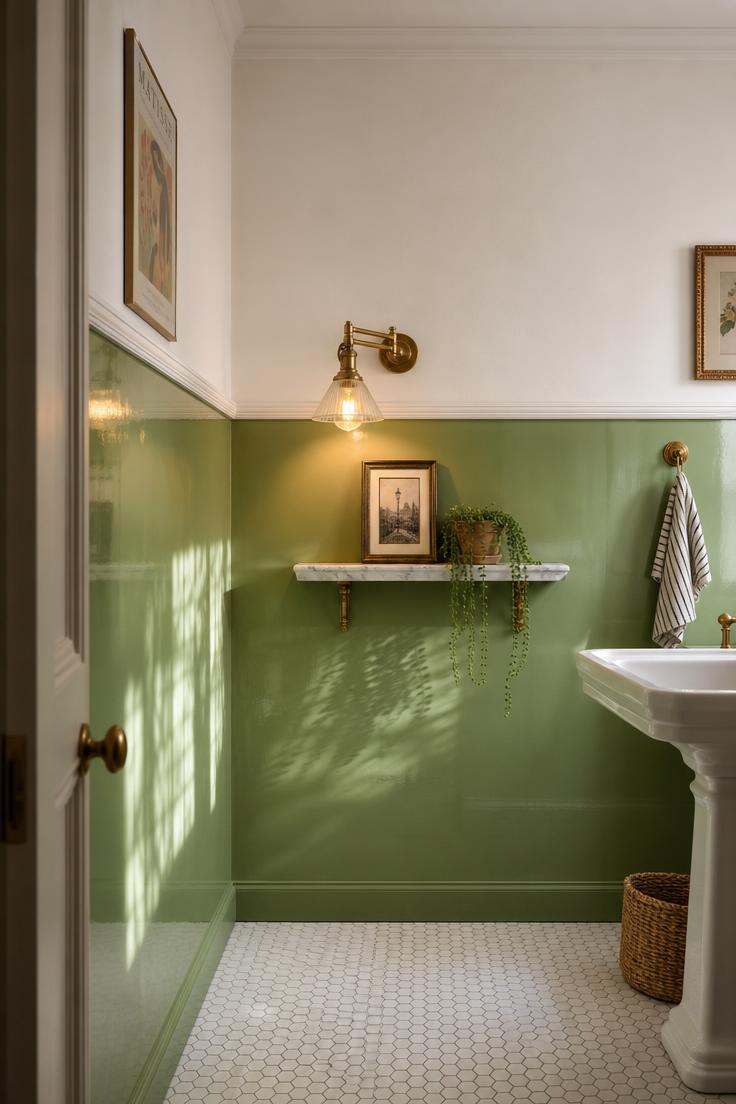
Color on bathroom walls doesn’t have to mean committing to four walls of the same shade.
A lacquered half-wall — just the lower four feet — gives you that punch of color while the white upper wall keeps the room from feeling closed in.
Pistachio green in a high-gloss finish is one of those colors that reads sophisticated rather than childish, especially under warm brass lighting.
The gloss matters here. Matte green paint on a half-wall looks like a nursery. High-gloss lacquer looks like a jewelry box.
Top the color break with a simple chair rail molding and the whole thing looks intentional and architectural, not like you ran out of paint halfway up.
A swing-arm sconce on the green section lets you angle light wherever you need it — toward the mirror for grooming, or pointed down for a softer ambient glow at night.
Style Blueprint:
- High-gloss lacquer paint in pistachio or soft mint
- Chair rail molding at 48-inch height (white to match upper wall)
- Vintage brass swing-arm sconce
- Narrow marble shelf for small display items
- White hexagonal floor tile to ground the color
Floating Raw-Edge Walnut Shelf With Apothecary Jars
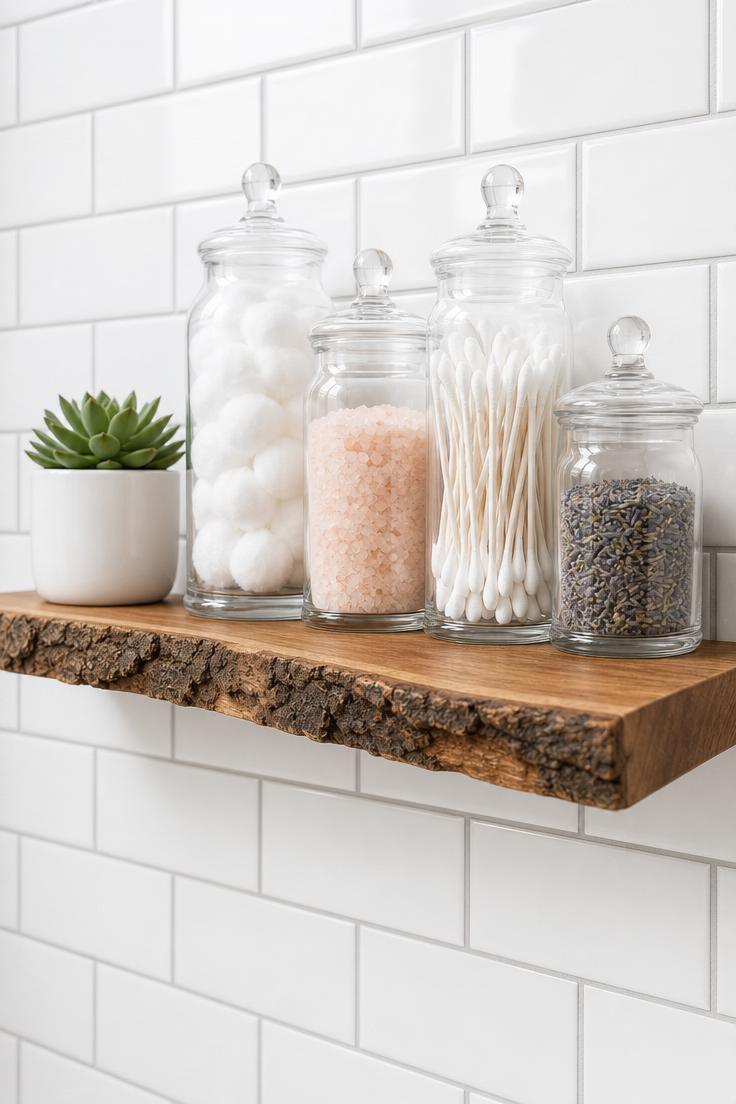
A single shelf can do what an entire built-in cabinet does for a bathroom’s personality.
The raw edge is what makes this work. A perfectly milled shelf on subway tile is fine, but that live edge — bark still clinging in spots, the natural curve of where the tree actually grew — breaks the geometry of the tile grid in exactly the right way.
Walnut is an ideal choice because it’s dense enough to resist moisture and its dark chocolate grain stands out against white tile without competing with it.
Fill the apothecary jars with things you actually use. Cotton balls, bath salts, swabs. When everyday items sit in clear glass on a beautiful shelf, they stop being clutter and become part of the decor.
The shelf should float — no visible brackets. Hidden rod-style shelf supports are the standard method, and they hold more weight than you’d expect.
Style Blueprint:
- Raw-edge walnut slab (30-36 inches, sealed with matte polyurethane)
- Hidden floating shelf brackets (rod-style)
- Clear glass apothecary jars in varying heights
- White subway tile backdrop
- One small plant in a simple ceramic pot
Black-and-White Line Art Above a Freestanding Tub
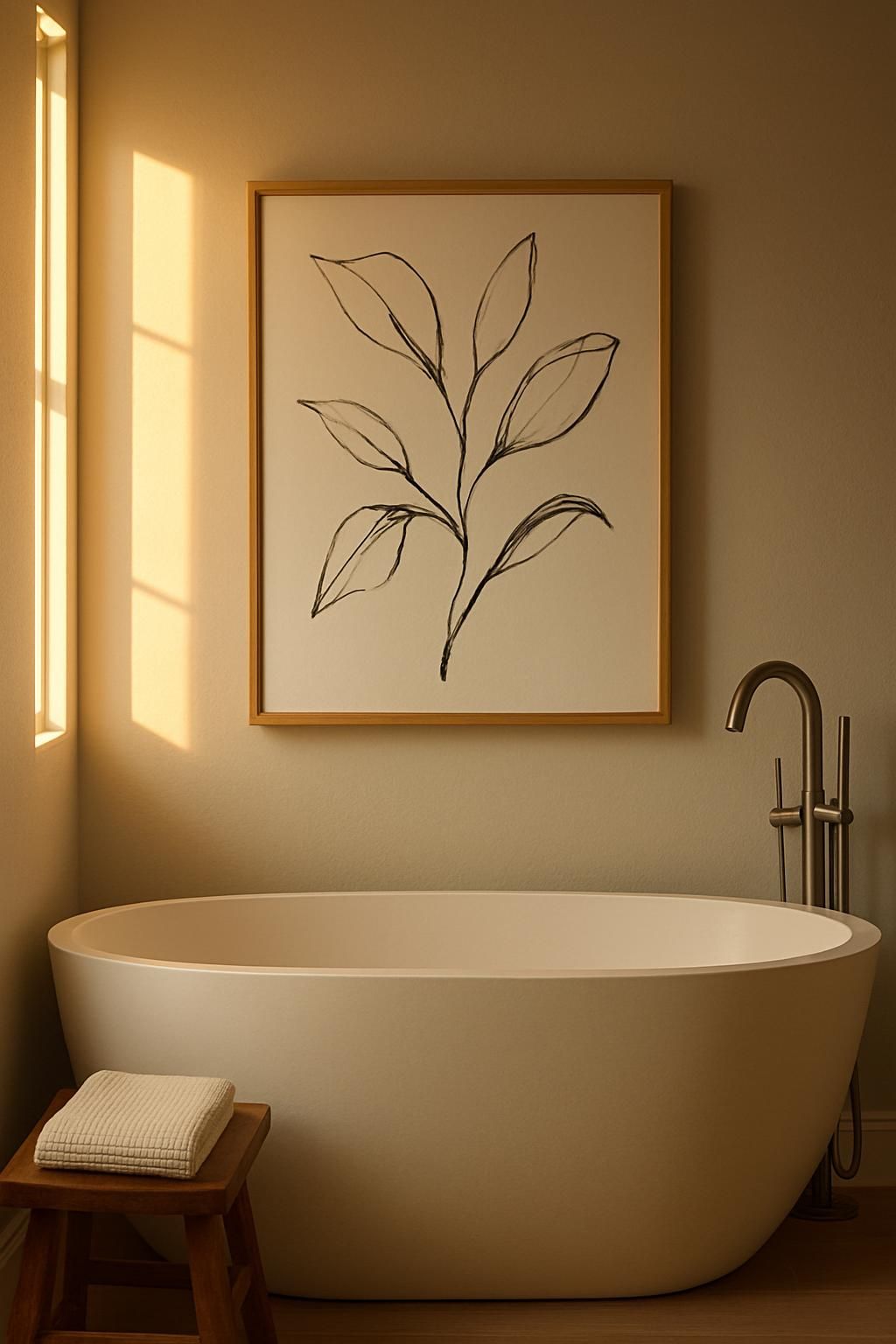
The wall above a freestanding tub is prime real estate that most people leave completely bare.
One large piece — not a cluster, not a gallery, just one — is all that space needs.
Black-and-white line art works here because it doesn’t compete with the curves of the tub or the hardware. It complements them.
A figure study or abstract line drawing in that minimalist ink style reads as intentional and slightly bohemian. It’s the kind of thing you’d see in a boutique hotel in Copenhagen.
Scale is everything with this arrangement. Too small and the art looks like an afterthought floating on the wall. Go at least 24 by 36 inches — big enough to hold the space above the tub.
Keep the frame simple. Thin natural oak or a slim black profile. Heavy ornate frames fight with the clean lines of modern tubs.
Style Blueprint:
- Oversized black-and-white line art (24×36 inches minimum)
- Thin natural oak or slim black frame
- Centered above the tub at standing eye level
- Pale grey or warm white wall behind
- Floor-mounted tub filler to keep the wall uncluttered
Design Pro-Tip: Hang art above a tub at standing eye level, not sitting-in-the-tub level. You look at the wall most often while walking into the room, brushing your teeth, getting towels. The art should meet you at your most common vantage point — not be optimized for a position you’re in for twenty minutes once a week.
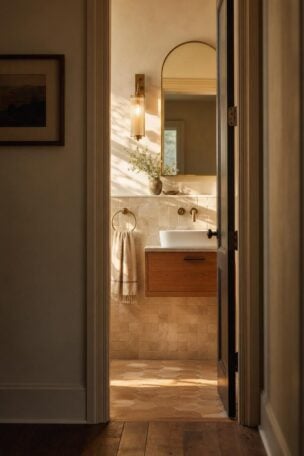
Fluted Plaster Panel Framing an Arched Mirror
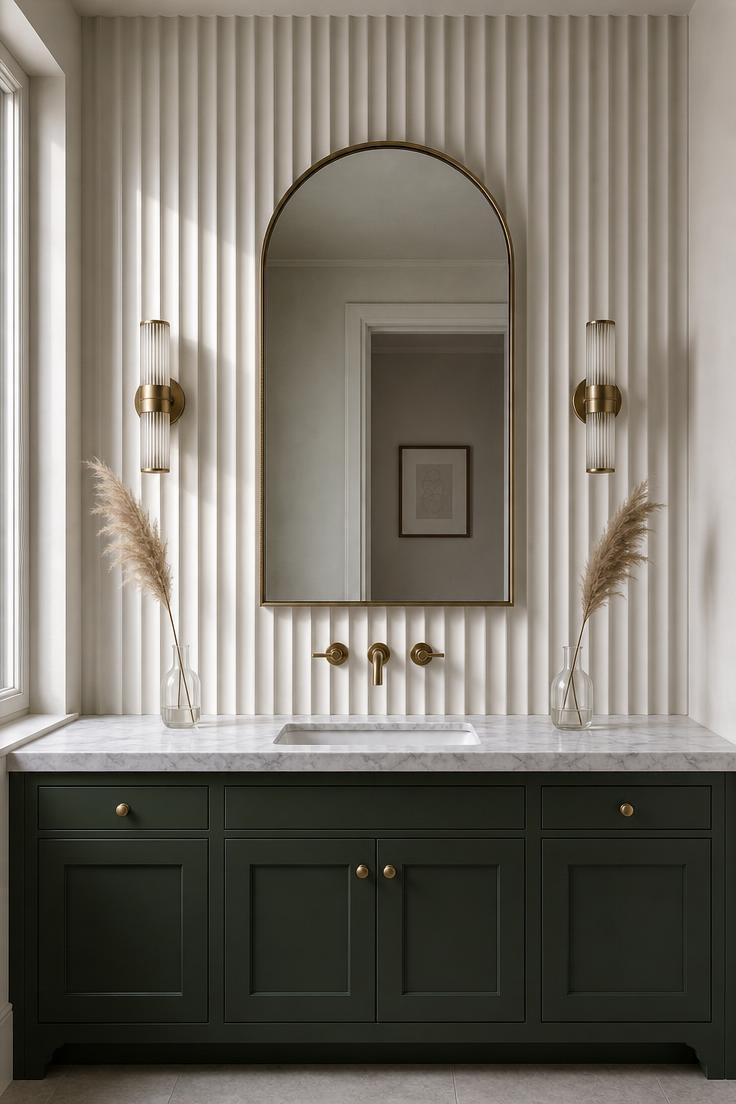
Fluted surfaces have made a comeback in furniture and cabinetry, but putting them directly on the wall is a different move entirely.
A plaster panel with vertical ridges — installed behind the vanity and mirror — turns a flat wall into something sculptural without adding a single piece of art or shelf.
The magic is in how the ridges catch raking light. Morning sun coming from the side creates a pattern of highlight and shadow that shifts throughout the day.
An arched mirror softens the vertical lines. That contrast — rigid straight ridges meeting a smooth curve at the top — creates visual tension that makes you look twice.
Paint the fluted panel the same color as the surrounding walls. When it’s the same hue, the texture does all the talking without the wall feeling busy or like it’s trying too hard.
This treatment works best when confined to one section — a four-foot-wide panel behind the vanity. Full-wall fluting starts to look institutional.
Style Blueprint:
- Fluted plaster panel (vertical half-round ridges, 4 feet wide)
- Arched mirror with slim brushed brass frame
- Same wall color for panel and surrounding walls
- Dark-painted vanity cabinet for contrast
- Raking natural light from a side window
A Vertical Herb Garden in Wall-Hung Terracotta Pots
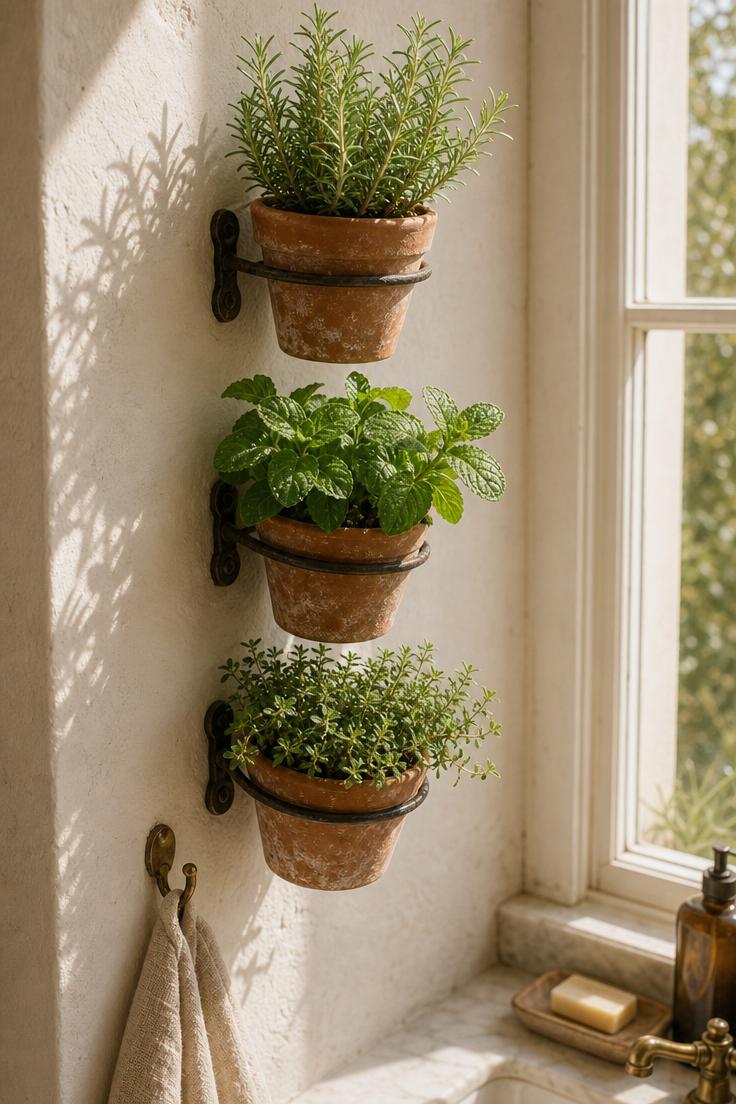
Living plants on a bathroom wall hit differently than any framed print.
Herbs are the smartest choice because they serve double duty — they look good and they fill a steamy bathroom with actual scent that no candle can match.
Mount them near the window. Herbs need direct light, and the bathroom’s humidity handles the watering for you half the time.
Terracotta is the right material here. Glazed ceramic pots look fine on a shelf, but unglazed terracotta on a white wall has a roughness that reads as rustic Italian instead of garden center.
Three pots in a staggered line — not perfectly spaced, not in a grid. One slightly to the left, one to the right, one centered. That imperfect arrangement stops it from looking like a retail display.
Over time, the pots develop white mineral deposits from watering. Some people clean them off. Don’t. That patina is part of the look.
Style Blueprint:
- Three unglazed terracotta pots (4-5 inch diameter)
- Wrought iron ring brackets for wall mounting
- Herbs that love humidity: rosemary, mint, thyme or basil
- Position near a window with direct light
- Linen hand towel on a nearby hook for the tactile contrast
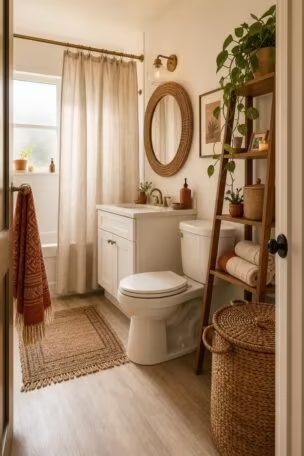
Ivory Venetian Plaster Paired With a Linen Roman Shade
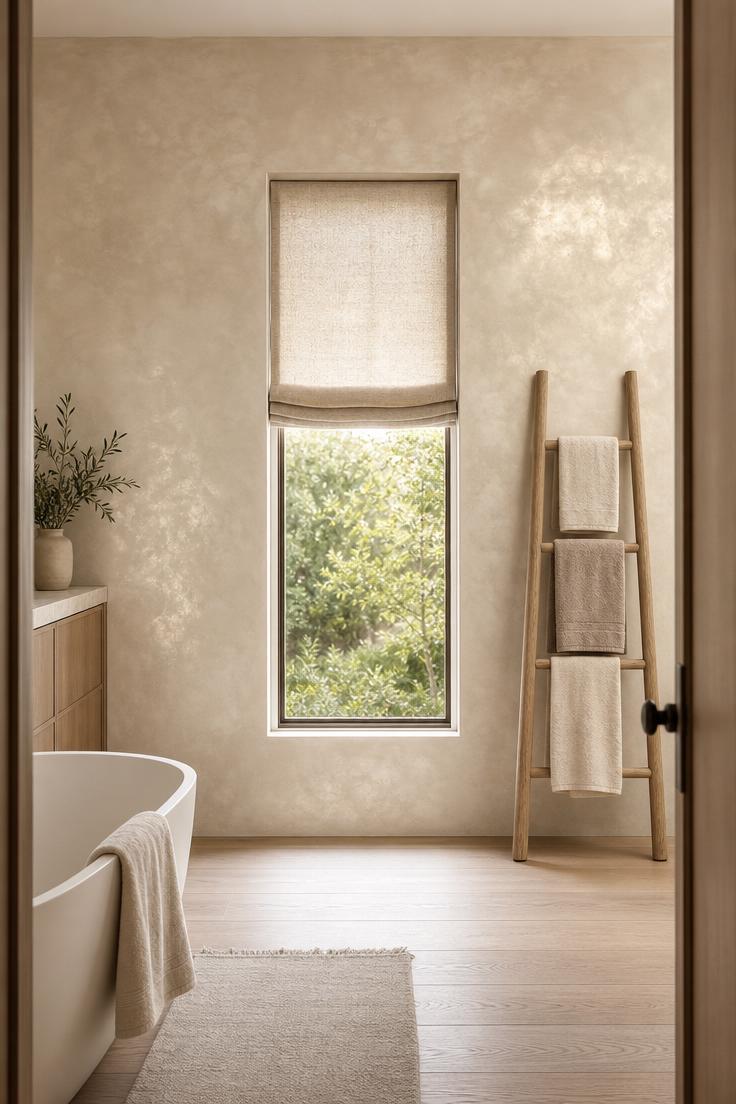
Venetian plaster and limewash get grouped together, but they’re different animals.
Where limewash is chalky and matte with visible brush strokes, Venetian plaster has a subtle sheen — almost like polished stone. Run your hand across it and the surface feels smooth and slightly cool.
In ivory, it reads as a warm neutral that flatters skin tones. That matters in a bathroom, where you spend time looking at yourself in the mirror under whatever light the walls reflect back.
Pairing it with a linen Roman shade is about layering textures that come from the same tonal family. Ivory plaster, oatmeal linen, cream towels. Everything is warm, everything is neutral, but nothing is flat because each surface has its own texture.
The plaster absorbs and bounces light differently than paint. Late afternoon sun creates a glow on Venetian plaster that makes the whole room feel warmer without changing the thermostat.
Style Blueprint:
- Venetian plaster in ivory or warm cream (hire a specialist for application)
- Relaxed linen Roman shade in natural oatmeal
- Towel ladder in light ash or birch wood
- Towels in graduating neutral tones
- Wide-plank white oak or light wood flooring
Oversized Travertine Slab as a Shower Feature Wall
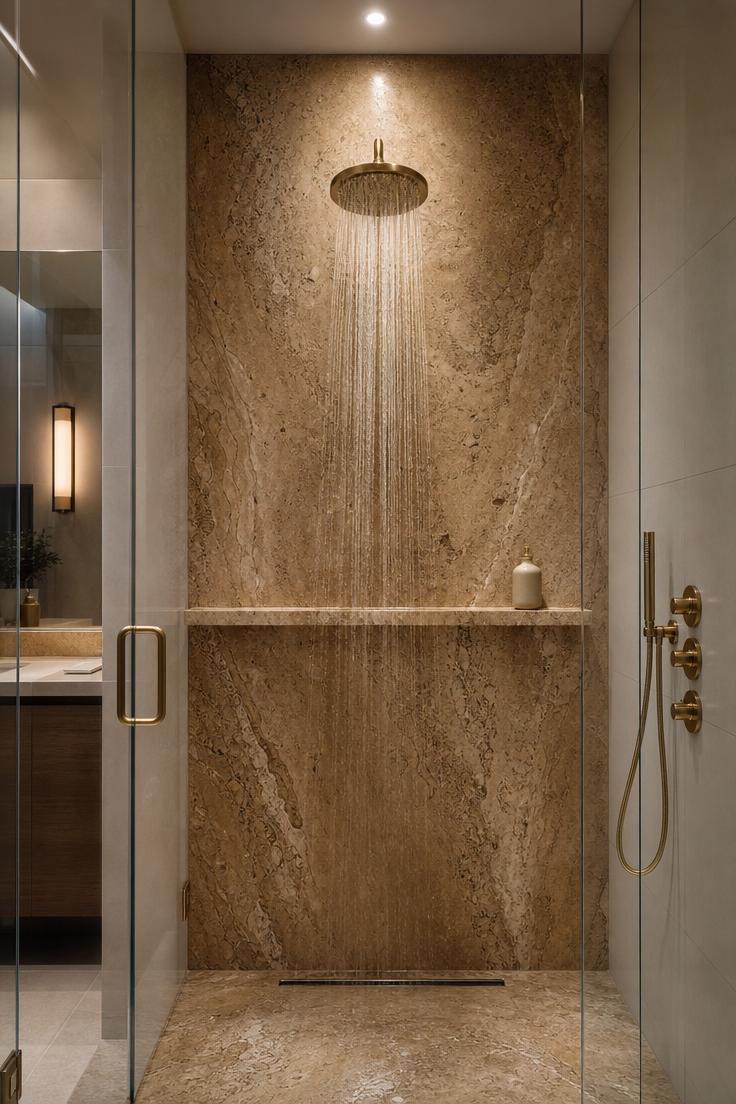
A single slab of natural stone — floor to ceiling, no grout lines, no seams — is the most powerful wall decision you can make in a bathroom.
Travertine is the material of Roman baths, and there’s a reason it endured. The fossil marks, the mineral veining, the way it shifts from pale cream to warm caramel within a single piece — no factory can replicate it.
The key word here is “slab,” not “tile.” Tiles break the surface into a grid. A slab lets the stone’s natural movement run uninterrupted, and that continuity is what makes it feel like a geological event rather than a renovation choice.
Wet travertine deepens in color. Every shower turns the wall into a slightly different version of itself, with the veining becoming more pronounced and the surface gaining a wet sheen.
Keep the other shower walls plain. White porcelain, no pattern. Let the travertine do all the work.
Style Blueprint:
- Oversized travertine slab (honed, not polished, for slip safety on adjacent floors)
- Full-height installation floor to ceiling
- Brushed gold or aged brass shower fixtures
- Frameless glass enclosure to keep the slab visible
- Built-in stone shelf at functional height
A Woven Seagrass Basket Trio on White Plank Walls
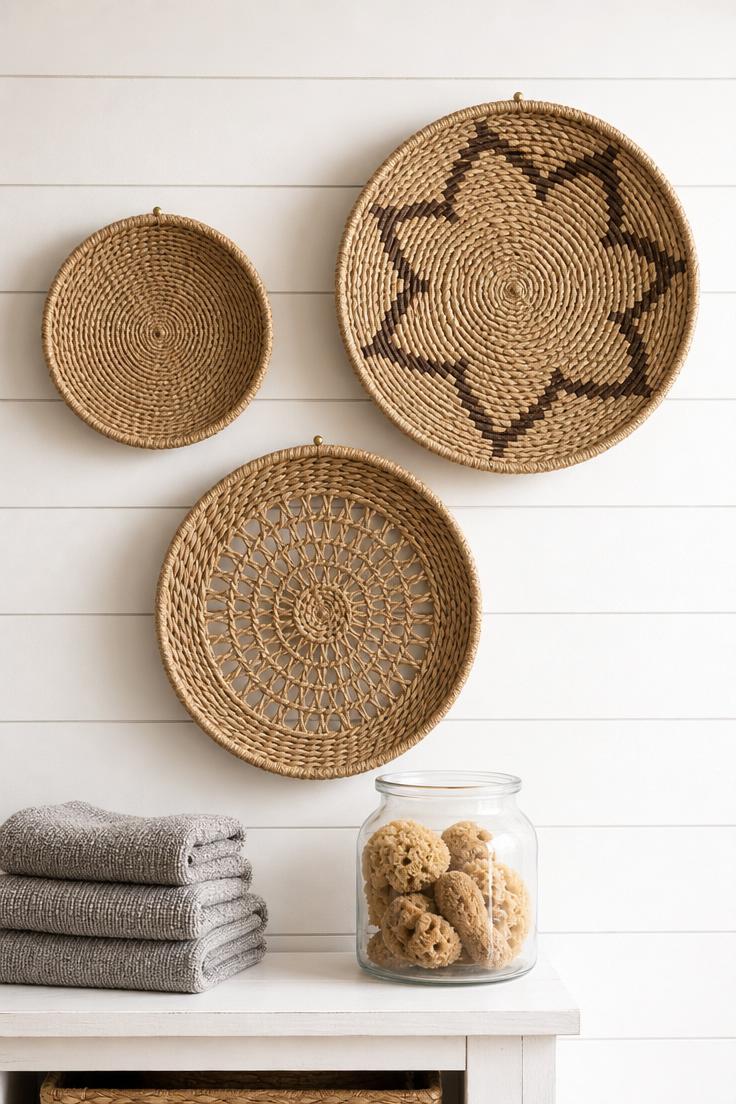
Baskets on a wall might sound like a Pinterest cliché from 2018, but the execution here is what separates decoration from decor.
Three baskets — not five, not seven. And all seagrass, all in the same tonal family, but with different weave patterns.
The variation in pattern does the same thing that mixing frame styles does in a gallery wall. It creates enough difference to be interesting without becoming chaotic.
White plank walls (tongue and groove, horizontal) give the baskets a backdrop with its own rhythm. The horizontal lines of the planks play against the circular shapes of the baskets.
These work best in a bathroom that skews coastal or Scandinavian — spaces where natural materials already set the tone. In a high-gloss modern bathroom, baskets on the wall would feel out of place.
Hang them with small brass picture hooks. The baskets are light enough that a single hook per basket holds them flat against the wall.
Style Blueprint:
- Three round seagrass baskets (varied sizes: 10, 14, 18 inch)
- Different weave patterns within the same color family
- White tongue-and-groove plank wall
- Loose triangular hanging arrangement
- Small brass picture hooks (one per basket)
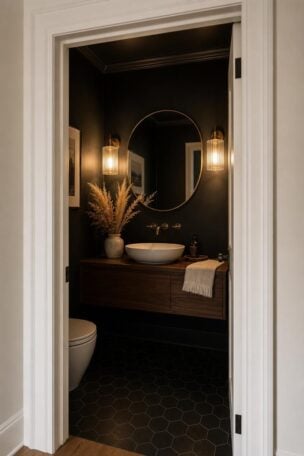
Matte Charcoal Subway Tile With Contrasting White Grout
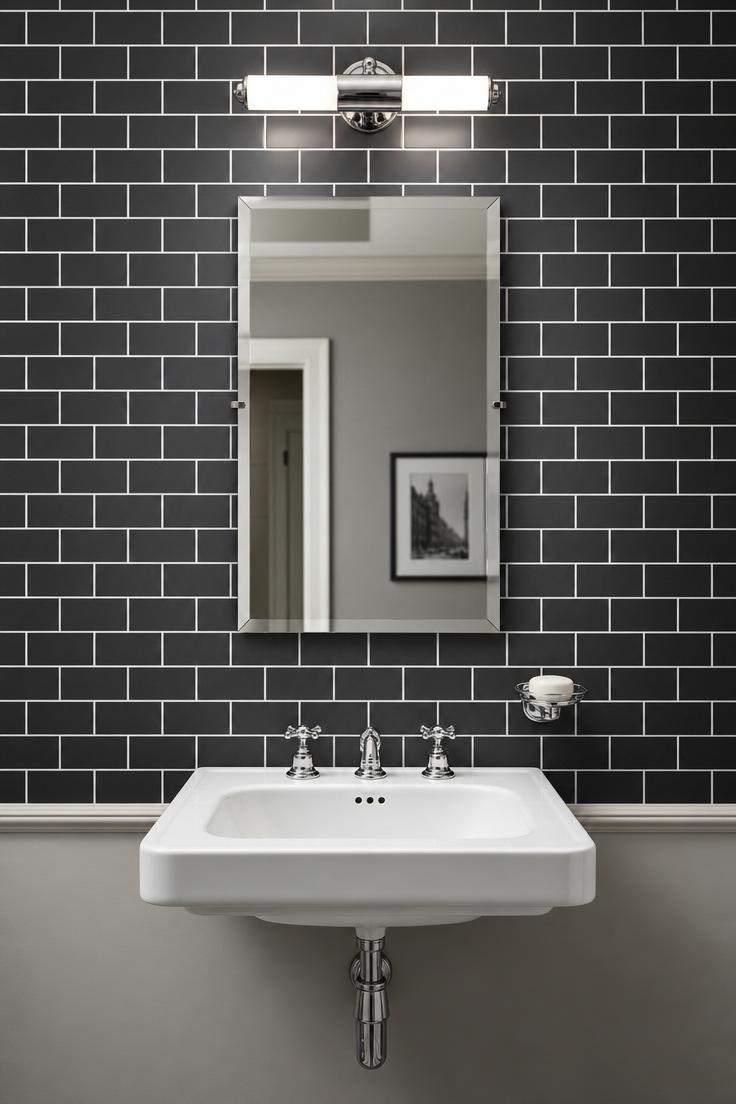
Subway tile is the most democratic bathroom wall decor choice — affordable, available everywhere, and nearly impossible to install badly.
But matte charcoal instead of glossy white changes the entire equation.
The dark matte surface absorbs light where white tile bounces it. The bathroom feels moodier, more intimate, less clinical.
White grout is the counterintuitive move here. Most people pick matching dark grout for dark tile, which makes the individual tiles disappear into a solid surface. White grout on dark tile does the opposite — it turns every tile into a defined rectangle, creating a bold graphic pattern.
Run the tile from about 36 inches up to the ceiling. Below that, paint the wall in a warm pale grey. That break between painted wall and tiled wall gives the room layers.
Chrome fixtures — not matte black, not brass — work best against charcoal tile. The reflective metal catches the white grout lines and ties the whole palette together.
Style Blueprint:
- Matte charcoal subway tile (3×6 classic size)
- Bright white unsanded grout
- Running bond pattern (classic offset)
- Chrome fixtures and accessories
- Pale warm grey paint below the tile line
Design Pro-Tip: Grout color changes a tile wall more than the tile color does. Before committing, buy a sample board and grout three sections — one matching, one contrasting, one neutral. Live with it for a week near the bathroom in similar lighting. What looks right on the showroom floor often reads completely different under your own vanity lights.
A Gilt-Framed Oil Painting Hung Above the Towel Bar
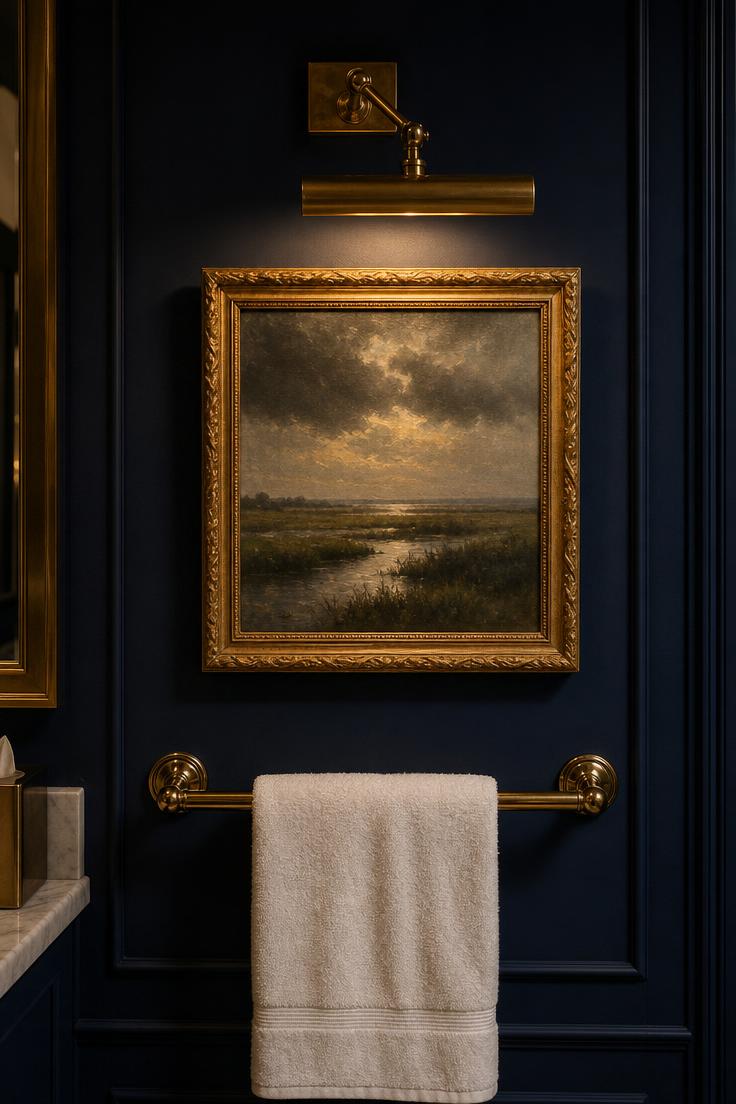
Hanging a real oil painting in a bathroom feels almost transgressive. Aren’t you supposed to save those for the living room?
That’s exactly why it works.
A small oil painting in a gilt frame — something you’d expect to find in a study or above a fireplace — creates a moment of surprise in a bathroom. It elevates the room from functional to personal.
The navy wall behind it is doing heavy lifting here. Dark colors make small paintings feel more precious, more like something displayed in a gallery rather than something hung to fill space.
A picture light is the finishing touch that separates someone who hangs art from someone who displays it. That small brass lamp above the frame says you care about this piece enough to light it properly.
Look for landscapes in muted tones — marshlands, overcast coastlines, twilight fields. The subdued palette sits comfortably in a bathroom where you don’t want anything too stimulating competing for attention.
Style Blueprint:
- Small oil painting (11×14 to 16×20 inches) in muted, earthy tones
- Gilt frame with carved detail (antique or reproduction)
- Deep navy, forest green or charcoal wall paint
- Wall-mounted brass picture light
- Polished brass towel bar below for functional anchoring
Conclusion
Bathroom walls are the one surface in a home that gets looked at every single day but decorated almost never.
Most of these ideas — the pressed prints, the baskets, the floating shelf, the paint treatment — don’t require a contractor, a permit or a weekend of demolition.
Start with one wall. The one you face when you brush your teeth, the blank stretch above the tub, the awkward space between the window and the door.
That’s the wall. Pick one idea from this list and put it there.
The bathroom will feel different by tomorrow morning. And that’s the whole point of bathroom wall decor — it’s not about following a trend or matching a Pinterest board. It’s about making a room you