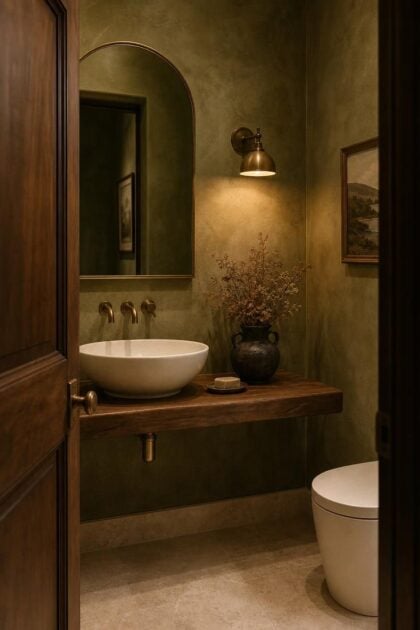
This post may contain affiliate links. If you make a purchase through these links, we may earn a commission at no additional cost to you.
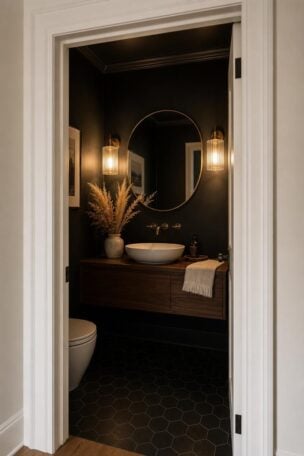
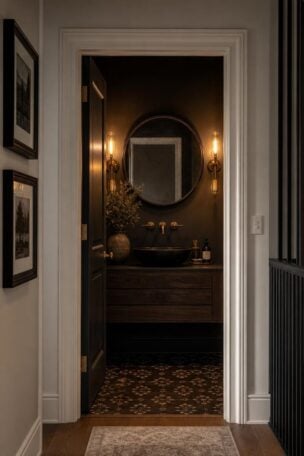
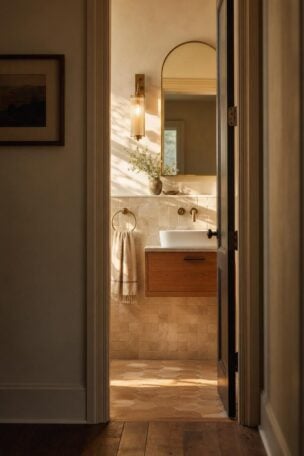
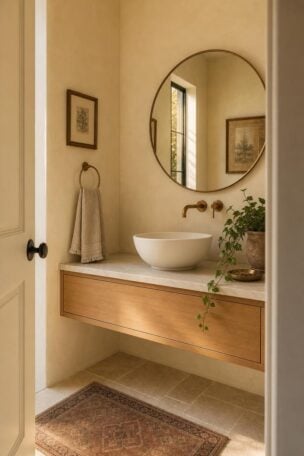
A statement powder room is one of the few places in a home where you can commit fully to a single bold idea without worrying about how it connects to the rest of your rooms.
The small footprint means that premium materials, saturated color, and unexpected finishes cost less and register more.
Guests step in for just a moment, but a well-designed powder room stays with them long after they leave.
These 10 ideas pair specific materials and fixtures to create collected, layered looks that feel intentional from floor to ceiling.
Every detail here is chosen to help you build a half bathroom design that holds its own against any room in the house.
Zellige Tile Backsplash With a Hammered Copper Vessel Sink
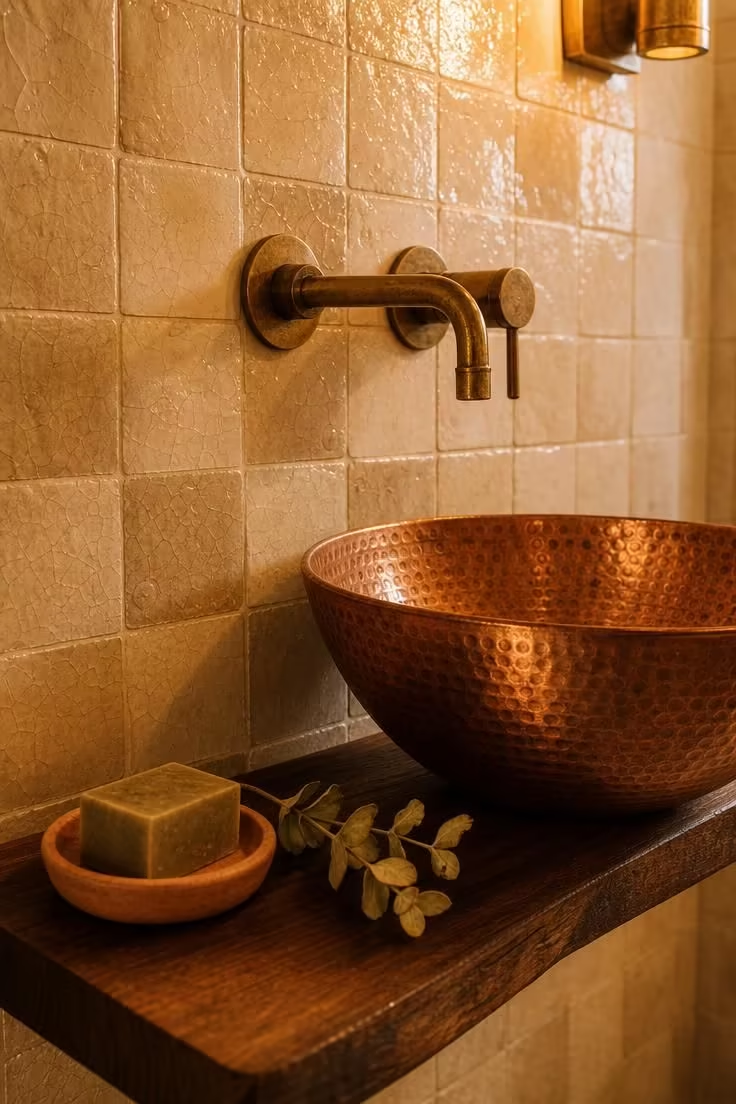
There is something magnetic about a surface you can feel just by looking at it, and handmade zellige tile delivers that quality in every single piece.
The slight variation between tiles, where some catch light and others absorb it, creates a living wall that shifts throughout the day.
Copper ages alongside brass in a way that makes the whole room feel like it has been collecting character for years rather than months.
This vessel sink becomes the room’s centerpiece without competing with the wall behind it because both share the same warm family of tones.
A floating walnut shelf keeps the floor open and draws the eye straight to the copper basin and brass faucet pairing.
Keeping accessories to a bare minimum, just soap and a dried stem, lets the materials do all the talking.
The result is a statement powder room that feels artisan-made from the moment you walk in.
Style Blueprint:
- Handmade zellige tile in ivory or sand tones for the backsplash
- Hammered copper vessel sink with visible texture
- Unlacquered brass wall-mount faucet
- Oiled walnut floating vanity shelf
- Single brass wall sconce for warm, directed light
Lime Wash Plaster Walls in Deep Olive With Brass Sconces
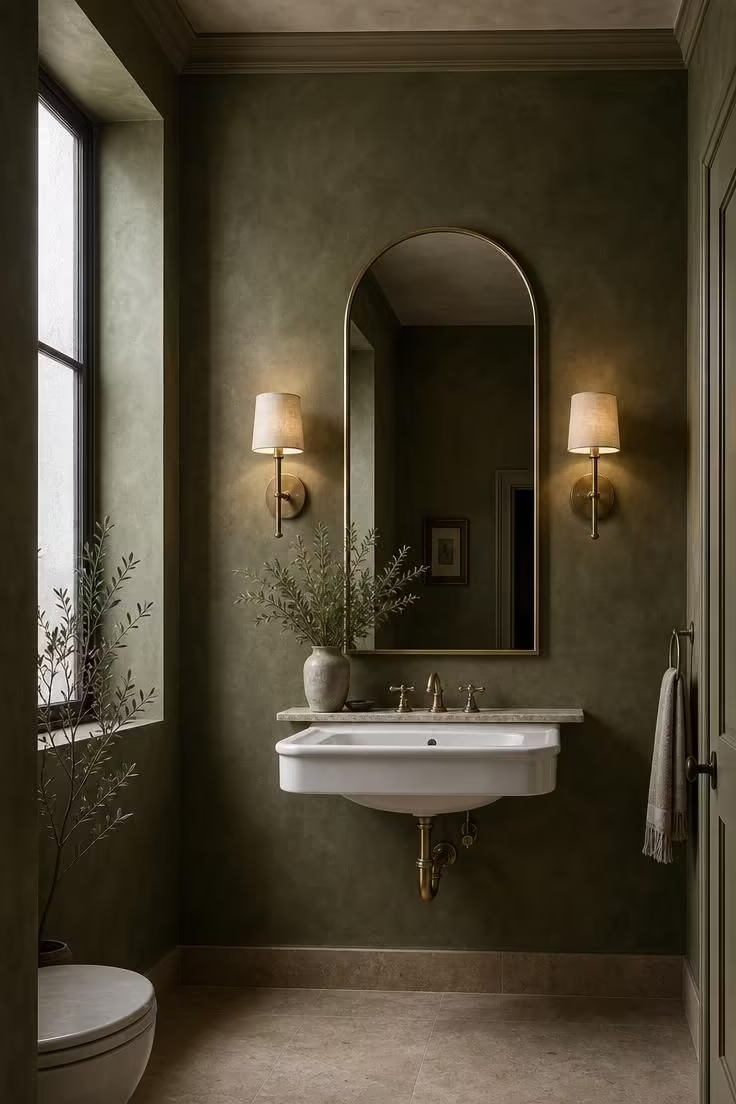
Lime wash plaster rewards patience, and every layer of pigment adds depth that flat paint simply cannot match.
The olive tone shifts from sage in direct light to something closer to forest in the corners, giving a small room surprising visual range.
Placing two sconces at mirror height rather than overhead creates pools of warmth that let the plaster’s texture show fully.
An arched mirror softens the room where angular tile or square frames would add tension.
Exposed brass plumbing below the sink turns a functional connection into a decorative one, adding a layer of intentional honesty to the space.
Fresh herbs on the ledge bring a living green element that ties directly to the wall color without matching it too closely.
Limestone flooring in a honed finish keeps the palette grounded and cool, balancing all the warmth happening at eye level.
The overall mood reads as calm, collected, and surprisingly spacious for a room this small.
Style Blueprint:
- Lime wash plaster in a deep olive or sage-to-forest green
- Aged brass sconces with linen shades at mirror height
- Arched mirror with a thin brass frame
- Wall-mounted sink with exposed brass plumbing
- Honed limestone floor tile
Black Fluted Wood Paneling Behind a Stone Console Vanity
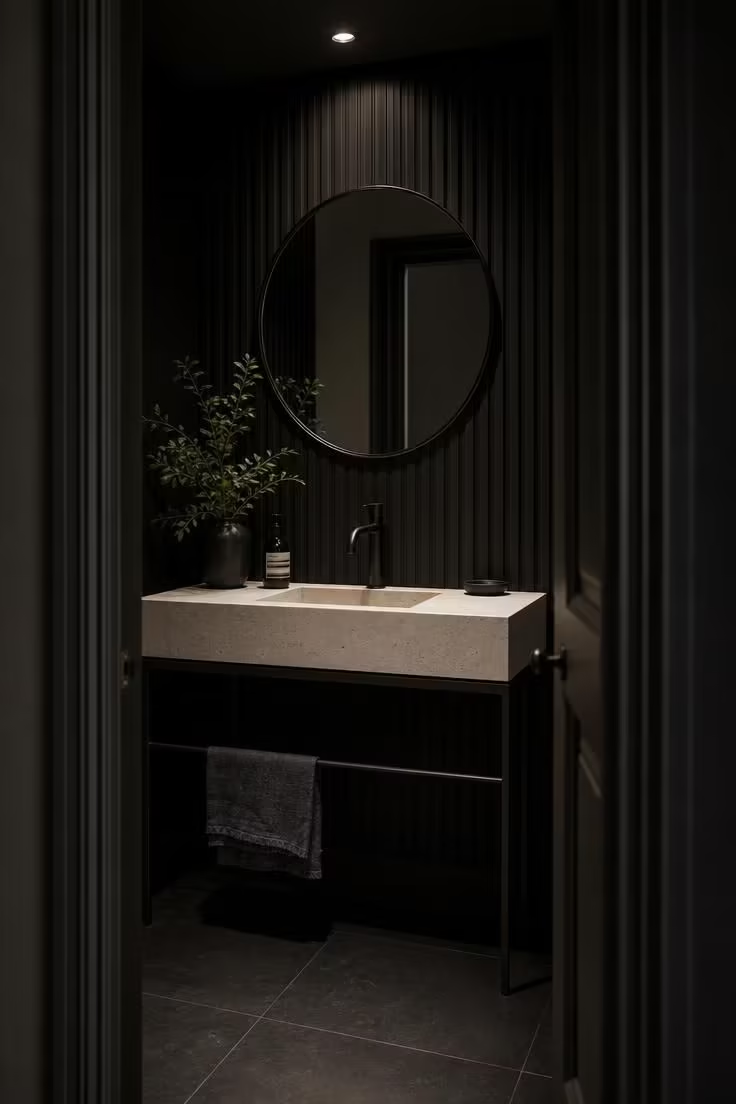
Fluted paneling painted black reads completely differently from a flat black wall because the vertical ridges catch and release light along their edges.
That rhythm of shadow and highlight adds architectural texture without adding a single decorative object.
A console vanity on iron legs keeps the look open at the floor line, which matters in a dark room where heaviness can close in fast.
Honed limestone, not polished, absorbs light gently rather than bouncing it, keeping the moody atmosphere consistent from wall to countertop.
Choosing a blackened iron mirror frame instead of brass keeps the palette tight and intentional.
This bold powder room proves that restraint and drama can share the same square footage.
Style Blueprint:
- Vertical fluted wood paneling in matte black
- Honed limestone console vanity on iron legs
- Matte black single-hole faucet
- Blackened iron round mirror
- Large-format black porcelain floor tile
Design Pro-Tip: In a dark-walled powder room, keep one surface pale, whether it is the countertop, the sink basin, or the floor, to anchor the eye and prevent the room from feeling like a cave. That single light element becomes the focal point by default.
Oversized Botanical Wallpaper With a Matte White Pedestal Sink
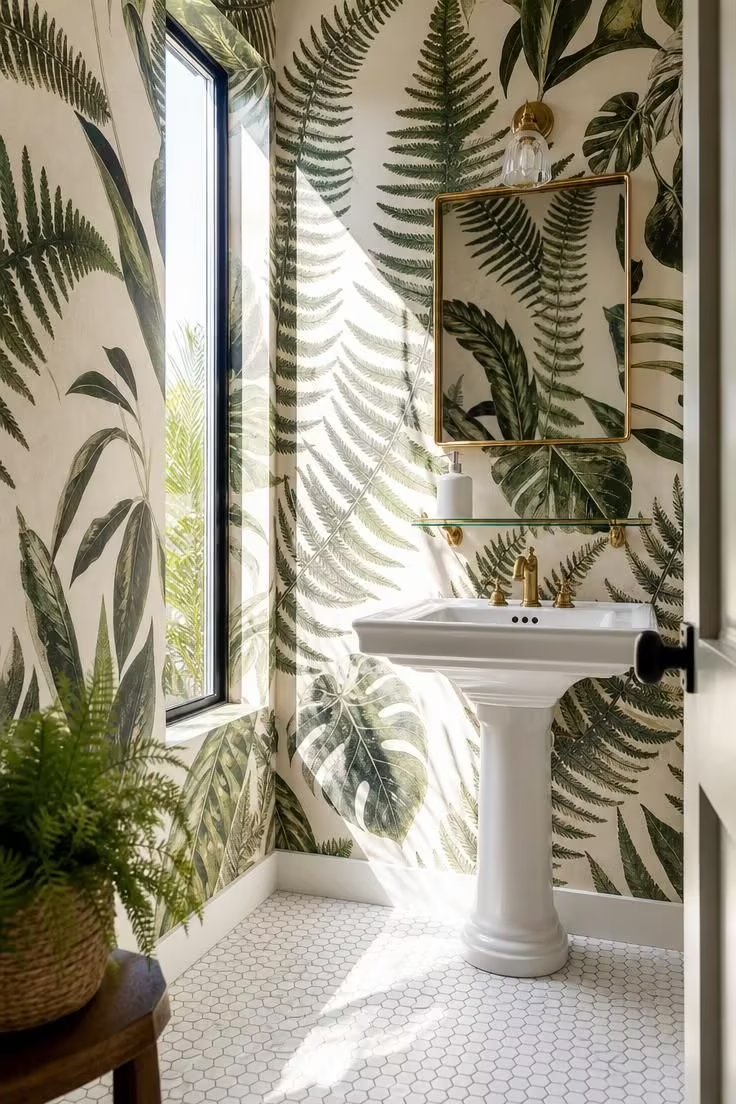
Powder room wallpaper works best when the pattern is large enough that you read it as a mural rather than a repeating tile.
Oversized botanical prints bring the outdoors in without any of the maintenance, and in a small room, two or three full leaf motifs are enough to fill your entire field of vision.
A pedestal sink is the right partner here because it takes up almost no visual space, letting the walls carry the full weight of the design.
White hexagonal mosaic on the floor provides a classic, quiet base that does not compete with anything above the baseboard.
The absence of a curtain is deliberate: bright midday light makes botanical greens look their richest and most saturated.
Keeping the mirror small and brass-framed prevents it from interrupting the wallpaper’s flow with a large reflective break.
A single ceramic soap pump and nothing else on the shelf maintains the idea that the pattern is the room’s only decoration.
This is a powder room tile and wallpaper pairing that treats the walls as the main event and everything else as a supporting player.
The overall feeling is that of stepping into a greenhouse, brief and refreshing.
Style Blueprint:
- Large-scale botanical wallpaper with brushstroke texture on cream ground
- Classic matte white pedestal sink
- White hexagonal mosaic floor tile
- Small brass-framed rectangular mirror
- Tall uncovered window for maximum natural light
Terrazzo Floor Tile With a Walnut Floating Vanity and Round Mirror
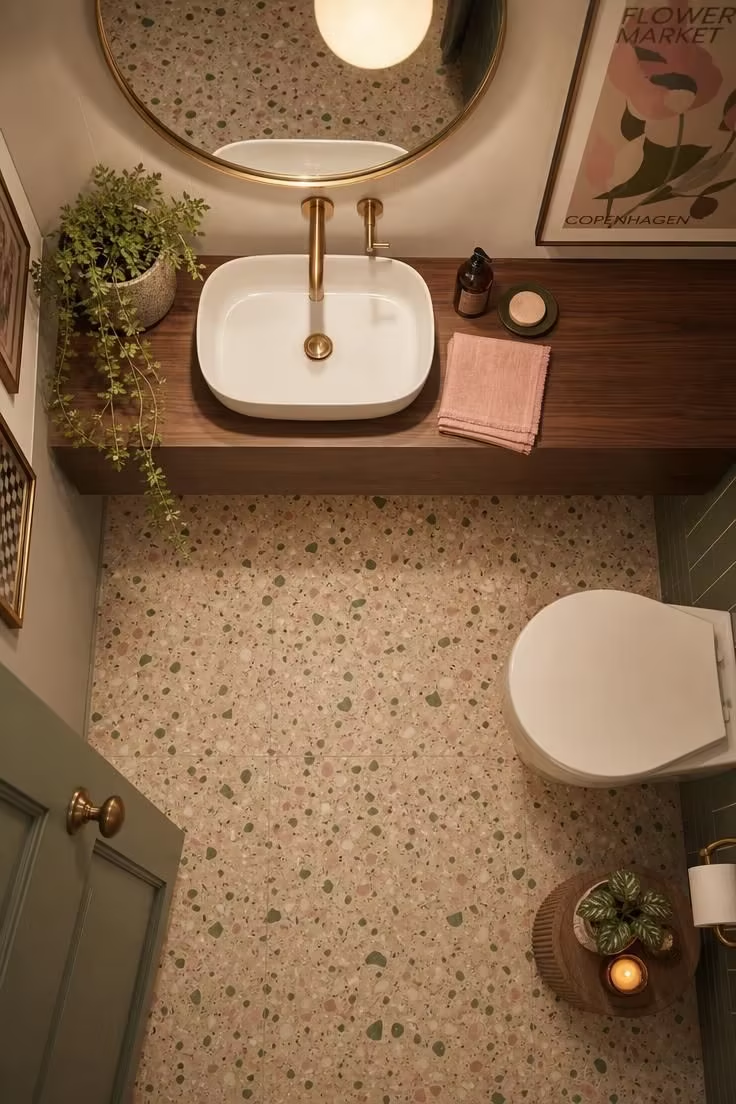
Looking down into this room tells you everything you need to know about how a terrazzo floor anchors a palette.
Every chip of color in the terrazzo, sage, blush, cream, becomes a cue that the rest of the room can pick up without forcing a match.
The floating vanity in walnut creates a warm midtone that bridges the cool green and warm pink chips below it.
Mounting the vanity to the wall shows off as much of the terrazzo as possible, which is the whole point when the floor is this good.
A shallow ceramic basin sits low on the walnut surface, keeping the top of the vanity clean and open.
Blush linen towels pull directly from one of the terrazzo chip colors, a small move that makes the room feel carefully considered.
This small powder room vanity and floor combination has a mid-century quality that feels fresh without trying to be trendy.
Style Blueprint:
- Terrazzo floor tile with sage, blush, and cream chips
- Walnut floating vanity with clean rectangular lines
- Shallow white ceramic basin
- Brushed brass single-lever faucet
- Round mirror with thin brass frame
Venetian Plaster Ceiling in Rust Paired With Encaustic Floor Tile
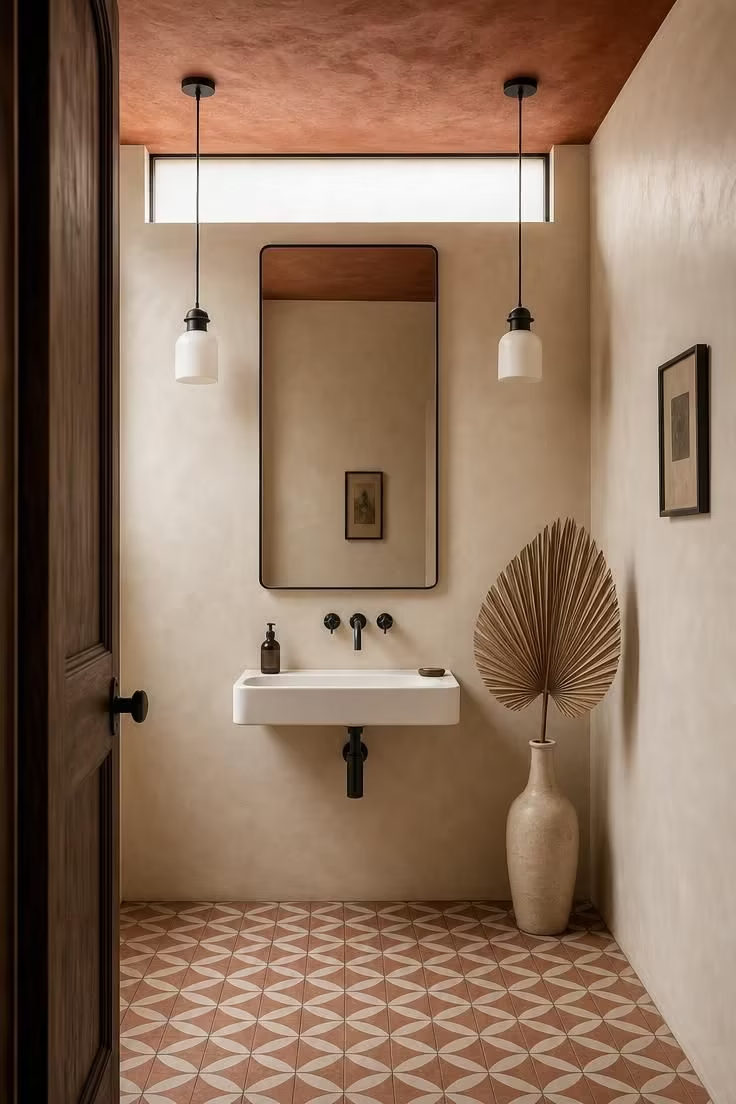
Most powder rooms put all their energy into the walls, so pushing color to the ceiling instead catches people off guard in the best way.
A rust plaster ceiling feels like a warm canopy that lowers the visual height of the room and wraps the space in warmth.
Encaustic cement tile on the floor mirrors that commitment by adding pattern and color underfoot, creating a top-and-bottom sandwich that leaves the walls quiet.
Ivory lime-washed walls act as a breathing space between the two strong horizontal planes, preventing the room from feeling heavy.
This is a jewel tone bathroom approach that skips the expected emerald or navy and goes straight to a warm, earthy rust.
Two small pendants hanging close to the ceiling draw the eye upward and put the plaster finish on full display.
Powder room lighting like this, low-wattage pendants on long cords, creates a layered glow that a single overhead fixture cannot match.
A dried palm fan on the floor adds a sculptural vertical element that bridges the gap between the two patterned planes.
Style Blueprint:
- Venetian plaster ceiling in rust or deep terracotta
- Encaustic cement floor tile in a two-tone geometric pattern
- Ivory lime wash on walls for neutral breathing room
- Frosted glass pendant lights on black fabric cords
- Tall rectangular mirror with a thin iron frame
Design Pro-Tip: Painting or plastering the ceiling a deeper color than the walls makes a small room feel more intimate, not smaller. The eye reads the darker surface as a cozy envelope rather than a low barrier, especially when the walls stay light and open.
Smoked Mirror Accent Wall With a Concrete Trough Sink
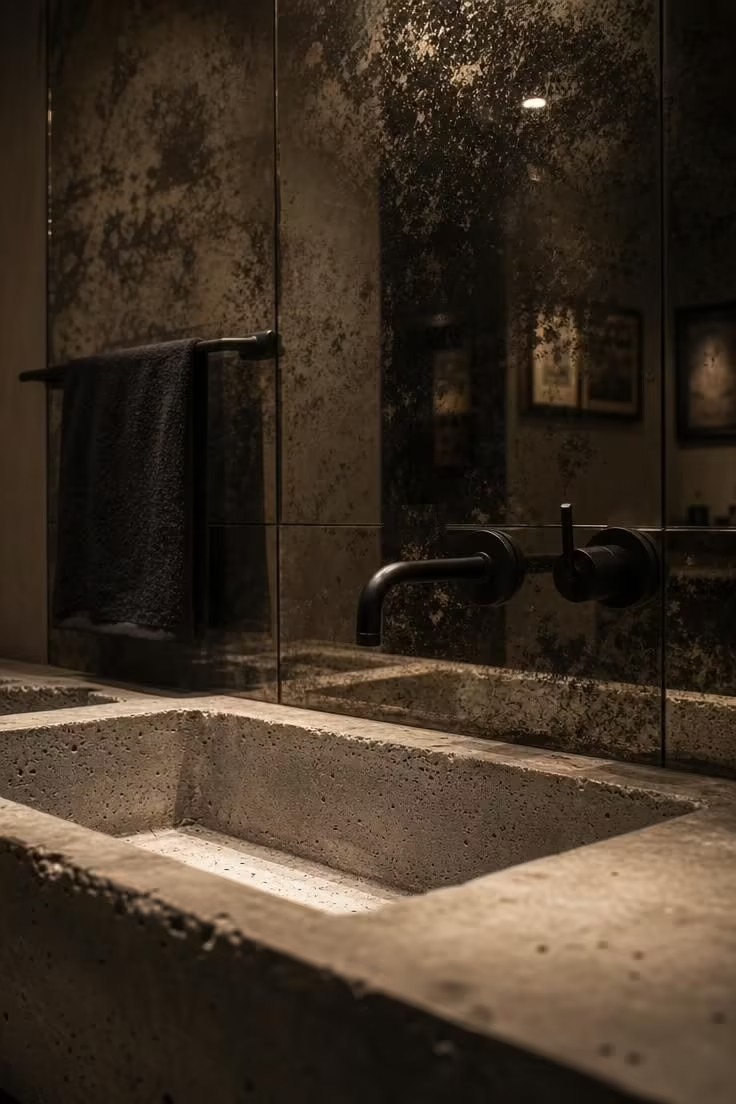
Smoked mirror does something that no other wall treatment can: it adds depth, reflection, and age all at once without a single brushstroke.
Each panel oxidizes slightly differently, so the wall reads as a collection of tones rather than a uniform surface.
A concrete trough sink is the right counterweight here because it is just as raw and honest as the mirror is mysterious and layered.
Mounting the faucet directly through the mirror panel eliminates the need for a backsplash and keeps the material uninterrupted.
Low directional light from a single recessed spot is what makes this composition work, pushing everything outside the sink area into soft shadow.
A decorative mirror wall like this doubles the perceived room size while simultaneously making the space feel more enclosed and private.
Style Blueprint:
- Smoked antiqued mirror panels as full accent wall
- Raw concrete trough sink with hand-cast edges
- Matte black wall-mount faucet through mirror surface
- Single recessed directional spotlight
- Matte black towel bar and hardware
Hand-Painted Chinoiserie Mural With Polished Nickel Fixtures
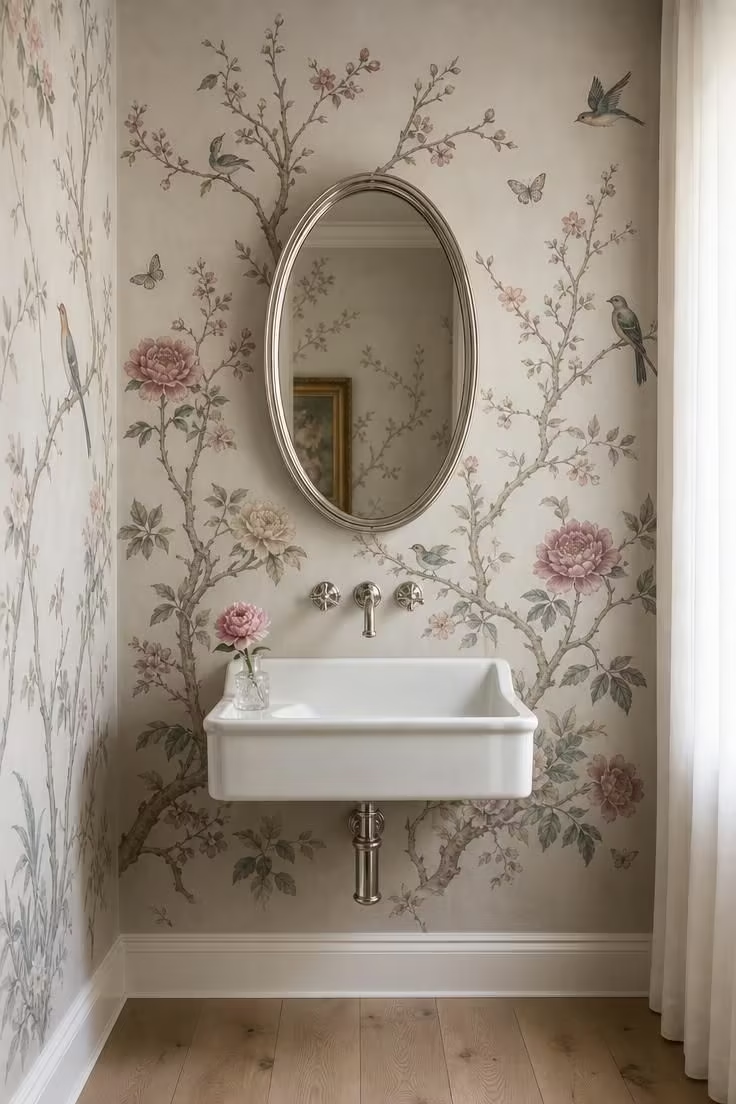
A hand-painted mural on every wall turns a powder room into a room you want to stand in longer than you need to.
The visible brushwork is what separates a mural from wallpaper: up close, you can see the artist’s hand in every petal and branch.
Muted tones keep the scene from overwhelming the small space, reading as delicate rather than busy.
Polished nickel fixtures bring a cooler, more formal edge that suits the traditional craft of chinoiserie better than brass or bronze would.
A farmhouse-style fireclay sink adds substance and weight below the delicate mural, grounding the composition.
Wide-plank white oak flooring in a natural finish stays warm underfoot without pulling attention from the walls.
Soft diffused light is the only lighting condition that lets a mural read correctly, because any harsh directional beam would create glare on the silk-finish ground.
A single peony in a crystal bud vase is the kind of finishing touch that connects the real room to the painted one.
This is half bathroom design at its most considered, where every surface supports the same story.
Style Blueprint:
- Hand-painted chinoiserie mural on pale silk-finish ground
- Polished nickel wall-mount faucet with cross handles
- White fireclay farmhouse-style wall sink
- Polished nickel oval mirror
- Wide-plank white oak flooring in natural matte finish
Shou Sugi Ban Wood Accent Wall With a Black Granite Basin
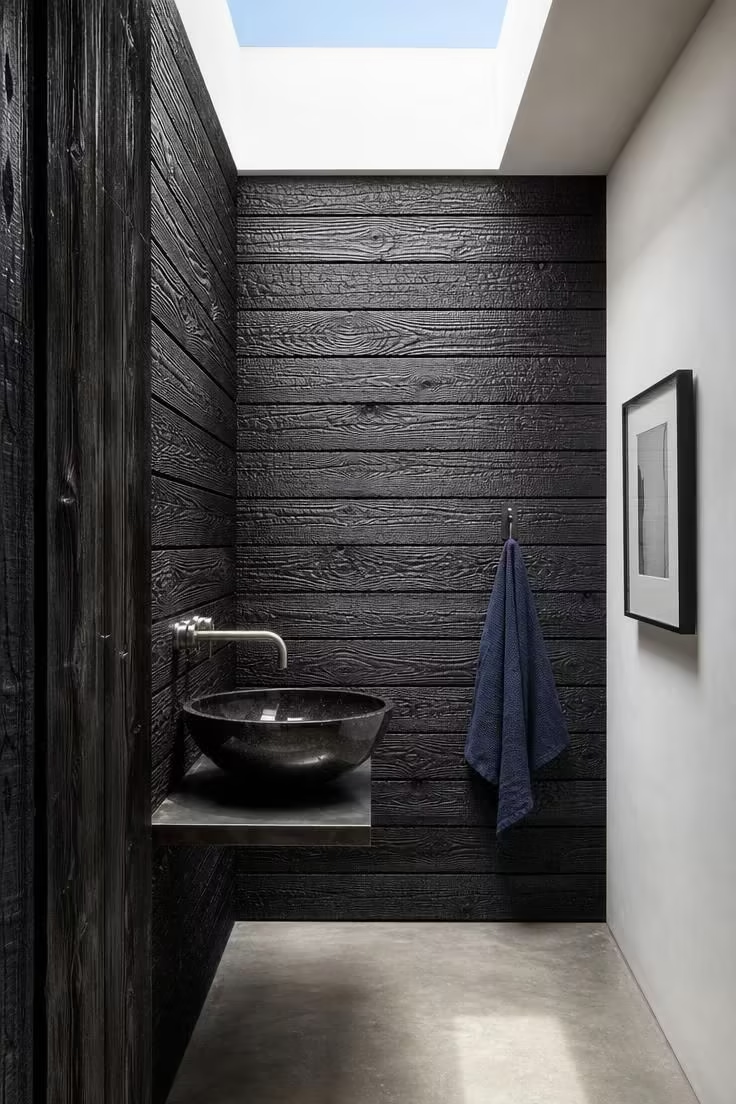
Charred cedar carries a scent and a texture that no printed wallpaper or painted surface can replicate.
The shou sugi ban process, burning, brushing, and sealing, creates a finish that is both waterproof and deeply tactile.
Bright overhead light from a skylight is the best way to reveal the raised grain because it casts micro-shadows across every ridge.
A black granite basin on a raw steel shelf bracket matches the rugged honesty of the charred wood without introducing competing warmth.
White plaster on the opposite wall gives the eye a place to rest and makes the charred surface feel more intentional by contrast.
Poured concrete flooring continues the raw material story underfoot without distracting from the accent wall.
An indigo linen towel is the single color accent, and it works because the deep blue reads as neutral next to black and white.
Style Blueprint:
- Shou sugi ban charred cedar planks for accent wall
- Polished black granite vessel basin
- Raw steel shelf bracket and matching hook
- Brushed nickel wall-mount faucet
- Poured concrete flooring with satin seal
Design Pro-Tip: When pairing two dark materials like charred wood and black stone, separate them with a visible gap of lighter material, like a white plaster wall or a pale grout line. That breathing room prevents the dark surfaces from visually merging into one flat mass.
Sage Board and Batten With a Marble Shelf Sink and Aged Brass Tap
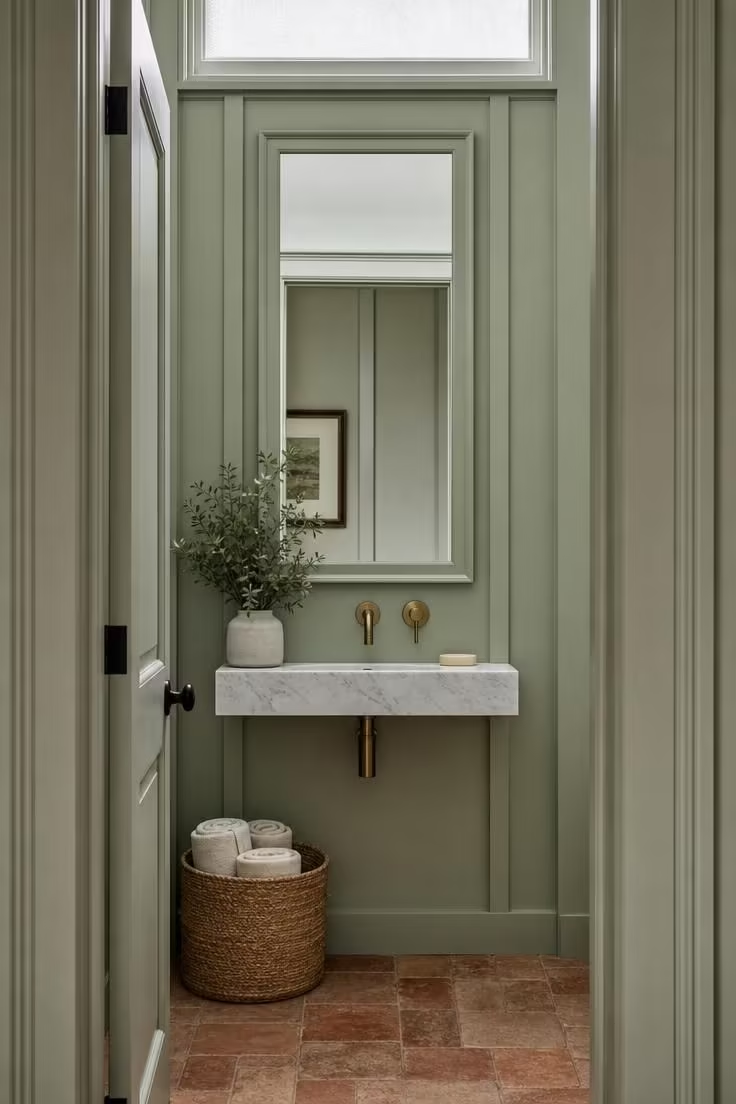
Board and batten in sage green brings architectural rhythm to a flat wall while adding a color that feels both fresh and classic.
The vertical lines of the battens draw the eye upward, making the ceiling feel taller than it actually is.
A marble shelf sink mounted directly between two battens turns the millwork into a built-in frame for the vanity area.
Aged brass, not polished or brushed but genuinely aged with dark spots and warm undertones, adds a lived-in quality that brand-new hardware cannot.
Reclaimed terracotta floor tile introduces warmth and imperfection underfoot, balancing the precision of the painted millwork above.
Painting the mirror frame the same sage as the walls lets it disappear into the paneling, turning the reflection into a quiet window rather than a decorative object.
A jute basket with rolled towels on the floor adds texture and keeps linens within reach without needing a towel bar.
This powder room tile and millwork combination proves that softness and structure can occupy the same room comfortably.
Style Blueprint:
- Board and batten millwork in soft sage green
- Narrow Carrara marble wall-mounted shelf sink
- Aged brass single-lever tap with round base plate
- Reclaimed terracotta floor tile
- Tall rectangular mirror painted to match the wall color
Conclusion
The best statement powder rooms share one quality: every surface, fixture, and finish works together toward a single clear idea.
Whether that idea is a charred cedar accent wall, a hand-painted mural, or a terrazzo floor that sets the palette for the entire room, the commitment is what makes it land.
Start with the one material or finish that excites you most, then build every other choice around it.
A small room with a strong point of view will always leave a bigger impression than a large room that plays it safe.