This post may contain affiliate links. If you make a purchase through these links, we may earn a commission at no additional cost to you.
Your laundry room is probably the last space in your house you’d think to decorate.
And that’s exactly what makes it the perfect place to take a color risk.
A dark green laundry room feels grounded, warm, and surprisingly sophisticated — without the commitment of painting your entire kitchen or living room.
If you’ve been eyeing moody green tones on Pinterest and wondering if they’d actually work in a small utility space, the answer is yes.
Here are ten ideas that show you exactly how to pull it off, from simple cabinet swaps to full-room makeovers.
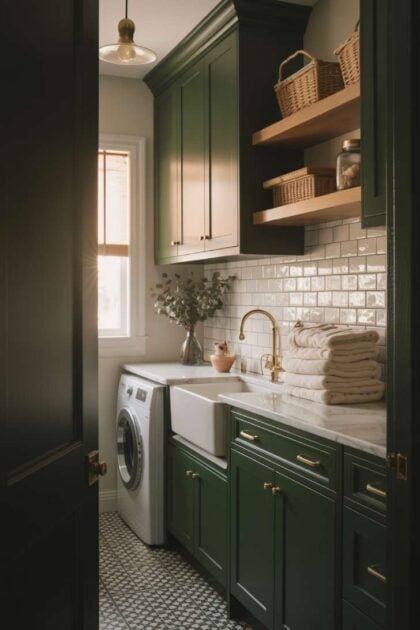
Dark Green Shaker Cabinets with Brass Hardware
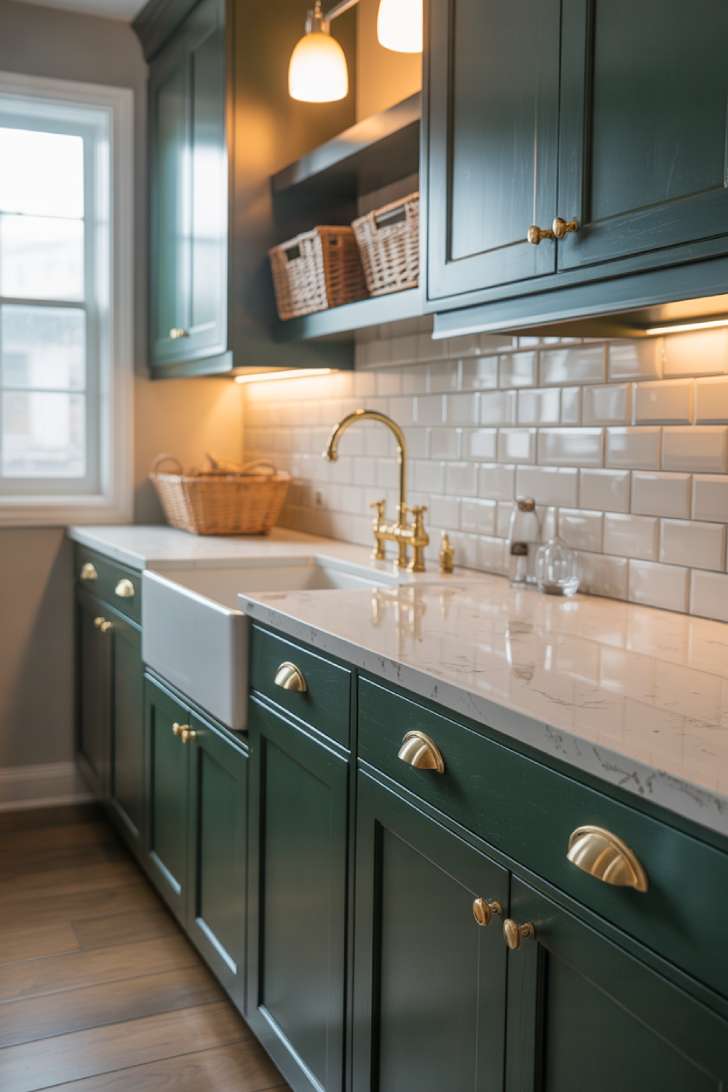
This is the look that started it all for dark green cabinets in the laundry room.
The pairing of hunter green paint with brass hardware has a timeless quality that doesn’t feel trendy — it feels collected, like something you’d see in an older home that’s been updated with care.
What makes this combination work so well is the contrast between the cool depth of the green and the warm glow of the brass.
Your eye naturally moves between the two, and the white countertop acts as a visual rest point that keeps the space from feeling heavy.
Colors like Benjamin Moore Backwoods, Sherwin Williams Pewter Green, and Pratt & Lambert Essex Deep Green are all strong picks for this look.
A satin or semi-gloss finish on the cabinets will catch light and make a small laundry room feel a bit more open.
Style Blueprint:
- Dark green shaker cabinets (Benjamin Moore Backwoods or similar)
- Brushed brass cup pulls and round knobs
- White quartz countertop with subtle veining
- White apron-front farmhouse sink
- Warm-toned pendant light fixture
Crisp Contrast with White Subway Tile
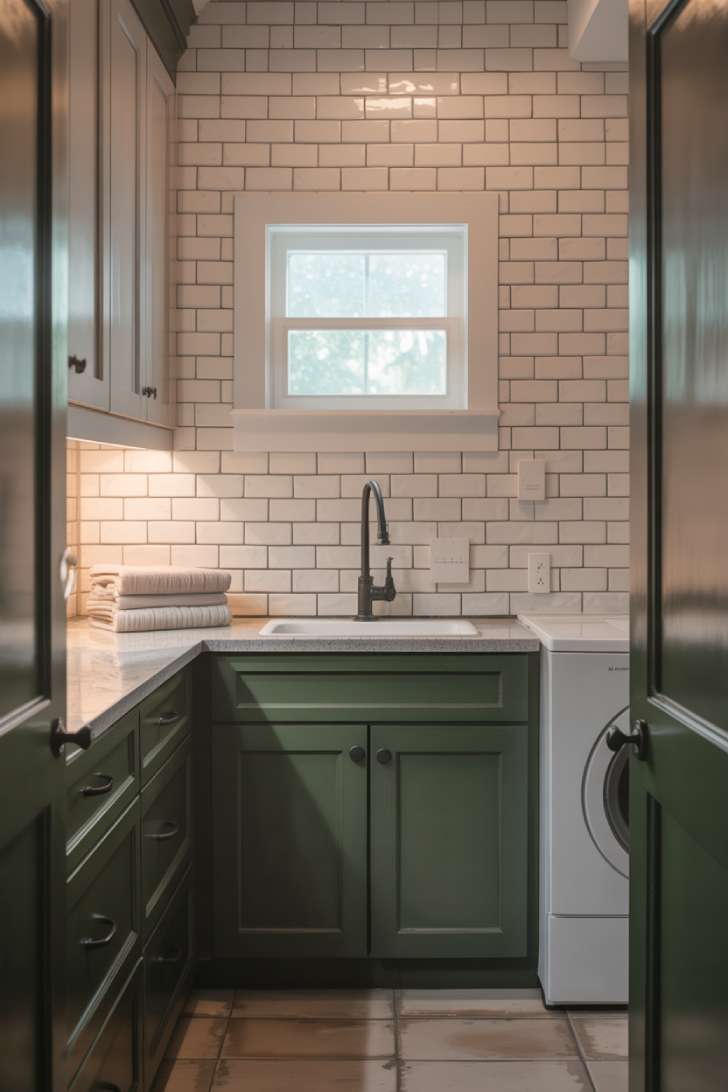
Sometimes the simplest pairing is the one that works hardest.
White subway tile and dark green cabinets create a crisp contrast that gives the cabinetry a strong presence without overwhelming the room.
The light tile keeps the wall surface bright and provides a clean backdrop for the deeper cabinet color, which is especially useful in laundry rooms with limited natural light.
What makes the pairing work visually is the contrast between the darker lower elements and the lighter surfaces above.
The green cabinetry gives the lower half of the room more visual weight, while the white tile and upper cabinets keep the composition open and bright.
That distribution of light and dark creates a more balanced layout and prevents the deeper color from dominating the entire space.
If you go with standard 3×6 subway tile, a beveled edge adds subtle shadow lines and dimension that flat tile does not provide.
White grout creates a quieter, more continuous surface, while gray grout outlines each tile and adds more visible pattern and texture.
Style Blueprint:
- Dark green painted lower cabinets
- White beveled subway tile backsplash
- White or light-toned upper cabinets
- Matte black or brass faucet
- Light neutral porcelain floor tile
Moody Floors Meet Bold Green Cabinets
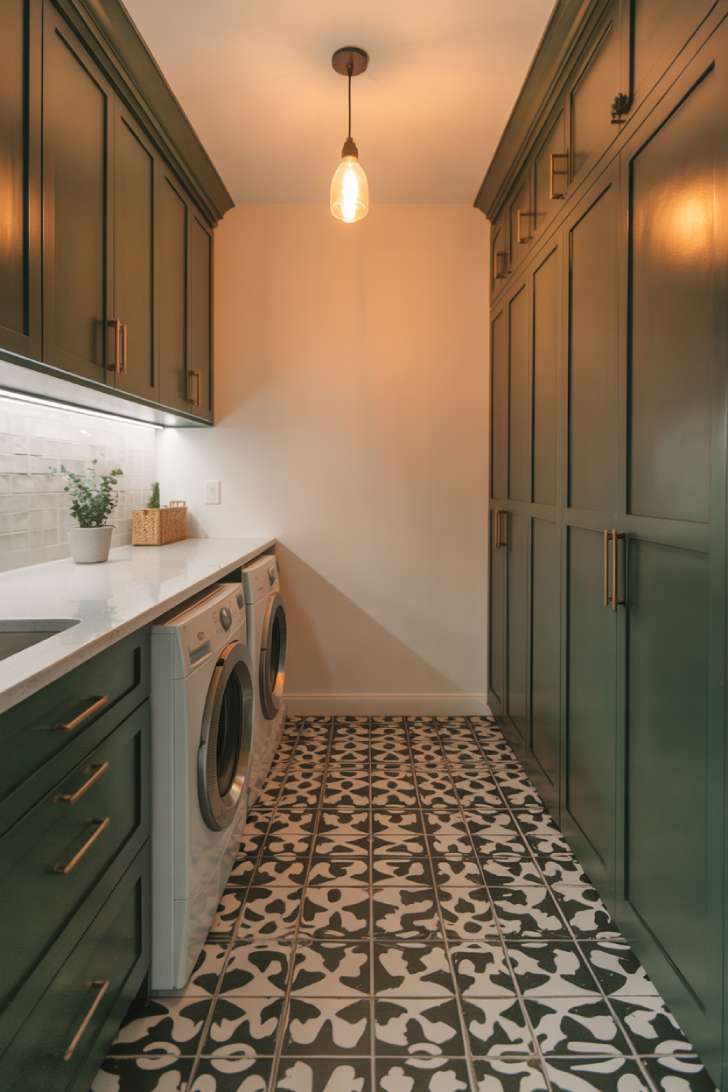
This one is a crowd favorite for a reason.
A patterned floor tile turns the laundry room into something worth photographing — and the dark green cabinets keep it from looking too busy.
Black-and-white encaustic cement tile, geometric patterns, or classic checkerboard all pair naturally with deep greens.
The pattern pulls your eye down, and the green anchors the vertical space.
What happens visually is that the floor becomes the personality of the room, and the cabinets become the calm backdrop.
If the floor were paired with bright white or bland beige cabinets, the pattern would feel disconnected.
The depth of the green ties the whole room together and gives the pattern something to rest against.
Keep the walls white or very pale to let the floor and cabinets do the talking.
A moody laundry room like this one is a space people will actually want to spend time in.
Style Blueprint:
- Dark green cabinets (Sherwin Williams Shade Grown or similar)
- Black-and-white patterned cement tile floor
- Aged brass or satin gold cabinet pulls
- White walls and ceiling
- Glass pendant light with warm bulb
Design Pro-Tip: If you’re using a bold patterned floor tile, limit your room to two dominant colors — the tile pattern and the cabinet color. Adding a third strong color will compete and make the space feel chaotic instead of collected.
A Half-Wall of Rich Green Board and Batten
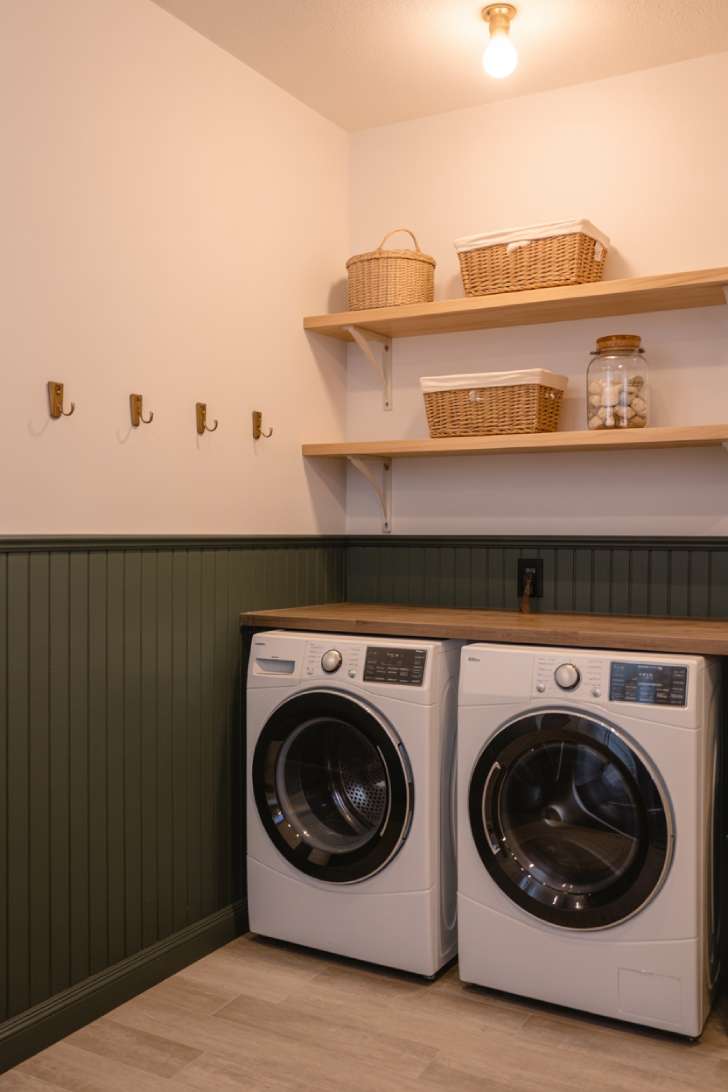
Not ready to paint the entire room?
A half-wall approach gives you the color without the full commitment.
Board and batten on the lower portion of the wall, painted in a deep green like Benjamin Moore Backwoods, creates a wainscoting effect that adds structure and contrast.
The upper wall stays white, keeping the overall palette lighter and giving the darker lower section a crisp visual boundary.
The contrast also helps define the proportions of the room.
The deep green anchors the lower half of the wall, while the white upper section keeps the composition from feeling too heavy.
As a practical bonus, the darker paint can make everyday scuffs and marks less noticeable in a hardworking laundry room.
It is practical and polished at the same time.
Add floating shelves on the upper white section to hold baskets, detergent, and a plant or two.
A butcher block countertop over the washer and dryer adds warmth and softens the contrast between the dark green and white.
Style Blueprint:
- Dark green board and batten (lower two-thirds of wall)
- Warm white paint on upper walls (Benjamin Moore White Dove or similar)
- Floating white oak shelves
- Butcher block countertop over machines
- Small brass wall hooks on the batten section
Warm Wood and Hunter Green
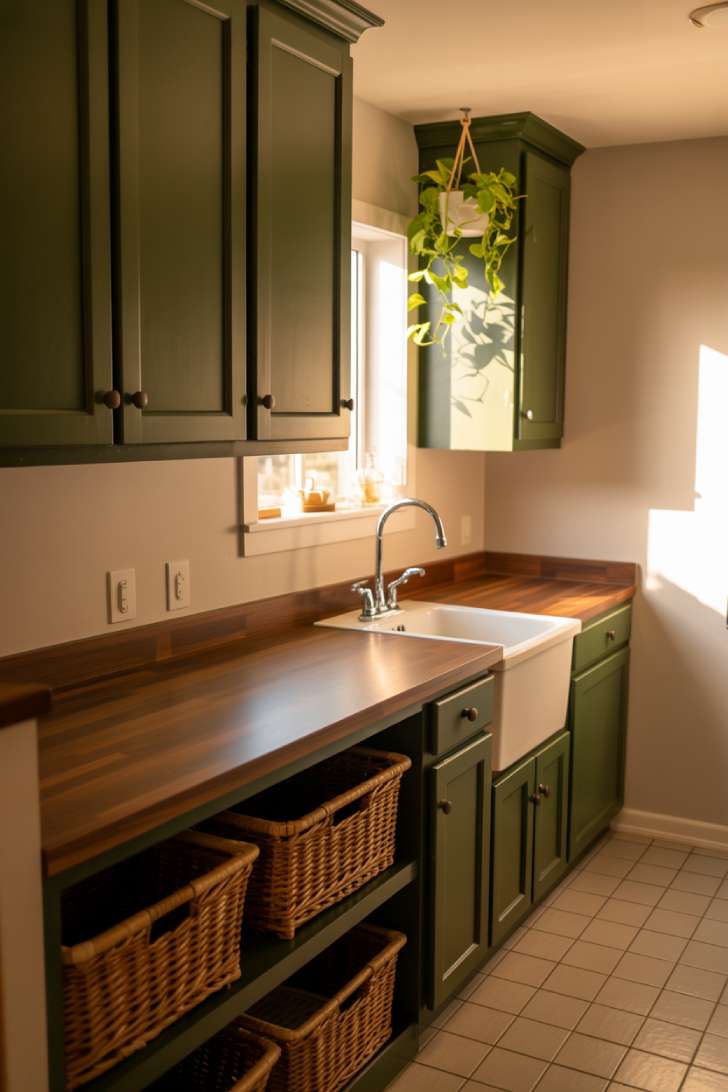
There’s something about wood and green that just works.
It makes sense — they’re colors you’d find together outside, in a forest or a garden — so the combination registers as natural and calming.
A sealed walnut or white oak butcher block countertop paired with hunter green paint creates one of the warmest versions of the dark green laundry room.
The wood adds a layer of texture and warmth that a stone or quartz countertop can’t quite match.
This look leans a little more relaxed and organic, less polished, which is exactly right for a room that’s meant to be functional.
Matte black hardware keeps things grounded, and a white farmhouse sink provides the only real pop of contrast.
Pothos and snake plants do well in laundry rooms — the humidity and indirect light suit them — and the trailing green leaves echo the cabinet color.
Style Blueprint:
- Dark hunter green cabinets (Sherwin Williams Dard Hunter Green or similar)
- Sealed walnut butcher block countertop
- Matte black bin pulls and knobs
- White undermount utility sink
- Trailing pothos or snake plant on an upper shelf
Green Walls with White Cabinetry
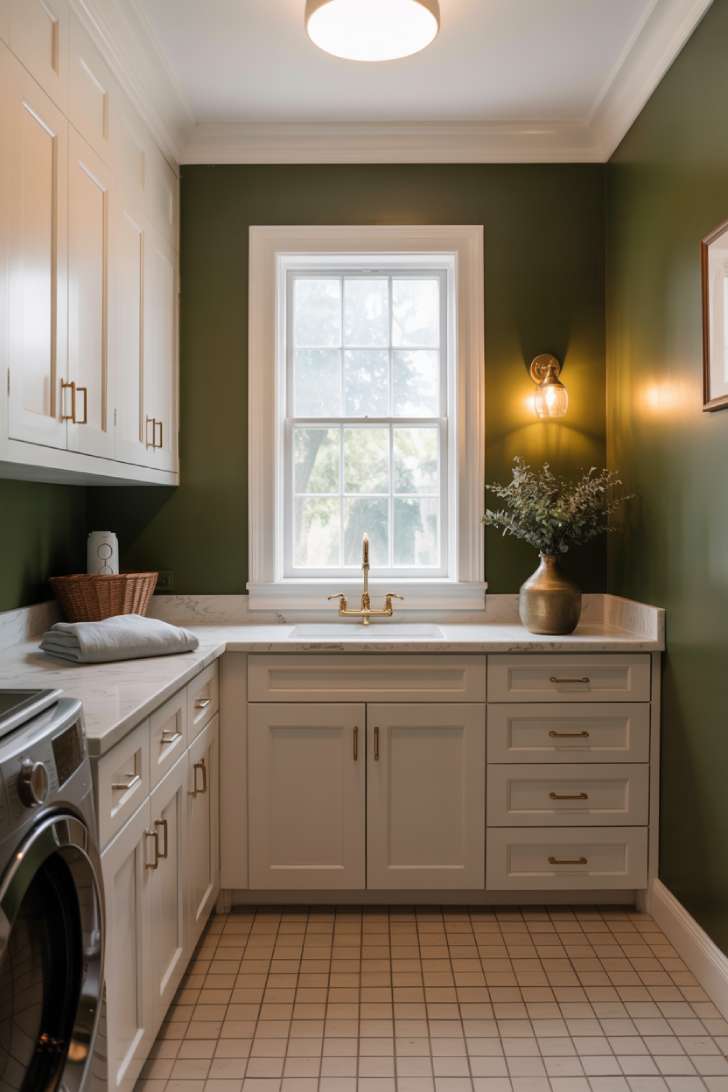
Here’s the reverse approach — paint the walls and let the cabinets stay white.
This gives the room an enveloping, moody feel that wraps around you when you walk in.
The white cabinets pop against the dark backdrop and keep storage areas easy to see and access.
Sherwin Williams Shade Grown, Behr Black Bamboo, and Benjamin Moore Backwoods are all great choices for walls.
The most common concern with dark wall colors is that the room will feel too small.
That can happen — but the fix is simple.
White cabinets, a light countertop, and good lighting (a wall sconce, under-cabinet LEDs, or a bright pendant) counterbalance the darkness and create enough contrast to keep the space from closing in.
This look works best in rooms with at least one window, where natural light can hit the green walls and reveal the true richness of the color.
A room without windows can still pull this off, but you’ll need to lean harder on artificial light sources.
Style Blueprint:
- Dark green wall paint (Behr Black Bamboo or similar)
- White shaker cabinets (upper and lower)
- White marble-look quartz countertop
- Polished nickel or chrome cabinet pulls
- Brass or nickel wall sconce for task lighting
Design Pro-Tip: Dark paint colors shift dramatically based on light direction. A north-facing laundry room will make your green look cooler and darker; south-facing light will bring out warmth and saturation. Always test with a large peel-and-stick paint sample on the wall for at least 48 hours before committing.
The Full-Green Cocoon
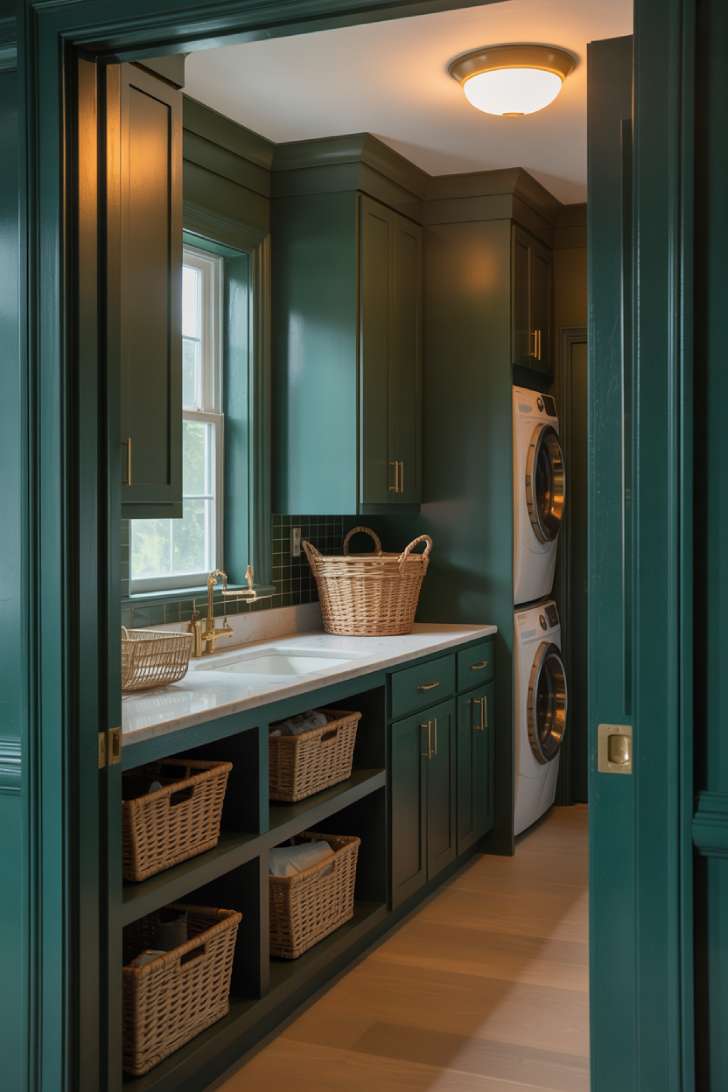
This one takes confidence.
Painting the walls, cabinets, and window trim in the same dark green creates a strong color-drenched look.
The repeated tone connects the architectural elements and gives the room a more continuous, enveloping appearance.
It feels moody and dramatic, and it works especially well in rooms with generous natural light.
What keeps the scheme looking refined rather than heavy is the visual consistency.
Using one color across walls, cabinetry, and trim reduces contrast between individual surfaces and creates a cleaner, more unified composition.
The finish matters here.
Use satin or semi-gloss on the cabinets and trim, with matte or eggshell on the walls. T
he subtle change in sheen gives each surface definition without interrupting the overall color palette.
A white countertop and brushed gold hardware provide enough contrast to keep the dark green from dominating the room.
Natural woven baskets and a light wood floor add texture, variation, and warmth.
Style Blueprint:
- One dark green paint color on all surfaces (Benjamin Moore Essex Green or similar)
- Satin finish on cabinets and trim; eggshell on walls
- White quartz countertop for contrast
- Brushed gold cup pulls and knobs
- Natural woven baskets in two or three sizes
Botanical Wallpaper Above Green Cabinets
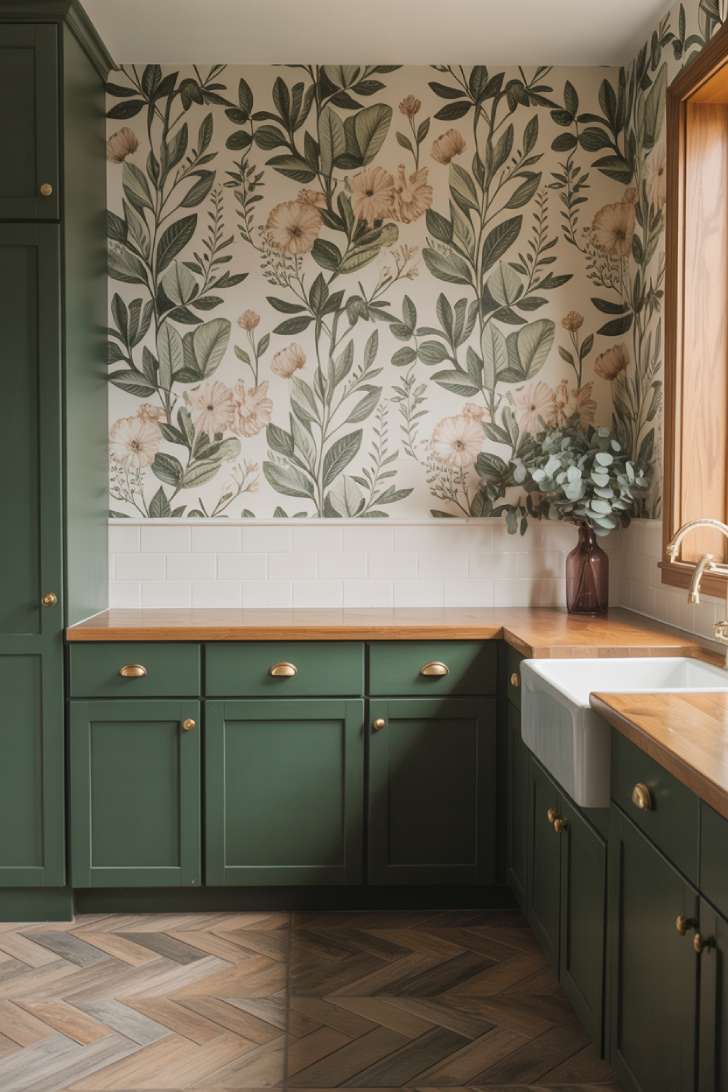
Wallpaper in a laundry room might sound risky, but peel-and-stick options have made it a much easier commitment.
A botanical or floral pattern on the upper walls, paired with dark green cabinets below, ties the room together with a garden-inspired color story.
The wallpaper brings movement, pattern, and softness to a room that’s otherwise full of hard surfaces — tile, countertops, machines.
That contrast between the rigid geometry of the room and the flowing, organic shapes in the wallpaper gives your mind something interesting to land on.
It turns a utility space into a room with actual character.
Pick a wallpaper with green tones that relate to your cabinet color but don’t match exactly — you want harmony, not a perfect match.
Cream, blush, and soft green on a light background keeps the upper portion of the room bright.
A simple white tile backsplash between the countertop and the wallpaper protects the paper from splashes and creates a clean dividing line.
Style Blueprint:
- Dark green painted lower cabinets
- Botanical peel-and-stick wallpaper on upper walls
- White tile backsplash (2-3 rows) between cabinets and wallpaper
- Butcher block or light wood countertop
- Brass cabinet knobs and a dried eucalyptus arrangement
Small Laundry Room with a Green Accent Wall
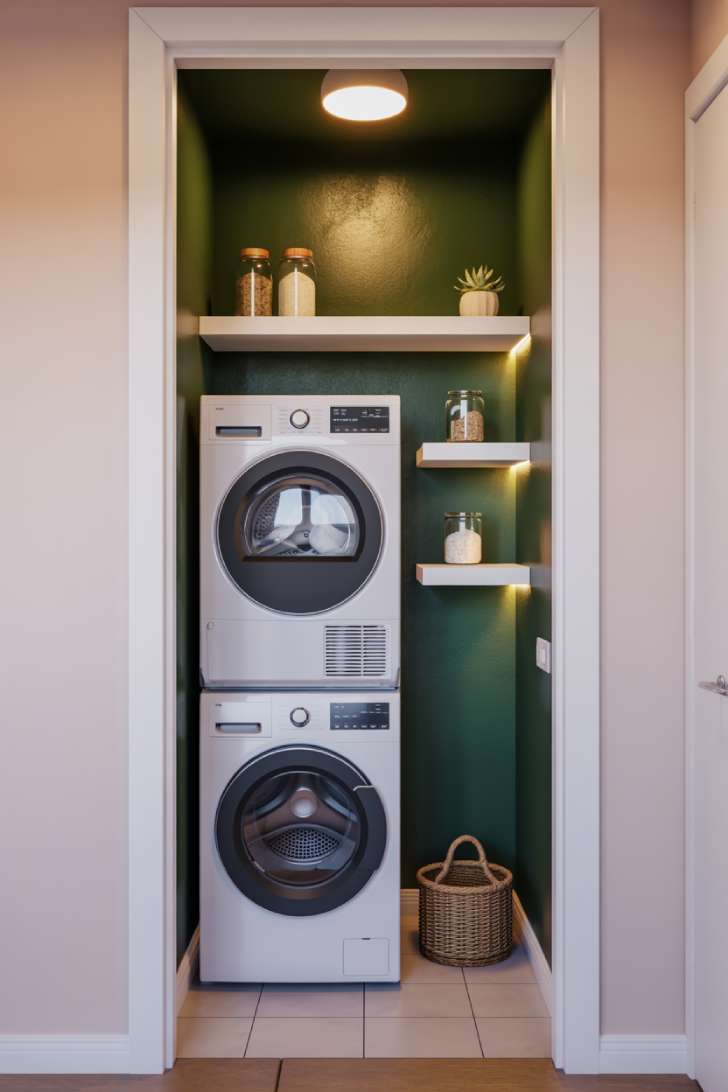
Small laundry rooms can absolutely handle dark color when it is used selectively and balanced with lighter surfaces.
One accent wall in a deep green, such as the wall behind the machines, creates a strong focal point and gives the room more visual definition without overwhelming the layout.
Keeping the remaining walls white or very light creates contrast around the darker surface and preserves a brighter overall composition.
In a compact room, a single contrasting wall gives the space a clear visual hierarchy instead of allowing every surface to compete equally for attention.
The darker wall also adds a stronger sense of layering between the back of the room and the lighter surrounding surfaces.
That contrast can make the layout feel more dimensional, with the green wall acting as a visual backdrop and the white side walls framing it.
LED strip lighting under shelves can make a noticeable difference in a small laundry room makeover like this.
It is relatively inexpensive, adds a warm layer of illumination, and directs light onto work surfaces that might otherwise remain shadowed.
A semi-gloss or satin finish on the green wall will reflect more light than a flat finish, giving the dark surface a slightly brighter appearance in a room with limited natural light.
Style Blueprint:
- Dark emerald green accent wall (one wall only)
- Soft warm white on remaining walls and ceiling
- Stacked washer and dryer to save floor space
- White floating shelves with LED strip lighting underneath
- Glass jars for pods and detergent to keep the look clean
Design Pro-Tip: In a room smaller than 30 square feet, limit dark color to a single wall or the cabinet fronts. Everything else should stay light. The contrast is what creates the drama — not the amount of dark surface area.
Open Shelving and Green Cabinets
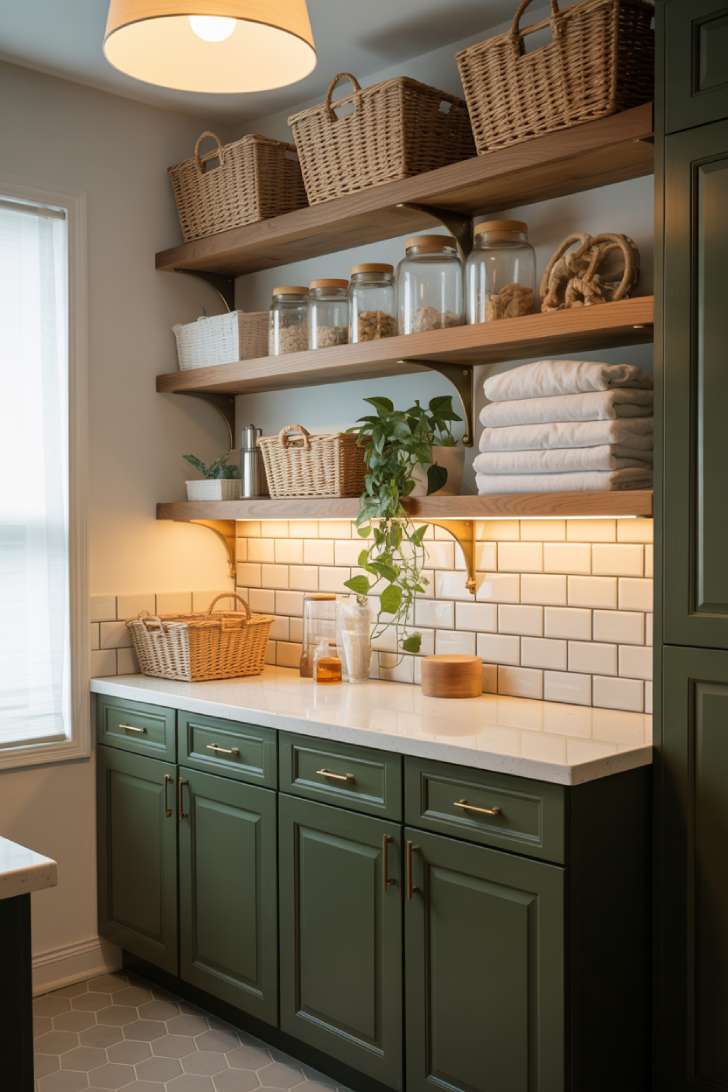
Replacing upper cabinets with open shelving gives a dark green laundry room a lighter, more relaxed feel.
The shelves let the wall color (or tile) show through, and the visual weight of the room drops.
White oak and walnut are the most popular shelf choices, and brass brackets that match the cabinet hardware pull everything together.
Open shelving does something closed cabinets can’t — it lets you curate what you see.
Woven baskets, glass jars with wooden lids, and a small trailing plant turn storage into decoration.
The room feels intentional and personal instead of purely functional.
One trade-off: open shelves collect dust and show clutter.
If you go this route, commit to keeping things tidy or stick to attractive containers that hide the mess.
This look photographs beautifully, and it’s one of the easier small laundry room makeover projects to take on yourself over a weekend.
Paint the lower cabinets, mount two or three floating shelves, add styled accessories, and you’ve got a room that looks like it came out of a magazine.
Style Blueprint:
- Dark green lower cabinets
- Two rows of white oak floating shelves with brass brackets
- White subway tile backsplash
- Styled accessories: woven baskets, glass jars, trailing pothos
- White quartz countertop
Wrapping Up
A dark green laundry room is one of those rare projects where a relatively small investment — a few cans of paint, some new hardware, maybe a patterned floor tile — completely changes how a space looks and feels.
It’s a room where you can go bolder than you’d normally dare, and the payoff is a space that actually makes the chore of laundry a little more enjoyable.
Pick the idea that fits your budget, your comfort level, and your light situation, and go for it.