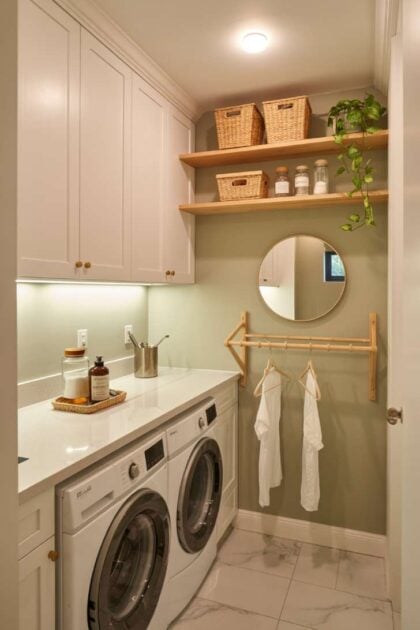
A small laundry room can feel like the most defeating space in the house.
There’s never enough room for the basket, the detergent keeps falling off the shelf, and folding clothes on top of the dryer feels like a circus act.
But here’s the truth: size has very little to do with how well a laundry room works.
The ideas ahead cover every kind of small laundry space — tight closets, hallway alcoves, apartment nooks, and under-stair corners — and range from weekend DIY fixes to full small laundry room makeover-level upgrades.
Some of these changes take an afternoon.
Others take a little more planning.
All of them make a real difference.
Go Vertical With a Stacked Washer and Dryer
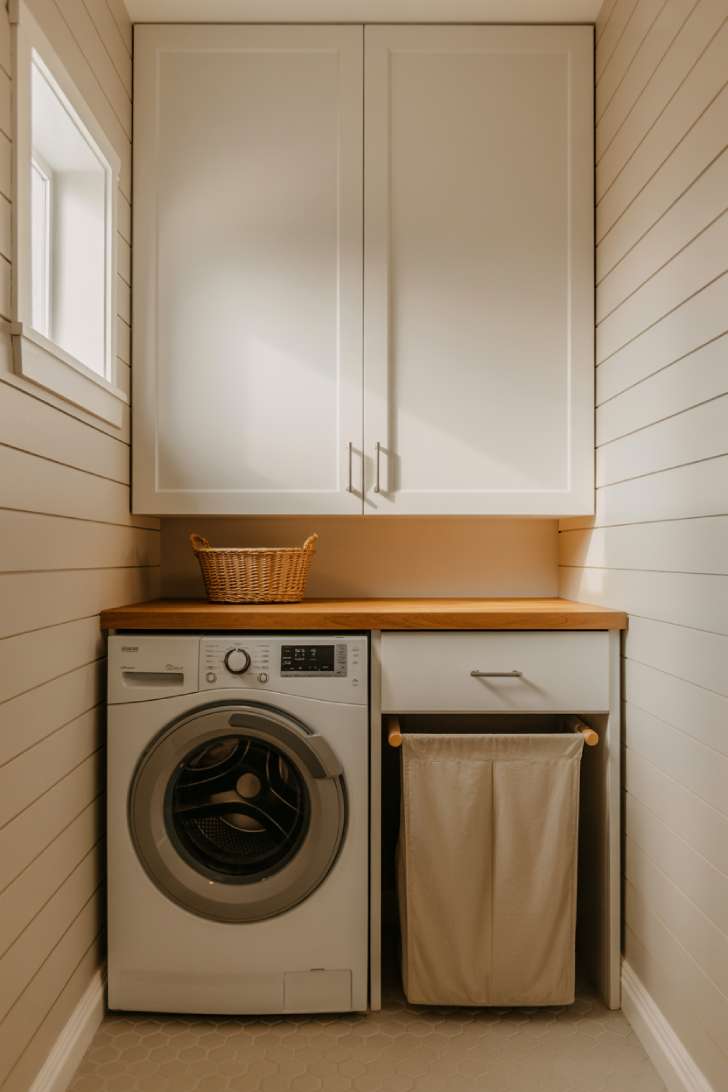
Of all the small laundry room ideas out there, stacking your appliances is the one that delivers the most dramatic result for the least amount of effort.
By going vertical instead of side by side, you instantly free up 27 to 30 inches of floor width — that’s the equivalent of a full cabinet run.
Front-loading machines are the only real option here, and that’s actually a good thing.
Front-loaders allow for a countertop above them, cleaner cabinetry integration, and a more streamlined overall look.
Always use a manufacturer-approved stacking kit to secure the dryer safely on top — this isn’t a step to skip.
The wall space that opens up beside and above the stacked units is where the real transformation happens.
Pull-out hampers, slim rolling carts, and tall storage towers can fill that reclaimed floor width without the room feeling crowded.
The vertical height of a stacked pair — around 75 inches — naturally draws the eye upward, which is a trick that makes any small room feel taller and more open than it actually is.
Style Blueprint:
- Stacking kit (brand-matched to your specific appliances)
- Front-loading washer and dryer in matching finish
- Tall upper cabinets that reach ceiling height
- Slim pull-out hamper cabinet beside the stack
- Pale tile flooring to reflect light upward
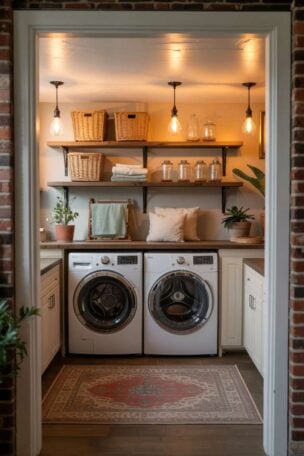
Float Some Shelves Above the Machines
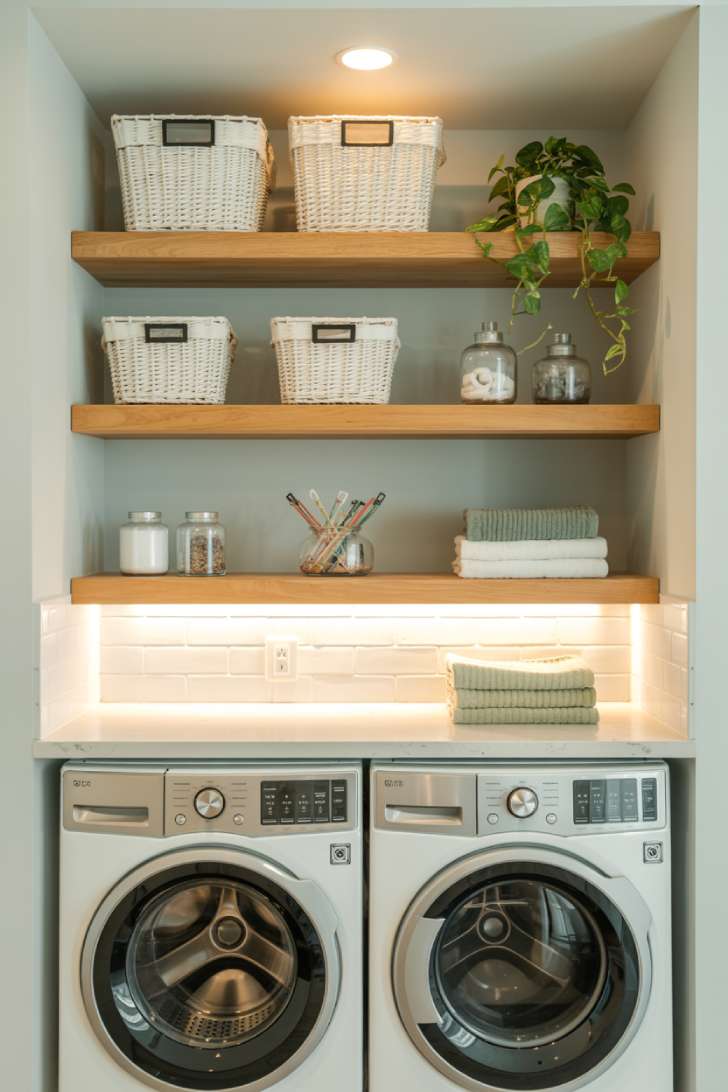
The space directly above a washer and dryer is almost always wasted.
It’s the number-one missed opportunity in small laundry room storage, and fixing it doesn’t require a contractor or a big budget.
Floating shelves are the fastest solution — they go up in an afternoon and instantly transform a blank wall into organized, accessible storage.
Space shelves 12 to 18 inches apart vertically so items are easy to grab without awkward reaching.
The styling of the shelves matters as much as the storage itself.
Mixing closed woven baskets with open glass jars creates visual rhythm — the eye gets some rest, then some detail, then some rest again.
That rhythm keeps the room from feeling cluttered even when every shelf is full.
Natural wood shelves against a white wall add warmth without color, which is a reliable way to make a utility space feel more like an intentional room.
Under-shelf LED strips are worth adding at the same time — they brighten the countertop below and make the shelf styling visible even in a windowless room.
Style Blueprint:
- Natural wood or white laminate floating shelves (3 tiers minimum)
- Matching woven baskets with label holders
- Clear glass apothecary jars for pods, clothespins, and small items
- Under-shelf LED strip lights
- White subway tile or painted shiplap as a backdrop
Create a Dedicated Folding Surface
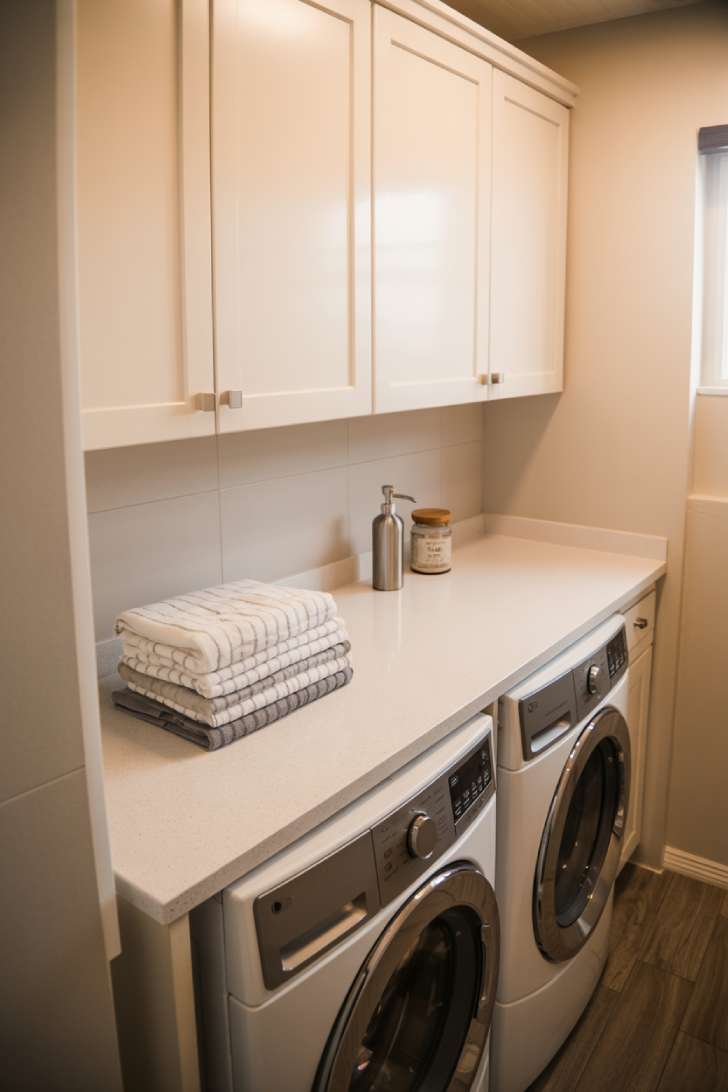
A folding surface changes everything about how laundry actually gets done.
Without one, clean clothes pile up on top of the dryer, in baskets on the floor, or — let’s be honest — on the couch.
Adding a countertop above front-loading machines gives you a dedicated, flat, always-available workspace that costs far less than most people expect.
Butcher block is warm and forgiving on a budget.
Quartz is durable and wipes clean in seconds.
Laminate in a stone or wood finish lands somewhere in between.
If the room is too tight for a permanent countertop, a fold-down wall-mounted table is the next best option.
It latches flush against the wall when not in use, reclaims every inch of floor space, and still gives you a real folding station when you need it.
One thing to keep in mind: this only works with front-loading machines that aren’t raised on pedestals.
If yours are on pedestals, the countertop height becomes impractical for most people.
The countertop surface also serves as a landing zone the moment the dryer finishes — clothes go straight up, not into a basket to wrinkle while you forget about them.
That one small shift in workflow saves more time than it sounds.
Style Blueprint:
- Quartz, butcher block, or laminate countertop cut to machine width
- Flat-panel upper cabinets with simple hardware
- Matte ceramic or stone-look backsplash tile
- Slim soap dispenser and lidded jar for counter essentials
- Wood-look LVP flooring for warmth underfoot
Slide In a Slim Rolling Cart
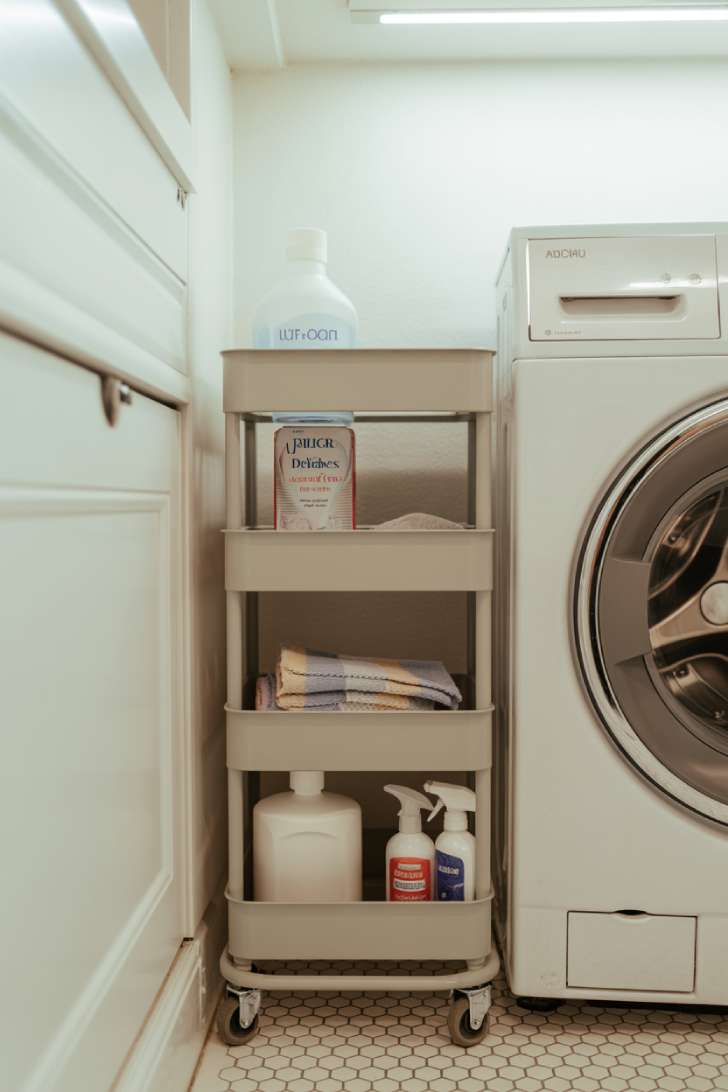
Every laundry room has a gap somewhere.
Between the washer and the wall, between the dryer and the cabinet, between the machines and the door frame.
That gap is almost always collecting lint, lost socks, and forgotten dryer sheets.
A slim rolling cart — typically 4 to 8 inches wide — slides right into that space and turns it into one of the most-used storage spots in the room.
These carts hold more than you’d expect: full detergent bottles, stain sprays, dryer balls, extra sponges, even a folded microfiber cloth on the bottom shelf.
When you need more room to work, the cart rolls out in one pull.
When you don’t, it disappears right back into the gap.
For anyone renting, this is one of the best laundry room organization upgrades available — no drilling, no permanent changes, no landlord conversations required.
Design Pro-Tip: When choosing storage for a small laundry room, always prioritize what can be seen at eye level. The brain reads a room from the middle of the wall outward — keep that zone tidy and the whole room feels more organized, even if the upper shelves aren’t perfect.
Mount a Fold-Flat Drying Rack
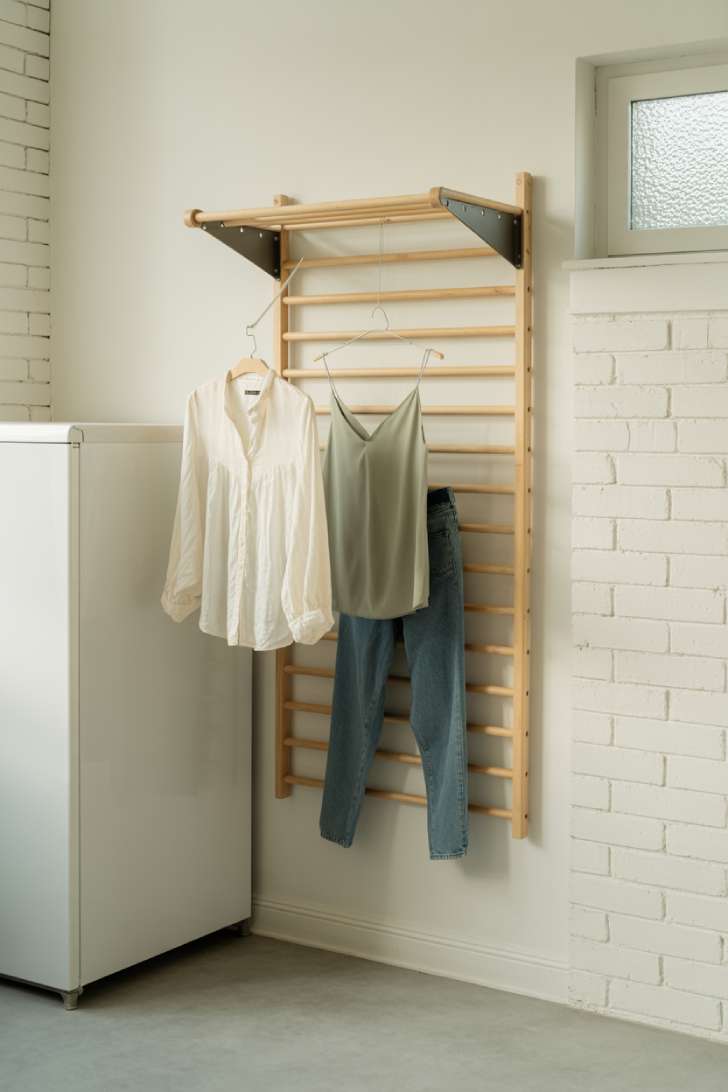
A freestanding drying rack is one of the biggest floor-space mistakes in a small laundry room.
It’s always in the way, it tips over, and it takes up the one clear path through the room every single time someone needs to get past.
A wall-mounted fold-flat rack solves all of that at once.
When extended, it holds a full load of delicates.
When folded, it sits flush against the wall — barely an inch of depth — and disappears completely.
Placement matters: mount it near a window or vent if possible, since air movement dramatically speeds up drying time and prevents that damp-clothes smell from settling in.
Natural birch or beech wood racks with matte black hardware look far more considered than the plastic alternatives, and they hold up better over time.
For rooms where wall space is already committed, a ceiling-mounted pulley rack is worth considering — clothes hang overhead, completely out of the way, and the whole rack raises and lowers on a cord system.
It sounds unusual until you try it.
Style Blueprint:
- Wall-mounted fold-flat wooden drying rack with metal brackets
- Matte black hardware and fixings throughout
- Placement near a window or ventilation source
- Optional ceiling pulley rack for zero-wall-space situations
- White or light painted brick/shiplap wall as backdrop
Turn the Door Into a Storage Wall
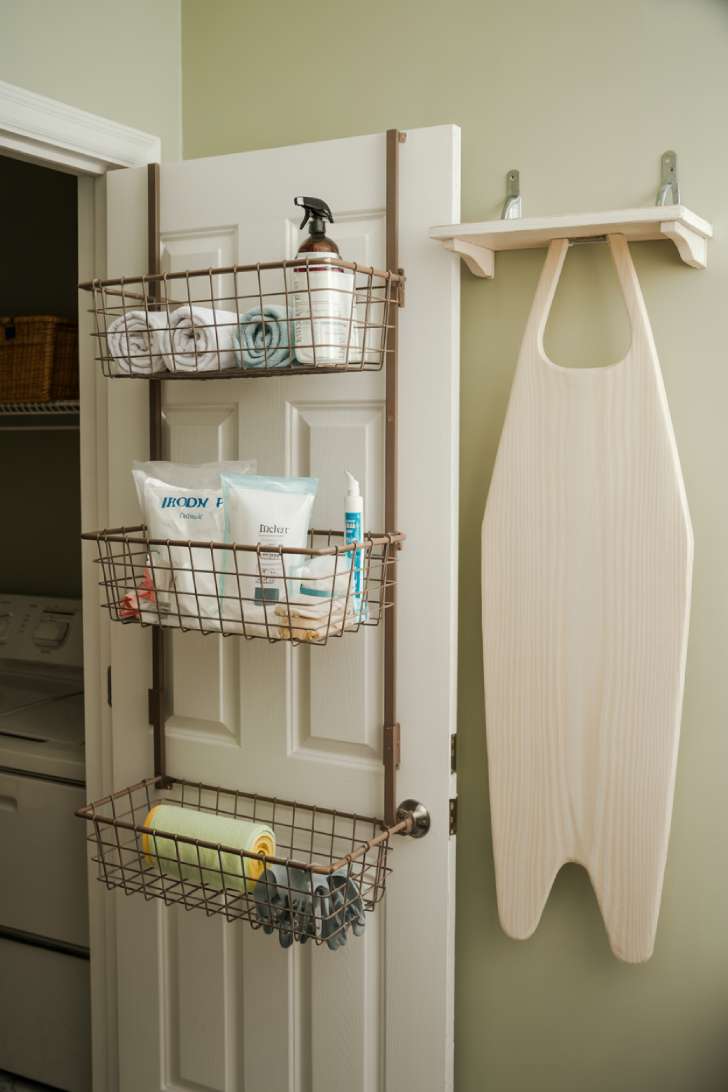
The back of the laundry room door is free real estate that almost nobody uses.
It doesn’t need studs, it doesn’t need drilling (in most cases), and it can hold a surprising amount of gear.
Over-door wire organizers are the easiest starting point: hang two or three at different heights and you’ve instantly got dedicated spots for pods, stain pens, lint rollers, rubber gloves, and dryer sheets.
The ironing board situation deserves its own mention.
A full-sized ironing board stored on the floor leans, falls, gets knocked over, and takes up a disproportionate amount of space for something you use once a week.
Mounting it flat against the door — or the wall beside the door — on two simple hook brackets keeps it off the floor entirely.
Some door-mounted systems combine the ironing board with a shelf above it, creating a compact ironing station that sets up and breaks down in under ten seconds.
The door works especially well in a laundry closet where the inner face is visible only when the doors are open — meaning all the functional clutter is hidden the moment you close up.
Style Blueprint:
- Over-door wire baskets (3-tier) in matte white or chrome
- Wall-mount or door-mount ironing board bracket set
- Slim full-length ironing board (compact, lightweight model)
- Stain pen, lint roller, and rubber gloves stored within easy reach
- Sage green or white paint on the adjacent wall
Add a Hanging Rod for Straight-From-the-Dryer Organization
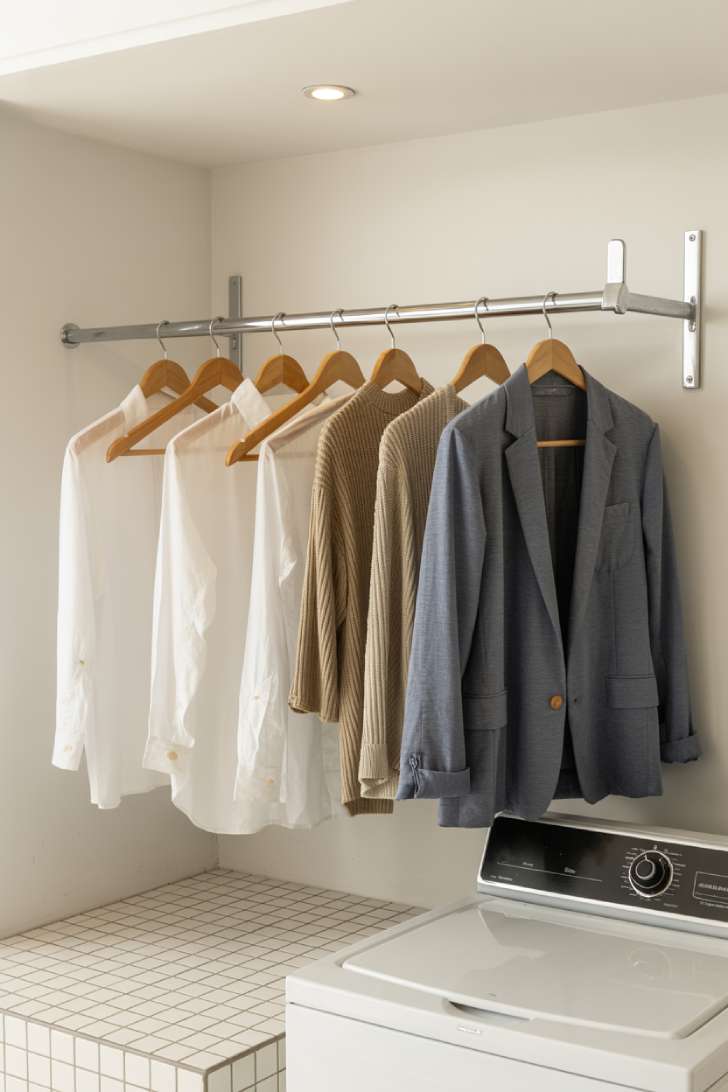
Wrinkled shirts are almost always the result of one thing: clothes sitting in a basket instead of going straight onto a hanger.
A hanging rod in the laundry room fixes that.
The moment a shirt comes out of the dryer, it goes on a hanger, onto the rod, and it’s done.
No ironing, no re-drying, no re-washing because it sat too long.
The rod doesn’t need to be long — 24 to 36 inches is plenty for a full load of hang-dry items.
A swing-arm or retractable rod is the best choice for rooms where a fixed rod would constantly be in the way of the door or the workflow.
It extends when you need it and folds flat when you don’t.
Ceiling-mounted rods are another option for rooms where wall space on all sides is already spoken for.
Pair the rod with slim wooden or velvet hangers to keep everything compressed and tidy, and the visual effect is neat rather than cluttered.
Design Pro-Tip: In a small laundry room, anything mounted at or above eye level should be lightweight and visually “quiet” — light wood, white metal, or chrome. Heavy-looking fixtures mounted high make a small room feel like the ceiling is closing in.
Style Blueprint:
- Wall-mounted or swing-arm chrome hanging rod
- Slim wooden or velvet hangers (no wire)
- Single recessed ceiling light for even illumination
- White matte paint on all walls and ceiling
- Proximity to the dryer door for a one-step transfer
Organize Around Clearly Defined Zones
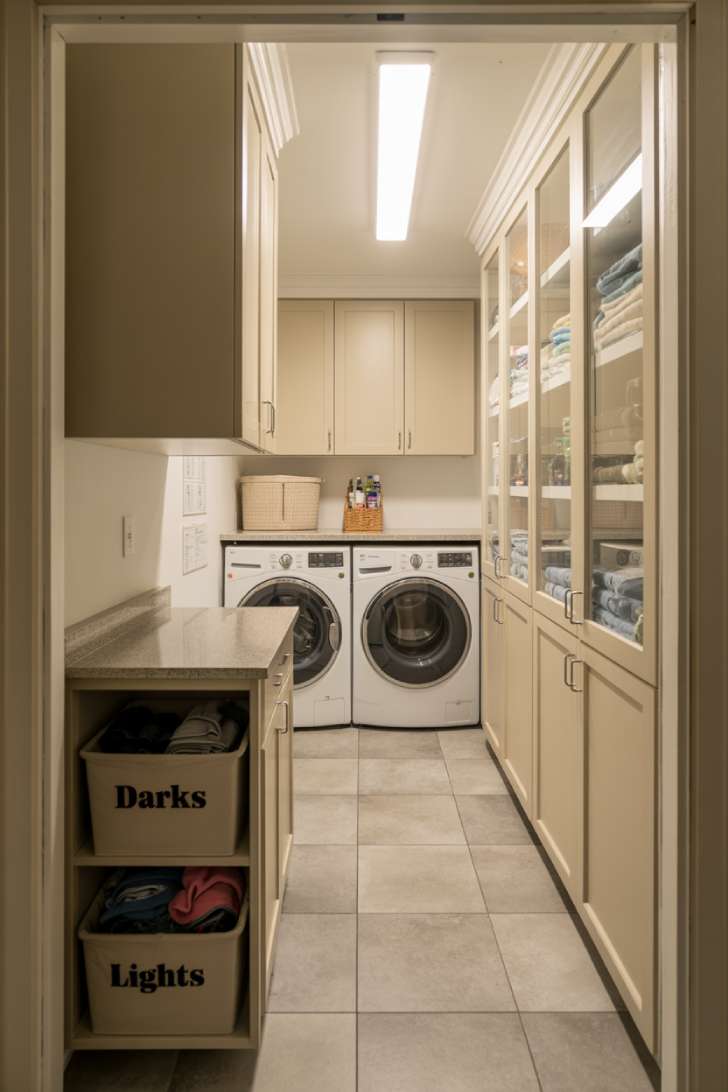
The most organized laundry rooms aren’t necessarily the biggest ones.
They’re the ones where every action has a designated place.
A zone-based approach means you divide the room — mentally, if not physically — into four areas: sort, wash and dry, fold, and store.
In a larger room, these are separate areas.
In a small laundry room layout, they overlap — and that’s completely fine.
Your sorting zone might be two fabric bins on a shelf directly above the machines.
Your folding zone might be the same countertop where you set down the basket.
The key is that each function has a home, and that home doesn’t move.
This removes the low-grade friction of figuring out where to put things every time you do laundry.
It also means the room resets to tidy much faster after each load, which is one of the small things that makes a big space feel genuinely manageable.
Style Blueprint:
- Two or more labeled fabric bins for sorting by color or type
- Countertop that doubles as a sorting and folding surface
- Upper glass-front cabinets for folded linens (visible but contained)
- Solid lower cabinets for supplies and cleaning products
- Large-format light grey porcelain floor tile
Label Everything and Contain the Rest
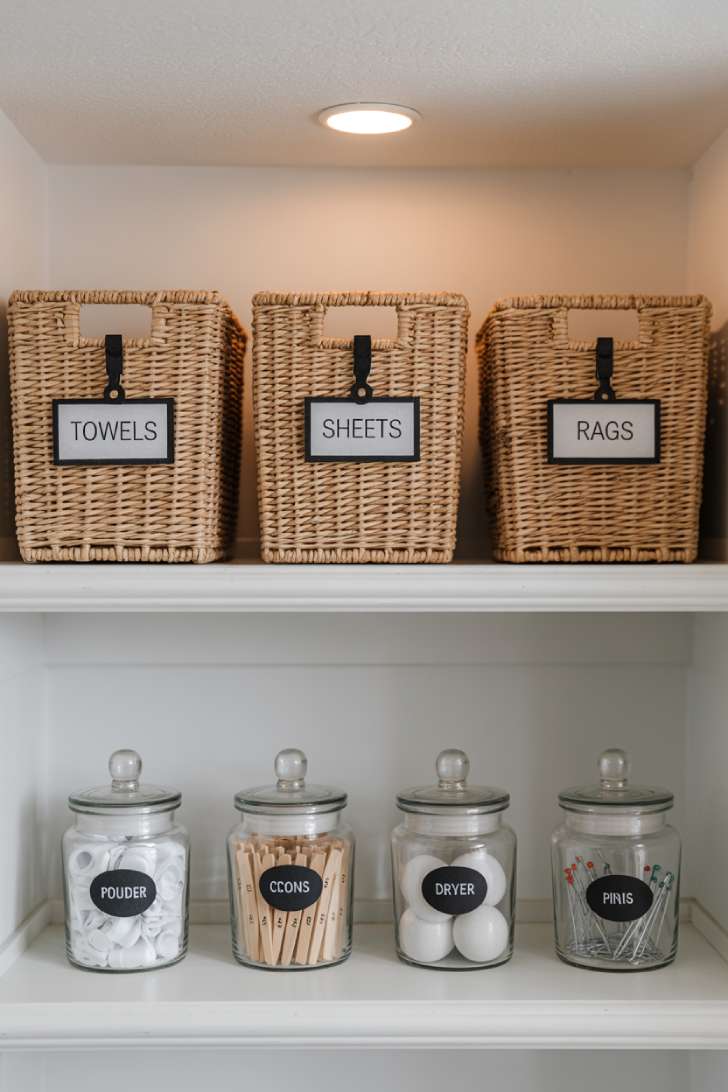
A laundry room doesn’t look cluttered because there’s too much in it.
It looks cluttered because nothing has a clear place.
Labeled containers solve that.
The moment every item has a designated bin, jar, or basket — and that container is labeled — the room becomes self-correcting.
Things go back where they belong not because of willpower, but because the label tells you exactly where that is.
Matching containers do something else entirely: they turn a functional utility wall into something that actually looks good.
Seagrass baskets in the same natural tone, glass jars in the same size family, and fabric bins in the same palette read as a cohesive, intentional system rather than a collection of random storage solutions.
Black lettering on natural or white containers is the most legible and the most timeless combination — it works in a modern laundry room, a farmhouse-style one, and everything in between.
Clear jars are particularly useful for pods, clothespins, and small miscellaneous items, since you can see at a glance when something is running low without pulling the jar off the shelf.
Style Blueprint:
- Matching seagrass or woven rectangular baskets with metal label holders
- Clear glass apothecary jars in two or three consistent sizes
- Black sans-serif labels or printed label tape
- White painted wooden shelves as the base
- One trailing plant (pothos or ivy) on the top shelf for softness
Match Your Layout to Your Room’s Actual Shape
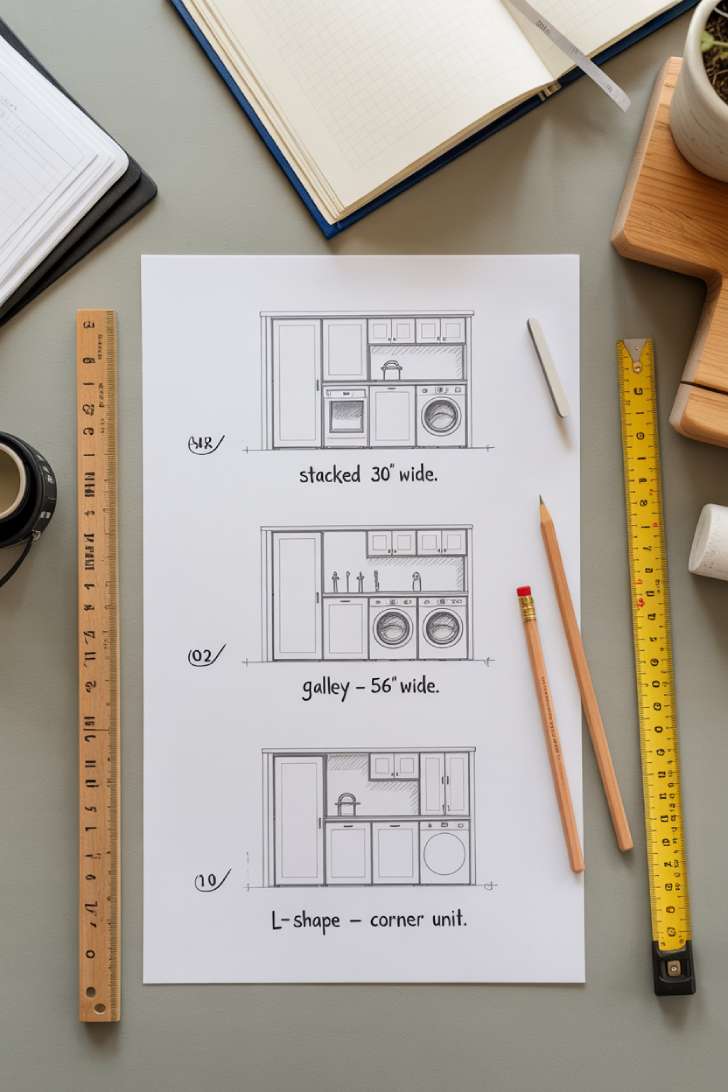
Before buying a single shelf or choosing a cabinet finish, the appliance layout needs to be right.
Everything else works around the machines — not the other way around.
A stacked configuration needs only 27 to 30 inches of width and about 75 inches of height.
A side-by-side setup needs 56 to 60 inches of width and 34 inches of depth.
Leave at least 6 inches behind the machines for hoses, vents, and electrical connections.
Leave at least 1 inch on each side for airflow and vibration reduction.
Leave 4 feet of clearance in front of the machines so doors can swing open and you can actually load them without contorting.
If the room is genuinely tiny — we’re talking under 30 square feet — an all-in-one combination washer-dryer deserves serious consideration.
These single-drum units wash and dry in one cycle, eliminate the transfer step entirely, and free up the space a second appliance would have occupied.
They’re not for everyone — cycle times are longer and capacity is smaller — but for a true micro-space, they’re hard to beat.
Design Pro-Tip: Tape out your appliance footprint on the floor before committing to a layout. Use painter’s tape to mark the machines and their door swings — then live with it for a day. You’ll immediately see if the workflow makes sense or if something needs to shift.
Style Blueprint:
- Painter’s tape for floor planning before installation
- Front-loading washer and dryer (stacked or side-by-side)
- Manufacturer-spec clearance on all sides and behind units
- All-in-one combo unit for spaces under 30 square feet
- Measured floor plan sketch before any cabinetry decisions
Raise the Machines on Pedestal Drawers
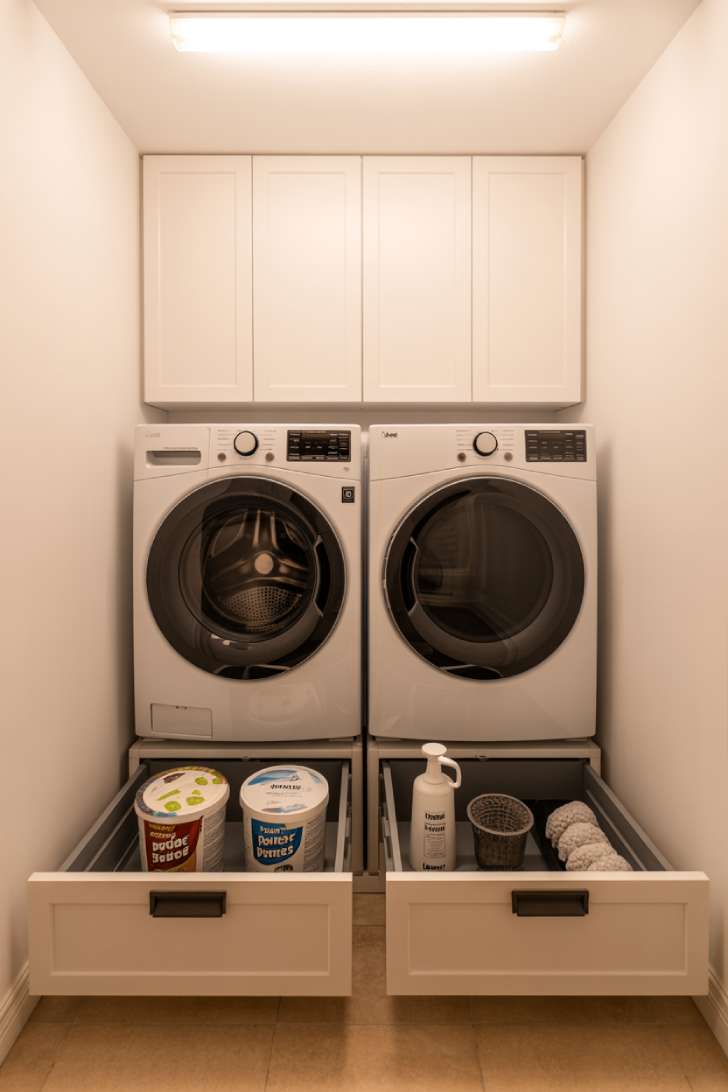
Pedestal drawers are one of those upgrades that sounds like a luxury until you actually use one.
Raising the machines to a more comfortable loading height — usually 12 to 16 inches above floor level — makes a genuine physical difference if you do laundry multiple times a week.
No more bending down to fish a lone sock from the back of the drum.
But the real value in a small laundry room is the drawer itself.
Each pedestal includes a wide, shallow drawer that holds a full supply of laundry consumables: detergent pods, dryer sheets, stain sprays, a measuring cup, dryer balls.
Everything is right there at the point of use, which means the shelves above the machines don’t have to work as hard.
One thing to confirm before ordering: not every machine is compatible with a pedestal from the same brand, and cross-brand compatibility rarely works.
Check the manufacturer spec sheet before anything else.
Also worth noting — once the machines are on pedestals, adding a countertop above them becomes impractical for most people given the resulting height.
Style Blueprint:
- Manufacturer-matched pedestal drawers (brand-specific)
- Slim laundry supply organizer tray inside the drawer
- White flat-panel upper cabinets above
- Warm beige or light grey porcelain tile
- Matching finish on washer, dryer, and pedestals (all same color)
Build a Pegboard Command Center
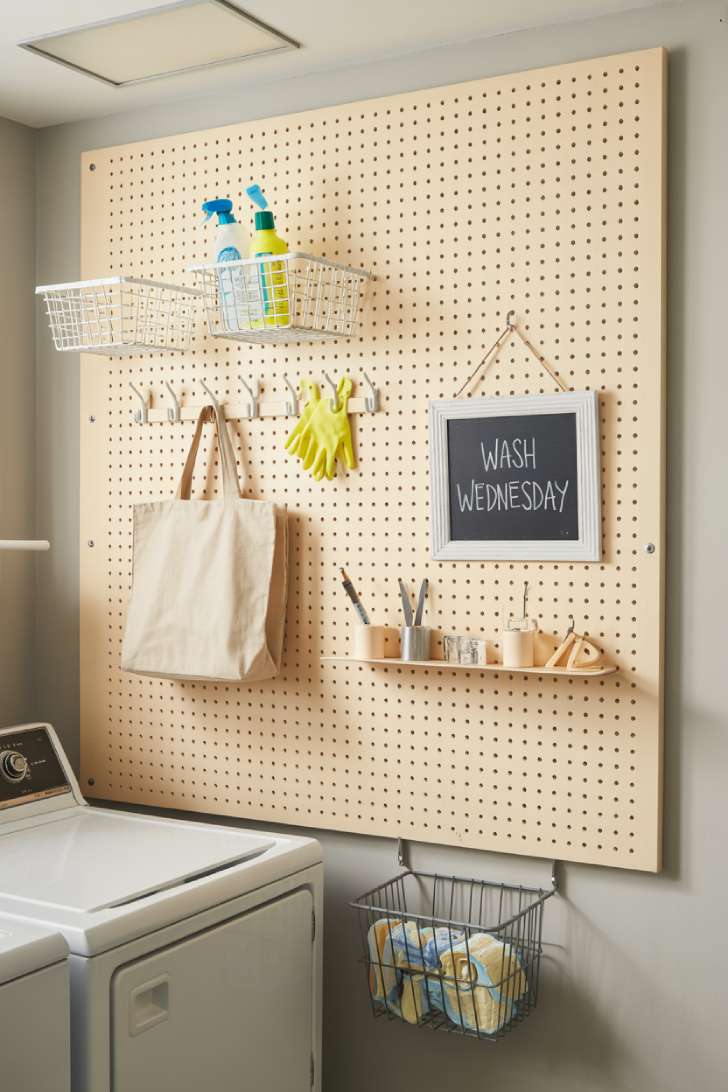
A pegboard wall is the most adaptable storage system in a small laundry room.
Unlike fixed shelving, it changes as your needs change — move a hook, add a basket, swap a shelf — without touching a single wall anchor.
Mounted beside the dryer, it puts the most-used items (lint roller, stain pen, dryer sheets) within reach of one hand while the other is pulling laundry out.
That’s the kind of workflow detail that sounds minor but genuinely speeds up the whole process.
The dry-erase board addition is underrated.
A small framed board or chalkboard square on the pegboard gives you a spot to track what’s in the wash, when to add fabric softener, or simply which load is next.
The magnetic lint bin clipped to the side of the dryer deserves a spot in every small laundry room — it catches lint, used dryer sheets, and miscellaneous debris right at the source, without requiring a separate wastebasket on the floor.
Paint the pegboard the same color as the wall for a sleek, built-in feel.
Or go a contrasting shade for a bolder look.
Either works — it just depends on how much visual presence you want it to have.
Style Blueprint:
- White-painted MDF pegboard panel (24×36 inches minimum)
- Assorted pegboard hooks, wire baskets, and round cup holders
- Small framed dry-erase or chalkboard board
- Magnetic metal lint bin (attaches to dryer side panel)
- Matte white or contrasting wall paint behind the board
Brighten the Space With Light, Color, and a Mirror
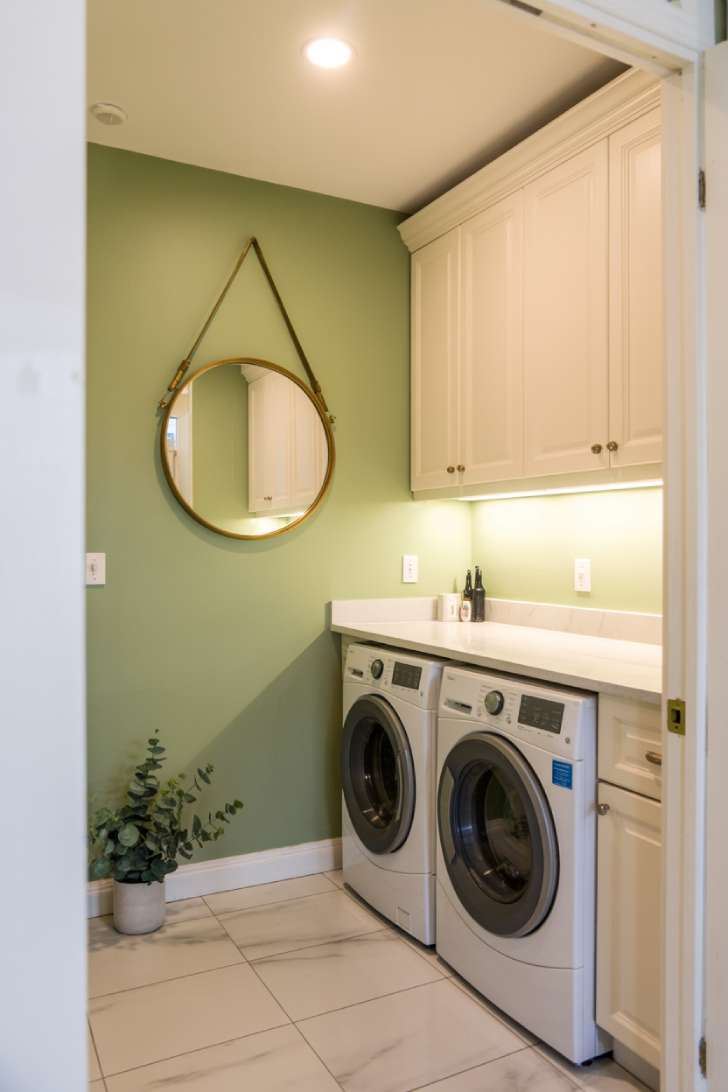
Lighting and color do more for a small laundry room than almost any organizational system.
A well-lit room with a cohesive palette feels open and calm to work in, even at 40 square feet.
A dark, randomly painted room feels cramped at twice the size.
Soft sage green, warm white, pale blue, and warm cream are the most reliable choices for small laundry rooms.
They reflect enough light to keep the space bright without making it feel sterile.
A round mirror — especially in a warm metal frame like brass or brushed gold — does two things at once: it bounces light around the room and adds a decorative element that elevates the space from utility to something more considered.
The reflective surface effectively makes the room look wider without changing a single structural thing.
Under-cabinet LED strips are the upgrade that most people install once and immediately wish they’d done sooner.
They illuminate the countertop directly where the work happens, remove shadows cast by upper cabinets, and add a warm glow that changes the entire character of the room after dark.
Light-colored flooring — particularly large-format tiles — reflects the overhead light back up into the room, which visually lifts the ceiling and makes the floor feel less heavy.
Style Blueprint:
- Sage green or soft white semi-gloss wall paint
- Round brass or brushed gold framed mirror (18–24 inches)
- Under-cabinet LED strip lights (warm white, 2700K–3000K)
- Large-format marble-look porcelain floor tile
- Small live plant in a neutral ceramic pot
Find Storage in the Spaces Everyone Overlooks
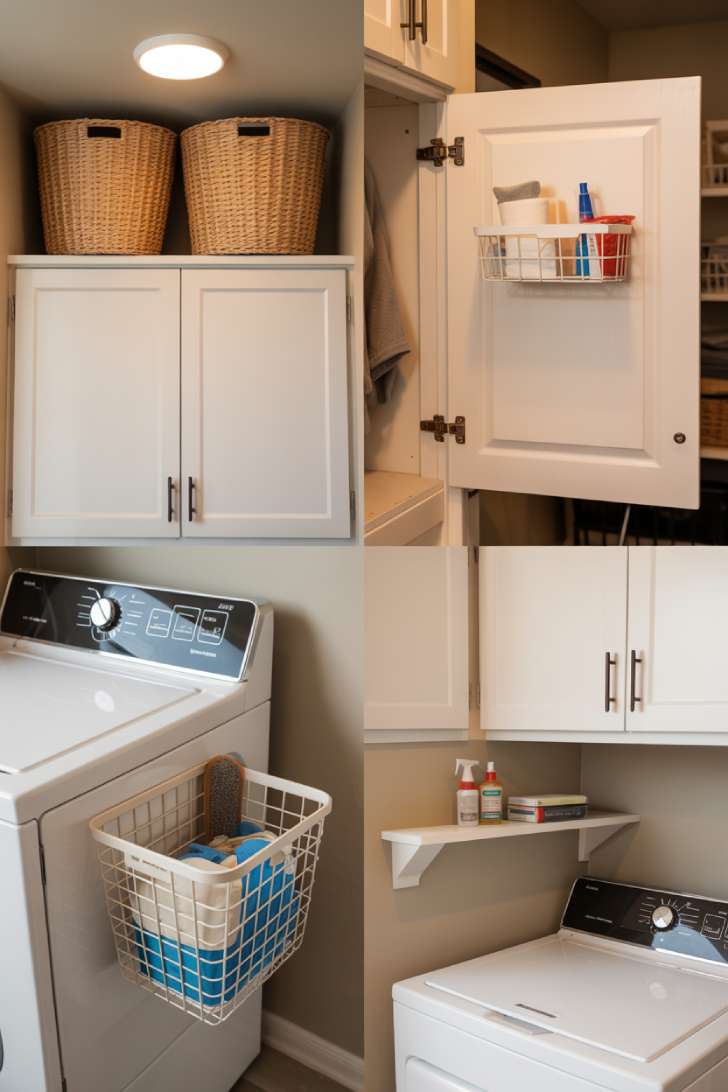
The floor, the main walls, and the obvious shelf positions are just the beginning.
The most efficiently organized small laundry rooms find storage in the places that most people walk past without a second look.
The top of upper cabinetry, for example — that often-dusty 12-inch gap between the cabinet top and the ceiling — is perfect for large round woven baskets that hold extra linens or seasonal items.
The inside face of cabinet doors is another one.
A small mounted organizer on the inside of a cabinet door turns wasted MDF into a storage spot for dryer sheets, stain pens, and small tools.
The side panels of appliances accept magnetic accessories — bins, hooks, paper towel holders — without any installation at all.
Narrow gaps between the dryer and the wall that aren’t quite wide enough for a rolling cart can sometimes hold a single shallow floating shelf at head height.
Two spray bottles fit.
A small plant fits.
A framed reminder card fits.
It’s not much — but in a small laundry room, “not much” adds up.
Design Pro-Tip: Before installing any new storage, spend one full laundry cycle paying attention to every surface you instinctively reach for or set something down on. Those surfaces are telling you exactly where your storage needs to go — trust that instinct over any floor plan.
Style Blueprint:
- Large round woven baskets for above-cabinet storage
- Inside-door mounted organizer panel (adhesive or screw-mount)
- Magnetic metal accessories for dryer side panels
- Shallow floating shelf for narrow wall gaps (4–6 inches deep)
- Consistent white or natural finish across all added elements
Hide It All Behind Beautiful Doors
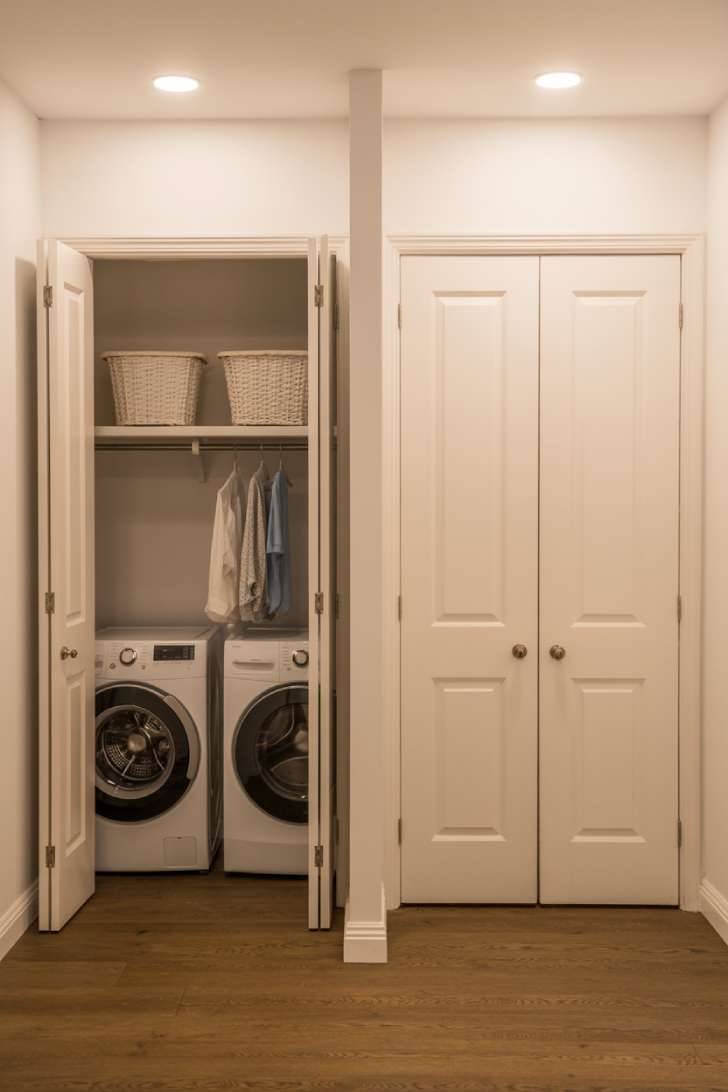
Not every laundry room has the luxury of a dedicated door.
Many open directly into a living space, bedroom, or kitchen — and in those cases, what you see when the laundry area is “open” matters as much as how it functions.
Concealment transforms the whole dynamic.
Bi-fold doors are the most practical option for tight laundry closets: they require minimal swing clearance, come in almost any panel style, and can be painted to match the surrounding wall so perfectly that the closet disappears when closed.
Sliding barn doors add a design element in their own right — the hardware is visible and decorative, and the door slides completely out of the doorway for full access.
Pocket doors are the cleanest solution of all: they vanish into the wall, leave zero footprint in the open position, and give the space a built-in, architectural quality.
A curtain panel on a tension rod is the budget-friendly version.
It works, it hides the machines, and a good fabric choice makes it feel deliberate rather than provisional.
The goal in all cases is the same: when the laundry is done and the doors close, the room shouldn’t announce itself.
It should just disappear.
Style Blueprint:
- White bi-fold or sliding panel doors with brushed nickel hardware
- Paint matched to the surrounding hallway or room wall
- Interior rod and two to three slim hangers for garments
- One floating shelf above machines for visible styling
- Medium-toned hardwood floor in the adjoining space for warmth
A Tidy Laundry Room Is Built One Decision at a Time
Small laundry room ideas work best when they’re chosen for your specific space — not just copied from a mood board.
The 15 approaches above cover the full range: from a $15 rolling cart to a full stacked-appliance and custom-cabinetry setup.
Start with the one change that addresses your biggest frustration right now.
Maybe that’s a folding surface.
Maybe it’s finally mounting a hanging rod so your button-downs stop wrinkling in the basket.
Maybe it’s just labeling the baskets you already have.
Any of those is a real improvement.
Small laundry room storage doesn’t come from buying more things — it comes from putting the right things in the right places.
Get that part right, and the rest of the room follows.
Save this post for your next laundry room refresh, and check out our related guides on small laundry room decor and space-saving laundry solutions for even more inspiration.