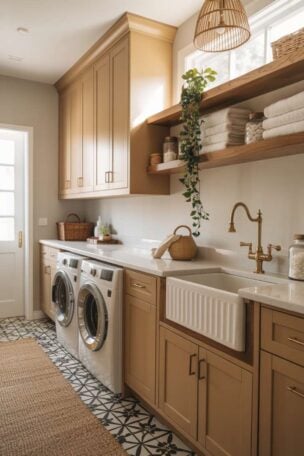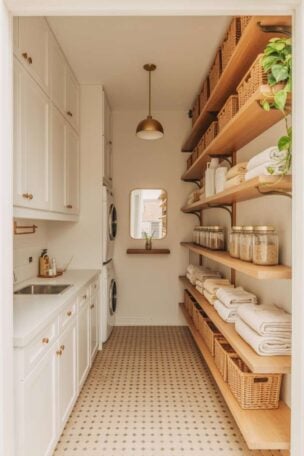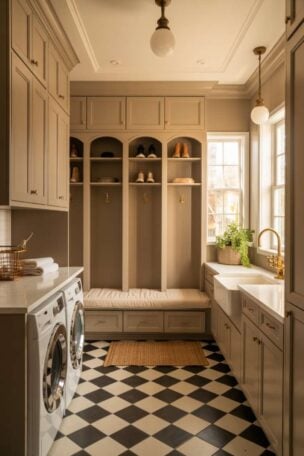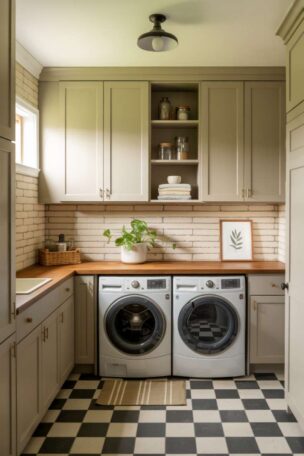
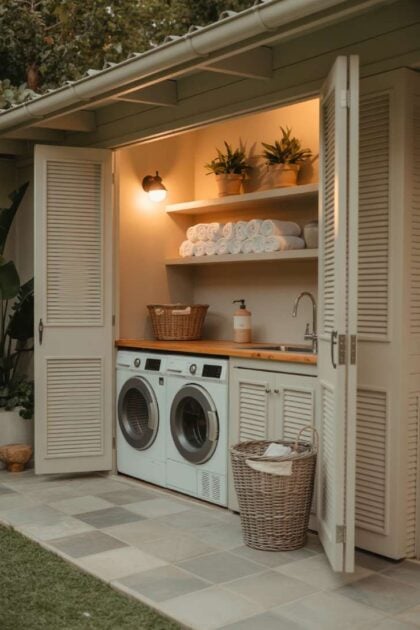
If you’re running out of room indoors, taking your laundry setup outside might be the smartest move you haven’t tried yet.
Small patios, side yards, balconies, and backyard corners can all become fully functional outdoor laundry room ideas for small spaces — without sacrificing style or comfort.
These 10 ideas are packed with inspiration and practical guidance, whether you’re working with a covered porch, a forgotten side yard, or a tiny balcony.
A Patio That Pulls Double Duty
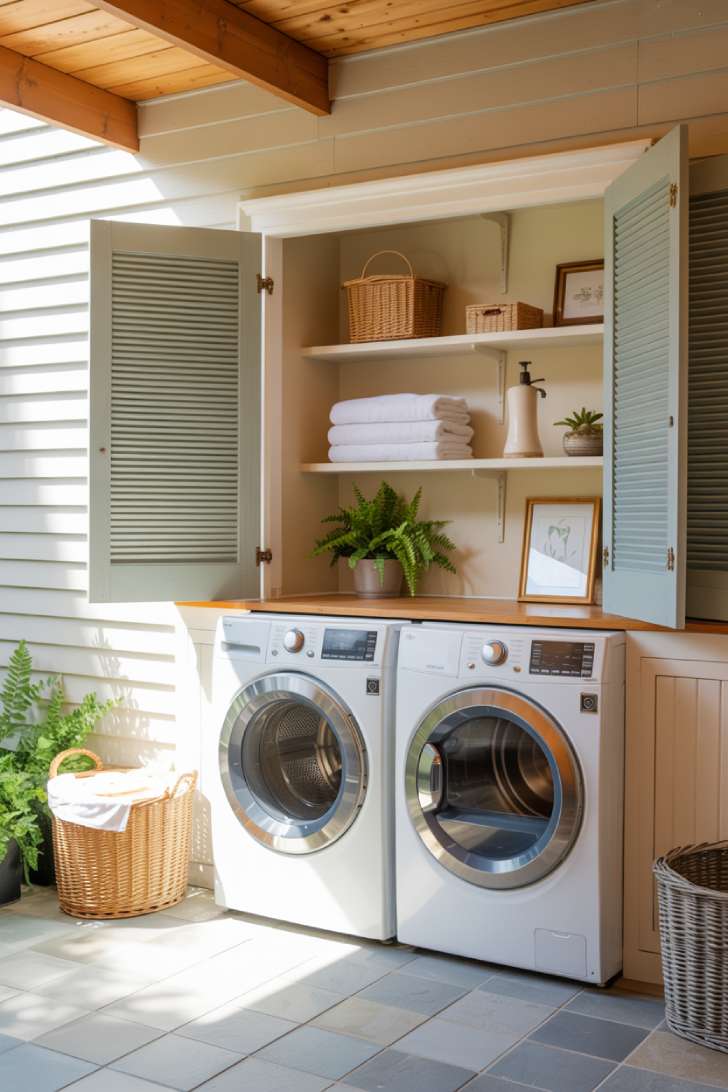
There’s something genuinely satisfying about a covered patio that works harder than it looks.
When a porch already has a ceiling overhead, half the work is done.
The protection from rain and direct sun means appliances last longer, and the open sides keep airflow moving — which is exactly what a small outdoor laundry area needs to prevent humidity buildup.
What makes this setup so visually appealing is the layering.
Warm wood ceilings, soft-colored cabinetry, and natural textures like wicker and stone pull the eye in multiple directions without creating chaos.
That contrast between organic materials and clean appliances is what gives the space a collected, intentional feel rather than a purely functional one.
Natural light coming in from the open patio side keeps the space from feeling boxed in, which matters a lot in a small covered patio laundry room.
Style Blueprint:
- Vented shaker-style cabinet doors in a matte, nature-inspired color
- Open shelving in sealed wood or powder-coated steel above the machines
- Tongue-and-groove or shiplap wall finish for a clean coastal look
- Slate or porcelain tile flooring with a light grout color
- One or two small potted plants to soften the utilitarian feel
The Fold-Away Station Nobody Sees Coming
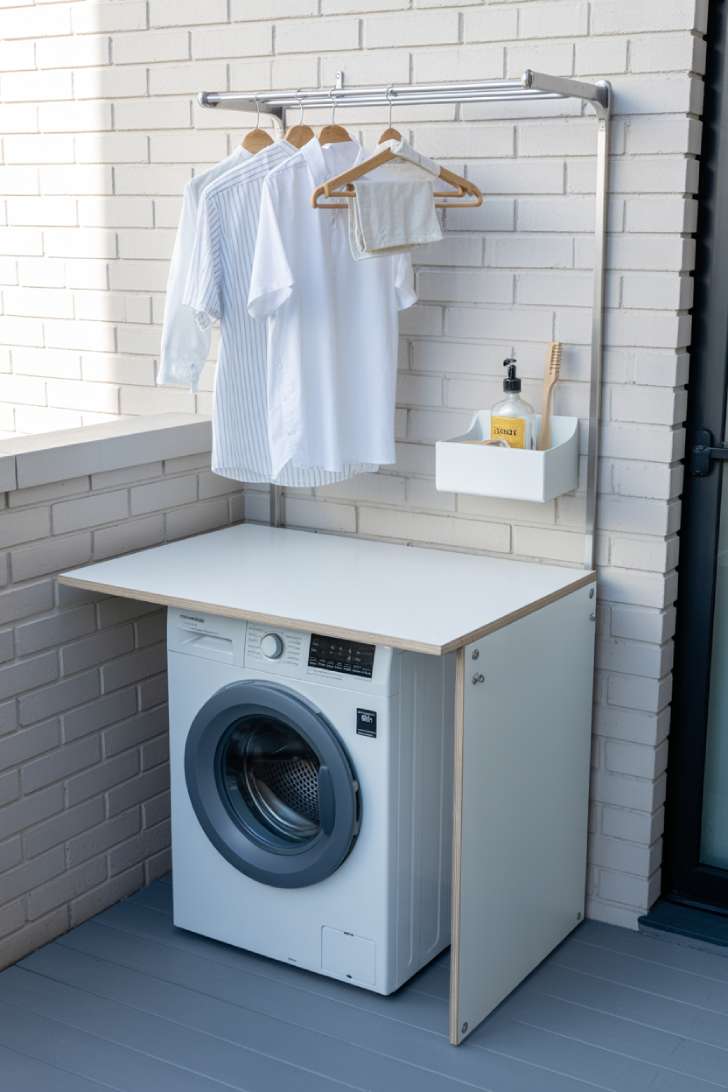
This one genuinely surprises people.
A fold-down counter paired with a wall-mounted drying rack is one of the most space-efficient outdoor laundry room ideas for small spaces, and it costs far less than a built-in renovation.
The entire thing disappears when you’re done.
That ability to “hide” the function of a space is a powerful psychological tool — it lets the area serve two roles without either one feeling compromised.
When the counter folds up and the rack retracts, the balcony goes back to being a balcony.
Visually, keeping finishes light — white, pale gray, natural steel — makes the wall feel like it recedes rather than crowds.
That’s what makes a small balcony laundry nook work: the space looks bigger when everything is tucked away.
Style Blueprint:
- Marine plywood countertop sealed with exterior epoxy for weather resistance
- Heavy-duty stainless steel folding brackets rated for outdoor use
- Wall-mounted stainless or powder-coated vertical drying rack
- Small wall-mounted caddy or magnetic strip for supply organization
- Light-toned composite decking underfoot for a clean, modern base
Cabinetry That Hides Everything
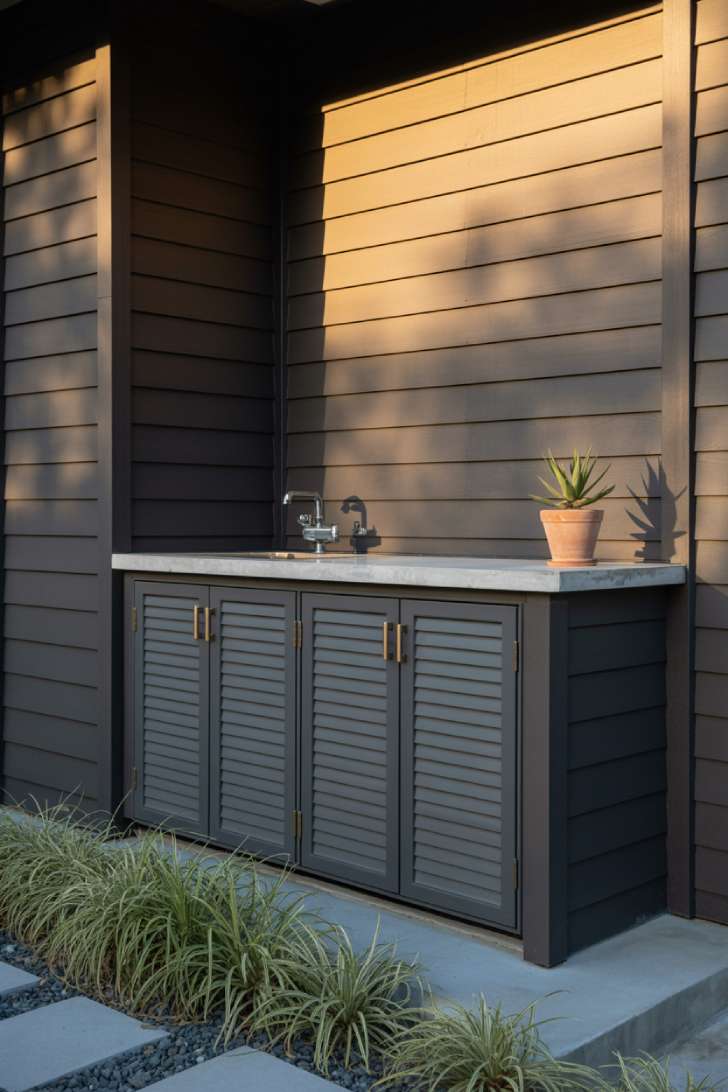
This is what “seamless” actually looks like in practice.
A weatherproof cabinet enclosure around a washer and dryer transforms what could be an eyesore into something that looks like it was always meant to be there.
The louvered door panels are doing a lot of work in this setup.
They allow enough airflow to keep the machines ventilated and prevent mildew, all without breaking the clean lines of the exterior.
Darker cabinet colors like charcoal or deep navy tend to recede visually against home exteriors, making the enclosure feel like a natural extension of the architecture rather than an addition.
Pairing that with warm metal hardware like brushed brass brings in just enough warmth to stop the look from feeling cold or industrial.
Outdoor laundry storage ideas work best when they’re built into the visual language of the home, and this approach does exactly that.
Style Blueprint:
- Composite panel or marine-grade plywood cabinet construction
- Louvered ventilation panels integrated into cabinet doors
- Slim concrete, tile, or sealed timber countertop across the top
- Weather-resistant hardware in brushed brass, matte black, or satin nickel
- Exterior finish matched or complementary to the home’s existing cladding
Design Pro-Tip: When choosing a cabinet color for an outdoor laundry enclosure, pull a tone directly from your home’s existing exterior palette. Even a one-shade darker version of your trim color creates a cohesion that makes the entire addition feel planned — not bolted on.
Stack It and Reclaim the Floor
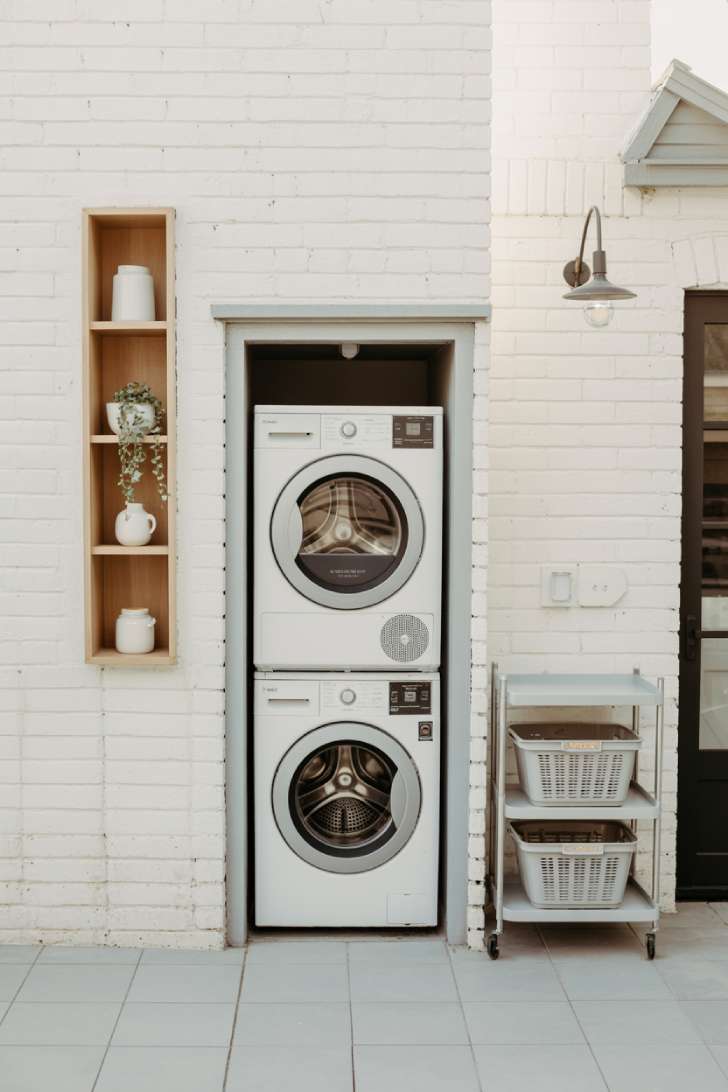
Going vertical changes everything in a tight space.
A stackable washer dryer outdoor setup cuts the floor footprint in half and immediately opens up room for storage, a counter, or simply more breathing space around the machines.
It sounds simple, but the visual impact is significant.
A single vertical tower of appliances reads as one intentional unit rather than two separate pieces of equipment crowding a small area.
The trick to making a stacked setup look styled rather than purely functional is what you put beside it.
A slim oak shelf on one side and a pull-out trolley on the other create flanking elements that frame the machines and make the whole wall feel composed.
If you’re leaning toward this approach, condenser or heat-pump dryers are worth the extra cost — they don’t need an external vent duct, which simplifies outdoor installation considerably.
Style Blueprint:
- Compact stackable washer and dryer with a matching trim kit
- Narrow floating shelf in sealed timber or powder-coated steel on one side
- Slim pull-out laundry trolley with individual basket compartments
- Wall-mounted pendant or sconce for task lighting
- Porcelain or sealed concrete tile for a clean, water-resistant floor
The Shed That Became a Sanctuary
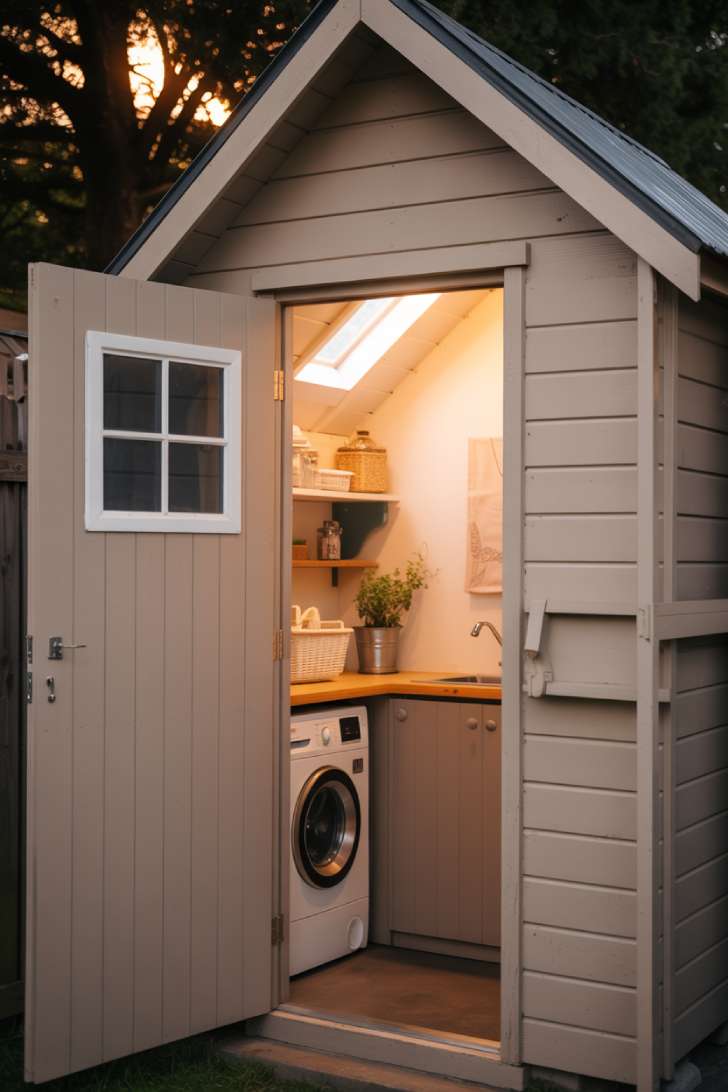
A backyard shed conversion is the most committed of all these ideas — and often the most rewarding.
Having a small backyard laundry nook that is fully enclosed and separate from the house creates a satisfying division between living space and utility space.
It’s a setup that apartment dwellers genuinely envy.
The skylight is the element that makes or breaks a shed conversion.
Without natural light, a small interior quickly feels like a closet.
A single skylight or well-placed window changes the entire atmosphere, pulling daylight into what would otherwise be a dim, enclosed box — and that matters enormously for how long you’re willing to spend in there.
Keeping the interior palette light and warm — soft whites, natural timber, woven baskets — prevents the space from feeling utilitarian despite its function.
Don’t overlook the floor either.
Reinforcing it before installing appliances is non-negotiable; most storage sheds aren’t built to handle the weight of a full washing machine.
Style Blueprint:
- Skylight or casement window for natural light and ventilation
- Interior walls in moisture-resistant paint in a warm white or cream tone
- Open shelving with woven baskets and glass storage jars for supplies
- Narrow sealed timber countertop for folding and sorting
- Reinforced floor with non-slip sealed concrete or composite tile
Design Pro-Tip: In a shed conversion, mount your shelving higher than you think you need to. Keeping the lower two-thirds of the wall clear creates the illusion of more floor space — a trick that makes even a six-by-four-foot interior feel manageable.
A Lean-To That Earns Its Keep
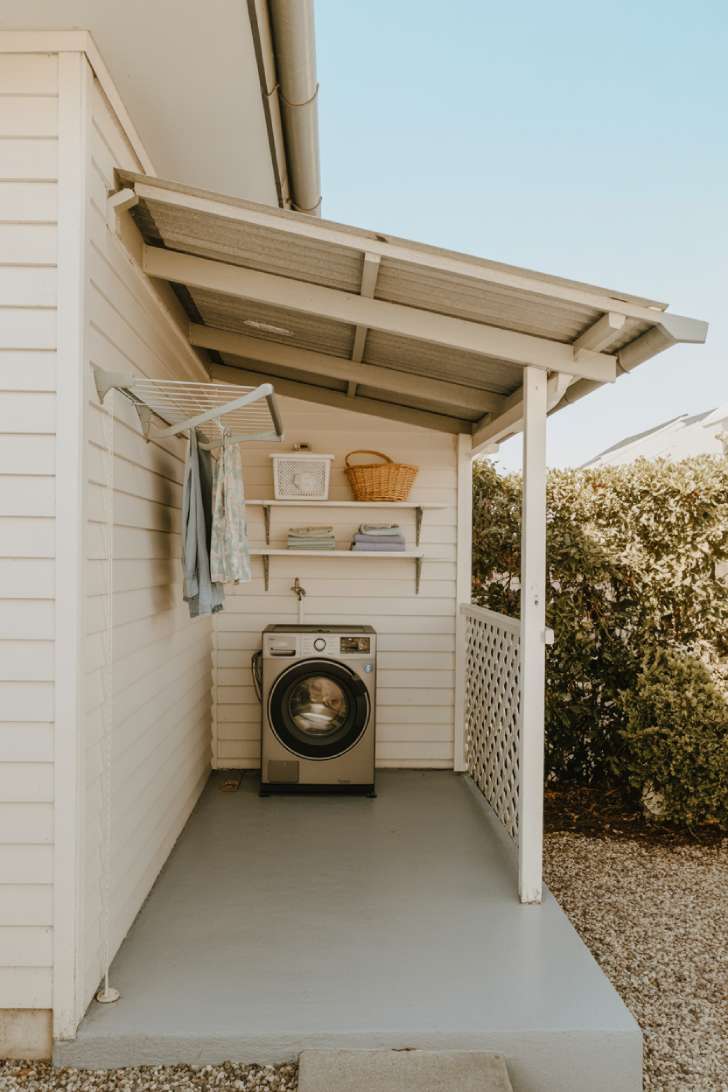
Lean-tos are undeniably practical, and they cost a fraction of a full shed build.
By attaching a single-slope roof to an existing exterior wall, you get solid overhead coverage for a washer and dryer outdoor setup without touching the interior of the house.
The wall becomes a utility wall — shelves, hooks, retractable clotheslines, and a mounted laundry caddy all live there.
What makes this setup feel intentional rather than makeshift is the privacy panel.
A low timber lattice on one open side creates a boundary without blocking airflow, and it gives climbing plants — jasmine, passionfruit, or a simple creeper — something to grow along.
That living green screen does two things at once: it adds softness and it absorbs some of the visual weight of the machines, making the whole structure feel less industrial.
Gravel underfoot is worth considering too.
It drains quickly, requires no sealing, and has a relaxed, natural quality that suits the lean-to aesthetic perfectly.
Style Blueprint:
- Corrugated metal or polycarbonate single-slope roof panel
- Retractable stainless steel clothesline mounted to the house wall
- Two or three white-painted timber shelves above the machine
- Low timber or metal lattice privacy panel on one open side
- Compacted gravel or concrete pad with good drainage slope
The Balcony Setup That Actually Works
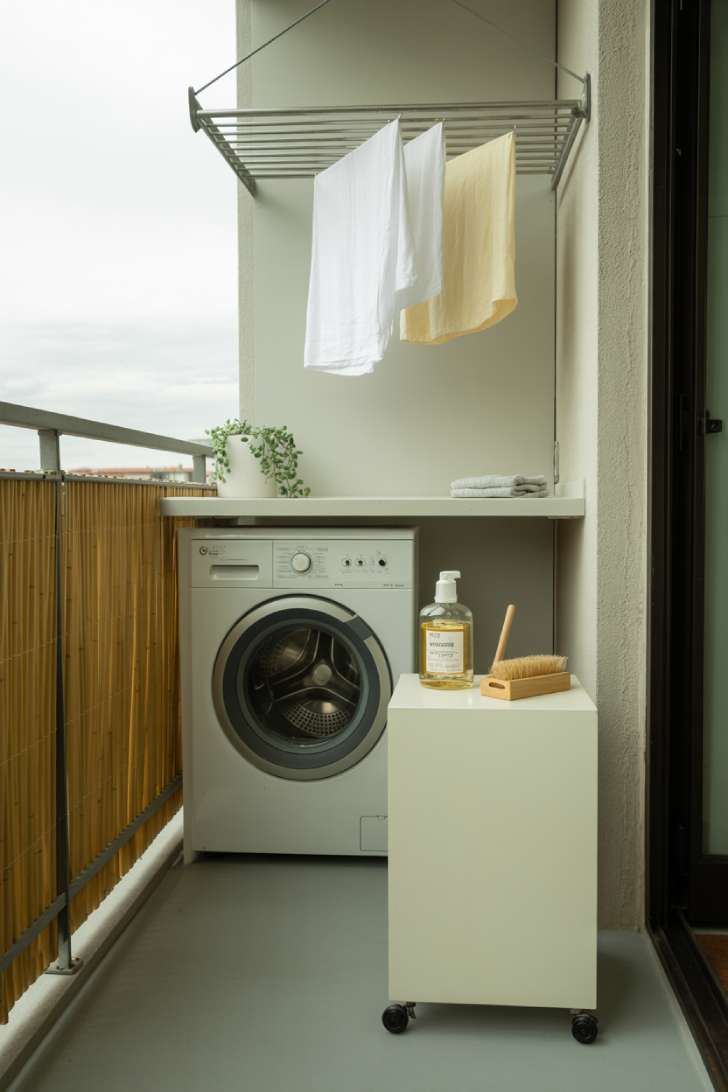
Balcony laundry setups get overlooked because most people assume there isn’t enough room.
There usually is — it just takes a willingness to think in layers.
A front-load washer tucked under a floating counter sits no deeper than a standard cabinet, and a fold-down drying rack mounted above it uses wall space that would otherwise go to waste.
The bamboo privacy screen is the element that transforms a balcony laundry nook from “exposed utility” to “considered design.”
It creates a defined zone within the balcony while also providing a backdrop — and backdrops matter because they give the eye somewhere to rest rather than scanning all the way to the street.
Keeping the color palette consistent across the entire balcony — white appliances, white counter, white cart, neutral screen — makes a small outdoor laundry room ideas for small spaces setup feel intentional rather than cramped.
One important practical note: always confirm drainage options and building regulations before installing a washer on a balcony.
It varies significantly depending on your building and location.
Style Blueprint:
- Compact front-load washer in white or light gray
- Slim floating counter in white-coated MDF or powder-coated steel
- Fold-down stainless steel drying rack mounted to the wall
- Bamboo or aluminum privacy screen for one balcony edge
- Narrow rolling utility cart for supplies in a matching tone
Design Pro-Tip: On a balcony laundry setup, keep every element the same color family. When the washer, cart, counter, and walls all read as “one thing,” the small space stops looking cluttered — even if there’s a lot going on.
The Side Yard That Finally Got Some Attention
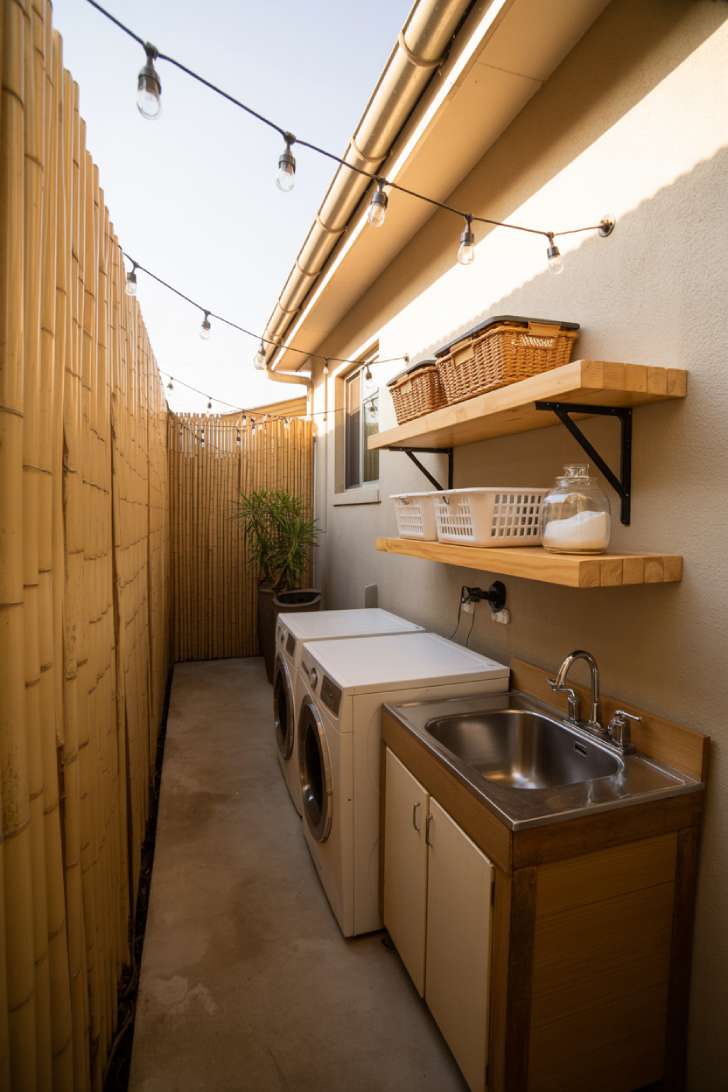
Side yards get ignored for years — until someone has the idea to actually use them.
A single-wall layout along the house exterior is a natural fit for a narrow small backyard laundry nook.
The machines line up neatly, plumbing connections are short, and the wall handles shelving, lighting, and supply storage without eating into the already-slim floor space.
The outdoor utility sink ideas that work best in a side yard setup are deep-basin stainless models on a timber cabinet base.
They handle muddy clothes, garden tools, pet rinsing, and pre-soaking all in one spot — which turns the laundry zone into a genuine multi-purpose utility area.
String lights overhead do more than look pretty.
They signal that the space is “finished” — that it belongs to the house rather than sitting in an awkward in-between state.
That psychological shift, from passthrough corridor to defined room, is one of the most effective things you can do for a small outdoor space without spending much money.
Style Blueprint:
- Side-by-side front-load washer and dryer on a sealed concrete pad
- Deep-basin stainless steel utility sink on a sealed timber cabinet base
- Two floating shelves in sealed timber with white woven storage baskets
- Full-length bamboo or timber slatted privacy screen on the opposite wall
- Weatherproof string lights strung overhead for warmth and definition
Pergola Life With a Practical Side
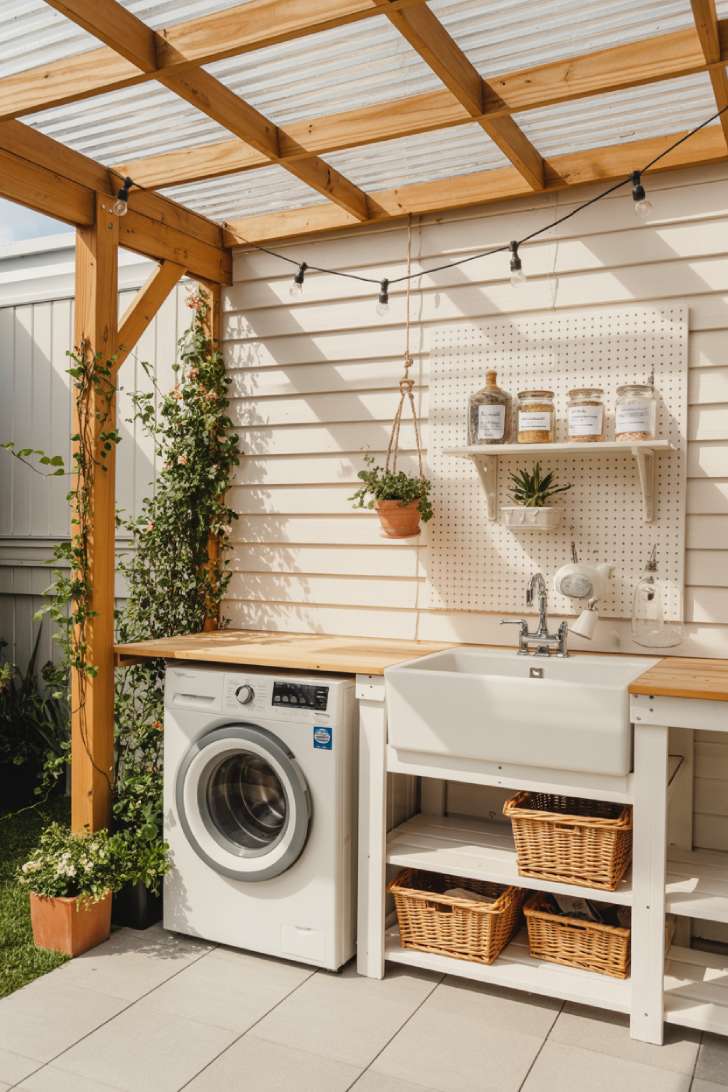
A pergola-covered laundry station is where practicality starts to feel like outdoor living.
The structure provides enough overhead coverage to protect a washer and a deep outdoor utility sink from most weather, and the open sides keep ventilation excellent.
It’s one of the most attractive outdoor laundry room ideas for small spaces precisely because the pergola itself is a design feature, not just a shelter.
The polycarbonate roof panel is a small but important detail.
It keeps rain off the machines without darkening the space — natural light still filters through, which keeps the area feeling open rather than covered.
The farmhouse utility sink is the visual anchor here.
A deep, wide basin has a weight and presence that grounds the entire setup, and it makes the space feel more like a room than a corner.
Climbing plants along the pergola beams do the work of softening every hard edge — the timber, the machine, the pegboard — without any extra effort once they’re established.
Style Blueprint:
- Natural timber pergola frame with translucent polycarbonate roof panel
- Deep farmhouse-style white utility sink on a painted timber cabinet base
- White pegboard wall panel for hanging supplies and small tools
- Climbing plant (jasmine, passionfruit, or similar) trained along one beam
- Edison bulb weatherproof string lights across the pergola frame
Design Pro-Tip: Mount your pegboard at counter height, not eye height. Supplies stored at waist-to-chest level are easier to grab during laundry tasks — and the lower visual line keeps the wall from feeling top-heavy in an open outdoor setup.
The Bench That’s Keeping a Secret
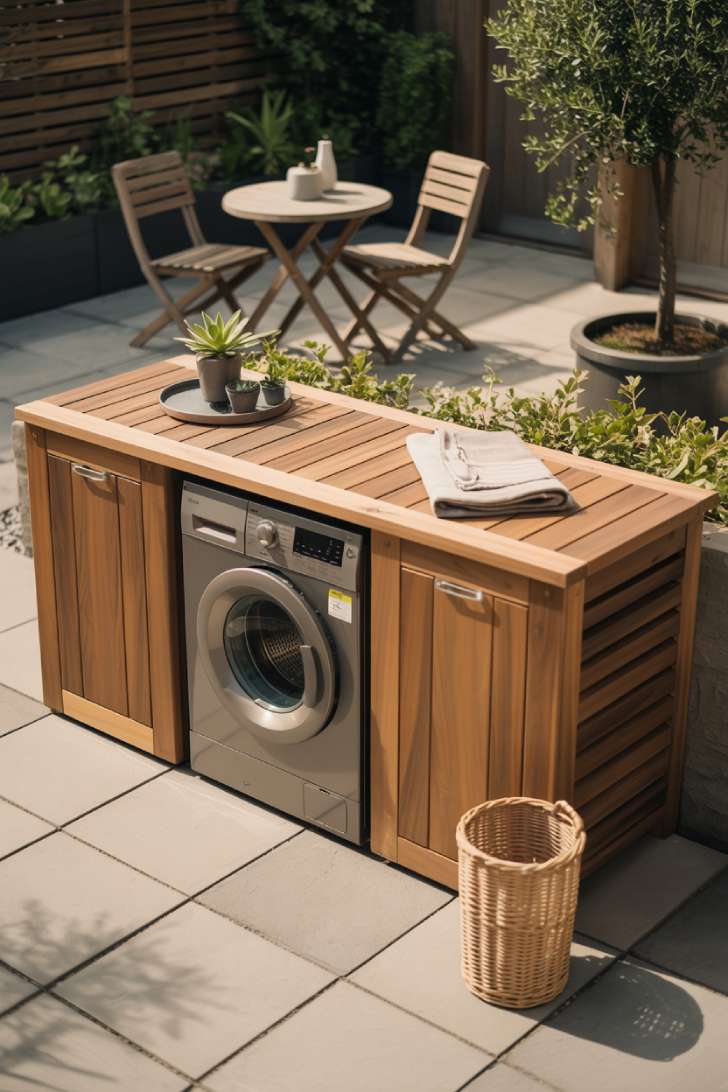
This one is genuinely clever.
A garden bench with a hidden washer underneath is the most visually discreet of all outdoor laundry room ideas for small spaces — and that’s exactly what makes it so appealing.
When the lid is down and the laundry is done, the space looks like a patio.
There’s no trace of a laundry room anywhere.
The psychology behind this is straightforward: when a space serves one obvious purpose, it feels smaller.
When it appears to serve none at all, the mind reads it as open and relaxed.
That’s what concealed appliances do for a small outdoor area.
The ventilated side panels are non-negotiable here — without airflow, heat and moisture build up inside the bench cavity, which shortens appliance life and creates mildew.
Opt for composite timber over solid wood for the bench exterior.
It handles outdoor conditions with far less maintenance, and modern composite profiles are virtually indistinguishable from real timber at a glance.
Style Blueprint:
- Composite timber bench frame with a smooth, hinged lid on heavy-duty stainless piano hinge
- Ventilated side panels in slatted timber or powder-coated metal mesh
- Compact front-load washer sized to fit the bench cavity with clearance on all sides
- Brushed steel or matte black hardware for lid, hinges, and ventilation panels
- Weatherproof cushion or folded linen throw for the bench surface when not in use
A Few Things Worth Knowing Before You Start
Choosing weather-rated appliances — or placing standard ones inside a fully enclosed, ventilated cabinet — is the single most important decision you’ll make for an outdoor laundry room on a budget or otherwise.
Always use GFCI-protected outdoor electrical outlets.
Group plumbing connections on one wall wherever possible; it keeps costs down and makes future maintenance straightforward.
Non-slip, water-resistant flooring like sealed concrete, porcelain tile, or composite decking is worth prioritizing from the start.
Check local building codes and any HOA regulations before installing fixed plumbing or electrical systems outdoors.
Some areas require permits for these changes, and it’s far easier to sort that out before the work is done than after.
Go Make That Corner Work
Small outdoor spaces are capable of so much more than most people give them credit for.
Whether you’re drawn to the simplicity of a fold-down counter on a balcony or the commitment of a full shed conversion, there’s an outdoor laundry room with drying rack, storage, and personality waiting to be built in your space.
Pick the idea that fits your layout, your budget, and your style — then go make that corner actually work for you.
If this gave you some inspiration, save it for later and share your own outdoor laundry setup in the comments.