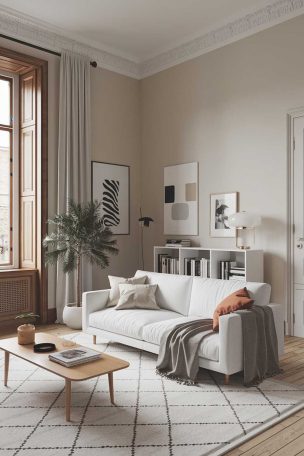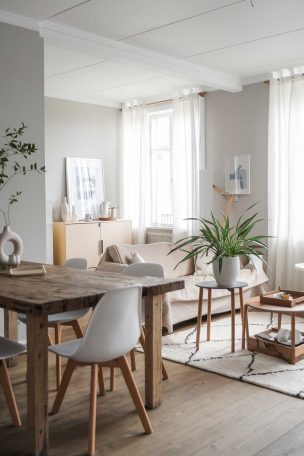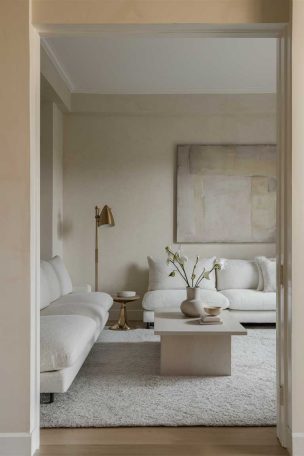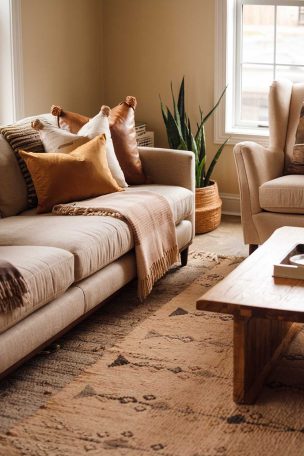
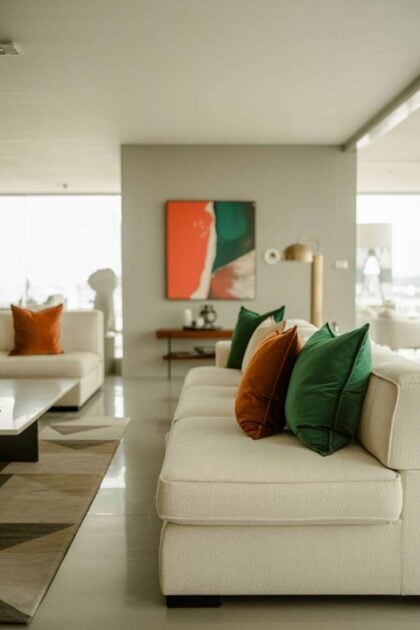
A neutral living room with pop of color is one of the smartest decorating strategies out there.
It gives you the calm, grounded foundation of beige, cream, or gray — and then lets you have fun with color without committing to a bold wall or a statement sofa you might regret in two years.
The result? A space that feels both polished and personal.
These ideas show just how far a few well-placed accent colors for a neutral living room can take you — from quiet and cozy to bold and contemporary.
Emerald, Coral, and Turquoise Against a Soft Gray Canvas
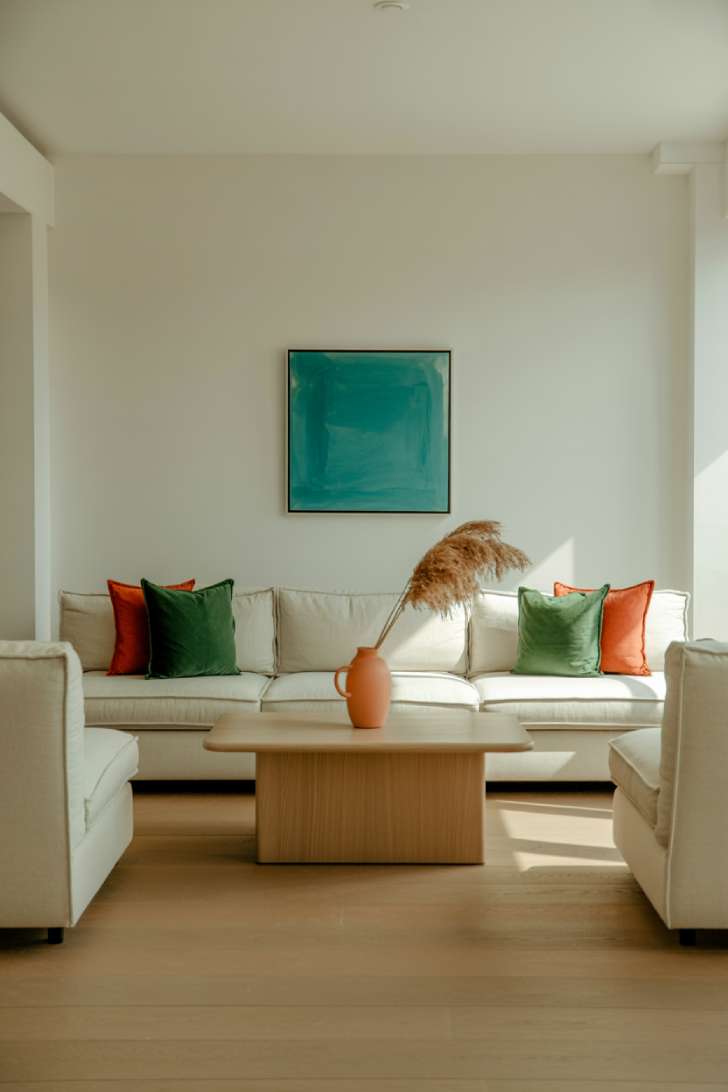
There’s something about the combination of emerald, coral, and turquoise that just works against a pale gray wall.
Each color is distinct, yet they don’t fight each other — they pull the eye around the room in a way that feels intentional rather than chaotic.
From a design psychology standpoint, the soft gray backdrop lowers visual “noise,” which actually makes the accent colors hit harder.
The pampas grass in that coral vase adds organic texture that softens what could otherwise feel like a styled showroom.
Large windows are doing their job here, too — natural light shifts throughout the day, and those accent colors will look slightly different at noon than they do at dusk. That kind of living, breathing quality is what separates a good room from a great one.
Style Blueprint:
- Pale gray walls (think one shade darker than white)
- Cream linen sectional as the anchor
- Three accent colors max: one warm, one cool, one neutral-bright
- A single large artwork to tie the palette together
Ivory and Emerald with Fresh Florals on the Coffee Table
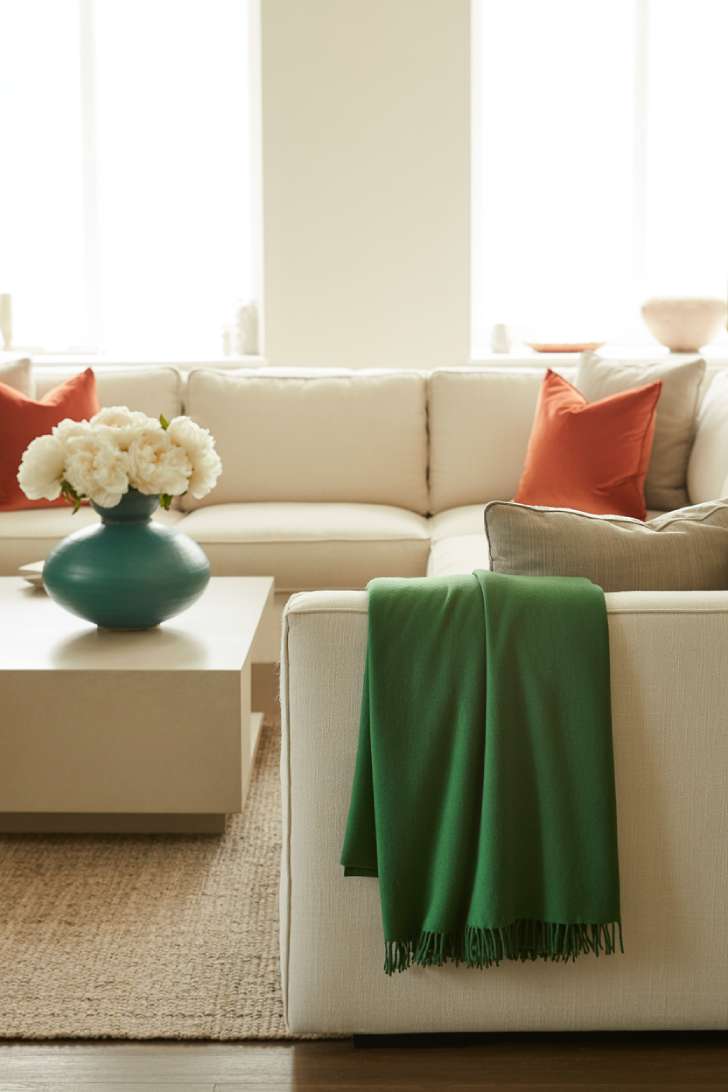
This one leans into softness.
The ivory tones are warmer than white — they don’t feel stark — and that emerald cashmere blanket draped over the sofa arm brings in rich color without demanding attention.
What I love most about this setup is the turquoise vase with white peonies.
It’s a detail that rewards a second look.
Design-wise, the flowers add a layer of organic life that no throw pillow can replicate. Fresh botanicals introduce unpredictable shapes and subtle fragrance — two sensory elements that make a room feel genuinely lived-in rather than staged.
The coral pillows and the turquoise vase create a warm-cool tension that keeps the eye moving, which is exactly what you want in a lounge decor color scheme that could otherwise read as flat.
Style Blueprint:
- Ivory or warm white sectional (avoid cool-toned whites)
- One cashmere or chunky-knit throw in a jewel tone
- Fresh florals in a contrasting ceramic vase
- Coral or terracotta as your warm accent
Coral Pillows, Turquoise Accents, and Potted Greens on Pale Walls
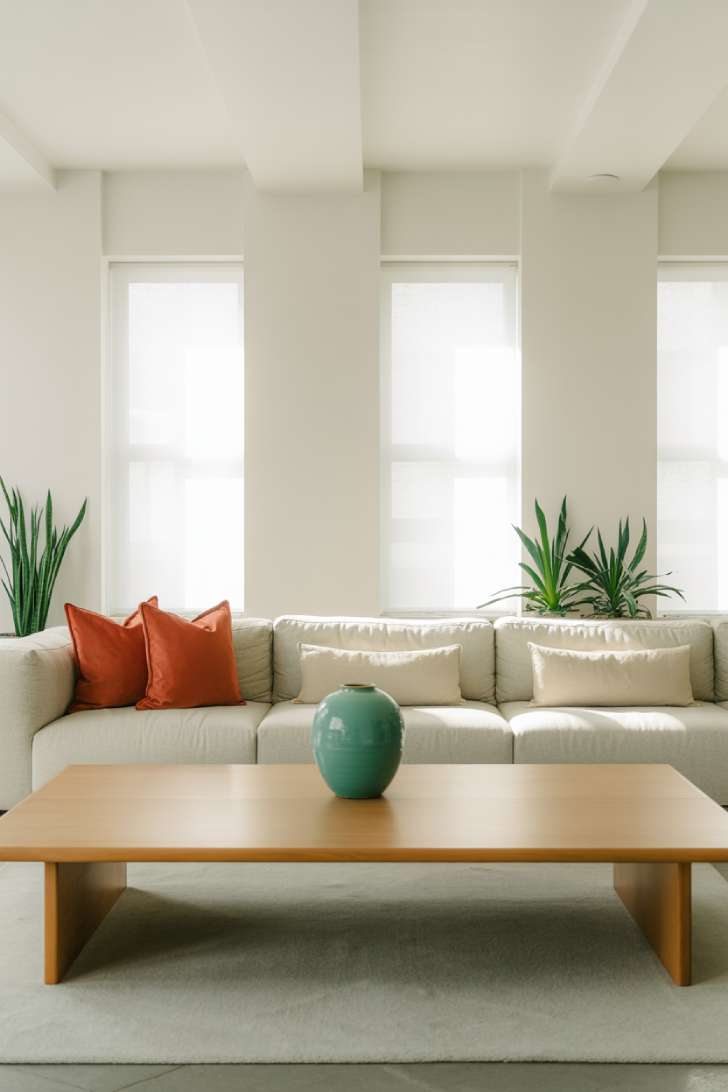
White walls can feel cold if you’re not careful.
But here, the warm beige sofa and coral pillows immediately counteract that chill, creating a space that feels airy without feeling clinical.
The potted plants are doing real work in this room.
Greenery placed at different heights — floor-level, tabletop, and eye-level — creates a sense of vertical rhythm that pulls the eye upward and makes the ceiling feel taller.
That’s a practical design trick worth stealing.
The turquoise vase on the coffee table is small, but it punches above its weight. A single pop of cool color against all that warmth creates just enough tension to make the room feel considered, not accidental.
Style Blueprint:
- White or off-white walls paired with warm-toned furniture
- Coral accent pillows (2–3 maximum)
- Plants at varying heights for visual movement
- One cool-toned ceramic object as contrast
Emerald Plants and Coral Drapes on a Soft Gray Sectional
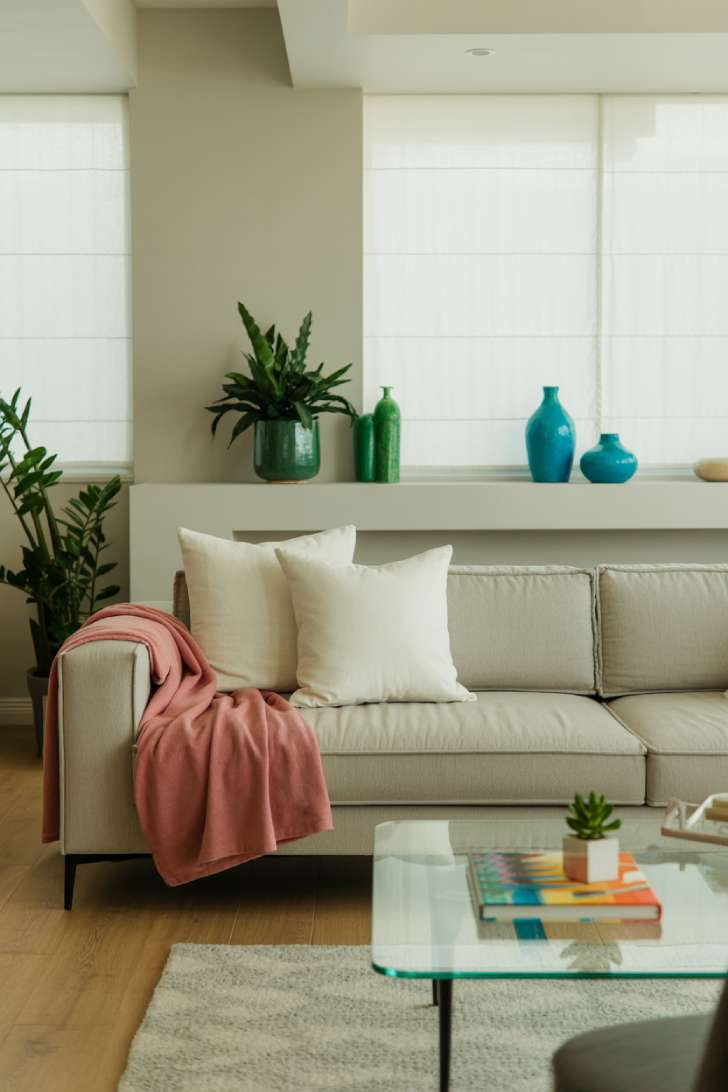
Gray sofas are perhaps the most neutral choice you can make — which means they’re also a blank slate waiting to be brought to life.
The coral throw here is the first thing you notice, and rightly so.
It breaks the cool tone of the gray immediately, signaling warmth before you’ve even sat down.
The floating shelves with turquoise vases are a detail I find underused in most living rooms.
Wall-mounted objects lift color off the floor plane and distribute it vertically, which prevents the room from feeling bottom-heavy — a common issue in spaces with low furniture.
From a color psychology angle, the combination of green plants and coral accents mimics a natural outdoor palette. That subconscious reference to nature has a measurable calming effect. It’s no coincidence that this kind of cozy colorful living room tends to feel genuinely relaxing.
Style Blueprint:
- Light gray sectional as the base
- Coral or warm-red throw for immediate warmth
- Floating shelves with colorful ceramics for vertical color distribution
- At least two potted plants in different sizes
Design Pro-Tip: When mixing warm and cool accent colors (like coral and turquoise), always ground them with one shared neutral — a beige rug, a wood coffee table, or white walls. Without that anchor, the contrast can tip from dynamic to chaotic.
Cream Sofa with Emerald Pillows and a Terracotta Gallery Wall
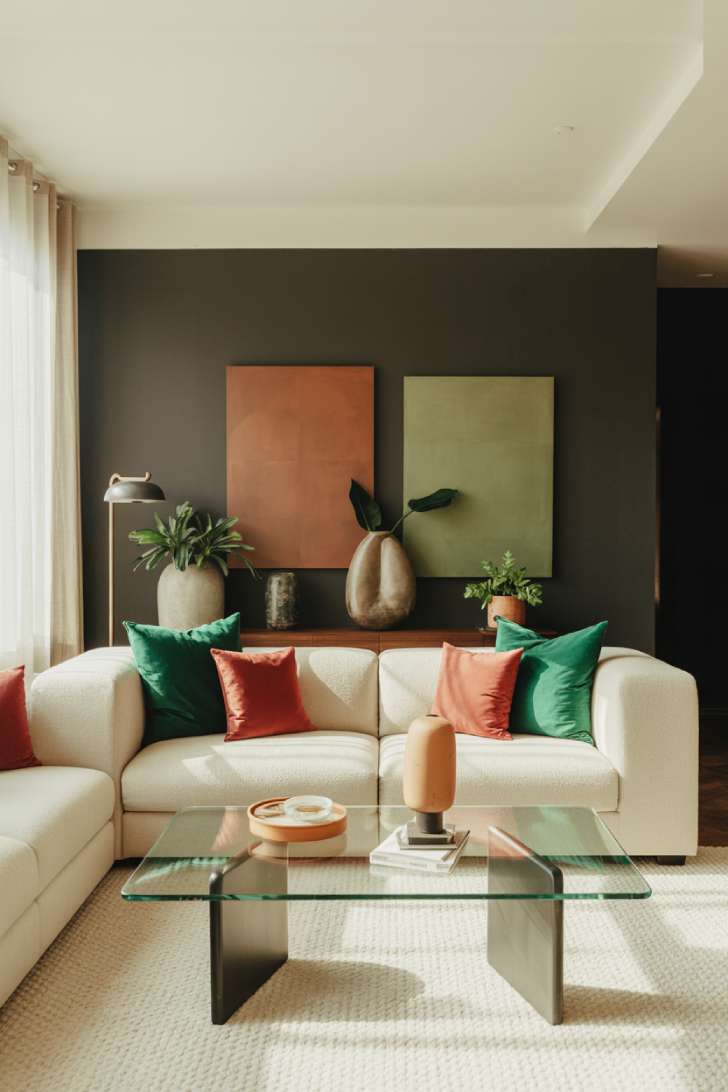
The charcoal accent wall here is a bold move — and it pays off.
Dark accent walls work by creating depth, making the room feel like it has more spatial layers than it actually does.
Against that deep backdrop, the terracotta and sage artwork reads almost luminous.
The brass floor lamp is a quiet hero.
Brass finishes bridge warm and cool tones naturally, making them one of the most versatile metals you can bring into a living room color scheme. It works with coral. It works with emerald. It works with charcoal. That’s rare.
What I appreciate about this arrangement is the restraint. The accent colors — emerald, coral, sage, terracotta — could easily become overwhelming. But by anchoring them to that charcoal wall and the cream sofa, the room maintains a clear visual hierarchy.
Style Blueprint:
- One dark accent wall (charcoal or deep navy)
- Brass or gold metal accents throughout
- Artwork that picks up two or more colors from your accent palette
- Cream sofa to balance the dark wall
Marble Coffee Table and Turquoise Abstract Art as the Focal Point
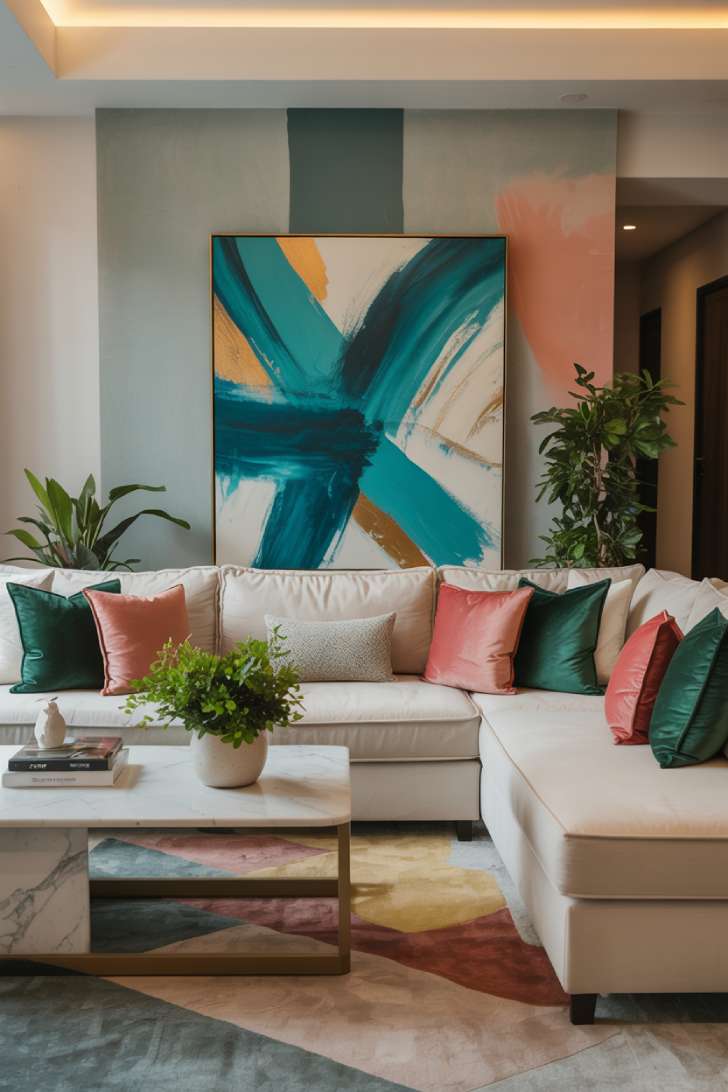
A large abstract painting is one of the most efficient ways to introduce multiple accent colors for a neutral living room at once.
This one does exactly that — turquoise and gold on a soft gray wall — and it becomes the room’s visual anchor without competing with the furniture.
The white marble coffee table is a smart pairing.
Marble’s natural veining picks up on both the gray wall and the white sofa, creating continuity that makes the room feel cohesive rather than assembled from separate decisions.
The geometric rug in muted tones is worth noting, too. It adds pattern without color competition — something many people overlook when planning living room colors.
Pattern and color are separate tools, and using a patterned neutral element frees you up to go bolder elsewhere.
Style Blueprint:
- One large statement artwork as the room’s color source
- White marble or stone coffee table
- Geometric rug in muted, low-saturation tones
- Potted plants for organic contrast against structured furniture
Floor-to-Ceiling Windows with Turquoise Art and Polished Concrete
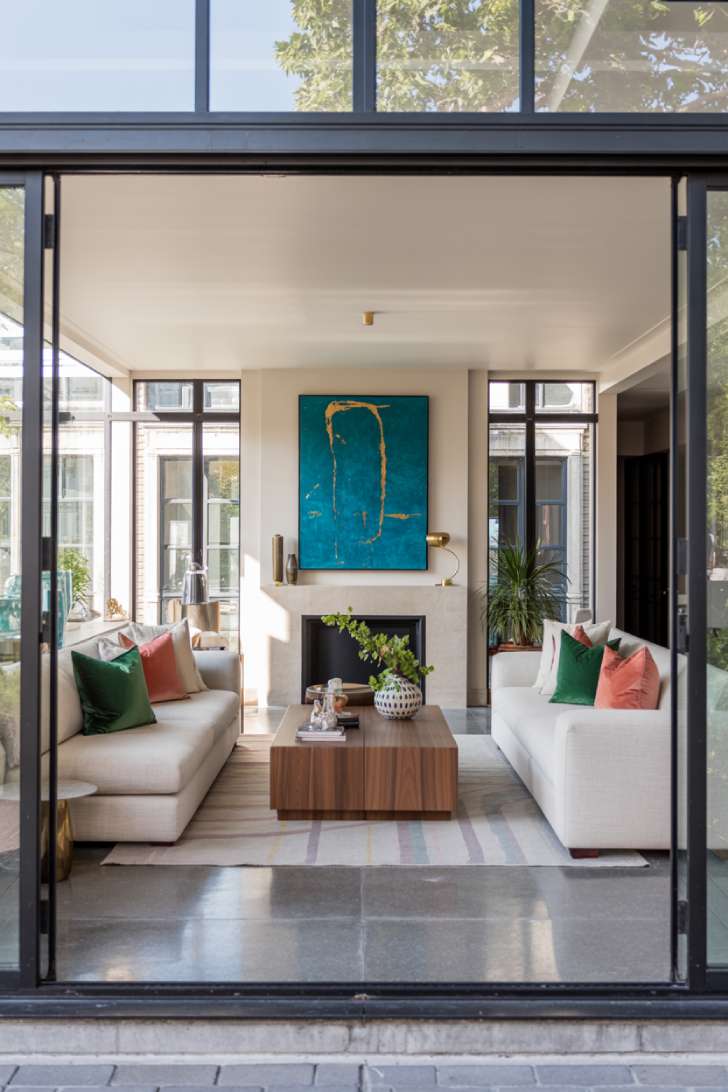
Floor-to-ceiling windows change the rules entirely.
When natural light is this abundant, you can afford to go richer with your accent colors — the light will keep them from feeling heavy.
The turquoise and gold artwork above the fireplace is a masterclass in focal point placement.
A fireplace is already a natural anchor for the eye. Hanging strong artwork directly above it doubles down on that visual gravity, ensuring the room has one clear center of attention.
The polished concrete floors softened by a geometric rug is a pairing that balances industrial and warm beautifully.
Concrete alone would feel cold. The rug introduces softness and a secondary pattern element without adding more color.
That restraint is what makes the accent pieces — the coral pillows, the brass lighting, the emerald throws — stand out so clearly.
Style Blueprint:
- Maximize natural light before choosing accent colors
- Place your boldest artwork above the room’s natural anchor (fireplace, TV, etc.)
- Use concrete or stone flooring with a soft rug to balance temperatures
- Limit brass accents to 2–3 points in the room
Design Pro-Tip: Natural light is the most powerful design tool in any room. Before buying accent pieces, observe how your space looks at different times of day. A coral pillow that glows in morning light might look muddy by evening — and vice versa with cooler tones like turquoise.
A Small Living Room That Gets Color Exactly Right
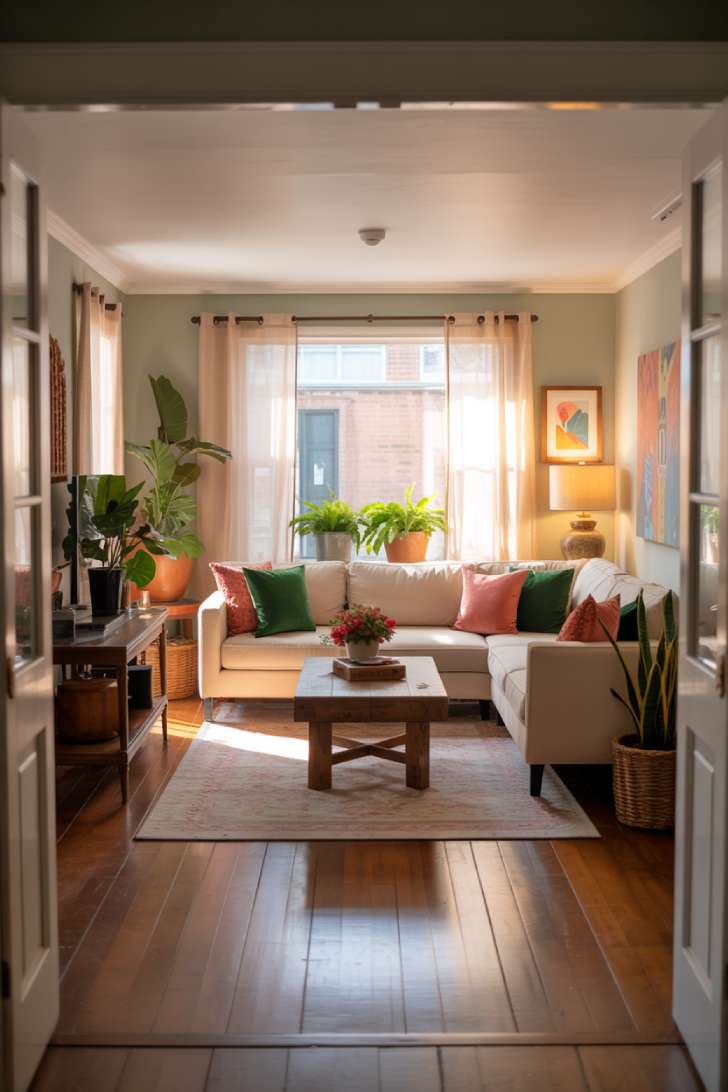
Small spaces don’t need to play it safe.
This room is proof.
The cream sectional is the right call for a compact space — it expands the room visually — but the emerald and coral pillows bring personality without making the space feel cluttered.
The rustic wooden coffee table is a grounding choice.
Wood adds warmth and texture, and in a small room, that tactile quality matters even more than in a larger space.
You need elements that feel substantial without taking up visual or physical room.
Sheer curtains with afternoon sunlight filtering through them create a soft, diffused glow that wraps the whole room.
This is one of the most overlooked tricks for a cozy colorful living room: soft, indirect light makes a space feel intimate and warm without sacrificing brightness.
The pale gray walls reflect that light beautifully, keeping the room from feeling closed-in.
Style Blueprint:
- Light-colored sofa to open up a small space visually
- Rustic or natural wood coffee table for warmth and texture
- Sheer curtains to diffuse light and maintain brightness
- Two to three accent colors kept to pillow and decor scale
Charcoal Rug, Abstract Art, and Burnt Orange as the Surprise Accent
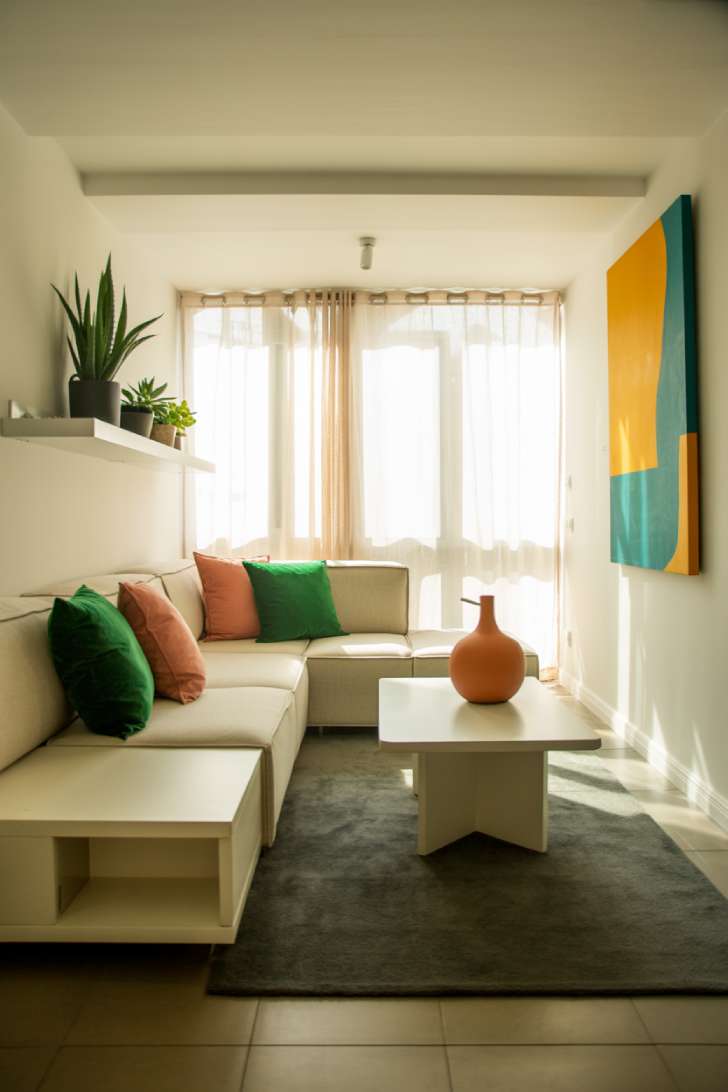
Mustard yellow doesn’t get enough credit as an accent color.
In this room, it appears in the abstract wall art alongside turquoise — an unexpected pairing that somehow feels completely coherent.
The charcoal rug is the decision that makes everything else work.
By darkening the floor plane, it creates a visual “frame” for the furniture, making the room feel grounded and intentional. Without it, the lighter colors would float without direction.
The burnt orange ceramic vase on the coffee table is a tiny detail with outsized impact.
Orange is adjacent to coral on the color wheel, so it doesn’t clash — but it’s distinct enough to add an extra note of warmth.
That kind of subtle color layering is what separates a well-considered lounge decor color scheme from a simple “neutral plus one accent” approach.
Style Blueprint:
- Charcoal or dark area rug to anchor light furniture
- Statement wall art that contains at least two accent colors
- One unexpected ceramic or sculptural accent in a tertiary color
- Floating shelves for succulents or small decorative objects
Brass-Based Coffee Table and a Coral Vase in a Bright, Airy Room
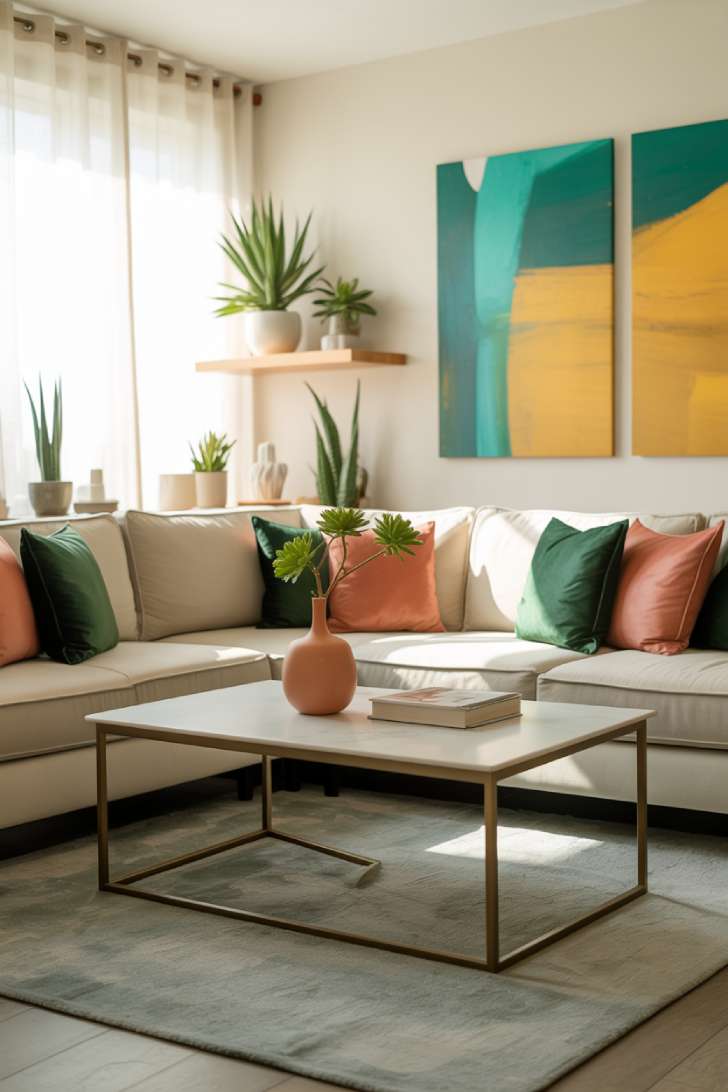
The geometric brass base on the coffee table here is a detail worth pausing on.
Brass introduces warmth and a touch of glamour without overwhelming a neutral room.
It’s a material that catches light in a way that plastic or matte metals simply don’t — and in a room built around living room colors, that kind of material interest matters.
The soft gray rug and white coffee table keep the base palette clean, which is exactly the right strategy when your walls are carrying bold abstract artwork.
If the floor, the furniture, and the walls all competed for attention, the room would feel restless.
The coral vase on the coffee table is a callback to the coral pillows on the sofa — that kind of color repetition is a foundational principle of good room design. It creates rhythm.
The eye recognizes the repeated color and reads the room as intentional rather than random.
Style Blueprint:
- Coffee table with a metallic (brass or gold) structural detail
- Soft gray rug to calm the floor plane
- Repeat your main accent color in at least two spots in the room
- Sheer white curtains to maintain brightness with privacy
Design Pro-Tip: Repeat each accent color at least twice in a room — once in a large element (pillow, throw) and once in a smaller object (vase, book). This color repetition creates visual rhythm and makes the space feel deliberately designed rather than randomly assembled.
Turquoise Vase and Jewel-Tone Art Against Clean White Walls
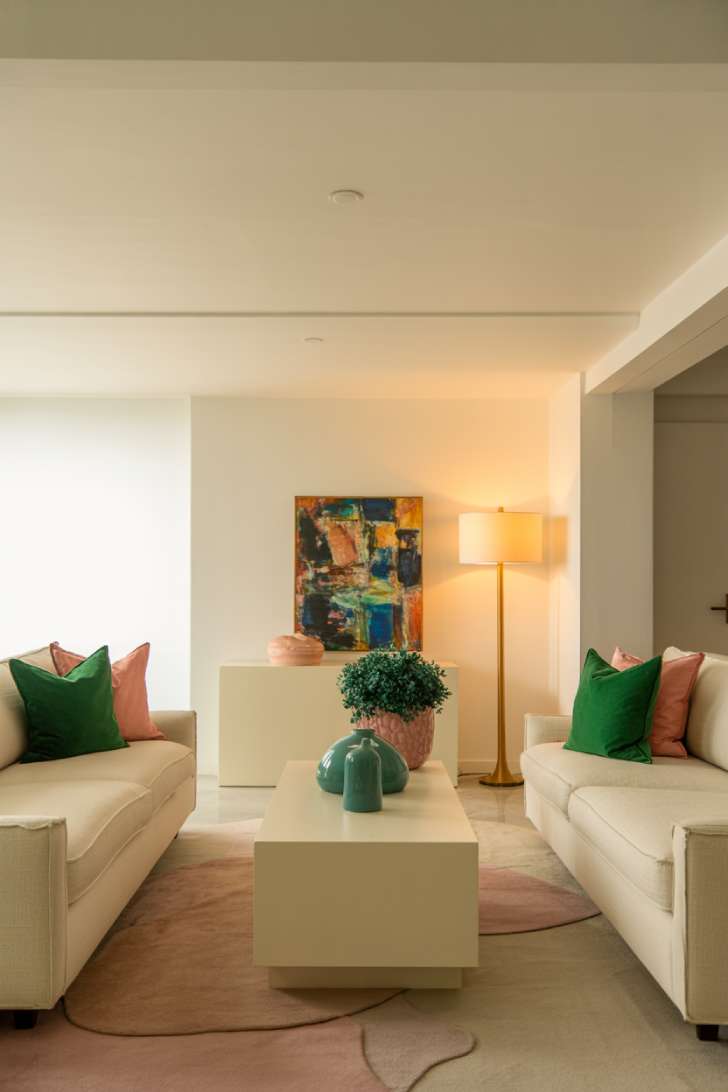
This room is a case study in restraint done well.
White walls. Beige rug. Cream sofa. And then — a jewel-tone painting that earns every bit of attention it commands.
The brass floor lamp is positioned as a companion to the sofa rather than a background element, which gives the seating area a sense of enclosure and intimacy.
Good lamp placement is underrated as a design decision.
The turquoise vase and the deep green potted plant work as a duo — the ceramic is cool and structured, the plant is organic and soft.
That contrast of material and form adds visual complexity without introducing any new colors.
Natural daylight from the unseen window keeps the whole room honest.
It prevents the jewel tones from looking muddy, which is a real risk with deep greens and corals in rooms that lack sufficient light.
Style Blueprint:
- White walls as the cleanest possible backdrop for jewel-tone art
- Brass floor lamp positioned to define the seating zone
- Pair one cool ceramic object with one live plant for textural contrast
- Soft beige rug to warm up white-dominant spaces
Sage, Terracotta, and Warm Oak in a Contemporary Neutral Space
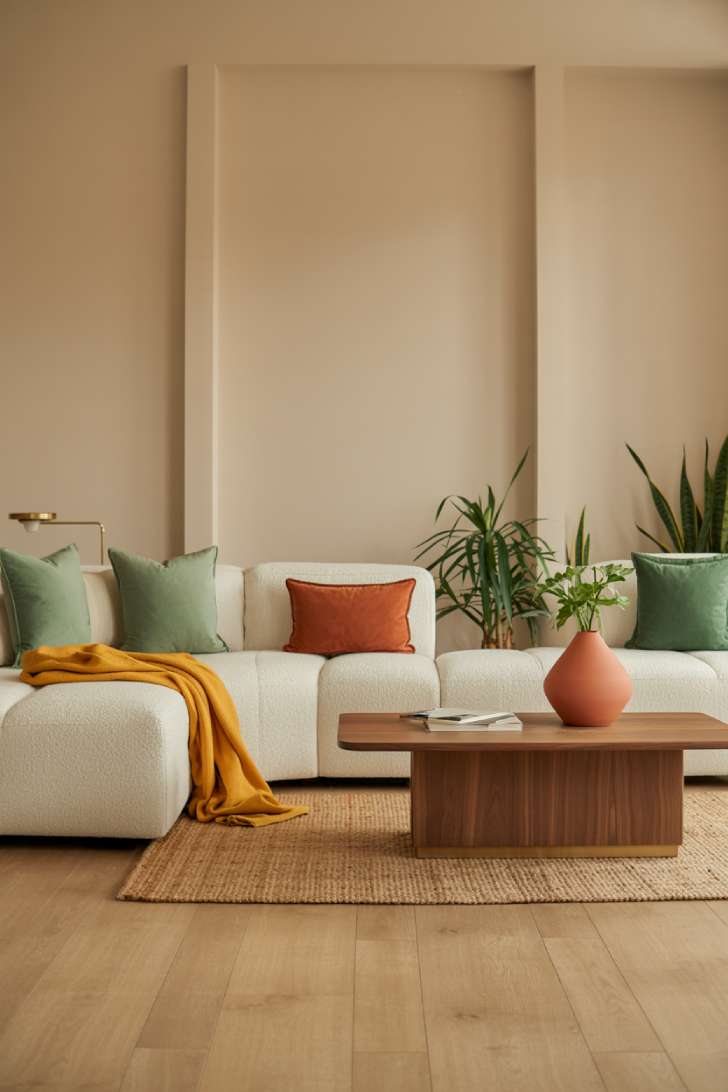
This is a softer, more earthy take on the neutral living room with pop of color — and it’s one of my favorites in this collection.
Sage green and terracotta are nature-adjacent colors, meaning they reference earth, clay, and plant life. Rooms built around this palette tend to feel grounding in a way that brighter accent colors sometimes don’t.
The jute rug is a texture anchor here.
Natural fiber rugs add warmth and a tactile quality that synthetic rugs can’t replicate. They also have a visual weight that prevents lighter rooms from feeling too clean or too perfect.
The mustard yellow throw draped casually over the sofa arm introduces a fourth accent tone without feeling excessive.
The word “casually” matters here — draping, rather than folding, signals that the room is lived-in.
That’s a psychological signal that tells visitors (and the people who live there) that the space is meant to be used, not just admired.
Style Blueprint:
- Earth-toned accent palette: sage, terracotta, mustard, coral
- Natural fiber jute rug for texture and warmth
- Walnut or dark oak coffee table with metallic leg detail
- Loosely draped throw to suggest a lived-in quality
Emerald Accent Chair and Copper Lamps Against White Shiplap
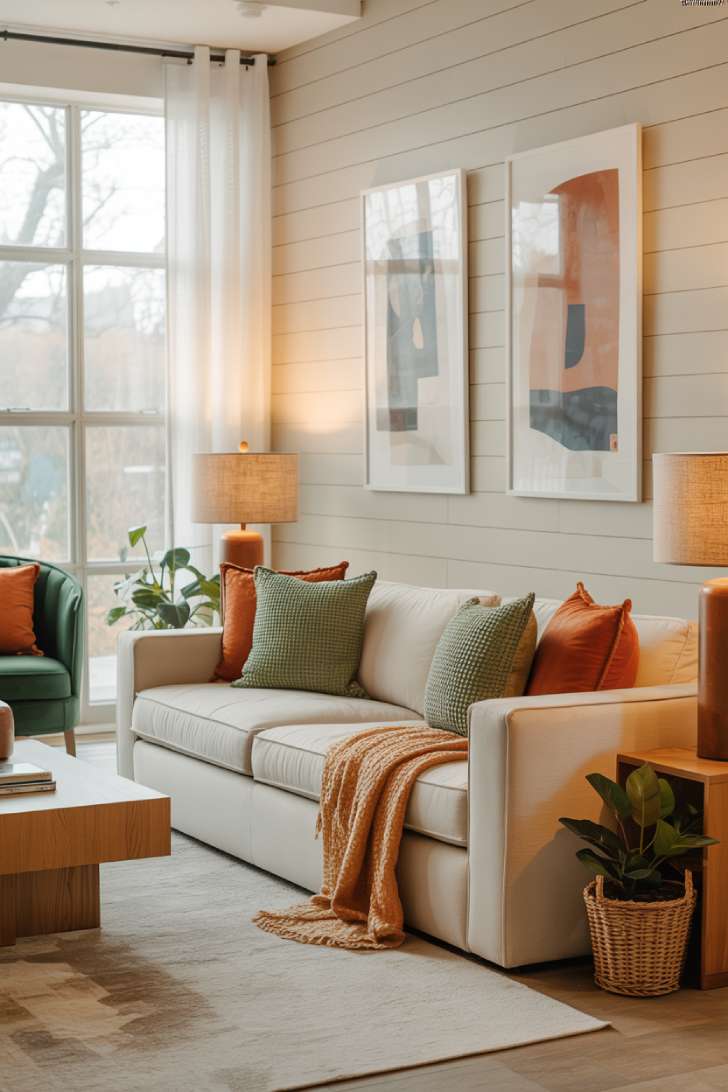
The emerald accent chair is a confident move.
Most people relegate bold color to accessories — pillows, vases, throws. Putting it into a seating piece escalates the commitment, and it pays off here.
The chair becomes a second focal point alongside the sofa, which creates a more dynamic and welcoming conversation layout.
Copper table lamps are an interesting choice alongside emerald.
Copper and green appear together in nature — think oxidized metal, verdigris, the color of aged copper rooftops — so the combination has an inherent visual logic that the brain recognizes and finds pleasing.
The white shiplap walls add texture without color, which is a great way to make a neutral wall feel less flat.
The abstract art in blues and burnt sienna bridges the cool tones of the emerald and the warm tones of the copper, acting as a color translator between the two. Woven baskets around the plants add another layer of natural texture at floor level, completing a space that feels genuinely considered from top to bottom.
Style Blueprint:
- One bold accent chair in your primary accent color
- Copper or warm-metal table lamps for a nature-adjacent pairing with green
- Shiplap or textured wall treatment to add depth without color
- Woven baskets or natural containers for floor-level plants
Quick Comparison: Neutral Living Room Styles at a Glance
| Style | Dominant Accent Colors | Key Mood | Best For |
|---|---|---|---|
| Emerald, Coral & Turquoise | Emerald, coral, turquoise | Fresh, curated | Open-plan spaces |
| Ivory & Jewel Tones | Turquoise, coral | Soft, refined | Formal living rooms |
| White Walls & Botanicals | Coral, turquoise, green | Airy, natural | Small or bright rooms |
| Gray Sofa with Warm Accents | Coral, emerald | Cool-warm balance | Contemporary spaces |
| Charcoal Accent Wall | Terracotta, sage, emerald | Dramatic, rich | Larger rooms with good lighting |
| Marble & Abstract Art | Turquoise, gold | Polished, modern | Minimalist spaces |
| Floor-to-Ceiling Windows | Turquoise, gold, coral | Open, luxurious | Rooms with generous natural light |
| Cozy Small Room | Emerald, coral | Intimate, warm | Compact apartments |
| Charcoal Rug & Mustard | Turquoise, mustard, orange | Bold, layered | Eclectic decorators |
| Brass Details & Sheer Curtains | Coral, turquoise, mustard | Bright, cheerful | Rooms needing warmth |
| Jewel-Tone Art Focus | Jewel tones, turquoise | Clean, restrained | Minimalist collectors |
| Earth-Tone Earthy Palette | Sage, terracotta, mustard | Grounding, organic | Nature-lovers |
| Emerald Chair & Copper Lamps | Emerald, copper, blue | Textural, confident | Statement-lovers |
Conclusion
A neutral living room with pop of color isn’t about picking one bold shade and hoping for the best.
It’s about understanding how colors relate to each other, how light affects them, and how texture and material choices support — or undermine — the whole effect.
These ideas show that whether you go earthy with sage and terracotta or crisp with turquoise and coral, the foundation is always the same: a quiet neutral base that lets your chosen accent colors shine without competing for attention.
Pick the palette that matches your personality, commit to it in at least two or three spots around the room, and let the light do the rest.