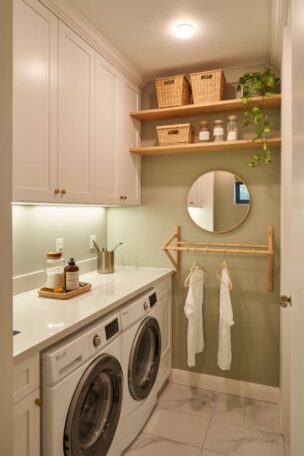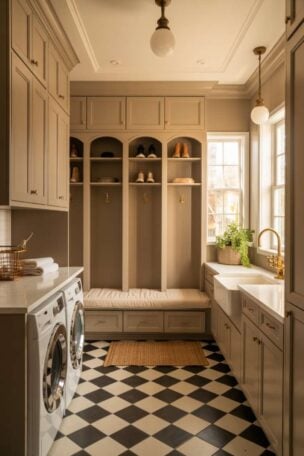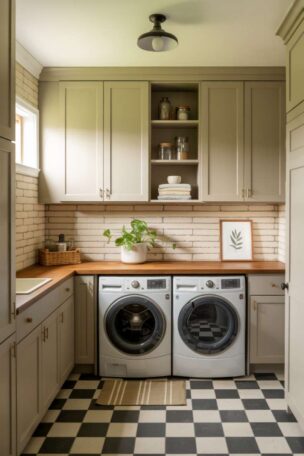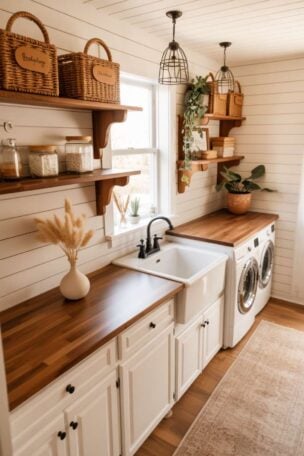
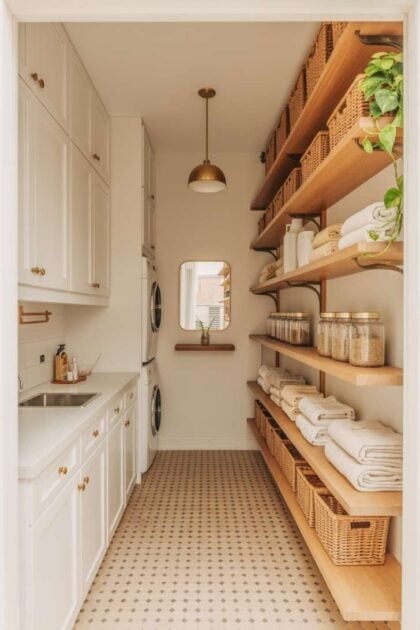
A narrow laundry room can feel like a lost cause.
The space is tight, the layout is awkward, and no matter how many times you rearrange things, it still feels cramped and disorganized.
But here’s the thing — some of the most beautifully functional laundry rooms out there are also the smallest ones.
With the right small laundry room ideas, a long, slim corridor or a converted hallway closet can become one of the hardest-working spaces in your home.
This article walks you through 13 narrow laundry room ideas that go far beyond basic organization hacks.
You’ll find layout strategies, storage solutions, appliance choices, and décor decisions that make a real difference — whether you’re starting from scratch or just looking to refresh what you already have.
Let’s get into it.
Stack Your Washer and Dryer to Free Up the Floor
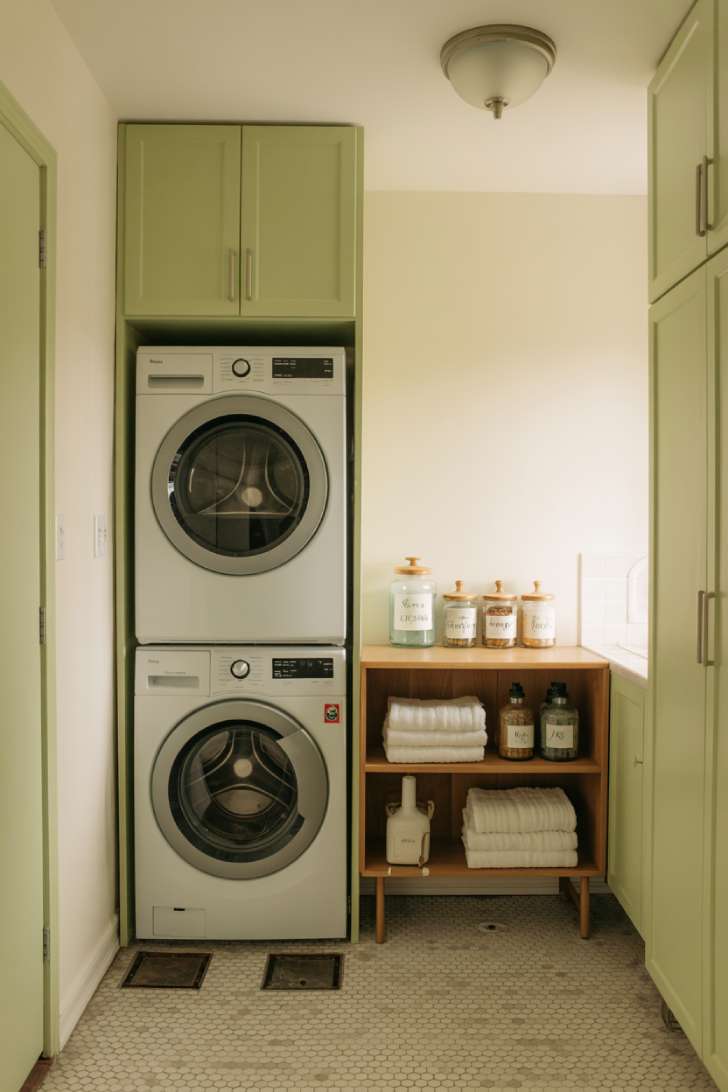
If there’s one change that makes the biggest difference in a narrow laundry room, it’s stacking your appliances.
A standard stacked washer and dryer unit is roughly 24 inches wide — about the footprint of a single appliance.
That instantly frees up feet of floor space that can be used for storage, a folding station, or simply breathing room.
Modern stackable units come with front-facing controls, so reaching the dryer up top isn’t the inconvenience it used to be.
If you’re working with an extremely tight closet-style space, a stacked unit fits in a room as small as 3 feet by 6 feet.
That’s genuinely workable.
When the washer and dryer are tucked into a vertical column, the eye reads the room as more open.
There’s less visual clutter at eye level, and the floor appears larger than it actually is.
This is why stacking feels so much more spacious than side-by-side in a narrow laundry room — it concentrates the appliance mass in one spot and leaves the rest of the room free.
Style Blueprint:
- Stacked front-load washer and dryer with front-facing controls
- Tall cabinet enclosure in a matte painted finish to frame the unit
- Small hexagonal floor tile in white or light gray
- Slim freestanding shelf unit (max 12 inches deep) beside the stacked unit
- Labeled glass storage jars for detergent pods and dryer sheets
Work the Galley Layout to Your Advantage
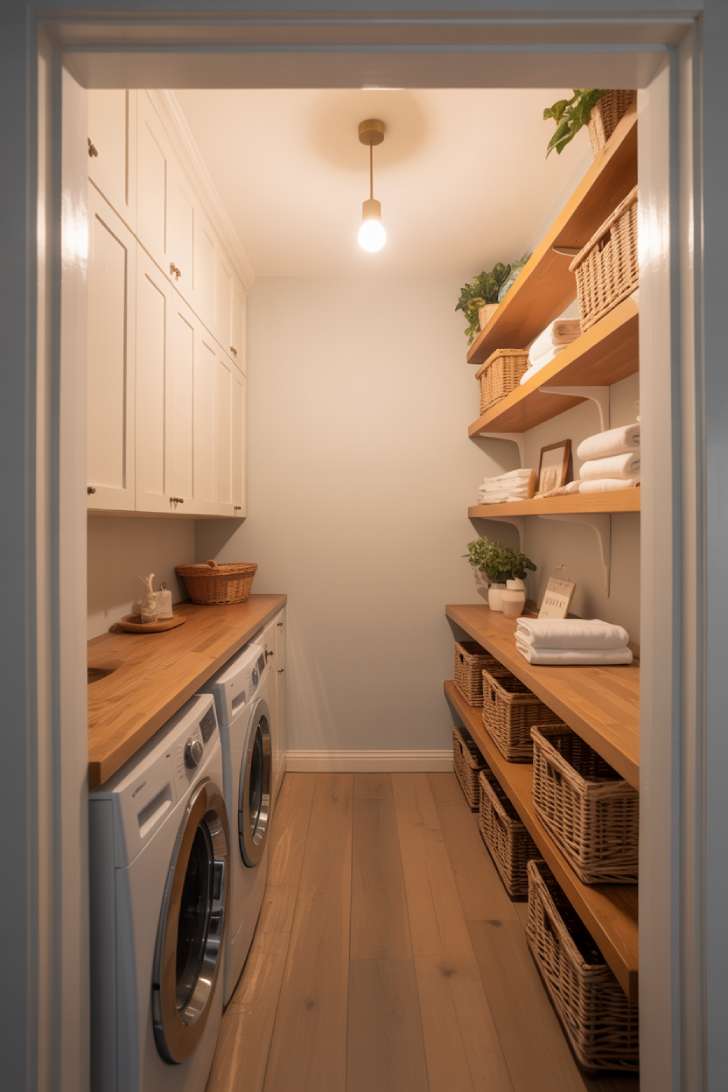
The galley layout is your best friend in a space-saving laundry room.
It works by placing the washer and dryer along one wall and dedicating the opposite wall entirely to storage, folding, or utility functions.
This creates a natural workflow — you’re not crossing the room back and forth to get things done.
Load the machine, turn around, sort and fold, done.
One thing to keep in mind: you need at least 30 to 36 inches of aisle clearance between the two walls.
That’s non-negotiable for comfortable movement and for opening appliance doors fully.
A common mistake is packing both walls too heavily with deep cabinets.
If the opposite wall holds deep upper cabinets, the corridor starts to feel like a tunnel.
Keeping one side lighter — open shelves, hooks, or a thin countertop — maintains that sense of openness.
The horizontal lines created by a continuous countertop running the full length of one wall also help.
They draw the eye forward, making the room feel longer and more deliberate rather than cramped.
Style Blueprint:
- Continuous countertop running wall-to-wall above the appliances
- Upper shaker or flat-panel cabinets on the appliance wall
- Open floating shelves on the opposite wall
- Wicker or rattan baskets for open-shelf storage
- Pendant light in a warm metal finish at the center of the ceiling
Take Cabinetry All the Way to the Ceiling
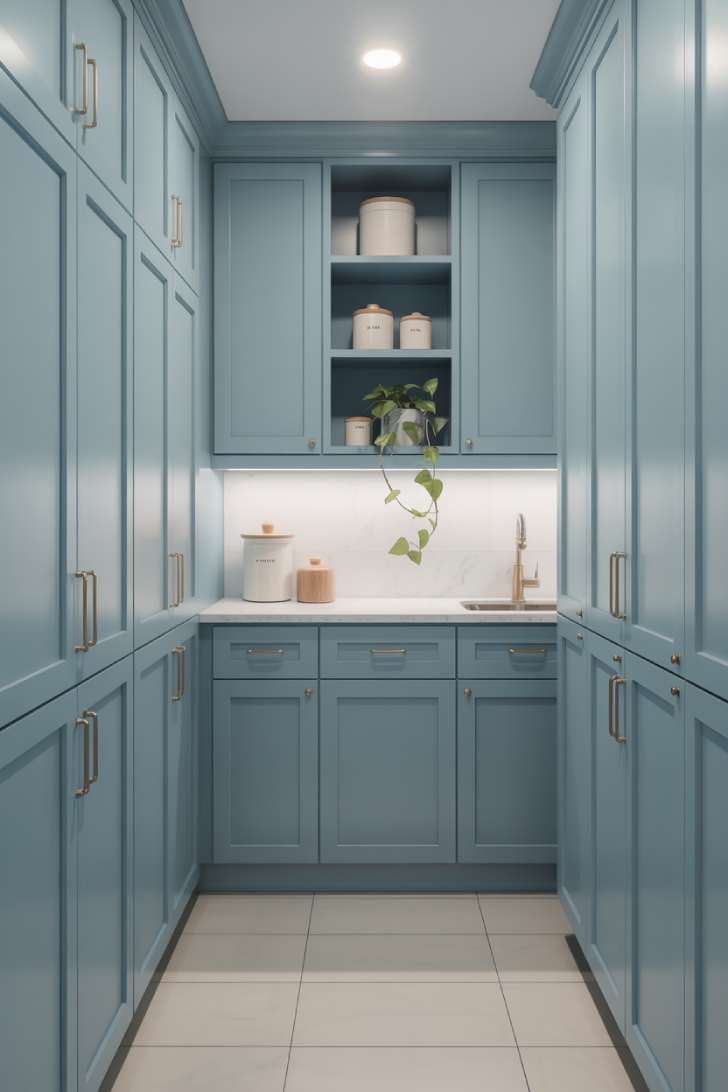
Most laundry rooms waste the top two feet of every wall.
That gap between the top of the cabinets and the ceiling collects dust and does nothing else.
Taking cabinetry all the way to the ceiling changes that completely.
You gain storage without consuming a single extra inch of floor space.
It’s not just practical — it’s also a strong visual move.
Unbroken vertical lines created by floor-to-ceiling cabinetry draw the eye upward, making the ceiling feel higher and the room feel taller.
When you paint those cabinets the same color as the walls, the cabinetry visually recedes rather than advancing into the room.
The space reads as one cohesive surface rather than a collection of objects.
Reserve the upper cabinets for items you don’t reach for daily — seasonal items, backup supplies, extra linens.
The lower and mid-level cabinets should hold your everyday laundry room essentials.
A small section of open shelving cut into the upper cabinetry breaks the monotony and gives the room a lived-in, styled quality.
Style Blueprint:
- Floor-to-ceiling cabinetry in a matte painted finish matched to wall color
- Simple bar-pull or cup-pull hardware in a warm metal tone
- White quartz or laminate countertop for easy cleaning
- One small open-shelf section for decorative or frequently used items
- Recessed ceiling lighting for even, shadow-free illumination
Design Pro-Tip: Paint your cabinet interiors a contrasting color — like a deep navy inside soft white cabinets. When the doors are open during laundry time, the pop of color adds personality without permanently committing to a bold look.
Hang a Fold-Down Countertop That Disappears When You’re Done
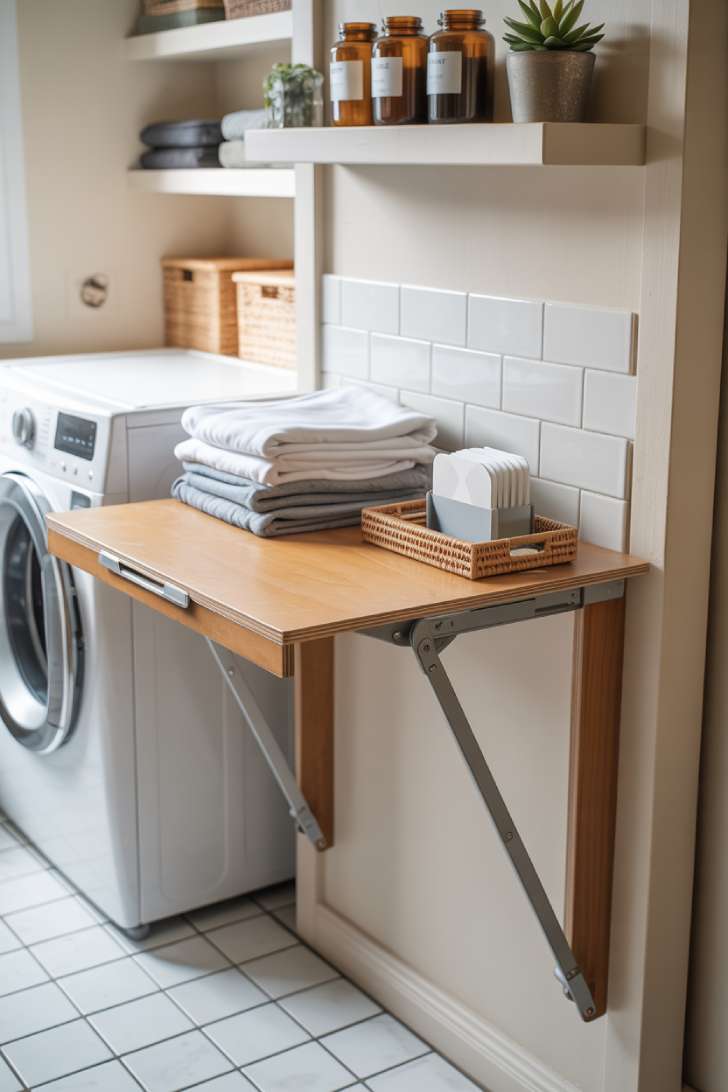
A permanent folding table in a narrow laundry room is a space trap.
It sits there taking up precious walking room even when you don’t need it.
A wall-mounted fold-down countertop solves this without compromise.
When it’s open, you have a full working surface at the right height — about 36 inches — for sorting, folding, and treating stains.
When it’s done, it folds flat against the wall and takes up almost nothing.
Mount it on the wall opposite your stacked washer and dryer for the most logical workflow.
That way, you’re transferring clothes directly from the machine to the folding surface without carrying them across the room.
The psychological effect of a fold-down surface is worth noting, too.
When it’s up, the room shifts into “work mode.”
When it folds away, the room feels more open and less task-heavy.
That mental shift actually makes doing laundry feel less like a chore you’re trapped in.
A wall-mounted countertop also serves as a flexible surface for treating stains or presoaking items when a utility sink isn’t available.
Style Blueprint:
- Wall-mounted fold-down countertop with slim folding metal legs
- White subway tile backsplash on the mounting wall
- Floating shelves above the fold-down surface for supplies
- Labeled amber or clear glass jars for detergent and accessories
- Small woven or rattan tray to keep countertop tools corralled
Float Shelves Across the Whole Wall
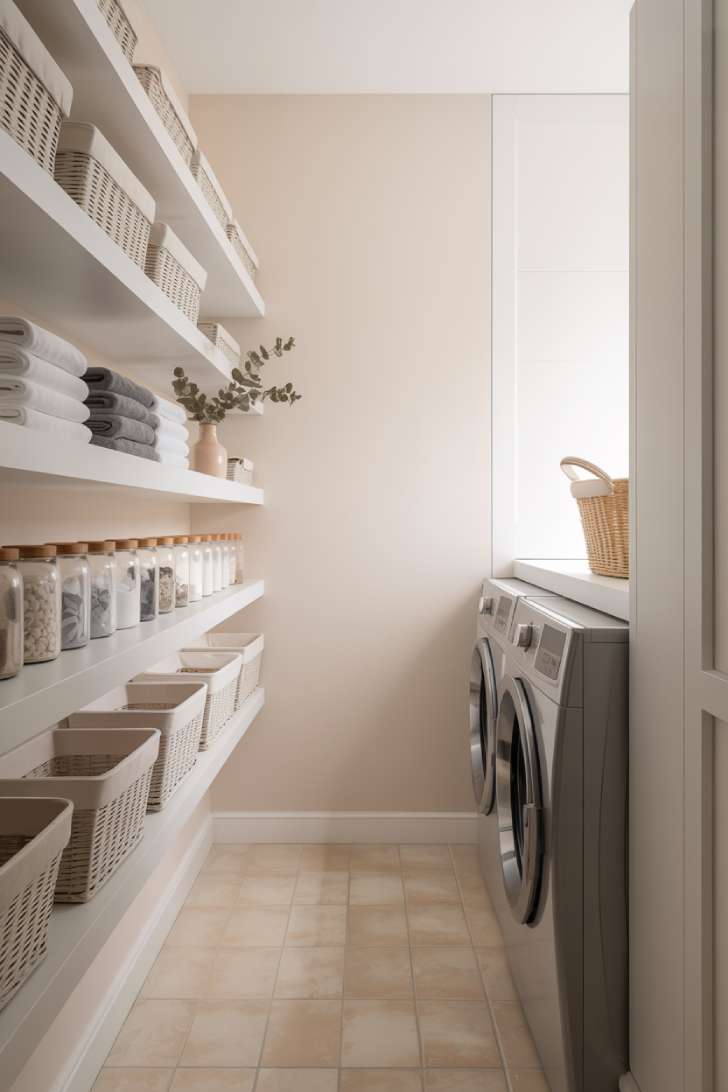
Floating shelves are one of the best laundry room storage solutions for narrow spaces.
They add real storage capacity without the visual weight of full cabinetry.
The wall behind remains visible, and that visibility makes the room breathe.
The real move here is running the shelves across the entire wall — corner to corner.
That continuous horizontal line makes a narrow room feel wider.
Most people install shelves only above the appliances, but extending them across the full wall is a much stronger design decision.
Group similar items together on each shelf: one shelf for detergents and fabric care products, one for folded textiles, one for baskets holding sorted laundry.
Matching containers are a game-changer on open shelves.
Clear glass jars, white ceramic canisters, or uniform woven baskets create a calm, cohesive look instead of a chaotic collection of different-sized product bottles.
Switching from bulky liquid detergent jugs to laundry sheets is a practical tip that significantly cuts down on shelf space, too — one flat box takes up almost nothing.
Style Blueprint:
- Full-wall white or natural wood floating shelves in two to three rows
- Matching woven or fabric baskets for the lower shelves
- Clear glass jars or ceramic canisters for detergent and supplies
- Dried or faux botanicals for a natural styling touch
- Laundry sheets instead of bulky detergent jugs for space-saving storage
Slide In a Slim Rolling Cart
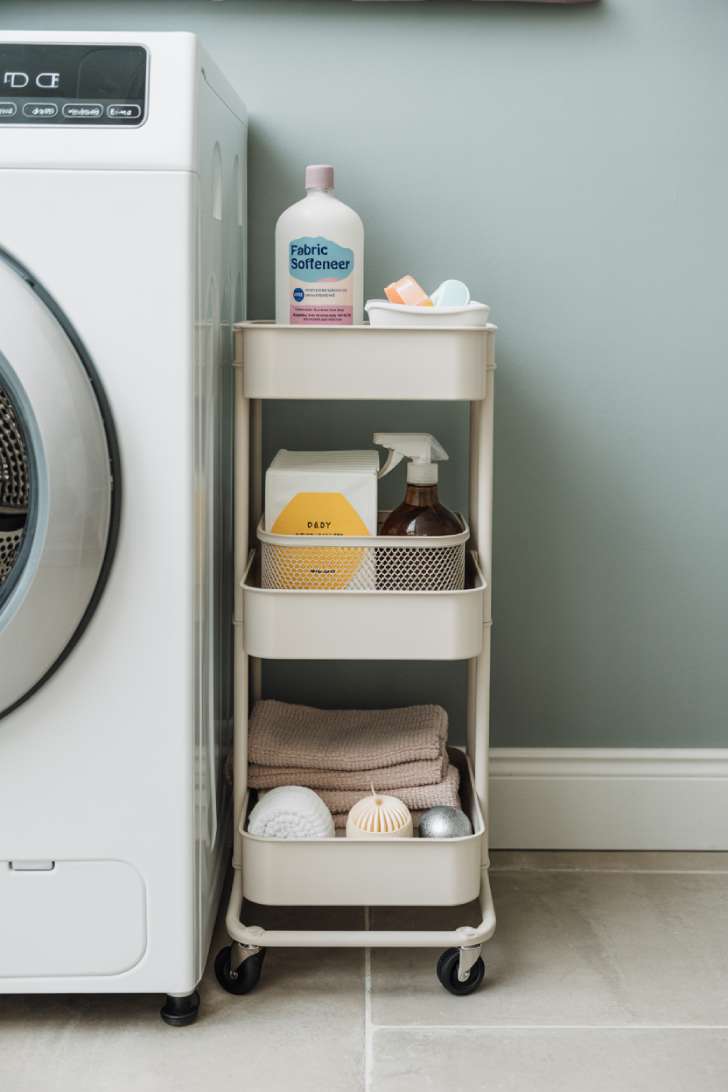
That skinny gap beside the washing machine?
It’s not wasted space — it’s hiding the most convenient storage spot in the room.
A slim rolling cart fits into gaps as narrow as 6 to 9 inches and provides multiple tiers of accessible storage for all the supplies you reach for mid-laundry.
Pull it out when you need it, slide it back when you’re done.
It’s that simple.
This is probably the most budget-friendly idea on this list.
A basic rolling cart costs very little, requires no installation, and can move with you if you ever change the room’s layout or relocate.
For renters especially, this is a laundry room organization solution that requires zero commitment.
Multi-tier carts work best when you organize them by frequency of use: daily-use items on the top tier, occasional-use items in the middle, and backup stock on the bottom.
Clear bins or labeled baskets on each tier mean you’re never digging around for what you need.
Style Blueprint:
- Slim metal or plastic rolling cart (6–9 inches wide) with caster wheels
- Clear or mesh bins for each tier
- Small labeled tags or chalkboard labels on each tier
- Compact spray bottle for stain treatment on the top tier
- A set of wool dryer balls on the accessible middle tier
Design Pro-Tip: Measure the gap between your appliances and the wall before buying a rolling cart. Subtract half an inch to account for baseboard depth — most people forget this and end up with a cart that won’t slide in fully.
Mount a Retractable Drying Rack on the Wall
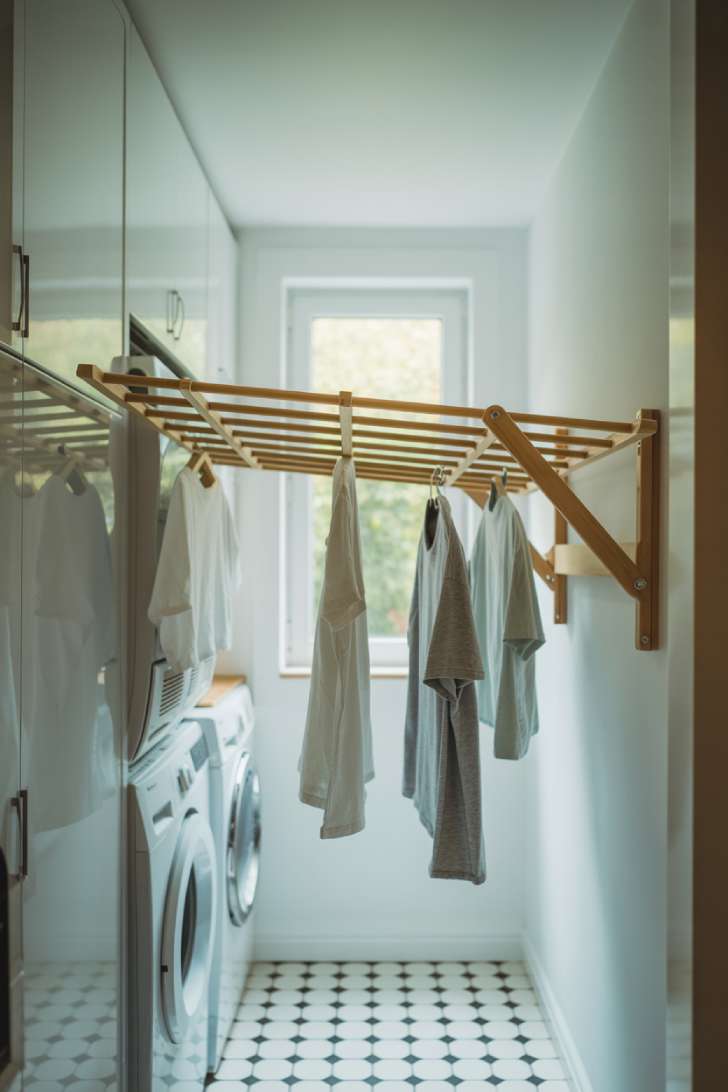
A freestanding drying rack in a narrow laundry room is one of those things that seems fine until you actually try to use it.
It wobbles, takes up floor space, blocks access to the machine, and gets in the way of everything.
A wall-mounted drying rack eliminates all of that.
When extended, it holds a full load of delicates.
When folded back against the wall, it’s nearly flush — about two to three inches of depth at most.
There’s also the built-in drawer version, which is worth considering if you’re planning a full cabinetry build.
This style tucks the drying rack inside a cabinet drawer that slides out horizontally above the appliances, completely invisible when not in use.
For the simplest and most affordable option, a retractable wall rack with folding wooden arms does the job beautifully.
Mount it near a window or a small ventilation source so air circulation speeds up drying time.
The position matters more than people think.
Good airflow around drying clothes is what prevents that damp, musty smell — and in a narrow space with limited ventilation, this detail really pays off.
Style Blueprint:
- Wall-mounted retractable wooden drying rack with folding arms
- Installed at shoulder height for comfortable hanging access
- Positioned near a window or vent for air circulation
- Black-and-white or patterned floor tile for a classic, timeless look
- Optional: a ceiling-mounted hanging rod above the appliances for longer garments
Organize Everything with a Pegboard Wall
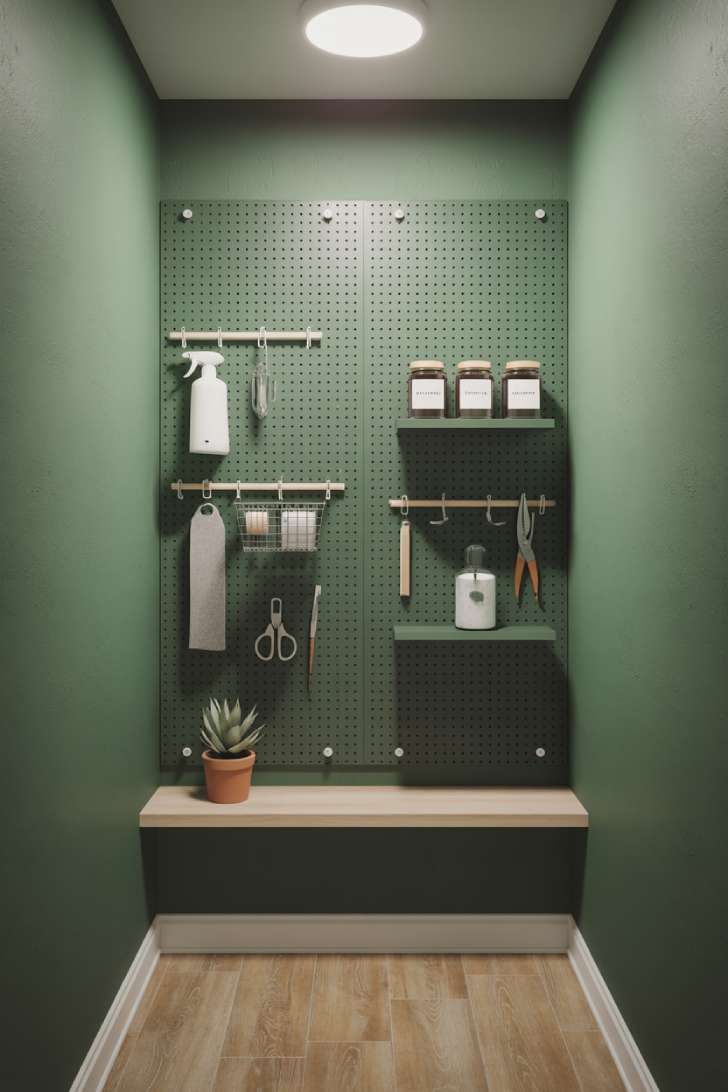
Pegboards don’t get nearly enough credit in laundry room design.
They’re less than an inch deep, mount directly to the wall, and can hold an impressive variety of tools, supplies, and small accessories.
Everything that would otherwise clutter a countertop or fall off a shelf has a proper home on a pegboard.
Spray bottles, lint rollers, scissors, clothespins, small hooks for reusable bags — all of it hangs neatly in plain sight.
The real advantage of a pegboard is flexibility.
No two households use their laundry room the same way, and a pegboard can be completely reconfigured whenever your needs change — no new holes, no new hardware.
Painting the pegboard to match or contrast the wall makes a big difference aesthetically.
A dark-painted pegboard on a light wall becomes an intentional design feature rather than a utility board.
It draws the eye in a way that feels curated rather than improvised.
A matching painted pegboard blends seamlessly and adds subtle texture.
Both approaches work — it comes down to whether you want the storage to be a focal point or to recede into the background.
Style Blueprint:
- Large-format painted pegboard (MDF or hardboard) in a contrasting or matched wall color
- White or black metal pegboard hooks, shelves, and baskets
- A mix of hook sizes for items of different weights
- Small labeled jars mounted directly on pegboard shelves
- One or two small live or faux plants for a softening visual touch
Replace the Hinged Door with a Sliding One
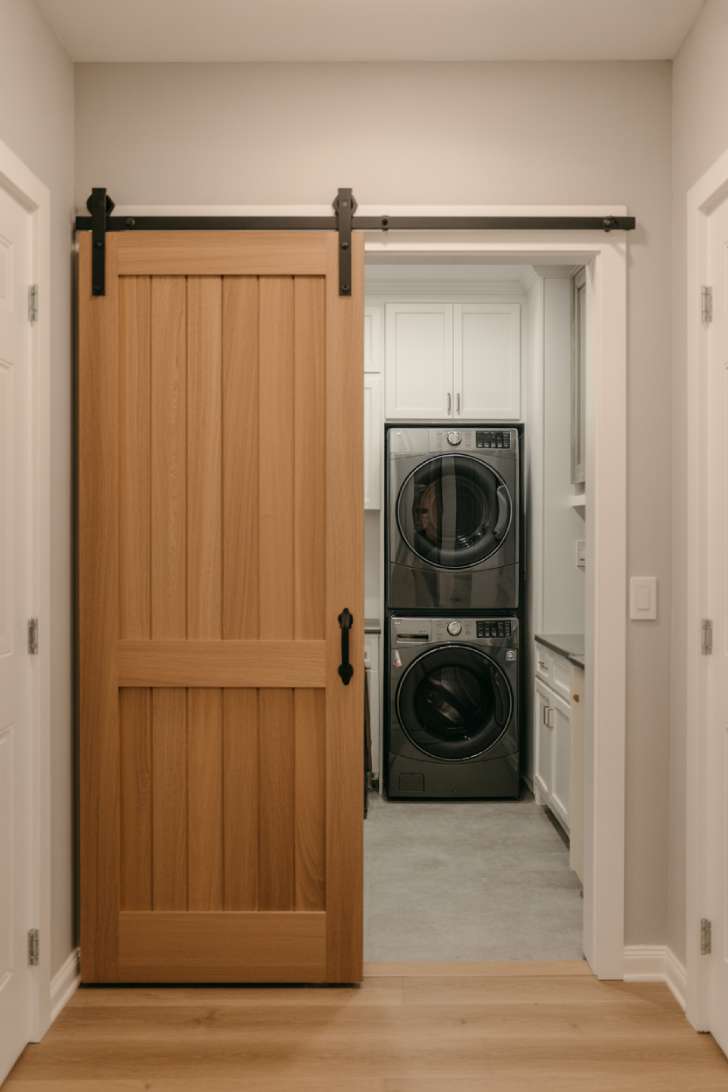
A traditional hinged door swings into the room and immediately eats up usable floor space.
In a narrow laundry room, that’s a real problem.
The arc of the door can block cabinet doors, prevent access to the washer, or simply make an already tight space feel tighter every time you enter.
Swapping to a sliding door changes everything.
A barn-style door mounted on an exterior track adds warmth and character to the space.
A pocket door — which slides entirely into the wall cavity — is the most space-efficient option of all.
When closed, it looks like a flat wall panel.
When open, it completely disappears.
Beyond pure function, the door style sets the tone for the entire laundry room.
A barn door signals warmth, farmhouse charm, casual ease.
A sleek panel door with a recessed pull signals a modern, minimal approach.
Getting the door right is worth the effort because it frames the first impression of the room every time someone looks in.
A mirror finish on a sliding door also works brilliantly in narrow rooms — it reflects light and depth, making the corridor feel significantly longer than it is.
Style Blueprint:
- Barn-style sliding door in natural wood or painted finish, or pocket door for maximum efficiency
- Black or brushed metal sliding track and hardware
- Recessed floor guide to prevent door swing
- Optional: mirror panel inset into the door for reflected depth
- Matching flooring inside and outside the room to create visual continuity
Design Pro-Tip: If a full pocket door installation isn’t in the budget, a bifold door is a solid middle ground — it folds back on itself, clearing the doorway without swinging into the room. Choose a flush-panel style to keep the look clean.
Tuck an Ironing Board Inside a Cabinet Door
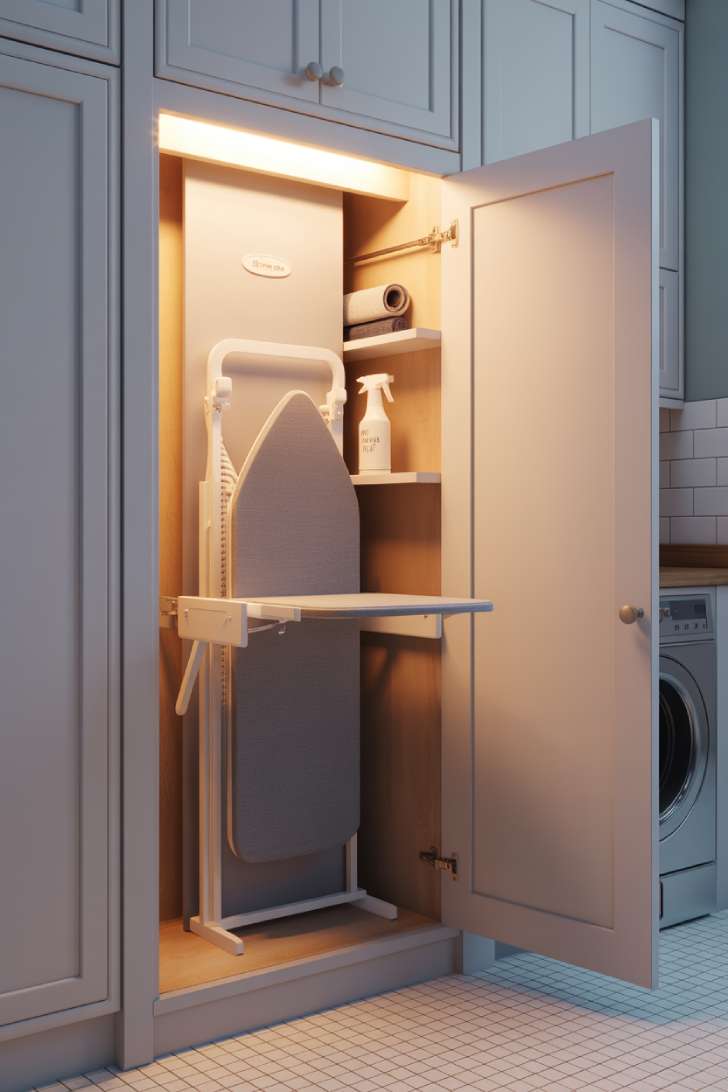
An ironing board is one of those objects that has no good home in a narrow laundry room.
It’s too large to store upright in a cabinet, too awkward to lean against a wall, and too bulky to leave standing.
Building it into a cabinet door is a genuinely elegant solution.
The board folds out from the inside face of the door, deploys to working height, and folds back when you’re done.
From the outside, the cabinet looks exactly like every other cabinet in the room.
The hidden nature of this feature does something interesting to the room’s mood.
A narrow laundry room without visible clutter feels calmer and more organized — even if the same number of items are present, they’re just not on display.
Each object that disappears behind a door reduces the visual noise of the space, and in a narrow room, visual noise is what makes the space feel small.
A pull-out drawer ironing board is another option if building into a door isn’t feasible.
It functions like a deep drawer — pull it out, and the ironing surface extends on a sliding mechanism.
Either way, the result is a room that looks intentional and tidy rather than full of the necessary-but-ugly tools of household life.
Style Blueprint:
- Cabinet door-mounted fold-out ironing board at counter height
- White or matching painted cabinet exterior with simple knob or bar pull
- Small internal shelf beside the ironing board for spray bottle and ironing cloth
- Soft warm overhead lighting for good visibility while ironing
- Optional: pull-out drawer ironing board as an alternative for existing cabinetry
Go Bold with Wallpaper or Statement Tile
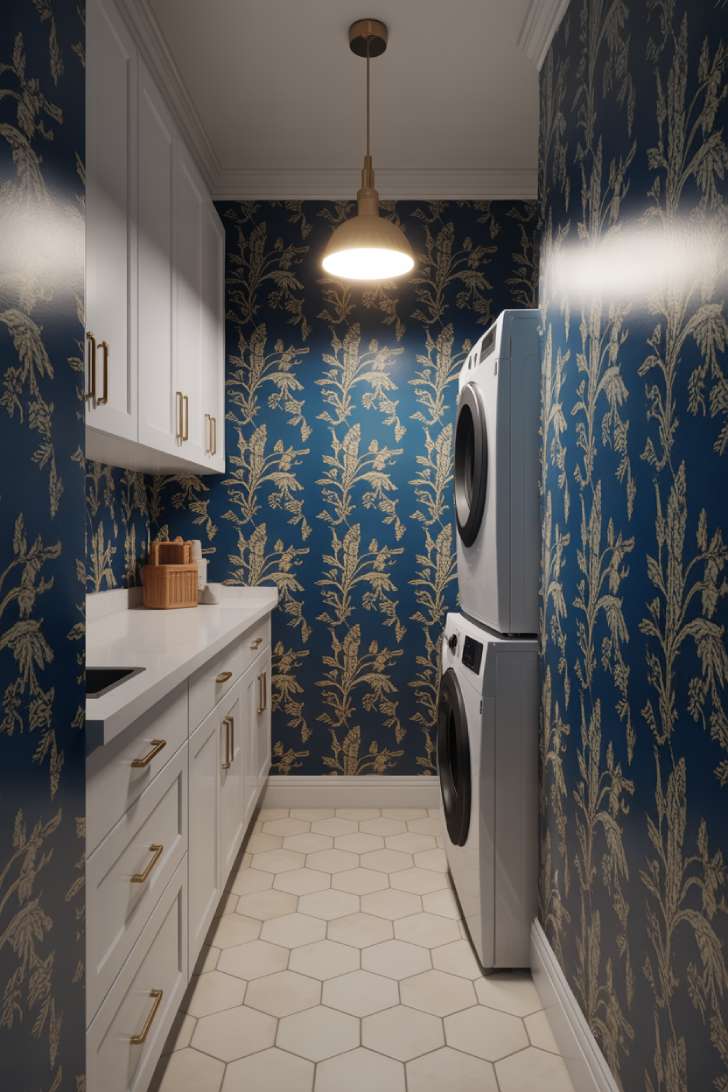
One of the genuine perks of a narrow laundry room is how affordable it becomes to use high-end finishes.
The square footage is so small that a few rolls of designer wallpaper or a small quantity of decorative tile goes a long way.
Bold wallpaper makes a narrow laundry room feel intentional rather than incidental.
It signals that this space was thought about, not just fitted out with whatever was leftover.
Vertical prints — stripes, tall botanical patterns, elongated geometric designs — work especially well in narrow rooms by drawing the eye upward and making the ceiling feel higher.
Small-to-medium-scale prints add depth without making the walls feel like they’re closing in.
For tile, a patterned floor in a narrow room does something smart: it draws the eye forward along the length of the space rather than highlighting its narrow width.
Herringbone, checkerboard, and encaustic cement tile patterns all do this effectively.
One important practical note: avoid delicate wallpaper materials like silk or grasscloth in a laundry environment.
Moisture from drying clothes and the general humidity of an active laundry room will damage them over time.
Vinyl-coated or moisture-resistant wallpaper is the right call.
Style Blueprint:
- Vinyl-coated or moisture-resistant bold-pattern wallpaper
- White or neutral flat-front cabinetry to balance the bold pattern
- Brushed brass or black bar-pull cabinet hardware
- Patterned floor tile in hexagonal, herringbone, or checkerboard format
- Brass or black pendant light for a focal-point ceiling fixture
Brighten Up with Light Colors and Layered Lighting
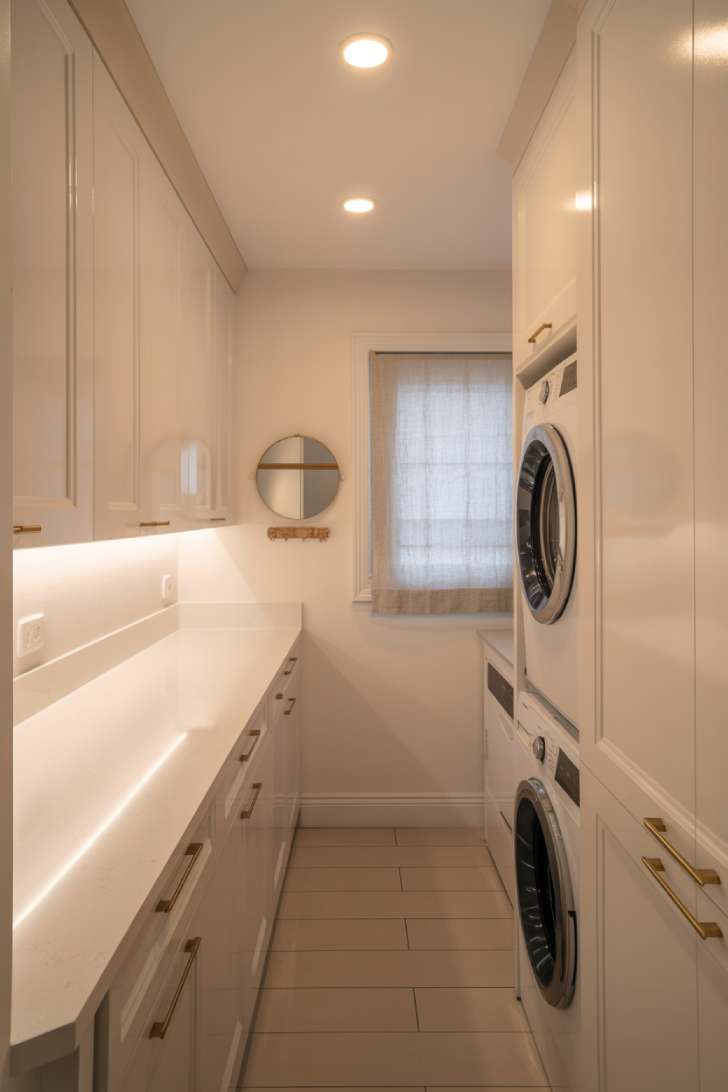
Light is one of the most underused tools in laundry room design.
And in a narrow room, getting the lighting right can make the difference between a space that feels like a closet and one that feels like a proper room.
The simplest starting point is paint color.
White or near-white walls reflect light rather than absorbing it.
Painting the walls, ceiling, and trim all the same crisp white creates an unbroken, expansive feeling.
The room reads as one continuous surface, and without the contrast of trim lines, the walls appear to push outward rather than close in.
Under-cabinet lighting is a practical and atmospheric addition.
It illuminates the countertop for task work while creating a warm, layered glow that makes the room feel considered and comfortable.
A mirror on the end wall — even a small one — works remarkably well in narrow rooms.
It reflects the length of the room back at you, creating the illusion of additional depth.
Round mirrors with thin metal frames are the most versatile option aesthetically.
If there’s any natural light source — even a small window — treat it carefully.
Mount curtains as high as possible and use sheer linen or cotton so light passes through freely throughout the day.
Style Blueprint:
- White or warm off-white paint on walls, ceiling, and trim — all the same shade
- LED under-cabinet strip lighting for countertop task lighting
- Small round wall mirror with a thin brass or black metal frame mounted on the end wall
- Sheer linen curtains mounted at ceiling height on any windows
- Recessed ceiling lighting for even, shadow-free ambient light
Design Pro-Tip: For the brightest possible result without repainting, swap standard light bulbs for 4000K “cool white” LED bulbs. They mimic daylight more closely than warm-toned bulbs and make white and near-white surfaces practically glow.
Turn the Space Into a Laundry-Mudroom Hybrid
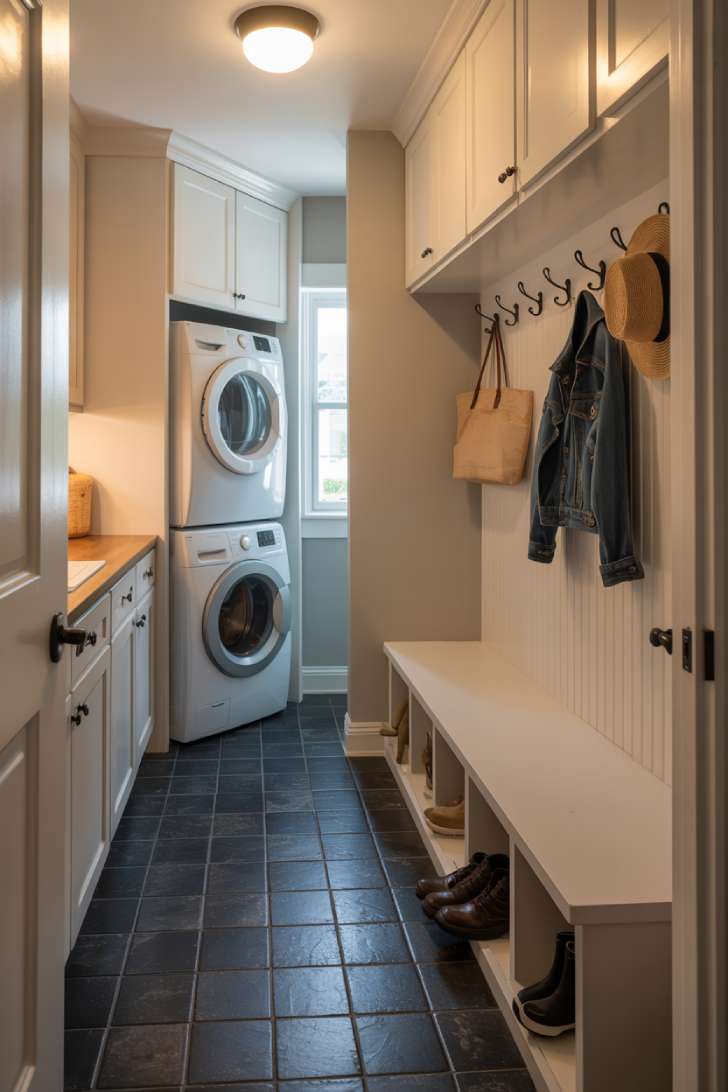
If your narrow laundry room sits near a back door, side entry, or garage access, you’re sitting on an opportunity.
Combining laundry and mudroom functions in one space is one of the smartest things you can do with a tight floor plan.
The logic is simple: the laundry area handles washing, and the mudroom side handles the drop zone — coats, shoes, bags, and outdoor gear.
On the laundry side, keep the stacked washer and dryer with upper cabinetry for supplies.
On the opposite wall, build in a simple bench with deep cubby storage beneath for shoes and boots.
Add a row of wall-mounted hooks above the bench for bags, jackets, and hats.
This dual function doesn’t just maximize the narrow footprint — it also creates a defined entry ritual for the household.
Items come off at the door, land in their designated spot, and dirty clothes go straight into the machine.
That flow cuts down on the clutter that spreads through the rest of the house.
The key to making this hybrid feel cohesive rather than chaotic is consistent finishes.
Use the same cabinetry style and paint color on both sides of the room.
The same floor tile, the same hardware finish, the same trim color.
When everything matches, the two functions read as one intentional space rather than two mismatched afterthoughts sharing a room.
Style Blueprint:
- Built-in bench with painted wood construction and deep shoe cubbies below
- Row of heavy-duty wall-mounted hooks in black or brushed nickel above the bench
- Matching cabinet finishes on both the laundry and mudroom sides
- Durable dark porcelain or stone-look tile for high-traffic entry floor
- Consistent hardware finish throughout for a cohesive, pulled-together look
The Bottom Line
A narrow laundry room doesn’t have to be the most frustrating space in your home.
With the right layout — stacked appliances, a galley configuration, or a smart hybrid setup — the floor plan starts working for you instead of against you.
With the right storage — floor-to-ceiling cabinetry, floating shelves, rolling carts, and pegboards — every inch of vertical and horizontal wall space earns its keep.
And with the right visual decisions — light colors, bold wallpaper, layered lighting, or a sliding door — the room stops feeling like a utility closet and starts feeling like a space someone actually thought about.
Narrow laundry room ideas don’t need to be complicated.
Start with one or two changes that fit your budget and your biggest pain point right now.
Maybe that’s stacking your appliances to free up the floor.
Maybe it’s swapping the door or adding a fold-down countertop.
Each improvement builds on the last, and before long, the narrow laundry room that felt impossible is the room you’re actually proud of.
Save this post for your next refresh — and if you’ve transformed your own laundry room, share it.
The smallest spaces often have the best stories.